 Login
LoginSecret Panel HERE ☕ https://patreon.com/posts/96113760
24 April 2026 at 13:43
Secret Panel HERE ☕ https://patreon.com/posts/96113760




Secret Panel HERE ☕ https://patreon.com/posts/96113760
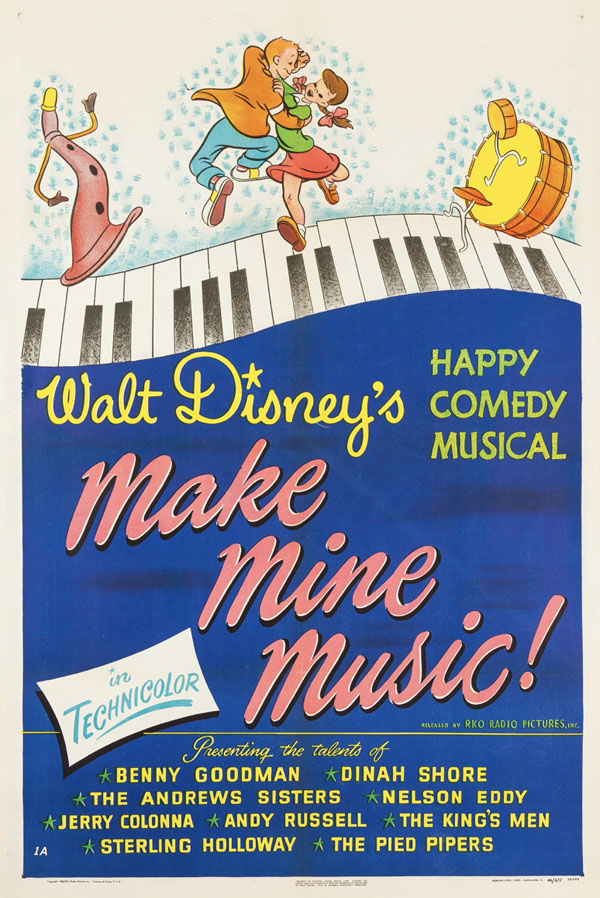 When Make Mine Music opened in 1946, The New York Post called it “…a veritable vaudeville show, a three-ring circus, and grand opera thrown together into one technical masterpiece.”
It may be the best description for this film made during a difficult time for Walt Disney and his Studio. Between an animators’ strike, and America’s involvement in World War II, production at the Studio had been a challenge during most of the 1940s.
Walt kept animation production going during this period by producing lower-budgeted, easy-to-execute films, known as “package films,” which didn’t have a traditional plot but instead were a series of short subjects strung together during a feature-length running time.
One of these was Make Mine Music, with a common theme among the segments being that each was set to a particular piece of music. As each is so vastly different, the Post’s description of the film is appropriate.
The film plays with the Fantasia formula, opening like a concert complete with a program that reads: “Make Mine Music: A Musical Fantasy.”
From here, the film segues to the first section of the film, “The Martins and the Coys” (billed on the program as “A Rustic Ballad”), narrated by the singing group The King’s Men, as it tells the musical tale of two feuding mountain families.
 After this, the Ken Darby Chorus performs the title song, “Blue Bayou.” The slow-paced music features accompanying visuals of a nighttime bayou as a bird takes flight, in a sequence that reuses animation intended for a sequel to 1940’s Fantasia, originally intended to accompany the musical composition “Clair de lune.”
Next up is Benny Goodman and his Orchestra with “All the Cats Join in.” Two “hepcat bobbysoxer” teens of the decade dance to the upbeat music as they get ready for a date, with animation introduced by a pencil that draws images that come to life.
Singer Andy Russell performs the next segment, “Without You,” a ballad, with sad, surreal images that transition into views of lonely woods and nighttime stars.
The following segment is one of the film’s most famous, “Casey at the Bat,” narrated as a “Musical Recital” by comedian Jerry Colonna, in his over-the-top style, as a re-telling of the “baseball poem” by author Ernest Thayer about the Mudville team and their star player. This segment was released later in 1946 as a stand-alone short subject and even spawned a sequel with Casey Bats Again, in 1954.
Singer Dinah Shore sings “Two Silhouettes,” the next segment, a “Ballade Ballet” featuring two ballet dancers in rotoscoped silhouette animation, performing in front of a stylized backdrop and assisted by two cherubic figures.
Next is arguably the most popular segment, “Peter and the Wolf,” narrated by the familiar, comforting voice of Disney stalwart Sterling Holloway, from the famous musical composition by conductor Sergei Prokofiev. This segment (sans narration) was also created to be an additional component to Disney’s Fantasia.
 Set in Russia, the segment tells the tale of young Peter and his friends Sascha, a bird, Sonia the duck, and Ivan the cat, who venture off into the woods to hunt a wolf. A different musical instrument represents each character, with a distinct theme.
“Peter and the Wolf” was such a substantial segment that it has been shown on its own several times and even released as a record album (paired with “The Sorcerer’s Apprentice” on the flip side).
“Peter and the Wolf” is followed by another Benny Goodman number, “Since You’ve Been Gone,” which provides the backdrop for a march of anthropomorphized musical instruments.
The Andrews Sisters then perform the musical narration for “Johnny Fedora and Alice Blue Bonnet,” a sweet story of two hats who fall in love after meeting in a department store window.
The concluding segment is baritone singer Nelson Eddy and the story of “The Whale Who Wanted to Sing at the Met,” about a whale named Willie with incredible operatic talents and dreams. He is hunted by a music conductor who believes that the whale has swallowed an opera singer.
Although it contains a sad ending, this segment includes beautiful, lush animation, particularly where Willie sings as Pagliacci the Clown, and full opportunity is taken for sight gags involving the size and scale of Willie.
 Directed by Jack Kinney, Clyde Geronimi, Hamilton Luske, Joshua Meador, and Robert Cormack, Make Mine Music features animation by Disney Legends Ward Kimball, Ollie Johnston, and Eric Larson, among others.
The artists balance the different styles. There’s the entertaining, overly caricatured design of “Casey,” with the main character’s jut-jaw, and a player who touches the base with his giant handlebar mustache. This is offset by scenes with such images in “Without You,” which play out like rain cascading down a window.
Make Mine Music has been shown on The Disney Channel and released on home video in 2000 (with “The Martins and the Coys” removed due to violence and gunplay concerns), and on Blu-ray in 2021, but as of this writing, the film is still not available on Disney+ (although it is available on Amazon Prime).
Make Mine Music had its premiere in New York City on April 20, 1946, and went into general release on August 15. As the film now celebrates 80 years, it’s the perfect time to revisit this “vaudeville show, three-ring circus, and grand opera” from a unique era in Disney history.
For more about the music of Make Mine Music, check out Greg Ehrbar’s 2016 article.
Secret Panel HERE 😀 https://tinyview.com/mrlovenstein/2026/04/22/working-from-home
It’s a Famous Studios sort of week– thanks to Cartoon Logic’s excellent new release, Famous Studios – The Champion Collection. I just got my copy and its a beautiful as I thought it would be (I was lucky enough to see a little progress along the way). Thad Komorowski has done a huge service to these cartoons and film history in this release – these films looking as good (or better) than they were meant to be seen. Support his efforts and get a copy if you haven’t already! [Click Here].
So, as a tribute of sorts to the set, here’s an unrestored Famous Studios cartoon from 1949: Spring Song!
But first, as usual, in Thunderbean land:
Shipping, shipping, shipping. We’re still getting out a batch of special discs with another following it, and then almost immediately following those we’ll be starting to ship the Rainbow Parades, Volume 2 disc. We’ll have an article about that set as it gets back here. The Thunderbean Noveltoons disc is just about to get back from being re-replicated as well, so we’ll be shipping those soon too.
It’s the last weeks of school here at CCS, where I teach animation. Even though I enjoy the job a lot, I’m especially excited for the summer this year and so happy to have a break. Having the extra time makes all the difference in being able to accomplish big things each summer- and this one is packed. I’ll be taking a trip out west to get a bunch of films to scan, then headed east to scan a bunch of other things too! Since there’s a lot of projects wrapping up, and as each wraps up it frees me to work toward the finish of another. Four are close right now, so those will be the first out the door. I’m already trying to figure out when to rest
Enough of that! Back to today’s cartoon!!
The Screen Songs are definitely not at the top of the list of best cartoons from the studio- but that said, they’re still full of quality work. The drawing and animation is appealing throughout this short, and the design and layout is well done. This is a Myron Waldman directed one, and I can recognize some of his layout in the early scenes. I especially love the illustrations during the song in this one, and can recognize some of the layout of those stills are also by Myron. Larry Silverman is also credited, and I’m sure a good amount of the usual team in the unit is on this film. I wish I had talked to Myron more about the Screen Songs. They’re such an afterthought in the history of the studio since they’re so simple, and sort of half-length in terms of actual animation footage.
The Jerry Colonna-baby bird is an especially strange moment in this film. Super fun to watch frame by frame or slow if you’re interested in a few extra laughs.
We were able to get some color back into this old NTA print that had faded, but yellows don’t pop the way I’d like them to. Still, it’s nice to see at least some color on this particular title.
Have a good week all!
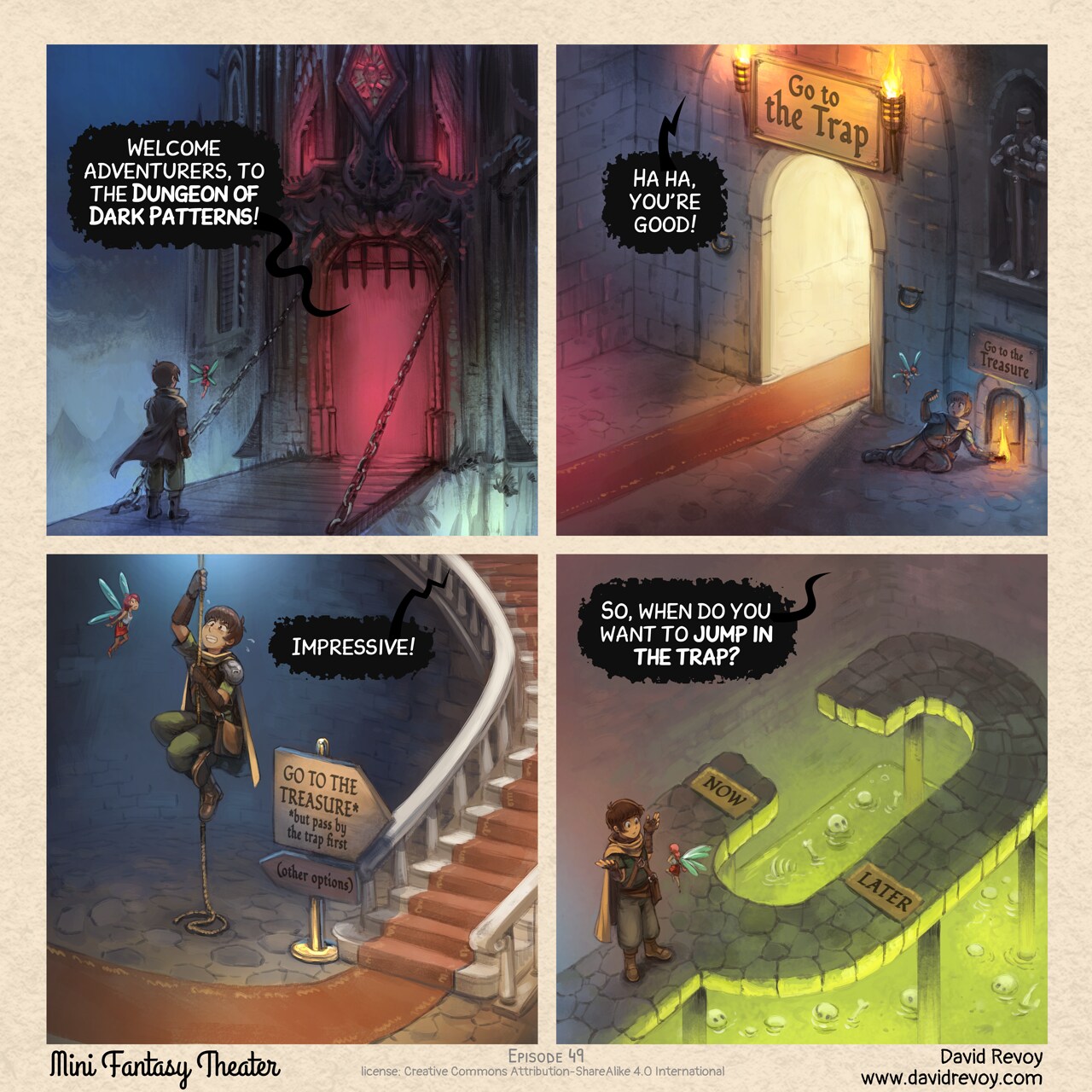
Sources and bonus timelapse: https://www.peppercarrot.com/en/miniFantasyTheater/049.html
Transcript:
Panel 1. The adventurer and his fairy are in front of the door of a nightmarish dungeon, it's dark, foggy, and the inside the door we can't see anything except a deep red light.
Dungeon: "Welcome adventurers, to the Dungeon of Dark Patterns!"
Panel 2. In one room of the dungeon, a giant beautiful and inviting door with a red carpet, and on the side, in the shadow a too little door. Writing on big door: Go to the trap, on small door: Go to the treasure. The adventurer crouch and do a little sign to the fairy to follow him to the little door.
Dungeon: "Ha ha, you're good!"
Panel 3. The aventurer is now putting some effort climbing on an old rope in the middle of a room with a beautiful luxuous stairway with a red carpet on the side. A sign tells "GO TO THE TREASURE but pass by the trap" in direction of the beautiful stairs; and "(other options)" in small and in the shadow in direction of the rope.
Dungeon: "Impressive!"
Panel 4. Top down view on the adventurers shrugging in front of the fairy, they reached a dead end. A short path on the right has on the ground the word "Now", and a longer path "Later". Both lead to a giant pool of green acid where bones and skulls are floating.
Dungeon: "So, when do you want to jump to the trap?"
Secret Panel HERE 😬 https://patreon.com/posts/148782694
The Disney and Pixar Studios have recently given us a bit of an over-saturation of feature animation spotlighting one of nature’s reputedly most industrious critters. At least one of such kind appears in a prominent part in Zootopia 2, while a swarm of them form the principal animal cast of Hoppers. As I have not yet been able to acquire home media versions of these films to review, I am not up to speed on them, and they will not be further discussed in this series. However, it might be said that this recent cinema trend is setting us up for the Year of the Beaver – so I thought it might be fun to trace the buck-toothed, flat-tailed character’s history in animation, and see how these character-actors of nature have fared in the dam-dest of situations, starting from the earliest days of sound.
(A note here is in order. While in the process of writing this first installment, which I had actually been percolating the research for as of at least a year ago, I happened to discover by chance online that another author, in anticipation of the “Hoppers” premiere, has been thinking along the same lines, and attempted a brief survey of the same subject on Cartoon Brew. I swear this was a case of coincidental independent creation. Nevertheless, in reviewing the other article, I observed that most of its material consisted of title-dropping and some clips without much discussion of cartoon content, and (as in the case of our recent coverage of bullfighting cartoons) many on-subject films were omitted from the title list. I thus proceed full steam ahead with the present project, to add some depth as to the gags and ideas presented in the subject films, and to fill in a number of gaps.)
Correct me if I’m wrong. It’s rather surprising that I seem to have come up empty in locating any verified appearances of a beaver in any known surviving silent cartoon. You would think Paul Terry’s Aesop’s Fables would be loaded with them somewhere – but they don’t seem to even turn up in natural settings where you’d expect all varieties of animals to be represented, such as “If Noah Lived Today” or “Amateur Night On the Ark”. Maybe the primitive pencils at the Terry studio couldn’t hit on a model design for the creature they felt comfortable with. Similarly, Max Fleischer missed his chance to include the species in his first Talkartoon, Noah’s Lark. It thus appears that Disney (as he often did in those days) got the jump on everybody, including the characters in one of his earliest Silly Symphonies, Autumn (Columbia, 2/13/30 – Ub Iwerks, dir.) (noticeably overlooked by the Cartoon Brew coverage, as were nearly all of this week’s films).
Part of a four-episode quad-rilogy, themed about the four seasons of the year (though one might say the follow-up, Night feels like it makes the series a set of five). All of the films are relatively plotless, concentrating on well-synchronized cavorting to a lively Carl Stalling score. The first half of this one deals with various animals gathering their stores for Winter while the leaves fall. Squirrels do most of the heavy lifting, while scavenger crows raid the squirrel’s hollow tree homes and swipe corn, storing it away inside the pantlegs of a farm scarecrow who isn’t scaring anyone. A skunk tries to roll a large pumpkin into a tree, but when it doesn’t fit, gives it a running tackle to push it through, only resulting in the fragile pumpkin shell cracking and depositing its innards all over him. A porcupine has a better method of harvesting, shaking a fruit tree and catching the falling fruit on the ends of his quills (a gag later repeated in Father Noah’s Ark, discussed below). Now comes a brief sequence for the beavers, changing subject.
The beavers dance atop a dam under construction in the foreground, tamping down lumber into its structure with their tails, while several other small groups of beavers are seen in the stream, constructing beaver dens with entrances below water. Two beavers dance together in synchronized rhythm along the bank, then chew down a small tree, which topples onto the head of one of them. In the later climax of the film, as the first cold blasts of winter wind are felt, one beaver calls an alarm to the others, and one-by-one, several beavers dive into the water and are seen as bulges and vibrations within the structure of a beaver den, having entered it from below. A stranger appears – a misguided duck, who doesn’t have the good sense to fly south, and instead also dives under the water, attempting to join the beavers in their comfy abode. He is quickly and rudely ejected, swimming away with complaining quacks. The skunk looks for shelter, but gets hit with a back of porcupine quills from inside one tree already occupied – so moves into another one, sending all of its furry occupants scattering for another tree next door. The crows get the final shot, taking up residence inside the hollow clothing of the scarecrow. One small crow is left out, and kicks the pantleg of the trousers, hoping for access. In an ending which nearly duplicates that of “The Skeleton Dance”, the bony foot of one of the crows reaches out from the drop-seat of the trousers, yanks the little crow inside, then re-buttons the drop-seat.
Minus Iwerks (who by this time had moved on to another animation studio), Disney’s beavers make a comeback in The Busy Beavers (Columbia, Silly Symphony, 6/22/31 – Burt Gillett, dir.). Obviously, with the beavers taking center stage, there’s a lot more room for action and gags in this one. It’s rather comical also to note that in both of these early cartoons, the sound engineers seem to have no idea what a beaver should sound like (their natural sounds are more like grunts), so decide to use what sounds like a squeaky toy to emit puppy-dog like high-pitched barks. This does have the advantage of permitting quick one-note tones that fit easily into the punctuated rhythms of an average cartoon score, but must still bring howls from anyone who’s studied the behavior of the animals in the wild. The sound effect also proved rather interchangeable – I swear I’ve heard the same “voice” given to foxes and bear cubs in productions from various studios, not to mention used in its proper place for Bosko’s pup at the end of early Looney Tunes. (Who was that pup anyway? Baby Bruno?)
The film opens with the usual construction under way of a dam and beaver dens – though with broader scope that the previous film’s opening shot, panning back and forth across the river full of busy workers. A first gag has one beaver curl up his tail to form a place to carry a load of lumber, then hold a small cylindrical stump between his hands. The beaver loading the lumber on takes hold of the other beaver’s rear feet, balancing him upon the held stump, and carts the lumber to the worksite, using the first beaver as a living wheelbarrow. Another beaver searches for just the right lumber in what seems to be a woodpile, but finds within a sleeping moose, who stands to reveal the beaver trapped as a passenger in his antlers. Another pair of beavers mix a muddy mortar in a hollow tree stump, one beaver loading up his cheeks with water from a nearby pond to spit into the stump, while the second mixes the solution in the stump with his tail. Then, a line of beavers arrives as hod-carriers, using large leaves held aloft atop Y-shaped tree branches as their tools to carry the mud to the dam, emptied into them by the tail of the mixing beaver.
 More heavy construction occurs elsewhere. One beaver hangs by his tail from the limbs of a flexible sapling, whole another tugs at a lower branch like a crane operator, maneuvering the higher beaver into position to chomp upon and transport cut logs from a pile to an assembly line. One by one, the logs are threaded between two husky beavers, who combine with their sharp teeth to hone each log down into an elongated conical shape. Then, the shaped cones are flipped by beavers’ tails into the shallow water, point down, where they are hammered into place by the tails of two more beavers to serve as pilings. (I’m not aware that a dam requires pilings – are they also building an auxiliary pier?) In the woods, a team of two cutting beavers moves along, making short work of felling trees marked with X’s, while a scout beaver proceeds ahead of them, choosing just the right trees of strong grade for marking and felling like a lumber crew boss. Two large worm-like creatures in one tree save their home by spotting the freshly-chalked X left as a marker, and rubbing it off before the cutting crew spots it. Some beavers approach the cutting task solo. One, who might be the laziest of this beaver colony, is large and lethargic, casually cutting a very puny sapling and slowly walking away with it toward the dam, in a gait that suggests he is in no mood to exert himself. Eclipsed behind him is a much smaller beaver who is all energy, and fells an older-looking tall pine while an owl is still perched on its branch. Single-handedly, the young beaver pushes the heavy tree down a slope and into the river, then propels the tree downstream by spinning his tail as an outboard motor, tugging on the owl’s tail as if a ship’s whistle cord to pass a slower-moving log team of beavers who is rowing their lumber with tail action like the crew of a scull in a college boating race. As the young beaver’s log hits the riverbank, rolling the beaver off and up onto land to collide with a rooted tree, a lightning flash illuminates the sky, and the first drops of rain begin to fall.
In one of those elaborate long-cycles of animation that only Disney seemed capable of carrying out successfully in those days, a full shot of the river and just-completed dam shows the entire beaver community scurrying for the safety of their dens. The little beaver is bringing up the rear, and is the only one to spot that the construction project has not gone quite according to plan. The earthen-packed base of the dam has sprung a small leak, with a spout of the newly-arrived rain water shooting out. The beaver begins to play the role of the Dutch boy at the dike, plugging the hole with one paw, only to have another hole develop elsewhere. One paw after another, and even his face, are used to block the holes, but he soon finds himself short on number of appendages to hold back the current. Cleverly, he spies several small sticks protruding from the dam edge, and grabs them up, throwing them like darts to plug each of the previous holes – only to find that they had already been serving a blocking purpose in their original position, as a delayed spout of even more forceful water bursts from where he plucked the sticks out. In desperation, the beaver sits in the hole, providing a temporary plug, until his tail is chomped upon by the jaws of a snapping turtle swimming in the waters on the backside of the dam. The turtle is pulled through as the beaver leaps out of the hole in pain, and the beaver makes due by propping the turtle’s shell up against the hole in the dam to do the plugging job, the beaver bracing the turtle into permanent position by wedging a stick between the turtle’s chest and the dry river bottom.
Troubles are not over. A dark rain cloud above bursts as a lightning bolt tugs at a zipper in its bottom, dropping enough rain to form a massive wall of water in an area about a mile above the dam. A couple of wonderful shots show the progression of the flood that develops in the hills down the river, particularly a tracking shot just ahead of the flow as it careens around a continuing curve, taking out trees protruding into the river bed in 3-D style detail as it goes. The little beaver, now standing atop the dam edge, watches in horror as the leading edge of the flood waters reaches the beaver dens, nearly swamping them, and subjecting the dens to a beating from the floating logs passing in the waters. The beaver hops down into the river bed on the front side of the dam, and tries to hide in its shadow from the oncoming rush of water and debris. The water pounds repeatedly upon the dam’s backside, then suddenly breaks through, seemingly destroying the dam’s entire middle expanse – until the water recedes somewhat, showing that the beaver has been left on a small island of safety in the river’s middle, only a sliver of the dam center still standing to offer him protection.
With the other beavers still having their hands full within the dens, little beaver is forced to come to the rescue. He races for the tallest and largest pine along the riverbank, and like a buzzsaw chews deeper and deeper into its trunk, about 90% of the way across. The tree begins to tremble, and the beaver does an about-face to get out of the way, nearly getting trapped when the sagging trunk briefly catches his tail. He pulls out just in time to let the tree fall across the river, but is right in the path of its collapse, as the felled tree lands in perfect position to cover the complete expanse of the river width, proving to have dense-enough foliage to stop the flood water in its tracks. (Unlikely, given the general amount of space between branches of the average tree.) Dozens of birds emerge from the greenery and fly away from the fallen forest giant. In one of the earliest Disney moments where we are led to believe a character has passed, there is no further movement from the tree for a few seconds, and the musical tone turns somber as the camera slowly closes in on the tree’s uppermost limbs. Suddenly, the tension is relieved, as the smiling face of the little beaver, safe and sound, pops out of the greenery, wearing a bird’s nest as a hat. The other beavers, now safe in the still waters surrounding their dens, dance for the little one in celebration. The little beaver smiles and bows to his adoring fans, and takes off the nest as if tipping his hat to his public. His moment of glory is briefly marred by the egg in the nest choosing this moment to hatch, allowing a featherless baby to repeatedly utter “Cuckoo” at him, for the iris out.
Were this cartoon produced later, without the need for music synchronization timing to eat up footage and slow general pacing, the plot/gag material for this early outing was actually quite strong, and full of typical Disney innovation for a first cartoon focusing on a new subject idea. Though the picture hasn’t achieved an everlasting spot as a timeless classic in the Disney hall of fame, it deserves a second appraisal. And it seems a “dam” sure bet it was remembered by at least some folk in Chuck Jones’s unit in the 1940’s, as its story structure bears substantial similarity to and seems the direct inspiration for Chuck’s own classic, “The Eager Beaver”, to be discussed in later pages of this series. It’s easy to imagine how much of this cartoon’s material could have been directly interpolated by Jones into his own film had scripts been swapped, with Jones probably achieving just as lively results as his own film from the Disney gags.
Beavers almost miss the boat in Disney’s major animal adventure, Father Noah’s Ark (UA, Silly Symphony, 4/8/33 – Wilfred Jackson, dir.). They are never seen involved in the initial construction process for the ark, nor in woodland group shots, not in the stampede racing for the ark, nor on the boarding gangplank. And they certainly didn’t tag along with the pair of skunks who make the voyage on the roof of the ship. Yet, somehow, they are seen in the third-to-last shot of the film, disembarking. The male and female beavers march down the gangplank, side by side, each one carrying a new youngster along on its tail. Guess they stayed busy on the trip, even if they missed being on the passenger list and traveled as stowaways.
Either competing studios were blown away by the Disney efforts above, or just for unknown reasons were slow to adopt the beaver into their animation models for various forest-related cartoons of the period, as, for a few more years, no beavers seem to turn up in cartoons I’ve been able to discover. I again could be overlooking something, as reference to beavers rarely turns up in the titles of episodes, so if anyone remembers any other early beavers, feel free to comment. Harman and Ising seem to have missed their opportunities entirely, choosing not to include beavers in such possible vehicles as “Ain’t Nature Grand?”, “The Trees’ Knees”, and “Bosko’s Woodland Daze”. But, as Leon Schlesinger began to shift the Merrie Melodies series to color, we get Pop Goes Your Heart (Warner, 2-strip Technicolor, 12/8/34 – Isadore (Friz) Freleng, dir.). In essence, this is Friz’s idea of a Silly Symphony, considerably behind the times, and resembling something Disney might have produced several years before. It is another plotless romp in nature, with the likes of humming birds and humming bees, a papa grasshopper teaching his young ones to spit with chewing tobacco, turtles learning to swim by flipping over on their backs and stroking with reeds like a rowing crew, and some harp-stylist spiders playing the title tune on the strands of their web, while worms inside two apples simulate the limbs of a pair of dancers, and a trio of croaking frogs sings the lyric. (The song, by the way, was a semi-hit from Dick Powell’s feature, “Happiness Ahead”.)
 About two-thirds of the way into the film, our attention shifts to a community of beavers, engaged in the usual dam and den building. Two beavers, however, prove that a beaver’s life shouldn’t be all work and no play, engaging in some recreation between shifts, finding their tails to be of natural use in an intense game of tennis, using them as racquets to hit a ball (where did they get it?) over a net of cobwebs. A bear comes lumbering through the woods, trying to let out intimidating roars, but having his first come out like a kitten’s meow – causing him to spray his throat with an atomizer to correct his tone. He first begins following one of the turtles too closely, only provoking the amphibian to bite a painful snap upon his nose. The bear thus turns to easier prey, chasing the beavers. The beavers duck into a hollow tree, and the bear sticks his head into the trunk to snarl at them, but can proceed no further. One beaver sneaks out of a hole in the upper trunk, then administers a light spanking to the bear’s rear with his tail. At the top of the tree, another beaver chomps at an overhanging limb, dropping a bombshell of a hanging bee hive upon the bear’s back. The hive bursts open, plastering the bear with honey and attracting the bees to swarm upon him. The bear runs for it, colliding with the fence of a farmer’s field and tumbling over the top of it into a pasture. With the gooey honey mixed into his fur, the bear is a magnet for the dry grass, and rolls down an incline, developing a growing coating of grass around his entire body in the manner of a rolling snowball. At the base of the hill, a farmer works with a hay-baling machine. He can’t tell the difference between a bear covered in grass and a haystack, so tosses the bear into the machine with his pitchfork. The bear emerges with torso encased in a bale of hay, and exits at a gallop over the hills, leaving the farmer to scratch his head in puzzlement.
• “Pop Goes Your Heart” is on Dailymotion
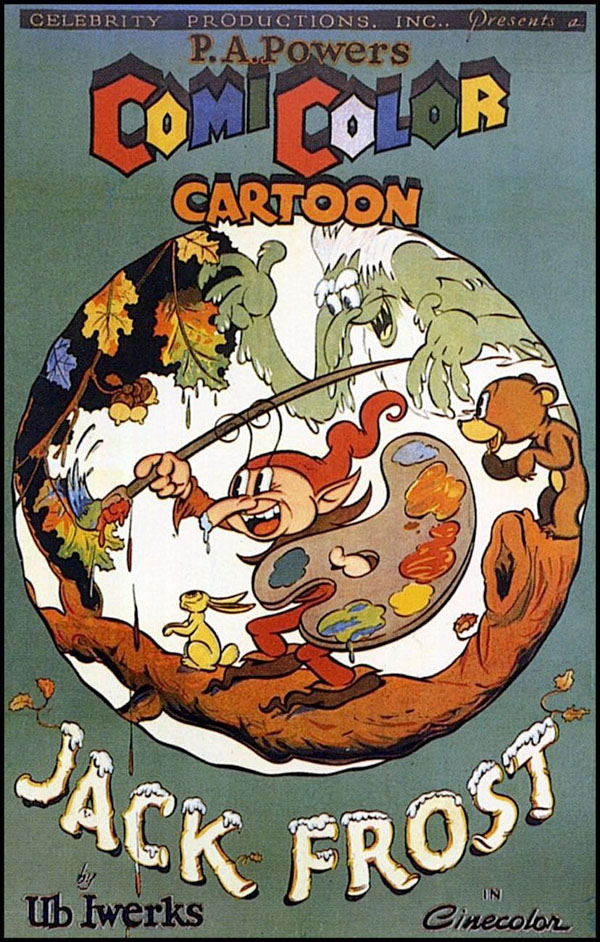 Though Ub Iwerks may have invented the animated beaver, he didn’t find much opportunity to use him in productions from his own cartoon studio. What appears to be the only such instance was a brief cameo shot in Iwerks’s wintertime classic, Jack Frost (ComiColor, 12/24/34). A forest full of various animals opens the first shots of the film, cavorting in a public game of leap frog (no, Flip is not a participant). A small bear is the first to notice an observer on a tree limb, with the mere utterance of his name drawing the undivided attention of the forest folk. A magical elf, by the name of Jack Frost, has appeared, carrying a paintbrush and artist’s palette, with which he performs magic by changing objects’ color and appearance to render them harbingers of approaching Autumn. He is seen painting the green leaves into orange and brown hues, and calls down an advance warning that summer’s gone, and Old Man Winter will be knocking at their door. Better get their food and nuts stored away. A dancing quartet of beavers responds, “Thanks, Mr. Jackie for your advice. We’ll hurry home to our wives”, while various squirrels complete the rhyming couplet by stashing nuts in their trees, and stating that they’ll “have their cupboard filled with supplies, when Old Man Winter Arrives.” That’s all the beavers get to do. The rest of the film follows the misadventures of a determined grizzly bear cub, who thinks he’s too tough to have to worry about winter cold thanks to his furry coat, and doesn’t want to hibernate like his parents. When the cub ventures out into the forest, Old Man Winter locks him away inside a hollow log with a row of icicle bars to block his exit. But Frost takes pity on the disobedient cub, and uses his paint magic to change the ice bars into peppermint sticks, allowing the cub to lick his way to an escape. Jack flies the cub home, tucks him in to sleep, then writes in frost upon the window as he exits, “Finis”.
 Beavers also don’t get a lot to do in Van Beuren’s The Hunting Season (RKO, Rainbow Parade, 8/9/35 – Burt Gillett/Tom Palmer, dir.). This was in essence the first starring vehicle for the budding character of Molly Moo Cow, who had first appeared as a guest nemesis in the color Toddle Tale, “The Picnic Panic”, and who even as of this production had still not received a name. The beavers are oddly the first to be spotlighted in the film (Gillett by this time well-acquainted with animating them), building a dam and tamping down mud with their tails in a serene forest scene, shared with squirrels gathering nuts, a mother bird tending to two young ones in a nest, and two ducks swimming in circles in the river. Enter Molly, just randomly venturing through the woods. She decides to take a dip in the stream, and tests the water with her hoof and tail, which seems to be a bit colder than is to her liking. The ducks pull a prank upon her, tugging at her tail to pull her abruptly into the water. Molly counters the prank by sticking her head underwater and blowing bubbles that float the ducks off of the water surface into the air, pop, and deposit the ducks onto her back. Little by little, the joking relationship makes her and the ducks fast friends. Meanwhile, a human hunter prepares one of his shotguns at a nearby campsite, and strides into the area. Spotting the same serene forest scene we started the film with, he soon wreaks havoc upon it with his shotgun full of buckshot. He fires upon the bird family, shooting away the branch upon which the nest rests, causing mom to have to rescue in mid-air her falling flightless chicks. He blasts at the squirrels’ tree, piercing a gaping hole in the trunk, out of which pours all the nuts and the squirrels as well. And he takes pot-shots at the fleeing ducks in mid-air. Yet he takes no shots at the beavers! I guess he’s not in the market for trappers’ pelts. Molly gathers up the two ducks as they fall from the sky, at first mourning them, but finding them to be all right, as one of them rings her cow bell. They inform her what just happened, and Molly carries them to the hunter’s campsite, where they pick up a crate full of ammunition and a small arsenal of the hunter’s other shotguns, all threaded upon Molly’s tail. Together, they race back to the forest, where they deposit the weaponry for the others to see, inform them of a plan for revenge, and distribute shotguns and ammo to each of the forest residents. The hunter enters a clearing, looking for the fallen ducks but finding only a handful of feathers on the ground, while the camera pulls back, revealing the forest army surrounding him from all sides. This appears to be the first of many instances in which multiple studios would find use for beavers in “Give him the works” sequences of mass forest retaliation. Everyone opens fire upon the hunter from all directions. The beavers play their part in only one scene, apparently stocked for gunpowder but not for bullets, so they load their rifle with marsh reeds, which don’t have much lethal effect, but spear-off the hunter’s jacket, then tickle him like crazy under the armpits and in the tummy. The ducks decide to launch pumpkins off the end of their gun barrel, leaving the hunter wearing the shell of one like a helmet, with two more pumpkin shells rolling around his ankles like a set of wheels. The ducks next launch a bee hive, with end results similar to the bear’s retreat in “Pop Goes Your Heart”. Molly and the ducks march back to the rest of the forest folk in triumph, but the ducks drop their rifle, causing it to accidentally discharge, leaving Molly awkwardly scurrying up a tree, to moo to the camera for the fade out.
 Porky in the North Woods (Warner, Porky Pig, 12/19/36, Frank Tash[lin], dir.) features a lot of beaver involvement. Porky is ranger of a game preserve (he calls it a game refuge), where there is (as declared by an endless display of signs posted in the forest) no hunting, no fishing, no trapping, no fires, and no, no, a thousand times NO! But one shadowy figure, who is seen through half the picture only as a silhouette on the snow while heard speaking in a French-Canadian accent, seems determined to ignore, and break, every rule. He shoots down the No Hunting signs, catches fish, starts campfires carelessly left burning, and lays strong steel traps throughout the woods. Two playful young beavers are engaged in a game of leap frog, propelling each other forward by flips of their tails under the other’s feet. They encounter a bright shiny apple hanging from a thread draped over a tree limb. One’s pulling upon the string triggers one of the jagged traps behind him to clamp upon his tail. He yells to his brother to go get Porky to help. Some historians, including Leonard Maltin, have incorrectly given credit to Tashlin’s work on the later “Porky’s Romance” as an innovation in the cutting and timing of action in super-speed. They neglect to mention that Tashlin was already experimenting with high speed and rapid-fire cutting at least as early as the battle finale of “Little Beau Porky” in mid-1936, and here in the beaver sequence, easily as finely timed as Petunia’s high-speed run after candy in the later acclaimed film. Beaver #2 zips out of frame, and in movement deliberately blurred by speed lines, traverses six scenic backgrounds in perspective in under four seconds! Just to make sure nobody blinked and missed it, the beaver screeches to a stop, realizing he’s forgotten something. At the same lickety-split tempo, he runs the course in reverse, to nab the coveted apple for his meal, before repeating the action a third time in his quest to locate Porky.
When Porky hears the news, he comes a-running, prying open the cruel trap holding beaver #1. The beaver’s tail is bent in a zig-zag, and the beaver frets that he hopes it isn’t a permanent wave. But Porky’s worries are only beginning, because the beavers aren’t the only victims. Everywhere he looks, he spots more traps, with more animals caught in them. A rabbit is caught by the ears. A fox by his bushy tail. Yes, even a skunk by his striped rear appendage, which Porky has to free while holding his breath with a clothespin on his nose. Each of the animals suffers the same zig-zag creasing from the traps’ jaws as did the beaver. So Porky sets up what resembles a laundry business in his ranger’s cabin, though his services are free of charge. A seemingly-endless queue of victimized animals waits their turn, as Porky performs miracles with a towel and hot flat iron, ironing smooth the ridges left in the animals’ anatomies by the traps. There is one, however, who is displeased at this turn of events. The mystery trapper, who can easily see the tell-tale signs of Porky’s and the animals’ footprints around each of his empty traps. Someone has confiscated all his prizes, and he wants revenge.
The trapper is finally revealed as one Jean Batiste – a large, burly, lumberjack-style dog. He easily traces the tracks back to the ranger station, and walks in on the line waiting for Porky’s ironing. Grabbing the iron, he uses it without the aid of insulating towel directly on Porky’s tail, straightening it like a dart, then sticks the rigid tail into the table woodwork, suspending Porky above it, to be punched back and forth like a punching bag. He throws Porky across the room, his tail again piercing the wood of the cabin wall like a dart, placing Porky’s rear end over the escaping hot steam of a whistling tea kettle atop Porky’s stove. Then, Batiste pulls out a sled dog whip, and removes one of his snowshoes. He lassoes Porky with the whip, pulls him out of the wall and back to him, then smacks Porky with the snowshoe, bouncing him off the wall like a tennis ball, and playing a painful one-man tennis game with Porky taking all the hits. Beaver #2 sees all this happening from the doorway, and again retraces his previous steps through the six scenic backgrounds at super-speed, finally coming to a stop below a fuzzy hanging object above, which he pulls. It is the goatee-like fur hanging from the throat of a giant moose, who bellows out a low-pitched wail as an alarm of distress to the forest. In several shots of fine animation detail, rows of bears come charging out of caves, skunks from within trees, a parade of snapping turtles tapping a beat on their shells with drumsticks as a marching band, and of course, hundreds of beavers from dens in the river bed. They converge on the cabin just as Batiste has succeeded in knocking Porky cold. Jean prepares to leave the cabin, but quickly spots the approaching stampede, and tries to bolt the door. No matter. The animals smash it down. Jean speeds out of a rear exit on skis. It’s time to “give him the works” again. Two bears launch the beaver twins at him via crosscut saw catapults, and they slap his head around with their tails as well as wooden sticks. The turtles slide between Jean’s skis, beating his bottom with clubs as they pass under. More beavers launch a barrage of small logs at the back of Jean’s head via slingshots rigged into the antlers of moose. The skunks also launch fitting weapons from their tails – smelly, rotten eggs. Finally, the beaver twins pull the old vine-across-the-path trick, tripping Jean and launching him skyward and off the mountain slope. Jean begins to descend, upside down, and his skis act like whirling propeller blades, spiraling him into a twist, so that he screws himself firmly into the snow-covered ground below, only his ankles and skis left protruding from the snow. The revived Porky, who seems to have recuperated entirely, joins the animals in cheers of victory – then smile at observing what the beaver twins are up to. They have taken advantage of Jean’s downfall and present position, by converting his inverted skis on Jean’s ankles into their new playground attraction – a see-saw (an ending likely “borrowed” from Morty and Ferdie’s similar see-saw atop Mickey Mouse’s head in Mickey’s Steam-Roller of a few seasons back).
 Little Hiawatha (Disney/UA, Silly Symphony, 5/15/37 – David Hand, dir.) is a forest masterpiece that certainly earned director David Hand the future right to be supervising director of “Bambi”. It tells the tale of Longfellow’s mighty Indian warrior – when he was just starting out as a tiny boy, out for his first day of solo hunting in the woods. He is capable enough in rowing a canoe, but has a lot to learn when it comes to bringing back prize game. Try as he might, he can’t get close enough to the animals to take a shot with his small bow and arrow, as they keep running out of range. The only two creatures who stay still long enough for him to aim are a grasshopper (who proves himself the better marksman by spitting in Hiawatha’s face), and a tiny baby bunny, who is too inexperienced and becomes cornered atop a tree stump. Hiawatha shouts, “Yippee” and aims his bow. The bunny, however, turns on him a set of what Charlie Dog at Warner Brothers would have called the “big, soulful eyes”. Hiawatha starts losing his nerve to go through with it, sniffles, and sheds a single tear. He then gets hold of himself, and decides to make it a fair fight, reaching into his Indian trousers (which, by the way, someone really needs to buy him a belt for – as the running gag of the film has his pants falling down at least seven times!) and pulling out a matching bow and arrow with which he arms the bunny. Positioning himself and the bunny back-to-back, he paces off five steps in duel fashion, turns, and pulls back his bowstring to fire. The bunny, however, is no opponent, having no idea what to do with the weapon, which drops out of his trembling hands. Frustrated, Hiawatha kicks at the dirt, shoos the bunny away to his waiting parents, then breaks his bows and arrows across his knee. He’s given up picking on the little guy. This reaction brings cheers from the creatures of the woodland, embarrassing Hiawatha, who shyly backs out of the scene.

The re-reease poster
But where do beavers come into the picture? Right about now. The forest animals can see Hiawatha is in trouble, and decide to repay the act of kindness Hiawatha showed them. Thus begins another elaborate “give him the works” master plan to slow up the bear. Several beavers rally the forest creatures with an alarm, beat out in rhythms upon a hollow log with their tails. A squad of raccoons pull down a long vine from the branches of a tree and stretch it across the bear’s path to trip him up. The beavers are ahead at the bank of a stream, floating a log up to the shoreline for Hiawatha to climb upon as he reaches the water. The beavers paddle him a short distance into the stream, hoping to leave the bear high and dry. But they are not fast enough, and the beast leaps into the water, getting his front paws upon the end of the log, and flipping Hiawatha into the air and onto the trunk of a nearby tall tree. The bear continues swimming and reaches the base of the tree, swiftly climbing up after his target. The beavers shift to plan “B”, and a trio of them quickly gnaw away at the base of the tree. The tall pine begins to topple, with the bear clinging to the trunk for dear life. Hiawatha also clings above him, but begins slipping as the tree’s angle changes in its fall. A family of opossums are prepared for this, and hanging by their tails from several tress, grab Hiawatha before he can fall, swinging him from tree to tree like living vines might be used by Tarzan.
 At a ledge closest to the last tree waits a deer, who has put her head though some vines connecting two long branches of wood, trailing the branches behind her in the fashion of an Indian travois. Hiawatha is tossed onto the branches, and begins to be towed through the woods with the swiftness of the deer who pulls him. And not a moment too soon, as the fallen bear has climbed out of a canyon, and gives chase once again. The beavers get back into the act, felling over a half-dozen trees into the bear’s path, but narrowly miss their attempts to conk the bear on the dome with them. The deer develops a good lead on the bear, allowing for some rabbits to carry out a masterstroke of deception. As the deer passes them, taking Hiawatha on one path leading back to the river, the rabbits get under, then uproot, a small shrub, shifting its position to block view of Hiawatha’s path, and exposing a second path that leads off to nowhere in the distant hills. The bear, seeing only one visible thoroughfare, assumes he is on the right track, and continues on at full speed into the mountains, presumably never to be seen again. Meanwhile, the deer makes it back to the lower riverbank where Hiawatha left his canoe, and two turtles act as stepping stones so that Hiawatha can board his vessel. For the return trip, Hiawatha won’t even have to raise a paddle. The beaver trio reappear, and from the rear end of the canoe, dip their tails in the water, one to serve as rudder, two to serve as oars, slowly but majestically propelling Hiawatha homeward, who stands proudly with arms folded at the helm of the canoe, while his animal fans “watch him as a friend departing”. The narrator adds, “And the beaver called him, brother.” And, brother, that’s enough for a first installment.
• “Little Hiawatha” is on Internet Archive.
NEXT WEEK: We’ll get busy with more beavers from the ‘30’s and ‘40’s.
Secret Panel HERE 🔥 https://patreon.com/posts/14047676
Does anyone (besides us geeks at Cartoon Research) really miss or even care about Conrad the Cat?
After all, he only appeared in three cartoons, all in 1942, and in two of them he was a mere co-star. Chuck Jones created the character, then abandoned him after that trifecta. A doughy yellow cat specializing in physical comedy, viewers remember Conrad as a knockoff of Disney’s Goofy, especially when Pinto Colvig voiced him in Conrad the Sailor. (Side note: Ink and Paint veteran Martha Sigall related that the I&P department thought that Conrad was a caricature of Jones himself).
 Conrad, however, can be seen as a transitional figure in Chuck Jones’ development as a Warner animator and director. From the bones of Conrad would arise a snappier and more cosmopolitan Jones, one capable of perhaps more nuance than any of his contemporaries. Let’s examine this thesis.
Chuck Jones became a Warner director in 1938. His first cartoon, starring an unnamed kitten in The Night Watchman, featured a cute character that very much resembled his next “star’ Sniffles the mouse, whom Jones created and first directed in 1939 (Naughty but Mice). Siffles was childlike and super-cute. His gabby voice, provided by Margaret Hill-Talbot (later by Marjorie Tarlton), reinforced this take on the character. Sniffles went on to headline a dozen cartoons between 1939 and 1946, showing little evolution.
During those years, Jones was obsessed with laborious drawings and layouts, lighting effects, and showed a strong predilection for Disney-flavored action. Conflict tended to be character-versus-object (or self), a far cry from the later interplay between Bugs and Daffy, for example.
 Jones’ cartoons tended to be gentle, with visual references to Disney’s Silly Symphony period. Nowhere is this more evident than in the 1940 cartoon Tom Thumb in Trouble. His characters were adorable and mild, and until Jones found a more individual voice, they seemed most anchored in Pluto Pup. The Jones unit at this time had some outstanding talent: animators Robert Cannon, Ken Harris, Robert McKimson, Ben Washam, and background artist Paul Julian. Yet the best this group could achieve was shorts that recalled Disney but could not be confused with its output.
By the time Conrad Cat appeared in The Bird Came C.O.D. (1942), there were signs of Jones transitioning to a different comic style. Although Conrad strongly recalled Goofy (minimal vocals by Mel Blanc), especially when wrestling with a palm tree, there are glimpses of Jones’ future work; in one scene, while watering the tree, Conrad mugs to the camera. After smacking into a door for the second time, he gives the audience a frustrated side glance. After finally getting the plant through the door, more fourth-wall facial expressions are seen.
 Skip ahead to Conrad’s encounter with the bird(s) in a magician’s hat. The bird (a visual predecessor to Henery Hawk) treats Conrad with far more violence than could be imagined in a Sniffles cartoon. Notably, the bird recalls Jones’ Minah Bird (first appearing in 1939) in that he marches to a distinct musical theme. Jones is clearly using comedy differently in this short.
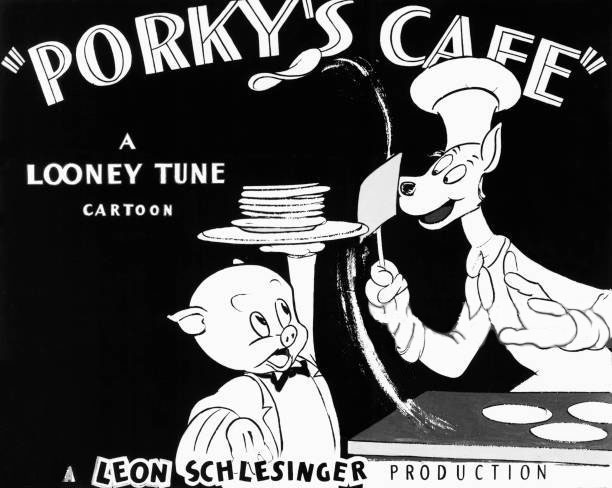
In his final two cartoons, both in 1942, Conrad was a co-star, paired with two of Warner’s biggest stars. Such pairings are likely as good as they could be for the goofy yellow cat, since he was far too weak to be a stand-alone character. In Porky’s Café, Conrad is a short-order cook who still manages to show glimpses of Jones’ future work; there are more gags and more telling reaction shots from Conrad. Jones was to become a master of expressing emotion through the twitch of an eye or a tiny movement of the mouth. These precursors can be glimpsed in the scene where Conrad attempts to beckon a recalcitrant pancake.
Conrad’s final cartoon was Conrad the Sailor, in which Daffy Duck harassed the poor cat in a total mismatch. Not only was Conrad constantly defeated by Daffy (who was far more like Bob Clampett’s duck than the egotist Jones would later fashion him into). As related earlier, Conrad’s voice was unfortunately provided by Pinto Colvig, the longtime portrayer of Disney’s Goofy, with no tweaking of the Goofy vocalization. Fairly or not, Colvig’s dialogue and singing reinforced the observation that Jones had not quite abandoned his Disneyesque tendencies.
As stated, while Conrad was not a character that could ever be featured independently, Conrad did offer occasional glimpses of Chuck Jones’ evolving style. Conrad was better built for comedy than Sniffles was, and he worked far better in gag situations than, say, the childlike Porky Pig in Old Glory (1939) or Tom Thumb. Conrad at least suggested an adult figure, and that represented a step forward.
Later, with writers such as Michael Maltese and a more developed sense of how to underplay a gag, Jones would blossom into one of Warners most sophisticated directors. If Jones reshaped the personalities of the studio’s stars during his heyday, it still started with a single step. Conrad the Cat may not stir many fond memories, but his three cartoons during 1942 just might have been that step.
