More than 25,000 square miles of the U.S. Great Basin, an area nearly twelve times the size of Yellowstone, has flipped from native sagebrush to invasive annual grassland over the past three decades, much of it without ever burning. The change is amplifying the Western fire season. Researchers using satellite data found that fire is no longer required to convert these landscapes; once the grasses arrive, the fire follows.
Grasses occupy a unique position in our climate. They are everywhere — pas
More than 25,000 square miles of the U.S. Great Basin, an area nearly twelve times the size of Yellowstone, has flipped from native sagebrush to invasive annual grassland over the past three decades, much of it without ever burning. The change is amplifying the Western fire season. Researchers using satellite data found that fire is no longer required to convert these landscapes; once the grasses arrive, the fire follows.
Grasses occupy a unique position in our climate. They are everywhere — pastures, lawns, prairies, savannas, roadsides — and they are easy to overlook precisely because they are so familiar. However, the world’s grasses are responding to warmer temperatures, shifting precipitation, and rising atmospheric carbon dioxide in ways that are reshaping ecosystems and fire regimes from the Mojave Desert to the slopes above the fire-scorched community of Lahaina in Hawaii.
The story of climate change and grass is, increasingly, a story about what burns, when, and how often.
A different kind of fuel
Wildfire science has long focused on forests, but the dominant fuel type driving change in the American West today is not timber. It is grass, particularly fine, dry, non-native annual grass that cures by early summer and carries flame between shrubs that would otherwise be too widely spaced to burn together.
Cheatgrass greens up earlier than native bunchgrasses, drawing down soil moisture and nutrients before native species start to grow. It then dies in early summer, leaving a continuous, dry, highly ignitable mat across landscapes that historically had patchy fuels and infrequent fires. The Bureau of Land Management found that areas invaded by cheatgrass (Bromus tectorum) are roughly twice as likely to burn as uninvaded land, and that cheatgrass now dominates or is a meaningful component of vegetation on roughly 52 million acres of the Intermountain West, up from roughly 31.5 million acres mapped in 2000 using satellite imagery.
A 2013 study, later supported by broader analyses, found that fire return intervals are now two to four times more frequent in cheatgrass-dominated landscapes than in intact sagebrush steppe. In 2019, ecologist Emily Fusco and her colleagues published the first national-scale analysis of the problem in Proceedings of the National Academy of Sciences. They looked 12 invasive grass species across 29 U.S. ecoregions, and found that eight significantly increased fire occurrence by up to 230 percent, and six increased fire frequency by up to 150 percent.
“This work shows that invasive species are one of the ‘big three’ ways that people are changing fire regimes,” senior author Bethany Bradley told reporters when the study was published. “Climate change more than doubles the likelihood of fire, human ignitions triple the fire season, and now we can add invasive species fueling fires.”
How climate change rewires the grass life cycle
Grasses are unusually responsive to climate change. Three variables — temperature, the timing and form of precipitation, and atmospheric CO₂ — interact in ways that often favor invasive annuals over the perennial natives they displace.
A decade-long warming experiment published in Frontiers in Plant Science by the U.S. Geological Survey tracked cheatgrass through three climate manipulations on the Colorado Plateau. Plots warmed by 4°C above ambient temperatures saw the vegetative growing season shorten by about 12 days; at 2°C, by about 7 days. Cheatgrass compressed its life cycle, finishing seed production and dying earlier in the summer. That sounds like bad news for cheatgrass, until you remember that an earlier, drier death means earlier, drier fuel, set down before the peak of the fire season.
Cheatgrass has another advantage native species lack: phenotypic plasticity. The Frontiers researchers concluded that the plant’s “phenotypic plasticity … may make the plant particularly adept at dealing with extreme interannual climate variation,” allowing it to respond to shifting climate cues that native bunchgrasses cannot. When native grasses fail to keep up with earlier springs and longer dry seasons, cheatgrass moves into the gap, adding fuel for fires.
Precipitation patterns matter as much as temperature. A long-term study in Global Change Biology of more than 10,000 wildfires across the Great Basin between 1980 and 2014 found that area burned in any given year was strongly predicted by precipitation in the previous one to three years. Wet years build fuel; the next dry year burns it. As the climate delivers more whiplash between wet winters and intense summer drought, the cycle accelerates.
Rising atmospheric CO₂ adds another wrinkle. Grasses use one of two photosynthetic pathways — C₃ (most cool-season grasses, including cheatgrass) or C₄ (most warm-season prairie grasses) — and both grow more efficiently as CO₂ climbs. A study in Nature examined a Wyoming CO₂ enrichment site, finding that elevated CO₂ improved water-use efficiency enough to partly offset the drying effect of warming;later research showed similar benefits for C₄ grasses. In short, more CO₂ means more grass, and more grass means more fuel.
Grasslands will not simply grow more biomass and burn more. Nature’s rules governing which grasses dominate where, and when each one cures, are being rewritten in real time. The species best equipped to exploit the new rules are, very often, the ones accelerating the grass-fire cycle.
Lahaina and the human-grass-fire cycle
On August 8, 2023, downed power lines sparked dry vegetation on a fallow hillside above Lahaina, Maui. By nightfall the fire had killed at least 102 people and become the deadliest U.S. wildfire in more than a century. A Washington Post investigation later confirmed the inferno began on land covered in non-native grasses, relics of sugar plantations that closed in the 1990s.
Hawaiʻi has experienced a roughly 400 percent increase in the typical area burned annually over the past century, and roughly a quarter of the state’s land area is now covered in flammable invasive grasses, according to the Hawaiʻi Invasive Species Council. Guinea grass (Megathyrsus maximus), buffelgrass (Cenchrus ciliaris), molasses grass, and fountain grass are the dominant culprits — all introduced for pasture or ornament, all now spreading on lands no one is actively managing.
“The main factor driving the fires involved the invasive grasses that cover huge parts of Hawaii, which are extremely flammable,” Clark University climatologist Abby Frazier told ABC News in the days after the fire. University of Hawaiʻi fire scientist Clay Trauernicht had been warning about exactly this scenario for years; in a 2018 letter referenced in Smithsonian Magazine, he wrote: “Just like with climate change, we know what steps will reduce the risk of wildfire. But actually taking these steps will require reinvesting in and, frankly, reimagining our individual and collective responsibility for the larger landscape.”
The Lahaina disaster is now considered a defining example of what ecologist Emily Fusco and her co-authors call the “human–grass–fire cycle,” the recognition that invasive grasses, human ignition sources, and a warming, drying climate are not separate problems but a single coupled system. People plant or spread the grasses (often inadvertently). The grasses build continuous fuel beds. Climate change extends the burn season. Human infrastructure provides the spark. The fire returns the landscape to grass-favored conditions, and the cycle tightens.
All the factors are rising, increasing the chance that a region will see a grass-fed fire.
Beyond the West
It would be reassuring if this were a regional problem. It is not. The U.S. Geological Survey has documented invasive grasses altering fire cycles in the Midwest, Northeast, and Southeast as well. Cogongrass (Imperata cylindrica) is reshaping fire behavior in Southern pine forests; silk reed (Neyraudia reynaudiana) more than tripled fire frequency in the South Florida areas Fusco’s team studied. Mediterranean grass (Schismus barbatus) tripled fire occurrence in the Sonoran Desert.
Native grasslands face their own pressures. C₄ tallgrass prairie species like big bluestem (Andropogon gerardii) differ markedly in drought tolerance from co-occurring species like little bluestem (Schizachyrium scoparium); during the Dust Bowl of the 1930s, little bluestem replaced big bluestem across much of the tallgrass prairie, driving the kind of species reshuffling that more frequent drought is likely to drive again.
A 2025 study used species distribution models for 37 grasses and projected that C₄ species will retain higher habitat suitability in a warmer future while many C₃ species will decline. Because the C₄ species projected to take over tend to be less flammable than the C₃ species they replace, the same study found elevated CO₂ raised water-use efficiency enough to lower leaf-level flammability for some species, a rare piece of cautious good news in a literature dominated by bad.
What can be done
There is no clean fix for a feedback loop, but there are well-tested intervention points in grasslands management. Federal agencies are scaling up restoration. The BLM launched the Restoration for Resilience program, funded through the Bipartisan Infrastructure Law and Inflation Reduction Act (both laws’ funding is under attack), is targeting 21 priority landscapes across the West for invasive species removal and native reseeding. Researchers at the University of Wyoming are leading the IMAGINE partnership to translate management science into guidance for land managers facing annual grass invasion.
On private land and at the wildland-urban interface, the highest-leverage actions are simpler than they sound: maintain native or low-fuel vegetation, remove invasive grass thatch before fire season, and create and maintain fuel breaks. Pre-emergent herbicides applied promptly after fires can give native perennials a fighting chance; without that intervention, burned landscapes in cheatgrass country tend to convert permanently to annual grassland.
Maintain defensible space. If you live in a fire-prone area, keep grass mowed below four inches within 30 feet of structures and remove cured fuels before the dry season.
Resist the urge to plant non-native ornamentals. Fountain grass, pampas grass, and several other landscape favorites are listed as moderate to high fire-hazard species and often escape cultivation.
Replant natives after disturbance. Whether the disturbance is fire, construction, or removal of an invasive stand, native perennial bunchgrasses re-establish slowly and benefit from active reseeding.
Support landscape-scale work. Most invasive grass control is too big for any single landowner. Support local fire-safe councils, conservation districts, and state-funded restoration programs that operate at the watershed or basin scale.
Picture two houses in the aftermath of a California wildfire. What’s left of one is a scorched foundation on a blackened lot. The fire spread quickly, partly due to a bed of flammable bark mulch under the windows and tall, dry ornamental grasses touching the siding. The other home is an island in a sea of gray ash. It remained intact, thanks to its protective landscape of low-growing succulents near the foundation and a 5-foot perimeter of gravel and concrete pavers.
Extreme weather events are s
Picture two houses in the aftermath of a California wildfire. What’s left of one is a scorched foundation on a blackened lot. The fire spread quickly, partly due to a bed of flammable bark mulch under the windows and tall, dry ornamental grasses touching the siding. The other home is an island in a sea of gray ash. It remained intact, thanks to its protective landscape of low-growing succulents near the foundation and a 5-foot perimeter of gravel and concrete pavers.
Extreme weather events are setting the stage for fires in periods experts once considered safe. A record-breaking heat wave raised temperatures to 106° Fahrenheit in mid-March and melted the area’s snowpack, paving the way for an early and likely severe wildfire season. The time to prepare is now, not in the “traditional” summer months.
Research from the Insurance Institute for Business and Home Safety (IBHS) shows that the survivability of a house is less about the wildfire itself and more about the first 5 feet around it. Learn how the landscaping choices within this zone can either protect or endanger your home, as well as recommendations for your region.
How Plants Can Fuel or Prevent Home Ignitionho
To landscape for safety, you should understand how fire behaves at a scientific level. The goal is to create a setup that fundamentally disrupts the ignition process.
The Three Ignition Pathways
The first pathway is ember ignition. Fire starts with embers, which are small burning pieces of wood, bark and other vegetation. The wind can carry and shower them down on homes far from the main fire front. They smolder when they land on a receptive “fuel bed,” which could be anything from a pile of dry leaves in a gutter to the dense, dead material inside a bush. Then, a small flame erupts, which can then spread to nearby surfaces and structures.
Radiant heat is another avenue. Think of it as the intense heat you feel on your face from a bonfire several feet away. A large fire nearby would radiate powerful thermal waves, which can be enough to crack windows, melt vinyl siding and cause plants and structures to ignite without touching a flame.
The final pathway is direct flame contact. It’s the wall of fire moving through a landscape. This occurs when continuous, dense vegetation acts as a path for the fire to travel directly to the side of the house. While direct flame contact is the most dramatic progression, it’s also the least common cause of home ignition.
Plant Characteristics That Increase Fire Risk
The following traits make vegetation more likely to catch fire:
High oil or resin content: Plants like eucalyptus, pine, juniper and rosemary contain volatile oils that act as a powerful accelerant, causing them to burn hotter and faster.
Fine fuels: Things like pine needles, dry grass blades and the wispy fronds of ornamental grasses have a high surface area to volume ratio, which means they ignite from the smallest ember.
Low moisture content: Drought-stressed plants and dead vegetation burn fast because they have little to no moisture.
Dense branching: Ladder fuels refer to any vegetation that allows fire to climb from the ground up into the tree canopy, like a tall, unpruned shrub growing under a tree with low-hanging branches.
Retained dead material: For example, pampas grass keeps a core of tinder-dry dead leaves and branches, making it highly flammable.
Rapid growth: Plants that grow fast produce a large volume of flammable material, creating a dense fuel load that requires constant maintenance to manage.
Plant Characteristics That Reduce Fire Risk
The traits of the ideal vegetation for fire-safe landscaping include:
High moisture content: The fire must first boil off all the water from high-moisture plants before they can ignite.
Low resin or oil content: Perennials and hardwoods like maple and oaks lack or have low levels of volatile accelerants.
Coarse fuels: Thick leaves like those on coral bells can resist ignition from small embers.
Open branching: Fire can’t spread quickly on vegetation with sparse structure.
Self-cleaning: Plants with this trait naturally drop dead leaves and branches, preventing the build up of flammable tinder within their structure.
Low to ground: Low-growing plants help keep flame heights down, preventing the fire from spreading vertically to a home’s eaves or a tree’s canopy.
Understanding Defensible Space Zones
Fire protection is about managing the entire “ecosystem” around your home. This includes every element around the house up to 200 feet from the foundation, which is also known as the home ignition zone. This large area has several parts.
Zone 0 — Most Critical
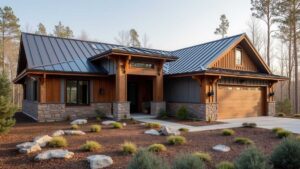
Zone 0 covers the immediate 0-5 feet around the structure. The goal is to eliminate all the fuels that could ignite from embers and burn against the house.
Keep bark and mulch out of this zone and use non-combustible materials like gravel, pavers, concrete or rock for landscaping. If you want to add greenery to Zone 0, choose low-growing, high-moisture plants like succulents. Clean the area regularly to ensure it’s free of fallen leaves and other debris.
Zone 1 — High Priority
Zone 1 covers the area 5-30 feet from the house. Aim to create a landscape that will not transmit fire to your home. If embers land there, they should find nothing to burn.
Grow low-growing, well-irrigated, fire-resistant plants with some distance from each other to keep flames from spreading. Avoid large patches of flammable vegetation, and choose fire-resistant groundcovers. Zone 1 is typically the most intensively gardened zone, as it may require regular watering, dead branch pruning and ground litter removal, depending on the landscape.
Zone 2 — Wildlife Buffer
Also known as the fuel reduction zone, the goal of Zone 2 is to slow the approaching fire and reduce its height and intensity. Larger, properly maintained fire-resistant trees and shrubs are ideal. You can also plant native, fire-adapted species.
However, keep the landscape “thin.” Remove clusters of dense vegetation to create “fuel breaks” and limb up trees to remove ladder fuels.
Horizontal Spacing Requirements
Strategic horizontal spacing can prevent fire from jumping from one plant to the next. The distance between two shrubs or trees should be at least two times their mature height.
For example, if a shrub grows to be five feet tall, the next one should be at least 10 feet away. You can plant shrubs in small clusters, but use 15-20 feet of irrigated lawn or a non-combustible groundcover to keep the groups separate.
Vertical Spacing Requirements
For strategic vertical spacing, aim to eliminate ladder fuels that allow a small ground fire to climb up tall vegetation. Increase the space between shrubs and trees, and keep branches trimmed up to at least 6 feet from the groundcover.
Multiply shrub height by three to get the ideal clearance. For example, a 5-foot shrub near a tree needs 15 feet of clearance to the tree’s lowest branches. Keep in mind that the minimum distance between the tree canopy and the shrub is 10 feet.
The Fire-Resistant Plant Database by Zone
These lists are a starting point, not an exhaustive encyclopedia. The best fire-resistant plants are those native or well-adapted to your specific location. Consult native plant specialists for recommendations for your exact microclimate.
Zone 0 — Ember-Resistant Options
You can add plants to this area, but aim to add zero fuel. Choose species that won’t carry a flame to the house.
Groundcovers
All varieties of sedum: Hardy, low-growth succulent plants with water-filled leaves
Ice plant: Has high-moisture, fleshy leaves and a dense, low weed-suppressing mat
Brass buttons: Has a fine texture but stays green and grows low
Creeping thyme: Stays green, low to the ground and doesn’t build up significant dead material
Small Perennials
Coral bells: Has coarse leaves and a low-profile growth habit
Hens and chicks: Form tight rosettes and have a high moisture content
Stonecrop: A drought-tolerant succulent with water-filled leaves and low oil or resin levels
Keep trees, shrubs and grasses away from Zone 0. Even a small, well-watered shrub can accumulate flammable debris at its base. Using non-combustible mulch is nonnegotiable, as bark or wood chip varieties are essentially pre-packaged kindling. Rock, gravel and sand are better options.
Zone 1 — Low-Flammability Plantings
If you want some green in this area, keep it lean and clean. Choose plants carefully and grow them in clusters to keep fire from spreading.
Shrubs
California lilac: Has low oil and resin levels, stores water effectively and creates minimal, slow-burning litter
Bush anemone: Has high moisture retention and a lack of oily, volatile compounds
Toyon: A slow-burning evergreen shrub with thick, leathery leaves that retain moisture
Currant: Has a high internal moisture, burns slowly and does not accumulate large amounts of dead material
Mock orange: Features well-hydrated broad leaves and low levels of volatile oil
Perennials
Yarrow: A low-lying, compact groundcover that’s drought-tolerant and well-hydrated
California fuchsia: Has low fuel volume, low oil and resin content and is hard to ignite
Salvia: Retains moisture well, does not accumulate dry, dead material and grows low on the ground
Daylily: Features water-storing fleshy leaves and low fuel volume
Small Trees
Redbud: A deciduous tree that does not accumulate large amounts of dead wood, leaves and needles
Dogwood: Has a high internal moisture content, low resin levels and an open branching structure
Cherry and plum: Stores moisture effectively, generates little dead material and is free of volatile waxes or oily sap
Fire-resistant plants can become flammable if they’re drought-stressed or drying, so water them regularly. Remove dead material weekly. Also, make sure to space trees and plants at least twice their mature width apart.
Zone 2 — Fire-Adapted Landscape
This is the buffer zone. Design a landscape that can help slow an approaching fire and reduce its flame height.
Trees
Hardwoods: Generally safer than conifers due to their high moisture content, less flammable resin and open canopy
Conifers: Can be acceptable in this zone, but only if they’re mature, widely spaced and limbed up
Shrubs
Manzanita: Requires active management to keep it from becoming overly woody, but has good fire-adapted properties
Serviceberry: Has an open structure that produces less fuel than dense evergreens
Coffeeberry: Features leathery, moisture-rich leaves that are less likely to ignite
Ground Layer
Native bunchgrasses: Preferable to a solid carpet of turfgrass, but must be mowed to less than four inches in late spring before they dry out
Wildflowers and low forbs: Typically grow low to the ground, retain moisture well and lack the volatile oils that fuel wildfires
Keep the trees 10-30 feet apart. If you have shrub clusters, ensure there’s at least a 15-foot distance between them. Thin shrubs, limb trees and reduce fuel material often.
Plants to Avoid (Fire-Hazard Species)
While no plant is fireproof, some species are so inherently flammable that including them in a fire-prone landscape is a serious mistake. They can act like solid gasoline, undermining all other fire safety efforts.
According to a licensed and International Society of Arboriculture (ISA) certified arborist from Richard’s Tree Service, “In a 10-year average, humans caused 88% of forest fires in America. Making poor planting choices near a home is one way homeowners contribute to the overall problem. Alternatively, actively removing hazardous varieties is one of the most impactful ways you can take to avoid becoming part of that statistic.” The team advises avoiding the following fire-hazard species in your landscape.
1. High Hazard
Juniper: Has extremely high resin content, a structure that retains dead, twiggy material and a tendency to burn explosively
Pampas and fountain grass: Accumulate dense, fine, dead material in their cores that embers can ignite quickly
Eucalyptus: Has a high oil content and tends to shed flammable bark, which spreads fire
Italian cypress: Often called “roman candles” due to its high resin, dense vertical structure and dead branch retention
2. Moderate Hazard
Most conifers, when close to structures: Flammable needles and sap or resin make them a risk
Most ornamental grasses: Maiden grass is tall and dry, blue fescue generates fine fuels, and feather reed grass retains dead material
California bay laurel: Highly flammable due to its high oil content
3. Regional Hazards
Southeast: Wax myrtle, gallberry, saw palmetto when not maintained
Southwest: Chamise, pinyon pine, sagebrush species
Northwest: Scotch broom, gorse, large rhododendron
Northeast (emerging risk): Eastern red cedar, ornamental junipers
Regional Plant Selection Guides
These lists are general starting points. To get more ideas, talk to a local native plant nursery to find the species best suited for your specific soil, sun exposure and elevation.
1. Pacific Northwest
Western Washington, Oregon and the Northern CA coast often get mild, wet winters that lead to lush growth. However, summers are increasingly long and dry, creating significant fire risk. Fire-resistant plant recommendations include:
Trees: Bigleaf maple, red alder, Pacific dogwood, vine maple
Shrubs: Red flowering currant, ocean spray, osoberry, evergreen huckleberry
The Golden State has dozens of microclimates. The plant selection for each region reflects the local conditions. However, regardless of the area, it’s best to avoid eucalyptus, Italian cypress, pampas grass, bamboo and large junipers.
Coastal
Trees: Coast live oak, large toyon, well-maintained California bay
Shrubs: Low-growing ceanothus, California fuchsia, coffeeberry
Groundcovers: Yarrow, beach strawberry, sedums
Inland Valleys
Trees: Valley oak, California sycamore, western redbud
Shrubs: Mock orange, bush anemone, currants
Groundcovers: California poppy, Dudleya, native fescues
Sierra Foothills
Trees: Well-spaced ponderosa pine, black oak, maintained incense cedar
Shrubs: Low-growing manzanita, mountain mahogany
Groundcovers: Sedges, monkeyflowers
Southern California
Trees: Coast live oak, California pepper tree
Shrubs: Lemonade berry, toyon, sugarbush
Groundcovers: Succulents like Dudleya and Sedum, native salvias
3. Southwest
In Arizona, New Mexico, Nevada and Utah, the climate is typically hot and arid. Intense sun and monsoon seasons are the norm. The best choices in these places are naturally water-wise plants with fire-resistant properties:
Cacti and succulents also offer excellent fire resistance, thanks to their high moisture content.
4. Rocky Mountains
Colorado, Wyoming, Montana, and the Idaho mountains are home to cold winters, dry summers and vast forests of ponderosa and lodgepole pine. Top plant choices for these areas include:
Trees: Highly fire-resistant aspen, cottonwood, mountain maple
Avoid: Dense juniper, large sagebrush, unthinned pine/fir stands
Conifers can be retained at a distance if well-thinned and limbed.
5. Emerging Fire Risk Regions
While these regions don’t have the same history of wildfires as the West, changing climate patterns are increasing the frequency of drought and fire risk. The key strategy is usually to choose native deciduous hardwoods over flammable ornamental conifers, which are often overplanted in these areas.
Avoid: Pine straw mulch near the house, dense saw palmetto
Northeast
Trees: Hardwoods preferred, like maple, oak, birch
Shrubs: Viburnum, sumac, blueberry
Avoid: Eastern red cedar, ornamental junipers, extensive groundcover junipers
Maintenance Practices for Fire Safety
A brilliant design can become a firetrap in a single season without regular maintenance.
1. Irrigation Requirements
To keep everything moist:
For Zone 0, year-round vigilance is a must because it’s immediately adjacent to your house. Keep all the plants in this area at maximum hydration, even in the off-season.
For Zone 1, keep the vegetation lush and green. Keep it well-irrigated throughout the entire local fire season, which can vary per region. In much of California, this could be from May through October, while in the Pacific Northwest, it might be June through September.
For Zone 2, practice supplemental irrigation, which delivers water directly to the plant’s roots, minimizing loss from evaporation. This method leads to healthier, more robust plants.
2. Pruning and Thinning
Know what to do yearly and by season.
Annual Tasks
Remove dead branches from all trees and shrubs.
Limb trees to 6-10 feet above ground to remove ladder fuels.
Thin shrub canopies to 30-40% to improve airflow and reduce fuel density.
Deadhead perennials and remove dried flower stalks.
Seasonal Timing
Late winter to early spring: Conduct major structural pruning while plants are dormant.
Late spring: Mow lawns before they dry and become flammable.
Summer: Remove dead material weekly in Zones 0-1 during peak fire season.
Fall: In regions with autumn fire seasons, this is the time for major cleanup to prepare for that risk period.
3. Clearing Ground Fuels
Fallen leaves are like a welcome mat for embers, especially in Zones 0-1. A weekly clearing during fire season is essential, but consider balance. A thick carpet of dry pine needles is extremely flammable, but completely bare soil can cause erosion. Leaving a layer no more than 3 inches deep is a possible solution.
Remove all fallen branches and other woody debris from Zones 0-1. Unlike leaves, these larger fuels can hold a flame for a long time, giving fire more time to ignite your house. Also, never keep flammable wood or bark mulch within 5 feet of any structure. For good measure, you can create “fuel breaks” by separating mulch beds with nonflammable walkways.
4. Grass Management
Four inches of grass is a lawn. Twelve inches is a field of fuel, so keep your grassy field short. In dry climates, a well-maintained dormant lawn that’s mowed to 1-2 inches is actually more fire-safe than a stressed, partially green lawn because it contains little fuel to burn.
Mow the grass before it dries completely because it’s much less flammable while it’s green. Imagine the mower blade striking a rock and creating a spark, which can easily ignite a field of dry grass. Also, don’t use leaf blowers during an active wildfire event in your area. Gas-powered ones can suck in embers and act like flamethrowers, releasing them into new fuel sources.
5. Tree Care Specifics
The goal is to prevent a crown fire, where fire jumps from treetop to treetop. Thin trees so their outermost branches don’t touch the branches of the neighboring trees.
Remove snags or standing dead trees. They’re double hazards, as they’re a massive, pre-dried piece of fuel that can fall during a fire, potentially onto your house or an escape route.
Maintain a 10-foot clearance between any tree branch and your roof or chimney to prevent direct flame contact. It also keeps branches, leaves and needles from accumulating on the roof. If you have conifer trees, prune their lower branches more aggressively than you would hardwoods to maintain a safe vertical clearance.
Balancing Fire Safety With Ecosystem Health
You don’t have to create a sterile, barren scape around your home. Modern fire science promotes a balanced approach that increases a home’s safety while fostering a healthy, thriving local ecosystem.
With large-scale environmental shifts, this balancing act is more critical than ever. According to the World Meteorological Organization, 2015-2025 were the hottest 11 years in history. In a world where the temperatures rise steadily, a fire-safe landscape is sustainable and ecologically sound.
The Native Plant Advantage
The plants native to your region are genetically programmed to thrive in your specific climate, soil and rainfall patterns. This means they’re less likely to become drought-stressed and flammable. They also require less water, fertilizers and pesticides than ornamental varieties from other regions.
Native plants also support the nearby ecosystem. They provide the specific food and shelter local birds, pollinators and beneficial insects need to survive.
Fire-Adapted ≠ Fire-Safe Near Homes
Fire-resistant plants don’t ignite easily due to characteristics like high moisture retention and low resin. Fire-adapted species have evolved strategies to survive or even thrive after a wildfire. For example, the chamise is a fire-adapted native that’s supposed to burn. Some of its seeds only germinate after a fire, making it a terrible choice near a structure.
Place truly fire-resistant plants in Zones 0 and 1. Use fire-adapted native species further out in Zone 2, where they can be a part of a healthy ecosystem without endangering your home.
Creating Wildlife Corridors
Instead of planting a continuous, dense thicket of shrubs, you can create islands of three to five native shrubs in Zone 2. These islands provide shelter and food for birds and small animals, creating a corridor for them to move through the area without creating a continuous fuel path for fire. Place water sources like bird baths and ponds well away from your house to draw animals to a safer part of the property.
Avoiding Invasive Species
Many of the plants on the “High Hazard” list are also destructive invasive species. By removing these plants from your property, you increase your home’s fire safety and simultaneously help restore the health of your local ecosystem.
Working With Existing Landscapes
Most people are starting with a yard filled with mature and potentially hazardous plants and landscapes that make ensuring fire safety challenging. A good example is the Steen House in Santa Rosa, California. It sits on a hilltop compound, making it vulnerable to terrain-driven fire and wind-blown embers. To improve fire safety, it has nonflammable hardscape near the structure and fire-resistant plants further out.
The Steen House proves that hillside lots can be successfully retrofitted to survive a wildfire. The key lies in assessment and implementing the right landscaping strategies.
Assessment Process
Walk through your property with a clipboard, camera and measuring tape. Mark 5-foot, 30-foot and 100-foot circles out from your home’s foundation and deck.
Take photos of every plant and use a plant encyclopedia or online resource to identify them. Compare them against the fire hazard list, and take note of all the plants for removal. Also, be sure to check for ladder fuels.
Prioritization
A full retrofit can be a huge job, so it’s best to take a phased approach. Focus on Zone 0 for the first year. Remove all flammable materials within five feet of your home.
Tackle Zone 1 the following year, or once you’re done with the first area. Remove any remaining fire-hazard plants and start thinning and spacing the rest. Plant fire-resistant replacements.
You can move on to Zone 2 tasks once Zone 1 is secure. Limb up trees and begin the long-term project of managing the outer buffer zone.
Removal Strategies
Hire a certified arborist for large trees, trees near power lines and for any removal that requires a chainsaw on a ladder. Professionals are insured against property damage and have the right equipment to do the job safely and efficiently. They also know how to remove trees without damaging nearby structures or plants.
Take the DIY approach for smaller plants and shrubs. You can usually remove them using hand tools like shovels, saws and loppers. Always wear gloves and eye protection, and be aware of your surroundings.
Before you cut anything, find your local waste management or fire department website to determine local disposal regulations. Some communities have green waste bin programs, while others offer seasonal curbside pickup for yard debris. While some areas may require chipping, burning debris is rarely the answer.
Once you remove a hazardous plant, it’s best to have a replacement plan ready. Bare soil can erode, and it’s also the perfect seedbed for flammable weeds. Install new, fire-resistant plants during the same planting season you do the removal. This establishes the plants quickly, helps stabilize the soil and completes the safety upgrade for that part of your landscape.
When to Get Professional Help
Calling an expert is best if:
Removing the tree requires a chainsaw operated at shoulder height.
The tree has a diameter greater than 10-12 inches.
The tree or branch is within 15 feet of a power line.
You’re unsure how to safely fell a tree or large shrub.
You need a formal wildlife risk assessment for insurance purposes.
You want a professionally designed and implemented fire-safe landscape.
The Cost of Fire-Safe Landscaping
How much you sink into your landscaping covers more than the initial set up.
Initial Investment
Besides the new plants, the initial investment includes the cost of removing old vegetation and evaluating the hardscape features that are part of the defensible space zones. When budgeting for a landscape overhaul, you must also consider improvements to adjacent features, like a flammable wooden deck attached to your house. Upgrade to fire-resistant materials like PVC or concrete. If you prefer wood, choose decking that meets Class A fire ratings for safety.
Ongoing Maintenance Costs
If you’re taking the DIY route, consider how much time you’ll spend on upkeep. During the fire season, you may need to spend four to eight hours monthly doing things like:
Raking leaves and pine needles from Zone 0
Cleaning debris off the deck
Checking your irrigation system for leaks or clogs
Pruning new growth lightly
Pulling out weeds
Hiring professionals to help could mean paying $100-$300 per visit, monthly or quarterly. Beyond mowing and cleaning, the landscape maintenance crew could cover fuel reduction tasks such as ground litter removal, low tree branch pruning and shrub thinning.
Irrigation can increase your water bill to $20-$100 per month during fire season. The fire-resistant quality of your plants often depends on their high moisture content. A drought-stressed succulent is far more flammable than a well-watered one.
Cost Offsets
Contact your insurance agent and ask if your provider offers discounts for homes that are certified by Firewise USA or the IBHS Wildfire Prepared Home program. Some insurers offer up to 20% discounts.
In fire-prone regions, a well-documented fire-safe landscape is becoming a significant selling point, similar to a new roof or updated kitchen. Native fire-resistant plants can sweeten the deal, thanks to their beauty and easy upkeep.
Grants and Programs
Check your state’s website for cost-share programs, which reimburse homeowners for a percentage of the cost of professional services. Their availability varies by location.
You can also find your local Fire Safe Council online. These nonprofit organizations often provide free chipping for debris disposal, organize volunteer groups for plant removal assistance and other services.
After major fire events, look for grant announcements from federal agencies, which provide funds to communities and individuals for rebuilding and reducing future risk. Don’t forget to check with your own homeowners association or community group for internal programs or shared resources for landscape maintenance and neighborhood cleanup days.
Certification and Professional Assessment
Getting an official designation proves you’ve done the work correctly and opens doors to insurance discounts.
Wildfire Prepared Home Program
The IBHS developed this program, which determines exactly what makes a home vulnerable or resilient based on full-scale wildfire testing. Rigorous, repeatable experiments built these science-based standards. The program has two levels:
Base: This focuses on protecting a home from embers, the most common wildfire threat.
Plus: This is for homes in areas with a higher wildfire risk, adding protection against direct flames and radiant heat.
Many insurance companies look for this program to gauge a property’s risk reduction measures. The IBHS website has a self-assessment checklist that you can use to do a preliminary audit of your home. If you’ve earned the designation, let your insurance agent know when you inquire about their discounts.
FireSmart Assessments
FireSmart is the leading wildfire preparedness program in Canada and is so successful that many communities in the U.S. have adopted its principles. It’s essentially a free home assessment from trained local coordinators.
The experts will walk the property with you and provide a customized list of specific, actionable recommendations to improve its fire resistance. They can also help you connect to local grants, chipping programs and FireSmart-certified contractors. If a whole community works together to get certified, it can achieve a neighborhood-level certification, which can lead to even greater insurance recognition.
Professional Wildfire Risk Assessments
While IBHS and FireSmart are excellent programs, many consider an assessment from a state or local fire agency as the official word on a property’s risk. Either entity offers a highly detailed, customized mitigation plan that prioritizes actions based on the highest risk. Because these agencies have a vested interest in reducing wildfire risk, these evaluations are often provided at little to no cost to the homeowner.
What to Expect in an Assessment
Evaluators typically check the entire ecosystem of your property, including:
Vegetation: They will identify hazardous plant species and use a measuring tape to check for proper spacing and clearance.
Topography: They will analyze your property’s slope and explain how it could affect fire behavior.
Structure: They will inspect your home’s weak points for ember intrusion, such as its vents, eaves, windows and roofing materials.
Access: They will measure your driveway’s width to determine if a fire engine can safely get to your property.
Water: They will note the location of the water sources firefighters could use, such as the nearest hydrant, pool or large tank.
Getting Certified
While the exact process may vary, these steps are often essential for fire safety certification:
Complete the required mitigation tasks noted in your assessment.
Document your work with before and after photos, as well as receipts for professional services and materials.
Submit your application to the certifying organization.
Receive your official certification.
Once you get your designation, contact your insurance agent. Inform them of your new achievement and provide documentation to secure potential discounts.
Planting for Survival
The choices you make in the last 100 feet around your home are more critical to its survival than a fire truck. A fire-safe landscape is a long-term project. The earlier you start, the safer you’ll be. Moreover, every home that creates defensible space helps reduce the risk to the neighborhood, as it removes fuel and creates a safer environment for firefighters.
There’s a wide selection of stunning fire-resistant native plants available, so you don’t have to sacrifice aesthetics. Make the last days of spring count. Grow plants that will both beautify and protect your home.
About the Author
Rose Morrison is the managing editor of Renovated Magazine. She has over six years of experience writing about sustainability, circular economy, and better building. When not contributing to various reputable publications and advocating for environmental awareness, Rose loves being outdoors and spending time with her pets.

 Login
Login