Today, extensive tooth repair or replacement often requires the installation of a dental bridge made from durable resin and metal. That said, the procedure is nothing new. Archaeological examples of dental bridges date back thousands of years across cultures around the world. Recently, researchers discovered the oldest variant ever found in Scotland, but it’s anything but inconspicuous. According to a study recently published in the British Dental Journal, the medieval dental bridge excavated in
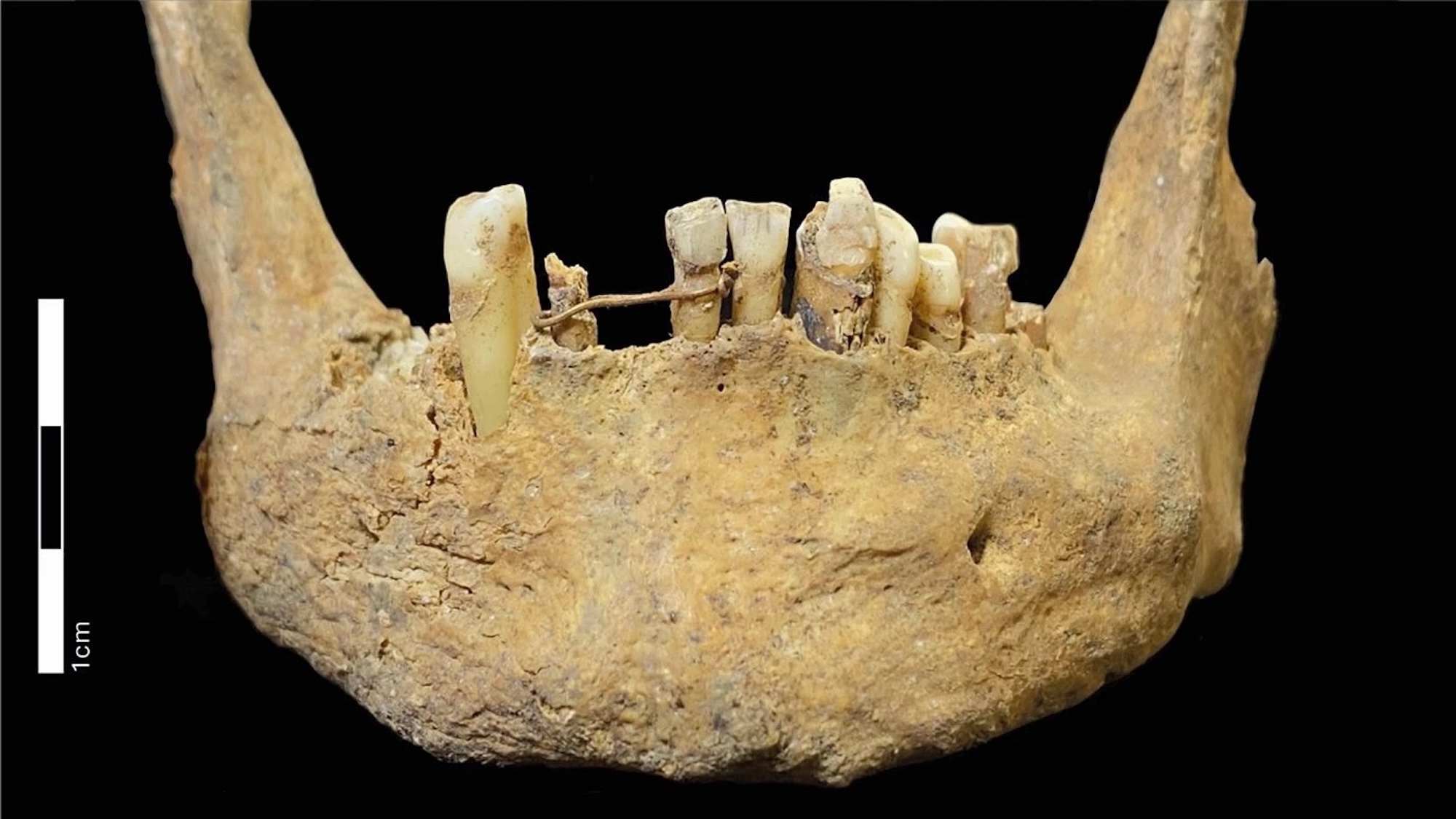
Today, extensive tooth repair or replacement often requires the installation of a dental bridge made from durable resin and metal. That said, the procedure is nothing new. Archaeological examples of dental bridges date back thousands of years across cultures around the world. Recently, researchers discovered the oldest variant ever found in Scotland, but it’s anything but inconspicuous. According to a study recently published in the British Dental Journal, the medieval dental bridge excavated in Aberdeen was crafted using 20-carat gold.
Simplified bridges made from silver or gold wire called dental ligatures date back to at least 2,500 BCE in ancient Egypt. In some cases, funerary preparers installed them in the recently deceased to make their bodies appear more “complete” for the afterlife. However, it took until the Middle Ages before more complicated dentistry spread throughout Europe. Even then, primary texts suggest tooth maintenance likely wasn’t performed by doctors or surgeons.
“During the Middle Ages, teeth were often treated by barbers, or dentatores, who were individuals that specialized in teeth.”University of Aberdeen archaeologists wrote in their study.
Few dental ligature artifacts exist from England prior to the 17th century, and none of them were found in Scotland before the team’s analysis. That is until 2006. A team digging on the grounds of East Kirk of St. Nicholas Kirk in Aberdeen (“kirk” is Scottish for “church”) uncovered a trove of skeletal remains including the skull in this study.. The team recently reexamined 100 of the roughly 900 individuals in the collection—only one of which featured a dental ligature.
35x magnification of the knotted end of the ligature. Credit: Dittmar, et al.
X-ray spectroscopy, scanning electron microscopy, and radiocarbon dating filled in many gaps about the person’s identity. Based on their findings, the researchers believe the remains belonged to a middle-aged man who died in Aberdeen sometime between 1460 and 1670. Dental evidence also revealed his bridge had been installed long before his death.
The 20-carat gold alloy ligature’s existence and composition suggests that the man was not only wealthy, but well connected in his community. Although they can’t definitively know if he received care in Aberdeen, records show around 22 goldsmiths worked in the area during that era. These artisans were likely skilled enough to craft and securely knot the wiring.
The reasons for receiving the implant were probably “multifaceted,” according to the study’s authors. Physical appearance during the Late Medieval and Early Modern eras was often culturally tied to one’s character.
“The appearance of a person and their perceived health was linked to one’s sins,” they explained. “As such, the social importance of an individual’s smile encouraged those who were able to afford such treatments to seek them out.”
Apart from being the first dental discovery of its kind in Scotland, the artifact underscores just how long humans have balanced the complex interplay between wealth, beauty standards, and personal health.
Your immune system has one job: to protect you. And most of the time, it does that job like a pro.
But occasionally it gets a bit overzealous, even paranoid. It mistakes harmless, even wonderful things—flowers, peanuts, cats—for threats, and attacks them (and you—mostly you) with a senseless, chaotic vengeance.
For most allergy sufferers, this might mean giving up a few tasty foods, staying inside during high pollen counts, or rehoming the cat—or, more realistically, the person allergic t
Your immune system has one job: to protect you. And most of the time, it does that job like a pro.
But occasionally it gets a bit overzealous, even paranoid. It mistakes harmless, even wonderful things—flowers, peanuts, cats—for threats, and attacks them (and you—mostly you) with a senseless, chaotic vengeance.
For most allergy sufferers, this might mean giving up a few tasty foods, staying inside during high pollen counts, or rehoming the cat—or, more realistically, the person allergic to the cat. But for a tiny number of people, the immune system decides to take aim at one of the most essential substances on earth: water.
Yes, it is possible to be allergic to water. And the condition is even stranger than it sounds.
“Imagine not being able to go into the pool, or the lake, or the ocean,” says dermatologist Dr. Amir Bajoghli, who has treated a patient with this rare condition. “My patient also has to take much faster showers, as you might imagine. It definitely interferes with quality of life.”
Yes, you can be allergic to water
The medical term for an allergy to water is aquagenic urticaria, a form of hives. The condition is so rare that only an estimated 100 to 150 cases have ever been reported. However, researchers believe many more cases go undiagnosed: When a patient comes in complaining of hives, “it could be water” is probably not the first thing that leaps to mind.
People with this rare condition break out in hives like these when exposed to water. Image: Getty Images / Yuliia Kokosha
“Honestly, a lot of general physicians aren’t even aware of it,” says Bajohgli, an adjunct professor at Georgetown University School of Medicine. “It’s rare, and it’s not on their radar.”
Although scientists don’t fully understand exactly how aquagenic urticaria works, they believe water itself isn’t the culprit. Rather, it appears that certain people’s skin responds differently to water contact, setting off a reaction in the skin’s outermost layer. This triggers the body’s mast cells (immune cells that sound the alarm during allergic reactions), which releases histamine, the troublemaking chemical responsible for allergic responses.
Within minutes of water touching the skin, a person with aquagenic urticaria will develop raised, intensely itchy welts. The reaction typically lasts anywhere from 30 minutes to an hour, and the longer the exposure, the more severe the symptoms.
You can still drink water, but sweating can be a problem
Interestingly, and luckily, aquagenic urticaria does not interfere with the body’s need for life-sustaining hydration. In other words, drinking water is fine. When water is swallowed and processed by the gut rather than absorbed through the skin, it doesn’t trigger the same immune response, Bajoghli says.
“The gut, just like the skin and the lungs, is one of the first forms of defense,” he says, “but in this case, somehow, it’s not eliciting the response in the gut the way it does in the skin.”
Bajoghli notes that some patients with aquagenic urticaria do react to their own sweat, although his patient does not. Sweat, he explains, involves an entirely different biological process than external water making contact with the skin.
Scientists believe an unidentified substance in the skin may be triggering this reaction, although much remains unknown.
“It’s still, medically, for us, a mystery,” he says.
How to test if you’re allergic to water
For better or worse (mostly better), water is inescapable. Because of its ubiquity, and also because aquagenic urticaria is something of a medical unicorn, it often takes a while for patients or doctors to connect the dots.
Once it occurs to the patient and provider that water could be the culprit, diagnostic testing is fairly straightforward. It typically involves applying water-soaked compresses to the skin and waiting. In most positive cases, symptoms appear within five minutes, although the test can take up to 30.
“We wait 30 minutes before we call it negative,” Bajoghli says.
The importance of very quick showers
So, what is life like for a person whose body treats H₂O as a sworn enemy? For Bajoghli’s patient, an active teenager involved in sports, the condition reshapes even the most basic daily routines. Among other things, this means really fast showers.
“When he showers for about two minutes, the symptoms are more subdued and milder in nature,” Bajoghli says. “If he takes a longer shower, they’re more severe and they persist longer.”
The good news is that aquagenic urticaria is unlikely to cause a major allergic reaction. It is, however, chronic; patients should not expect it to resolve on its own.
Treatment options do exist, however. Bajoghli’s patient takes an antihistamine called cyproheptadine, which reduces symptoms enough to make that two-minute shower manageable. Timing is important: taking the antihistamine about an hour before water exposure helps maximize its effectiveness.
For patients who need more relief, Bajoghli says a newer drug called omalizumab has shown promise.
For now, the mechanisms behind aquagenic urticaria, including the identity of the substance—or antigen—that triggers it, remain poorly understood, and that knowledge gap makes it difficult to develop more targeted treatments.
“We’re really looking forward to finding out what that antigen is,” Bajoghli says, “and hopefully one day solving this.”
In Ask Us Anything, Popular Science answers your most outlandish, mind-burning questions, from the everyday things you’ve always wondered to the bizarre things you never thought to ask. Have something you’ve always wanted to know? Ask us.
For a woman in her mid-40s to mid-50s, it arrives without warning. She wakes up, overheated, wondering why it’s so hot in the house—until she sees the thermostat is set for 70 degrees, same as always. Or, she’s midway through a work presentation when heat rises from her chest to her face, and she wonders if the flush on her cheeks is visible to everyone in the room.
It’s a hot flash—a rite of passage for the majority of women in either perimenopause, the years leading up to menopause, or the
For a woman in her mid-40s to mid-50s, it arrives without warning. She wakes up, overheated, wondering why it’s so hot in the house—until she sees the thermostat is set for 70 degrees, same as always. Or, she’s midway through a work presentation when heat rises from her chest to her face, and she wonders if the flush on her cheeks is visible to everyone in the room.
It’s a hot flash—a rite of passage for the majority of women in either perimenopause, the years leading up to menopause, or the years beyond it. Menopause itself is diagnosed after 12 consecutive months without a period, but the hot flashes don’t always get the memo.
Here’s everything doctors currently know about hot flashes.
What is a hot flash, and who gets them?
Hot flashes are a sudden heat flare up often paired with flushed skin and sweating. They don’t usually last long, between a minute and five minutes in duration.
Most women experience a hot flash about four and a half to five years after their last period, Dr. Monica Christmas, an OB/GYN at University of Chicago Medicine and director of its menopause program tells Popular Science. She also is the associate medical director of the nonprofit Menopause Society, which provides healthcare professionals with tools and resources to support women through the transition.
Women have grappled with hot flashes—whether simply annoying or genuinely debilitating—for centuries. In 1582, Dr. Jean Liebault of France was among the first to document the phenomenon. But while we know much more about hot flashes and night sweats than Liebault ever did, one question still stumps experts.
“What we can’t answer is why doesn’t everybody get them,” Christmas says. “Because everybody doesn’t get them. I have patients that will say, ‘I don’t know,’ if I say, ‘Are you having any hot flashes or night sweats?’ And as soon as they say that, I’m like, ‘You’re not having them.’”
What’s actually happening inside women’s bodies during a hot flash?
During a hot flash, a woman might feel like she’s spiking a high fever, but physiologically, that’s not what is happening. As women approach menopause and the ovaries begin to make less estrogen, the brain’s internal thermostat—the hypothalamus—becomes hypersensitive to even small shifts in temperature, Christmas says.
The body “thinks” it’s overheating, even when the actual temperature hasn’t changed much. In response, our bodies try to cool us down. Blood vessels dilate, which is supposed to help dissipate some of that heat, but then that triggers a sweating reflex.
“Many people will say, ‘I feel this out of nowhere, this surge of warmth that typically is from the nipple line up,’” she says. “And then as soon as the heat came on, and I felt like I was internally heated up or on fire, I start to sweat.”
Exactly how an individual woman experiences hot flashes varies wildly. Some describe very mild symptoms. Others grapple with profuse sweating. Some experience only hot flashes during the day, while some have regular night sweats. About four in five women experience them at some point during the menopause transition, according to the American College of Obstetricians & Gynecologists.
“There’s a lot of variability,” Christmas says. Common triggers include alcohol, caffeine, high-sugar and highly processed foods, along with stress.
Black women also are more likely to experience more severe and longer-lasting symptoms, sometimes up to 11 years, she says. And research also shows that women with more severe, longer-lasting hot flashes and night sweats appear to be at higher risk of cardiovascular disease.
That doesn’t mean treating hot flashes automatically lowers heart risk, Christmas says. But it does reinforce that these women deserve particularly careful attention to blood pressure, cholesterol, and lifestyle. “I want to make sure I’m doing everything possible to minimize that risk,” she says when she treats her patients.
There’s more to hot flashes than hormonal changes
For decades, the entire process was blamed purely on estrogen loss, Christmas says. But that explanation left some unanswered questions.
“That doesn’t explain why every menopausal woman doesn’t have night sweats,” she says. “And it also doesn’t quite explain why we can sometimes start to experience them during the perimenopause transition because during perimenopause, people still have some estrogen.”
Newer research now is telling a more complex story. When the brain recognizes that a woman’s estrogen levels are low, nerve cells in the hypothalamus called KNDy neurons (pronounced “candy”) become overactive, releasing neurotransmitters, which are chemical signals the brain uses to send messages throughout the body. These neurotransmitters include kisspeptin, dynorphin, and neurokinin B.
“It’s actually those neurotransmitters that seem to have more of an impact on our ability to regulate our internal temperature,” Christmas says. “They’re not hormones.”
What to do if you get a hot flash
For women in the middle of their hot flash years—along with the 10 percent of menopausal women who continue to experience them—there are treatments.
Estrogen-based hormone therapy can help, but not every woman, including those with a history of blood clots or breast cancer, can take hormone therapy.
Hormone therapy can help alleviate hot flashes. Video: Hormone therapy – Four things a Mayo Clinic women’s health specialist wants you to know., Mayo Clinic
Fortunately, researchers’ new understanding about the role of KNDy neurons has allowed for new treatments that block the brain signals that trigger hot flashes in the first place. The FDA approved a new drug called Veozah (it’s chemical name is fezolinetant) in 2023. It targets the neurokinin 3 receptor, which plays a key role in regulating body temperature.
Lynkuet, another drug (with the chemical name elinzanetant), came along in 2025. It blocks both the neurokinin 1 and neurokinin 3 receptors, interrupting the process that triggers hot flashes at two points instead of one.
Other medications can also provide relief, though weren’t originally developed for hot flashes, Christmas says. Some SSRIs and SNRIs; gabapentin, a neurologic medication; and oxybutynin, used for overactive bladder, are all used off-label for hot flashes and night sweats.
Cognitive behavioral therapy and hypnosis also have been shown to reduce hot flashes. “I’m menopausal, too, so I know if I’m under a lot of stress or in a stressful situation, I’m going to probably have more hot flashes than not,” Christmas says.
“So there’s certainly something about being able to calm our central nervous system down that seems to have an impact, too.”
If you’re struggling with hot flashes, Christmas recommends seeing your healthcare provider for help. Treatments are available. What’s more, in some cases, hot flashes or night sweats could signal other issues, including thyroid disorders, cancer, and infections, among others.
But bottom line, when it comes to hot flashes, you don’t have to sweat them out.
In Ask Us Anything, Popular Science answers your most outlandish, mind-burning questions, from the everyday things you’ve always wondered to the bizarre things you never thought to ask. Have something you’ve always wanted to know? Ask us.
It’s four in the morning and you wake from a dream. It wasn’t a nightmare exactly, but it was vivid and unsettling—a circus of imagery in which the other commuters stuck in gridlock beside you were all octopi or your feet were transformed into a pair of horse hooves while going through airport security.
Maybe you don’t often remember your dreams but this one, this episode that fused the mundane with the outlandish, it sticks. Even days later, you can still see those tentacles gripping the s
It’s four in the morning and you wake from a dream. It wasn’t a nightmare exactly, but it was vivid and unsettling—a circus of imagery in which the other commuters stuck in gridlock beside you were all octopi or your feet were transformed into a pair of horse hooves while going through airport security.
Maybe you don’t often remember your dreams but this one, this episode that fused the mundane with the outlandish, it sticks. Even days later, you can still see those tentacles gripping the steering wheels or feel the awkwardness of your gait running to catch your flight.
It couldn’t have been that joint you smoked before bed, could it? Science says maybe.
How weed effects sleep cycles
Reports of vivid dreams are “very well known” in cannabis and neuroscience research, says Andrew Kesner, assistant professor of psychology at Indiana University in Indianapolis. But “we still don’t really know the neurobiology of dreaming and what sort of features make you remember your dreams better or worse.”
Cannabinoids are found naturally in the brain in a non-psychoactive form called endocannabinoids. Endocannabinoids control our sleep/wake cycle, aka our circadian rhythms, by modulating and maintaining the brain’s biological balance through an abundant receptors neuroscientists call CB1.
“When people fall asleep, the brain makes its own cannabinoids that increase and decrease throughout the sleep-wake cycle, and throughout the day,” explains Kesner.
Marijuana contains a different form of cannabinoid than the one naturally produced by the brain, THC or tetrahydrocannabinol. THC also works on the brain’s CB1 receptors but, unlike endocannabinoids, it is psychoactive, meaning it makes users feel high by producing feelings like euphoria and paranoia.
Blooming cannabis plant ready to be harvested into various THC-based products. Image: Sunan Wongsa-nga / Getty Images Sunan Wongsa-nga
When you smoke weed before bed, the THC added to the brain’s natural endocannabinoids sends the brain’s CB1 receptors into overdrive. And when those CB1 receptors are in overdrive, they change the way you sleep.
Natural sleep in healthy adults begins with a short period of nodding off followed by a stage of “slow-wave” sleep, that deep sleep from which it’s hard to wake someone up. Cycles of lighter sleep punctuated by bouts of REM (rapid eye movement) sleep follow, growing longer and longer throughout the night.
“REM sleep is classically the time when you’re dreaming,” says Kesner, when “your brain acts like it’s awake but the brain stem paralyzes your body so you can’t act out your dreams.”
Consuming THC appears to suppress REM sleep: It causes it to arrive later in the sleep cycle and to make up less of the overall percentage of sleep. THC also causes more frequent interruptions to REM sleep. That, says Kesner, may be the origins of its reputation for causing weird dreams.
“We know if you wake someone up in REM sleep, that’s when they have the highest chance to remember their dreams,” he explains. So, while there’s no evidence that dreams under the influence of THC are any different than THC-free dreams, the ability to remember them more easily may make the sleeper believe they are more bizarre or intense.
“It’s possible that the THC could be making dreams more intense by changing cortical activity [the way the brain functions], making them wonkier and maybe adding some variability to what you’re dreaming about,” Kesner continues. But the huge variability among individuals in both sleep and the effects of THC use makes objectively studying weed-induced dreams “kind of a nightmare”—pun not intended.
Researchers still don’t even know exactly what dreams are or why they happen—though there’s a good chance that it may be the brain coming up with different learning scenarios, according to Kesner. Someone who plays with puppies all day may, for example, dream that night about being chased by wolves. That way, if it ever happens in real life, the dreamer is better prepared to react to them.
Whether the weed was smoked or taken in edible form is probably also important; THC immediately affects the brain when smoking while edibles take time for the body to metabolize. One study in which participants reported weird dreams after smoking weed before bedtime, therefore, may have had to do more with the way REM sleep “rebounds,” or immediately returns to longer and more robust natural cycles, when the brain experiences THC withdrawal than with THC’s psychoactive effects.
It’s well documented, says Kesner, that chronic THC users experience more intense REM sleep after they stop using it. The same might happen in occasional users, whose REM sleep could theoretically become more intense as the acute effects of weed wears off during the night. In other words, you don’t sleep as well while weed’s psychoactive THC is bouncing around your brain but it becomes much more restorative as soon as its effects wear off.
Ultimately, there probably is no “one-size-fits-all for what cannabis does to sleep or how it affects dreams,” Kesner concludes. As of now, there’s simply not enough data to come to any meaningful verdict. THC or not, dreams are, by their very nature, weird.
In Ask Us Anything, Popular Science answers your most outlandish, mind-burning questions, from the everyday things you’ve always wondered to the bizarre things you never thought to ask. Have something you’ve always wanted to know? Ask us.
The US uninsured rate is expected to rise significantly in the coming years. | Malte Mueller/Getty Images
One of the clearest success stories in US healthcare over the past 20 years has been the dramatic decline in the number of Americans without health insurance. In 2010, the year the Affordable Care Act was enacted, 16 percent of the population lacked coverage. By 2025, according to estimates from the US government, that figure was cut nearly in half, to 8.3 percent.
The increase in c
The US uninsured rate is expected to rise significantly in the coming years. | Malte Mueller/Getty Images
One of the clearest success stories in US healthcare over the past 20 years has been the dramatic decline in the number of Americans without health insurance. In 2010, the year the Affordable Care Act was enacted, 16 percent of the population lacked coverage. By 2025, according to estimates from the US government, that figure was cut nearly in half, to 8.3 percent.
The increase in coverage hasn’t been a panacea; even people with an insurance card can struggle to afford their medical bills or to secure a doctor’s appointment. But with the US standing alone among its international peers in its failure to offer universal healthcare, it represented significant progress toward ensuring every American had a basic level of access to routine medical services.
Now, however, those gains are about to be reversed.
Last year, when drafting their One Big Beautiful Bill, Republicans had a chance to strike a blow against the ACA — a law they’d vilified for years — 15 years after its passage and eight years after failing to repeal the law in President Donald Trump’s first term. They established work requirements to target the people covered by the ACA’s Medicaid expansion and allowed subsidies that had helped millions of people to buy private coverage on the ACA marketplaces to lapse.
As a result, millions of Americans are dropping their health insurance this year, and millions more are expected to lose their coverage in the years to come.
The uninsured rate has spiked before, but it’s usually the byproduct of an economic crisis; people lose their jobs, and they lose their coverage. What makes the current turmoil different is that it is entirely a matter of policy choices.
“I don’t think there’s any historical precedent for the rollback in federal support for health coverage coming with the cuts in Medicaid plus the expiration of enhanced ACA premium subsidies,” Larry Levitt, executive vice president for health policy at the healthcare think tank KFF, told me. “The expected effects of OBBBA on coverage are self-inflicted and dwarf even the historical losses due to changes in the economy.”
ACA marketplace enrollment is projected to shrink dramatically in 2026
One of the major ways that the ACA expanded health insurance coverage was by setting up insurance marketplaces where individuals and families could purchase private health plans with the help of government subsidies.
Sign up for the Good Medicine newsletter
Our political wellness landscape has shifted: new leaders, shady science, contradictory advice, broken trust, and overwhelming systems. How is anyone supposed to make sense of it all? Vox’s senior correspondent Dylan Scott has been on the health beat for a long time, and every week, he’ll wade into sticky debates, answer fair questions, and contextualize what’s happening in American healthcare policy. Sign up here.
Enrollment in those marketplaces has ballooned — particularly since 2021, when Democrats in Congress approved an expansion of the ACA’s financial aid that made more people eligible for assistance. Prior to 2021, there had been a strict cutoff at 400 percent of the federal poverty level (about $64,000 for an individual in 2026, or $132,000 for a family of four). Anybody who made a higher income was ineligible for aid. After 2021, anybody could qualify for ACA subsidies, and their insurance premiums were capped at a percentage of their income. (The subsidies were initially authorized for two years and, then, were extended to 2026 through the Inflation Reduction Act.)
It seemed to have plugged one of the obvious holes in the healthcare law: While many people below 400 percent of the poverty level had enjoyed both mandated comprehensive coverage and new government subsidies that offset any increases in costs, people above that threshold had been subjected to significant premium hikes since the ACA passed. Now, they were able to access the same subsidies, and sign-ups boomed. Marketplace enrollment grew from 9.8 million Americans in 2019 to 22.3 million in 2025.
But, to keep down the cost of their legislation and get it passed with a narrow Senate majority, Democrats allowed the new subsidies to expire in 2026. Then, Trump won the 2024 presidential election, and Republicans took control of Congress. The GOP decided not to extend the subsidies, despite some bipartisan efforts to pull together a plan. When people went to sign up for their health insurance for 2026, many of them no longer had access to financial aid. I spoke last year with some of those people. One family was preparing to allow one parent and child to become uninsured so they could afford a health plan for the other parent who has an autoimmune disease. A young man with asthma also expected to go without coverage after his previous plan ($100 per month and no deductible) was no longer available, and the cheapest replacement he could find was $282 per month with a $10,000 deductible. He told me he was banking on being able to pay for his medication out of pocket or getting it through a charity service.
So, we knew some people would drop their insurance as a result of the expired subsidies, but it was hard to be sure how many. Now, we’re starting to get hard data, and it does not look good. Based on KFF’s preliminary analysis of enrollment data and premium payments, about 4.7 million fewer people will actually end up being enrolled in an ACA marketplace plan in 2026 compared to 2025 — a 21 percent drop in a single year.
Work requirements are going to knock millions of people off Medicaid
The ACA’s other major coverage provision was the expansion of Medicaid eligibility to any American with an income at or below 133 percent of the poverty level (about $21,000 for an individual in 2026, or $44,000 for a family of four). It replaced the preexisting patchwork system for eligibility that created significant differences across states — in particular, millions of childless adults, some of whom were living in deep poverty but had been left out of the program in many states before the ACA, now qualified for Medicaid.
As of June 2025, more than 16 million Americans who became newly eligible for Medicaid through the ACA had been enrolled in the program, making up nearly a quarter of all Medicaid enrollees.
Republicans in Congress had been sharply critical of Medicaid expansion, even as many GOP-led states adopted it, and 2025’s OBBBA gave them a chance to roll it back. They approved, for the first time, national work requirements for Medicaid, targeted to expansion-eligible enrollees, and made several other technical changes to constrain states’ Medicaid financing. People on the program will be required to work or perform other approved activities for at least 80 hours per month or show they should be exempted from the requirement. Otherwise, they could lose their benefits.
And based on what we know from historical precedent, many of the coverage losses won’t be because people are actually ineligible for Medicaid, but because of the administrative burden of complying with these new requirements, even if you are working, or if you are someone — like a pregnant person — who is supposed to be exempted. Arkansas is the only state to implement Medicaid work requirements prior to the OBBBA, and only a fraction of the people required to submit work activities to the state actually did so; many of the people who lost coverage lost it because they failed to turn in paperwork.
The Medicaid population is, by nature, hard to reach. This group is lower-income and might work irregular hours, move around more, or have less access to the internet. It’s easy for people to fall through the cracks.
The OBBBA’s requirements go into effect nationally in January 2027 (after this year’s midterm elections), but some states are instituting them early. Nebraska implemented work requirements on May 1, Montana and Arkansas are starting theirs on July 1, and Iowa will adopt the requirements on December 1. Then, starting on January 1, 2027, they will apply in every state.
The coverage losses are difficult to project, and they could take time to accrue, but they are expected to be sizable. The nonprofit research group RAND estimated Medicaid enrollment will drop by 7.6 million people by 2034.
And they, much like those people dropping ACA coverage, will lose more than just their insurance card. Health insurance, even with its shortcomings, does a lot to help people. Americans with health insurance accrue less medical debt. They are more likely to go to routine medical appointments and receive routine screenings. Prior research on Medicaid expansion’s effects has estimated that it saved tens of thousands of lives.
In other words, the coming increase in the uninsured rate will do more than change some percentage points on a spreadsheet; it will make it harder for millions of Americans to stay healthy and stay alive.
The Graphic Medicine International Collective (GMIC) has announced their shortlist for their GMIC Awards for outstanding health-related comic projects completed and/or published in 2025. There are three categories, long-form, short-form, and educational, with five finalists in each category. Winners will be announced at their annual conference in Baltimore on July 25.Here are the finalists:EducationalLong FormShort […]
The Graphic Medicine International Collective (GMIC) has announced their shortlist for their GMIC Awards for outstanding health-related comic projects completed and/or published in 2025. There are three categories, long-form, short-form, and educational, with five finalists in each category. Winners will be announced at their annual conference in Baltimore on July 25.Here are the finalists:EducationalLong FormShort […]

 Login
Login