In the large-scale murals of Alex Senna, figures gather, greet one another, relax, and interact with their own shadows in bold compositions. The Brazilian artist is known for his black-and-white murals that emphasize community and emotional bonds. Togetherness, security, and positivity pervade the scenes, sometimes playful and other times more contemplative. Set against colorful backgrounds and amid urban structures, Senna’s pieces emphasize connection, support, reflection, and belonging.
In the large-scale murals of Alex Senna, figures gather, greet one another, relax, and interact with their own shadows in bold compositions. The Brazilian artist is known for his black-and-white murals that emphasize community and emotional bonds. Togetherness, security, and positivity pervade the scenes, sometimes playful and other times more contemplative. Set against colorful backgrounds and amid urban structures, Senna’s pieces emphasize connection, support, reflection, and belonging.
At the end of May, Senna embarks on a tour across Italy, France, and Spain to participate in several festivals. Follow the artist’s Instagram for updates.
Festival Monstar, Bosnia (2022). Photo by Ilda Kero“Acrobatas” (2022), Festival da Paz, Friedensstadt, Augsburg. Photo by Sebastian Buehler“A Estrela de Matusalém” (2022), Festival Gragnano, Italy. Photo by Noemi VerdolivaFestival Civita Street Fest, Italy. Photo by Alessia Di RisioFestival Stadt Wand Kunst, Germany (2024). Photo by The Realness“Solitarios” (2024). Photo by Pedro Bayeux“Atento porém Disperso” (2024), Kansas City“Baile dos Mascarados” (2022). Photo by Erib
There's a lot of humor in The London Police's work, from the armies of smiling Lads that propagate the scenes to other characters, like a dog astronaut or mermaids. Yet, there's a sense of absolute perfectionism in every piece. Read Liz Ohanesian's full article by click above.
The post The Art & Adventures of The London Police first appeared on Hi-Fructose Magazine.
There's a lot of humor in The London Police's work, from the armies of smiling Lads that propagate the scenes to other characters, like a dog astronaut or mermaids. Yet, there's a sense of absolute perfectionism in every piece. Read Liz Ohanesian's full article by click above.
Although James Reka finds total freedom in his studio practice, it’s public art that he gravitates toward. The Australia-born artist researches the history of a building or neighborhood as he conceptualizes a mural and enjoys the constraints of creating within a particular geographic and cultural context.
“Public art needs to connect with the local community,” he says. “It does need to have a narrative or a message, even if it’s very subtle. I am mindful of this and choose to view it as a
Although James Reka finds total freedom in his studio practice, it’s public art that he gravitates toward. The Australia-born artist researches the history of a building or neighborhood as he conceptualizes a mural and enjoys the constraints of creating within a particular geographic and cultural context.
“Public art needs to connect with the local community,” he says. “It does need to have a narrative or a message, even if it’s very subtle. I am mindful of this and choose to view it as a challenge to explore certain themes and color combinations that my studio work does not.”
Rheine, Germany
Reka renders minimalist shapes into dense compositions with a distinctive sense of vitality and movement. The largely geometric depictions draw attention to the color palettes and layerings, which the artist builds up through contrasting hues that delineate a hand or face. Architectural details like windows or piping play a role, too, and are incorporated into the final piece.
While the studio and street require different approaches, Reka finds that all of his work has trended toward abstraction in recent years. “I was actually never very good at painting or drawing realistic things!” he says. “Maybe subconsciously, I acknowledged my strengths and weaknesses at an early stage in my art career.” In describing his process, he adds:
I often start by drawing proportionally correct figures before stripping them back to the rawest form or most simplified version. Through sketching, happy accidents occur, which often help me direct the content or composition. Certain lines tend to stand out for me to then manipulate and abstract further. Eventually, this process is ripping the content apart and then rebuilding its core elements in an abstract way.
Reka is currently preparing for a solo show this fall in his hometown of Melbourne. Keep up with his projects in and out of the studio on Instagram.
Known for his collaborative photography projects like Invisible Jumpers, Joseph Ford is interested in perception and intervention. His ongoing series, Impossible Street Art, invites artists such as Antonyo Marest, Alex Senna, and MadC to imagine their work in monumental landscapes via a bit of sleight of hand. The artists create trompe-l’œil interventions on Ford’s photographs, which he then documents on an easel in front of that same place to give a sense of what these huge paintings or inst
Known for his collaborative photography projects like Invisible Jumpers, Joseph Ford is interested in perception and intervention. His ongoing series, Impossible Street Art, invites artists such as Antonyo Marest, Alex Senna, and MadC to imagine their work in monumental landscapes via a bit of sleight of hand. The artists create trompe-l’œil interventions on Ford’s photographs, which he then documents on an easel in front of that same place to give a sense of what these huge paintings or installations would feel like in situ.
“These new works mostly explore infrastructure in the form of huge concrete constructions—nuclear power plants, dams, fossil fuel power stations,” Ford says. The locations are often connected to the industries and network of energy production, such as hydropower systems, or logistical configurations related to highways and ports.
Alex Senna, Luzzone Dam, Switzerland
For example, the nuclear power station “painted” by Skirl is situated in a sprawling nature preserve on England’s east coast, adjacent to the Suffolk & Essex Coast & Heaths National Landscape, and a new plant is currently under construction despite much local opposition.
“These locations are physically in the public domain and dominate their surroundings through their huge scale, but often have restricted access. They are imposed on us—it is impossible not to see them—but it is impossible to engage with them, use them, or sometimes even approach them.” By superimposing street art on otherwise inaccessible sites, Ford and the participating artists address these looming constructions and the nature of energy production as “a way of reclaiming and engaging with them,” he says.
See Ford’s work this month at The Other Art Fair in Chicago, which runs from April 9 to 12. Find more on Instagram.
Skirl, Sizewell Nuclear Power Plant, U.K.Sen2, Willington Power Plant, Derbyshire, U.K.RH Doaz, Jersey Turnpike, New JerseyGuy Denning, Luzzone, SwitzerlandMadC, Luzzone Dam, SwitzerlandChris RWK, New JerseyJoe Iurato, Morris Canal Basin, New Jersey
The surprise of turning onto a street to see a vibrant mural—or the joy of viewing several in progress during popular festivals like Nuart Aberdeen—is essentially an ephemeral experience. Murals may be designed to last several decades, or they may be temporary installations that address a particularly interesting bit of local history or urgent social issue, but either way, the experience is brief as we walk by. Always vulnerable to the elements and new development, these pieces don’t always l
The surprise of turning onto a street to see a vibrant mural—or the joy of viewing several in progress during popular festivals like Nuart Aberdeen—is essentially an ephemeral experience. Murals may be designed to last several decades, or they may be temporary installations that address a particularly interesting bit of local history or urgent social issue, but either way, the experience is brief as we walk by. Always vulnerable to the elements and new development, these pieces don’t always last long. That’s where Art UK’s archive comes in.
As a digital platform, Art UK connects viewers to public collections around the nation. There are about a million artworks on the site, drawn from around 3,500 collections, including museums, libraries, hospitals, town halls, and more. The organization also recently reached a significant milestone in its ambition to map and catalogue street art and murals across the country. Just a little more than two years after launching the initiative, Art UK has added more than 6,600 new works to its database, bringing the total number of public artworks to well over 21,000.
Ranging from small, spray-painted pieces by the notoriously enigmatic Banksy to large-scale compositions by Rogue-one, The London Mural Company, and more, the scope is daunting. “Our initial aim for the project was simple: we wanted to record 5,000 murals and wall-based artworks from across the U.K.,” says Art UK’s Public Art Manager, Tracy Jenkins. “The artworks would date from A.D. 1000 to the present day and include wall paintings in historic churches, post-war ceramic and concrete works, and contemporary painted murals and mosaics.”
Volunteers dedicated more than 5,000 hours to locating and photographing the works. The database includes many that are decades old at this point, emphasizing their sites and condition in case they’re ever threatened by future redevelopments. Most of the works are relatively recent, but Art UK doesn’t discriminate based on date or even if they’re outside. A series of otherworldly paintings inside of St. Thomas’ Church in East Shefford, Berkshire, for example, are centuries old.
Jenkins notes that the project launched at a time when street art and mural-making in the U.K. were experiencing a boom, and the addition of these aesthetic installations within an urban context “has been shown to significantly reduce the instances of unsightly tagging graffiti,” in addition to boosting visitors and local economies. She also acknowledges “public art in any form can be contentious, sparking debate and strong emotion… Street art and muralism is in many ways the most democratic genre—it is not created in a faraway studio, it is not locked behind closed doors, and it does not require prior expert knowledge.”
Creating an archive of street art and murals is a way to build engagement and also understanding of the medium, promoting a feeling of what Jenkins calls “community ownership and pride,” where moments of artistic, informative, playful, and celebratory work delight around city corners. See a handful of additions below, and explore the database on Art UK’s website.
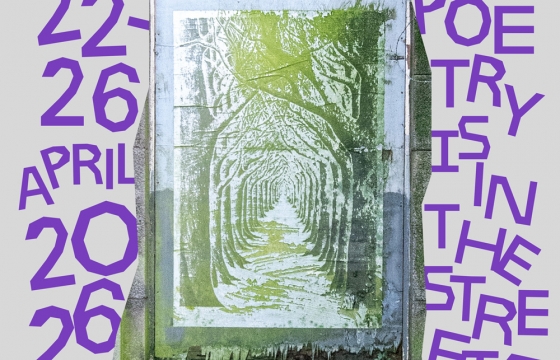
Welcome to the latest edition of Nuart Aberdeen. As far as we can ascertain, this will be the first street art festival in the world with a focus primarily on poetry and text-based works. Over the years, for better or worse, the large scale colourful figurative mural has come to dominate the culture we work with, and although it’s an aspect of the culture we support, due to the resources required to produce murals, they’re perhaps also the least democratic form of art on the streets. As curators
Welcome to the latest edition of Nuart Aberdeen. As far as we can ascertain, this will be the first street art festival in the world with a focus primarily on poetry and text-based works. Over the years, for better or worse, the large scale colourful figurative mural has come to dominate the culture we work with, and although it’s an aspect of the culture we support, due to the resources required to produce murals, they’re perhaps also the least democratic form of art on the streets. As curators, researchers and producers working in “festival” culture, we have a responsibility to not only showcase and celebrate the most interesting and technically competent works of our time, but to also ensure the…

 Login
Login