Reading view

Backlash over chants calling Delcy Rodriguez a ‘monkey’ at Venezuela opposition rally

Madrid, Spain – A chant at a rally for Venezuelan opposition figure María Corina Machado – referring to interim president Delcy Rodríguez as a monkey — has sparked backlash across political divides and forced a well-known Venezuelan singer to apologize.

The chant of “fuera la mona” (get the monkey out) resounded through Madrid’s Puerta del Sol on Saturday as thousands convened to show their support for Machado.

Although it lasted only seconds, the chant drew widespread criticism from both Venezuelan government supporters and the opposition; some denounced it as racist, while others said that, regardless of intent, it was derogatory and inappropriate to comment on someone’s appearance.

Latin America Reports was a few rows from the stage and observed that Venezuelan singer Carlos Baute had been calling for free elections when a small group began chanting. The slogan quickly spread through parts of the crowd. As it grew louder, Baute joined in and turned his microphone toward the audience, prompting even more people to repeat the chant.

By Sunday afternoon, clips were circulating on social media showing Baute joining in the chant on stage. The singer, who has more than a million followers on Instagram, issued a video apology on Monday. He said he had got caught up in the atmosphere of the rally, but insisted he is not racist.

“I let myself be carried away by the emotion of a very powerful moment… and I also know when something wasn’t right,” the 52-year-old said.

“All my life I have sung about love, life and unity. I am not racist. I am a singer who loves his country, his family and God.”

Some on social media who had been at the rally blamed the incident on “infiltrators” and said only a small number of people had taken part.

Not everyone in the crowd participated and some attendees appeared visibly uncomfortable. 

Although the chanting lasted only seconds and were followed by upbeat performances and Machado’s speech, by the following day the footage had gone viral.

Machado, leader of Venezuela’s opposition, moved quickly to distance herself from the remarks, criticizing the chant in an interview with EFE on Sunday: “No one will ever hear me say anything that judges or disqualifies a person based on their religion, gender or race.”

The same day, the Venezuelan Embassy in Spain condemned the remarks, describing them as “a form of political violence rooted in misogyny and racism.”

Others, however, defended the moment, pointing to what they described as a double standard and to language often used by government supporters against opposition figures, including insults directed at Machado such as “bruja” — meaning witch — and “sayona,” a reference to a Venezuelan legend about an evil female spirit.

Prominent Venezuelan journalist, Nicmer Evans, described Baute’s remarks as “racist” but also criticized the government, particularly Interior Minister Diosdado Cabello, for frequently using similar language against opponents.

“Just as I have made clear the racism  and therefore the idiocy of calling Delcy ‘mona’, it is impossible not to point out the cynicism of someone who insults Venezuelan women every day, when he calls Machado ‘sayona’ or ‘bruja,’” he wrote.

Machado is currently in Madrid as part of a European tour, meeting Venezuelan diaspora supporters and political figures. She has not, however, met Spain’s Prime Minister Pedro Sánchez.

Featured image description: Delcy Rodriguez.

Featured image credit: Government of Russia via Wikimedia Commons

The post Backlash over chants calling Delcy Rodriguez a ‘monkey’ at Venezuela opposition rally appeared first on Latin America Reports.

  •  

‘The return home begins today!’: María Corina Machado rallies thousands in Madrid

Madrid, Spain – Venezuela’s opposition leader, María Corina Machado, drew thousands of supporters to Madrid’s Puerta del Sol on Saturday, telling them that they would soon be able to return to Venezuela.

“Today we begin our return home,” she said to raucous applause from the crowd.

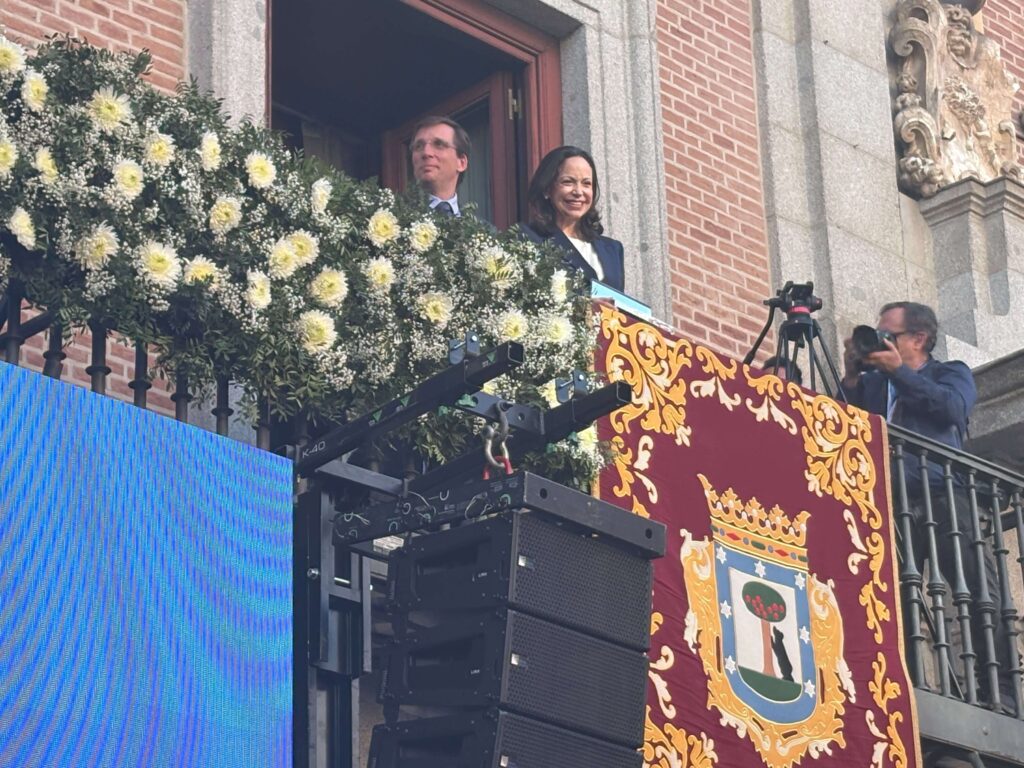
Machado appeared on a balcony draped with the Spanish and Venezuelan flags overlooking the square and flanked by members of her team.

It was a moment that felt closer to a presidential address than a political rally, followed by chants calling for elections to vote her in and cries of “president, president, president” filling the square at various points throughout her speech.

The Madrid rally marks an attempt by Machado to build momentum, amid uncertainty over the opposition’s next steps and anticipation about when she will go back to Venezuela.

Machado won the opposition’s 2023 primary by a landslide but was barred from running in the 2024 presidential election. Edmundo Gonzalez ran in her place and is widely believed to have won. 

But since the capture of Nicolas Maduro by U.S. forces on January 3, many Venezuelans want fresh elections and do consider Delcy Rodriguez, now interim president, to represent them.

A few minutes after Machado’s balcony appearance, she stepped onto a stage in her signature white top and jeans — the same look she wore during dozens of rallies in Venezuela ahead of the 2024 elections — as well as rosary beads around her neck, gifted by supporters.

Machado, who won the Nobel Peace Prize in 2025, lifted small children onto the stage to hug them, as various gifts were passed through the crowd towards the stage — pictures, flowers, and more rosary beads.

She said that on January 3 a huge hole opened up, and that force and energy had begun to flow: “Now, having lived through what we’ve lived through, having endured the worst repression and persecution, having overcome fear, we are now unstoppable — unstoppable.”

While she criticized interim president of Venezuela, Rodriguez, she praised the U.S. president.

“There is one leader in the world, one head of state, who has risked the lives of his country’s citizens for the freedom of Venezuela. And that is Donald Trump,” Machado said, referring to the U.S. capture of Maduro in January.

Machado also paid tribute to the city of Madrid, which she said had welcomed and integrated Venezuelans at their time of need — but said soon they would be able to go back to Venezuela.

“Today the whole world has its eyes on this Plaza del Sol, because it knows that here today we are beginning the return home,” she shouted. “Pack your bags, because we’re going back.”

Spain hosts one of the largest Venezuelan communities in Europe, making it a key base of support for the opposition abroad.

Many Venezuelans at the gathering said that they did want to return home.

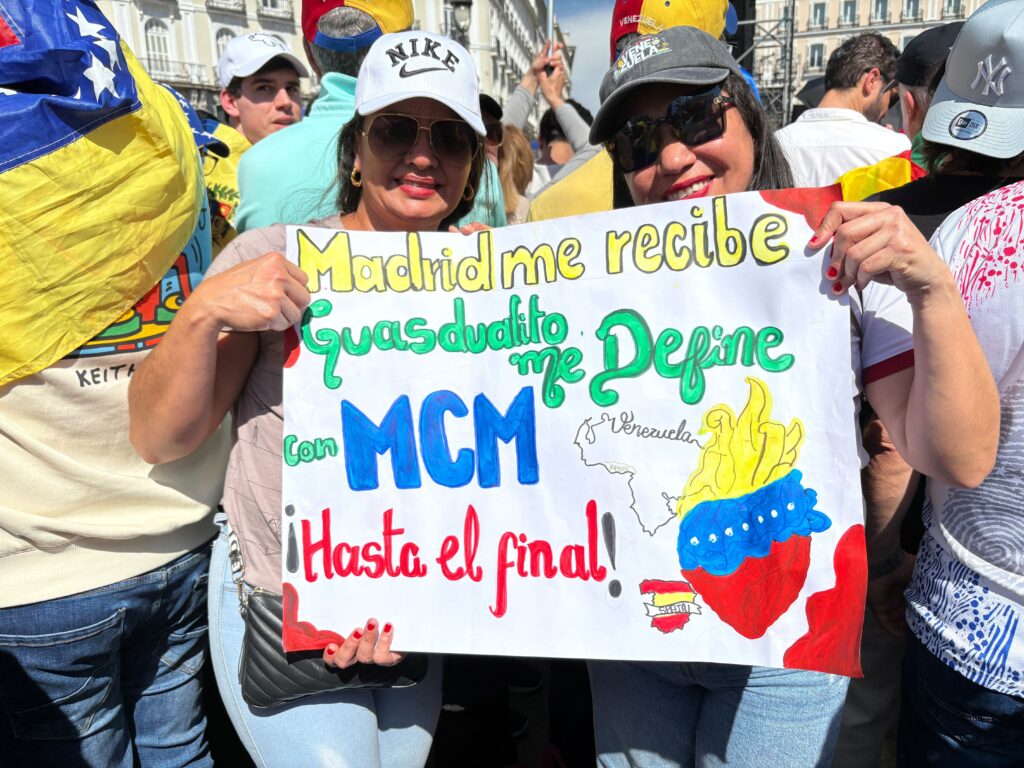
“We were nurses, eighteen years of service, and we had to leave home, we had to leave work, we had to leave everything,” a woman called Nazareth told Latin America Reports. She had left with her friend in September 2025 because of persecution by authorities in Venezuela. 

Nazareth, pictured right, holds a sign reading: “Madrid receives me, Guasdualito (a town in Venezuela) defines me. With MCM until the end!” Image credit: Catherine Ellis

But she said she wants to  go back as soon as it is safe enough — and believes Machado can make that happen: “I’m with María Corina to the very end and beyond. She is a warrior woman, a woman who represents all of us.”

Others who had lived in Spain for years said Madrid was now their home, although some were beginning to consider a return. Liliana Urbina came to Spain 20 ago, when Hugo Chávez was still in power. But she said the changes since January 3 and Machado’s leadership now had her considering a permanent return to her home country.

“When I arrived here, I forgot about the idea of returning, but María Corina has changed that. She has shown the world that we can rebuild the country, that we are united, and that we will move forward,” she told Latin America Reports. “So it is feasible, and it is possible, and it is a dream that we too now have — of returning.”

The event was at times more like a concert than a rally, with musical performances from well-known Venezuelan performers such as Carlos Baute and opera singer Víctor García Sierra.

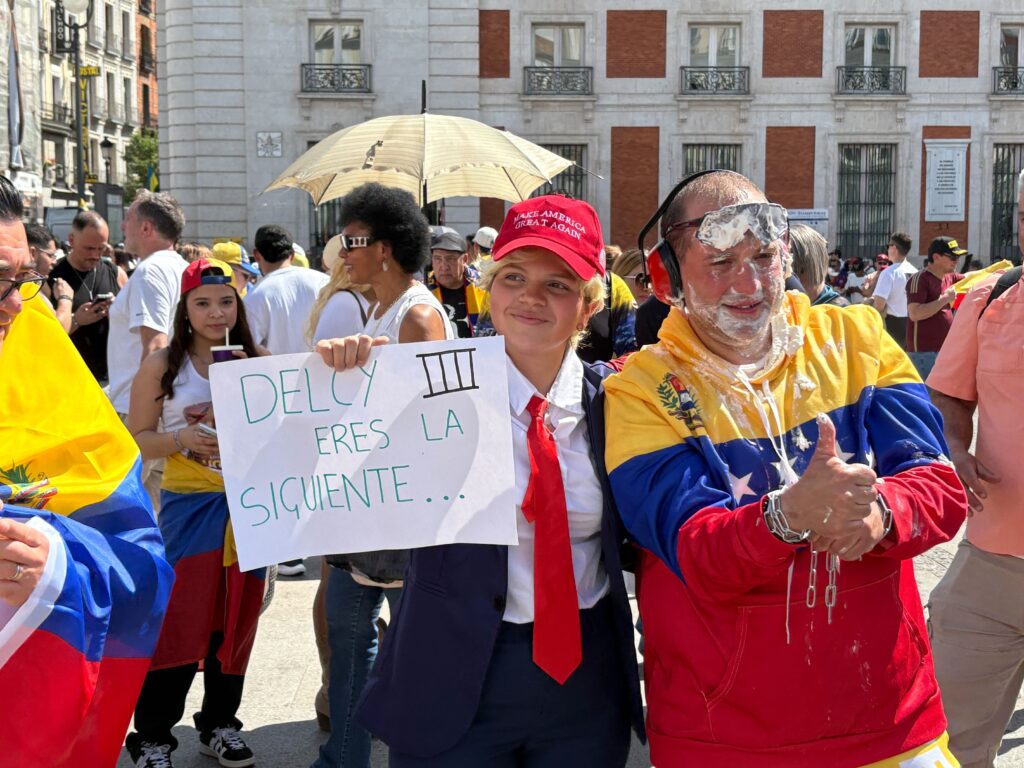
Many Venezuelans had arrived as early as 2 P.M. to secure their spots, bringing supplies as well as musical instruments to play for others around them. Others dressed up as President Trump or Nicolas Maduro, and posed for photos with the crowd.

MCM supporters dressed as Donald Trump and Nicolás Maduro. Image credit: Catherine Ellis.

As the day progressed and the crowd increased, several people fainted due to the heat and lack of shade.

Earlier in the day, Machado had attended a second symbolic ceremony during her visit. This time, she was awarded the Medal of the Community of Madrid. Edmundo González also received the honour but was unable to accept it in person as he is currently in hospital. On Friday she received the “llave de Oro” — golden key — an honour usually reserved for heads of state.

On Friday and Saturday, María Corina met with the country’s two main opposition leaders — Alberto Núñez Feijóo of the PP and Santiago Abascal of Vox. But she did not meet with Prime Minister Pedro Sánchez, who was hosting a conference of left-wing leaders — including Petro, Lula and Sheinbaum — in Barcelona. However, Sánchez said he had offered to meet her.

María Corina will visit the Spanish Senate on Monday.

Featured image description: Maria Corina Machado spoke to a crowd of supporters on Saturday, April 18. Featured image credit: Catherine Ellis.

The post ‘The return home begins today!’: María Corina Machado rallies thousands in Madrid appeared first on Latin America Reports.

  •  

Maria Corina Machado receives symbolic ‘golden key’ in Madrid as Venezuelans welcome her

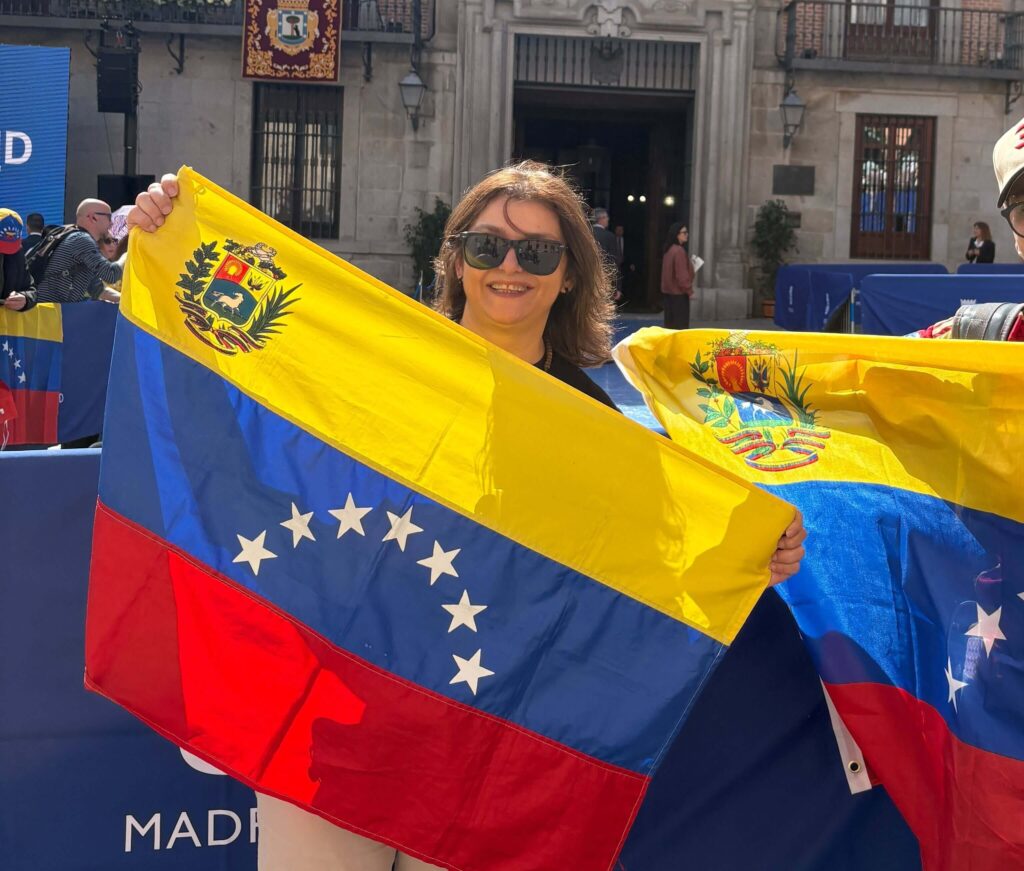
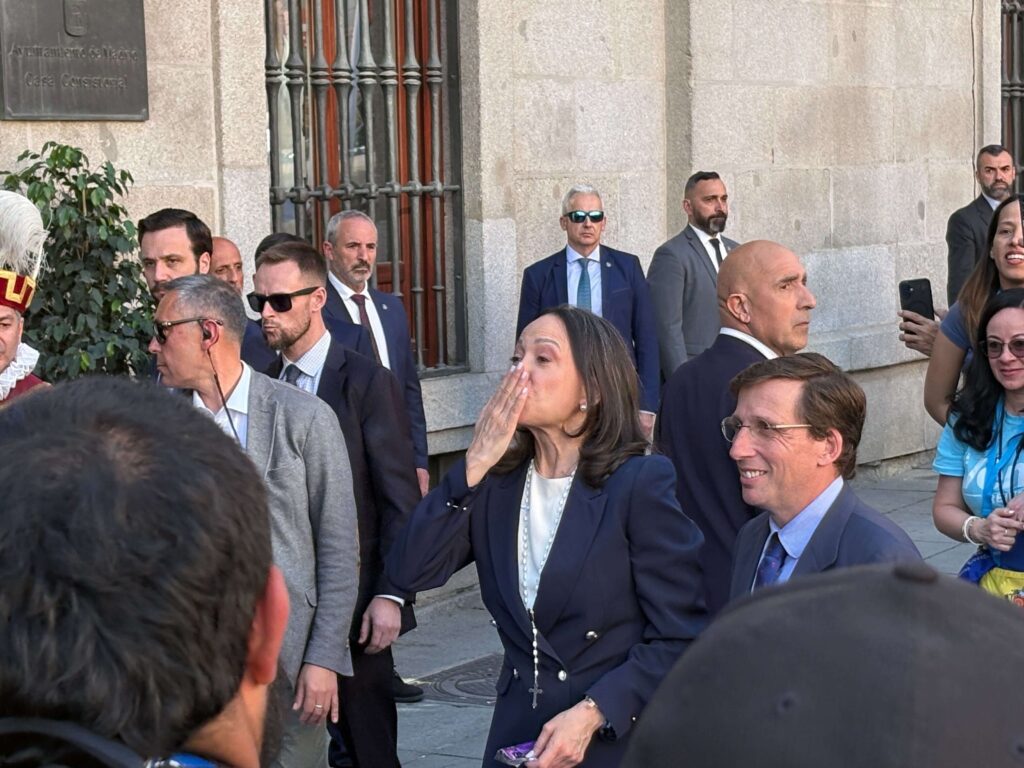
Madrid, Spain – Hundreds of Venezuelans waving flags and chanting “libertad” filled a central Madrid plaza on Friday, as Venezuelan opposition leader, María Corina Machado, arrived for a symbolic ceremony to receive the ‘Llave de Oro’ – or ‘Golden Key.’

Some in the crowd had travelled from across the country to see her on her multi-day visit to Spain. Many sang along as an orchestra played well-known Venezuelan songs.

Inside the city’s historic town hall — and broadcast on a large screen outside — Machado was given the prestigious award, an honor typically reserved for visiting heads of state.

The city’s mayor, José Luis Martínez-Almeida, said it recognized her “fight for freedom, democracy and peace” in Venezuela, describing her as “the embodiment of the Venezuelan people’s resistance”.

Machado, responding, first wished the mayor a happy birthday before saying she hoped to return to Venezuela soon.

“Keys open doors, and today they symbolize the opening to freedom for the Venezuelan nation,” she said, adding that she would one day reciprocate the honor in a free Venezuela.

Many Venezuelans at the event said they too planned to return home if political change comes.

Maribel Santiago, who said she has lived in Spain for 10 years, described Machado as a symbol of hope and optimism for her country.  “I have my suitcases ready,” she said. “When María Corina returns, I will return too.”

10-year-old Mónica (L) travelled from Málaga to Madrid with her mother for a ceremony honoring Maria Corina Machado on April 17, 2016. Image credit: Catherine Ellis for Latin America Reports.

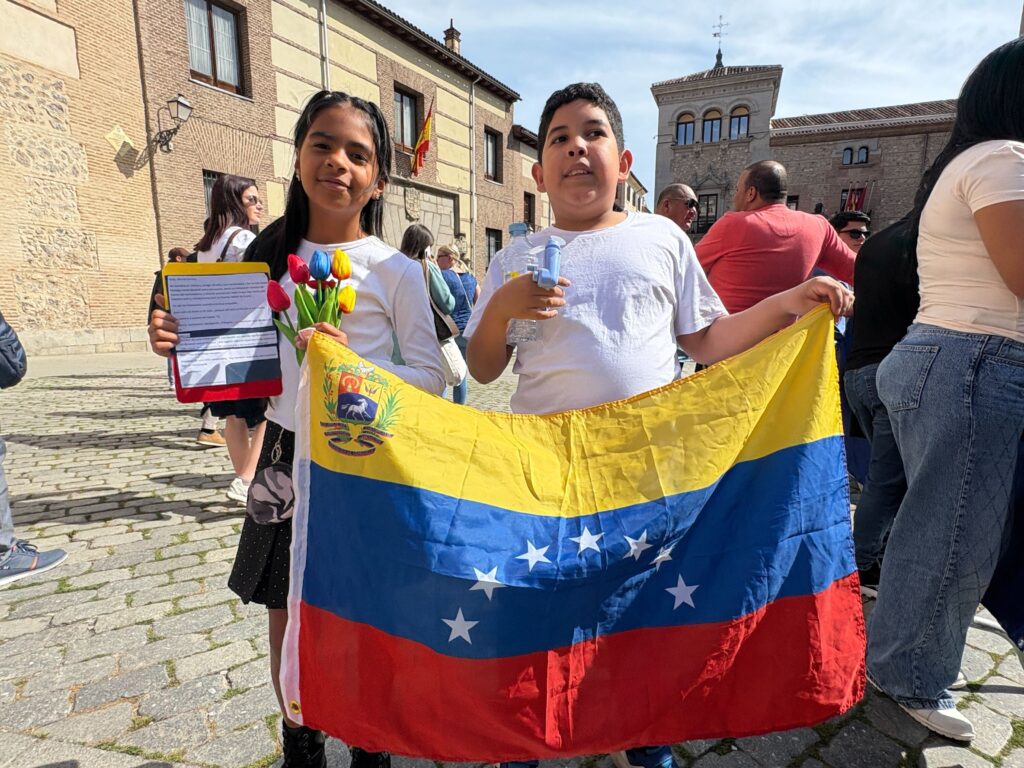
Another Venezuelan in the crowd, 10-year-old Mónica, had travelled from Málaga with her mother to see Machado. After the ceremony, the Venezuelan leader stopped to speak to her and Monica presented her with flowers in the color of the Venezuelan flag and a card. “She’s such an important person to me,” she said. “I will never forget this day.”

The “Llave de Oro” has previously been awarded to only a small number of non-heads of state, underlining the political weight of the gesture.

Machado, who was awarded the Nobel Peace Prize in 2025, had earlier met leaders of Spain’s conservative Popular Party, including Alberto Núñez Feijóo, and also met the leader from the right-wing party Vox, Santiago Abascal..

She is not expected to meet Prime Minister Pedro Sánchez, who is hosting a separate gathering of left-wing leaders in Barcelona this weekend.  

Read more: Latin America’s left gather in Spain to counter far-right

Machado is due to take part in further events over the coming days, including a mass rally on Saturday expected to draw thousands from Spain’s Venezuelan diaspora and a visit to the Senate on Monday.

Spain is home to one of the largest Venezuelan communities in Europe — numbering close to 700,000 — many of whom fled the country’s prolonged political and economic crisis.

Machado also visited Edmundo González Urrutia in hospital. He had been expected to attend Saturday’s rally, but said he would be unable to join due to a follow-up medical procedure.

The retired diplomat stood in for Machado in the 2024 presidential election after she was barred from running and is widely believed by the opposition to have won the vote.

Machado has said she will return to Venezuela “soon”, although no date has been given.

Maria Corina Machado. Image credit: Catherine Ellis
Maribel Santiago attended the event in honor of Maria Corina Machado. Image credit: Catherine Ellis
Maria Corina Machado. Image credit: Catherine Ellis

Featured image: Maria Corina Machado embraces a young girl in Madrid at a ceremony in her honor on April 17, 2026.

Image credit: Catherine Ellis for Latin America Reports

The post Maria Corina Machado receives symbolic ‘golden key’ in Madrid as Venezuelans welcome her appeared first on Latin America Reports.

  •  

Police fire tear gas at Venezuela protesters as workers demand higher pay

Police fired tear gas at protesters in Caracas on Thursday, as workers marched to demand higher wages and better pensions.

Demonstrators, reported to number around 2,000, attempted to reach the presidential palace but were blocked by officers in riot gear. Videos shared on social media show police in helmets and shields scuffling with protesters as clashes broke out along the route.

The protest is the latest in a series of anti-government demonstrations that have occurred since the U.S. removed longtime leader Nicolás Maduro on January 3. 

Edward Ocariz, who was at the protest, told Latin America Reports there was a lot of shoving by police. He said an officer took his phone as he was filming on it, but he managed to get it back, sustaining an injury to his hand in the process.

One video published by Venezuelan human rights organisation PROVEA appears to show an officer assaulting a person with his shield, which the NGO said was its photographer.

Workers took to the street to protest over low wages and pensions that have left some citizens struggling to get by. Venezuela’s minimum wage for public sector workers has not been increased since 2022, leaving many employees with just 130 bolívares per month — equivalent to less than US$0.30, not even enough for a loaf of bread.

Top up ‘bonuses’ – additional payments given out by the government — can raise total income to between US$50 and $150, but unions and workers say these are unreliable and they want a dignified salary.

For years, Venezuelans have endured an economic crisis that has left people struggling to pay for food, medicine and basic goods.

“We’re not going to keep surviving on a miserable wage,” Rene Zapata, Secretary of the Organization of the Venezuelan Teachers’ Federation in Miranda State, told Latin America Reports. “With my wage I cannot even buy half a carton of eggs,” he said.

Zapata said he and other demonstrators had managed to push past some barricades and that workers just wanted a better income and to be able to afford to eat.

Since Nicolás Maduro and his wife, Cilia Flores, were captured in a U.S. operation on January 3, there have been an increase in anti-government protests calling for better living standards. Following the 2024 presidential election — when Maduro claimed victory despite opposition evidence showing he had lost — protests had been almost non-existent due to the threat of detention.

“People have shown they’ve lost their fear. We are no longer afraid, and we will keep moving forward for a fair wage,” Zapata said.

On Wednesday evening, interim president Delcy Rodríguez announced that wages would rise on May 1, describing the increase as “responsible” and designed to avoid inflation, though she did not disclose the amount. While hoping to quell public discontent, many public-sector workers said the announcement fell short of what they deserved.

“They come talking about a responsible increase, but it is a fallacy and a lie,” Argelia Castillo, general secretary of the APUFAT‑UCV union representing workers at the Central University of Venezuela, told Latin America Reports. 

Castillo, a social worker and university professor, said the government should ensure salaries cover the basic cost of living. She added, “Workers cannot endure this, and we cannot wait until May 1.”Rodríguez has been leading the country since Maduro’s capture, but many citizens see her as a continuation of the old administration and are hoping for new elections.

Featured image description: Workers partake in a protest in Caracas in March 2026 calling for higher salaries.

Featured image credit: Catherine Ellis

The post Police fire tear gas at Venezuela protesters as workers demand higher pay appeared first on Latin America Reports.
  •  

Defense funding a key issue at Maduro’s pre-trial hearing in New York 

Nicolás Maduro returned to a New York federal court on Thursday for a pre‑trial hearing, facing U.S. charges of narcoterrorism, cocaine trafficking, and weapons offenses.

It was the second court appearance of the ousted Venezuelan leader since his capture alongside his wife, Cilia Flores, on January 3, 2026, from a military compound in Caracas. Both pleaded not guilty two days after their capture, with Maduro describing himself as a “prisoner of war.”

The hearing was a procedural step ahead of any potential trial, where the court will consider pre‑trial motions. Maduro’s defense attorney asked the court to drop the case citing the U.S. blocking payments to the former president’s lawyers. 

One of the central issues at the moment is legal funding for Maduro and Flores. The couple say they don’t have the personal resources to cover their legal fees. Their lawyers argue that U.S. sanctions are blocking them from accessing Venezuelan government funds to pay for their defense — and that this restriction prevents them from choosing their own attorneys, a right guaranteed by the U.S. Constitution.

Judge Alvin K. Hellerstein questioned the prosecution over the blockage of funds, which the U.S. argues are related to sanctions on Venezuela’s government. 

Both Maduro and Flores are on the U.S. sanctions list. Current regulations generally prohibit a sanctioned government from paying the legal fees of sanctioned individuals without a specific license. That means, for now, Caracas cannot cover their legal bills without special permission from Washington.

While Maduro argues he is Venezuela’s legitimate president, the United States did not recognize his claim to office at the time of his arrest. But it has since recognized Delcy Rodríguez as interim president, a close ally of Maduro’s who had served as vice president.

Maduro had led Venezuela since 2013, following the death of Hugo Chávez, as head of the socialist, anti‑imperialist chavismo movement. Critics say Maduro’s government became increasingly authoritarian. His claimed victory in the 2024 presidential election was disputed, with voting tallies collected by the opposition indicating their candidate had won.

He faces four federal counts, including conspiracy to participate in narcoterrorism, conspiracy to import cocaine into the United States, and offenses related to possession and conspiracy to possess machine guns and destructive devices. His wife, Cilia Flores, faces related charges.

Groups of both pro and anti-Maduro protesters gathered outside on Thursday, some calling for the release of Maduro and Flores. Others however, sang the Venezuelan national anthem and expressed their satisfaction that he was going through a judicial process in the U.S.

Some Maduro supporters gathered in central Caracas watched the scene outside court on a large screen. Maduro and Flores’ son, Nicolás Maduro Guerra who is also a politician, was also at the rally.

The case unfolds as Washington balances sanctions enforcement with ongoing engagement with Caracas, including in the energy and mining sectors.

Featured image: Nicolás Maduro arrives on a New York helipad ahead of his first court appearance on January 5, 2026.

The post Defense funding a key issue at Maduro’s pre-trial hearing in New York  appeared first on Latin America Reports.
  •  
❌