 Login
Login


A rare type of meteorite discovered in Mali is revealing a multibillion-year tale of lunar catastrophes. With its unique composition, astronomers are beginning to better understand the processes that shaped not only the moon and Earth, but the solar system itself.
The study recently published in the journal Geology is nearly 10 years in the making and focuses on a meteorite classified as NWA 12593. Found in the west African nation in 2017, experts soon recognized the space rock as an especially unique specimen. NWA 12593 is one of only 53 known lunar breccia—a meteorite formed by the amalgamation of multiple moon fragments during separate impacts billions of years ago.
“Breccias are similar to what you would see if you went and chipped out a chunk of concrete. You would see all these little rocks, and then they’re fused together by the cement,” Carolyn Crow, a planetary scientist at the University of Colorado Boulder and study co-author, said in a statement.
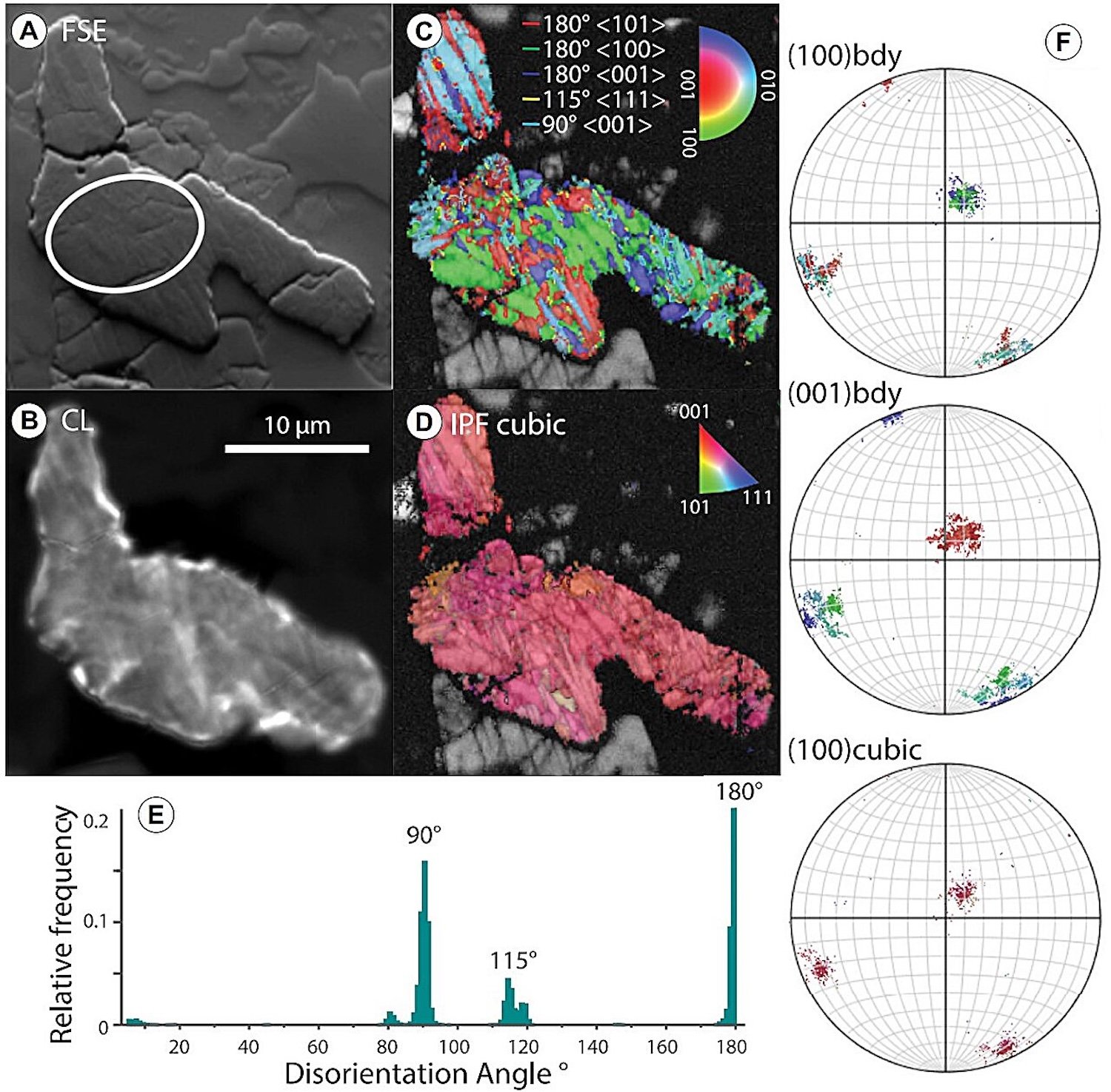
Crow and her colleagues used radiometric dating and chemical analysis on NWA 12593 to successfully identify evidence of three major impact events in the moon’s past. The earliest occurred around 3.5 billion years ago amid an era that also produced the first known fossil evidence of life on Earth. This collision was powerful enough to reduce the moon’s surface to molten rock similar to a lava flow.
The impact also created cubic zirconia, a mineral that only forms during extremely high temperatures. Known for its uses in jewelry, cubic zirconia doesn’t last in cold, uncontrolled temperatures. While the mineral disappeared as the lunar surface eventually solidified and cooled, researchers pinpointed lingering traces of its existence in NWA 12593.
The second impact event formed the breccia itself. In the aftermath of that meteor strike, slabs of lunar rock slammed into one another to create a mosaic of materials.
“The meteorite is fused together by the impact process. You get all these chunks of different kinds of rocks that the impact hit into,” explained Crow.
The third event explains how the lunar breccia reached Earth. At some point in the more recent past, yet another impact cracked off a piece of our moon itself and sent it hurtling towards the planet.
A portion of the meteorite’s story also aligns with a tumultuous chapter in Earth’s geological history. The 3.5-billion-year-old impact identified in the breccia occurred around the same time as known impacts on both Earth and the asteroid 4 Vesta, fourth-largest member of the asteroid belt between Mars and Jupiter. This was a particularly chaotic time in the solar system, with planets still forming amid near-constant collisions Knowing this, further examination of NWA 12593 can help contextualize the history of Earth, the moon, and the wider cosmic neighborhood.
The post Rare lunar meteorite was smacked three times before finally hitting Earth appeared first on Popular Science.
“Mars, can you please clean up your Legos?”
“Jupiter, finish your peas.”
“Don’t pull the cat’s tail, Mercury!”
The Social Security Administration (SSA) has released its baby name data for 2025 and it’s clear that plenty of parents found inspiration in the cosmos for their little ones. The most popular proper planet in our solar system to name a baby after in 2025 was Mars, followed by Jupiter. Thankfully, no one named their child Uranus, but 80 parents did name their child Cosmo.
Here’s the planet-baby name breakdown:
A couple of our solar system’s dwarf planets also made appearances on the list:
Of course it’s important to note that most of our solar system’s planets got their names from Roman and Greek gods and goddesses, so a love of space likely wasn’t the only motivation for new parents.
Last year, 332 parents used the name Artemis for their babies. According to baby name site Nameberry, Artemis is of Greek origin and means “safe” or “butcher.” It’s also the name of NASA’s high-profile mission to return humans to the moon.
And as a bonus fun-with-data note: the name Tesla has completely disappeared from SSA’s data. The name peaked in 2016 with 180 children given the moniker. It last appeared on the charts in 2023 when only 13 babies got the name.
For privacy purposes, the SSA only releases data on names given to at least five children. So maybe somewhere, one little Uranus is ruling the playground.
The post ‘Mars’ is 2025’s most popular planet baby name appeared first on Popular Science.





Six in the morning on the Brooklyn Bridge, and New York City is something it rarely is. It is quiet. Not empty, but quiet. Dan Aragon is standing on the walkway watching the light come up across the East River. The bridge holds a few early walkers, runners, and cyclists. A ferry is just starting to move on the water below. He has not raised the camera yet. He is still enjoying the silence.
dougmartin571 posted a photo:

finished product on the stand, with additional lenticular screens, and cartridges

A rare meteorite discovered in the Sahara Desert proves that our solar system almost had at least one extra planet. In a study published in the journal Earth and Planetary Science Letters, astronomers say the chunk of space rock known as Northwest Africa (NWA) 12774 once belonged to a protoplanet possibly as large as Mars. That is, until a cosmic crash likely blew it to smithereens.
The solar system includes eight known planets (sorry, Pluto). Barring interstellar catastrophe, this number will remain the same until the sun finally dies about 5 billion years from now. However, this total planetary count was never a guarantee.The solar system’s earliest era featured multiple embryonic protoplanets that had the potential to grow together into additional cosmic neighbors.
The remnants of these long gone celestial bodies are scarce, but traces still exist. That said, astronomers didn’t expect to find protoplanetary evidence in a meteorite like NWA 12774. Discovered in 2019, NWA 12774 is an angrite—one of the oldest known types of volcanic rock that was formed during the solar system’s era about 4.56 billion years ago. They’re also very rare. Of the roughly 80,000 meteorites discovered on Earth so far, only 68 are angrites.
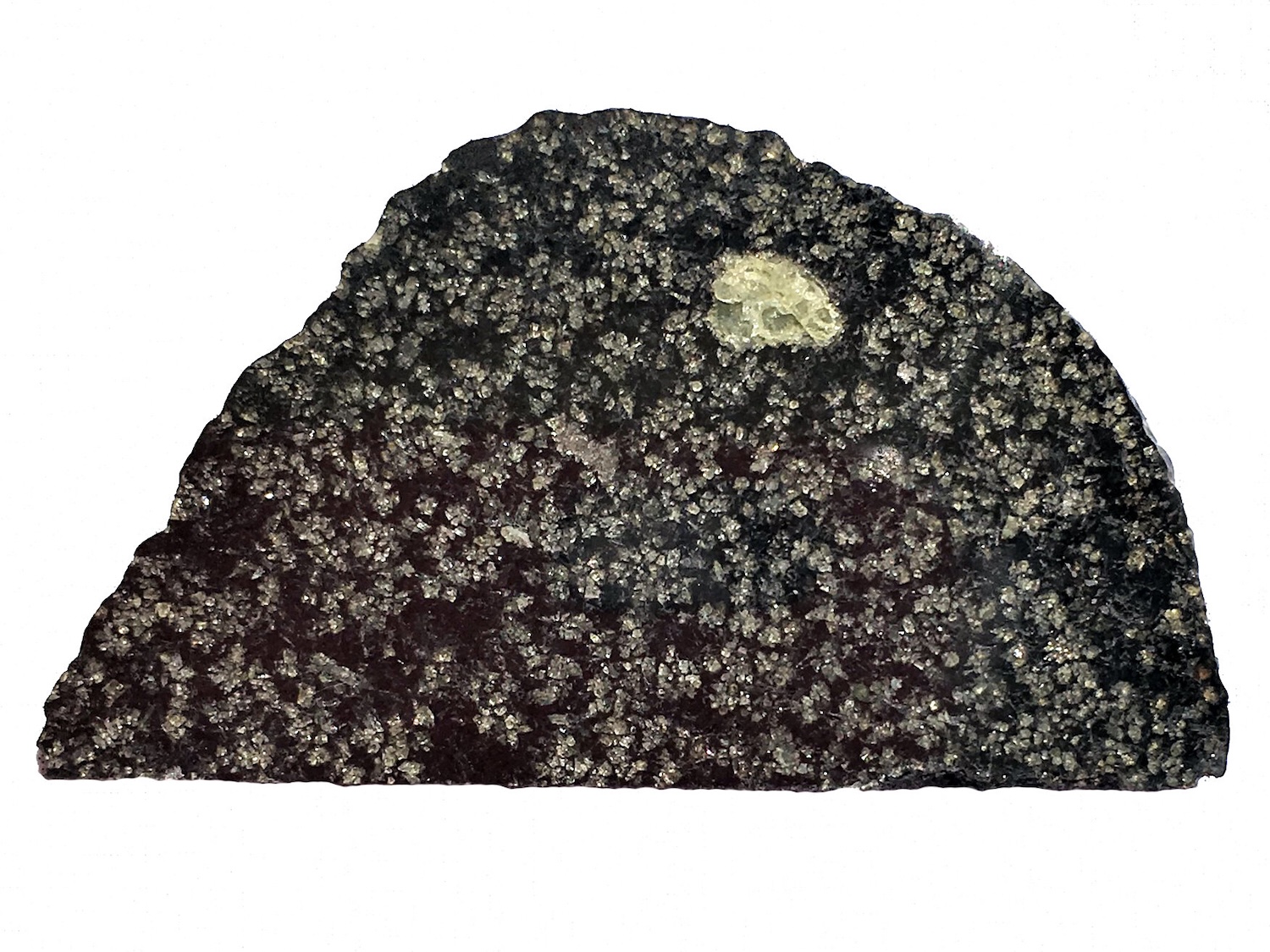
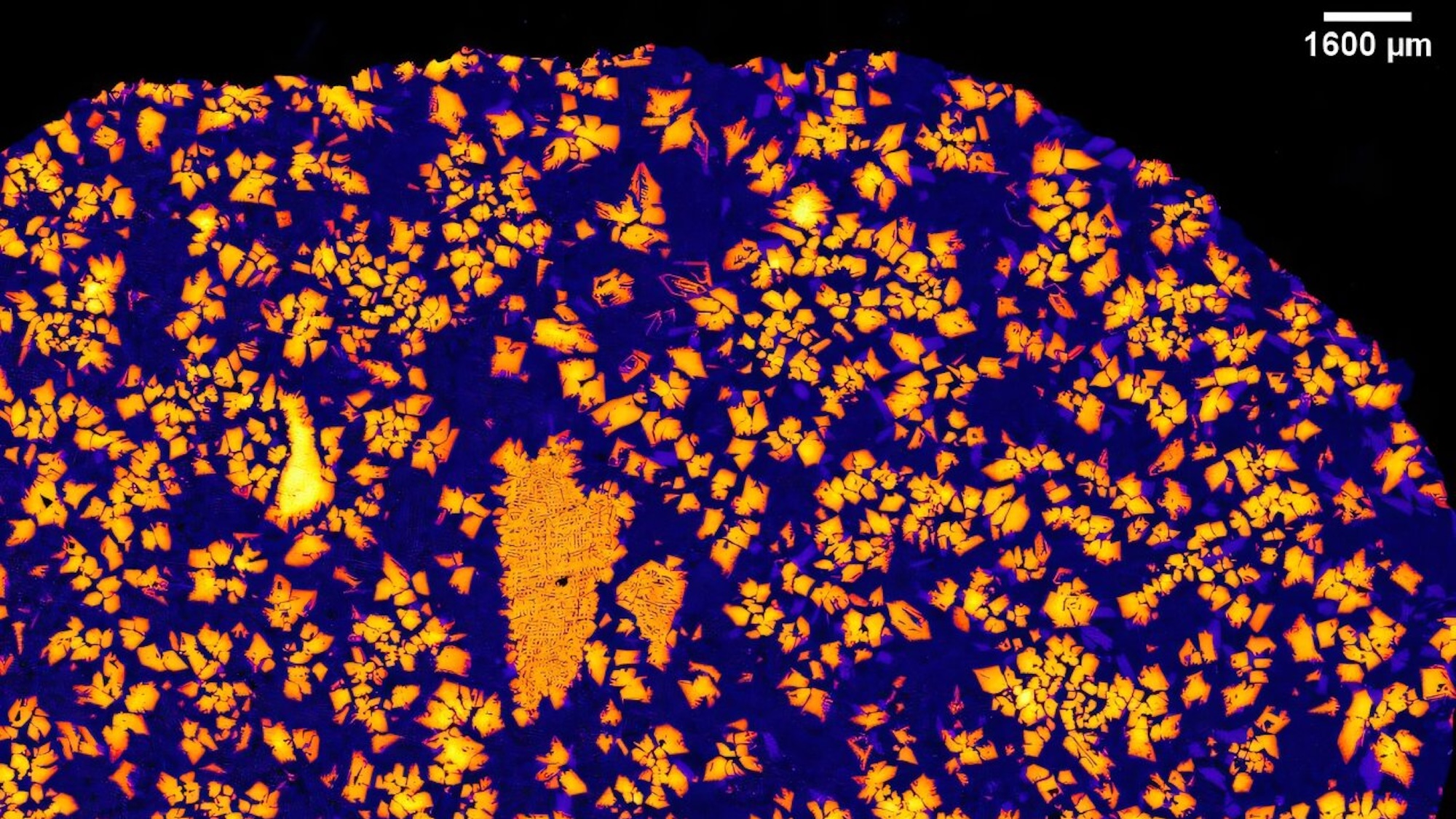
Unlike rocky planets such as Mars and Earth, angrites do not have a lot of silicon dioxide. Because of this, astronomers have long assumed that angrites always originated in asteroids no larger than about 124 miles wide. NWA 12774 blows this theory apart..
While analyzing the meteorite, researchers at the University of Colorado Boulder detected clinopyroxene, a mineral crystal that exists throughout Earth’s mantle and crust. NWA 12774’s clinopyroxene was also heavy in aluminum, which directly points to formation under massive amounts of pressure underground. The team then calculated the conditions necessary to create an angrite like NWA 12774, and settled on at least 17.5 kilobars of pressure. To put that in perspective, the pressure experienced at the bottom of the roughly 35,875-foot-deep Mariana Trench is barely one kilobar.
Small asteroids simply don’t possess the conditions needed to generate a rock like NWA 12774. What’s more, the angrite’s sharp crystalline edges also indicate that it formed at comparatively shallow depths in its host body. Based on all of these factors, astronomers now believe NWA 12774 once belonged to a young protoplanet with a radius anywhere from 621 to 2,050 miles wide. This means that instead of an asteroid, the angrite may have existed inside something as big as Mars.
“It’s incredible to think there was once a world this large,” Aaron Bell, a UC Boulder earth scientist and study co-author, said in a statement. “We only know it existed because a few fragments of it happened to land on Earth. These meteorites preserved evidence of a completely different pathway through which early planets developed.”
Although it’s unclear how the protoplanet met its demise, some type of crash between early solar system denizens is definitely a possibility. Regardless, the ramifications are huge for astronomers’ understanding of our cosmic neighborhood’s history.
“The materials that formed the angrite parent body are fundamentally different from the ingredients of Earth and Mars,” explained Bell. “It points to a distinct and separate evolutionary path in planetary formation in the early history of our solar system.”
The post Rare meteorite proves our solar system almost had an extra planet appeared first on Popular Science.
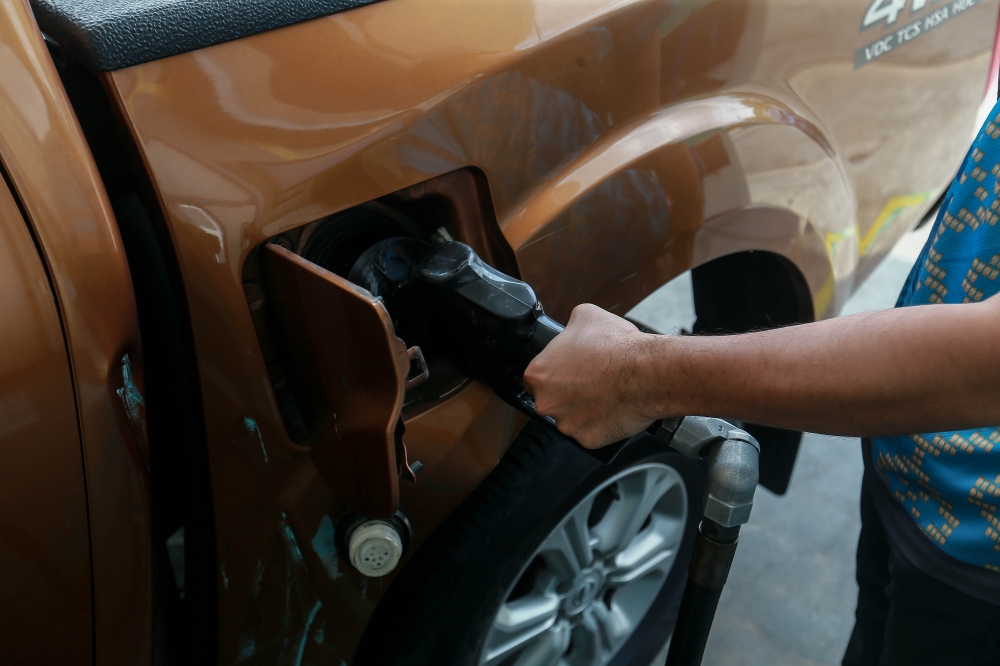
KOTA KINABALU, June 15 — Domestic Trade and Cost of Living Minister Datuk Armizan Mohd Ali has again urged goods and public land transport companies in Sabah, Sarawak and Labuan to register immediately under the Subsidised Diesel Control System (SKDS) to enjoy the diesel subsidy benefits.
He said registration would enable eligible companies to receive fleet cards and enjoy subsidised diesel rates of RM2.15 per litre for goods transportation and RM1.88 per litre for public land transport operators.
Armizan said applications for the SKDS for the goods transport sector were extended to Sabah, Sarawak and Labuan on May 4.
“The mandatory use of SKDS fleet cards to obtain diesel subsidies for the goods and public land transport sectors will be enforced on a date to be announced later. Therefore, companies in both sectors are urged to register under SKDS as soon as possible.
“This is important to ensure that vehicles listed under the 33 eligible vehicle categories continue to receive subsidised diesel,” he told reporters after presenting the Petronas Fleet Card SmartPay to several companies that had obtained SKDS approval here today.
According to Armizan, a total of 8,060 companies across Sabah, Sarawak and Labuan had registered under SKDS, involving 29,631 vehicles, as of June 14.
He stressed that transport operators should take advantage of the registration process to avoid having to purchase diesel at market prices.
On a related matter, the minister said SKDS was introduced to address diesel subsidy leakages through a digital monitoring and enforcement mechanism.
“The fleet card system under SKDS is designed to ensure that diesel subsidies fully benefit the targeted recipients.
“It is also part of efforts to curb subsidy leakages through smuggling, abuse and misuse of subsidised diesel by foreign nationals and undocumented migrants,” he said.
Details on eligible vehicle categories and SKDS registration can be found on the MySubsidi portal at https://mysubsidi.kpdn.gov.my. — Bernama


