China said Friday it was holding an American citizen accused of espionage, identifying the man as a political analyst at a policy think tank focusing on neighbouring Myanmar.
Min Zin — a founder of the Institute for Strategy and Policy Myanmar (ISP-M) — “has been subjected to criminal compulsory measures”, Chinese foreign ministry spokesman Lin Jian told a news briefing.
Min Zin, founder of the Institute for Strategy and Policy Myanmar (ISP-M). File photo: Min Zin, via Facebook.
Authorities are holding him “on suspicion of engaging in espionage activities that endanger China’s national security”, he said, without providing further details.
The ISP-M researches the political, resource and conflict dynamics of Myanmar, which was plunged into civil war by a 2021 coup.
Some of their publications detail China’s influence in the borderlands of Myanmar, where Beijing is accused of supporting armed factions which suit its national interests.
It is not clear whether Min Zin was conducting research at the time he was held by Chinese authorities.
A person with professional ties to ISP-M, who spoke on condition of anonymity because of the sensitivity of the case, told AFP Min Zin was arrested on June 3 at Kunming airport in Yunnan province, which borders Myanmar.
“He went there to attend a meeting,” said another person with a close relationship to the detained academic, who also spoke on condition of anonymity.
Chinese authorities said the US consulate in Guangzhou had been notified of the case.
“His family and colleagues are following up with the consulate office there,” the second source said. “I know his family is worried.”
Neither the US State Department nor the ISP-M have responded to a request for comment.
The ISP-M is based in the northern Thai city of Chiang Mai, a hub for political exiles from Myanmar since the coup ousted the democratically elected government of Aung San Suu Kyi.
Analysts, including those at the ISP-M, say China has intermittently backed both the military and rebels in the civil war according to its varying economic and security interests.
President Xi Jinping hailed China and Russia’s “unyielding” ties in talks with Vladimir Putin on Wednesday, as the pair met to underscore their alliance days after Donald Trump’s own visit to Beijing.
Chinese President Xi Jinping (left) welcomes Russian President Vladimir Putin at the Great Hall of the People in Beijing on May 20, 2026. Photo: The Kremlin.
The two countries’ ties have deepened since Moscow’s 2022 invasion of Ukraine, as Russia has become increasingly dependent on China, its main oil customer.
Putin was received by Xi outside Beijing’s opulent Great Hall of the People in much the same fashion as Trump last week, complete with chanting children and military fanfare.
But the language was much warmer, with Xi telling the Russian leader Beijing and Moscow have “continuously deepened our political mutual trust and strategic coordination with a resilience that remains unyielding”, according to Chinese state media.
Opening talks, both were quick to laud their countries’ special ties as they extended their treaty of “friendly cooperation”.
Putin, quoting a Chinese phrase, told Xi: “A day apart feels like three autumns”, adding that relations had reached an “unprecedentedly high level” despite “unfavourable external factors”, Russian media footage showed.
In an apparent swipe at the United States, Xi warned of “unilateral and hegemonic countercurrents running rampant” in the world.
Children greet Chinese President Xi Jinping (left) and Russian President Vladimir Putin during the welcome ceremony at the Great Hall of the People in Beijing on May 20, 2026. Photo: The Kremlin.
In contrast to Trump’s visit last week, which yielded little in the way of immediate concrete announcements, Putin and Xi signed a slew of agreements on Wednesday on trade, media and energy.
The two leaders later had talks over tea, which the Kremlin had previously said would be reserved for “the most important issues” such as Ukraine, Iran and relations with the US.
That session lasted around 1.5 hours before Putin headed to the airport, according to Russian media.
Fossil fuel push
Beneath the camaraderie, Putin is now perceived by many to be the junior partner in the relationship.
The Russian leader has been weakened over four years of the Ukraine conflict, with his country’s economy shrinking in the first quarter of the year as factors such as wartime spending, labour shortages and sanctions take their toll.
Analysts believed Putin would use his visit to push for progress on the “Power of Siberia 2”, a major natural gas pipeline running from Russia to China through Mongolia.
But Kremlin spokesman Dmitry Peskov told Russian media Wednesday that while the two sides had reached a “basic understanding” — including on “the route and how it will be built” — there was no “clear timeline”, and “there are still some details to be worked out”.
Chinese President Xi Jinping (left) and Russian President Vladimir Putin inspect the honour guard at the Great Hall of the People in Beijing on May 20, 2026. Photo: The Kremlin.
The US-Israeli war on Iran has hampered crude and gas flows from the Middle East, giving an opportunity for Putin to offer Russian energy sources as an alternative.
“Russia and China are actively cooperating in the energy sector… We are, of course, ready to continue reliably supplying all these types of fuel to the rapidly growing Chinese market,” Putin said Wednesday.
His priorities may differ from China’s, which wants the Middle East conflict concluded as soon as possible.
Underlining that, Xi told Putin on Wednesday that “a comprehensive ceasefire is of utmost urgency, resuming hostilities is even more inadvisable and maintaining negotiations is particularly important”.
‘Sovereign foreign policy’
Xi has played host to a series of world leaders as an increasingly unpredictable United States under Trump has pushed many to shore up alliances with Beijing.
Many have urged him to use his influence with Russia and Iran to help bring an end to the respective conflicts there.
US President Donald Trump and Chinese President Xi Jinping tour the Hall of Prayer of Good Harvest at the Temple of Heaven in Beijing on May 14, 2026. Photo: The White House, via Flickr.
Ukrainian President Volodymyr Zelensky had asked Trump to discuss ending the war during his meetings with Xi last week.
The pair did talk about the issue, but the US president left China without a breakthrough.
Beijing has regularly called for talks to end the war in Ukraine, but has never condemned Russia for sending in troops — presenting itself instead as a neutral party.
The two leaders talked about Ukraine, Chinese state media said after the visit had ended, without giving further details.
On Wednesday Putin said that Russia and China were “committed to an independent and sovereign foreign policy”.
In a joint statement released by the Kremlin, Russia said it “positively assesses the objective and unbiased position of the Chinese side regarding the situation in Ukraine and welcomes China’s aspiration to play a constructive role”.
Another Hong Kong performance artist has been stopped and searched by plainclothes police after showing up in Causeway Bay on the eve of the Tiananmen crackdown anniversary.
Artist Chan Mei-tung was stopped and searched by police after appearing in Causeway Bay with a question mark-shaped balloon on June 3, 2026 – the eve of the Tiananmen crackdown anniversary. Photo: Kyle Lam/HKFP.
Artist Chan Mei-tung appeared with balloons – one shaped like a golden question mark – at around 7:18pm near SOGO department store. The store is near Victoria Park, once the site of vigils to remember the 1989 dead.
Artist Chan Mei-tung was stopped and searched by police after appearing in Causeway Bay with a question mark-shaped balloon on June 3, 2026 – the eve of the Tiananmen crackdown anniversary. Photo: Kyle Lam/HKFP.
Police demanded to see her ID card and searched her. When asked by reporters what the balloon represented, Chan said it was for a “proposal.”
Police then escorted her to the nearby MTR station, where she destroyed the balloon after police told her they were banned on the metro system.
Artist Chan Mei-tung was stopped and searched by police after appearing in Causeway Bay with a question mark-shaped balloon on June 3, 2026 – the eve of the Tiananmen crackdown anniversary. Photo: Kyle Lam/HKFP.
“It’s abnormal that, whenever we are saying or doing something, we are being monitored,” he said in Cantonese.
Performance artist Sanmu Chan holds a piece of red string measuring 6.4 metres in Causeway Bay on June 3, 2026. Photo: Kyle Lam/HKFP.
The Tiananmen crackdown occurred on June 4, 1989, ending months of student-led demonstrations in China. It is estimated that hundreds, perhaps thousands, died when the People’s Liberation Army cracked down on protesters in Beijing.
In response to HKFP’s enquiries about the two artists, police said officers patrolling East Point Road and Lockhart Road spotted a man and a woman loitering in the area. Officers approached them to understand the situation, and both individuals subsequently left of their own accord.
They did not respond as to whether paying tribute to the 1989 dead was legal, but said that any enforcement action is handled lawfully, based on actual circumstances. Operational deployments are made appropriately in response to potential threats to national security, public safety, and public order, they added.
Mass vigils replaced by patriotic fair
The mass candlelit vigils have not been officially held in Victoria Park since 2019. In 2020, Hong Kong authorities denied permission for the annual event, which typically attracted hundreds of thousands, citing Covid-19 pandemic restrictions.
The Tiananmen crackdown vigil in 2016. File Photo: Tom Grundy/HKFP.
After Beijing imposed the national security law on June 30, 2020, the Hong Kong Alliance in Support of Patriotic Democratic Movements of China, which organised the annual event, was disbanded. The group’s key leaders are now facing a national security trial.
A week-long patriotic food carnival is held in Victoria Park on June 3, 2026. The park was once the site of vigils to remember those killed in the Tiananmen crackdown. Photo: Kyle Lam/HKFP.
Since then, police have routinely searched and detained members of the public, activists, and artists on the crackdown’s anniversary and before.
Solomon Islands Prime Minister Matthew Wale said Wednesday he would be “reviewing” his country’s secretive 2022 security pact with China, which rattled Canberra and Washington.
Solomon Islands Prime Minister Matthew Wale speaks during a press conference at Parliament House in Canberra on June 3, 2026. Photo: Hilary Wardhaugh/AFP.
Asked about that pact alongside Australian Prime Minister Anthony Albanese, the Solomons leader — who was elected last month — said he had been “praying and fasting” about the Chinese security deal.
“We are going to be reviewing, as we are reviewing other security agreements that we have with many other countries,” he said.
Australia and the United States have been sharply critical of the deal over concerns it could allow a permanent Chinese navy presence in the South Pacific.
It was signed under one of Wale’s predecessors, Manasseh Sogavare, who was seen as Beijing’s staunchest ally in the South Pacific.
Wale said the deal contained a non-disclosure agreement and he had not seen it until just before his visit to Australia.
“I have had to remove certain people from key positions. I have not been afforded a copy, even, of that agreement, until a day before I left, so I have not had a good look at it,” he told a news conference in Canberra.
Australia is the largest aid donor to the country of 800,000 people that sits 2,000 kilometres (1,240 miles) to its north-east and historically provided police support during crises.
After the Solomons switched diplomatic ties from Taiwan to Beijing in 2019 and struck the security pact, relations with Canberra and Washington deteriorated.
China quickly became the strategically located Pacific island state’s largest bilateral creditor, with Solomon Islands’ debt to Chinese banks for infrastructure projects doubling last year.
Seeking to counter Beijing’s influence, Australia has seized the opportunity to rebuild ties, hosting Wale on his first international visit as leader.
Albanese said Wednesday the two countries would begin work on a “comprehensive” new treaty as well as deepen ties in policing, with Australia seeking to be the top security partner for the Pacific.
Solomon Islands Prime Minister Matthew Wale (left) and Australian Prime Minister Anthony Albanese attend a press conference at Parliament House in Canberra on June 3, 2026. Photo: Anthony Albanese, via Facebook.
The treaty will be “underpinned by mutual trust, respect, and open dialogue”, the prime minister said.
Deals on policing, infrastructure
“We have sought a reset in this relationship — we acknowledge there have been problems over the last few years,” Wale told reporters.
The Pacific should turn to other countries within the region for their security, he stressed.
The leaders also agreed to push ahead with a major police training deal.
Australia’s offer to fund the expansion of the Solomons own police force had stalled under the previous Solomon Islands government, which allowed Chinese police to enter villages to collect household and biometric data.
Wale also said he was in discussions with Australia and the United States for financing for critical infrastructure such as ports.
Former Solomon Islands prime minister Sogavare rejected US offers of infrastructure grants, instead opting to partner with Chinese state companies.
Australia has sought to bind South Pacific countries closer by striking treaties with a string of small but strategically located island states, Tuvalu, Nauru and Papua New Guinea offering significant economic support in return for curbs on Chinese security ties.
Vanuatu and Fiji have said they are close to signing similar deals.
Hong Kong independent bookshop Book Punch and its owner have been fined HK$6,000 after holding a stand-up comedy show without an entertainment licence – the second time they have been penalised within a month.
Hong Kong independent bookstore Book Punch owner Pong Yat-ming outside the Kowloon City Magistrates’ Courts on April 10, 2026. Photo: Hans Tse/HKFP.
Pong Yat-ming and his firm, Active Experiential Learning Company, which owns Book Punch, were fined HK$3,000 each on Monday afternoon after they were found guilty of breaching the Places of Public Entertainment Ordinance following a trial that morning.
The two defendants were accused of holding a stand-up comedy event at the Sham Shui Po bookstore on June 29 last year, local media reported.
According to a Facebook post that month, the event was a stand-up comedy performance featuring people who had completed a comedy course hosted by the bookstore.
That day, two undercover Food and Environmental Hygiene Department (FEHD) officers attended the pay-as-you-wish event, each giving HK$100.
‘Stage performance’
During the trial, one of the FEHD officers who posed as a participant testified for the prosecution.
The officer, surnamed Hui, described around 40 chairs facing the same direction, towards the event host and performers.
Food and Environmental Hygiene Department. File photo: GovHK.
Representing Pong and his firm, barrister Lawrence Lau asked whether the performance space was on the same level as the audience.
Hui confirmed that there was no stage, so the performers were not elevated.
Lau said he agreed that the event was a “performance,” but since there was no stage – doubted whether it was a “stage performance,” citing the wording used in the Places of Public Entertainment Ordinance.
The ordinance states that the laws apply to “a concert, opera, ballet, stage performance or other musical, dramatic or theatrical entertainment.”
A poster for the stand-up comedy event on June 29, 2025. Photo: Book Punch, via Facebook.
Lau added that while the ordinance lists “comedy” as an example of a “stage performance,” along with other types of entertainment such as melodrama and dancing exhibitions, stand-up comedy should not be considered comedy.
Pong did not testify in the trial.
Past convictions
Delivering the verdict on Monday afternoon, Magistrate Andrew Mok said he disagreed with Lau’s narrow reading of the ordinance.
He said he did not think “stage performance,” as stated in the ordinance, applied only to performances with a stage.
Mok said that Pong showed no remorse during the trial, and therefore, there was no reason to give a lighter penalty. But he noted that Pong’s attitude during the trial was “pragmatic,” and that his past convictions all had to do with promoting culture.
On April 10, Pong and his firm were fined HK$32,000 after being found guilty of running an unregistered school. The case related to a Spanish interest class that was held at the bookstore.
In 2022, Pong was convicted of serving alcohol without a licence after he served sake to attendees at a sake-book-sharing event. The judge handed down a fine of HK$12,000.
The Department of Justice (DoJ) has sought to overturn former pro-democracy lawmaker Lam Cheuk-ting’s acquittal on a charge of perverting the course of justice related to an incident during the 2019 protests and unrest.
Lam Cheuk-ting. File Photo: Holmes Chan/HKFP.
Government prosecutors told the Court of Appeal on Thursday that Lam had the intent to pervert the course of justice by demanding that a person, referred to as “X,” delete photos of protesters at a march in July 2019.
The DoJ is also seeking to overturn acquittals for Lam’s co-defendants: former InMedia journalist Ronnie Tsang, 28, and social worker Aggie Chung, 39.
According to case details read out in previous hearings, Lam and Tsang were accused of committing acts with the intention to pervert the course of justice by asking X to delete from his phone photos showing the faces of protesters who might have committed criminal offences that day.
Tsang was also charged with unlawful assembly and later jailed for 13 months, while Chung was charged with access to a computer with dishonest intent and criminal damage for accessing X’s phone and deleting photos. However, Chung was later acquitted after the prosecution failed to prove dishonest intent.
Intention to pervert course of justice
Assistant Director of Public Prosecutions Ivan Cheung argued on Thursday that the District Court’s January 2023 ruling that Lam had no intention to pervert the course of justice was “counterintuitive,” online news outlet The Witness reported.
The High Court. File photo: Kyle Lam/HKFP.
Cheung presented to the court a video of the exchange, in which Lam said that “what matters now is to delete the photos with protesters’ faces.”
Although Lam verbally said that he wanted to help X leave the scene, he could also have harboured an intent to pervert the course of justice, Cheung told the three appeal judges.
X had previously testified that Lam did not force him to delete the photos and that he agreed the lawmaker was mediating the situation.
The prosecutor said the lower court erred in finding that Lam had no intent to pervert the course of justice.
However, Judge Derek Pang said on Thursday that it was impossible to conclude that Lam had that intent, while Judge Judianna Barnes said Lam’s actions did not necessarily suggest his intent.
In response to Cheung’s argument that the three defendants invited suspicion upon themselves by being present at a protest, Pang said that this was not a rioting or unlawful assembly case, adding that he could not understand how suspicion could be inferred.
Barrister Erik Shum, representing Lam, noted that the lower court found no connection between Lam’s actions and any existing or potential legal proceedings. The prosecution at trial also failed to specify any crimes or legal proceedings, he said.
Lam’s acquittal could not be overturned if the prosecution failed to prove whether he had interfered with legal proceedings or had any intention to do so, Shum said.
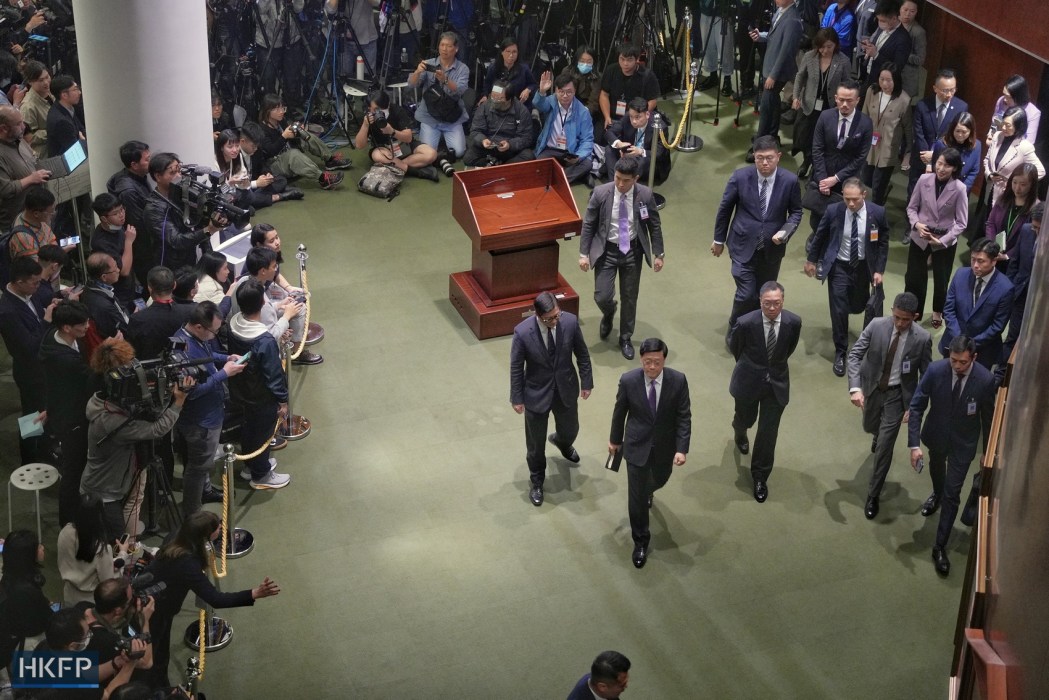
A Hong Kong government proposal that will allow the city’s leader to certify criminal acts as national security offences is intended to “make the law clear,” Chief Executive John Lee has said.
Chief Executive John Lee at a press conference on January 27, 2026. Photo: Kyle Lam/HKFP.
Speaking at a press conference on Tuesday, Lee said the new subsidiary legislation for Hong Kong’s homegrown national security law, the Safeguarding National Security Ordinance, commonly known as Article 23, “is purely to make the law even clearer.”
Shortly after, Lee approved the subsidiary legislation during a meeting with the Executive Council, the city’s top decision-making body.
Under the new law, which was gazetted and came into effect the same day, the chief executive will be able to certify “other offences endangering national security.”
Criminal cases classified as endangering national security will have tougher court procedures, such as a higher bar for bail and trial before designated judges.
“The purpose of introducing the subsidiary legislation is to make it clear, make it much, much clearer, how offences… endangering national security under the law of Hong Kong will be so classified,” Lee told reporters on Tuesday.
“It is not intended and will not expand the definition of the offences, and it’s not adding any new offences or any new powers or punishments. It also does not expand the scope of the application of the law,” he added.
‘Sensitive’ information
Lee said the new piece of legislation would reduce “controversy or debate in court” about what constitutes national security offences.
Asked whether he was concerned about giving an impression of further centralising power into his hands, Lee said the city’s chief executive must shoulder the “important responsibility” of safeguarding national security.
Lee said he would exercise the new power with “prudence and seriousness,” but added that, as city leader, he has access to exclusive information regarding threats to national security.
A lot of activities endangering national security “are committed by state players of another place. They are professional, sophisticated, and the series of information that may be available to indicate the seriousness of the matters [is] privy to the chief executive,” he said.
“A lot of this information is sensitive and not suitable for public disclosure,” he added.
Under the government proposal, the certificate issued by the chief executive will be binding on the city’s courts and cannot be challenged.
China’s national flags and Hong Kong flags are displayed in the city on September 30, 2025, a day before the 76th anniversary of the People’s Republic of China. Photo: Kyle Lam/HKFP.
Speaking to reporters on Monday, Secretary for Justice Paul Lam said the designation of national security offences involves “highly confidential” information that would not be available to the courts.
“The judiciary would not be capable of making such a decision,” Lam said.
Asked whether the chief executive’s certificates will be announced, Lam only said “people will know” as court proceedings are open to the public.
“If you see designated judges or other special arrangements in a trial, you will know” that the case has been designated as relating to national security, he said.
Several photojournalists, who were covering the protests outside Delaney Hall, have alleged that they were purposely targeted and attacked by some ICE agents.
A five-day patriotic food carnival is held in Victoria Park on June 3, 2026. The park was once the site of vigils to remember those killed in the Tiananmen crackdown. Photo: Kyle Lam/HKFP & Todd Darling/HKFP.
The fourth Hometown Market Carnival – jointly organised by Hong Kong’s 30 provincial hometown associations – opened on Wednesday for a five-day run at Victoria Park in Causeway Bay, state-controlled Wen Wei Po reported.
The carnival features 370 booths showcasing Chinese specialities and performances, though it requires visitors to undergo security checks before entering the venue.
A five-day patriotic food carnival is held in Victoria Park on June 3, 2026. The park was once the site of vigils to remember those killed in the Tiananmen crackdown. Photo: Kyle Lam/HKFP.
Thursday marks the 37th anniversary of the 1989 Tiananmen crackdown.
A five-day patriotic food carnival is held in Victoria Park on June 3, 2026. The park was once the site of vigils to remember those killed in the Tiananmen crackdown. Photo: Kyle Lam/HKFP.
The Tiananmen crackdown occurred on June 4, 1989, ending months of student-led demonstrations in China. It is estimated that hundreds, perhaps thousands, died when the People’s Liberation Army cracked down on protesters in Beijing.
A five-day patriotic food carnival is held in Victoria Park on June 3, 2026. The park was once the site of vigils to remember those killed in the Tiananmen crackdown. Photo: Kyle Lam/HKFP.
Before the enactment of the Beijing-imposed national security law, a large-scale candlelit vigil was hosted at Victoria Park every year on the evening of June 4. Members of Hong Kong’s pro-democracy movement would remember the dead, as well as call for the democratisation of China and justice for the victims.
A five-day patriotic food carnival is held in Victoria Park on June 3, 2026. The park was once the site of vigils to remember those killed in the Tiananmen crackdown. Photo: Kyle Lam/HKFP.
On Wednesday, the eve of the 37th anniversary, HKFP saw police surround two performance artists, who attempted to stage subtle performances in Causeway Bay near to the park.
Hong Kong artist Sanmu Chan was stopped and searched by police in Causeway Bay on June 3, 2026. Photo: Kyle Lam/HKFP.
Artist Chan Mei-tung was stopped and searched by police after appearing in Causeway Bay with a question mark-shaped balloon on June 3, 2026 – the eve of the Tiananmen crackdown anniversary. Photo: Kyle Lam/HKFP.
Meanwhile, on the same day, Hong Kong’s officials and lawmakers visited Victoria Park to endorse the patriotic event.
A five-day patriotic food carnival is held in Victoria Park on June 3, 2026. The park was once the site of vigils to remember those killed in the Tiananmen crackdown. Photo: Kyle Lam/HKFP.
Chief Secretary for Administration Eric Chan appeared at the opening ceremony of the carnival. The No. 2 official said that the event boosted “love for hometowns,” as well as local consumption, Orange News reported.
Hong Kong lawmakers visited the patriotic carnival at Victoria Park on June 3, 2026. Photo: Starry Lee, via Facebook page.
Starry Lee, president of the Legislative Council (LegCo), led over 50 lawmakers to the carnival on Wednesday afternoon. On her Facebook page, Lee praised the event for not only showcasing Chinese specialities, but also boosting the local economy and enhancing exchanges between Hong Kong and mainland China.
However, some exhibitors cited hot weather when complaining that foot traffic at the carnival was down by 30 per cent compared to last year, HK01 reported.
A five-day patriotic food carnival is held in Victoria Park on June 3, 2026. The park was once the site of vigils to remember those killed in the Tiananmen crackdown. Photo: Kyle Lam/HKFP.
In June 2020, Hong Kong police banned the Tiananmen vigil gathering at Victoria Park for the first time in 30 years, citing Covid-19 restrictions.
A five-day patriotic food carnival is held in Victoria Park on June 3, 2026. The park was once the site of vigils to remember those killed in the Tiananmen crackdown. Photo: Kyle Lam/HKFP.
The force imposed the same ban in 2021, nearly a year after the national security law came into effect.
A five-day patriotic food carnival is held in Victoria Park on June 3, 2026. The park was once the site of vigils to remember those killed in the Tiananmen crackdown. Photo: Kyle Lam/HKFP.
The Hong Kong Alliance in Support of Patriotic Democratic Movements of China, which organised the vigils, disbanded in September 2021 after several of its members were arrested.
A Hong Kong court is now hearing a landmark trial of the Alliance and two vigil leaders, Chow Hang-tung and Lee Cheuk-yan. They are accused of “inciting subversion” under the national security law, an offence that carries a maximum penalty of 10 years behind bars. Another vigil leader – Albert Ho – pleaded guilty when the trial opened in January.
The Hong Kong government has appointed a former top police officer to head the Food and Environmental Hygiene Department.
Food and Environmental Hygiene Department. File photo: GovHK.
The government said in a Monday statement that Albert Yuen, who served as Deputy Commissioner of Police (Operations) from 2021 to 2023, was “identified as the most suitable candidate.” His appointment took effect on Tuesday.
Yuen was previously appointed as an advisor to the FEHD for a year in November 2023.
Secretary for the Civil Service Ingrid Yeung was quoted as saying that Yuen has “extensive experience in public administration and law enforcement, and possesses outstanding leadership and management capabilities.”
“I am confident that under his leadership, the Food and Environmental Hygiene Department will continue with its reforms to provide public services, perform regulatory functions and meet future challenges with innovation and excellence,” Yeung added.
‘Political acumen’
The government said during its February recruitment exercise that the head of the FEHD should have “strong political acumen to manage political sensitivities adeptly,” with knowledge and experience in law enforcement work preferred.
Albert Yuen, Director of Food and Environmental Hygiene. Photo: GovHK.
Restaurant licences can now be revoked if licence holders and “related persons” engage in “offending conduct” against national security or the public interest.
Three other senior appointments were also announced on Monday. Maisie Chan, formerly Commissioner for the Development of the Guangdong-Hong Kong-Macao Greater Bay Area, will take up the post of Director-General of Communications on July 2.
Ann Chan, Deputy Secretary for Financial Services and the Treasury, will take up the post of Commissioner for Tourism on June 25.
Deputy Director of Food and Environmental Hygiene Arsene Yiu will take up the directorship of the Hong Kong government’s Beijing Office on June 29.
Top cops
Yuen is the latest in a line of former police officers to take up office in government departments. In May, John Tse, who served as chief superintendent of the police force’s public relations branch, took up office as head of the Information Services Department (ISD).
The position, also advertised in February, called for “strong intellectual ability, political acumen, interpersonal and communication skills, strategic thinking and leadership skills, [and] the acumen to embrace changes and challenges.”
The most prominent example is city leader John Lee, an ex-police officer who served as security minister during the 2019 protests and unrest. He became chief secretary in 2021, and was later elected unopposed as chief executive in a single-candidate poll the following year.
Hong Kong officials including Chief Executive John Lee and Secretary for Security Chris Tang leave the Legislative Council after the passage of Article 23 legislation on March 19, 2024. Photo: Kyle Lam/HKFP.
Secretary for Security Chris Tang entered government directly after serving as head of the police force. He remains in the position after replacing Lee in 2021.
Meanwhile, Michael Cheuk was in the police force for 38 years before retiring in 2020 – but he was brought back from retirement to serve as under secretary for security a year later. And Warner Cheuk, the deputy chief secretary for administration, also had a brief career in the police force in the 1980s.
Chinese companies in 15 key industrial sectors received vastly more state support than their international competitors between 2005 and 2024, according to an OECD report released on Monday.
The conference centre at the Organisation for Economic Cooperation and Development (OECD) headquarters in Paris. Photo: OECD.
The 15 sectors received US$108 billion in 2024 alone, according to data compiled by the Organisation for Economic Cooperation and Development in its Manufacturing Groups and Industrial Corporations (MAGIC) database.
Between 2005 and 2024, it added, “Chinese firms received on average three to eight times more government support than firms based in the OECD, a conservative estimate.”
“These subsidies were also considerably higher than the support received by firms based in non-OECD economies such as Brazil, India and Indonesia.”
The Paris-based organisation of 38 member countries said its “conservative” estimate was based on disclosures by the biggest companies in the 15 sectors, which underpin entire segments of the global economy.
It considers direct subsidies, tax breaks and favourable loans from banks and public financial institutions — at times below their base lending rates — to be public support.
“For Chinese firms, almost 60 percent of their global market share gains can be explained by the subsidies they received,” the OECD said.
Chinese firms have carved out huge market shares over 20 years in sectors such as solar panels, shipbuilding and steel, not because they are better than their US or European competitors but because of their unparalleled state support, it added.
Effect of subsidies
With subsidies, they have more financial leeway to invest in new production sites, more time to reach profitability and greater support against economic headwinds, according to the report.
Installation of solar photovoltaic panels on the roofs of the Hongqiao Passenger Rail Terminal in Shanghai, China, in 2010. Photo: Climate Group, via Flickr.
This has led to overcapacity in some sectors, pushing down global prices to the detriment of other international players.
“Just like doping in sports, the risk is that subsidies help less productive players win unfairly at the expense of better, more innovative and more efficient ones,” the OECD’s Secretary-General Mathias Cormann told a press conference.
“Subsidies increased market share but that did not lead to significant gains in productivity or profitability,” Cormann added.
“Firms won market share not by being more efficient or more innovative but by being more heavily subsidised.”
The OECD looked at aerospace and defence, aluminium, car manufacturing, cement, chemicals, fertilisers, glass and ceramics, heavy machinery, semiconductors, shipbuilding, photovoltaic panels, steel, telecommunications equipment, rolling stock, and wind turbines.
Worldwide state support in these sectors reached its highest level since the 2008 financial crisis in 2023-24, amounting on average to 1.3 percent of companies’ revenues in 2024.
The OECD noted that the peak observed in 2009 coincided with a severe global recession, which was not the case in 2023-24.
That “indicates the recent increase in industrial subsidies to be more structural”, it added.
A woman who served as mayor of a California city has been charged with acting as an illegal agent of the Chinese government, the Department of Justice said Monday.
Eileen Wang, 58, the mayor of Arcadia, a city just north of Los Angeles with a population of about 50,000, has agreed to plead guilty to the felony charge, the department said in a statement.
Arcadia Mayor Eileen Wang. File photo: City of Arcadia – City Hall, via Facebook.
Wang resigned from her post as mayor on Monday, according to the Arcadia City Council’s website.
Acting as an illegal agent of a foreign government carries a maximum term of 10 years in prison in the United States.
The Justice Department said Wang and an accomplice, Yaoning Sun, promoted pro-Chinese propaganda through a website they operated called US News Center serving the local Chinese American community.
“Wang and Sun received and executed directives from (Chinese) government officials to post (pro-Chinese) content on the website,” it said.
Sun pleaded guilty in 2025 to acting as an illegal agent of a foreign government and is serving a four-year prison sentence.

 Login
Login