Kacey Musgraves has returned. It’s been thirteen years since her debut album, and nearly a decade since she broke out of Nashville and into the mainstream with her 2018 masterpiece Golden Hour. In that time, the singer has dissolved the boundaries of traditional country music, taking listeners on a journey tinged with pop, folk, disco, Americana, and psychedelic rock. Each new sonic evolution has brought its own changes to her personal style, too.
“There are a lot of different sides to me,” Musgraves says. “Ultimately, I always try to lean into what feels the most comfortable and authentic for the time period that I’m in.”
But if it wasn’t clear by the pedal steel guitars, duets with Willie Nelson and Miranda Lambert, and the rhinestones, denim, and Texas-sized belt buckles she’s been seen sporting at her shows, Musgraves’ latest album, Middle of Nowhere, is a love letter to home.
To usher in this new era, the singer has teamed with Depop to release several Shop Drops featuring items from her personal wardrobe (think: the Akimbo camouflage hoodie from her “Dry Spell” music video, Bode beaded Western slacks, fringe Mother jeans, and a red Serratelli cowboy hat). Proceeds from the purchases will be donated to the Young Center for Immigrant Children’s Rights, which advocates for unaccompanied migrant children in their legal proceedings.
Ahead of the latest drop, out today at 3 PM EST, W caught up with Musgraves to talk about her alt-country style, her fashion icons, and her vintage shopping finds.
How did you choose the items included in this Depop collaboration?
It’s made up of personal pieces from my own closet—from music videos, shows, and appearances over the last couple of years. It’s hard for me to let go of stuff sometimes, because each piece holds a memory for me, but I love the thought of passing it along to someone else, so they can have their own memories in it.
How did you land on the Young Center for the donations?
I just think they’re doing incredible work. I’m a big fan of what they’re out there doing, so I was adamant that this is the organization I wanted to support.
Your album dips into several different genres, including Tejano and Norteño. How did your time in Mexico seep into the fabric of Middle of Nowhere?
It’s been inspiring to spend a lot of my time there, and naturally, I’m very inspired by my surroundings. Through osmosis, a lot of those sounds wove their way into the record, but I’ve always been such a fan of Norteño and Tejano music. It’s been a fun to explore, and get to see firsthand the beautiful vaquero culture, and how it’s made its way into Texas.
How would you describe your sense of style for the Middle of Nowhere era?
Western fashion is familiar to me, because I grew up wearing it, and singing Western country and Western traditional songs since I was about eight years old. That style has always felt like home to me, and it’s fun to bring it into the modern day—play with it a little bit, and mix it up.
You have a song called “Everybody Wants to Be a Cowboy.” What’s your reaction to the most recent resurgence of Western fashion we’ve been seeing lately?
Western fashion has had such a moment over the last several years in pop culture. There was definitely a time when I felt super uncool wearing it myself, you know. Like, when I was in eighth grade and everybody else was wearing name brands and Adidas, I was wearing something that looked like it came out of the 1940s. But I’ve grown to appreciate that. And the truth is, Western style looks good on everybody.
With the song, I wanted to say that while I love the aesthetic, the trend will eventually pass—it’s cyclical, and it’s inevitable. But even when the trend fades, there are still people who live the true cowboy lifestyle every single day. It’s hard work, and I have a lot of respect for it.
Speaking of eighth-grade Kacey: What was your style like growing up?
It was a big mix of Western and then sometimes alternative style. There was a period of time when I wore my fringe-y, rhinestone Western pearl snaps with high-top Converse, and studded bracelets. It was definitely a huge convergence of two very different facets. And that was reflected in my musical tastes. I was always trying to find the balance, and lean into both of those sides authentically.
Do you have any holy grail secondhand finds? What are you on the lookout for when you’re vintage shopping?
I always have my eye out for a great pair of vintage Levi’s, or vintage Wranglers. I love a great pair of beat-up cowboy boots, and authentically Native-made turquoise. I’m actually standing in my closet right now—it’s just such a big mix of things. Honestly, I love a great score more than a designer find. I love getting something you’ve been truly searching for. And if it’s $10, then even better.
Every Texas woman knows the power of a good accessory to bring together an outfit. What accessory makes you feel like you’re ready to walk out the door?
I love a really good belt buckle right now, but the key is getting the foundation right. Getting the fit of your jeans just right, and then add on to that. But I also do love some big hair.
I have to say, your hair as a guest judge on RuPaul’s Drag Race is a standout fashion moment for me.
Oh my god, it was neck-breakingly big. [Laughs] But hey, there’s definitely a time and a place. I love some high camp.
Who are your style icons?
I would say Selena Quintanilla, Dolly Parton, Ralph Lauren.
Do you have any fashion regrets?
I would have to think on that one. I feel like we all made unfortunate choices in the mid 2000s.
1943 would mark the final year in the decade’s output of Lantz cartoons to feature a mix of product by various directors. By the end of the year, the reins of the studio’s work would be turned over entirely to James “Shamus” Culhane, who would give his films a distinctive, minimalistic and stylized background style somewhat predicting some of the work of UPA. Character animation, however, remained fairly fluid, and improved particularly in energy, posing, and camera angles, beginning to rival the dynamic feel of the Warner and Avery influences. However, having only one production unit took its toll on the number of issues per year, cutting output to only seven or eight films a season. Andy Panda, while continuing to make sporadic appearances, was not a favorite of Culhane, and takes little prominence during this period (with the exception of a rare Oscar nomination for Culhane’s Fish Fry, a film that features nothing new in the way of music, mostly based upon variations of “Polly Wolly Doodle”). The Swing Symphonies continued to be the primary proving ground for new ideas and new songs, and Culhane was there to breathe life into their work. Meanwhile, Woody Woodpecker remained the reliable laugh-getter and fan favorite, but was still undergoing transition in finding his voice after the departure of Mel Blanc. As luck would have it, a chance for a musical plot presented itself, requiring the seeking out of someone who could sing well in the voice of the character. They eventually found the right man – and how!
The Dizzy Acrobat (5/31/43) – Woody Woodpecker had been undergoing some voice changes lately, with Mel Blanc having left voice duties at Lantz and concentrating his work at Warner Brothers. Here, he is voiced by Kent Rogers, who tries his first hand at making Woody sing. His voice perhaps doesn’t quite fit, seeming to have a bit of a New York accent that might have better suited an attempt to do a formative Bugs Bunny. Nevertheless, he provides a somewhat memorable rendition of “I Went To the Animal Fair”, as Woody surveys the layout of the menagerie and sideshow at the circus grounds. He gets stuck like a broken record on the line, “And what became of the monk, the monk, the monk, the monk…”, then pauses to inject his own personal observation – “Well, who cares?”
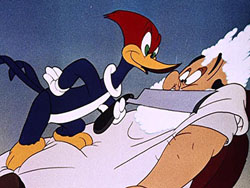
Storywise, Woody harasses several circus animals, including getting back at a lion who takes a bite of his hot dog by having the beast bite off his own tail (“Just call me stubby”). He then tries to enter the big top without a ticket. A roustabout boots him out, then insists that he work for it by watering the elephant if he wants to see the show. Woody short cuts with the old gag from the silent days of hooking up the pachyderm’s nose to a fire hydrant. The roustabout vows, “When I get through with you, any similarity between you and a woodpecker will be purely coincidental.” The chase leads inside, where Woody takes to the trapeze, swinging at times from his topknot, and scatting several bars of a middle movement of “The Blue Danube”. The roustabout is forced to perform a harrowing bicycle ride down a steep inclined ramp, gaining so much speed that he straightens out the loop-de-loop in the wooden structure. Both characters end the film outside within the shooting gallery booth, dodging shot and shell. Though there were many better Woody films produced over the years, this one bears the unexpected distinction of being the only Woody cartoon ever nominated for an Academy Award.
SONG: “I Went To the Animal Fair” received one mainstream recording by Carl Fenton’s Orchestra for Brunswick in 1924. Thereafter, it was particularly a song associated with children’s recordings. Tex Ritter included it on a Capitol multi-disc set. Arthur Godfrey would record a Columbia Playtime version circa 1951. Dorothy Olsen (the Singing Schoolteacher) issued an RCA version for their Bluebird Childrens’ series. An anonymous version would appear on Cricket Records, while Golden Records would issue one by Captain Kangaroo (Bob Keeshan). Speaking of children’s records, Mel Blanc (the original Woody” would get his chance to perform a sort of sequel to “The Dizzy Acrobat” in which Woody finally decides to attempt to solve the riddle of what became of the monk, in the storyteller single, “Woody Woodpecker and the Lost Monkey” for Capitol.
To be continued…
The Beach Nut (10/16/44) returns Lee Sweetland to the mike, here providing Woody with a spirited rendition of “My Bonnie Lies Over the Ocean”, featuring both a line in falsetto, whistling, and colorful runs of octave scales. The film provides a landmark, as the first appearance of Woody’s most durable foil, Wally Walrus, whose peaceful day at the beach is destroyed by Woody’s utter chaos – running him down with a surfboard, setting fire to his beach umbrella, and posing as a fake swami fortune teller at the amusement pier. Wally ties him to an anchor, and tosses it into the sea. However, he forgets to untie the other end of the rope from a weight-supporting post of the pier. The entire pier collapses, dropping Walrus and all members of an onlooking crowd into the drink, just as Woody comes up unharmed. The film closes with everyone dog-paddling to chase Woody out to sea. SONG: “My Bonnie Lies Over the Ocean” The Leake County Revelers performed an early electrical version on Columbia. An anonymous acoustic side also appeared by the “Harmony String Orchestra.” Baritone Stuart Robertson included it in a medley on an HMV Red Seal release with male chorus. Ella Logan performed “My Bonnie…” for Brunswick. Ella Fitzgerald and Glen Gray would each issue Decca sides. Cliff Briner’s Texas Wanderers also waxed a Decca side, giving it the Western Swing style. The Hoosier Hot Shots would issue a Melotone side, making it one of their unique novelty pieces with added comedy repartee. Irv Carroll and his Orchestra issued a Bluebird side, probably in swing style. It received Dixieland treatment on a MacGregor transcription by the Sextette From Hunger. A very old-tyme sounding accordion version appeared by Jimmy Shand’s band on Parlophone. An odd conga-beat version was released in the 50’s by Martinas and His Music for British Columbia. Harry Blons’ Dixieland Band included it on an Audiophile 12″ microgroove hi-fi 78. The Living Guitars tried a rock rendition for RCA in 1964. Freddy Quinn (I cannot determine on what label) performs it absolutely straight and sentimental, as the song was no doubt intended to be heard, on a stereo LP. James Last also plays it fairly straight on a Polydor LP, but adds a little syncopation. Here’s a fun clip with Alvino Rey and his singing guitar:
While the cartoon isn’t readily available online from reliable sources, a modern transcription of the music, digitally performed, has appeared, showing off a sheet-music depiction of what might have been the printed score had Universal ever chosen to publish the piece. Why was it not professionally published? Perhaps those in the music world were realistic enough to know that very few would have the talent to adequately play it.
Jungle Jive (5/15/44) – An essentially plotless musical vehicle, which provided the final chapter for a piano great of the big band era. Bob Zurke had come to prominence with the Bob Crosby orchestra as arranger and soloist, then formed his own short-lived big band. His luck and fame had taken a downhill turn for personal reasons by the time of this cartoon, when he had been out of the recording studio for years. This film would mark his final recording and studio session, and the title piece is his own original. He would die before the film’s release. The film is set in the Sandwich Islands (with typical puns on various kinds of edible ones). Though several of the local natives are drawn with oversize lips similar to those seen in “Scrub Me Mama” and “Boogie Woogie Bugle Boy”, Lantz does not repeat his past racial stereotype mistakes by portraying the natives as black cannibals, but lightens their skin several tones to make the depictions at least less controversial. The painting change worked, and the film was able to remain in TV syndication. The title number is performed by a large overweight native (is he supposed to be a tropical Fats Waller?) who tries to tickle the ivories upon a piano that washes up in a crate along with other musical instruments from a shipwreck, and a crabby crab who also turns up inside the crate, who is very particular about sharing the piano keys with anyone, and prefers to do the showing-off himself. The crab, by the way, is another loose adaptation of the classic design originated in Disney’s “Hawaiian Holiday” and then lifted by Harman and Ising for “The Little Goldfish”, though rendered in simpler stylized color in James Culhane’s usual economic and artistic style.
Abou Ben Boogie (9/18/44) contains absolutely no plot – and makes no pretense at being anything but Lantz’s attempt to do an all-out “homage” (or is the proper word, “steal”) of the night-club girl watching of Avery’s Red Hot Riding Hood). Since the film is essentially a comeback for the designs of the Princess and the fastest man in Siam, from The Greatest Man in Siam, the locale is shifted to an unknown nation in the middle East, at a night spot known as the Adobe Club (“Here’s mud in your eye”). The princess is recast as the entertainment, appearing out of a giant magic lamp, while the former fastest man appears as Abou Ben Boogie, the oriental rug cutter. No effort is made to not copy the Avery style, with wild takes galore (including Avery’s own giant-eyeball once-over of the girl), and substantially smoother and more seductive animation of the girl’s title number than anything seen in “Siam”. In fact, there are artifacts that suggest the film got in trouble with the censors (who had already required the girl to at least wear transparent harem-leggings in the prior picture), as several walk-cycles are seen only from the waist up – a likely indicator that the censors made the shots be zoomed-in upon to remove view of sensuous hip-strutting. It is surprising this film is not better-known and regarded among animation buffs for its similarities to the Avery product – something that often catches the eye when appearing in the work of other studios, such as Famous’s Sheep Shape – and, alas, may be mainly due to Universal keeping the film under wraps for so many decades. The title number, with writing credit given onscreen to Tot Seymour and Vee Lawnhurst, is an original, of which I am aware of no commercial recordings. However, the piece was published by Leeds Music, with a colorful and seductive piece of original artwork based on the film.
The Greatest Man in Siam (3/27/44) – A contest to select Siam’s most suitable suitor for the hand of the royal princess is announced by King Size (we wonder how decades later, Paul Smith, who worked on this short, transformed the King into a mouse as ruler of Rodentia). The event is sandwiched into the palace schedule, around the scheduled bowling match at 3:30 between the Lockheed and Kaiser Welders. Contestants include the self-proclaimed “smartest” man in Siam (because he thinks himself immune from the Draft Board, carrying a goldfish bowl around one leg for a “water on the knee” exemption). He is proven not so smart, as a Draft Board representative declares his water on the knee to make him a perfect candidate for the King’s navy. The richest man in Siam has so many glistening jewels, he has to be sprayed with dimmer paint to keep the glare from blinding the King. He also has the “riches” of all kinds of rationed goods and foodstuffs. But a visit from the vacuum cleaner-equipped armored car of the royal Tax Collector reduces him to nothing but a barrel to wear (fashions by Cooper). The fastest ma in Siam demonstrates his speed with the old gag from Disney’s “The Tortoise and the Hare” of performing both ends of a William Tell arrow shoot, then by dodging lightning bolts – inly to get hit by one and reduced to a charred matchstick. “He burned himself out”, chortles the King. Of course, the competition is won by the trumpet-playing “hottest man in Siam”, whose eyes turn into electric fuses that burn themselves out when he plays hot licks. Mention should also be made of the King’s daughter, whose animation was Lantz’s closest to Avery’s Little Red, and considered too hot for the kiddies to handle, keeping this film from television syndication. (Will MeTV possibly think differently (or have they already), now that the Lantz cartoons are circulating in their hands?) “Siam” was another item introduced by Spike Jones, who seems to have had the only recordings of it, on Bluebird and for Standard Transcriptions. Notably, a Victor reissue kept the song in catalog, recoupling it with “Pass the Biscuits, Mirandy” – a Walter Lantz double-header.
\
Though the musical selection is old hat to this article series, it is too tempting to pass up mention of Woody Woodpecker’s The Barber of Seville (4/10/44), which of course uses the standard aria from the work, Largo Al Factotum. Woody takes over a barber shop when he finds that its proprietor never came back after leaving to take a draft board physical, (“Maybe I can cut my own hair. I cut my own teeth.”), then inflicts chaos upon its customers (an Indian chief, and an Italian construction worker). What is notable about this film, besides being a tour de force for Woody himself and for James Culhane’s energy-filled style of direction (watch for a scene of Woody calling everywhere for Figaro, developing into a pyramid of six Woody’s standing one atop another), is the uncredited vocal performance by Lee Sweetland, a concert-trained baritone, who proved to be the perfect singing match for Woody’s spoken voice when his voice tracks were speeded just right. Little seems to be written about Sweetland, but his connection with animation dates at least as far back as Disney’s Farmyard Symphony (1938), where he provided the voice of a singing farmer operatically calling his pigs. His most commonly-available photo shows him singing to an NBC microphone, indicating his obtaining of radio work, and he was a regular vocalist with an Olde Tyme group, Georgie’s Tavern Band, on Decca. He would record several concert-style operetta works with Paul Weston’s orchestra for Capitol. His wife, Sally Sweetland, would have her own singing and acting career, and the two of them operated a voice studio to teach their art for years. Lee’s sterling performance as Woody in this picture not only puts over a fine rendition of the aria (if you have capability to play the track slowed-down, it must have been a task to sing the piece with extended holds of notes in slow motion, yet come across with convincing dramatic effect when the track is played in Woody’s key), but is even climaxed by a singing version of Woody’s laugh, which again seems an absolutely perfect vocal match to what we would expect from the character’s vocal chords.
• The only decent clip from “Boogie Woogie Man” available is on DailyMotion.
Boogie Woogie Man (9/27/44) – Here’s one that still hasn’t made it intact to the internet (though it was released remastered on the Volume 2 DVD set, The Woody Woodpecker and Friends Classic Cartoon Collection, which is a must as substantially more comprehensive than and current blu-rays). In the ghost town of Goose Pimple, Nevada, a Spook of the Month Club convention is being held for ghosts, presided over by a duct devil who spins underneath a saloon tablecloth and transforms into a rotund ghost, broadcasting on a ghost-to-ghost hookup (yes, the line was already old news by the time Paramount got around to using it). For reasons unknown, all of the delegation in attendance except an old bearded ghost from a vintage bottle of “spirits” feels that the fright business is slipping, and unless ghosts become hep to the jive, their chain clanking and clammy hands will be regarded as so much corn. A delegation of three black ghosts from Lennox Avenue sets the pace vocally and on piano (performed by the “Lew Mel Morgan Trio” – at least, that’s how they’re billed here, although their handful of commercial recordings, including sides for Super Disc and Apollo, as well as V-Disc and MacGregor transcriptions, credit them as “Loumell”). They are joined in the film by the ghost orchestra of Spook Jones and his Creepy Crooners. Soon everyone – even Grandpa ghost – is dancing away, until a clock chimes 5:00 a.m. (chimes rung by a figurine hammering on whiskey bottles). Everyone does a quick disappearing act before sunrise, with the chairman last to leave, converting himself back into a dust devil to whirl his way out of town. “Boogie Woogie Man (Will Get You If You Don’t Watch Out)” is not to be confused with several recorded songs of similar titles during the period, and appears to be an original (was it composed by the performing trio or a collaboration with Darryl Calker?), unique to this film.
Pass the Biscuits, Mirandy (8/23/43) – Had it not been for affixing a wartime ending to this film, this cartoon might have fit well in TV rotation among Lantz’s other product, and perhaps be remembered alongside such hillbilly epics as Tex Avery’s “A Feud There Was”, Disney’s “The Martins and the Coys”, and the like. Based on a number introduced by Spike Jones, the film initially follows the plot of the song lyric rather closely, and keeps connection with the Jones recording by hiring vocalist Del Porter for the soundtrack, who also sang it on the record. After a hard day of “shootin’ everything [and everyone] in sight”, a hillbilly craves food, and our principal head of household calls for Mirandy’s biscuits, and some gravy to sop ‘em in. Mirandy, who rather closely resembles Mammy Yokum from L’il Abner, prides herself on her buscuits, which won her her man. However, she also prides herself on having no recipe – just throw in the kitchen sink, including glue and chicken feathers to make ‘em light, mix the dough on a washboard, flatten it out in a washing machine wringer, and slap in in an old stove with a spring-release ejector to pop ‘em out when they’re done. For all their renown, the biscuits have one problem – they’re entirely inedible. Chomp down on ‘em, and upper and lower teeth warp in opposite directions. Slap ‘em with an axe, and watch the steel bend. Toss ’em out the window, and knock down the neighbors’ shack. The rival family declares from the rubble, “Mandy’s baking them blockbusters again”, and come a-runnin with their shotguns blazing. Following the song, Mandy’s old man gets the brilliant idea to load all the clan’s rifles with biscuits instead of bullets, to drive the ornery cusses off. In the original song, the idea doesn’t work so well – causing the mountaineer’s gun to explode in his face. Here, however, the biscuits work like a charm, racking up score after score on the rival feuders. The whole fracas is interrupted by someone posting an official war office bulletin on a post nearby, ordering that all families in the area must work or fight. Work? No hillbilly ever heard of it. So both families wind up on the front lines, with Mirandy still supplying the ammunition as a member of the WAAC’s. Hitler, Mussolini, and Tojo make an appearance in a command tank, and are blasted by the baked bombshells, and transformed into a German sausage, a bowl of spaghetti, and a dish of steaming rice. The hillbillies sing in celebration, while the end title asks us to buy more war bonds for victory. There are three known recordings of the song – Spike Jones on Bluebird and on Standard Transcription, and the Merry Macs on Decca – also a quite entertaining version. Spike would also get to perform the number on film, in an unusually gag-laden and highly-entertaining Soundie.
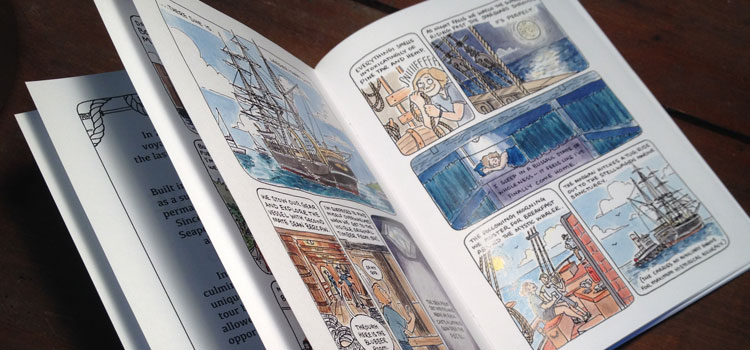
A number of fantastic ducks lined up in the month of June and I want to talk about all of them, but there isn’t time to do it in one giant post. One duck, however, took the form of appearing at the 14th International Melville Society Conference to speak about my time aboard the Charles W. Morgan eleven years ago. (You can read the comic about that trip here.)
I read Moby-Dick for the first time a handful of years ago and loved it, but I wouldn’t call myself a Melville scholar. However, attending this conference felt like a great chance to scratch the academic itch without, say, going to grad school.
I ended up spending the whole week taking visual notes, which allowed me to drop into a type of weightless, fixated attention that I’ve really missed in my caregiving life. It also helped give me something to do during panels where I felt a little, uh, out of my depth.
When I’m drawing, words just wash over me. I can pluck the ones that resonate in the moment, then step back at the end of the hour and get a picture of what I took away from the talk. I particularly loved the freedom to just wander into panels where I had no idea what the speakers were talking about, only to come away newly-enthused about some niche avenue into Melville’s work.
Time and time again the attendees emphasized how unique this conference is in its warmth and intellectual diversity. I met scientists and art historians and medievalists and printmakers and disability scholars and tall ship sailors and filmmakers and many, many professors. It was a dreamy, albeit intense, four days.
Here are the notes from every talk I attended, all drawn straight to ink during the speakers’ presentations (usually about 20 minutes per person).
The biggest takeaway was that we need embedded cartoonists at all sorts of academic conferences—and the demand is there! People were so thrilled to see this kind of work coming out of the event, and there are lots of journals hungry to publish unusual creative content alongside academic papers.
Something to pursue…eventually. Got a couple things* to wrap up first.

 Login
Login




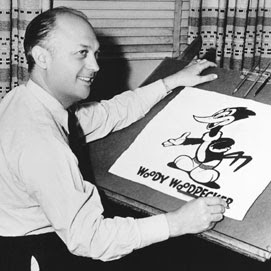 1943 would mark the final year in the decade’s output of Lantz cartoons to feature a mix of product by various directors. By the end of the year, the reins of the studio’s work would be turned over entirely to James “Shamus” Culhane, who would give his films a distinctive, minimalistic and stylized background style somewhat predicting some of the work of UPA. Character animation, however, remained fairly fluid, and improved particularly in energy, posing, and camera angles, beginning to rival the dynamic feel of the Warner and Avery influences. However, having only one production unit took its toll on the number of issues per year, cutting output to only seven or eight films a season. Andy Panda, while continuing to make sporadic appearances, was not a favorite of Culhane, and takes little prominence during this period (with the exception of a rare Oscar nomination for Culhane’s Fish Fry, a film that features nothing new in the way of music, mostly based upon variations of “Polly Wolly Doodle”). The Swing Symphonies continued to be the primary proving ground for new ideas and new songs, and Culhane was there to breathe life into their work. Meanwhile, Woody Woodpecker remained the reliable laugh-getter and fan favorite, but was still undergoing transition in finding his voice after the departure of Mel Blanc. As luck would have it, a chance for a musical plot presented itself, requiring the seeking out of someone who could sing well in the voice of the character. They eventually found the right man – and how!
  The Dizzy Acrobat (5/31/43) – Woody Woodpecker had been undergoing some voice changes lately, with Mel Blanc having left voice duties at Lantz and concentrating his work at Warner Brothers. Here, he is voiced by Kent Rogers, who tries his first hand at making Woody sing. His voice perhaps doesn’t quite fit, seeming to have a bit of a New York accent that might have better suited an attempt to do a formative Bugs Bunny. Nevertheless, he provides a somewhat memorable rendition of “I Went To the Animal Fair”, as Woody surveys the layout of the menagerie and sideshow at the circus grounds. He gets stuck like a broken record on the line, “And what became of the monk, the monk, the monk, the monk…”, then pauses to inject his own personal observation – “Well, who cares?”


 Though the musical selection is old hat to this article series, it is too tempting to pass up mention of Woody Woodpecker’s The Barber of Seville (4/10/44), which of course uses the standard aria from the work, Largo Al Factotum. Woody takes over a barber shop when he finds that its proprietor never came back after leaving to take a draft board physical, (“Maybe I can cut my own hair. I cut my own teeth.”), then inflicts chaos upon its customers (an Indian chief, and an Italian construction worker). What is notable about this film, besides being a tour de force for Woody himself and for James Culhane’s energy-filled style of direction (watch for a scene of Woody calling everywhere for Figaro, developing into a pyramid of six Woody’s standing one atop another), is the uncredited vocal performance by Lee Sweetland, a concert-trained baritone, who proved to be the perfect singing match for Woody’s spoken voice when his voice tracks were speeded just right. Little seems to be written about Sweetland, but his connection with animation dates at least as far back as Disney’s Farmyard Symphony (1938), where he provided the voice of a singing farmer operatically calling his pigs. His most commonly-available photo shows him singing to an NBC microphone, indicating his obtaining of radio work, and he was a regular vocalist with an Olde Tyme group, Georgie’s Tavern Band, on Decca. He would record several concert-style operetta works with Paul Weston’s orchestra for Capitol. His wife, Sally Sweetland, would have her own singing and acting career, and the two of them operated a voice studio to teach their art for years. Lee’s sterling performance as Woody in this picture not only puts over a fine rendition of the aria (if you have capability to play the track slowed-down, it must have been a task to sing the piece with extended holds of notes in slow motion, yet come across with convincing dramatic effect when the track is played in Woody’s key), but is even climaxed by a singing version of Woody’s laugh, which again seems an absolutely perfect vocal match to what we would expect from the character’s vocal chords.
  Pass the Biscuits, Mirandy (8/23/43) – Had it not been for affixing a wartime ending to this film, this cartoon might have fit well in TV rotation among Lantz’s other product, and perhaps be remembered alongside such hillbilly epics as Tex Avery’s “A Feud There Was”, Disney’s “The Martins and the Coys”, and the like. Based on a number introduced by Spike Jones, the film initially follows the plot of the song lyric rather closely, and keeps connection with the Jones recording by hiring vocalist Del Porter for the soundtrack, who also sang it on the record. After a hard day of “shootin’ everything [and everyone] in sight”, a hillbilly craves food, and our principal head of household calls for Mirandy’s biscuits, and some gravy to sop ‘em in. Mirandy, who rather closely resembles Mammy Yokum from L’il Abner, prides herself on her buscuits, which won her her man. However, she also prides herself on having no recipe – just throw in the kitchen sink, including glue and chicken feathers to make ‘em light, mix the dough on a washboard, flatten it out in a washing machine wringer, and slap in in an old stove with a spring-release ejector to pop ‘em out when they’re done. For all their renown, the biscuits have one problem – they’re entirely inedible. Chomp down on ‘em, and upper and lower teeth warp in opposite directions. Slap ‘em with an axe, and watch the steel bend. Toss ’em out the window, and knock down the neighbors’ shack. The rival family declares from the rubble, “Mandy’s baking them blockbusters again”, and come a-runnin with their shotguns blazing. Following the song, Mandy’s old man gets the brilliant idea to load all the clan’s rifles with biscuits instead of bullets, to drive the ornery cusses off. In the original song, the idea doesn’t work so well – causing the mountaineer’s gun to explode in his face. Here, however, the biscuits work like a charm, racking up score after score on the rival feuders. The whole fracas is interrupted by someone posting an official war office bulletin on a post nearby, ordering that all families in the area must work or fight. Work? No hillbilly ever heard of it. So both families wind up on the front lines, with Mirandy still supplying the ammunition as a member of the WAAC’s. Hitler, Mussolini, and Tojo make an appearance in a command tank, and are blasted by the baked bombshells, and transformed into a German sausage, a bowl of spaghetti, and a dish of steaming rice. The hillbillies sing in celebration, while the end title asks us to buy more war bonds for victory. There are three known recordings of the song – Spike Jones on Bluebird and on Standard Transcription, and the Merry Macs on Decca – also a quite entertaining version. Spike would also get to perform the number on film, in an unusually gag-laden and highly-entertaining Soundie.