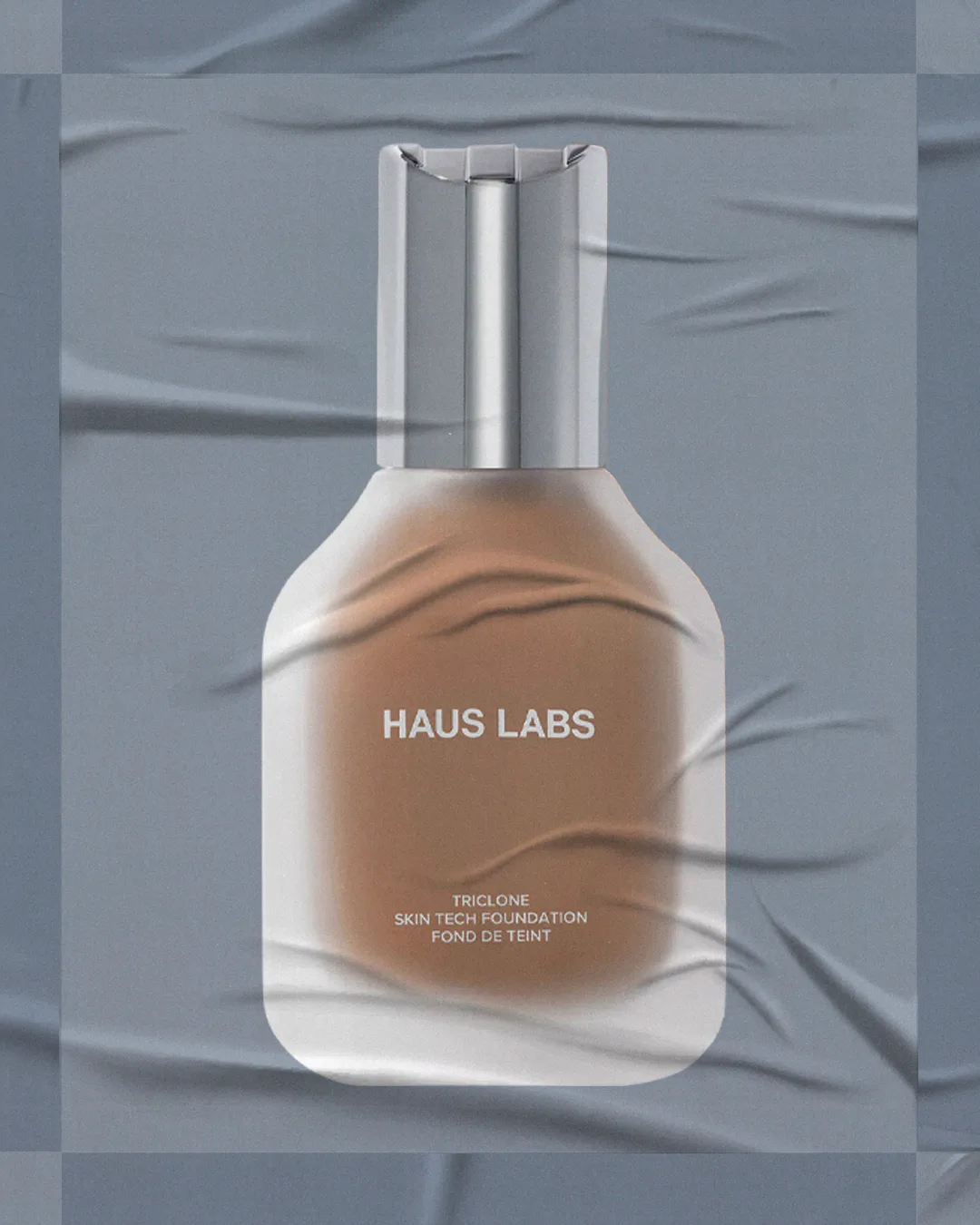
Image courtesy of Haus Labs. Illustration by Kimberly Duck
Between saltwater swims, jungle hikes, and balmy dinners that begin at golden hour and end well after dark, Costa Rica is a place where makeup immediately shows—whether it adapts or disappears. On a recent trip to Central America, I packed just one base product: the Haus Labs Triclone Skin Tech Foundation, a formula designed to flex with heat, humidity, and movement rather than sit heavily on the skin. Was it risky to pack a foundation I had never tried before? Absolutely. But the beauty tester in me couldn’t resist finding out if one formula could actually hold up.
The Triclone Skin Tech Foundation is a skincare-meets-makeup formula that promises breathable, buildable coverage that actually adapts to your skin versus masking it. The product is packed with over 20 skin-friendly ingredients, including a fermented arnica complex that helps calm redness and protects against environmental stressors (which is perfect for me, since I struggle with mild rosacea along the center part of my face). The texture is lightweight and serum-like, so it’s meant to layer easily from a sheer, everyday finish to a more polished look without creasing or settling into fine lines. And with a wide shade range designed to flatter a spectrum of skin tones (51, to be exact), it’s made to feel inclusive and effortless—exactly what you want when you’re packing light and hoping one foundation can really do it all on vacation.
During my trip, I wore the foundation three completely different ways: spot concealing for the beach, sheered out for daytime exploring and hikes, then built up for sunset dinners. Somehow, it stayed smooth, flexible, and crease-free in every setting. What surprised me most was how cooperative the formula was—no matter how I applied it, it layered seamlessly with everything else in my routine. It sat well over SPF, didn’t pill when tapped on with concealer, and played nicely with cream bronzers and blushes without breaking apart underneath. As for the finish, it landed in that perfect sweet spot: skinlike and softly radiant, never flat or greasy, even in humidity.
How I applied the product depended entirely on my day’s activities, and that’s what made the foundation such a standout. For the beach, I skipped an all-over base and used my fingers to tap it only where I needed coverage—around redness, a few dark spots, and uneven areas. It blended nicely into bare skin and stayed put without looking obvious or heavy.
For daytime exploring and hikes, I sheered it out by applying a few drops to the center of my face with a damp makeup sponge, pressing and bouncing it outward for a lightweight, even finish. At night, I switched to a larger foundation buffing brush, layering thin coats where I wanted more coverage and lightly buffing for a smooth, polished look. No matter the tool—brush, sponge, or fingers—it blended seamlessly, never streaked, and built beautifully without caking, making it easy to tailor the finish from barely there to nighttime-ready in seconds.
In a climate that doesn’t forgive heavy formulas or weak wear time, this foundation proved it could handle real heat, humidity, and movement without looking heavy at all.
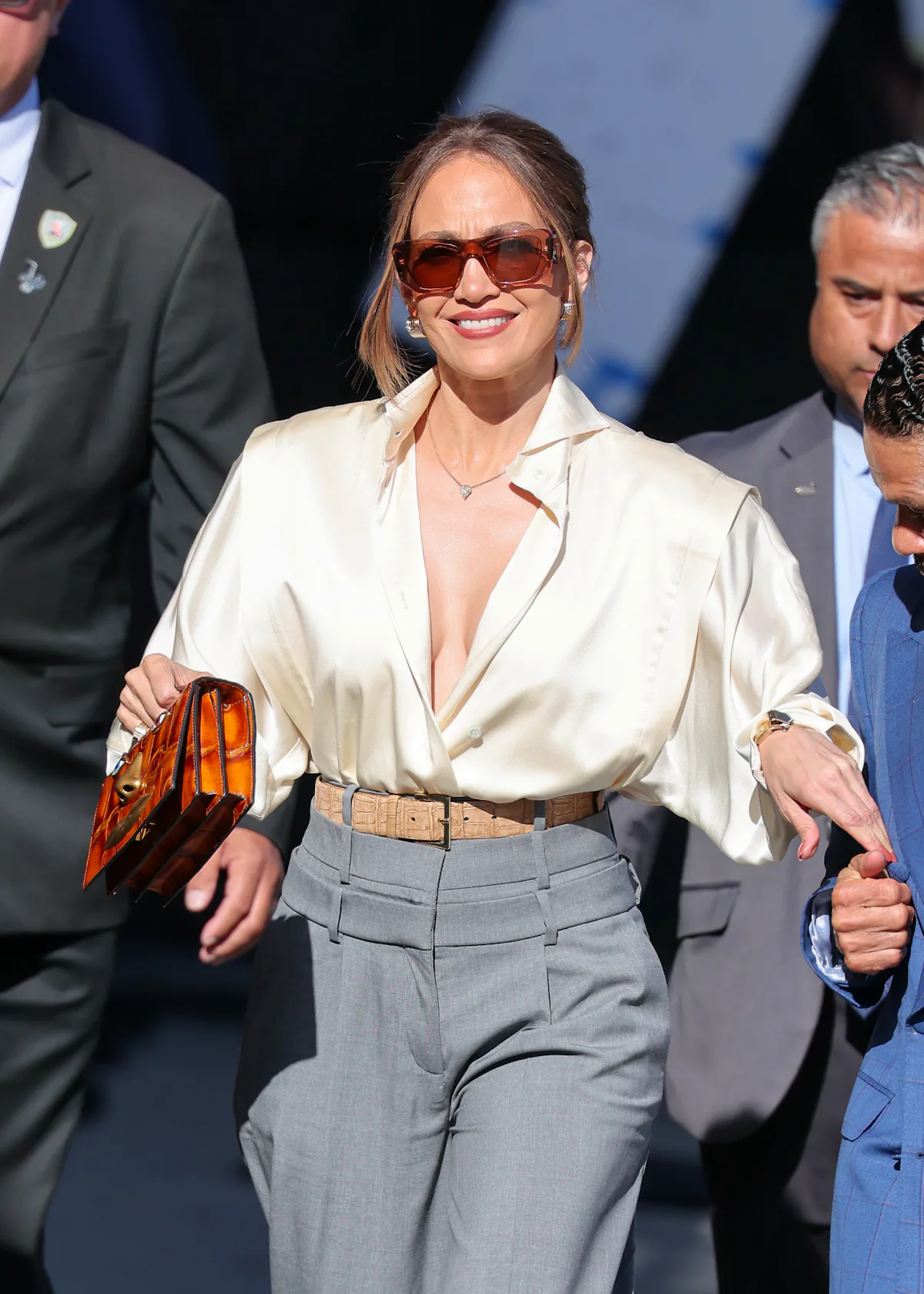
If your boss wears Louboutins, they now have two things in common with Jennifer Lopez. Amidst the press tour for her new Netflix film Office Romance, Lopez has stepped out in an array of looks that nod to workwear and corporate style. Her latest brought a dynamic take to simple office-wear, complete with a glamorous height boost only she could pull off.
In Los Angeles, Lopez stepped out in a set of light gray slacks and an ivory silk blouse. However, this wasn’t your standard office manager’s attire. Her trousers included a triple-waisted silhouette with flowing wide legs, cinched at the top by a reptilian-embossed belt with a large gold buckle. Meanwhile, her button-down shirt featured oversized, padded shoulders and was unbuttoned to form a plunging neckline in a nod to power dressing.
PG/Bauer-Griffin/GC Images/Getty Images
Lopez completed her look with two bold accents that were also core to her high glamour sensibility. A recent adoptee of Schiaparelli under Daniel Roseberry, she carried a small, warm brown top-handled version of the brand’s viral Face bag. Her style included allover reptilian embossments, complete with sculptural gold accents that formed its namesake face. Meanwhile, the star—always one for a sky-high heel—opted for a towering set of Christian Louboutin’s nude Dolly Alta pumps. The round-toed shoe featured thick platform soles and 6.29-inch stiletto heels, originally released as part of the brand’s fall 2023 collection. Though the style certainly soared, Lopez strolled in them with ease—fitting for a musician with a song called “Louboutins.”
The star’s ensemble may not have been up to code for your standard workplace, but her accessories certainly were. Lopez finished her outfit with squared gold post earrings and a matching watch, as well as a small diamond pendant necklace. Her look was complete with a pair of glistening brown Prada Symbole sunglasses, which delivered added drama from their oversized frames and triangle-textured temples.
PG/Bauer-Griffin/GC Images/Getty Images
Though Lopez’s business-ready outfit aligns with her current corporate-themed project, the star’s never shied away from luxe takes on office-wear. In fact, she’s regularly worn ensembles from slouchy suits to skirt suits, statement-making blazers, and classic button-downs and slacks—and occasionally swapped her go-to heels for office-friendly ballet flats. However, even when faced with the recent “quiet luxury” trend, Lopez has still gravitated towards eye-catching accessories and embellishments for a little extra drama.
Of course, Lopez’s business wardrobe is fitting—after all, she is also a businesswoman. Since 2001, the star’s led her production company Nuyorican Productions across numerous film and television ventures. Her latest deal, inked with Netflix in 2021, has found Lopez acting and producing various projects for the streaming service, including Office Romance, the films Mother and Atlas, and her own Super Bowl documentary Halftime. As a true multi-tasker, there’s still more to come from Lopez—including the film Happy Place and an adaptation of Isabella Maldonado’s Cipher. Clearly, this boss is clocked in until further notice.
The first Monday in May has arrived, which in the fashion world means one thing: the stars have descended upon Manhattan for the Met’s annual gala benefiting the Costume Institute. This year's edition, co-chaired by Beyoncé, Nicole Kidman, Venus Williams, and Anna Wintour—with Jeff Bezos and Lauren Sánchez Bezos as honorary chairs—celebrates the opening of "Costume Art," an exhibition pairing garments and artworks from across the Met's vast collection to make the case for fashion as an embodied art form. The dress code, "Fashion Is Art," plays on the same theme.
The gala surpassed last year's $31 million in funds raised with a record-breaking $42 million, an especially vital sum given that the Costume Institute is largely self-funded. That’s part of what makes the night so important for supporting the arts, and while the parade of celebrities, designers, and artists posing in meticulously crafted looks is the night's biggest draw, the spontaneous moments once guests clear the museum steps are the most coveted. That's in part because phones and photography inside the gala have been banned—per Wintour—since 2015, though a few candid photos typically manage to make it out (you might recall 2017’s infamous bathroom-smoking photos). Below, the behind-the-scenes celeb run-ins and moments from the 2026 Met Gala you might've missed.
ANGELA WEISS/AFP/Getty Images
Sunday Rose Kidman Urban and Nicole Kidman
Matt Winkelmeyer/MG26/Getty Images Entertainment/Getty Images
Anok Yai and Pierpaolo Piccioli
Matt Winkelmeyer/MG26/Getty Images Entertainment/Getty Images
Jennie, Hoyeon, and Chase Infiniti
Matt Winkelmeyer/MG26/Getty Images Entertainment/Getty Images
Jennie, Hoyeon, and Chase Infiniti
Matt Winkelmeyer/MG26/Getty Images Entertainment/Getty Images
Coco Jones and Doechii
LEONARDO MUNOZ/AFP/Getty Images
Beyoncé
Matt Winkelmeyer/MG26/Getty Images Entertainment/Getty Images
Beyoncé and Blue Ivy Carter
Dia Dipasupil/MG26/Getty Images Entertainment/Getty ImagesArturo Holmes/MG26/Getty Images Entertainment/Getty Images
Blue Ivy and Beyoncé inside the Met
Kevin Mazur/MG26/Getty Images Entertainment/Getty Images
Sometimes it feels like fresh handbags are hitting the market every single day. Just moments after you swipe your card for a new going-out bag, a casual scroll through Instagram may reveal another contender. Every time Bella Hadid steps out on the town, or Dua Lipa posts a new photo, they have a new covetable carry-all by their side. It’s downright overwhelming, but it’s not surprising. Accessories have long been a major seller for luxury brands, and there’s an incentive to release new and updated pieces. Are we to blame for wanting them all?
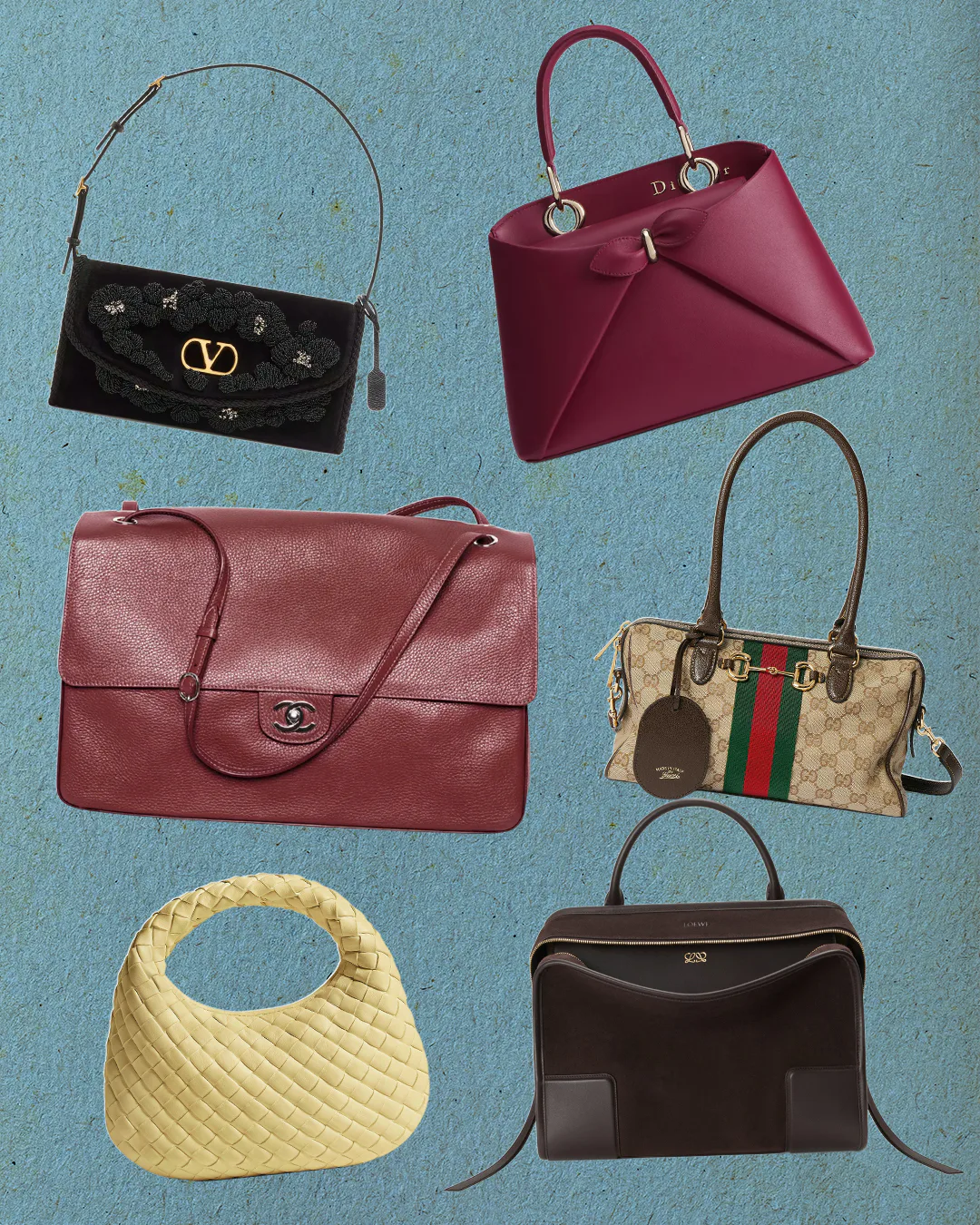
The situation has gotten even bigger thanks to the constant designer debuts. It seems that whenever someone takes the helm at a brand, they’re expected to couple their first collection with a new bag. The spring 2026 season brought with it many inaugural collections from new creative directors—and now, we’re reaping the benefits. Since the beginning of the year, many bags have become available, and they’re already in the closets of fashion’s most influential faces. Yes, you can collect them all, but if you’re attempting to be more selective (and save a few bucks), see below for a breakdown of the year’s It bags, so you can determine which one (or two...or three) will be right for you.
Dior Cigale
Gregory Shamus/Getty Images Sport/Getty Images
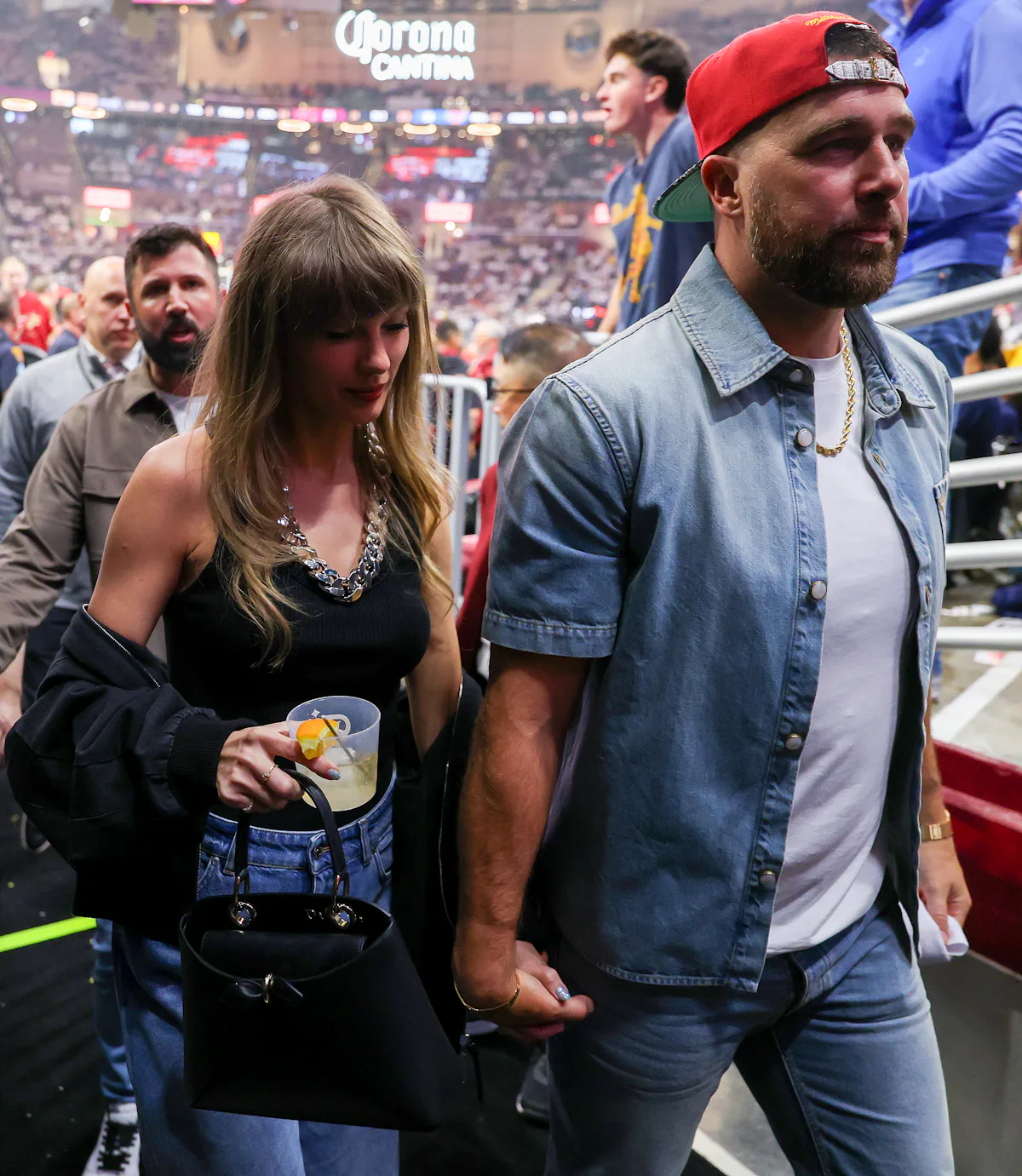
Jonathan Anderson has introduced many new bag designs during his first few seasons at the helm of Dior, but none have quite caught the eye of buyers as much as the Cigale. Presented during the spring 2026 runway show, the Cigale is named after a 1952 dress designed by Christian Dior. Once called “a masterpiece of construction and execution” by Vogue, the Cigale dress is known for its structured silhouette featuring a pinched-in waist and reduced pannier hips. Anderson has cited the dress as his favorite of all time, so it’s no surprise references to the piece have popped up throughout his work at Dior. The Cigale bag, specifically, features the same architectural lines for which the 1952 gown is known—representing feats in craftsmanship and construction, but also timelessness. It’s a sophisticated accessory for the modern ladies who lunch, and it has already been seen toted by Taylor Swift, Ariana Grande, Charlize Theron, and Charli xcx.
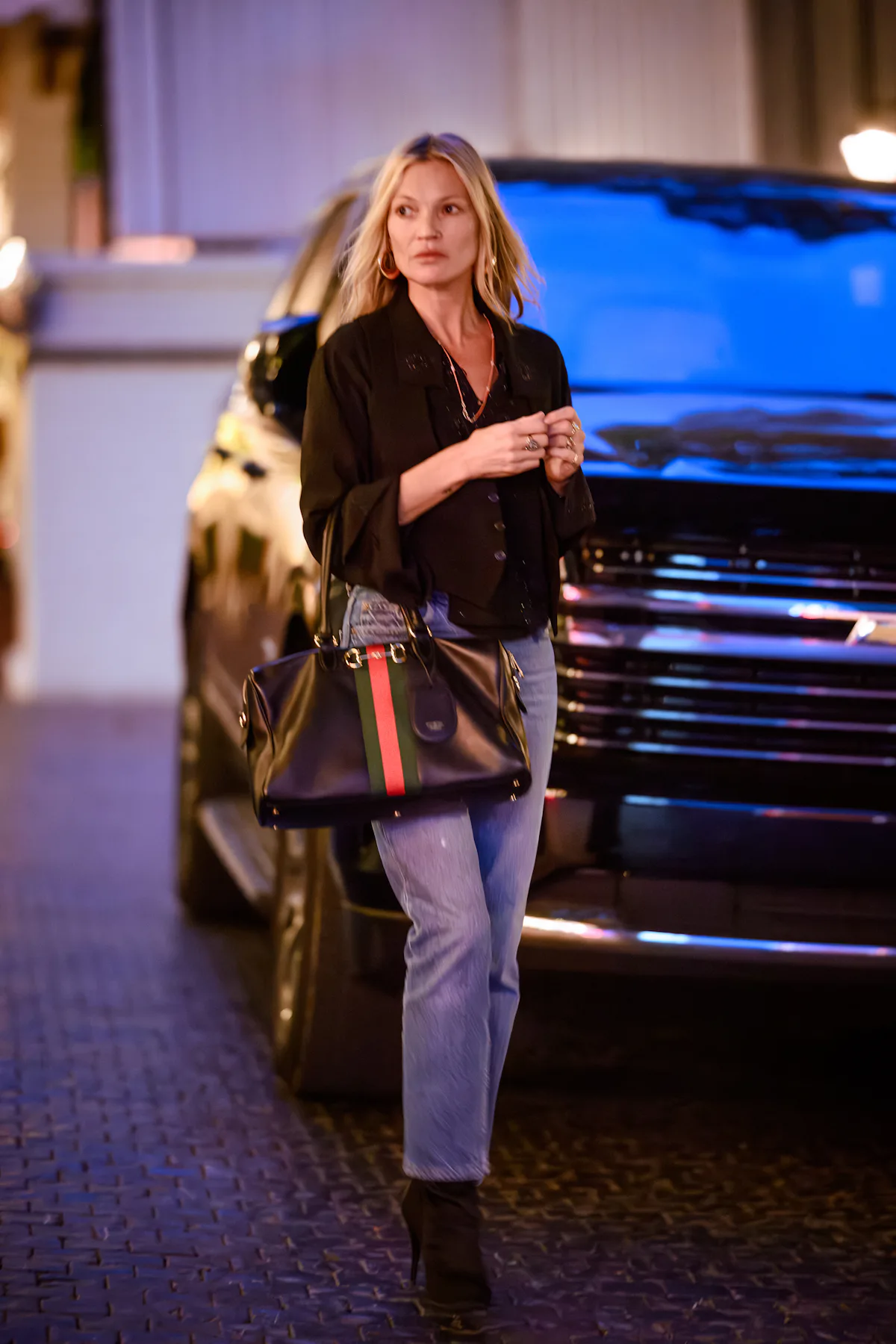
Gucci Borsetto
Getty
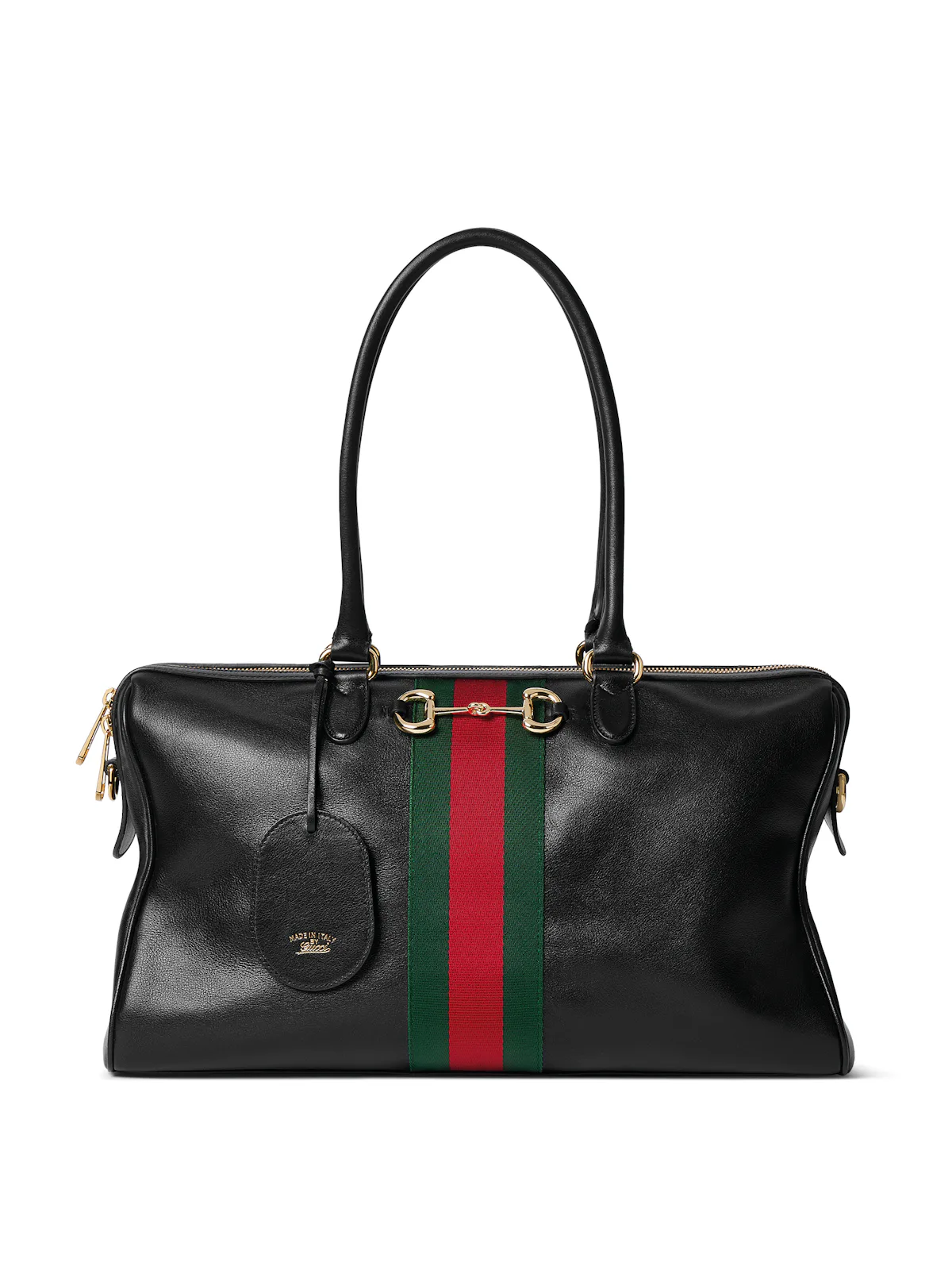
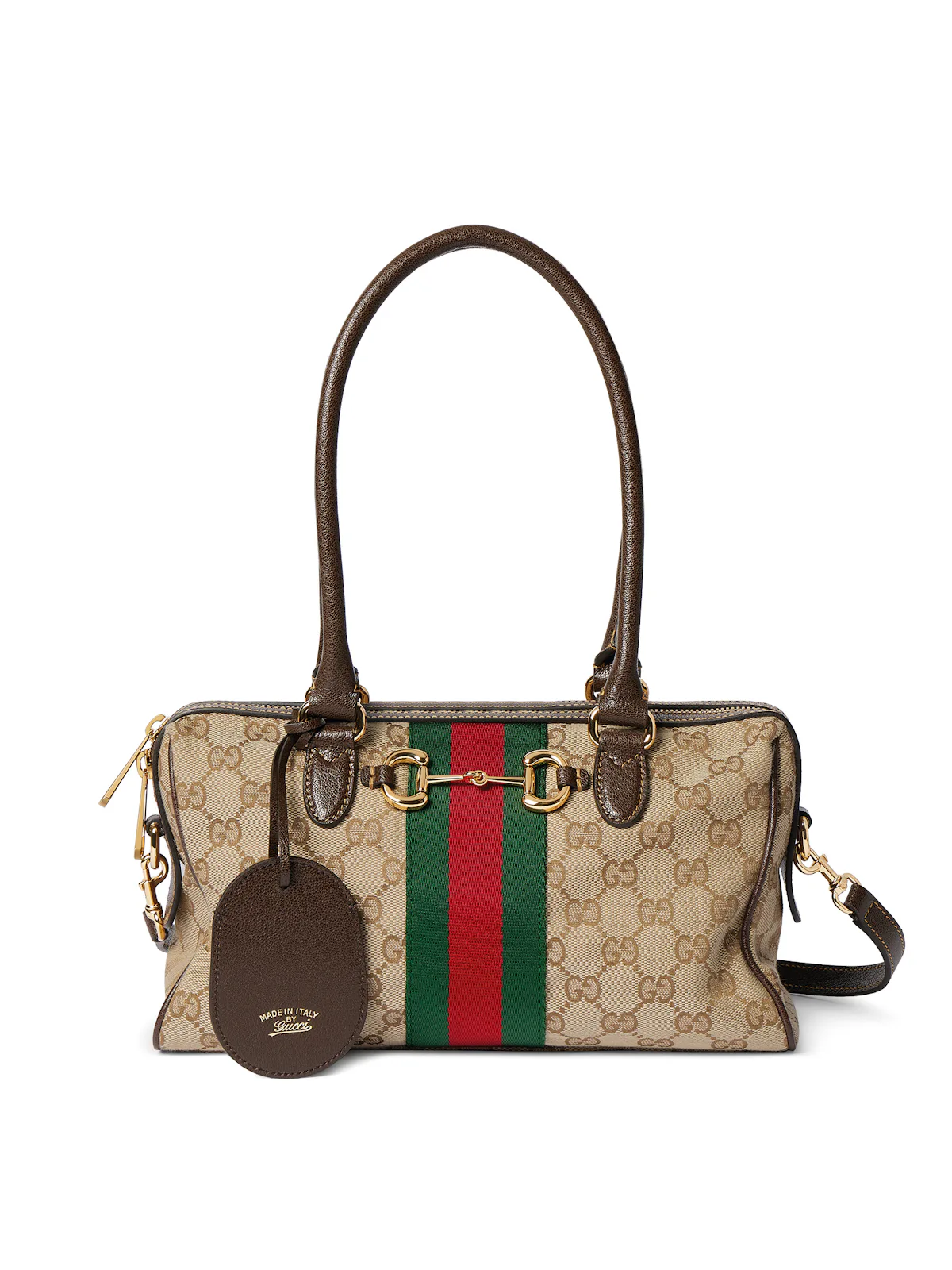
The Gucci Borsetto is one of those handbags you know about before it even launches, because you see it on the arms of all your favorite It girls. Prior to becoming available to the public earlier this year, the accessory was already seen held by Alex Consani and Vittoria Ceretti. Since then, Demi Moore, Kate Moss, and Dua Lipa have given the design their expert seal of approval too (with Moss also starring in the bag’s campaign).
The name Borsetto comes from an amalgamation of borsa (Italian for “bag”) and morsetto (Italian for “horse bit”). Of course, the piece features Gucci’s iconic horse bit, placed on the front of the bag atop the house’s two-tone stripe. With an elongated zipper and detachable strap, the Borsetto allows for versatility; an array of colors offers a more subtle look—black leather, brown suede—or something a bit more flashy with the classic GG monogram.
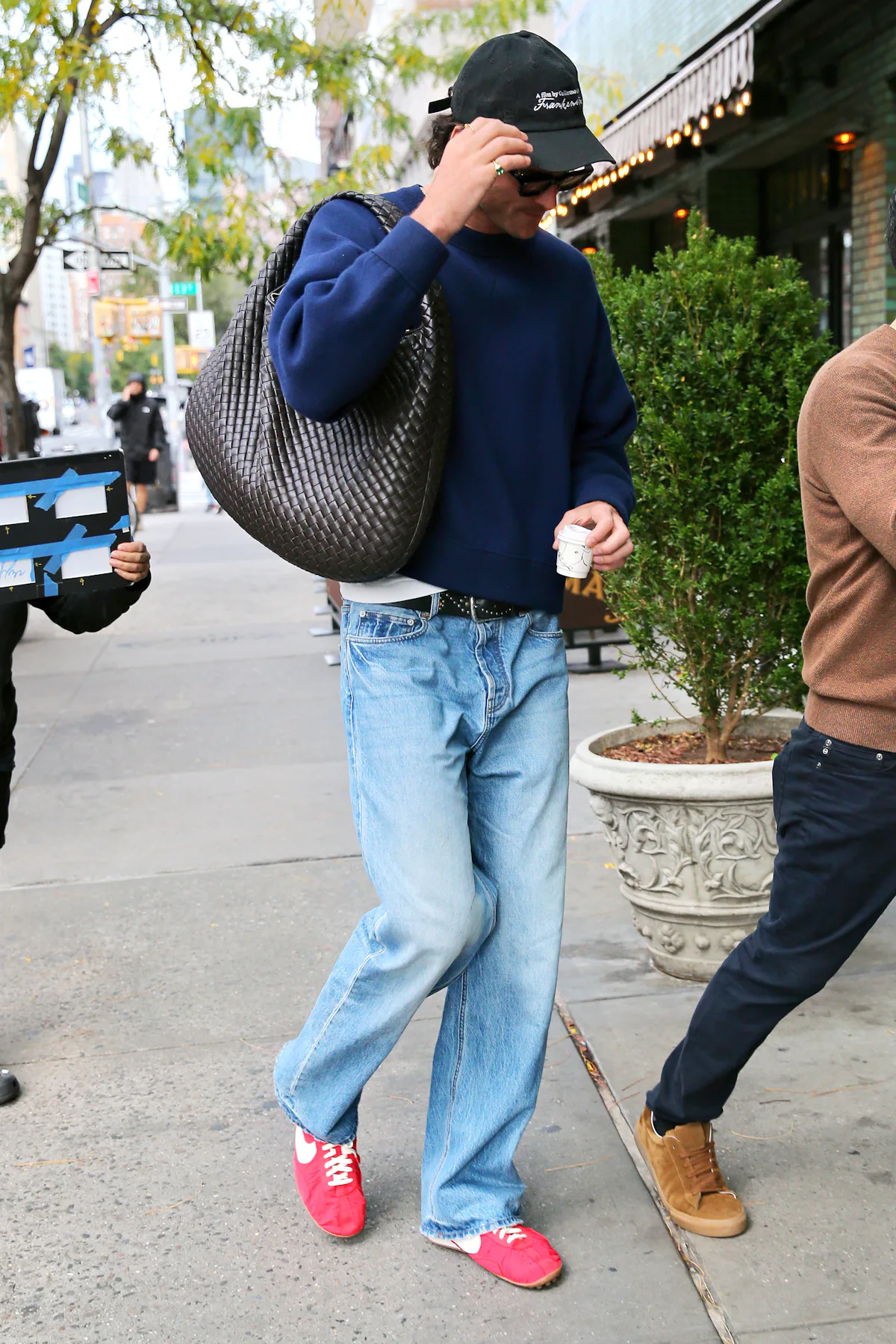
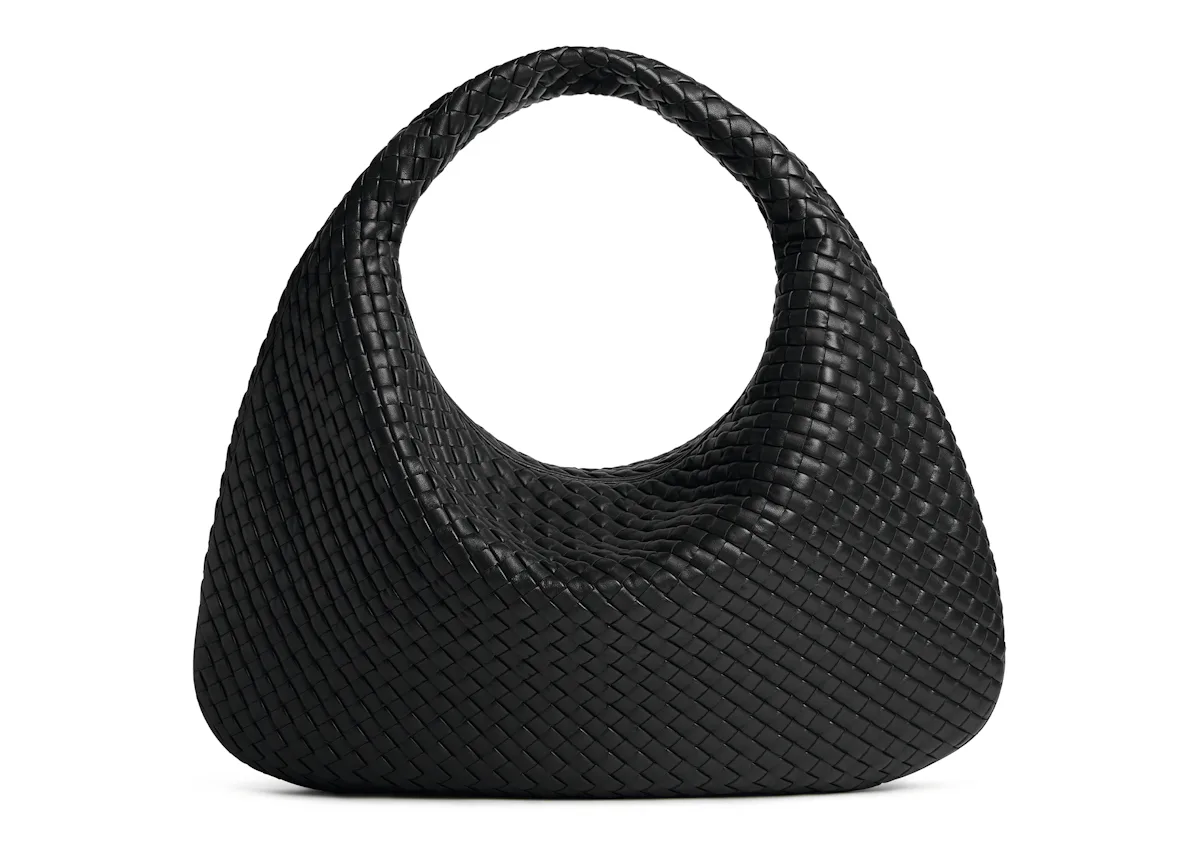
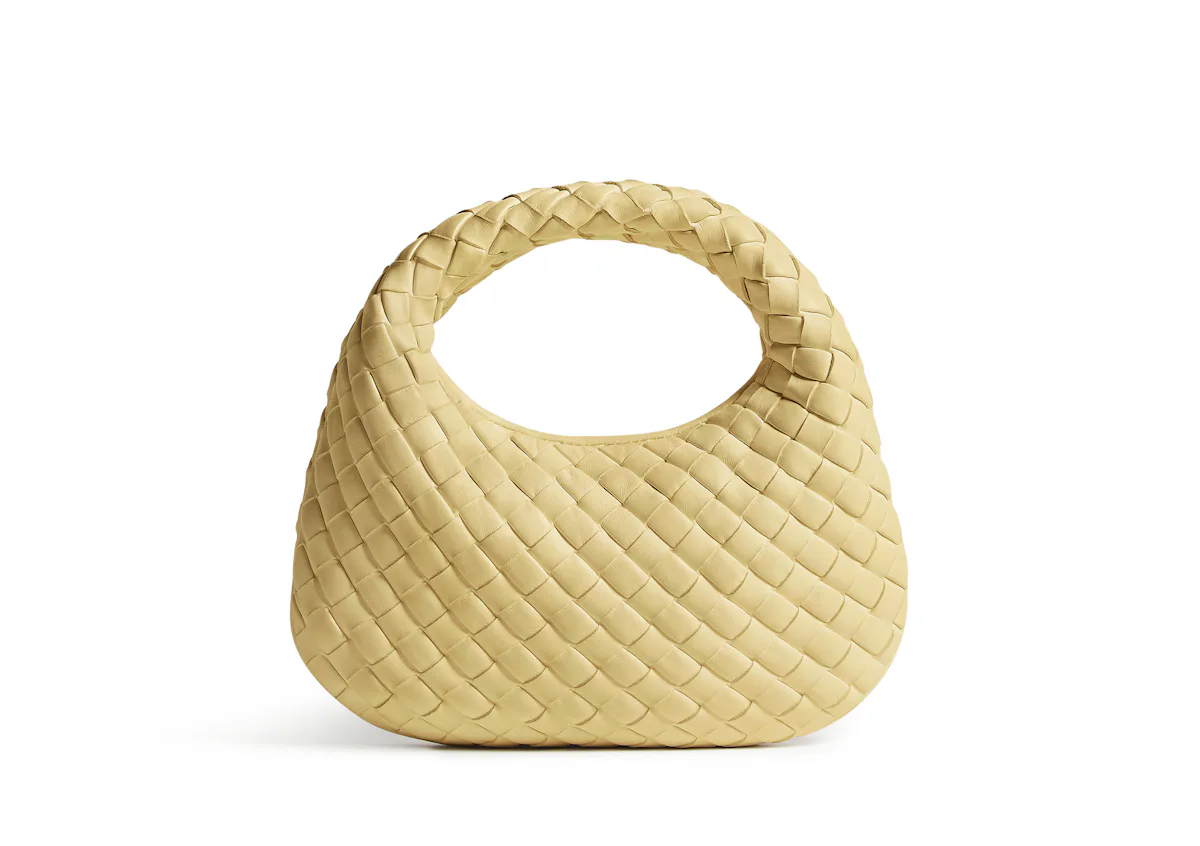
Jacob Elordi has one of the best bag collections out there, and if he cosigns a design, it’s worth a second look. Of course, Elordi is a Bottega boy, so it’s no surprise the actor was one of the first to get his hands on the brand’s newest Veneta bag. The Veneta was first created in the ’70s by Bottega cofounder Renzo Zengiaro before being reintroduced under its current name in 2002. Last year, as part of spring 2026—Louise Trotter’s first with the brand—the Veneta was reimagined in four new sizes. The updated Veneta also features leather strips of 1.2cm width, padded out with a soft interior filler, allowing for a more cushioned feel. It has already proven to be a favorite of Julianne Moore, Olivia Dean, and Elle Fanning.
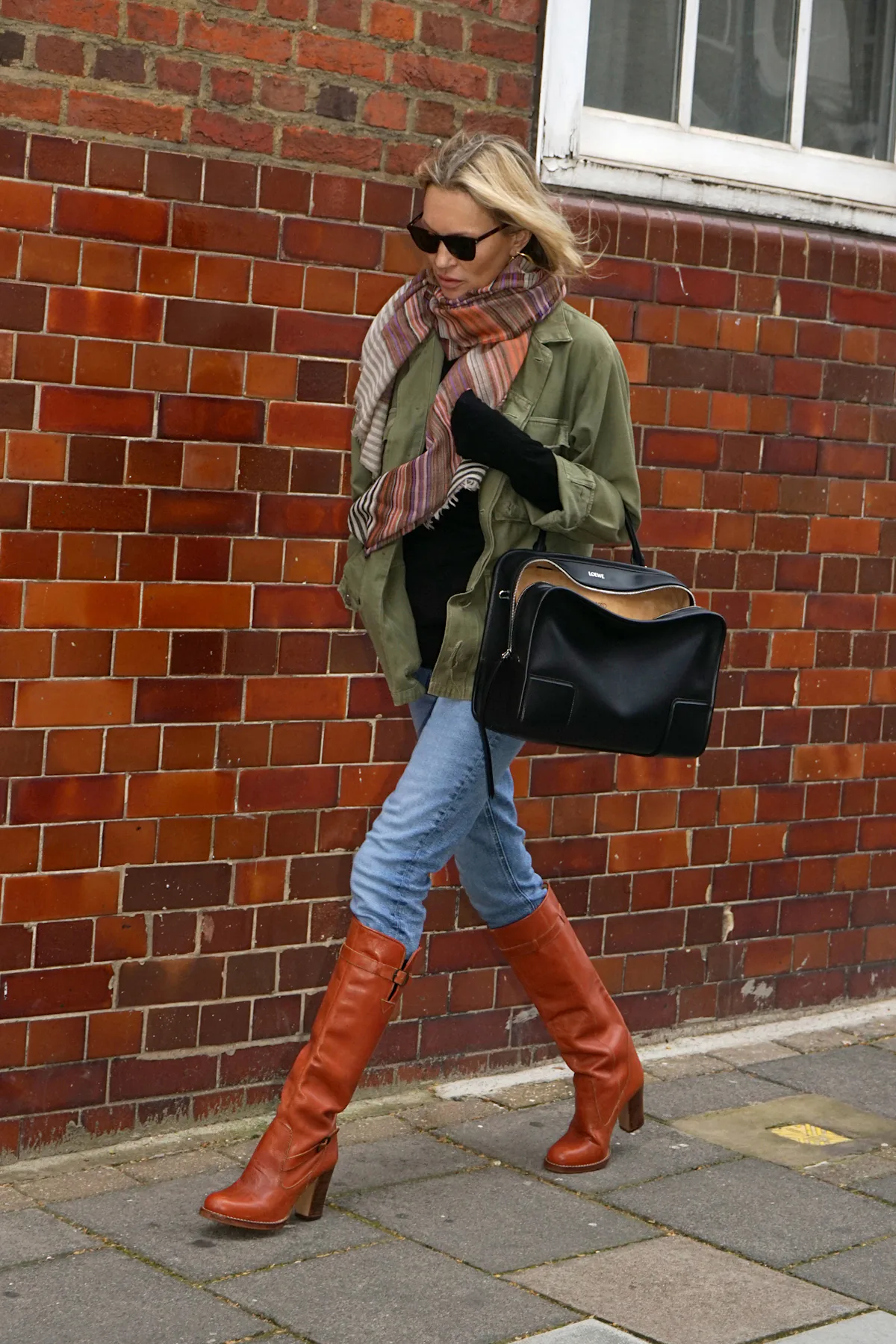
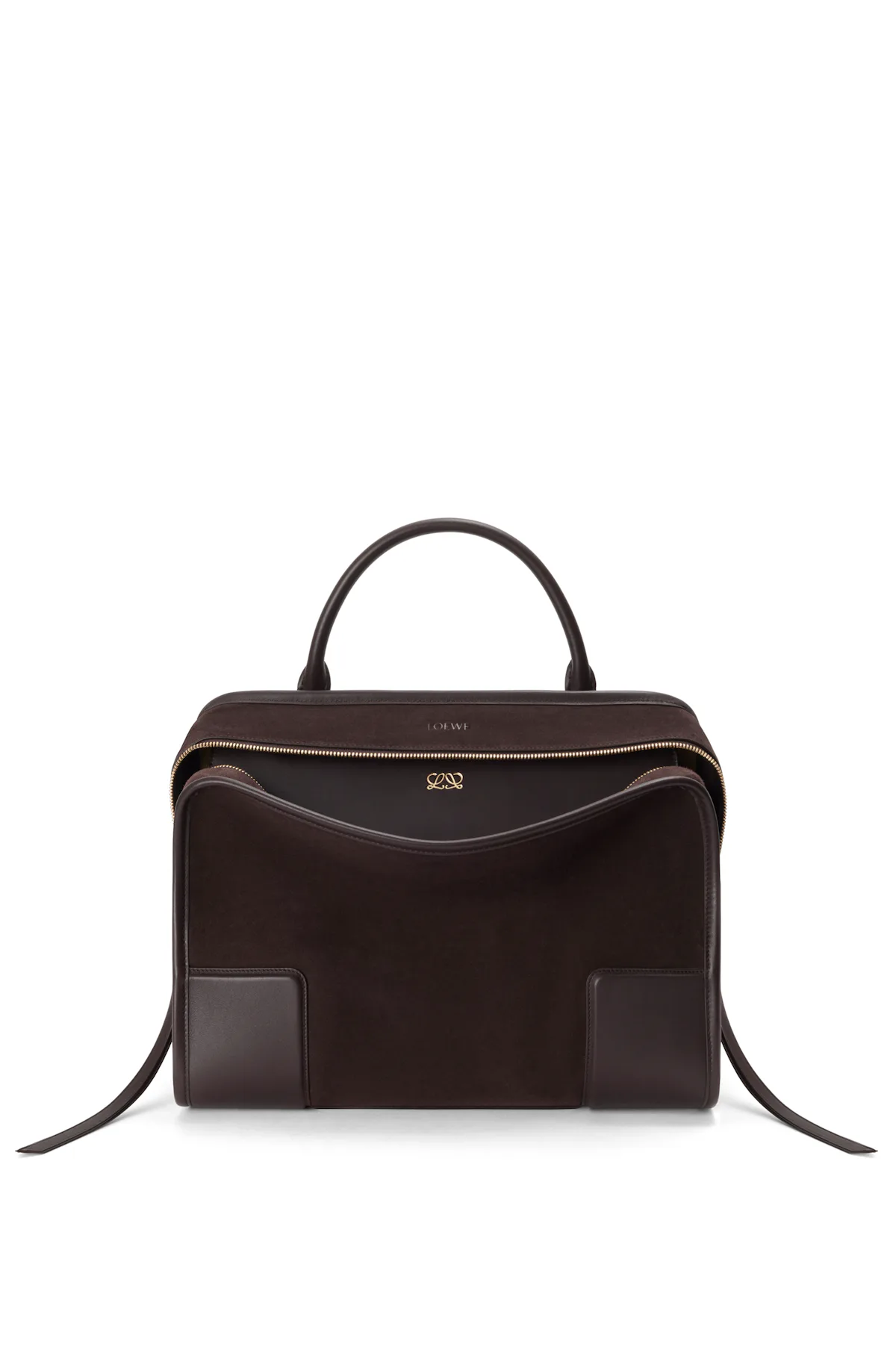
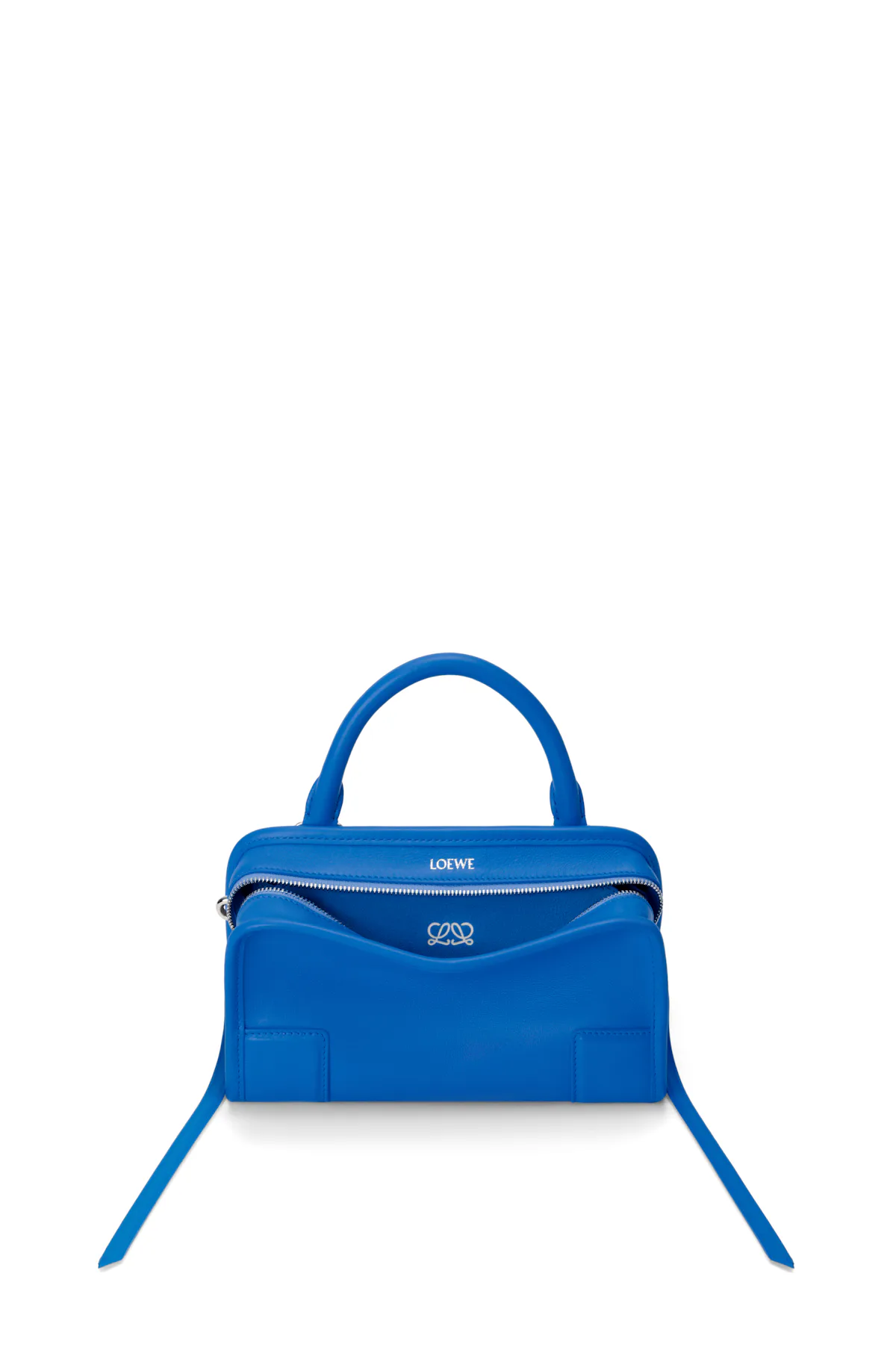
No, this isn’t just a list of Kate Moss’s favorite bags (we already did that). It’s just that the model is always on the cutting edge of accessories. That’s why it’s no surprise she was one of the first to get her hands on the new Loewe bag, one of the many spring 2026 designs that fall under the “Pickpocket Bags” category. When the Amazona 180 first appeared at Jack McCollough and Lazaro Hernandez’s debut show for the house, it was presented unzipped. And while you may have thought that was just a styling technique, here Moss is, proving the look can be taken to the streets (with caution).
Of course, the zipper does work, so those afraid of losing their phone need not fear—and the style also fits under the shoulder for extra protection. The Amazona 180 (named for Loewe’s 180th anniversary) also features a removable crossbody strap and comes in a variety of colors, as well as three sizes. Moss opted for the large in black leather, but the mini in blue makes for a perfect, bright addition of color to any outfit.
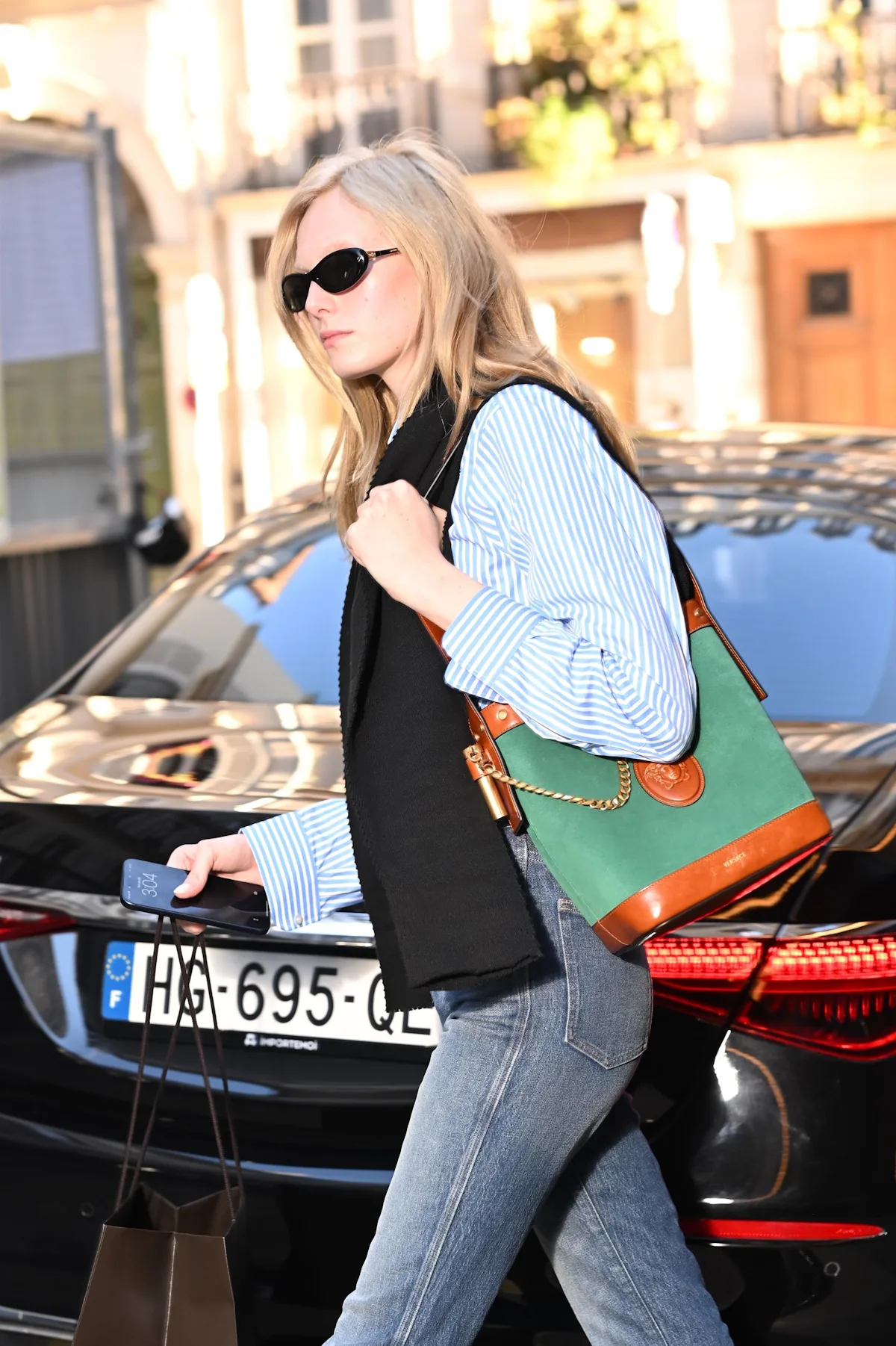
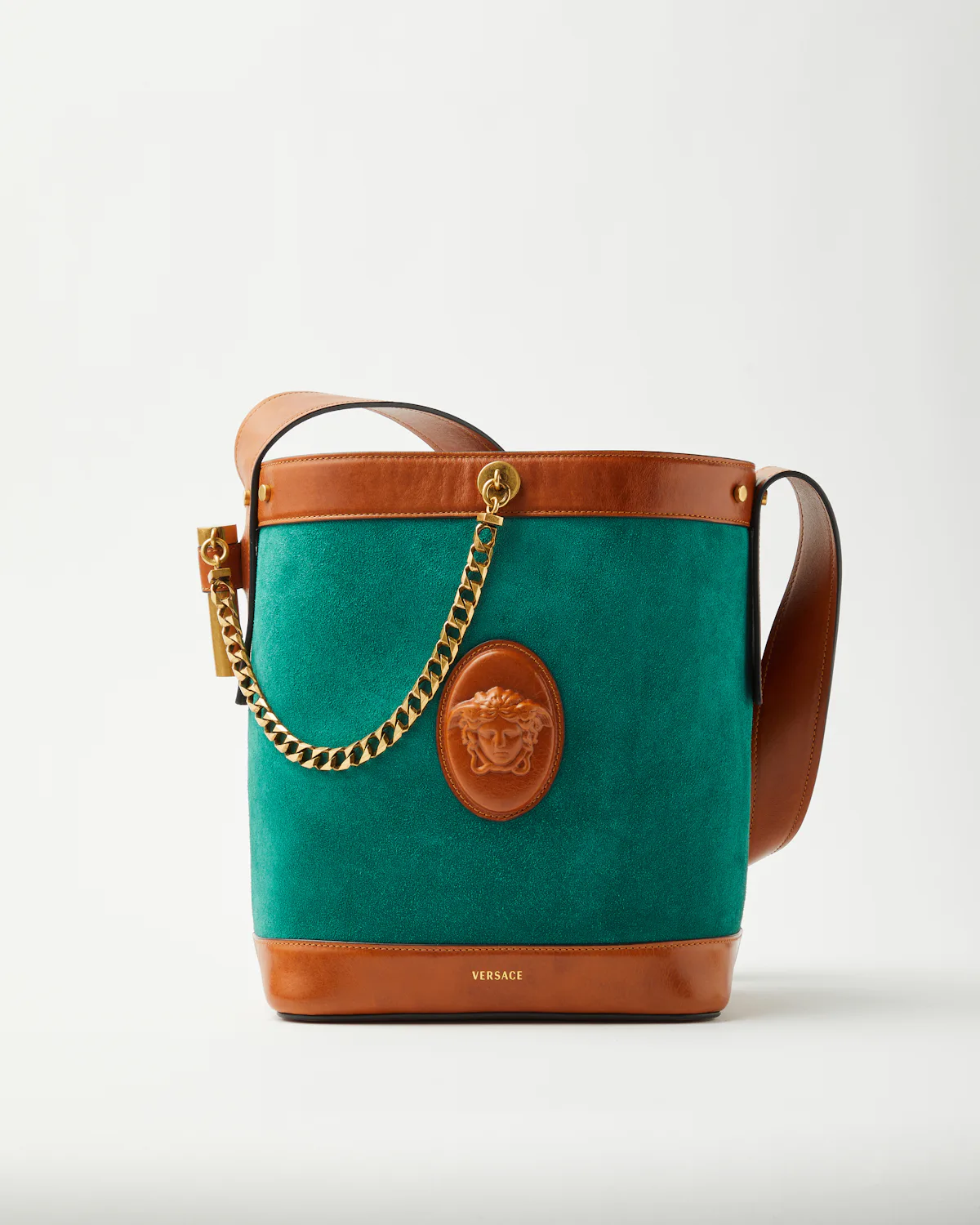
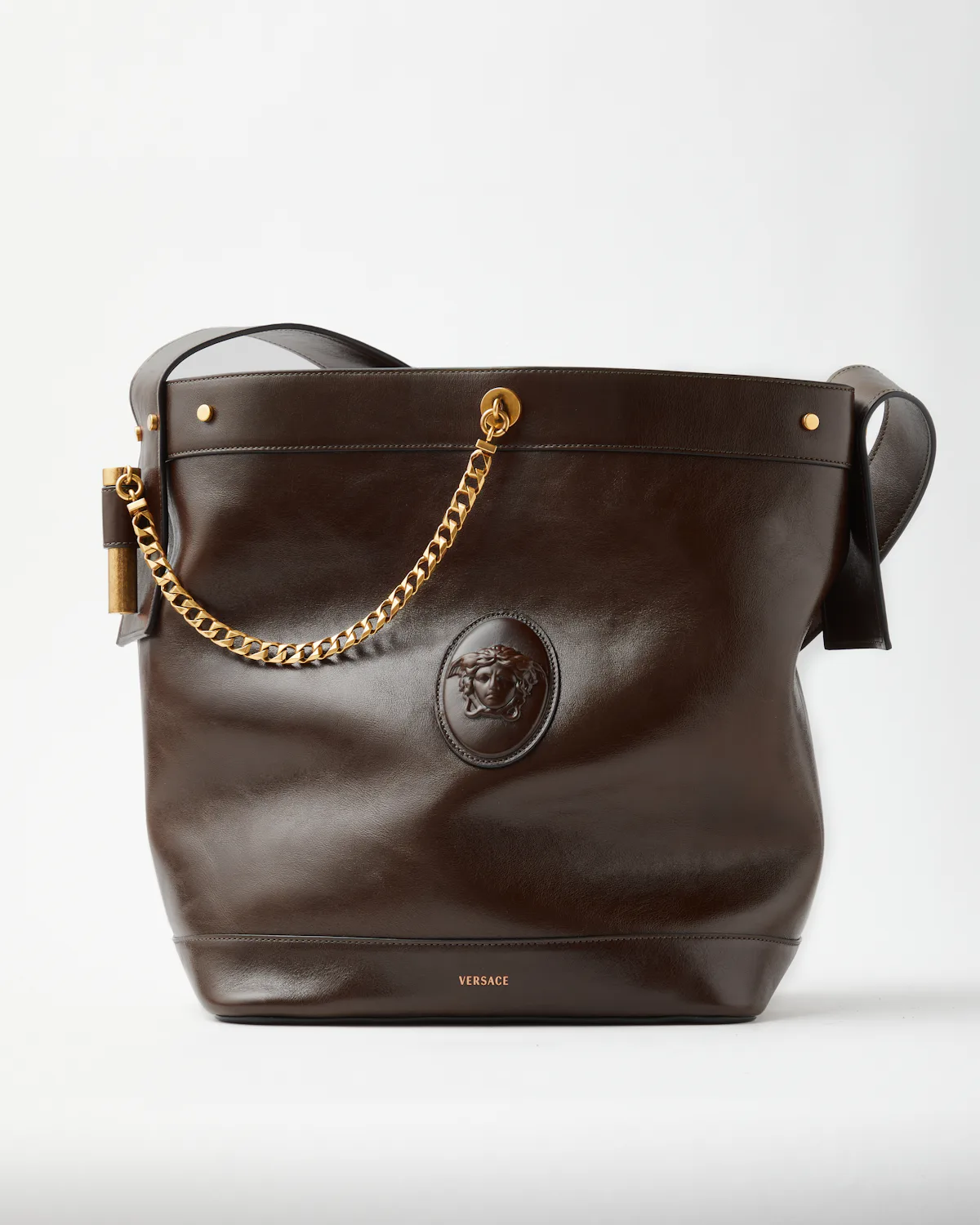
Versace is championing the continuing domination of the bucket bag, a silhouette that has often been ignored by luxury brands despite its extreme popularity on the street. Straight from Dario Vitale’s debut (and only Versace show), the Pivot Bag leapt off the runway and onto the arms of Alex Consani, Chloë Sevigny, and Amanda Seyfried. It brings some color to this lineup, with offerings in cobalt blue and aquamarine suede. But those looking for something subtler will also be drawn to the black, camel, or chocolate brown leather. And, of course, upon the front lies the classic Versace Medusa emblem—lest anyone mistake the bag for another brand. It is flanked by a chain that swoops from the lip to the side strap for an extra flourish that feels quintessentially Versace.
The most elusive of this new crop of bags is undoubtedly Matthieu Blazy’s ludicrously capacious take on Chanel’s classic Flap. After debuting on the runway during the spring 2026 season (Blazy’s first with the brand), the collection released to much fanfare in March. Everyone wanted to get the bag, but most walked away empty-handed—adding, of course, to the appeal. It also helps, of course, that the purse is equal parts chic and practical, with its large size allowing for use as a work or travel bag. And while the layman may continue to struggle to add the Maxi Flapbag to their closet, Hailey Bieber, Kendall Jenner, Jennie, and even Harry Styles have been taunting us, flaunting their own acquisitions on the street.
Valentino Garavani Devain
DAMEBK/Bauer-Griffin/GC Images/Getty Images
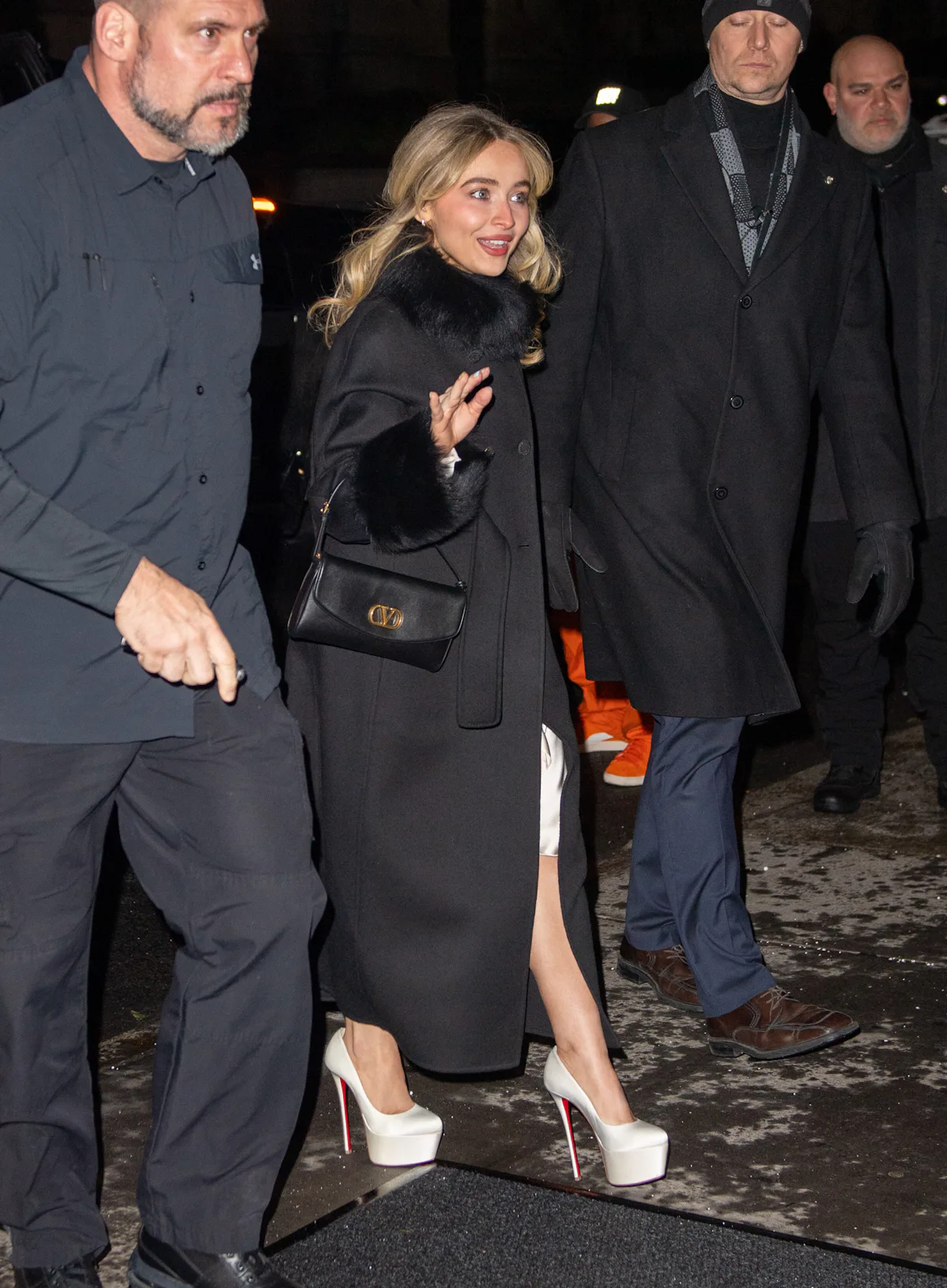
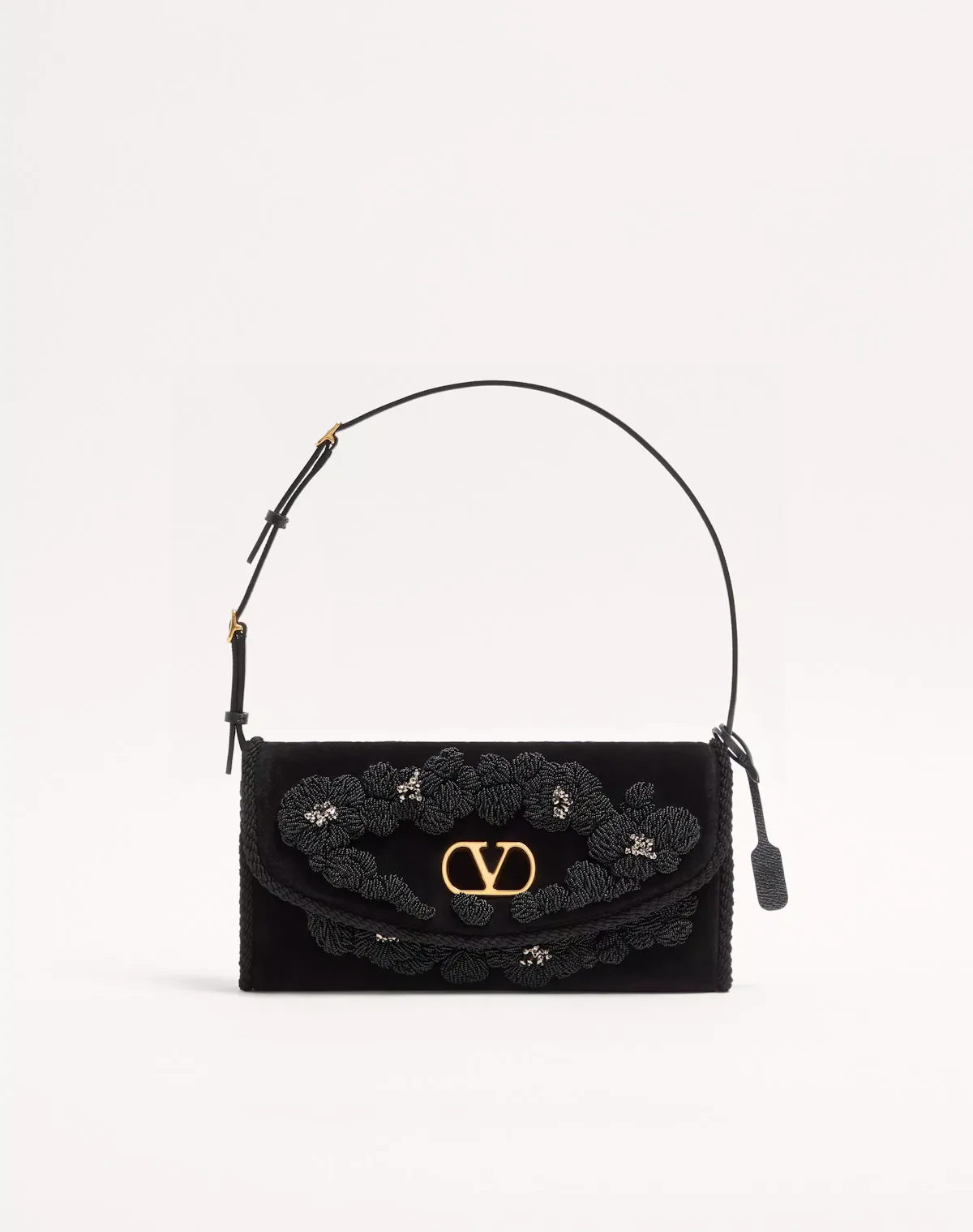
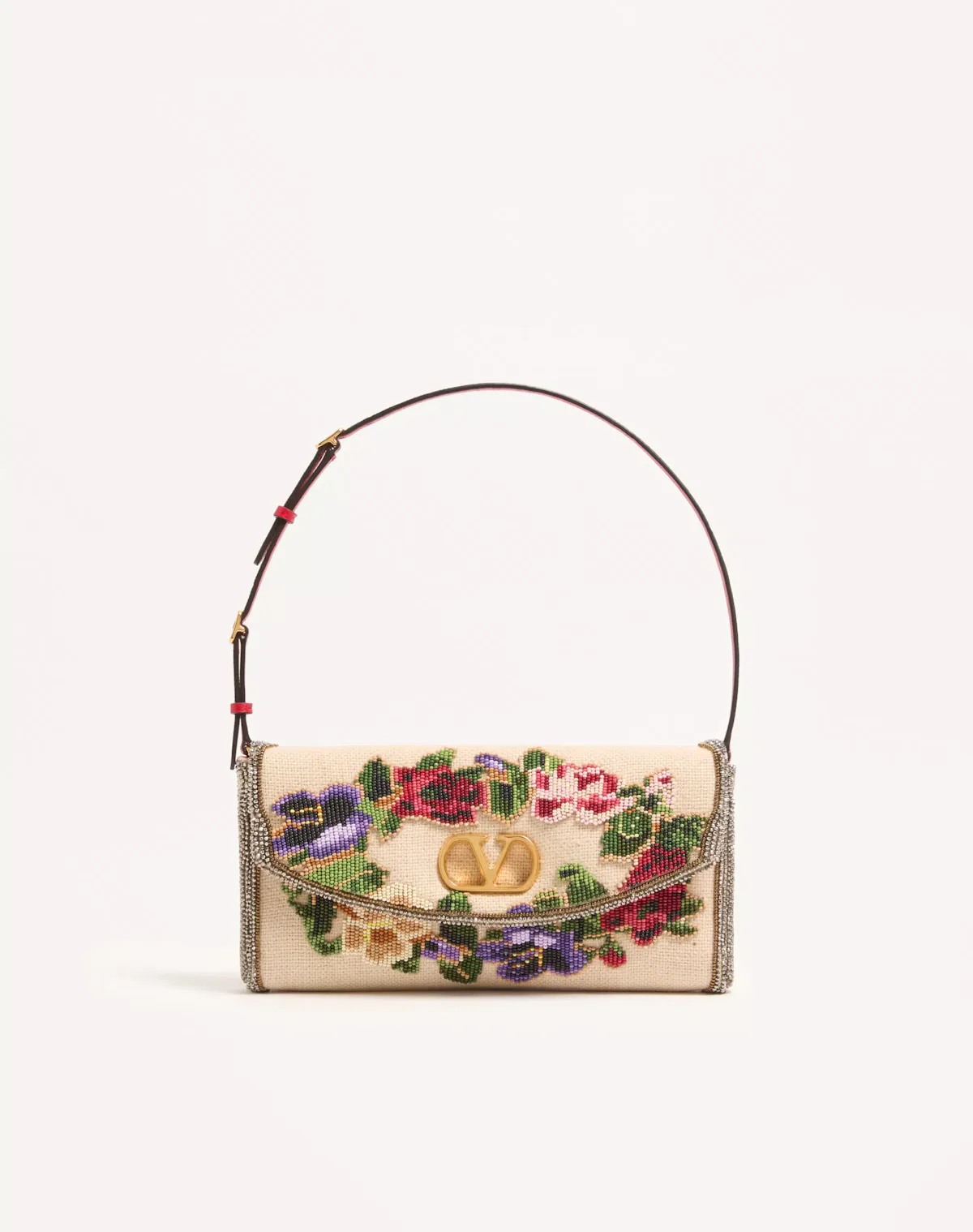
Many of the bags on this list fall squarely in the “everyday” category, but with its latest offering, Valentino is suggesting an accessory for evening. First presented in the pre-fall 2025 collection, the Devain has been seen on everyone. And we mean everyone: Sabrina Carpenter, Dakota Johnson, Olivia Rodrigo, Hailey Bieber, Selena Gomez, Bella Hadid, Margot Robbie...the list goes on. That’s likely due to the versatility: the accessory comes in a wide swath of colors, fabrics, and embellishments, allowing one to mix and match, working the Devain into their existing wardrobe. There’s a denim version embroidered with flowers, a metallic blue one covered in sequins and beads, a completely crocheted option—and that’s just the tip of the iceberg. The many iterations make the bag feel customizable. And as an added bonus, the variety decreases the chance of you carrying the same bag as your best friend on a night out.
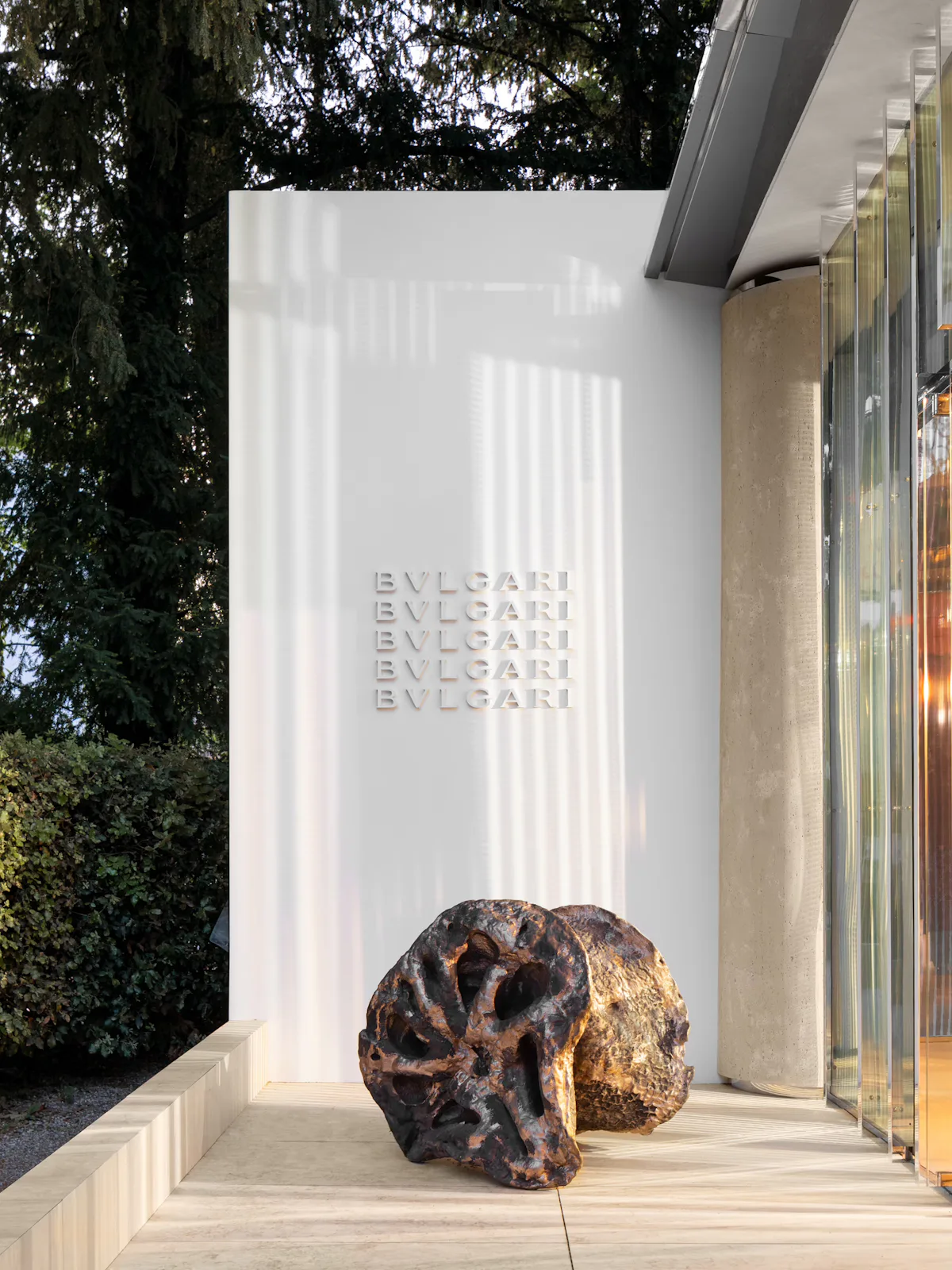
For the first time ever, Bulgari became an official sponsor of the 2026 Venice Biennale, a role that will continue through 2030. Supporting the arts is nothing new to the Roman high jewelry brand—the Fondazione Bulgari was launched in 2024 to officially codify decades of patronage, ranging from the restoration of Rome’s Spanish Steps to partnering with the Whitney Museum of American Art in New York. The foundation acts as a sort of cultural bridge across time, nurturing new contemporary artists while helping to preserve historical treasures.
The centerpiece of this year’s endeavor is the Bulgari Pavilion, situated within the Giardini exhibition space, where different countries show the work of highlighted artists in designated national pavilions. Here, the Canadian multimedia rising star Lotus L. Kang—whose work suggests atmospheric environments rather than static assemblages—was commissioned to create a site-specific installation, which she titled The Face of Desire Is Loss.
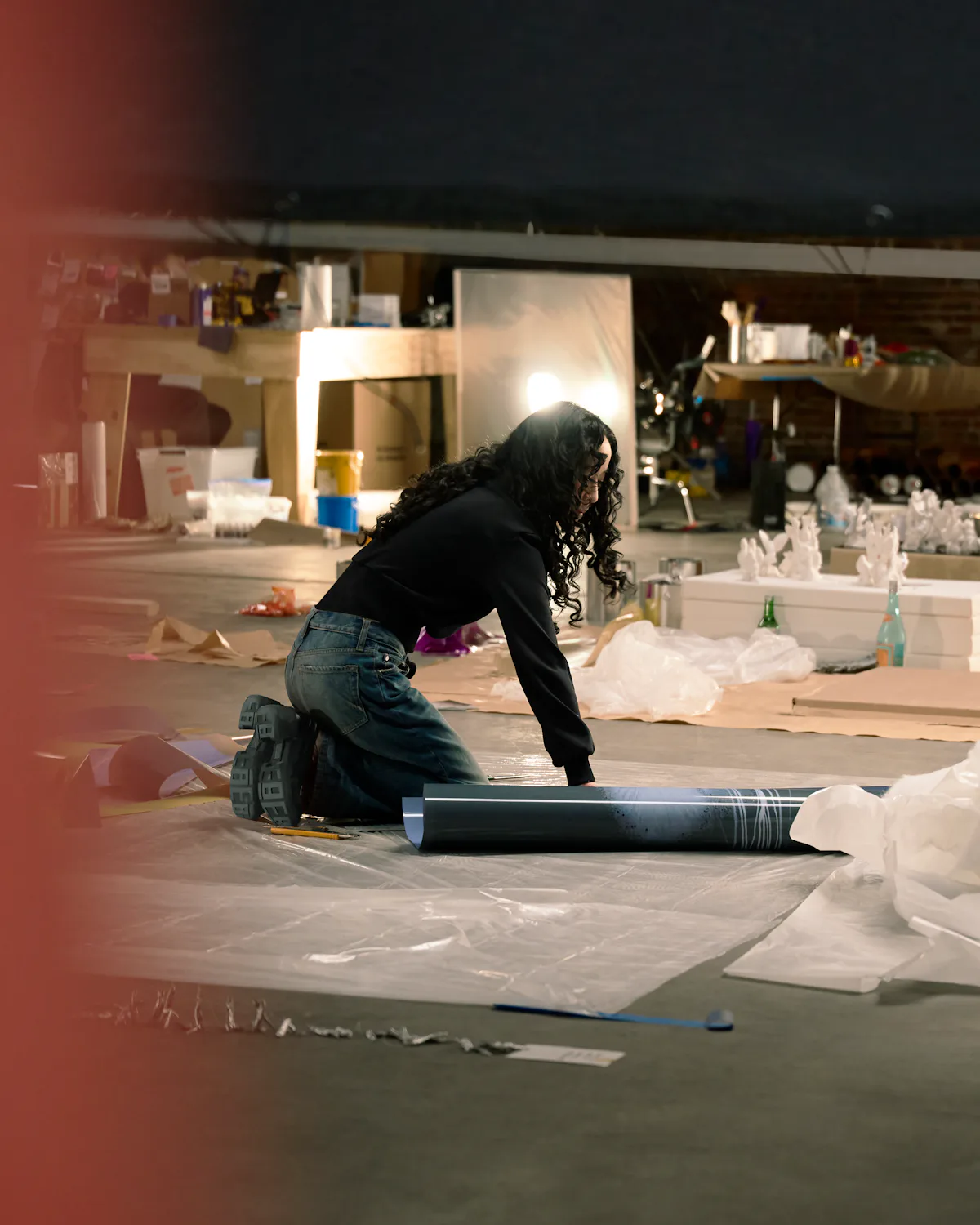
Lotus L. Kang during the making of The Face of Desire Is Loss, 2026
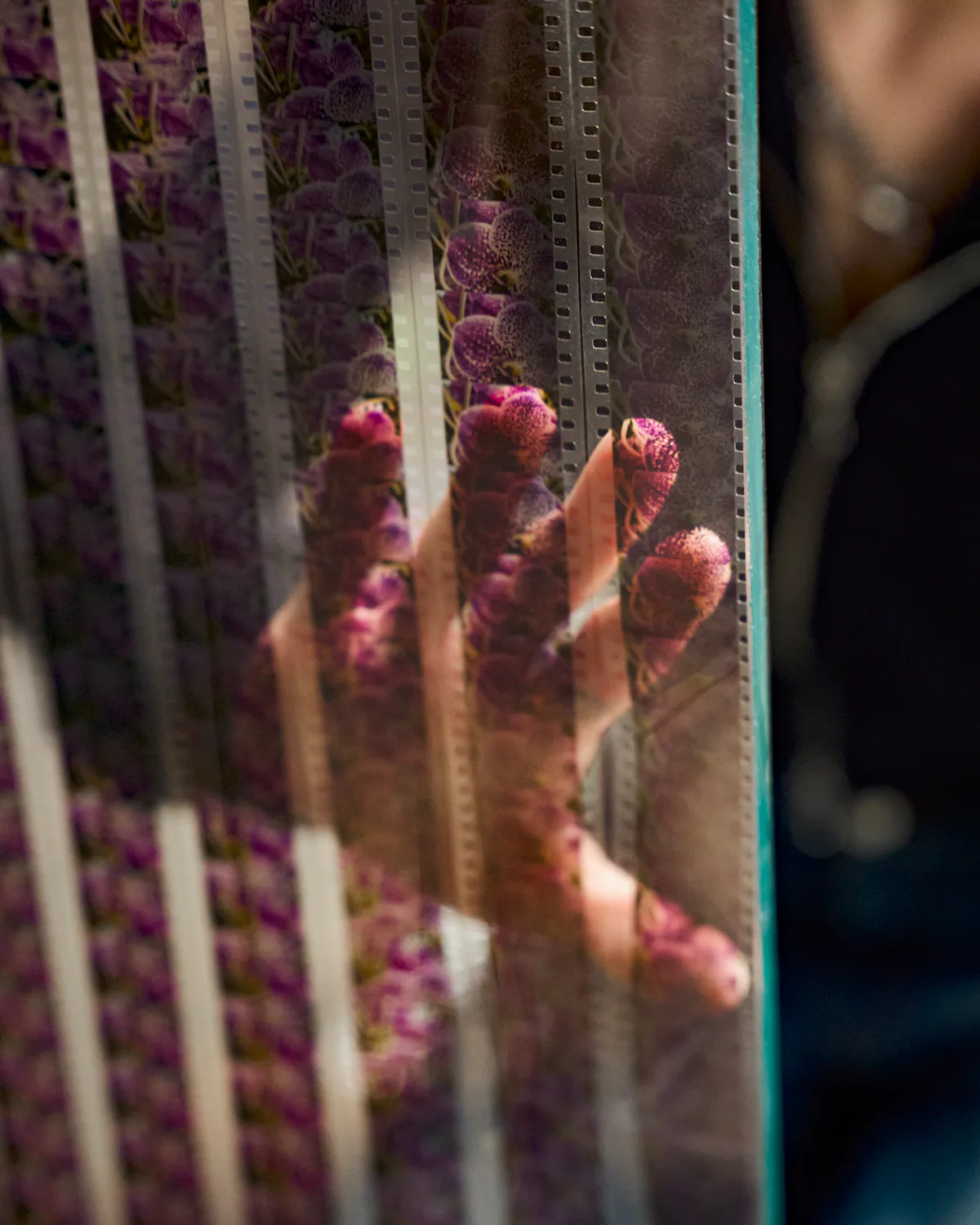
Inspired by Lara Mimosa Montes’ Thresholes, a book of poems exploring emptiness and voids as generative spaces, Kang suspended large sheets of photographic film from perforated steel joists resembling industrial lotus roots. The sheets weren’t treated with the chemical process that preserves images, so they remain sensitive to the world around them; as the sunlight hits them and the air circulates around them, their colors bruise, fade, and shift. The windows of the pavilion are lined with much thinner 35 mm film strips bearing images of tidal mudflats and spectrograms of birdcalls; Kang rounds out the sensory experience with 49 bottles of spirits placed around the space, referencing the number of days that a soul hovers between death and rebirth in Buddhist culture. Instead of a permanent monument, Kang offers an artwork that is continuously evolving.
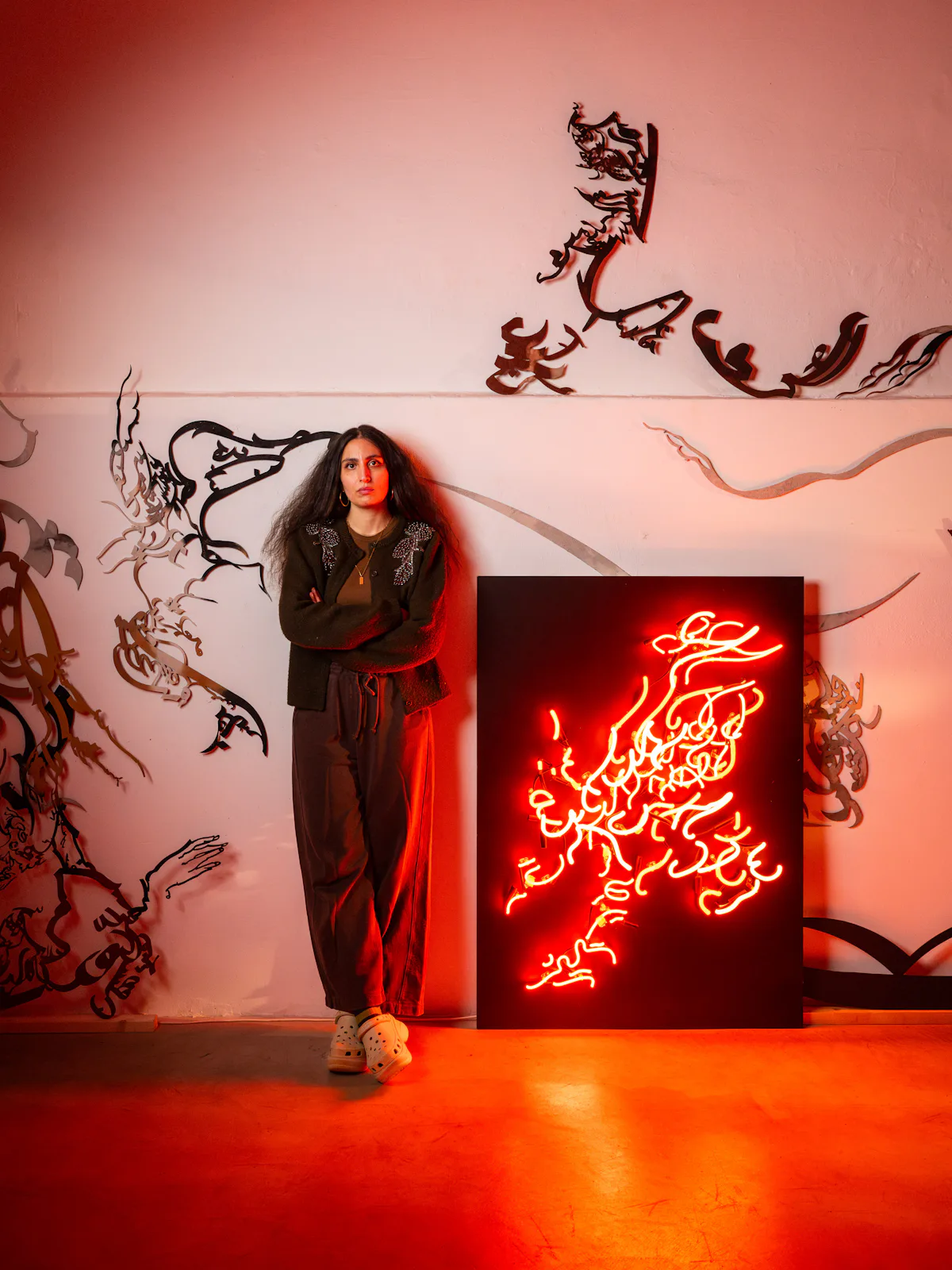
A twenty-minute walk from the Giardini, at the Biblioteca Nazionale Marciana, on San Marco square, Bulgari staged another exhibition, in the library’s Salone Sansovino. It features two on-the-rise artists of the Italian contemporary scene: Lara Favaretto and Monia Ben Hamouda. A large installation by Ben Hamouda, the latest recipient of the MAXXI Bulgari Prize in Rome, consists of two fiery neon wall sculptures that dominate the library’s vestibule. The daughter of a calligrapher, Ben Hamouda uses an accumulation of script-like marks to create an invented, nonexistent alphabet. Her piece, Fragments of Fire Worship, feels like excavated relics of a future religion and introduces a visceral energy into the room.
In the main salon, Favaretto presents the seventh and final chapter of her Momentary Monument–The Library, a piece that explores the idea that nothing—not even history—is permanent. The installation is composed of stacks of ordinary donated books placed on a long shelving unit in a grand, gold-leafed Renaissance salon designed to preserve knowledge forever. Inside each tome, like an Easter egg, is a different image culled from Favaretto’s personal archive, that the artist has inserted. With that simple gesture, Favaretto challenges the idea of preservation of knowledge, implying that information is fragile and subject to changes through ongoing processes of circulation and redistribution.
“Jewelry was the first form of art developed by humankind, more than 120,000 years ago,” said Jean-Christophe Babin, Bulgari’s CEO and President, commenting on why it makes sense for the company to support such varied cultural endeavors. “There is great value in work that is done with our hands. Art is the true manifestation of what only human beings can do.”
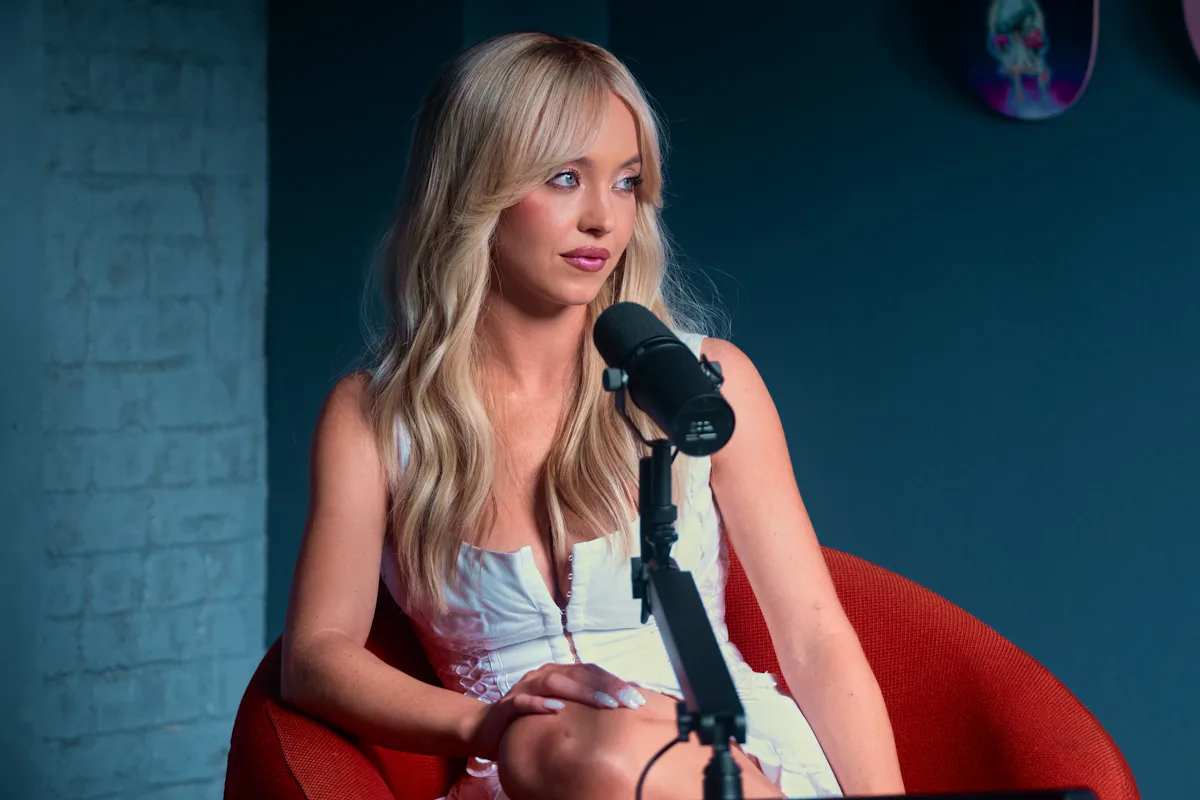
Sydney Sweeney as Cassie in 'Euphoria.' Eddy Chen/HBO
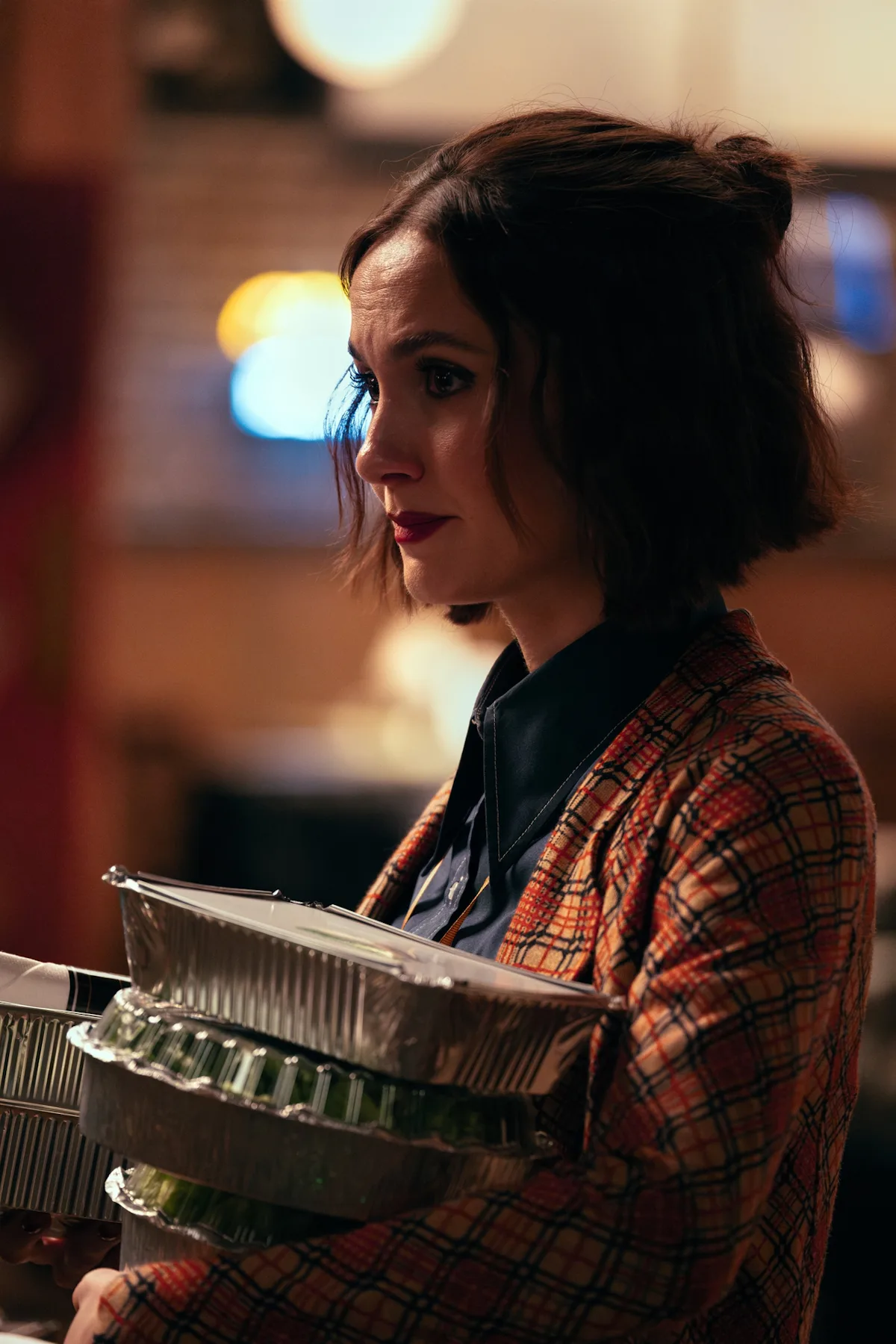
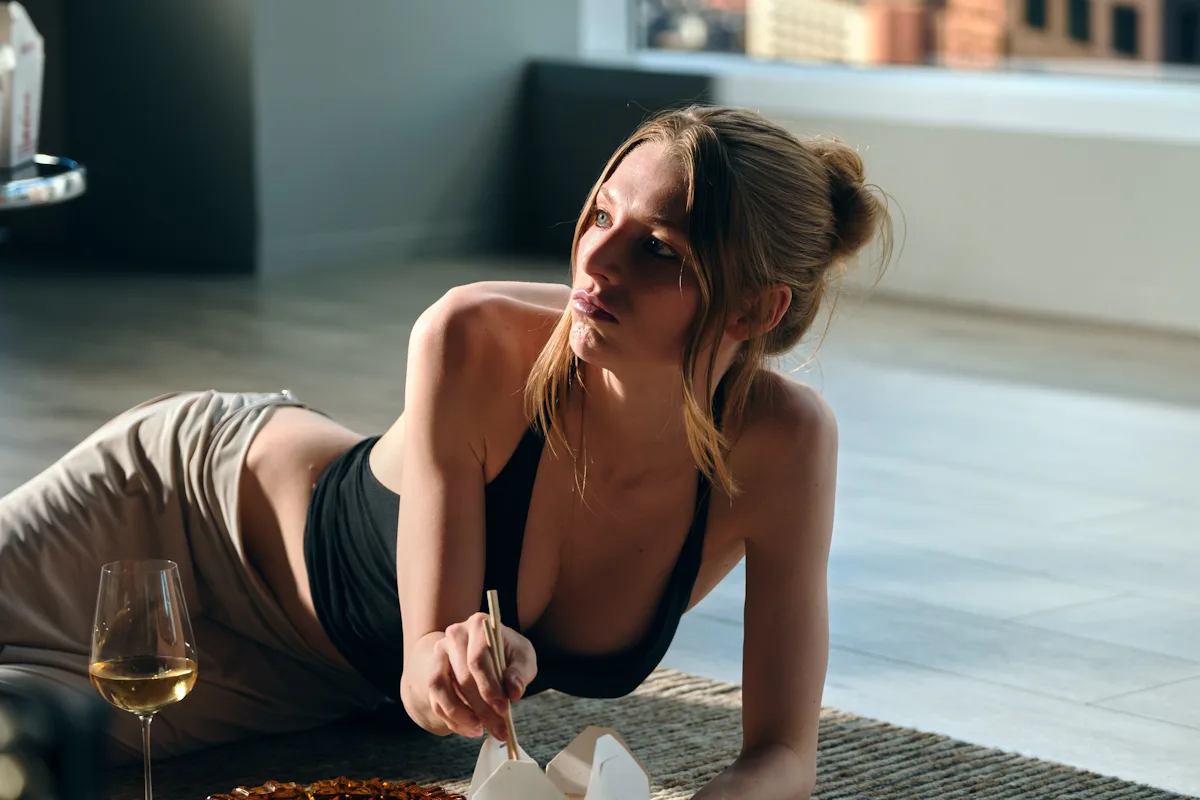
The episode opens with Cassie licking her toes. Within 24 hours of Brandon Fontaine tagging her, you see, she’s gained 17,000 new subscribers and counting. Maddy, her manager, has been “working her to the bone,” Rue narrates. Cue the montage of Maddy waking Cassie up early every morning to make content: ASMR of her breasts rubbing together, personalized videos doing small penis humiliation, whispering the names of men from every race and creed imaginable into a microphone—your basic OnlyFans stuff.
As hard as Cassie’s working, Maddy’s working, too—mailing off Cassie’s used underwear to fans and even offering to perform the “fart in a jar” request that one such user has made for $700. Cassie points out that no one will know the difference. It’s all part of Cassie’s big plan to get rich and famous, and also to help Nate pay back his debts. Yes, Cassie is still in contact with Nate, who, it turns out, is totally supportive of what she’s doing. He has to be, anyway—she’s been wiring him $35,000 here and there, though it’s still not anywhere near enough to get him out of trouble. Even though Cassie’s the one “bringing home the bacon,” with Nate fully cucked at home, encouraging her to make erotic videos with Brandon Fontaine, Cassie goes on a series of podcasts to promote edgy manosphere talking points.
“American men are treated like second-class citizens,” she says on one podcast, before telling a stunned Trisha Paytas, putting on her best vocal fry for her cameo, “If a man says he wants a girl who can cook or clean, he might as well be screaming the N-word.” It’s especially humorous given Cassie’s breakdown at her wedding reception, when she told Nate she wasn’t going to be a cooking-and-cleaning kind of housewife after all. It’s also clearly a meta-commentary on Sydney Sweeney’s ongoing MAGA allegations. “You sound like a Democrat,” a male podcast host says at one point. Cassie pauses before grinning and saying, “I’m not retarded.”
Eddy Chen/HBO
“You know what’s funny? The angrier these idiots get, the more money you make,” Maddy says to Cassie at one point. Are we the idiots?
Maddy clearly doesn’t think her client is the smartest, either. She tells Cassie to put “her big, sweet heart and stick it in the fucking freezer,” because Nate is going to be entitled to 50 percent of all her earnings, and he’s already leeching off her. There’s one thing Maddy and Cassie can definitely agree on: Cassie is going to be huge.
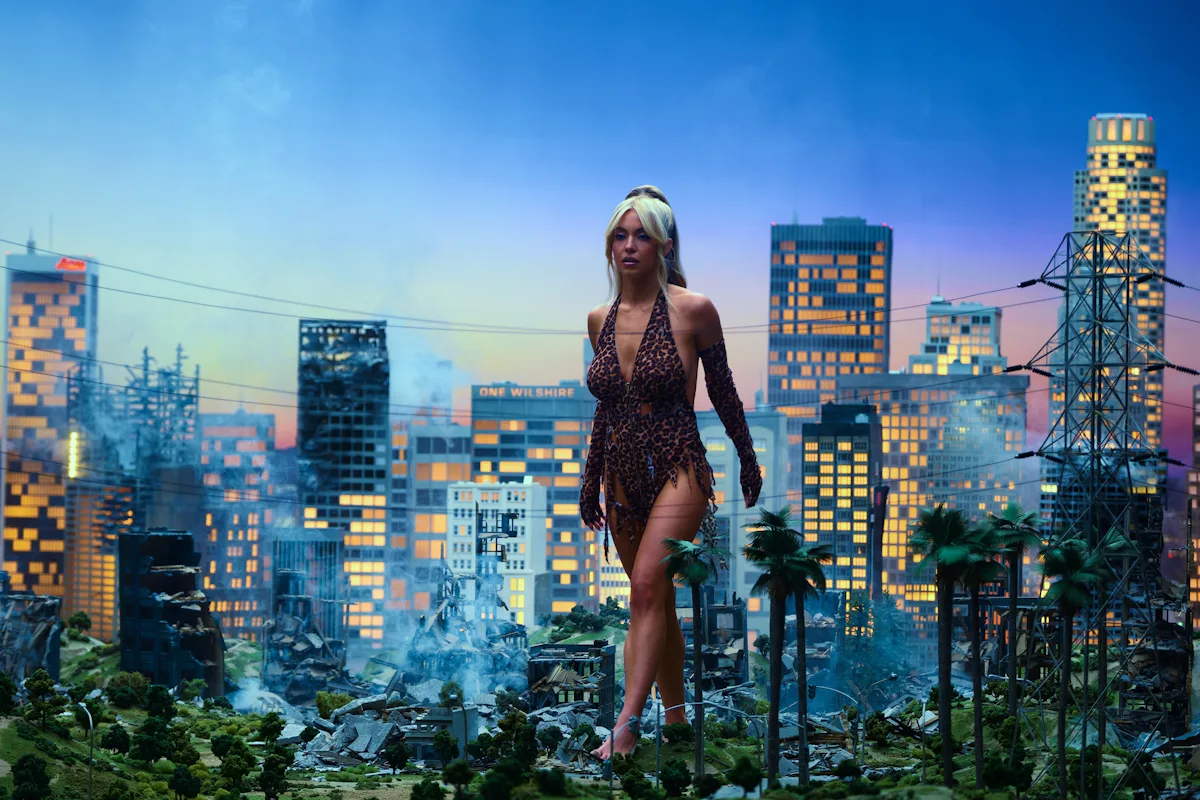
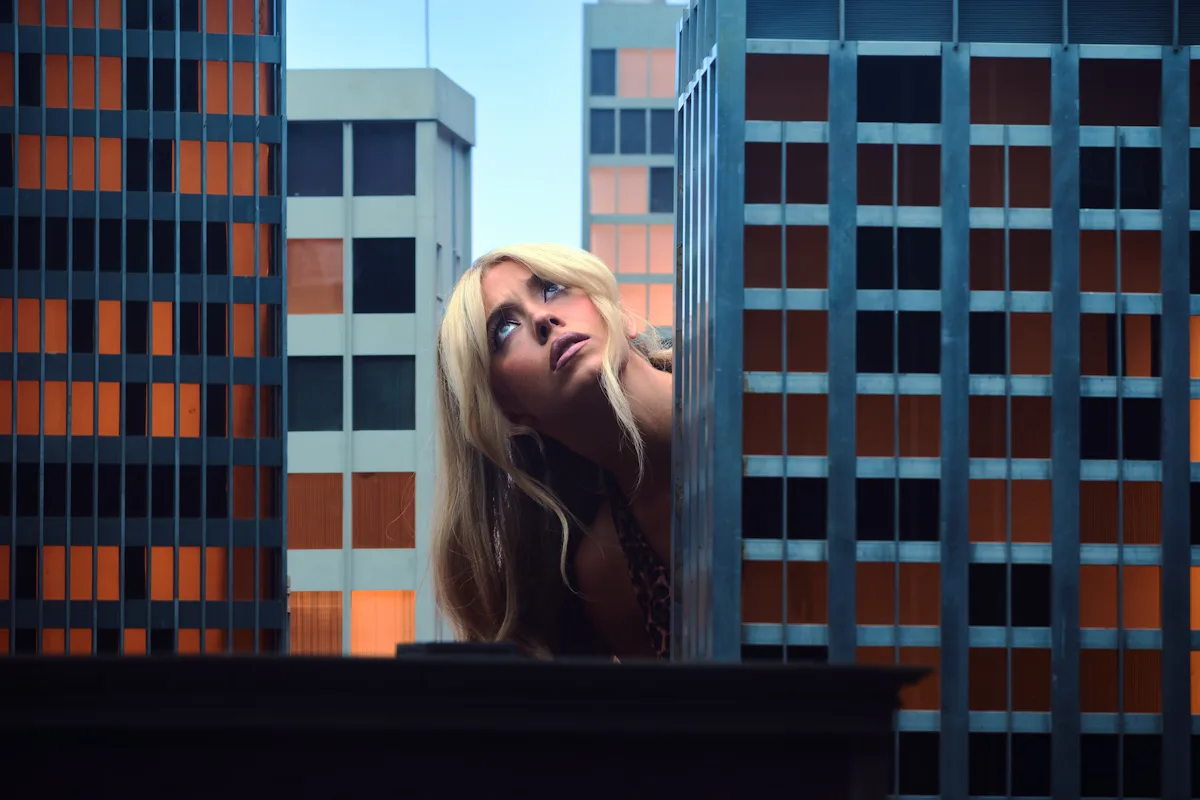
This belief gets played out in a surreal sequence, where Cassie grows into an Attack of the 50 Foot Woman-style giantess, bursting out of her catsuit and stomping all over downtown Los Angeles while helicopters try and fail to stop her. Massive Cassie shows up outside the office of a man pleasuring himself to one of her videos—a fetish video of her sticking a tiny male figurine in between her breasts—and literalizes the moment, taking her top off and pressing her building-size chest against the office windows until they burst.
"Big lady, get on your knees,” a military helicopter pilot orders Cassie. “Back away from the building and get on your knees. Lethal force will be used if you do not comply.” She brushes past him and “Jesus Saves” written in neon lights, before stomping off to the Hollywood sign, dropping to the ground and thanking God while Los Angeles burns behind her.
"She knew this was her destiny—to triumph, to conquer, to win,” Rue narrates. "The world was hers. She had finally been unleashed."
Eddy Chen/HBO
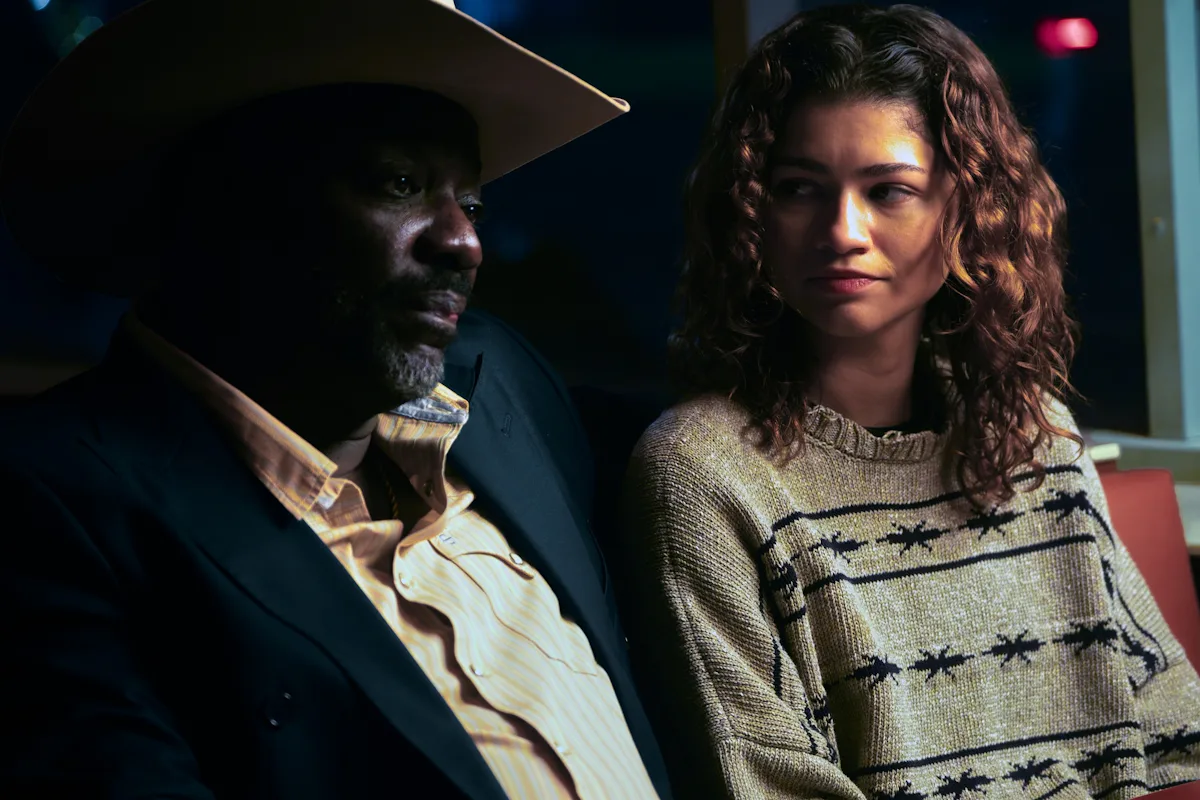
Back at Alamo’s ranch, we revisit the events of the last episode, where Rue became an informant for the DEA, and Big Eddy let the safe get robbed. So far, it’s only Big Eddy taking the heat. He’s still in the hospital after being shot in the stomach, and Alamo threatens to finish the job himself as Rue listens on. They vow again to get back at Laurie’s crew, raiding her farm and “taking back what’s theirs.” When Kidd (Asante Blackk), one of Alamo’s workers, accidentally buys him pants that don’t fit, Alamo flips out, offended that Kidd thought of him as being a smaller man than he is. Size is a theme here, and Alamo nearly kills Kidd, holding him down and stabbing the desk next to his head with an ice pick.
There’s more violence to come, though. Later, Alamo asks to see Rue alone, “for the first time since the robbery,” in what will surely be the most nerve-wracking 1:1 an employee can have with their boss. As Rue waits, she watches Bishop put on a plastic Tyvek-style suit and gather duct tape, rope, and an electric handsaw. He tells Rue he thinks she’s brought bad luck to Alamo’s crew: "I'm of the belief that certain people are cursed," he tells her. "Ever since you came around, there's been a cascade of trouble. I'm not saying you got a 666 inscribed on the back of your skull, but something about you gives me the heebie jeebies." He plugs the saw in and sends Rue on her way. We cut to Bishop (the heebie-jeebiest character since Laurie, for what it’s worth) entering a plastic-covered bathroom with his saw, where Big Eddy is bound and gagged, screaming for his life.
Eddy Chen/HBO
Rue has a conversation with Alamo, who seems to have TCM on in the background with Rita Hayworth doing her famous Gilda hair flip. There’s a redhead strewn out on Alamo’s couch, too. He tells Rue he’s “no monkey” of Laurie’s as he plays a small trumpet. He also questions Rue about Laurie’s farm, since she used to live there, and whether she can draw a map of the place. Rue says that Laurie is probably keeping the money they stole in her basement, but Alamo says, "What she got is a whole lot fucking more valuable than money."
In the next scene, Bishop is standing over a pig trough, watching the pigs eat—and presumably, they are eating Big Eddy.
In case you forgot about Rue’s DEA situation, she has a meeting with the agents under a bridge in a sketchy part of town. Rue tries and fails to get Laurie to incriminate herself over the phone so that the DEA can start a wiretap, but she finds success with Wayne, who’s lying on the couch watching Pretty Woman with Faye, and immediately references Rue being their “drug mule.” Bingo.
Cassie and Maddy have some things to clear up. Brandon has been in Cassie’s ear, trying to convince her to sign with him and his TikTok house—where he has an entire content team employed—rather than Maddy, who is an assistant and “just another Hollywood leech.” Pot, meet kettle. Cassie visits Maddy at her apartment to break the news that she’s leaving her for Brandon, catching Maddy in her lie that she lives in a doorman building. Maddy plays it cool and says she doesn’t care, then fakes a phone call canceling Cassie’s audition for LA Nights. Cassie breaks immediately, signing Maddy’s contract instead without even reading it.
Eddy Chen/HBO
There was no audition, but Maddy strong-arms Lexi into getting Cassie a chance to be on the show. Cassie shows up to the studio in a Blumarine butterfly top, playing the part of a bubbly, ditzy, bouncy blonde, reading off her measurements—37, 25, 37—and blowing kisses for the camera. But then, she breaks out a scene from Shakespeare’s Antony & Cleopatra—Cleopatra’s “monologue of defiance.” It’s kind of…good? Lexi sees her bosses watching it on the monitors, and though they seem to be laughing at Cassie, they’re also impressed. "That's your sister?" Patti Lance asks. "If she can do Shakespeare, she can do LA Nights." Even though she’s the one who put Cassie up for the audition, Lexi is horrified and furious that Cassie used her name.
Lexi tells an ecstatic Cassie that she got the part. "I'm gonna be on TV!” Cassie screams. “This is just the beginning. You, me, LA Nights. I'm gonna be fucking famous. I'm not even gonna be able to walk down the street. I'm gonna be a household name!”
"You are literally the most selfish, narcissistic person I have ever met," Lexi tells her, preparing to walk out the door.
"But that's what it takes to make it in this town," Cassie squeals. As she stuffs more used underwear into bubble envelope mailers, she starts crying with joy.
We check in with Jules and are confronted with the limitations of her seemingly glamorous life. She and Rue are hanging out in the daytime, drinking wine and talking about high school. Jules brings up Rue’s former intimacy issues—in past seasons, you might recall, the main issue in their relationship was that Rue never wanted to have sex. Jules presses Rue on what she wants from her. "You come over here, you lie around, you look at me like you have something to say, but you never say it. I feel like I'm back in high school." She dares Rue to kiss her. "You want me? Make me yours."
Eddy Chen/HBO
The scene cuts to later at night, where Jules is moaning during sex, but it’s not with Rue. It's been a while since we've seen Ellis, or Jules’s “landlord,” as Rue called him, and unfortunately, he's back. He finds Rue’s boxers on the floor, which, for some reason, have her initials on them, and he’s angry. "You're bringing guys to my apartment and fucking them when I'm not here?"
"I give you a lot of freedom, but I got kids," he tells Jules. "I got a wife. I cannot be coming home with a fucking STD." She tells him it's not like that, but he’s livid. "I like you, but I love my family, and I will not put them at risk," he says, coldly throwing Rue's shirt at Jules, who has tears in her eyes.
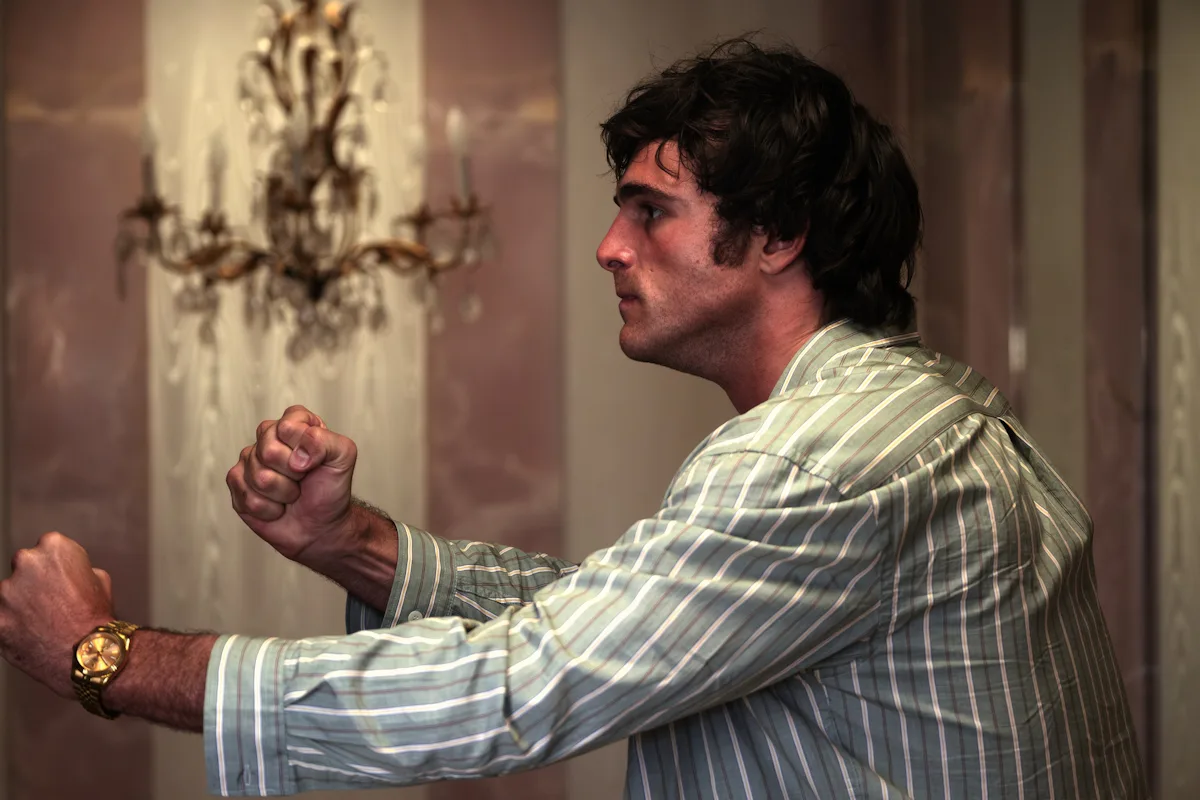
We also get a quick Nate check-in. For a moment, he’s doing well. Cassie has just transferred him another $30,000, and he’s day-drinking in his pajamas, dancing to old records on vinyl. His busted-up face even looks kind of healed. But it doesn’t last long. One of Nas’s goons breaks into the house with a golf club and chases Nate up the stairs, ripping off his toe again and cutting off a finger for good measure. Outside, a little girl rides by on a tricycle down their idyllic suburban street, as Nate can be heard faintly screaming in the background. He really just can’t win.
Eddy Chen/HBO
Back at the Silver Slipper, Rosalía’s Magick finds a bag of coke in her locker and brings it to Alamo, telling him that Rue framed her. She reiterates what she was telling Big Eddy right before the robbery—that Rue was questioning Kitty about whether she was being trafficked, and that Rue can’t be trusted. It’s news to Alamo that Magick was present that night, and he gets more details from her, including a damning one for Rue: that she didn’t seem to immediately recognize the voices of Laurie’s crew.
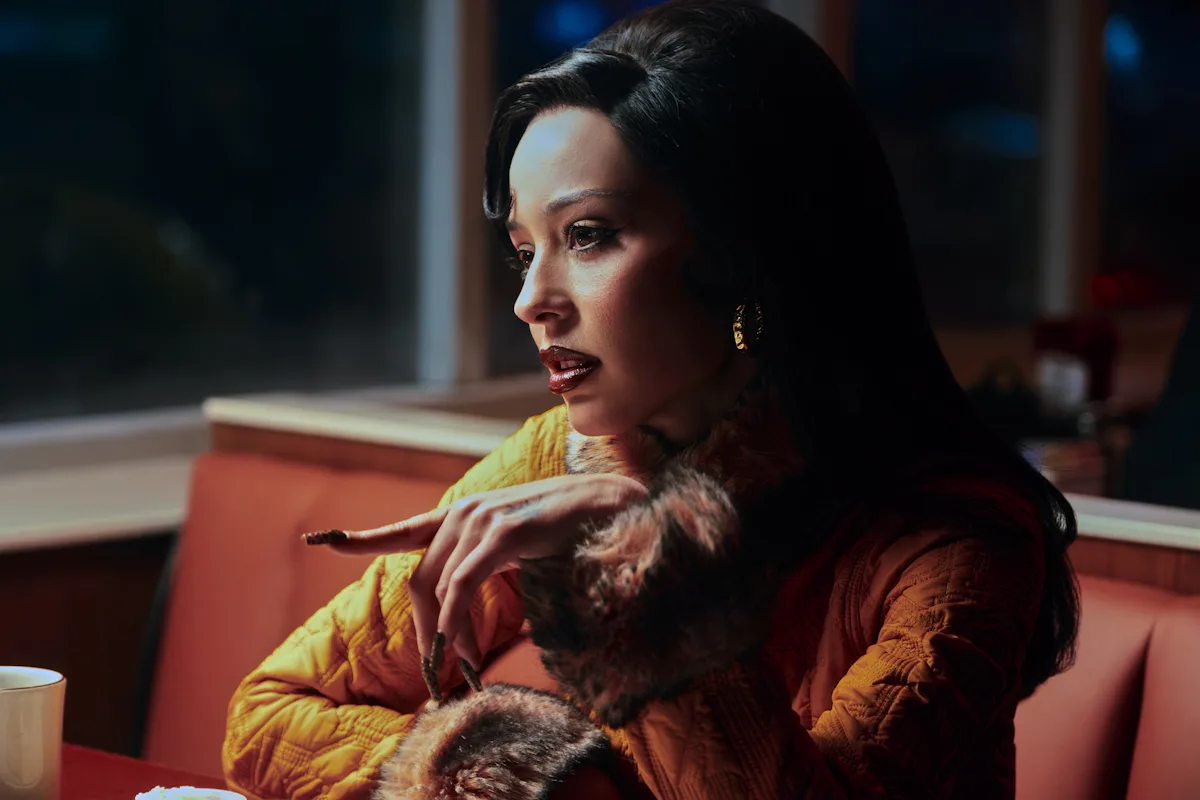
Rue, meanwhile, is having dinner with Maddy at a diner. Maddy explains that she's removed all emotion from her dealings with Cassie. It's all business now. "Equanimity," Maddy explains. "Everything is as it should be. It's all equal." She adds that she’s “reached a state of pure harmony." Rue doesn't buy it, but Maddy says, "It all goes back to Jesus,” and reminds Rue to keep reading her Bible. "Jesus teaches us to be in the world, but not of the world, right? That's basically what I'm saying."
Eddy Chen/HBO
As they’re talking, Alamo approaches the table, spurs clinking on his boots. We’re fully in the Western noir territory promised this season. He introduces himself to Maddy and compliments her nails, joining them at the table. Maddy knows that Alamo is Rue’s boss and that he owns strip clubs, but clearly has no idea just how dangerous he is. She asks where he’s from, and he explains: “I didn't have the fortune of growing up in a safe place like Rue. Nice suburban street. Cute little house. The American dream didn't really factor for me."
"My boss knows literally nothing about me or my family," Maddy says. Alamo replies that it's important to know about your employees, "or you won't know who's working for you or against you." He’s obviously on to Rue, and he tells her that G and Bishop are waiting for her outside and are going to give her a ride somewhere vague. Rue is concerned about leaving Maddy alone with Alamo, although she really should be worried about herself.
Rue gets in the car with G and Bishop. She asks where they're going, and G says, "to another place." Not exactly comforting, and even worse, they take her phone.
Back at the diner, Maddy is opening up to Alamo. "That's what I didn't respect about my dad," she says. "He just accepted his fate." Maddy tells Alamo that the one thing missing from her life is money, and about her plan to manage more OnlyFans stars. Hollywood made $8 billion last year, and OnlyFans made $7 billion, she says. "A lot of money is being left on the table.” Alamo agrees that people are afraid of the stigma of sex work and are too caught up in being seen as "good people” to cash in. "I'm not," Maddy says. "I'm not either," he replies. Maddy and Alamo are a truly diabolical combo.
"Within six months, my top girl, Cassie, could be bringing in a million a month," Maddy tells Alamo. She shows him a picture of Cassie, and he says he has girls just like her that they could make money off of together. Maddy says she wants to “see the inventory first,” adding, "You might have some busted-ass girls." They drive off to the Silver Slipper together, where Maddy surveys the dancers like cattle at an auction. She chooses #7 and #15—Kitty and Magick, of course.
HBO/Eddy Chen
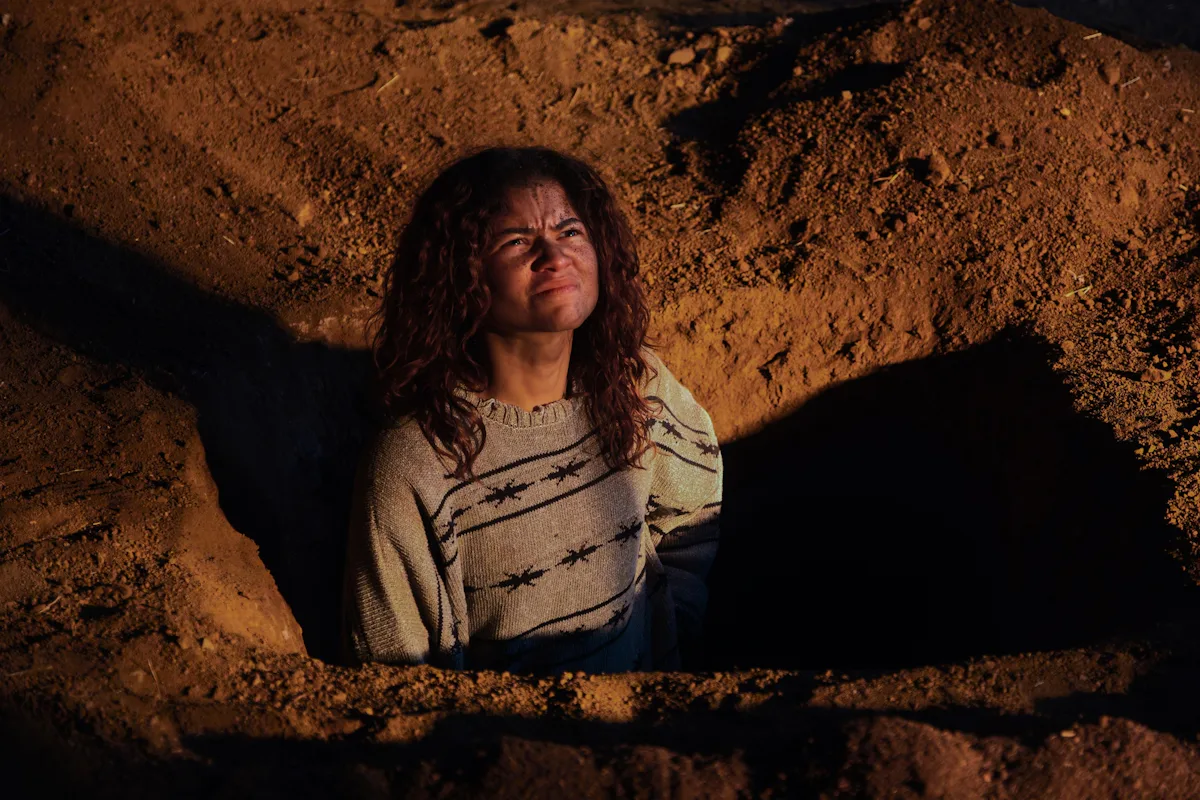
At the ranch, Bishop, G, and Kidd make Rue dig a hole “up to her throat.” It’s not looking good for Rue, and once she’s finished digging, they immediately start burying her up to her head. "I don't know what I did to deserve this, but this is extreme," she says. "Who even thinks of this shit?" Indeed. Having brokered a deal with Maddy, Alamo is back home, saddling up his horse and talking about trust. "Some people don't even deserve to be trusted," he tells the horse. It's morning now, and Rue is begging the guys to get her out of the hole in which she’s buried. Alamo picks up a riding crop with a mallet on the end and comes galloping down the hill on his horse, swinging the crop toward her head. She screams for her life, and as Alamo descends on Rue, the scene cuts to black.
Is Rue really dead? It seems unlikely—given that we still have three episodes left in the season, including a finale that’s HBO’s longest-ever episode—but anything can happen in Euphoria land. Stay tuned for next week, when we’ll find out if Maddy is an even better pimp than Alamo, and whether Nate got his toe and finger on ice quick enough this time to get them both sewn back on.
The Cannes Film Festival is known for its glamour. The gowns, the guest list, the seaside location all oozes with elegance and the red carpet is a constant parade of couture. But outside of the black-tie premieres, some of the most powerful fashion statements have been made with a humble T-shirt.
The festival actually has a pretty rich history with graphic tees. For decades, guests have been attending photocalls and even premieres in the wardrobe basic. Sometimes, they do so to make a statement—advocate for a political candidate or call out unjustified violence. More often, they’re supporting their film with a shirt that references the director, the theme, or a quote from the movie. And then, there are those who just feel most comfortable in a T-shirt, dress code be damned.
Jordan Firstman made headlines in 2026 with the display of his NSFW tees in promotion of festival darling Club Kid, but he is hardly the first to pack such a top for his trip to the South of France. Below, a visual history of graphic tees at Cannes, from Dennis Hopper’s Napoleon number in 1976 and Spike Lee supporting the Knicks, to Elle Fanning shouting out her Sentimental Value director Joachim Trier.
Jordan Firstman, 2026
Getty
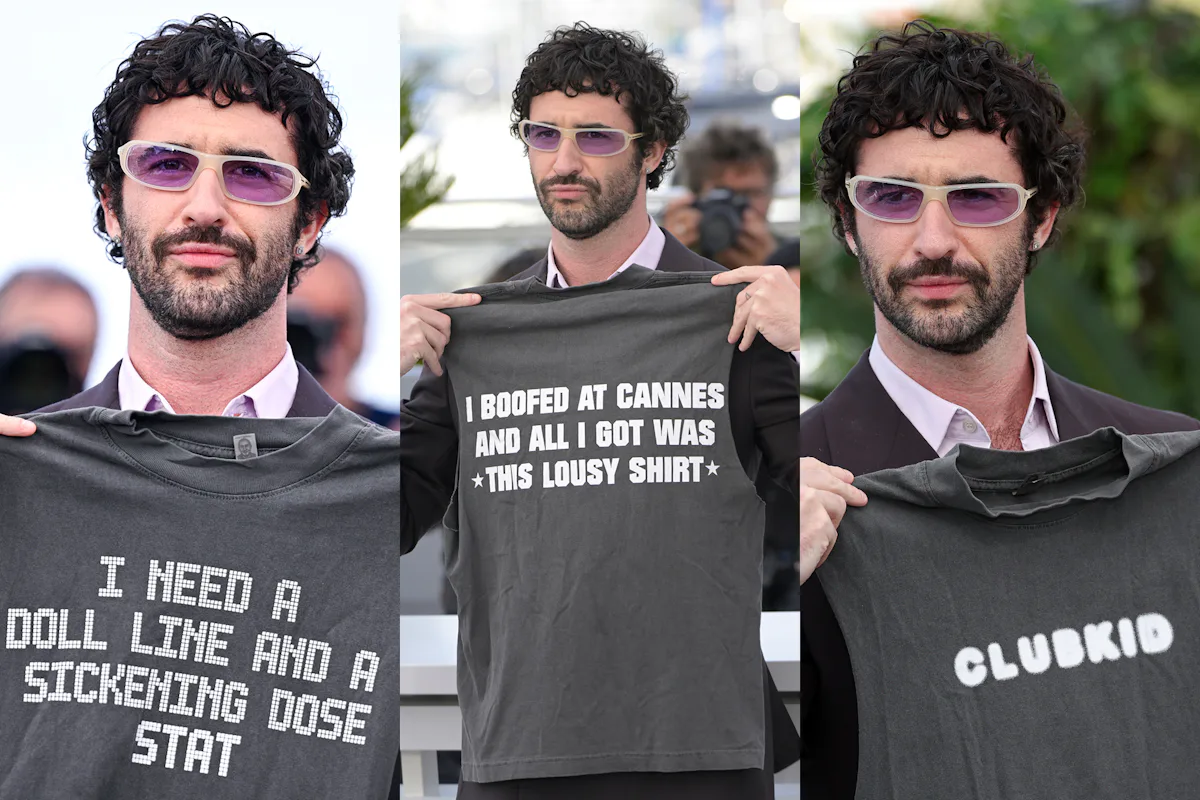
Jordan Firstman promoted his directorial debut, Club Kid, one of the buzziest films at Cannes this year, with an array of NSFW, Internet-brained T-shirts, with jokes seemingly referencing the movie, which was acquired by A24.
Niels Schneider, 2026
Anadolu/Anadolu/Getty Images
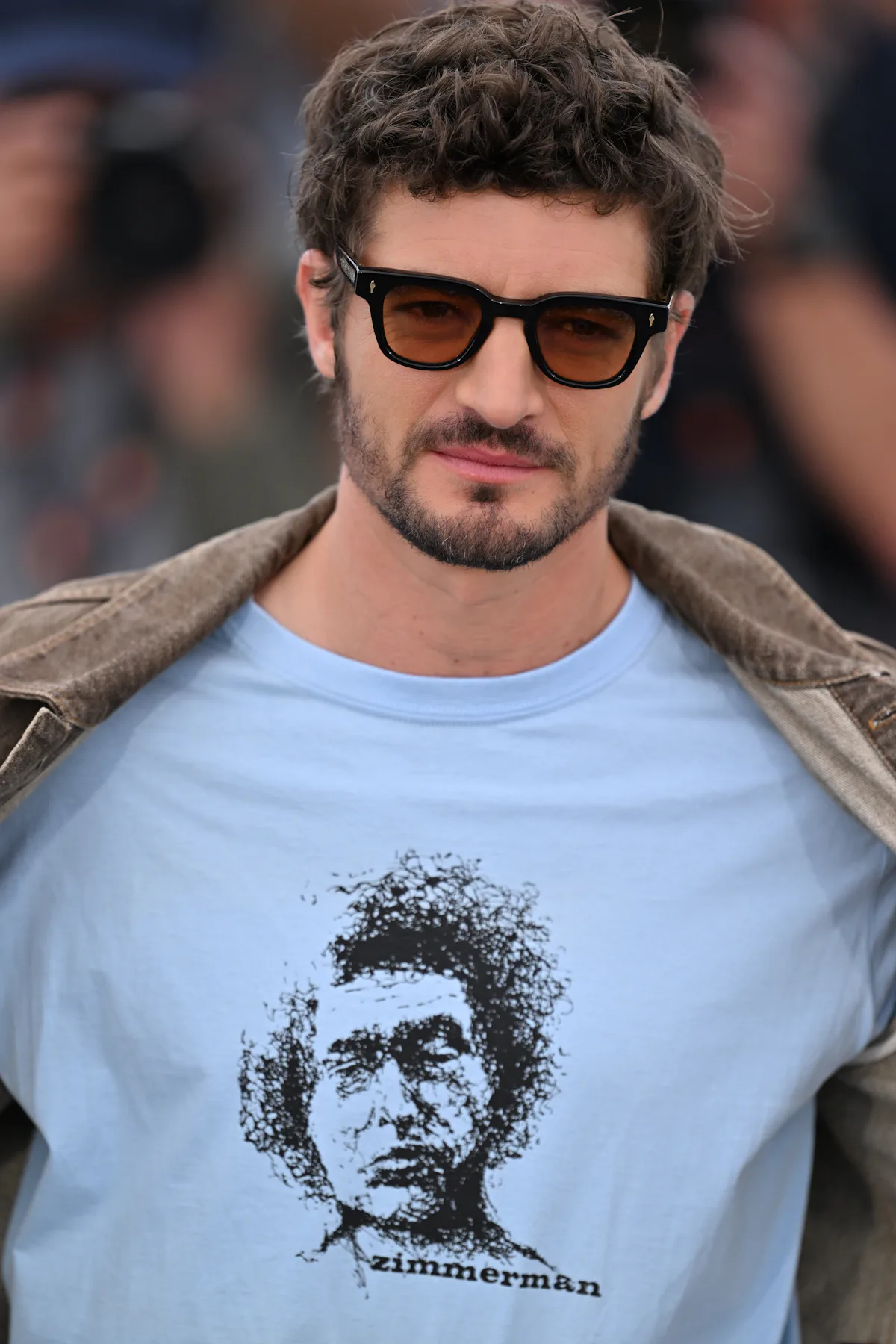
French-Canadian actor Niels Schneider attended the photocall for his film, The Unknown, wearing a shirt featuring a sketch of Bob Dylan and the singer’s legal last name, Zimmerman. But Schneider wasn’t simply showing his support for Dylan; he was likely also referencing The Unknown, in which he plays a character named David Zimmerman.
Adèle Exarchopoulos, 2026
Andrea Cremascoli/GC Images/Getty Images
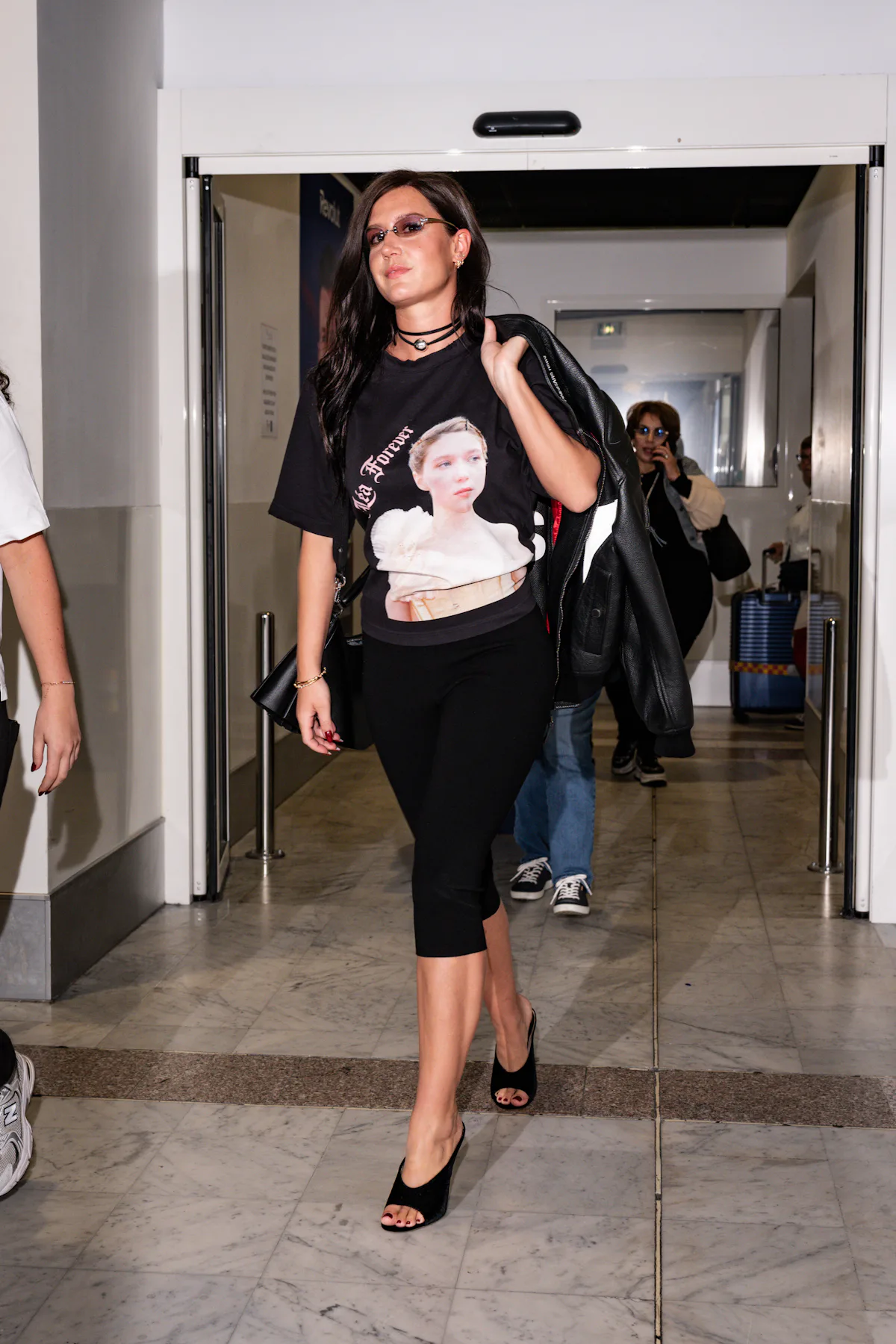
Not all T-shirts make it to the red carpet. French actress Adèle Exarchopoulos arrived at Nice Airport ahead of the festival this year in a shirt featuring her Blue Is the Warmest Color co-star Léa Seydoux and the phrase “Léa Forever.” The tribute nodded to the pair’s shared Cannes history: in 2013, the jury made the unprecedented decision to award the Palme d’Or not only to the film’s director, Abdellatif Kechiche, but also to Exarchopoulos and Seydoux.
Elle Fanning, 2025
MIGUEL MEDINA/AFP/Getty Images
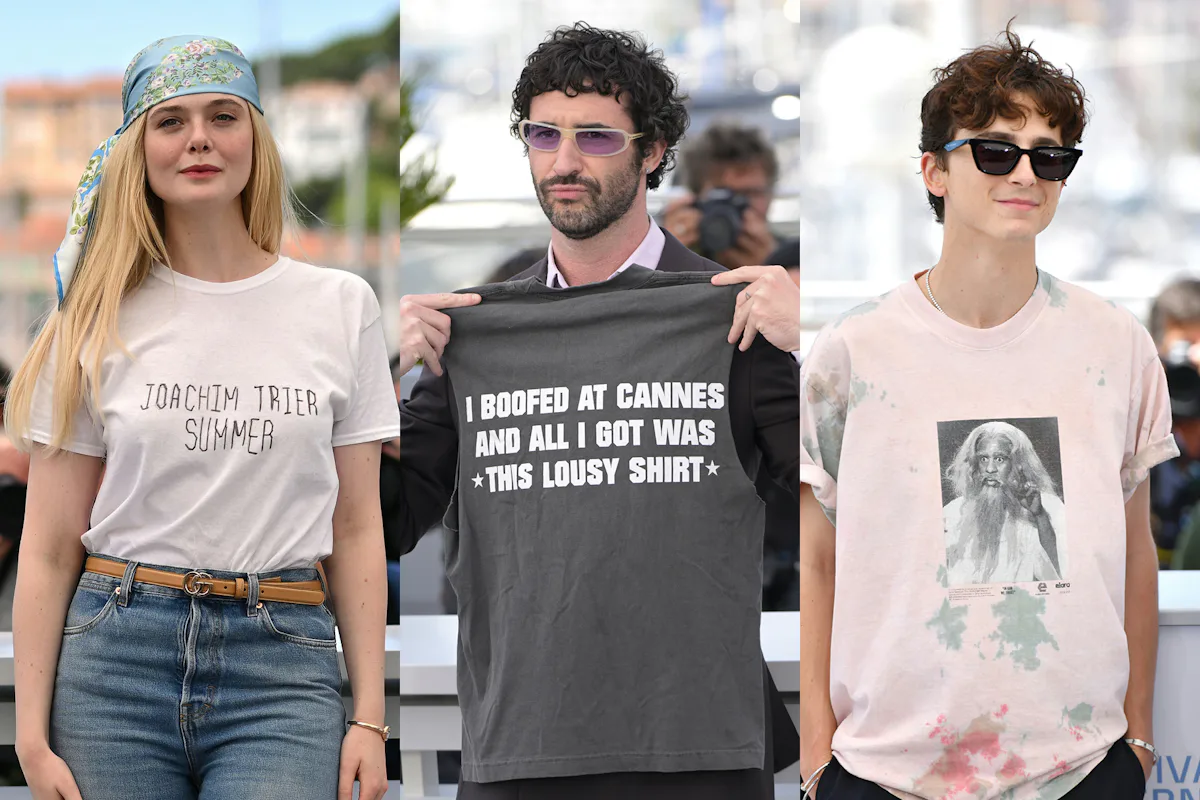
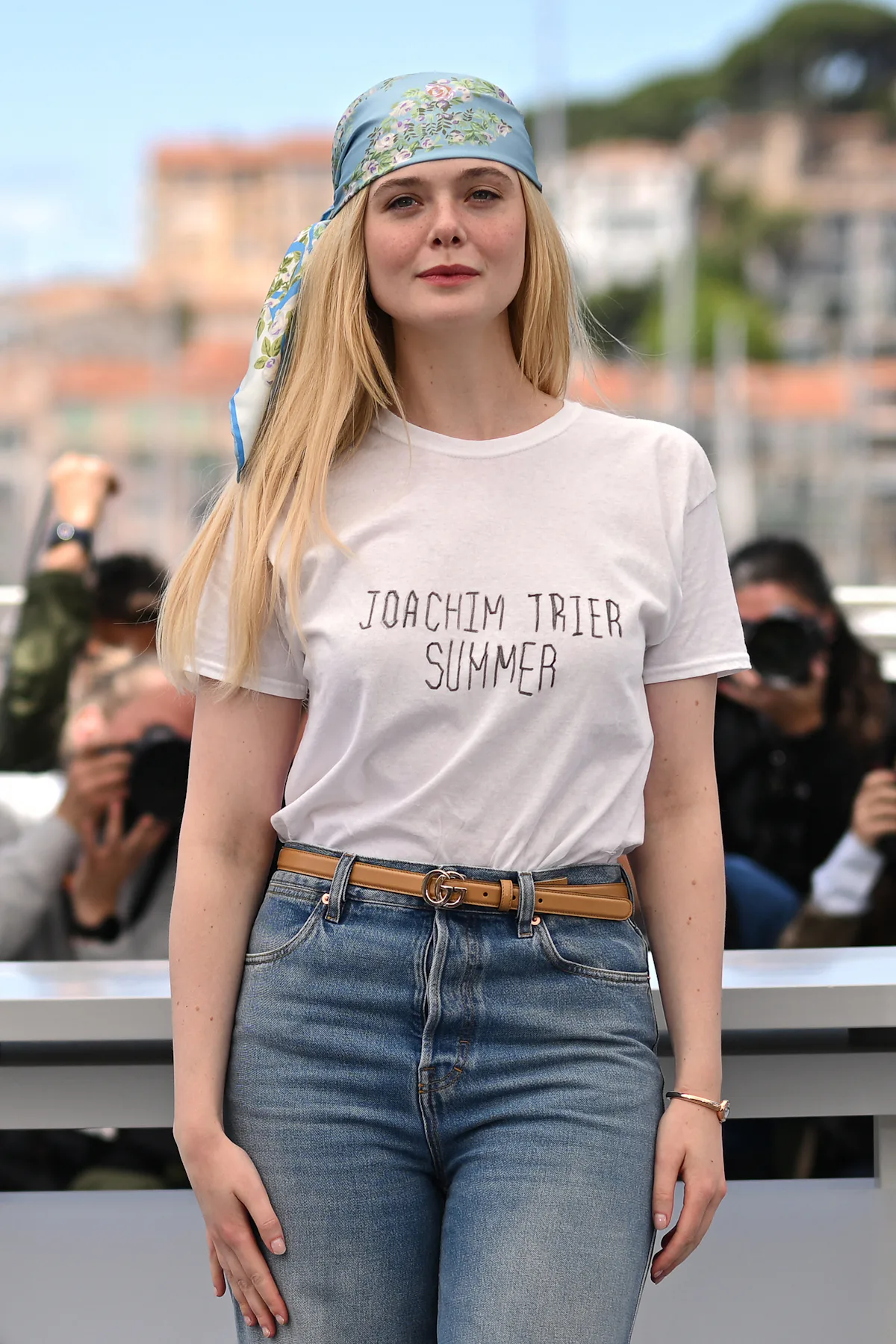
While 2024 was Brat Summer, Charli xcx predicted 2025 would be “Joachim Trier Summer” during her Coachella set that year. Elle Fanning was inspired by the announcement, tapping the 12-year-old son of her stylist, Samantha McMillen, who has his own brand called Dylan’s T-Shirt Club, to put the phrase on a top for her to wear to the photocall of her film, Sentimental Value, directed by Trier.
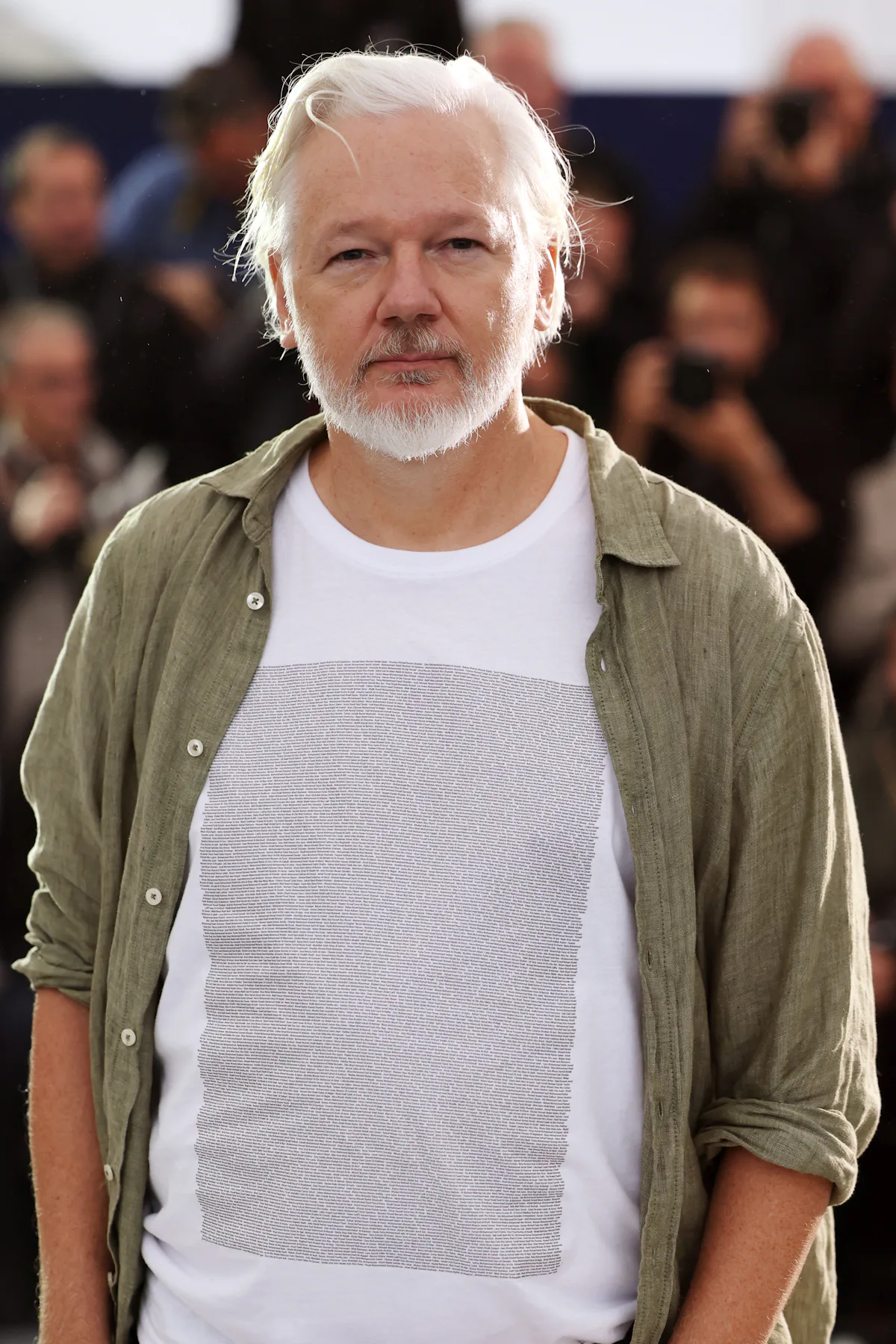
During his first major public appearance following his release from prison, WikiLeaks founder Julian Assange attended the 2025 photocall for the documentary about his life, The Six Billion Dollar Man. He did so in a white tee featuring the names of 4,986 Palestinian children under the age of five killed in Gaza since 2023.
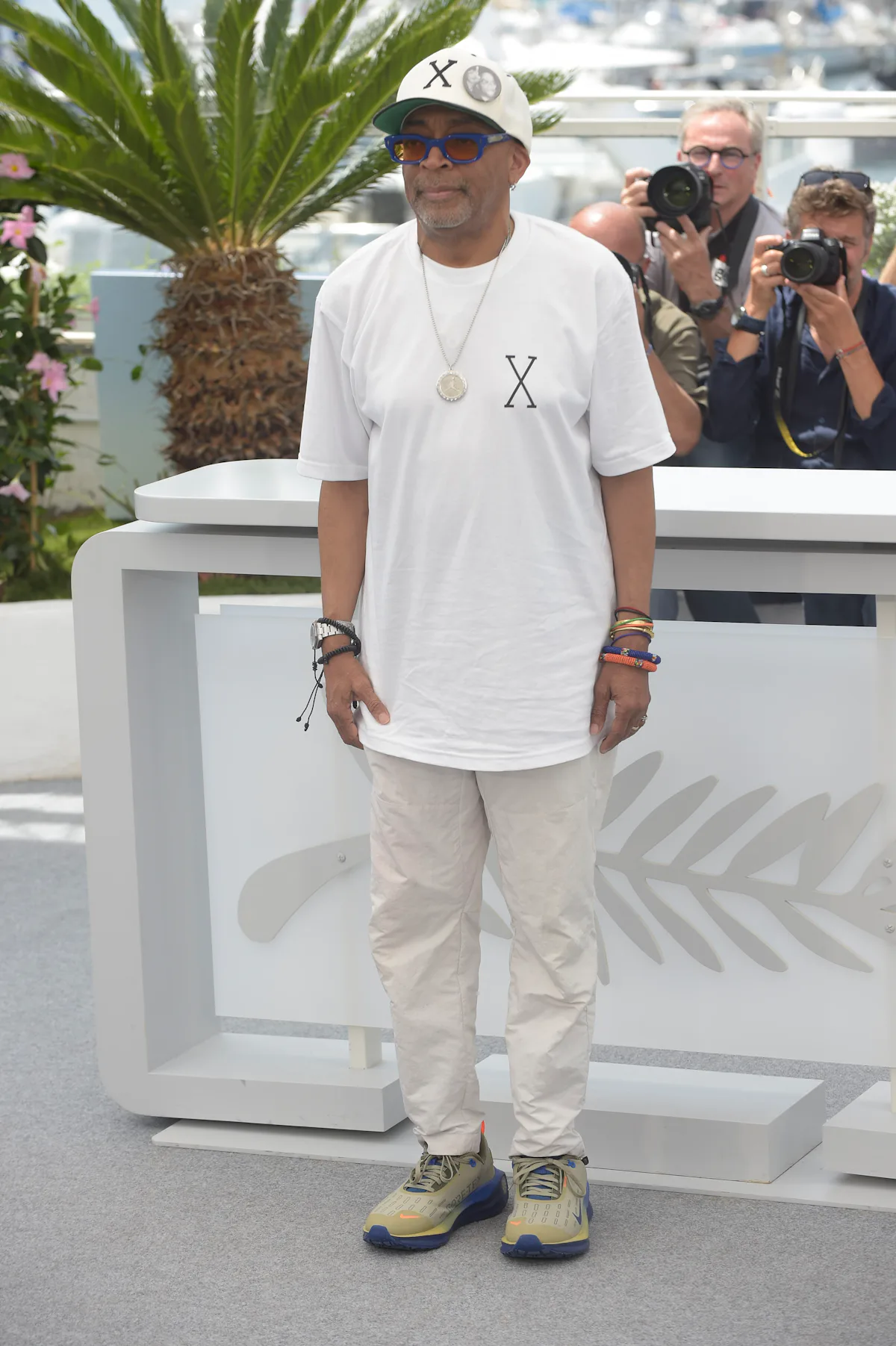
Spike Lee wore a shirt and hat from the collab between his apparel line, 40 Acres and Supreme to the photocall for his 2025 film, High 2 Lowest. The two specific pieces he chose for the French Riviera-set event featured the logo from his 1992 film, Malcolm X.
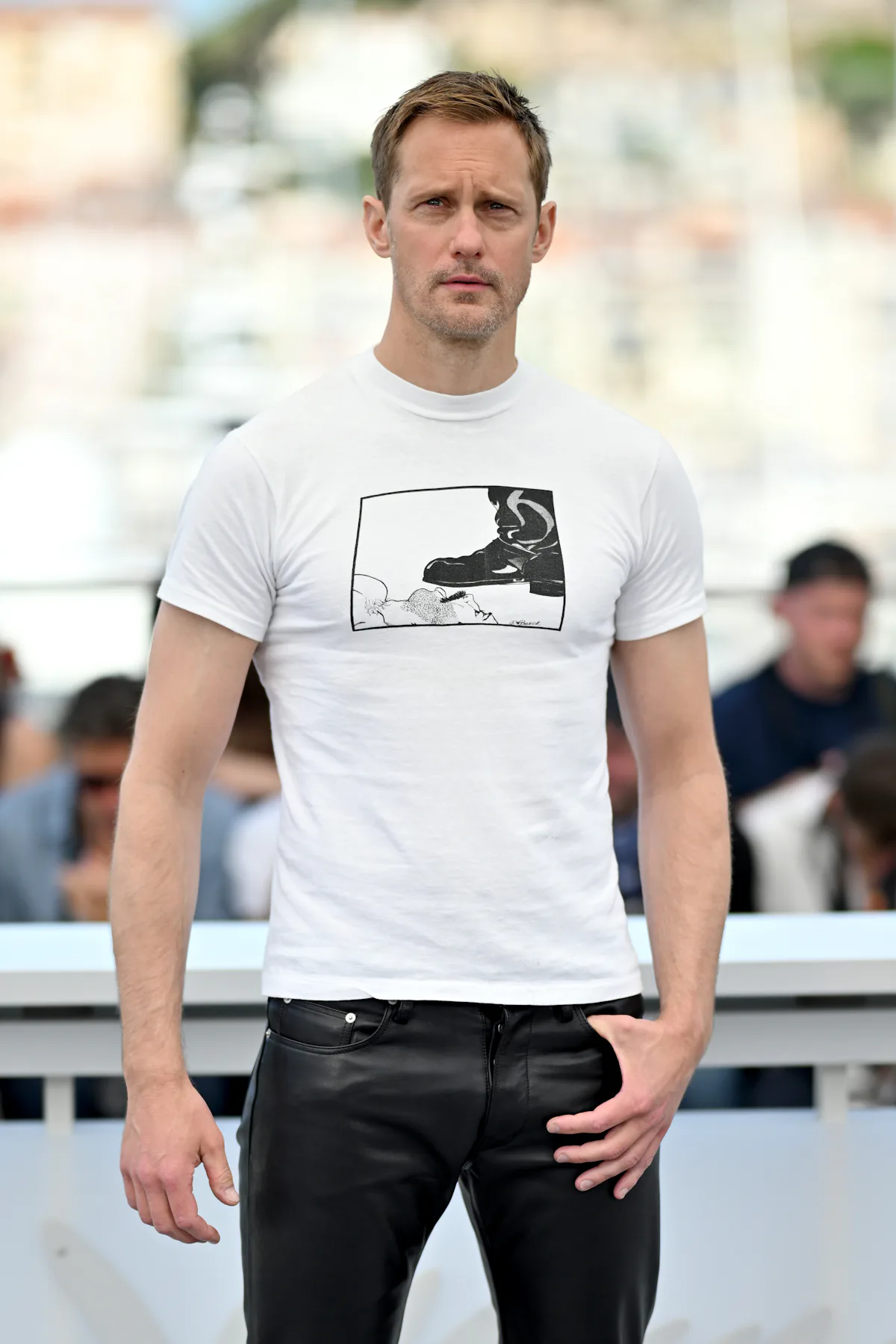
Alexander Skarsgård really embraced the theme of his biker BDSM film, Pillion, while attending the festival in support of it in 2025. At the Pillion photocall, he paired tight leather pants with a T-shirt from the South London store Jerks, featuring an illustration of a man licking a leather boot.
Kenichi Yoda, 2025
CHRISTOPHE SIMON/AFP/Getty Images
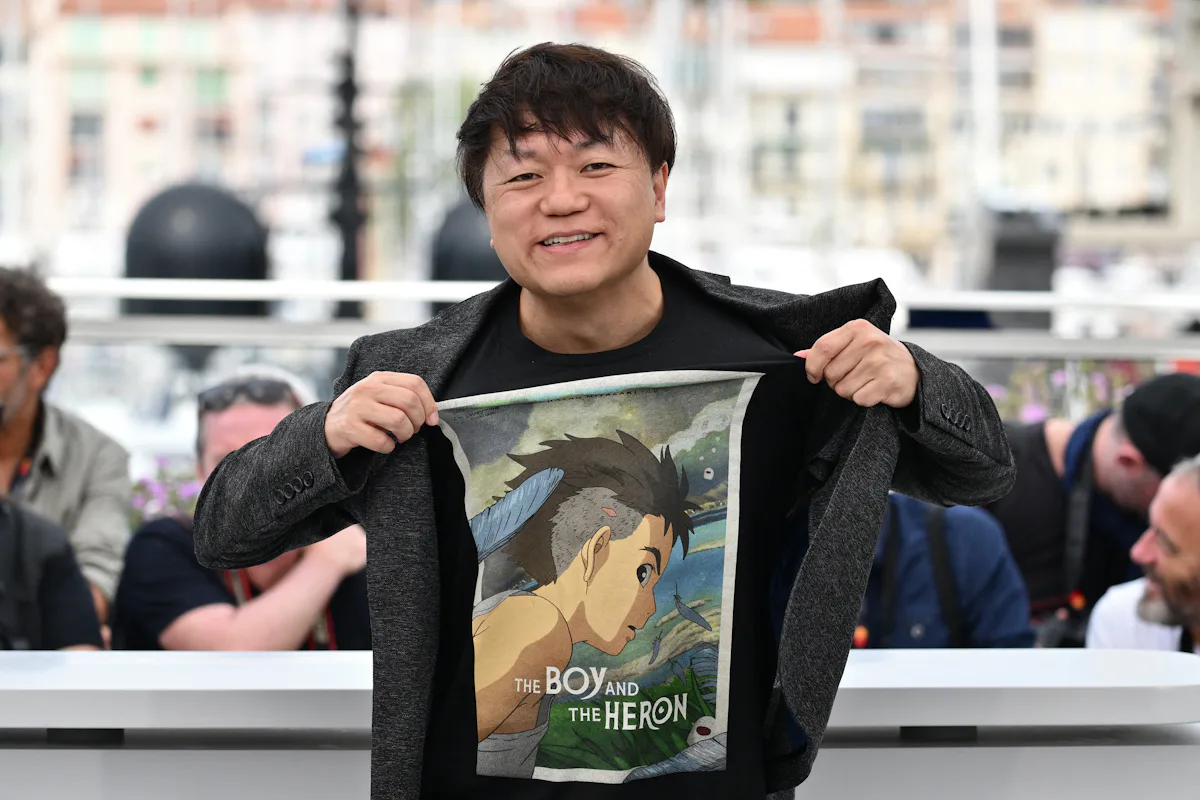
Then-Vice President—and recently appointed President—of Japanese animation studio Studio Ghibli, Kenichi Yoda, showed off a t-shirt from the 2023 Studio Ghibli film The Boy and the Heron. He was attending the festival that year in order to accept the Palme d'Or on behalf of the studio.
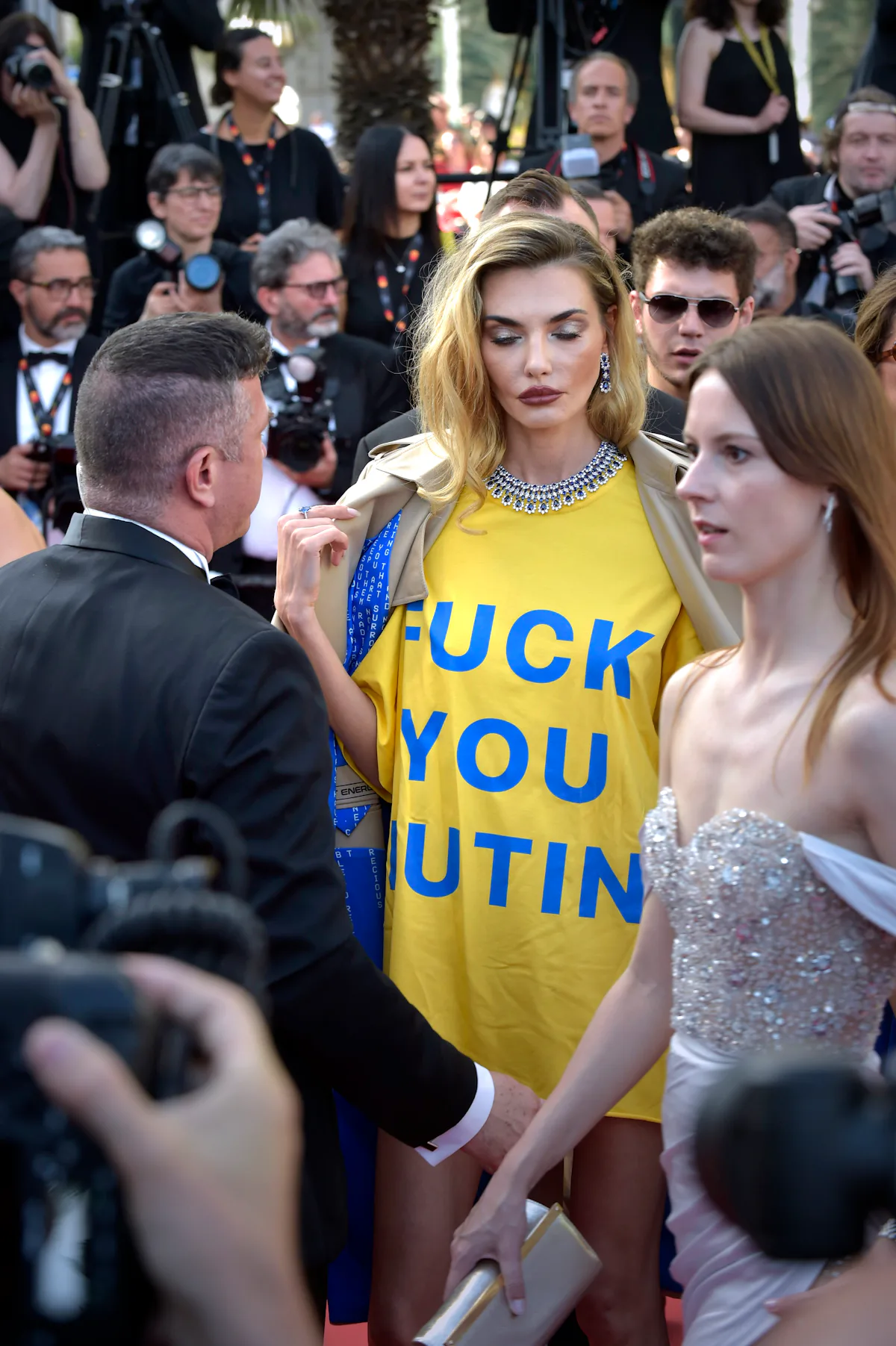
Ukrainian model Alina Baikova only had a brief moment to show off her shirt disparaging Russian president Vladimir Putin and the war in Ukraine before she was removed from the red carpet by security.
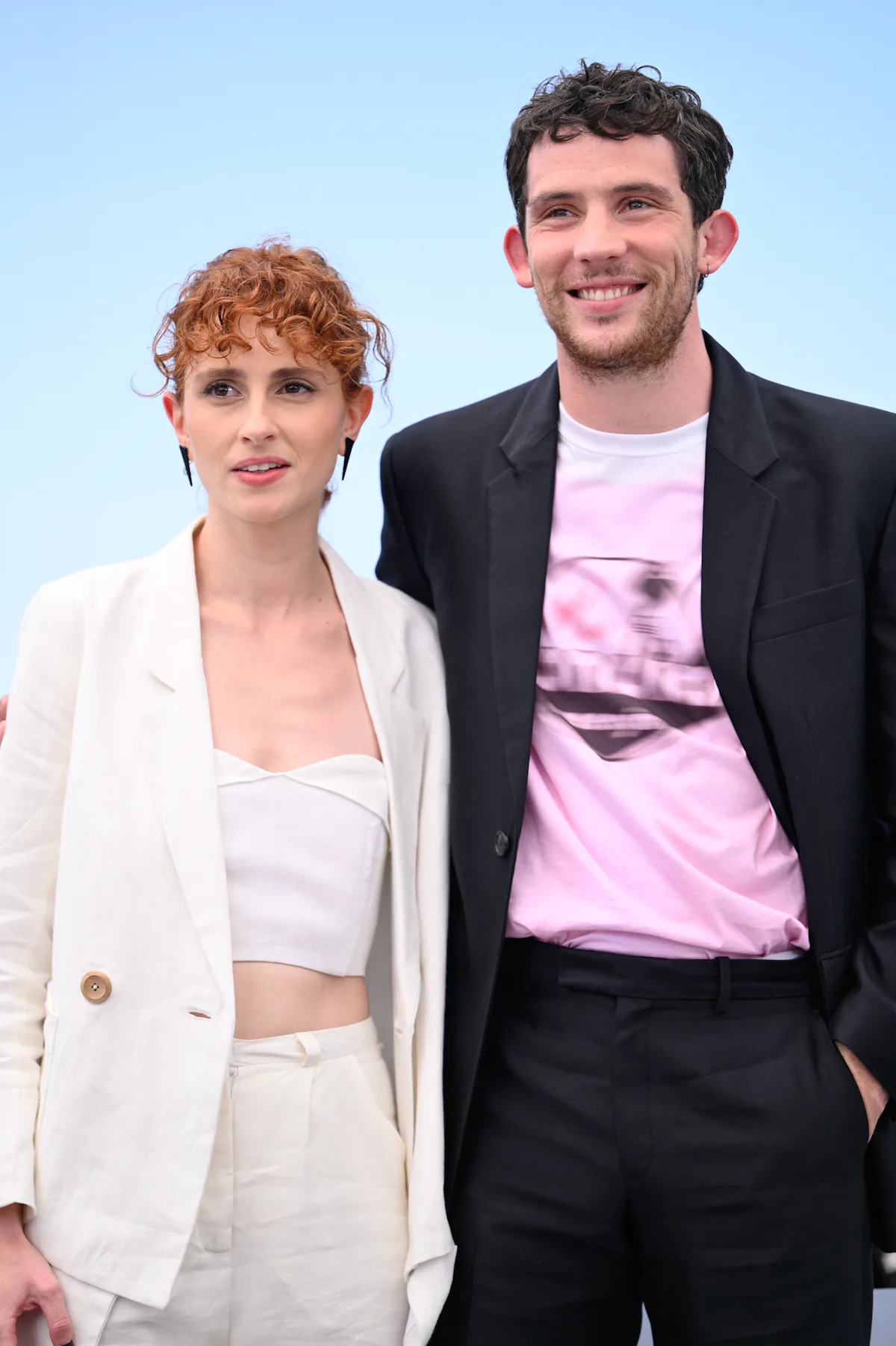
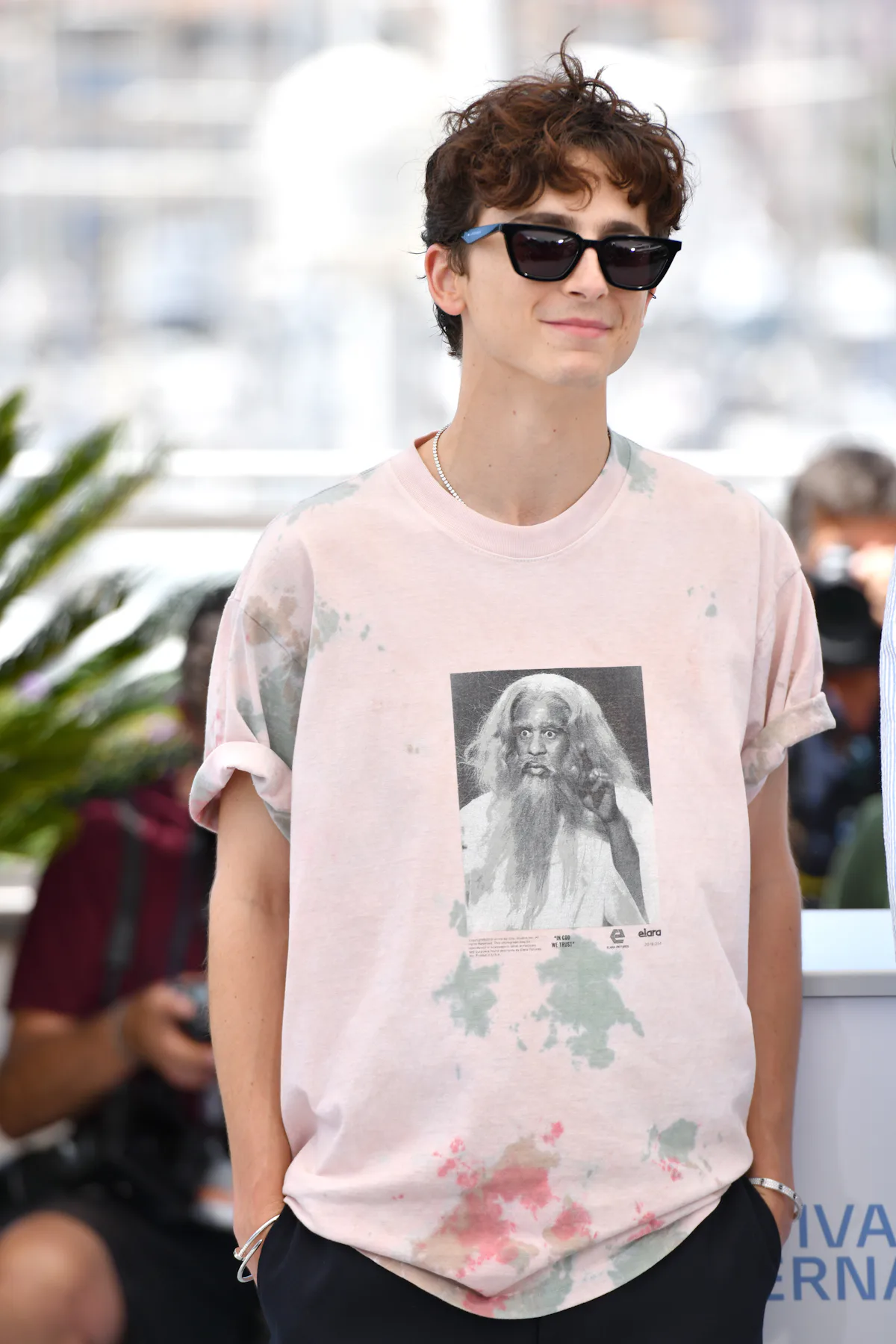
While promoting Wes Anderson’s The French Dispatch at the 2021 festival, Timothée Chalamet donned a pink tee featuring Richard Pryor as God in the 1980 comedy In God We Trust.
Spike Lee, 2021
Kate Green/Getty Images Entertainment/Getty Images
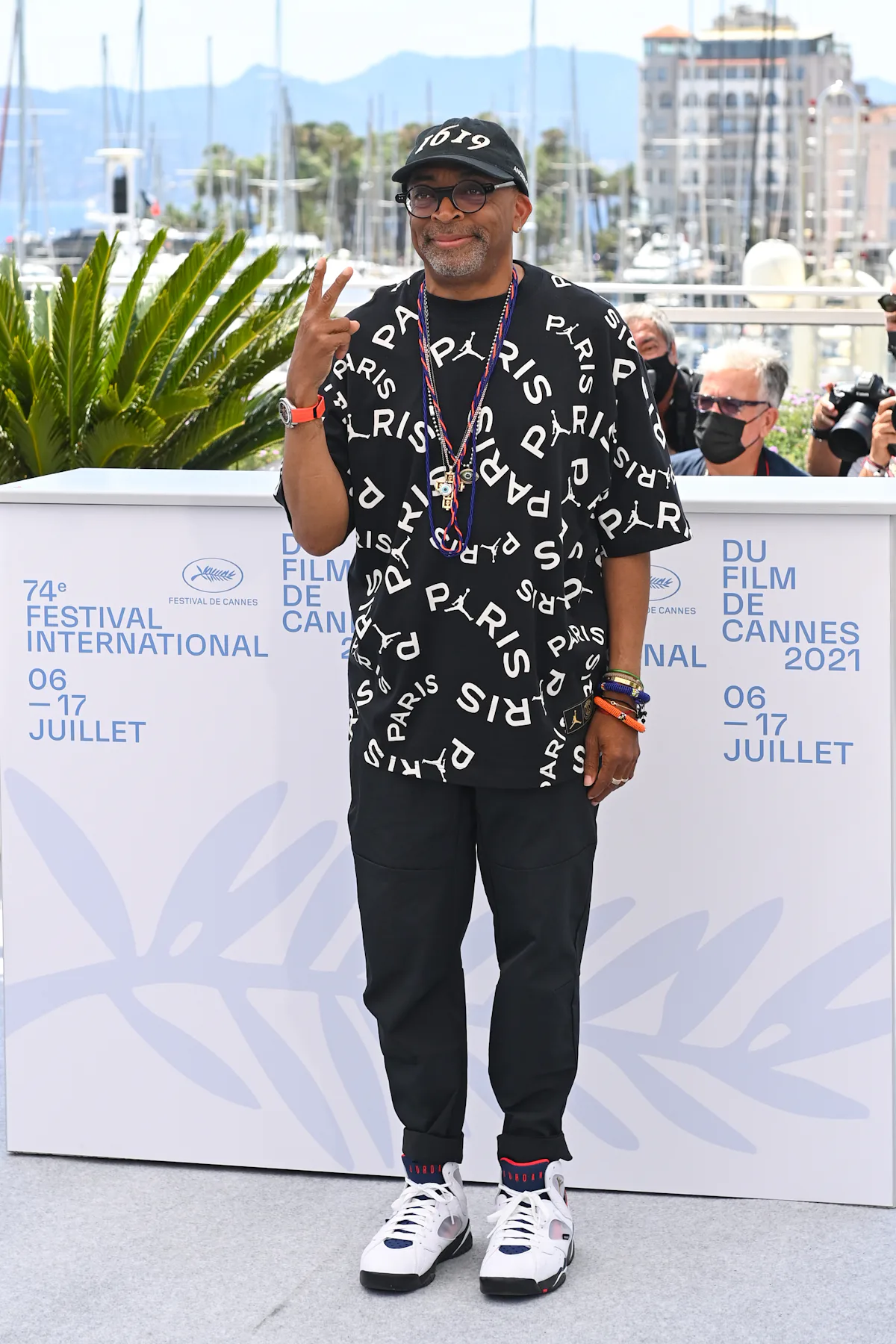
While Lee wore a graphic Air Jordan shirt to the jury photocall in 2021, it was his hat that made more of a statement. The director’s cap is from a collaboration between 40 Acres and Mitchell & Ness. The year on it, 1619, refers to the first arrival of enslaved Africans to Jamestown, Virginia, over 400 years ago.
Terry Gilliam, 2018
Kurt Krieger - Corbis/Corbis Entertainment/Getty Images
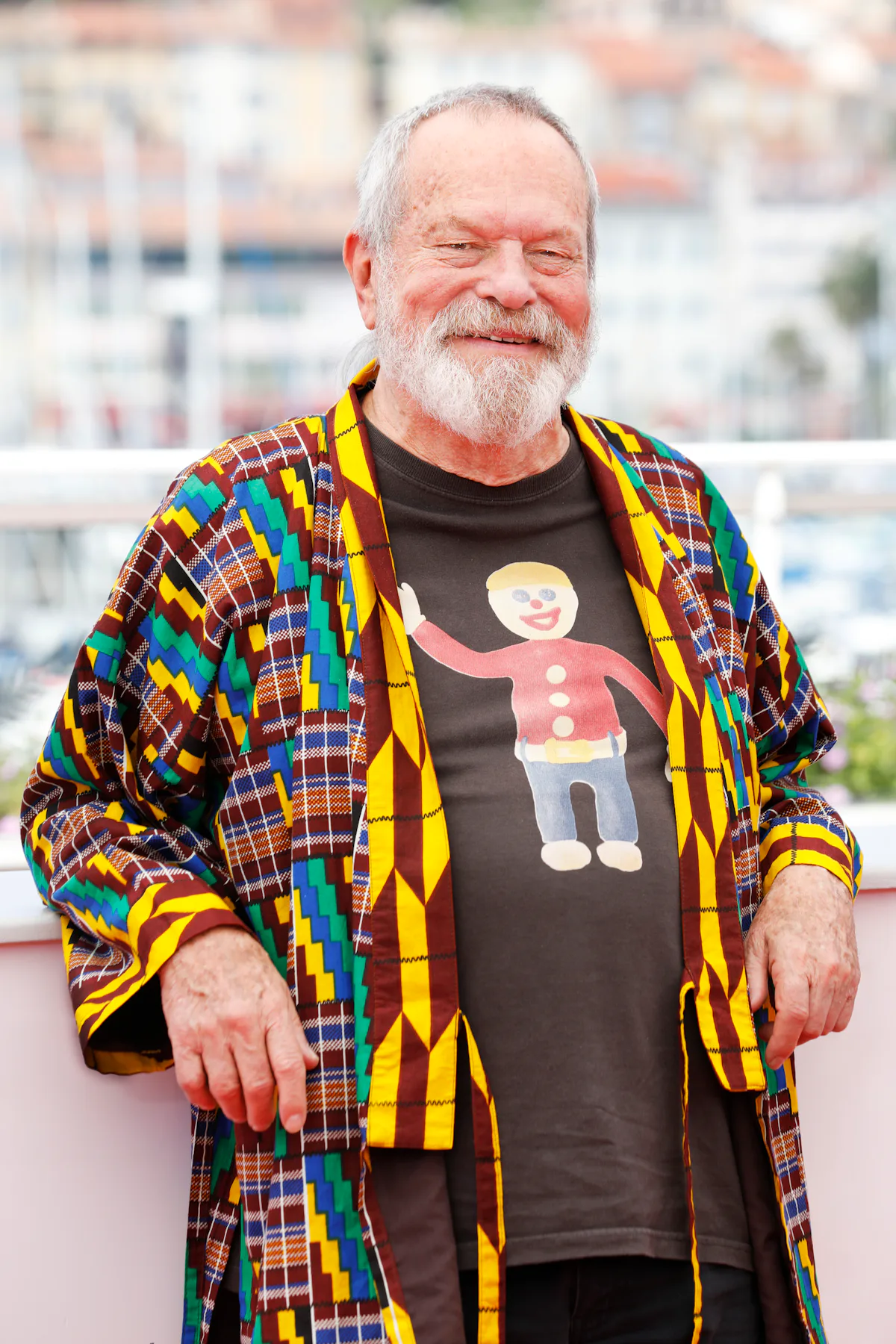
British comedian and filmmaker Terry Gilliam paid homage to his sketch comedy roots when he attended The Man Who Killed Don Quixote photocall in 2018, wearing a shirt featuring Mr. Bill from Saturday Night Live.
Jessica Chastain, 2017
Jacopo Raule/GC Images/Getty Images
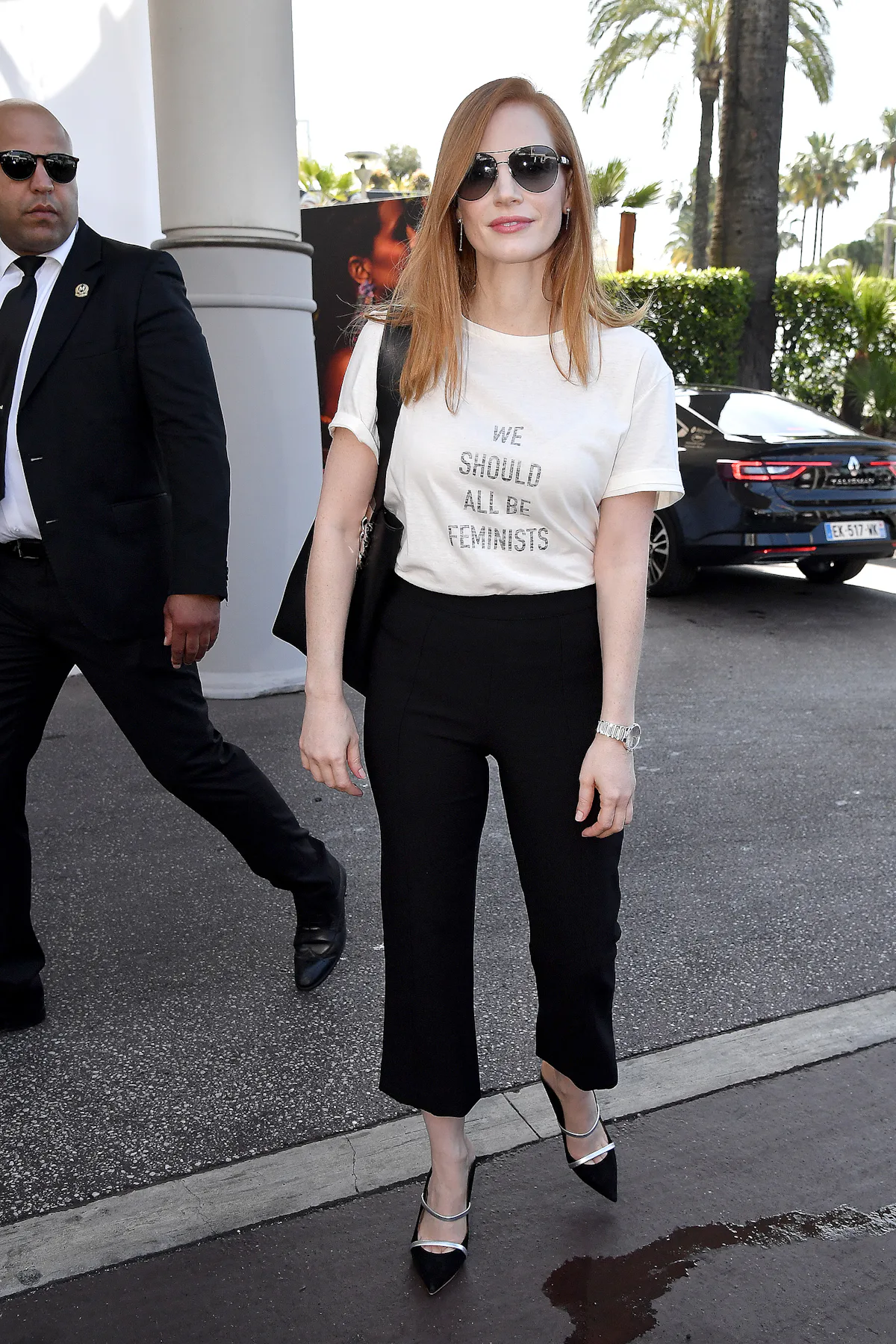
Jessica Chastain arrived to the Cannes Film Festival in 2017 wearing the graphic tee of the moment. Her shirt, which read “We Should All Be Feminists,” came from Maria Grazia Chiuri’s debut collection for Dior. The show featured many politically adjacent slogan shirts, but it was this phrase that really seemed to strike a nerve, with the shirt being spotted on several stars including Rihanna.
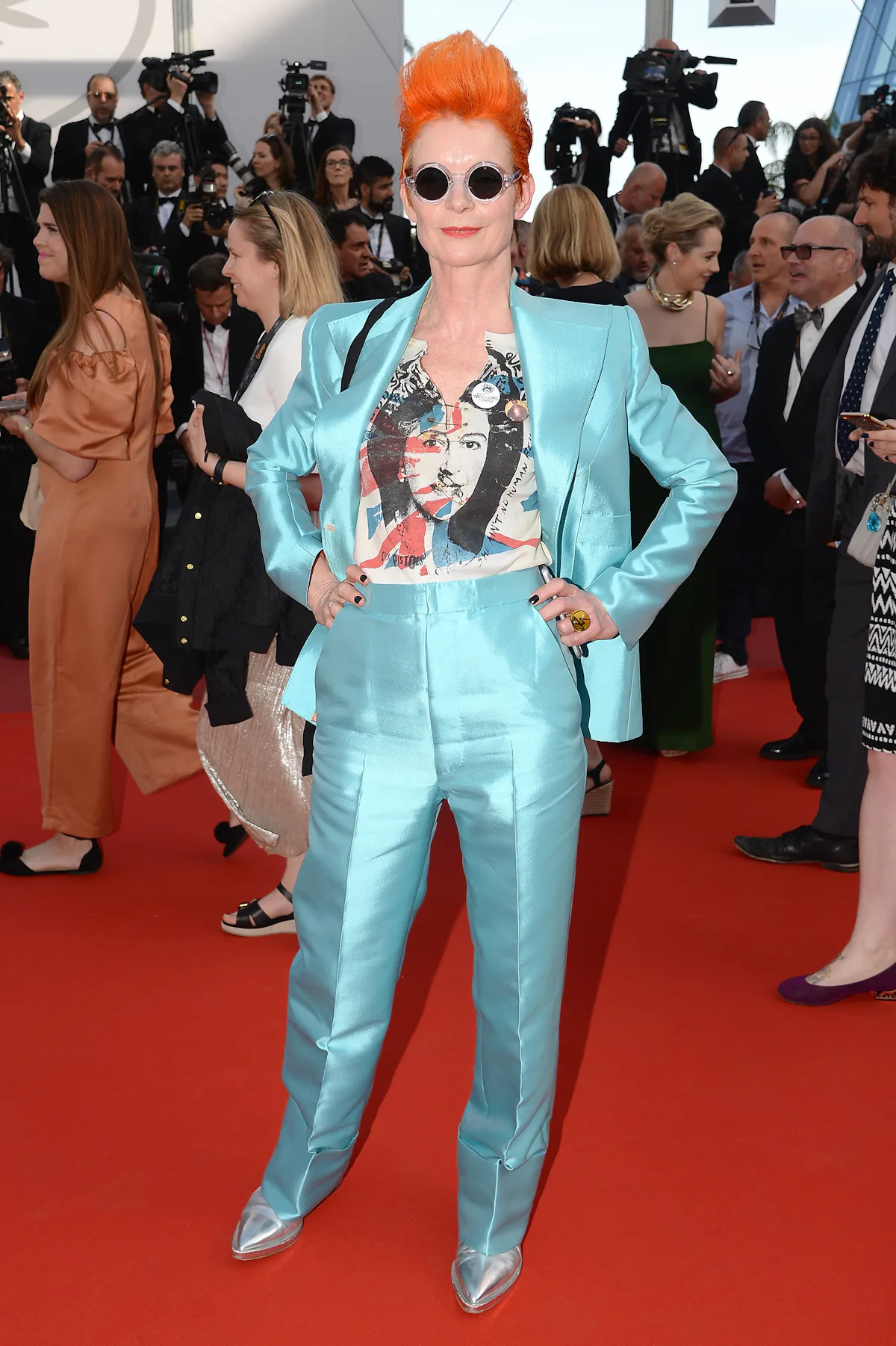
British costume designer Sandy Powell attended the How to Talk to Girls at Parties during its Cannes premiere in 2017 in a Sex Pistols T-shirt. The choice was likely made to pay homage to the film she costumed, which takes place in the punk rock world of 1970s London.
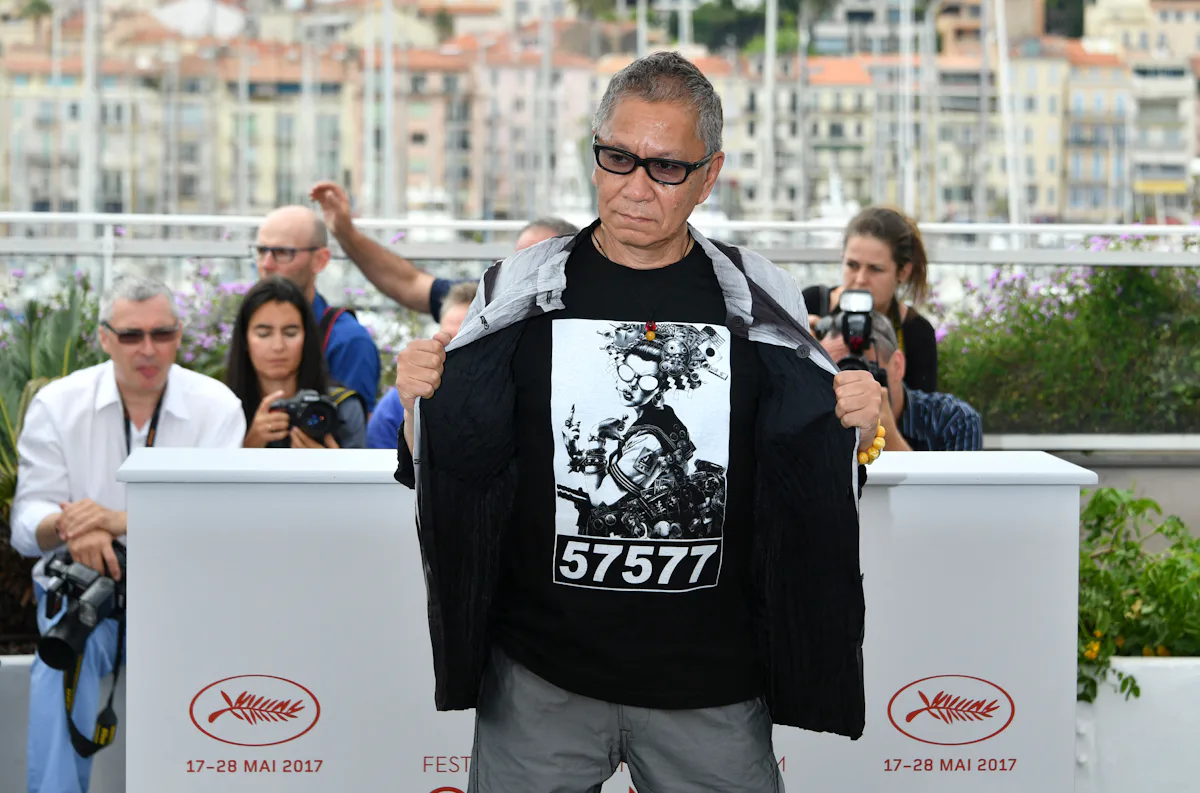
Takashi Miike, 2017
LOIC VENANCE/AFP/Getty Images
Japanese director Takashi Miike posed for a photocall for his 2017 film, Blade of the Immortal, wearing a T-shirt featuring artwork by Katsuhiro Otomo, the son of Akira creator Katsuhiro Otomo, along with his signature 57577, the title of Otomo’s 2014 book.
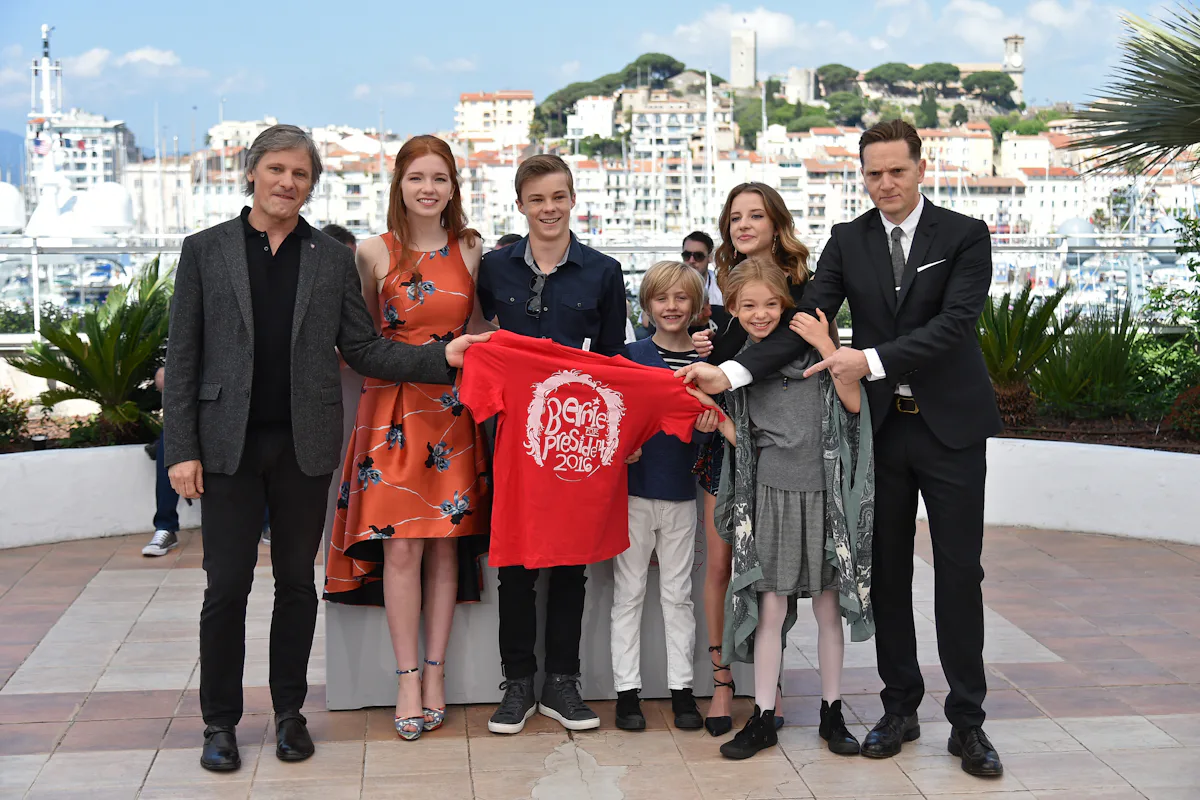
The Captain Fanastic Cast, 2016
ALBERTO PIZZOLI/AFP/Getty Images
Captain Fantastic has often been described as a fictional manifestation of left-wing idealism, and the film’s cast doubled down on this idea at the 2016 Cannes photocall. There, Viggo Mortensen and his co-stars broadcast their support for Bernie Sanders in the lead-up to the U.S. Presidential election.
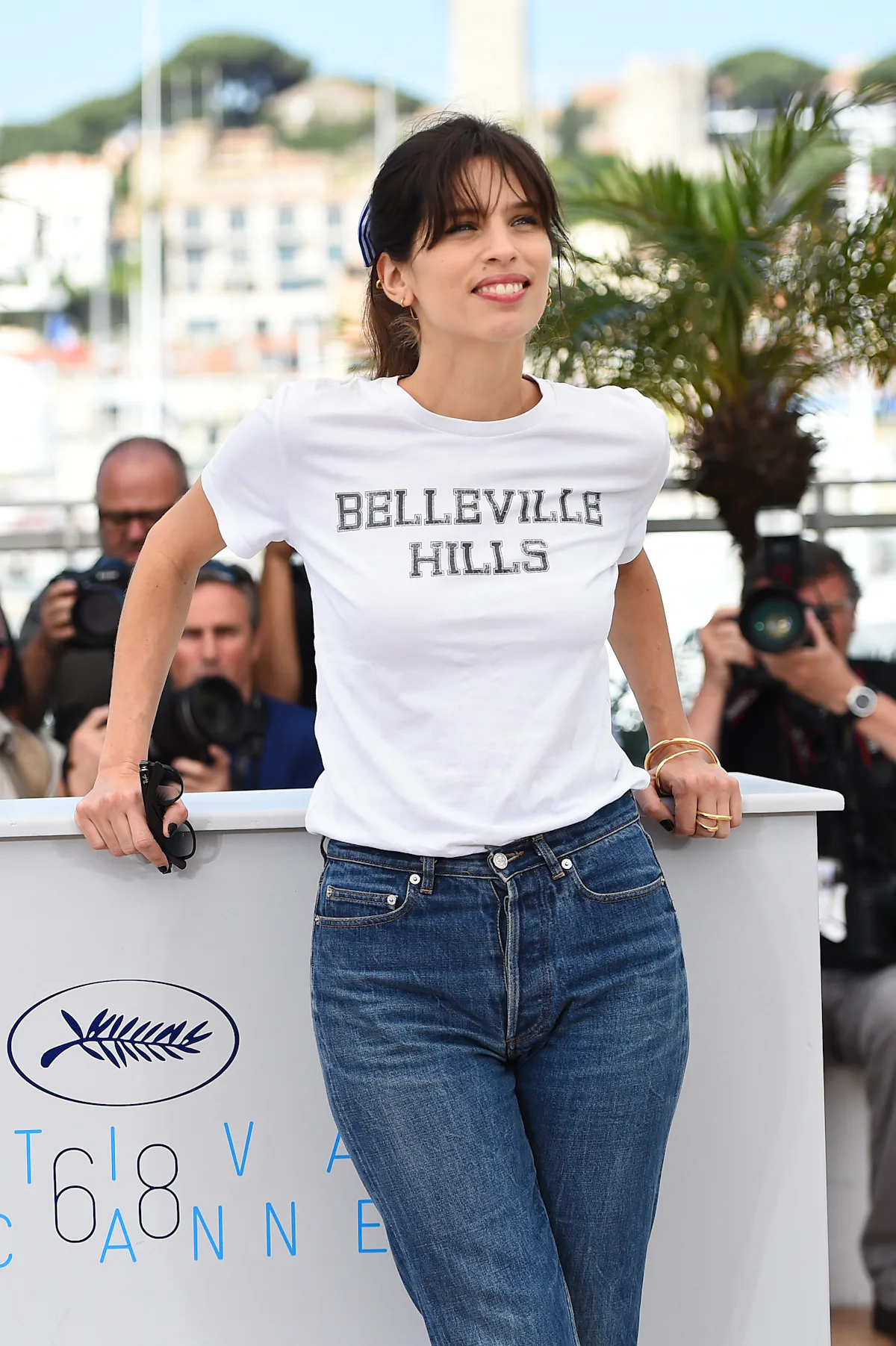
Maïwenn, 2015
ANNE-CHRISTINE POUJOULAT/AFP/Getty Images
No, Maïwenn’s shirt doesn’t say “Beverly Hills,” it actually says Belleville Hills. The French director shouted out Paris’s hilltop artistic community while promoting her film, My King, in 2015.
Jack Black, 2011
Jean Baptiste Lacroix/FilmMagic/Getty Images
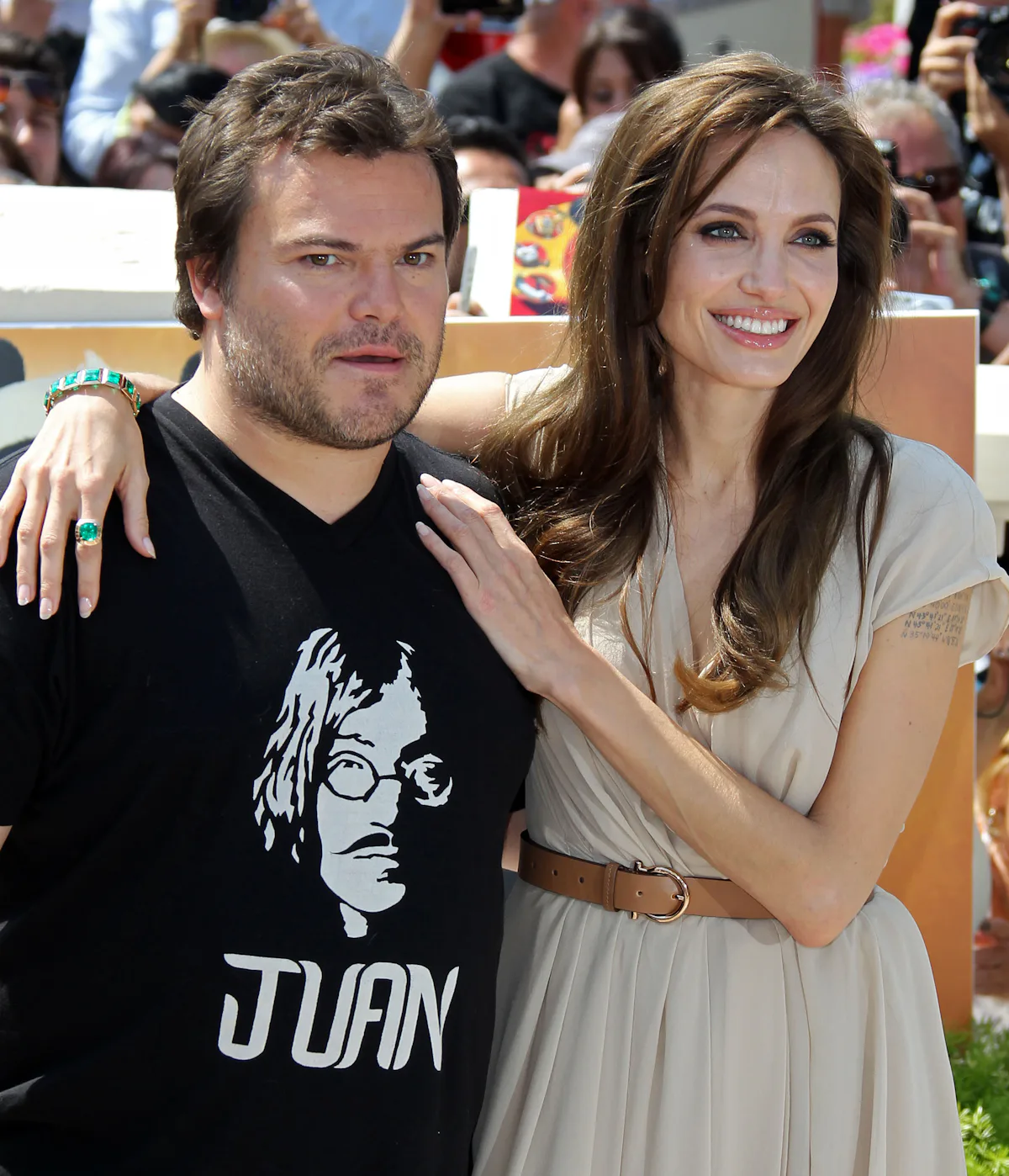
Ever the joker, Jack Black posed with Angelina Jolie wearing a shirt bearing John Lennon’s face and the name “Juan” at the photocall for Kung Fu Panda 2 in 2011.
Spike Lee, 2008
John Shearer/WireImage/Getty Images
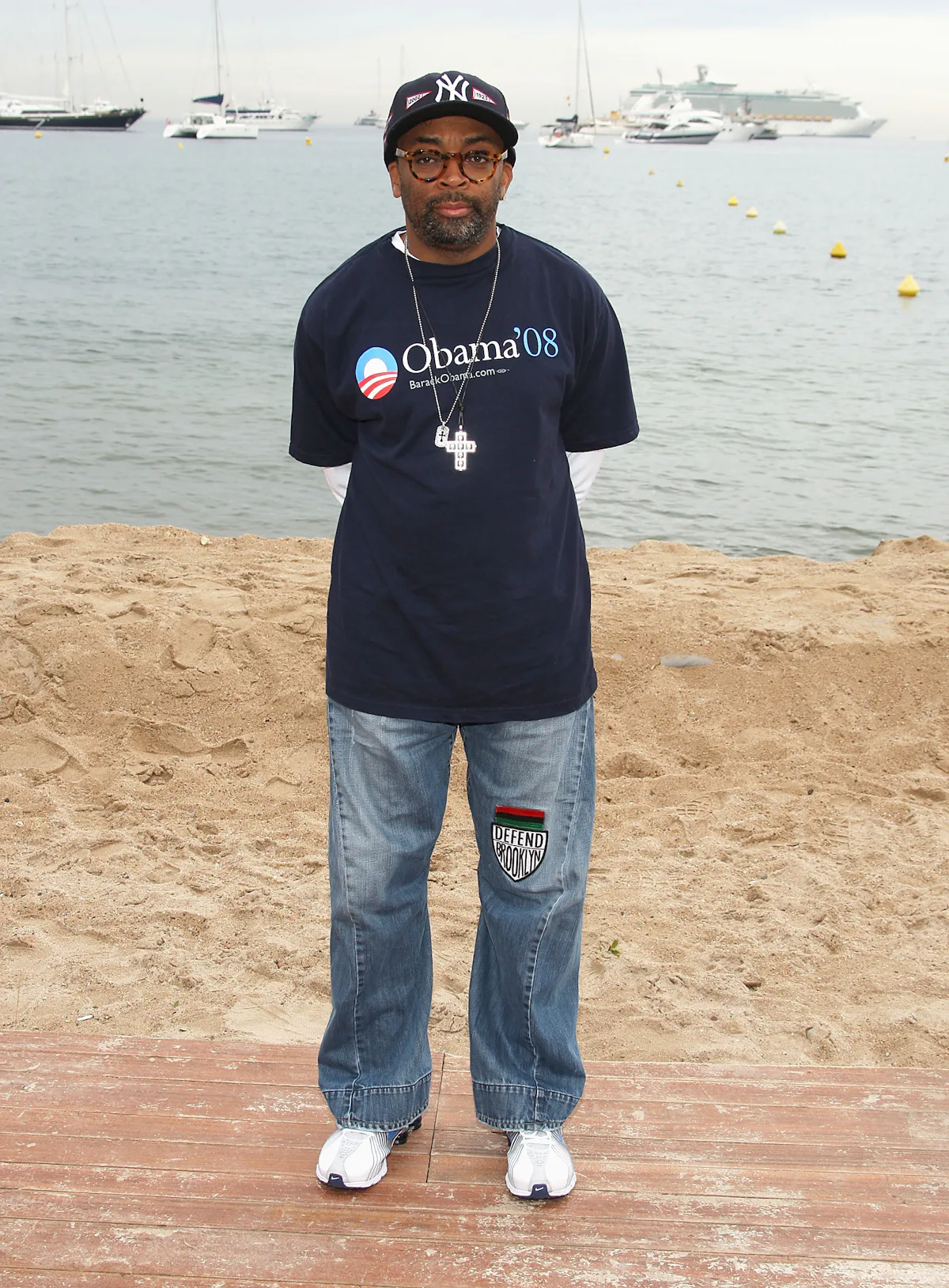
In 2006, Lee took the opportunity to show his support for Barack Obama ahead of his first election that fall.
Natalie Portman, 2008
George Pimentel/WireImage/Getty Images
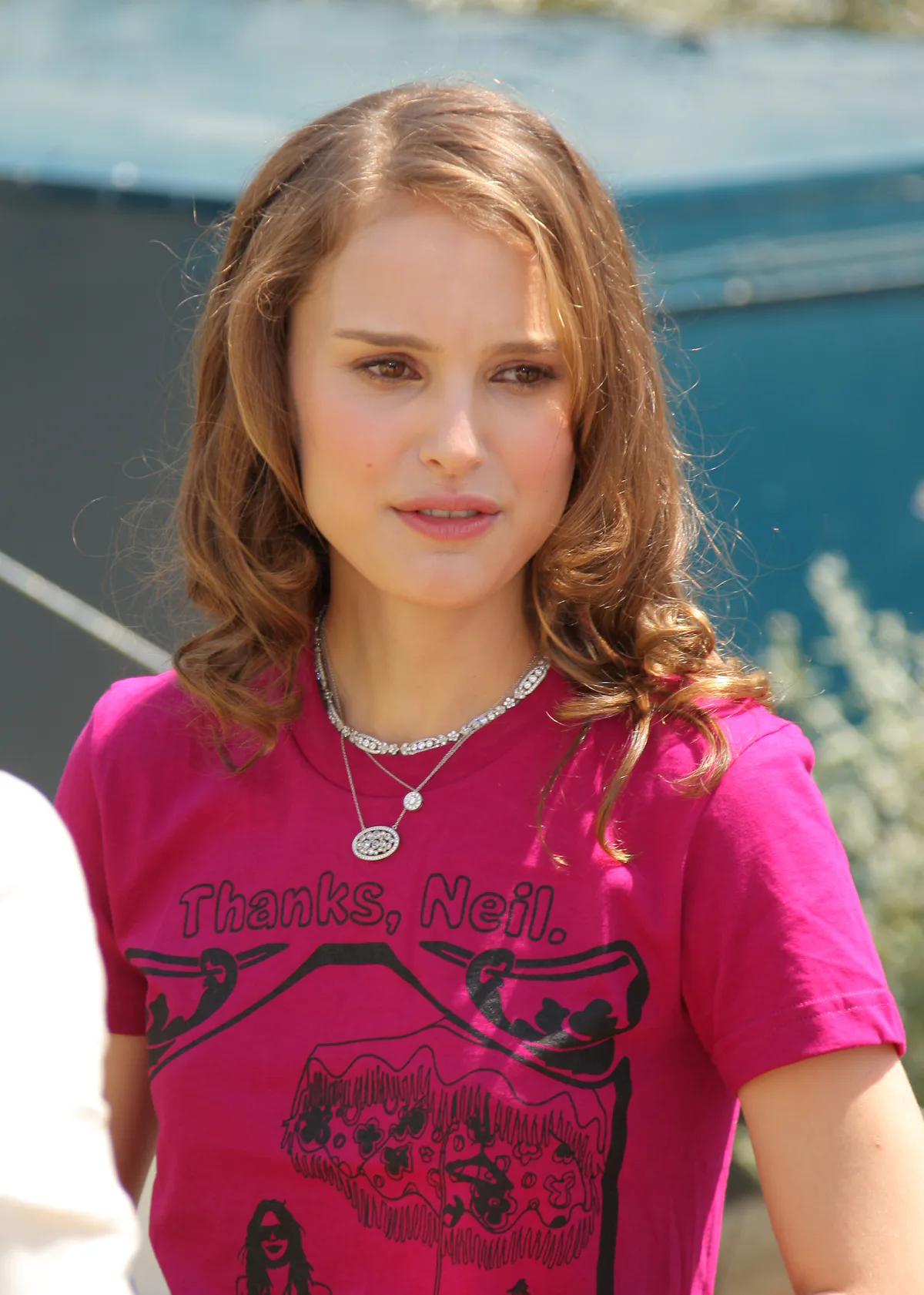
In 2008, Jury member Natalie Portman showed her love for Neil Young in a magenta tee by illustrator Jess Rotter of Rotter and Friends. Rotter started her company in 2007 and has been popular for her illustration of world-famous musicians ever since.
Gus Van Sant, 2007
Sean Gallup/Getty Images Entertainment/Getty Images
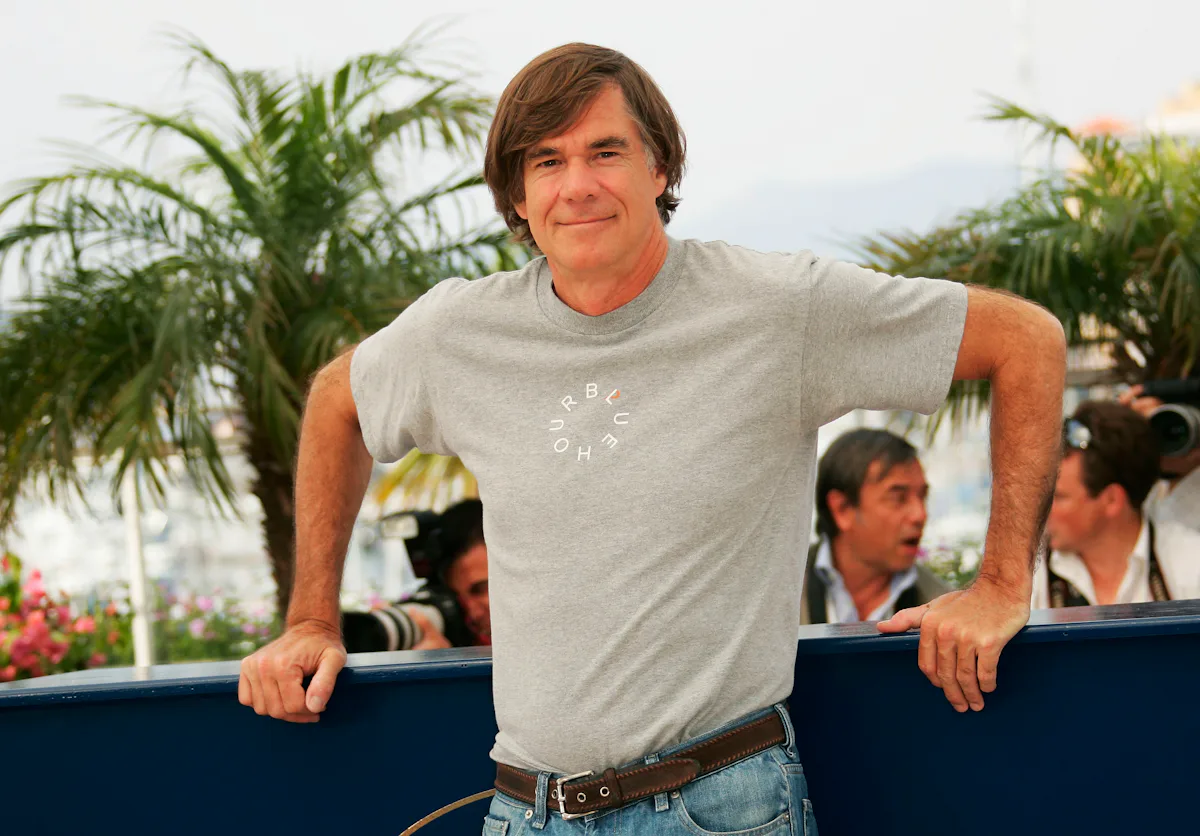
In 2007, director Gus Van Sant, who lives primarily in Portland, Oregon, attended the Paranoid Park photocall in a tee from the local restaurant, Bluehour—one of his go-to spots before it closed in 2020.
Kim Ki-Duk
VALERY HACHE/AFP/Getty Images
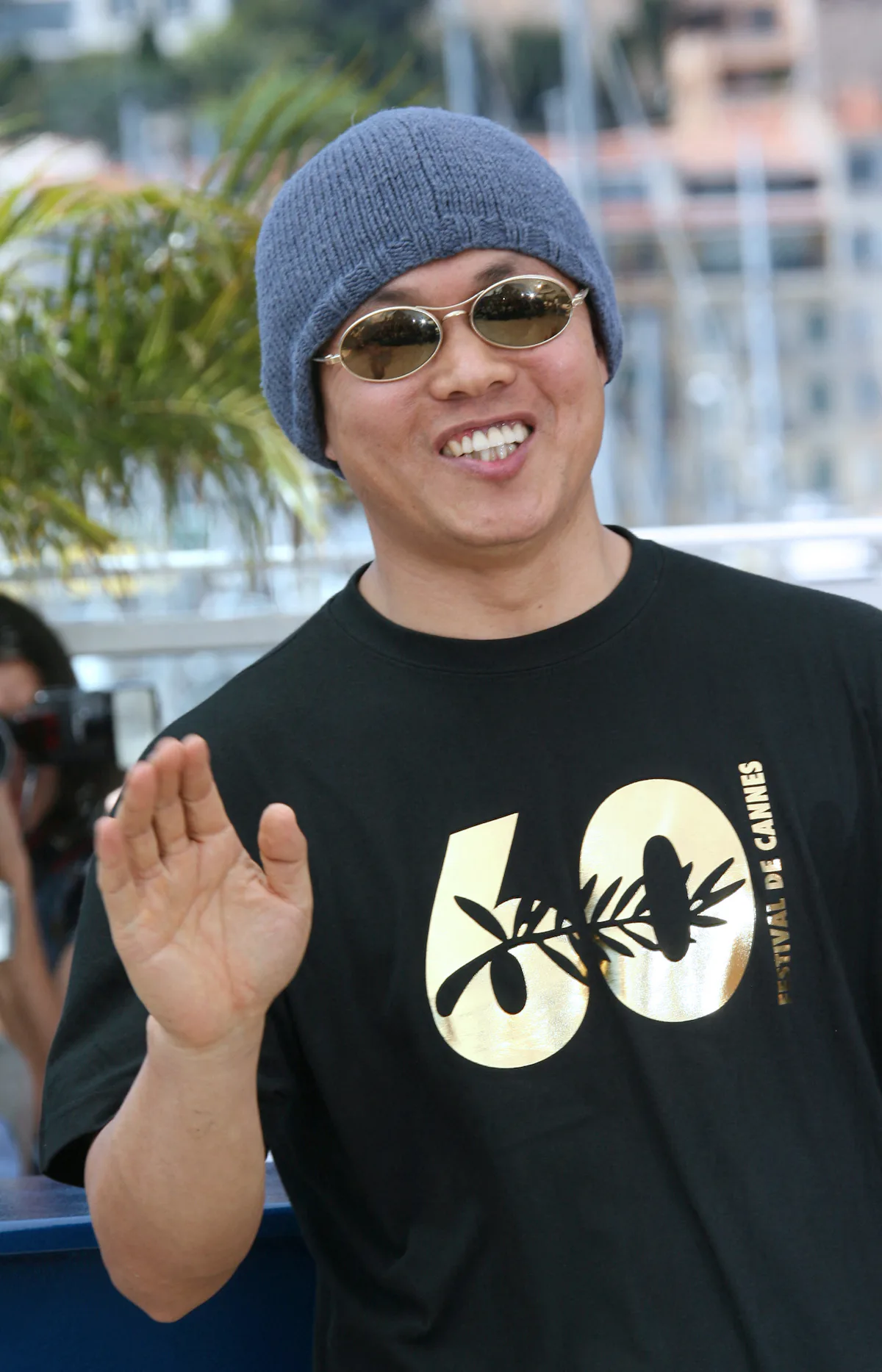
Korean director Kim Ki-Duk celebrated the 60th anniversary of the Cannes Film Festival with a T-shirt marking the occasion.
Michael Pitt, 2005
Toni Anne Barson Archive/WireImage/Getty Images
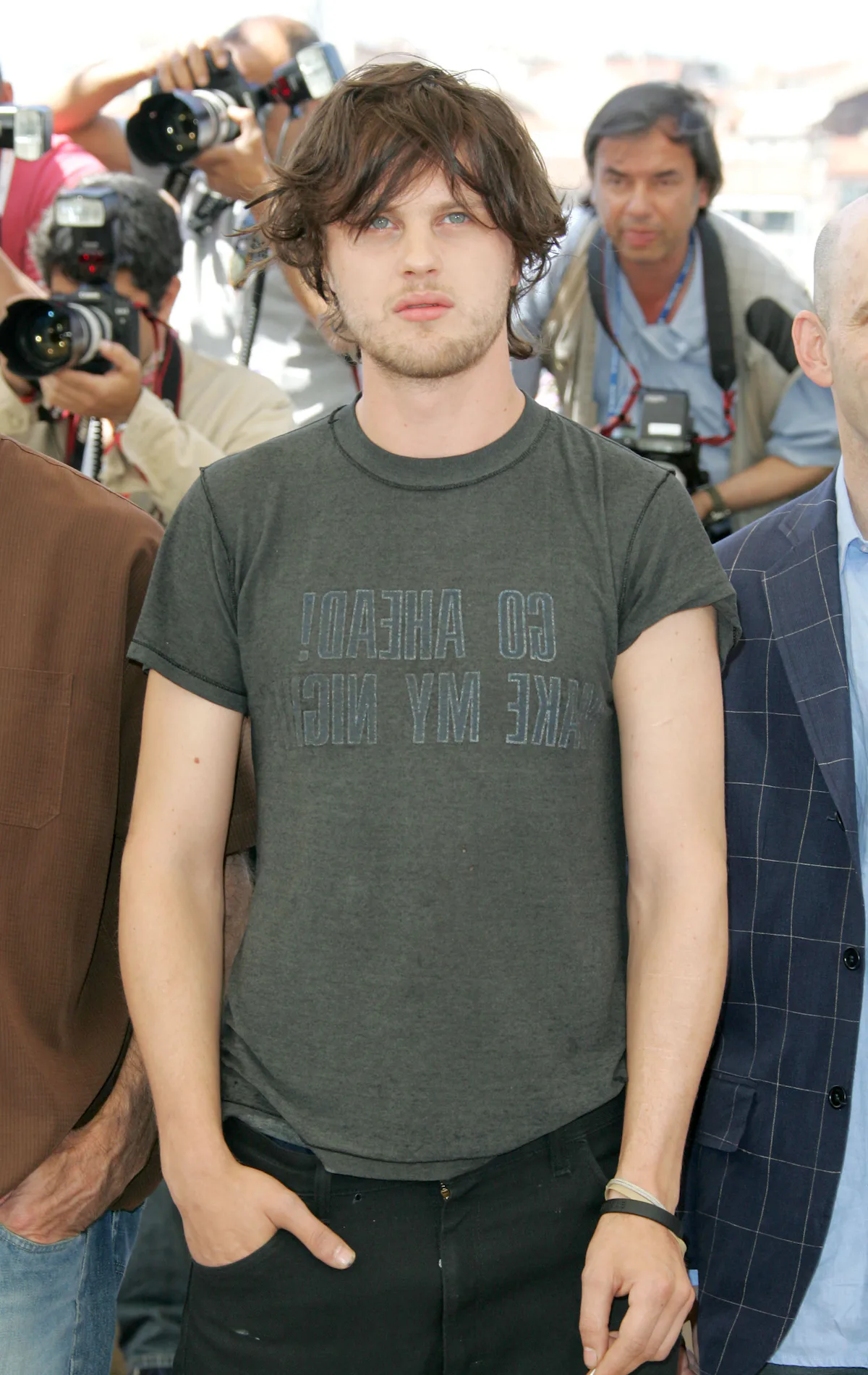
Michael Pitt wasn’t promoting the 1983 film Sudden Impact at Cannes, but he did wear a shirt bearing Clint Eastwood’s famous quote from the movie, “Go ahead, make my day.”
Penelope Cruz, 2004
Dave Hogan/Getty Images Entertainment/Getty Images
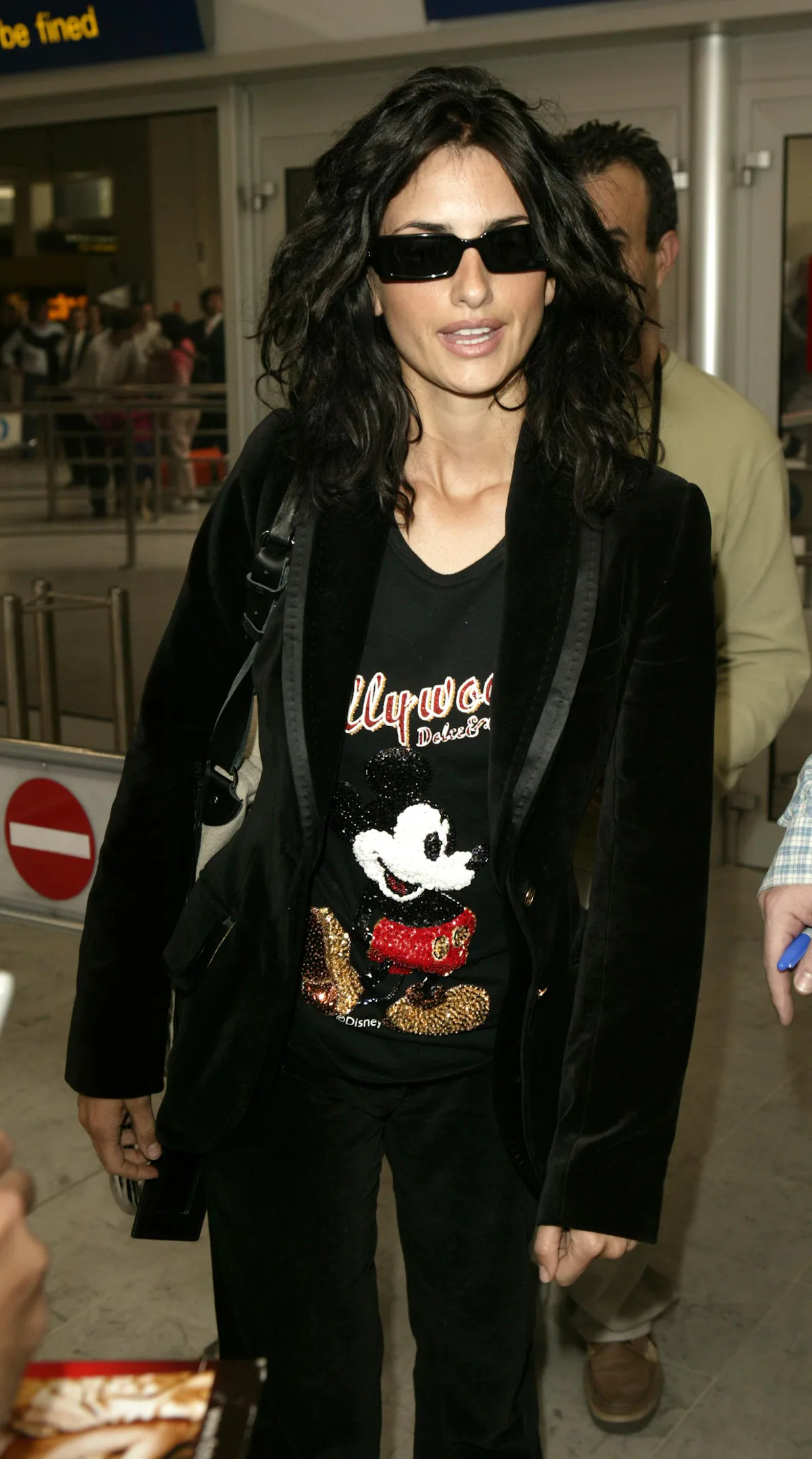
Penélope Cruz arrived to the festival in 2004 wearing a bedazzled Dolce & Gabbana Mickey Mouse tee.
Terry Gilliam, 2001
Dave Hogan/Getty Images Entertainment/Getty Images
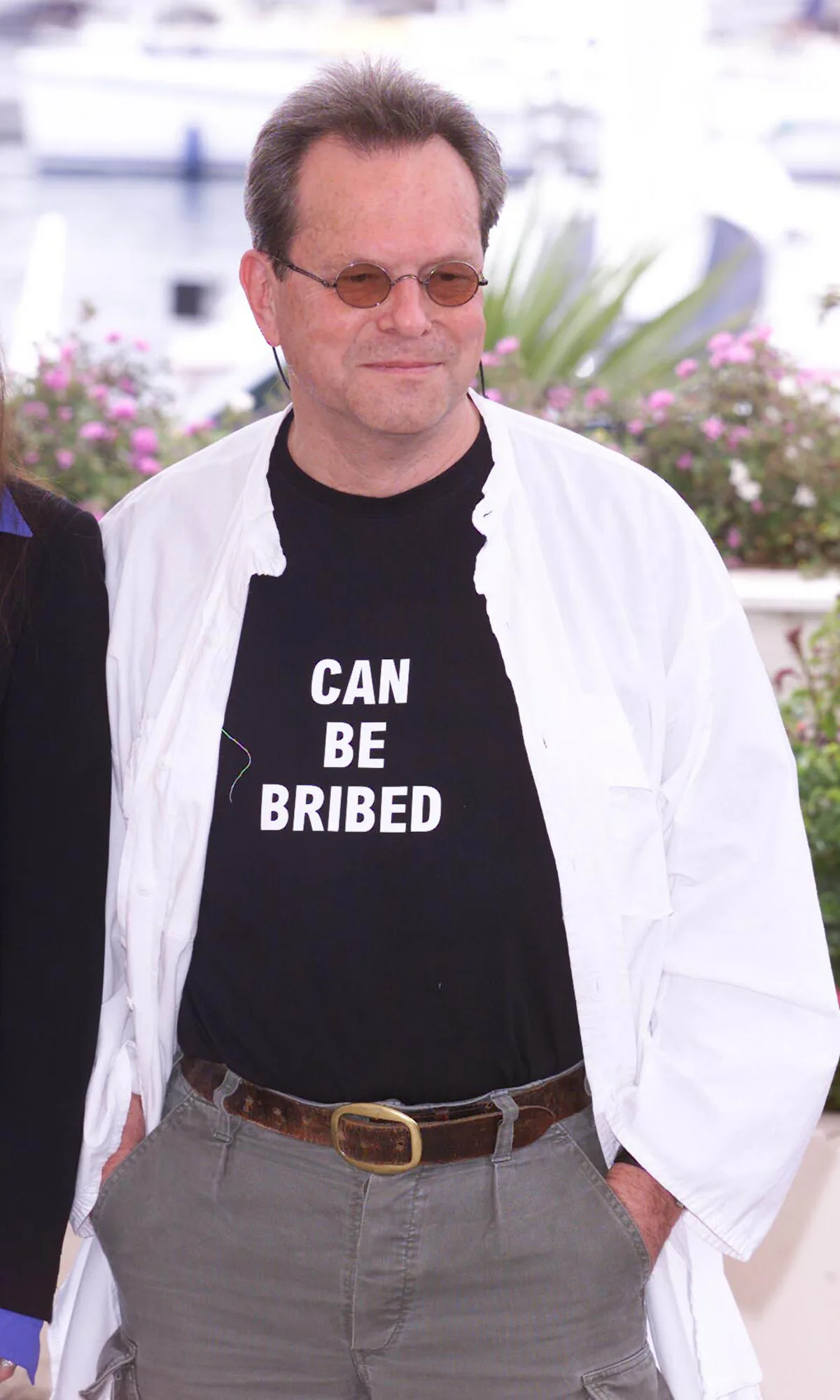
In 2001, Cannes jury member and Monty Pyton and the Holy Grail director Terry Gilliam joked that he could be bribed by producers to award their films. “I’m willing to take large sums of money to vote for your film,” he said on opening day. “I will choose the film whose producer gives me the largest amount of money.”
Spike Lee, 1996
PATRICK HERTZOG/AFP/Getty Images
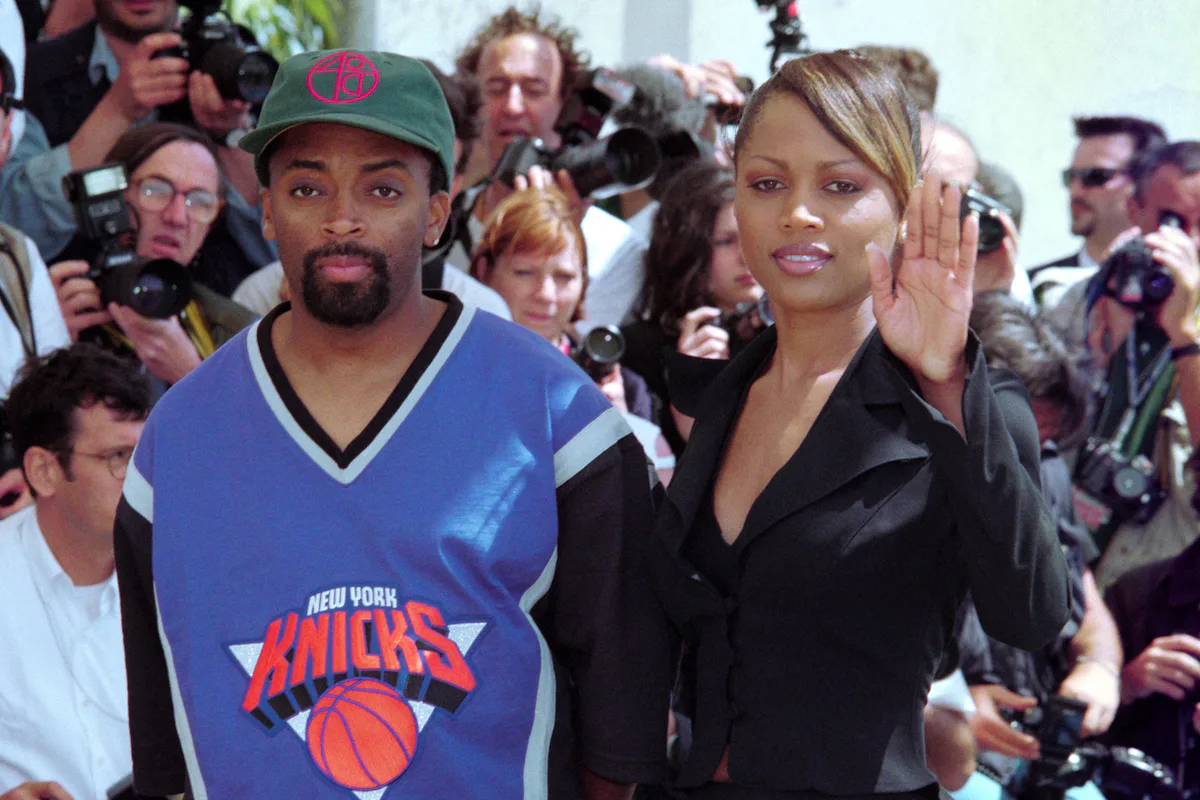
A lifelong Knicks fan, Lee repped his favorite team as well as his production company 40 Acres and a Mule at the Girl 6 photocall in 1996.
Neil Young and Jim Jarmusch,
Eric Robert/Sygma/Getty Images
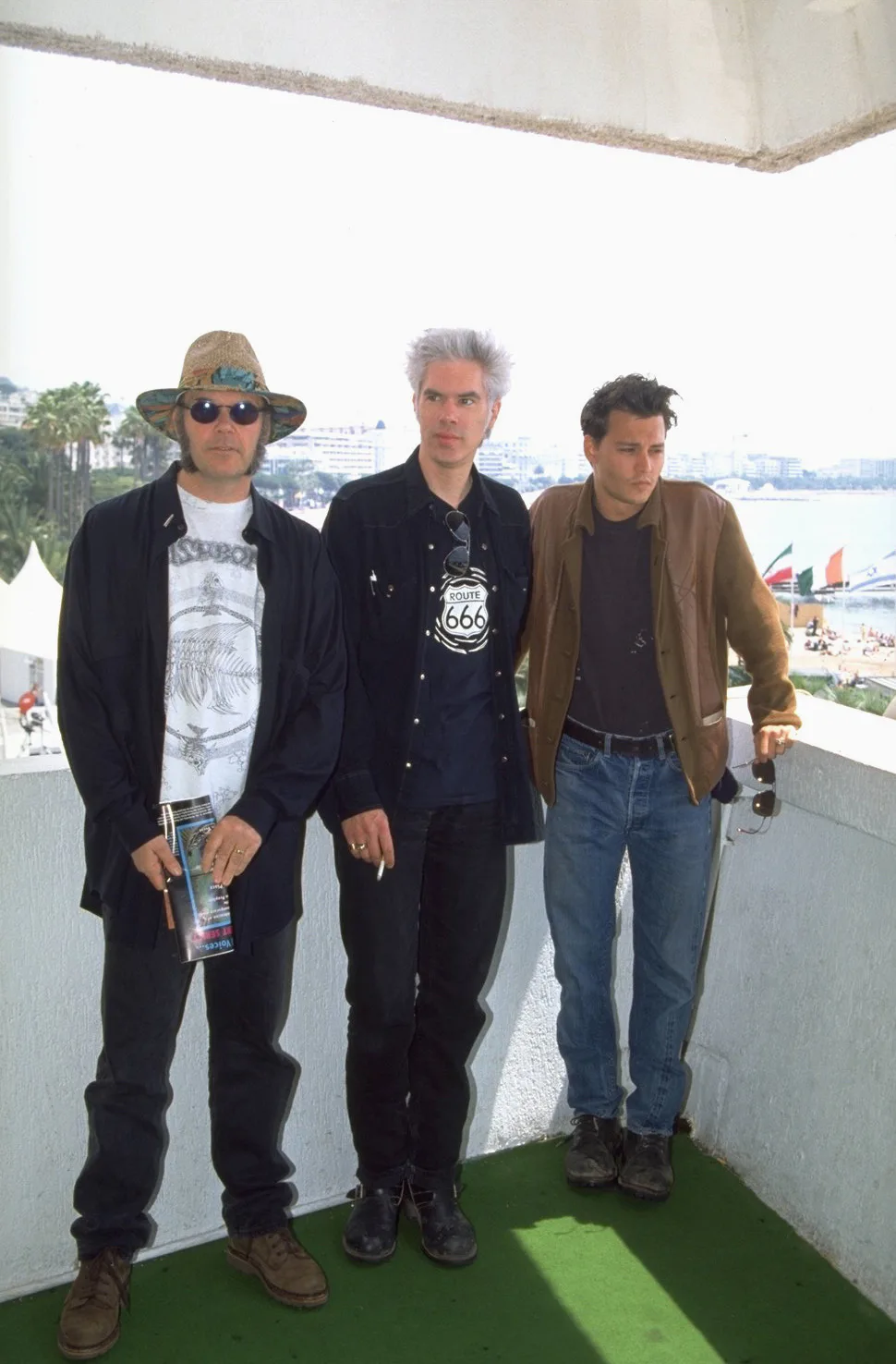
Neil Young, Jim Jarmusch, and Johnny Depp made quite the trio in their T-shirts at the photocall for Dead Man in 1995. Young supported the movie he composed music for in a Fishbone band tee, while director Jarmusch opted for a top emblazoned with the road known as the “Devil’s Highway”, Route 666.
Kenneth Branagh, 1993
Pool BENAINOUS/REGLAIN/Gamma-Rapho/Getty Images
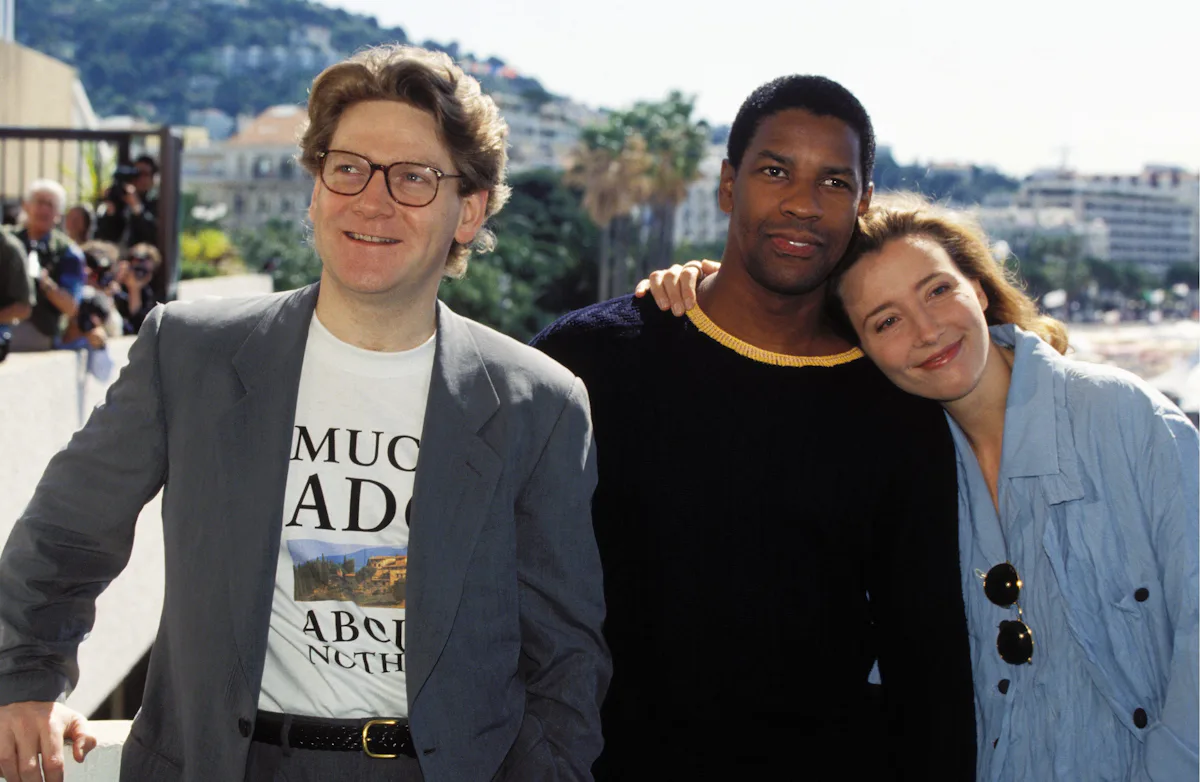
In case you were curious what movie Kenneth Branagh was promoting alongside Emma Thompson and Denzel Washington at the festival in 1993, just look at his shirt, and you’ll see the trio starred in Much Ado About Nothing.
Spike Lee, 1989
Alexis DUCLOS/Gamma-Rapho/Getty Images
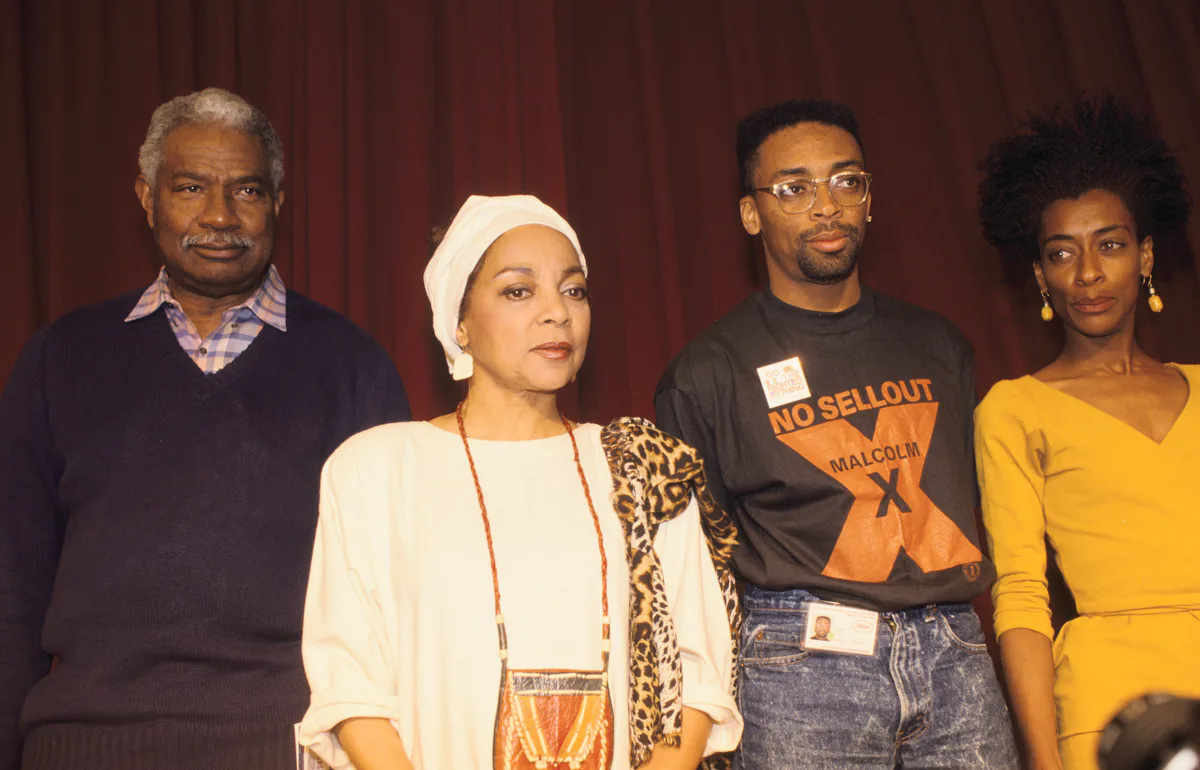
Three years before he released Malcolm X, Spike Lee hit the South of France to promote Do the Right Thing wearing a “No Sell Out” Malcolm X tee. The slogan, which the civil rights leader frequently used in his speeches, was sampled on Keith LeBlanc’s 1983 hip-hop single of the same name.
Derek Jarman, 1987
Richard Blanshard/Moviepix/Getty Images
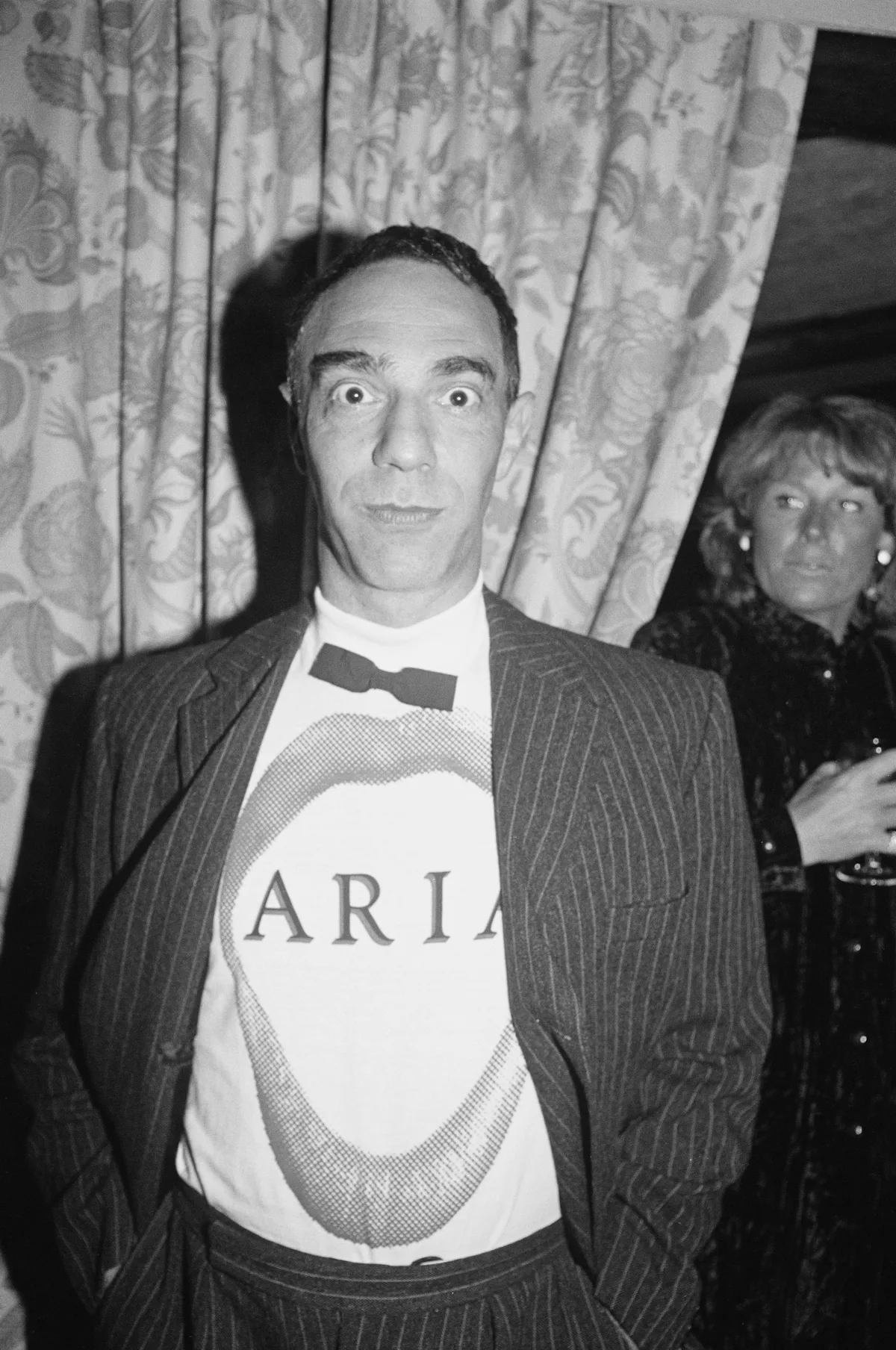
Derek Jarman dressed up his T-shirt with a striped suit, but he made sure the top, which bore the name of his film, Aria, could still be clearly seen. Jarman was one of ten filmmakers including Robert Altman and Jean-Luc Goddard who participated in the anthology film project, with each one directing a segment that interpreted an opera aria. Jarman’s was set to Gustave Charpentier's “Depuis le jour.”
Dennis Hopper, 1976
-/AFP/Getty Images
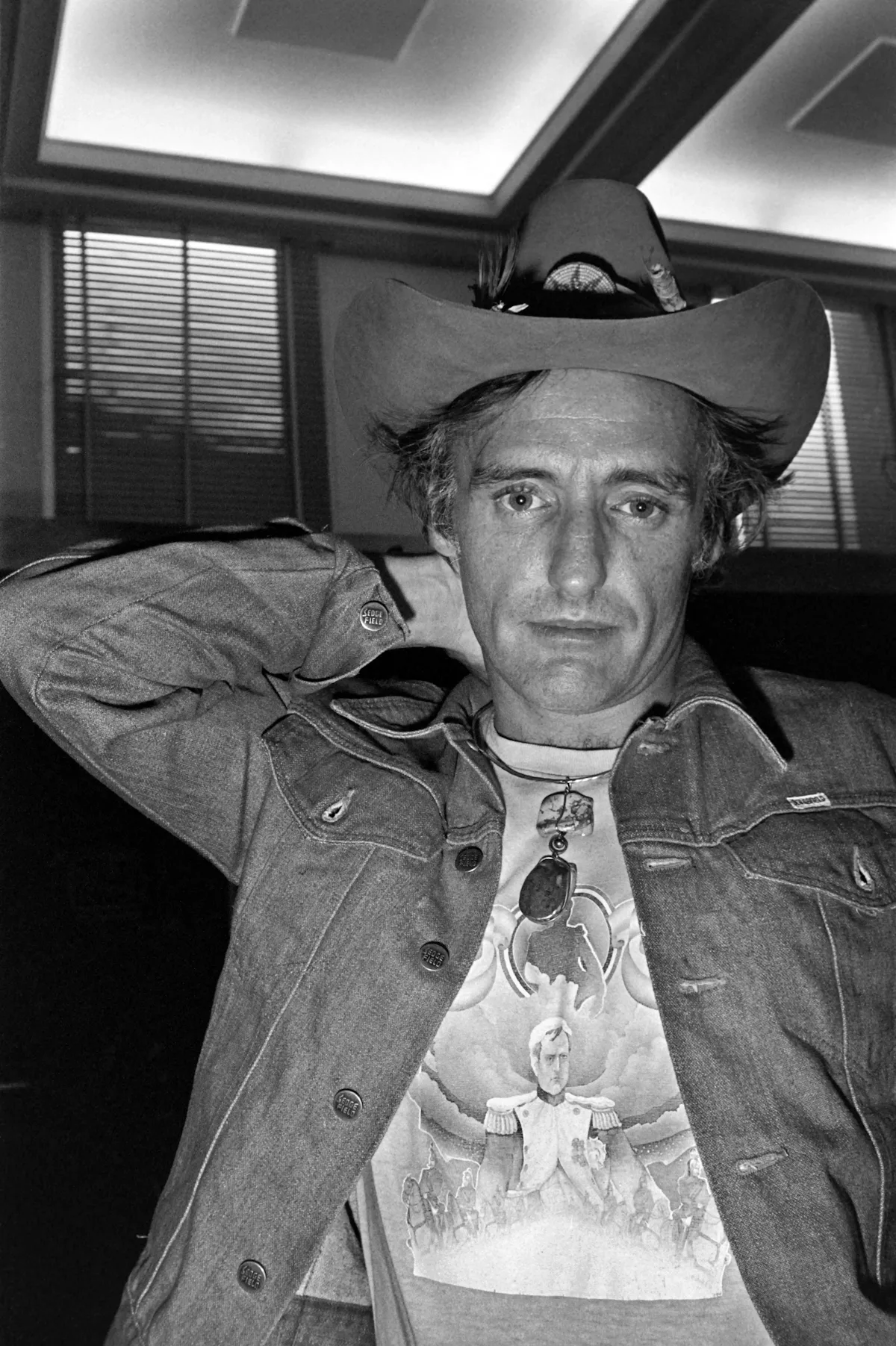
Dennis Hopper attended the Cannes Film Festival in 1976 to promote his film Tracks. He was very casual at the event, attending in a cowboy hat, jean jacket, and a tee featuring Napoleon on the front.
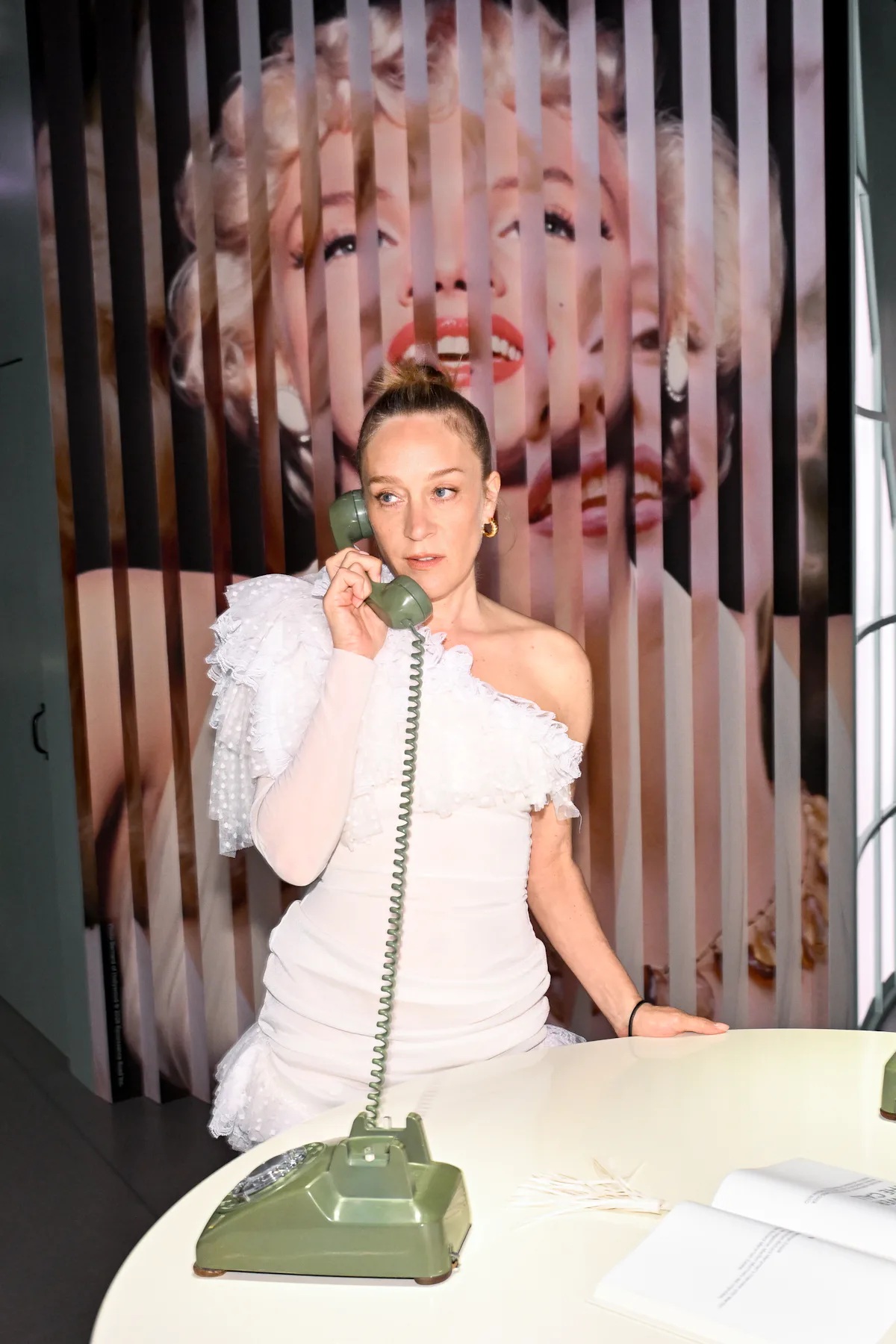
Chloé Sevigny got “quite emotional” walking through the Genesis House in Manhattan’s Meatpacking District on Monday night. There, in honor of what would have been Marilyn Monroe’s 100th birthday, the space transformed with the immersive installation, “Manifesting Marilyn: The Making of an Icon.”
“We had her for too brief a time,” Sevigny says of Monroe, though “Manifesting Marilyn” is attempting to remedy that fact. A display of faux newspaper headlines continues her curtailed timeline, while a library of books from Monroe’s personal collection and snippets from her final interview with Richard Meryman for Life expand on her established persona. “There were so many variations of her,” Sevigny tells W. “She must have been so much more complicated than we know.”
Zach Hilty/BFA.com
Sevigny, an admirer of Old Hollywood, was the perfect attendee for the event. In many ways, there are parallels between Monroe and Sevigny. The obvious, of course: They’re both blonde actors, oft referred to as It girls, at times wrung out by the hands of the Hollywood machine. Sevigny plays further into these comparisons with her outfit for the exhibition’s opening reception. Her form-fitting Claire Sullivan dress evokes Monroe with its color—though a subway grate’s wind gust would hardly ruffle the layers of lace that sit on the design’s hem and shoulder.
Sevigny believes both she and Monroe were similarly “pigeonholed,” a phenomenon faced by many actresses. “People in Hollywood see us in a certain light and it’s very hard to get out of that,” she says. At 51, Sevigny is still trying to break past her indie actress persona, just as “Manifesting Marilyn” is attempting to broaden the story of the blonde bombshell. Below, Sevigny discusses Monroe further, shares her favorite movie from the actor, and contemplates her continued legacy.
Zach Hilty/BFA.com
What does Marilyn mean to you?
I think about her often. She’s so misunderstood and maligned. People project all this stuff onto her as a bombshell, but she was a real thinker and she respected the craft.
What was so special about her?
You don’t get as far as she did in Hollywood based on looks alone. There were so many beautiful women, especially at that time, in the business. But she had to have something special, some spark beyond the ditzy thing. She was a go-getter. And I’m sure there was a connection, too, when she met people. She must have been personable. She must have been impactful beyond her figure.
How can you relate to Marilyn as a fellow actor?
I recently watched Mariska Hargitay’s documentary about her mom, Jayne Mansfield, who was also so misunderstood. I can relate to it, even being an actress in the ’90s. There was this chokehold. Now, post-Me Too, all the new girls coming up can’t even imagine what it was like for us. It was such a different climate. And by that same reasoning, I can’t imagine what it was like for Marilyn.
Zach Hilty/BFA.com
Does she inspire your style at all?
Just the way she moved and wore clothes and smiled and carried herself is such an inspiration.
What about your look for tonight? You see white, and you do think of Marilyn in The Seven Year Itch.
I just wanted to wear something fun and flirty from an independent New York designer. I do think about the color white in association with Marilyn because of her white hair and the white dress.
Do you have a favorite Marilyn film?
I love The Misfits and Gentlemen Prefer Blondes.
Montgomery Clift, Monroe, and Clark Gable in The Misfits. | Ernst Haas/Ernst Haas/Getty Images
Why do you think this obsession with Marilyn has continued? Why are we celebrating her 100th birthday when she has been gone for over 60 years?
She is a mystery to a certain extent. People are intrigued by her beauty and her transformation story. How does Norma Jean have the wherewithal to become Marilyn Monroe, from ginger-blonde to platinum, from farm girl to glamour girl? That takes strength, courage, and determination. I also think people are taken by her ingenuity and stamina.
What can we learn from her story?
It was a tragedy. You need to surround yourself with community and people who believe in you and encourage you, people you can feel safe around and express your fears and desires around.
Both you and Marilyn have been considered It girls. Do you think you two would have been friends?
I would hope so. My friends all know me as quite funny—although I don’t have that reputation in Hollywood. But I think we would have had a laugh.
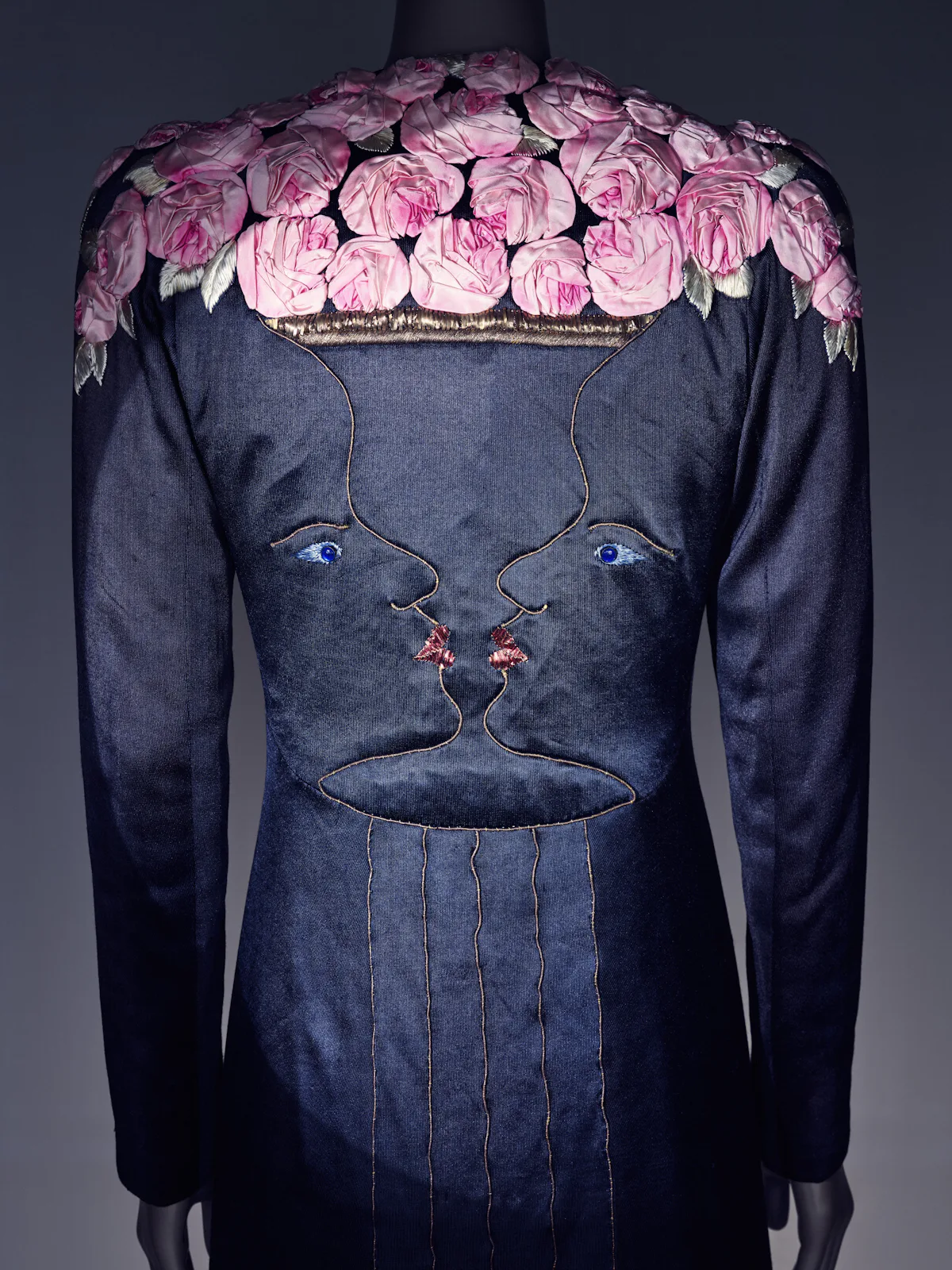
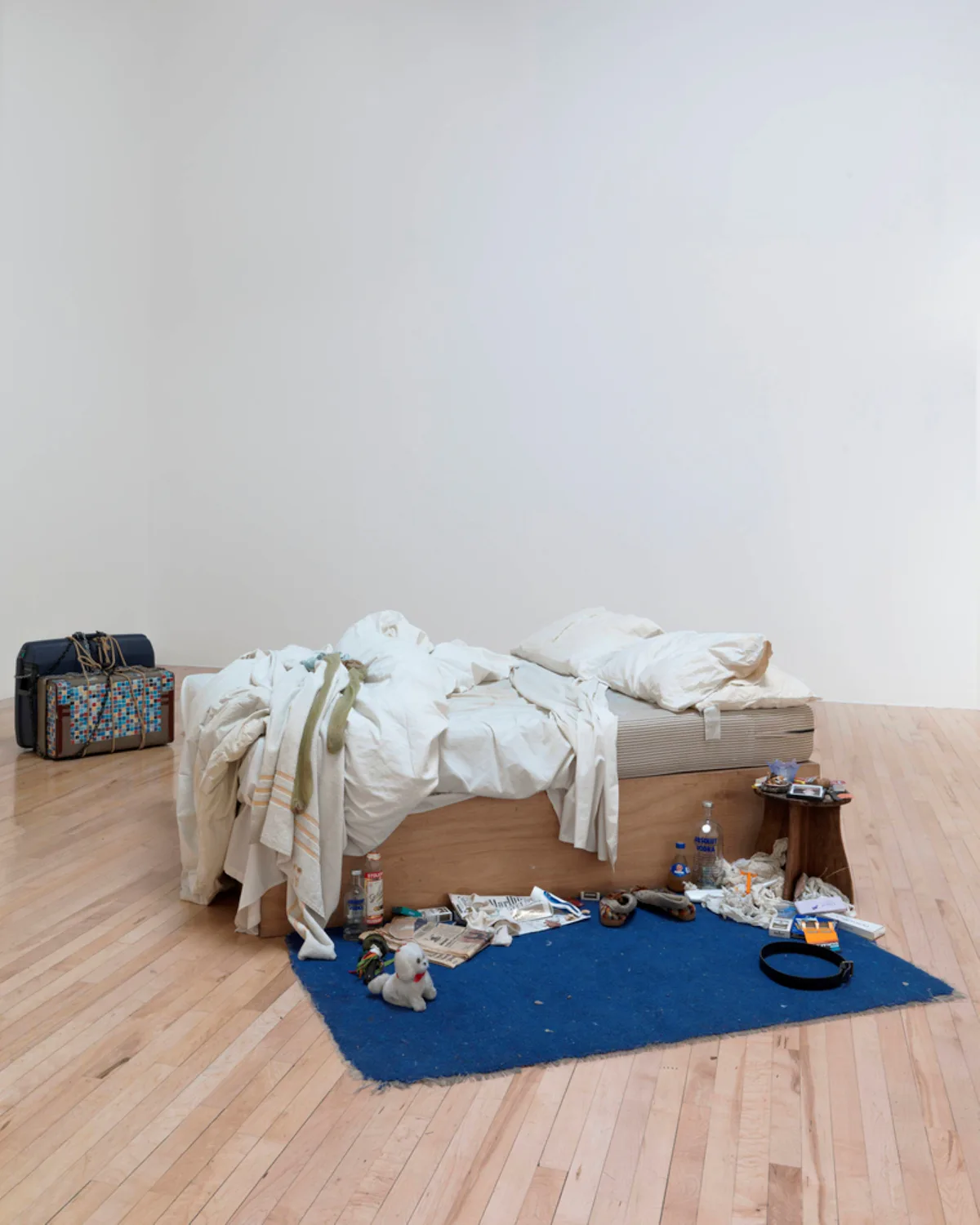
Twenty-twenty-six is a big year for those who like their art with a side of pop culture. Many of the world’s major museums and galleries are banking on big names for their first shows. Take Ghosts by Eliza Douglas at Gagosian, which celebrates the artist’s first solo New York exhibition with a body of work that nods to the iconography of advertising. In London, Tate Modern showcases stunning Tracey Emin work that And Just Like That... fans might recognize, while the V&A is going all in on Schiaparelli. Finally, the National Gallery of Iceland is celebrating Björk’s upcoming album with a three-work installation from the artist (plus an accompanying show from her frequent collaborator). Whether you’re fashion, music, or TV-minded, there’s something for you—and we’re still less than halfway through the ever-growing art calendar. More will come both in the U.S. and abroad, so if you’re planning some cultural stops for your next trip or just looking to see what’s on view in your neighborhood, consider this your all-encompassing guide to the can’t-miss art shows of the year.
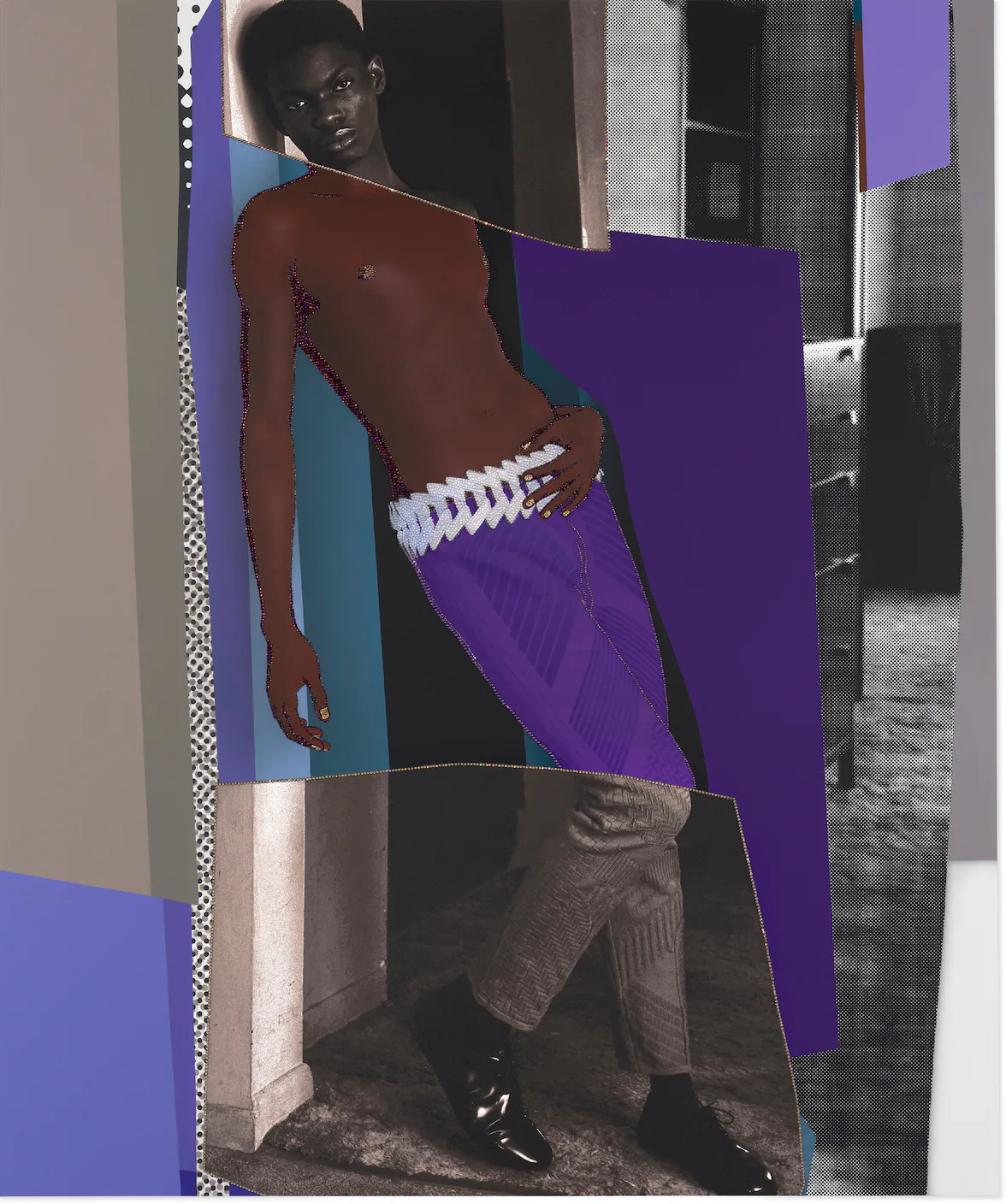
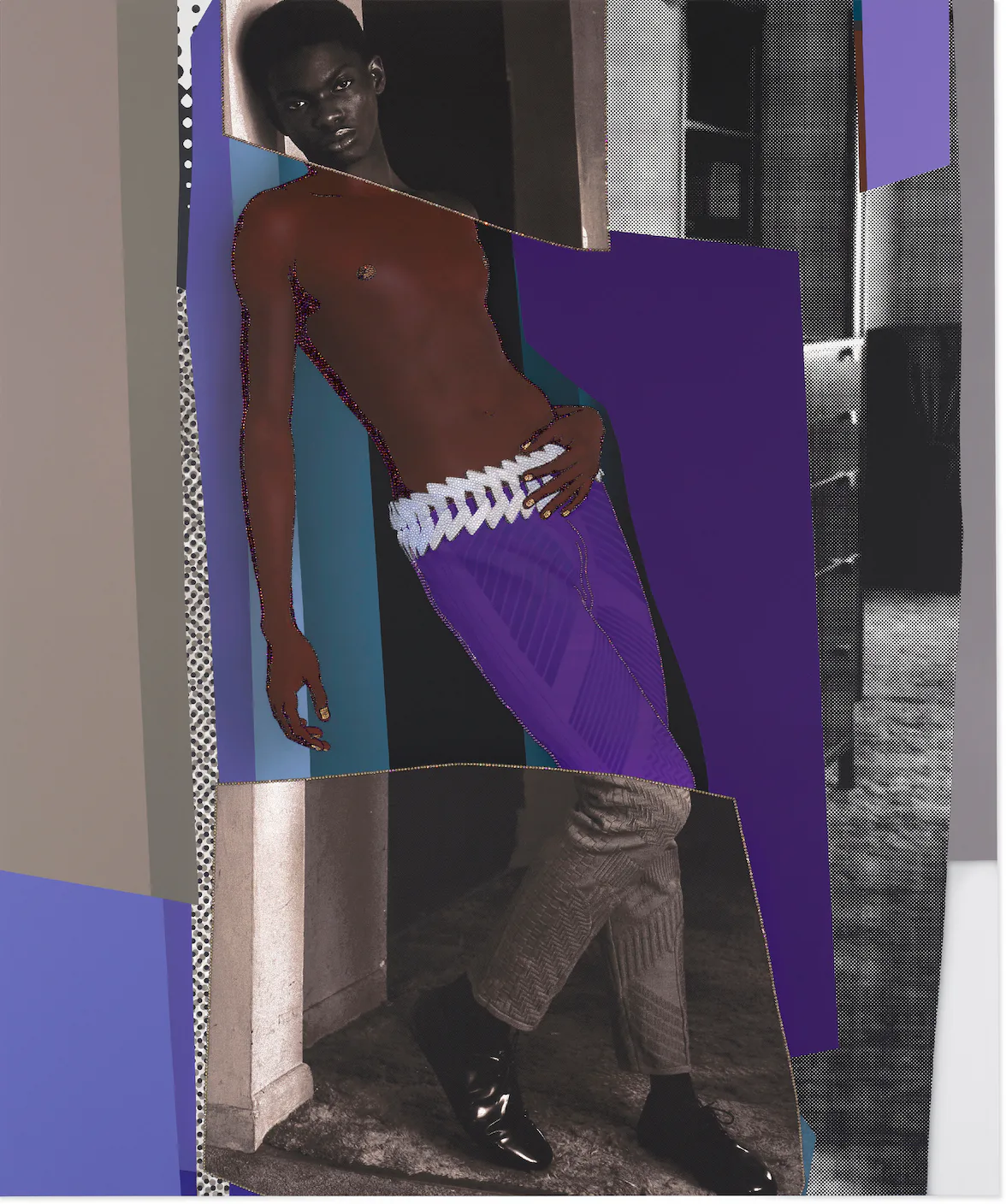
After two decades spent developing a highly influential, distinctive artistic practice centered on the depiction of Black womanhood, Mickalene Thomas has, for the first time, turned her creative eye toward Black masculinity. An entirely new body of work, Beneath the Moonlight, will be on display at the Shepherd in Detroit from June 6 through August 23, 2026, presented by Library Street Collective. The exhibition includes large-scale paintings, collages, and photography, as well as Thomas’s trademark staged settings. “The representation of masculinity spoke to me more, and using the Black male body as a vehicle, as a conduit to express those ideas that are resonant and paralleled to my concepts that I’m already working within with the female body,” Thomas said in a release. She worked with models beyond the gender binary to create her works, exploring themes of representation, stereotypes, and self-agency. She was inspired, in part, by the work of photographers like Quil Lemons and John Edmonds, who represent a new generation of artists grappling with themes of identity. To accompany the show, a catalog featuring original essays and interviews, designed by artist Bob Faust, will also be available for visitors to read. Beneath the Moonlight follows Thomas’s first major touring solo exhibition, All About Love, which debuted at The Broad in 2024.
Mickalene Thomas, Perfectly Purple Standing, 2026 | Courtesy of the Artist and Library Street Collective
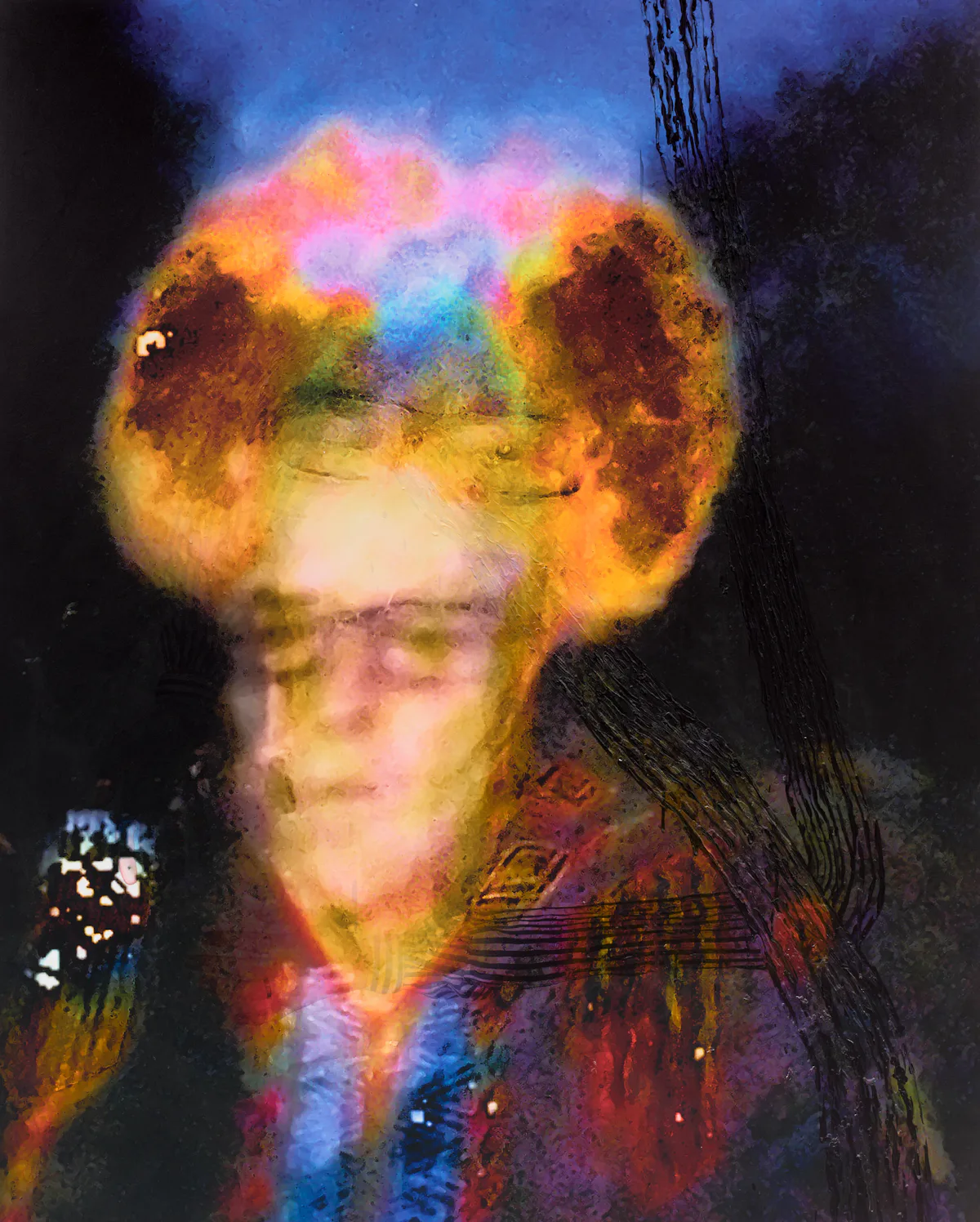
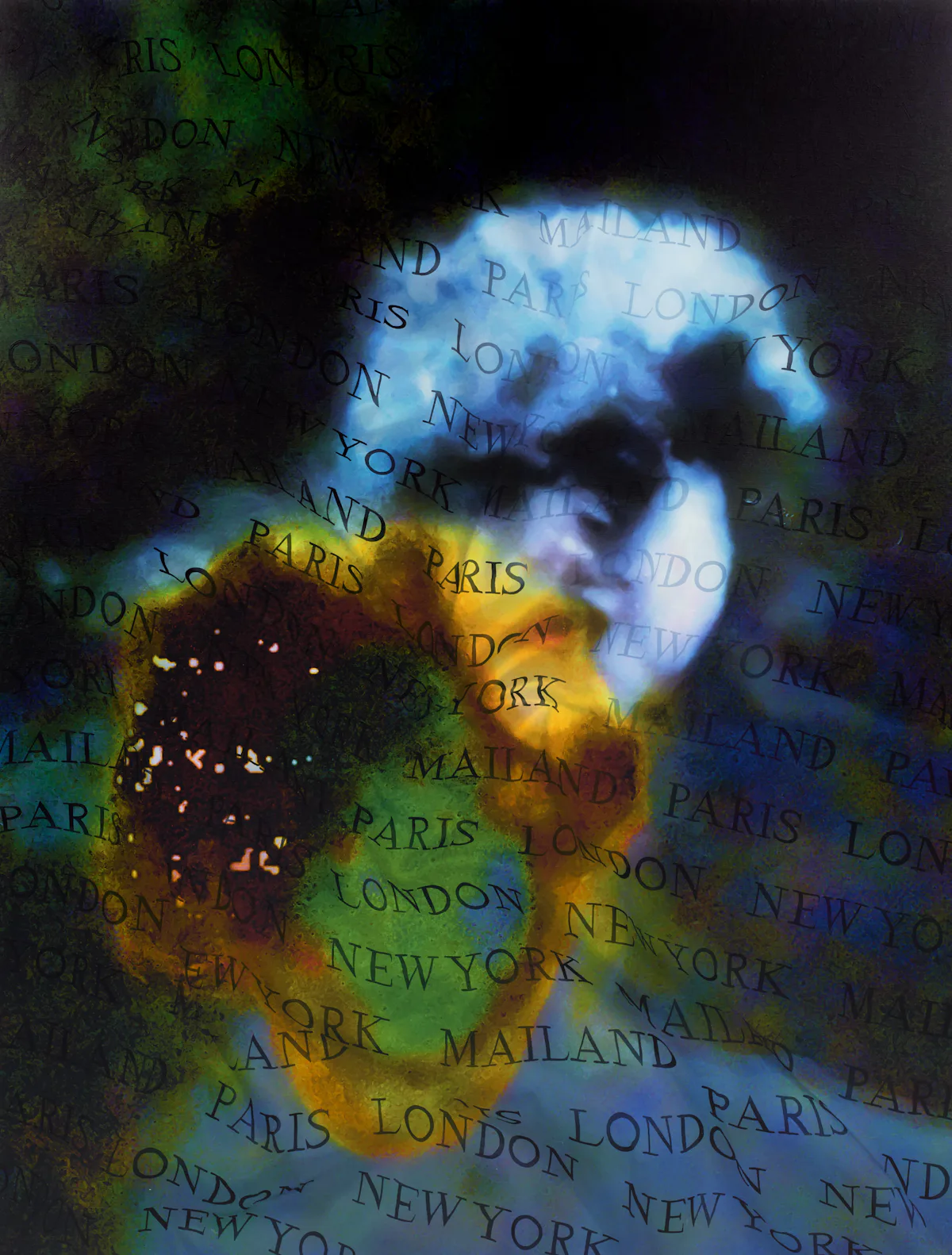
Ghosts is filled with firsts. It is Eliza Douglas’s first solo exhibition in New York, her first at Gagosian, and the first in a new program at the gallery consisting of solo presentations by different artists curated by Francesco Bonami. “The unique and historic character of the Park Avenue and 75th Street location is an ideal space for a laboratory of fresh perspectives that will complement the gallery’s existing programming,” Bonami says of the series, which kicks off on May 12 with a display of Douglas’s “meta-paintings.”
The works in Ghosts borrow from the iconographies of advertising and popular culture, blending them with gestural abstraction. Through this practice, Douglas emphasizes art’s status as a consumable good. Those familiar with the artist’s work may recognize some of the pieces in Ghosts because they are reworkings of paintings she exhibited over the past decade at her gallery, Air de Paris. In this new show, she combines the existing compositions with selfies taken by her aunt, Leslie Kean, an investigative journalist who has long been reporting on UFOs and “otherworldly phenomena.” Douglas also pulls from a 2022 group exhibition at Gagosian London titled Haunted Realism, which explored the idea that the past continually haunts the present. Douglas has always toyed with the idea of hijacking, but Ghosts marks the first time she has incorporated such a practice into her production. The use of an existing body of work acknowledges the constant repackaging of cultural products. As theorist Mark Fisher says, “Those who can’t remember the past are condemned to have it resold to them forever.”
Ghosts is on view at Gagosian Park and 75th location through July 31.
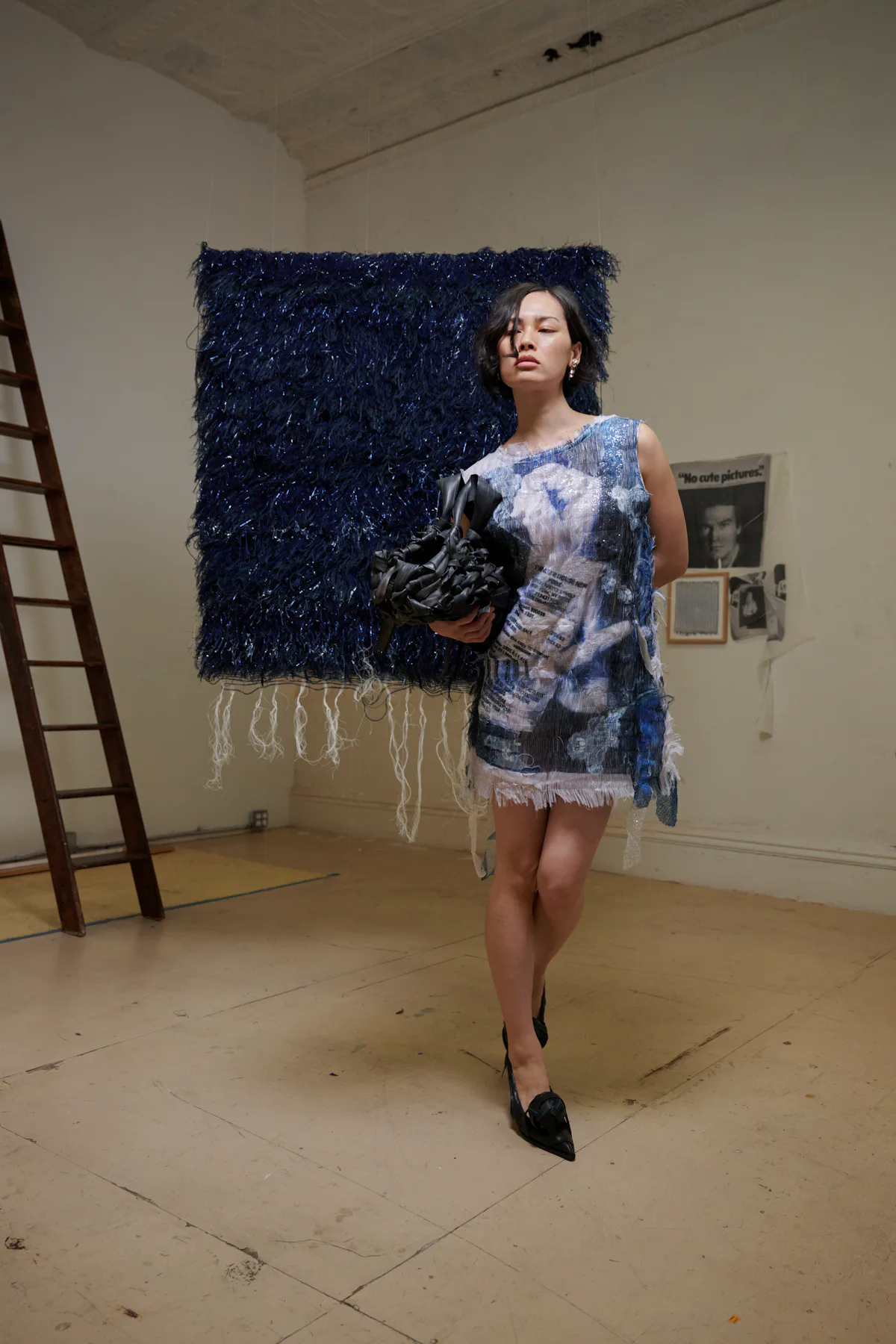
Studio2M has opened in SoHo as a workshop and exhibition space—and for its inaugural exhibition, founder Abby Caulkins has asked French artist Marie Hazard and Portuguese designer Constança Entrudo to collaborate on a body of work. The result is Ad Hoc, an exhibition that provokes a dialogue between art and fashion while deconstructing the usual hierarchies found within both disciplines. Hazard provides tactile compositions with poetic narrative qualities and installations combining weaving, beading, and crochet. Similarly, Entrudo uses digitally layered textiles to explore the ideas of weaving as a language and the intersection of craft and technology. Together, they push the limits of traditional weaving practices, blurring the boundaries between fashion show and performance, and taking into consideration the connections between fabric, space, and the body.
Ad Hoc will be on view at Studio2M from May 7 to June 13.
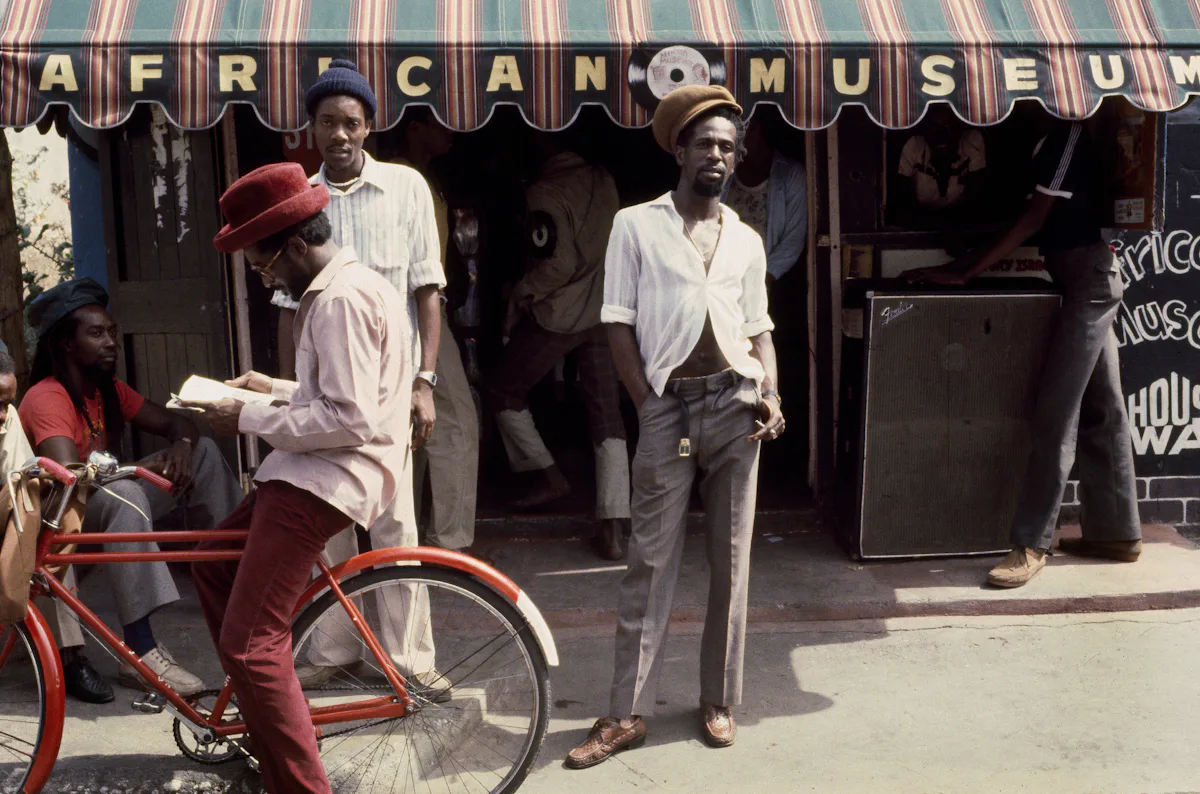
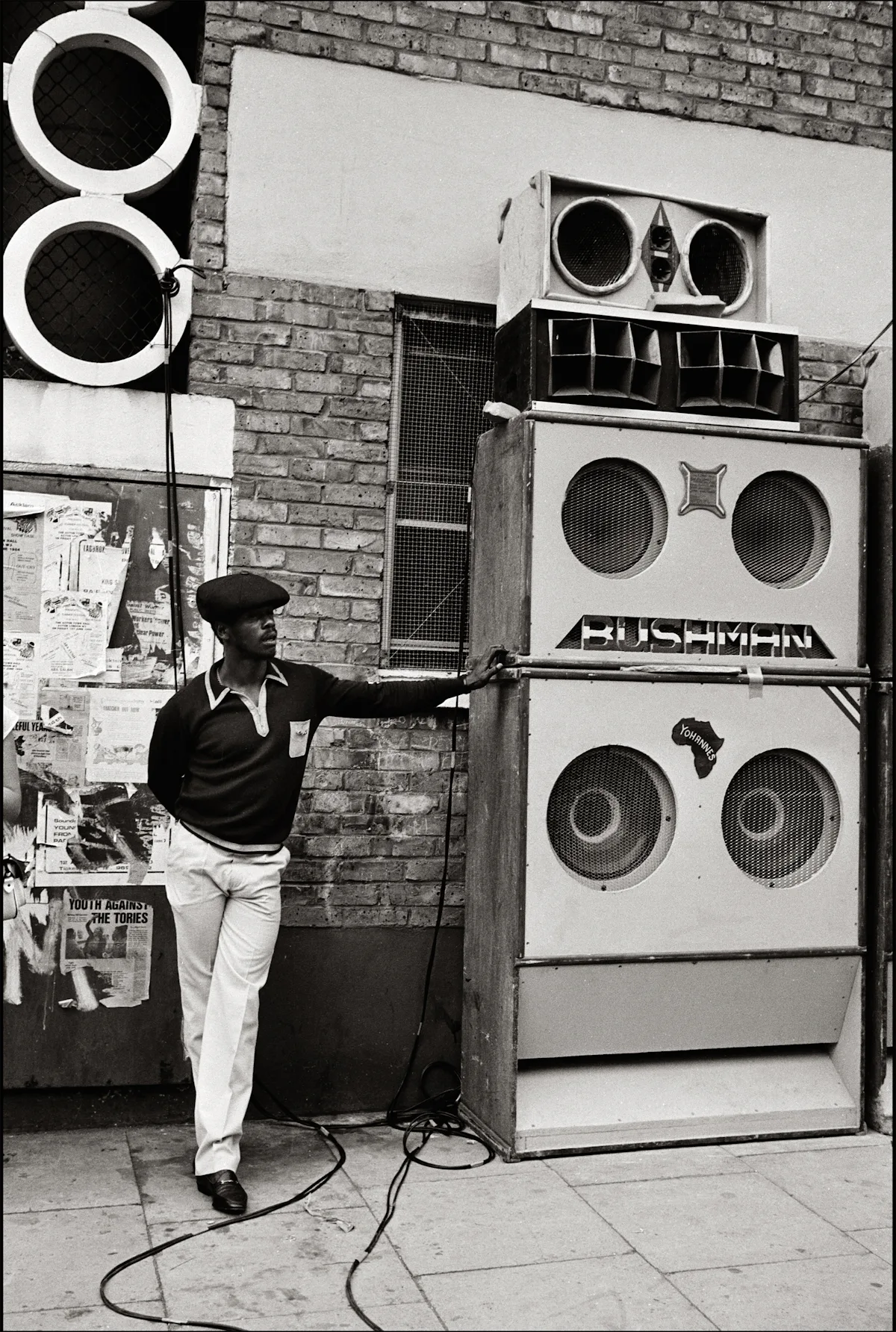
Intrinsically tied with music and sound, dance and movement have always played an integral role in spaces of collective organizing for liberation across the globe. On view at MCA Chicago through September 20, 2026, Dancing the Revolution: From Dancehall to Reggaetón underscores the histories and lasting impact of dancehall and reggaetón across visual, political, and spiritual registers. The major exhibition looks at how these musical genres have expanded beyond their “grassroots origins” and now serve as major shapers of culture on a global scale.
Spanning painting, sound sculpture, installation, photography, and video, Dancing the Revolution features the work of over forty contemporary artists, including Isaac Julien, Edra Soto, and Alberta Whittle, to name a few. The works in the show meditate on the revolutionary power of dance, particularly within the realms of dancehall and reggaetón, and how the practice functions not only as a source of joy but also of resistance. From sexual liberation to political protest, Dancing the Revolution positions dance and music as pillars of Black Atlantic history and culture, in the Caribbean and beyond. —Daria Simone Harper
Comité Colbert presents “the most exclusive exhibition on French luxury held in New York,” at The Shed from May 26 to 31. Hidden Treasures, 250 Years of Franco-American Luxury Stories brings together over 65 French luxury maisons and cultural institutions, along with their never-before-seen American archives. Together, these pieces illustrate two-and-a-half centuries of friendship between France and the United States, and the role luxury has played in that relationship.
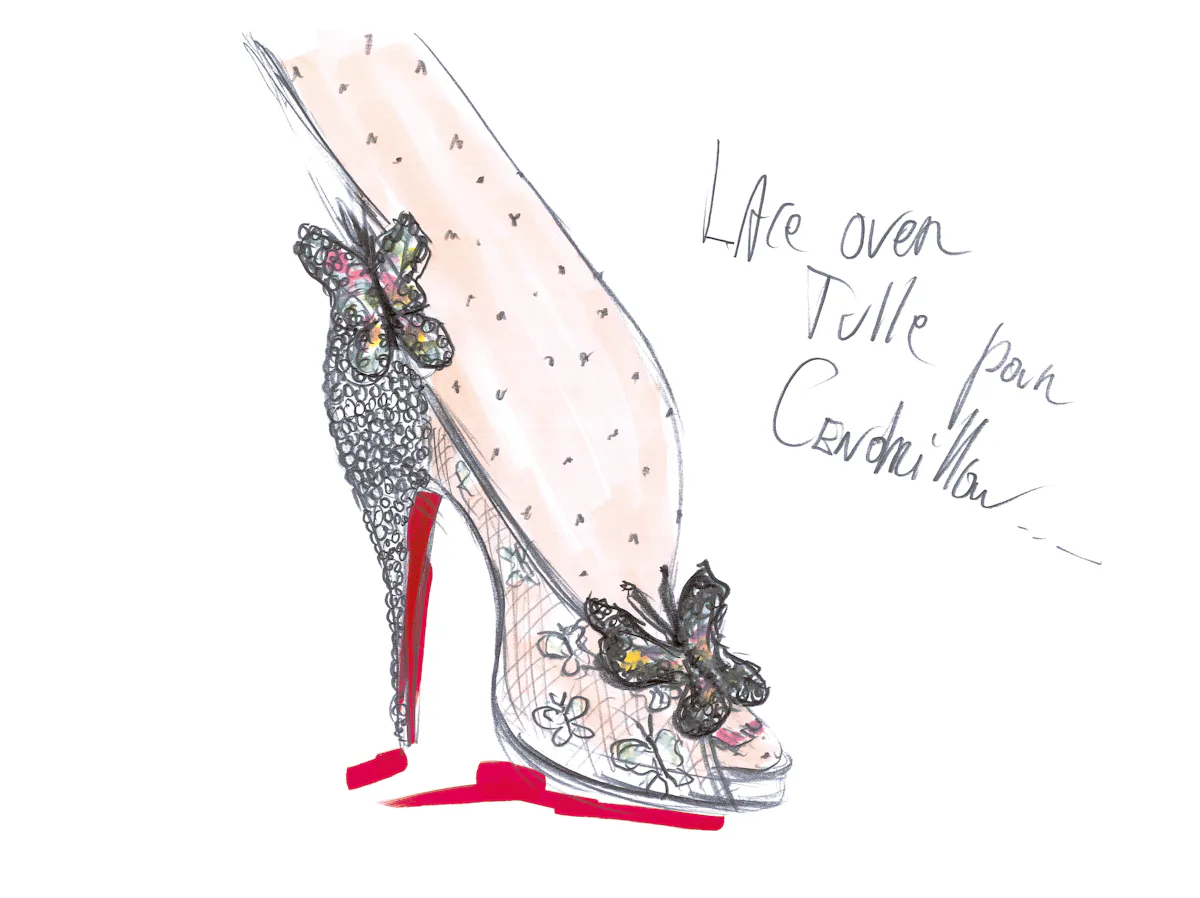
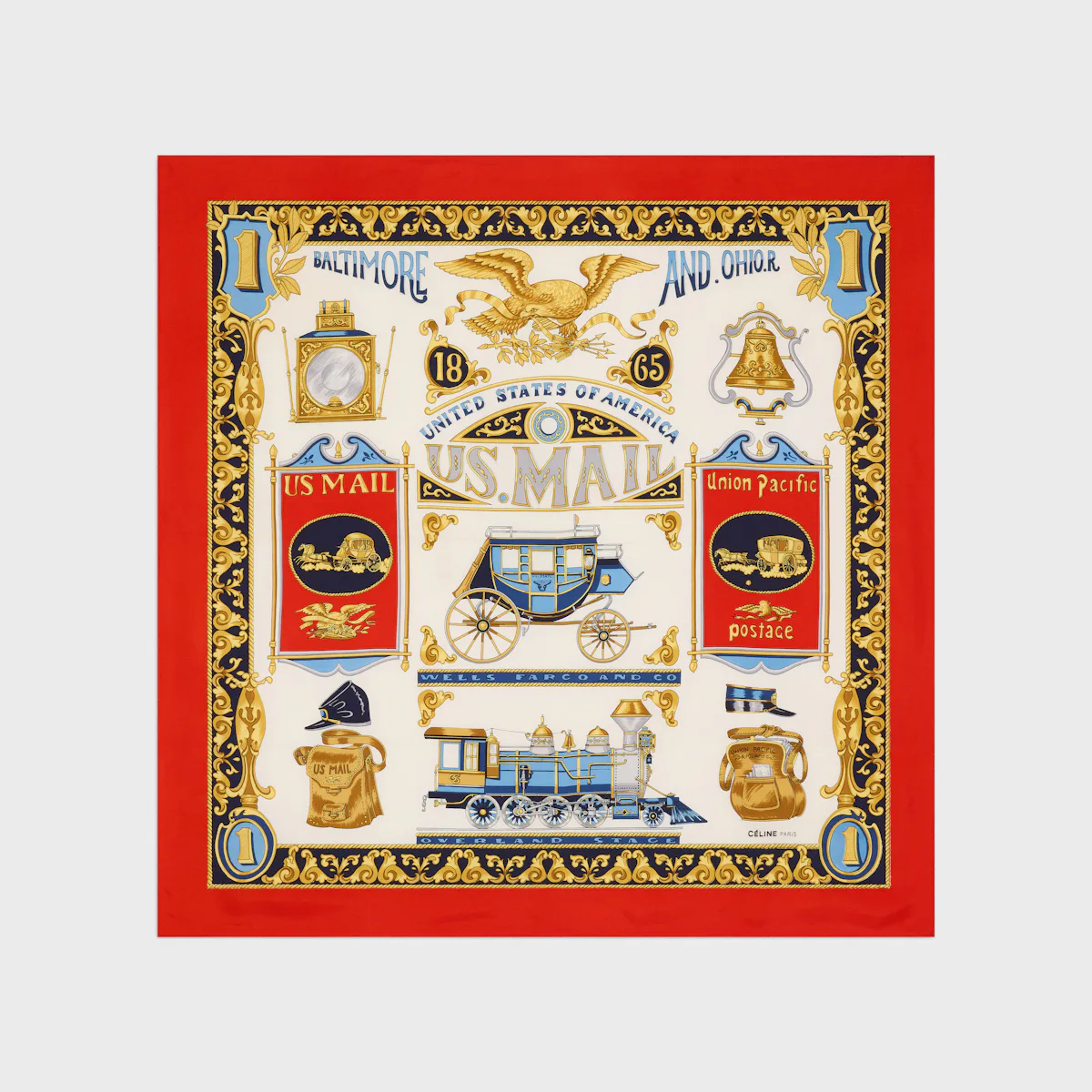
Each luxury brand is represented by one singular artifact, and together, a story is told about two countries and their cultural dialogue. Hidden Treasures explores the diplomacy, identity, and popular culture shared across the Atlantic. Jewelry, hotels, fragrance, liquor, and more are all represented in the exhibition, which attempts to portray the universal language of beauty. Christofle tableware from the Normandie collection and a Louis Vuitton trunk represent the luxury of cross-Atlantic travel. A 1933 gown designed by Cristóbal Balenciaga and worn by American socialite Mona von Bismarck exemplifies the influence of French couture on American style. Pieces from Berluti, Hermès, Chanel, and more luxury brands add to the narrative. A Celine scarf printed with U.S. Mail iconography and a Christian Louboutin heel inspired by Cinderella’s glass slipper, meanwhile, proves that inspiration flows both ways.
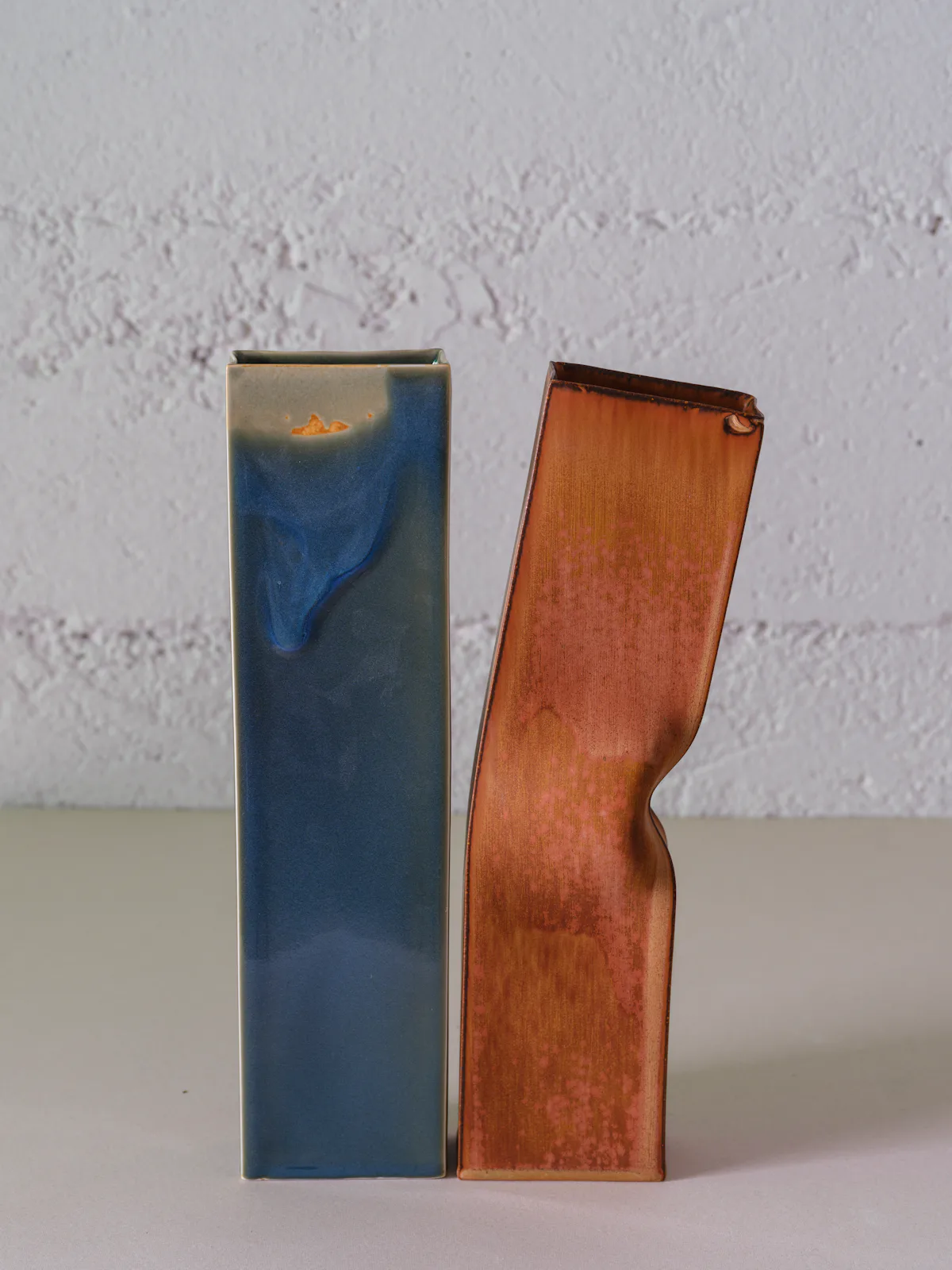
French ceramist Emmanuel Boos is bringing his glazed porcelain practice to NYC with his first solo show in the United States. A “glaze consultant” for Hermès and the recipient of the “Special Mention” award at the 2024 Loewe Foundation Craft Prize, Boos has long boasted a transatlantic career. But this show, Noir C’est Noir, takes border-jumping to a new level. From April 9, Raisonné will host over 70 of Boos’s unique works, including coffee tables, side tables, stools, vases, and other objects. Together, these pieces illustrate Boos’s distinct style and exploration of fragile beauty and humorous practicality.
Boos’s porcelain practice allows him to embrace imperfection and welcome the unexpected, which he calls “happy accidents.” Also important to the process is Boos’s arrangement of his work within a space. There’s a modular aspect to this practice, with pieces grouped into various unfixed cohorts. This provides a reflection of the artist’s own nomadic life, and his closely held belief that meaning always exceeds function. “My practice of glaze does not aim for mastery nor domination,” the artist said in a statement. “I wish to slip into the glaze and develop a friendly relationship with chaos and eventually trust chance. It is emotion, sensuality, poetry.”
A piece from Emmanuel Boos’s show, Noir C’est Noir. | Raisonné/Zach Pontz
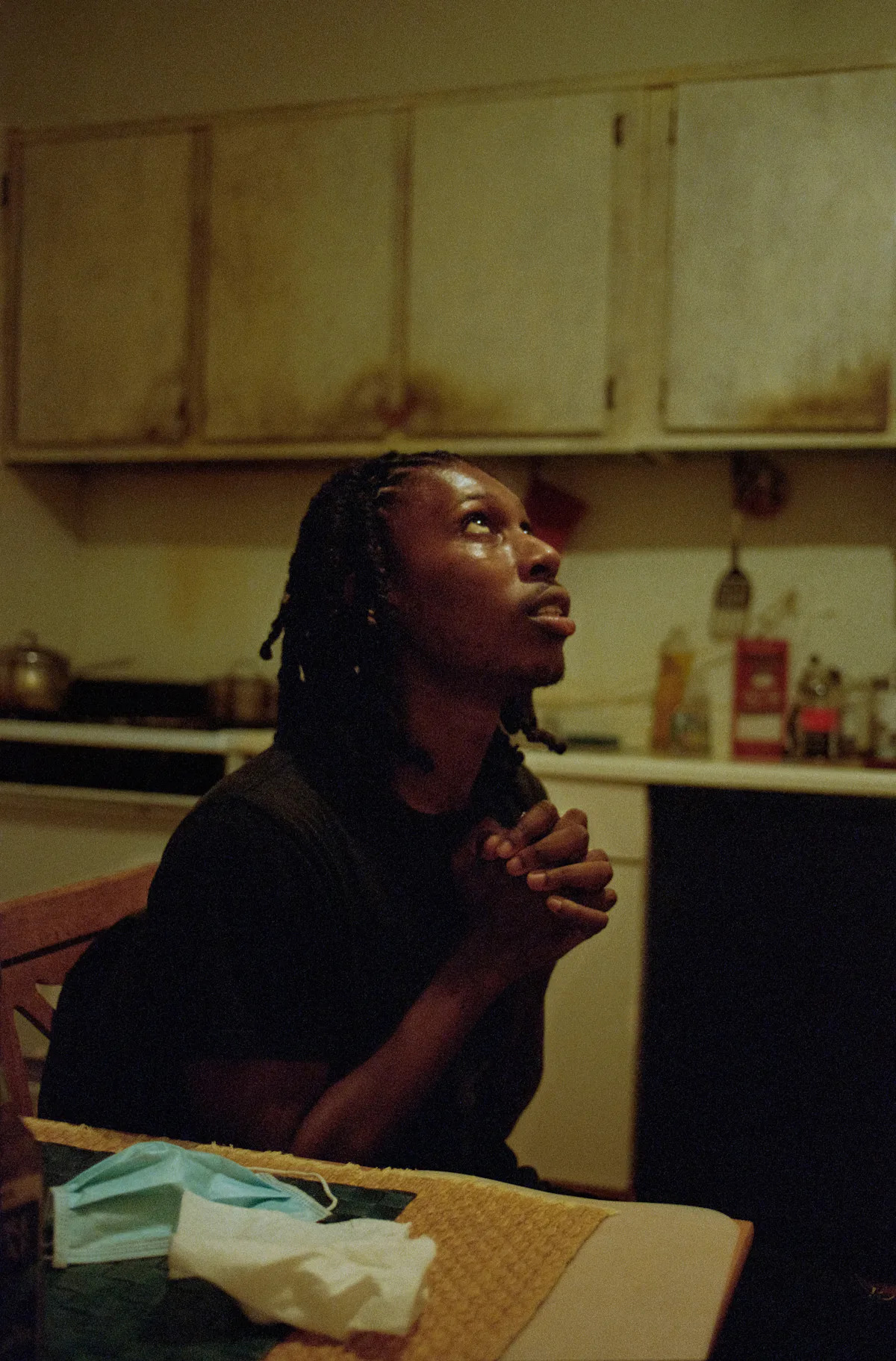
In his debut solo show, Hard Feelings, Palestinian-American photographer Dean Majd chronicles a decade of brotherhood, grief, gore, and glory. As a young boy, the Queens, New York-born artist was often left alone, with only a camera in his hand to document his loved ones. But the sudden passing of a childhood friend in 2015 thrust him back into the nocturnal and hypermasculine graffiti and skate scenes, where the odyssey of Hard Feelings begins.
Driven by devastating loss and a desire to record truth, Majd captures deeply intimate portraits, demanding reflection and healing. In early imagery like geri on the hellgate bridge or bohemian rhapsody, risk and bliss alike appear in ritual and full force, from a young man undergoing a rite of passage, to friends sharing a hotel tub. The trust between Majd and his community is palpable, offering his sitters and viewers the opportunity to confront self-destruction head on. Brutality and tenderness unfolds as Majd’s community allows him to lens aftermaths of self-harm, abuse, and death. As both participant and observer, the artist’s visual language is unflinching and profoundly empathetic. Notably, Hard Feelings begins and ends with celebrations of life. —Ayesha Le Breton
Dean Majd, Mohamed (Prayer), 2020. | Courtesy of the Artist
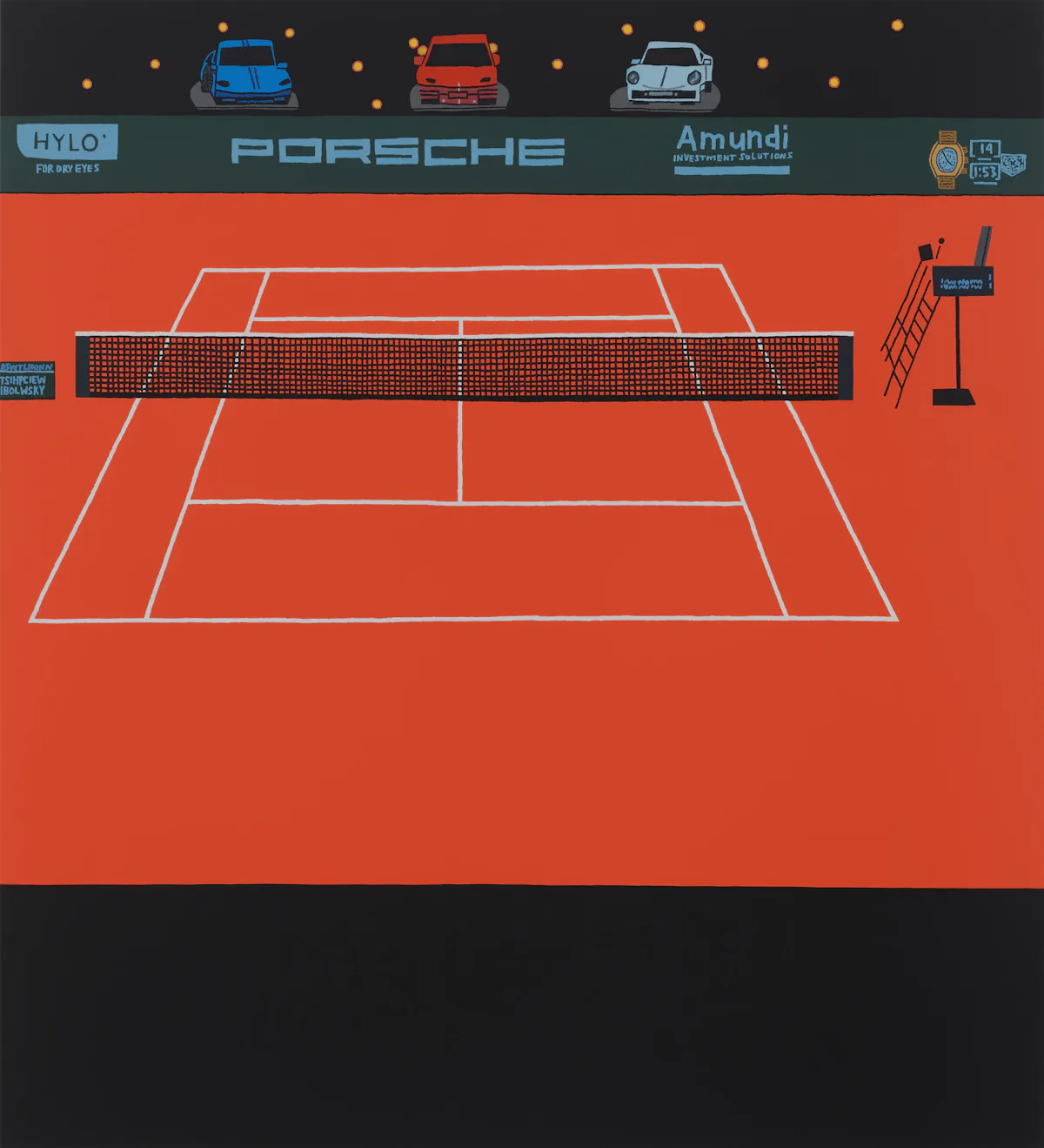
The worlds of sporting and art combine in a series of works on display now at Gagosian’s Beverly Hills gallery. Over the past two decades, American artist Jonas Wood has turned prominent tennis matches into works of art, depicting these on-court battles in oil and acrylic paintings. The works are uniform in their vantage point, with each placing the viewer behind the baseline. Players and officials are nowhere to be seen, while spectators make an infrequent appearance in the form of abstract brushstrokes or dots.
Wood’s paintings blur the line between abstraction and Pop Art. A painted wood pattern surrounds Wimbledon with Wood Grain (2025), while the dotted audience of Mexican Open (2025) places the court in a star-filled galaxy. Homages to Roy Lichtenstein come in the form of works like Paris Olympics with Crying Girl (2025) and Dubai with Nude with Blue Hair (2026), where the late artist’s iconic Crying Girl (1963) and Nude with Blue Hair (1994) frame the courts. There is a standard followed with each painting: saturated colors, similar dimensions, and repeated elements. This uniformity allows the differences to come alive, making you ponder—and rethink—each piece.
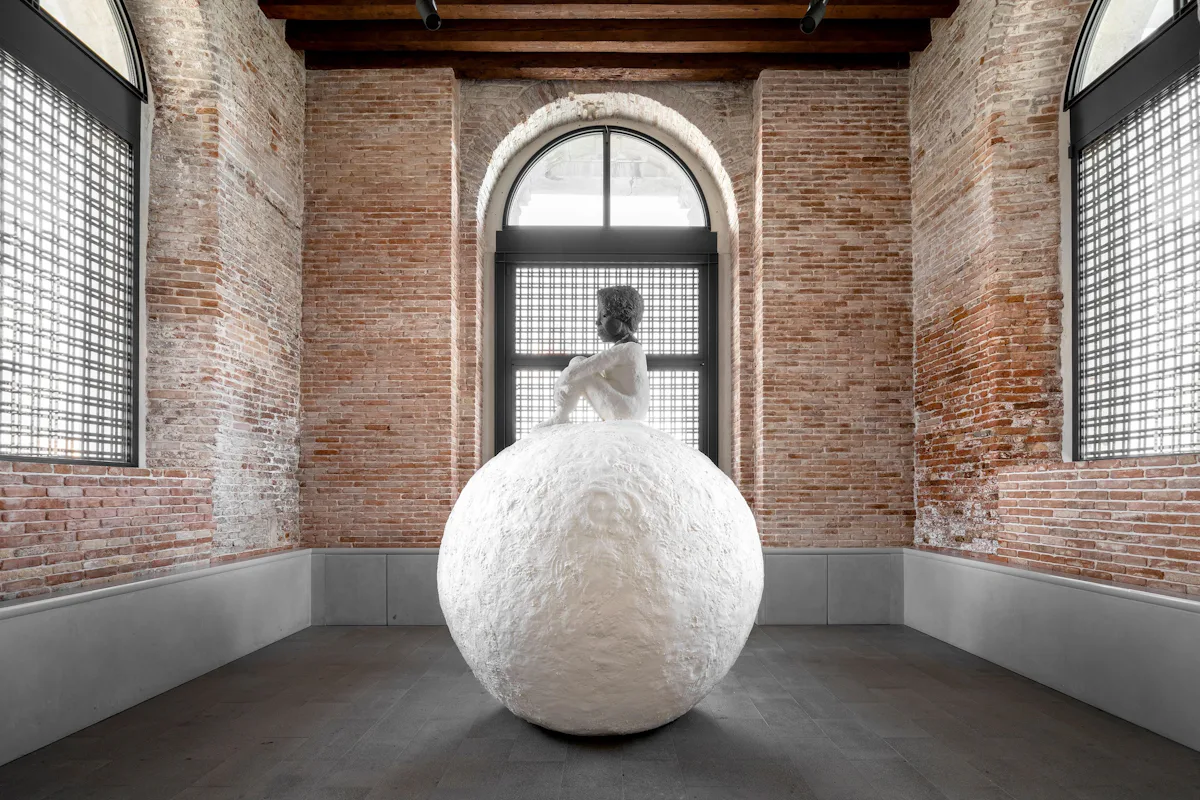
Since her first solo show in New York in 1986, Lorna Simpson has explored concepts of race, gender, identity, and subjectivity, archiving Black lives and experiences in vivid, boundary-breaking form. She changed the language of photography, turning the media on itself as she framed Black women with their faces just out of view, text collaged on the images that hinted at and asked the viewer to question how the women were seen. In the decades since, Simpson brought her renowned conceptual experimentation to collage, film, sculpture, and—beginning at the 2015 Venice Biennale—painting. Now, the legendary artist is opening her first major European exhibition at Pinault Collection’s Punta della Dogana in partnership with the Metropolitan Museum of Art. Third Person, running March 29 through November 22 at the Venice museum, features over 50 of Simpson’s paintings, spanning 20 years. There’s a special focus on the aforementioned large-scale works from Okwui Enwezor’s Biennale, never-before-seen offerings from Simpson’s personal archive, and new paintings made especially for this exhibition. —Ashley Simpson
Lorna Simpson, Woman on Snowball, 2020 | Courtesy of the Artist and Punta della Dogana
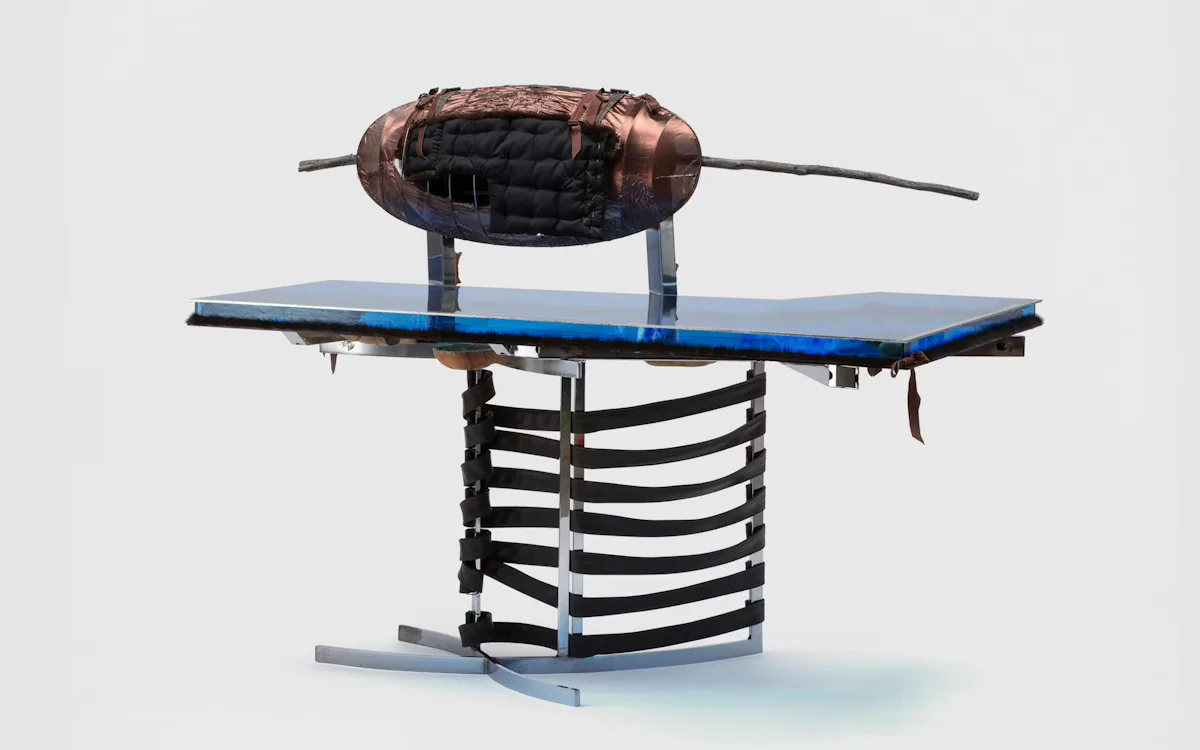
Ever since Arts and Letters NYC got a curatorial team (including Jenny Jaskey and curator Kristin Poor) two years ago, the uptown establishment has been increasingly showing up on downtown feeds. Rotated on the half year, a new suite of exhibitions has recently taken over Arts and Letters’s enviable rooms, including a mutation of Jessi Reaves’s first institutional solo show, which opened at the Walker Art Center earlier this year, and now has been reconstituted in a new configuration for Arts and Letters.
Cushions for tetris-like banquets welcome visitors into Art and Letters’s right wing; sitting atop these hand-painted perches, as you are encouraged to do, one can pivot in place and survey the show’s topography—namely, an archipelago of free-standing sculptures populated by a flock of reusable water bottles. Each water bottle bears a different paper cut-out of a bird, and these flightless creatures are like everything in Reaves’s world—a recombination. Reaves first made a name for herself in sculpture by dressing down modernist icons, Marcel Breuer seats and Le Corbusier lounges—until only their vulnerable essentials were left. Now more than a decade in, her attentions have turned elsewhere: to the empty promises of pure function and the transformative powers of accumulation. Here, a Nalgene bottle becomes a paper crane, a WPA mural becomes a bench, an art show in one city is something else entirely in a different location. By the time you’ve sat down, you’ve forgotten there is a painting underneath you. —Kat Herriman
Jessi Reaves, Big vanity with modesty flap, 2025 | Photo by GC Photography. Courtesy the artist and Bridget Donahue, New York.
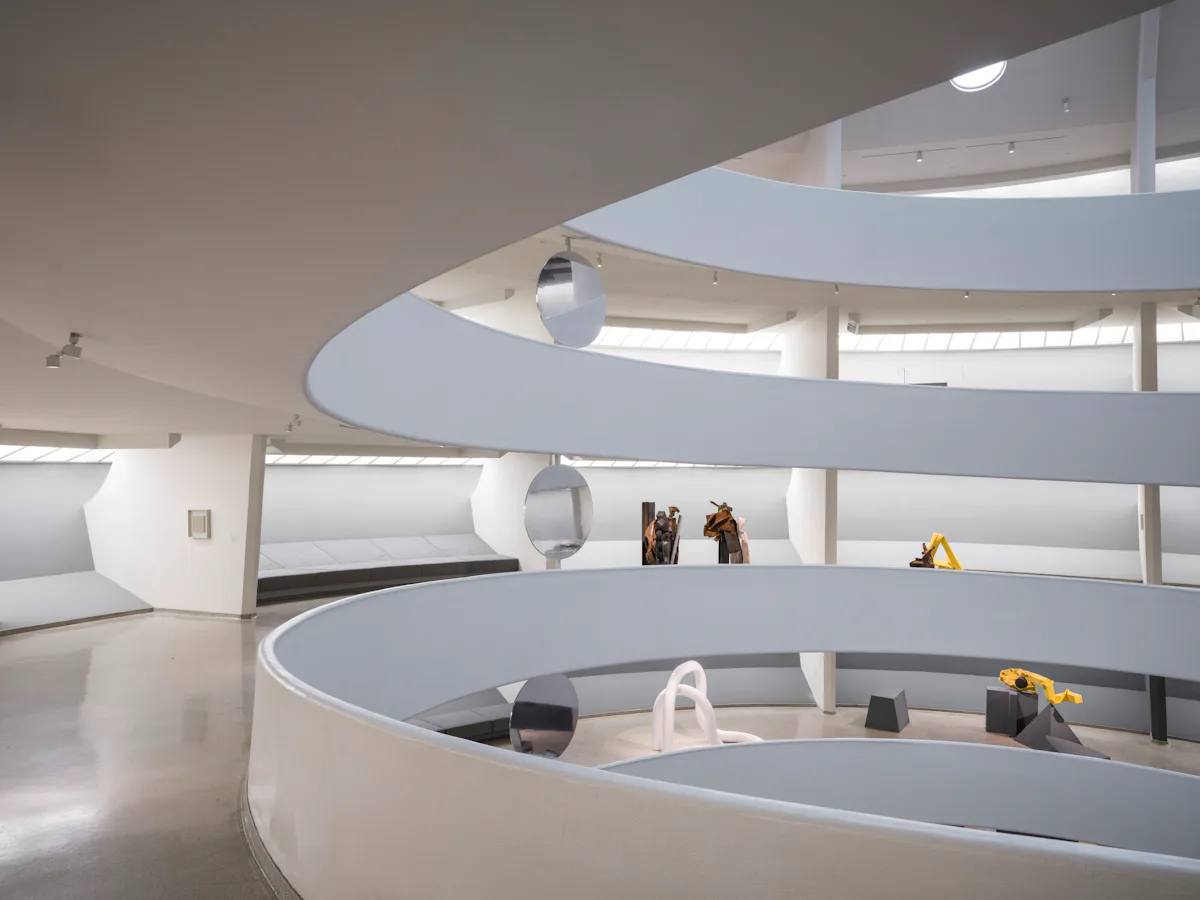
For the next several months, tea will be served in the rotunda of the Solomon R. Guggenheim Museum. The occasion? Artist Carol Bove’s monumental new survey, which has taken on the Frank Lloyd Wright masterpiece as a co-conspirator rather than an obstacle. Bove—whose work has long explored the juxtaposition of geometries, both found and made—draws out the patterns and repetitions embedded in the architect’s design. In doing so, she reveals that the museum’s famous circle is in fact composed of countless rings and discs, to which she adds several of her own in metal, fabric, and paint.
As you ascend the building’s signature spiral, you travel in reverse chronology through Bove’s career. You might notice you are also moving from dark to light; Bove has applied a black-to-white ombré that unfurls floor by floor. It is a minimal intervention with maximum impact. It all comes into focus the higher you climb—Bove has consistently, and gently, adjusted the essential forms we think we know so well. By doing so, she renews them, revealing truths that were hidden in plain sight. The most glaring and delightful example? A diamond-shaped cut Bove has made in a false wall, which reveals a Joan Miró work that hasn’t been seen for decades.
It is an exhibition that insists you slow down and unwind time. It warms you up for the act of steeping by creating the conditions conducive for it: ample seating and something to sip. —K.H.
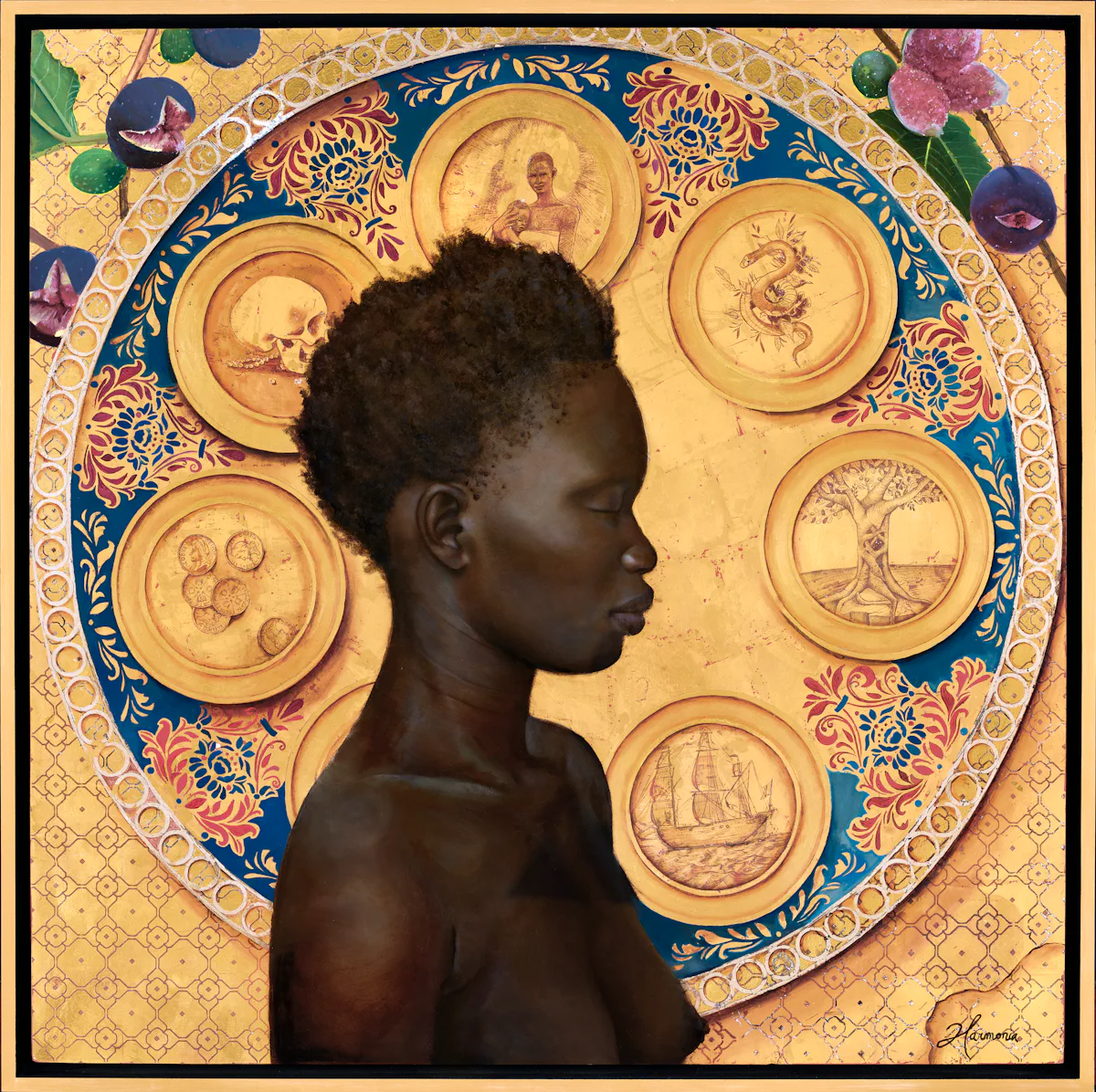
The Biblical narrative of creation is explored in a modern context in Beginnings: The Story of Creation in the Middle Ages. Paintings by American artist Harmonia Rosales are shown in dialogue with transcripts from the Getty’s collection, situating her work within the world of visual storytelling and placing her paintings in direct conversation with medieval representations of creation. Rosales has long been known to draw on artistic methods from the Renaissance and Baroque periods, combining them with African diasporic histories. She continues this practice with Beginnings by contributing a contemporary perspective shaped by West African spiritual traditions, adding to the ongoing conversation around creation. In addition to previous work, including Portrait of Eve (2021), Beginnings will feature a new piece, created in response to the significant illuminated manuscript, Stammheim Missal.
Beginnings: The Story of Creation in the Middle Ages is on view at the Getty Center in Los Angeles from January 27 to April 19.
Leonard Baby’s new show may have a quirky title, but don’t be fooled. Resting Babyface features work from the New York-based artist, which he created during a period of profound sadness. As a result, the paintings on display encapsulate the essence of vulnerability and the complexities of personal experience. This is nothing new for Baby, who often draws on his past and emotions in his work, transforming trauma into acts of resilience and self-acceptance. In Resting Babyface, Baby turns the focus to two very vulnerable settings: the bedroom and a therapist’s office. With this new set of work, Baby explores themes of aftermath and introspection, using the paintings as personal confessionals meant to leave viewers in a state of discomfort and ambiguity.
Resting Babyface is on view at Villa Carlotta in Los Angeles from February 26 to March 11.
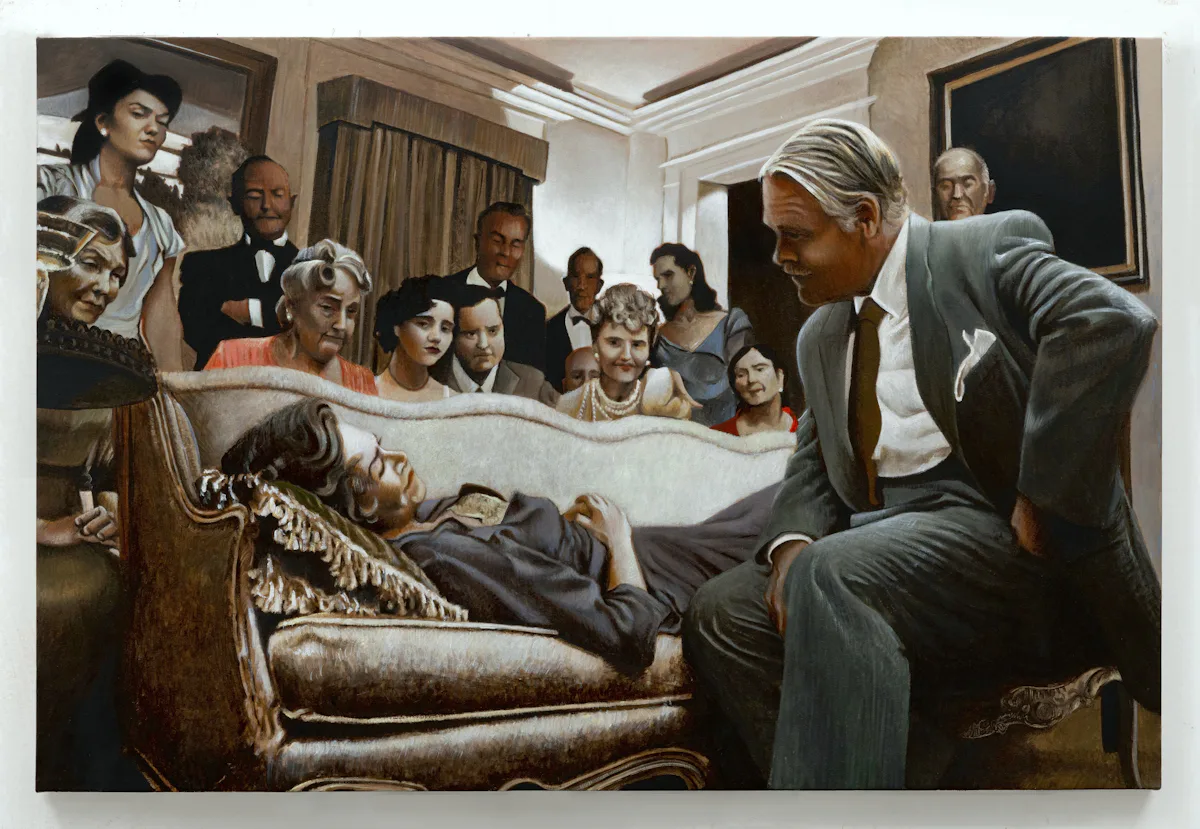
Leonard Baby, Group Therapy. | Courtesy of Half Gallery
This February, the ICA Boston turns its attention to an artist-led institution that has shaped the fabric of New England’s art community since 1977. Founded by Dana C. Chandler Jr., the African American Master Artists-in-Residence Program (AAMARP) is one of the longest-running Black artist residency programs. Therefore, its story resonates not just on a local level but a national and international one. AAMARP’s influence can be felt far beyond Boston through its alumni network of artists, educators, and organizers. Conceived originally as a Black artist-led exhibition space, AAMARP evolved into a living ecosystem: part studio collective, part political area, and part cultural refuge, where new modes of working could take root even as institutional support shifted around it.
As the first exhibition devoted to AAMARP’s far-reaching legacy, it was essential for Mannion Family Curator Jeffrey De Blois to spend lots of time with members past and present. Developed in close dialogue with the founder Chandler before his passing in 2025, the show arrives less like a retrospective and more as a constellation of practices whose collective energy points outward. At the exhibition, the story of AAMARP’s community-driven approach is told through the work of five decades of participants. There are some folks you know. The rest are discoveries. Rather than closing a chapter, the exhibition feels like an opening gesture. —K.H.
Dana C. Chandler Jr., For the Children We Strive, 1991. | Photograph by Hakim Raquib
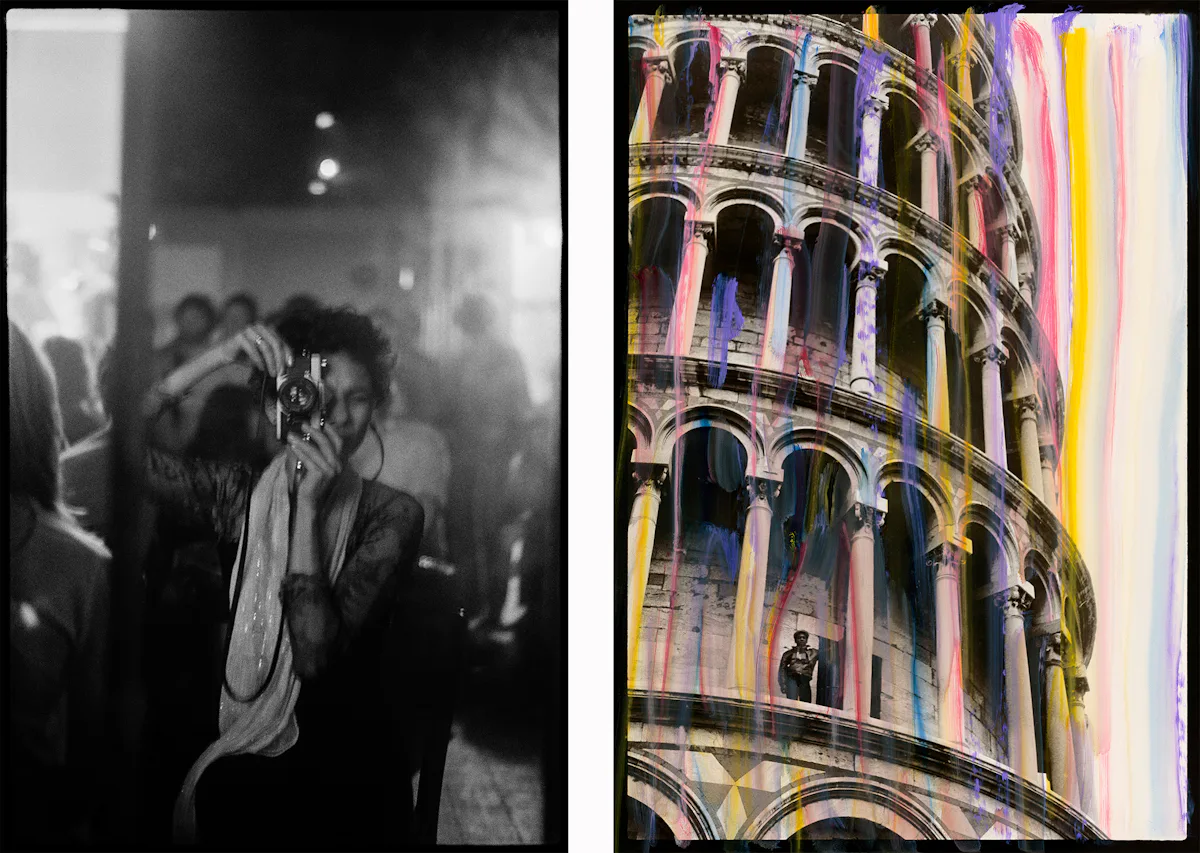
This new exhibition from photographer Ming Smith traces an artistic journey shaped by movement, experimentation, and freedom. The Detroit-born artist came of age at a time when Europe offered Black artists greater opportunity and receptivity. Smith’s travels abroad, specifically in the 1970s in Paris, proved formative; there, she encountered the evocative work of photographers like Brassaï and Henri Cartier-Bresson while developing a visual language of her own. This exhibition reflects on how those early experiences continue to inform Smith’s practice, highlighting photographs—many of which have been printed for the first time—that capture fleeting moments infused with rhythm, intuition, and motion. Smith’s work resists photography’s long-standing impulse to define, document, or objectify Black subjects. Rooted in the core principles of the Black Arts Movement, her photographs expand the medium beyond realism, often confronting and subverting the gaze itself. Her signature use of blur and abstraction is both poetic and political, mimicking the improvisational spirit of jazz while responding to the ways Black Americans are rendered simultaneously invisible and hypervisible. A pioneer for Black women in photography, Smith’s legacy lies in her innovation, her fearless experimentation, and her unwavering commitment to capturing the depth and richness of Black life. —Che Baez
Courtesy of the Ming Smith Studios and The Gund at Kenyon College
Ming Smith: Jazz Requiem–Notations in Blue is on view at the Portland Museum of Art in Portland, Maine from February 6th to June 7th 2026.
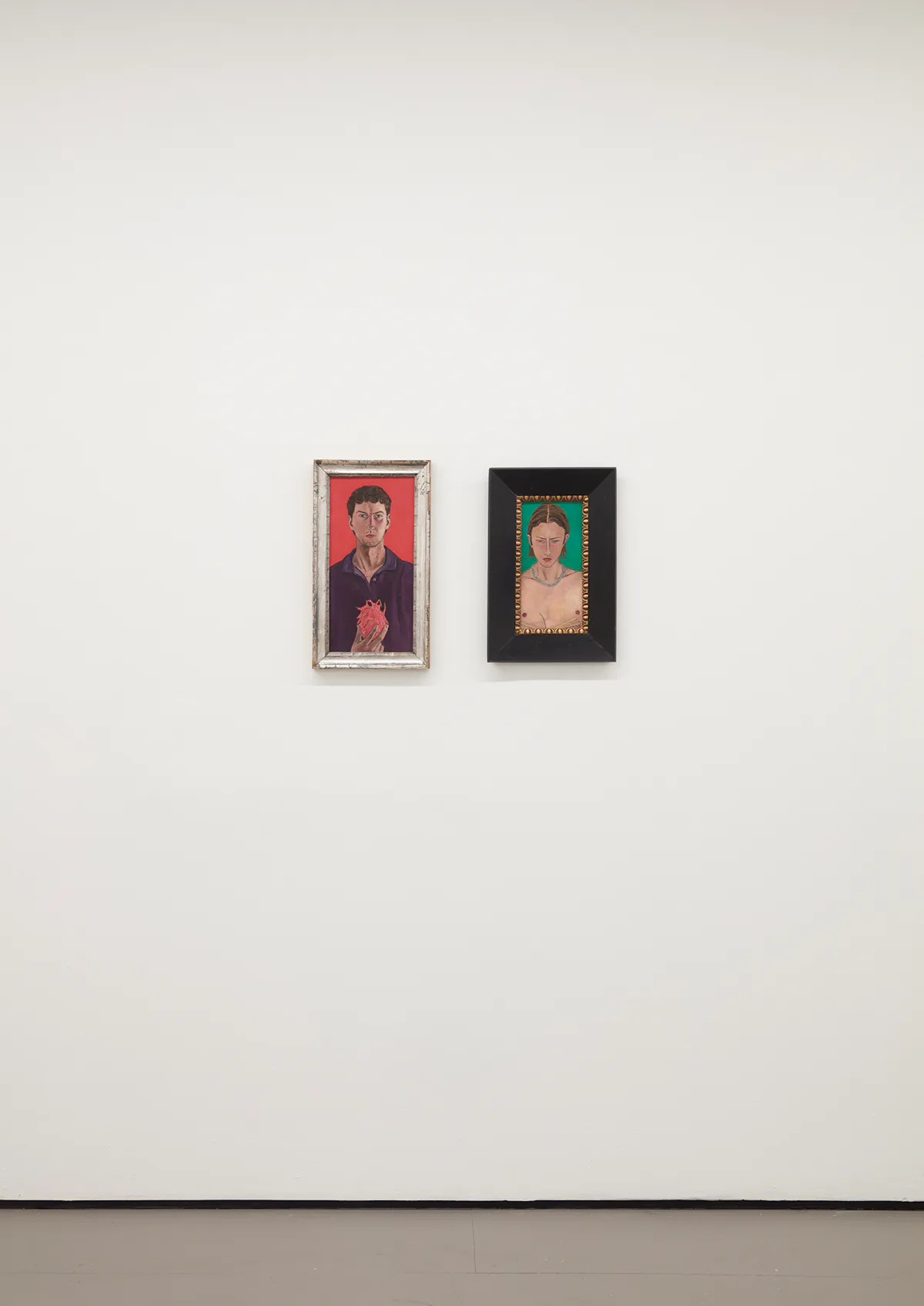
For the German artist Max Jahn, frames are just as important as the imagery inside of them. As part of his practice, Jahn painstakingly chooses each border for his painted works from his father’s antique shop. They are personal to him—as personal as the colorful portraits he creates, which will be on view in the new show, Time Spent Looking. The exhibition features both portraiture (like Self With Fan, a painting in which Jahn is depicted coyly holding a floral accordion fan to his face) and still life. Jahn paints what he knows; his subjects often come from within his social circle. His relationships with them—and by extension, his depictions of them—are shaped by time and prolonged observation. He paints his sitters for an hour at a time over the course of a week, in varying lights for each session. But his work in self-portraiture arguably features his most familiar subject of all.
Installation shot from Time Spent Looking at Gratin, New York. | Photograph by Jason Wyche; Courtesy of Gratin
Hailing from Berlin and growing up in the aftermath of German reunification in the ’90s, Jahn was raised with the ghosts of a different era. He spent time at his father’s antique store on Motzstrasse, in the heart of the Schöneberg neighborhood, where painters and poets ruled before the Second World War. Otto Dix, the Dutch Masters he studied at school, Balthus, and more combine to create Jahn’s own signature style, now on display in his first solo show in New York.
Time Spent Looking runs from January 29 to Match 2026 at Gratin New York.
Multidisciplinary artist and composer Samora Pinderhughes centers his work on one urgent question: “What if we built a world around healing rather than punishment?” In Call and Response, a new exhibition at MoMA on view through February 15, 2026, Pinderhughes beckons audiences to ponder this inquiry alongside him. The show comprises two core components including a two-channel film created with Christian Padron, REAL TALK,which examines the impact of absence on families whose loved ones are incarcerated. It also features a series of performances and programming developed in collaboration with community organizations in New York City.
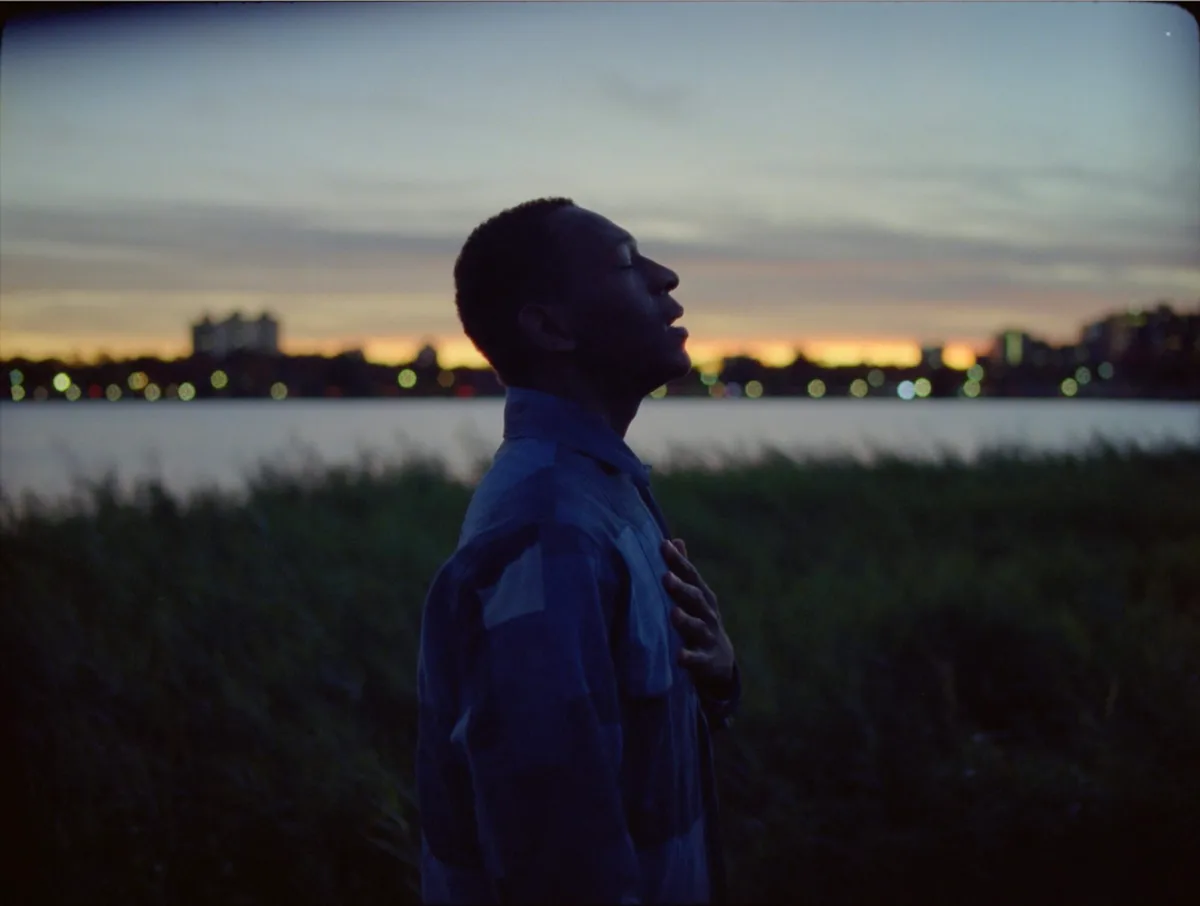
Samora Pinderhughes and Christian Padron, still from REAL TALK, 2025. | Courtesy of the artist.
With Call and Response, Pinderhughes considers how narratives of criminalization are applied to groups of people to justify violence against them. “As a country, we’re willing to allow basically anything to happen if there’s this illusion that it will protect us from [who]ever is deemed criminal,” the artist said. The show is part of his stint as the 2025 Adobe Creative Resident at MoMA, and builds upon his work as a creator of The Healing Project, a community arts organization founded in the spirit of prison abolition. It also underscores Pinderhughes’s commitment to unearthing how art, particularly collective sonic practices, might contribute to collective healing and liberation. —D.H.
Sterling Ruby is an artist who, over the years, has become larger than life, a boldfaced name in both the art and fashion worlds. His work, moving across sculpture, textile, ceramics and video, explores themes of violence and the impacts of social norms while remaining autobiographical. His fashion line, S.R. Studio L.A.C.A., echoes his love of craft and feels very much due after years of lending inspiration for designers like his close friend Raf Simons. On January 30, the Los Angeles-based multihyphenate will present his first solo show in several years, running until March 28. Ruby’s new work, titled Atropa for the nightshade herb known for its deadly quality, is inspired by the duality of the deeply poisonous yet medicinal plant and the mythology that surrounds it. The Greeks associated the genus with the cutter of the thread of life. Ruby uses it as a launch pad for stirring watercolor collages, bronze flowers, and graphite pen-and-ink studies that switch between decay and vibrant bloom. As in all of Ruby’s work, material exploration is at the heart of the show. So are themes of mortality. An as usual, the exhibition is not to be missed.—A.S.
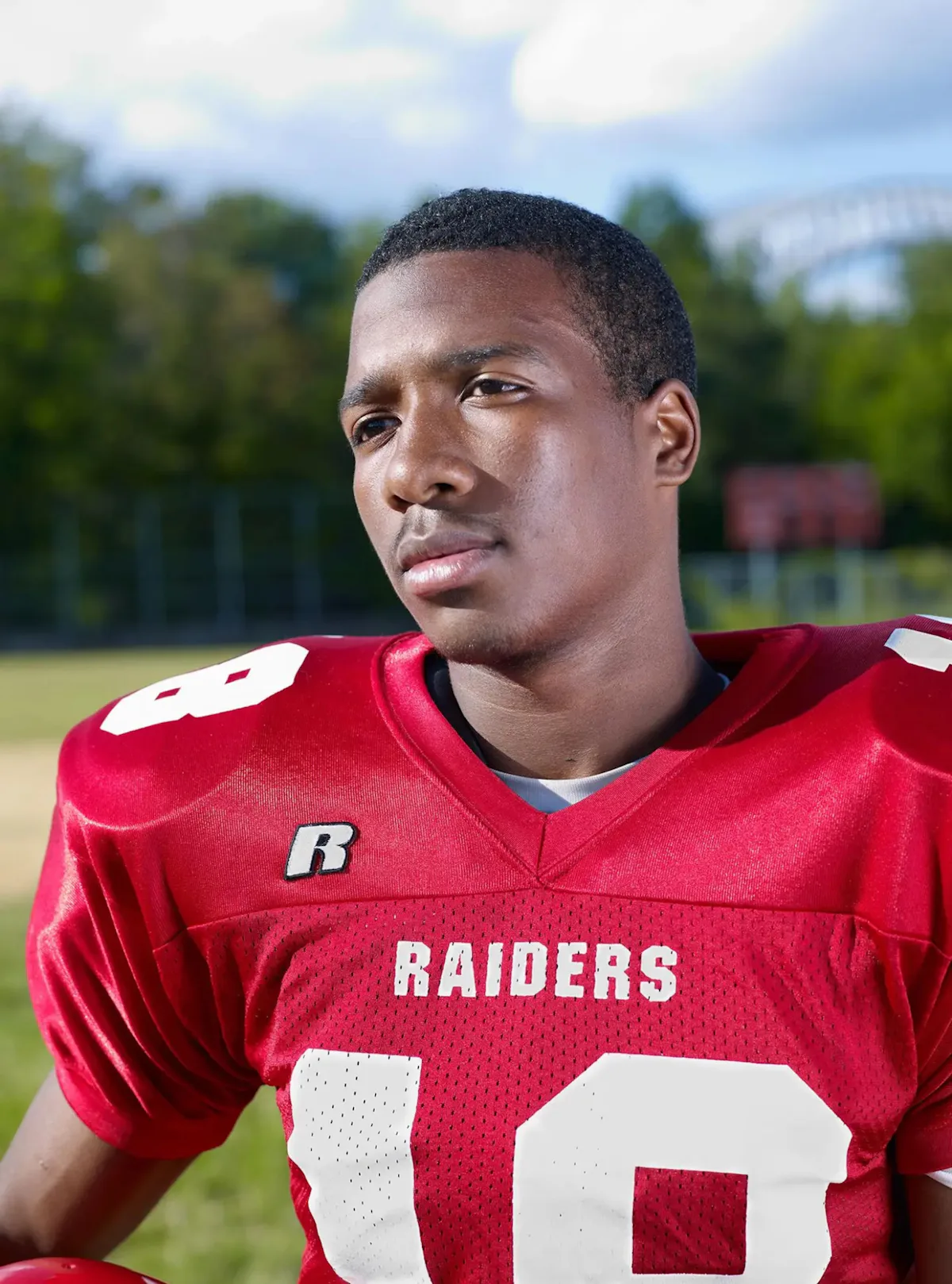
The American photographer Catherine Opie broke into art-world fame with portraiture of her early ’90s queer family, often friends from the Los Angeles S/M scene captured in the style of Baroque paintings. Early self-portraits, Self-Portrait/Cutting and Self-Potrait/Pervert display incredible tenderness, giving viewers the opportunity to lay down assumptions and connect with Opie’s community with equal depth. Over three decades later, the seminal artist will present the first major museum exhibition of her work in the U.K. at The National Portrait Gallery, from March 5 to May 31. Catherine Opie: To Be Seen will explore intimacy, home, and family—the personal and the political—through the photographer’s images of these communities, surfers, high school footballers, and more. Opie is directly involved in the curation of the show, which will speak in dialogue with the permanent collection of the museum. —A.S.
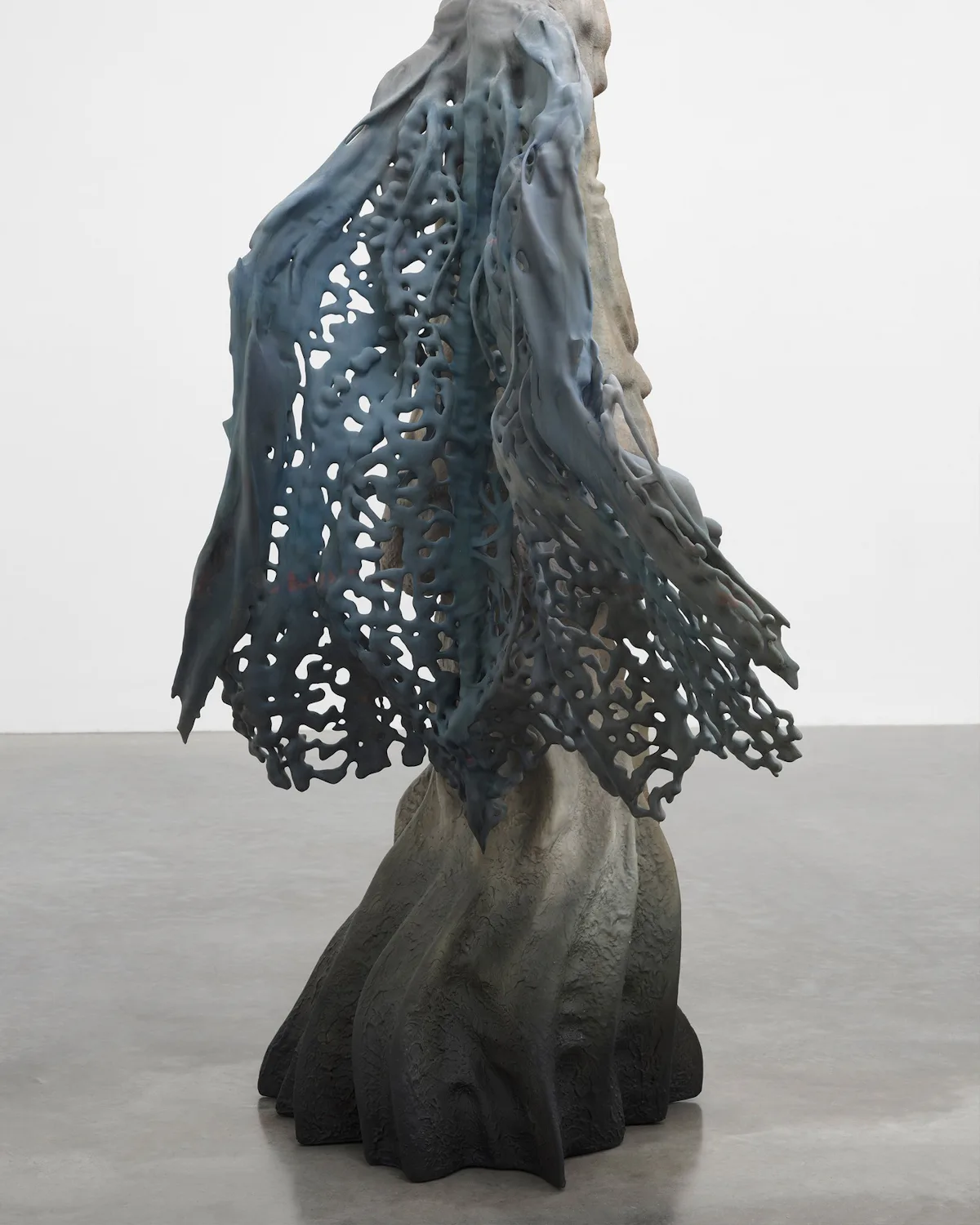
The French multidisciplinary artist Marguerite Humeau is known for reimagining and creating extinct worlds. One extensive land art project saw mystics and scientists lending expertise as Humeau brought to life 84 sculptures that could survive the climate apocalypse on land deemed unfarmable. Another gave Cleopatra a reborn voice as she sang in the nine extinct languages she was recorded to know. Now, Humeau will open a solo show for the first time at White Cube’s New York gallery. Open from January 16 to February 21, the exhibition blends stalactite-like and bat-shaped sculptures with works on paper, all inspired by a trip to a bat cave in West Papua. As in the case of previous work, the cave is not just a cave, but rather a metaphor for the unknown and the unnamable. Pastel drawings mimic prehistoric cave drawings. Stalagmite and stalactite sculptures help us navigate our precarious environment. The pieces reference John Koenig’s The Dictionary of Obscure Sorrows (2021): can Humeau’s sculptures give emotion to words we have yet to invent? Her new work certainly makes us feel.—A.S.
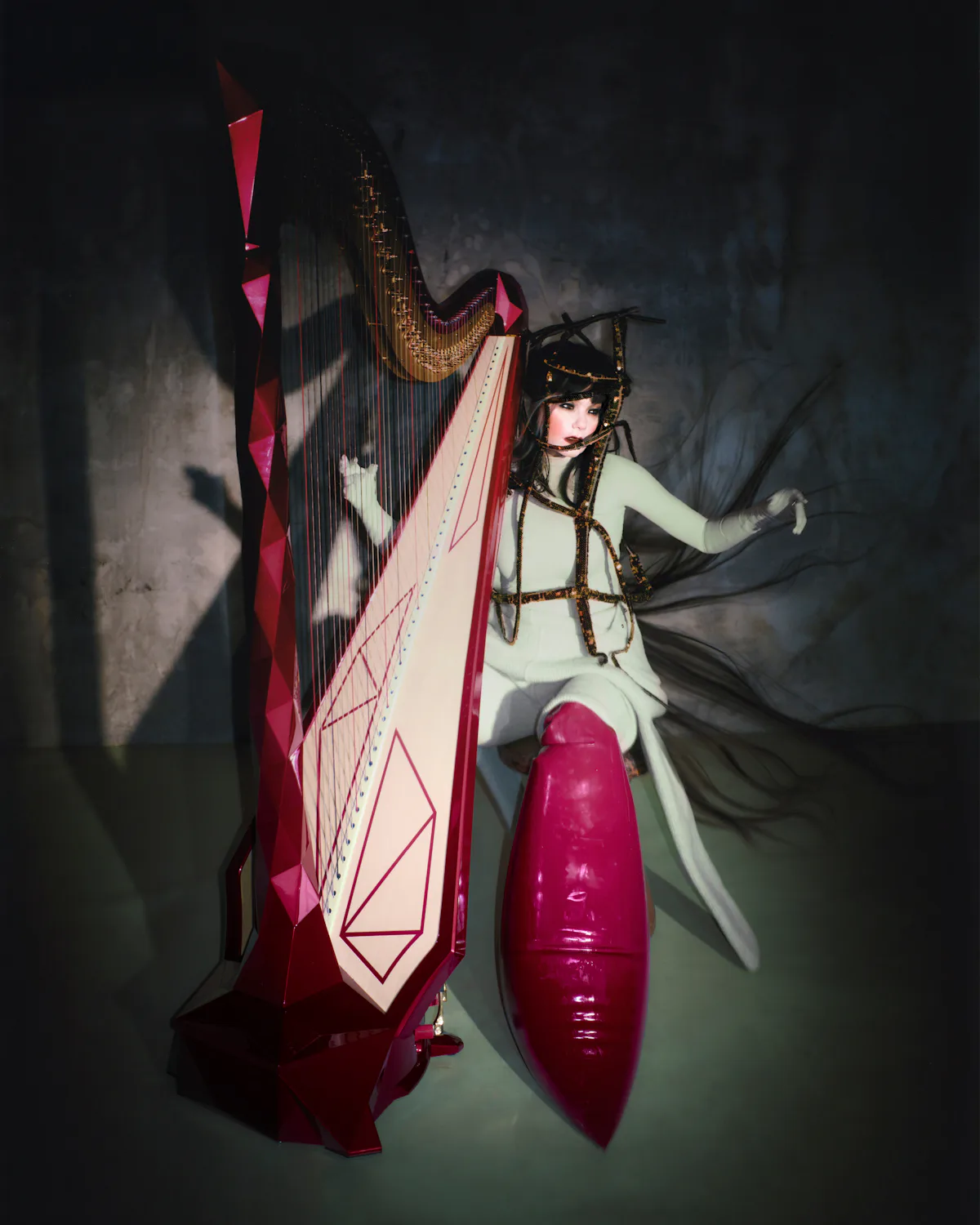
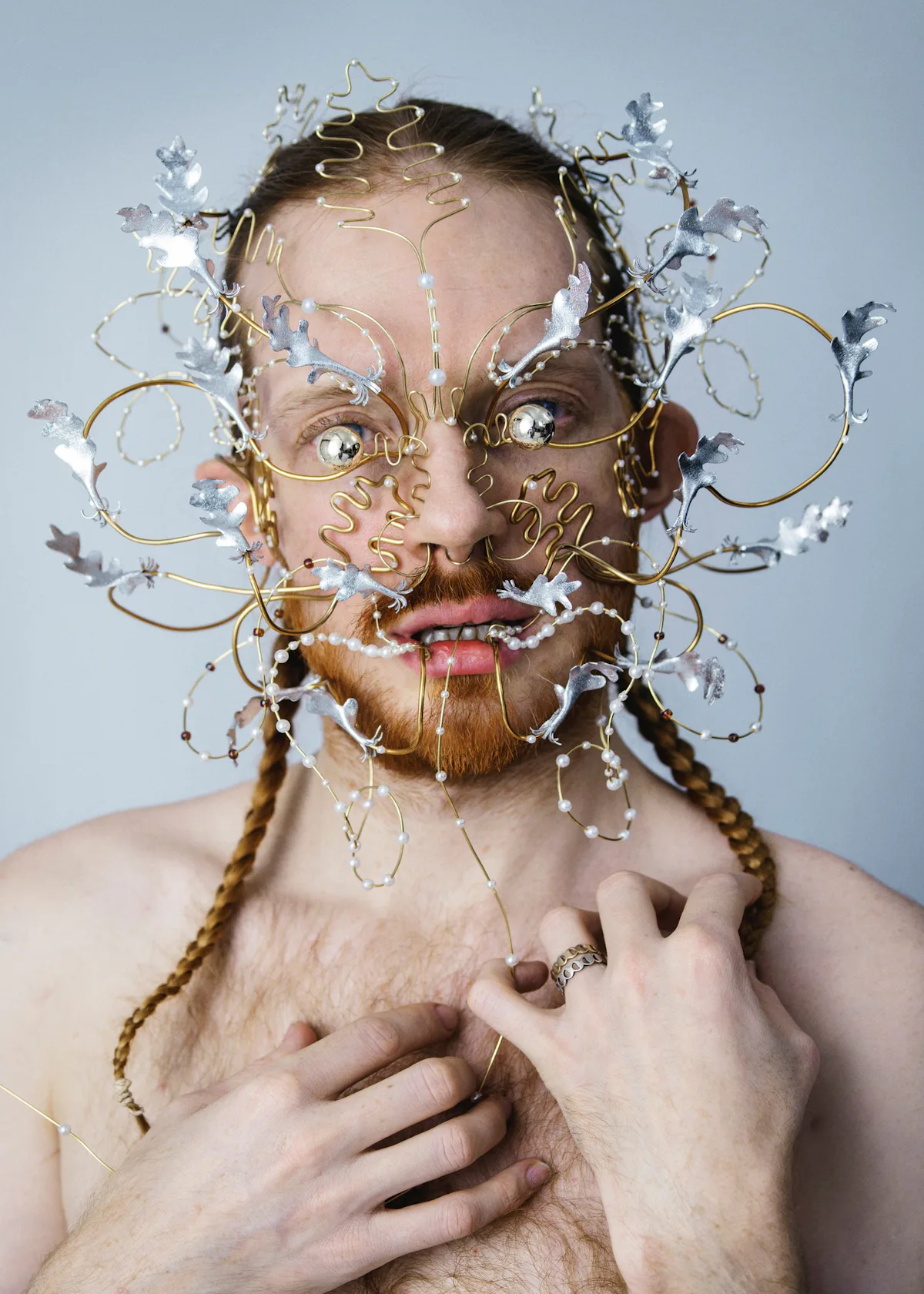
The public will experience a different side of the perennial musical enigma Björk when she returns to her native Iceland to stage a new art exhibition at the country’s National Gallery. Echolalia, as the show is called, is comprised of three immersive installations, the first of which will provide the public with a peek into the artist’s upcoming album. The two other works, Ancestress and Sorrowful Soil, both honor Björk’s mother, environmental activist Hildur Rúna Hauksdóttir, who passed away in 2018. While these pieces were originally released with Björk’s 2022 album, Fossora, their presentation at the museum will allow for a more theatrical experience. Ancestress, specifically, features a film set in a remote valley in Iceland where a ritualistic procession is taking place. Björk and her son, Sindri Eldon, star—with contributions from filmmaker Andrew Thomas Huang and James Merry, Björk’s co–creative director and the designer of the masks and ritual objects worn in the video.
Those especially interested in Merry’s work will have the opportunity to stop by his show, Metamorphlings, running simultaneously with Echolalia at the National Gallery. The first museum retrospective of Merry’s work, Metamorphlings features 80 pieces offering a look into his artistic output over the last decade. Heavily focused on the mask, the exhibition showcases Merry’s craftsmanship while exploring the piece as a catalyst for performance and transformation. Using embroidery, metalwork, 3-D printing, and jewelry, Merry has created masks for Tilda Swinton and Iris Van Herpen; they will be on display together for the first time.
Echolalia runs from May 30 to September 19, 2026, while Metamorphlings runs from May 30 to October 3, 2026.
James Merry, Greenman, 2017. | Photograph by Tim Walker
The V&A is staging a century-spanning exhibition on Schiaparelli, marking the first time the fashion house will be the sole subject of a museum show in the U.K. Opening March 28, Schiaparelli: Fashion Becomes Art will trace the brand from its birth in the 1920s to the present day, exploring Elsa Schiaparelli, the woman, as well as her role as an innovator and key figure in interwar fashion. The exhibition will follow Schiaparelli around the world, from Paris to New York and London, with a focus on the latter—specifically, Schiaparelli’s British clients and the founder’s relationship with the city.
Over 200 objects will make up the exhibition, including archival garments, accessories, jewelry, paintings, photographs, sculpture, furniture, and perfumes. Some of Schiaparelli’s most unique designs—including the “Tears” dress and the famous upside-down shoe hat—will be on display, placed alongside art by her contemporaries like Pablo Picasso and Man Ray. The V&A worked with Schiaparelli and the fashion house’s current creative director, Daniel Roseberry, whose designs will also be featured.
Schiaparelli: Fashion Becomes Art will run through November 8, 2026.
Those who sit in small Venn diagram of And Just Like That... viewers and fine art lovers were likely horrified to see Tracey Emin’s seminal work imitated, and then tossed aside in the Sex and the City reboot’s final season. Luckily, Tate Modern is stepping in to provide Dame Emin with deserved credit, by mounting an expansive exhibition tracing four decades of the artist’s work—showcasing her most influential pieces alongside those that have never been exhibited until now. Through painting, video, textiles, neons, writing, sculpture, and installation, Emin has long challenged society’s view of the female body, as well as the line between public and personal. She did this most notably with her 1998 piece, My Bed, using the conversation that sparked around this controversial piece to further challenge the definition of art at the turn of the 21st century. At Tate Modern, My Bed and more work will be on display in a celebration of Emin’s raw and personal approach to artistic expression.
Tracey Emin runs at Tate Modern from February 27 to August 31, 2026.
Dan Flavin’s grids take center stage for the first time at David Zwirner New York, in a new exhibition that explores the matrix-like vertical artist’s body of work, which first gained prominence in the mid 1970s. Like much of Flavin’s fluorescent lamp-based pieces, the grids simultaneously highlight and redefine every space in which they’re installed. This latest exhibition features Flavin’s first two grids: untitled (for Mary Ann and Hal with fondest regards)1 and 2. Both created in 1976, they will be installed at Zwirner identically to their debut at the Otis Art Institute Gallery, Los Angeles, where they sat kitty-corner to one another in a single room. Other pieces, including four-foot creations like untitled (for you, Leo, in long respect and affection) 3 and 4, illustrate Flavin’s exploration of scale within the format. They are contrasted by untitled (in honor of Leo at the 30th anniversary of his gallery), which spans 24 feet. Flavin’s dedications within the work provide a second narrative to the exhibition, one that follows the many people who helped support the artist’s career. Former gallery director of the Otis Art Institute Gallery, Hal Glicksman (and his wife Mary Ann), plus his longtime New York dealer Leo Castelli are just some of the figures represented through this set of work.
Dan Flavin’s Grids will run from January 15 to February 21, 2026, at David Zwirner New York.
Gloria Klein, a contemporary artist known for her bold, expressive work, is championed in a new lively exhibition of paintings, and her first solo show, at Anat Ebgi in New York. Featuring works from the late 1980s and early ’90s, the exhibition immerses viewers in Klein’s hypnotic, repeated diagonal hatch marks that stack and shimmer across the canvas. While her work nods to Minimalism and Conceptual art, it is joyfully rooted in the Pattern & Decoration movement and the feminist embrace of so-called “women’s work,” transforming repetition, ornament, and labor into something bold and eye-catching. Klein’s stitch-like marks echo the crowded streets of New York, visual noise, and the early digital pulses of the 1980s. Visually addictive and intellectually playful, Crisis Management is an irresistible invitation to step into Klein’s radiant world, and the feminist spirit that animates it, up close.
Gloria Klein: Crisis Management is on view at Anat Ebgi through February 28, 2026.
Gloria Klein, Bon Voyage/Semaphore, 1987 | Courtesy of the estate of Gloria Klein and Anat Ebgi
Although he was famously shy, it’s remarkable how often the designer Yves Saint Laurent had his picture taken. In 1957, when he was newly appointed head of Dior at just 21 years old, Saint Laurent sat for Irving Penn in what would become the first of countless unforgettable photographs of the French fashion icon. When he founded his own label with Pierre Bergé in 1961, the duo made the extraordinary decision to put Saint Laurent himself at the center of the brand's image, a rare move at the time. Through it all, the camera was a constant presence, as if he knew posterity was watching.
A new exhibition celebrates Saint Laurent’s visionary use of photography and imagery to cement his brand’s legacy. On view from June 11 to September 28, 2026, “Yves Saint Laurent and Photography” at the International Center of Photography in New York City takes visitors into the expansive visual universe of a designer whose work continues to shape how fashion is perceived today. Organized with the Musée Yves Saint Laurent Paris and the Fondation Pierre Bergé–Yves Saint Laurent, the show unfolds in two parts: the first devoted to emblematic images of Saint Laurent and his garments by photographers such as Richard Avedon, Cecil Beaton, Irving Penn, and Annie Leibovitz; while the second is a wunderkammer of contact sheets, magazine pages, advertising layouts, and invitations to his shows, amounting to some three hundred photographs and objects.
“What’s most exciting about the show is that it functions as a kind of history of photography in its own right—a greatest-hits of image-making related to fashion,” says Simon Baker, curator of the show with Nastasia Alberti and Clémentine Cuinet. “Saint Laurent chose to work with the best practitioners at each moment, and he stayed friends with them. He worked with Penn for more than 30 years and Helmut Newton was a presence throughout almost his entire career. He also kept pace with what was emerging, so when Paolo Roversi and Juergen Teller began to rise as the defining photographers of their moment, he worked with them too.”
A section of the exhibition is devoted to Saint Laurent’s work with fashion magazines, including original pages and a series of Polaroids taken for styling purposes. Imagery from fashion shows appear as well, documenting backstage and front-row moments alike.
“This kind of behind-the-scenes documentation was genuinely unusual for the time,” Baker says. “It’s fairly normal now, but to have someone doing that with real artistic intention in the 1960s—when Saint Laurent was just launching his own house, getting photographed in fitting rooms in beautiful black and white, in images that were not merely documentary but genuinely beguiling—that was something else entirely.”
Saint Laurent’s expansive interest in the art world is also evident in the exhibition. Among the highlights are images from collections in which he paid tribute to artists such as Piet Mondrian and Pablo Picasso, translating their visual languages into stylish garments. Also on view is Andy Warhol’s 1972 portrait series of Saint Laurent, alongside a photograph of Warhol wearing the designer’s clothes.
Although Saint Laurent is considered the quintessential Parisian designer, New York played a critical role in his career. “Avedon and Penn, the two biggest names in fashion photography at the time, whom Saint Laurent worked with often, were both based in New York,” Baker says. Attuned to its local audience, the ICP show spotlights his decades-long relationship with the city through images of events and fashion shows at landmarks like Battery Park and Liberty Island. In a photograph taken by Henri Dauman in 1958, months after his Dior appointment and years before the launch of his own label, Saint Laurent stands on Seventh Avenue, surrounded by the whirling city. In great contrast, a photograph by Roxane Lowit from the early 1980s shows him holding a Statue of Liberty like a trophy, with a radiant, wide smile.
Noor Khan wears The Row shirt and pants; Charvet cummerbund; shoes from Académie du Bal Costumé, Paris; stylist’s own tie.Khan wears Dior top, pants, belt, and shoes.Khan wears The Row tank tops and skirt; Charvet cummerbund; Church’s shoes.Khan wears Chanel jacket and skirt; Church’s shoes.Khan wears Prada shirt, pants, and shoes.Khan wears Marc Jacobs jacket, top, skirt, and shoes.Khan wears Louis Vuitton dress, pants, and shoes.Khan wears Prada jacket and dress.Khan wears Dior Haute Couture sweater and pants with attached skirt; Church’s shoes.Khan wears Dior jacket, shirt, pants, and shoes.
Hair by Damien Boissinot at Art + Commerce; makeup by Francelle Daly at Bryant Artists; manicure by Marie Rosa for Dior. Model: Noor Khan at Next NY. Casting by Ashley Brokaw Casting. Set design by Alexander Bock.
Produced by Endorphyn; executive Producer: Guillaume Rasquier; Producer: Emanuela Polo; Line Producer: Magali Mennessier; Lighting Director: Margaux Jouanneau; Light Assistants: Jakub Fulin, Charles Hardouin; Digital Technician: Nicolas Fallet; Digital Technician assistant: Kiara Chhahira; Postproduction: D-Factory; Production Assistants: Benjamin Cayzac, Simon Rihouey; Studio Assistant: Quentin Dewilde; Fashion Assistants: Bianca Parisotto, Annica Sidebrand; Hair Assistant: Tomohiro Inotsume; Makeup Assistant: Madrona Redhawk; Tailor: Bravan Nunes.
Since her breakout turn as Carolyn Bessette-Kennedy in FX’s Love Story, Sarah Pidgeon has been leaning into a minimalist look adjacent to the fashionable figure’s own iconic wardrobe. However, in recent weeks, that stark aesthetic has incorporated more unique and subtly artisanal details on the red carpet—particularly as Love Story petitions for Emmy Awards consideration. At a FYC screening event for the show, Pidgeon took a more referential approach to CBK’s minimalism while embracing one of her all-time favorite designers: Yohji Yamamoto.
Katie Flores/Variety/Getty Images
For the aforementioned Love Story screening, Pidgeon stepped out in a lightweight black Yamamoto dress. However, this was far from your average LBD. Her flowing piece featured a squared neckline with one long, ruffled sleeve gathered at the sides. Meanwhile, the other featured a flounced, off-the-shoulder shape with a long slit, creating an asymmetrical appearance.
To further the piece’s minimalism, Pidgeon’s look was only worn with a dark pedicure and thin black slingback sandals, drawing further focus to the dress’s textures and technique. A wavy, undone hairstyle—much like her hair as Bessette-Kennedy on Love Story, which has been a frequent topic of discussion since the shoe premiered—further enhanced her nod to the late style icon.
CHRIS DELMAS/AFP/Getty Images
Decades ago, Bessette-Kennedy frequently wore Yamamoto’s pieces for their structural forms and subtly simple silhouettes. One of her most iconic was from a Whitney benefit event, featuring a white shirt from the Japanese designer’s menswear collection tucked into a black skirt from his women’s line. Other styles, including a ruffled opera coat and structural suiting, similarly struck a chord between classic elegance and avant-garde flair. Yamamoto’s designs both continued Bessette-Kennedy’s own intricate minimalism while progressing her look during her marriage to John F. Kennedy Jr. from 1996 to 1999, where she was documented nearly exclusively wearing his pieces.
Rose Hartman/Archive Photos/Getty Images
With her own Yamamoto ensemble, Pidgeon took an approach to method dressing as Bessette-Kennedy that was more referential than literal. By nodding to the late figure’s style and the beloved designer that was a constant in her wardrobe, the actor’s approach was formally appropriate while showing a take on Bessette-Kennedy’s look that we haven’t seen before. Plus, given Yamamoto’s artisanal techniques and commitment to form, this is one CBK-inspired look the West Village girls can’t replicate overnight.

 Login
Login