A transgender alum has sued her former secondary school over “discriminatory” policies that barred her from having long hair.
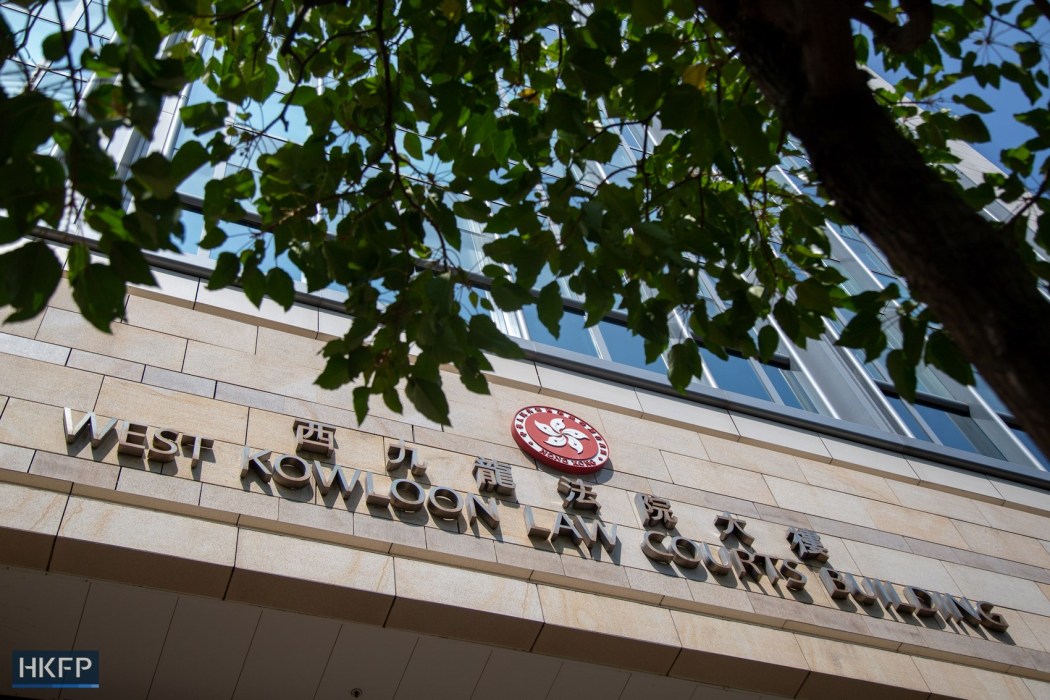
Lung Kung World Federation School Limited (LKWFSL) Lau Wong Fat Secondary School in Tai Kok Tsui. Photo: LKWFSL Lau Wong Fat Secondary School.
Oscar Fung, who studied at Lung Kung World Federation School Limited (LKWFSL) Lau Wong Fat Secondary School in Tai Kok Tsui from 2019 to 2025, filed a writ in the District Court on Thursday, local media reported.
According to the writ, Fung experienced gender dysphoria at the age of 14 when her parents separated.
During the Lunar New Year holiday in 2024, Fung decided to grow out her hair. However, she was reprimanded at school after the break because her hair exceeded the length permitted for male students and was accused of violating school rules.
The writ stated that Fung was scolded by two teachers for almost 30 minutes one day, with the teacher threatening to withdraw her from science competitions she was representing the school in.
Equal Opportunities Commission. Photo: Kelly Ho/HKFP.
Fung felt embarrassed and angry as other students witnessed the scene. She was then sent to the disciplinary teacher, who accused her of “cosplaying as a girl” and told her to cut her hair.
The writ also mentioned that Fung had filed a complaint with the Equal Opportunities Commission, but it was dismissed.
‘Injury to feelings’
Fung alleged in the writ that the school had breached the Sex Discrimination Ordinance, as female students were allowed to grow long hair while male students were not.
She asked the court to declare the school’s rules discriminatory and to order it to pay damages for “injury to feelings,” a term under the ordinance.
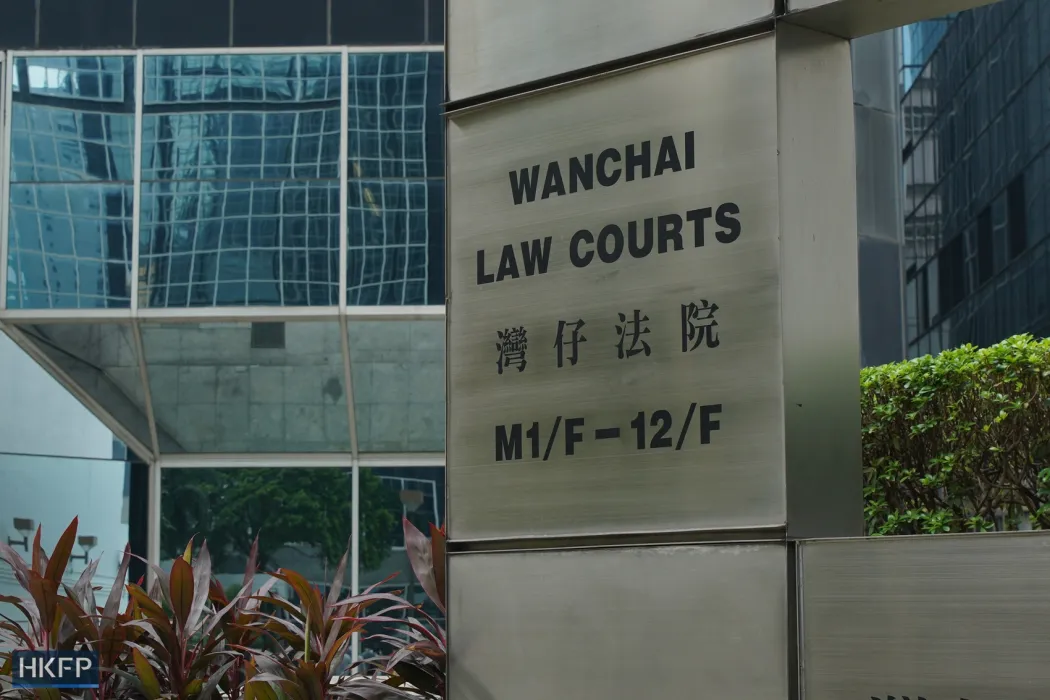
District Court in Wan Chai. File photo: Hans Tse/HKFP.
The writ also stated that one of the school’s vice principals, Pang King-fai, had twice dismissed the Sex Discrimination Ordinance.
During a meeting with Fung before the 2023-24 school year ended, Pang said the school was not subject to the Sex Discrimination Ordinance.
The second instance was during a ceremony on the first day of school for the 2024-25 academic year in September 2024. Pang told pupils publicly that male students’ hairstyles did not fall under the ordinance, and any challenges would be handled through disciplinary measures.
According to the writ, another vice principal, Li Wing-yee, told Fung that if she did not abide by the school’s rules, she should change schools.
A hearing for the case has been scheduled for July 15, according to the Judiciary’s website.
A Hong Kong court has upheld the conviction and sentence of a journalist and former head of a press union for obstructing police while reporting.
Ronson Chan in 2024. File photo: Kelly Ho/HKFP.
Veteran journalist Ronson Chan began serving his five-day sentence on Friday after Deputy High Court Judge Lily Wong upheld a lower court’s conviction over an incident in September 2022, when Chan refused to show his ID card to a police officer while reporting on a homeowners’ meeting.
In her written judgment, which was not read out in court on Friday, Wong shot down Chan’s argument that the police officer’s demand was unlawful and found that the journalist had obstructed the police by wilfully delaying the presentation of his identification.
According to case details, Chan was covering the meeting at MacPherson Stadium in Mong Kok, where he was stopped by a plainclothes police officer who said he was acting “suspiciously” and asked to see his identification card.
He was arrested on suspicion of obstructing a police officer after allegedly failing to comply with demands to produce his ID card despite multiple warnings.
At trial, Chan said that he refused to present his identification due to privacy concerns, referring to an incident during the 2019 protests when a police officer showed his ID card in front of his camera, which was live-streamed to thousands of viewers.
The High Court. File photo: Kyle Lam/HKFP.
The West Kowloon Magistrates’ Courts found Chan guilty in September 2023, a year after he was arrested.
The trial judge, Leung Ka-kie, said Chan deliberately stopped the police officer from carrying out her duties and that his persistent questioning of officers when they asked for his identification was “reckless and unreasonable.”
‘Social climate’
Noting online calls to protest at the homeowners’ meeting, Judge Wong also concurred with the trial judge’s ruling that the police officers were justified in their actions to maintain public order.
“As the Magistrate ruled… given the social climate at the time, observing the rules and maintaining order in public places in Hong Kong was both important and commendable,” Judge Wong wrote.
Chan repeatedly questioned the officers and ignored warnings to calm down, and only offered an opaque cardholder, which constituted wilful obstruction, the judge added.
Chan’s barrister, Steven Kwan, told the court that he would seek a certificate from the appellate court to take the journalist’s appeal to the city’s apex court, but did not submit a bail application.
With the certificate, Chan would be able to seek permission for a final chance to appeal his conviction and sentence.
Reactions from press groups
Chan, who was elected as chair of the Hong Kong Journalists Association (HKJA) in June 2021, stepped down at the end of his term in June 2024, citing increasing pressure against him and the press union.
Hong Kong Journalists Association. Photo: HKFP.
In a statement issued on Friday, the HKJA expressed “deep regret” over the court’s decision and raised concerns about the ruling’s impact on journalists’ work.
“Citing the exercise of constitutionally protected fundamental rights as grounds for a search is legally untenable, and today’s ruling failed to directly address this contradiction,” the HKJA said.
Reporters Without Borders (RSF) said on Friday that it “is outraged by the imprisonment of Ronson Chan.”
“The verdict sets a dangerous precedent, effectively giving the police a free hand and further eroding already dismantled press freedoms,” said Aleksandra Bielakowska, advocacy manager of RSF Asia Pacific.
Immigration cases at Federal Court have more than quadrupled since 2020, with some lawyers linking the surge to increased automation in visa processing and application reviews.
A Hong Kong court has ordered the forfeiture of more than HK$670,000 in “terrorist property” from three persons involved in a thwarted bomb plot during the 2019 protests.
The High Court. File photo: Kyle Lam/HKFP.
In a written judgment on Thursday, High Court Judge Judianna Barnes ruled that Wong Chun-keung and Ng Chi-hung were “terrorists” and Lau Pui-ying was a “terrorist associate” under the United Nations (Anti-Terrorism Measures) Ordinance.
Barnes said a total sum of HK$674,860 in the defendants’ accounts and in cash, which was liable to be seized under the ordinance, was “intended to be used to finance or otherwise assist the commission of ‘terrorist acts.’”
In November 2024, Ng was sentenced to almost 24 years in jail for masterminding the foiled bomb plot, which aimed to kill police officers at a demonstration on December 8, 2019, amid the large-scale protests and unrest that year.
Wong, who led a radical group known as “Dragon Slayers,” was sentenced to 13 and a half years in prison. Both defendants pleaded guilty, with Wong testifying for the prosecution in exchange for leniency in sentencing.
Lau was among seven defendants who stood trial by jury. In August 2024, the nine-member jury found her and five others not guilty. Only one defendant was convicted by the jury and was sentenced to 10 years and 10 months behind bars.
Despite her acquittal, authorities submitted “numerous Telegram messages” that showed Lau “actively administered, together with [Wong], crowd-funding exercise in securing funds” for Dragon Slayers and the bomb plot, according to the judgment on Thursday.
A rally is held in Hong Kong Island on December 8, 2019, to mark International Human Rights Day. File photo: May James/HKFP.
Between November 6 and December 9, 2019, Lau’s three accounts received net deposits of more than HK$1 million while she was earning a salary of less than HK$3,000, the government submitted.
Barnes said the evidence “overwhelmingly supported” the government’s application to forfeit the sum.
Roughly HK$536,000 was kept in Lau’s three accounts, according to the judgment, while the remainder, around HK$138,000, consisted of deposits in Wong and Ng’s bank accounts, as well as cash.
Wong and Ng did not oppose the application while Lau was absent throughout the proceedings, including court notices and a hearing regarding the government’s application.
The anti-terrorism ordinance, enacted in 2002, was invoked for the first time to prosecute the group.
The defendants were accused of planning a bomb attack during a rally marking International Human Rights Day, plotting to place two bombs along the rally’s marching route to kill police officers.
Remember DOGE, the Elon Musk-led “government efficiency” project that spread chaos during President Donald Trump’s first few months back in office, fired tens of thousands of federal employees, and then vanished almost as abruptly as it began?
If you didn’t lose your job in one of Musk’s federal employee purges, or you aren’t one of the remaining federal civil servants who has to figure out how to do your job without many of your colleagues around, DOGE is probably little more than a memory. But the legacy of this era of arbitrary firings is still being litigated in federal court, and Justice Amy Coney Barrett just handed down some very bad news for nearly every civilian who works for the federal government.
On the surface, the Supreme Court’s decision in Margolin v. National Association of Immigration Judges, which was handed down on Tuesday, is a bit removed from Elon’s brief stint as Trump’s human resources manager. The case concerns whether federal immigration judges have a First Amendment right to give public speeches about immigration law. And the full Supreme Court decided to get rid of the case using a procedural argument that has few implications for federal employees.
But Justice Clarence Thomas, in an opinion joined by Barrett, wrote a separate opinion that would allow Trump to strip all federal civil servants of employment protections that many federal workers have enjoyed since the Chester A. Arthur administration.
While Thomas often takes extreme positions, Barrett is a relative moderate who is close to the center of the GOP-controlled Supreme Court. So, if Barrett is willing to endorse Thomas’s one neat trick to abolish civil service protections, that’s a strong sign that a majority of the Court agrees with her position.
Republican judges have long backed a legal theory known as the “unitary executive,” which holds that the president must have the power to fire high-ranking government officials who lead federal agencies. But the unitary executive has not historically been understood to eliminate employment protections for civil servants and other relatively low-ranking federal employees.
Justice Antonin Scalia’s dissent in Morrison v. Olson (1988), which is considered something akin to a holy text to proponents of the unitary executive, referred to the president’s power to “remove executive officers” — “officers” are relatively high-ranking government workers — but it did not say that the president must be able to fire every individual postal worker or Social Security clerk.
In Margolin, however, Thomas and Barrett suggest a way to collapse this distinction between agency leaders and ordinary civil servants. Trump can simply fire all of the government officials who adjudicate civil service disputes, and then civil servants will no longer have any enforceable rights.
Barrett, in other words, appears to believe that civil service protections only exist if the president wants them to exist. And if she says so, it’s likely the Court’s majority will, too.
Why civil service protections are essential to a modern government
If you watched the Netflix show Death by Lightning, which was about the brief presidency of James A. Garfield, or if you read the book the show was based on, you got a pretty good picture of what the president’s life was like before civil service reform.
As author Candice Millard wrote, when Garfield took office, the line of job seekers hoping to secure a federal job “began to form before he even sat down to breakfast.” By the time Garfield had finished his meal, “it snaked down the front walk, out the gate, and onto Pennsylvania Avenue.” As president, Garfield was expected to meet with each of these job-seekers and sort them into jobs — often based on whether they had a politically powerful patron.
This system was inefficient, as it forced the federal government to replace much of its workforce every time the White House changed hands. It diverted a simply enormous amount of the president’s attention into low-level hiring decisions. It fostered corruption, as often the only way to secure a federal job was to do favors for a senator, congressman, or some other powerful figure who could act as the job-seeker’s patron. And it made it very difficult for the government to hire highly specialized workers.
Why would someone go to the trouble of, say, getting an economics degree and becoming an expert on federal monetary policy if they knew that their job in the Treasury Department would evaporate the minute their party lost an election?
President Arthur signed the Pendleton Civil Service Reform Act in 1883, shortly after Garfield was assassinated by a disgruntled job-seeker. It was the first of several laws which ensure that the government did not have to replace every Republican postal worker or FBI agent with a Democrat if a Republican president lost an election.
Modern civil service laws also prohibit the federal government’s political leadership from coercing civil servants into political activity. They provide protections for whistleblowers. And they generally ensure that the government will be staffed by competent professionals who provide continuity across presidential administrations.
Federal civil service laws are primarily enforced by an agency known as the Merit Systems Protection Board (MSPB). Civil servants who believe their rights as federal employees have been violated typically must file their case in the MSPB, which gets the first crack at adjudicating these sorts of disputes.
Early in his second presidency, however, Trump took several actions that appeared designed to shut down the MSPB. He fired one of the Board’s members, depriving the MSPB of the quorum it needs to operate. He also fired Special Counsel of the United States Hampton Dellinger, an official who investigates alleged violations of civil service laws and brings cases to the MSPB, and attempted to replace Dellinger with a far-right podcaster.
Since then, Trump has taken some actions to reinvigorate the MSPB. The Board now has two members, which is the minimum it needs to operate. The podcaster withdrew from consideration to replace Dellinger after Politico reported that the podcaster said he has a “Nazi streak in me from time to time.” And Trump later assigned Dellinger’s duties to US Trade Representative Jamieson Greer.
So, while there are good reasons to believe that the MSPB is significantly diminished thanks to Trump’s actions, the Board currently has the minimum amount of personnel it needs to operate. But that was not true for the first several months of the second Trump administration, when it only had one member and thus was unable to adjudicate civil service disputes.
Barrett would let Trump abolish civil service protections by firing the MSPB’s members
The most interesting issue in the Margolin case concerns what should have happened if Trump had never appointed a second MSPB member, and thus had left the Board inoperative.
A federal appeals court, the United States Court of Appeals for the Fourth Circuit, decided Margolin in June 2025, during the period when the MSPB was defunct. That court suggested that, if the MSPB is nonfunctional, then the federal judiciary must step in and hear civil service disputes that otherwise would be heard by the MSPB — because, otherwise, federal civil service laws would cease to function.
On Tuesday, the full Supreme Court reversed the Fourth Circuit, although it did so on narrow grounds. The full Court’s opinion in Margolin states simply that the Fourth Circuit should not have opined on what happens when the MSPB is defunct, because the plaintiffs in Margolin did not raise this issue in their briefs.
But Thomas’s concurring opinion, which was joined by Barrett, rejects the Fourth Circuit’s argument outright. He argues that federal law says that civil servants must bring employment disputes in the MSPB, and if there is no MSPB, that means that they are simply out of luck.
Thus, as a practical matter, Trump could gain the power to fire any federal worker simply by firing one of the two current members of the MSPB. If that happened, the MSPB would cease to function, and federal civil servants would be cut off from any legal remedies, even if they were illegally fired for being Democrats.
Despite the significant implications of Barrett’s decision to join Thomas’s opinion, it isn’t particularly surprising. Last July, in McMahon v. New York (2025), the Court permitted the Trump administration to fire about half of the Department of Education’s workforce. Though the Court’s three Democrats dissented in McMahon, the Republican justices in the majority did not explain their decision; it was decided on the Court’s shadow docket, and the justices often do not explain their reasoning in those cases.
Nevertheless, McMahon was an early sign that the Court’s Republican majority does not support civil service protections, or believe that those laws should be enforced. Barrett’s decision to join Thomas’s Margolin opinion also suggests that she holds that view.
It appears, in other words, that this Supreme Court wants to tear down a consensus that was reached in 1883 — that the federal government should have a professional civil service that cannot be removed simply because the Republican Party controls the White House. Barrett’s move suggests Trump has plenty of leeway to keep firing people, even if federal law is supposed to stop him from doing so.
In April, the 70th month since Beijing imposed the national security law, the Hong Kong government applied to the court to seize assets belonging to Apple Daily founder Jimmy Lai, who is serving a 20-year prison sentence.
St Paul’s Co-educational College Choir performs at the opening ceremony of National Security Education Day on April 15, 2026, at the Hong Kong Convention and Exhibition Centre. Photo: GovHK.
On National Education Day, a top Chinese official delivered a warning about those who “politicised” the deadly Tai Po fire and tried to “stir up chaos” in the city.
Gov’t seeks to seize Jimmy Lai’s assets
The Hong Kong government filed an application with the High Court on April 2 to seize “offence-related” properties owned by jailed pro-democracy media tycoon Jimmy Lai on national security grounds.
In a statement issued the same day, the government mentioned Lai’s earlier convictions under the Beijing-imposed national security law. It said the High Court had found that he was the “mastermind and driving force behind the case, consciously using Apple Daily and his personal influence” to undermine local and Beijing authorities.
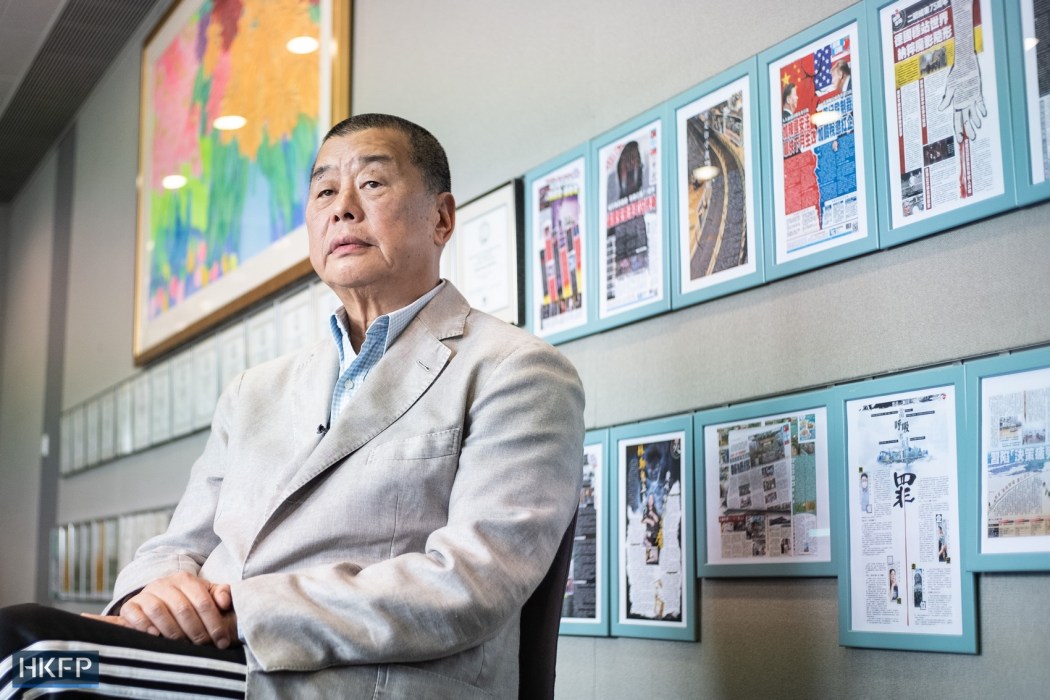
Hong Kong pro-democracy media mogul Jimmy Lai. File photo: Kelly Ho/HKFP.
The assets include credit balances in bank accounts belonging to or linked to the Apple Daily founder.
Fifteen bank accounts under Lai’s name – 10 with HSBC, two with Hang Seng Bank and three with Shanghai Commercial and Savings Bank – have over HK$32 million.
The government is also seeking to seize bank accounts belonging to 17 companies linked to Lai. It is also demanding that Lai give up shares in 17 companies, some of which overlap with the 17 firms whose assets the government is seeking to seize.
Among the companies whose assets and shares the government wants to seize are Dico Consultants Ltd, which has over HK$404,302 in its HSBC account, and Lai’s Hotel Properties Ltd, which has over HK$3.1 million in its four HSBC accounts.
Lai has been summoned to the High Court on July 8 to hear the government’s application. The case will be presided over by Esther Toh, one of the three judges who heard his national security trial.
Apple Daily headquarters. Photo: Candice Chau/HKFP.
The move to seize Lai’s assets came after the government designated three companies linked to Lai’s now-defunct Apple Daily tabloid “prohibited organisations” in late March and removed them from the corporate registry. Police cordoned off the Apple Daily building in Tseung Kwan O a day later.
The three firms were tried and convicted alongside the Apple Daily founder in his high-profile national security case. Lai was sentenced to 20 years behind bars in early February, while the companies were each fined over HK$3 million.
Wong Kwok-ngon, known by his pen name Wong On-yin, has been detained since his arrest in December for allegedly divulging in a YouTube video details of enquiries made by police during a national security investigation.
Judge Stanley Chan said the pre-trial review would take place behind closed doors on August 11, and the trial would begin on October 9.
Wong Kwok-ngon in a YouTube video posted on December 2, 2026. Screenshot: On8 Channel – 王岸然頻道, via YouTube.
Wong’s offence falls under the Safeguarding National Security Ordinance, a homegrown security law known as Article 23. It was added to the ordinance in May as part of subsidiary legislation, and Wong is the first to be charged under the new law.
He is also charged with sedition over videos posted on YouTube between January 3 and December 6 last year. He plans to plead not guilty to both charges.
The defendant, who continues to represent himself, told the court he had dropped his legal aid application.
Asked by the judge whether he had legal knowledge for self-defence, Wong said he had “three law degrees” and was confident of handling the case.
Nat. security clauses for restaurant licences
Secretary for Environment and Ecology Tse Chin-wan said in early April that all Hong Kong restaurant licences would include national security clauses from September.
Shops awaiting for lease on a Hong Kong street in October 2024. File photo: Kyle Lam/HKFP.
Tse made the remarks on April 7, nearly a year after the Food and Environmental Hygiene Department (FEHD) introduced the provisions for restaurant licence renewals in May.
“With restaurants renewing their licences gradually, we expect that by September this year, all restaurant licences will contain the clauses,” Tse told reporters, according to RTHK.
Retiree jailed over seditious Facebook posts
A Hong Kong man was jailed for a year under the city’s homegrown national security law after pleading guilty to making seditious remarks on Facebook, including comments supporting Hong Kong’s and Taiwan’s independence.
The magistrate handed Chong, a retiree in his early 60s, an 18-month sentence but discounted it by six months after considering his guilty plea.
A Facebook log-in screen. Photo: Pixabay, via Pexels.
Chong was accused of making 53 seditious social media posts between March 2024 and November 2025, local media reported.
The posts had wording such as “dissolving the Chinese Communist Party is the most important thing” and “Hong Kong independence is within sight.”
The defendant posted on a public Facebook page called “Holy Raymond,” which features the Chinese phrase “Heaven will destroy the Chinese Communist Party, God bless Hong Kong” as its profile picture.
During mitigation ahead of sentencing, his lawyer argued that Chong was a Falun Gong believer who had come to hate the Chinese Communist Party because of false information that the CCP engaged in live organ harvesting.
Beijing official warned of ‘politicising’ Tai Po fire
China’s top official in charge of Hong Kong affairs warned of some people who “politicised” the deadly Tai Po fire and tried to use the disaster to “stir up chaos” in Hong Kong.
Xia Baolong, director of the Hong Kong and Macao Affairs Office, delivered his remarks on April 15 via a recorded video shown at a National Security Education Day ceremony.
In his speech, Xia mentioned the massive fire that broke out at Wang Fuk Court, a government-subsidised housing estate in Tai Po, on November 26, killing 168 people.
Xia Baolong, the director of the Hong Kong and Macau Affairs Office, gives a speech via a video on National Security Day on April 15, 2026. Photo: GovHK.
“After the Tai Po fire, some malicious people politicised the tragedy, attempting to use the disaster as a means to disrupt Hong Kong,” Xia said in Mandarin, without giving further details.
“Once again, it reminds us that along Hong Kong’s path toward prosperity under good governance, there will be various risks and challenges.”
Speaking at the same event, Hong Kong Chief Executive John Lee also warned that some people were “using the disaster to stir up chaos” and “to incite hatred” in Hong Kong.
“Only through the government’s swift action and decisive law enforcement has the situation been able to return to normal,” Lee said in Mandarin.
French journalist denied entry to city
A French journalist was denied entry to Hong Kong in November, Reporters Without Borders (RSF) said in late April, accusing the city’s authorities of “weaponising visas” against foreign media workers.
French journalist Antoine Vedeilhe. Photo: Reporters Without Borders.
Antoine Vedeilhe, who was shooting a documentary for French public broadcaster France Télévisions, was questioned upon arrival at Hong Kong International Airport on November 2 last year, RSF said in a statement on April 24.
He was detained for three hours before being deported without being given a reason, it added.
The press freedom NGO said Vedeilhe was the 13th foreign media worker who had been denied entry or a visa by the city’s authorities following Beijing’s imposition of the national security law in 2020.
“In the journalist’s view, his detention was a reprisal for his work on a documentary examining Beijing’s grip on Hong Kong,” RSF said.
Another cameraman for the documentary was able to enter the city, RSF said, but he was followed by “unidentified individuals that he suspects were Hong Kong’s national security police.”
“In the following days, there was a hacking attempt on Vedeilhe’s private email account and his sources in the documentary were harassed by the national security police,” the NGO said.
In an emailed reply to HKFP’s enquiries, the Hong Kong government said it “strongly condemns the smearing remarks and distorted narratives by” RSF.
Prosecution and arrests figures
As of April 1, a total of 394 people have been arrested for “cases involving suspected acts or activities that endanger national security” since Beijing’s national security law came into effect, according to the Security Bureau. That figure includes those arrested under Article 23 and for other offences.
Of the 208 people and five companies that have so far been charged, 180 people and four companies have been convicted or are awaiting sentencing.
In total, 100 people and four companies have been charged under Beijing’s national security law, with 79 persons and three companies convicted. Thirteen people have been charged under Article 23, 10 of whom have been convicted.
The Department of Justice (DoJ) has sought to overturn former pro-democracy lawmaker Lam Cheuk-ting’s acquittal on a charge of perverting the course of justice related to an incident during the 2019 protests and unrest.
Lam Cheuk-ting. File Photo: Holmes Chan/HKFP.
Government prosecutors told the Court of Appeal on Thursday that Lam had the intent to pervert the course of justice by demanding that a person, referred to as “X,” delete photos of protesters at a march in July 2019.
The DoJ is also seeking to overturn acquittals for Lam’s co-defendants: former InMedia journalist Ronnie Tsang, 28, and social worker Aggie Chung, 39.
According to case details read out in previous hearings, Lam and Tsang were accused of committing acts with the intention to pervert the course of justice by asking X to delete from his phone photos showing the faces of protesters who might have committed criminal offences that day.
Tsang was also charged with unlawful assembly and later jailed for 13 months, while Chung was charged with access to a computer with dishonest intent and criminal damage for accessing X’s phone and deleting photos. However, Chung was later acquitted after the prosecution failed to prove dishonest intent.
Intention to pervert course of justice
Assistant Director of Public Prosecutions Ivan Cheung argued on Thursday that the District Court’s January 2023 ruling that Lam had no intention to pervert the course of justice was “counterintuitive,” online news outlet The Witness reported.
The High Court. File photo: Kyle Lam/HKFP.
Cheung presented to the court a video of the exchange, in which Lam said that “what matters now is to delete the photos with protesters’ faces.”
Although Lam verbally said that he wanted to help X leave the scene, he could also have harboured an intent to pervert the course of justice, Cheung told the three appeal judges.
X had previously testified that Lam did not force him to delete the photos and that he agreed the lawmaker was mediating the situation.
The prosecutor said the lower court erred in finding that Lam had no intent to pervert the course of justice.
However, Judge Derek Pang said on Thursday that it was impossible to conclude that Lam had that intent, while Judge Judianna Barnes said Lam’s actions did not necessarily suggest his intent.
In response to Cheung’s argument that the three defendants invited suspicion upon themselves by being present at a protest, Pang said that this was not a rioting or unlawful assembly case, adding that he could not understand how suspicion could be inferred.
Barrister Erik Shum, representing Lam, noted that the lower court found no connection between Lam’s actions and any existing or potential legal proceedings. The prosecution at trial also failed to specify any crimes or legal proceedings, he said.
Lam’s acquittal could not be overturned if the prosecution failed to prove whether he had interfered with legal proceedings or had any intention to do so, Shum said.
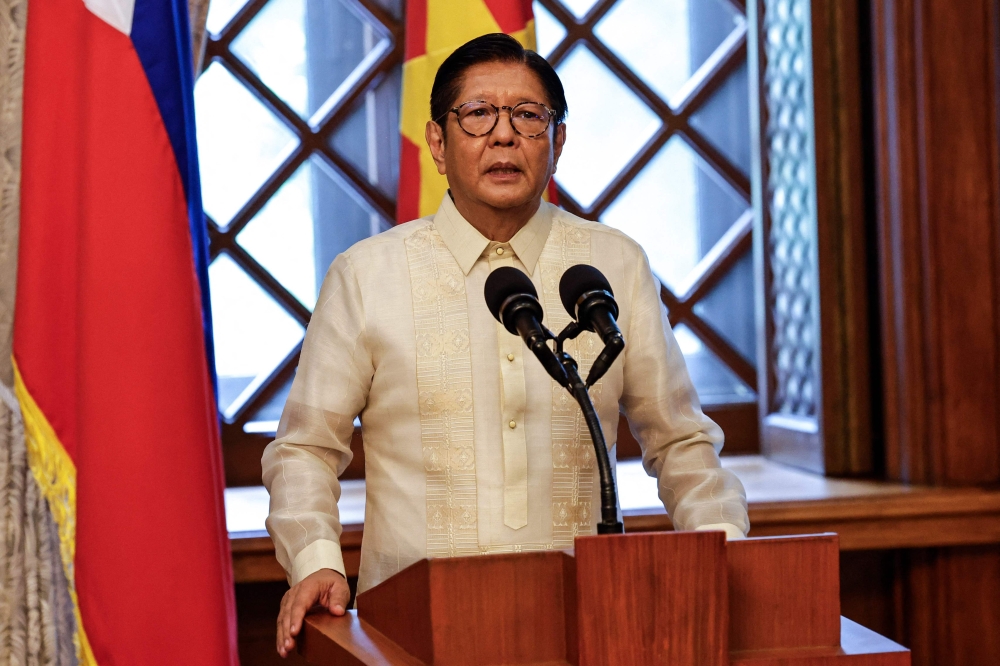
MANILA, June 3 — Philippine President Ferdinand Marcos warned today that important laws may be derailed as senators backing Vice President Sara Duterte stopped attending sessions ahead of her impeachment trial next month.
Pro-Duterte lawmakers began a Senate boycott this week after losing majority control, with one lawmaker arrested for large-scale corruption and another in hiding to avoid arrest by the International Criminal Court.
“The legislature is now in disarray,” Marcos told reporters.
“Get back to work because it’s important; we have a lot of work to do... We have to pass a lot of laws.”
Marcos said his team was looking at possible laws and amendments to aid Filipinos as the Middle East war sends shockwaves through the global economy.
“We are trying to achieve some form of stability so that people can go on with their lives and plan ahead for their future; so that people can count on the assistance of government during this time of an emergency,” the president said.
“We cannot do that if the legislature decides to stay at home and have a vacation.”
The Philippine Constitution states that the executive is co-equal to the legislature, limiting Marcos’s options.
“We cannot tell them what to do; we cannot punish them for what they are doing. They have to regulate themselves. And they haven’t been doing much of a good job right now,” Marcos said.
Last month, the 13 lawmakers allied with Duterte took control of the 24-seat Senate just hours before the majority of the House of Representatives voted to impeach the vice president.
Four days later, Duterte ally Ronald Dela Rosa fled after the International Criminal Court issued an arrest warrant against him.
Another pro-Duterte senator, Jose “Jinggoy” Estrada, was arrested on Monday for allegedly receiving kickbacks worth more than 573 million pesos (RM36,964) over a flood control project.
The resulting 11-11 deadlock means it is difficult to pass a bill into law unless senators cross party lines.
Duterte ally and Senate President Alan Peter Cayetano justified the boycott by saying the body is being “held by the throat” and that majority members are being eliminated.
The vice president’s Senate impeachment trial is expected to begin on July 6. — AFP
Two Hong Kong men accused of conspiring to incite people to riot during the 2019 protests and unrest have had their case moved to a higher court, where they face a maximum sentence of seven years’ imprisonment.
West Kowloon Magistrates’ Courts. File photo: Kelly Ho/HKFP.
Ng Tsz-lok, who is unemployed, and photographer Chan Wai-leong appeared at the West Kowloon Magistrates’ Courts on Thursday.
The two men have been remanded since they were charged in October over their alleged role in the anti-extradition protests six years ago. Prosecutors have accused them of manufacturing and providing weapons to protesters.
The pair have been charged with conspiring to incite others to take part in a riot, with the date of the offence being October 22 to 23, 2019.
Ng was among a group of defendants acquitted by a High Court jury in September of alleged involvement in three bomb plots in places including a hospital and a car park between November 2019 and March 2020.
Ng Tsz-lok leaves the High Court after being acquitted on September 4, 2025. Photo: Kyle Lam/HKFP.
With the completion of handover procedures, Magistrate Victor So announced on Thursday the transfer of the case to the District Court.
The maximum penalty at the District Court is seven years’ imprisonment. At the magistrates’ court, the maximum penalty is two years, or three years when a defendant is convicted of more than one offence.
The case will be heard at the District Court on June 2 for the pair to confirm whether they will plead guilty or not guilty, So said.
Ng also faced an additional charge of “incitement to take part in a riot” on November 14, 2019. The prosecution said on Thursday it had changed the charge to “conspiracy to incite others to take part in a riot” and added an additional day – November 15, 2019 – to the offence.
District Court in Wan Chai. File photo: Almond Li/HKFP.
The details of the amended charge specified that the target of Ng’s incitement was an unknown individual and somebody by the name of Lee Tsz-ying – transliterated from Cantonese, as read out in court by the prosecution.
The prosecution also added a new charge for Ng, accusing him of inciting others to riot on different dates, between October 19 and November 8, 2019.
The court ruling, handed down in May, says Karl Antonius was convicted in 2020 of sexual assault for having unprotected sex with a woman after she fell asleep in his bed in 2015.
Approval of the new House map came a month after the U.S. Supreme Court struck down the state's current map as an illegal racial gerrymander, weakening the landmark 1965 federal Voting Rights Act.

 Login
Login