Editor’s note, May 31, 8 am ET: We’re bringing you some of our best-loved Your Mileage May Vary columns while Sigal Samuel is on parental leave. The one below originally published on October 6, 2024. This unconventional advice column offers you a unique framework for thinking through moral dilemmas. It’s based on value pluralism — the idea that each of us has multiple values that are equally valid but that often conflict with each other. Stay tuned for more original Your Mileage May Vary columns coming in June.
My grandmother had a teenage pregnancy she hid from her family before giving birth in secret and immediately giving the child up for adoption after birth. I accidentally discovered this after I received a message on an ancestry DNA website from someone closely related genetically to me. She told me she knew barely anything about her birth parents and was desperate to just have an answer. I accidentally exposed this secret to my mother and grandmother by asking if anyone knew who this person who messaged me was.
My grandmother was horrified, and wants nothing to do with her. How do I respect the choice my grandmother felt she had to make at that time in her life and protect her peace, while also acknowledging that this person should be able to at least know who the people who created her are and prominent family medical history? I feel guilty for exposing this secret accidentally but now I feel like I have an obligation to protect my grandmother and offer this person some peace of mind.
Dear Caught-in-the-Middle,
Your question reminded me of an idea from Bernard Williams, one of my favorite modern philosophers. He said that someone facing a moral trade-off can make what is, all things considered, the best decision, and — even though it was the right call — find that it still results in some cost that deserves acknowledgment or feels regrettable. Williams called that cost “the moral remainder.”
Regret is a trickster of an emotion. We’re used to viewing it as an indication that we’ve done something wrong. But as Williams explains, sometimes all it means is that reality has forced upon us an incredibly hard choice between two options, with no cost-free option available.
Your grandmother is not in the wrong for giving up her child all those years ago — or for wanting to keep her distance now. As you said, it’s the choice she “felt she had to make at that time in her life.” Pregnancy outside of marriage, especially in her generation, often came with a massive serving of shame, and the fact that she felt the need to hide it from her family and give birth in secret suggests this was a pretty traumatic experience.
It’s understandable if she’s scared to reopen that trauma now. She has a right to decide if and how to process it — a right to self-determination.
Have a question you want me to answer in the next Your Mileage May Vary column?
At the same time, her grown child is not wrong for wanting answers today. The desperation felt by this newfound relative of yours is the “moral remainder” of your grandmother’s decision.
As technology shifts over the generations, moral norms shift along with it. When your grandmother gave up the baby for adoption, she had no idea DNA testing would become commonplace — but it has. And as cheap testing kits like 23andMe have exposed all kinds of family secrets, more and more kids who’d been kept in the dark are making their experiences known.
Some were never bothered by their obscured origins, but discover an extra measure of joy and connection once they meet long-lost relatives. Others say they always suffered from an uneasy sense that they’re different from their siblings. Still others say it’s important to know your biological family’s medical history, especially with the advent of precision medicine.
All this has led to an increasing belief that children have a right to know where they came from — a right to self-knowledge.
Take it from Dani Shapiro, author of Inheritance, who found out as an adult that her beloved father was not her biological father. She writes:
The secret that was kept from me for 54 years had practical effects that were both staggering and dangerous: I gave incorrect medical history to doctors all my life. It’s one matter to have an awareness of a lack of knowledge — as many adoptees do — but another altogether not to know that you don’t know. When my son was an infant, he was stricken with a rare and often fatal seizure disorder. There was a possibility it was genetic. I confidently told his pediatric neurologist that there was no family history of seizures.
Some bioethicists, like Duke University’s Nita Farahany, are also building this case. Following the famous proclamation from Ancient Greece — “Know thyself!” — Farahany argues that people have a right to self-knowledge, including when it comes to medical information. She writes that “access to that essential information about ourselves is central to the self-reflection and self-knowledge we need to develop our own personalities.” It helps us shape our own lives and empowers us to make choices about our future.
That means that self-knowledge is actually a subset of self-determination — the exact same value that your grandmother is asserting. And it seems only fair for us to acknowledge that if your grandmother is entitled to that, then so is her child.
If both people have a right to self-determination, and their rights are in conflict with each other, then … well … what do you do?
Even John Stuart Mill, the 19th-century English philosopher who literally wrote the book on liberty, didn’t think that anyone’s right to liberty or self-determination is an absolute right. Instead, it’s a qualified right — the kind that we generally honor but that can be restricted to protect the interests of others.
So it feels appropriate here to strike a balance between your grandmother’s wishes and her child’s. There are a few different ways to do that, but here’s one: You could assure your grandmother that you won’t pressure her to talk to the child or hear any more about her, but you will give the child family medical information and a general understanding of her birth story, including the aspect that might feel most important to her: why she was given up for adoption.
Without mentioning your grandmother’s name or any details that would make it easy for the grown child to track her down, you could say something like, “Your birth mom is one of my relatives. She got pregnant as a teenager and didn’t have the means or support to take care of you. She made the hard choice to give you up for adoption in hopes that you’d have a better life than she could provide. She doesn’t feel comfortable being in contact now, and I feel that I need to respect her wishes and her privacy, but I hope this message brings you at least a little bit of peace.”
Ultimately, you won’t have total control over what your relative does with this information, because internet sleuthing is a force to be reckoned with. And you won’t be able to control whether she feels fully satisfied with what you tell her. That’s a feature of this kind of moral dilemma: You can’t please everyone 100 percent, but you’re doing what you can to honor the values at stake.
If you want, you might choose to meet with the grown child without involving your grandmother. Or you might decide that your notion of kinship isn’t rooted in biology and you don’t feel any particular need to bond with someone new to you.
Either way, what I love about Williams’s idea of the “moral remainder” is that it encourages you to view everyone in this tricky situation (including yourself!) compassionately. Regardless of which specific step you take next, you can move forward from that place of compassion.
Bonus: What I’m reading
23andMe is floundering, to the point that the company’s CEO is now considering selling it. As Kristen V. Brown notes in The Atlantic, that would mean “the DNA of 23andMe’s 15 million customers would be up for sale, too.” It’s one of the many reasons why I’ll never spit into one of those test tubes.
I recently reread the philosopher Susan Wolf’s 1982 essay “Moral Saints,” and it feels more on point than ever. Wolf argues that you shouldn’t actually strive to be “a person whose every action is as morally good as possible” — and not just because those people are incredibly boring!
David Brooks is not my usual cup of tea, but I appreciated him writing in the New York Times about how, contrary to popular opinion, “emotion is central to being an effective rational person in the world.”
Nick Sadler and his wife had different ideas of what a chill Saturday looked like. He considered the weekend a blank slate — no set plans, the family’s moment to reset and chill. She was under the impression that time was up for grabs and put a short hangout on their calendar, which Sadler saw as his wife not taking his schedule into account. To settle the argument, he opened up ChatGPT, specifically the group chat function, which allows more than one human to interact with the technology. Sadler prompted the chatbot to act as a neutral mediator and to instruct them on their next moves. Sadler tells Vox that ChatGPT acted as a trusted friend, or even a therapist, suggesting both of them consider different perspectives. It attempted to pinpoint where the conversation broke down (“Both of you then behaved logically according to your own understanding. That means this is not primarily a respect problem. It’s a classification problem.”) and offered guidelines for future scheduling (“A simple question can prevent most of these arguments: ‘Is this an idea, or are we locking this in?’”)
“It was like, ‘Well, next time just consider this’ and ‘maybe try saying this’ and ‘maybe try doing that,’” Sadler, a film producer, says. “We got some sort of advice to follow, but ultimately we’ve still got to do the work and we’ve still got to actually take the actions.”
Sadler, a 48-year-old self-proclaimed AI enthusiast, is no stranger to utilizing ChatGPT in his marriage. He’s used it to uncover the weaknesses in his arguments and to craft apology texts to his wife. “I put in purpose mistakes so she wouldn’t think I was just using ChatGPT,” he says.
But the pressures of parenting two young kids was kindling for their periodic annoying marital spats. Sadler and his wife considered couples counseling, but once he discovered ChatGPT could guide them through difficult conversations, they no longer felt they needed the help of a professional. One night, while sitting on the couch with his wife, Sadler launched ChatGPT and told his wife to talk to it as if it was a therapist. “In a way, it’s having a therapist on tap,” he says.
That people are turning to large language models to navigate their love lives isn’t entirely surprising. Relationships have peaks and valleys and, many times, exist in an emotional gray area. Chatbots, on the other hand, are authoritative in tone and confident, even when they’re wrong.
Some people are going a step beyond asking Claude to draft an apology text, and inviting AI into the most intimate moments of their lives: fights with their significant others. In other words, they are treating technology like an on-demand couples therapist. The tech, which could be ambiently listening or addressed directly via voice or text, might suggest someone use more “I” statements or prompt couples to ask questions like “Where did you feel unsupported?”
The desire for an authoritative, always-available guide in the midst of conflict is certainly seductive, but emotional matters are best reserved for human-to-human conversation. “The answer is typically not that you need some type of content strategy on how you should approach your next steps,” Amelia Miller, a fellow at the Berkman Klein Center for Internet and Society at Harvard University, tells Vox. “But it’s much more that you need emotional support, which comes from asking other people that you care about what you should do in the situation, not asking a machine.”
Drawing from a shared reality
In her Bay Area therapy practice, Courtney Quattrini has seen her fair share of couples who leverage AI chatbots in their relationships, including using it as a practice conversation partner and to ghostwrite texts to their significant other. While none of her clients have let ChatGPT or Claude mediate a fight, some do bring in AI summaries of arguments from one person’s perspective to their sessions with her. “They’re ruminating or they’re thinking about their side of the fight: What am I going to come back and say, how am I going to prove that I’m right or wrong?” Quattrini tells Vox. “They’re summarizing the fight from their perspective, and then they’ll bring in the summary and present it almost like it’s objective, but of course it’s not objective.”
But much of the work in couples therapy centers on the idea that two things can be true at once, and is about getting both individuals to understand that their partner’s emotional reality is important. “When you’re coming in and you want to summarize who won a fight, that really doesn’t align with the work that we’re actually doing,” Quattrini says. Feeding AI your narrative doesn’t help you see the things you could have done differently.
But when both people in a relationship invite AI into the discussion, leveling the playing field, the technology draws from a version of the story that may be more closely aligned with reality. A few months into dating, Khalid Tawohid and his partner discovered they’d both been discussing their relationship with their respective AI chatbots. “How can we get our AIs to just talk to each other?” Tawohid tells Vox.
Earlier this year, the 25-year-old software engineer designed a workaround where both his and his partner’s Claude agents — drawing from each individual’s full chat history — could facilitate difficult conversations. The app, called Bridge, claims to provide scaffolding for the discussions and package disorderly thoughts in a more coherent manner. Instead of looking to a machine to validate your point of view, the machine, ideally, would hold your hand as you attempt that same conversation with a human. “This helps your AI have a real sense of identity of who this [other] person is because it’s two different AIs, one knows one person, one knows the other person, and they’re both vehemently going to defend their own person,” Tawohid says. “But together it gets you to a more shared sense of truth.”
Still, Tawohid isn’t convinced his AI chatbot mediation tool, Bridge, is even a good idea. He has shared Bridge with about 10 couples, all of whom have given him the feedback that they’d use it again, he says, but it isn’t widely available for use. Perhaps, he says, it could be a supplement to traditional couples counseling, a way to practice communication outside of the therapy room.
Ironically, though, Tawohid has come down on the side of mild AI skepticism. “It’s a combination of a journal and a therapist and a friend, but it is also not real. It’s also just a computer code,” he says. When he discovered he’d lost his ability to craft a sentence without help, he stopped writing with AI. Now he fears people could lose their relationships to chatbots, too.
Gateway to introspection or outsourcing sincerity?
After a few months of using Bridge, Tawohid says he and his partner spend much less time talking to AI. They’ve had enough machine-facilitated conversations that they better understand each other’s thought patterns and triggers. Sadler, the AI-curious film producer, and his wife have similarly come to rely on AI less frequently because, he says, ChatGPT has taught them to be better communicators. “It just taught me to understand that she’s got a different perspective on things. If I’m not understanding where [she’s] coming from, just asking questions to say, well, what do you mean? And not jumping to conclusions,” he says.
Using AI as a therapeutic outlet can be instructive for people who aren’t in the habit of introspection, says Miller, the Harvard fellow. These chatbots can, in theory, be a tool for reflecting on an argument and for rehearsing what to say next. But sometimes the language the chatbot suggests is so far out of the realm of what your partner would actually say that its assistance is counterproductive.
For Josh Elledge and his wife, the stupid fight began over a haircut — or lack thereof. Elledge, a 54-year-old podcast consultant, was refusing to clean up his look (“I didn’t like something my barber said, and so I stopped going to him,” Elledge says) and his wife was not pleased. So she turned to an AI chatbot for assistance on how to break it to him. What she ended up saying to Elledge didn’t land. “It just made her opinion stronger in a way that wasn’t really helpful,” he says. “She’s conveying this stuff and I’m like, wow, you really think that? And she’s like, well, no, not really.” He says they “thankfully had the good sense” to distinguish between what she believed and what was the AI.
Once you relinquish enough of your critical thinking to AI, you run the risk of undermining the relationship you sought to fix. Therapists are trained to identify when a fight needs to be slowed, rerouted, or ditched altogether. But because chatbots never tire of hearing about your problems, you can get caught in a loop of rumination, perpetually mulling over the same frustrations and workshopping language on how to tell your husband you hate his haircut. At that point, who are you in a relationship with — a large language model, or a human? “That was an instance where maybe this isn’t a miracle process. You still have to just be really careful about not showing up as someone who you are not just simply because you defaulted to this AI being this authority in all things,” Elledge says.
AI chatbots are programmed to keep you engaged, but endless mediation and reflection isn’t exactly helpful. If you feel compelled to use one to navigate a squabble, give the technology guardrails. For example, Miller has created custom prompts that don’t exceed 10 or so exchanges with the AI and are meant to illuminate your own biases and shortcomings. But, ultimately, Quattrini, the therapist, says it’s important to remember that true counsel comes from a human who possesses the ability to read nonverbal cues, affect, and changes in body language. “Right now I think AI is a pretty dangerous mediator because it doesn’t have a nervous system,” she says.
The joy of being a person in a relationship with another person is getting through the hard parts together, even imperfectly. “We’re complicated people and no one really knows everything going on in everyone’s mind,” Tawohid says. “But humans are awesome, truly.”
Shakira finally said the quiet part out loud. “Life is a bitch.” That was her summary of what it felt like to live through Gerard Piqué‘s alleged affair with Clara Chía, the public unraveling, the move from Barcelona to Miami, the whole thing. And then she said something that stopped me. “I always thought that...
It's not as bleak as it sounds, but it has started a death clock for me. While I am not religious, I do believe I am here for a reason, but I am not knowledgeable enough to understand exactly why. The lessons of the good, bad and ugly are intended for me. Even for situations […]
Dua Lipa kissed Callum Turner in a London ceremony this weekend, and the internet did what it always does. Squealed. Zoomed in on the dress. Pulled up the two-year timeline from soft launch to “I do.” The “Physical” singer and the “Eternity” actor look impossibly aligned. Same indie-film taste. Same book club energy. Same easy...
Armie Hammer is back in front of cameras, weathered, bearded, and looking nothing like the polished leading man we used to know. Five years after the allegations that detonated his career, the photos went viral this week. Everyone has a hot take. The villain returns. The cannibal cosplay. The “how dare he show his face.”...
In the background of Mikey's tutorials or photographs, you are seeing a Wool Genie. In the unboxing below, I give you context on how I discovered this product. Since unboxing, I now own four of these. I love this tool so much that I would possibly marry it if I could! Yeah, yeah, I'm obsessed […]
SINGAPORE: One Singaporean man is wondering whether love alone is enough to save his relationship after his fiancée told him that earning S$100,000 a year still isn’t “sufficient.”
The 30-year-old shared his situation on the r/asksg forum on Wednesday (May 27), saying he and his partner have been together for five years and are due to wed in the next few months.
However, he admitted that instead of being excited about the wedding, he feels stressed, drained, and honestly quite defeated.
According to him, his fiancée keeps comparing him to people around her who are allegedly earning S$30,000 to S$40,000 a month.
“[She feels I’m] lacking behind because there are people around her earning S$30-40k/month,” he said.
“Yes, I can be a provider, to provide food, etc. But it has come to my realisation that I have to buy luxury bags whenever she wants, cover the entire vacation cost whenever she wants, and that I am falling behind because I do not have a second, third, or fourth income.”
He also confessed that she has made him feel “very useless in society” and like he’s “nothing” if he cannot immediately pay for whatever she wants.
What upset him even more was her response when he tried to suggest budgeting and planning for the future together. Instead of discussing finances as a team, she simply told him to “earn more money.”
“It’s never enough,” he lamented. “I feel it’s her comments about how I’m way below societal norms when it comes to my income—[saying] why others can do things I can’t—that make me feel bad. And yes, maybe she means it to push me to do better, but I feel like I’ll never reach the end goal.”
“You deserve someone better!”
Many commenters felt the man was already doing well for himself and questioned why he was being made to feel inadequate by his partner.
One user said, “Your earnings are already really good, but she’s whining? Sorry, she sounds like someone who just talks down on every single thing you do.”
Another wrote, “Celebrate your personal wins. 30M earning ~100k PA is commendable.”
Some also urged the man to leave the relationship. One individual explained, “Leave. 5 years is a long time, but spending the rest of your life feeling ‘not enough’ is even longer.”
“A partner should make you feel valued, appreciated, and supported, not constantly compared to other people’s incomes or lifestyles. From your post, it sounds less like she cares about you as a person and more about what you can provide for her image and expectations.”
Another added, “If my son is dating a woman like that, I will ask him to cut his losses. Losing the deposit for whatever you’ve paid for is cheaper than the divorce procedure in the future. You deserve someone better!”
In other news, a man in his 20s recently shared that his strict parents, who take 15% of his salary every month, expect him to buy a home by the time he turns 35.
In a post on the r/asksg subreddit, he shared his fears, saying he does not have enough money to fulfil his parents’ wishes.
Yarnspirations has updated its pattern-searching system to show you what is currently trending in searches. Based on what others are looking for. Some patterns have also been classified by the type of stitching journey they provide. On top of the existing filtering, this is in-your-face and easy to see what others have found that caught […]
The art of reading a crochet diagram is a method I prefer over reading written words. It's like teaching yourself hieroglyphics but for crochet. The symbols mean something and are a language all their own. For myself, my first crochet book, when I was fourteen, had written words and diagrams for each pattern. Standard Crochet […]
Starting a business is one of the most exciting and challenging undertakings an entrepreneur can pursue. Interest in entrepreneurship is at an all-time high, and there have been spectacular success stories of early-stage startups growing into multi-billion-dollar companies—from Uber and Facebook to WhatsApp, SpaceX (a trillion-dollar company), and Airbnb. Yet behind every headline-grabbing success story lies years of hard work, countless decisions, and no shortage of obstacles. Understanding the fundamental questions that come with building a startup from the ground up is an essential first step for any aspiring founder.
Starting a business entails understanding and dealing with many issues—legal, financing, sales and marketing, intellectual property protection, liability protection, human resources, and more. Whether you are a first-time entrepreneur or a seasoned business professional exploring a new venture, getting clear answers to the most common startup questions can help you avoid costly mistakes and put your company on a stronger footing from day one. Below are ten frequently asked questions about startups, along with thorough answers drawn from the expertise at AllBusiness.com.
1. What Kind of Legal Entity Should I Set Up for My Startup?
One of the first and most important decisions a founder must make is how to legally structure the company. The founders of a company must initially determine whether to organize the business as a limited liability company (LLC), a general partnership, a sole proprietorship, or a corporation. If formed as a corporation, the company must also decide whether to file an election to be taxed as an "S corporation" rather than a "C corporation." Each structure carries distinct tax implications, ownership rules, and protections for the founders.
As a general rule, you should never form a company as a general partnership or sole proprietorship, as these structures carry the significant disadvantage of potential personal liability for the debts and liabilities of the business. If the company plans to bring in outside investors, it will most likely need to be structured as a C corporation, since venture capitalists typically invest only in preferred stock issued by C corporations. An S corporation can be a solid starting point for a simple company with one or two individual owners, and it can always be converted to a C corporation as the company grows and brings in additional investors.
An LLC offers another viable option, providing limited liability protections similar to a corporation along with favorable flow-through taxation. However, LLCs can be somewhat more complex to set up, maintain, and file taxes for than S corporations. The right choice ultimately depends on how many owners the company will have, whether outside investment is anticipated, and how the founders wish to handle taxation and decision-making authority.
2. Where Should I Incorporate My Startup?
Corporations are formed under the laws of a specific state, and the choice of where to incorporate can have real legal and financial consequences. Many advisors recommend incorporating under Delaware law, given that Delaware has a well-developed body of corporate law, a specialized Court of Chancery for business disputes, and is widely preferred by investors and venture capital firms. However, another reasonable approach is to incorporate in the state where the business is actually located, which can save on fees, filings, and administrative complexities in the early stages.
If the company grows and begins attracting venture capital or institutional investors, it can always reincorporate in Delaware later. The key is not to let the incorporation decision paralyze early progress—getting the business legally established quickly and correctly is far more important than perfecting the state of incorporation at the outset. What matters most is that the proper entity is formed, corporate formalities are observed, and personal and business assets are kept clearly separate from day one.
3. How Should Equity Be Divided Among Co-Founders?
Equity division is one of the most sensitive and consequential decisions a founding team will face, and it is essential to address it early and put the agreed-upon terms in writing. There is no single correct formula, but the split should take into account the relative value of each founder's contributions, who originated the core idea, the amount of time each founder will commit to the business, the compensation each founder is accepting in lieu of full market salary, and whether any founder is contributing cash as an investment in the company.
It is also important to build in vesting provisions tied to continued participation in the business. You do not want to give away a significant equity stake to a co-founder who departs after only a few months. A standard approach is a four-year vesting schedule with a one-year "cliff," meaning no equity vests until the founder has been with the company for one year, after which the remaining equity vests monthly over the following three years. This protects the company and the remaining founders if someone leaves early.
If you are the original founder and the primary driver of the idea, a reasonable case can be made for retaining more than 50% ownership. Additional dilution will occur in the future as investors come in and stock options are granted to employees, so it is important to plan the initial equity split with the long-term ownership picture in mind. Formalizing the agreement in a written founder agreement—sometimes called a "co-founder agreement"—is essential to avoiding misunderstandings and potential legal disputes down the road.
4. How Can I Come Up with a Great Name for My Startup?
Choosing the right name is more important than many first-time founders realize. A poor name can create legal hurdles, confuse customers, and make branding far more difficult. When brainstorming potential names, avoid those that are hard to spell or pronounce, and steer clear of names that could become limiting as the business grows into new markets or product lines. It is also important to avoid names so abstract or nonsensical that customers have no sense of what the business actually does.
Once you have a list of candidate names, conduct a thorough internet search to see what is already in use. That initial search will likely eliminate the vast majority of your options. Next, perform a trademark search through the U.S. Patent and Trademark Office (www.uspto.gov) to ensure the name is not already registered. Secure a ".com" domain name—not a ".net" or other variant—as the ".com" extension remains the most trusted and recognizable online. You can use the WHOIS search at a domain registrar to find the current owner of any domain name you want to acquire, and be prepared to pay a fair market price for premium names.
Test your top choices with prospective partners, employees, customers, and mentors before committing. Getting candid feedback from people outside the founding team often surfaces issues—pronunciation problems, unintended connotations, confusion with existing brands—that founders who are close to the idea might miss. A well-chosen name that is memorable, distinctive, and easy to find online is a genuine competitive asset in the long run.
5. How Can I Protect My Startup's Intellectual Property?
Intellectual property (IP) issues are among the most important considerations a startup will face, yet they are often overlooked in the rush to get a product to market. For technology companies in particular, intellectual property is frequently the most valuable asset the company owns, and protecting it can be essential to attracting venture capital funding and keeping competitors at bay. A startup will encounter IP issues at nearly every stage—when developing its product, when hiring employees, when bringing on contractors, and when raising capital from investors.
One critical first step is to ensure that the company, not any individual founder or employee, owns all relevant intellectual property. Generally, IP rights belong to the individual who created the work, absent a written agreement to the contrary. This means that all employees and contractors should be required to sign a comprehensive Confidentiality and Invention Assignment Agreement, which ensures that any work product or innovations related to the business are legally assigned to the company. Venture capitalists and acquirers alike will look for these agreements during due diligence, and missing signatures can derail a financing or acquisition deal.
Beyond employment agreements, startups should consider filing for patents on genuinely novel inventions, registering trademarks for the company name and key product names, and using non-disclosure agreements (NDAs) when sharing sensitive information with partners, vendors, or potential investors. While NDAs provide limited protection on their own, they establish a clear expectation of confidentiality and can support legal remedies if information is misused. The broader point is that IP protection requires active, ongoing effort—it does not happen automatically.
6. What Are the Biggest Mistakes Made by Startup Entrepreneurs?
New entrepreneurs can make a wide range of mistakes, and many of the most damaging ones are entirely avoidable with proper planning and realistic expectations.
Among the most common pitfalls are not starting with enough capital, assuming that success will come quickly, failing to carefully budget and forecast when funds will run out, and underestimating the importance of sales and marketing relative to product development. Many founders pour enormous energy into perfecting their product while neglecting the revenue-generating activities that will ultimately determine whether the company survives.
Other frequent mistakes include not understanding the "product/market fit"—the degree to which a product genuinely meets the needs of a target market—and failing to adapt or pivot quickly enough when early signals indicate that the original approach isn't working. Taking too long to get a product to market in pursuit of perfection can delay meaningful progress and allow better-funded competitors to move ahead. Equally damaging is underestimating the competition; founders who insist they have no real competitors are almost always proven wrong, often quickly.
On the people and legal side, hiring the wrong employees and not parting ways with poor performers swiftly enough is a persistent problem for early-stage companies. Ignoring legal and contractual matters—particularly around intellectual property and employment agreements—is another costly error that often surfaces at the worst possible time, such as during a financing round or acquisition. Mispricing a product or service and underestimating how hard and time-consuming it is to raise angel or venture capital financing round out the list of the most common and avoidable startup mistakes.
7. Do I Need a Business Plan for My Startup?
The traditional lengthy business plan has become less central to the startup process than it once was, but that does not mean planning itself is unimportant. Most professional venture capital investors today prefer to see a concise, compelling investor pitch deck for an initial review rather than a multi-page business plan. That said, the exercise of thinking through the key elements of a business plan—the market opportunity, competitive landscape, financial projections, and go-to-market strategy—is enormously valuable for founders, regardless of whether they produce a formal document.
If you are seeking financing from angel investors, lenders, or certain institutional investors, a written business plan may still be requested or expected. The most important components of any business plan are a clear identification of the company's unique competitive advantages, a credible set of financial projections with stated assumptions, a realistic go-to-market strategy, and a detailed breakdown of how capital will be used and what milestones it will help the company achieve. Investors want to see evidence that founders have done their homework and understand the business they are building.
The key is not whether you call the document a "business plan" or a "pitch deck"—it is whether you have clearly thought through the fundamentals. Startups that can articulate their value proposition, target market, revenue model, and competitive differentiation in plain language are far more likely to gain traction with investors and customers alike. Whatever format you choose, make sure your story is clear, your numbers are defensible, and your projections are grounded in realistic assumptions.
8. How Can I Raise Angel or Seed Financing for My Startup?
Raising early-stage financing is one of the hardest and most time-consuming challenges any startup founder faces. If a company has only an idea and little or no progress in executing on that idea, it will be very difficult to obtain financing from professional angel or seed investors. In that situation, founders typically need to rely on personal savings, family and friends, or crowdfunding platforms such as Kickstarter or Indiegogo to fund initial development. Most professional seed and angel investors want to see meaningful traction before they will seriously consider writing a check.
Traction can take many forms: a working prototype of the product, initial revenues, a strong and complementary management team, strategic partnerships, pilot customers—particularly well-known brand names—customer testimonials, or admission into a competitive accelerator program such as Y Combinator. The more traction a startup has demonstrated, the more likely it is to attract financing and command a favorable valuation. Every data point that shows real-world validation of the business model makes the fundraising conversation easier.
The mechanics of getting in front of investors also matter enormously. Investors receive a flood of unsolicited executive summaries and pitch decks from startups, and most of those go unread. The most effective way to get a serious hearing is through a warm introduction from a trusted mutual contact—another entrepreneur, a lawyer, an investment banker, or an existing investor in the fund. Checking LinkedIn for shared connections and nurturing relationships with the startup ecosystem well before you need money is a far more effective strategy than cold outreach.
9. What Should a Startup Look for When Hiring Early Employees?
Hiring for a startup is fundamentally different from recruiting for a large, established organization. Early employees help drive innovation, shape company culture, and often determine the direction the company will take in its formative months. Because job descriptions at early-stage companies are inherently fluid and employees typically need to juggle multiple responsibilities, hiring primarily for a rigid set of technical skills can be a mistake. Character, adaptability, and a genuine passion for the company's mission matter enormously at this stage.
Among the qualities most valuable in early startup hires are intellectual humility, a willingness to pitch in at any level regardless of title, a high tolerance for ambiguity and change, and the emotional intelligence to build strong working relationships with a small team. While employees must be confident enough to speak up and disagree, ego battles can be genuinely destructive in a small startup environment. People who take ownership of their work, accept responsibility when things go wrong, and are willing to ask for help when they need it tend to thrive in early-stage companies.
It is also important to move quickly to address hiring mistakes. A wrong hire in the early days of a startup can cost the company dearly—in time, money, morale, and momentum. Founders should have honest conversations early and often with new hires about expectations and performance, and be willing to make difficult people decisions without undue delay. Equally important is ensuring that all new hires sign appropriate confidentiality and invention assignment agreements from day one to protect the company's intellectual property and proprietary information.
10. Do I Need an Investor Pitch Deck, and What Should It Include?
Yes—if you are seeking capital from angel investors or venture capitalists, a compelling investor pitch deck is not optional, it is essential. Professional investors expect to see a concise and well-organized summary of the business before they will even consider scheduling a meeting.
A pitch deck that tells a clear, compelling story about the problem you are solving, the size of the opportunity, and why your team is uniquely positioned to win is one of the most important tools a startup founder can develop. The look and feel of the deck matters too—a polished, professionally designed presentation signals that the founders take their work seriously.
A strong pitch deck should cover, in roughly this order: a company overview, the mission and vision, the founding team and their relevant backgrounds, the problem being addressed, the proposed solution and its differentiation, the size of the market opportunity, the product or service in detail, the target customer and demand drivers, the underlying technology, the competitive landscape, early traction and validation, the business model, the marketing plan, financial projections with key assumptions, and the specific funding ask along with how the capital will be deployed.
Keep the deck at 15-20 slides. If a startup cannot tell its story with brevity and clarity, it cannot tell it well. Use plain English and avoid excessive jargon or acronyms that could confuse rather than impress. Do not underestimate or dismiss the competition—sophisticated investors will see through it, and this damages credibility. Make sure all data, metrics, and financial figures are current and accurate. Send the deck as a PDF in advance of any meeting, and be prepared to expand on every slide with thoughtful, data-backed answers during the presentation itself.
Conclusion About Startups
Building a startup from the ground up is one of the most demanding and rewarding endeavors an entrepreneur can take on. The questions covered in this article—from entity formation and equity division to fundraising, hiring, and intellectual property—represent only a fraction of the decisions founders will face, but they are among the most consequential. Getting these foundational elements right from the start can mean the difference between a company that gains real traction and one that stumbles before it ever finds its footing. The entrepreneurs who succeed are typically those who take the time to understand the landscape, seek out experienced advisors, and make thoughtful, informed decisions rather than acting on instinct alone.
Entrepreneurship involves resilience, adaptability, and a willingness to learn from mistakes—including the mistakes of those who have built companies before you. The startup ecosystem offers an enormous wealth of resources, mentors, accelerator programs, and communities designed to help founders navigate the challenges ahead. By staying curious, remaining open to feedback, and building a strong team and a product that genuinely solves a real problem for real customers, any entrepreneur stands a far better chance of joining the ranks of the companies that not only survive but thrive.
My biggest issue with the term junk drawer is the word junk. If something truly has no purpose, why are we storing it in valuable space in our kitchen, mudroom, or office? Now don’t get me wrong—I’m not saying everything in your junk drawer needs to be high quality or particularly valuable. What it does need to do, however, is serve a purpose.
When organizing any space in your home—from your fridge to your closet—every item should earn its keep. If you don’t wear those black pumps, donate them. If you keep buying that bag of spinach but never finish it, it might be time to re-evaluate. The items in your junk drawer should follow the same rule.
Once you stop thinking of it as a catch-all space and start thinking of it as a utility drawer with a purpose, it becomes much easier to keep organized. Below is my step-by-step system for organizing a junk drawer so it actually stays that way.
Rachel Rosenthal
Rachel Rosenthal is an organizing expert and founder of Rachel and Company, a Washington, DC-based professional organizing firm. Since 2007, Rachel’s firm has worked with 3000+ clients and teamed up with prominent brands, including West Elm, Pottery Barn, The Container Store, and Four Seasons. Rachel’s expertise has been featured in 100+ publications, including Real Simple, Martha Stewart, House Beautiful, The Rachael Ray Show, and local NBC, ABC, and Fox morning shows. Rooted in the belief that organization can be achieved by all, Rachel emphasizes solutions that are easy to use and enhance a home’s existing aesthetic.
How to Organize a Junk Drawer (Quick Steps)
If you want the quick version, here’s the simple system I use:
Empty the drawer completely
Declutter broken or unused items
Relocate items that belong elsewhere
Create categories for what remains
Add drawer organizers or dividers
Return items thoughtfully—and prep them for use
Now let’s break down each step.
Why Junk Drawers Get Out of Control
The biggest problem with a junk drawer is the catch-all mentality. We’ve been conditioned to toss items we don’t know what to do with into one drawer and deal with them later. That’s how you end up with drawers bursting at the seams and never being able to find the battery you know you have, or the matchbook you need when the power goes out.
Just like every other space in your home, your junk drawer should contain intentional categories. When every item has a place, the drawer becomes useful instead of chaotic. Changing your mindset from “junk drawer” to a drawer that holds categorized items with purpose is the first step in organizing it.
Step-by-Step Guide to Organizing a Junk Drawer
Step 1: Empty the Junk Drawer Completely
Yes, everything. I know the thought of it can make most of us wince, but the first step to organizing your junk drawer is to dump it all out. It’s the only way to see exactly what you’re working with. Once the drawer is empty, wipe it down so you’re starting with a clean slate.
Step 2: Declutter and Remove Broken Items
Next, declutter the items you pulled out of the drawer. Some things will be obvious—like tossing trash or recycling old receipts. But don’t stop there. Write with each pen to make sure it works. Test batteries. Turn on flashlights. Check tape rolls. You might be surprised how many items in a junk drawer are actually broken or unusable. Think through which items you truly need in your home and which ones can be discarded or donated.
Step 3: Relocate Items That Belong Elsewhere
After decluttering, look at what remains and decide whether it actually belongs in this drawer.
For example:
Does your screwdriver need to live in the kitchen, or should it go in the garage or toolbox?
Is that ruler better suited for the kids’ homework area?
Should extra charging cables live in an office drawer instead?
Relocating items helps prevent your junk drawer from becoming a storage space for things that belong elsewhere.
Step 4: Create Categories for What’s Left
Once you’ve decluttered and relocated items, you’ll be left with the things that truly belong in the drawer. Now it’s time to create categories.
For example:
Scissors
Tape
Batteries
Pens and pencils
Rubber bands
Small tools
Chargers
Grouping items into categories makes it much easier to find what you need—and maintain the system over time.
Step 5: Add Drawer Organizers or Dividers
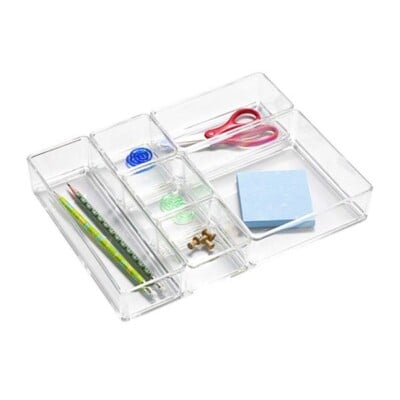
Once you’ve identified your categories, measure your drawer so you can add organizers that fit. Some type of bins or drawer dividers is essential for junk drawer organization. Because these drawers often contain multiple categories, organizers prevent everything from sliding together into one big pile.
Measure the width, depth, and height of the drawer, then find organizers that fit your space and categories. Adjustable dividers, small bins, or modular trays all work well. Think of it like playing a little Tetris until everything fits perfectly.
Step 6: Put Everything Back (and Prep It for Use)
Now comes the satisfying part—putting everything back. Place each category into its designated organizer or section. But before you close the drawer, take it one step further.
This step will be unique to your junk drawer, but consider sharpening pencils, folding the end of the tape over so it’s easy to grab, refilling a lighter, or pairing batteries by size. These small finishing touches make a big difference. Now everything in your junk drawer is ready to be used at a moment’s notice.
What Should Actually Go in a Junk Drawer?
A well-organized junk drawer typically holds small, frequently used household items that don’t have another obvious home.
Some common items include:
Batteries
Scissors
Tape
Rubber bands
Pens and pencils
Flashlight
Matches or lighters
Phone chargers
Small tools like a screwdriver
The key is that every item serves a purpose and belongs to a category within the drawer.
Common Junk Drawer Organization Mistakes
If your junk drawer never seems to stay organized, one of these habits might be the reason.
Treating it like a catch-all. A junk drawer should not be where random items go to disappear.
Keeping broken items. Dead batteries, dried-out pens, and tangled cords create clutter quickly.
Not using drawer dividers. Without organizers, everything slides into one chaotic pile.
Mixing too many categories. Limiting the drawer to a few simple categories helps keep it functional.
Never editing the drawer. A quick reset every few months keeps clutter from building up again.
How to Keep Your Junk Drawer Organized
Once your drawer is organized, a little maintenance will go a long way toward keeping it that way. A quick five-minute reset once a month can help prevent clutter from building up—use that time to toss broken items, test pens, or remove anything that’s found its way into the drawer without a real purpose. Try to return items to their designated sections after using them so categories stay intact, and be mindful about what you add back in. If something doesn’t serve a clear purpose, it likely doesn’t need to live there.
A junk drawer doesn’t need to be perfect, but with a simple system in place, it can stay functional, tidy, and easy to use.
Organize Your Junk Drawer With the Help of These Hard-Working Products
Once your drawer is decluttered and categorized, the right organizers make all the difference. Drawer dividers, small bins, and modular trays keep items from shifting around and turning back into one big pile.
The right tools help ensure that every item in your drawer has a home—and stays there.

 Login
Login