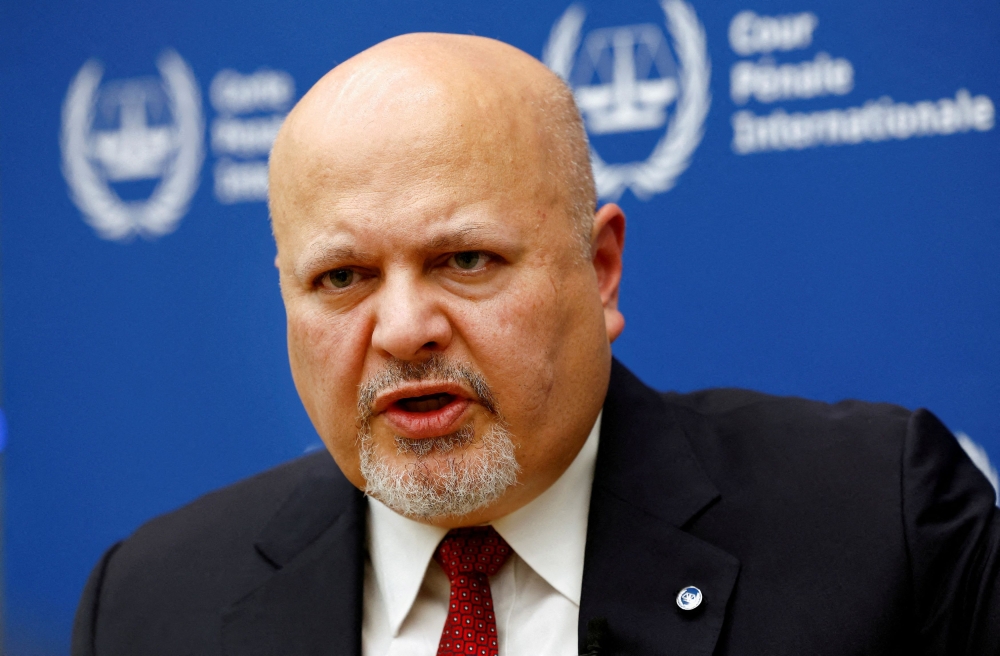
THE HAGUE, June 9 — A key governing body of the International Criminal Court yesterday suspended chief prosecutor Karim Khan as he faces sexual abuse allegations against a member of his office.
The 21-member bureau of the Assembly of State Parties (ASP) decided to refer Khan’s case to the wider ASP that represents every member country of the ICC.
The bureau decided “by qualified majority... to suspend the Prosecutor from duty with immediate effect pending the final decision of the Assembly of States Parties as the competent decision-maker,” the body said in a statement.
“The bureau emphasises that this suspension is not an indication of the final outcome,” added the statement.
The decision will have little practical impact on the functioning of the court, as the 55-year-old Khan stepped aside in May 2025, taking a leave of absence to fight the allegations that he denies.
He has already been removed from pleading in the ICC’s most high-profile case against former Philippines president Rodrigo Duterte.
A special session of the ASP will be convened as soon as possible to discuss the Khan case, according to the statement.
The 55-year-old Briton hit the headlines when he sucessfully applied for arrest warrants against Israeli Prime Minister Benjamin Netanyahu and former defence minister Yoav Gallant over the Gaza war.
He was among the first to be sanctioned by Israel’s ally, the United States, which expressed outrage over the arrest warrants. — AFP
KUALA LUMPUR, June 9 — Police have arrested 15 men after raiding an illegal cockfighting activity at a coastal hut near the Miri Golf Club area on Thursday afternoon.
The 3.30pm raid was carried out by officers from the Miri district police headquarters following a tip-off on the activity at the location, according to a report by BuletinTV3.
Miri police chief Asst Comm Mohd Farhan Lee Abdullah confirmed that all those detained were locals aged between 28 and 74.
He said various items believed to have been used in the activity were seized during the raid, along with live and dead roosters found at the scene.
“Initial investigations found that all suspects admitted they were at the location for cockfighting purposes,” he said in a statement.
Police have completed investigation papers and all suspects were charged at the Miri Magistrates’ Court last Friday under Section 73(1)(g) of the Veterinary Public Health Ordinance 1999.
If convicted, they face a maximum fine of RM2,000 or up to six months’ jail, or both.
The court set June 12 for mention.
All accused were allowed bail of RM600 each with one local surety.
Republican Justices Samuel Alito, Clarence Thomas, and Brett Kavanaugh. | Chip Somodevilla/Getty Images
Here’s a familiar story. On Tuesday night, the Supreme Court handed down a decision that will almost certainly give the Republican Party an additional seat in the US House of Representatives. Not all of the justices disclosed how they voted, but the decision appears to have come down 6-3 along partisan lines — that is, the six Republican justices voted to give the GOP another House seat, while the Court’s three Democrats dissented.
In fairness, the GOP justices’ most recent decision in Allen v. Milligan fits a broader pattern in this Supreme Court’s gerrymandering cases that can be explained without accusing those Republican justices of deciding election cases solely on the basis of partisanship. The Court has spent the past seven years dismantling all federal safeguards against gerrymandering.
Allen fits this pattern. On its face, the Republican justices’ brief opinion in the case is just the next iterative step toward a legal regime where states can draw maps however they want, regardless of whether those maps are drawn to favor one political party, or whether they are drawn to lock nonwhite voters out of power.
But the Republican justices’ new decision stands out because, while the Allen opinion is consistent with the Court’s broader trend toward redistricting anarchy, its actual legal arguments are inconsistent with things the same justices said as recently as one month ago. The decision is also inconsistent with previous orders that the Court’s Republican majority handed down in the Allen case itself.
If you want the full rundown of all of these inconsistencies, go read Justice Sonia Sotomayor’s dissent in this most recent decision. There are so many of them that it is hard to escape the conclusion that the Court’s Republicans aren’t being honest about their true motivations. The simplest explanation for Tuesday night’s decision is that the Court’s Republican majority is bending the rules because they want the Republican Party to hold a majority in the House.
The decision in Allen breaks a rule that the Supreme Court announced one month ago
At the end of April, the Court’s Republican majority handed down Louisiana v. Callais, which completed a project that at least one member of that majority began more than four decades ago.
When this bill was being debated in Congress, however, there was a conservative faction within the Reagan administration that opposed it, and which unsuccessfully urged Reagan to veto it. Future Chief Justice John Roberts was a member of this faction, and as a fairly junior lawyer wound up doing much of the granular work that is often assigned to young attorneys. Among other things, Roberts wrote about two dozen memos opposing the 1982 amendment, and he drafted speeches and talking points for senior lawyers who also opposed it.
Although Roberts’ faction failed in 1982, Roberts held onto his grudge against the Reagan amendments to the VRA, and his faction eventually took over the Republican Party. All six of the Court’s Republicans joined Callais, which repealed the 1982 amendment and imposed a new rule requiring voting rights plaintiffs challenging a gerrymandered map to show that state lawmakers acted with racist intent.
In the Allen case, however, a three-judge panel that included two Trump-appointed judges determined that “we cannot understand [Alabama’s new congressional maps] as anything other than an intentional effort to dilute Black Alabamians’ voting strength.” The panel reached that conclusion in an astonishingly thorough 571-page opinion handed down in 2023. After Callais, the Supreme Court ordered that panel to reconsider its ruling, and the panel did not change its mind — concluding again that Alabama engaged in intentional race discrimination.
Among other things, the panel pointed out that the 2023 Alabama law drawing the new maps achieved its racial goals by holding together a majority-white area of the state known as the Gulf Coast, while dividing a Black-majority region known as the Black Belt. Incredibly, the 2023 state law said that the Gulf Coast “shall be kept together to the fullest extent possible,” in part because Alabama lawmakers wanted to preserve its “distinct culture stemming from its French and Spanish colonial heritage.”
The state legislature, in other words, wrote into the statute itself that it wished to preserve a European American region of the state’s ability to elect its preferred representative, while the same law also broke up an African American region of Alabama. If that doesn’t give rise to a strong inference that intentional discrimination occurred, nothing does.
The Republican justices’ latest opinion in Allen, meanwhile, is only four pages long. And it spends only a single sentence responding to the hundreds of pages of evidence the lower court compiled, which shows that Alabama engaged in intentional race discrimination. According to the Republican justices, the lower court “did not heed the presumption of legislative good faith” that judges are supposed to apply to state lawmakers who are accused of race discrimination.
So, to summarize, just over one month after the Court’s Republicans declared in Callais that racial gerrymandering plaintiffs could still prevail if they can show that a state’s legislature engaged in intentional race discrimination, those same Republicans appear to have abandoned that rule. And the upshot is that the Republican Party gets an extra seat in the US House.
The GOP justices’ Allen opinion isn’t even consistent with their previous decisions in the same case
As Sotomayor explains in her dissent, there are several other examples of the Republican justices taking one position in previous decisions, then abandoning them in order to hand a victory to Alabama Republicans.
The most galling is that, in Callais, the Republican justices explicitly stated that “we have not overruled Allen,” a reference to the Supreme Court’s 2023 ruling in this very same case, where the Court struck down Alabama’s maps and ordered it to draw new ones. It’s now clear that the Republican justices were lying when they said that in Callais. The Court’s 2023 ruling in Allen held that Alabama must draw maps with at least two Black congressional districts, while its 2026 ruling in Allen holds that Alabama does not need to do so after Callais. So Callais overruled the 2023 opinion in Allen.
Sotomayor also spends much of her opinion warning that the Court’s latest Allen decision is likely to cause “chaos” in Alabama’s upcoming congressional election, because the primaries in that election are supposed to take place on August 11, leaving the state with very little time to complete the time-consuming task of going through each voter’s record to make sure they are assigned to the correct district.
According to Sotomayor, after a federal district court first struck down an earlier version of Alabama’s maps in 2022, the state told the Supreme Court that it needed to block that decision because the district court handed it down four months before a primary election, and “four months was not enough time to change congressional maps.” Sotomayor’s Republican colleagues appear to have agreed with that claim. Indeed, when the Court agreed to block the 2022 decision, two justices warned that the lower court’s order “would require heroic efforts by . . . state and local authorities in the next few weeks—and even heroic efforts likely would not be enough to avoid chaos and confusion.”
So, when a lower court handed down a decision that would have benefited the Democratic Party by requiring Alabama to draw a map that would elect an additional Black Democrat, the Republican justices appear to have concluded that four months wasn’t enough time for Alabama to comply with that decision. Now, however, those same justices have decided that the state can pull off the same “heroic efforts” in just two months.
In fairness, the Court’s Republicans have occasionally ruled against their political party when that party presents particularly weak arguments. In 2020, for example, the Supreme Court famously rejected President Donald Trump’s attempt to overturn his loss to former President Joe Biden.
As I wrote at the time, handing a victory to Trump would have required herculean efforts by the justices, because Biden won by a wide enough margin that the Court would have needed to overturn the election results in three different states. That was too much even for this Supreme Court.
But this is still the same Supreme Court which held in 2024 that Trump is allowed to use the powers of the presidency to commit crimes. So the Republican justices are willing to do extraordinary favors for their political party and its leadership, even if they don’t do the GOP’s bidding in literally every case that comes before them.
It is safe to say, in other words, that the Republican justices are putting a thumb on the scales of the 2026 midterms. That’s not the same thing as putting a one-ton sack of concrete on those scales. But the most reasonable explanation for the GOP justices’ behavior is that they want to give an advantage to the Republican Party and are willing to contradict their own past decisions in order to do so.
Joshua Wong’s national security case has been transferred to a higher court, where the pro-democracy activist faces up to life imprisonment, following the conclusion of committal proceedings.
Joshua Wong. File Photo: Joshua Wong, via Facebook.
Wong appeared at the West Kowloon Magistrates’ Courts on Thursday morning to face a charge of conspiring to commit foreign collusion, a crime under the Beijing-imposed national security law.
In the present case, the 29-year-old stands accused of conspiring with self-exiled activist Nathan Law and “other persons unknown” between July 1 and November 23, 2020, to request foreign countries, organisations, or individuals based overseas to impose sanctions, blockades or engage in other hostile activities against Hong Kong or China.
Magistrate Victor So said in August last year that Wong’s case would be transferred from the magistrate’s court to the High Court, where the maximum penalty is life imprisonment. At the magistrate’s court, the maximum penalty is two years, or three years when a defendant faces more than one offence.
Since then, Wong has appeared at a number of hearings related to the committal of the case to the High Court.
The High Court. File photo: Kyle Lam/HKFP.
Under court reporting laws, media reports relating to procedures involving the transfer of cases from the magistrate’s court to the High Court are severely restricted.
Reports cannot publicise the contents of the procedures, and can only describe information such as the names of defendants, judges and lawyers, and information on the charges.
Wong has been remanded since November 2020, when he was detained in an unauthorised assembly case linked to the anti-extradition protests and unrest in 2019.
A Hong Kong court has upheld the conviction and sentence of a journalist and former head of a press union for obstructing police while reporting.
Ronson Chan in 2024. File photo: Kelly Ho/HKFP.
Veteran journalist Ronson Chan began serving his five-day sentence on Friday after Deputy High Court Judge Lily Wong upheld a lower court’s conviction over an incident in September 2022, when Chan refused to show his ID card to a police officer while reporting on a homeowners’ meeting.
In her written judgment, which was not read out in court on Friday, Wong shot down Chan’s argument that the police officer’s demand was unlawful and found that the journalist had obstructed the police by wilfully delaying the presentation of his identification.
According to case details, Chan was covering the meeting at MacPherson Stadium in Mong Kok, where he was stopped by a plainclothes police officer who said he was acting “suspiciously” and asked to see his identification card.
He was arrested on suspicion of obstructing a police officer after allegedly failing to comply with demands to produce his ID card despite multiple warnings.
At trial, Chan said that he refused to present his identification due to privacy concerns, referring to an incident during the 2019 protests when a police officer showed his ID card in front of his camera, which was live-streamed to thousands of viewers.
The High Court. File photo: Kyle Lam/HKFP.
The West Kowloon Magistrates’ Courts found Chan guilty in September 2023, a year after he was arrested.
The trial judge, Leung Ka-kie, said Chan deliberately stopped the police officer from carrying out her duties and that his persistent questioning of officers when they asked for his identification was “reckless and unreasonable.”
‘Social climate’
Noting online calls to protest at the homeowners’ meeting, Judge Wong also concurred with the trial judge’s ruling that the police officers were justified in their actions to maintain public order.
“As the Magistrate ruled… given the social climate at the time, observing the rules and maintaining order in public places in Hong Kong was both important and commendable,” Judge Wong wrote.
Chan repeatedly questioned the officers and ignored warnings to calm down, and only offered an opaque cardholder, which constituted wilful obstruction, the judge added.
Chan’s barrister, Steven Kwan, told the court that he would seek a certificate from the appellate court to take the journalist’s appeal to the city’s apex court, but did not submit a bail application.
With the certificate, Chan would be able to seek permission for a final chance to appeal his conviction and sentence.
Reactions from press groups
Chan, who was elected as chair of the Hong Kong Journalists Association (HKJA) in June 2021, stepped down at the end of his term in June 2024, citing increasing pressure against him and the press union.
Hong Kong Journalists Association. Photo: HKFP.
In a statement issued on Friday, the HKJA expressed “deep regret” over the court’s decision and raised concerns about the ruling’s impact on journalists’ work.
“Citing the exercise of constitutionally protected fundamental rights as grounds for a search is legally untenable, and today’s ruling failed to directly address this contradiction,” the HKJA said.
Reporters Without Borders (RSF) said on Friday that it “is outraged by the imprisonment of Ronson Chan.”
“The verdict sets a dangerous precedent, effectively giving the police a free hand and further eroding already dismantled press freedoms,” said Aleksandra Bielakowska, advocacy manager of RSF Asia Pacific.
The immediate upshot of this decision is that Joseph Clifton Smith, who’s at the heart of this case, will not be killed. Smith prevailed in the federal appeals court that previously heard his case. And the fact that the justices decided not to decide Hamm — they dismissed it “as improvidently granted,” to use the Court’s precise legal terminology — means that Smith’s victory in the lower court stands.
Though the full Court issued no opinion in Hamm, six justices joined at least one of three concurring or dissenting opinions revealing how they thought the case should have been decided. Justice Sonia Sotomayor’s concurring opinion offers a likely explanation for why her Court chose to make this case go away. Meanwhile, Justices Clarence Thomas and Samuel Alito’s dissenting opinions reveal some riffs among the Court’s Republicans.
In Atkins v. Virginia (2002), the Supreme Court held that it is unconstitutional to execute someone with an intellectual disability. The Hamm case largely turned on whether Smith’s IQ is low enough that he qualifies as intellectually disabled. But most of the justices appear to have thrown up their hands and determined that they are not well-positioned to determine Smith’s IQ.
Sotomayor’s opinion suggests that Alabama may have lost this case because of inept lawyering. Among other things, she points out that none of the expert witnesses that testified in a lower court, including Alabama’s own expert, used the same methods to determine Smith’s IQ “that Alabama now claims is necessary.”
At least some constitutional protections against capital punishment are probably safe, for now.
Because the Supreme Court has the final word on questions of constitutional law, the justices are supposed to be reluctant to decide questions that are not fully vetted by lower courts, due to the risk that the Court could hand down an uncorrectable error if it decides a case too hastily. Thus, Sotomayor argues that her Court was right to “exercise caution” by not handing down the definitive word on a constitutional question that was not fully aired in other forums.
Meanwhile, at least some of the Republican justices appear to have backed away from more hardline positions that they took in the past. That means that at least some constitutional protections against capital punishment are probably safe, for now.
Most of the Republican justices appear to have made peace with Atkins
The Court’s right flank has historically opposed Atkins altogether. The late Justice Antonin Scalia, for example, claimed in Atkins that only “severely or profoundly” disabled people — perhaps those with an IQ of 25 or lower — are protected from execution. But, under the Atkins framework, people with an IQ of 70 or below are often ineligible for the death penalty. And people who test slightly higher than 70, such as Smith himself, may also sometimes show that they are intellectually disabled by pointing to other factors besides IQ.
But only Thomas, who wrote a dissenting opinion in Hamm that was joined by no one else, called for Atkins to be overruled.
It’s particularly surprising that Justice Neil Gorsuch, who previously has expressed very hardline views in death penalty cases, appeared to chart a more moderate course in Hamm. Gorsuch seemed to suggest in Bucklew v. Precythe (2019) that his Court should toss out the entirety of its past 60 years worth of cases interpreting the Eighth Amendment’s ban on cruel and unusual punishments, and instead adopt a new rule that would allow the government to impose very high penalties for minor crimes.
But, of the three Hamm opinions, only Thomas cited Bucklew. And Gorsuch neither joined Thomas’s opinion nor did he join some parts of Alito’s opinion, which called for harsher rules in Atkins cases. So it appears that Gorsuch’s Bucklew opinion may be an orphan.
Alito, meanwhile, wrote a bifurcated opinion, major parts of which were joined by a total of four justices — Alito, Chief Justice John Roberts, Thomas, and Gorsuch. But only Thomas joined the part of Alito’s opinion which called for the most limits on Atkins.
The parts of Alito’s opinion that were joined by four justices largely concern the unusual facts present in Hamm.
It’s safe to say that Smith’s claim that he is intellectually disabled is marginal. While courts consider whether a capital defendant’s IQ is below 70 in order to determine if that defendant is intellectually disabled, Smith took several tests that measured his IQ somewhere in the 70s — and none of them showed that he has an IQ of 70 or below.
Under the Court’s previous death penalty cases, the fact that a death row inmate tests slightly above 70 is not fatal to his Atkins case — in part because IQ tests have a margin of error and may overestimate a test subject’s IQ. But Alito essentially argues that someone like Smith, who took multiple tests that showed him with an IQ above 70, may be executed.
In the part of his opinion joined only by Thomas, meanwhile, Alito claims that “‘higher scores are likely to be more indicative’ of a person’s intelligence than the lower scores,” a rule that would potentially doom capital defendants with a wide range of scores, some of which are below 70.
Still, it’s notable that Alito focused his opinion so closely on the minutiae of the Hamm case, without making broader attacks on Atkins or on the general rule that intellectually disabled people may not be executed. It is tough to evaluate where the full Court stands on Atkins, as three justices — Elena Kagan, Brett Kavanaugh, and Amy Coney Barrett — were silent in Hamm. But it now appears likely that the Court’s current majority does not plan a wholesale assault on Atkins, or on the Court’s broader framework for determining which punishments are impermissible. That’s good news for inmates whose lives could be spared by Atkins and similar cases.
The Court’s Republican majority is often hostile to past precedents that were decided by more liberal justices. Indeed, at times, they appear to have been going through a checklist, overruling decisions where the Court’s right flank lost and transforming dissents by justices like Scalia or Thomas into majority opinions. But, for now, at least, it appears that Atkins is not on this Court’s checklist.
A transgender alum has sued her former secondary school over “discriminatory” policies that barred her from having long hair.
Lung Kung World Federation School Limited (LKWFSL) Lau Wong Fat Secondary School in Tai Kok Tsui. Photo: LKWFSL Lau Wong Fat Secondary School.
Oscar Fung, who studied at Lung Kung World Federation School Limited (LKWFSL) Lau Wong Fat Secondary School in Tai Kok Tsui from 2019 to 2025, filed a writ in the District Court on Thursday, local media reported.
According to the writ, Fung experienced gender dysphoria at the age of 14 when her parents separated.
During the Lunar New Year holiday in 2024, Fung decided to grow out her hair. However, she was reprimanded at school after the break because her hair exceeded the length permitted for male students and was accused of violating school rules.
The writ stated that Fung was scolded by two teachers for almost 30 minutes one day, with the teacher threatening to withdraw her from science competitions she was representing the school in.
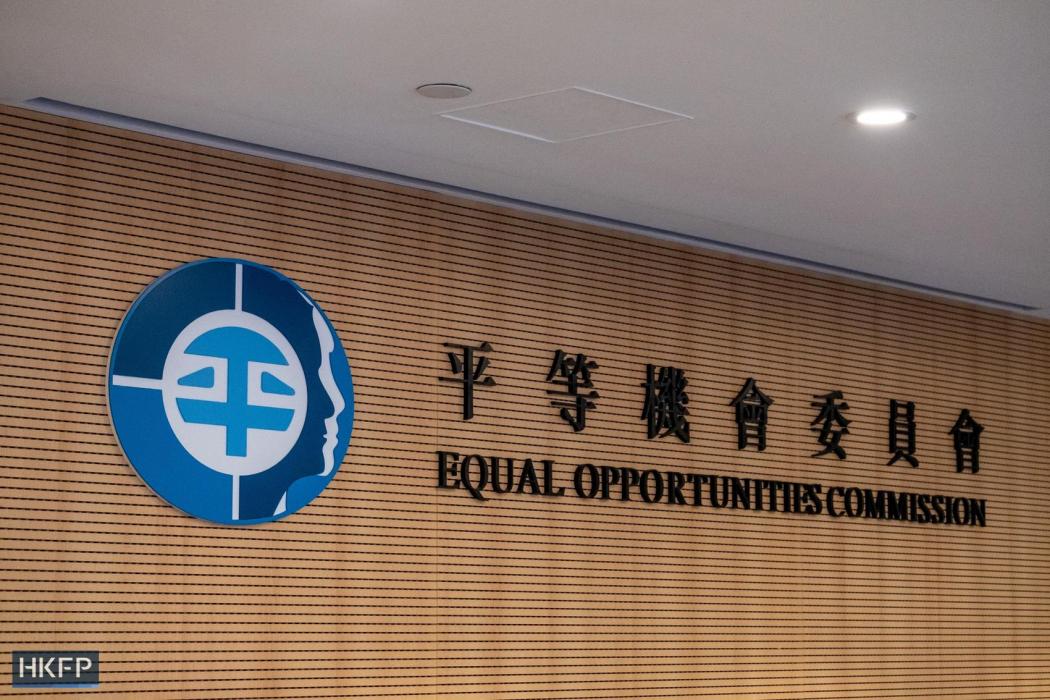
Equal Opportunities Commission. Photo: Kelly Ho/HKFP.
Fung felt embarrassed and angry as other students witnessed the scene. She was then sent to the disciplinary teacher, who accused her of “cosplaying as a girl” and told her to cut her hair.
The writ also mentioned that Fung had filed a complaint with the Equal Opportunities Commission, but it was dismissed.
‘Injury to feelings’
Fung alleged in the writ that the school had breached the Sex Discrimination Ordinance, as female students were allowed to grow long hair while male students were not.
She asked the court to declare the school’s rules discriminatory and to order it to pay damages for “injury to feelings,” a term under the ordinance.
District Court in Wan Chai. File photo: Hans Tse/HKFP.
The writ also stated that one of the school’s vice principals, Pang King-fai, had twice dismissed the Sex Discrimination Ordinance.
During a meeting with Fung before the 2023-24 school year ended, Pang said the school was not subject to the Sex Discrimination Ordinance.
The second instance was during a ceremony on the first day of school for the 2024-25 academic year in September 2024. Pang told pupils publicly that male students’ hairstyles did not fall under the ordinance, and any challenges would be handled through disciplinary measures.
According to the writ, another vice principal, Li Wing-yee, told Fung that if she did not abide by the school’s rules, she should change schools.
A hearing for the case has been scheduled for July 15, according to the Judiciary’s website.
Justice Brett Kavanaugh wrote the majority opinion in Pitchford v. Cain. | Aaron Schwartz/AFP via Getty Images
Justice Brett Kavanaugh is a Republican. He served in a Republican White House, typically votes with the Court’s other Republicans, and even sometimes sides with President Donald Trump in major cases that divide the Republican Party. He’s not the sort of person you’d expect to carry a torch for a liberal cause for nearly four full decades.
But, well, he did. In Kavanaugh’s majority opinion in Pitchford v. Cain, which was handed down on Thursday, the justice more or less implemented a proposal for how to prevent racism from infecting jury selection that he first proposed in a 1989 piece that he published when he was still a law student.
To be clear, Kavanaugh’s Pitchford opinion doesn’t really break much new ground. It involves a straightforward violation of Batson v. Kentucky (1986), the Supreme Court’s most important precedent governing race in jury selection, and rules in favor of the person on death row who brought this fairly clear-cut violation to the Supreme Court’s attention.
Still, Pitchford was a 5-4 decision, with four of Kavanaugh’s fellow Republicans joining a dissent by Justice Neil Gorsuch. So the decision could have easily come down the other way if one of the Republican justices hadn’t developed a liberal approach to Batson before he started his legal career. Sometimes, even Supreme Court justices — arguably the most highly vetted political appointees in the entire federal government — contain multitudes.
Again, Pitchford is a fairly easy case. In a less ideological Supreme Court, the incarcerated person at the heart of this case might have won unanimously. But the decision does suggest that left-leaning advocates can sometimes prevail in this Court by appealing to the idiosyncratic views of some of the Republican justices.
Kavanaugh’s long-standing approach to race in jury selection, explained
In 1989, Kavanaugh published a “note” in the Yale Law Journal. Notes are student-authored works of legal scholarship, which often examine an important recent legal development. High-achieving law students frequently choose to write these notes because it gives them a published exemplar of their own legal writing skills that they can share with potential employers.
The surprising twist is that in his 1989 note, Kavanaugh — who, of course, would go on to become one of the most powerful Republicans in the United States — chose to advocate for a cause that is ordinarily associated with liberals. Published three years after the Supreme Court handed down Batson, Kavanaugh’s note, which is titled “Defense Presence and Participation: A Procedural Minimum for Batson v. Kentucky Hearings,” argued that the Court’s recent decision protecting against racism in jury selection should be read to include certain procedural protections for criminal defendants.
In criminal trials, both the prosecution and the defense often get a limited number of “peremptory challenges,” which they can use to remove a potential juror from the jury pool for virtually any reason. These peremptory strikes may be used to remove a juror because the prosecutor doesn’t like the juror’s haircut, because the defense counsel thinks a juror looked at their client suspiciously, or because counsel doesn’t like having jurors whose name begins with the letter “M.”
But the Constitution prohibits prosecutors from removing a juror because of that juror’s race.
As Kavanaugh explains in his Pitchford opinion, Batson sets up a three-step process to determine whether prosecutors did, in fact, remove a juror for impermissible racial reasons. After the defense counsel objects to the removal of a particular juror or group of jurors (step one), the prosecutor typically must give a race-neutral explanation for why they wanted the juror removed (step two). At step three, Kavanaugh writes, “defense counsel has an opportunity to rebut the prosecutor’s race-neutral reason as pretextual,” and then the judge has to decide who is telling the truth.
Kavanaugh’s 1989 note argues that courts must ensure that this third step is complied with; he wrote at the time that “the defense should have an opportunity to rebut the prosecutor’s reasons before the trial judge decides whether to allow the prosecutor’s peremptories.” His opinion in Pitchford makes a very similar argument.
In Pitchford, prosecutors in a Mississippi murder case used their peremptory challenges to remove four of five potential Black jurors from defendant Terry Pitchford’s jury pool. Defense counsel objected on Batson grounds, and the prosecutor gave race-neutral explanations for targeting these jurors. (The prosecution claimed that one juror was removed because they arrived late to court, two because they had brothers convicted of violent offenses, and one because he, like the defendant, was a young father.)
But the trial judge never gave defense counsel an opportunity to rebut these explanations. The judge simply deemed the prosecutor’s explanations acceptable and moved on.
So how did this easy case produce a four-justice dissent?
To be clear, it’s not exactly a stretch for Kavanaugh to argue that, when Batson said that courts must use a three-step process to resolve jury discrimination claims, all three steps are mandatory. At most, Pitchford makes explicit something that was already implicit in US law.
But Pitchford was complicated by a federal law, the Antiterrorism and Effective Death Penalty Act of 1996 (AEDPA), that makes it difficult for convicted offenders to challenge their convictions or sentences in federal court if they were first tried in state court. To prevail in such a federal challenge, Pitchford must show that state courts handed down a decision that “was contrary to, or involved an unreasonable application of, clearly established Federal law, as determined by the Supreme Court of the United States” or “was based on an unreasonable determination of the facts in light of the evidence presented in the State court proceeding.”
Given this high bar placed in front of people who wish to challenge state-level convictions or sentences, a federal judge who wants to leave the state court’s decision in place will almost always be able to find a way to do so. And Gorsuch’s opinion does just that.
The dissent’s primary argument is that Pitchford waived his Batson argument because, while his lawyers raised it in the trial court, they did not provide enough detail about how, specifically, the trial judge violated Batson when they raised this objection. As a general rule, lawyers may not raise an argument on appeal unless they also raised that argument in the trial court.
That’s not a very good argument, because, as Kavanaugh explains, defense counsel raised their Batson argument multiple times at trial. And, after one of these objections, the trial judge “explicitly assured Pitchford’s counsel that the Batson objection was preserved.” So it would have been odd — and could have potentially antagonized the judge — if defense counsel had elaborated further on their Batson argument after the judge effectively told them to drop the issue and take it up in the appeals courts.
But the fact remains that Pitchford barely prevailed in the Supreme Court. And, if not for the fact that Kavanaugh appears to have developed the view that all three prongs of Batson’s process are mandatory in law school, this case would have likely come out the other way.
Liberal victories aren’t exactly common in this Court, but they also aren’t so rare that they are unimaginable. In this case, one of the justices appears to have formed an opinion on a politically contentious issue before he fully embraced the broader worldview that he needed to have in order to score political appointments in a Republican administration. And that means that, at least in cases involving jury discrimination, criminal defense lawyers will sometimes find a sympathetic bench in the Supreme Court.
Ng Kam-cheong, 70, wore a mask and sunglasses when he appeared at the Kwun Tong Magistrates’ Court on Thursday, Court News reported.
Police officers at the site of a fatal traffic accident in Ngau Tau Kok on May 13, 2026. Photo: Supplied.
He was charged with one count of dangerous driving causing death and three counts of dangerous driving causing grievous bodily harm.
Ng was arrested on May 13 after a fatal traffic incident in Ngau Tau Kok on the same day.
He was driving downhill along Chun Wah Road when his taxi went out of control, mounted the pavement and a sitting-out area on Choi Ha Road, and hit two female pedestrians.
One woman was certified dead at hospital around 40 minutes after the crash. The other pedestrian died in hospital on Monday, five days after the accident.
The two passengers in the taxi suffered chest, back and neck injuries – they were in stable condition as of Monday.
The defendant was granted bail of HK$50,000 on the condition that he must surrender all travel documents, be barred from leaving Hong Kong, hand over his driving licence, refrain from driving any class of vehicle, and report to a police station every week.
The offence of dangerous driving causing death carries up to 10 years’ imprisonment in Hong Kong, while the offence of dangerous driving causing grievous bodily harm is punishable by up to 7 years in jail.
BANGKOK, June 6 — A Thai court has sentenced a ride-hailing driver to one month in jail and fined him 5,000 baht (RM645) for assaulting a Japanese passenger following a dispute during a trip in Bangkok.
The incident occurred near the busy Asok intersection on Monday and involved a 23-year-old driver and a 52-year-old Japanese passenger travelling in a Bolt vehicle, The Bangkok Post reported today.
The passenger admitted swearing at the driver and kicking the driver's seat during an argument over the fare and traffic conditions.
The driver later ordered the passenger out of the vehicle before assaulting him.
The Criminal Court found the driver guilty of causing bodily harm and related traffic offences.
The driver had earlier settled separate administrative charges with a 3,000-baht (RM387) fine.
The court suspended the one-month jail sentence for one year.
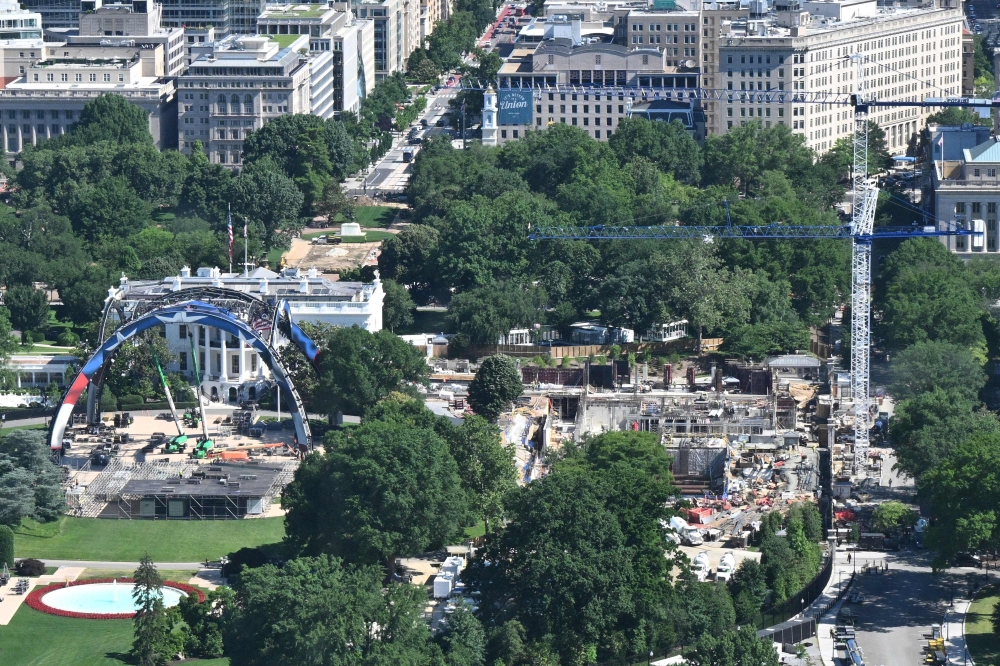
WASHINGTON, June 5 — US President Donald Trump’s administration will ask an appeals court today to allow construction of a US$400 million ballroom on the site of the White House’s demolished East Wing, pitting Trump against preservationists in a case testing the limits of presidential authority.
The East Wing, part of the White House complex in Washington, traditionally housed the offices of the first lady and her staff. The National Trust for Historic Preservation, a nonprofit group that campaigns to protect significant American sites, sued last year after the Trump administration tore down the East Wing in October 2025 and began building a 90,000-square-foot (8,360-square-meter) ballroom without seeking authorisation from Congress. Trump’s ballroom plan is part of a broader push by the Republican leader to reshape central Washington’s landscape of government buildings and national monuments. The hearing before a three-judge panel of the US Court of Appeals for the District of Columbia Circuit, a powerful court one rung below the Supreme Court, is scheduled for 9:30 am EDT (1330 GMT). US District Judge Richard Leon, appointed by Republican former President George W. Bush, twice blocked above-ground construction on Trump’s ballroom while allowing underground work to continue.
Leon said no federal statute even “comes close to giving the President” the required authority to construct the ballroom without approval by Congress.
The administration’s appeal is being heard by Democratic-appointed D.C. Circuit judges Patricia Millett and Bradley Garcia alongside Trump-appointed Judge Neomi Rao. In an order last month, the appeals court allowed construction to continue during the legal battle without ruling on the merits of the case. The administration has framed the ballroom project as a national security necessity, citing recent assassination attempts against Trump.
“The East Wing Project answers that critical security need, and ensures that the President can fulfill his constitutional duties in a safe and heavily secured facility,” the Justice Department told the appeals court in May.
Preservationists reject that argument. The National Trust for Historic Preservation contends that the D.C. Circuit and US Supreme Court have never allowed a president to “usurp powers vested in Congress by the Constitution based on nothing more than his claim of necessity.”
The organisation said in a filing that “the public has a strong interest in pausing a project that will irreparably damage what is perhaps the most significant historic site in the country.” Trump also intends to erect a 250-foot (76-meter) arch near the National Mall, the tree-lined strip between the US Capitol and the Lincoln Memorial, and renovate the Kennedy Center performing arts complex. A federal judge last week ordered Trump to remove his name from the iconic Kennedy Center building and blocked his plans to close it for renovations.
Trump has said his planned ballroom is scheduled to open around September 2028. — Reuters
 Login
Login