Login
Login
We Are Doing to Low Earth Orbit What We Did to the Oceans
About two tons of satellite material burns up in Earth’s atmosphere every day. That is the steady-state exhaust of a single company’s broadband network, SpaceX’s Starlink, operating at its current scale. Each vaporized spacecraft leaves behind aluminum oxide, lithium, copper, and a growing list of metals the upper atmosphere has never had to contained in these quantities before.
We’re following a familiar human pattern. A commons, like the low earth orbit (LEO) region of space, is declared abundant. Commercial activity scales faster than science can measure the consequences. Governance lags by a decade or more. By the time the damage is legible, it is already expensive to reverse.
We did this to rivers in the 19th century, to the atmosphere in the 20th, and to the deep ocean in a quiet accumulation that stretched across both. A new peer-reviewed analysis published in Advances in Space Research makes clear that LEO is now on the same trajectory, and the chemistry is moving faster than the regulation.
An Atmosphere Already Dominated by Human Metal
The paper, an update to a 2021 study, reassesses how much spacecraft material is now being injected into the mesosphere and lower thermosphere as satellites and rocket stages burn up on reentry. The comparison it draws is that for several metals commonly used in spacecraft, anthropogenic injection now rivals or exceeds the natural input from meteoroids.
What was already true in 2021 is more true now. The researchers incorporate direct observations from stratospheric aerosol sampling — work led by Daniel Murphy at NOAA and published in PNAS in 2023 — which confirmed that roughly 10 percent of stratospheric aerosol particles now contain aluminum and other metals traceable to satellite and rocket-stage burn-up. For decades, the natural baseline was micrometeoroid ablation, what space sent naturally toward our planet. Earth sweeps up roughly 30 to 50 metric tons of cosmic dust every day, a steady rain of mostly sand-grain-sized particles left over from comets and asteroids. Those grains hit the upper atmosphere at speeds between 11 and 72 kilometers per second, vaporize in a thin layer between about 75 and 110 kilometers altitude, and seed the mesosphere with iron, magnesium, silicon, sodium, and trace amounts of nickel, calcium, and aluminum. This process has been running for the entire 4.5-billion-year history of the planet. The metal layers it produces in the upper atmosphere are well-mapped; they are the chemistry the stratosphere evolved with.
Aluminum is a useful tracer because it is a small share of the natural input. Cosmic dust is dominated by silicates and iron, with aluminum running on the order of one to two percent by mass. So when researchers began detecting elevated aluminum in stratospheric aerosol particles in the early 2020s, the signal was unambiguous — meteoritic infall could not account for it. The source had to be terrestrial in origin, vaporized at altitude. Spacecraft, in other words.
Human vehicles have become a second, larger source.
The near-term trajectory is worse. Researchers at the University of Southern California documented an eightfold increase in stratospheric aluminum oxide between 2016 and 2022, corresponding almost exactly to the ramp-up of Starlink and other satellite megaconstellations. In 2022 alone, reentering satellites released an estimated 17 metric tons of aluminum oxide nanoparticles — raising total atmospheric aluminum input about 29.5 percent above natural levels.
The Ocean Parallel
Consider the deep ocean in the 1960s. Dumping was legal, monitoring was barely funded, and the prevailing assumption was that the ocean was big enough to absorb anything. We now know the answer to that assumption after finding microplastics in Mariana Trench amphipods, pharmaceutical residues in Arctic sediment cores, and PFAS in polar bear blood.
Low Earth orbit is in the 1960s-ocean phase. The prevailing assumption among launch operators is that satellites that burn up are satellites that disappear. Michael Byers, Canada Research Chair in global politics and international law, put this directly in a 2024 interview with Scientific American: “There’s this widespread assumption that something burning up in the atmosphere disappears, but, of course, mass never disappears.”
What it does instead is change form. A 250-kilogram satellite, typically about 30 percent aluminum by mass, generates roughly 30 kilograms of aluminum oxide nanoparticles as it ablates through the mesosphere. Those particles are small enough — 1 to 100 nanometers — that they can drift in the stratosphere for decades before settling. Aluminum oxide is not inert. It catalyzes the chlorine reactions that destroy stratospheric ozone, the same chemistry the Montreal Protocol was designed to stop. Crucially, the particles are not consumed in those reactions; they continue to destroy ozone molecules for the duration of their atmospheric lifetime.
The Scale Is Not Hypothetical
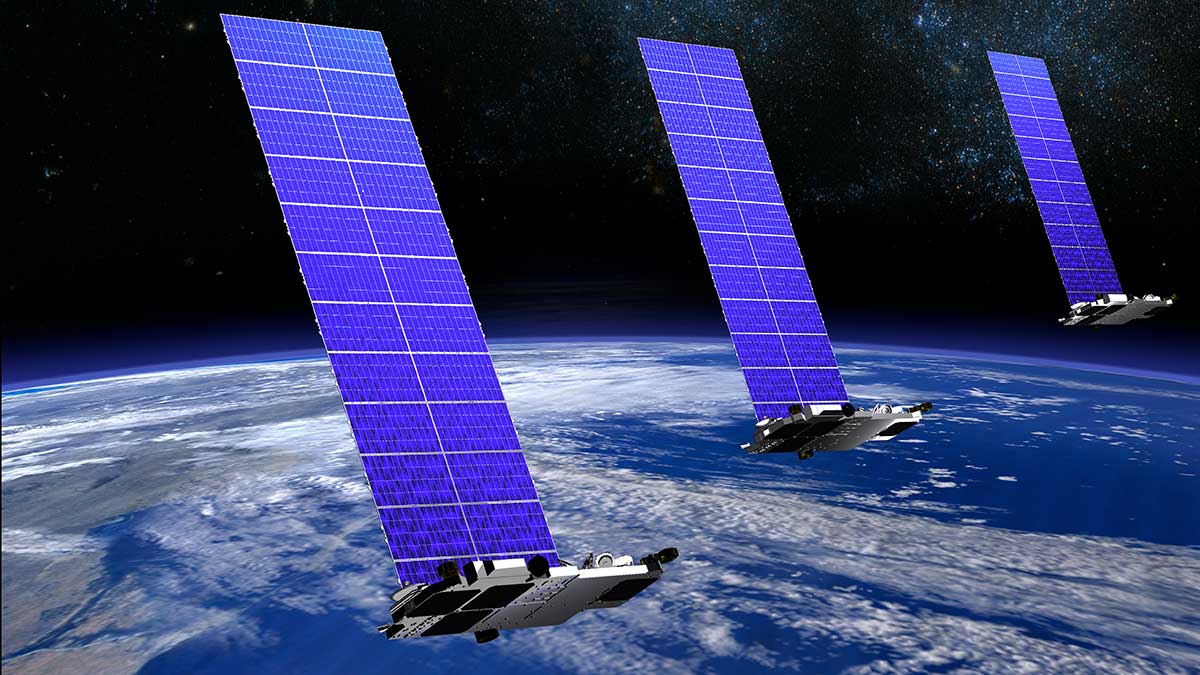
As of April 2026, SpaceX alone operates more than 10,000 active Starlink satellites, roughly two-thirds of all functioning spacecraft in orbit. The company has launched over 11,700 total, with about 1,500 already deorbited and replaced. Starlink satellites are designed for a five-year operational life, which means the constellation is, by design, a continuous churn: launch, operate, burn, launch again.
Amazon’s Project Kuiper, Eutelsat’s OneWeb, and a growing roster of Chinese state-backed constellations are moving toward similar architectures. The European Space Agency now tracks roughly 40,000 objects in low Earth orbit, about 11,000 of them active payloads, the rest debris or derelict hardware. Statistical models from ESA estimate another 130 million fragments smaller than one centimeter, each traveling fast enough to destroy whatever it hits.
Research published in Geophysical Research Letters projects that once currently planned megaconstellations are fully deployed, roughly 912 metric tons of aluminum will reenter the atmosphere every year, producing around 360 tons of aluminum oxide annually. A separate NOAA modeling study published in 2025 found that sustained alumina injection at expected 2040 levels could alter polar vortex speeds, warm parts of the mesosphere by as much as 1.5°C, and measurably impact the ozone layer.
Two Kinds of Pollution, One Commons
The orbital damage is happening on two fronts simultaneously, and they reinforce each other.
Atmospheric injection is the slow-accumulating chemistry problem. Every satellite that completes its mission becomes tomorrow’s stratospheric dust. A newly upgraded lidar system at the Leibniz Institute of Atmospheric Physics in Germany can now simultaneously detect lithium, sodium, copper, titanium, silicon, gold, silver, and lead in the upper atmosphere — each element a chemical fingerprint for specific spacecraft components. On February 20, 2025, the instrument registered a sudden spike in lithium vapor that researchers traced to a Falcon 9 upper stage reentering overhead.
The measurement capability is arriving just as the pollution is scaling.
Orbital debris is the faster-moving physical problem. SpaceX reported that its Starlink satellites executed 144,404 collision-avoidance maneuvers in the first half of 2025, due to collision warnings every couple of minutes, for six months straight — three times the previous rate. Two Starlink satellites have fragmented in orbit in the past four months, each creating a trackable debris field. Space is getting filled with junk that led to the International Space Station performing avoidance maneuvers twice in a single six-day window in November 2024, and again in April 2025.
Darren McKnight, a senior technical fellow at the debris-tracking firm LeoLabs, told IEEE Spectrum that certain orbital altitudes at 775, 840, and 975 kilometers have already passed the debris-density threshold where collisions generate fragments faster than atmospheric drag can remove them. This is known as the Kessler syndrome, proposed by NASA scientists Donald Kessler and Burton Cour-Palais in 1978, and it is no longer hypothetical in every band.
“Some operators in low Earth orbit are ignoring known long-term effects of behavior for short-term gain,” McKnight said, “Some will not change behavior until something bad happens.”
The Governance Gap
There is no body that regulates the cumulative atmospheric impact of satellite reentries. No operator is required to submit an environmental impact assessment for a constellation’s aggregate burn-up.
The FCC licenses spectrum.
National launch authorities license liftoff.
Debris mitigation guidelines from the UN’s Committee on the Peaceful Uses of Outer Space are voluntary, and compliance is inconsistent. The chemistry of the upper atmosphere is, in regulatory terms, nobody’s jurisdiction.
The United Nations Environment Program took a first step in late 2025, releasing a report titled Safeguarding Space: Environmental Issues, Risks and Responsibilities. It framed space debris and atmospheric injection as “emerging issues” deserving the attention international bodies already give to ocean pollution and transboundary air quality. This is the same framing UNEP used for atmospheric ozone depletion in the 1970s before the Montreal Protocol. Measuring something does not fix it. But it is the necessary precondition for fixing it — and for the first time, the measurement infrastructure is catching up to the pollution.
The Counter-Case, Honestly
Not every specialist agrees the situation is as urgent as the headlines suggest. A skeptical review published in March 2026 argued that the Kessler cascade framing oversimplifies a risk that plays out on timescales of decades to centuries, and in specific orbital bands rather than across all of LEO. The review is right on one narrow point: the ISS has operated continuously at 400 kilometers since 2000, its debris risk is managed in real time, and the environment is not in a runaway state.
What the skeptical case does not resolve is the atmospheric chemistry. The Kessler debate is about whether low-earth orbit becomes unusable. The alumina question is about whether the recovery of the ozone layer — a genuine success story of international environmental governance — is quietly being undone from above. Those are different problems. The first might take a century. The second is already measurable and is projected to worsen within fifteen years.
The post We Are Doing to Low Earth Orbit What We Did to the Oceans appeared first on Earth911.