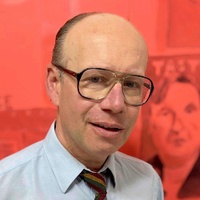
Women Laughing, Liza Donnelly and Kathleen Hughes documentary film about New Yorker women cartoonists past and present, will be screened at a number of venues beginning this Spring and into the Fall. You can see the schedule here.
Please note that three screenings are happening within the next few days:
Update: Thurber Prize For American Humor In Writing Awarded
Congrats to Shalom Auslanderfor being awarded the 2026 Thurber Prize for American Humor in Writing … and congrats once again to Emily Flake the (previously announced) 2026 Thurber Prize winner for American Humor In Cartoon Art.
“Motherhood-It’s the biggest on-the-job training program in existence today”. – Author and humorist Erma Bombeck. Indeed, this is true. And, this weekend, we get to celebrate all who have endured this lifelong “on-the-job training” for us on Mother’s Day.
Continuing a tradition from 2021 and 2025, what follows are some additional classic cartoon shorts that are perfect for Mother’s Day (three of them suggested by Cartoon Research readers).
Mother Hen’s Holiday, Columbia, (1937)
Here is a classic “Color Rhapsody” from Columbia, set on Mother’s Day.
As the short opens, we meet the Mother Hen (voiced by Toby Wing) who is singing about how much she has to do and how tired she is, and we can see why – she is mom to so many little chicks, they almost overflow out of the baby carriage.
It’s soon evident why she is so overwhelmed, as, once back home, the endless number of little chicks causes chaos in the house, creating absolute destruction. However, they then spot the calendar and note that it’s Mother’s Day.
The chicks then decide to do all they can for mom, cleaning and repairing the house. They even bake a cake and feed it to their happy Mother Hen, as the short ends.
Directed by Arthur Davis, Mother Hen’s Holiday features some nice sight gags, particularly during the sequences where the chicks trash the house, all set against lovely backgrounds.
It all has a cozy, classic cartoon tone, and a nice sentiment for Mother’s Day, as one of the little chicks state: “Make every day a Mother’s Day, not only once a year, every day in every way, cheer up mother dear, for everything you’ve done for us, perhaps we can repay, by making every single day a Happy Mother’s Day.”
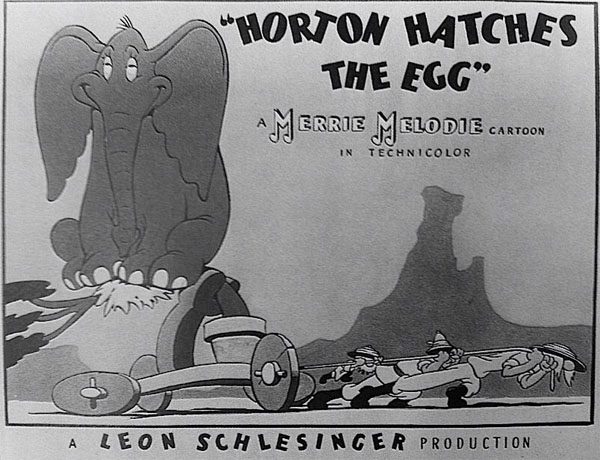
Horton Hatches the Egg, Warner Bros., (1942) – suggested by Frederick Weigand
Initially published as a book by Dr. Seuss (Theodor Geisel), in 1940, the book’s popularity eventually brought it to Warner Bros. as an animation project.
Horton Hatches the Egg tells the tale of Horton (Kent Rogers), an elephant who is tricked into sitting on an egg in a nest when the mother, Mayzie (Sara Berner), decides to rest and go on vacation. Horton endures several challenges: stormy weather, ridicule from other animals, hunters, and life in the circus.
Through it all, the steadfast elephant never leaves the egg, keeping his promise to Mayzie and repeatedly stating (in true Seuss rhyme), “I meant what I said, and I said what I meant. An elephant’s faithful, one hundred percent.”
The Warner Bros. artists remained close to the book. In fact, they wrote and sketched ideas for the short, right on the pages as they adapted them. Director Robert Clampett and his team, which included Robert McKimson, Bill Melendez, and Virgil Ross, inserted their unique brand of humor, which includes moments where Mayzie breaks into a brief impression of Katherine Hepburn.
Like the book upon which it is based, Horton Hatches the Egg is an innocent, endearing tale about nurturing and loyalty that is perfect for Mother’s Day, “one hundred percent.”
Bringing Up Mother, UPA (1954) – also suggested by Frederick Weigand
In a film noir-style opening, a police car drives slowly through the night street, calling all cars to be on the lookout for a John Smith. The shadow of a figure walking along a street passes by. He narrates: “Yeah, it’s me they want. I’m the guy, alright. But what could I do? She drove me to it. It was the only way out, and I took it.”
What we come to see through flashbacks is that this isn’t a thriller, and that isn’t the talk of a man who committed a crime, but instead a young boy who has run away from home, after his parents bring home his baby brother from the hospital, and the attention he received has shifted.
Don’t worry, there’s a happy ending: the police find John and cheerfully bring him home. But in the flashbacks throughout the short, the audience gets sharply written insight (by Tedd Pierce and director William Hurtz) into the relationship between the young boy and his mother, dating back to his infancy.
This includes a scene where Johnny, wearing a sailor hat and sucking his thumb, is told by his mother that “sailors don’t suck their thumbs.” So, Johnny proceeds to take off his sailor hat. In his full cowboy outfit and playing with his friend (in the role of the horse), Johnny is told by his mother that they’re “going to have a little baby to play with.” “I’d rather have a horse,” replies Johnny.
But when he’s promised a baby sister (which he’s excited for, as there will be a cowgirl in the house) and instead gets a baby brother, that’s when he runs away.
The short has a wonderful, stylish design, by Robert Danko, in everything from backgrounds to characters, that is such a part of all UPA did, and is coupled with great voice work from Jerry Hausner as Johnny, Marvin Miller as the friendly police officer and Marian Richman as mom.
Bringing Up Mother is a great tribute to all mothers and what they deal with while raising one child, with another on the way.
Scooby-Doo, Where Are You?, “Jeepers, It’s the Creeper,” (1970) – suggested by Christopher Cook
There’s a slight Mother’s Day connection here, but a fun one, nonetheless. As Scooby and the gang look to hide from the ghoulish Creeper, Scooby (Don Messick) and Shaggy (Casey Kasem) sneak into in a chicken house. Scooby sits on an egg, which hatches, and the little chick imprints on Scoob, thinking he’s his mom.
The chick even begins barking and spends the remainder of the episode on Scooby’s nose (even when Scooby reveals the real identity of the creeper, at the end).
“Jeeper’s, It’s the Creeper” is an entertaining Scooby-Doo episode that offers a maternal subplot for those who crave classic Saturday morning memories.
Here’s the clip from the episode where the chick adopts Scooby Doo as his mother:
• If this clip isn’t enough for you and you need to see the whole episode – you can wait for it to come around on MeTV Toons – or you can buy the complete series on blu ray – or you can watch a slanted version of it online at DailyMotion.
Feel free to suggest some of your favorite cartoon shorts and episodes for Mother’s Day in the comments, and here’s wishing all a very Happy Mother’s Day.
James Thurber Born, Columbus, Ohio, December 8, 1894. Died 1961, New York City. New Yorker work: 1927 -1961, with several pieces run posthumously. According to the New Yorker’s legendary editor, William Shawn, “In the early days, a small company of writers, artists, and editors — E.B. White, James Thurber, Peter Arno, and Katharine White among them — did more to make the magazine what it is than can be measured.”
Key cartoon collection: The Seal in the Bedroom and Other Predicaments (Harper & Bros., 1932). Key anthology (writings & drawings): The Thurber Carnival (Harper & Row, 1945). There have been a number of Thurber biographies. Burton Bernstein’s Thurber (Dodd, Mead, 1975) and Harrison Kinney’s James Thurber: His Life and Times (Henry Holt & Co., 1995) are essential. Website
Exhibit Of Interest: Edward Sorel & Madeline Sorel
Sorry I missed the opening date of this exhibit, but there are still two weeks left to see it. Edward Sorel and his eldest daughter, Madeline Sorel in a joint exhibit of their work. From Kingsborough Community College’sLinkedin:
Father and daughter are now launching a unique joint-show at the college where Madeline has taught illustration for the past 25 years. The Family Line: Edward and Madeline Sorel, seeks to tell the story through each artist’s work of overcoming external influences to develop one’s own voice and in doing so, develop their own sense of self.
The exhibit is at the Kingsborough Art Museum (KAM) at Kingsborough Community College, 2001 Oriental Boulevard, Brooklyn, NY. The show, free and open to the public, runs through May 20.
__________________
Madeline Sorel, an illustrator, collagist, felt artist and, the past 25 years, professor in Kingsborough Community College’s art department.
Edward Sorel’s A-Z Entry:
Edward Sorel (self-portrait above from a strip appearing in The Nation following the death of Marlene Dietrich. Drawing used by permission of Mr. Sorel). Born 1929. New Yorker work: 1990 – . All of Mr. Sorel’s books are of great interest; Unauthorized Portraits (Alfred A. Knopf, 1997) is particularly essential. Website:edwardsorel.net
We learned yesterday that Peter Kuper (above, left) and Ivan Ehlers (on the right) were named finalists in the Pulitzer Prize category of Illustrated Reporting and Commentary. The Spill congratulates both of these fine folks.
Mr. Kuper began contributing to The New Yorker in 2011; Mr. Ehlers in 2021.
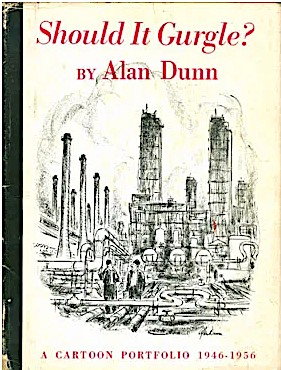
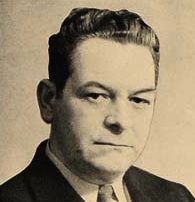
— this piece by Will Wiles comes just weeks before the publication of Gabriele Neri’s Alan Dunn: The Cartoonist As Architectural Critic (May 25, 2026. MIT Press).
Mr. Dunn was, for many years, the most published New Yorker artist.
Alan Dunn (self portrait above from Meet the Artist) Born in Belmar, New Jersey, August 11, 1900, died in New York City, May 20, 1974. New Yorker work: 1926 -1974 Key collections: Rejections (Knopf, 1931), Who’s Paying For This Cab? (Simon & Schuster, 1945), A Portfolio of Social Cartoons ( Simon & Schuster, 1968). One of the most published New Yorker cartoonists (1,906 cartoons) , Mr. Dunn was married to Mary Petty — together they lived and worked at 12 East 88th Street, where, according to the NYTs, Alan worked “seated in a small chair at a card table, drawing in charcoal and grease pencil.”
The Monday Tilley Watch takes a glancing look at the art and artists of the latest issue of The New Yorker
The Cartoonists and Cartoons
Nineteen cartoons, twenty cartoonists in this themed (“America At 250”) double issue* (Barry Blitt has the cover). One duo, that we know of (the Spill counts duos as one cartoonist). No newbies. Liana Finck has a ‘Sketchbook” as well as a cartoon.
*Not counting the three cartoonists whose drawings appear as part of the Cartoon Caption Contest. However, the longest active contributing cartoonist in the issue is Mort Gerberg, who supplied this week’s Caption Contest drawing (he began contributing in 1965).
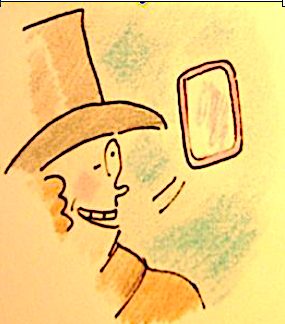
Back in May of 2017, the above perfect Talk design by Rea Irvin was carted away (after appearing for 92 years!) and replaced –if you can believe it — by a redraw via a contemporary illustrator. The Spill continues to hope Mr. Irvin’s work returns. Read more here.
_____________
Rea Irvin’s A-Z
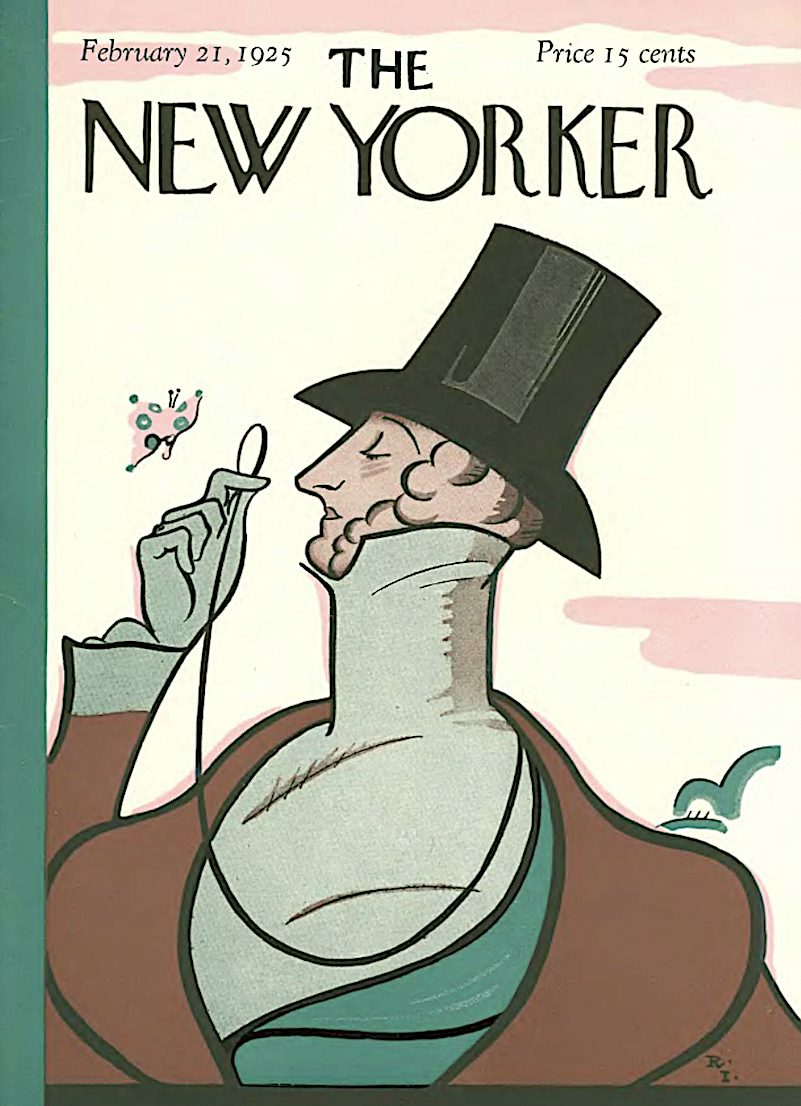
Rea Irvin (pictured above. Self portrait above from Meet the Artist) Born, San Francisco, 1881; died in the Virgin Islands,1972. Irvin was the cover artist for the New Yorker’s first issue, February 21, 1925. He was the magazine’s first art and only art supervisor (some refer to him as its first art editor) holding the position from 1925 until 1939 when James Geraghty assumed the title of art editor. Irvin then became art director and remained in that position until William Shawn officially succeeded Harold Ross in early 1952. Irvin’s last original work for the magazine was the magazine’s cover of July 12, 1958. The February 21, 1925 Eustace Tilley cover had been reproduced every year on the magazine’s anniversary until 1994, when R. Crumb’s Tilley-inspired cover appeared. Tilley has since reappeared, with other artists substituting from time-to-time. Number of New Yorker covers (not including the repeat appearances of the first cover every anniversary up to 1991): 179. Number of cartoons contributed: 261.
Tilley Watch Online, The Week of April 27–May 1, 2026
An end of the week listing of New Yorker artists whose work has appeared on newyorker.com features
Daily Cartoon: Lynn Hsu, Enrico Pinto, (the duo of) Sophie Lucido Johnson and Sammi Skolmoski, Sarah Kempa, Hilary Campbell. See them here (in a slideshow).
Pomp And Circumstance: A slideshow of graduation cartoons (the below, from the great Warren Miller,* is just one of many in this online special feature.
Warren Miller (photo by Liza Donnelly, NYC, Sept. 1997) Born 1936, Chicago, Ill. The following biographical information comes from The Phoenix Gallery site which hosted a group exhibit of NYer cartoonists work (Lorenz, Harris, Modell, and Miller) in 2007: “Warren Miller studied commercial and fine art at the American Academy of Art, Chicago. He started selling cartoons to Playboy and The New Yorker in 1961 and moved to New York City later that year. Miller’s work has also appeared in Esquire, Punch, Rolling Stone, Audubon, Harvard Business Review, Barrons, Time, Newsweek, The New York Times, and the London Sunday Times. Mr. Miller is a painter and a sculptor as well. He has exhibited his work in a number of shows in the New York area and in the Midwest.” Key collections: All Thumbs (Bobbs-Merrill,1967); Prince and Mrs. Charming (Bobbs-Merril, 1970). New Yorker work: 1959 -.
Polly Lou Adams Guests On The Latest Cartoon Caption Contest Podcast
Polly Lou Adams (upper left in the photo), who began contributing to The New Yorker in June of 2025, joins two of four CCCP co-hosts, Paul Nesja (upper right) and Nicole Chrolavicius. It’s Episode #249 for those keeping track. Listen here.
Cover by Rea Irvin: Born, San Francisco, 1881; died in the Virgin Islands,1972. Irvin was the cover artist for the New Yorker’s first issue, February 21, 1925. He was the magazine’s first art and only art supervisor (some refer to him as its first art editor) holding the position from 1925 until 1939 when James Geraghty assumed the title of art editor. Irvin then became art director and remained in that position until William Shawn officially succeeded Harold Ross in early 1952. Irvin’s last original work for the magazine was the magazine’s cover of July 12, 1958. The February 21, 1925 Eustace Tilley cover had been reproduced every year on the magazine’s anniversary until 1994, when R. Crumb’s Tilley-inspired cover appeared. Tilley has since reappeared, with other artists substituting from time-to-time. Number of New Yorker covers (not including the repeat appearances of the first cover every anniversary up to 1991): 179. Number of cartoons contributed: 261.
In a 1989 collection, Conversations With James Thurber (University Press of Mississippi) edited by Thomas Fensch, there’s a terrif article, “Melancholy Doodler,” by Arthur Millier (it originally appeared in The Los Angeles Times Sunday Magazine, July 2, 1939). Thurber was forty-four at the time, and in the last year of the best decade of his life, drawings-wise. His eyesight, by May of ’39, had already worsened to the point of his “struggling to type, read, and draw.”
The article makes no mention of Thurber’s eyesight or his struggles — it rolls along as if all’s well in Thurberland. Here are just a few quotes from the piece (I’d run the whole thing, but don’t want to get into a copyright muddle).
Thurber speaking to Millier:
“You are probably the only person in America who knows I write.” he said bitterly. “They all say: ‘Oh yes, Thurber?–the guy makes those crazy drawings?'”
“i’m not an artist. I’m a painstaking writer who doodles for relaxation. But it’s those doodles they go for…They’ve even labeled me a Dadiast and a surrealist…”
“I almost never have a piece of writing turned down [by The New Yorker]. They print them all — but who reads them? Whereas my drawings — the things people know me for — are often turned down.”
“Captions can make a drawing. Some of my drawings lie around the office for years — waiting for an inspired line.”
Finally, here’s Millier talking about Thurber’s drawings:
“When Thurber begins a drawing of these curious yet strangely familiar people, he rarely knows what they will look like or do. He just lets his hand move with a pencil in it. His people simply happen…”
James Thurber Born, Columbus, Ohio, December 8, 1894. Died 1961, New York City. New Yorker work: 1927 -1961, with several pieces run posthumously. According to the New Yorker’s legendary editor, William Shawn, “In the early days, a small company of writers, artists, and editors — E.B. White, James Thurber, Peter Arno, and Katharine White among them — did more to make the magazine what it is than can be measured.”
Key cartoon collection: The Seal in the Bedroom and Other Predicaments (Harper & Bros., 1932). Key anthology (writings & drawings): The Thurber Carnival (Harper & Row, 1945). There have been a number of Thurber biographies. Burton Bernstein’s Thurber (Dodd, Mead, 1975) and Harrison Kinney’s James Thurber: His Life and Times (Henry Holt & Co., 1995) are essential. Website
Photos, top row: Joe Dator, Amy Hwang, Tom Toro; middle row: Jason Chatfield, Tom Chitty; bottom row: Liniers, Garry Trudeau
A number of New Yorker contributors are finalists for this years NCS awards. Joe Dator, Amy Hwang, and Tom Toroare the finalists in the single panel group. Jason Chatfieldis one of three finalists for Book Illustration. Tom Chitty is one of the three finalists in the Book and Magazine Illustration category. Liniers and Garry Trudeau are among the Newspaper Strip finalists.
The full slate of nominees for the 2026 awards, and more info on the awards themselves can be found here.
Liza Donnelly In Conversation With Andy Borowitz Today, Live At 3 (EST).
Andy Borowitz, of the popular Borowitz Report will be a guest on long-time New Yorker contributor (and now filmmaker) Liza Donnelly’s Substack, Seeing Things, today at 3 (EST).
Exhibit Of Interest: Mick Stevens to Show Work On Martha’s Vineyard
Mick Stevens, who began contributing to The New Yorker in December of 1979, tells the Spill that:
“There’s a show of a dozen or so of my older original New Yorker drawings here at The Martha’s Vineyard Playhouse in Vineyard Haven. The show will run for the entire month of May. The artist will be lurking there from time to time.”
Here’s a personal fave New Yorker drawing by Mr. Stevens (not sure this will be included in the exhibit) :
The Monday Tilley Watch takes a glancing look at the art and artists of the latest issue of The New Yorker
The Cartoonists and Cartoons
Thirteen cartoons, thirteen cartoonists. No newbies. No duos, that we know of. The longest active contributing cartoonist in the issue is this cartoonist (my drawing of a fife-playing bear appears on the Cartoon Caption Contest page with this week’s winning caption).
Way back in 2017, Rea Irvin’s 92 year old Talk design (shown here) was yanked and replaced by…I can’t even believe I’m writing this: a redrawn version by a contemporary illustrator. The Spill continues to hope that Mr. Irvin’s work returns. Read more here.
Rea Irvin (pictured above. Self portrait above from Meet the Artist) Born, San Francisco, 1881; died in the Virgin Islands,1972. Irvin was the cover artist for the New Yorker’s first issue, February 21, 1925. He was the magazine’s first art and only art supervisor (some refer to him as its first art editor) holding the position from 1925 until 1939 when James Geraghty assumed the title of art editor. Irvin then became art director and remained in that position until William Shawn officially succeeded Harold Ross in early 1952. Irvin’s last original work for the magazine was the magazine’s cover of July 12, 1958. The February 21, 1925 Eustace Tilley cover had been reproduced every year on the magazine’s anniversary until 1994, when R. Crumb’s Tilley-inspired cover appeared. Tilley has since reappeared, with other artists substituting from time-to-time. Number of New Yorker covers (not including the repeat appearances of the first cover every anniversary up to 1991): 179. Number of cartoons contributed: 261.

 Login
Login





.png)







.jpg)