Login
Login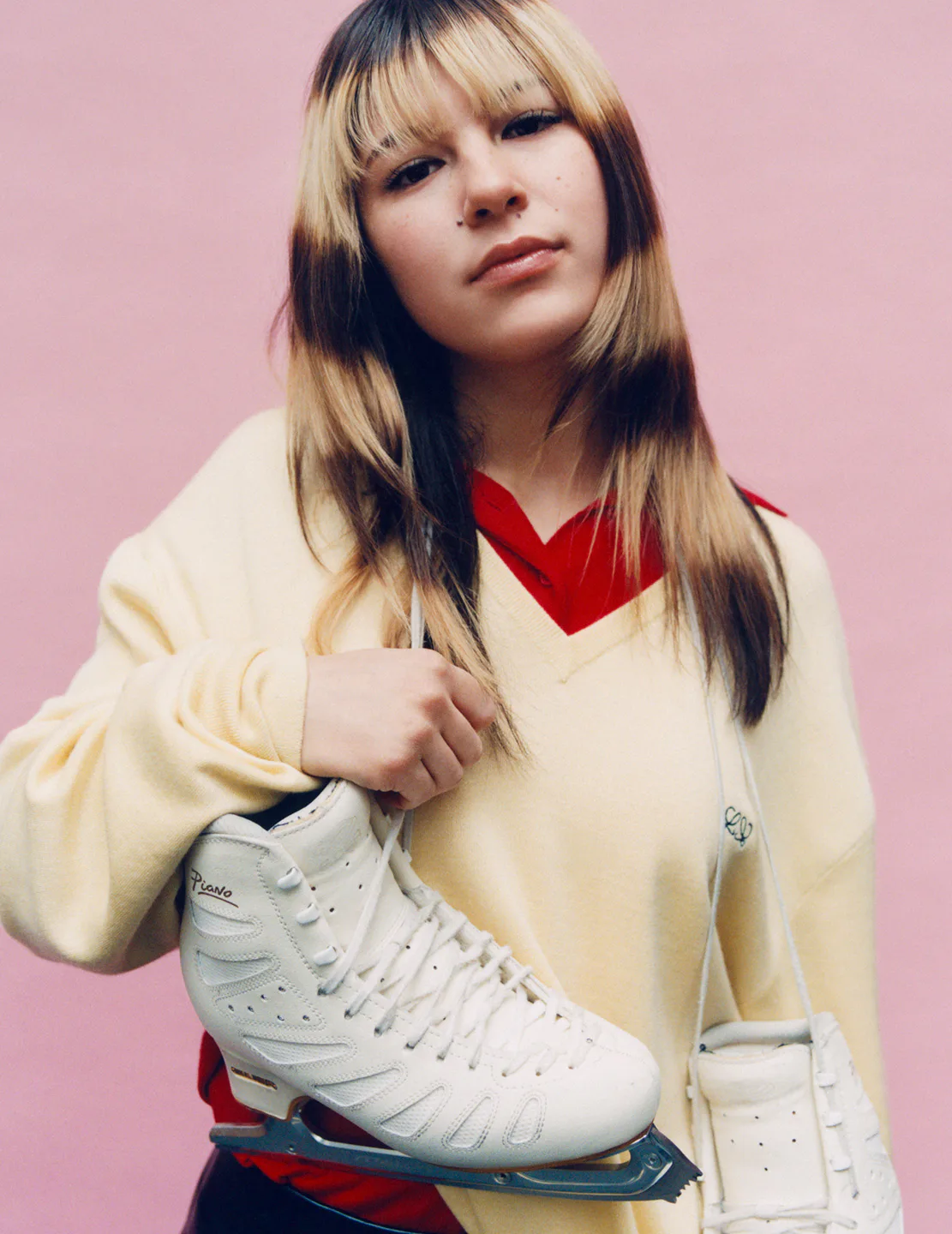


Alysa Liu on Life in the Spotlight: "I Actually Don't Want to Be Famous"

On a Monday afternoon in March, Alysa Liu navigated the corridors surrounding the ice rink at Rockefeller Center with her skates anchoring her five-foot-three frame. Tilting her ankles slightly outward, she stomped across the terrazzo floors. In her wake, bystanders broke into spontaneous applause. It was the kind of involuntary reaction reserved for freed political prisoners, first responders, and, as it turned out, a punky-haired sports star who had just become the first American woman to win Olympic figure skating gold in 24 years.
Minutes earlier, an overzealous fan had attempted to ambush Liu in the locker room. The day before, she’d had her first brush with the paparazzi. “Initially, I thought it was funny. And then today it happened again—less funny,” she said. “They were kind of shady. They roasted me.” But just as the 20-year-old sensation had appeared inured to pressure in Milan while racking up a winning score of 226.79, her personal best, Liu was once again largely unfazed by the followers who have now become a feature of her daily life.
“I actually don’t want to be famous,” Liu told me matter-of-factly. Seated on a nondescript sofa in a private office tucked away from curious onlookers, she had changed out of her work uniform and into sweatpants and Uggs. She joked that her mane, dyed in a pattern resembling that of a ring-tailed lemur, had been that way “since birth.” Flashing a smile to reveal her mouth piercing, a small horseshoe-shaped barbell that hangs over her two front teeth, she added: “Unfortunately, the things I like to do are just going to make me famous.”
Indeed, being responsible for one of the most unlikely comebacks in the history of the Winter Games has proven more dizzying than any triple-triple. Since February, she has tasted an edible gold medal made of Lucky Charms with Al Roker on the Today show (a bowl of the cereal’s colorful marshmallows is currently her profile picture on Instagram, where her followers have jumped from a few hundred thousand to more than 8 million since the Olympics); sat front row at Nicolas Ghesquière’s fall/winter 2026 show for Louis Vuitton in Paris, clad in a brown denim jacket and matching baggy jeans; and presented Taylor Swift with the Artist of the Year award at the iHeartRadio Music Awards. The New York Times crowned her “the new face of her sport,” adding that her “effervescence intoxicates arenas, wafts through screens, and infects millions of viewers.”
But it goes further than that. More than just a trending figure skater, Liu has emerged as a new kind of pop culture figure entirely: an iconoclast who has won over the worlds of dance, music, fashion, and art by simply being herself. “I just have so many ideas I want to get out there,” she said. “Podium finishes aren’t really part of that.”
Liu is the eldest of five children, raised in Oakland, California, by their single father, Arthur Liu, a lawyer who built his family through anonymous egg donors and surrogacy. He started her at figure skating when she was 5, hoping to make her into a medalist. At 12, Liu became the youngest American to land a triple Axel in international competition; at 13, the youngest U.S. champion in the history of competitive skating; and at 14, the first American in women’s figure skating ever to land a quadruple Lutz.
She participated in the 2022 Olympics, but didn’t win any individual medals; burned out from the athletic grind, she quit at age 16. “Literally, my whole life was just skating and scores. If I fell, life was over. If I took one day off, it was over,” she said. “I was always in fight-or-flight mode when I was a kid.” She spent the next few years hiking Everest base camp; attending UCLA, where she majored in psychology while taking a few film classes; and, crucially, finding her calling outside of competing. At the end of that year, she self-pierced her frenulum.
When she returned to competition, in 2024, she did so entirely on her own terms. “I was like, ‘You tell me to change, I’m quitting again,’ ” she said of the officials who bristled at her feral-kawaii look, a sharp break from the steely status quo set by traditional ice princesses. “Why would I change my hair for you?” That self-assurance has since produced the so-called Alysa Liu Effect, a continuous scroll of videos in which people revisit sports after having quit them.
When a contact in the tournament world suggested Liu listen to Donna Summer’s “MacArthur Park Suite,” something clicked immediately. “I was like: I can dance to this,” she said. An iconic photograph shot during Liu’s Olympic free skate captures her rapturous Biellmann finish, the move in which she reaches back, grabs the blade of her skate, and pulls it overhead until her body forms an almost impossibly elongated teardrop shape while spinning. The image is nearly abstract, the gold costume whirling outward as if worn by an after-dark reveler lost in the music at Studio 54. Never mind that she didn’t know who Donna Summer was. After her performance, the 1978 song hit No. 1 on Billboard’s Dance Digital Song Sales chart. Now Liu’s favorite track is “I Feel Love.”
Liu collaborated on the dresses she wore at the Olympics with the designer Lisa McKinnon. The gold competition look—built around an asymmetrical shoulder cut, drenched in crystals, with a turtleneck-choker silhouette—was conceived to read “very disco, very sparkly, lots of movement,” Liu said. The number registered across the cultural spectrum. Barbra Streisand, who recorded with Summer the 1979 duet “No More Tears (Enough Is Enough),” posted it on her Instagram; Sports Illustrated’s Swimsuit issue featured a gold bathing suit by the Blonds that paid homage to Liu’s free-skating fashion.
For her exhibition program, set to PinkPantheress and Zara Larsson’s “Stateside” (which also skyrocketed to the top of the charts), Liu wore a puff of pinstripes that drew on J-pop theatrics. She improvised the choker from a scrap of fabric. “I love pinstripes, but in crystal, because I’m a figure skater,” Liu said. The buns in her hair were color-coded to match the Olympic rings.
She traces her performance instincts back to her childhood spent studying the masters of compressed, high-impact visual spectacle. “Ever since I was, like, 3 years old, I’ve loved watching music videos by Lady Gaga, Michael Jackson, and Britney Spears,” she said. She almost went to school for film, which explains in part why her costumes and choreography have such cinematic flair. On YouTube, her layback spins and open-arm landings rack up views commensurate with those of the tracks they’re performed to. In March, Liu worked with the Oscar-nominated costume designer and stylist Miyako Bellizzi, a fellow Bay Area native, on looks for her post-Olympics New York City press tour.
“I think everything has a little bit of art in it,” she said, gently thrusting her piercing with her tongue as she considered her next leap forward. Still, she added, “someone could teach me how to sew so I can make everything on my own.”
Hair by Tamara McNaughton for Bumble and Bumble at R3-MGMT; makeup by Yumi Lee for Armani Beauty at Streeters. Photo Assistants: Nick Thomsen, John Griffith; Retouching: Vingt-Six; Fashion Assistant: Isabel Choi; Special Thanks to The Rink at Rockefeller Center.