I first wrote about West Virginia painter Lynn Boggess back in 2014. As an introduction, I will quote myself from that post:
—In writing about painters who work with thick impasto (such as Antonio Mancini), I have sometimes used “troweled on” as a metaphor to describe the heavy application of paint. In the case of West Virginia painter Lynn Boggess, however, “troweled on” literally applies to his painting method.
Boggess works in a manner associated with painting knives; and though
I first wrote about West Virginia painter Lynn Boggess back in 2014. As an introduction, I will quote myself from that post:
— In writing about painters who work with thick impasto (such as Antonio Mancini), I have sometimes used “troweled on” as a metaphor to describe the heavy application of paint. In the case of West Virginia painter Lynn Boggess, however, “troweled on” literally applies to his painting method.
Boggess works in a manner associated with painting knives; and though he does use large painting knives at times, he works at such a scale that cement trowels of varying sizes are among his most commonly used tools for the application of paint. —
Boggess traverses the line between naturalism and non-representational painting with surprising ease. His dimensionally thick paint at times seems as close to sculpture as it is to painting.
Boggess’s work is currently on display at the Principle Gallery, Alexandria, VA, in a solo show that started on April 24th, 2026. I’m assuming it wil run for a month, though I didn’t see that mentioned on the site.
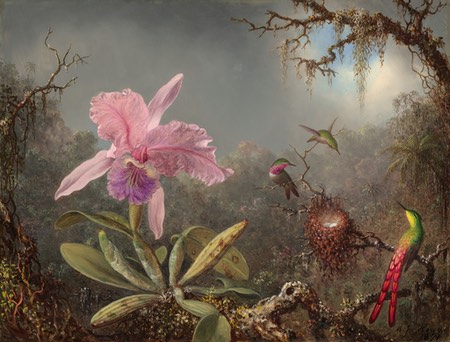
Cattleya Orchid and Three Hummingbirds, Martin Johnson Heade, oil on wood, 14 x 18 in. (35 x 46 cm), in the collection of the National Gallery of art, DC. which has a large downloadable image.
Though he also painted wonderful landscapes, Martin Heade’s standout subjects are his portrayals of exotic flowers and birds. Here, he sets a striking pink orchid against a mist enshrouded forest, and includes three rare hummingbirds and a nest with eggs.
Cattleya Orchid and Three Hummingbirds, Martin Johnson Heade, oil on wood, 14 x 18 in. (35 x 46 cm), in the collection of the National Gallery of art, DC. which has a large downloadable image.
Though he also painted wonderful landscapes, Martin Heade’s standout subjects are his portrayals of exotic flowers and birds. Here, he sets a striking pink orchid against a mist enshrouded forest, and includes three rare hummingbirds and a nest with eggs.
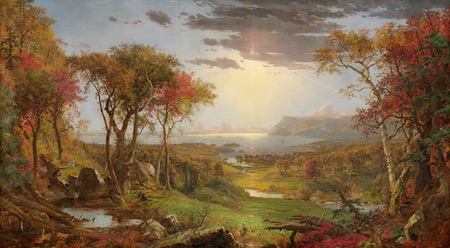
Autumn – On the Hudson River, Jasper Francis Cropsey, oil on canvas, 60 x 108 in. (152 x 275 cm), in the collection of the National Gallery of Aart, DC, which has both a zoomable image and a downloadable high res file available.
Cropsey was a 19th century American architecht and first generation Hudson River painter known for his colorful and dramatic views of mountains and valleys, particularly when arrayed in bright fall foliage.
This painting is considered his landmark work, pai
Autumn – On the Hudson River, Jasper Francis Cropsey, oil on canvas, 60 x 108 in. (152 x 275 cm), in the collection of the National Gallery of Aart, DC, which has both a zoomable image and a downloadable high res file available.
Cropsey was a 19th century American architecht and first generation Hudson River painter known for his colorful and dramatic views of mountains and valleys, particularly when arrayed in bright fall foliage.
This painting is considered his landmark work, painted in the studio from memory, notes and sketches. It’s common to talk of landscape paintings as haveing a morefgound, middleground and background, but Cropsey’s composition appears to have six or seven levels of distance, reinforced by his deft handling of atmospheric parspective.
I love the little details that lend the image scale; the family picnicing on the hillside in the foreground (images above, second down), the horse and rider on tha path between the trees in the middleground, a bit to the right of center (images above, third down) and the cows drinking from a stream at the lower right (images abvoe, bottom).
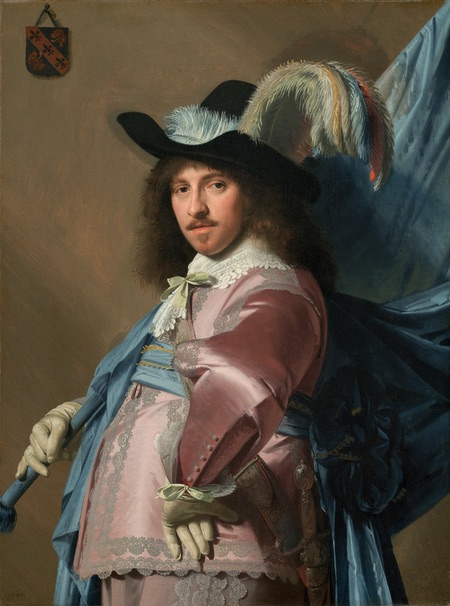
Andries Stilte as a Standard Bearer, Johannes Cornelisz Verspronck, oil on canvas, 41 x 31 in. (104 x 79 cm), in the collection of the National Gallery of Art, DC, which has both a zoomable and downloadable version of the image.
I hadn’t heard of 17th century Dutch painter Johannes Verspronk until I came across this painting while browsing the National Gallery site.
The portrait grabbed my attention with its striking persence and dimenaionality, the latter largely accompished by th
Andries Stilte as a Standard Bearer, Johannes Cornelisz Verspronck, oil on canvas, 41 x 31 in. (104 x 79 cm), in the collection of the National Gallery of Art, DC, which has both a zoomable and downloadable version of the image.
I hadn’t heard of 17th century Dutch painter Johannes Verspronk until I came across this painting while browsing the National Gallery site.
The portrait grabbed my attention with its striking persence and dimenaionality, the latter largely accompished by the extended elbow and the overall value structure, which thrusts the figure forward into the light out of the dark background..
Meticulous attention is paind to the uniform, a symbol of the subject’s rank and position in the malitia. Though some of the elements, like the feathers, are handled quite economically.
According to the Canadian Chamber of Commerce’s 2024 audited financial statements, 85 per cent of its membership revenue came from Corporate Members despite those members representing only about 0.22 per cent of the total organizations the Chamber says it represents.
In other words, a tiny fraction of the membership base appears to hold outsized financial influence.
And who are these corporate members?
An analysis of the Chamber’s online directory showed that 57 per cent were large enterprises w
According to the Canadian Chamber of Commerce’s 2024 audited financial statements, 85 per cent of its membership revenue came from Corporate Members despite those members representing only about 0.22 per cent of the total organizations the Chamber says it represents.
In other words, a tiny fraction of the membership base appears to hold outsized financial influence.
And who are these corporate members?
An analysis of the Chamber’s online directory showed that 57 per cent were large enterprises with 250 or more employees. Only 26 per cent were small enterprises.
That bears no resemblance to the Canadian economy.
In Canada, 97.8 per cent of businesses are small businesses. Only 0.3 per cent are large enterprises.
Yet when governments consult “business,” they often hear disproportionately from organizations shaped by the priorities of large corporations.
That is not inherently wrong. Large companies absolutely deserve representation.
But it becomes a problem when corporate priorities are mistaken for the priorities of Canadian business as a whole.
The organizations shaping federal economic policy don’t represent most Canadian businesses
Every year, before the federal budget is finalized, the House of Commons Standing Committee on Finance holds pre-budget consultations. Industry associations, think tanks, advocacy groups, and business organizations are invited to testify about what Canada’s economy needs most.
The process sounds democratic and balanced. Parliament hears from “the business community,” gathers expert advice, and shapes economic policy accordingly.
But there’s a problem hiding in plain sight:
Much of what Canada calls “the business community” is still dominated by the voices of large, traditional corporate interests rather than the realities of most Canadian businesses.
And most Canadians have no idea.
The same voices keep getting the microphone
Over the last decade, the Finance Committee’s witness list has changed considerably from year to year. Some years included hundreds of witnesses; others only a few dozen.
But one organization appeared almost every time: the Canadian Chamber of Commerce.
At first glance, that makes perfect sense. The Canadian Chamber says it represents more than 200,000 organizations across Canada through its network of chambers. Its annual policy process includes proposals submitted by local chambers across the country. On paper, it appears to function as a broad voice for Canadian business.
But representation is not just about numbers. It is about whose priorities drive policy.
A closer look suggests the Canadian Chamber of Commerce is not actually representative of the majority of Canadian businesses, particularly women business owners, self-employed workers, and equity-deserving entrepreneurs.
Women business owners are still largely invisible
The gaps become even clearer when you examine whose experiences appear in policy advocacy and whose do not.
Over the past decade, Canadian Chamber of Commerce policy resolutions have rarely addressed the well-documented barriers facing women business owners.
In fact, the words “woman,” “women,” or “female” appeared in only three per cent of policies per year on average. And when they did appear, they were usually connected to workforce participation issues, especially childcare as a labour-force solution, rather than women’s business ownership, economic leadership, or structural barriers to equity.
This is not necessarily evidence of bad intentions. The Chamber is doing what chambers of commerce historically evolved to do: advocate for the interests of their most influential members.
However, the Canadian government cannot continue to treat an organization with this policy agenda as representative of the general business community.
It is not.
Canada’s economy has changed. Our advocacy systems have not.
Today’s economy looks very different from the one many business institutions were built to represent.
Canada now has growing numbers of self-employed workers, solopreneurs, gig workers, care-based businesses, independent contractors, and hybrid-income earners. Women are increasingly concentrated in business models that do not fit traditional employer-business structures.
Many self-employed women operate without paid employees. Many balance caregiving responsibilities alongside paid work. Many fall through gaps in EI eligibility, income protections, retirement systems, and business development supports.
Yet these realities remain largely absent from mainstream economic advocacy.
The result is a structural blind spot in Canadian policymaking.
If governments primarily hear from organizations shaped by large-enterprise priorities, then policy outcomes will naturally reflect those priorities.
Meanwhile, huge portions of Canada’s actual economy remain politically underrepresented.
Giving Everyone a Chance
Who gets heard matters.
Each year, hundreds of Canadians submit recommendations during the federal budget consultation process, but many of the same organizations are invited to testify before the Finance Committee year after year.
This creates a risk of an echo chamber, where decision-makers hear familiar perspectives while missing emerging issues and grassroots solutions. The people closest to a problem are often the first to identify it, but their voices rarely make it into the room.
One way to broaden participation would be to reserve some witness spots for individuals and organizations selected at random from among those who submitted written recommendations. Even a day or two of randomly selected testimony would create a more equitable process and ensure a wider range of Canadians have a chance to be heard.
Angela Hao lives and works in the U.S., but makes virtual visits to Japan via Google Street view, capturing the charm of small, quirky storefronts in digital ink and watercolor style illustrations she creates in Procreate.
These are delightlfully whimsical and take note of the small details that give each little store its own personality.
She has prints available on inPrint.
Via My Modern Met
Angela Hao lives and works in the U.S., but makes virtual visits to Japan via Google Street view, capturing the charm of small, quirky storefronts in digital ink and watercolor style illustrations she creates in Procreate.
These are delightlfully whimsical and take note of the small details that give each little store its own personality.
Oliver Bonhomme is a French illustrator and art director with a long client list that inludes le Monde, the New York Times Magazine, The Washington Post, Apple and numerous others.
His illustrations look at first to be high in chroma, but then you realize the colors are not actually that intense, but are made to appear so by the artful juxtapositon of complimentary colors.
His subjects are often imaginative and surreal, but sharply delineated and graphically strong.
[Via Richard
Oliver Bonhomme is a French illustrator and art director with a long client list that inludes le Monde, the New York Times Magazine, The Washington Post, Apple and numerous others.
His illustrations look at first to be high in chroma, but then you realize the colors are not actually that intense, but are made to appear so by the artful juxtapositon of complimentary colors.
His subjects are often imaginative and surreal, but sharply delineated and graphically strong.
Ponte Sant’Angelo, Rome, Edward Seago; 20 x 30 in. (51 x 77), link is to Bonham’s auction from 2019. I assume it’s currently in a private collection.
Edward Seago, a British painter active in the early to mid 20th century, is one of my favorite landscape painters. I particularly love his brushy, painterly application of paint, as is evident in this view of the famous bridge in Rome.
Ponte Sant’Angelo, Rome, Edward Seago; 20 x 30 in. (51 x 77), link is to Bonham’s auction from 2019. I assume it’s currently in a private collection.
Edward Seago, a British painter active in the early to mid 20th century, is one of my favorite landscape painters. I particularly love his brushy, painterly application of paint, as is evident in this view of the famous bridge in Rome.
Emilio Ocón y Rivas was a 19th century Spanish artist specializing marine subjects, perhaps unsurprisingly as he lived in Malaga, the bustling port city on Spain’s Medterranean coast. He is considered responsible for founding the School of Marine Artists there.
He had a particular touch for atmosphere and his paintings show the moods of the sea, sunny and tranquil, stormy and dark.
Cautionary note to contemporary painters: Ocón died of lever disease brought on by the ingestion of p
Emilio Ocón y Rivas was a 19th century Spanish artist specializing marine subjects, perhaps unsurprisingly as he lived in Malaga, the bustling port city on Spain’s Medterranean coast. He is considered responsible for founding the School of Marine Artists there.
He had a particular touch for atmosphere and his paintings show the moods of the sea, sunny and tranquil, stormy and dark.
Cautionary note to contemporary painters: Ocón died of lever disease brought on by the ingestion of paint – due to his habit of bringing his brushes to a point in his mouth.

 Login
Login