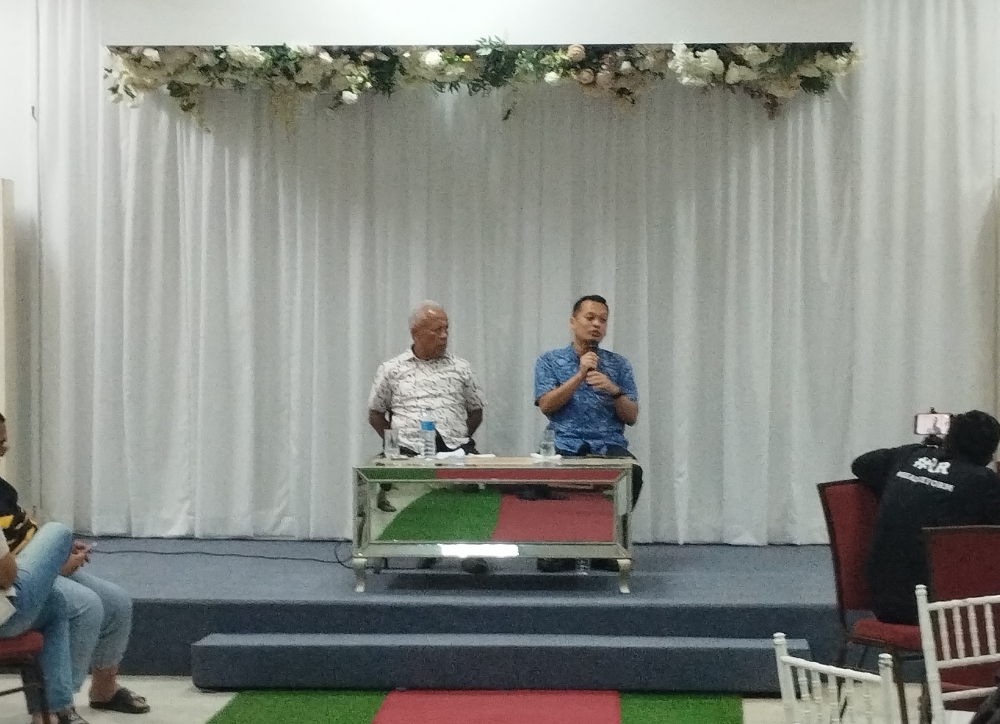
KUALA LUMPUR, June 11 — In Setiawangsa last night, a resident stood up at a dialogue session to complain about abandoned cars in Seksyen 6, Wangsa Maju. Another wanted roads resurfaced. Others asked about a proposed development near Bukit Dinding.
For nearly an hour, the discussion sounded much like any meeting between voters and their elected representative.
There was only one difference.
Nik Nazmi Nik Ahmad is no longer the MP for Setiawangsa.
Yet at his first dialogue with residents since resigning the seat last month, many in the audience still turned to him as though he remained the person responsible for solving their local problems.
The former natural resources and environmental sustainability minister listened patiently as residents raised the kind of complaints familiar to any constituency service centre, from abandoned vehicles left to rust along neighbourhood roads to patchy road surfaces and concerns over development near Bukit Dinding.
One resident, Razif from Seksyen 6, sought Nik Nazmi’s help over abandoned vehicles that he said had become an eyesore.
“Some of these vehicles have been there for so long that trees are growing out of them. There is a lorry, a Perodua Kancil and even a Mercedes among them,” he said.
Nik Nazmi responded much as he might have before stepping down, explaining the legal complications surrounding abandoned vehicles and promising that his office would follow up with Kuala Lumpur City Hall (DBKL) on the issues raised.
“To the people of Setiawangsa, my office in Sri Rampai remains open in the same location. We continue to handle issues involving DBKL, the Social Welfare Department, Baitulmal and other agencies. We still go down to the ground and engage with the community. The only difference is that I no longer hold the official status of an MP,” he said.
The scene captured the unusual position Nik Nazmi now finds himself in: no longer a lawmaker, no longer in government, but still trying to speak to the voters who had sent him to Parliament.
Three weeks ago, Nik Nazmi became one of two elected representatives — alongside Datuk Seri Rafizi Ramli — to voluntarily vacate a parliamentary seat.
His resignation followed several eventful months.
In May last year, he failed to retain the PKR vice-president post, having already lost the Setiawangsa division chief position in the party elections a month earlier.
Shortly afterwards, he resigned from the Cabinet, saying he wanted to take responsibility for his defeat.
Almost a year later, Nik Nazmi left PKR altogether alongside former economy minister Rafizi. Both subsequently resigned their parliamentary seats, arguing that voters should be allowed to decide whether they still deserved a mandate after leaving the party under whose banner they had been elected.
The two have since joined Parti Bersama Malaysia, a political party positioning itself as an alternative to both the ruling coalition and the opposition bloc.
But last night’s session was less about party strategy than the immediate question now facing Nik Nazmi in Setiawangsa: whether voters who once saw him as their MP would still accept him as their representative without the title.
Some residents used the session to express disappointment over his decision to resign.
Tengku Syahrizal, a Setiawangsa resident, compared holding a parliamentary seat to raising a child.
“Holding the position of MP is like holding your own child. You shouldn’t let it go, but you did,” he told Nik Nazmi.
Another resident, Rozita, urged him not to repeat the move if he were re-elected in future.
“If you contest, win and become MP again, don’t resign. Unless the people themselves remove you.
“I am frustrated and disappointed that you resigned as the Setiawangsa MP. If you stand again and win, please do not resign,” she said.
Syahrizal told the former Selangor executive councillor that he had seen visible improvements in Setiawangsa during Nik Nazmi’s tenure and wanted to know what would convince him to campaign for the former MP again at the next election.
“I hope you will continue serving as our representative here, but what are the prospects? What would persuade me to campaign for you once more?” he asked.
In response, Nik Nazmi said his pitch to voters was straightforward.
“My proposition is simple: I want to pursue genuine reform and meaningful change at the national level. Am I idealistic? I don’t know. But since my youth, I have taken this path because of my ideals. If my goal had been wealth, power or luxury, I would never have chosen it.
“That is how I justify this decision to myself and how I sleep at night. It was not an easy decision, but I pray that it was the right one,” he said.
Not everyone in the room disagreed with the resignation.
One resident, who said he had lived in Setiawangsa for more than three decades, told the gathering that he supported Nik Nazmi’s decision, arguing that the former PKR leader had acted according to principle.
The resident said voters should focus less on party labels and more on whether an individual could carry out the responsibilities entrusted to them.
Still, much of the evening returned to the same question, asked in different ways: why leave the seat, and why should voters follow him again?
Nik Nazmi told residents that relinquishing the seat was not easy after two terms as Setiawangsa MP and two terms previously as a Selangor assemblyman.
But he said remaining in office after taking a fundamentally different position from the party under whose ticket he had been elected would have been difficult to justify.
“Had I remained in government, there would have been many constraints. It would have been like remaining married to someone you no longer trust. That would not have been fair, especially while continuing to draw a salary.
“So I chose to step away and present my own vision for the future and my agenda for the next phase.
“Ultimately, I leave it to the people of Setiawangsa to decide whether what I am fighting for remains relevant,” he said.
The former minister also used the session to explain the frustrations that eventually pushed him out of government.
While coalition politics inevitably involved compromise, he said some reforms had stalled not because of resistance from coalition partners but because of reluctance within his own political camp.
Among the issues he cited were judicial reform, institutional accountability and the separation of the attorney general’s and public prosecutor’s roles.
The discussion occasionally drifted beyond neighbourhood concerns.
Residents asked about his new political party, the country’s political direction and even the timing of the next general election.
When one attendee asked whether he knew when Malaysians would next head to the general polls, the room erupted in laughter.
“That one, I need to call Datuk Seri Anwar Ibrahim,” Nik Nazmi replied in jest.
It was one of several moments that lightened an otherwise pointed exchange between a former MP and residents still deciding whether to see him that way.
The dialogue session was the first of two town hall meetings Nik Nazmi is holding with Setiawangsa residents, with the second scheduled for next Wednesday in Sri Rampai.

 Login
Login