Normal view

  • ✇Cartoon Research
  • The Last Days of UPA’s Mr. Magoo – 1959-1960 Jerry Beck
    This post is the “flip-side” of an article I posted here a few weeks ago (The Last Five Screen Gems Cartoons 4/14/26) where I looked at transition of the outgoing Columbia’s Screen Gems releases and the incoming UPA cartoons. A real changing of the guard. Roughly ten years later, the guard changed again. Things weren’t going well for UPA in the second half of the decade. Their satellite studios in New York and London closed; the Magoo feature was a troubled project; The Boing Boing Show was bom
     

The Last Days of UPA’s Mr. Magoo – 1959-1960

5 May 2026 at 07:01

This post is the “flip-side” of an article I posted here a few weeks ago (The Last Five Screen Gems Cartoons 4/14/26) where I looked at transition of the outgoing Columbia’s Screen Gems releases and the incoming UPA cartoons. A real changing of the guard.

Roughly ten years later, the guard changed again. Things weren’t going well for UPA in the second half of the decade. Their satellite studios in New York and London closed; the Magoo feature was a troubled project; The Boing Boing Show was bombing; the Columbia contract for theatrical shorts had an expiration date: 1959.

The last of the 1958-59 season, released in July 1959, was Terror Faces Magoo. Produced in New York during the production crunch in Burbank on 1001 Arabian Nights, the Magoo feature.

By the end of the year UPA founder/producer Stephen Bousustow found a new financial “partner” to bail the studio out – Henry G. Saperstein – who essentially bought the studio and ultimately inched Bosustow out the door. Beginning in November, Columbia began releasing Hanna Barbera’s TV-styled Loopy DeLoop shorts as theatrical subjects (an arrangement that lasted through June 1965)!

Mr. Magoo was still extremely popular, if only as a short subjects star – and Bosustow knew that. Bosustow decided to keep making “UPA shorts” for theatrical release, and from this point on UPA itself would release them. Four new shorts were put into production.

The first one, Magoo Meets Boing Boing (The Noise Making Boy), directed by Abe Levitow, was given an Oscar qualifying release in late 1959. This cartoon was certainly a perfect idea to start with a ‘Bang-Bang’. I love how in the ‘UPA-niverse’, Magoo is on a short list of babysitters in the McCloy household. Magoo mistakes Gerald for his dog (and vice-versa) and “rescues” Gerald from a fire (actually just Gerald’s sound effects voice). The animation is no worse than the last few Columbia Magoo films – but far from the heights of greatness both characters had previously attained just a few short years earlier. Note that the theatrical title for this film was Magoo Meets Boing Boing (The Noise-Making Boy), the TV version is retitled Magoo Meets McBoing Boing.


The second Magoo cartoon, released in 1960, was likewise submitted for Academy Award consideration – I Was A Teenage Magoo – this time directed by Clyde Geronimi. It’s an odd one. The most UPA aspect of it is the background designs by Tom Yakutis, which are very cool. The animation is up the theatrical standards of the last Columbia Magoo’s – but that’s not saying too much. Told in flashback, the plot has teenage (but still nearsighted) red-headed Magoo picks up his date “Melba” (a kangaroo) from her home (in a circus) and go on a picnic. Sort of a prequel of sorts to Magoo’s Young Manhood (1958). Bosustow’s attempt to self-distribute was a huge failure. This cartoon was ultimately released as part of the TV package – albeit cut by two minutes and shown under the title Teenage Magoo.


The third short produced by Bosustow for theatrical release was Bric’s Stew – directed by Harvey Toombs – which featured a pair of new characters “Bric n’ Brac”. The negative was discovered a few years ago among film elements acquired by the Academy of Motion Picture Arts and Sciences – within unclaimed inventory from the defunct DuArt Laboratory in New York City. Why it was abandoned and forgotten no one knows. Why there is a UA-TV logo at the end – no one knows. Asifa-Hollywood funded a preservation and I wrote about it in a post about this find in January 2019. I’m happy to present the entire cartoon, for the first time, below.


A fourth Magoo short intended for theaters – Magoo Meets Frankenstein – joined the other two in the Mr. Magoo TV package (130 new cartoons made-for-TV). Below is the first half of the rare theatrical version:

Bosustow finally sold his interest in UPA in June 1960. This wasn’t the end of Magoo – he would live on in his Christmas Carol TV special (a classic), a 26 episode series of Famous Adventures, as Uncle Sam, a GE light bulb salesman, in a Saturday morning DePatie Freleng series – and a live action movie (released by Disney)!

Despite a bittersweet fade-out, UPA was a historic game changer for animation during the 1950s. It was a studio – like Walt Disney’s – that is worth exploring with deeper dives.

For more information on UPA – I highly recommend Adam Abraham’s outstanding UPA history, When Magoo Flew: The Rise and Fall of Animation Studio UPA.

SPECIAL THANKS to Al Warner and Denis-Carl Robidoux for permission to share their transfers of the first two UPA Magoo theatricals – and to ASIFA-Hollywood for letting us debut the complete “Bric’s Stew”.

  • ✇Cartoon Research
  • A “Short” Tribute to Mom – Part III Michael Lyons
    From UPA’s “Bringing Up Mother” (1954) “Motherhood-It’s the biggest on-the-job training program in existence today”. – Author and humorist Erma Bombeck. Indeed, this is true. And, this weekend, we get to celebrate all who have endured this lifelong “on-the-job training” for us on Mother’s Day. Continuing a tradition from 2021 and 2025, what follows are some additional classic cartoon shorts that are perfect for Mother’s Day (three of them suggested by Cartoon Research readers). Mother Hen’s Hol
     

A “Short” Tribute to Mom – Part III

8 May 2026 at 07:01

From UPA’s “Bringing Up Mother” (1954)

“Motherhood-It’s the biggest on-the-job training program in existence today”. – Author and humorist Erma Bombeck. Indeed, this is true. And, this weekend, we get to celebrate all who have endured this lifelong “on-the-job training” for us on Mother’s Day.

Continuing a tradition from 2021 and 2025, what follows are some additional classic cartoon shorts that are perfect for Mother’s Day (three of them suggested by Cartoon Research readers).

Mother Hen’s Holiday, Columbia, (1937)

Here is a classic “Color Rhapsody” from Columbia, set on Mother’s Day.

As the short opens, we meet the Mother Hen (voiced by Toby Wing) who is singing about how much she has to do and how tired she is, and we can see why – she is mom to so many little chicks, they almost overflow out of the baby carriage.

It’s soon evident why she is so overwhelmed, as, once back home, the endless number of little chicks causes chaos in the house, creating absolute destruction. However, they then spot the calendar and note that it’s Mother’s Day.

The chicks then decide to do all they can for mom, cleaning and repairing the house. They even bake a cake and feed it to their happy Mother Hen, as the short ends.

Directed by Arthur Davis, Mother Hen’s Holiday features some nice sight gags, particularly during the sequences where the chicks trash the house, all set against lovely backgrounds.

It all has a cozy, classic cartoon tone, and a nice sentiment for Mother’s Day, as one of the little chicks state: “Make every day a Mother’s Day, not only once a year, every day in every way, cheer up mother dear, for everything you’ve done for us, perhaps we can repay, by making every single day a Happy Mother’s Day.”


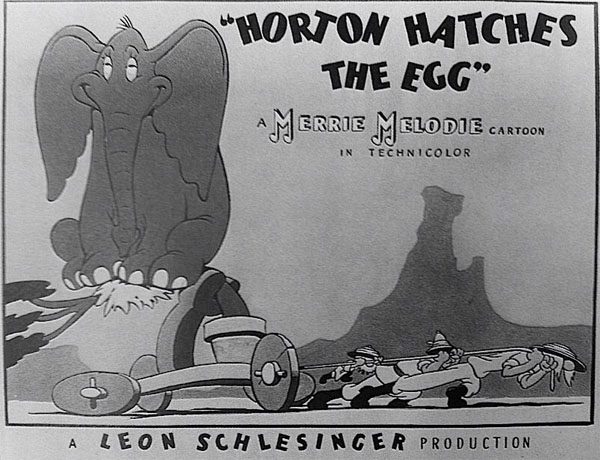
Horton Hatches the Egg, Warner Bros., (1942) – suggested by Frederick Weigand

Initially published as a book by Dr. Seuss (Theodor Geisel), in 1940, the book’s popularity eventually brought it to Warner Bros. as an animation project.

Horton Hatches the Egg tells the tale of Horton (Kent Rogers), an elephant who is tricked into sitting on an egg in a nest when the mother, Mayzie (Sara Berner), decides to rest and go on vacation. Horton endures several challenges: stormy weather, ridicule from other animals, hunters, and life in the circus.

Through it all, the steadfast elephant never leaves the egg, keeping his promise to Mayzie and repeatedly stating (in true Seuss rhyme), “I meant what I said, and I said what I meant. An elephant’s faithful, one hundred percent.”

The Warner Bros. artists remained close to the book. In fact, they wrote and sketched ideas for the short, right on the pages as they adapted them. Director Robert Clampett and his team, which included Robert McKimson, Bill Melendez, and Virgil Ross, inserted their unique brand of humor, which includes moments where Mayzie breaks into a brief impression of Katherine Hepburn.

Like the book upon which it is based, Horton Hatches the Egg is an innocent, endearing tale about nurturing and loyalty that is perfect for Mother’s Day, “one hundred percent.”


Bringing Up Mother, UPA (1954) – also suggested by Frederick Weigand

In a film noir-style opening, a police car drives slowly through the night street, calling all cars to be on the lookout for a John Smith. The shadow of a figure walking along a street passes by. He narrates: “Yeah, it’s me they want. I’m the guy, alright. But what could I do? She drove me to it. It was the only way out, and I took it.”

What we come to see through flashbacks is that this isn’t a thriller, and that isn’t the talk of a man who committed a crime, but instead a young boy who has run away from home, after his parents bring home his baby brother from the hospital, and the attention he received has shifted.

Don’t worry, there’s a happy ending: the police find John and cheerfully bring him home. But in the flashbacks throughout the short, the audience gets sharply written insight (by Tedd Pierce and director William Hurtz) into the relationship between the young boy and his mother, dating back to his infancy.

This includes a scene where Johnny, wearing a sailor hat and sucking his thumb, is told by his mother that “sailors don’t suck their thumbs.” So, Johnny proceeds to take off his sailor hat. In his full cowboy outfit and playing with his friend (in the role of the horse), Johnny is told by his mother that they’re “going to have a little baby to play with.” “I’d rather have a horse,” replies Johnny.

But when he’s promised a baby sister (which he’s excited for, as there will be a cowgirl in the house) and instead gets a baby brother, that’s when he runs away.

The short has a wonderful, stylish design, by Robert Danko, in everything from backgrounds to characters, that is such a part of all UPA did, and is coupled with great voice work from Jerry Hausner as Johnny, Marvin Miller as the friendly police officer and Marian Richman as mom.

Bringing Up Mother is a great tribute to all mothers and what they deal with while raising one child, with another on the way.


Scooby-Doo, Where Are You?, “Jeepers, It’s the Creeper,” (1970) – suggested by Christopher Cook

There’s a slight Mother’s Day connection here, but a fun one, nonetheless. As Scooby and the gang look to hide from the ghoulish Creeper, Scooby (Don Messick) and Shaggy (Casey Kasem) sneak into in a chicken house. Scooby sits on an egg, which hatches, and the little chick imprints on Scoob, thinking he’s his mom.

The chick even begins barking and spends the remainder of the episode on Scooby’s nose (even when Scooby reveals the real identity of the creeper, at the end).

“Jeeper’s, It’s the Creeper” is an entertaining Scooby-Doo episode that offers a maternal subplot for those who crave classic Saturday morning memories.

Here’s the clip from the episode where the chick adopts Scooby Doo as his mother:

• If this clip isn’t enough for you and you need to see the whole episode – you can wait for it to come around on MeTV Toons – or you can buy the complete series on blu ray – or you can watch a slanted version of it online at DailyMotion.

Feel free to suggest some of your favorite cartoon shorts and episodes for Mother’s Day in the comments, and here’s wishing all a very Happy Mother’s Day.

  • ✇Cartoon Research
  • UPA’s “Christopher Crumpet’s Playmate” (1956) Steve Stanchfield
    First, some quick Thunderbean news: We’re cranking on sending out special sets this week – 8 in total! We’re trying hard to catch up on all of these and have this be the most productive year at Thunderbean. I’m particularly happy with this group of the special sets, and thanks to everyone who has contributed to these since it’s made so many of the real sets move forward. We also have two new ones (and all Lantz and all Columbia set) at the Thunderbean Shop, and will be working to get Rainbow P
     

UPA’s “Christopher Crumpet’s Playmate” (1956)

9 April 2026 at 07:01

First, some quick Thunderbean news:

We’re cranking on sending out special sets this week – 8 in total! We’re trying hard to catch up on all of these and have this be the most productive year at Thunderbean. I’m particularly happy with this group of the special sets, and thanks to everyone who has contributed to these since it’s made so many of the real sets move forward. We also have two new ones (and all Lantz and all Columbia set) at the Thunderbean Shop, and will be working to get Rainbow Parades volume 2 out the door soon as well as several other official sets. I’m really enjoying seeing many longer-term projects finally out the door, and I know many of you are super happy about that too!


Now- today’s film!

The loveliest thing about this period in time is that we have good quality versions of so many things that used to be only available in both less-than-great versions and standard def. It still makes you wish that *everything* was already available, but that’s of course asking for too much!

For the things that are still not available in HD, having access to a good 35mm scan often suits the bill.

Christopher Crumpet’s Playmate (1956) is a feast for the eyes in its simplicity and ‘modern’ aesthetic. Directed by brilliant animator Robert Cannon, it’s full of both the design sensibility and beautiful animation you would expect. T. Hee takes credit for story (along with Cannon) as well as design, with the great Jules Engel simply getting a credit for color. It’s nice to see a credit for voice actors Marvin Miller and Marian Richman, who provided voices for the first Christopher Crumpet film as well.

The film starts out with Christopher Crumpet’s father making Christopher return a very blue dog, suggesting Christopher play with an imaginary friend instead. From there, it’s a fun little story featuring incredibly supportive parents, something I think a lot of us would have loved. I was lucky in that my own parents really tried to help me with artistic pursuits the best they could. If you did have supportive parents and they’re still around, show them this little film!

Seeing this 35mm print projected recently was a feast for the eyes, and I’m glad to be able to share that print here. Seeing a high definition version on these really make a difference- you see the textures of the paint, the self ink lines on the cels, the detail of grids and phone cords in one scene- and the beautiful quality of motion.

While I don’t see this as a top cartoon from the studio, I find it pretty enjoyable as a little piece of entertainment- and I applaud UPA for making films like this one for families that could work like an animated storybook.

Have a good week all!


EDITOR’S NOTE: I’ve been waiting for one of my contributors to mention Christopher Crumpet’s Playmate – like the “secret word” on Groucho’s You Bet Your Life TV show – I descend within a special prize for this post. Over 20 years ago I helped organize and catalog Pete Burness’ archive (for his son) and among the material there were several pencil tests for various UPA shorts… among them, THIS.

The first one below is the raw scan of the film, which was negative. That’s how most pencil tests were screened, in negative form. No need to create a print – the pencil test was going to be thrown away after viewing. I took the liberty if inverting the neg and created a video with the image positive – easier to see the pencil lines. Enjoy them both.
– Jerry Beck

❌
Subscriptions