Normal view

  • ✇National Herald
  • A subdued Eid in Kolkata Kunal Chatterjee
    Kolkata witnessed an unusually subdued Eid-ul-Adha this year, with many residents saying the city felt very different from previous celebrations. Across several traditional Muslim neighbourhoods, the familiar festive rush, crowded livestock markets, roadside fairs and cultural programmes were largely absent, leaving many people emotional and disappointed.At Kolkata’s historic Tangra slaughterhouse, which usually becomes one of the busiest places in the city before 'Bakri Eid', there was an eerie
     

A subdued Eid in Kolkata

28 May 2026 at 14:11

Kolkata witnessed an unusually subdued Eid-ul-Adha this year, with many residents saying the city felt very different from previous celebrations. Across several traditional Muslim neighbourhoods, the familiar festive rush, crowded livestock markets, roadside fairs and cultural programmes were largely absent, leaving many people emotional and disappointed.

At Kolkata’s historic Tangra slaughterhouse, which usually becomes one of the busiest places in the city before 'Bakri Eid', there was an eerie silence. Muhammad Javed, who has worked there for 35 years, stood near the gates and looked around in disbelief.

“I have never seen such a gloomy atmosphere before Eid-ul-Adha,” he said. “In earlier years, there would not be even standing room. People used to come from far away to buy cattle. This year, if someone visited for the first time, they would not even realise Eid is being celebrated.”

That is possibly because this year, cattle were almost completely absent from markets across Kolkata and several districts of West Bengal. In areas such as Kidderpore, Mominpore, Iqbalpore and Tangra, where large temporary cattle markets used to attract thousands of buyers, only goats and sheep could be seen.

The change followed the state's new BJP government's strict enforcement of provisions under the 1950 Livestock Act. The rules require official veterinary certification and permit slaughter only at designated facilities. Though cow slaughter was not formally banned, traders and buyers said the legal procedures and transport-related difficulties made the cattle trade nearly impossible this year.

Mohammad Farooq, a resident of Tangra, explained, “Nobody has stopped us from performing Qur'an, but people are afraid of legal complications and harassment during transport. As a result, cows are simply not reaching the markets.” 

Many traders also pointed to severe disruptions in cattle transport from neighbouring states such as Uttar Pradesh. Vehicles carrying cattle were allegedly stopped repeatedly on highways, discouraging suppliers from bringing animals into Bengal.

The impact was visible not only among Muslim families but also among Hindu traders and workers who depend on the seasonal livestock business. A cattle seller from Murshidabad said sadly, “I had hoped to repay my debts by selling cows before Eid. This year, the market has collapsed.”

With cows missing from the markets, demand for goats and sheep rose sharply. Goat sellers at Kolkata’s Narkeldanga Bakri Market reported unusually high prices this year. Nilu Singh, who brought goats from Uttar Pradesh, said, “Goats are moving freely, so traders have shifted to goats instead of cattle. Prices are much higher because demand has increased everywhere.”

Despite the disruption, many residents tried to adapt to the situation calmly. Sheikh Zahid from Tangra joked, “Perhaps it is better this way. A cow would cost more than Rs 1 lakh, while a goat costs around 20,000.”

Religious leaders also appealed for peace and adjustment. Maulana Mohammad Shafique Qasmi of Kolkata’s Nakhoda Mosque urged Muslims to avoid sacrificing cows this year and instead buy goats. “Our main duty is to perform qurbani peacefully. People should respect the law and maintain harmony,” he said.

Alongside the missing cattle markets, another noticeable change this year was the disappearance of the small Eid fairs that traditionally brought colour and excitement to many neighbourhoods across Kolkata. These temporary fairs would appear in open grounds and street corners in areas such as Kidderpore, Park Circus, Metiabruz, Rajabazar and Mominpore. Families from all communities enjoyed the food stalls, toy shops, clothes, rides and evening gatherings.

This year, however, many of those grounds remained empty. In some areas, only a handful of small stalls were seen.

Abdul Rahman, a resident of Mominpore, said, “Children wait for these fairs every year. Earlier there would be lights, food stalls and crowds till late night. This time, everything feels incomplete.”

The absence of cultural programmes has also deeply affected local artists and small businesses connected to Eid celebrations. Traditionally, local clubs and community groups organised musical evenings where singers performed popular songs of Mohammed Rafi, Kishore Kumar, Kumar Sanu, and other popular singers. Decorators, sound system operators and stage workers would receive steady work during the festive season.

This year, many such programmes were cancelled altogether. Shahid Ali, a sound equipment supplier from Park Circus, said, “Usually during Eid we work continuously for nearly ten days. We instal stages, lights and sound systems in different neighbourhoods. This year, hardly any bookings came.”

Local singer Imran Khan shared a similar disappointment. “Every year, we perform old Hindi classics during Eid evenings. Families gather together and it creates a beautiful atmosphere. This year, there are no stages and no programmes. Many artists have lost important seasonal income.”

Decorators and lighting workers also said business had fallen sharply because fewer community celebrations were being organised.

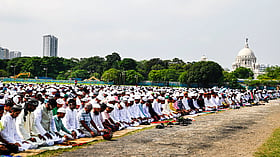
Even the city’s Eid prayers saw a major change this year. For decades, Kolkata’s main Eid congregation had been held at Red Road near the Maidan. However, following new government restrictions on prayers on public roads, the main gathering was shifted to the Brigade Parade Ground under heavy security.

Despite all these changes, Eid prayers were completed peacefully across the city. Many residents said the spirit of Eid remained alive, even though the celebrations were quieter and simpler than before.

  • ✇National Herald
  • More fake history in the service of bigotry Ruchika Sharma
    On Friday, 15 May, a two-judge bench of the Madhya Pradesh High Court pronounced a 700-year-old mosque in Dhar, near Indore, to be a temple of the Hindu goddess Saraswati. The verdict was substantially based on a court-ordered GPR (Ground Penetrating Radar) survey by the Archaeological Survey of India (ASI).As per the survey, the Kamal Maula mosque, a 14th century hypostyle monument, also the first Jama Masjid (congregational mosque) of Dhar, was built on a pre-existing 11th century temple, popu
     

More fake history in the service of bigotry

23 May 2026 at 04:05

On Friday, 15 May, a two-judge bench of the Madhya Pradesh High Court pronounced a 700-year-old mosque in Dhar, near Indore, to be a temple of the Hindu goddess Saraswati. The verdict was substantially based on a court-ordered GPR (Ground Penetrating Radar) survey by the Archaeological Survey of India (ASI).

As per the survey, the Kamal Maula mosque, a 14th century hypostyle monument, also the first Jama Masjid (congregational mosque) of Dhar, was built on a pre-existing 11th century temple, popular by the modern misnomer Bhojashala (named after the 11th century Paramara king Bhoja). But the archaeological reading of the ASI and the court verdict are both problematic in their understanding of historical sources, the phenomenon of architectural reuse and the historical evolution of religions.

The brief findings of the ASI survey, as recorded in the court order, indicate pre-existing structure underneath the mosque, which was ‘massive perhaps for public purpose’ (p.186). It further states that the pre-existing structure was ‘damaged and modified for reuse’ (ibid.).

Later, on p.189, the ASI contradicts itself when stating that the ‘art and architecture of these pillars and pilasters in colonnades suggest that they were originally part of temples (emphasis added). The remains, then, do not come from a single structure but from multiple temples (p.189).

The identification of the structure underneath as a temple is done purely on the basis of the material reused in the mosque. According to the ASI, figures of four-armed deities as well as of other Puranic gods such as Ganesha can be found on the reused pillars, albeit defaced in consonance with Islamic iconoclasm.

The ASI survey does not entertain the possibility that the structure underneath could be a palace and that the material reused to make the mosque could have also been sourced from a palace. Sculptural reliefs featuring deities were a common feature of palace pillars, cornices and doors.

The ASI also overlooks its own finding that the material reused in the mosque comes from multiple sources and not just one structure (p.189). Furthermore, the survey provides no evidence for its assertion that the pre-existing structure was the one that was damaged and re-used in the mosque.

Security personnel at the 700-year-old Kamāl Maula mosque in Dhar

The 2019 Ayodhya verdict (p.906-907) demonstrated how a full-fledged excavation underneath the illegally demolished Babri Masjid could not establish that the structure underneath had been destroyed. How, then, is the ASI able to prove destruction of an earlier structure with a GPR survey?

That the pre-existing structure was possibly a palace is also bolstered by the ‘discovery’ of the ‘Vagdevi’ statue. This is first introduced on p.12 and it is alleged that the statue is the ‘idol of Goddess Vagdevi (Ma Saraswati), which was buried there by Muslim rulers’.

This assertion is followed by a broken weblink, which misspells British Museum. The idol is discussed again on p.44, and the weblink again leads nowhere, presumably because it again misspells British Museum.

The correct weblink presents a curious picture. The exhibit is mentioned as a ‘standing figure of the Jaina yakṣiṇī Ambikā carved in a coarse white marble’. Nowhere in the British Museum website is the figure identified as that of goddess Saraswati.

The identification of this figure as Jaina yakshini Ambika is done via the accompanying inscription that dates the sculpture to 1034 CE and states that Vararuci after fashioning the idol of Vagdevi and three Jinas, made this image of Amba. In fact, Vararuci identifies himself in the inscription as one who is intent on the dharma of the Chandranagari and Vidyadhari, which are branches of Jain religion.

Not only is the sculpture that of a Jain yakshini, it is also made by a Jain. This information is totally ignored, and on p.12 both Vagdevi and Amba are presented as forms of goddess Saraswati, without giving any evidence to support such a ridiculous assertion!

The verdict ignores the fact that the figure of the Jaina Yakshini was found in the ruins of a city palace in Dhar in 1875 by colonial surveyor William Kincaid — information that is clearly detailed on the British Museum website but is absent from the court order.

The deliberate misrepresentation of the Jaina yakshini Ambika as the idol of Saraswati is the only evidence produced to claim that a Saraswati temple made by Paramara king Bhoja existed here and was built in 1034 CE.

What further supports the possibility that the pre-existing structure was Jaina in origin is the finding in the same ASI survey of the statue of a Jain Tirthankara in the mosque premises.

Interior of the prayer hall of Kamāl Maula, showing the mihrab and minbar

The verdict tries to explain this away (on p.234) by claiming that ‘in India, Jainism and Hinduism are not distinct entities. Although, the rituals of worship in these two religions may differ, both faiths have evolved side by side since ancient times, worshipping the same supreme being’.

This assertion is historically untenable. In his 1975 study on the rock-cut temples of Tamil Nadu, archaeologist K.R. Srinivasan shows how several Jaina rock-cut shrines were converted into Shaiva or Vaishnava shrines in the 8th and 9th century.

The identification of Jainism and Hinduism as not distinct entities also reiterates the colonial definition of Hinduism, as being ‘not Muslim, not Christian’. This incorrect understanding of Hinduism was also followed by colonial surveyors, chiefly architectural historian James Fergusson, who in his 1876 work on Indian architecture groups Jaina basadis and Buddhist stupas under the rubric of Hindu architecture.

The order not only relies on the British definition of Hinduism but also on colonial sources for the understanding of the Sanskrit inscriptions found inside the mosque. No Sanskrit source has been cited that records the presence of a temple around the mosque.

Just as the figure of Jaina yakshini Ambika found in a palace is misrepresented as Saraswati belonging to a temple, an inscription found 3 km from the disputed site, in the tomb of sufi saint Abdullah Shah Changal is taken as proof of destruction of the pre-existing structure.

How the ASI makes the connection between the alleged destruction of a temple on the Kamal Maula mosque site and the inscription on Changal’s tomb is not explained.

Apart from presuming the underlying structure to be a temple, the material reused to be from the destruction of the pre-existing temple, a Jaina figure to be the idol of Saraswati, and Hinduism and Jainism not being distinct, what has been glossed over is the history of the structure being a mosque for the past 700 years.

An inscription found at the site (also listed in the ASI survey) records that the governor of Malwa, Dilawar Khan Ghori, repaired the mosques of Dhar in 1392-93. This confirms that the Kamal Maula mosque was built in the early 13th century, possibly by Delhi sultan Alauddin Khalji’s governor Ain-ul-Mulk Multani.

The mosque features a mihrab, with Quranic inscriptions, a minbar (pulpit) as well as a zenana. Not only does the verdict erase the Jaina history of the site and the region, it also invisibilises the long history of the structure as a mosque, associated with the tomb of the Chishti Sufi saint Kamal Malawi.

Ruchika Sharma is a Delhi-based historian and professor. She runs a popular YouTube channel on Indian history

Beer overtakes wine in France for first time as high cost of living reshapes drinking habits

21 May 2026 at 10:40

France has consumed more beer than wine for the first time on record, marking a significant shift in the drinking habits of a country long associated with wine culture as younger consumers, changing lifestyles and economic pressures reshape alcohol consumption patterns.

According to figures released by the OIV (International Organisation of Vine and Wine), French wine consumption fell to 22 million hectolitres in 2025, slightly below the 22.1 million hectolitres of beer consumed during the same period, according to data from the French brewers' association, Brasseurs de France.

The figures represent a 70-year low for wine consumption in France and a decline of 3.2 per cent compared with 2024. The OIV described the trend as part of a long-term decline that has unfolded over several decades.

Despite the drop, France remained Europe's largest wine-consuming nation in 2025, although consumption was 7.2 per cent below the country's five-year average.

Economic pressures and generational change

Industry experts attributed the shift to a combination of economic challenges and changing consumer behaviour, particularly among younger generations.

The OIV said overall wine consumption had fallen to its lowest level in more than six decades, reflecting both weaker demand in mature wine markets and broader changes in social habits.

“What we can see in the 2025 data is a sector that's reacting to real-time impacts of US tariff policies, but also adapting to some longer-term changes in terms of climate and consumption,” OIV Director General John Barker said.

Beer consumption, meanwhile, remained relatively stable and marginally exceeded wine consumption for the first time.

The strongest growth was recorded in alcohol-free beer. Consumption of non-alcoholic beer rose by 12 per cent last year, with approximately 600,000 litres consumed during July and August alone.

Analysts said the changing pattern reflected broader shifts in French society, including changing work routines and dining habits.

Sociologist Joan Cortinas told France Télévisions that traditional meal-centred drinking customs were becoming less common.

“Society has become more tertiary. Often people do not even eat properly at midday anymore,” Cortinas said.

Global pressures weigh on wine industry

The decline in wine consumption comes as producers face multiple challenges, including climate-related pressures, changing consumer preferences and trade disruptions.

Tariffs imposed by the United States under President Donald Trump have added fresh uncertainty for wine exporters. The United States remains the world's largest wine market, making trade barriers particularly significant for producers across Europe.

Barker said it was still too early to determine the full impact of the conflict involving Iran on the wine sector, although any disruption to shipping routes and consumer sentiment could affect the industry.

The wine sector has increasingly sought to adapt by diversifying revenue streams through wine tourism, sustainability initiatives and the development of lower-alcohol products aimed at attracting new consumers.

Italy remains largest producer

While France's domestic consumption has declined, it remains one of the world's leading wine-producing countries.

According to OIV figures, Italy was the world's largest wine producer in 2025 with 47.3 million hectolitres, followed by France with 35.9 million hectolitres and Spain with 29.4 million hectolitres.

The latest figures nevertheless highlight a profound cultural shift in France, where beer has overtaken wine in annual consumption for the first time, underscoring how economic realities and changing lifestyles are transforming one of the country's most enduring traditions.

Beer overtakes wine in France for first time as high cost of living reshapes drinking habits
  • ✇National Herald
  • Kaifi Azmi: The revolutionary romantic who gave poetry a conscience Hasnain Naqvi
    On 10 May, India remembers one of the finest poetic voices of the twentieth century — Kaifi Azmi, the revolutionary-romantic whose words transformed not only Urdu poetry but also the language of Indian cinema. Poet, lyricist, scriptwriter, activist and public intellectual, Kaifi belonged to that extraordinary generation of progressive writers who believed literature must not merely decorate society but challenge it.Even twenty-four years after his passing, Kaifi Azmi remains astonishingly contem
     

Kaifi Azmi: The revolutionary romantic who gave poetry a conscience

11 May 2026 at 04:22

On 10 May, India remembers one of the finest poetic voices of the twentieth century — Kaifi Azmi, the revolutionary-romantic whose words transformed not only Urdu poetry but also the language of Indian cinema. Poet, lyricist, scriptwriter, activist and public intellectual, Kaifi belonged to that extraordinary generation of progressive writers who believed literature must not merely decorate society but challenge it.

Even twenty-four years after his passing, Kaifi Azmi remains astonishingly contemporary. His poetry still speaks to fractured times, to inequality, loneliness, love, resistance and human dignity. Few poets managed to combine ideological conviction with lyrical tenderness as effortlessly as Kaifi did. Whether in mushairas, political meetings or cinema halls, his words carried the same emotional intensity and moral clarity.

Born Syed Athar Hussain Rizvi on 14 January, 1919, in Mijwan village in Uttar Pradesh’s Azamgarh district, Kaifi emerged from a deeply traditional Shia family but soon gravitated toward radical politics and literature. According to accounts in his memoirs and biographies, he wrote his first ghazal at the age of eleven and stunned audiences when he recited it at a local mushaira. The matla of that youthful composition became prophetic of the turbulence and passion that would later define his literary life:

“Itna to zindagi mein kisi ki khalal pade,

Hansne se ho sukoon na rone se kal pade.”

(“May someone disturb life so deeply,

That neither laughter brings peace nor tears bring relief.”)

The young poet soon joined the Progressive Writers’ Movement and later became associated with the Communist Party of India. Unlike many literary figures who remained confined to elite circles, Kaifi immersed himself in workers’ movements, trade union activism and struggles for social justice. For him, poetry was not an escape from reality; it was a weapon against injustice.

The poet of revolution and compassion

Kaifi Azmi’s poetry carried the fragrance of romance but also the fire of rebellion. His celebrated nazm “Aurat” remains among the boldest feminist poems written in Urdu literature. Addressing women not as passive symbols of beauty but as equal participants in history, he wrote:

“Uth meri jaan mere saath hi chalna hai tujhe.”

(“Rise, my beloved, you must walk beside me.”)

In an era when patriarchy dominated both society and literature, these lines sounded revolutionary. Kaifi challenged the romanticised suffering imposed upon women and envisioned companionship built on equality. The poem remains strikingly relevant in contemporary conversations around gender justice.

His poetry also reflected deep empathy for the marginalised. In poems like “Makaan”, written after observing construction workers building luxurious homes they themselves could never inhabit, Kaifi exposed the cruelty of class divisions:

“Aaj ki raat bahut garam hawa chalti hai.”

(“Tonight, fierce winds rage through the city.”)

The “wind” in Kaifi’s poetry was often symbolic — the storm of exploitation, communal hatred or political betrayal threatening ordinary lives.

Yet Kaifi was never merely a slogan-driven poet. His genius lay in combining political consciousness with extraordinary emotional depth. His verses could move seamlessly from revolution to heartbreak, from collective suffering to intimate longing.

Bringing Urdu Poetry Into Indian Cinema

If Sahir Ludhianvi intellectualised Hindi film lyrics and Shakeel Badayuni infused them with classical grace, Kaifi Azmi brought to cinema the sophistication of modern Urdu poetry. He transformed the vocabulary and emotional texture of film songwriting.

Beginning with Buzdil in 1951, Kaifi gradually became one of the defining lyricists of Hindi cinema. His collaborations with filmmakers such as Guru Dutt, Chetan Anand and Khwaja Ahmad Abbas produced some of the most unforgettable songs in Indian cinematic history.

Who can forget the haunting melancholy of:

“Waqt ne kiya kya haseen sitam,

Tum rahe na tum, hum rahe na hum.”

(“What beautiful cruelties time has inflicted;

You are no longer yourself, nor am I myself.”)

From Kaagaz Ke Phool, the song remains one of the greatest expressions of loss and doomed love in Indian cinema. Sung by Geeta Dutt with heartbreaking tenderness, Kaifi’s lyrics elevated cinematic music into pure poetry.

Equally immortal is his patriotic elegy from Haqeeqat:

“Kar chale hum fida jaan-o-tan saathiyon,

Ab tumhare hawale watan saathiyon.”

(“We have sacrificed our lives and bodies, friends;

Now the nation rests in your hands.”)

Written in the aftermath of the 1962 India-China war, the song transcended propaganda and became an enduring meditation on sacrifice and nationhood.

Kaifi also gave Hindi cinema some of its finest songs of loneliness and existential despair. In Heer Raanjha, for which he wrote the entire dialogue in verse — an extraordinary achievement in Indian screenwriting — he penned:

“Yeh duniya yeh mehfil mere kaam ki nahin.”

(“This world, this gathering, are not meant for me.”)

The line became an anthem for generations alienated by modern life.

The literary brilliance behind the screen

To reduce Kaifi Azmi merely to a film lyricist would be a grave injustice. His literary contributions to Urdu poetry remain immense. Collections such as Aakhir-e-Shab, Jhankar, Awara Sajde and Iblis Ki Majlis-e-Shura established him among the leading Urdu poets of modern India.

His nazms combined conversational simplicity with profound philosophical depth. Unlike heavily ornamented classical poetry, Kaifi’s writing spoke directly to ordinary people while retaining literary sophistication.

One of his most powerful poems emerged after the demolition of the Babri Masjid in 1992. Deeply disturbed by rising communal hatred, Kaifi wrote “Ram Ka Doosra Banbas”, imagining Lord Ram returning to India only to find his ideals betrayed:

“Paon dhoye bina Sarju ke kinare se uthe,

Ram ye kehte hue apne dwaare se uthe.”

(“Without washing his feet in the Sarju, Ram rose from the riverbank,

Saying these words as he departed.”)

The poem was not an attack on faith but a lament for the erosion of India’s pluralistic ethos. It revealed Kaifi’s lifelong commitment to secularism and communal harmony.

The activist who never forgot his roots

Kaifi Azmi’s commitment to social change extended far beyond literature. After suffering a paralytic stroke in the 1970s, he returned to his ancestral village Mijwan and dedicated himself to rural development. Roads, schools, educational initiatives for girls and vocational programmes emerged through his relentless efforts.

Years later, his daughter Shabana Azmi would carry forward this legacy through the Mijwan Welfare Society. Kaifi believed true patriotism meant empowering the most neglected citizens.

Despite severe health struggles, he continued writing with astonishing resilience. Those who knew him often recalled his sharp wit, warmth and refusal to surrender to despair.

Cinema, poetry and immortality

Kaifi Azmi also left a lasting imprint through films like Garam Hawa, widely regarded as one of the greatest films on Partition. Writing its screenplay, dialogues and lyrics, Kaifi captured the anguish of Indian Muslims caught between memory, identity and displacement after 1947. The film remains painfully relevant in today’s climate of polarisation.

His later songs for Arth displayed unmatched emotional maturity:

“Tum itna jo muskura rahe ho,

Kya gham hai jisko chhupa rahe ho.”

(“You smile so much —

What sorrow are you hiding?”)

Or the unforgettable:

“Jhuki jhuki si nazar beqarar hai ke nahin.”

(“Your lowered gaze — is it restless or not?”)

These were not merely film songs; they were psychological portraits rendered in poetry.

Kaifi Azmi passed away on May 10, 2002, at the age of eighty-three. Yet poets like him do not really die. They survive wherever language resists hatred, wherever poetry speaks for justice, wherever love and rebellion coexist.

In an increasingly noisy age, Kaifi’s voice still arrives with rare moral elegance. He taught generations that poetry could be beautiful without becoming escapist, political without becoming shrill, and deeply human without surrendering to cynicism.

Perhaps no lines describe Kaifi Azmi himself better than his own immortal verse:

“Main dhoondta hoon jise woh jahaan nahin milta,

Nayi zameen naya aasman nahin milta.”

(“I keep searching for that world, but cannot find it;

Neither a new earth nor a new sky appears.”)

Kaifi spent his life searching for that better world — and through his poetry, he brought humanity a little closer to it.

~Hasnain Naqvi is a former member of the history faculty at St. Xavier’s College, Mumbai

  • ✇National Herald
  • Bharathiraja, 84, the visionary filmmaker who revolutionised Tamil cinema, is no more NH Digital
    The death of veteran filmmaker, screenwriter, and actor P. Bharathiraja, 84, in Chennai on the morning of 10 June brings to an end an era of a towering titan who broke the shackles of studio-bound filmmaking to inject raw, rural realism into Tamil screenplays.The national award-winning director had been battling prolonged age-related ailments and recurring respiratory complications for several months. Family associates noted that his physical decline was accelerated by severe emotional trauma fo
     

Bharathiraja, 84, the visionary filmmaker who revolutionised Tamil cinema, is no more

10 June 2026 at 14:21

The death of veteran filmmaker, screenwriter, and actor P. Bharathiraja, 84, in Chennai on the morning of 10 June brings to an end an era of a towering titan who broke the shackles of studio-bound filmmaking to inject raw, rural realism into Tamil screenplays.

The national award-winning director had been battling prolonged age-related ailments and recurring respiratory complications for several months. Family associates noted that his physical decline was accelerated by severe emotional trauma following the sudden demise of his son, actor-director Manoj Bharathiraja, in March 2025. He is survived by wife, Chandraleela, and daughter, Janani.

Chief minister C Joseph Vijay was among the early visitors at the director's residence to pay tributes. In his condolence message he said, “A director who rose from a rural background and infused his films with vibrant life and realism, Mr Bharathiraja left a distinct mark on Tamil cinema with numerous successful films. For his work, he received many national and state honours, including the prestigious Padma Shri.”

The CM announced that in recognition of his contributions to cinema, state honours would be accorded to Bharathiraja.

TN chief minister pays homage to Bharathiraja

The actor-director was known as a trendsetter for his choice of stories and their treatment. A multiple national award winner known for his predominantly rural content, Bharathiraja shot to fame with his debut directorial venture 16 Vayathinile in 1977. It also marked his maiden association with legendary musician Ilayaraja as the songs went on to become chartbusters.

Kamal Haasan and the late Sridevi were the lead pair, with superstar Rajinikanth playing the villain in a film that went on to rule the box office. 16 Vayathinile is rated one among the best Tamil films even today.

Rajinikanth and Kamal Haasan were also among those who visited Bharathiraja’s residence.

In an emotional tribute, Kamal Haasan said, “The gentleman has gone, but his art will continue to live on. I'm not counting the losses; I'm counting the gains. He was there, and he made films with me. I am very grateful."

Rajinikanth recalled how his ‘dear friend’ Bharathiraja was open-hearted. “He was like a child at heart. Whatever he felt, he would say it directly. He used to criticise me too. He would tell me, I like you as a person, but I don't like your acting. That was the kind of honesty he had.”

Indian cinema has lost one of its greatest storytellers, #Bharathiraja garu.

He transformed the fragrance of village soil, the beauty of human relationships, the innocence of love, and the emotions of ordinary people into timeless cinematic poetry. His films touched millions of… pic.twitter.com/MdoUfpztji

— Chiranjeevi Konidela (@KChiruTweets) June 10, 2026

Born Chinnasamy on 17 July 1941, in Allinagaram, Theni district, Bharathiraja rose from humble beginnings to alter the trajectory of South Indian cinema permanently. Before his arrival in the late 1970s, Tamil cinema was heavily dominated by indoor studio sets, high-decibel theatrical melodramas and urban-centric narratives.

Bharathiraja shattered this status quo by taking his cameras out of the studio floors and onto the dusty, sun-drenched tracks of actual villages. He introduced mainstream audiences to an unglamorous, authentic rural landscape. 16 Vayathinile became a cultural phenomenon and established a new lexicon for commercial filmmaking.

The iconic '16 Vayathinile'

His signature technique coupled folk aesthetics, localised dialects, and complex human vulnerabilities. For generations of viewers, the filmmaker's booming, emotive voiceovers introducing his works with the iconic phrase, ‘My dear Tamilians’ became synonymous with high-quality, rooted storytelling.

Over a prolific career spanning nearly five decades, Bharathiraja helmed more than 40 feature films across Tamil, Telugu and Hindi. He demonstrated a remarkable stylistic range, moving effortlessly from rural dramas to psychological thrillers.

His pathbreaking films in Tamil include Sigappu Rojakkal (1978), a sophisticated, gritty psychological thriller that broke his rural mould; Alaigal Oivathillai (1981), a poignant, critically acclaimed romance addressing caste and religious barriers; Mudhal Mariyathai (1985), a masterful, mature narrative on platonic love featuring Sivaji Ganesan; and Karuthamma (1994), a hard-hitting social commentary tackling the menace of female infanticide.

Beyond his technical prowess behind the lens, Bharathiraja was widely recognised as the industry’s ultimate star-maker. He possessed an uncanny eye for raw talent and systematically introduced a generation of performers who would go on to shape the future of Indian cinema.

In a characteristic and superstitious tradition, he frequently rechristened his lead actors with names beginning with the letter "R". Through this unique grooming school, he introduced iconic artistes such as Radikaa, Revathi, Radha, Rekha and Vijayashanti. He was also instrumental in launching the careers of male stars like Karthik and Pandian, alongside legendary technicians, comedians, and character actors.

Furthermore, the Bharathiraja School of Filmmaking served as a foundational training ground for several highly successful directors, including K Bhagyaraj, R Parthiban, and Pandiarajan, all of whom began their careers as his assistant directors.

In the latter half of his career, Bharathiraja seamlessly transitioned to the front of the camera, reinventing himself as a formidable character actor. His powerful screen presence and distinct dialogue delivery earned him widespread critical acclaim from younger generations of filmgoers.

As a director, his final creative output was a critically praised segment in the 2023 OTT anthology 'Modern Love Chennai'.

He was conferred the Padma Shri in 2004. His illustrious trophy cabinet also included six national film awards, four Filmfare awards south, and six Tamil Nadu state film Awards.

  • ✇National Herald
  • Remembering a fearless historian of the Indus: Shereen Ratnagar and the burden of rational enquiry Hasnain Naqvi
    The passing of Shereen Ratnagar marks the end of an era in Indian archaeology and historical scholarship. Reports of her demise on 25 May 2026, accompanied by tributes from scholars and academic bodies including The Indian History Congress, have evoked profound sorrow across academic circles. For generations of historians, archaeologists, and students, Ratnagar was not merely a scholar of the ancient past; she was among the fiercest defenders of intellectual honesty in the present.To speak of S
     

Remembering a fearless historian of the Indus: Shereen Ratnagar and the burden of rational enquiry

27 May 2026 at 11:35

The passing of Shereen Ratnagar marks the end of an era in Indian archaeology and historical scholarship. Reports of her demise on 25 May 2026, accompanied by tributes from scholars and academic bodies including The Indian History Congress, have evoked profound sorrow across academic circles.

For generations of historians, archaeologists, and students, Ratnagar was not merely a scholar of the ancient past; she was among the fiercest defenders of intellectual honesty in the present.

To speak of Shereen Ratnagar is to speak of a scholar who refused comfort, conformity, and ideological compromise. In a public sphere increasingly vulnerable to myth dressed as history, she stood firmly on the side of evidence, excavation, and reason. Her scholarship on the Indus Valley Civilisation transformed understandings of early urbanism, trade, technology, and social organisation in South Asia. Yet her significance extended well beyond the archaeology of Harappa. She became one of the most important public intellectuals defending secular and scientific history-writing in contemporary India.


Excavating the Indus Beyond Romanticism

Born into a generation of scholars shaped by post-Independence intellectual optimism, Ratnagar approached archaeology not as a glorified search for civilisational pride, but as a disciplined inquiry into human societies. Educated at Deccan College in Pune and later trained in Mesopotamian archaeology at University College London, she brought to Indian archaeology a rare combination of global perspective and methodological rigour.

Her work fundamentally altered the study of the Indus Valley Civilisation. At a time when many interpretations of Harappan society remained descriptive and artefact-driven, Ratnagar insisted on asking larger structural questions: How did trade networks function? What forms of political organisation existed? What ecological and economic pressures contributed to urban decline? What did craft production reveal about class and labour?

Books such as Encounters: The Westerly Trade of the Harappa Civilisation and Understanding Harappa, and The End of the Great Harappan Tradition remain indispensable texts for students of ancient India. They revealed the Indus world not as an isolated marvel frozen in antiquity, but as part of a vast interconnected Bronze Age network stretching from Mesopotamia to the Arabian Sea.

Ratnagar challenged simplistic narratives that reduced the Harappan civilisation to nationalist symbolism. She consistently warned against reading modern religious identities into prehistoric societies. For her, archaeology was not a tool for validating political mythologies; it was a discipline grounded in material evidence and critical interpretation.

A Scholar Who Refused Silence

What distinguished Shereen Ratnagar from many accomplished academics was her refusal to remain confined within university walls. Even after retiring from the Centre for Historical Studies at Jawaharlal Nehru University, she continued to intervene courageously in public debates over history, secularism, and communal politics.

During the long and contentious disputes surrounding Ayodhya, Ratnagar emerged as one of the scholars who openly challenged the politicisation of archaeology. She argued that archaeological evidence must never become subordinate to religious mobilisation or majoritarian sentiment. Whether or not one agreed with every aspect of her interpretation, there was little doubt about the intellectual courage involved in defending scientific standards amid a highly charged political atmosphere.

In an age increasingly hostile to dissenting scholarship, Ratnagar represented a generation of historians who believed that evidence mattered more than ideology. She belonged to that shrinking tribe of public intellectuals willing to endure vilification in defence of academic integrity.

Writing history from the margins

Another remarkable aspect of Ratnagar’s work was her attention to communities often neglected in conventional historical narratives. Her writings on pastoralists, tribal societies, and marginalised peoples reflected a deep concern with social histories excluded from elite-centric accounts of civilisation.

She recognised that archaeology was not simply about kings, monuments, or urban grandeur. It was also about forgotten labourers, craftspeople, migrants, herders, and ordinary communities whose lives shaped history but rarely entered textbooks. In this sense, her scholarship possessed an unmistakably democratic impulse.

Her prose, though rigorous, was never inaccessible. Students remember her not only as a formidable scholar but also as a teacher capable of making ancient history intellectually alive and politically relevant. She inspired generations to see archaeology not as treasure hunting, but as an ethical engagement with the past.

The Defence of Secular History

The grief surrounding Ratnagar’s passing is also tied to the larger anxiety about the future of critical scholarship in India. She represented an intellectual tradition that viewed secularism not as a slogan, but as a scholarly obligation. Historical interpretation, she believed, must remain independent of religious chauvinism and state patronage.

At a time when mythology is often presented as historical fact and professional historians are routinely subjected to ideological attacks, Ratnagar’s life acquires even greater significance. She demonstrated that scholarship requires not only knowledge, but moral stamina.

Her generation of historians — including figures who defended plural and evidence-based historiography through turbulent decades — understood that the battle over the past is ultimately a battle over the character of the Republic itself. Ratnagar never separated historical inquiry from democratic responsibility.

An Irreplaceable Intellectual Loss

The sorrow over Shereen Ratnagar’s passing is therefore not merely institutional. It is civilisational in a deeper sense. India has lost one of the sharpest minds devoted to understanding its ancient past without surrendering to romantic nationalism or sectarian distortion.

Her books will continue to be read in classrooms and libraries, but her absence will be felt most acutely in public discourse — especially in moments when historians are called upon to defend reason against propaganda.

In mourning Shereen Ratnagar, India mourns more than an archaeologist. It mourns a scholar who insisted that history must remain accountable to evidence, complexity, and truth. Such voices are never easily replaced.

Hasnain Naqvi is a former member of the history faculty at St. Xavier’s College, Mumbai

Remembering a fearless historian of the Indus: Shereen Ratnagar and the burden of rational enquiry
  • ✇National Herald
  • Sarna, ORP and the assertion of ‘Adivasiyat’ Kumar Rana
    'Be very careful! The Census operation has begun. The enumerators may insist that you mention your religion as Hindu. Never do that. Mention Sarna as your religion. Sarna is the identity of the Adivasis. We must not lose that.’ Even the most casual observer can hear the campaign’s resonance across Jharkhand. The longstanding demand of Adivasis in Jharkhand and neighbouring states for a separate Sarna code in the Census has acquired renewed urgency with the Union government’s proposal to abolish
     

Sarna, ORP and the assertion of ‘Adivasiyat’

7 June 2026 at 13:24

'Be very careful! The Census operation has begun. The enumerators may insist that you mention your religion as Hindu. Never do that. Mention Sarna as your religion. Sarna is the identity of the Adivasis. We must not lose that.’ Even the most casual observer can hear the campaign’s resonance across Jharkhand.

The longstanding demand of Adivasis in Jharkhand and neighbouring states for a separate Sarna code in the Census has acquired renewed urgency with the Union government’s proposal to abolish the ‘Other Religions and Persuasions’ (ORP) category (Code 7). Many Adivasi organisations view this proposal as an extension of demands advanced by the RSS and allied organisations to ‘delist’ Adivasi Christians from the Scheduled Tribe category.

As an Adivasi activist remarked at a street corner meeting in Dumka in mid-May, the move is “an attack on Adivasis who have increasingly been asserting their distinct identity.” In his view, the government is not only rejecting the demand for recognition of Sarna but also eliminating the limited space for indigenous religious self-identification available under the ORP category.

Coupled with the campaign for delisting, the proposal is widely seen as an attempt to weaken both Adivasi identity and constitutional protections. Consequently, the demand for a separate Sarna code has become a broader assertion of ‘Adivasiyat’, or Adivasi peoplehood. The campaign has found support beyond Jharkhand. A massive rally held on 23 May in Jashpur, Chhattisgarh, against delisting echoed the demand.

In contrast, organisations aligned with the government have intensified efforts to push Adivasis to join the broader Hindu fold. On 24 May, the Janjati Suraksha Manch (JSM) organised a rally in New Delhi under the slogan: ‘Tu main ek rakt, vanvasi-gramvasi-nagarvasi, hum sab Bharatvasi (you and I are one blood, forest-dwellers, villagers, city-dwellers, we are all Indians).’

The use of ‘vanvasi’ — long promoted by Hindu nationalist organisations — instead of Adivasi is significant, as it rejects the indigenous status implied by Adivasi. Home minister Amit Shah, the principal speaker at the event, also consistently used the term vanvasi.

Adivasi apprehensions are, therefore, not unfounded. The proposal to abolish ORP, combined with the campaign to delist and the refusal to recognise a Sarna code, is a deliberate attempt to reshape the politics of identity, representation and power.

Let us look at the demographic background. According to the 2011 Census, about 79.4 lakh Indians — 0.66 per cent of the national population — were enumerated under ORP. The largest concentrations were in Jharkhand (42.4 lakh), Madhya Pradesh (6 lakh), Chhattisgarh (4.9 lakh), Odisha (4.8 lakh) and Arunachal Pradesh (3.6 lakh).

Nationally, Sarna constitutes the largest indigenous religion within the ORP category. Nearly 62.5 per cent of all ORP adherents identified as Sarna followers in 2011. If followers of Sari Dharam, who share the same broad community base (specifically Santal), are included, the proportion is even higher. The next largest categories — Gond/Gondi and Sari Dharma (considered separately) — accounted for only 12.9 per cent and 6.4 per cent, respectively.

The political import of these figures is most evident in Jharkhand. The state recorded 42.4 lakh persons under ORP, representing 12.8 per cent of its population. More than 41.3 lakh identified as Sarna, constituting 97.5 per cent of the state’s ORP population. Among Jharkhand’s Adivasis, Sarna followers substantially outnumber those who identify as Hindu.

This demographic reality has major political implications. Regional parties such as the Jharkhand Mukti Morcha (JMM) have derived much of their legitimacy from questions of identity and self-determination. The demand for a separate Sarna code has emerged as one of the most visible expressions of this assertion. Indeed, identifying with Sarna in Jharkhand is a feature well reflected in the 1991 and 2001 Census.

The continuing electoral success of the JMM-led coalition, despite the broader expansion of the BJP across eastern and central India, demonstrates the enduring political strength of Adivasi identity. In this context, abolishing ORP would do far more than eliminate a census category. If Sarna followers are compelled to identify as Hindus or any other recognised religion, their collective visibility in official statistics will disappear.

Such a move would strengthen the claim that Adivasis are part of the Hindu fold while weakening the demographic basis of political mobilisation around a distinct indigenous identity. In electoral terms, this will work to the BJP’s advantage.

The implications extend beyond Jharkhand. West Bengal — where the BJP has made significant gains among the Adivasis, who share a common cultural, linguistic and clan membership with Jharkhand’s Adivasis — also has a substantial ORP population. According to the 2011 Census, nearly 10 lakh people in the state were enumerated under ORP, with Sarna and Sari Dharam followers comprising the majority.

This points to a contradiction in the BJP’s tribal strategy. While the party has expanded its electoral support among Adivasis, many of these communities continue to maintain religious identities outside Hinduism. The Jharkhand experience demonstrates how demands for religious recognition can evolve into broader claims for cultural autonomy, political representation and indigenous rights, thereby challenging projects of cultural assimilation and political absolutism.

****

Their diversity also creates a potential faultline in Adivasi politics. A movement centred on Sarna can be perceived and presented as just one regional stream of indigenous assertion rather than representing the collective aspirations of all tribal peoples. While Sarna has become the principal symbol of indigenous religious assertion in Jharkhand, Odisha, West Bengal, Bihar and parts of Chhattisgarh, it is not the only indigenous faith tradition. The northeast presents a very different landscape.

In Arunachal Pradesh, nearly 90 per cent of the ORP population identifies with Doni Polo. In Manipur, more than 95 per cent identify as Sanamahi followers. Indigenous communities in Meghalaya follow the Khasi, Niamtre and Songsarek traditions, while Nagaland’s ORP population is dominated by the Heraka tradition. In Sikkim, many indigenous communities identify with Yumasam and related traditions.

These religions are rooted in distinct linguistic, cultural and historical contexts and have evolved independently of the Sarna movement. Consequently, Sarna may not automatically serve as a common religious identity for indigenous peoples across India.

The JSM gathering in New Delhi saw substantial participation from northeast tribal groups. While publicly presented as a celebration of ‘one tribal culture’ and ‘national unity’, it also demonstrated that different tribal communities can be mobilised through frameworks other than indigenous religious assertion.

The strategic significance of such mobilisation is its capacity to accentuate regional distinctions within India’s tribal population. If Sarna is portrayed (and seen) as primarily a Jharkhand-centric project, with communities from the northeast pursuing their own separate trajectories, the prospects for a unified indigenous political platform become considerably weaker. A broad movement for indigenous religious recognition, stretching from Jharkhand to Arunachal Pradesh, would pose a powerful challenge to projects of cultural homogenisation.

The debate over ORP, therefore, concerns much more than census enumeration. It is fundamentally a struggle over how Adivasis will be seen and counted in the Indian nation state. The proposed abolition of ORP advances two interconnected objectives: the absorption of indigenous communities into the Hindu fold and the fragmentation of a possible pan-Adivasi political identity by accentuating regional, ethnic and religious differences among India’s tribal communities.

Irrespective of whether diverse Adivasi traditions can (or should) be brought together within a broader framework of indigenous solidarity, the issue of the religious identity of Adivasis cannot be seen as an exclusive Adivasi concern. It should concern all practitioners of democracy.

Kumar Rana is a research activist

  • ✇National Herald
  • A valuable tool that requires vigilance NH Digital
    It is not my intention here to offer a comprehensive treatment of artificial intelligence, nor to give an overview of the extensive relevant literature, since authoritative contributions already exist, including within the ecclesial context. I limit myself to recalling a few essential elements for a moral and social discernment that safeguards the primacy of the human person, in order to ensure that it will always be human intelligence, with its conscience and freedom, that guides technical inno
     

A valuable tool that requires vigilance

7 June 2026 at 14:43

It is not my intention here to offer a comprehensive treatment of artificial intelligence, nor to give an overview of the extensive relevant literature, since authoritative contributions already exist, including within the ecclesial context. I limit myself to recalling a few essential elements for a moral and social discernment that safeguards the primacy of the human person, in order to ensure that it will always be human intelligence, with its conscience and freedom, that guides technical innovations and responsibly determines their use and limits.

It is appropriate to preface this discussion with two considerations. First, any statement regarding AI risks becoming quickly outdated, given the remarkable pace at which these systems are developing.

Second, all of us, including those who design them, possess only a limited understanding of their actual functioning. Indeed, current AI systems are more ‘cultivated’ than ‘built’, for developers do not directly design every detail, but instead create a framework within which the intelligence ‘grows’.

As a result, fundamental scientific aspects — such as the internal representations and computational processes of these systems — remain, at present, unknown. There thus emerges an urgent need for a twofold commitment: on the one hand, a deepening of scientific research; on the other, the exercise of moral and spiritual discernment.

It is not possible to provide a single, comprehensive definition of AI. What can be stated, however, is that we must avoid the misconception of equating this type of ‘intelligence’ with that of human beings. These systems merely imitate certain functions of human intelligence. In doing so, they often surpass human intelligence in speed and computational capacity, offering tangible benefits across many fields. Yet this power remains entirely tied to data processing.

So-called artificial intelligences do not undergo experiences, do not possess a body, do not feel joy or pain, do not mature through relationships and do not know from within what love, work, friendship or responsibility mean. Nor do they have a moral conscience, since they do not judge good and evil, grasp the ultimate meaning of situations, or bear responsibility for consequences.

They may imitate language, behaviour and analytical skills, or even simulate empathy and understanding, but they do not understand what they produce, for they lack the affective, relational and spiritual perspective through which human beings grow in wisdom. Even when these tools are described as capable of ‘learning’, their way of doing so is different from that of a human person.

It is not the experience of those who allow themselves to be shaped by life and grow over time through choices, mistakes, forgiveness and fidelity. Rather, it is a form of statistical adaptation based on data and feedback, which can be very effective, but does not imply inner growth.

[...]

A valuable tool that requires vigilance

The speed and simplicity with which information, complex analyses, media content and practical assistance can be accessed undoubtedly makes life easier. Yet they can also encourage excessive reliance and the search for readymade answers, and weaken personal creativity and judgment.

The apparent objectivity of the responses and suggestions these systems provide can lead us to overlook the fact that they reflect the cultural assumptions of those who designed and trained them, with all their strengths and limitations. The artificial imitation of positive human communication — words of advice, empathy, friendship and even love — can be engaging and at times genuinely helpful. However, for less discerning users, it can also be misleading, creating the illusion of a relationship with a real personal subject.

When words are simulated, they do not build genuine relationships, but only their appearance. The artificial imitation of care or support can become particularly risky when it enters contexts where real relationships and emotional bonds are lacking. Here, the danger is not so much that a person may believe they are communicating with another person, but rather that they may gradually lose the very desire to form genuine human connections.

Broadening our perspective to the use of AI in society, we see that it is now embedded in decision-making processes across many sectors and at multiple levels: in communication, management and control. The gains in efficiency and the potential to improve certain services are clear, yet rapidly and uncritically adopting them exposes us to a range of risks, including the tendency to overlook the environmental impact.

Current AI systems require enormous amounts of energy and water, significantly influencing carbon dioxide emissions, and place heavy demands on natural resources. As their complexity increases, especially in the case of large language models, the need for computing power and storage capacity grows too, which requires an extensive network of machines, cables, data centres and energy-intensive infrastructure.

For this reason, it is essential to develop more sustainable technological solutions that reduce environmental impact and help protect our common home.

Responsibility, transparency and the governance of AI

The use of AI is never a purely technical matter: when it enters processes that affect people’s lives, it touches on rights, opportunities, status and freedom.

Important and sensitive decisions — concerning employment, credit, access to public services or even a person’s reputation — risk being fully delegated to automated systems that do not know ‘compassion, mercy, forgiveness, and above all, the hope that people are able to change,’ and can therefore give rise to new forms of exclusion.

There are clearly harmful uses, such as the manipulation of information or violations of privacy. Yet there is also a subtler danger, for when AI systems present themselves as neutral and objective, they end up reflecting and reinforcing the stereotypes or ideological bias of their designers and developers.

Indeed, entrusting an algorithm in practice with the power to select who is worthy or not, without anyone bearing responsibility for that judgment, is to hand over the task of redefining the boundaries of human possibilities. In this process, political responsibility is also lost, not just empathy toward those excluded, which can, after all, be simulated.

The exclusion of the vulnerable becomes cloaked in a veneer of neutrality and objectivity, against which it becomes difficult to raise objections. In this way, injustice goes unnoticed, and compassion, mercy and forgiveness — understood not as mere appearances but as real political actions — gradually disappear from view.

From this follows a simple but compelling consequence: we cannot consider AI to be morally neutral. In reality, every technical tool embodies choices and priorities through what it measures, ignores and optimises, and how it classifies people and situations. If a system is designed or used in a way that treats some lives as less worthy, or excludes them without the possibility of appeal, then it is not merely a tool ‘to be used well’, since it has already introduced criteria that contradict the inalienable dignity of the human person.

For this reason, ethical discernment cannot be limited to asking whether we are using a system for good or bad purposes; it must also examine how that system is designed and what vision of the human person and society is embedded in the data and models that guide it.

For AI to respect human dignity and truly serve the common good, responsibility must be clearly defined at every stage: from those who design and develop these systems to those who use them and rely on them for decisions. In many cases, the internal processes leading to a result remain opaque, making it harder to assign responsibility and correct errors. This is where accountability becomes crucial: the possibility of identifying who must ‘account’ for decisions, justify them, monitor them and, when necessary, challenge them and remedy any harm caused.

Extracted from ‘Magnifica humanitas’, Pope Leo XIV's first encyclical published on 25 May 2026. Part 2 of this reflection will be published next week

  • ✇National Herald
  • Bashir Badr, the poet who humanised the Urdu ghazal Hasnain Naqvi
    With the passing of Dr Bashir Badr on Thursday, 28 May at 91, Indian literature loses one of the last towering figures of the modern Urdu ghazal — a poet whose words escaped the confines of literary gatherings and settled permanently in the emotional vocabulary of ordinary people.Dr Badr was not merely a celebrated Urdu poet; he was a cultural phenomenon. His couplets travelled effortlessly across generations, classes, and linguistic boundaries. They appeared in mushairas and newspapers, films a
     

Bashir Badr, the poet who humanised the Urdu ghazal

28 May 2026 at 13:39

With the passing of Dr Bashir Badr on Thursday, 28 May at 91, Indian literature loses one of the last towering figures of the modern Urdu ghazal — a poet whose words escaped the confines of literary gatherings and settled permanently in the emotional vocabulary of ordinary people.

Dr Badr was not merely a celebrated Urdu poet; he was a cultural phenomenon. His couplets travelled effortlessly across generations, classes, and linguistic boundaries. They appeared in mushairas and newspapers, films and political speeches, handwritten letters and, more recently, across social media timelines. Few poets in post-Independence India achieved such intimate public presence.

At a time when poetry often risked becoming either excessively ornamental or intellectually inaccessible, Badr restored to the ghazal its most essential quality: emotional immediacy. He spoke a language people recognised — the language of longing, dignity, heartbreak, civility, memory, and survival.

Born Syed Muhammad Bashir on 15 February 1935 in Ayodhya, Bashir Badr belonged to a generation shaped by both the cultural richness and political upheavals of 20th-century India. As the trauma of Partition altered the landscape of Urdu literature, Badr emerged as one of the writers who ensured that Urdu would continue to flourish within India’s composite cultural imagination.

Educated at Aligarh Muslim University, where he later completed his doctoral studies, Badr combined academic sophistication with remarkable accessibility. Unlike many classical poets whose verses demanded extensive familiarity with Persian symbolism and literary tradition, Badr’s poetry spoke directly to lived experience.

He wrote about broken homes, fading relationships, loneliness, communal wounds, urban alienation, and fragile hope — all with extraordinary simplicity.

Perhaps no couplet captures his moral clarity more powerfully than this immortal sher:

Log toot jaate hain ek ghar banane mein/ Tum taras nahin khate bastiyan jalane mein

(People break themselves building a single home/ Yet you feel no pity while burning entire settlements)

These lines became far more than poetry. They became an indictment of violence, hatred, and the casual destruction of human lives. Decades after they were first recited, they continue to resonate in moments of communal tension and political unrest..

The genius of Bashir Badr lay in making profound truths appear effortless. His verses seemed conversational, almost casual, yet beneath their simplicity rested deep philosophical reflection and emotional intelligence.

Har dhadakte paththar ko log dil samajhte hain/ Umr beet jaati hai dil ko dil banane mein

(People mistake every beating stone for a heart/ A lifetime passes before a heart truly becomes a heart)

In another widely quoted couplet, he distilled the ethics of disagreement and coexistence:

Dushmani jam kar karo lekin ye gunjaish rahe/ Jab kabhi hum dost ho jaayein to sharminda na hon

(Be enemies with conviction if you must/ But leave enough room that friendship may someday return without shame)

Behind the gentleness of Badr’s poetry lay deep personal sorrow. During the communal violence that scarred parts of northern India in the late 20th century, his house in Meerut and a large part of his personal library were reportedly destroyed in a fire. Manuscripts, books, and years of memories vanished overnight.

That experience of loss and displacement quietly transformed his poetry. Themes of exile, fragility, and remembrance became more pronounced in his later work. Yet remarkably, he never allowed bitterness to overpower his writing. Instead, he responded to cruelty with introspection and compassion.

His poetry often carried the ache of someone searching for humanity amid devastation:

Ujaale apni yaadon ke hamaare saath rehne do/ Na jaane kis gali mein zindagi ki shaam ho jaaye

(Let the lights of memory remain with me/ Who knows in which street life’s evening may descend)

Alongside poets such as Nida Fazli and Rahat Indori, Bashir Badr helped redefine the public life of Urdu poetry in post-Independence India. His mushaira recitations attracted enormous audiences, yet he never relied on theatricality. The power of his poetry lay in its emotional recognisability.

He avoided unnecessarily dense vocabulary and instead embraced the shared linguistic space of Hindustani. That openness widened the reach of Urdu poetry at a time when the language itself faced cultural and political marginalisation.

Ironically, the digital age further expanded his legacy. Today, countless people quote Badr online — often without realising they are reciting one of the greatest Urdu poets of modern India.

One of his most perceptive verses remains especially relevant in an age obsessed with power and proximity:

Bade logon se milne mein hamesha faasla rakhna/ Jahaan dariya samandar se mila, dariya nahin rehta

(Always keep some distance from the powerful/ When a river meets the sea, it ceases to remain a river)

Over his long and distinguished literary career, Bashir Badr received numerous honours, including the Sahitya Akademi Award and the Padma Shri. His poetry collections — among them Subah Ki Pehli Kiran, Aas, Bisat, and Udāsī — became landmarks of contemporary Urdu literature.

Yet his true achievement cannot be measured through awards alone.

Bashir Badr succeeded in something far rarer: he became part of public memory. His poetry accompanied people through love, separation, migration, ageing, grief, and reconciliation. His verses survived because they offered comfort without sentimentality and wisdom without arrogance.

His passing leaves behind an irreplaceable void in Urdu literature. He represented a tradition where poetry was not merely performed but lived — where language carried ethical grace, emotional restraint, and cultural civility.

In an increasingly polarised world, Bashir Badr’s poetry reminded readers that kindness itself could be an act of resistance.

As tributes pour in from writers, scholars, artists, politicians, and admirers across the world, one realises that Bashir Badr was never simply a poet of romance. He was a poet of human fragility.

And perhaps that is why his words continue to endure.

Today, as the curtains fall on one of Urdu’s most cherished voices, his own lines return with haunting poignancy:

Mohabbaton mein dikhawe ki dosti na mila/ Agar gale nahin milta to haath bhi na mila

(In love, do not offer friendships of pretence/ If you cannot embrace me, do not even extend your hand)

Bashir Badr may have departed, but his poetry will continue to inhabit the emotional life of the subcontinent — quietly, gracefully, eternally.

Hasnain Naqvi is a former member of the history faculty at St Xavier’s College, Mumbai. More of his writing here

  • ✇National Herald
  • ‘I wanted to fill this unpardonable gap’ Subhoranjan Dasgupta
    Mahasweta Devi (1926–2016), whose birth centenary we are observing this year, remains a powerful voice through her novels and short stories. She’ll always be remembered for her literary brilliance, but no less for her social activism and the empathy that animates her works. A winner of many prestigious awards, including the Magsaysay and Jnanpith, her work has inspired memorable plays and films such as Govind Nihalani’s Hazar Chaurasi ki Maa. Former professor of human sciences Subhoranjan Dasgup
     

‘I wanted to fill this unpardonable gap’

24 May 2026 at 09:25

Mahasweta Devi (1926–2016), whose birth centenary we are observing this year, remains a powerful voice through her novels and short stories. She’ll always be remembered for her literary brilliance, but no less for her social activism and the empathy that animates her works. A winner of many prestigious awards, including the Magsaysay and Jnanpith, her work has inspired memorable plays and films such as Govind Nihalani’s Hazar Chaurasi ki Maa.

Former professor of human sciences Subhoranjan Dasgupta, who was lucky to have known her well, recounts a previously unpublished conversation.

In your very first book Jhansir Rani (Queen of Jhansi, 1956), you abjured the typical biographical format, which might have presented her as a figure of romance.

Yes, I broke new ground. My book was not a biographical novel in the accepted sense of the term. On the contrary, I depended on meticulous historical research rooted in that region and in the imagination of the common people, particularly villagers.

I examined local ballads and folklore, engaged in long interactions with people who ransacked their memories to recall the queen as she had been handed down through generations. The result of this grassroot exploration was the production of a ‘human history’ centred around the queen, as recollected and retold by the people themselves.

You followed the same method in later masterpieces too, like Aranyer Adhikar (Rights of the Forest, 1977) and Titumeer (1998).

Yes. I tried to create a form of historical fiction where the stress is on the revolt of the trampled and the exploited, be it under the great Muslim peasant-rebel Titumeer of Bengal or under Birsa Munda in Jharkhand (then Bihar).

I confess I have a special weakness for Aranyer Adhikar because there I tried to interweave two layers — documentation and fearless battle. We have to admit that the conventional historiography of our freedom movement has not given the Santhals the respect they deserve for their rebellion against ruthless colonial exploitation.

I wanted to fill this unpardonable gap, and what helped me immensely was my first-hand knowledge of the region and my intimacy with the local people. Once again, their memories, folk ballads, in short, their many-faceted invocation of the past ‘humanised’ my narrative.

You are perhaps the only Indian author of our times who consciously penetrated into the lives of the rural folk and tribals — exploited, cheated, impoverished at every step, yet so vibrant. This was not the occasional foray of an urban intellectual but a lifelong passion. Can you explain this deliberate choice?

I cannot explain it. I can only say that I made a choice. I ignored the mainstream and I opted for them. I did not go to the Ganga and Jamuna, I went to the unknown hills and rivers deliberately. And do you know what I discovered? The great respect and great love the Adivasis and tribals aroused in me. Let me say in all candour: the tribal society of our country is much more civilised, knowledgeable, even more sophisticated than those who clutter our metropolises. I went to them to seek inspiration.

In the process, you came very close to the Lodhas, Sabars and other tribal communities. Did this intense engagement reduce your output?

Tell me, who measures the genuine worth of creativity by quantity? Many urban writers are churning out thousands of books every year on the trials and travails of the middle class. Don’t we consign this abundance to oblivion?

On the contrary, my social activism has deepened my experience — giving it concrete-existential shapes — and defined the nucleus of my commitment. This valuable experience is layered with the invocation of myths, legends, folktales, collective memory. In short, magic realism.

When you read Budhani Ekti Raat Kahani (Budhan, a Tale of Night, 2001), you confront the intensity of this magic realism. Or, when you read Bashai Tudu (1978), the mysterious story of a Naxalite who revives miraculously after every encounter that riddles him with bullets.

Are you the only one in contemporary Bengali literature to have transcribed the experience of ‘the wretched of the earth’ in literary texts?

I need to correct a possible erroneous impression that only I have concentrated on the marginalised and the lowly. In West Bengal, powerful novelists like Debes Ray and Amiya Bhusan Majumdar, who were never popular in the obvious sense of the term, have also traversed the same tormented terrain. For example, Debes Ray’s magisterial Teestaparer Brittanto (A tale from the banks of the Teesta, 1988) is devoted to the subalterns, their woes, their struggles.

Similarly, in Bangladesh, Hasan Azizul Huq, probably the most forceful short story writer of our time, and novelists like Shawkat Ali and, above all, Akhtaruzzaman Elias have highlighted, with rebellious rigour, the deprivation and resistance of people condemned to the lowest rungs in towns and villages. In fact, I would like to salute Elias as the greatest novelist of our day, the very best, after Manik Bandopadhyay. Believe me, he has attained this exemplary status in both Bengals by writing just two novels. Elias proved that it isn’t quantity that matters, but quality, dedication and commitment.

I would also like to stress that our literary movement, limited though resolute, has received due recognition: renowned directors have turned our texts into stirring plays and films. Though we have never craved the applause of millions, Usha Ganguli’s marvellous dramatisation of Rudali (The Mourner), that too in Hindi, was hailed as a landmark production in West Bengal. Elias’s epic-like Khwabnama (Dream Elegy) and Chilekothar Shepai (Sentry of the Attic) were staged in both Dhaka and Kolkata with marked enthusiasm.

Last but not least, my Hazar Churasir Ma (Mother of 1084) inspired Govind Nihalani to create the moving Hindi film Hazaar Chaurasi ki Maa (1998). The oppressed and erased, in short, the subalterns, won the recognition they deserve, a solemn acknowledgement, neither cheap nor tawdry.

You are hundred per cent leftist, but what sort of leftism appeals to you? Do you feel closely attached to any particular party?

You have put a delicate and difficult question but I shall answer it. You know that I come from an illustrious leftist or rather communist background. My father Manish Ghatak (pseudonym ‘Jubanashwa’) was a rebel-poet of sorts. My uncle was the filmmaker Ritwik Ghatak whose adherence to Marxism calls for no special mention. And my first husband, the famous dramatist Bijan Bhattacharya, heralded the new movement of Bengali drama by writing Nabanna (1944) in the glory days of IPTA (Indian People’s Theatre Association).

When I dwell on this background, I find that our official communist movements have not been able to address the burning questions of our country and society. They have become far too ‘parliamentarised’ and this tendency partly explains why I wrote Bashai Tudu and Hazar Churasir Ma, two creative texts which unforgivingly expose the brutality of state machinery.

Does this mean that I regard the extremist, Naxalite movement as the only answer? Not at all. I expose the sheer mercilessness of the state and cry for a system that will not provoke desperate young men to take up the gun.

I myself have adopted the constitutional route and opposed the death penalty of several extremists. My appeal was explicit in my letter to the President of India, ‘In the land of Buddha, Mahavir and Gandhiji, let it not be said that there is no place in our hearts for mercy’. I remain a leftist, an ardent one. I am still searching for an appropriate path to human and social deliverance.

And this aspired-for deliverance focuses inevitably on the emancipation of the tortured, tormented Indian woman. I am referring to characters in Rudali (1979) and Gohumani (1993)…

Of course, women fight against semi-feudal, patriarchal oppression, particularly in villages, because they have to live and win. Live — not just survive. I cherish a special weakness for Gohumani. Though bonded labour was abolished by law in 1976, it continued to survive in Palamau. In 1979-80, when the bonded labourers began their fight, I joined them. Gohumani is an outcome of that actual experience and struggle.

What surprises you most?

You know, I have lashed out against the powers that be without mincing words. For example, I opposed the CPI(M) regime tooth and nail during the Nandigram tragedy. But still, god knows why, the rulers choose me as their country’s voice. Why? I was requested to lead the Indian delegation to the 2006 Frankfurt Book Fair where India was honoured as the partner-country. You know what I said in my inaugural address? “My country, torn, tattered, proud, beautiful, hot, humid, cold, sandy — my country.”

  • ✇National Herald
  • ‘My music, my films, my poetry — all begin with Bashir Badr’: Vishal Bhardwaj NH Entertainment Bureau
    Even after dementia had taken away much of his memory, legendary Urdu poet Bashir Badr would still respond to the mention of filmmaker Vishal Bhardwaj’s name — a reflection of a friendship that shaped the director’s life and creative journey for more than four decades.Bhardwaj, speaking to PTI following Badr’s death at the age of 91, described the poet not merely as a literary influence but as one of the defining figures of his life.“The track of poetry in my life is the strongest part of my per
     

‘My music, my films, my poetry — all begin with Bashir Badr’: Vishal Bhardwaj

30 May 2026 at 12:10

Even after dementia had taken away much of his memory, legendary Urdu poet Bashir Badr would still respond to the mention of filmmaker Vishal Bhardwaj’s name — a reflection of a friendship that shaped the director’s life and creative journey for more than four decades.

Bhardwaj, speaking to PTI following Badr’s death at the age of 91, described the poet not merely as a literary influence but as one of the defining figures of his life.

“The track of poetry in my life is the strongest part of my personality, my creativity. My music is because of my poetry. My films are because of my poetry,” Bhardwaj said, adding that he regarded Badr and poet-lyricist Gulzar as parental figures who helped shape his artistic sensibility.

The filmmaker said he was only 19 when he first encountered Badr’s poetry in Meerut, where the poet taught and lived. The introduction came through Badr’s daughter, who was a classmate of Bhardwaj’s sister. After borrowing one of the poet’s books, the young Bhardwaj spent an entire night copying verses into his diary.

What began as admiration soon evolved into a close friendship.

Bhardwaj recalled visiting Badr almost every weekend, listening to newly written poems and memorising them with remarkable ease. Those visits became even more significant after a tragic turning point in Badr’s life.

Recovering poetry from memory

In 1987, Badr’s house in Meerut was burned down in communal violence, destroying much of his unpublished work. Around the same period, he also lost his first wife and slipped into depression. It was during that painful phase that he wrote some of his most memorable lines, including the widely quoted verse: “Log toot jaate hain ek ghar banane mein, tum taras nahi khate bastiya jalane mein.”

Bhardwaj said his own memory became an unexpected archive.

“I could remember 90 per cent of what he had narrated to me. He would ask me about those couplets and I would narrate them back. I helped him retrieve at least 90 per cent of the poetry,” he recalled.

The director described evenings spent with Badr and the poet’s friend Prem Bhandari as some of the most formative experiences of his youth.

A bond that endured decades

As Bhardwaj established himself first as a music composer and later as one of Hindi cinema’s most acclaimed filmmakers, the friendship endured. Badr’s poetry found its way into Bhardwaj’s creative work, including films such as Betaabi, Dil Pe Mat Le Yaar and Dedh Ishqiya. The filmmaker has also independently composed and released several of Badr’s ghazals and is set to release another composition based on the poet’s writing next month.

Bhardwaj said Badr was among the first people to recognise his talent.

“Even when I was struggling, he would tell everyone, ‘You have to trust me when I say that this boy is very talented,’” he recalled.

In later years, even as dementia progressed, flashes of memory remained. Bhardwaj recounted an incident when Badr had stopped speaking for days but unexpectedly completed one of his own forgotten couplets, leaving everyone around him stunned.

The filmmaker said he still gifts copies of Badr’s poetry to people he deeply cares about, considering it one of the most meaningful things he can share. For him, the poet’s influence extends far beyond literature.

“He was a saint, a beautiful saint. All poets are saints, but Bashir Badr was a saint of some other level,” Bhardwaj said.

Bhardwaj is expected to attend a memorial meeting for the poet at Ravindra Bhawan in Bhopal on 4 June.

AMU entrance: When Bashir Badr failed a viva on a couplet he himself had written
  • ✇National Herald
  • Book extract: ‘Your news, in your language’ NH Digital
    Title: The Good ReporterAuthors: Disha Mullick with Geeta Devi, Harshita Verma, Kavita Bundelkhandi, Lakshmi Sharma, Lalita, Meera Devi, Nazni Rizvi, Shyamkali, Suneeta Prajapati Publisher: Simon & Schuster IndiaPrice: Rs 699 (hardcover)The kernel of who and what we are, local journalists and a local news product, emerged in the nineties in India. It was a moment of globalization with new kinds of resources and ideas for ‘development’ work. We emerged in the fertile environment of policies a
     

Book extract: ‘Your news, in your language’

24 May 2026 at 08:54

Title: The Good Reporter

Authors: Disha Mullick with Geeta Devi, Harshita Verma, Kavita Bundelkhandi, Lakshmi Sharma, Lalita, Meera Devi, Nazni Rizvi, Shyamkali, Suneeta Prajapati

Publisher: Simon & Schuster India

Price: Rs 699 (hardcover)

The kernel of who and what we are, local journalists and a local news product, emerged in the nineties in India. It was a moment of globalization with new kinds of resources and ideas for ‘development’ work. We emerged in the fertile environment of policies and programmes that brought women into the public domain as proactive subjects, like the Mahila Samakhya programme and the 73rd Amendment to the Constitution.

The Mahila Samakhya programme, for instance, launched after the formulation of the National Policy on Education of 1986, introduced the idea of education as a critical tool and process to empower adult women. Chitrakoot, where we would start Khabar Lahariya, was one district where this programme was implemented. Our access to education that could question structures of power, and our introduction to local, participatory processes of literacy and knowledge creation, came from this programme.

The 73rd Amendment to the Constitution in 1992 introduced one-third reservation for women in local governance institutions. Although women have always had suffrage in independent India, this law mandated women to participate in political processes at the rural level and triggered numerous confrontations with how organizing structures like gender and caste ensured the continuation of the status quo. The control of our bodies, labour and voice was no longer the prerogative of our patriarchal homes.

Khabar Lahariya came out of an idea piloted in 1993 in a residential adult literacy centre run in the nineties in Banda district of Uttar Pradesh, as part of the Mahila Samakhya programme. A broadsheet was developed in workshops with women students and distributed to rural communities. It quickly gained popularity.

It was the first and only piece of mass media in the local language, Bundeli, centring remote rural audiences and prioritising stories of their everyday lives. And it was created by women.

This literacy product took on an unexpected significance — that prophesied its future outside of the world of development that it was born in — when the women who produced it began to price and sell it. Dehati, unpaid women selling a broadsheet! Stepping out of their homes, piling into jeeps, and wading through rivers to get people to buy and read! And people paid. This propelled the idea of a more permanent local newspaper, which eventually launched as Khabar Lahariya in 2002.

Khabar Lahariya had, at its heart, the desire to bring into the public domain stories about everyday rural lives from the perspective of those considered most unlikely — because of their castes, and their history of exclusion from education — to have a public voice. We were in a prime location to put this corrective desire into action. Uttar Pradesh is the largest state in the country, with the largest number of members of Parliament. It is densely populated and, from its cities to its smallest hamlets, holds firmly and distinctively to the norms of caste, class and gender.

Bundelkhand, where Banda is located, is on the southern border of the state — rocky, stricken by drought, and with a history of underdevelopment and poverty. Here, sensational crime abounded, yet the politics of the well-oiled, deeply striated, feudal system operating within the democratic structure of the panchayat found little space in the newspapers in circulation.

The broadsheets available were densely packed with stories in small print, in a language that no one spoke (or read, in these districts with dismal literacy rates) and mostly included stories about cities far away and unrelated to the everyday lives of rural people. They were — and mostly still are — owned by large businesses or politicians, and reporters and stringers were predominantly ‘upper’-caste’.

Khabar Lahariya became the only newspaper that represented rural lives in intimate detail, reported and distributed by women who knew life and work, hardship and violence, and the culture in these villages better than anyone else. It was written in the language we spoke and our neighbours spoke — as well as our village heads, panchayat secretaries and officials.

It made some of them smile, even snigger, but it made them subscribers. Not being able to read was no barrier; copies were bought and read aloud by the often-theatrical men found on the village chabutra, or school-going children to their mothers while they cooked and worked.

With the gaze and language of rural women, Khabar Lahariya brought an understanding of the business of the rural public space that no ‘mainstream’ newspaper had. It brought into the ambit of the public forum why Kalavati being burnt alive by ‘accidental’ fire while she was making chapatis was suspicious; why Gangaram Tiwari, with his three buffaloes, ten bighas of land and government job, had his application for a house under the rural housing scheme for the poor passed immediately, but landless, sickly Kallu Ahirwar’s application was delayed for years; why Tabassum couldn’t get her meagre widow pension from the bank; or why Raju (urf Abbas), a local stringer with a portfolio of reports praising the local administration, seemed to have more modern amenities in his house than anyone else in the village.

And since it was written in the language that was spoken not just in the rural public, but inside homes, on fields, in brick kilns, by the well, in the panchayat bhavan and the taluk office, it was anticipated eagerly, it resonated and it was relished. If it ruffled feathers — it did, it did — it also built credibility with rural audiences who saw their realities being recognised, and with local administration who acknowledged the hard work of going where others were reluctant to go.

This, then, became Khabar Lahariya’s foundational principle, and eventually, our ‘brand’: ‘Aapki khabar, aapki bhasha mein’, your news, in your language. It was not media affiliated with a certain community. It was media that attempted to bring the contradictions and tensions of our unequal identities — including, and not limited to, the shifting, malleable, knotty politics of caste — into the newsroom. We were a rural newspaper run by women who were not seen by the public as knowledge creators, but who have been able to present knowledge from a perspective and idiom that lays bare the mechanics of life in rural north India.

❌
Subscriptions