Normal view

Received — 29 March 2026 Cartoon Research
  • ✇Cartoon Research
  • The 50th Anniversary of Rankin/Bass “The First Easter Rabbit” Michael Lyons
    If you celebrate the 50th anniversary of The First Easter Rabbit this spring, prepare for an “earworm.” The song “There’s That Rabbit” (written by Jules Bass and Maury Laws) will play in your head on repeat. It opens the special from Rankin/Bass, the Studio synonymous with beloved TV Christmas specials. Following in the footsteps of favorites like Rudolph, the Red-Nosed Reindeer and Frosty the Snowman, The First Easter Rabbit, directed by Arthur Rankin, Jr. and Jules Bass, shares many familia
     

The 50th Anniversary of Rankin/Bass “The First Easter Rabbit”

27 March 2026 at 07:01

If you celebrate the 50th anniversary of The First Easter Rabbit this spring, prepare for an “earworm.” The song “There’s That Rabbit” (written by Jules Bass and Maury Laws) will play in your head on repeat. It opens the special from Rankin/Bass, the Studio synonymous with beloved TV Christmas specials.

Following in the footsteps of favorites like Rudolph, the Red-Nosed Reindeer and Frosty the Snowman, The First Easter Rabbit, directed by Arthur Rankin, Jr. and Jules Bass, shares many familiar plot elements. Just as those specials tell the story of how a holiday legend came to be, so too does this one, highlighting the Easter Rabbit. The special features an appropriately themed song, a narrator, and even an appearance by Santa Claus, making it instantly recognizable as a Rankin/Bass production.

Instead of their usual stop-motion “Animagic,” Rankin/Bass uses traditional 2D animation here.

Though telling an Easter story, the special opens at Christmas. The narrator, G.B., a well-dressed rabbit, introduces Stuffy, a stuffed rabbit gifted to a young girl named Glinda. When Glinda contracts Scarlet Fever, her family must destroy her toys to stop the disease’s spread.

Happiness returns as Calliope, a sprite, saves Stuffy, bringing him to life and assigning him a mission: to become the First Easter Rabbit. Stuffy travels to Easter Valley—a North Pole section warmed by the magical Golden Easter Lily—where he meets Santa Claus, who assists him.

Actor Robert Morse

Three other rabbits—Spats, Flops, and Whiskers—help Stuffy reach Easter Valley and assist him there.

Zero, the evil ice wizard, and his sidekick Bruce, a snowball, aim to stop Easter. Zero wants to create a blizzard in Easter Valley and steal the Golden Easter Lily. With his friends and Santa, Stuffy sets out to save Easter.

The main character of Stuffy is voiced by Tony Award-winning Broadway musical veteran Robert Morse. “Robert appeared in three Rankin/Bass TV specials,” said Rick Goldschmidt, official Rankin/Bass historian/biographer and author of such books as The Enchanted World of Rankin/Bass. “Jack Frost is probably his best-known appearance. He was ecstatic to get my 15th-anniversary edition of The Enchanted World of Rankin/Bass, so much so that he called me on Christmas morning. He said the memories of working with Arthur and Jules were great. I think he understood the magic in the specials; that extra something that really can’t be described.”

Don Messick voices Whiskers and Bruce; Stan Freberg plays Flops; Joan Gardner is Calliope; and Paul Frees gives voice to Zero, Spats, and Santa Claus.

The cover of the rare sheet music.

Continuing the tradition of memorable narrators, none other than Burl Ives returns to a Rankin/Bass special to provide the voice of G.B., who guides the audience through the story of The First Easter Rabbit. “I became great friends with Burl’s widow, and she was proud of his work in this as G.B.,” noted Rick. “I also thought it was cool that he returned in the vest, watch, et cetera. – a nod to his appearance as Sam in Rudolph.”

The animation showcases Paul Coker, Jr.’s distinctive design, familiar from the Studio’s other specials like Frosty the Snowman (1969). Coker, a Mad magazine and Hallmark contributor, gave the special a style reminiscent of vintage greeting cards.

In addition to “There’s That Rabbit,” the special also includes “Easter Parade,” the familiar holiday standard by Irving Berlin, which features in the finale and is complemented nicely by springtime color.

The First Easter Rabbit aired on NBC on April 9, 1976. It was written by Julian P. Gardner (a pseudonym for Jules Bass) and based loosely on the popular book, The Velveteen Rabbit by Margery Williams. With their take on the story, Rankin/Bass continues the tradition established by their other holiday specials. Here, they not only provide an “origin story” for another iconic holiday figure, but with “There’s That Rabbit,” they offer an earworm of a song that may linger with you through Mother’s Day.

For more about the music in this special – check Greg Ehrbar’s post about that by Clicking Here! Another Rankin/Bass Easter special celebrates a milestone this year and will be featured next week.

  • ✇Cartoon Research
  • Terrytoons “The Prize Guest” (1939) Steve Stanchfield
    Every studio experimented with different formats in making cartoons. 1939 is a really interesting year in animation history. Gulliver’s Travels became a huge hit at the end of the year, Pinocchio was finished at the end of the year, with Fantasia also being nearly done. Warners continued to refine their own brand of comedy while MGM struggled between comedy shorts (The Milt Gross, plus the Captain and the Kids shorts) and, later in the year, Harman/Ising’s Disney-esque films. The Fleischers
     

Terrytoons “The Prize Guest” (1939)

26 March 2026 at 07:01

Every studio experimented with different formats in making cartoons. 1939 is a really interesting year in animation history. Gulliver’s Travels became a huge hit at the end of the year, Pinocchio was finished at the end of the year, with Fantasia also being nearly done.

Warners continued to refine their own brand of comedy while MGM struggled between comedy shorts (The Milt Gross, plus the Captain and the Kids shorts) and, later in the year, Harman/Ising’s Disney-esque films. The Fleischers remained strong in the Popeye cartoons and meandered between solid and wobbley films with the later Betty Boops and the Color Classics. Back on the east coast, Paul Terry’s Studio, comprised of seasoned New York animators, had a pretty fascinating year in terms of types of films. Some shorts were the standard animal outings with fair to spectacular production qualities (Their Last Bean, the Ice Pond, The Owl and the Pussycat, The Nutty Network, The Three Bears, The Orphan Duck). Their overall look and story elements fall between a cloying Disney-esque approach, Fleischer’s Color Classics and WB’s Merrie Melodies. A whole series of one-shot black and white shorts feature human characters (Nick of Time, Frozen Feet, The Golden West, The Prize Guest). Gandy Goose and Sourpuss get their own shorts that land somewhere between a Warners and a little more Disney-esque in approach. I find all pretty interesting, and have found I’ve rarely gone back to watch the one shots. So, when Tommy Stathes lent me this short a few weeks back, I was pleasantly surprised – so here it is!

The Prize Guest (1939) plays like a one or two-reel comedy short more than a cartoon in many ways. Directed by Mannie Davis and written by John Foster, the short features a hotel detective tasked with following a mysterious, magical guest who can defy gravity as well as make his dog disappear at will.

It’s a beautifully layed-out picture featuring some beautiful shots of New York Skyscrapers. Terrytoons don’t often get noted for their backgrounds, but they really should since there’s so much beautiful layout and painting work in these shorts.

Now, it’s not a ‘top’ cartoon by any means, but a very enjoyable little outing nonetheless.

The short repeats a gag from Foster’s earlier Van Beuren cartoon Trouble featuring ‘Tom and Jerry’. The print here has a splice at that gag, so here is another print of the same cartoon to watch that scene

Here is the print we’re posting, featuring the original titles. Thanks again to Tommy for the lend – and have a good week all!

  • ✇Cartoon Research
  • Special Bull-etin! (Part 5) Charles Gardner
    A few more this week from Hanna-Barbera, then more bullfighting action from UPA, Terrytoons, the Disney Afternoon, and even from Japan. Smurf Me No Flowers (The Smurfs, 11/27/82). Lazy Smurf, true to his name, loves to spend the day performing no work, and snoozing away. Oddly, he’s experiencing a problem he’s never faced before – inability to doze off, no matter what position, and no matter where he tries to sleep. Experimenting with new sleeping locales in the underbrush of Smurfette’s gar
     

Special Bull-etin! (Part 5)

25 March 2026 at 07:01

A few more this week from Hanna-Barbera, then more bullfighting action from UPA, Terrytoons, the Disney Afternoon, and even from Japan.

Smurf Me No Flowers (The Smurfs, 11/27/82). Lazy Smurf, true to his name, loves to spend the day performing no work, and snoozing away. Oddly, he’s experiencing a problem he’s never faced before – inability to doze off, no matter what position, and no matter where he tries to sleep. Experimenting with new sleeping locales in the underbrush of Smurfette’s garden, inside Baker Smurf’s cupboards, and even down the village well, is driving the other Smurf’s crazy with fright at discovering his wide-awake eyes in the darkness. Brainy Smurf suggests Lazy see Papa Smurf for some sort of magical cure. But even Papa Smurf claims to have nothing for Lazy in his bag of tricks. The best cure he knows for sleeplessness is good old fashioned exercise. Exercise? Not a permissible word in Lazy’s vocabulary. Lazy leaves Papa Smurf’s home with a feeling of hopelessness, just as Vanity Smurf bursts in, panicking at the condition of a withering plant in a pot, and hoping that the wrinkles in the plant’s leaves aren’t catching. Papa tells him to leave the plant with him to see if there’s anything he can do. Meanwhile, Lazy breaks the news to Brainy outside that Papa had no magical solution. Brainy is unconvinced that these words could have come from Papa, and advances to Papa’s door to speak to their leader himself. But before entering the doorway, he overhears the voice of Papa Smurf, remarking “If only he’d come to me sooner. It looks like this is the end. I’d say two more days, at the most.” Of course, he is talking to himself about the plant. Brainy, however, assumes the worst – that Lazy is not long for this Smurf.

Brainy spreads news of the tragedy to everyone except Lazy and Papa Smurf. The Smurfs plan to make Lazy’s last days as happy as possible, starting by throwing him a going-away party – hopefully without letting him know he is going away. All hope for secrecy dies quickly, when a Smurf’s ode to Lazy causes him and others to break down in tears, and Clumsy Smurf blurts out the bad news, amplified by Brainy repeating similar phrases in trying to shut him up. Lazy gets it, and his first instinct is to retreat into solitude. His continuing inability to sleep results in a change of plans. He resolves to use his last two days wisely – by doing great things he was always too tired to do. Ride roaring rapids. Conquer the highest mountain. And tame a fierce wild beast. The other Smurfs tag along in hopes of dissuading him, or at least keeping his numbered days from dwindling in number prematurely. Lazy accomplishes the first two tasks, while his friends take the lumps in a wrecked canoe and caught in a rolling snowball. As for the beast, Lazy selects a menacing-looking bull in a cow pasture. The Smurfs get an idea to prevent another disaster, and divert Lazy for a few moments with the suggestion that he needs a few more slices of Baker’s cake to strengthen himself before taking on his foe. In the meanwhile, the Smurfs perform a switcheroo, doctoring and dolling up a cow to serve as the bull’s substitute. Lazy returns, carrying a large red autumn leaf to serve as a cape. He gets some slow responsive action by waving it at the cow, and the cow passes in plodding, non-threatening manner, while Smurfs seated on the cowpasture fence shout “Ole”. Lazy takes bows between passes to his public. The noise of the event is heard by Papa Smurf, who has remained for the day inside his home, tending to the sick plant, and achieving wonders that seem to ensure the plant’s survival. Carrying the plant along to deliver to Vanity, Papa finds the village deserted, and follows the sounds of the cheers to the cowpasture. Of course, the misunderstanding is quickly cleared up, to everyone’s surprise – particularly Lazy, who stammers, “Then what am I battling this fierce beast for?” Lazy turns to run, but the other Smurfs laugh and tell him of the substitution they made. However, a snort of hot breath above their heads tells them the danger isn’t over – the real bull has returned. The Smurfs scatter, every Smurf for themself, as the bull charges, but is stopped by a smack of his head on the pasture fence. By the time they reach the village, Lazy is found – fast asleep. Papa remarks that he told him some good exercise would cure his problem. However, exercise has also been a sure cure for everyone else’s ability to doze, too, and Papa finds the village’s entire population exhausted in the square and snoring everywhere. Papa smiles, and turns to Vanity’s plant, remarking, “Well, little friend, it looks like you and I eat alone tonight.”


Just Rambling Along (from “The Tom and Jerry Kids Show”, 10/31/92) – Mice have large families. (For example, witness, all those cousins of Herman the Mouse we knew for years at Famous.) We’ve been introduced to Jerry the Mouse’s cousins and uncles since 1951. His family further expanded in the Tom and Jerry Kids Show with the introduction of Slowpoke Antonio – a character who seemed to descend (or steal) in equal parts from Jerry’s Uncle Pecos (“Pecos Pest”), and Speedy Gonzales’s cousin Slowpoke Rodriguez (“Mexicali Shmoes”/“Mexican Boarders”). What, cross-pollination between the products of two rival studios? Next thing you know, some genealogist will find a direct bloodline link between Jerry and Pixie and Dixie!

Slowpoke differed primarily from his namesake at Warner Brothers by speaking in a Western twang, singing in off-key country yodeling style, and being an expert in fancy lariat work in the rodeo. His connection to Uncle Pecos became painfully evident in his first appearance in the series, where he completely lifts Pecos’s reach-out-of-the-TV ending to hogtie Tom. This time, Slowpoke is given a starring cartoon of his own, and for reasons unknown, has traveled to sunny Spain, believing there is a rodeo playing locally in which he wants to enter the bulldogging events. Of course, he erroneously enters the local bull ring through the matadors’ entrance. Just before reaching the ring, he encounters a Senorita and her Mamacita mouse in a box seat located within a flower pot. The Senorita asks if he is the matador who will fight the bull. Slowpoke claims he doesn’t know what this “matador” stuff is (a writing inconsistency, as, at a later point of the film, he utters verbal challenges of “Ole” and “Toro”, and adds “That’s matador talk”), but boasts that he can throw any bull in this here parts. The snorting breath of a bull’s muzzle suddenly blasts at him, as the bull has overheard the insulting claims of the little “turista”, and denies that he can be thrown. Slowpoke puts a stop to the “rude interruption”, by plugging the bull’s nostrils with two corks, and stating that he doesn’t like being in a draft. As Slowpoke enters the ring, the bull gallops toward him at full speed. Slowpoke grabs onto the bull’s nose ring, and attempts to stop him (though in fact being pushed several times across the arena), claiming this ain’t no way to start a rodeo. Slowpoke pulls out his lariat, and with a great time of only a couple of seconds, has the bull on his back and hogtied at the hooves. Slowpoke tells the cantankerous bovine to get back to his pen and not come out until it’s his turn.

The bull makes an ungraceful exit bound in rope, but somehow breaks loose and re-emerges, ready for another charge. Slowpoke is butted into the air, landing on the bull’s back. This suits Slowpoke fine, as he always loves the bucking bronco event. He performs a wild ride, staying upon the bull bareback. Then, gag material begins to get highly derivative of several past cartoons. One gag has Slowpoke opening the bull’s mouth, to play his teeth like a piano keyboard (Tex Avery’s “Bad Luck Blackie”). Slowpoke produces a branding iron, and, as the bull hides behind a wooden barrier, brands him right through the wood (derived from Pixie and Dixie’s “Cousin Tex”). A tug on a triple-looped lariat around the bull turns the bull into a link of sausages (“Popalong Popeye”). Slowpoke finally adapts to toreador cape, and plants an anvil behind it (“Bully For Bugs”, derivative of “The Grey-Hounded Hare”). And the bull can’t stand Slowpoke’s singing (“El Kabong Strikes Again”). Writers (or shall we call them “researchers”?) must have been really hoping the viewing kids had never seen other cartoons before to hope to get away with this many gag thefts unnoticed. Yet, in fairness, the animation is of reasonably high quality, commensurate with the obviously larger budgets H-B was able to obtain for this show, pacing is energetic and more in tune with the classic theatrical days, and, if you can ignore the fact that you’ve seen almost all of it before, it doesn’t play badly. Slowpoke ends the film serenading the Senorita, who acknowledges that she thinks he’s a great bullfighter – if only she could say the same for his singing.

• No online prints available of “Just Rambling Along”. If you find one, let us know.


A late entry nominally-billed as Hanna-Barbera product by Cartoon Network was Johnny Bravo’s Did You See a Bull Run By Here? (7/28/97). It’s a bit of a weak finish to the H-B bullfighting legacy, without much of a plotline. While at the Pamplona running of the bulls trying to pick up Senoritas, Johnny winds up in the way, has his shirt snagged by a charging bull, and is dragged into the bull ring. He still tries to put the make upon a shapely American girl in the stands, but someone hands him a cape, saying he is going to need it standing in the ring. Johnny doesn’t know what it’s for, and throws it over his shoulder, playing cavalier and spouting poetry to the lady in improvised Shakespeare fashion. He is tapped on the shoulder by the hoof of the bull, who says its nothing personal, and agrees that violence isn’t the answer, yet knows the rules. Johnny’s got the cape, so they gotta fight. Johnny gets butted into the air three different times (once as himself, once playing matador, and once attacking the bull with kung fu moves. All his flights into the air result in crashing into the dust below, leaving three identical craters stretched end to end at arms-length. Johnny says it’s getting personal. The bull meanwhile lounges between rounds on a lawn chair with a martini, gets a manicure, and flirts with the American girl, trying to tell her a funny joke. Someone passes the bull a phone in the middle of his flirtation. “Talk to me”, he grunts. A voice says, “Look behind you.” It is Johnny, wearing an oversize red boxing glove. With one punch, he K.O.’s the bull. The American girl leaps into the ring, checking on the bull’s condition, and tells Johnny, “Well, I hope you’re happy.” It seems losing bulls in these parts are eaten by the crowd, and their hooves turned into ash trays. As the folks in the stands raise their knives and forks, and the dazed bull sings a chorus of “Won’t You Come Home, Bill Bailey”, Johnny provides a distraction, by simply pointing to the sky and stating, “Look up there.” While the crowd looks, the girl drives into the arena with a convertible, and she, Johnny and the bull drive away, leaving the crowd asking whether they should order Chinese. The girl turns out to be a Hollywood producer, and signs up the bull for a movie contract, but only on the bull’s condition that Johnny also be signed as his comedy partner. Johnny ends the cartoon in a successful career as the bull’s stooge, remarking to the camera that a guy’s gotta make a living.

• A flipped version of “Did You See a Bull Run By Here?” is on a block of Johnny Bravo cartoons on Dailymotion, beginning at 1:14:23.


Turning back the clock again to the 1950’s, UPA’s The Boing Boing Show included a bullfighting episode entitled The Matador and the Troubadour (circa 1956?). Only a foreign-language print without subtitles is currently available online, so I can only give details beyond the visuals from memory of a prior screening recorded on VHS which I cannot readily lay hands upon. It tells a simple tale of a village where the local matador reigns supreme in the eyes of the villagers – and especially, the ladies – in popularity, while a small, lonely troubadour strums his guitar alone in the streets, virtually unnoticed (except by a rather plain and homely village girl, who is the only one charmed by his plaintiff ballads). The troubadour believes he has all the moves and grace to match the matador, and indeed is shown in a side-by-side performance behind the matador’s back, matching his every move in miniature. Thus, the troubadour begins training in secret to learn all the passes of the matador, with the local girl assisting by charging at him with a set of bull horns attached to the head of a wheelbarrow. The film attempts to be slightly educational, naming in Spanish several of the passes he perfects, but ending with something that sounds like “El Paseo Ridiculoso” – a move that gets the Troubadour completely wrapped up from head to toe within his own cape.

The day finally comes when the Troubadour presents himself for a tryout at the bull ring. The Matador, in attendance at one side of the arena, accompanied by a beautiful Senorita, scoffs at the amateur upstart, as does his girl. The bull they release is so mean, he wears a patch over one eye like a pirate. The Troubadour makes a gallant try, but repeatedly gets mowed down by the bull. Even the bull starts to take pity on him as he lays in the dust of the arena, propping him up with his muzzle so that the Troubadour can continue the fight. Finally, the Troubadour repeats his “Paseo Ridiculoso”, swishing his cape repeatedly from one side of the bull to the other, and winds the bull up in fabric, using the cape to hogtie him upside down as if in a rodeo. Cheers go up from the crowd. The matador in the stands utters a half-hearted “Ole”, but is surprised when his Senorita abandons him, and appears in the ring, offering her hand to the Troubadour for a kiss. The Troubadour is about to deliver the kiss, but then has second thoughts. If this girl will so easily dump the matador, would she not someday possibly do the same to him? Is she worth it? The Troubadour concludes, no – and so, without delivering the kiss, releases her hand, bows to her respectfully, and exits the arena. Where does he go? Back into the village, to sit next to the plain and homely girl, who smiles, offers him his old guitar which she has saved, and faithfully sits quietly with him, to listen entranced to his melodies. True beauty runs farther within than skin deep.

• A German-language print of “The Matador and the Troubadour”, at least showing-off the visuals and the music, can be found on Youtube titled “Zu Gast bei Paulchens Trickverwandten – Der kleine Troubadour” on the channel of Joey Bridgehouse at https://www.youtube.com/watch?v=Fu2wnezvjSM


A whole article has been devoted by the columns of Dr. Toon on this site to the story and history of Toei Animation’s feature-length Saiyuuki, or Alakazam the Great (8/14/60) (as known to American audiences), and its checkered editing and translation in attempt to make its material palatable to the U.S. market. I thus won’t go into its sometimes unfathomable plot about a magical monkey king, his fall from grace by challenging the gods, and his lengthy pilgrimage with a ragtag band of friends to achieve humility. However, it is odd that it has been forgotten by the readership here, as its climactic sequence develops into a full-blown bullfight with an evil bull-demon who resorts to his roots, transforming into a humongous and pure-animal version of the bovine beast for a savage showdown with Alakazam. Alakazam himself produces a red cape, and adds something no other animated depictions of the sport have included – the decorated banderillas, spear-like poles, used to puncture the bull’s shoulder muscles and weaken him. To make things a little more magical, the battle occurs in mid-air, both characters defying gravity (Alakazam doing so by taking up his matador positions while standing atop a floating cloud, while the bull needs no cloud to gallop airborne at will), with both of them hovering over a volcanic lava pit. The bull action is rather traditional to the moves of the ring, with graceful passes, and multiple spears placed into the bull’s back. (It’s hard to tell if the animation shows primarily red paper streamers upon the spears, or if there is some suggestion of bloodletting from the wounds.) It seems unclear what is the fatal blow or cause that finally sends the bull tumbling from the sky into the lava pit. Strangely, one of Alakazam’s companions, a large pig in a kimono who provides most of the comic relief, is in possession of a magic fan which can freeze things in its path. He chooses at this moment to wave the fan to stop the lava flow, freezing the lava and the mountain peak in ice. So we may never really know if the bull demon burned to a crisp in the volcanic molten rock, or merely was placed into a deep freeze.

The full feature of “Alakazam the Great” is on You Tube. Below is an 11-minute highlight reel including the bullfight:

NEXT WEEK: We’ll wrap a cape around this subject, with some more Disney, and contributions from WB, The Simpsons, Dreamworks, and a feature.

• A perfect print of “When Mice Were Men” is on You Tube.

Now Gadget can complete her project – a mechanical toreador! Mounted on a wheeled base, the device also features flip-down anchoring boards with metal spikes at the ends, to allow the machine to hold its ground when needed. Its waist consists of a large coiled spring, giving it flexibility during the passes, and a broom handle out of the torso serves to hold out a red tablecloth as a torero’s cape. Everything is operated from several stations within the machine, by pulleys, ropes, and levers. The first charge brought on by waving the cape repeats the old standby gag of positioning the cape in front of a large boulder. The bull is dazed, but not down. Pass number two relies upon the spring-waist, tossing the bull backwards on the rebound, but having almost an equally-jarring effect upon the Rangers within. Plans A and B having not worked quite as Gadget hoped, she asks the others to stall for time, while she works out the coordinates for a plan C with a slide rule. The robot toreador and the rangers take a bit of a beating in the meanwhile, but manage to regain a standing position, while the bull rubs his horns together to sharpen them, ready to finish the job. Planting one anchor of the toreador in the ground, and leaning just so to one side, Gadget induces a side pass that spins the toreador device around at the waist by its mainspring, catching the bull with it into a spiral, then reversing the force of the wound-up spring, to launch the bull upwards into the bell tower of the mission, where he becomes solidly wedged inside to tower’s huge bell. The rangers leave him there, getting the bull wagon rolling downhill toward the village, to arrive just in time to crash, breaking open the wagon pen lock to release the other bulls in time to save the fiesta. El Emenopio (whom Dale, who never can get the name right, refers to as “El Lemonpie-o”) stumbles back into town after having somehow gotten free of the tower, but is so groggy, Monty is able to knock him to the ground with just a flick of one finger upon his nose. The mice clamor around Monty, and carry El Monte Grande in a victory parade upon their shoulders. Dale grumbles at Monty taking all the credit, noting that the rest of them did as much as he did. But a small child in her mother’s arms extends Dale a kiss on the cheek, thanking “El Dale Grande” for saving the day, bringing a quick end to Dale’s complaining, as he blushes and responds bashfully, “Gosh, it was nothin’.”

Chip, Gadget, and Zipper console Monty, and assure him that, with their unified help, they can better the odds against the villain. But there’s still the matter of Dale. Dale is still outside, thinking the bull is paying possum and just trying to mess up his show of heroism. Dale tries to lasso the bull and drag him off with a rope, but still can’t budge him. Chip emerges, trying to get Dale to follow them inside, and insisting that Dale can’t do the job all by himself. The two chipmunks get into one of their usual verbal debates, while the bull comes to. It is not long before they are both cornered against a wall. Gadget meanwhile has been engaging in her own specialty – trying to construct a mechanical contraption out of the debris in the storage shed, with Monty’s help. They discover upon looking outside that their help may be too little and too late to save their chipmunk friends. But one team member is neither too little nor too late. Little Zipper the fly hits upon an idea, and zips straight into one of the bull’s ears. The bull becomes entirely distracted, pawing at his ear and trying to hit his head on the side with the opposite hoof to get the proverbial bee out of his bonnet. The diversion does the trick, and Chip and Dale join the others inside the shed as Zipper also flies through the crack in the door, leaving the gang in temporary safety.

The mice’s present plight has resulted from the unexpected return of El Emenopio, days before the festival, making no attempt to attack of interfere with the humans, but singling out the mice for destruction and punishment. A phase two of the bull’s plans is quickly revealed, as the time arrives for the bulls to run – only to leave the populace gazing upon an empty street. The bulls have disappeared! The Rescue Rangers rise to the occasion to conduct investigation, Monterey Jack hesitantly bringing up the rear, as if none-too-anxious to get involved in the situation. The trail of inquiry leads to the corrals of a hacienda where the bulls would usually be maintained – but none to be found. Only fresh wagon tracks, leading several miles away to the gates of an empty mission – and hoofprints pulling it, of humongous size. Monty can tell in an instant that only one animal could have made those prints – El Emenopio. Sure enough, when they enter the mission yard, the missing bulls are immediately spotted in plain sight, locked in a wagon bed, and who should be awaiting their arrival but Monty’s old adversary. El Emenopio snorts his challenge, stating that he knew destroying the mice’s homes and stealing the bulls would bring Monty back – so he can now take sweet revenge. Instead of answering the challenge with bravado, Monty, knowing well that Dale has been itching to get into the action, relinquishes responsibility to Dale and offers him the chance to be the hero. Dale advances on the bull, who gives him virtually no notice, his eyes still glued on Monty. Dale tries to grab the bull’s tail to throw him like in the flashback, then grabs upon his horn in attempt to bulldog him – all with no effect nor recognition from the bull. Seeing that the bull remains unhampered, Monty directs a full-speed retreat of the remaining rangers through a crack in the door of an old building storing a small pile of long-neglected tools and debris, including an old broom, splintered wood, springs, and other bric-a-brac. The bull crashes his head into the wooden door, temporarily knocking himself cold. Explanations are in order from Monty, who finally fills in all but Dale on the details of the past. What the villagers thought they saw several years ago was at a distance. In reality, Monty had just been wandering along the road next to the wall overlooking the bay, after having scouted up one of his favorite pieces of smelly cheese. Upon catching sight of El Emenopio trashing the town, Monty had turned to run – smacking right into the wagon of a mouse clothing vendor. In rolling through the merchandise, Monty had accidentally come up with the toreador cap and suit, and with the red cape dangling on his tail. The bull charged the red cape, and crashed into the wall as in the legend. But instead of throwing the bull into the fishing trawler, El Emenopio’s downfall came from standing up upon reviving, and slipping by placing one hoof upon the squishy wad of cheese Monty had dropped on the pavement during his own tumble. So the legend had been born – from mis-reporting of what had occurred – and Monty was the only one who knew he was in fact no match for the bull’s ferocity.

Upon arrival at the village in the Ranger Plane, the rangers are surprised to see nothing out of the ordinary among the town’s human population, who are busy gathering and decorating the place for the village’s biggest annual festival – the running of the bulls. Upon turning into a smaller back alley, a different sight awaits them. The small pottery, crates, and other objects that the local mice use as their homes have been well trampled everywhere. The rodent residents come out of hiding among the rubble, and shout praise that “El Monte Grande” has returned to answer their call. The other rangers are genuinely surprised and impressed at the renown of Monty – but the usual braggadocio of the largest ranger seems to have disappeared from him, and only the locals will reveal the story of how Monty became so “Grande”. In a flashback sequence told by them, we learn that several years back, during a prior running of the bulls, the fiercest bull in all Spain, El Emenopio, went without an invitation. The slighted bovine stormed into town despite the lack of welcome, and began tearing up the place, frightening away both the others bulls and the humans in his determined effort to bring a halt to the festival. According to the legend, only one stood his ground against the invader. None other than Monty, wearing mouse-sized toreador hat, yellow suit, and flashing red cape. A wave of the cape, and the bull is lured into smashing face-first into a rock wall bordering the bay. Monty is then shown grabbing the bull by the tail, swinging him around in the air in the manner of Mighty Mouse in “Throwing the Bull”, and tossing the bull into the fish-filled tank of a trawler heading out to sea. As the scene returns to the present, and Dale expresses hero-worship of Monty’s feats, Monte remains tight-lipped and exhibiting a visible degree of embarrassment, and remarks that there’s a good deal of luck involved in any heroic endeavor.

When Mice Were Men (Disney, Chip ‘n’ Dale’s Rescue Rangers, 11/17/89), presents a typical high-quality script for its extended half-hour length. Monterey Jack is usually the first one to tell (many times over) of his tales of past exploits as a daring world-wide adventurer – and Dale the first one to provide an audience as an avid listener. But there’s one episode from Monterey’s past as to which he’s been entirely hush-hush – even though it earned him the reputation of a local hero. The incident cones to light when Monterey receives a letter from Trampleonia, Spain, desperately seeking his help. Though they are told nothing of the details by the letter (or by Monterey), the other rangers volunteer to accompany Monty as a team to the colorful Spanish village to investigate. Dale in particular is eager to team up with Monty, hoping for a chance to share in the glory of participating in a fearless rescue.


Deputy remains clinging to the matador’s waist, informing him that bullfighting is un-legal in this country, and that he is under arrest. The matador jabs Deputy in the gut with his elbow, causing Deputy to lose his grip and fall. Deputy lands hard on the diving board, and is sprung back up again, passing the matador, and snagging away his cape in the process. Now with no parachute, the matador falls into the drink. He utters what seem to be curse words at Deputy in Spanish, while Deputy, now floating down himself with the cape, retorts back, “Well, the same to you, fella!” Deputy lands on the ground under the cape, and the matador leaps upon him, pounding viciously upon the cape to deliver Deputy a hidden beating. The bull reacts with shock at the sight of seeing someone beating up on his friend, and begins to snort and paw the ground. Muskie remarks, “I thought you were afraid to fight, Mr. Bull.” The bovine remarks, “Oh, no. I am not cheeken. I simply did not wish to fight – – until NOW!” The bull charges, knocking the matador into a tree so hard, the trunk is nearly snapped in half, and the matador sports a black eye. But the matador is pleased. “So, you have decided to fight”, and holds out his cape in traditional manner, shouting “Toro, Toro.” The bull charges again, and the matador makes a sweeping move and reversal of direction to let the bull pass. “Surprise”, says the bull, who, instead of passing, has put on the brakes, and is standing directly behind the matador’s rear end. POW! Deputy covers his eyes – almost, stating “I can’t bear to look – Well, maybe a little.” The bull returns, carrying the battered bullfighter on one horn, speared through his trousers seat. “You want a news flash? I have just discovered I like this bullfighting, Senor Deputy.” “No, no!”, shouts the matador, darting away in retreat, leaving a patch of his pants on the bull’s horn. “Come back, you cheeken bullfighter”, shouts the bull, as they both disappear in the direction of Mexico. Vincent asks whether Deputy thinks they’ll make it back to their own country. “Si si, Vince. They’ll make it, I theeeenk. That’s foreign talk.”

Muskie and Vincent usher the bull into the watermelon patch for hiding. The matador soon joins them, telling the “chicken” to come out, wherever he is. Deputy follows, but is knocked back by the matador tossing a watermelon at him from his sword tip. The bull sees merit in this strategy, and launches two watermelons at the matador from his horns. Muskie and Vincent lead the bull off in search of a better hiding place, with the bull thanking them, “Muchas gracias”. Vincent doesn’t have the hang of the language yet, and responds, “Oh, yeah, we’ll get ya’ much grass, too.” They hide together in the waters of the creek, in close proximity to a diving board. The matador steps out on the board to look in the water, just as Deputy catches him by the waist. Both Deputy and the matador bounce off of the board, with the matador landing seat first – on the bull’s submerged horns. Springing high into the air, Deputy and the matador begin to sail slowly back to earth, with the matador’s cape billowing out like a parachute to suspend them. (Is this where Tennessee Tuxedo later got the idea in his opening credits?) The bull comments “Ees fun for everyone here, si?” Muskie responds, “Yeah, I see.”

Chicken Bull (3/30/63) is a fairly-short late season episode of The Deputy Dawg Show from Terrytoons, but packs plenty of action and gags into its running time of only 4:06. Muskie awakens from slumber with Deputy and Van Gopher at their creek fishing hole, to observe a sight the likes of which the South has never seen – a bull in a small sombrero, floating to shore while rowing with the aid of an inner tube. The bull claims to have been paddling for nineteen days, and states he is seeking political asylum. “Nobody by that name around here”, responds Deputy. Clarifying that he merely wishes to stay in this country, the bull is told by Deputy he can stay as long as he wants to. But it seems the bull will stay hidden in a tree stump, as a matador appears in pursuit of the bull, addressing Deputy at sword-point with inquiry as to the bull’s whereabouts. Deputy demands that he remove that pig-sticker from his chest – please – and finds out that the charge against the bull is running away from the bull ring. The matador refers to him as a “chicken bull”, causing the bull to give away his position with the response, “I am not chicken. I just do not weesh to fight.” The matador sticks his sword point into a hole in the stump, forcing the bull into the open, while Deputy hops onto the end of the matador’s cape to prevent his pursuit. “He doesn’t have to fight unless he wants to”, says Deputy. “That’s what you theenk, gringo”, says the matador, pulling the cape out from under Deputy’s feet for a backwards flip of the lawman.


  • ✇Cartoon Research
  • Lantz-a Lot! (Part 13) James Parten
    1943 would mark the final year in the decade’s output of Lantz cartoons to feature a mix of product by various directors. By the end of the year, the reins of the studio’s work would be turned over entirely to James “Shamus” Culhane, who would give his films a distinctive, minimalistic and stylized background style somewhat predicting some of the work of UPA. Character animation, however, remained fairly fluid, and improved particularly in energy, posing, and camera angles, beginning to rival
     

Lantz-a Lot! (Part 13)

24 March 2026 at 07:01

1943 would mark the final year in the decade’s output of Lantz cartoons to feature a mix of product by various directors. By the end of the year, the reins of the studio’s work would be turned over entirely to James “Shamus” Culhane, who would give his films a distinctive, minimalistic and stylized background style somewhat predicting some of the work of UPA. Character animation, however, remained fairly fluid, and improved particularly in energy, posing, and camera angles, beginning to rival the dynamic feel of the Warner and Avery influences. However, having only one production unit took its toll on the number of issues per year, cutting output to only seven or eight films a season. Andy Panda, while continuing to make sporadic appearances, was not a favorite of Culhane, and takes little prominence during this period (with the exception of a rare Oscar nomination for Culhane’s Fish Fry, a film that features nothing new in the way of music, mostly based upon variations of “Polly Wolly Doodle”). The Swing Symphonies continued to be the primary proving ground for new ideas and new songs, and Culhane was there to breathe life into their work. Meanwhile, Woody Woodpecker remained the reliable laugh-getter and fan favorite, but was still undergoing transition in finding his voice after the departure of Mel Blanc. As luck would have it, a chance for a musical plot presented itself, requiring the seeking out of someone who could sing well in the voice of the character. They eventually found the right man – and how!

The Dizzy Acrobat (5/31/43) – Woody Woodpecker had been undergoing some voice changes lately, with Mel Blanc having left voice duties at Lantz and concentrating his work at Warner Brothers. Here, he is voiced by Kent Rogers, who tries his first hand at making Woody sing. His voice perhaps doesn’t quite fit, seeming to have a bit of a New York accent that might have better suited an attempt to do a formative Bugs Bunny. Nevertheless, he provides a somewhat memorable rendition of “I Went To the Animal Fair”, as Woody surveys the layout of the menagerie and sideshow at the circus grounds. He gets stuck like a broken record on the line, “And what became of the monk, the monk, the monk, the monk…”, then pauses to inject his own personal observation – “Well, who cares?”

Storywise, Woody harasses several circus animals, including getting back at a lion who takes a bite of his hot dog by having the beast bite off his own tail (“Just call me stubby”). He then tries to enter the big top without a ticket. A roustabout boots him out, then insists that he work for it by watering the elephant if he wants to see the show. Woody short cuts with the old gag from the silent days of hooking up the pachyderm’s nose to a fire hydrant. The roustabout vows, “When I get through with you, any similarity between you and a woodpecker will be purely coincidental.” The chase leads inside, where Woody takes to the trapeze, swinging at times from his topknot, and scatting several bars of a middle movement of “The Blue Danube”. The roustabout is forced to perform a harrowing bicycle ride down a steep inclined ramp, gaining so much speed that he straightens out the loop-de-loop in the wooden structure. Both characters end the film outside within the shooting gallery booth, dodging shot and shell. Though there were many better Woody films produced over the years, this one bears the unexpected distinction of being the only Woody cartoon ever nominated for an Academy Award.

SONG: “I Went To the Animal Fair” received one mainstream recording by Carl Fenton’s Orchestra for Brunswick in 1924. Thereafter, it was particularly a song associated with children’s recordings. Tex Ritter included it on a Capitol multi-disc set. Arthur Godfrey would record a Columbia Playtime version circa 1951. Dorothy Olsen (the Singing Schoolteacher) issued an RCA version for their Bluebird Childrens’ series. An anonymous version would appear on Cricket Records, while Golden Records would issue one by Captain Kangaroo (Bob Keeshan). Speaking of children’s records, Mel Blanc (the original Woody” would get his chance to perform a sort of sequel to “The Dizzy Acrobat” in which Woody finally decides to attempt to solve the riddle of what became of the monk, in the storyteller single, “Woody Woodpecker and the Lost Monkey” for Capitol.

To be continued…

The Beach Nut (10/16/44) returns Lee Sweetland to the mike, here providing Woody with a spirited rendition of “My Bonnie Lies Over the Ocean”, featuring both a line in falsetto, whistling, and colorful runs of octave scales. The film provides a landmark, as the first appearance of Woody’s most durable foil, Wally Walrus, whose peaceful day at the beach is destroyed by Woody’s utter chaos – running him down with a surfboard, setting fire to his beach umbrella, and posing as a fake swami fortune teller at the amusement pier. Wally ties him to an anchor, and tosses it into the sea. However, he forgets to untie the other end of the rope from a weight-supporting post of the pier. The entire pier collapses, dropping Walrus and all members of an onlooking crowd into the drink, just as Woody comes up unharmed. The film closes with everyone dog-paddling to chase Woody out to sea. SONG: “My Bonnie Lies Over the Ocean” The Leake County Revelers performed an early electrical version on Columbia. An anonymous acoustic side also appeared by the “Harmony String Orchestra.” Baritone Stuart Robertson included it in a medley on an HMV Red Seal release with male chorus. Ella Logan performed “My Bonnie…” for Brunswick. Ella Fitzgerald and Glen Gray would each issue Decca sides. Cliff Briner’s Texas Wanderers also waxed a Decca side, giving it the Western Swing style. The Hoosier Hot Shots would issue a Melotone side, making it one of their unique novelty pieces with added comedy repartee. Irv Carroll and his Orchestra issued a Bluebird side, probably in swing style. It received Dixieland treatment on a MacGregor transcription by the Sextette From Hunger. A very old-tyme sounding accordion version appeared by Jimmy Shand’s band on Parlophone. An odd conga-beat version was released in the 50’s by Martinas and His Music for British Columbia. Harry Blons’ Dixieland Band included it on an Audiophile 12″ microgroove hi-fi 78. The Living Guitars tried a rock rendition for RCA in 1964. Freddy Quinn (I cannot determine on what label) performs it absolutely straight and sentimental, as the song was no doubt intended to be heard, on a stereo LP. James Last also plays it fairly straight on a Polydor LP, but adds a little syncopation. Here’s a fun clip with Alvino Rey and his singing guitar:


While the cartoon isn’t readily available online from reliable sources, a modern transcription of the music, digitally performed, has appeared, showing off a sheet-music depiction of what might have been the printed score had Universal ever chosen to publish the piece. Why was it not professionally published? Perhaps those in the music world were realistic enough to know that very few would have the talent to adequately play it.

Jungle Jive (5/15/44) – An essentially plotless musical vehicle, which provided the final chapter for a piano great of the big band era. Bob Zurke had come to prominence with the Bob Crosby orchestra as arranger and soloist, then formed his own short-lived big band. His luck and fame had taken a downhill turn for personal reasons by the time of this cartoon, when he had been out of the recording studio for years. This film would mark his final recording and studio session, and the title piece is his own original. He would die before the film’s release. The film is set in the Sandwich Islands (with typical puns on various kinds of edible ones). Though several of the local natives are drawn with oversize lips similar to those seen in “Scrub Me Mama” and “Boogie Woogie Bugle Boy”, Lantz does not repeat his past racial stereotype mistakes by portraying the natives as black cannibals, but lightens their skin several tones to make the depictions at least less controversial. The painting change worked, and the film was able to remain in TV syndication. The title number is performed by a large overweight native (is he supposed to be a tropical Fats Waller?) who tries to tickle the ivories upon a piano that washes up in a crate along with other musical instruments from a shipwreck, and a crabby crab who also turns up inside the crate, who is very particular about sharing the piano keys with anyone, and prefers to do the showing-off himself. The crab, by the way, is another loose adaptation of the classic design originated in Disney’s “Hawaiian Holiday” and then lifted by Harman and Ising for “The Little Goldfish”, though rendered in simpler stylized color in James Culhane’s usual economic and artistic style.


• “Abou Ben Boogie” is on Vimeo

Abou Ben Boogie (9/18/44) contains absolutely no plot – and makes no pretense at being anything but Lantz’s attempt to do an all-out “homage” (or is the proper word, “steal”) of the night-club girl watching of Avery’s Red Hot Riding Hood). Since the film is essentially a comeback for the designs of the Princess and the fastest man in Siam, from The Greatest Man in Siam, the locale is shifted to an unknown nation in the middle East, at a night spot known as the Adobe Club (“Here’s mud in your eye”). The princess is recast as the entertainment, appearing out of a giant magic lamp, while the former fastest man appears as Abou Ben Boogie, the oriental rug cutter. No effort is made to not copy the Avery style, with wild takes galore (including Avery’s own giant-eyeball once-over of the girl), and substantially smoother and more seductive animation of the girl’s title number than anything seen in “Siam”. In fact, there are artifacts that suggest the film got in trouble with the censors (who had already required the girl to at least wear transparent harem-leggings in the prior picture), as several walk-cycles are seen only from the waist up – a likely indicator that the censors made the shots be zoomed-in upon to remove view of sensuous hip-strutting. It is surprising this film is not better-known and regarded among animation buffs for its similarities to the Avery product – something that often catches the eye when appearing in the work of other studios, such as Famous’s Sheep Shape – and, alas, may be mainly due to Universal keeping the film under wraps for so many decades. The title number, with writing credit given onscreen to Tot Seymour and Vee Lawnhurst, is an original, of which I am aware of no commercial recordings. However, the piece was published by Leeds Music, with a colorful and seductive piece of original artwork based on the film.


The Greatest Man in Siam (3/27/44) – A contest to select Siam’s most suitable suitor for the hand of the royal princess is announced by King Size (we wonder how decades later, Paul Smith, who worked on this short, transformed the King into a mouse as ruler of Rodentia). The event is sandwiched into the palace schedule, around the scheduled bowling match at 3:30 between the Lockheed and Kaiser Welders. Contestants include the self-proclaimed “smartest” man in Siam (because he thinks himself immune from the Draft Board, carrying a goldfish bowl around one leg for a “water on the knee” exemption). He is proven not so smart, as a Draft Board representative declares his water on the knee to make him a perfect candidate for the King’s navy. The richest man in Siam has so many glistening jewels, he has to be sprayed with dimmer paint to keep the glare from blinding the King. He also has the “riches” of all kinds of rationed goods and foodstuffs. But a visit from the vacuum cleaner-equipped armored car of the royal Tax Collector reduces him to nothing but a barrel to wear (fashions by Cooper). The fastest ma in Siam demonstrates his speed with the old gag from Disney’s “The Tortoise and the Hare” of performing both ends of a William Tell arrow shoot, then by dodging lightning bolts – inly to get hit by one and reduced to a charred matchstick. “He burned himself out”, chortles the King. Of course, the competition is won by the trumpet-playing “hottest man in Siam”, whose eyes turn into electric fuses that burn themselves out when he plays hot licks. Mention should also be made of the King’s daughter, whose animation was Lantz’s closest to Avery’s Little Red, and considered too hot for the kiddies to handle, keeping this film from television syndication. (Will MeTV possibly think differently (or have they already), now that the Lantz cartoons are circulating in their hands?) “Siam” was another item introduced by Spike Jones, who seems to have had the only recordings of it, on Bluebird and for Standard Transcriptions. Notably, a Victor reissue kept the song in catalog, recoupling it with “Pass the Biscuits, Mirandy” – a Walter Lantz double-header.


\

Though the musical selection is old hat to this article series, it is too tempting to pass up mention of Woody Woodpecker’s The Barber of Seville (4/10/44), which of course uses the standard aria from the work, Largo Al Factotum. Woody takes over a barber shop when he finds that its proprietor never came back after leaving to take a draft board physical, (“Maybe I can cut my own hair. I cut my own teeth.”), then inflicts chaos upon its customers (an Indian chief, and an Italian construction worker). What is notable about this film, besides being a tour de force for Woody himself and for James Culhane’s energy-filled style of direction (watch for a scene of Woody calling everywhere for Figaro, developing into a pyramid of six Woody’s standing one atop another), is the uncredited vocal performance by Lee Sweetland, a concert-trained baritone, who proved to be the perfect singing match for Woody’s spoken voice when his voice tracks were speeded just right. Little seems to be written about Sweetland, but his connection with animation dates at least as far back as Disney’s Farmyard Symphony (1938), where he provided the voice of a singing farmer operatically calling his pigs. His most commonly-available photo shows him singing to an NBC microphone, indicating his obtaining of radio work, and he was a regular vocalist with an Olde Tyme group, Georgie’s Tavern Band, on Decca. He would record several concert-style operetta works with Paul Weston’s orchestra for Capitol. His wife, Sally Sweetland, would have her own singing and acting career, and the two of them operated a voice studio to teach their art for years. Lee’s sterling performance as Woody in this picture not only puts over a fine rendition of the aria (if you have capability to play the track slowed-down, it must have been a task to sing the piece with extended holds of notes in slow motion, yet come across with convincing dramatic effect when the track is played in Woody’s key), but is even climaxed by a singing version of Woody’s laugh, which again seems an absolutely perfect vocal match to what we would expect from the character’s vocal chords.


• The only decent clip from “Boogie Woogie Man” available is on DailyMotion.

Boogie Woogie Man (9/27/44) – Here’s one that still hasn’t made it intact to the internet (though it was released remastered on the Volume 2 DVD set, The Woody Woodpecker and Friends Classic Cartoon Collection, which is a must as substantially more comprehensive than and current blu-rays). In the ghost town of Goose Pimple, Nevada, a Spook of the Month Club convention is being held for ghosts, presided over by a duct devil who spins underneath a saloon tablecloth and transforms into a rotund ghost, broadcasting on a ghost-to-ghost hookup (yes, the line was already old news by the time Paramount got around to using it). For reasons unknown, all of the delegation in attendance except an old bearded ghost from a vintage bottle of “spirits” feels that the fright business is slipping, and unless ghosts become hep to the jive, their chain clanking and clammy hands will be regarded as so much corn. A delegation of three black ghosts from Lennox Avenue sets the pace vocally and on piano (performed by the “Lew Mel Morgan Trio” – at least, that’s how they’re billed here, although their handful of commercial recordings, including sides for Super Disc and Apollo, as well as V-Disc and MacGregor transcriptions, credit them as “Loumell”). They are joined in the film by the ghost orchestra of Spook Jones and his Creepy Crooners. Soon everyone – even Grandpa ghost – is dancing away, until a clock chimes 5:00 a.m. (chimes rung by a figurine hammering on whiskey bottles). Everyone does a quick disappearing act before sunrise, with the chairman last to leave, converting himself back into a dust devil to whirl his way out of town. “Boogie Woogie Man (Will Get You If You Don’t Watch Out)” is not to be confused with several recorded songs of similar titles during the period, and appears to be an original (was it composed by the performing trio or a collaboration with Darryl Calker?), unique to this film.


Pass the Biscuits, Mirandy (8/23/43) – Had it not been for affixing a wartime ending to this film, this cartoon might have fit well in TV rotation among Lantz’s other product, and perhaps be remembered alongside such hillbilly epics as Tex Avery’s “A Feud There Was”, Disney’s “The Martins and the Coys”, and the like. Based on a number introduced by Spike Jones, the film initially follows the plot of the song lyric rather closely, and keeps connection with the Jones recording by hiring vocalist Del Porter for the soundtrack, who also sang it on the record. After a hard day of “shootin’ everything [and everyone] in sight”, a hillbilly craves food, and our principal head of household calls for Mirandy’s biscuits, and some gravy to sop ‘em in. Mirandy, who rather closely resembles Mammy Yokum from L’il Abner, prides herself on her buscuits, which won her her man. However, she also prides herself on having no recipe – just throw in the kitchen sink, including glue and chicken feathers to make ‘em light, mix the dough on a washboard, flatten it out in a washing machine wringer, and slap in in an old stove with a spring-release ejector to pop ‘em out when they’re done. For all their renown, the biscuits have one problem – they’re entirely inedible. Chomp down on ‘em, and upper and lower teeth warp in opposite directions. Slap ‘em with an axe, and watch the steel bend. Toss ’em out the window, and knock down the neighbors’ shack. The rival family declares from the rubble, “Mandy’s baking them blockbusters again”, and come a-runnin with their shotguns blazing. Following the song, Mandy’s old man gets the brilliant idea to load all the clan’s rifles with biscuits instead of bullets, to drive the ornery cusses off. In the original song, the idea doesn’t work so well – causing the mountaineer’s gun to explode in his face. Here, however, the biscuits work like a charm, racking up score after score on the rival feuders. The whole fracas is interrupted by someone posting an official war office bulletin on a post nearby, ordering that all families in the area must work or fight. Work? No hillbilly ever heard of it. So both families wind up on the front lines, with Mirandy still supplying the ammunition as a member of the WAAC’s. Hitler, Mussolini, and Tojo make an appearance in a command tank, and are blasted by the baked bombshells, and transformed into a German sausage, a bowl of spaghetti, and a dish of steaming rice. The hillbillies sing in celebration, while the end title asks us to buy more war bonds for victory. There are three known recordings of the song – Spike Jones on Bluebird and on Standard Transcription, and the Merry Macs on Decca – also a quite entertaining version. Spike would also get to perform the number on film, in an unusually gag-laden and highly-entertaining Soundie.


  • ✇Cartoon Research
  • Fleischer’s Animated News #8 Devon Baxter
    Nearly thirteen years have passed since the last issue of Fleischer’s Animated News, the Paramount cartoon studio’s employee newsletter, was shared on Cartoon Research (check the past posts of issues #1-7 HERE). Let’s pick up where we left off… Charles Hastings, a former Walter Lantz animator infamous for accidentally blinding Tex Avery’s eye with a paper clip, was the cover artist of this edition (credited as “Hasty”). At the time of this issue, Hastings was an animator in the Willard Bowsky un
     

Fleischer’s Animated News #8

23 March 2026 at 07:01

Nearly thirteen years have passed since the last issue of Fleischer’s Animated News, the Paramount cartoon studio’s employee newsletter, was shared on Cartoon Research (check the past posts of issues #1-7 HERE). Let’s pick up where we left off…

Charles Hastings, a former Walter Lantz animator infamous for accidentally blinding Tex Avery’s eye with a paper clip, was the cover artist of this edition (credited as “Hasty”). At the time of this issue, Hastings was an animator in the Willard Bowsky unit, but soon shifted to Dave Tendlar’s and Tom Johnson’s respective crews.

Other highlights include: gag cartoons by Sidney Pillet, Hal Seeger, and Herman Cohen; a profile on camerawoman and film editor Kitty Pfister, who was hired by the Fleischers in 1926; an article on timing by Nelly Sanborn, head of the timing department; and reviews for Myron Waldman’s latest Betty Boop, A Language All My Own (working title: A Song for Harmony), and Willard Bowsky’s latest Popeye, Dizzy Divers, that give full credit to the writers and animators.

[PAGES BELOW – Click To Enlarge]

Thanks to Jerry Beck and Bob Jaques for these rare materials.

  • ✇Cartoon Research
  • Spring Into Classic Cartoons Michael Lyons
    Spring arrives today. Well, at least according to calendars and meteorologists, it arrives today, March 20, at 10:46 a.m. eastern time. The weather itself may feel different. As temperatures still chill and snow still falls in some areas. A few weeks ago, there was a celebration of winter-themed cartoons as we looked forward to spring. Now that it’s arrived, it’s only fitting that we welcome this very welcome season with some spring-theme classic cartoons: Springtime (1929), Disney This Disney S
     

Spring Into Classic Cartoons

20 March 2026 at 07:01

Spring arrives today. Well, at least according to calendars and meteorologists, it arrives today, March 20, at 10:46 a.m. eastern time.

The weather itself may feel different. As temperatures still chill and snow still falls in some areas. A few weeks ago, there was a celebration of winter-themed cartoons as we looked forward to spring.

Now that it’s arrived, it’s only fitting that we welcome this very welcome season with some spring-theme classic cartoons:

Springtime (1929), Disney

This Disney Silly Symphony, “Drawn by Ub Iwerks,” as the titles inform us, celebrates the colorful season of change in glorious black-and-white.

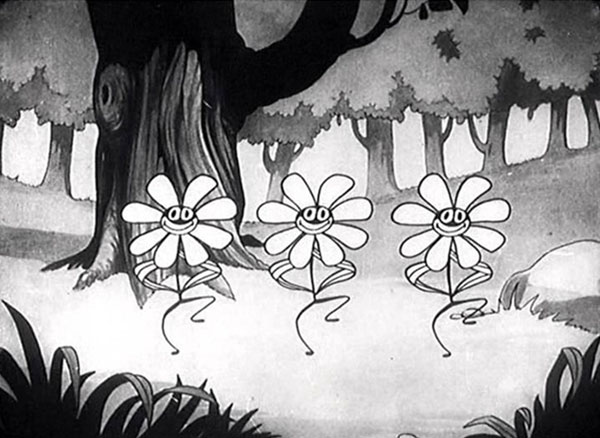
The short opens with the lovely music “Morning Mood” from Edvard Grieg’s Peer Gynt, as three flowers dance, with one flower then coming toward the screen as two ladybugs dance atop its pedals.

We then see a caterpillar dancing through the glen, and it splits into sections, all dancing independently. A crow then comes up behind it and eats each one of the sections.

The crow, wearing his top hat, then dances back to the nest where Mamma is sitting on eggs. The eggs hatch and the little hatchlings get out and immediately start dancing themselves.

A thunderstorm then arrives as lightning threatens a cloud, which tries to duck out of the way of the strikes, but the lightning finally pierces the cloud, and rain comes out of the cloud like a waterfall.

A somewhat bare tree treats the rainfall like a shower, scrubbing its branches like hair, and is then zapped in the rear end by lightning. As the rain stops, two grasshoppers, who have been using mushrooms as umbrellas, come out from underneath and begin dancing around to “Dance of the Hours” by Amilcare Ponchielli.

The two grasshoppers wind up unknowingly jumping into a frog’s mouth, and because they continue to dance, so does the frog. A spider then swings in does its own dance and uses its spider web as a harp.

A group of frogs then continues to dance, but they are tracked by a large water bird. For safety, all the frogs jump inside of each other like nesting eggs and take off, being chased by the bird, who manages to eat all of the frogs, after tossing them in the air. The bird skips through puddles, but the last puddle is deeper, and the bird sinks into the puddle as the cartoon ends.

While it’s typical of this era, with repetitive animation and a series of gags in place of its story, there is very creative animation here, including nice use of perspective and effects (when the frog dances we see its reflection rippling in the water below, which builds to a nice gag where the frog’s reflection seems to do its own dance steps).

Springtime has a vibe that’s as comforting as the season it celebrates.


Porky’s Spring Planting (1938), Warner Bros.

Another black and white entry, this one a sequel to the short, Porky’s Garden (1936), with Porky (Mel Blanc) looking to plant his vegetable garden, with assistance from his laconic dog, Streamline.

Streamline (also Blanc) digs the holes with his tail, and Porky rolls the seeds down the dog’s back to plant the garden. However, the chickens next door are hungry and see the garden as a diner (even hanging out a menu sign that reads: “Corn Beet and Cabbage”).

Porky’s efforts to rid his garden of the chickens are useless. He tries swinging a broom, but each time he does, an additional chicken appears. He eventually sends Streamline after the chickens, but they pummel the poor dog.

It all eventually leads Porky to try to come to some sort of agreement with the chickens and to try to get them to agree to creating one garden for himself and one for them. When he asks them what types of vegetables they want, and he mentions corn, the chickens break into an imitation of comedienne Martha Raye, as they declare, “Ohhh yeaaah!”

Directed by Frank Tashlin, this has his ingenious comedic touches throughout. Streamline’s thoughts come through the soundtrack in voice-over, and when Porky asks for the dog’s help, he mutters, “I’ll be able to sleep all day when I get my Social Security!”

Here, the humor is partnered with full animation and, much like Springtime, plays with perspective in the sequences where Porky plows the garden and nicely timed gags with the chickens, making Porky’s Spring Planting an entertaining entry from the title star’s early days.


Springtime for Thomas (1946), MGM

As this short opens, Jerry emerges from his mousehole (in the mailbox), ready for the day, and attempts to bother Tom by kicking the cat and pulling his hair out, but Tom simply shushes Jerry away.

Jerry looks out the window and sees what has Tom’s attention – Toodles, the female cat next door, lying out on a lounge chair, reading “Har-Puss Bazaar” magazine. Tom is in love, which is evident by the hearts that appear in his eyes and the fact that he kisses Jerry.

Toodles drops her handkerchief, and Tom buzzes over quickly to get it. She then blows a kiss, which flutters through the air and lands on Tom’s lips.

In a classic cartoon trope, a devil version of Jerry appears to the mouse and tells him that he needs to break up that relationship to save his friendship with Tom.

Jerry forges a letter from Toodles and gives it to an Alley Cat, voiced by Frank Graham (who reads it and notes that Toodles has always admired his physique, which he pronounces “fizzy-queue.”

The Alley Cat immediately goes over and breaks in between Tom and Toodles, throws Tom in the pool and immediately starts serenading Toodles with the song, “Quiéreme mucho.”

What follows is back and forth between Tom and the Alley Cat. Tom is thrown into a BBQ pit on a rotisserie, and the Alley Cat crashes into a pool that’s been drained of its water. It ends with Tom being ejected from the premises and meeting up with Jerry again.

The two gleefully start chasing each other, until Jerry encounters a female mouse and begins falling in love, as Tom did, as the cartoon ends.

Directed by William Hanna and Joseph Barbera, Springtime for Thomas is well-crafted, with beautiful visuals and lovely backgrounds by Robert Gentle, especially in the opening scene.

With a team of animators that includes Ed Barge and Kenneth Muse, the gags throughout play out perfectly (after Tom is kissed, his heart goes off like a fire alarm, he jumps in the air and is whacked in the head by a mallet from cupid, as the words “Love” appear in his eyes like a slot machine).

Additionally, the cigar-chomping, gruff Alley Cat is a great, additional rival for Tom. In all, Springtime for Thomas is a classic entry from the Golden Age of this legendary cartoon duo.

Just three of the many Springtime-themed cartoons (mention some of yours in the comments below). Once you’ve watched them, summer can’t be far behind.

  • ✇Cartoon Research
  • Screen Gems’ “Mutt ‘n Bones” (1944) Steve Stanchfield
    Happy Thursday! First, at Thunderbean: Things are humming as we get out a bunch of the special discs and Mid Century Modern 2, now back in stock. We’ve put up the titles we’re sending this week in case anyone missed them as well. I had a chance over this last week to get out to New York and scan a bunch of things. I was also able to visit my friend and collaborator Tommy Stathes, who was nice enough to lend this week’s cartoons and many more. Thanks Tommy! Now, onto this week’s film: Maybe Co
     

Screen Gems’ “Mutt ‘n Bones” (1944)

19 March 2026 at 07:01

Happy Thursday!

First, at Thunderbean:
Things are humming as we get out a bunch of the special discs and Mid Century Modern 2, now back in stock. We’ve put up the titles we’re sending this week in case anyone missed them as well. I had a chance over this last week to get out to New York and scan a bunch of things. I was also able to visit my friend and collaborator Tommy Stathes, who was nice enough to lend this week’s cartoons and many more. Thanks Tommy!


Now, onto this week’s film:

Maybe Columbia’s Mutt ’N Bones is the closest any studio got to making a Pluto cartoon besides Disney. In this WW2 outing, a dog dreams of being the “king of the bones” but wakes to none. In his local newspaper (“The Hard Times”) he reads about a bone drive to support the war, then spends the rest of the film competing with a Bulldog to bring bones to the bone drive, looking for a bigger one than he already has.

Compared to Disney’s Pluto, Columbia’s dog here is a little more worldly. He completely understands what he reads in the paper, and, like Tom and Jerry, seems to lead a human life even while living like a dog. It’s nice to see such an altruistic animal supporting the war at the expense of the thing he’d like most in the world.

Columbia cartoons from this period tend to be really dialogue heavy, often at the expense of much action. Mutt N’ Bones is refreshing in that it’s a visual gag cartoon without dialogue. While clearly taking cues from both Disney and Tom and Jerry cartoons, it still holds its own. There’s lots and lots of personality poses in the fun animation along the way, and plenty of gags- and while it’s far from the finest entertainment you’ll have this year, it’s enjoyable in the way it’s enjoyable to read the funny papers, and after all, that’s what it was designed to be.

Have a good week everyone!

  • ✇Cartoon Research
  • Special Bull-etin! (Part 4) Charles Gardner
    As usual, Hanna-Barbera was always a major contributor to standard cartoon scenarios and settings, tried and true by studios for years, which would find regular reuse in their seemingly-endless stream of production of films for TV. Of course, bullfighting thus became a common fall-back for situation comedy. Previous comments and posts have already addressed Bullfighter Huck, and Yogi Bear’s Big Bad Bully. We thus pick up with the sadly-neglected third member of H-B’s original triumvirate of
     

Special Bull-etin! (Part 4)

18 March 2026 at 07:01

As usual, Hanna-Barbera was always a major contributor to standard cartoon scenarios and settings, tried and true by studios for years, which would find regular reuse in their seemingly-endless stream of production of films for TV. Of course, bullfighting thus became a common fall-back for situation comedy. Previous comments and posts have already addressed Bullfighter Huck, and Yogi Bear’s Big Bad Bully. We thus pick up with the sadly-neglected third member of H-B’s original triumvirate of animal icons, Quick Draw McGraw, who provides two episodes of interest, then proceed ahead into other series with bullfight action overlooked by our readership.

El Kabong Strikes Again (Quick Draw McGraw, 12/21/59, Carlo Vinci, anim.) – Michael Maltese’s follow-up to his sub-franchise-creating classic that gave Quick Draw an alter ego which may have had longer longevity in viewers’ memories than his “real” persona. The continuing legend of the bumbling horse Western cowpoke who vanquishes evil by slipping into a mask and cape, swinging from a rope, and using his trusty “gee-tar” instead of a gun as his weapon of choice, smacking it over the heads of villains with the mighty shout of “KABONG!” (all in a clever lampoon of the long-popular Zorro franchise and then-current television series under production by Disney).

A narrator recites background for the story in rhyming couplets, setting the tale in the Mexican border town of El Pueblo. (There are two recordings of the narration – one for the cartoon track, and one re-recorded by Daws Butler as Quick Draw (with assistance from Baba Looey, his mock Spanish-accented anthropomorphic burro sidekick) for a storyteller Colpix LP otherwise using original dialog and sound-effects tracks from the film (but not the Capitol records needle-drops which provided the music). Some key differences in the record script will be noted below). The town’s hero is El Kabong, who is shown driving out the latest bandit to hold-up the town. But no sooner does one bad guy leave, then another arrives. Both narrations recite, “Then fickle fate inflicted a fiendish fiasco, in the form of the tyrant – the terrible Tabasco!” (The LP version adds a comment between Baba Looey and Quick Draw. Baba: “Was his last name, ‘Sauce’?” Quick Draw: “Who told ya’?” The LP continues with Quick Draw adding a couplet not in the film: “He was so mean, and he was so cruel, he threatened a beautiful Senorita O’Toole.” Baba sound incredulous about this remark. “Was that her name?” Quick Draw responds, “Search me. It rhymes with ‘cruel’, that’s all I know.”) Tabasco threatens the Senorita, “If tomorrow you do not have ten thousand pestardos, you will have to marry me.” Senorita: “You fiend. Haven’t you done enough harm to this town?” Tabasco: “Nooo…There must be something else I can steal.” The girl screams for El Kabong, and Quick Draw, off on the plains with Baba while singing a number in incredibly off-key fashion, hears the call. He shouts, “El Kabong strikes again! – Notice how neatly that works into the title of the picture?”

A quick costume change plays on an old gag from Bugs Bunny’s “Super Rabbit”, as Quick Draw appears mistakenly in a clown outfit instead of the proper cape and mask. Once wardrobe problems are resolved, Tabasco receives his first introduction to Kabong’s “Kabonger” – over the head. “He is dangerous”, Tabasco admits. Even making an escape in a stagecoach provides little protection, as the Kabonger is extended to the moving stagecoach’s window on a telephone extender to strike another blow. But the matter remains that the debt of ten thousand pestardos still needs to be paid, and all Kabong has in his pockets is $1.35 and half a Green Stamp (far insufficient, even with favorable Mexican exchange rates).

By a strange coincidence, Tabasco is also active in promoting bullfights, and a poster on the wall of the plaza offers Tabasco’s prize of ten thousand pestardos to anyone who fight El Gorito, the ferocious bull. “You are going to fight the bull for me?” asks the Senorita. “I am?”, responds Kabong in a tremulous question. “Ah, I knew you would”, sighs the Senorita. Before he knows it, Kabong is being pushed out into the bull ring by Baba before a cheering crowd, protesting that he’s not fighting any bull. “But the bull is bullfighting you”, says Baba, as the bull pen gate bursts open to reveal Kabong’s competitor. Baba wishes Kabong luck, and scatters. Kabong wishes the bull luck, and starts running too. The bull and Kabong perform about three laps around the arena, while Tabasco calls out from the stands, “What kind of bull fighting you call that?” “I’m gonna tire him out first – that’s what kind!” shouts Kabong. The bull pauses to remove one horn from his head, and insert its point in a “Sure Sharp” pencil sharpener mounted on the arena wall. Kabong continues his next lap around the ring, skidding to a stop as he realizes he’s caught up with the bull, who scores a “bull’s eye” on Kabong’s rear-end with the newly-sharpened horn. “Oooh – that’s pointy!” From the sidelines, Baba offers and suggests that “Queek Straw” use his trusty Kabonger. “Why didn’t I think of that”, says Kabong. But instead of smacking the bull over the head with it, Kabong has a different plan. He plays the guitar, singing a repeat performance of his awful song from earlier in the film: “I have not slept in twenty days. I should look an awful sight. But it doesn’t bother me at all – ‘cause I always sleep at night.” This is too much for any bull to handle. Holding his ears, the bull moans, “Oh, no, no, NO!!”, and runs away. But Tabasco makes a quick getaway with the chest full of pestardos. Finally, Kabong makes use of his guitar for its proper purpose, and bashes Tabasco over the head again. Tabasco scoots, leaving the chest behind. The Senorita thanks Kabong, but asks for him to unmask so that she can reward him with a kiss. Quick Draw obliges. One look at that “rugged” face, and the Senorita screams in panic. She runs from the ring, but not before grabbing the money chest and taking it with her, calling out, “Wait, Tabasco! Wait for me!” Baba has the final observation for the curtain line: “I thinn, maybe El Kabong strikes out again, yes, no?”


Bull-Leave Me (3/7/60) finds Quick Draw in a new setting – on the pampas in the Argentine. A prize bull, named El Screwballito, has escaped, and a gaucho is in pursuit to re-capture him. The bull features a delightful resonating basso chortle of a laugh, that is reminiscent of the laugh of Tex Avery in such films as “Hamateur Night” and “The Penguin Parade” – a bit of a surprise it doesn’t show up in more H-B films, in place of Don Messick’s ever-present snicker for dogs such as Muttley and Mumbly. A narrator asks the bull why he ran away, and, after a laugh, he responds, “Ees fun!” The gaucho throws a set of bolas at the bull, but the bull acquires from nowhere a baseball bat, and bats the bolas back to the gaucho, tying him firmly up. The gaucho points out how well the name “El Screwballito” thus fits the bull.

Ranchero Don Town (or as Baba puts it, maybe Uptown – what’s the difference?) can’t get any further volunteers from his gauchos to pursue the bull. Enter Quick Draw, anxious to fill the role of hero. In another instant costume change, Quick Draw assumes the garb of a gaucho, but Don Town does not believe his horse-face fills the bill. He gives Quick Draw a pop quiz on the basic terminology of the job. Q: “What’s a gaucho?” A: “One of the Marx Brothers.” Q: “What are the Andes?” A: “The other half of ‘Amos and’.” Q: “What are bolas?” A: “Where you keep a goldfish.” Don Town leans against Quick Draw, weeping, “Oh, no!” Quick Draw consoles him with the un-encouraging words, “Let’s face it. You’re stuck with me.”

A lengthy chase ensues between Quick Draw and El Screwballito over the pampas, most of which makes little direct reference to the sport of bullfighting. One notable gag has the bull appearing to patiently wait for Quick Draw, leaning against a rock and laughing. Quick Draw charges him at full speed toward the camera – then slams his face into what appears to be an invisible barrier, and collapses. The camera pulls back, to reveal a huge pane of invisible glass which the bull has put up between himself and Quick Draw. But ultimately, Quick Draw resorts to the red cape and calls of “Toro” in the traditional matador manner. His plot is a variation of Bugs Bunny’s “The Grey-Hounded Hare” and “Bully For Bugs” gag and similar gags which followed at other studios – having the bull charge, while the cape is held before a solid object, to cause the bull to conk himself on the head. Quick Draw chooses to hold the cape before a mammoth boulder. Unfortunately for him, he underestimates Screwballito’s strength – as the bull charges with such power, he knocks the boulder upwards high into the air – then down upon Quick Draw’s head. What else is there to say, but “Ouch Ouch, Ooch Ouch Ouch!!” The final sequence plays upon an old gag setup first seen in the context of bullfighting in the famous Three Stooges live-action short, “What’s the Matador?” (though the Stooges’ writers likely modified it from the ending of the Donald Duck cartoon, “Sea Scouts”, in which the head-to-head battle was performed between Donald and a shark). Quick Draw equips the hood of a jeep with a huge set of bull horns taken from a longhorn steer, planning to “fight horns with horns”. El Screwballito is caught by surprise, and mutters, “Uh oh”, as he finds himself on the retreat, ahead of the hood of the speeding jeep. The bull comes upon the gates of a pampas corral, which just happen to have a matching set of longhorn horns hanging over the gate. “Ah ha!”, snorts the bull, grabbing the larger horns and tying them onto his own head. Now evenly matched, the bull charges the jeep. The camera quickly swaps between alternating views of the speeding jeep and the speeding bull. – then finally shows us the dust clouds of the ultimate head-on collision. (One will recall similar staging for the ending of Woody Woodpecker’s “The Hollywood Matador”). When the dust clears, Quick Draw and jeep look visibly shaken, but temporarily whole. It doesn’t last long, and crack lines appear throughout the bodies of both Quick Draw and the jeep, as both crumble into powder. The bull engages in his laugh again at this outcome, but suddenly goes rigid, with a cry of “Huh?” Within a few seconds, he too has developed crack marks, and crumbled into powder. Baba as usual delivers the afterthought. “That’s Queek Straw for you. When the chips are down, he goes all to pieces – – but I like him.”


George Jetson in a bullfight? Well, of sorts, in Test Pilot (The Jetsons, 12/30/62). Spacely’s research division (consisting of one old timer who’s been at it for 58 years) has developed the indestructible suit, guaranteed to be impervious to all destructive forces, and to protect the wearer as well. Unfortunately, as Spacely stares out the window at the Cogswell Cogs building, relishing the thought that his competitor’s days are numbered with all the sales Spacely will make, an explosion matching the one in which Spacely’s inventor put the final touches on the suit is witnessed inside the Cogswell building. A peek through binoculars reveals that Cogswell’s researchers have produced a matching suit! The only way for Spacely to get the jump on sales is to call out the press, and stage a public demonstration of the suit’s wonders. But one problem quickly presents itself. No one is stupid enough to agree to test-hop the suit – not even the suit’s inventor. Cogswell finds himself in the same boat, and for the moment, the two moguls are stymied and stalemated in their race for success.

Meanwhile, George is reporting for a company physical, at the office of a doctor who just happens to collect ancient human artifacts, including a genuine Egyptian mummy. Via a space-age slingshot gun, George is made to swallow a computerized mini-probe shot down his throat. The probe (in the voice of Mel Blanc, not far removed from his voice for Marvin the Martian) communicates with the doctor on a monitor screen, as it travels through George’s body examining him from the inside. On the way to the brain, the probe overshoots a curve, pops out of George’s ear unnoticed (wouldn’t this at least leave a punctured ear drum?), and winds up inside the ear of the mummy resting on the opposite side of the room. As the probe gives an image of the brain, it displays a darkened maze of cobwebs. The probe states that this is the first time he’s ever been inside a haunted head, and when asked by the doctor for an opinion of the patient’s condition, the probe reveals a small bugle, upon which it blows “Taps”. George is told the end is imminent, and if he has anything he needs to do, do it in a hurry. Assuming his life is ending, George finds the gumption to do something he could never do if he had anything left to live for – tell Spacely off, and quit. After blowing smoke in Spacely’s face and dousing him with water, George seizes him by the collar, stopping him cold before he can utter, “You’re fired”, and making clear Spacely’s threats mean nothing to him anymore. The suit’s inventor sees this display of courage as the answer to their prayer – here is the man brave enough to test the suit. A bidding war for George’s services takes place between Spacely and Cogswell, with Spacely going all out and offering money from his private safe that hasn’t seen the light of day for so long, the picture of George Washington on the bills has to don a pair of sunglasses. With nothing to lose, George accepts Spaceley’s proposition.

The tests begin, with Spacely sparing no expense on publicity. George runs the gamut of hazards – spun underwater tied to a ship’s propeller blade, lying under a ten-ton boulder while it is smashed to pebbles in a compressor, placed in a room with closing walls on all sides, electrically fried with a mammoth dose of voltage, and defying a buzzsaw which is unable to saw him in two. George somehow survives all with no lasting damage. The final test finds George set to be raised to a height of three miles and dropped by parachute, with two anti-missile-missiles targeted to hit him simultaneously during his descent. Just before the lift-off, who should break through the crowd to speak to George but the doctor, with news that it was all a mistake, and that George should live to the ripe old age of 150. But it’s too late to stop the stunt. The missiles launch, and George finds himself in their crosshairs. Grabbing the parachute fabric (though no explanation is offered why George continues to fall slowly with no billowing silk), George waves the fabric with timid cries of “Ole”, to lure the missiles to charge him. The missiles pause in mid-air, and, accompanied by the music of a majestic trumpet as if from the bull ring, paw with their stabilizer fins as if a four-legged bull pawing the dirt before a charge. The first missile advances, and George performs a perfect matador’s pass. The other missile takes up the challenge. George continues his beckoning calls: “Ole – Ole – Oy, Vey!” as the second missile passes. Both missiles loop and turn around, returning simultaneously from both directions. George hastily writes a will, drops it to the ground, and closes with the words, “George Jeston, signing off.” BOOM!! But George descends to the ground, still all in one piece. The suit worked, and Spacely tells George his bonuses and vice-presidency are assured. George would have settled just for finding himself alive. But of course, all is not the bed of roses they planned. Before a banquet to announce George’s promotion, well-intentioned Jane puts the suit in the washer. It falls apart from not being dry-cleaned! Spacely announces he’ll be bankrupted, and George submits a quick resignation, racing to Cogswell Cogs to see if he can find a job. Even Spacely is forced to eat his pride, shouting after George, “Wait! I’ll go with you!”


Bully For Atom Ant (1/22/66) – Atom Ant takes a needed vacation South of the border, traveling incognito under a sombrero of human size. While sampling the local cuisine at a taco stand, he hears weeping at the shoreline. A skinny young man is about to toss a large boulder off a pier – with himself tied to it. “Adios, cruel world. I don’t theenk I stay on you anymore.” He and the rock plunge into the briny – but Atom Ant zooms in to pull the spluttering man back onto the shore. He wails that nothing goes right, unaware he has been saved, and thinking the ocean is as dry as the dry land. Atom explains that he has been rescued, but the man sees little point in it, as there is nothing to live for. His senorita has given him the air and will not marry him, because he will not fight El Tornado in the bull ring. Atom asks the man’s name, and he responds, “C. Enchilada” – the “C” standing for “Chicken”. (Perhaps if he’d had a brave brother, his first initial would have been B. for Beef.) But Atom has a plan. The man himself can hardly see Atom – even when he is standing on the man’s nose – so no one in the bull ring will see Atom either. Atom will thus do the real fighting, and all Enchilada has to do is wave a cape around for a sure victory.

Enchilada’s appearance in the ring fails of itself to provide any instant impression on the senorita, who remains haughty and unconvinced that anything has changed with Enchilada. El Tornado makes an impressive entrance, and revs up for his first charge. Atom hides behind the folds of Enchilada’s cape, and when the bull hits, he is knocked back so far by Atom’s fist, he has to creep up on the cape and look underneath it, to resolve his worries that Enchilada placed a solid rock behind it. Tornado charges again, after using the old pencil sharpener gag to sharpen his horns. Enchilada is bent over taking bows to the crowd, and seems an easy target – but Atom lifts Enchilada up by the seat of his pants into mid-air, in the nick of time, leaving Tornado to crash through a wooden barrier. Enchilada remains suspended in air, still waving his cape to entice Toro. Tornado resets his sights, placing a stepladder in the center of the ring, and charging up its steps to reach Enchilada. Atom pulls Enchilada away to one side, leaving the bull racing upwards into thin air past the last ladder rung, then falling to create a crater in the arena dirt. Enchilada, back on the ground, waves his cape to entice the bull again. But the bull dives deeper into the crater he has created, tunnels underground, and pops up with full force under Enchilada’s feet, driving him and Atom as passenger into the air and down, to create a matching crater in the dust of their own. Now the bull takes bows to the crowd. Enchilada asks Atom what they should do now? Atom asks Enchilada to wait just a minute. With speed in excess of the sound barrier, Atom takes a ten-second time out to fly through the air all the way back to his headquarters hole in the ground, do about six lifts of his barbell to build up his strength, and zip back again to Mexico, where he returns the bull’s trick, by tunneling underneath him, then delivering through the dirt the might of his “atomic punch”. The bull rises high in the sky, then his descending shadow looms over Atom. “And here comes the fallout”, remarks out hero, zipping out of the bull’s trajectory. The bull again winds up buried in the dirt, and raises from the dust a white flag hoisted upon his tail, as a sign of surrender. The film closes with Enchilada and the senorita as newlyweds, riding off into the sunset atop the now tame El Tornado, dragging clanking tin cans and a “Just Married” sign upon his tail. Atom closes to the audience with, “And so, they lived happily ever after, I theenk!”

• “Bully For Atom Ant” is on Dailymotion.


Unaccounted for are two possible (one likely) episodes from The Abbott and Costello Cartoon Show, with no plot synopsis available, but promising titles. The longshot is Bully Billy, which might as easily refer to some human bully. But Bully For Lou sounds like a sure bet. Anyone know what old retreaded gags they dredged up for either of these?


What a difference a decade and mother’s anti-violence groups can make. H-B’s new “The Tom and Jerry Show” was never something I heard Bill or Joe discuss in interviews, but, even if they spoke of it to the press at some point, one has to believe that deep within, there had to be some shame as to the visible shoddiness of production, poor timing, and entirely lackluster plots of virtually the entire show. It was certainly something they kept their own names off of as far as direction credits (though by this time, this was true of all their shows), and some of the TV shorts they would direct themselves in their final years (such as “Wind-Up Wolf” and others) certainly show they personally still had within them a sense of better timing and a glimmer of their old creative spark. Perhaps the biggest sin of this project was its managing to render two characters who had exuded so much personality on screen without need to utter a word entirely persona-less – cardboard cutouts with no more visible character traits than Buster Bear or Marty the Monk (if you don’t know ‘em, look ’em up). And gone was any semblance of the signature scenario of the series – the chase. Now, the two would fit better as members of the Get Along Gang. H-B’s re-licensing of their own creations, just to allow the entire reputation of the series to be dragged down to an all-time low (even Filmation’s later encounter with the characters, though miserably animated, could sometimes generate a small laugh, restored the characters to adversaries, and resumed the chasing), seemed clearly a simple “taking a dive” for the almighty dollar, and an absolute sell-out of the franchise which never should have seen the light of day. I still (I’m sure along with most fans of the characters) cringe whenever one of these items gets replayed, although I seem to be able to at least sit through everyone else’s attempts.

The Bull Fighters (12/6/75) finds Tom and Jerry, for no apparent reason, walking along a road in the Mexican countryside, apparently on their way to Tiajuana. A bull in a pasture works out with barbells for his morning exercise, then plants a sign near the road reading “Shortcut to Tiajuana” to lure Tom and Jerry into his pasture – thus providing the bull with a target for his morning “road work”. The bull charges, but T&J make a quick reversal of directions, and the bull keeps on sliding forward in his attempt to stop, sliding into the water of a pond. The bull flounders in the water, calling for help because he can’t swim. Tom notices a well with an attached wooden bucket, and tosses the bucket at the bull’s horns, spearing one horn into the bucket’s wood. Tom then reels in the line with the well handle, towing the bull to safety. Despite the good deed, Tom and Jerry aren’t going to stick around to see what mood the bull is in, and start running again. The bull hollers for them to come back, and tosses the well bucket so as to land atop them, stopping their retreat. The bull explains that they saved his life, and from now on, they’ll be friends forever. He introduces himself as Toro the Terrible, a fighter in the bull ring, and as a reward for saving his life, gives T&J two free tickets to see him perform at the arena this afternoon.

T&J needn’t have worried about the free passes to the ring, as circumstances have them destined to view the event from a different perspective. As they enter the town, several people, including the owner of the bull ring, flee in terror, as another bull, El Rotteno, has broken loose. T&J find themselves running away once again, as the hooves of El Rotteno come closer and closer. Tom gets tangled up in the clothing rack outside a dressmaker’s shop, and emerges carrying a frilly red dress. As he holds the garment out in front of him to observe it, the bull passes through, reacting to it as if a cape. Tom is unscratched, but the bull is unable to put on the brakes after the pass, slides up the ramp of a truck with a wooden stake bed, and gets his horns jammed in the wood of one of the cross-beams, holding him captive. The arena owner is amazed at Tom’s cape-work, and offers to make him a famous and wealthy matador. Tom shakes his head no at the offer, until he hears that the owner intends to match him in the ring with someone he knows – Toro the Terrible. Remembering the bull’s promise of eternal friendship, Tom accepts the owner’s offer with a friendly handshake. The owner takes T&J to a holding corral outside the arena, giving Tom a chance to study his bovine opponent. This allows Toro, after briefly putting on an act of ferocity for the boss, to reaffirm that the match will be “duck soup”, and giving Tom a set of signals – a twirl of his left horn means Toro will pass on the left, and the opposite if he twirls his right.

Jerry becomes practically a non-participant in this cartoon, appearing in the ring only as an assistant to carry Tom’s capes (we never see a sword, so one can only wonder how any match is supposed to end). Toro is released from the opposite door of the arena, and begins giving his horn-turning signals. Tom pulls a few of the standard cape maneuvers, including the old windowshade roll-up as Toro passes. Tom uses one new move, hanging the cape upon his tail for another pass. Toro looks back to observe that the crowd is loving it – but overshoots the parameters of the arena, sliding through the archway of the matadors’ entrance, and crashing into a wall inside. He is not only temporarily dazed, but comes up with a twisted ankle. The show must go on, declares the arena owner, making a call for a substitute – El Rotteno. The angry substitute quickly recognizes Tom as the wise guy with the red dress, and seeks to even the score. Tom, however, is none the wiser about the substitution, and calmly walks up to the bull, clasping the metal ring hooked in his nose, and raising and lowering it a couple of times as if using a door-knocker. El Rotteno charges, and two old Warner gags are quickly swiped by the writers. First, a pass transforms Tom’s cape into a string of paper dolls (straight out of Daffy Duck’s “Mexican Joyride”). Then, a second cape handed to Tom by Jerry is punctured with a bull-shaped silhouette (from “Bully for Bugs”). Tom smiles through it all, still thinking it’s part of the act (though no explanation is provided as to why Tom is not looking for the twirling horn signals expected from Toro). As for Toro himself, he suddenly appears above Jerry on the sidelines, watching the match from the spectator’s side of the fence. Toro thinks Tom is doing all right for himself – but explains to Jerry about his twisted ankle, and that Tom is really fighting El Rotteno. Jerry, maintaining his inability to speak, quickly scribbles a note of explanation to Tom, runs up Tom’s back, and displays the note before Tom’s eyes. El Rotteno makes another pass, catching the note on his horns, then slashing one horn against another to cut the paper into confetti. Tom runs for one of the picador barriers, climbing it. El Rotteno again slams his horns into wood, but this time exerts his strength, lifting the barrier out of the ground, and carrying Tom along on top of it with him. He then spots Jerry, and starts to chase him too. Atop the bull, Tom grabs the points of the bull’s horns protruding through the barrier, and steers them to the right to change the bull’s direction. El Rotteno is steered through the archway back to the bull enclosure, and the wooden barrier falls into place at the archway, very unconvincingly providing a supposed barrier to the bull’s re-entrance. (It’s not mounted to the wall by anything, so couldn’t El Rotteno merely knock it down?) The film abruptly ends without further development, in a traditional scene of T&J taking bows as sombreros are tossed into the ring. Ho Hum – and this was one of the better installments of the series!


How do you turn bullfighting into a competitive team sport, without an awful lot of bloodletting? That’s what “Scooby’s All-Star Laff-a-Lympics” attempted to do in the installment, Spain and the Himalayas (11/5/77), taking a leaf – as well as petals and stem – from Lotte Reiniger’s 1934 shadow-animation version of “Carmen” (discussed in chapter I of this article series), and reversing it. Instead of the bull taking a rose from the lips of Carmen, the objective is to retrieve a rose from the lips of the bull! I don’t particularly know of any professional toreadors who have tried this stunt, nor of any bull who was cooperative enough to keep his teeth clenched throughout the event. So let’s just chalk this up to animators’ poetic license – anything for a gag situation.

Mumbly open the competition for the Really Rottens – as usual, with a plan to cheat. He has with him a sleeping gas bomb, intending to make the bull go nighty-night while he grabs the rose. But the device doesn’t work as intended when tossed, merely bouncing off the bull’s nose without emitting its contents, and rebounds back to Mumbly’s feet where it finally bursts open. Mumbly yawns, falls into a sleepwalk, and walks himself out of the arena in a complete doze. Dynomutt steps out as the representative of the Scooby-Doobies. Hos gimmick: use his bionic leg extensions to obtain an overhead position on the bull, sneaking up from behind to pluck the rose from a position right between the bull’s eyes. The bull, however, spots him on the first attempt, and dodges forward into a run across the arena before Dynomutt can make the grab. With his feet still planted where they started from, Dynomutt attempts to keep up with the bull not by running, but by continuing to extend his telescoping lower limbs. He runs out of extension room, reaching his maximum limit, and is sprung backwards by his mechanical limbs, which land hard upon his feet, compressing him into a short squat stance back where he started. Dynomutt apologizes that he must have strained a transistor, and waddles slowly away. This leaves the surprise contestant chosen to represent the Yogi Yahooeys – Cindy Bear! Commentators Snagglepuss and Mildew Wolf can’t figure how she ever expects to get near enough to the bull to do anything – especially when, instead of a cape, Cindy produces a music stand and sheet music. But Cindy promises that music has charms to soothe the savage beast, and the tune she intends to perform will have the bull dropping the rose right at her feet. The bull begins a charge, and Mildew observes that he doesn’t look like he’s got any ear for music. But Cindy stands her ground, and must have been taking lessons from Quick Draw McGraw (making one wonder why Quick Draw wasn’t chosen as team representative to repeat his performance discussed above, since Quick Draw is also a regular member of the Yogi Yahooeys team), performing a run of high-piercing, off-key contraltos. Her singing has the same effect upon the bull as Quick Draw’s, with the bull stopping just short of impact to plug his ears with his hooves, his jaw dropping open in a “no” position, and the rose landing right at Cindy’s feet as promised. (Odd in retrospect, since Cindy sang quite competently in “Hey, There, It’s Yogi Bear”, and “Yogi’s First Christmas”.) Mildew loses a bet to Snagglepuss that Cindy couldn’t do it, and is required to eat his straw hat, complaining that it’ll spoil his din-din – but please, pass the ketchup.

• “Spain and the Himalayas” is on Dailymotion.


There’s plenty of bull in the double-length “All-New Popeye” installment, King of the Rodeo (circa 1979, air date unknown). While the setting is a Western event, traditional bullfighting capework shows up twice in this story, once in each reel. Unusual to a rodeo, the first event is expressly referred to by announcer/judge Wimpy as “bullfighting”. Popeye steps into the arena, producing a cape from under his Stetson hat, and expertly handling the bull’s first pass. As the bull shifts direction to advance upon Popeye again, Popeye wise-cracks, “Reversing the charges, eh?” Of course, Bluto is Popeye’s competition, sitting on the sidelines atop a corral gate. He decides to improve his odds for the competition, by getting at Popeye’s “threads” with the suction of a vacuum cleaner, which steals his cape away. Popeye avoids impact by jumping over the top of the approaching bull, leap-frogging over his oncoming horns. The bull’s momentum carries him forward, and he smashes horns-first into the corral gate Bluto is sitting on. Rearing back, the bull picks up both the gate and Bluto, carrying them back into the arena to pursue Popeye. The ride’s a little rocky, but as long as Bluto is in the event, he chooses to steer the bull by the horns toward Popeye. Popeye remarks, “A bull-cycle built for two”, and runs. But, as the three approach an arena exit with a low overhanging archway, Popeye yells out to Bluto that his mount has no power steering. The bull follows Popeye through the exit, but Bluto and the gate smash into the upper archway, pressing Bluto momentarily flat and dazed, while Popeye, somehow safe, peeps in to laugh with delight at his downfall.

One of the events in the second half of the film is bulldogging. Bluto fouls up Popeye’s attempt to grab the bull by the horns, by placing stretchy rubber tips at the top of each of the bull’s horns while in the corral. Popeye gets a false grip, and is dragged behind by the stretchy rubber. When he finally lands in front of the bull, the bull hogties him, takes his own bows to the crowd, then pulls on the rope to release Popeye like a spinning top. A quick head-butt, and Popeye is driven head-first through a wooden barrier, stuck. Bluto uses a pencil to draw circles upon the seat of Popeye’s pants, providing the bull with a perfect bull’s-eye. Olive tries to intervene, running out into the ring with a red cape of her own, and shouting “Andalay, Andalay.” The bull changes target, sending Olive for a spin of her own as he passes, and spearing her cape upon one of his horns. As the bull reverses direction, Olive and Popeye find themselves cornered on one side of the arena. Popeye meets the challenge, pawing the dirt with one foot and charging the bull, but suddenly transforms the confrontation into a social affair, with the inquiry to the bull, “May I have this dance?” He and the bull break into a round of square dancing, Olive joins in, and the bull even drags in Bluto from the sidelines. Bluto complains that dancing is for sissies, so the bull casually tosses him aside into a watering trough. Finally, however, Popeye decides to have the last laugh, grabbing one of the bull’s front hooves, spinning him around, and landing the bull upside-down on his back, allowing Popeye to rope his feet and win the event.

Brahma Bull riding is the last event. Bluto’s taking no chances on losing this one, having supplied his own mount, in the form of two dumb assistants who wear an old cowhide in impersonation of a bull. Bluto saunters out of the corral atop the two of them, in almost slow motion, but certainly having no trouble staying astride the beast. Wimpy awards him 10 points for a perfect, if somewhat boring, ride. Popeye, however, draws El Diablo, the toughest Brahma in the event. He holds firmly to the rope around the bull’s waist, failing to notice Bluto as he cuts it. Popeye thus finds himself in the ride of his life, fighting desperately to keep his seat. Olive uses a lariat to lasso the bull’s hump, but is merely towed along, her spurs digging a deep trench into the ground, within which Olive becomes stuck. The bull circles around, and now charges at the trapped Olive. Time for Popeye’s “pick-me-up”, this time opening the can by using one of the bull’s horn tips as a can opener. The spinach turns him into a human bulldozer, allowing him to dig Olive out of the ground and deposit her back in the stands to safety, then meet the bull’s charge head on, stopping him cold. The bull turns to an easier target, approaching the fake steed of Bluto, and the two flunkies within ditch their bull costume and run for the exit, revealing Bluto’s fraud. Bluto is disqualified, and Popeye receives the Rodeo crown and trophy. But Bluto never loses gracefully, and seeks revenge by releasing all the remaining bulls in the rodeo at once for a stampede. Popeye grabs up a tall pile of spare boards used for building the bleacher grandstands, and tosses them into the air, forming a corral pen around the cattle. Bluto tosses huge bales of hay at Popeye, but Popeye as quickly tosses them back, stating that once again he as to “bale” Bluto out. Bluto is buried under the hay bales – and who should come charging through them but Popeye’s Brahma bull. Bluto is chased out of the arena and down the road, only one step ahead of the beast’s horns. The final scenes of the film have Popeye and Olive parading before the crowd in victory. Olive observes that Bluto is back in the stands. “Even Bluto’s standing to watch us ride by”, she remarks. “That’s because he can’t sit down”, correctly guesses Popeye, as two large band-aids are observed upon Bluto’s soft and tender pants-seat.


Scooby’s Bull Fright (The Scooby and Scrappy Doo Show, 12/6/80) is a short one-reeler, with neither mystery to solve, nor the human players of the Scooby Gang in attendance besides Shaggy – although the Mystery Machine makes an appearance for transportation. Dawn breaks upon two familiar figures sleeping on blankets under large sombreros, with the Mystery Machine seen parked in the background. They are, of course, Scooby and Shaggy, who are awakened by a rooster, who crows, but adds the words, “Hey, Senor”. Shaggy thinks it’s still night – because his hat is pulled down far over his eyes. But a call for breakfast from Scrappy Doo opens both of their eyes, as he tosses them the local idea of breakfast fare – hot tamales. As steam pours out of Scooby’s and Shaggy’s ears, Shaggy manages to gasp an inquiry to Scrappy as to where he got this stuff. “Right up there”, says Scrappy, pointing upwards to a grandstand where a vendor sells them to the seated crowd. Scooby and Shaggy suddenly realize that, in the darkness, they mistakenly camped out in the middle of the bull arena.

Of course, the bull makes an appearance right on cue. Scrappy is in his usual fighting mood, and grabs up a small cape, yelling “Toro, Toro. Right this way, ya big bully.” Scooby runs interference, wearing a Keystone Kop hat, and holding up a traffic sign reading “Stop” in the bull’s face. (Never mind that the sign is red, which should make the bull even madder.) Scooby races off with Scrappy, depositing him in the Mystery Machine, as Shaggy tries to start the ignition. Of course, the engine won’t turn instantly over, providing Scrappy with enough time to emerge from the van’s rear, wearing boxing gloves and challenging the bull to put up his dukes. The bull answers the challenge, abandoning his traditional charge, and also appearing in fighter’s gloves. Before the two can mix it up, Shaggy rings a bell, and Scooby places a stool at one side of the arena, as the two convince the bull that round 1 has just ended, and take the bull over to one corner, pep-talking him with phrases such as “He never laid a glove on ya”. Scooby throws a pail of water in the bull’s face, as our heroes drag Scrappy back behind a picador’s barrier. But Scrappy emerges again, this time decked out in the mask of a hockey goalie, and with his own stick, puck, and net. He challenges the bull to try to score a goal on him. Once again, the bull answers the challenge, appearing with a hockey stick larger than Scrappy himself. But Shaggy and Scoob run interference again, blowing a penalty whistle, accusing the bull of crossing the blue line too soon, and giving him four minutes in a penalty box. The diversion again gives them time to drag Scrappy away.

With the Mystery Machine’s ignition still not cooperating, our heroes attempt to make a getaway, disguised in an old cow hide. As in any bullfight cartoon, the bull is smitten by the fake female, but a kiss from him is more than Scooby in the fake cow head can stand, who reveals himself to spit away the flavor and say “Yuck”. Scrappy somehow winds up inside the head, and still utters verbal challenges to the bull, charging him, and dragging Shaggy and Scooby along in the rear of the costume. Roles become reversed, as the bull picks up a cape, and plays toreador for a pass of the charging Scrappy. Scooby and Shaggy crash into a wall, while Scrappy breaks free of the head, and leaps on the bull’s back, seeking to ride him as if in a rodeo. The bull begins to buck, but Scrappy remains astride him. Shaggy and Scooby duck out of the galloping bull’s way, as Scrappy leans over the top of the bull’s head. “You still wanna play games, eh? Well try this one.” He leans over the bull’s brow, using both front paws to shut the bull’s eyes. “Guess who?”, he says. Unable to see, the bull charges through an arena archway, and a loud crash is heard within. Scooby and Shaggy presume the worst, but Scrappy emerges from the archway unharmed, leading the bull, who is bandaged and in traction. The boys find themselves strewn with roses tossed from the stands, and Scrappy still wants more. “We can’t quit while we’re ahead”, he declares. “That’s what you think”, answers Shaggy, as the Mystery Machine’s engine finally turns over, and the three speed off into the Mexican sunset.

• “Scooby’s Bull Fright” is on Dailymotion

NEXT WEEK: If you can stand it – A few more H-B items, and miscellany from other studios.

  • ✇Cartoon Research
  • Classic Cartoon Writing: Why These Cartoons Weren’t for Kids David Derks
    Left to right: Daws Butler, June Foray and Stan Freberg There are voices you recognize instantly. And then there are voices you’ve known your entire life—without ever realizing how much intention, intelligence, and writing lived behind them. June Foray was a legendary voice actor. But the conversations I remember most with her weren’t really about performance. They were about writing—and about what animated cartoons were actually trying to be during that era. Looking back now, that distinction
     

Classic Cartoon Writing: Why These Cartoons Weren’t for Kids

17 March 2026 at 07:01

Left to right: Daws Butler, June Foray and Stan Freberg

There are voices you recognize instantly.

And then there are voices you’ve known your entire life—without ever realizing how much intention, intelligence, and writing lived behind them.

June Foray was a legendary voice actor. But the conversations I remember most with her weren’t really about performance. They were about writing—and about what animated cartoons were actually trying to be during that era.

Looking back now, that distinction matters.

Who June Foray Was—and Why She Was There

June Foray was one of the most prolific American voice actors in animation history. Her career spanned radio, television, and film, and she worked across studios such as Warner Bros., MGM, Hanna-Barbera, Jay Ward Productions, and Disney.

She voiced an extraordinary range of characters, from Rocky the Flying Squirrel and Natasha Fatale to Granny, Witch Hazel, and Lucifer the Cat. But while her performances were iconic, June understood something deeper about animation: voices serve the writing.

And the writing, she believed, was never meant to be simplistic.

A Conversation About What Cartoons Really Were

I was fortunate to know June Foray, and one conversation in particular has stayed with me.

We were talking about The Adventures of Rocky and Bullwinkle, and I mentioned that as an adult, I had gone back and watched segments like Fractured Fairy Tales. What struck me was realizing how many of the jokes clearly weren’t written for children at all.

June laughed.

She told me that Rocky and Bullwinkle was never meant to be children’s television. It was simply adults writing for adults—sharp, satirical humor delivered through animation. The idea that it was “for kids” came later, largely because of the medium rather than the intent. Even though the show was produced for Saturday morning children’s programming, it wasn’t

That moment reframed how I saw the entire era.

Super Chicken and the Writing You Don’t Catch as a Kid

As a child, I loved Super Chicken simply because it was a cartoon. The action kept moving, the characters felt strange and memorable, and the situations were endlessly unpredictable. At the time, that was enough. However, when I revisited the series as an adult, everything changed. I began to notice how carefully the jokes were constructed. More importantly, I finally understood who this classic cartoon writing was really written for.

One episode, in particular, captures exactly what June Foray once described about animation being far smarter than people assume. In this episode, a mad scientist creates a living toupee—a sentient hairpiece that escapes and launches a destructive rampage through Pittsburgh. As a result, buildings come under threat and chaos spreads quickly. The premise itself leans fully into surreal satire. Meanwhile, Super Chicken and Fred respond with wit and clever gadgetry. Still, the episode’s real impact comes from its finer details.

At one point, Super Chicken devises a plan to stop the toupee by worrying it until it loses its hair. The episode then delivers lines such as, “Congratulations, it’s twins. Signed, Kewpie,” followed shortly by, “Special delivery from the draft board—you have been classified 1A.” As a child, those jokes passed right by me. As an adult, however, they land immediately. These are unmistakably adult jokes, written with confidence and precision. They exemplify how classic cartoon writing trusted its audience to be smarter than expected.

That confidence is the point. Kids laugh at the chaos. Adults catch the subtext. In the end, animation was never the limitation. Instead, it served as the perfect disguise.

Animation as a Delivery System, Not a Target Audience

What June Foray understood—and what many of us only realize years later—is that animation in that era wasn’t defined by who it was for, but by how it was written.

These cartoons trusted their audience. They layered humor. They embraced irony, wordplay, cultural references, and satire. Children could enjoy the surface. Adults could appreciate the subtext.

Animation wasn’t the message.

It was the delivery system.

Why This Perspective Still Holds Up

Today, we talk about “adult animation” as if it’s a modern invention. But shows like Rocky and Bullwinkle and Super Chicken were already doing it decades ago—without branding, without disclaimers, and without apologizing for their intelligence.

June Foray wasn’t just voicing characters in that world. She was helping bring sophisticated writing to life, fully aware of what it was doing and who it was really speaking to.

That’s the legacy worth revisiting.

A Medium That Trusted Its Audience

June Foray passed away in 2017, but the writing she helped deliver still works—because it was never built on trends or assumptions about age.

If you’ve ever rewatched a cartoon from your childhood and suddenly realized, “Oh… this wasn’t meant for kids,” you’ve uncovered the same truth she was pointing to.

Some cartoons don’t age.

They reveal themselves.

June Foray in a recording session on November 29th 1965

• For more on June Foray, there’s a short biography by Charles Solomon on ASIFA-Hollywood’s website.

  • ✇Cartoon Research
  • Celebrating Ted Nichols and the Hanna-Barbera “House Sound” Greg Ehrbar
    The creation of Hanna-Barbera is certainly the result of a perfect storm of talent, circumstances, and miracles. An extraordinary team of people, veterans and newcomers, gave even the most budget, time, and scrutiny-challenged entertainment a special spark. Most of the time, when they had the chance to make something good, it was better than good, it was great. Ted Nichols at Hanna Barbera. Photo Credit – Ryan Williams:WGCN One of those people is the often-overlooked composer/arranger/conductor
     

Celebrating Ted Nichols and the Hanna-Barbera “House Sound”

16 March 2026 at 07:01

The creation of Hanna-Barbera is certainly the result of a perfect storm of talent, circumstances, and miracles. An extraordinary team of people, veterans and newcomers, gave even the most budget, time, and scrutiny-challenged entertainment a special spark. Most of the time, when they had the chance to make something good, it was better than good, it was great.

Ted Nichols at Hanna Barbera. Photo Credit – Ryan Williams:WGCN

One of those people is the often-overlooked composer/arranger/conductor Ted Nichols. Hoyt Curtin is considered TV animation’s musical genius, and rightly so. In 1963, when the studio started bursting at the seams from massive production demands and unparalleled success, Nichols began his H-B career. Along with Jack de Mello, whom we remembered in this Animation Spin, Nichols was among the additional music staff needed to get the scoring done at its highest level.

The Dapper Dans: John Borneman (tenor), Roger Axworthy (lead), T.J. Marker (bass), and Ted Nichols (baritone).

Ted Nichols began his musical aspirations as a singer and musician in high school, eventually becoming the director of the orchestra and choir. During his Naval service, he founded and directed the Navy Big Band during its heyday of swing (like Curtin, he brought that big, brassy sound to Hanna-Barbera that I like to call “Jetson Jazz.” In addition to musical direction for schools, colleges, and churches (some of the latter done as he was composing for H-B), Nichols was one of the beloved “Dapper Dans” on Main Street, U.S.A. in Disneyland.

Walt Disney was among the guests enjoying the quartet during his countless park visits. Nichols told Marissa Freireich of the Williams-Grand Canyon Review in a rare interview. “The funny thing was, Uncle Walt as we called him, used to come there to Disneyland, and he’d sneak in and go over to the coffee place and sneak in the back,” Nichols told Freireich. “I’d just go over, sit with him, and have coffee.”

During his years as Minister of Music at Church of the Open Door in Glendora, California, he met an animator who was also a choir singer. “He liked what I did. And I kidded him one time, I said, ‘well why don’t you introduce me to your boss?’ The next week, I get a call from Bill Hanna,” Nichols said. Hanna, also a musician and lyricist, was an avid barbershop quartet singer (“Zuckerman’s Famous Pig” in Charlotte’s Web was a tribute to Hanna’s avocation).

Nichols’ earliest success for H-B was creating action/adventure cues for Jonny Quest. According to TV music historian Jon Burlingame, the composers did not collaborate. The orchestra sessions were separate. Nichols’ extensive experience as a musical director was evident, as was his ability to work within the general framework that Curtin created for Hanna-Barbera. This was a specialized technique requiring the ability to write cues for sequences in the works, as well as anticipating the need for additional cues that might necessary later in production.

Nichols proved astute in adapting his music to that of Curtin’s previous H-B cues. All of Hanna-Barbera’s TV cues were not the same. While the Loopy DeLoop and Yogi Bear Show cues had a similar tone, those for The Flintstones, The Jetsons, and Top Cat were distinct enough for sharp listeners to distinguish in most cases. These cues were heard in virtually all H-B cartoons of the early sixties. Nichols managed to blend his music with the other cues for Jonny Quest so it all functioned as a cohesive score.

Hoyt Curtin, who worked often for Hanna-Barbera from Ruff and Reddy to Jonny Quest, went out on his own during sometime during Quest. As discussed on an earlier Animation Spin, he recorded a unique album of songs for a limited album released called Hollywood Directory. He continued to contribute theme songs here and there until 1972, when he returned to scoring cues.

In the meantime, Ted Nichols was the H-B equivalent of Milt Franklyn at Warner Bros., composing music that continued the flippant, spot-on comedy of Carl Stalling. Nichols (along with de Mello) created cues for The Magilla Gorilla Show that became staples of H-B cartoons, as well as record albums, along with earlier Curtin music. In 1966, Curtin’s score for Alice in Wonderland, or What’s a Nice Kid Like You Doing in a Place Like This? and Nichols’ music for The Man Called Flintstone each yielded dozens of new cues, promptly added to the studio library (Alice cues can be heard as early as 1964.)

Ted Nichols’ music dominated such series as The Atom Ant Show, The Secret Squirrel Show, Space Ghost and Dino Boy, Frankenstein Jr. and The Impossibles, Herculoids, Shazzan, The Fantastic Four, Cattanooga Cats, Wacky Races and its spinoffs, Dastardly and Muttley in Their Flying Machines and The Perils of Penelope Pitstop.

Nichols occasionally post-scored Hanna-Barbera films and records. The assignment for The Man Called Flintstone was certainly a vote of confidence, as his experience, while considerable, was not as high profile in the industry as that of Marty Paich, a veteran of superstar recordings and television. Paich composed the background music for H-B’s first feature, Hey There It’s Yogi Bear (1964). However, his work for Alice and The Man Called Flintstone was limited to the songs, and those songs were not contracted for commercial records. Al Capps created simpler arrangements for Alice’s Hanna-Barbera record album based on the Paich charts.

For The Man Called Flintstone, Nichols was asked to do what Henry Mancini did for RCA Victor. Instead of using the soundtrack music, Nichols adapted his background scoring for individual album tracks. For the songs, Nichols created completely different arrangements for a small orchestra, although most of the vocal tracks came from the film. The album was released in mono, but the stereo version was also completed before HBR folded. The masters still exist.

When its own label ended, H-B partnered with Liberty Records to produce additional albums on their Sunset label (all remaining HBR’s were also re-labeled as Sunset). Two outstanding productions resulted, both featuring complete scores and songs created for the LPs. The albums were the authentic-to-the-series Shazzan and the Evil Jester of Masira and a spectacular musical extravaganza called The Flintstones Meet the Orchestra Family (click links for previous Animation Spins. The songs for both were written by John McCarthy, who also contributed songs to the Flintstone feature and the series’ first Christmas episode.

The New Adventures of Huckleberry Finn (NBC, 1968) was the first weekly series combining live-action and animation. It was one of the most expensive TV series up to its date (along with its competition on ABC, Land of the Giants). The higher budget allowed for more ambitious musical scoring. In addition to its memorable theme song and numerous cues, several episodes were post-scored. This was something Hanna-Barbera and Hoyt Curtin seldom, if ever, were able to do for television. For more about this extraordinary series, please enjoy this deep dive with author/historian Jim Fanning and me on The Funtastic World of Hanna and Barbera podcast (and please listen to other episodes, as well as the POP Culture Favorites Podcast).

Before he departed Hanna-Barbera for other musical endeavors, including an opera based on the John Bunyan novel, Pilgrim’s Progress, his grand finale with Hanna-Barbera were the iconic music cues for 1969’s Scooby-Doo, Where Are You? Before the groovy theme was added to the titles, one of Nichols’ most familiar Scooby cues was heard over the main titles. Like the cues from Huck Finn, the first season of Scooby was a treasure trove of background music, used in countless subsequent cartoons.

The premiere Scooby episode, “What a Night for a Knight,” was another of those rare post-scored films. It is fascinating to see the visuals match the action exactly.

We lost Ted this year, due to a long illness. Surely when St. Peter saw him at the gate, he said, “The composer for Scooby-Doo, Space Ghost, and Wacky Races? Come on in.”

❌