Normal view

  • ✇Cartoon Research
  • Frankly, I Don’t Give a Dam! (Part 2) Charles Gardner
    Our survey of the animated appearances of beavers wends its way into the last half of the 1930’s and through the beginnings of WWII. Animation has generally shown a marked improvement over the dog-yipping fuzzballs that populated early Disney efforts. Some studios spotlight the beaver as the center of storylines, while others present him in isolated spot gags among menageries of other animals. Some prominent directors try their hand at the critter, including Frank Tashlin, Sid Marcus, Tex
     

Frankly, I Don’t Give a Dam! (Part 2)

29 April 2026 at 07:01

Our survey of the animated appearances of beavers wends its way into the last half of the 1930’s and through the beginnings of WWII. Animation has generally shown a marked improvement over the dog-yipping fuzzballs that populated early Disney efforts. Some studios spotlight the beaver as the center of storylines, while others present him in isolated spot gags among menageries of other animals. Some prominent directors try their hand at the critter, including Frank Tashlin, Sid Marcus, Tex Avery, Chuck Jones, Rudolf Ising, and Alex Lovy

Porky’s Building (Warner, Porky Pig, 6/19/37 – Frank Tash[lin], dir.) is a fun 1930’s style animal romp – even if Porky doesn’t seem to be entirely the center of the cartoon’s activity. It begins with a rarely seen Foreward: “Any similarity of characters or happenings in this picture to actual people or events is definitely intended – If you think we’re going to sit around for days thinking up new ideas, you’re pixilated!” Porky, and a canine known as Dirty Diggs, are the town’s only construction contractors, and fierce rivals. They are each asked to submit a bid on building the town’s new City Hall according to pre-approved plans. (The plans guarantee the structure to be a politician’s paradise, with hot air outlets.) The two construction whizzes seat themselves at opposite desks in the office of commissioner Sandy C. Ment, and begin number-crunching to make the lowest bid (with a few attempts to sneak views of the other’s paper over the shoulder). Facing each other nose to nose, they hand in their bids simultaneously. According to the Commissioner, the bid amounts are identical! (However, Diggs’s paper actually displays a comma where a decimal point should be before the digits for pennies – so, shouldn’t Porky have won in the first place?) How to settle the matter? Of course – a competition. Each one tries to build a building. First one completed gets paid. (Such a deal! So the loser eats the $3,000,000.02 in construction costs? And who gets the second uncompleted building?)

Construction commences on adjoining lots, at the firing of a starter’s gun. Porky directs an all-species roster of animal workers, while Diggs’s crew seems to consist entirely of humanized dogs. Things begin pretty evenly matched. One character on Porky’s team will be familiar to long-time Warner viewers who may never have seen this picture – a meandering little dog better known for his recurring walk-ons in “Porky the Fireman”, with a signature walking tune. Here, he follows an electrical wire from a stash of dynamite ready to blast, over to the plunger detonator. A crowd of spectators huddles around him. He orders them back, telling them to “Stand back, folks, ya bother me.” But they keep pushing back in to the same proximity before the plunger can be pushed. Finally, the dog abandons the detonator, and travels over to the wire’s other end, pretending to inspect the explosives. The people follow him, huddling around the dynamite. The dog slips through the crowd between someone’s legs, returns to the plunger, and pushes it down, exploding away the intrusive crowd. A hod carrier scales the side of an erected girder with plumber’s helpers tied to his shoes. Dirty Diggs begins to engage in dirty tricks, and tosses a brick at him. The worker falls to the ground, but the two plungers continue scaling the girder on their own to the top. We finally get some beaver activity, as two beavers from Porky’s crew mix respective vats of sand and water with their tails, then flip scoops of their ingredients into a large container fastened between the humps of a camel. The camel shakes the concoction with movements of his humps as if mixing a drink, then pours out the completed cement into the inverted shells of a continuous line of turtles. They deliver the cement to a dispenser for aerial delivery by pelicans. Diggs plays dirty again, sending up a fish tied to the string of a toy balloon. The pelican takes the bait, spilling his cement load onto Porky below.

Throughout the cartoon, a running gag is provided by a small rabbit among Porky’s workers, anxious for an assignment. Whatever task goes wrong, he shows up wearing a t-shirt reading “Hod Carrier”, “Cement Worker”, or the like, asking to be sent in as if a bench player on the football squad. Porky repeatedly tells him “N-n-n-No!” But things become desperate, when mid-project, Diggs informs his entire crew that they can go home, as he doesn’t need them here anymore. From out of a warehouse, Diggs rolls out his secret weapon – a giant automatic brick-laying machine, which shoots bricks on a belt like machine gun bullets. Porky shouts. “You c-c-can’t do that”. Diggs replies, “Well, I’m doing it, aren’t I?” In a matter of a few seconds, Diggs has bricks laid to the 77th floor. “Woe is me”, moans Porky. But the rabbit again enters on cue, rapidly changing shirts from mere “Brick Layer” up to “Super-Colossal Brick Layer”. Porky finally gives the little guy a chance. It turns out that, using a combination of his arms and his ears, the rabbit can work just as fast as the machine, and the race is now neck and neck. Diggs struggles with the gearshift of his machine, trying to shift from “Super Speed” to “Gosh Darn Fast”. Instead, he kicks the machine into reverse. Bricks are miraculously sucked away from his structure, back into the machine, which explodes. Porky’s City Hall is completed first, and Porky allows the rabbit to upstage his own bows to the crowd at the top of the tower, by holding the rabbit high above him in one hand, as the rabbit clasps his ear-tips together in a wave of victory.
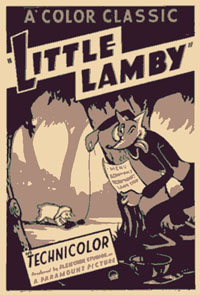

Max Fleischer would include the beaver in a “give him the works” setup in the Color Classic, Little Lamby (Paramount, 12/31/37 – Dave Fleischer, dir., Dave Tendlar/William Sturm, anim.). A traveling fox has a regular regimen planned for obtaining his meals when he visits strange places. Approaching the village of Animalville (population: 201), he views the community’s residents from a hillside through a spyglass. Many species and their offspring are viewed, including a beaver who has found a new use for his tail, having one end of a rubber band tied to it, and the other end ties to a ball, providing a natural game of paddleball. But the fox’s attention is drawn to a grazing baby lamb (one who predicts the later Thumper the Rabbit in not liking greens, only finding grass to be palatable when she (or he?) sprinkles sugar on it). The Fox predicts the results of his own plan, and rubs out the last digit of the population sign at the edge of town, drawing in as its replacement the reduced population tally of 200.

The fox posts a notice in the public square, announcing a Baby Contest, with big prize to the prettiest and healthiest baby (must be kind and tender). All the village takes notice, including a parent beaver carrying his youngster along, riding upon his tail. Soon, everyone is gussying-up their offspring as the logical choice for the prize, while the fox dons a fake beard and constructs a judge’s stand. The entrants parade past him in review, yet there is no sign of the beavers either in the preparation or in the contest. In fact, the beavers do not appear to have even entered, as they are not represented on a cross-off list the fox carries of rejects for his main course, ruling out squirrel on toast, roast duck, and fried rabbit. The lamb finally arrives, and is happily inspected by the fox for its plumpness. “The winner – and, my dinner!” shouts the fox, casting away his fake beard, dropping through the judge’s stand by way of a trap door, and exiting in a hurry upon a hidden motorcycle concealed beneath the stand, with the baby lamb clasped firmly under his arm.

The fox heads for his lair, zooming inside and slamming the door, with a sign hung on it reading “Gone to lunch”. The citizens of the village angrily pound upon his locked door, only to hear the fox inside holler “Scram!” Many means are employed by the animals to gain entry. A rabbit takes hold of the beaver like a power saw, and attempts with him to cut through the trunk base of the large tree stump that is the fox’s home. The fox sticks his head out of a knothole, and smacks the rabbit and beaver with a small club, knocking them out. Two birds fly with their claws clamped onto the handles of a twin-handled saw, flying back and forth in attempt to saw into the trunk from above. The fox, seeing the blade edge protruding into his wall, grabs a sledge hammer, and socks the blade in three places, bending the saw teeth in opposite directions to wedge the saw tight in the tree bark. Only the persistent efforts of a billy goat, holding onto the forward end of a battering ram, and the rest of the community carrying the log (plus a whole jar of headache pills for the goat’s aching noggin) finally bust down the front door. The lamb is rescued in the nick of time from the stove top, where she has been doused with sneeze-inducing pepper and perspires profusely from the stove’s anthropomorphic wood-eating flames. The fox is caught on the end of the battering ram, smacked into the opposite wall, then his arms and legs tied around a center pole support in his living room. A teeter-board is inserted under the fox’s rear, and the animals take turns jumping on one end of the board, launching the fox’s head into the ceiling over and over again. As the fox sits in a daze and with a lump on his head, the baby lamb sprinkles some of the pepper onto the fox’s nose, causing him to get his own case of the sneezes. “Gesundheit”, states the baby, for the iris out.


The House That Jack Built (Screen Gems/Columbia, Color Rhapsody, 4/14/39 – Sid Marcus, dir.) seems to have the distinction of featuring the first beaver character to have a name. The studio isn’t taking any chances as to the audience missing the point that Jack the Beaver is industrious – dressing him in the same worker’s hat and coveralls as Practical Pig, and even giving him a modification of the same voice (provided once again by Pinto Colvig, who also voies an ostrich featured in the story). Jack carries a box of tools and an armload of lumber through the forest to a vacant lot site. On the way, he is accosted by a bear panhandler. “Can you spare a dime for a cup of coffee?”, the bear asks in the standard sympathy ruse. Jack answers with a response I wish I’d turned on some panhandler, guaranteed to kerflummox their true intentions. “I haven’t got a dime…but here’s a cup of coffee.” The bear stares bewildered at the steaming cup handed to him as Jack continues on, and barely has the presence of mind to sip down the brew before tossing the cup away and continuing to pursue Jack. “What’cha doin’?”, asks the bear, seeing jack using a shovel to break ground. “Building a house”, replies Jack. The lazy bear immediately plops himself on his back onto the ground, and proposes. “Build one around me, buddy. I’m sick of the outdoors.” Jack gets as steamed as his coffee, and smacks the bear across the tummy with his shovel, forcing him to retreat a distance behind a tree. Jack begins to lecture in song about his work ethic, as Practical Pig was also prone to do, in a talk-sung number entitled, “You Don’t Get Nothin Doin’ Nothin’”. Bu the time the song is through, we have cross-dissolved our way to the home’s completion. (Being a beaver, Jack prefers lumber to Practical’s bricks.) The bear turns up right on cue, complementing how beautiful the house is, and proposing to an equally-shiftless ostrich pal of his that they should have a house warming. Jack immediately senses trouble, but can’t keep the two buttinskies from forcing their way through the front door, then locking Jack out behind them.

The two intruders are just natural-born troublemakers. The bear leaps into a bed with rollable casters on its poles, and rides the bed into the kitchen, where it stops in a corner directly in front of the refrigerator door, allowing the bear to feast on breakfast in bed. The ostrich isn’t so picky, and does what all cartoon ostriches do – swallow anything and everything in sight. Jack finally finds a point of entry into the house, and immediately rushes for the phone, attempting in a low whisper to phone the police. “Gimme that phone”, snaps the voice of the bear, as he yanks it away from Jack, and tosses it to the ostrich, who proceeds to swallow everything but the handset. Jack is still determined to get his call through, and pokes his finger into the ostrich’s belly to rotary-dial on the apparatus within him. Unfortunately, every time the call is connected, the ostrich hiccups, disconnecting the call. Finally, the bear again takes the matter out of Jack’s hands, grabbing the handset and yanking the rest of the phone out of the ostrich’s belly by the cord. As the ostrich keeps Jack busy in a tussle, the bear, out of pure spite, uses the phone to call the Termite Wrecking Company – a professional all-insect wrecking crew, and requests their services at the newly-built abode. Knowing the fate of Jack’s home is sealed, the bear and ostrich finally allow themselves to be chased out, mockingly bidding a neighborly goodbye as they depart. “Good riddance”, says Jack, settling down at his breakfast table. But…what table? It disappears in about one second flat – as does the chair. The termites have arrived. Within about a minute, the entire place has collapsed to the ground around Jack, and the bear and ostrich laugh uproariously outside at the show. Their laughter is abruptly silenced, as Jack produces from nowhere a shotgun. (Too bad he couldn’t have laid hands on this before.) Before long, the bear and ostrich are marched back to the lot at gunpoint, and work begins on a replacement home – that is, work performed solely by the meddlesome intruders, with Jack sitting by as supervising foreman, shotgun at the ready to dissuade any attempt at slacking off. The bear and ostrich close the film with a reprise of Jack’s song of industry – to be sung by them whether they like it or not.

Wish we had original credits for these. There’s been some mysteries as to whether credits got mixed at some point between the work of Sid Marcus and that of fellow director Art Davis at the studio. While multiple sources list this film as Marcus’s, there are a few artifacts that might suggest Davis’s presence. A few signature present-time dissolves occur between shots in the termite office, which was a camera style Davis was associated with in several Scrappys and even in later life in his Looney Tunes. And an appearance by a recognizable worm who had appeared in two Davis Scrappys, “The Early Bird” and “A Worm’s-Eye View”, in the last shot as Jack eats an apple for lunch. Could this be another instance of director miscrediting?
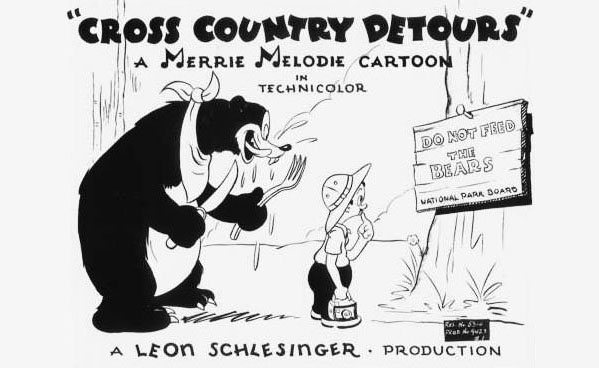

Cross-Country Detours (Warner, Merrie Melodies, 3/16/40 – Fred (Tex) Avery, dir.) – One of the best of Avery’s many spot-gag travelogue spoofs for the studio, featuring a variety of different types of gags. It is perhaps most remembered for its strip-tease rotoscope sequence of a lizard “shedding its skin” (even though this phenomenon of nature only occurs with snakes). Or for its split-screen imagery of something for the adults and something for the kiddies – a gila monster for the grown-ups, and a little girl reciting nursery rhymes for the tots. However, the little girl proves the more ferocious of the two, out-roaring the gila monster, causing him to run away in a panic. Beavers, however, are spotlighted in one sequence, constructing a dam. Before our very eyes, they built from concrete and mortar the mammoth Hoover Dam – then the best known and most modern hydroelectric dam in the nation. Avery would remember to use the structure as a prop again when he migrated to MGM, having his giant cat and mouse scramble over the top of it in King Size Canary.


Snowtime for Comedy (Warner, Merrie Melodies, 8/30/41 – Charles M. (Chuck) Jones, dir.) – Jones’s “two curious puppies” are in another of their battles for a bone – this time set against the icy backdrops of a frozen winter. Both dogs and the bone take a slide down a massive ski-jump, the bone in the lead. The little pup overshoots it, sliding out onto the banks of a not-yet frozen lake. He breaks off a small floe of ice from the banks before reaching the water, then sails out into the middle of the lake, helplessly trapped aboard the small floating chunk of ice. The larger dog also overshoots the bone, but avoids falling into the lake, negotiating a course adjustment in his slide that bowls him right into a small beaver dam just constructed (with the accompanying sounds of a bowling ball scoring a strike on a full lane of pins). The dog is next seen, still sliding, but with the dam’s logs piled atop him in the shape of an Indian teepee. Eventually, he sheds the lumber, only to slide into a snowbank, then collide below the snow surface into the trunk of a half-covered tree.

When the large dog next emerges, he is dazed and woozy, but spots the bone where he passed it, displayed in his POV blurred vision. He carefully tries to creep up upon the bone, but is blown backwards by an icy wind, again colliding with the half-buried tree. Again he attempts to advance, building up speed to fight the wind. He slides directly over the bone, but is unable to clamp his teeth together fast enough to grab it as he passes. What lies ahead? A new dam the beaver has constructed. CRASH! The end result of the collision leaves the sliding dog looking as if he is residing in Uncle Tom’s Cabin.

So what of puppy number 1? His ice floe has been severing into segments below him, again and again, until he is left standing with all four paws piled one-atop-another on one paw-sized fragment of ice. He just manages to hop off before it submerges, onto the icy bank, but is now pursued by a crack he has caused in the ice. The crack chases him right into the latest dam constructed by the beaver, with the typical results, and the lumber assuming the shape of a wooden steamboat surrounding the dog. The little pup is chased into the same snowbank previously occupied by pup #2, crashes into the same tree trunk, then the ice crack splits the entire tree up the middle. When the little pup emerges from the snow, he finally spies the resting place of the bone, and leaps for it. The bone squirts out from between his paws, propelled high into the air. The pup gives chase, and of course crashes into a beaver dam again (this time with no shape shifting gag for the lumber). The bone lands atop the seat of a chair lift leading high into the mountains, and the pup follows on a second chair. At the pinnacle, the bone is deposited by the seat as it turns for the return trip down the mountain, and the pup, leaping upon it, slides with the bone down a steep slope. Tumbling and gathering up snow in a giant snowball, the pup and bone are transformed into a gigantic snow sculpture of – a pup and bone! This mammoth mutt descends on pup number two – and on yet another beaver dam. The beaver isn’t going to stick around close with this monster apparition sliding right toward him, and flees to the highest hillside vantage point he can find, then turns to see the aftermath of the snow-dog’s collision with his construction project. Instead of destroying the new construction, the snow joins with it, emerging as another perfect snow replica of Hoover Dam! Carl Stalling appropriately underscores this finale gag with the notes of Ella Firzgerald’s recent hit, “Keep Cool, Fool.”


The Bear and the Beavers (MGM, Barney Bear, 3/28/42 – Rudolf Ising, dir.) – This picture is frameworked as if taking place within the illustrations of a children’s storybook, much in the same manner as Disney would later framework “Winnie the Pooh”, but without some of the page-turning and type-moving gimmicks. We are told by its pages that Barney (still apparently a nameless bear at the time of release) has gotten tired of living in cold, damp caves and old hollow trees, so has adopted human homebuilding style, constructing himself a sturdy log cabin with massive stone fireplace and chimney (a sign outside names the cabin the “Snuggly-Wuggly”). Barney sits in a plush easy chair padded with multiple pillows, dressed in a warm robe, loading logs into his fireplace only inches-distanced from his reach, and basking in the warmth and comfort. Life might be ideal, but one day he runs out of firewood. He enters the forest, wearing scarf and hat, and armed with an axe and a large box for his wood. We don’t know how Barney got his original supply of big and little logs to build his cabin and stoke his fires, but all indications are that Barney cannot claim the title of an experienced woodsman. He wrestles with an axe head with a talent for coming loose from its handle. It first causes Barney to swing at the tree with no blade, sending a wave of vibrations through his arms and up his entire torso upon impact. Replacing the blade on the handle, Barney swings again, flipping the axe head loose into the air, where it twirls like a Frisbee, and returns for circling passes at Barney’s face again and again like a boomerang. After repeatedly ducking out of its way, Barney stands erect, and extends out his arm with the axe handle, timing things perfectly to catch the whirling blade back upon the handle on the next pass. He finally gets a swing at the tall pine which has been his target. But now the tree gets the vibration shivers just as Barney experienced before, shaking down an avalanche of snow nestled in the tree’s upper branches, right on Barney.

All this while, Barney experiences slow-burn frustration at viewing the ease with which a pair of happy beavers addresses the same task nearby, efficiently alternating axe-swings to chop a tree just as tall into log-sized sections, then piling the perfectly-sized wood onto a small sled for hauling back to their home. When Barney emerges from under the snowbank emptied upon him by the tree, he first drums his fingers as the passing beavers tip their cap in friendly manner to him, and wonders what to do next – then hits upon a revelation. That nice, tidy wood pile on the beavers’ sled! What if…well, you read into Barney’s mind, as he just happens to stroll along whistling, along the same path as the beavers follow, then pitches his unneeded axe into the bushes. Barney ducks into a bush, then cautiously pokes his head through to see what the beavers are up to. What he views is more than he could have hoped for. The beavers have entered the busy little community of Beaverville, where everyone seems to be busy sawing and cutting away at lumber. But in this instance, they are not collecting it for any designated project such as a dam or den construction. Instead, all the collected wood is being stockpiled in one warehouse structure, bearing a sign reading, “Beaverville community woodpile.” This is all the information Barney needs, and his face pulls back into hiding, with a nefarious grin on his face, ready to wait his chance for action.

That night, Barney returns to what will be the scene of – the crime, armed with boxes galore. Displayed as still illustrations within the book pages, Barney “borrows” some wood. The next page displays him loaded – for bear, so to speak, adding the words, “Quite a bit.” The next page shows the beavers’ warehouse, empty, with the additional words, “In fact, all of it.” The theft of the century. However, Barney is as inept in covering his traces as he is as a woodsman. An elderly beaver with a walking cane, who acts as night watchman for the community, passes the warehouse on his rounds – and does a delayed double-take upon discovering the place laid “bear”. He races to a square in the center of the village, and rings a triangle to sound a community alarm, rousing all the other beavers from their dens, in a scene likely inspired by the “Giant on the beach” alarm sounded by Gabby in Fleischer’s “Gulliver’s Travels.” It’s not hard to find the path of the culprit, as the watchman points the community’s eyes to a long trail of huge bear pawprints left in the fallen snow. The trail ends obviously at the doorstep of Barney’s cabin. Inside Barney now basks in the heat of a monster blaze in the fireplace, stoked by a lumber pile at his sides reaching all the way to the ceiling. What’s more, embers and plumes of smoke pour out the chimney top, almost as visible as a rocket’s exhaust, making it elementary to determine from outside where the community woodpile is currently located.

A slow-marching mob (also possibly inspired by “Gulliver’s Travels”) forms from Beaverville, following the tracks to Barney’s door. The parade is led by the equivalent of a beaver “Spirit of ‘76″ fife and drum corps, and by the watchman carrying a yellow lantern (again matching Fleischer’s Gabby) and beckoning the community to follow with a wave of his cane. Everyone seems to be armed with wood-cutting devices, sleds for hauling, and ropes (one of them noticeably fashioned into the familiar form of a hangman’s noose). A beaver at the end of the procession signals the end of the parade with a red-colored lantern dragged along on his tail (possibly a nod to Dopey marching along at night in Snow White’s “Heigh-Ho” sequence). Everyone amasses outside Barney’s home, and the watchman signals with his cane for all to be silent. He peeks in the window of the cabin to get the layout of the room and a view of his opponent, then, when Barney begins to doze off, beckons again with the cane for everyone to advance. Beavers move in from all directions, taking up positions in squads in the cellar, upon the roof, and one beaver slipping into the cabin through some undisclosed entryway, taking up a stance upon a structural cross-beam over Barney’s head. The watchman gets an okay signal from each positioned beaver or squad. Barney meanwhile has heard some rustling, but is still too happily groggy to care about the unexplained disturbance, and settles into relaxed pose again. When all is ready, the watchman chooses the proper moment to blow a shrill note upon a small whistle, as the starting signal for all hell to break loose. The whistle rouses Barney from slumberland, causing him the leap high into the air, directly under the beaver on the rafter – who is carrying a large wooden mallet, with which he conks Barney soundly on the head. As Barney tries to collect his dizzied thoughts, the souds of friction upon wood fill his head from everywhere. Axes chop in random rhythms on the roof and walls. Elsewhere on the structure, hefty buck teeth gnaw their way through log sections. Below the floorboards, sawblades emerge through, carving out whole sections of the floor below Barney’s feet.

Barney is utterly Mesmerized by the flurry of activity, the din of the chopping, and the vibrations of the entire structure, and cannot gather his thought processes to formulate a counter-attack. He instead casts a look at the camera, expressing to us his utter helplessness to address this unexpected onslaught. Then a shout of “Timber” is heard from above the roof. The support beams of the cabin begin to crack and splinter, and within a few seconds, the entire structure collapses upon Barney’s head. Our image blacks out – much as it probably did to Barney, and we fade in to a reprise of the beaver parade, but now heading back home. The fife and drum team passes, then the watchman beckoning the others with his cane. Then the rest – but with a major change. Each beaver is completely loaded down with limber to tote home, forming a line that seems to extend all the way to horizon. At the end of the procession is one of the two beavers whom Barney originally met, carrying the last of the lumber in Barney’s own “wood box’ crate, and again politely tipping his cap to Barney as a good-bye. We see Barney, lying in a heap before the stones of his now empty fireplace, fingers again nervously dropping in frustration, as the camera pulls back, revealing nothing to be left of Barney’s home except the stone fireplace structure, portions of a window-frame with now-shattered glass, and the hanging remnants of the battered “Snuggly-Wuggly” sign outside. The beavers have recovered their own wood, and Barney’s logs as interest for the loan! In a scene excised for years on television release prints, the storybook closes, with the words “The End” on the back cover, while white letters dissolve in across the shot, providing the only dated reference to when the film was released – a standard motto which appeared on most MGM features and shorts from this season, reading “America needs your money. Buy defense bonds and stamps every pay day.”

For reasons I have never understood, some reviewers have criticized this film for slow and deliberate pacing. I have never seen such fault with it, and consider it one of my favorites in the Barney series. If anything, it follows in the same meticulous attention to detail that was the fascination of the tying-the-giant-up sequences of “Gulliver’s Travels”, which as mentioned above, appears to be its obvious inspiration in several respects. The detail of the animation on massed group shots is amazing, the facial expressions and personality animation on the characters is superb, and the backgrounds are picturesque and lush. Everything about the film speaks lavishness, and I have always classed this as among the closest efforts of the studio to matching the best of Disney and Fleischer feature output. View this as if part of an extended feature work without the need to rush through its material and ideas, and I think you’ll see my point.


Nutty Pine Cabin (Lantz/Universal, Andy Panda, 6/1/42 – Alex Lovy, dir.) – Another fun romp, that I remember fondly from early screenings on the Kelloggs’ Woody show as a child. Rustic woodland cabins must have been a part of the American dream in 1942, because Andy Panda has the same home-building fever as Barney Bear. Andy’s chosen material, however, is plywood instead of logs. Though his carpentry supplies include a tape measure, he could use some practice in measuring board length, as the first act of the cartoon displays his battle to hammer in place one board in the cabin’s side wall that is too long. It either pops out at the top, bends upwards at the bottom, or springs outward as a bulge in the middle. When Andy finally manages to hold it in place, its top edge raises the roof just slightly, allowing all the other wall boards to fall out of place, then the roof to collapse upon him for lack of structural support.

Meanwhile, a community of beavers works busily on a dam construction project. One beaver’s neck demonstrates great dexterity. After he has chewed 95% of the way through the trunk of a tree, he backs up a few steps, and allows another beaver to pump on his tail, causing his neck to elevate like an automotive jack to topple the tree above him. A stuttering beaver does an impression of Porky Pig, yelling “T-t-t-t-t….(POW falls the tree upon him)…TIMBER!!” The smallest beaver of the clan is getting nowhere gnawing at a giant tree assigned to him, when he spots Andy sawing away at more boards. Turning on his cutest charm, the little one assumes a begging position and a smile, thumping his tail to get Andy’s attention. Andy passes him a small sample of the lumber as “beaver board”, and thinks he’s done his good deed for the day. But the beavers are opportunists. Rather than waste their efforts on manual labor, the minute the small one shows off his prize and where he got it, all the beavers want Andy’s boards over their own home cuttings. And so, the tables are turned on the Barney Bear scenario, with the beavers becoming the thieves instead of the victims.

The first beaver Andy spots is the same little one he already met. “Want some more wood?”, Andy asks. The beaver quickly nods, and scurries away with another small piece, but only as a cover for the activities of his relatives, who emerge from the side of the house to make hasty exits, not only carrying Andy’s boards, but pails and hardware as well. The last in the line is stopped by Andy stepping on his tail, while the forward motion of the beaver’s feet digs him into a trench in the ground. The embarrassed thief replaces the box of wood he is carrying where he found it, and attempts to back away, stumbling into Andy’s paint supplies, and transforming himself into a Technicolor rainbow. The little beaver is next spotted swiping a mallet, which of course he returns the hard way when Andy demands, “Give it to me.” Andy begins chasing the little one around and around the cabin, Andy becoming a speed blur that transforms into multiple-exposure running images of himself clear around the cabin. When he comes to a stop, all his multiple images catch up with him, colliding themselves back into his person with wooden-sounding clunks. The little beaver descends from the roof with the aid of Andy’s roll-out tape measure, then paddles the panda on the head with his tail, causing Andy’s eyes to bounce in their sockets. Just as Andy is about to toss something at him, the panda is mown down by two other beavers, carting off one of Andy’s finished doors. Andy switches targets, and pursues the door-robbers, who position the door directly in front of a tree trunk. They swing the door open at the last second, and Andy hits the trunk at full speed, penetrating his silhouette through not only this trunk, but those of a dozen other trees in a row behind it.

Andy’s reached his limit, and in scenes often unkindly cut for television broadcasts, resorts to a shotgun, firing pot shots at the beavers. (A similar fate often befell another Lovy episode of Andy from the same season, “Good-bye, Mr. Moth”, where excising of the rifle shots rendered the cartoon’s ending absolutely unfathomable.) The beavers go into a huddle, and devise a new strategy to win the war. They converge upon one of the largest forest giants, with teeth bared, making short work of its trunk. The mighty forest monarch falls, in close proximity to Andy’s cabin, generating shock waves that launch the cabin into the sky. The cabin, with Andy along for the ride, comes to rest skewered atop the uppermost branches of another nearly equally tall tree. Now, the beavers converge again to gnaw the trunk base away to only a pinpoint. One beaver spits against the upper section of the tree to choose the direction of its fall. Good expectorating! With precision, the second tree collapses across the river, jamming Andy’s cabin right into the center gap in the existing dam construction, effectively sealing off the water and completing the project. A defeated Andy slowly raises his head from the chimney, only to be tail-whacked in the head again by the little beaver, who is hiding inside his hat. Andy’s closing expression seems a precise match to Barney Bear’s – a picture of exasperation, silently communicating the phrase, “Why me?”
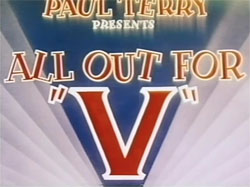

All Out For ‘V’ (Terrytoons/Fox, 8/7/42 – Mannie Davis, dir.) – An assortment of spot gags, as those in the animal community learn of the pronouncement of war declared from a newspaper extra. Among the first to react to the news are a population of beavers, who attack en masse a grove of trees in the wood, gnawing them within seconds into a bursting cloud of raining logs, which neatly stack into cabins in the newly-formed clearing, providing headquarters space for the War Production Office. The beavers later fell a tree with a shout of “Timber!”, while a woodpecker hammers a large tack into the sawed-off end of the log, a “caterpillar” tractor lassos the nail and tows the whole trunk away, and a team of termites uses their devouring power to cut the log into wooden boards. In a year when every studio got an automatic chance for an Oscar nomination, this film was under vote for the award – not that it had a chance of winning against Donald Duck’s “Der Fuehrer’s Face.”

NEXT TIME: Our buck-toothed friends remain “dammed” if they do, and “dammed” if they don’t.

  • ✇Cartoon Research
  • Frankly, I Don’t Give a Dam (Part 1) Charles Gardner
    The Disney and Pixar Studios have recently given us a bit of an over-saturation of feature animation spotlighting one of nature’s reputedly most industrious critters. At least one of such kind appears in a prominent part in Zootopia 2, while a swarm of them form the principal animal cast of Hoppers. As I have not yet been able to acquire home media versions of these films to review, I am not up to speed on them, and they will not be further discussed in this series. However, it might be said
     

Frankly, I Don’t Give a Dam (Part 1)

22 April 2026 at 07:01

The Disney and Pixar Studios have recently given us a bit of an over-saturation of feature animation spotlighting one of nature’s reputedly most industrious critters. At least one of such kind appears in a prominent part in Zootopia 2, while a swarm of them form the principal animal cast of Hoppers. As I have not yet been able to acquire home media versions of these films to review, I am not up to speed on them, and they will not be further discussed in this series. However, it might be said that this recent cinema trend is setting us up for the Year of the Beaver – so I thought it might be fun to trace the buck-toothed, flat-tailed character’s history in animation, and see how these character-actors of nature have fared in the dam-dest of situations, starting from the earliest days of sound.

(A note here is in order. While in the process of writing this first installment, which I had actually been percolating the research for as of at least a year ago, I happened to discover by chance online that another author, in anticipation of the “Hoppers” premiere, has been thinking along the same lines, and attempted a brief survey of the same subject on Cartoon Brew. I swear this was a case of coincidental independent creation. Nevertheless, in reviewing the other article, I observed that most of its material consisted of title-dropping and some clips without much discussion of cartoon content, and (as in the case of our recent coverage of bullfighting cartoons) many on-subject films were omitted from the title list. I thus proceed full steam ahead with the present project, to add some depth as to the gags and ideas presented in the subject films, and to fill in a number of gaps.)

Correct me if I’m wrong. It’s rather surprising that I seem to have come up empty in locating any verified appearances of a beaver in any known surviving silent cartoon. You would think Paul Terry’s Aesop’s Fables would be loaded with them somewhere – but they don’t seem to even turn up in natural settings where you’d expect all varieties of animals to be represented, such as “If Noah Lived Today” or “Amateur Night On the Ark”. Maybe the primitive pencils at the Terry studio couldn’t hit on a model design for the creature they felt comfortable with. Similarly, Max Fleischer missed his chance to include the species in his first Talkartoon, Noah’s Lark. It thus appears that Disney (as he often did in those days) got the jump on everybody, including the characters in one of his earliest Silly Symphonies, Autumn (Columbia, 2/13/30 – Ub Iwerks, dir.) (noticeably overlooked by the Cartoon Brew coverage, as were nearly all of this week’s films).

Part of a four-episode quad-rilogy, themed about the four seasons of the year (though one might say the follow-up, Night feels like it makes the series a set of five). All of the films are relatively plotless, concentrating on well-synchronized cavorting to a lively Carl Stalling score. The first half of this one deals with various animals gathering their stores for Winter while the leaves fall. Squirrels do most of the heavy lifting, while scavenger crows raid the squirrel’s hollow tree homes and swipe corn, storing it away inside the pantlegs of a farm scarecrow who isn’t scaring anyone. A skunk tries to roll a large pumpkin into a tree, but when it doesn’t fit, gives it a running tackle to push it through, only resulting in the fragile pumpkin shell cracking and depositing its innards all over him. A porcupine has a better method of harvesting, shaking a fruit tree and catching the falling fruit on the ends of his quills (a gag later repeated in Father Noah’s Ark, discussed below). Now comes a brief sequence for the beavers, changing subject.

The beavers dance atop a dam under construction in the foreground, tamping down lumber into its structure with their tails, while several other small groups of beavers are seen in the stream, constructing beaver dens with entrances below water. Two beavers dance together in synchronized rhythm along the bank, then chew down a small tree, which topples onto the head of one of them. In the later climax of the film, as the first cold blasts of winter wind are felt, one beaver calls an alarm to the others, and one-by-one, several beavers dive into the water and are seen as bulges and vibrations within the structure of a beaver den, having entered it from below. A stranger appears – a misguided duck, who doesn’t have the good sense to fly south, and instead also dives under the water, attempting to join the beavers in their comfy abode. He is quickly and rudely ejected, swimming away with complaining quacks. The skunk looks for shelter, but gets hit with a back of porcupine quills from inside one tree already occupied – so moves into another one, sending all of its furry occupants scattering for another tree next door. The crows get the final shot, taking up residence inside the hollow clothing of the scarecrow. One small crow is left out, and kicks the pantleg of the trousers, hoping for access. In an ending which nearly duplicates that of “The Skeleton Dance”, the bony foot of one of the crows reaches out from the drop-seat of the trousers, yanks the little crow inside, then re-buttons the drop-seat.


Minus Iwerks (who by this time had moved on to another animation studio), Disney’s beavers make a comeback in The Busy Beavers (Columbia, Silly Symphony, 6/22/31 – Burt Gillett, dir.). Obviously, with the beavers taking center stage, there’s a lot more room for action and gags in this one. It’s rather comical also to note that in both of these early cartoons, the sound engineers seem to have no idea what a beaver should sound like (their natural sounds are more like grunts), so decide to use what sounds like a squeaky toy to emit puppy-dog like high-pitched barks. This does have the advantage of permitting quick one-note tones that fit easily into the punctuated rhythms of an average cartoon score, but must still bring howls from anyone who’s studied the behavior of the animals in the wild. The sound effect also proved rather interchangeable – I swear I’ve heard the same “voice” given to foxes and bear cubs in productions from various studios, not to mention used in its proper place for Bosko’s pup at the end of early Looney Tunes. (Who was that pup anyway? Baby Bruno?)

The film opens with the usual construction under way of a dam and beaver dens – though with broader scope that the previous film’s opening shot, panning back and forth across the river full of busy workers. A first gag has one beaver curl up his tail to form a place to carry a load of lumber, then hold a small cylindrical stump between his hands. The beaver loading the lumber on takes hold of the other beaver’s rear feet, balancing him upon the held stump, and carts the lumber to the worksite, using the first beaver as a living wheelbarrow. Another beaver searches for just the right lumber in what seems to be a woodpile, but finds within a sleeping moose, who stands to reveal the beaver trapped as a passenger in his antlers. Another pair of beavers mix a muddy mortar in a hollow tree stump, one beaver loading up his cheeks with water from a nearby pond to spit into the stump, while the second mixes the solution in the stump with his tail. Then, a line of beavers arrives as hod-carriers, using large leaves held aloft atop Y-shaped tree branches as their tools to carry the mud to the dam, emptied into them by the tail of the mixing beaver.

More heavy construction occurs elsewhere. One beaver hangs by his tail from the limbs of a flexible sapling, whole another tugs at a lower branch like a crane operator, maneuvering the higher beaver into position to chomp upon and transport cut logs from a pile to an assembly line. One by one, the logs are threaded between two husky beavers, who combine with their sharp teeth to hone each log down into an elongated conical shape. Then, the shaped cones are flipped by beavers’ tails into the shallow water, point down, where they are hammered into place by the tails of two more beavers to serve as pilings. (I’m not aware that a dam requires pilings – are they also building an auxiliary pier?) In the woods, a team of two cutting beavers moves along, making short work of felling trees marked with X’s, while a scout beaver proceeds ahead of them, choosing just the right trees of strong grade for marking and felling like a lumber crew boss. Two large worm-like creatures in one tree save their home by spotting the freshly-chalked X left as a marker, and rubbing it off before the cutting crew spots it. Some beavers approach the cutting task solo. One, who might be the laziest of this beaver colony, is large and lethargic, casually cutting a very puny sapling and slowly walking away with it toward the dam, in a gait that suggests he is in no mood to exert himself. Eclipsed behind him is a much smaller beaver who is all energy, and fells an older-looking tall pine while an owl is still perched on its branch. Single-handedly, the young beaver pushes the heavy tree down a slope and into the river, then propels the tree downstream by spinning his tail as an outboard motor, tugging on the owl’s tail as if a ship’s whistle cord to pass a slower-moving log team of beavers who is rowing their lumber with tail action like the crew of a scull in a college boating race. As the young beaver’s log hits the riverbank, rolling the beaver off and up onto land to collide with a rooted tree, a lightning flash illuminates the sky, and the first drops of rain begin to fall.

In one of those elaborate long-cycles of animation that only Disney seemed capable of carrying out successfully in those days, a full shot of the river and just-completed dam shows the entire beaver community scurrying for the safety of their dens. The little beaver is bringing up the rear, and is the only one to spot that the construction project has not gone quite according to plan. The earthen-packed base of the dam has sprung a small leak, with a spout of the newly-arrived rain water shooting out. The beaver begins to play the role of the Dutch boy at the dike, plugging the hole with one paw, only to have another hole develop elsewhere. One paw after another, and even his face, are used to block the holes, but he soon finds himself short on number of appendages to hold back the current. Cleverly, he spies several small sticks protruding from the dam edge, and grabs them up, throwing them like darts to plug each of the previous holes – only to find that they had already been serving a blocking purpose in their original position, as a delayed spout of even more forceful water bursts from where he plucked the sticks out. In desperation, the beaver sits in the hole, providing a temporary plug, until his tail is chomped upon by the jaws of a snapping turtle swimming in the waters on the backside of the dam. The turtle is pulled through as the beaver leaps out of the hole in pain, and the beaver makes due by propping the turtle’s shell up against the hole in the dam to do the plugging job, the beaver bracing the turtle into permanent position by wedging a stick between the turtle’s chest and the dry river bottom.

Troubles are not over. A dark rain cloud above bursts as a lightning bolt tugs at a zipper in its bottom, dropping enough rain to form a massive wall of water in an area about a mile above the dam. A couple of wonderful shots show the progression of the flood that develops in the hills down the river, particularly a tracking shot just ahead of the flow as it careens around a continuing curve, taking out trees protruding into the river bed in 3-D style detail as it goes. The little beaver, now standing atop the dam edge, watches in horror as the leading edge of the flood waters reaches the beaver dens, nearly swamping them, and subjecting the dens to a beating from the floating logs passing in the waters. The beaver hops down into the river bed on the front side of the dam, and tries to hide in its shadow from the oncoming rush of water and debris. The water pounds repeatedly upon the dam’s backside, then suddenly breaks through, seemingly destroying the dam’s entire middle expanse – until the water recedes somewhat, showing that the beaver has been left on a small island of safety in the river’s middle, only a sliver of the dam center still standing to offer him protection.

With the other beavers still having their hands full within the dens, little beaver is forced to come to the rescue. He races for the tallest and largest pine along the riverbank, and like a buzzsaw chews deeper and deeper into its trunk, about 90% of the way across. The tree begins to tremble, and the beaver does an about-face to get out of the way, nearly getting trapped when the sagging trunk briefly catches his tail. He pulls out just in time to let the tree fall across the river, but is right in the path of its collapse, as the felled tree lands in perfect position to cover the complete expanse of the river width, proving to have dense-enough foliage to stop the flood water in its tracks. (Unlikely, given the general amount of space between branches of the average tree.) Dozens of birds emerge from the greenery and fly away from the fallen forest giant. In one of the earliest Disney moments where we are led to believe a character has passed, there is no further movement from the tree for a few seconds, and the musical tone turns somber as the camera slowly closes in on the tree’s uppermost limbs. Suddenly, the tension is relieved, as the smiling face of the little beaver, safe and sound, pops out of the greenery, wearing a bird’s nest as a hat. The other beavers, now safe in the still waters surrounding their dens, dance for the little one in celebration. The little beaver smiles and bows to his adoring fans, and takes off the nest as if tipping his hat to his public. His moment of glory is briefly marred by the egg in the nest choosing this moment to hatch, allowing a featherless baby to repeatedly utter “Cuckoo” at him, for the iris out.

Were this cartoon produced later, without the need for music synchronization timing to eat up footage and slow general pacing, the plot/gag material for this early outing was actually quite strong, and full of typical Disney innovation for a first cartoon focusing on a new subject idea. Though the picture hasn’t achieved an everlasting spot as a timeless classic in the Disney hall of fame, it deserves a second appraisal. And it seems a “dam” sure bet it was remembered by at least some folk in Chuck Jones’s unit in the 1940’s, as its story structure bears substantial similarity to and seems the direct inspiration for Chuck’s own classic, “The Eager Beaver”, to be discussed in later pages of this series. It’s easy to imagine how much of this cartoon’s material could have been directly interpolated by Jones into his own film had scripts been swapped, with Jones probably achieving just as lively results as his own film from the Disney gags.


Beavers almost miss the boat in Disney’s major animal adventure, Father Noah’s Ark (UA, Silly Symphony, 4/8/33 – Wilfred Jackson, dir.). They are never seen involved in the initial construction process for the ark, nor in woodland group shots, not in the stampede racing for the ark, nor on the boarding gangplank. And they certainly didn’t tag along with the pair of skunks who make the voyage on the roof of the ship. Yet, somehow, they are seen in the third-to-last shot of the film, disembarking. The male and female beavers march down the gangplank, side by side, each one carrying a new youngster along on its tail. Guess they stayed busy on the trip, even if they missed being on the passenger list and traveled as stowaways.


Either competing studios were blown away by the Disney efforts above, or just for unknown reasons were slow to adopt the beaver into their animation models for various forest-related cartoons of the period, as, for a few more years, no beavers seem to turn up in cartoons I’ve been able to discover. I again could be overlooking something, as reference to beavers rarely turns up in the titles of episodes, so if anyone remembers any other early beavers, feel free to comment. Harman and Ising seem to have missed their opportunities entirely, choosing not to include beavers in such possible vehicles as “Ain’t Nature Grand?”, “The Trees’ Knees”, and “Bosko’s Woodland Daze”. But, as Leon Schlesinger began to shift the Merrie Melodies series to color, we get Pop Goes Your Heart (Warner, 2-strip Technicolor, 12/8/34 – Isadore (Friz) Freleng, dir.). In essence, this is Friz’s idea of a Silly Symphony, considerably behind the times, and resembling something Disney might have produced several years before. It is another plotless romp in nature, with the likes of humming birds and humming bees, a papa grasshopper teaching his young ones to spit with chewing tobacco, turtles learning to swim by flipping over on their backs and stroking with reeds like a rowing crew, and some harp-stylist spiders playing the title tune on the strands of their web, while worms inside two apples simulate the limbs of a pair of dancers, and a trio of croaking frogs sings the lyric. (The song, by the way, was a semi-hit from Dick Powell’s feature, “Happiness Ahead”.)

About two-thirds of the way into the film, our attention shifts to a community of beavers, engaged in the usual dam and den building. Two beavers, however, prove that a beaver’s life shouldn’t be all work and no play, engaging in some recreation between shifts, finding their tails to be of natural use in an intense game of tennis, using them as racquets to hit a ball (where did they get it?) over a net of cobwebs. A bear comes lumbering through the woods, trying to let out intimidating roars, but having his first come out like a kitten’s meow – causing him to spray his throat with an atomizer to correct his tone. He first begins following one of the turtles too closely, only provoking the amphibian to bite a painful snap upon his nose. The bear thus turns to easier prey, chasing the beavers. The beavers duck into a hollow tree, and the bear sticks his head into the trunk to snarl at them, but can proceed no further. One beaver sneaks out of a hole in the upper trunk, then administers a light spanking to the bear’s rear with his tail. At the top of the tree, another beaver chomps at an overhanging limb, dropping a bombshell of a hanging bee hive upon the bear’s back. The hive bursts open, plastering the bear with honey and attracting the bees to swarm upon him. The bear runs for it, colliding with the fence of a farmer’s field and tumbling over the top of it into a pasture. With the gooey honey mixed into his fur, the bear is a magnet for the dry grass, and rolls down an incline, developing a growing coating of grass around his entire body in the manner of a rolling snowball. At the base of the hill, a farmer works with a hay-baling machine. He can’t tell the difference between a bear covered in grass and a haystack, so tosses the bear into the machine with his pitchfork. The bear emerges with torso encased in a bale of hay, and exits at a gallop over the hills, leaving the farmer to scratch his head in puzzlement.

• “Pop Goes Your Heart” is on Dailymotion


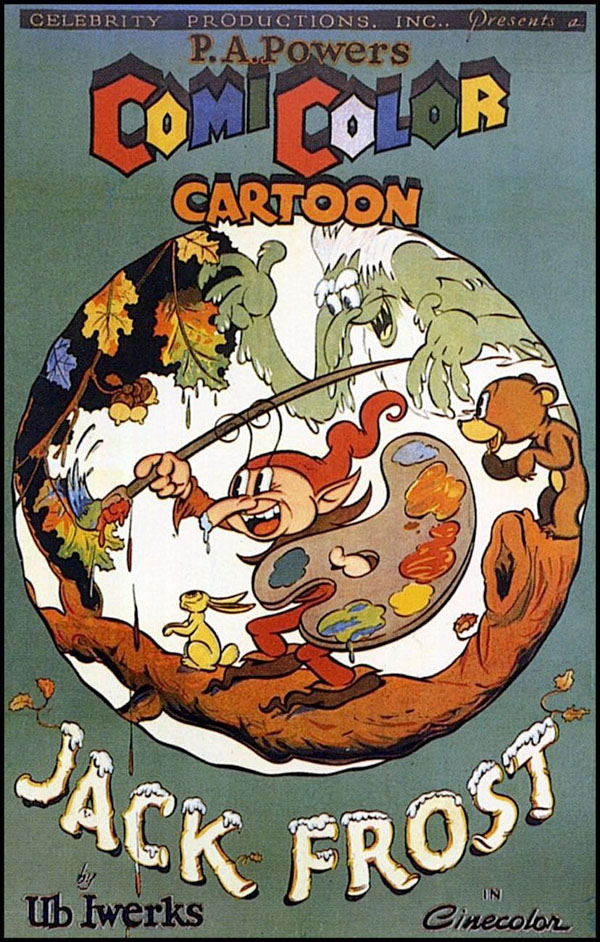
Though Ub Iwerks may have invented the animated beaver, he didn’t find much opportunity to use him in productions from his own cartoon studio. What appears to be the only such instance was a brief cameo shot in Iwerks’s wintertime classic, Jack Frost (ComiColor, 12/24/34). A forest full of various animals opens the first shots of the film, cavorting in a public game of leap frog (no, Flip is not a participant). A small bear is the first to notice an observer on a tree limb, with the mere utterance of his name drawing the undivided attention of the forest folk. A magical elf, by the name of Jack Frost, has appeared, carrying a paintbrush and artist’s palette, with which he performs magic by changing objects’ color and appearance to render them harbingers of approaching Autumn. He is seen painting the green leaves into orange and brown hues, and calls down an advance warning that summer’s gone, and Old Man Winter will be knocking at their door. Better get their food and nuts stored away. A dancing quartet of beavers responds, “Thanks, Mr. Jackie for your advice. We’ll hurry home to our wives”, while various squirrels complete the rhyming couplet by stashing nuts in their trees, and stating that they’ll “have their cupboard filled with supplies, when Old Man Winter Arrives.” That’s all the beavers get to do. The rest of the film follows the misadventures of a determined grizzly bear cub, who thinks he’s too tough to have to worry about winter cold thanks to his furry coat, and doesn’t want to hibernate like his parents. When the cub ventures out into the forest, Old Man Winter locks him away inside a hollow log with a row of icicle bars to block his exit. But Frost takes pity on the disobedient cub, and uses his paint magic to change the ice bars into peppermint sticks, allowing the cub to lick his way to an escape. Jack flies the cub home, tucks him in to sleep, then writes in frost upon the window as he exits, “Finis”.


Beavers also don’t get a lot to do in Van Beuren’s The Hunting Season (RKO, Rainbow Parade, 8/9/35 – Burt Gillett/Tom Palmer, dir.). This was in essence the first starring vehicle for the budding character of Molly Moo Cow, who had first appeared as a guest nemesis in the color Toddle Tale, “The Picnic Panic”, and who even as of this production had still not received a name. The beavers are oddly the first to be spotlighted in the film (Gillett by this time well-acquainted with animating them), building a dam and tamping down mud with their tails in a serene forest scene, shared with squirrels gathering nuts, a mother bird tending to two young ones in a nest, and two ducks swimming in circles in the river. Enter Molly, just randomly venturing through the woods. She decides to take a dip in the stream, and tests the water with her hoof and tail, which seems to be a bit colder than is to her liking. The ducks pull a prank upon her, tugging at her tail to pull her abruptly into the water. Molly counters the prank by sticking her head underwater and blowing bubbles that float the ducks off of the water surface into the air, pop, and deposit the ducks onto her back. Little by little, the joking relationship makes her and the ducks fast friends. Meanwhile, a human hunter prepares one of his shotguns at a nearby campsite, and strides into the area. Spotting the same serene forest scene we started the film with, he soon wreaks havoc upon it with his shotgun full of buckshot. He fires upon the bird family, shooting away the branch upon which the nest rests, causing mom to have to rescue in mid-air her falling flightless chicks. He blasts at the squirrels’ tree, piercing a gaping hole in the trunk, out of which pours all the nuts and the squirrels as well. And he takes pot-shots at the fleeing ducks in mid-air. Yet he takes no shots at the beavers! I guess he’s not in the market for trappers’ pelts. Molly gathers up the two ducks as they fall from the sky, at first mourning them, but finding them to be all right, as one of them rings her cow bell. They inform her what just happened, and Molly carries them to the hunter’s campsite, where they pick up a crate full of ammunition and a small arsenal of the hunter’s other shotguns, all threaded upon Molly’s tail. Together, they race back to the forest, where they deposit the weaponry for the others to see, inform them of a plan for revenge, and distribute shotguns and ammo to each of the forest residents. The hunter enters a clearing, looking for the fallen ducks but finding only a handful of feathers on the ground, while the camera pulls back, revealing the forest army surrounding him from all sides. This appears to be the first of many instances in which multiple studios would find use for beavers in “Give him the works” sequences of mass forest retaliation. Everyone opens fire upon the hunter from all directions. The beavers play their part in only one scene, apparently stocked for gunpowder but not for bullets, so they load their rifle with marsh reeds, which don’t have much lethal effect, but spear-off the hunter’s jacket, then tickle him like crazy under the armpits and in the tummy. The ducks decide to launch pumpkins off the end of their gun barrel, leaving the hunter wearing the shell of one like a helmet, with two more pumpkin shells rolling around his ankles like a set of wheels. The ducks next launch a bee hive, with end results similar to the bear’s retreat in “Pop Goes Your Heart”. Molly and the ducks march back to the rest of the forest folk in triumph, but the ducks drop their rifle, causing it to accidentally discharge, leaving Molly awkwardly scurrying up a tree, to moo to the camera for the fade out.


Porky in the North Woods (Warner, Porky Pig, 12/19/36, Frank Tash[lin], dir.) features a lot of beaver involvement. Porky is ranger of a game preserve (he calls it a game refuge), where there is (as declared by an endless display of signs posted in the forest) no hunting, no fishing, no trapping, no fires, and no, no, a thousand times NO! But one shadowy figure, who is seen through half the picture only as a silhouette on the snow while heard speaking in a French-Canadian accent, seems determined to ignore, and break, every rule. He shoots down the No Hunting signs, catches fish, starts campfires carelessly left burning, and lays strong steel traps throughout the woods. Two playful young beavers are engaged in a game of leap frog, propelling each other forward by flips of their tails under the other’s feet. They encounter a bright shiny apple hanging from a thread draped over a tree limb. One’s pulling upon the string triggers one of the jagged traps behind him to clamp upon his tail. He yells to his brother to go get Porky to help. Some historians, including Leonard Maltin, have incorrectly given credit to Tashlin’s work on the later “Porky’s Romance” as an innovation in the cutting and timing of action in super-speed. They neglect to mention that Tashlin was already experimenting with high speed and rapid-fire cutting at least as early as the battle finale of “Little Beau Porky” in mid-1936, and here in the beaver sequence, easily as finely timed as Petunia’s high-speed run after candy in the later acclaimed film. Beaver #2 zips out of frame, and in movement deliberately blurred by speed lines, traverses six scenic backgrounds in perspective in under four seconds! Just to make sure nobody blinked and missed it, the beaver screeches to a stop, realizing he’s forgotten something. At the same lickety-split tempo, he runs the course in reverse, to nab the coveted apple for his meal, before repeating the action a third time in his quest to locate Porky.

When Porky hears the news, he comes a-running, prying open the cruel trap holding beaver #1. The beaver’s tail is bent in a zig-zag, and the beaver frets that he hopes it isn’t a permanent wave. But Porky’s worries are only beginning, because the beavers aren’t the only victims. Everywhere he looks, he spots more traps, with more animals caught in them. A rabbit is caught by the ears. A fox by his bushy tail. Yes, even a skunk by his striped rear appendage, which Porky has to free while holding his breath with a clothespin on his nose. Each of the animals suffers the same zig-zag creasing from the traps’ jaws as did the beaver. So Porky sets up what resembles a laundry business in his ranger’s cabin, though his services are free of charge. A seemingly-endless queue of victimized animals waits their turn, as Porky performs miracles with a towel and hot flat iron, ironing smooth the ridges left in the animals’ anatomies by the traps. There is one, however, who is displeased at this turn of events. The mystery trapper, who can easily see the tell-tale signs of Porky’s and the animals’ footprints around each of his empty traps. Someone has confiscated all his prizes, and he wants revenge.

The trapper is finally revealed as one Jean Batiste – a large, burly, lumberjack-style dog. He easily traces the tracks back to the ranger station, and walks in on the line waiting for Porky’s ironing. Grabbing the iron, he uses it without the aid of insulating towel directly on Porky’s tail, straightening it like a dart, then sticks the rigid tail into the table woodwork, suspending Porky above it, to be punched back and forth like a punching bag. He throws Porky across the room, his tail again piercing the wood of the cabin wall like a dart, placing Porky’s rear end over the escaping hot steam of a whistling tea kettle atop Porky’s stove. Then, Batiste pulls out a sled dog whip, and removes one of his snowshoes. He lassoes Porky with the whip, pulls him out of the wall and back to him, then smacks Porky with the snowshoe, bouncing him off the wall like a tennis ball, and playing a painful one-man tennis game with Porky taking all the hits. Beaver #2 sees all this happening from the doorway, and again retraces his previous steps through the six scenic backgrounds at super-speed, finally coming to a stop below a fuzzy hanging object above, which he pulls. It is the goatee-like fur hanging from the throat of a giant moose, who bellows out a low-pitched wail as an alarm of distress to the forest. In several shots of fine animation detail, rows of bears come charging out of caves, skunks from within trees, a parade of snapping turtles tapping a beat on their shells with drumsticks as a marching band, and of course, hundreds of beavers from dens in the river bed. They converge on the cabin just as Batiste has succeeded in knocking Porky cold. Jean prepares to leave the cabin, but quickly spots the approaching stampede, and tries to bolt the door. No matter. The animals smash it down. Jean speeds out of a rear exit on skis. It’s time to “give him the works” again. Two bears launch the beaver twins at him via crosscut saw catapults, and they slap his head around with their tails as well as wooden sticks. The turtles slide between Jean’s skis, beating his bottom with clubs as they pass under. More beavers launch a barrage of small logs at the back of Jean’s head via slingshots rigged into the antlers of moose. The skunks also launch fitting weapons from their tails – smelly, rotten eggs. Finally, the beaver twins pull the old vine-across-the-path trick, tripping Jean and launching him skyward and off the mountain slope. Jean begins to descend, upside down, and his skis act like whirling propeller blades, spiraling him into a twist, so that he screws himself firmly into the snow-covered ground below, only his ankles and skis left protruding from the snow. The revived Porky, who seems to have recuperated entirely, joins the animals in cheers of victory – then smile at observing what the beaver twins are up to. They have taken advantage of Jean’s downfall and present position, by converting his inverted skis on Jean’s ankles into their new playground attraction – a see-saw (an ending likely “borrowed” from Morty and Ferdie’s similar see-saw atop Mickey Mouse’s head in Mickey’s Steam-Roller of a few seasons back).


Little Hiawatha (Disney/UA, Silly Symphony, 5/15/37 – David Hand, dir.) is a forest masterpiece that certainly earned director David Hand the future right to be supervising director of “Bambi”. It tells the tale of Longfellow’s mighty Indian warrior – when he was just starting out as a tiny boy, out for his first day of solo hunting in the woods. He is capable enough in rowing a canoe, but has a lot to learn when it comes to bringing back prize game. Try as he might, he can’t get close enough to the animals to take a shot with his small bow and arrow, as they keep running out of range. The only two creatures who stay still long enough for him to aim are a grasshopper (who proves himself the better marksman by spitting in Hiawatha’s face), and a tiny baby bunny, who is too inexperienced and becomes cornered atop a tree stump. Hiawatha shouts, “Yippee” and aims his bow. The bunny, however, turns on him a set of what Charlie Dog at Warner Brothers would have called the “big, soulful eyes”. Hiawatha starts losing his nerve to go through with it, sniffles, and sheds a single tear. He then gets hold of himself, and decides to make it a fair fight, reaching into his Indian trousers (which, by the way, someone really needs to buy him a belt for – as the running gag of the film has his pants falling down at least seven times!) and pulling out a matching bow and arrow with which he arms the bunny. Positioning himself and the bunny back-to-back, he paces off five steps in duel fashion, turns, and pulls back his bowstring to fire. The bunny, however, is no opponent, having no idea what to do with the weapon, which drops out of his trembling hands. Frustrated, Hiawatha kicks at the dirt, shoos the bunny away to his waiting parents, then breaks his bows and arrows across his knee. He’s given up picking on the little guy. This reaction brings cheers from the creatures of the woodland, embarrassing Hiawatha, who shyly backs out of the scene.

The re-reease poster

Hiawatha’s day seems to be entirely spoiled, until something catches his keen eye – large paw prints in the soft earth. Bear tracks! Forgetting his lack of weapons, Hiawatha’s tracking instincts take over, and he bends an ear to the ground to listen for vibrations of movement, then follows the trail of tracks deeper into the woods. Though the tracks seem large, the one that made them is by far not the largest of his species – a bear cub, whom Hiawatha comes up upon nose-to-nose. Hiawatha becomes excited, and seems to think he can bring this one back alive with his two “bear” hands, so pursues the cub further into the woods. He spots the cub hiding behind what seems a large brown rock, and climbs atop the rock to obtain a position of advantage over his opponent. Until the “rock” moves. We are never made aware whether it’s the mother or the father – but with an angry bear, does it really make a difference? The character model for the beast is gorgeous in detail, expressiveness, and ferocity – the most memorable design in the film – and was never surpassed until the ultra-realistic grizzly who battled Copper in The Fox and the Hound. Disney would fall back upon the same design for several films to follow, including Good Scouts, The Pointer, and Donald’s Vacation.

But where do beavers come into the picture? Right about now. The forest animals can see Hiawatha is in trouble, and decide to repay the act of kindness Hiawatha showed them. Thus begins another elaborate “give him the works” master plan to slow up the bear. Several beavers rally the forest creatures with an alarm, beat out in rhythms upon a hollow log with their tails. A squad of raccoons pull down a long vine from the branches of a tree and stretch it across the bear’s path to trip him up. The beavers are ahead at the bank of a stream, floating a log up to the shoreline for Hiawatha to climb upon as he reaches the water. The beavers paddle him a short distance into the stream, hoping to leave the bear high and dry. But they are not fast enough, and the beast leaps into the water, getting his front paws upon the end of the log, and flipping Hiawatha into the air and onto the trunk of a nearby tall tree. The bear continues swimming and reaches the base of the tree, swiftly climbing up after his target. The beavers shift to plan “B”, and a trio of them quickly gnaw away at the base of the tree. The tall pine begins to topple, with the bear clinging to the trunk for dear life. Hiawatha also clings above him, but begins slipping as the tree’s angle changes in its fall. A family of opossums are prepared for this, and hanging by their tails from several tress, grab Hiawatha before he can fall, swinging him from tree to tree like living vines might be used by Tarzan.

At a ledge closest to the last tree waits a deer, who has put her head though some vines connecting two long branches of wood, trailing the branches behind her in the fashion of an Indian travois. Hiawatha is tossed onto the branches, and begins to be towed through the woods with the swiftness of the deer who pulls him. And not a moment too soon, as the fallen bear has climbed out of a canyon, and gives chase once again. The beavers get back into the act, felling over a half-dozen trees into the bear’s path, but narrowly miss their attempts to conk the bear on the dome with them. The deer develops a good lead on the bear, allowing for some rabbits to carry out a masterstroke of deception. As the deer passes them, taking Hiawatha on one path leading back to the river, the rabbits get under, then uproot, a small shrub, shifting its position to block view of Hiawatha’s path, and exposing a second path that leads off to nowhere in the distant hills. The bear, seeing only one visible thoroughfare, assumes he is on the right track, and continues on at full speed into the mountains, presumably never to be seen again. Meanwhile, the deer makes it back to the lower riverbank where Hiawatha left his canoe, and two turtles act as stepping stones so that Hiawatha can board his vessel. For the return trip, Hiawatha won’t even have to raise a paddle. The beaver trio reappear, and from the rear end of the canoe, dip their tails in the water, one to serve as rudder, two to serve as oars, slowly but majestically propelling Hiawatha homeward, who stands proudly with arms folded at the helm of the canoe, while his animal fans “watch him as a friend departing”. The narrator adds, “And the beaver called him, brother.” And, brother, that’s enough for a first installment.

• “Little Hiawatha” is on Internet Archive.

NEXT WEEK: We’ll get busy with more beavers from the ‘30’s and ‘40’s.

  • ✇Cartoon Research
  • Get With The Times (Part 12) Charles Gardner
    A final installment of cartoons looking toward the new ways of present times, or bringing backwards characters of the past up to speed. We’ll deal with a couple of features, a Garfield special, a recent Mickey Mouse, and a lot of up-to-date action from the Looney Tunes gang. Garfield Gets a Life (Film Roman, 5/8/91), a half-hour prime-time special, could more appropriately be called “Jon Gets a Life”, dealing with the boredom that is Jon’s existence, and its contagious effect upon Garfield a
     

Get With The Times (Part 12)

15 April 2026 at 07:01

A final installment of cartoons looking toward the new ways of present times, or bringing backwards characters of the past up to speed. We’ll deal with a couple of features, a Garfield special, a recent Mickey Mouse, and a lot of up-to-date action from the Looney Tunes gang.

Garfield Gets a Life (Film Roman, 5/8/91), a half-hour prime-time special, could more appropriately be called “Jon Gets a Life”, dealing with the boredom that is Jon’s existence, and its contagious effect upon Garfield as well. The most exciting thing Jon seems to do is organize his sock drawer – two of them – by size, color, materials, blends, and all neatly tucked-in. When not occupied with socks, Jon counts ceiling tiles while flat on his back – and Garfield takes to doing the same thing, as they compare counts between the ceilings in the bedroom and living room. Garfield (perhaps for lack of anything better to do) tries to break Jon out of his rut, remembering an old copy on Jon’s bookshelf of “How To Make Friends and Fool the Rest”. Jon spots a chapter on getting dates, and attempts to follow it to the letter. Efforts to pick up girls in the park, at the beach, in the laundromat and at the video store fail miserably. Jon almost has accidental luck at a singles club (Club Ticky Tacky), as, while badly reading aloud from his book just for practice the line, “Hey there, would you like to dance with me?”, an equally-bored girl at the bar overhears him, and half-heartedly responds, “Sure, why not?” “YES!!”, shouts Jon, escorting her onto the floor. But Jon quickly loses her, by throwing her into a couple of forceful spins that spiral her right off the dance floor, then breaking into his own solo elaborate disco number (predicting Goofy’s in An Extremely Goofy Movie). Patrons of the club momentarily stare at the display, but, as the number reaches its close, the house lights go up, and Jon stands alone in an empty club, with total silence except for Jon’s last footfalls. Nevertheless, Jon strikes a closing Jon Travolta-style pose, only to hear from the rafters the voice of the D.J, yelling, “Hey, jerk. Disco is DEAD!” “What?? When??”, reacts Jon, and trudges away with Garfield, complaining how you learn a new dance, and 14 years later, they change it. “Go figure” responds Garfield in characteristic underplay.

A television ad by a dweebish-looking guy for his school, Lorenzo’s School For the Personality Impaired, intrigues Garfield and Jon – especially when mentioning such characteristics of the average students he helps as counting ceiling tiles and thinking disco is still in. Jon and Garfield arrive at Lorenzo’s meager institution (a run-down building complete with broken and partially-boarded windows and cracking plaster). They know they’re in the right place when they find every student in attendance looking up to count the ceiling tiles. Lorenzo dispenses rather meaningless advice, such as extend a hand to the one next to you and say, “Hi, my name is so-and-so”. Most of the students quote him verbatim, never including in the sentence their own name. Another suggestion is to make people believe you can speak a foreign language, by only sounding like you do. He thus utters French-sounding gibberish meaning nothing, then teaches Canadian by merely adding the syllable, “eh?” every few sentences.

Jon’s handshake extension during the class causes him to make the acquaintance of a moderately pretty girl, who is as unsure of herself as Jon is, and certain that she is blowing making a good first impression. Jon and the girl find themselves equally matched in awkwardness and shyness, and begin to open up to each other about it, being themselves – and really hit things off. Garfield is both amazed and puzzled that this is possible, having never thought Jon to have the potential for striking up any serious relationship. The two decide they’ve had enough education for one day, and step out for a bite to eat, then spend the entire evening on Jon’s porch, getting to know each other – and all the time being themselves, without following any of their professor’s advice. Things get personal for Garfield when he overhears Jon, carried away in conversation with the girl, refer to him merely as “his cat”. “Yesterday, I had a name”, Garfield complains to himself, seeing his best buddy and confidant relationship with Jon slipping away. Garfield lapses into a dream of what will happen if Jon marries, a toddler arrives, and the abuse he will endure as the toddler grabs at him and chomps upon his tail. He marches outside, seizing Jon by the collar and trying to shake some sense into him. The girl, taking her first notice of Garfield, reaches out to pet him behind the ear. “She’s trying to get to you by getting to me”. Garfield warns in thought and pantomime – but a few scratches in just the right places, and even Garfield finds himself being won over, resting in her lap as she scratches his back above his tail. However, the girl has pushed her luck, and an old nemesis of hers arises – an allergic sneezing fit when she is around cats. The two humans are heartbroken at this development, but Jon stays faithful to Garfield, giving his pet a hug. Garfield remarks at the value of having seniority. The two humans realize they can’t be a serious part of each other’s lives, but promise to see each other from time to time. Garfield still wants to ensure that things will stay this way, by promising to himself that their meetings will be chaperoned – riding along with the couple as Jon drives her home, not inside the car, but stuck to the rear window by suction cups on his feet and hands, just like so many plush Garfield ornaments decorated real-life car windows of the period.

• “Garfield Gets a Life” is on Dailymotion


My Generation G…G…Gap (Looney Tunes (unreleased, direct to video), Porky Pig, 3/31/04 – Dan Povenmire, dir.) – Hard to say if this one should have ever been produced. It was scrapped for theatrical release when box office on Looney Tunes: Back in Action failed to reach expectations (undeservedly). And it is definitely a departure for Porky, perhaps more jarring than Goofy’s 1950’s transformation to the “everyman”. Somehow, Porky is married? With a hip teenage daughter? (Where did Petunia fit into all of this, as she is never seen nor mentioned in the film.) Porky drives his daughter to her first rock concert, waiting outside the arena at a local coffee shop – where he sees a news story on TV about how out-of-control the concert tour has gotten at its previous venues, and sees a live shot from inside the area of his daughter wildly riding on the shoulders of a burly hunk. Porky spit-takes, and races for the arena, convinced that the performance is unsuitable for the likes of his young girl. A bulky gate attendant with a build reminiscent of construction worker Hercules from Bugs Bunny’s “Homeless Hare” refuses Porky entrance without a ticket, and even the influence of a talking Abe Lincoln on a five-dollar bill Porky offers the guard fails to impress him. Porky scolds Lincoln: “Y-y-you didn’t even try.” Yet, a couple of shapely girls get past the guard just on their good looks without any pass. Porky tries the same thing in drag, but just gets socked in the mush. Porky resorts to hiring a helicopter to lower him to the arena roof – however, the pilot is still giving him instructions when Porky jumps – and has not yet attached Porky’s safety cable. Porky falls through some high-tension wires, then crashes through the arena roof – in three dissected sections.

Inside, Porky lands inside an open guitar case next to the stage. The performance in progress has a rocker using guitars to smash everything on the stage – and Porky is the next “instrument” wielded. Bruised and battered, he is discovered by the guard. Running backstage, Porky ducks into wardrobe, and emerges wearing rocker’s garb, a mohawk wig, eye makeup resembling a member of Kiss, and two-foot tall platform shoes. Thinking he has spotted his daughter waiting around a dressing room backstage, Porky mistakenly demands that the young lady come home with him. She turns to reveal that she is a total stranger – and the other girls in the line would like to be taken home as well. Porky finds himself in the traditional predicament of all rockers – pursuit by an over-stimulated mob of women. He runs right into the guard, who fails to recognize him, and informs him that he should be on stage. Porky is deposited in the spotlight, while an almost stone-quiet audience tries to guess who he is. Porky tries to back away, but jostles a tall speaker, upon which someone has carelessly left a paper cup full of water. The water lands on a transformer, producing a short circuit, which makes its way up the cord of the microphone next to which Porky is standing. ZAP!! SIZZLE!! Porky engages in the most electrifying series of screams ever presented on stage, while a drummer in the back-up group behind him provides accompanying rhythmic beats. The whole stage blows up, and Porky is revealed next-to-naked. His daughter wails from the audience, “Daddy, how could you…” But the incident provides Porky with a new career, depicted in a mock TV commercial for a mail-away record album featuring 22 or so rock hits of other artists performed by a stuttering pig. As the list of hyphenated song titles scrolls across the screen, we fade out on Porky singing “B-b-b-bad to the bone.”


Rabid Rider (Warner, Road Runner (CGI), 12/17/10 – Matthew O’Callaghan, dir.) – A late theatrical short, produced in CGI. Wile E. Coyote is rarely one to be intimidated by new advances in technology. But for once, a new innovation has him perplexed – mostly, as to what to do with it. Wile E. eagerly unpacks the crate of the Acme Hyper-Sonic Transport, and dons his protective safety crash helmet before mounting up. As Road Runner passes the boulder behind which he hides, Wile E. rolls into view – at a relative snail pace and in jerking and tenuous motion and direction, atop a self-balancing platform! The device makes sudden stops causing the coyote’s belly to jam into the handlebars, topples forward to smash his face into the ground and then rights itself again, rolls him face-first into a boulder, then shifts into reverse uncontrollably, taking Wile E. Past the camera, only to be knocked back into view as he is hit from behind by an oncoming truck. As Wile E. lies prone upon the pavement, his fingers nervously drumming, the conveyance rights itself and wheels its way up to his side, letting out a beeping signal to indicate that it is ready to go again.

Wile E. knows this thing needs more speed. Standing atop it, he attempts to lasso the Road Runner passing around the neck, hoping to be towed like a chariot. His toss misses, but catches the next best thing – the air-fin of a passing sports car. Wile E. is off to the races, but has to do some fancy pulling of the “reins” to swerve and avoid being hit by oncoming traffic in the other direction. He finds himself rolling faster than the car he is tethered to, and facing the reflective rear of the back of a tanker truck between himself and the bird. Wile E. manages to fight the balancing instincts of his conveyance, leaning backwards to do a “limbo” pass under the truck’s axles. Now in front of the truck and still proceeding at a good clip, he lets go of the rope, and extends his arms in attempt to reach the Road Runner’s neck. But, the road reaches one of those inevitable T-intersections at the edge of a cliff, and Wile E. and the platform fall into the canyon below. They do not hit the ground, but come to rest straddling a pair of power wires, with the platform mid-way between two poles. Wile E. shimmies over to join his platform, but their combined weight bends the poles together at the top until their transformers touch. ZOWIE! A well-fried coyote and his platform shoot up into the air, striking into the bottom of a rock ledge overhanging above, then roll down the cliff face, Wile E. giving us a look as if to say, “Not again.” He and the platform roll past the Road Runner below, and come to rest in an intersection between a road and a train track. The platform’s wheels are sandwiched in the track bed between the rails and the cross-ties, and the machine rocks back and forth in its confined space helplessly, as Wile E. sees the approach of a train’s headlight. The coyote wisely hops off the track and his vehicle to avoid the train, only to get hit by a crossing truck. As the shadow of the train passes the flattened Wile E. in the roadway, the platform somehow emerges from the incident unscathed, and beeps again to signal that it is charged and ready for more.

Wile E. has had enough of this troublesome contraption. Swinging it around himself several times, he hurls it off a cliff. The vehicle lands on a rock ledge, balanced on a fulcrum like a teeter-totter, with a massive boulder positioned on the other end. The boulder is propelled into the air, and lands mere feet behind the sulking coyote walking on a road. Wile E. is barely phased in his bad mood by the near-miss, but his bad luck isn’t over. A large delivery truck swerves to avoid collision with the boulder, and its trailer payload is thrown over the rock, landing again mere inches behind the fleeing coyote, and covering him in a cloud of dust as he falls to the ground. As the dust clears, a chorus of electronic beeps announces the rise from the ground, one by one, of an armada of self-balancing platforms carried by the truck, who line up on each side of the roadway like an advance guard for a royal procession. Who speeds down the middle of the rows, plowing over Wile E. in the process, but the Road Runner, aboard one of the platforms himself, uttering his “Beep beep” and riding off into the sunset, passing a canyon wall on which the words ‘That’s all, folks!” appear.


Arthur Christmas (Aardman/Columbia/Sony, 11/23/11) attempts to bring the magical realm of Santa Claus into the modern hi-tech era. It also debunks a myth as to the everlasting nature of the man with the red suit and the white beard, who seems to have lived a good many lifetimes past the average human. There really wasn’t just one Santa, but several. In fact, the title has been passed down in the family for generations, the role of successor handed off twenty times since St. Nicholas to the most eligible of the clan, whenever one of those in charge reaches a stage of being past his prime.

The current Santa has already flown 70 missions. However, there’s been a lot of change to keep up with the demands of supplying toys to the entire world’s children in one night. No longer is the mission approached in the likes of a wooden sleigh. Instead, Santa’s vessel looks more like something out of Star Trek – the S-1, a giant, hovering behemoth of a space platform, complete with an underside of camouflaging cloaking panels to make it indistinguishable from the night sky as it moves into position to cover entire major cities. On a signal, an armada of elves drop on lines from the ship onto every rooftop, secure the area, and mass-unload the toys from panels in the bottom of the ship. Finding every which-way to enter into premises (one team is shown delivering presents to the president’s children in the White House by power-sawing a hole around a ceiling decoration of the Presidential seal), the elves scan sleeping children with a digital scanner that determines their percentage rating of naughty vs. nice before okaying the release of gifts from a supply chute. (One elf takes pity on a child who receives a borderline rating on the scanner, turning the device upon himself to register a more favorable rating and release the gifts.)

All is going well, and is monitored at a massive mission control base carved into the ice below the North Pole, until a child almost awakens to see the current Santa (who, more or less as a figurehead, delivers a few select toys personally). An emergency protocol is initiated to get Santa out of the touchy situation, and in the melee, a bicycle intended for a little girl falls from the ship and rests somewhere below undelivered. At mission control, two offspring of the current Santa become aware of the situation: one Steve, the elder brother and presumed next-in-line for the Santa title, currently in charge of mission control, and the younger Arthur, who has no dreams or realistic hopes of ever becoming Santa, and is a soft-spoken, sentimental type in charge of answering the letters to Santa. Arthur is distraught at the thought of the little girl who wrote for the bicycle facing complete disappointment on Christmas day when her bike doesn’t arrive, while Steve, more concerned for his own self-image and obtaining the family’s prestigious title of Santa the 21st, is not about to have it laid upon himself as being the first to allow the family’s perfect record of gift-giving to be spoiled. Steve talks his befuddled and confused Dad into classifying a one-in-a billion misdelivery as an acceptable margin of error, and Dad and Steve refuse Arthur’s request to send the S-1 out again to make the botched delivery. But Arthur will not rest until he sees that bike delivered – even if no one else will help him.

Arthur finds an unlikely source of assistance in the form of his cantankerous, headstrong, and a bit off-his-rocker Granddaddy, who was Santa before Arthur’s dad. Granddaddy claims he has a way to get Arthur to his destination to deliver the gift, and reveals out of hiding away in an ice cave something he’s been saving that no one else seems to know about – the original wooden sleigh previously used in his own heyday and by generations of Santas before him. Powered by magic dust distributed upon a team of reindeer, the “relic” can still make a top speed of 45,000 miles per hour, and maneuver under the hands of one trained in the reins to spin on a dime, streak through the skies like a comet, and fly to the moon and back if necessary (Granddaddy does so for Arthur, just for show). He remembers the good old days when the Clauses were the only humans who knew how to fly, and thinks of the present Santa (his own son) as a wimp who’d barely be able to control one of these babies. The Sleigh, in honor of the holiday, has been affectionately named “Evie”. Arthur experiences a white-knuckling but fascinating ride without the benefit of seat belts, and grows to have an equal admiration with Gramps for the ways of old, as Gramps shows him tricks like making a snowman out of cloud formations. But, a storyline we must have to support a feature-length CGI film, and a mishap places Gramps out of the driver’s seat and Arthur left holding the reins. Arthur does a good deal of globetrotting, arriving at the wrong destinations, losing the reindeer, and ultimately having the sleigh destroyed, while back at mission control, Dad and Steve finally get wind of Arthur’s secret mission, and embark on their own mission to rescue Arthur. Ultimately, all four surviving males of the Santa clan converge on the same location to try to right the wrong at the crack of dawn, but it is Arthur who, with his large heart (Steve in the course of the action discovering that he just doesn’t have a natural knack for getting along with children), receives the honor of placing the present under the tree. At Arthur’s suggestion, all of them hide behind a door, to witness the glee of the little girl when her present is opened. Dad remarks that in his 70 years, he’s always been too busy to see such an event firsthand – and realizes he should have made the time for it all this while. Even Steve is touched, and, with his blessing, allows Dad to pass the honor of the Santa title to – Arthur. By the next year, Arthur is at the helm of the S-1, but with a few changes. Its name has been changed to “Evie” in honor of the magic sleigh. And its power source is now the hooves of five thousand reindeer!


Tokyo Go (Disney, Mickey Mouse Cartoons (TV), 7/12/13 – Paul Rudish, dir.) – Another of Mickey’s frequent international episodes from this series, this time set in Japan, providing plenty of opportunity for imaginative and colorful background art. Mickey plays a typical Japanese commuter, facing the day-to-day hustle and bustle of trying to get to work from the congested urban setting of a busy railway station, and facing the current rage of commuter technology, the bullet train. He purchases a ticket for the blue line, then attempts to follow the colored lines on the station floor to his train’s departure zone. Unfortunately, the blue line on the floor intersects at right angles to a red line, and a mob of pedestrian cross-traffic sweeps up Mickey, pressing him onward toward the red train instead of the blue one. As bad or worse than New York subways, Mickey is tightly crammed into the train doorway by a station guard, so that when the doors closed, Mickey is plastered between the door’s glass windows and someone’s butt. Mickey pops out of the collar of the passenger’s coat to get a breath of the meager air supply inside the car as the train takes off, with enough inertia around a curve to send shock waves to the street below, piling four cars one on top of the other. Mickey looks around, seeing the blue train out the windows running at equal speed on another track – then also sees a sign at the end of his car reading in both English and Japanese, “Exit”. Mickey slips his way through people’s pantlegs, briefcases, and collars, attempting to make his way to the exit door through the sardine-can of humanity. His pants are punctured by the spiked heels of a gang of punk teens, but he manages to pass over them by swinging from the hand-holder handles in the ceiling of the car like Tarzan. But one passenger is unavoidable – a Sumo, whose girth blocks the whole car. Mickey has to peel off his trousers, revealing a Sumo’s pant-bandana underneath. The Sumo meets his challenge, also peeling down to the same bandana, and the two circle one another for combat. They both charge one another – but Mickey ducks at the last second between the Sumo’s legs. The behemoth crashes into the remaining passengers at the end of the car, both knocking himself out and clearing a path so that Mickey can escape through the exit.

Now, how to reach the proper train? The blue line is still speeding on a parallel track, but the speed of the trains makes any attempt to cross to the other seem impossible. Mickey is nearly blown away merely climbing onto the roof of the red train, and plays a dangerous game of dodging oncoming low signs and signals which protrude over the train roof as it passes them. Mickey shimmies every which way to miss being hit, and at one point even has to temporarily detach his ears to avoid disaster. More barriers in the form of poles or walls pass between him and the blue train to prevent a safe crossing. Finally, the blue track veers away, descending at an angle to a lower level, where its track passes under a bridge of the red line to cross at a right angle. Mickey’s last chance. In slow motion like a Japanese anime film, Mickey takes a daring leap from the bridge, passing a flock of ducks on the way down, and miraculously lands successfully upon the blue train’s roof. (How could he not be swept off or bounce given the blue train’s equal speed? But this is, after all, a cartoon.) In a matter of moments, the blue train screeches to a halt at its destination, and Mickey hurries from the local rail platform to a small park with a miniature red barn, entering the structure and flipping over a door sign in the window to read “Open”, then punching a time clock which finds him right on time. His job? The engineer of a Tokyo Disney duplicate of the “Casey Jr.” circus train ride known from Fantasyland in the States. Mickey displays a contented preference for the leisurely pace of this mode of travel, breathing a relaxed sigh as he circles the course with a load of happy children in tow.


World Wide Wabbit (Warner, Wabbit (Bugs Bunny), 9/22/15) – Yosemite Sam’s been in prison for 20 years, but finally tunnels his way out into the big city and freedom. “I’m free, I’m free…I’m broke”, he observes from his empty pants pockets. Conveniently, he has come up just outside the doors of a bank – the easy answer to his cash problems. He observes he has no firepower, but, setting up a running gag for the film, realizes that his pointing fingers pack as much ability to shoot up his surroundings as a pair of pistols. Thus, he marches into the bank, telling everyone to reach for the skies. The modern bank, however, is something absolutely new to him – no tellers, vault, or long lines, just Bugs at an ATM machine. So how do you hold the place up? Bugs tries to explain to him that everything’s gone digital – lots of ones and zeroes. Sam states he wants lots of bills with ones on them – followed by a lot of zeroes. Bugs continues that there’s nothing here to give, as its all on the Internet. “Okay – Hand over the Internet!!”, screams Sam. “Oh, boy”, mutters Bugs, realizing he’s dealing with a hopeless boob. Bugs again begins by informing Sam that the Internet isn’t something you just had over, and is hard to explain. He asks Sam to imagine a big delivery tube. “A big tube – got it!”. jumps Sam to conclusions, then checks outside for a kid’s drinking straw, an inner tube floating at a pool party, and even a girl’s tube top. “Eh, no”, cautions Bugs before he can touch it. Sam finally spots the biggest tube he’s ever seen, and runs into a subway tunnel, to be quickly run down by a train.

Bugs explains again that “tube” was merely a metaphor, and that digital information is in the cloud. Of course, Sam commandeers a hot air balloon to reach it, and Bugs makes sure he promptly falls out of its basket. Sam orders Bugs at trigger-finger point to take him to the Internet. Bugs leads him through a dark ventilation shaft, into a room where a game of turning on and off a pull-string light switch results in an unexplained change of locale and/or costumes with every pull of the switch (including lion’s dens, train tunnels, and even a gold room to which Sam just can’t return by turning the switch on and off again). Enough shenanigans, declares Sam, shooting away the pull string with a shot from his finger. Bugs finally tells him that the Internet is directly above them. Sam climbs a stepladder and saws a hole in the ceiling, then climbs up. “I’m on the Internet”, he shouts with jubilation – until he looks at his surroundings, and discovers he’s made his way right back into his jail cell, with a mob of police standing ready to capture him. As the sounds of police brutality echo from the hole above Bugs, Bugs climbs the stepladder himself, sticking a cell phone with camera up through the hole, and declaring “You’re on the Internet now, Doc.” As the live video records, the groggy voice of Sam is heard to say from the beating, “I’m up to a million hits already.”


Hareplane Mode (Warner, Wabbit (Bugs Bunny), 10/15/15) – Bugs is crossing the street, when Yosemite Sam careens down the road, texting while driving. The result is inevitable, with Sam’s car a wreck, and Bugs thrown onto the sidewalk. Sam has no concern for the victim he just collided with – only for his Smart phone, which bounced out of his convertible onto the pavement. Sam blames the rabbit for carelessly walking into the road when he could see Sam was texting, and threatens to sue when he notices a hairline crack in the screen of the phone. “I’m gonna sue the pants off ya”, he shouts, until Bugs points out he’s not wearing any pants – and also points to a billboard, advertising a new model phone available today. “Ya done me a favor”, Sam acknowledges in making him need a new phone, and Sam approaches the line in front of the “Phone Home” store, shoving all others to one side to be first in line. Who should be behind the counter in the store but Bugs, disguised as a typical teenage sales clerk, ready to seek revenge on this menace to society. “Gimme, gimme, gimme”, insists Sam, while Bugs deluges him in paperwork to sign and other red tape. Bugs demonstrates new security features, like a self-defense mode available at the push of a button, causing a gorilla fist to emerge from the phone screen and sock Sam in the jaw. Bugs sets a ringtone to a setting marked “Lion attack”. It goes off, emitting the sounds of a purring kitten. “That don’t sound like no lion attack”, complains Sam – until it signals a real lion to maul him. Bugs suggests switching to vibrator mode, but Sam insists it be nice and strong so he doesn’t miss any calls. Bugs sets the vibrator to “Apocalypse”. At a board meeting, an incoming call vibrates Sam right out of a skyscraper window to a 40-story drop. His mere leaning against a tree and a building when on the ground during phone rings brings down on his head a bee hive and a grand piano.

Sam returns to the store, demanding to return the phone. Bugs states be can’t understand why Sam is having issues – “That never happens with modern technology.” Bugs convinces Sam to keep the phone or be faced with the shame of using an older model, and resets Sam’s vibration lower. But Bugs isn’t through. That evening, he calls Sam, impersonating someone informing Sam that he’s won a grand sweepstakes prize, but interrupting the conversation with voice impressions of static, as if the signal is breaking up. Sam tries desperately to keep the connection going, first moving the phone all around the room for a stronger signal, then outside, then into the desert, and next the mountains. He finally re-establishes the call, shouting “Hello, hello…”, and brings down upon himself an avalanche. Then, the previous ring tone gets reactivated, and Sam is mauled by lions again. A bedraggled Sam returns to the store, again demanding a refund. Bugs pretends to be willing, but holds up the phone, dripping from melted snow from the avalanche, and states that he can’t take the phone back due to water damage. Sam insists that there’s no damage and he can prove the thing is working right, but everything he presses activates the gorilla punch, until he finally knocks himself out. Removing his disguise, Bugs remarks that this new model still had a few “Bugs” in it, then turns to the audience as if another customer, closing as he did in “Rabbit of Seville”: “Next!”


More than I can write about comfortably with my DVD temporarily mislaid and out of reach is Disney’s Ralph Breaks the Internet (11/21/18). A complicated tale finds Wreck-It Ralph and child racer Vanellope von Schweetz, two characters from old arcade games, in a dilemma when Vanellope’s video game, “Sugar Rush”, is rendered on the blink by Ralph’s helpful meddling in attempting to liven up the game for Vanellope by building her a new digital road. The steering wheel of the game becomes broken, and is only available as a vintage part at high cost in the resale market on the Internet. To keep the game from being scrapped by the arcade owner, Ralph and Vanellope travel through a Wi-Fi router to the world of the internet, structured like a magical city, in search of the replacement wheel and enough digital bucks to buy it. The mission, however, becomes rather unnecessary, as Vanellope discovers the existence of an online urban street racing game where everything is wild and unpredictable instead of the repetitive and tame race courses she has been used to, and decides she’d like to stay. Ralph feels his trust and friendship have been betrayed, and his own insecurity is built upon by a villainous character who creates clone duplicates of Ralph, merging into a colossal mega-monster. Ralph ultimately conquers the monster by conquering his own insecurities, realizing Vanellope is wise enough to make her own decisions, and he and the little girl part company as friends, staying in touch long-distance via video/email.

The film is also remembered for a memorable, if self-promoting, incident where Vanellope, who is considered a princess in her Sugar Rush game, encounters a Disney website, and meets all the famous princesses of past Disney classics, rendered in CGI. There are some funny bits, like Cinderella defending herself from the intruder by breaking one of her glass slippers and wielding the broken half like a bottle in a barroom. There is even a crossover from Pixar’s “Brave” of Princess Merida, who speaks in a heavy Scottish dialect which the others admit no one can understand, as one princess adds, “She’s from the other studio.” By the end of the sequence, Vanellope has all the princesses thinking like her, and each wearing similar knit casual shirts like Vanellope instead of their usual gowns. I remember seeing a complete set of dolls from the sequence in the special shirts for sale at a Disney store for a high but not exorbitant price based upon the sheer number of dolls in the set. It was tempting but out of my reach, and I wonder how many people managed to acquire it (the only copy I have noticed intact on line selling for $179 bucks – not a bad rate of investment return).


Virtual Mortality (Warner, Looney Tunes Cartoons (Bugs Bunny), 11/25/21 – David Gemmill, dir.) – After all these years, Elmer is determined as ever to know the feeling of victory – of finally catching that wascally wabbit. His latest efforts have him axe-swinging over Bugs’ rabbit hole (his latest cartons don’t allow him to use a shotgun – but is axe-swinging any less violent?). Between swings, Bugs asks if he’ll ever give up. Not until he’s felt victory – just once. An idea hatches in Bugs’ head, appearing in the form of a light bulb – but a swing of the axe fractures the bulb’s glass. Nevertheless, the idea remains in Bugs’s noggin, and he runs with it. He and Elmer could go on like this all day, with Elmer accomplishing nothing. Or, Elmer could achieve the feeling of victory – right now. “I’m wistening…”, says a skeptical Elmer. Bugs reminds Elmer that they are now living a modern era of technological marvels, and demonstrates what he means by disappearing into his rabbit hole to tinker loudly with some tools within. Bugs emerges from the hole carrying an old football helmet, fastened to which are a set of yellow safety goggles, and a snorkel. Elmer asks what it is, and Bugs displays it as a virtual reality helmet. With this, Elmer can experience the virtual reality of capturing him – something that in all likelihood will never occur in the real world. Still not sure what to believe, Elmer is at least willing to try the device on. Bugs “activates the simulation function”, by clunking Elmer a resounding blow on the back of the helmet with a hammer. As Elmer’s blurred vision comes into focus through the goggles, he can’t believe the clarity and detail he sees – of course, of the real forest before him. But Bugs reminds him he is viewing a virtual world that “ain’t real”. To prove the point, he hands Elmer a lit “virtual bomb”. “Wow! It wooks so dangewous!” marvels Elmer. Elmer asides to the audience that if this was real, he’d be freaking out about now. But since it’s virtual, he can be fearless. KA-BOOM! Now Elmer marvels at how real the virtual pain feels.

Bugs giggles to himself at how good a setup that was, and too bad its over so soon. But the rabbit hasn’t counted on Elmer’s recuperative powers, and in a few moments, Elmer has him tied up in rope, thinking he has “virtually caught” the wabbit, and now gets to virtually cook him and find out how good he virtually tastes. As Bugs is twirled on a spit over an open fire, he realizes things are being carried a bit too far. So, in his usual manner, he bluffs, convincing Elmer to not settle for such a small prey in this virtual world, but to go for an even bigger “virtual rabbit” – like the one over there. Slipping out of his bonds, he points out a grizzly bear eating honey from a hive, with his back facing Elmer. Zipping around behind the honey tree, Bugs extends one hand out to simulate, with two fingers, long ears protruding from the bear’s head. Elmer takes the bait, and approaches the bear, grabbing his fur and ordering him to come along quietly. When the beast doesn’t respond, Elmer kicks him. “I’m talking to you”, Elmer shouts, then reminds the beast that this is virtual reality, and Elmer’s in charge. The bear comes face to face with Elmer and snarls. Elmer again marvels at how vicious-looking these virtual wabbits are. Soon, he is experiencing that remarkable virtual pain again.

Elmer walks wobbly over to Bugs, stating that he thinks he’s had enough of the virtual world. But Bugs convinces him not to be a quitter, and to experience what it would be like to virtually conquer his biggest fears. What are the things that frighten Elmer most in the world. He answers, fear of heights, and his mother. Bugs hands Elmer a “virtual” cel phone, calling up Mom, and Elmer, again reminded that this “ain’t real”, tells off his Mom in no uncertain terms, that he’s through having her pick out clothes for him at the store, and also through eating his vegetables – so gets “virtually” cut out of Mama’s will. “Congratulations” says Bugs, shaking Elmer’s hand in close-up, for conquering both his fears. Elmer is confused, as he hasn’t conquered his fear of heights. “Ya could’a fooled me, Doc”, says Bugs, noting how well Elmer has taken to virtual sky diving. The camera pulls back, showing both of them somehow in the middle of a free-fall. But only Bugs is wearing a parachute. Elmer slams into the ground, while Bugs uses his chute to make a graceful landing. Bugs finally asks for an opinion whether Elmer enjoys better virtual reality, or hunting in genuine reality. “Neither”, responds Elmer matter-of-factly. “I prefer metaphysical reality.” Elmer assumes a lotus position, floats upwards a few feet off the ground, and makes a departure from the cartoon through a worm hole. A puzzled Bugs looks at the audience, and closes with the observation, “Huh, I’m more existential myself, but different strokes for different folks.”

This series of articles will no doubt need supplementation as time goes on, and new trends, fads, music styles, or other changes roll around worthy of satire and comedy. Any ideas as to something worthy and modern that hasn’t made the medium of animation yet? You could have the inspiration for the LOL classic of tomorrow. Share your suggestions – – or better yet, get cracking on your own animated productions!

Received — 8 April 2026 Comics Cartoons
  • ✇Cartoon Research
  • Get With the Times (Part 11) Charles Gardner
    Now, where were we? Ah, yes…… After a six-week hiatus into the world of bullfighting, we return to the universe of cartoons attempting to keep up with popular trends, fads and crazes, or update its characters from their past antiquated ways or personalities unbefitting popular activities into conforming members of society. We re-commence with a few last items from the 60’s, then move into more modern territory from Disney’s move into daytime television-animation and theatrical work post-Rog
     

Get With the Times (Part 11)

8 April 2026 at 07:01

Now, where were we? Ah, yes……

After a six-week hiatus into the world of bullfighting, we return to the universe of cartoons attempting to keep up with popular trends, fads and crazes, or update its characters from their past antiquated ways or personalities unbefitting popular activities into conforming members of society. We re-commence with a few last items from the 60’s, then move into more modern territory from Disney’s move into daytime television-animation and theatrical work post-Roger Rabbit.

Beatnik Boom/Call Out the Kids (Total Television, King Leonardo and His Short Subjects, circa 1960-61) is a typical two-part tale from the “King and Odie” segments of the show. All seems peaceful in Bongo Congo, with the king’s subjects happy, and industrious in the kingdom’s sole manufacturing enterprise of mass-producing bongo drums, with factory operations humming. This is bad news to resident villain Biggy Rat, who currently finds no ideas for fast moneymaking or promoting his own and his partner Itchy Brother’s rise to power. Itchy, the king’s disreputable sibling, is by nature a confirmed beatnik, and Biggy’s announcement that the two of them are out of money, and may actually have to go to work to eat, receives the same shock-wave of response as if you mentioned the word “work” to Maynard G. Krebbs. Itchy points out that he’s just not the working type, and prefers to spend his day sitting around playing the bongos and spouting beat poetry. In fact, Itchy calls himself the pied piper of poetry. A light goes on (not visualized on screen) inside Biggy’s brain. If the people of the kingdom could be convinced to see life in Itchy’s way, they’d have no use for that lunkhead Leonardo as their ruler, and Itchy could rise to power. So, a speechmaking campaign is set into motion. Itchy pours on the poetry, while Biggy promotes a lifestyle of all play and no work. The idea proves attractive to the Congo’s working class, and soon Itchy is indeed a pied piper to his followers, who abandon factory life and royal occupations in droves to take up bongo playing and poetry writing.

Leonardo becomes painfully aware of the problem when he finds no palace guards within the castle, forcing him to awkwardly open his own throne room doors, and almost wrench his wrist in the process. Royal aide Odie O-Cologne informs him of the bad news of Itchy’s beatnik campaign, and the mass walkout or workers from all occupations. Leonardo calls it the most unheard of thing he’s ever heard of, and ponders the unthinkable thoughts of the financial ruin of the kingdom, and a future of having no one to open doors for him. He and Odie attempt to keep the bongo factory running by trying to operate its assembly-line themselves, but the effort is an utter failure, resulting in both of them being stuffed inside the framework of a newly-minted set of bongos.

Now Biggy rallies the population for the final step – a march on the palace to demand an election, allowing them to cast their votes for Itchy as king. Leonardo observes democratic principles, and agrees to hold the election, nervously waving to his subjects in the belief that they would of course vote for him. But Odie can see where opinion polls are headed, and, despite talking Leonardo into running his own speech-making campaign in attempt to convince the public that work is necessary to the kingdom’s survival, Leonardo is booed resoundingly by the masses of nuevo-beatniks, and final poll results seem to indicate that no one will vote for Leonardo save himself and true-blue Odie.

However, there is one group of subjects left who retain a soft-spot for Leonardo – even though they are disenfranchised from the right to vote themselves. The kids of the kingdom remain loyal, button-wearing members of the King Leonardo fan club. They alone have the wisdom to realize that, if their parents don’t work, no one will be bringing in any money. And if there’s no money, then no toys! This is a lifestyle that cannot be stood for, and the kids resolve to commence their own emergency campaign to keep Leonardo on the throne. But how to convince their lazy parents to vote for him? The solution becomes an exercise in “monkey see, monkey do” logic. Hiding their fan club buttons to conceal their true allegiances, the kids present a unified transformation within the households of their parents – each doing their best impression of following in the footsteps of the example of their parents, and becoming beatniks too! Little girls won’t pick up their toys, because, like, Daddy-o, that would mean work. Boys won’t deliver to their fathers his favorite pipe. The kids start reciting hip poetry ansd banging out beats on bongos all day, giving their parents no aural peace. So, when election day rolls round, every disgruntled parent in the kingdom votes unanimously for Leonardo. The king wins by a landslide, while Biggy and Itchy’s campaign racks up only two favorable votes – their own. The kids reveal their efforts to Leonardo, who praises them publicly for their loyal support. The factory and palace return to normal industrious operation, while Biggy and Itchy trudge home in disgrace, carrying a few leftovers of their campaign banners and signs. We are left to wonder what will be their next nefarious scheme – until next time.


Alice In Wonderland, or What’s a Nice Kid Like You Doing In a Place Like This? (Hanna-Barbera, 5/30/66 – Alex Lovy, dir.), also deserves honorable mention for riding upon the beatnik craze. Although its portrayal of the Cheshire Cat as a goateed, beret-wearing hipster (voiced by Sammy Davis Jr.) is not quite as blatant as several other depictions of beatniks, the cat’s cool lingo comes very close to dialog suitable for Bob Clampett’s Wild Man of Wildsville. As the cat’s smile first appears, Alice remarks that she can’t “see” him. He responds, “Well, I ain’t that sure I flip over you, either.” Alice informs him that she’s not sure she understands him. “That’s all right, little square baby. Not many people dig what I put down.” The cat is not quite up on his Lewis Carroll, surprised when Alice calls him a Cheshire Cat. When Alice informs him that in the book, Carroll’s Alice met a Cheshire Cat”, he rearks “Well, bully for her. I bet that gave her an ‘A’ with the in-crowd.” The Cat declares that he’s really from Jersey City, four generations. Davis then goes on to perform the catchy title number, which was the hit of the hour-long special, and received release as a 45 RPM single on HBR records by Scatman Crothers, and also inclusion in a storyteller album. The film’s script was provided by Bill Dana (Jose Jimenez), and music composed by Charles Strouse and Lee Adams (“Bye Bye Birdie”), which score earned the special an Emmy nomination.


The title Scrooge’s Last Adventure (Disney, Ducktales, 11/17/90) may suggest that this episode was intended to be the wrap-up finale to the original series (although ultimately, a two-part episode, “The Golden Goose”, intended as something of a sequel to the theatrical “Treasure of the Lost Lamp”, aired last). It all starts when a round of Frisbee playing inside the mansion by the nephews wrecks Scrooge’s grandfather’s clock. The nephews take the broken pieces to a clockmaker known as Dr. Quackenshpiel. The clockmaker sees the repair job as hopeless, and at first refuses to even try. Desperate, the boys resort to their standard “Plan B” – throw a mass tantrum on the floor. The clockmaker relents, and promises to try his best. Meanwhile, Scrooge has been out for the day, taking his annual physical checkup – at a free clinic. “A penny scrounged is a penny earned” is Scrooge’s motto when it comes to medical care. Speaking of scrounging, Scrooge thinks he is having a happy day, thanks to a new attachment Gyro Gearloose has installed upon Scrooge’s walking cane – a magnetized tip that allows him to pick up any stray coin found on the street without bending. (A good trick, considering that no U.S. currency is currently made of metal attracted by magnetism – of course, if Scrooge is collecting only wartime steel pennies…) But a telephone call comes in from the “doctor”, informing Scrooge that the “old ticker” has given out, and at most can only run for a few more days. Of course, it is the clockmaker – but Scrooge thinks it is the results of his physical. “What can I do?”, asks a distraught Scrooge. “You could sell me the spare parts”, responds the clockmaker.

Scrooge visits his money bin, accompanied by his “bean counter” Fenton Crackshell (aka Gizmoduck, though he has no opportunity in this episode to revert to his heroic alter-ego). Scrooge worries, knowing that his fortune will be left to the kids, but plagued by the thought of how it can be effectively guarded from the Beagle Boys when he is no longer around. Fenton talks Scrooge into the world of computerized on-line banking to manage his financial affairs and monetary transactions. This is something new and foreign to Scrooge’s way of thinking. (Indeed, one could imagine Scrooge as feeling more comfortable having his accounting performed by scriveners with quill pens.) But, for the sake of the security of his nephews, he agrees to have the money bin drained and deposited in an online account – after one last swim through it for old times sake. The operation takes every truck in the county, but is accomplished. Fenton takes Scrooge to his computer console, and opens up a site where he begins to demonstrate how Scrooge’s money can be shifted from account to account and from investment to investment. Suddenly, upon another push of a button, the screen turns to static, and Fenton begins to perspire profusely – more that Mrs. Beakly at a disco. A one-in-a billion glitch has occurred, and all record of Scrooge’s money has disappeared. Fenton jiggles the keys, slams the monitor, but nothing changes. Scrooge refuses to be wiped out by technology and die a pauper. He and Fenton consult Gyro for a solution. In a bend of scientific possibility closely mirroring Disney’s “Tron” series, Gyro proposes the radical and risky idea of going into the computer to find the source of the problem – converted into electronic impulses and uploaded from a floppy disc. (Boy, Gyro’s floppies must have a lot more memory capacity than the ones I used to use on old systems.) Fenton begs to go along to make up for his disastrous ideas, but Scrooge refuses to subject him to the risks – until Fenton resorts to the nephews’ “Plan B”, and also throws a crying tantrum on the floor. Thus begins a trek into the electronic universe, as Gyro drops both of them into a digital world, propelled by a strange conveyance he refers to as a “hard drive”, a device steered by Fenton juggling cutouts of geometric shapes upon a magnetic dashboard like Colorforms. Gyro tells them to look for the glitch hiding out in a bad sector, and a black area of computer space punctuated by synthetic lightning flashes looks about as bad as Scrooge has ever seen.

While they are steering a course toward the sector, they are unaware that Gyro has taken a quick break from the screen to grab himself a sandwich, and the nephews have entered Scrooge’s office in his absence, carrying a video game cartridge which Scrooge has previously allowed them to play on his computer. Upon inserting the game, the scenery around Scrooge and Fenton changes abruptly – to a point-of-view inside the pill-filled maze of an ersatz Pac-Man game. However, Pac is nowhere to be found. Instead, Fenton and Scrooge are the targets, and the ghosts are replaced by one huge creature that somewhat resembles a monstrous whale – whom, upon sighting it, Fenton dubs “Moby Glitch”. The chase is on, and Gyro returns to find what the boys have done, the boys not understanding why images of Scrooge and Fenton are appearing in their game. Gyro informs the boys that the images are real, but the boys can see that Fenton and Scrooge have become cornered at one end of the maze. Having no way to steer them into a route of escape, one of the nephews does what he always does when about to lose a video game – pull the plug. The screen goes blank, and Gyro panics that the two voyagers may be lost forever. But inside the system, Fenton and Scrooge somehow re-materialize on board the hard drive, with the maze and all boundaries to their travel disintegrated. As Gyro reconnects the computer’s power and frantically searches the system for them, he somehow determines that the voyagers and the glitch have found a means of escaping the system through the phone modem, and into the telephone wires leading to the mansion. Gyro describes it as trying to “reach out and touch someone” – an old telephone company slogan.

A return to the viewpoint of our digital heroes finds them pursuing the glitch within a telephone cable, which looks more like a never-ending canal tunnel on the inside. The hard drive has taken substantial damage, and Fenton’s geometrical maneuvering isn’t accomplishing much with all gears dropping off except reverse. The conveyance finally falls apart, and the glitch turns to battle them. Fenton, upon Scrooge’s orders, puts up a fight against the beast, but is swallowed whole by it. Scrooge sees to be next – but the voice of Gyro reverberates through the cable, as he attempts to contact them through the telephone in Scrooge’s office. Gyro informs Scrooge that something magnetic might disrupt the glitch – and Scrooge remembers the new tip of his walking cane. Scrooge thus allows the beast to swallow him, then points the tip of his cane at him from the inside. BLAMMO! The beast disintegrates, and Fenton and Scrooge are saved. Not only that, but a sea of dollar signs emits from where the glitch had been – the digital dollars the beast had swallowed. Gyro reverses his electrical impulse program, re-routing the end result to a monitor within Scrooge’s money bin. In a miracle which could only happen in a cartoon, Scrooge, Fenton, and the entire former contents of the money bin burst out of the monitor to full 3-dimensional life, and everything is restored to what it was before. All except Scrooge, who reveals to the boys that he isn’t back for long, and relates to them the bad news he was given from the “doctor”. The boys quickly realize what “doctor” he is talking about, and a confession is made about their busting the clock. Scrooge is not so much mad about the clock, but at having risked his life and his fortune all for no good reason – and breaks into a Donald Duck-like quacking tantrum on the floor. One of the nephews remarks to the others that he didn’t know their uncle knew about “Plan B”.


It might also be said that Pixar’s Toy Story (11/22/95) constitutes a tale of getting with the times. Classic TV Western cowboy doll Woody comes face-to-face with the future, when Christmas brings the household of his boy, Andy, the top-flight superstar toy of Buzz Lightyear of Star Command. Buzz is not aware of the true meaning for his existence – to be a child’s plaything – and has the notion in his head that he is the real deal – a genuine Space Ranger, even equipped with the power to fly. His winged space-suit does not display genuine aerodynamics, and despite Buzz’s impressive demonstration of diving into the air and bouncing gracefully off various objects in the playroom, Woody calls his bluff by insisting that Buzz can’t fly – he is only “falling, with style.” Woody further repeatedly confronts Buzz with the reality check, “You are a toy!”, merely leaving Buzz with the prevailing impression that Woody isn’t well. When Buzz becomes Andy’s new favorite, even receiving a marker-pen inscription of Andy’s name that used to be reserved for the sole of Woody’s boot, Woody seems to secretly want nothing more than the ouster of the psycho space ranger from the playroom. An accidental mishap causes Buzz to fall out the window – and circumstances make it appear to the rest of the toys in the playroom that Woody pushed him. The toys gang up upon the innocent, if not entirely unpleased, Woody, and Woody is forced to exit the house also, determined to embark on a mission to rescue Buzz and clear his own name. The now-iconic tale thus weaves its way through many exciting misadventures, including a visit to the ever-popular “Pizza Planet” outer-space themed kiddie restaurant (a not-so-subtle send-up of Chuck-E-Cheese’s), and the chamber of horrors that is the room of next-door-neighbor boy, Sid the Toy Destroyer. In the course of it, Buzz learns from an on-the-air TV advertisement that he is one of thousands of dolls of his type, and that a disclaimer in the ad notes that he cannot really fly. Woody softens toward him, and reassures him that the role of a toy is equally important to any old space ranger, boosting Buzz’s shattered morale, and making him determined to get home to their boy, Andy, to serve their proper purpose. Of course, Sid is defeated (Buzz even leaning how to use his “falling with style” to the mutual advantage of himself and Sid’s other captive toys), and Buzz and Woody return to the playroom triumphantly, with a new-found respect and comradery toward one another. Maybe past and present heroes can co-exist, after all.


An Extremely Goofy Movie (2/29/00, direct to video), noted by one of our bloggers, receives honorable mention, though perhaps not precisely fitting the theme of this article series in its primarily-remembered content, as Goofy’s extended musical performance as a surprise whiz at disco dancing is not a transformation aimed at getting with the times, but a throwback to Goofy being himself, to impress a college librarian who is from his era and hooked on the same fads from the past as Goofy is. Perhaps the film’s main plotline more closely matches-up with our theme. Max is off to college with P.J., leaving Goofy with the feeling of an empty nest. Goofy’s mind wanders thinking of Max while doing his work at a toy factory, resulting in an assembly-line disaster that loses him his job. Finding no new jobs of sufficient stature available without a college degree, and Goof being one year short of education to obtain same, Goofy enrolls in the same college as Max and P.J., and tries to fit in with student society and hijinks. Of course, Goofy gets mixed up in the boys’ Extreme Sports competition against a rival fraternity, and has to deal with the realization that his son thinks he is ruining everything, but an ultimate reconciliation results when the chips are down. Meanwhile, Goofy finds new love in the form of the librarian, also mired in love of the past era that Goofy finds his comfort zone. Goofy and Max bring home the gold in the competition, and Goof receives his diploma – only to perplex Max as to what next year will bring, when Goof’s new sheepskin qualifies him for a good job right on campus next year. Another sidelight of the film, unexplained as to how she happens to exist unchanged by modern times, is the setting of a coffee house which is a favorite campus haunt, operated by a black-outfitted and bereted female proprietor who is 100% beatnik and a dean of cool poetry. P.J. finds budding romance with her, and begins to expound verse of a similar nature that even the girl can dig the most. Go fig, ya dig?


Disney’s Mickey Mouse Works marked the studio’s first full-scale revival of its cast of classic theatrical characters from the golden age of short subjects. While many episodes presented the characters in classic-style story situations which could have as easily fit into the time periods of the 40’s and ‘50’s, some would pit the characters against new and more modern settings and predicaments which did not yet exist in their glory days, attempting to keep the characters fresh and up-to-date. Of course, this didn’t mean that their personalities naturally meshed with their contemporary challenges, and culture shock could often contribute to the comedy of their attempts to face uncharted waters.

Computer.don (Disney, Mickey Mouse Works, 4/15/00) – Donald Duck is a dweeb. Don’t take my word for it – it’s everybody’s opinion – except for Donald himself. His houseboat is full of antiquated and obsolete objects that serve the functions of everyday necessities. His lighting is provided by a kerosene lamp. His wall clock is a sundial. His refrigerator is a 1930’s ice box. (Even iceman Goofy, who seems to have Donald as the last customer left on his list, remarks that Donald must be the only one on Earth to still have one of these.) And Donald does his math calculations on an abacus, which he thinks of as his computer. Daisy Duck, on the other hand, is with the modern trends, and owns a cell phone, computer, fax, and has just gotten e-mail (all cutting-edge when this cartoon was made). She calls up Donald (on his rotary phone), and asks him to sent her an email and a picture on the computer. “You do have a computer?”, she asks in afterthought, her tone indicating that, unfortunately, she can predict the answer. Finding Donald to be as backwards as ever, she demands that he purchase a computer, or she’ll look for a new, modern boyfriend – instead of a dweeb. Donald has visions running through his head of Daisy romancing a flashy-metal duck android, and so, against all his basic instincts, vows to purchase a computer. Of course, the computer store won’t take phone orders without punching in digits – something impossible on Donald’s rotary phone – so he is forced to march to the store and manually lug the heavy box of components home.

As Donald pops the top of the packed crate open, a speaker on a pole pops out of the packing materials, speaking to him to congratulate him on his purchase, and asking him to speak his name into a microphone for voice recognition. As clearly as his natural speech pattern will allow, our hero states into the microphone “Donald”. The computer misinterprets the name as “Duo”. Off to a great start. Now for the unpacking. Various drives (including a floppy drive consisting of a soggy wilting pizza, and a zap drive which zaps Donald electrically into charred blackness), plus a keyboard, circuit board, surfboard, and ironing board, and a mouse (Mickey in a crate, complaining about not belonging in this picture). Some assembly required. After scanning through instruction charts, dozens of manuals, glossaries, etc., the speaker finally informs the baffled duck that if he still can’t find the proper plug-in, his model requires a mail-away for additional instructions not included with the set. The frustrated fowl tosses the whole contents into the trash can, until another call from Daisy, accompanied by phantom batting of flirtatious eyelashes, puts Donald back on track again. Donald inverts the trash can and dumps the contents back out, which rebound off the floor, and miraculously bounce into place on Donald’s desk, attached and fully assembled. “Now, that’s more like it”, says the surprised duck.

The computer screen says Welcome, but a first push of a keyboard button initiates a start-up sequence. The screen images change from spinning clock hands to flipping calendar pages to barely-crawling progress bars, with mottos flashing on the screen such as “Patience is a virtue”. (This sequence is quite similar to the endless roll of instructions, arrows and directional hands seen as Goofy winds his camera film to photo 1 in the classic Disney theatrical, “Hold That Pose”.) Dawn breaks the next day before startup is completed. Daisy phones again, complaining that she didn’t receive Donald’s email. “I’m working on it”, shouts the exasperated duck.

Donald searches an old high-school yearbook for a photo of himself to send to Daisy. He encounters an atrocious one of himself in an Afro-feather-do, and is sure that’s not the one to send. But the computer scanner makes the decision for him, choosing that moment to suck all the pages out of the yearbook into its rollers. Donald engages in a tug-of-war with the machine over the last page – and is dragged into the scanner himself. What follows may be the first rendering of the duck in CGI, as he appears three-dimensionally on the screen of the computer monitor, and is pursued through a maze of icons by the selector arrow, which seems to have a determined goal of spearing Donald in the rear end, changing the color of his image with every hit. At one point, a drop-down selection menu appears for the pointer to choose from, with options including Smash Duck, Erase Duck, Pinch Duck, Punch Duck, Chase Duck, Pound Duck, Crush Duck, Flip Duck, Flop Duck, Annoy Duck, and Stomp Duck. Does it really make a difference which one of these options is selected? Donald hides out in the computer trash bin, but is selected from within by the arrow, which drag-clicks him over to the printer icon. Back in the real world, Donald rolls off the presses flat as a pancake, but pops back to his normal form, exhausted. Donald again tries to dump all the components into the trash can, but Daisy walks in, pleased that she received his email. How, thinks Donald, as Daisy presses the keyboard, revealing on the monitor that the machine self-sent Donald’s awful photo to Daisy. Daisy has sat up a web-site (appropriate for someone with webbed feet) displaying Donald’s image, which has already received a million hits. “What a dweeb”, remarks Daisy at the photo, but then throws her arms around Donald and kisses him, adding, “…but you’re my dweeb.” Donald gets woozy from the kiss, just as the computer speaker pops up again, to add “And you’re my dweeb, too – Duo!” Donald faints from exhaustion and frustration, for the iris out.


How To Be a Gentleman (Mickey Mouse Works, Goofy, 12/16/00) – Goofy faces the same dilemma addressed on multiple occasions by Fred Flintstone – how to gain membership in the local Country Club? Perhaps the Goof is even a more unlikely candidate for membership than the cave man. The Goof declares, “I’m country”, pulling out a Stetson hat to wear, “And I carry a club, too.” His entrance with both items gets him swiftly booted through the closed wooden door. But the ever-present narrator will give it a go to try and shape this refugee from the farm into a polished gentleman.

First, the attire. Goofy’s outfit disappears as if it were the flat raiments of a paper doll, and just as swiftly, a tuxedo takes its place. Goof turns away from the camera, revealing himself still visible in shorts on the backside of the paper cutout, and remarks, “Must be half-price.” Diction lessons have him reciting tongue twisters (presented with a bouncing ball over printed letters, confusing to Goofy as the words are not facing him, so he turns the words around backwards on the screen, then winds up bouncing atop the moving ball). He also practices greetings to a queen – lousing up the words with the classic spoonerism, “Queer old Dean”, and getting “crowned” by the queen’s scepter. His eating habits are to devour everything. Even when told not to use his hands, he still finishes everything in front of him – even devouring the table and the metal candelabra centerpiece (plenty of iron). A lesson in poise has Goofy challenging the narrator to “Do your worst”, resulting in him being smacked by an angry lady’s handbag, bitten by a dog, hit by a falling safe, speared by a knight in armor, run over by an express train, swamped by a tidal wave, and blown up by a cartoon bomb. He remains cool as a cucumber – though he falls apart into segments. He is finally ready for society – excepting forgetting to put on his pants as he re-enters the club – and again gets tossed out on his ear. The nrrator can’t believe he would need to remind Goofy about the trousers, and gives up on the whole idea, remarking, “What was I thinking? You’re Goofy!” Irritated no end, Goofy pulls out his wooden club again, and in POV shot from the narrator’s vantage point, Goofy approaches the camera, and lands three shattering blows upon whoever is behind it. The camera and narrator collapse sideways to the ground, as Goof walks away from our vantage point, while the narrator moans, “Now, that’s what I call a gentleman’s club.”

NEXT WEEK: Another go-round with modern trends.

It appear that this year, yet another Pixar film may join the ranks of eligibility for inclusion in this article series. Toy Story 5 has chosen to revive the franchise which most thought finished with the last picture, and its trailer suggests that the revival may not be merely a forced idea to cash in on some new bucks, but based on a legitimate and contemporary concept unexplored by the series, which many a parent has had to face with their real-life offspring. How do the three-dimensional playthings of old deal with the advent of the computer age, when smart pads and hand-held devices take the place of real-life gameplay and draw the kids into the colorful, flashing and immersing 2D world as opposed to creative play and use of the imagination in place of the frenetic action on the screen? I know of several households who wish they had an easy answer to this question, and I’m sure there are millions of others like them. “I’m losing her”, states Jessie the cowgirl in one of the trailer’s scenes, and I swear I’ve heard the same words from the parents. How Woody, Buzz, and the others will wage war against the “Lily Pad” that begins the conflict remains to be disclosed – and we can only hope the writers have thought of a solution as ingeniously creative as the franchise’s first venture, which might present some level of answer and guidance to the real world parents and kids watching so as to spark discussion, and perhaps reach to the inner child within both the little ones and the big ones alike to develop a mutual understanding that playtime should be more than spoon-fed images off a screen, but something that can, between the needed relaxation, reach and develop both the mind and imaginative soul of the player as well.


The wires need to be attached. The plastic bubble in which the package of cables is contained refuses to bust open – not even under hammer blows – until a stray drop of Goofy’s perspiration somehow dissolves it, spewing wires everywhere. They all have color-coded connectors – on the back of the set, facing the wall. Goofy is forced to cut a gaping hole in the wall with a power saw, then another to walk through to drag the cables outside to connect them. Anything that’s left sticking out when he puts the wall panel back in place is cut off with the same power saw. A diagram depicts the proper placement of the multitude of sound speakers, guaranteed to produce eventual deafness, especially by means of the sub-woofer, whose tone cracks our camera lens. Goofy suspends, glues, props up, and otherwise places speakers everywhere, knocking away the contents of a fireplace mantel (including a framed portrait of Walt Disney), dropping a speaker into a goldfish bowl, and stuffing another into the mounted head of a moose. When completed, Goofy is hanging upside down from the chandelier, dangling from the speaker cords. But, for Pete’s sake, says the narrator, it’s time for the big game! Goofy can hardly tell, as he’s yet to set any of the timers on the various devices, which all flash 12:00 like an old VCR. He races for a remote – but has no idea which one to push out of a table-load of such controls for the various equipment. As his arms wave frantically, trying to activate everything all at once, the narrator shouts, “WAIT! You DID purchase a universal remote?” Goofy, with one remote stuffed in his mouth, mumbles, “Uh huh.” Under a dome of glass (resembling the one housing the magic rose in “Beauty and the Beast”) rests the magical device, with one simple large button bearing yellow and black caution stripes like an industrial panic button. With a flourish and a flush of anticipation, Goofy presses it. The whole house explodes! Goof and his easy chair are rocketed into the sky, then land with a thud in a dust cloud, along with what appears to be the screen of the TV set. As the dust clears, Goof’s eyes widen with the grandeur and clarity of the image he is seeing. The entire offensive line of the football team is charging straight at the screen and the Goof – but things are a bit more realistic than Goofy bargained for, as he and the empty frame of the TV screen have actually landed on the football field itself. The players rush through the empty screen frame, picking up Goofy and his chair, and toss him around as the defensive line meets them in collision from the opposite direction. Goofy winds up in the middle of a dog pile of players, with the football stuck in his mouth, and a referee throwing a penalty flag across his face. Goofy spits out the football, with one eye blackened, but smiles, closing with the observation to the audience, “It’s almost like bein’ there!”

Delivery day! That is, any time between the hours of 8 a.m. and 5 p.m. Goofy waits at the window of his home, anxiously waving a pennant and a foam “we’re #1″ oversized hand. He waits – and waits – and waits – falling asleep until dawn of the next day, when the van arrives, shaking the whole house. The vibrations straighten a painting on the wall of the leaning tower of Pisa, which Goofy corrects to its proper leaning angle. Delivery is made with the movers’ customary precision – as they use a derrick to lift the whole house off its foundation, push the giant packing crates into the living room area with a bulldozer, then drop the house back into place. Goofy opens the top of the largest crate, and an exterior view of the home shows an explosion from all windows and doors of packing peanuts. Goof is swept out into the yard atop them, all stuck to his person by static electricity. He sticks a finger into his mouth and blows hard, propelling the peanuts away from the air emitting from his ears – only to have them stick right back upon him again as soon as he runs out of air.

The Goof travels to a high-tech wonderland – the local mega-store “Shiny Stuff” (bearing a surprisingly close resemblance to the average “Best Buy” outlet, right down to the sign’s color). Goof is instructed while floating on an imaginary cloud to pick up a few “essentials” – the DVD, the CD, the VHS, the LMNOP(????), and various others until he carries a tower of components. And don’t forget the batteries – they’re not included. This final weight brings Goof crashing down to Earth, but the components land in a convenient shopping basket. Now Goof begins passing flat-screen TV sets of various sizes, getting more excited as the screens grow larger. He finally finds himself facing a screen that seems the width and height of the whole department. Embracing the screen, Goofy affectionately whispers, “I LOVE you.”

An impressive encounter with the world of modern technology is the late Disney theatrical short, How to Hook Up Your Home Theater (12/21/07), starring Goofy, in a well-animated follow-up to his classic “How To” shorts of the past. Beginning with credits copying the traditional sunburst and burlap main titles of old, and the 1950’s Goofy theme and portions of the march from How To Play Football reorchestrated, we are invited by the narrator to witness the age-old tradition of “watching the big game”. Our first scenes are depicted in full color and widescreen live from the football stadium, with cheering squad members in lettered sweaters mistakenly spelling out “Go Meat” instead of “Go Team” until they get their standing placement rearranged. But then we see the game as Goofy is seeing it from his living room – on a portable black-and-white set with six-inch screen, using rabbit-ear antennae with makeshift repairs including the addition of a coat hanger, a pie tin (with one slice of pie still on it), and a partially crushed soda can empty. A fly lands on the screen, and a disgruntled Goofy calls out, “Down in front”. Then, the reception goes bad. As Goofy struggles to shake the miniature set in his bare hands, he happens to glance out the living room window, to witness two moving men carrying into the house next door a humongous packing crate from the van of a home theater system store. Goofy’s eyes turn into miniature footballs, as he envisions what it would be like to own one of these technological marvels. The narrator describes the experience as like being right on the field, and in Goofy’s daydream, he is in the stadium, carrying the ball while sitting in his easy chair, while the team propels him across the goal line for a touchdown. That’s settled – Goofy must have one of these babies.

Mickey Mouse Works would become House of Mouse, newly frameworked within the walls of Mickey’s swank night club in downtown Toontown for toons only. Individual cartoons elements, however, would still maintain the classic six to seven minute framework. One of these was How To Be Groovy, Cool, and Fly (House of Mouse, Goofy, 1/27/01), which presents a veritable Goofy fashion show, transcending us through all manner of male fashion trends from the British Invasion of the 60’s on through the new millennium. It begins with Goofy is his usual attire, as the narrator declares him out-of-date, and looking like his Mama dressed him. For perhaps the only time in the Goofy universe, we actually get a visit from Goofy’s Mama (an overweight likeness of himself in a dress, with a possible June Foray voice similar to Ma Beagle), who finishes the job by stating, “Don’t forget your hat. Hyulk!” The narrator magically removes all of Goofy’s uncool garments, reducing him to his underwear, then re-garbs him in the trend-setting styles of several generations. Goofy ranges from drum player in a rock band with Beatle wig, to hippie, to laid-back Afro, to disco fever (accompanied by Donald doing the Disco Duck), to the sci-fi look (entering in an outfit and hairdo that look like Star Wars’ Princess Leia, then cutting a wire holding up a spotlight above his head with a swing of his light saber, dropping the spotlight framing onto his head, in which he breathes heavily as if in the mask of Darth Vader). A running gag has ecstatic girls mob the “cool” Goofy while in various guises, tearing at his clothes like rock groupies, leaving the Goof in underwear again. When one style requires the added gear of a swinging sports car, the girls mob him again, not only taking his clothes, but the tires, hood, and doors of the car as well. Finally, we reach the contemporary current era. Goofy appears again, back in his old standard outfit. The narrator mutters “No, no”, believing that Goofy didn’t get the message of the whole cartoon. To his and our surprise, Mickey and Donald pass through the shot – wearing outfits identical to Goofy’s! And so is everyone else. The narrator is forced to admit that in the world of fashion, everything old is new, and congratulates Goofy on being in perfect style – as the usual mob of girls enter, all dressed in Goofy outfits, and reduce the Goof to underwear again.


Received — 1 April 2026 Comics Cartoons
  • ✇Cartoon Research
  • Special Bull-etin! (Part 6) Charles Gardner
    And so we come down to the Moment of Truth – a final look at the animated world of bullfighting. Disney, Warner, Film Roman, and Dreamworks all contribute short chapters from recent decades – plus, extended coverage of a notable feature film with a heavy emphasis on the bullfighting angle. The Pain In Spain (Disney, Timon and Pumbaa, 11/3/95) – In their worldly travels that set the theme for their television series, our heroes wind up in España. A billboard in the countryside advertises an u
     

Special Bull-etin! (Part 6)

1 April 2026 at 07:01

And so we come down to the Moment of Truth – a final look at the animated world of bullfighting. Disney, Warner, Film Roman, and Dreamworks all contribute short chapters from recent decades – plus, extended coverage of a notable feature film with a heavy emphasis on the bullfighting angle.

The Pain In Spain (Disney, Timon and Pumbaa, 11/3/95) – In their worldly travels that set the theme for their television series, our heroes wind up in España. A billboard in the countryside advertises an upcoming bullfight in the big city featuring El Toro – a bull so mean, the sign includes a scoreboard to keep track of the number of matadors he has gored. Timon gets into a bragging mode, boasting of what he could do if he were to face Toro himself. To demonstrate, Timon dives into their traveling suitcase and comes up dressed in a matador suit. He asks Pumbaa to use those useless tusks and charge at him. Pumbaa does one better, having just happened to pack in the suitcase for just such an occasion a bull costume to wear. Timon asks Pumbaa to go way back before starting his charge – so far back, that Pumbaa disappears beyond the horizon, and has to call Timon from a pay phone to ask if this is far enough. Pumbaa takes a few paces backwards to rev up his feet motors – and repeats the mistake of Ferdinand, backing into the sharp needles of a cactus. As with his Disney bull predecessor, Pumbaa charges with such force as to mow Timon down, and repeatedly trample him about six or seven times on repeated passes. (Timon sees miniature bull horns circling around his head, like so many tweeting bords.) Also as with Ferdinand, Pumbaa’s moves are observed by two bullfighting scouts, who capture and cart Pumbaa away as the new attraction for the bull ring – news that is not taken well by El Toro, who is given the heave-ho from his employment as nothing but a has-been, and swears revenge.

Timon learns where Pumbaa has been taken, by the heavens giving him “a sign” – in the form of a new billboard poster plastered right over him, announcing Pumbaa’s debut. “A brave bull?”, remarks Timon, making a bad joke despite his lack of an audience, that Pumbaa is really nothing but a “cow-ward”. Timon trails Pumbaa to the bull ring, and sneaks past the guards of the bull’s dressing room by being launched by the blades of a ceiling fan through an open transom window. Reunited with Pumbaa, Timon asks why he didn’t just take off the costume and explain he’s a warthog? Pumbaa cries, “The zipper’s stuck!” The only unguarded door of the room leads straight into the arena, posing a definite problem. A sign inside the door reads, “Wash hands before goring”, and a bowl of water and red cloth towels are provided in the room for such purpose. Timon picks up a towel, and states he’s got an idea. Pumbaa asks if his idea is to use the towel as a cape, perform an act for the crowd as bull and matador, then make their escape while the crowd is cheering. Timon sarcastically responds to Pumbaa’s stealing of his thunder, “No”, and that his idea was to locate a fairy to sprinkle pixie dust on the towel so that they could fly away upon it into the heavens. Pumbaa states he thinks that idea is a little far-fetched, and that his own idea of what Timon was thinking sounds better. Timon can only give a look of “Why me?” disgust to the camera.

Timon makes a flamboyant entrance into the ring in matador suit, and entertains the crowd with bad stand-up comedy lines about bulls while Pumbaa prepares for his own entrance. But Pumbaa’s entrance will be delayed – by the return of El Toro, who has “beefed” himself up for the event with a crash body-building course to prove he is still the champion. He attempts to dispose of Pumbaa by flushing him down a toilet, then appears in the ring. Timon isn’t quite sure what hit him, and thinks his pal is overacting – until Pumbaa escapes the plumbing and charges in to try to save his friend. Timon goes through the usual delayed reaction at finding himself in the ring with two bulls, and then Timon’s question, “If you’re Pumbaa, then what Pumbaa is THAT Pumbaa?”. The answer is obvious. Our heroes find themselves cornered, and Toro charges from a long distance, allowing for him to engage in transportation changes every time the camera cuts away to view him – from drag racer to diesel truck to streamlined train to Nasa rocket. Pumbaa finally convinces Timon to fight, reminding him of his boasts and that “You’re the brave one.” Timon asks just how he should do it – perform a flamenco dance? This is precisely what he ultimately does, bamboozling the bull similarly to Bugs Bunny’s impromptu dancing in “Bully for Bugs”, while planting snapping mousetraps on his nostrils, smashing clanging cymbals upon his snout, and having Pumbaa blast him in the face with the sour notes of a tuba. Timon backs the bull away from him, using a plunger to prod him instead of a sword, while Pumbaa rolls a cannon up behind the bull, Timon using the plunger end to stuff the bull inside. The cannon is fired, and the toilet plumbing is pushed into the ring, allowing the bull to land in the same predicament in which he had placed Pumbaa. The film quickly comes to a close as our heroes bow before the crowd and are strewn with flowers, Pumbaa shouting, “Ole”.


Bull Running on Empty (Warner, The Sylvester and Tweety Mysteries, 11/11/95) is sadly perhaps one of the weakest episodes of this series I have encountered. Made in an early season when one episode spanned the entire half-hour, it provides us with material that would have felt labored in running length even had it been cut to 10 to 12 minutes. Tweety and Hector seem to be given virtually nothing to do (although Tweety inexplicably comes up with a pair of thermal binoculars to give Granny to ultimately locate the stolen item), and Sylvester performs only two functions: mimic for one sequence his “scaredy cat” behavior from the classic cartoon of the same name in observing and keeping out of harms’ way the rest of the gang from the systematic destruction of Granny’s hotel room by saws appearing in the floorboards – and spending the entire remainder of the cartoon running from the bulls of Pamplona. (Sylvester complains, “I’ve heard of a running gag, but this is ridiculous.”) The “mystery”, when unraveled, makes no sense (and not in a funny cartoony way – just isn’t thought out in any manner). A museum artifact known as the Pamplona Periscope is missing, stolen from a hole cut or gnawed through the wooden base of its display case, leading to a crawl space in which only rats seem to reside. A caretaker of the bull ring seems to have had his apartment ransacked, and the ring is left locked, leaving the bulls running in the annual festival with no destination to run to (and free to endlessly pursue Sylvester). Attempts are made to keep Granny out of the way, by sawing her entire hotel room out of the building, then later locking her in the Pamplona public library. All of this boils down to the revealing of a supposedly old (and smelly) adversary of Granny’s – a crook living in the sewers called the Spanish Mole, who has used trained rats to commit theft of the Periscope and his other dirty work. A mere butt from Sylvester’s pack of bulls brings him to justice. It seems that he had disguised himself as the town’s bull ring caretaker for years, living under their noses (yet no one seems to have previously noticed his smell). And just when it seems Granny will reveal the Mole’s master plan to the populace, posing to them the questions why he waited until now to pull his crime, and why he locked the bull ring, Granny performs the ultimate cop-out to reveal how little the writers have thought this through, remarking, “Beats the heck out of me. I was hoping you’d fill me in.” For the quick half-smile this line delivers, it hardly justifies the existence of this episode.

Very few gags instill any life into this lame venture. One decent laugh is the museum curator’s telephone call from a restroom phone to “The World’s Greatest Detective”, a caricature of Sam Spade who is too busy playing tiddly winks with pennies to respond to the call for help. So instead, the curator takes note of graffiti on the restroom tile, one providing a telephone number and reading, “For a good detective, call Granny.” Granny somehow arrives in Spain via a second-hand rocket car, which jets them there in record time, but continues to sputter with knocks and pings after the ignition key is turned off, Granny remarking that it’ll stop – eventually. Of course, upon escaping from Granny’s runaway hotel room, Sylvester winds up with a red blanket, and an alarm clock ready to go off, waking the bulls from exhausted slumber for another day of chasing Sylvester. The bulls ultimately charge through the locked door of the bull ring in seeking out Sylvester, and Tweety and Hector provide Sylvester with a red jogging suit, ensuring that the running will continue round and round the arena ad infinitum.

• An angled print of “Bull Running on Empty” is on Dailymotion


Critters (Warner, Batman, 9/18/98) – One Enoch Brown (affectionately, “Farmer Brown”), an old-timer of country stock who looks and talks like he stepped out of “American Gothic”, but is in reality a highly-skilled biochemist, puts on a presentation with his attractive young country daughter (whom Bullock later refers to as “Elly Mae” for her resemblance to Donna Douglas of The Beverly Hillbillies) at an agricultural expo. Brown presents his solution to world hunger – growth hormones, which have produced a cattle specimen of proportions worthy to provide a meal to King Kong. The bovine is startled by flash photography in the same manner as the legendary ape, and breaks loose, with Commissioner Gordon and Bruce Wayne present in the front row. Bruce finds the creature chasing him, and pulls down a large red theater curtain, which drapes over the beast’s eyes like a cape, causing him to crash into the wall and stun himself, while Brown administers a sedative to leave him dreaming of green pastures. Gordon praises Bruce for his quick thinking, but Bruce covers for his uncharacteristic bravery, informing the Commissioner that he only pulled down the curtain to try to escape through the window.

Brown receives an injunction to cease his experiments and remove all live specimens from Gotham. Brown protests that this will mean financial ruin, but the judge responds, “You should have thought of that before you started creating these monsters.” Brown exits the courtroom, muttering, “I’ll give them monsters.” Before long, the city receives a “trial run” of giant aphids (or are they some form of mantis?), genetically altered to be immune to insecticide, but self-destructing to provide a warning. Then, a massed attack of Pterodactyl-like giant chickens, and a rampaging cow and bull bigger than the previous prototype. Batgirl and Robin, on prowl patrol in the batmobile, find themselves in the middle of the stampede. “Holy cow”, utters Robin, as Batgirl responds, “You had to say it.” Batgirl leads the cow into a construction yard, then lassos its legs with a batarang and rope, tripping it into a vat of cement mix. The bull of course invades a china shop, but is lured out by Robin waving his cape in matador fashion and shouting “Hey, Ferdinand.” The bull gives chase, as Robin leaps through the plate glass of a building window, and the bull tries to do the same, getting his head caught within the concrete framing. Batgirl assists, commandeering a garbage truck and driving it up against the bull’s hindquarters to prevent it from extricating itself. Robin looks out upon the scene from an upstairs window, and can’t resist the remark, “That’s a lot of bull.”

Of course, Brown is behind it all, operating from a new secret island lair outside the city limits. He demands a payoff of 50 million in unmarked bills, or the bugs come back for good. Batman and the Commissioner pull a switch, with most of the bills consisting of blank paper, and one of Batman’s homing devices concealed on the stack. The showdown at the island lair contains no further bullfighting, but attempts to place the bat-trio and Bullock in a silo which is really a rocket for launching into Gotham the hive of mutant bugs. Batman not only tricks one of the insects into ripping open the rocket door so as to allow for an escape of the heroes, but aims the armored car in which the money drop-off was made on a collision course with the rocket doorway before liftoff, sabotaging its flight and killing-off the bugs in the explosion. Brown and his daughter are arrested for an anticipated prison term of 10 to 20, with Bullock offering them the encouraging word that maybe he can find them a nice prison farm.

• Batman’s “Critters” is on DailyMotion


Pokey Mom (Film Roman, The Simpsons, 1/14/01) is one of two Simpsons episodes to include bullfighting. The setup for this one is both brief and odd. While driving hope from an apron festival, Homer spots a sign advertising a prison rodeo at a local penitentiary. The Simpsons attend the event in a front row of the grandstands, watching various inmates get thrown violently in the events. Among them is a prisoner who gets thrown and wedged into the fence on another side of the arena by a bucking bull. Marge wonders where the rodeo clowns are to keep the bull away from the helpless prisoner. They are still in the dressing rooms, fussing over their clown makeup. So Marge flails her arms wildly, trying to attract the bull’s attention away from the inmate. The waving has no effect. Homer calmly informs Marge that to get a bull’s attention, you need to wave something red at them. So, he picks up Lisa in her red dress, and dangles her precariously over the railing, waving her as a ready target for the bull’s wrath. But Homer isn’t a cruel parent, and pulls Lisa back to her seat as the bull’s charge toward them begins. Now, Homer says, all they need to do is wave something in calming blue at the beast to quiet him down. Homer reaches for Bart, but is aghast to find that Bart is not wearing a blue shirt. This is hardly a surprise, as Bart, who always wears red, points out, “Dad, I don’t even OWN a blue shirt.” The bull continues unabated, smashing into the grandstand, knocking Homer over the railing, then head-butting Homer halfway across the prison yard into the side of a guard tower. Unaware of what caused the impact vibration, the guard above responds reflexively, launching a volley of tear gas bombs into the stands, and dispersing the crowd.

The remainder of the show diverts entirely from the subject of bullfighting, splitting into two separate stories. Marge attempts to rehabilitate a prisoner she discovers has natural artistic talent, while Homer attempts to rehabilitate a battered back resulting from the accident. He is referred to a chiropractor who provide only temporary relief, and wants Homer to return for multiple weekly visits over the next three years. Homer discovers a better solution by accidentally falling backwards over the side of a tipped trash can – which instantly sets his vertebrae into proper position. Seeing possibilities in this easy cure, Homer opens his own chiropractic practice, without a license, administering the same treatment to every one of his patients, with miracle results. That is, until two mysterious men express an interest in buying into Homer’s idea, but turn out to be rival chiropractors, who destroy his trash can.

• The best I can find on “Pokey Mom” is a time-compressed vertical set of clips with audio and superimposed narration, on Youtube. Or you can watch it on Disney+.


Million Dollar Abie (4/2/06) is another roundabout script that seems to throw together several short and disparate ideas to fill out a half-hour timeslot. Homer sets his mind to spearheading a campaign to bring the NFL’s latest expansion team to Springfield. The campaign works as if by a miracle, and a new stadium is built, the whole town painted in the jersey colors of the soon-to-be Springfield Meltdowns, and all the streets renamed for various football terms and phrases. This renaming disorients the NFL commissioner in finding directions to the stadium to publicly sign the contract, his old road map only showing the street’s old names. He stops at the Simpsons’ house to phone for directions, finding Grandpa Abe to be the only one home who did not go to the stadium. Grandpa becomes mistakenly convinced that the stranger is a hoodlum intending to rob the house and prey on the elderly – so knocks the commissioner out with a blow from a golf club, and keeps him tied and gagged in a chair until late in the evening, when everyone at the stadium has given up waiting and gone home. The family arrives to discover Abe’s blunder, and release the commissioner, only to hear him swear that he will never return to this crazy town – and neither will the expansion team.

Abe is treated as an outcast by the town for losing the franchise. Another resident of the retirement home suggests he visit a physician specializing in assisted suicides, to put himself out of his misery, as well as satisfy the urges of the town to kill him. Grandpa ultimately consents to death by a suicide computer (looking much like a giant smart phone) to cut off his vital systems. Things do not go according to plan, as the police break in for a raid two minutes before Abe is to expire, announcing that the assisted suicide law has been repealed. The doctor swears, “I’ll kill you” – that is, once the repealing law is itself repealed. Grandpa revives in an emptied room, and thinks he’s dead. He wanders around in a hospital gown, ignoring busy crosstown traffic and taking other risks, believing he has nothing to fear. However, he spots the Simpson family in a restaurant, and thinks Homer or Bart went berserk and killed them all in a murder spree. They inform him that he is not really dead, and are shocked to find that he nearly suicided. But Abe declares he’s through with thoughts of suicide, observing that these few moments when he felt there was nothing to fear were the happiest moments of his life. He resolves to spend the rest of his life in such fearless manner. So, when a town meeting is called to figure out what to do with the empty football stadium, and the proposal is raised to turn it into a bullfighting arena, Abe volunteers to be the town’s first matador.

Abe trains in the backyard, using as a bull Bart on a bicycle with a set of horns strapped to the bicycle basket. Abe is too fast for Bart, but Homer is not, and nearly gets speared in the rear while bending over, then turns around to walk right into the horn points, catching him painfully at a key spot between the lower limbs. Lisa, as usual, is completely opposed to the idea – not so much for Grandpa’s safety, but because of the pointless slaughter of helpless bulls. She serenades her pleas for an end to the plan outside the stadium, self-accompanied on Spanish guitar, while the townsfolk merely admire her as cute but ignore altogether her message. Grandpa makes his debut in full matador garb, performs multiple “Veronica” cape passes, and tires the bull out, who lays on the dirt prone and exhausted, while Grandpa, with only momentary hesitancy, follows the crowd’s verdict of “thumbs down” to the bull, and with only the bloodletting kept offscreen, finishes the beast. That night, Grandpa stands admiring himself in the mirror, while Lisa enters, asking him how he could do it. Grandpa explains that for the first time in his life, people were cheering him for what he did, driving him to follow through. Lisa remarks, “I was cheering for you all the time, Grandpa – till now.” As she exits, Grandpa contemplates how she always knows what to say to get to him. At the next bullfight, Grandpa’s performance remains the same as the debut, with the bull again falling to the dirt in exhaustion. But this time, when Grandpa pulls his sword, he tosses it away across the arena, leaving it sticking in the arena fence, then walks to the corrida gates, opening both the main exit and the door holding back all the remaining bulls. Springfield experiences its first-ever running of the bulls, as they stampede down Main Street and everywhere they can find anything red or anyone engaged in selling meat. Only Abe and Lisa rise above the situation, in lawn chairs suspended in mid-air by helium-filled toy balloons. Lisa congratulates Grandpa on turning over a new leaf – but Grandpa’s woes may not be over yet, as two bulls rise into the sky on either side, also suspended by balloons. “Uh oh” moans Grandpa, for an abrupt cut to credits.

There is also a brief “couch gag” bit, with horned couches charging the family like a running of the bulls, from Season 25, episode 16.


What Goes Around (Dreamworks, The Penguins of Madagascar, 9/19/09) – The Penguins leave the zoo on a secret mission to replace the dolly of a little girl (which they have accidentally caused to be lost down a sewer grating at the zoo). Rico just happens to possess an identical doll as one of his private treasures, and is sweet-talked by Skipper into sacrificing it to prevent the thought of the never-ending weepy-eyes of the little girl. But once the mission is accomplished and the substitute doll left for the little girl to find, the problem remains of returning home cross-town to the zoo – particularly when a psychotic male animal control officer with high-tech capture van spots them on the street, and declaring them strays, says “They’re mine.” (This character may be said to predict the equally determined French female officer who would later appear in Madagascar 3: Europe’s Most Wanted.)

Throughout the episode, Rico feels dejected that his own dolly was sacrificed to make the girl happy. Private keeps reassuring him that good deeds don’t go unrewarded, and that what goes around, comes around. Yet, the penguins’ luck seems to keep going from bad to worse as the control officer remains hot on their trail. The penguins seem finally cornered, with the van blocking their path to the zoo. The officer wise-cracks that he knows why penguins are from the antarctic – they can’t take the heat. This angers Rico, who coughs up, from his never-ending belly full of useful objects and supplies, a bullfighter’s hat and red cape. He waves the cape before the van, taunting its driver to advance. The van charges Rico at full speed, but the penguin nimbly dodges, again and again, creating a needed diversion. Meanwhile, the other penguins swing down on ropes as the van passes, each of them armed with a monkey wrench. When the van pauses briefly at the end of each charge, the penguins use their wrenches to loosen bolts in the hubs of the van’s wheels. By its final charge, the van’s wheels fall off, capsizing the vehicle on its side. Rico mutters one word of clear dialog: “Ole!”

While the remainder of the film features no bullfighting, a final stand by the control officer at the zoo gates leads the penguins to notice he is standing just under a pipe connected to the zoo’s sewer line, prompting Rico to spit out a tool large enough to sever the pipe, in hopes of deluging the officer with the pipe’s foul contents. Yet nothing comes out as the pipe is cut. The officer lassos the birds, and calls the office to arrange for a nice tight-fitting cage for the four of them. Then, a rumbling and whistling is heard by Skipper. Looking up, the pipe is vibrating in threatening fashion, and Kowalski realizes something has been blocking the pipe, and it’s gonna blow. Out shoots, with the speed of a bullet, the lost dolly of the little girl, right in the officer’s face. As the doll bounces back, landing at the feet of Rico, the long-anticipated sewer water spews all over the helpless control officer, placing him out of commission. The penguins are able to return to headquarters safely, while the animal control officer is dragged away for causing seven blocks of destruction in his wake, and his remarks about wild penguins treated as the frantic ravings of a lunatic. And Rico hugs his new dolly in replacement of the one he gave up, proving that the universe eventually catches up in providing the return good luck for a deed well done.

• “What Goes Around” can be found, with last shot clipped, at DailyMotion.


There have been two fairly recent features built on The Day of the Dead. I am not truly into the ins and outs of such cultural mythos, nor can say that I quite understand it. (For example, both films carry a message that to be forgotten by the living is to bring an end to your afterlife. A sentimental idea, but does this mean that no one’s afterlife extends beyond the next generation or so who knew them personally? Or do passed-down stories count as being “remembered”? Furthermore, Pixar’s “Coco” places importance upon having a photograph. So what happened to souls before the invention of the camera? Honestly, these films’ explanations get as mixed-up as details of the life and origins of Santa Claus.) Yet, despite Pixar’s higher budget and more sophisticated technical know-how, I am surprised to say I give the edge in a comparison-test of the two projects to The Book of Life (Fox/Reel FX Animation, 10/17/14). Perhaps it could be said that the simpler visual style of this film has a certain UPA-ish attraction for stylistic and innovative design, making excellent use of color and Mexican art-inspired imagery in both costume and set design. The fashioning of nearly all of its characters as portrayed by wooden puppets from a chest of museum artifacts, together with the transformation of these deliberately-blocky designs into stylized skeletal versions as they visit the realms of the dead, is also quite creative and surprisingly well-executed, not looking cheap despite being an obvious money-saver in computer modeling. Plus, its storyline plays, and homages, more to themes traditional to Mexican cinema than the Pixar film did, and gives us characters who, even if bordering upon traditional stereotypical roles, tweak the stereotypes enough with updated attitudes and humor, and play the roles with enough emotion and soul, to make them more engaging and memorable than the Pixar cast. And, there are enough laughs and plot twists to maintain viewer interest throughout its length, with no real lags (something I found not always true of “Coco”). The effort, while not rising to the level of blockbuster in box office, was financially and artistically viable, doubling its original investment, and earning positive reviews and a Golden Globe nomination. If memory determines the length of afterlife, we can only hope that those who have seen it will keep this film alive considerably long after Coco has fallen to the dust of the forgotten.

The storyline follows a tale related by a shapely museum curator in an exhibit of Mexican cultural artifacts, penned into the Book of Life, an ever-changing magical volume containing the life stories of every soul, of a legendary wager between La Muerte, a skeletal but alluring female spirit who presides over the festive land of the remembered, and her erstwhile paramour, Xibalba, ruler of the deeper and danker land of the forgotten, where those not remembered go to crumble into dust. (Xibalba may be said to be the only character directly derivative from another studio’s work – but perhaps this is a good thing, as he is almost a “dead” ringer for the entertaining Hades from Disney’s “Hercules”). Xibalba wants out of his present job, and wants to swap realms with La Muerte. He apparently got stuck with his job by losing a previous wager, and, knowing La Muerte’s weakness for a good bet, offers another one. Two random child youths (Juaquin and Manolo) are observed on Earth, both sweet upon the same Senorita (Maria). Each of the gambling spirits chooses a boy as their champion, with the bet to see which one will marry Maria. If Xibalba’s boy (Juaquin) wins, realms are swapped between the spirits. If La Muerte’s Manolo wins, Xibalba agrees to stop meddling in human life forever (his only enjoyable pastime). Of course, Xibalba isn’t above cheating.

Juaquin aspires to be a soldier and hero like his military ancestors and living father, while Manolo is a gentler kind, torn between his love of playing soulful guitar and his family’s (the Sanchezes) generations-old legacy of being champions (and becoming quickly deceased) in the bull ring. Manolo is fine at learning the moves of the cape – but when to comes to the sword, sees no justification as to why the bull must be killed. Papa and Grandma Sanchez insist upon the old ways, and will show no regret for the conduct of generations of Sanchezes in slaying El Toro in the ring, living by a family motto – “a Sanchez never apologizes.” Maria, an intelligent and spirited girl, likes them both, but seems to show a bit of a edge toward Manolo, who holds more of the key to touching her heart than the brave but slightly self-centered Juaquin and his attempts to impress her with boisterousness and bravado. Even Xibalba soon sees this edge quickly, and decides to even the score, by somehow obtaining custody of a glowing green medal possessing magical protective powers for its possessor, either lost or stolen from a dreaded Mexican bandit cheiftan named El Chakal, and slipping it to Juaquin in a trade while wearing a human disguise. Thus, Juaquin’s success in the future battles he will face is assured.

Time passes, and the three youths grow to maturity, with Maria returning to the village after an extended tutelage in Spain, a natural and self-assured beauty. Juaquin has carved out an impressive military career for himself, with a chest decorated in medals of bravery (though keeping concealed within his uniform the “lucky” green medal obtained long ago). Manolo has been garbed as a matador, but still plays the guitar he had received as a going-away gift from Maria, with a carved inscription on the side telling him to always play from the heart. It is the day of Manolo’s first public bullfight. But, despite his elders’ insistence that he use the sword in the ring as intended, Manolo cannot bring himself to finish the bull, angering the crowd and disgracing the Sanchez name. Only Maria remains behind as the arena empties, the only one appreciating that he stood his moral ground, and listens in the shadows as he consoles himself with a plaintiff soliloquy on guitar. On the opposite battlefront, Juaquin surprises her with an engagement ring and a proposal, but lets slip enough verbal hints that his idea of an ideal married life is for the woman to devote herself solely to pleasing her husband, that Maria realizes he has retained the worst aspects of his self-centered nature. Though her father tries to give consent to Juaquin in advance of her own word, aimed more personally at keeping Juaquin around the village to protect against the bandit attacks of El Chakal, Maria will not give Juaquin an answer, though not locking him out of her life entirely with a no, hoping for the sake of their old friendship that maybe someday he’ll wise up and change his ways.

Though utterly disappointed in his son’s performance in the bull ring, Manolo’s father, hearing of Juaquin’s inability to obtain an immediate yes from Maria, convinces Manolo to at least act like a Sanchez by fighting to win the favor of his lady love. Manolo thus serenades at Maria’s window, and asks her to meet him secretly at dawn at a scenic vista on the outskirts of town. Overhearing this and other developments of the day in the shadows is Xibalba, checking in on his bet. He senses disaster if the romantic meeting takes place, and (in what could be said to be another borrowing of a story element from a Disney feature, this time “Aladdin”), transforms a snake-shaped walking staff into a living venomous reptile, to “take care of things”. As dawn breaks and finds the prospective lovers bonding, the snake does its work, biting Maria on the leg before Manolo can defend her. Maria is carried lifeless in Manolo’s arms to her father, and Manolo is blamed for once again not rising to the occasion as a man should have. Manolo remains on the spot, pouring out his emotions in a solo song to the skies at wishing to follow Maria. Who should appear in the same human disguise as before but Xibalba, who asks if he really, from the heart, wants to follow her to the land of the dead. Manolo answers yes, and Xibalba responds, “Done”. The snake reappears, biting Manolo twice.

We are transported with Manolo to the happy land of the remembered, where every day is fiesta – but especially today, being the Day of the Dead. A skeletal but recognizable Manolo is united with the entire deceased family line of the Sanchezes, most of whom perished in the ring, but still brag of their exploits. They are disappointed in Manolo, but not in a hard-handed way, and generally accept him, together with the loving arms of Manolo’s deceased Mama, who seems to be the one from which he inherited his soulful heart. But where is Maria? No one seems to know or have seen her. Suggestion is made to see La Muerte about it – but who instead is discovered to be sitting in her throne but Xibalba! Xibalba reveals the stakes of his bet, and declares that La Muerte is now down in permanent exile within the land of the forgotten. Manolo demands to know how Xibalba could have won the bet with Maria dead. Xibalba reveals that his snake requires two bites to make death permanent – only one bite has the “Snow White” effect of a sleeping death, revivable by a love’s first kiss. And Juaquin placed a kiss upon the lifeless form of Maria, bringing her back to life! Although Maria does not truly return the love of Juaquin’s kiss, upon learning of the death of Manolo, she has given her consent to Juaquin to please her father and the town and provide them with a protector against the bandits. So, Xibalba has claimed a win of the bet early, and La Muerte, unknowing of Xibalba’s cheating, has lived up to her side of the bargain. Manolo thus embarks on an unprecedented trek to the land of the forgotten, never survived (or perhaps we should say, accomplished) by any former mortal’s soul from the land of the remembered before his or her time. After facing several harrowing challenges, including a labyrinth with three rolling boulders of the Indiana Jones variety of crushing weight, Manolo is deemed pure of heart and worthy enough to gain entrance past the underworld’s gatekeeper spirit. La Muerte is tipped off, and she and Xibalba do a good job of spitting fire with words and tearing hair between themselves, until Manolo reminds them that this is getting him nowhere in trying to set things right for himself and Maria. The need to return to Earth becomes even more magnified when word reaches them that back at the village, a battle has taken place between Juaquin and some of El Chakal’s men, who have discovered in the battle Juaquin’s possession of the glowing green medal. Chakal has sworn death to the whole village in effort to retrieve the amulet – in which event the Sanchez clan would lose all remembrance among the living (but what about the spectators who knew of their fame in the bull ring?), and descend to the crumbling ranks of the forgotten. Manolo asks to be sent back to Earth, which both La Muerte and Xibalba at first declare out of the question. However, realizing their gambling spirit from their tales of deception, Manolo proposes a wager of his own – that he will face any challenge Xibalba can think up in return for the chance to go back. (It is not entirely clear what would be the penalty if he loses, that he would not already face when his village forgets him.) Xibalba thus zaps into existence a ghostly bull ring, with the Sanchez spirits and other skeletons in attendance, and poses the challenge to Manolo – to fight the spirits of every bull the Sanchez clan slaughtered over the years, all at once. Manolo knows this is likely to be more than he ever thought to bargain for – but with a ring of fire encircling him within the arena, he has little choice but to lift cape and sword, and face the onslaught.

The skeletal bull spirits are released. (It is quite unclear how one is supposed to finish a bull who is already dead – but we can only presume that the sword provided is somehow capable of accomplishing the task in traditional fashion.) Manolo performs not without natural fear, but nevertheless handsomely, in accomplishing pass after pass with his capework as bulls charge him every second from one direction or another. Seeing Manolo doing well, Xibalba ups the odds his own way, by amassing all the bull spirits into one giant, monster bovine towering several stories above Manolo. Manolo continues to perform amazing passes and capework, finally succeeding in causing the bull to crash into an arena wall, temporarily stunned and out cold. The Sanchezes (now including the soul of Manolo’s father, who has just arrived in the underworld by falling as one of the first victims to El Chakal and his bandits above) shout for Manolo to finish the beast. Manolo’s sword, as well as his guitar, have fallen into the dirt in the center of the arena during the battle. As Manolo reaches for the sword, his own reflection in the blade tells him once again that this is simply not his way – and instead, he reaches for the guitar. No, he does not sing off-key like El Kabong. Instead, he composes on the spot a sincere melody from the heart, admitting to all the amassed bull spirits that his family was wrong to have uselessly spilled their blood in the arena, and seeking within their heart forgiveness, through his own heartfelt apology. The bull is disbelieving at first, and butts Manolo and the guitar halfway across the arena. But Manolo still does not fight, and picks up the guitar to resume the apology. The beast charges again until he is nose to nose with Manolo – but hears the song’s words, stops short of collision, and allows Manolo to gently touch the bull’s face with one hand. The bull spirits become pacified, and the massed bull evaporates into what appear to be a flurry of wind-swept autumn leaves, the last one falling to rest in the palm of Manolo’s hand, having the shape of the outline of a heart. Manolo has won the challenge, yet stayed true to his ideals. The spirit of Manolo’s father repeats the old adage to him that “ A Sanchez never apologizes – until now.” A reconciliation occurs between father and son, and Manolo receives the right to return to Earth.

I won’t cover all the details of the final battle, which get a little tricky and leaves the subject of bullfighting. Suffice it to say that Juaquin loses his protective medal to the bandit, exposing that his courage was based on artificial help. Maria stands alone to rally the remaining townsfolk against what seem hopeless odds – but Manolo returns to everyone’s amazement, and stands up to Chakal, stating that he will fight. Chakal laughs uproariously, “You and what army?” An army does indeed arrive – the entire Sanchez clan reincarnated (La Muerte and Xibalba appearing and explaining that this being the Day of the Dead, they have some creative leeway). A battle royal takes place, with Manolo stealing away the magic green medal, which changes hands several times, fortunately being in Manolo’s hands when he and the bandit fall in a fatal blow to the bandit, but from which Manolo miraculously survives. Manolo tosses the amulet to Xibalba, to ensure it will not again fall into mortal hands. Manolo marries Maria, but the bride’s bouquet is caught by Juaquin, giving sign that he won’t be far behind to the alter among the local women. Even a reconciliation takes place between the formerly-bickering La Muerte and Xibalba, as the finale shot reveals that the museum guide telling the tale has really been La Muerte in disguise all the time, and Xibalba takes her in a final romantic embrace for the fade out.


Al Rojo Vivo (translation: “Red Hot”) (Disney, Mickey Mouse Cartoons (TV), 3/27/15 – Dave Wasson, dir.) – A Mickey episode with dialog entirely in Spanish, set in Pamplona, Spain for another running of the bulls. Mickey and Minnie watch on the sidelines, dressed in special white outfits of local design for the occasion – that is, until the wide – er, rear – of Pete looms in front of them to block their view. When Mickey politely asks that Pete step aside, all he receives is a kick in the gut from Pete’s peg leg, landing him in a barrel, and rolling him out into the middle of the street, where he receives a good trampling by a wave of bulls and the members of the crowd running ahead of them. Minnie is hung helplessly by her skirt upon a lamppost, while Pete tries to steal kisses from her. Mickey is peeved, and turns red from head to toe – not a good thing when you are in the middle of a bull run. One of the bulls who has passed him looks over his shoulder, stops, and his eyes turn as red as the color of Mickey’s anatomy. Minnie shouts a warning to Mickey, and the mouse turns white again – this time from fright. The color change is not soon enough to stop the advance of the raging bull, and Mickey flees for his life through the crowd, who parts a wide path for Mickey and the bull to pass.

Mickey ducks behind a parked van. However, its color is “Rojo!” (red). The bull’s horns emerge, right through the vehicle’s side. Mickey seeks refuge behind a flower cart – also full of “rojo” flowers. More destruction. Wherever Mickey runs, his surroundings seem to provide such objects as a red motor scooter, a red guitar, etc., and finally a whole neighborhood where almost everything seems to be red. Mickey spots one place in the neighborhood not red – a white door – so performs a transformation act, pulling off his black ears and blending into the scenery in camouflage fashion, while the over-stimulated bull tears up everything else in sight. The bull finally departs, and Mickey returns to his old, casual whistling self. But not for long, as it seems that part of the local festivities include a block-wide food fight – with red tomatoes! Mickey is plastered from head to toe with the dripping redness. The bull returns on cue, chasing Mickey through what seems a tidal wave of tomato juice resulting from the fight. He looks down at himself, to also remark with shock, “Rojo!”, as he too is now dripping red everywhere. Before the bull can ponder the question whether he should charge upon himself, who should backtrack to catch up with him but the herd of other bulls. Mickey and the first bull now race side by side, fleeing from the stampede of angry bovines behind them. Finally, Mickey decides he’s had enough, slams on the brakes, and holds up a cautionary hand to the “red bull” beside him to pause for a moment. Pulling out a large red handkerchief from his pocket, Mickey quickly wipes off the tomato goo from his own person, and then from the bull, restoring them to natural colors. The confused bulls behind them skid to a halt, realizing they have nothing more to charge at. Mickey grabs up all of their tails, and gives the herd a few small judo flips to show them who’s boss, then provides the herd with a new target, tossing the tomato-soaked handkerchief onto Pete. Riding atop the head of the lead bull, Mickey order a charge, and the herd knocks Pete for a loop that sails him entirely out of a long shot of the city skyline. Mickey accepts the applause and cheers of the crowd, and releases Minnie, who plants a kiss on his cheek. The bulls all stand behind them, cheering Mickey as their temporary friend. Mickey begins to blush from the kiss, which might be bad enough as the color red begins to flush through his cheeks. But even worse, the pants of his white outfit fall down, revealing that he is wearing his traditional red pants underneath! A scream from Mickey at knowing what’s to come, and a quick cut to credits.

Adios for now, amigos!

  • ✇Cartoon Research
  • Special Bull-etin! (Part 5) Charles Gardner
    A few more this week from Hanna-Barbera, then more bullfighting action from UPA, Terrytoons, the Disney Afternoon, and even from Japan. Smurf Me No Flowers (The Smurfs, 11/27/82). Lazy Smurf, true to his name, loves to spend the day performing no work, and snoozing away. Oddly, he’s experiencing a problem he’s never faced before – inability to doze off, no matter what position, and no matter where he tries to sleep. Experimenting with new sleeping locales in the underbrush of Smurfette’s gar
     

Special Bull-etin! (Part 5)

25 March 2026 at 07:01

A few more this week from Hanna-Barbera, then more bullfighting action from UPA, Terrytoons, the Disney Afternoon, and even from Japan.

Smurf Me No Flowers (The Smurfs, 11/27/82). Lazy Smurf, true to his name, loves to spend the day performing no work, and snoozing away. Oddly, he’s experiencing a problem he’s never faced before – inability to doze off, no matter what position, and no matter where he tries to sleep. Experimenting with new sleeping locales in the underbrush of Smurfette’s garden, inside Baker Smurf’s cupboards, and even down the village well, is driving the other Smurf’s crazy with fright at discovering his wide-awake eyes in the darkness. Brainy Smurf suggests Lazy see Papa Smurf for some sort of magical cure. But even Papa Smurf claims to have nothing for Lazy in his bag of tricks. The best cure he knows for sleeplessness is good old fashioned exercise. Exercise? Not a permissible word in Lazy’s vocabulary. Lazy leaves Papa Smurf’s home with a feeling of hopelessness, just as Vanity Smurf bursts in, panicking at the condition of a withering plant in a pot, and hoping that the wrinkles in the plant’s leaves aren’t catching. Papa tells him to leave the plant with him to see if there’s anything he can do. Meanwhile, Lazy breaks the news to Brainy outside that Papa had no magical solution. Brainy is unconvinced that these words could have come from Papa, and advances to Papa’s door to speak to their leader himself. But before entering the doorway, he overhears the voice of Papa Smurf, remarking “If only he’d come to me sooner. It looks like this is the end. I’d say two more days, at the most.” Of course, he is talking to himself about the plant. Brainy, however, assumes the worst – that Lazy is not long for this Smurf.

Brainy spreads news of the tragedy to everyone except Lazy and Papa Smurf. The Smurfs plan to make Lazy’s last days as happy as possible, starting by throwing him a going-away party – hopefully without letting him know he is going away. All hope for secrecy dies quickly, when a Smurf’s ode to Lazy causes him and others to break down in tears, and Clumsy Smurf blurts out the bad news, amplified by Brainy repeating similar phrases in trying to shut him up. Lazy gets it, and his first instinct is to retreat into solitude. His continuing inability to sleep results in a change of plans. He resolves to use his last two days wisely – by doing great things he was always too tired to do. Ride roaring rapids. Conquer the highest mountain. And tame a fierce wild beast. The other Smurfs tag along in hopes of dissuading him, or at least keeping his numbered days from dwindling in number prematurely. Lazy accomplishes the first two tasks, while his friends take the lumps in a wrecked canoe and caught in a rolling snowball. As for the beast, Lazy selects a menacing-looking bull in a cow pasture. The Smurfs get an idea to prevent another disaster, and divert Lazy for a few moments with the suggestion that he needs a few more slices of Baker’s cake to strengthen himself before taking on his foe. In the meanwhile, the Smurfs perform a switcheroo, doctoring and dolling up a cow to serve as the bull’s substitute. Lazy returns, carrying a large red autumn leaf to serve as a cape. He gets some slow responsive action by waving it at the cow, and the cow passes in plodding, non-threatening manner, while Smurfs seated on the cowpasture fence shout “Ole”. Lazy takes bows between passes to his public. The noise of the event is heard by Papa Smurf, who has remained for the day inside his home, tending to the sick plant, and achieving wonders that seem to ensure the plant’s survival. Carrying the plant along to deliver to Vanity, Papa finds the village deserted, and follows the sounds of the cheers to the cowpasture. Of course, the misunderstanding is quickly cleared up, to everyone’s surprise – particularly Lazy, who stammers, “Then what am I battling this fierce beast for?” Lazy turns to run, but the other Smurfs laugh and tell him of the substitution they made. However, a snort of hot breath above their heads tells them the danger isn’t over – the real bull has returned. The Smurfs scatter, every Smurf for themself, as the bull charges, but is stopped by a smack of his head on the pasture fence. By the time they reach the village, Lazy is found – fast asleep. Papa remarks that he told him some good exercise would cure his problem. However, exercise has also been a sure cure for everyone else’s ability to doze, too, and Papa finds the village’s entire population exhausted in the square and snoring everywhere. Papa smiles, and turns to Vanity’s plant, remarking, “Well, little friend, it looks like you and I eat alone tonight.”


Just Rambling Along (from “The Tom and Jerry Kids Show”, 10/31/92) – Mice have large families. (For example, witness, all those cousins of Herman the Mouse we knew for years at Famous.) We’ve been introduced to Jerry the Mouse’s cousins and uncles since 1951. His family further expanded in the Tom and Jerry Kids Show with the introduction of Slowpoke Antonio – a character who seemed to descend (or steal) in equal parts from Jerry’s Uncle Pecos (“Pecos Pest”), and Speedy Gonzales’s cousin Slowpoke Rodriguez (“Mexicali Shmoes”/“Mexican Boarders”). What, cross-pollination between the products of two rival studios? Next thing you know, some genealogist will find a direct bloodline link between Jerry and Pixie and Dixie!

Slowpoke differed primarily from his namesake at Warner Brothers by speaking in a Western twang, singing in off-key country yodeling style, and being an expert in fancy lariat work in the rodeo. His connection to Uncle Pecos became painfully evident in his first appearance in the series, where he completely lifts Pecos’s reach-out-of-the-TV ending to hogtie Tom. This time, Slowpoke is given a starring cartoon of his own, and for reasons unknown, has traveled to sunny Spain, believing there is a rodeo playing locally in which he wants to enter the bulldogging events. Of course, he erroneously enters the local bull ring through the matadors’ entrance. Just before reaching the ring, he encounters a Senorita and her Mamacita mouse in a box seat located within a flower pot. The Senorita asks if he is the matador who will fight the bull. Slowpoke claims he doesn’t know what this “matador” stuff is (a writing inconsistency, as, at a later point of the film, he utters verbal challenges of “Ole” and “Toro”, and adds “That’s matador talk”), but boasts that he can throw any bull in this here parts. The snorting breath of a bull’s muzzle suddenly blasts at him, as the bull has overheard the insulting claims of the little “turista”, and denies that he can be thrown. Slowpoke puts a stop to the “rude interruption”, by plugging the bull’s nostrils with two corks, and stating that he doesn’t like being in a draft. As Slowpoke enters the ring, the bull gallops toward him at full speed. Slowpoke grabs onto the bull’s nose ring, and attempts to stop him (though in fact being pushed several times across the arena), claiming this ain’t no way to start a rodeo. Slowpoke pulls out his lariat, and with a great time of only a couple of seconds, has the bull on his back and hogtied at the hooves. Slowpoke tells the cantankerous bovine to get back to his pen and not come out until it’s his turn.

The bull makes an ungraceful exit bound in rope, but somehow breaks loose and re-emerges, ready for another charge. Slowpoke is butted into the air, landing on the bull’s back. This suits Slowpoke fine, as he always loves the bucking bronco event. He performs a wild ride, staying upon the bull bareback. Then, gag material begins to get highly derivative of several past cartoons. One gag has Slowpoke opening the bull’s mouth, to play his teeth like a piano keyboard (Tex Avery’s “Bad Luck Blackie”). Slowpoke produces a branding iron, and, as the bull hides behind a wooden barrier, brands him right through the wood (derived from Pixie and Dixie’s “Cousin Tex”). A tug on a triple-looped lariat around the bull turns the bull into a link of sausages (“Popalong Popeye”). Slowpoke finally adapts to toreador cape, and plants an anvil behind it (“Bully For Bugs”, derivative of “The Grey-Hounded Hare”). And the bull can’t stand Slowpoke’s singing (“El Kabong Strikes Again”). Writers (or shall we call them “researchers”?) must have been really hoping the viewing kids had never seen other cartoons before to hope to get away with this many gag thefts unnoticed. Yet, in fairness, the animation is of reasonably high quality, commensurate with the obviously larger budgets H-B was able to obtain for this show, pacing is energetic and more in tune with the classic theatrical days, and, if you can ignore the fact that you’ve seen almost all of it before, it doesn’t play badly. Slowpoke ends the film serenading the Senorita, who acknowledges that she thinks he’s a great bullfighter – if only she could say the same for his singing.

• No online prints available of “Just Rambling Along”. If you find one, let us know.


A late entry nominally-billed as Hanna-Barbera product by Cartoon Network was Johnny Bravo’s Did You See a Bull Run By Here? (7/28/97). It’s a bit of a weak finish to the H-B bullfighting legacy, without much of a plotline. While at the Pamplona running of the bulls trying to pick up Senoritas, Johnny winds up in the way, has his shirt snagged by a charging bull, and is dragged into the bull ring. He still tries to put the make upon a shapely American girl in the stands, but someone hands him a cape, saying he is going to need it standing in the ring. Johnny doesn’t know what it’s for, and throws it over his shoulder, playing cavalier and spouting poetry to the lady in improvised Shakespeare fashion. He is tapped on the shoulder by the hoof of the bull, who says its nothing personal, and agrees that violence isn’t the answer, yet knows the rules. Johnny’s got the cape, so they gotta fight. Johnny gets butted into the air three different times (once as himself, once playing matador, and once attacking the bull with kung fu moves. All his flights into the air result in crashing into the dust below, leaving three identical craters stretched end to end at arms-length. Johnny says it’s getting personal. The bull meanwhile lounges between rounds on a lawn chair with a martini, gets a manicure, and flirts with the American girl, trying to tell her a funny joke. Someone passes the bull a phone in the middle of his flirtation. “Talk to me”, he grunts. A voice says, “Look behind you.” It is Johnny, wearing an oversize red boxing glove. With one punch, he K.O.’s the bull. The American girl leaps into the ring, checking on the bull’s condition, and tells Johnny, “Well, I hope you’re happy.” It seems losing bulls in these parts are eaten by the crowd, and their hooves turned into ash trays. As the folks in the stands raise their knives and forks, and the dazed bull sings a chorus of “Won’t You Come Home, Bill Bailey”, Johnny provides a distraction, by simply pointing to the sky and stating, “Look up there.” While the crowd looks, the girl drives into the arena with a convertible, and she, Johnny and the bull drive away, leaving the crowd asking whether they should order Chinese. The girl turns out to be a Hollywood producer, and signs up the bull for a movie contract, but only on the bull’s condition that Johnny also be signed as his comedy partner. Johnny ends the cartoon in a successful career as the bull’s stooge, remarking to the camera that a guy’s gotta make a living.

• A flipped version of “Did You See a Bull Run By Here?” is on a block of Johnny Bravo cartoons on Dailymotion, beginning at 1:14:23.


Turning back the clock again to the 1950’s, UPA’s The Boing Boing Show included a bullfighting episode entitled The Matador and the Troubadour (circa 1956?). Only a foreign-language print without subtitles is currently available online, so I can only give details beyond the visuals from memory of a prior screening recorded on VHS which I cannot readily lay hands upon. It tells a simple tale of a village where the local matador reigns supreme in the eyes of the villagers – and especially, the ladies – in popularity, while a small, lonely troubadour strums his guitar alone in the streets, virtually unnoticed (except by a rather plain and homely village girl, who is the only one charmed by his plaintiff ballads). The troubadour believes he has all the moves and grace to match the matador, and indeed is shown in a side-by-side performance behind the matador’s back, matching his every move in miniature. Thus, the troubadour begins training in secret to learn all the passes of the matador, with the local girl assisting by charging at him with a set of bull horns attached to the head of a wheelbarrow. The film attempts to be slightly educational, naming in Spanish several of the passes he perfects, but ending with something that sounds like “El Paseo Ridiculoso” – a move that gets the Troubadour completely wrapped up from head to toe within his own cape.

The day finally comes when the Troubadour presents himself for a tryout at the bull ring. The Matador, in attendance at one side of the arena, accompanied by a beautiful Senorita, scoffs at the amateur upstart, as does his girl. The bull they release is so mean, he wears a patch over one eye like a pirate. The Troubadour makes a gallant try, but repeatedly gets mowed down by the bull. Even the bull starts to take pity on him as he lays in the dust of the arena, propping him up with his muzzle so that the Troubadour can continue the fight. Finally, the Troubadour repeats his “Paseo Ridiculoso”, swishing his cape repeatedly from one side of the bull to the other, and winds the bull up in fabric, using the cape to hogtie him upside down as if in a rodeo. Cheers go up from the crowd. The matador in the stands utters a half-hearted “Ole”, but is surprised when his Senorita abandons him, and appears in the ring, offering her hand to the Troubadour for a kiss. The Troubadour is about to deliver the kiss, but then has second thoughts. If this girl will so easily dump the matador, would she not someday possibly do the same to him? Is she worth it? The Troubadour concludes, no – and so, without delivering the kiss, releases her hand, bows to her respectfully, and exits the arena. Where does he go? Back into the village, to sit next to the plain and homely girl, who smiles, offers him his old guitar which she has saved, and faithfully sits quietly with him, to listen entranced to his melodies. True beauty runs farther within than skin deep.

• A German-language print of “The Matador and the Troubadour”, at least showing-off the visuals and the music, can be found on Youtube titled “Zu Gast bei Paulchens Trickverwandten – Der kleine Troubadour” on the channel of Joey Bridgehouse at https://www.youtube.com/watch?v=Fu2wnezvjSM


A whole article has been devoted by the columns of Dr. Toon on this site to the story and history of Toei Animation’s feature-length Saiyuuki, or Alakazam the Great (8/14/60) (as known to American audiences), and its checkered editing and translation in attempt to make its material palatable to the U.S. market. I thus won’t go into its sometimes unfathomable plot about a magical monkey king, his fall from grace by challenging the gods, and his lengthy pilgrimage with a ragtag band of friends to achieve humility. However, it is odd that it has been forgotten by the readership here, as its climactic sequence develops into a full-blown bullfight with an evil bull-demon who resorts to his roots, transforming into a humongous and pure-animal version of the bovine beast for a savage showdown with Alakazam. Alakazam himself produces a red cape, and adds something no other animated depictions of the sport have included – the decorated banderillas, spear-like poles, used to puncture the bull’s shoulder muscles and weaken him. To make things a little more magical, the battle occurs in mid-air, both characters defying gravity (Alakazam doing so by taking up his matador positions while standing atop a floating cloud, while the bull needs no cloud to gallop airborne at will), with both of them hovering over a volcanic lava pit. The bull action is rather traditional to the moves of the ring, with graceful passes, and multiple spears placed into the bull’s back. (It’s hard to tell if the animation shows primarily red paper streamers upon the spears, or if there is some suggestion of bloodletting from the wounds.) It seems unclear what is the fatal blow or cause that finally sends the bull tumbling from the sky into the lava pit. Strangely, one of Alakazam’s companions, a large pig in a kimono who provides most of the comic relief, is in possession of a magic fan which can freeze things in its path. He chooses at this moment to wave the fan to stop the lava flow, freezing the lava and the mountain peak in ice. So we may never really know if the bull demon burned to a crisp in the volcanic molten rock, or merely was placed into a deep freeze.

The full feature of “Alakazam the Great” is on You Tube. Below is an 11-minute highlight reel including the bullfight:

NEXT WEEK: We’ll wrap a cape around this subject, with some more Disney, and contributions from WB, The Simpsons, Dreamworks, and a feature.

• A perfect print of “When Mice Were Men” is on You Tube.

Now Gadget can complete her project – a mechanical toreador! Mounted on a wheeled base, the device also features flip-down anchoring boards with metal spikes at the ends, to allow the machine to hold its ground when needed. Its waist consists of a large coiled spring, giving it flexibility during the passes, and a broom handle out of the torso serves to hold out a red tablecloth as a torero’s cape. Everything is operated from several stations within the machine, by pulleys, ropes, and levers. The first charge brought on by waving the cape repeats the old standby gag of positioning the cape in front of a large boulder. The bull is dazed, but not down. Pass number two relies upon the spring-waist, tossing the bull backwards on the rebound, but having almost an equally-jarring effect upon the Rangers within. Plans A and B having not worked quite as Gadget hoped, she asks the others to stall for time, while she works out the coordinates for a plan C with a slide rule. The robot toreador and the rangers take a bit of a beating in the meanwhile, but manage to regain a standing position, while the bull rubs his horns together to sharpen them, ready to finish the job. Planting one anchor of the toreador in the ground, and leaning just so to one side, Gadget induces a side pass that spins the toreador device around at the waist by its mainspring, catching the bull with it into a spiral, then reversing the force of the wound-up spring, to launch the bull upwards into the bell tower of the mission, where he becomes solidly wedged inside to tower’s huge bell. The rangers leave him there, getting the bull wagon rolling downhill toward the village, to arrive just in time to crash, breaking open the wagon pen lock to release the other bulls in time to save the fiesta. El Emenopio (whom Dale, who never can get the name right, refers to as “El Lemonpie-o”) stumbles back into town after having somehow gotten free of the tower, but is so groggy, Monty is able to knock him to the ground with just a flick of one finger upon his nose. The mice clamor around Monty, and carry El Monte Grande in a victory parade upon their shoulders. Dale grumbles at Monty taking all the credit, noting that the rest of them did as much as he did. But a small child in her mother’s arms extends Dale a kiss on the cheek, thanking “El Dale Grande” for saving the day, bringing a quick end to Dale’s complaining, as he blushes and responds bashfully, “Gosh, it was nothin’.”

Chip, Gadget, and Zipper console Monty, and assure him that, with their unified help, they can better the odds against the villain. But there’s still the matter of Dale. Dale is still outside, thinking the bull is paying possum and just trying to mess up his show of heroism. Dale tries to lasso the bull and drag him off with a rope, but still can’t budge him. Chip emerges, trying to get Dale to follow them inside, and insisting that Dale can’t do the job all by himself. The two chipmunks get into one of their usual verbal debates, while the bull comes to. It is not long before they are both cornered against a wall. Gadget meanwhile has been engaging in her own specialty – trying to construct a mechanical contraption out of the debris in the storage shed, with Monty’s help. They discover upon looking outside that their help may be too little and too late to save their chipmunk friends. But one team member is neither too little nor too late. Little Zipper the fly hits upon an idea, and zips straight into one of the bull’s ears. The bull becomes entirely distracted, pawing at his ear and trying to hit his head on the side with the opposite hoof to get the proverbial bee out of his bonnet. The diversion does the trick, and Chip and Dale join the others inside the shed as Zipper also flies through the crack in the door, leaving the gang in temporary safety.

The mice’s present plight has resulted from the unexpected return of El Emenopio, days before the festival, making no attempt to attack of interfere with the humans, but singling out the mice for destruction and punishment. A phase two of the bull’s plans is quickly revealed, as the time arrives for the bulls to run – only to leave the populace gazing upon an empty street. The bulls have disappeared! The Rescue Rangers rise to the occasion to conduct investigation, Monterey Jack hesitantly bringing up the rear, as if none-too-anxious to get involved in the situation. The trail of inquiry leads to the corrals of a hacienda where the bulls would usually be maintained – but none to be found. Only fresh wagon tracks, leading several miles away to the gates of an empty mission – and hoofprints pulling it, of humongous size. Monty can tell in an instant that only one animal could have made those prints – El Emenopio. Sure enough, when they enter the mission yard, the missing bulls are immediately spotted in plain sight, locked in a wagon bed, and who should be awaiting their arrival but Monty’s old adversary. El Emenopio snorts his challenge, stating that he knew destroying the mice’s homes and stealing the bulls would bring Monty back – so he can now take sweet revenge. Instead of answering the challenge with bravado, Monty, knowing well that Dale has been itching to get into the action, relinquishes responsibility to Dale and offers him the chance to be the hero. Dale advances on the bull, who gives him virtually no notice, his eyes still glued on Monty. Dale tries to grab the bull’s tail to throw him like in the flashback, then grabs upon his horn in attempt to bulldog him – all with no effect nor recognition from the bull. Seeing that the bull remains unhampered, Monty directs a full-speed retreat of the remaining rangers through a crack in the door of an old building storing a small pile of long-neglected tools and debris, including an old broom, splintered wood, springs, and other bric-a-brac. The bull crashes his head into the wooden door, temporarily knocking himself cold. Explanations are in order from Monty, who finally fills in all but Dale on the details of the past. What the villagers thought they saw several years ago was at a distance. In reality, Monty had just been wandering along the road next to the wall overlooking the bay, after having scouted up one of his favorite pieces of smelly cheese. Upon catching sight of El Emenopio trashing the town, Monty had turned to run – smacking right into the wagon of a mouse clothing vendor. In rolling through the merchandise, Monty had accidentally come up with the toreador cap and suit, and with the red cape dangling on his tail. The bull charged the red cape, and crashed into the wall as in the legend. But instead of throwing the bull into the fishing trawler, El Emenopio’s downfall came from standing up upon reviving, and slipping by placing one hoof upon the squishy wad of cheese Monty had dropped on the pavement during his own tumble. So the legend had been born – from mis-reporting of what had occurred – and Monty was the only one who knew he was in fact no match for the bull’s ferocity.

Upon arrival at the village in the Ranger Plane, the rangers are surprised to see nothing out of the ordinary among the town’s human population, who are busy gathering and decorating the place for the village’s biggest annual festival – the running of the bulls. Upon turning into a smaller back alley, a different sight awaits them. The small pottery, crates, and other objects that the local mice use as their homes have been well trampled everywhere. The rodent residents come out of hiding among the rubble, and shout praise that “El Monte Grande” has returned to answer their call. The other rangers are genuinely surprised and impressed at the renown of Monty – but the usual braggadocio of the largest ranger seems to have disappeared from him, and only the locals will reveal the story of how Monty became so “Grande”. In a flashback sequence told by them, we learn that several years back, during a prior running of the bulls, the fiercest bull in all Spain, El Emenopio, went without an invitation. The slighted bovine stormed into town despite the lack of welcome, and began tearing up the place, frightening away both the others bulls and the humans in his determined effort to bring a halt to the festival. According to the legend, only one stood his ground against the invader. None other than Monty, wearing mouse-sized toreador hat, yellow suit, and flashing red cape. A wave of the cape, and the bull is lured into smashing face-first into a rock wall bordering the bay. Monty is then shown grabbing the bull by the tail, swinging him around in the air in the manner of Mighty Mouse in “Throwing the Bull”, and tossing the bull into the fish-filled tank of a trawler heading out to sea. As the scene returns to the present, and Dale expresses hero-worship of Monty’s feats, Monte remains tight-lipped and exhibiting a visible degree of embarrassment, and remarks that there’s a good deal of luck involved in any heroic endeavor.

When Mice Were Men (Disney, Chip ‘n’ Dale’s Rescue Rangers, 11/17/89), presents a typical high-quality script for its extended half-hour length. Monterey Jack is usually the first one to tell (many times over) of his tales of past exploits as a daring world-wide adventurer – and Dale the first one to provide an audience as an avid listener. But there’s one episode from Monterey’s past as to which he’s been entirely hush-hush – even though it earned him the reputation of a local hero. The incident cones to light when Monterey receives a letter from Trampleonia, Spain, desperately seeking his help. Though they are told nothing of the details by the letter (or by Monterey), the other rangers volunteer to accompany Monty as a team to the colorful Spanish village to investigate. Dale in particular is eager to team up with Monty, hoping for a chance to share in the glory of participating in a fearless rescue.


Deputy remains clinging to the matador’s waist, informing him that bullfighting is un-legal in this country, and that he is under arrest. The matador jabs Deputy in the gut with his elbow, causing Deputy to lose his grip and fall. Deputy lands hard on the diving board, and is sprung back up again, passing the matador, and snagging away his cape in the process. Now with no parachute, the matador falls into the drink. He utters what seem to be curse words at Deputy in Spanish, while Deputy, now floating down himself with the cape, retorts back, “Well, the same to you, fella!” Deputy lands on the ground under the cape, and the matador leaps upon him, pounding viciously upon the cape to deliver Deputy a hidden beating. The bull reacts with shock at the sight of seeing someone beating up on his friend, and begins to snort and paw the ground. Muskie remarks, “I thought you were afraid to fight, Mr. Bull.” The bovine remarks, “Oh, no. I am not cheeken. I simply did not wish to fight – – until NOW!” The bull charges, knocking the matador into a tree so hard, the trunk is nearly snapped in half, and the matador sports a black eye. But the matador is pleased. “So, you have decided to fight”, and holds out his cape in traditional manner, shouting “Toro, Toro.” The bull charges again, and the matador makes a sweeping move and reversal of direction to let the bull pass. “Surprise”, says the bull, who, instead of passing, has put on the brakes, and is standing directly behind the matador’s rear end. POW! Deputy covers his eyes – almost, stating “I can’t bear to look – Well, maybe a little.” The bull returns, carrying the battered bullfighter on one horn, speared through his trousers seat. “You want a news flash? I have just discovered I like this bullfighting, Senor Deputy.” “No, no!”, shouts the matador, darting away in retreat, leaving a patch of his pants on the bull’s horn. “Come back, you cheeken bullfighter”, shouts the bull, as they both disappear in the direction of Mexico. Vincent asks whether Deputy thinks they’ll make it back to their own country. “Si si, Vince. They’ll make it, I theeeenk. That’s foreign talk.”

Muskie and Vincent usher the bull into the watermelon patch for hiding. The matador soon joins them, telling the “chicken” to come out, wherever he is. Deputy follows, but is knocked back by the matador tossing a watermelon at him from his sword tip. The bull sees merit in this strategy, and launches two watermelons at the matador from his horns. Muskie and Vincent lead the bull off in search of a better hiding place, with the bull thanking them, “Muchas gracias”. Vincent doesn’t have the hang of the language yet, and responds, “Oh, yeah, we’ll get ya’ much grass, too.” They hide together in the waters of the creek, in close proximity to a diving board. The matador steps out on the board to look in the water, just as Deputy catches him by the waist. Both Deputy and the matador bounce off of the board, with the matador landing seat first – on the bull’s submerged horns. Springing high into the air, Deputy and the matador begin to sail slowly back to earth, with the matador’s cape billowing out like a parachute to suspend them. (Is this where Tennessee Tuxedo later got the idea in his opening credits?) The bull comments “Ees fun for everyone here, si?” Muskie responds, “Yeah, I see.”

Chicken Bull (3/30/63) is a fairly-short late season episode of The Deputy Dawg Show from Terrytoons, but packs plenty of action and gags into its running time of only 4:06. Muskie awakens from slumber with Deputy and Van Gopher at their creek fishing hole, to observe a sight the likes of which the South has never seen – a bull in a small sombrero, floating to shore while rowing with the aid of an inner tube. The bull claims to have been paddling for nineteen days, and states he is seeking political asylum. “Nobody by that name around here”, responds Deputy. Clarifying that he merely wishes to stay in this country, the bull is told by Deputy he can stay as long as he wants to. But it seems the bull will stay hidden in a tree stump, as a matador appears in pursuit of the bull, addressing Deputy at sword-point with inquiry as to the bull’s whereabouts. Deputy demands that he remove that pig-sticker from his chest – please – and finds out that the charge against the bull is running away from the bull ring. The matador refers to him as a “chicken bull”, causing the bull to give away his position with the response, “I am not chicken. I just do not weesh to fight.” The matador sticks his sword point into a hole in the stump, forcing the bull into the open, while Deputy hops onto the end of the matador’s cape to prevent his pursuit. “He doesn’t have to fight unless he wants to”, says Deputy. “That’s what you theenk, gringo”, says the matador, pulling the cape out from under Deputy’s feet for a backwards flip of the lawman.


  • ✇Cartoon Research
  • Special Bull-etin! (Part 4) Charles Gardner
    As usual, Hanna-Barbera was always a major contributor to standard cartoon scenarios and settings, tried and true by studios for years, which would find regular reuse in their seemingly-endless stream of production of films for TV. Of course, bullfighting thus became a common fall-back for situation comedy. Previous comments and posts have already addressed Bullfighter Huck, and Yogi Bear’s Big Bad Bully. We thus pick up with the sadly-neglected third member of H-B’s original triumvirate of
     

Special Bull-etin! (Part 4)

18 March 2026 at 07:01

As usual, Hanna-Barbera was always a major contributor to standard cartoon scenarios and settings, tried and true by studios for years, which would find regular reuse in their seemingly-endless stream of production of films for TV. Of course, bullfighting thus became a common fall-back for situation comedy. Previous comments and posts have already addressed Bullfighter Huck, and Yogi Bear’s Big Bad Bully. We thus pick up with the sadly-neglected third member of H-B’s original triumvirate of animal icons, Quick Draw McGraw, who provides two episodes of interest, then proceed ahead into other series with bullfight action overlooked by our readership.

El Kabong Strikes Again (Quick Draw McGraw, 12/21/59, Carlo Vinci, anim.) – Michael Maltese’s follow-up to his sub-franchise-creating classic that gave Quick Draw an alter ego which may have had longer longevity in viewers’ memories than his “real” persona. The continuing legend of the bumbling horse Western cowpoke who vanquishes evil by slipping into a mask and cape, swinging from a rope, and using his trusty “gee-tar” instead of a gun as his weapon of choice, smacking it over the heads of villains with the mighty shout of “KABONG!” (all in a clever lampoon of the long-popular Zorro franchise and then-current television series under production by Disney).

A narrator recites background for the story in rhyming couplets, setting the tale in the Mexican border town of El Pueblo. (There are two recordings of the narration – one for the cartoon track, and one re-recorded by Daws Butler as Quick Draw (with assistance from Baba Looey, his mock Spanish-accented anthropomorphic burro sidekick) for a storyteller Colpix LP otherwise using original dialog and sound-effects tracks from the film (but not the Capitol records needle-drops which provided the music). Some key differences in the record script will be noted below). The town’s hero is El Kabong, who is shown driving out the latest bandit to hold-up the town. But no sooner does one bad guy leave, then another arrives. Both narrations recite, “Then fickle fate inflicted a fiendish fiasco, in the form of the tyrant – the terrible Tabasco!” (The LP version adds a comment between Baba Looey and Quick Draw. Baba: “Was his last name, ‘Sauce’?” Quick Draw: “Who told ya’?” The LP continues with Quick Draw adding a couplet not in the film: “He was so mean, and he was so cruel, he threatened a beautiful Senorita O’Toole.” Baba sound incredulous about this remark. “Was that her name?” Quick Draw responds, “Search me. It rhymes with ‘cruel’, that’s all I know.”) Tabasco threatens the Senorita, “If tomorrow you do not have ten thousand pestardos, you will have to marry me.” Senorita: “You fiend. Haven’t you done enough harm to this town?” Tabasco: “Nooo…There must be something else I can steal.” The girl screams for El Kabong, and Quick Draw, off on the plains with Baba while singing a number in incredibly off-key fashion, hears the call. He shouts, “El Kabong strikes again! – Notice how neatly that works into the title of the picture?”

A quick costume change plays on an old gag from Bugs Bunny’s “Super Rabbit”, as Quick Draw appears mistakenly in a clown outfit instead of the proper cape and mask. Once wardrobe problems are resolved, Tabasco receives his first introduction to Kabong’s “Kabonger” – over the head. “He is dangerous”, Tabasco admits. Even making an escape in a stagecoach provides little protection, as the Kabonger is extended to the moving stagecoach’s window on a telephone extender to strike another blow. But the matter remains that the debt of ten thousand pestardos still needs to be paid, and all Kabong has in his pockets is $1.35 and half a Green Stamp (far insufficient, even with favorable Mexican exchange rates).

By a strange coincidence, Tabasco is also active in promoting bullfights, and a poster on the wall of the plaza offers Tabasco’s prize of ten thousand pestardos to anyone who fight El Gorito, the ferocious bull. “You are going to fight the bull for me?” asks the Senorita. “I am?”, responds Kabong in a tremulous question. “Ah, I knew you would”, sighs the Senorita. Before he knows it, Kabong is being pushed out into the bull ring by Baba before a cheering crowd, protesting that he’s not fighting any bull. “But the bull is bullfighting you”, says Baba, as the bull pen gate bursts open to reveal Kabong’s competitor. Baba wishes Kabong luck, and scatters. Kabong wishes the bull luck, and starts running too. The bull and Kabong perform about three laps around the arena, while Tabasco calls out from the stands, “What kind of bull fighting you call that?” “I’m gonna tire him out first – that’s what kind!” shouts Kabong. The bull pauses to remove one horn from his head, and insert its point in a “Sure Sharp” pencil sharpener mounted on the arena wall. Kabong continues his next lap around the ring, skidding to a stop as he realizes he’s caught up with the bull, who scores a “bull’s eye” on Kabong’s rear-end with the newly-sharpened horn. “Oooh – that’s pointy!” From the sidelines, Baba offers and suggests that “Queek Straw” use his trusty Kabonger. “Why didn’t I think of that”, says Kabong. But instead of smacking the bull over the head with it, Kabong has a different plan. He plays the guitar, singing a repeat performance of his awful song from earlier in the film: “I have not slept in twenty days. I should look an awful sight. But it doesn’t bother me at all – ‘cause I always sleep at night.” This is too much for any bull to handle. Holding his ears, the bull moans, “Oh, no, no, NO!!”, and runs away. But Tabasco makes a quick getaway with the chest full of pestardos. Finally, Kabong makes use of his guitar for its proper purpose, and bashes Tabasco over the head again. Tabasco scoots, leaving the chest behind. The Senorita thanks Kabong, but asks for him to unmask so that she can reward him with a kiss. Quick Draw obliges. One look at that “rugged” face, and the Senorita screams in panic. She runs from the ring, but not before grabbing the money chest and taking it with her, calling out, “Wait, Tabasco! Wait for me!” Baba has the final observation for the curtain line: “I thinn, maybe El Kabong strikes out again, yes, no?”


Bull-Leave Me (3/7/60) finds Quick Draw in a new setting – on the pampas in the Argentine. A prize bull, named El Screwballito, has escaped, and a gaucho is in pursuit to re-capture him. The bull features a delightful resonating basso chortle of a laugh, that is reminiscent of the laugh of Tex Avery in such films as “Hamateur Night” and “The Penguin Parade” – a bit of a surprise it doesn’t show up in more H-B films, in place of Don Messick’s ever-present snicker for dogs such as Muttley and Mumbly. A narrator asks the bull why he ran away, and, after a laugh, he responds, “Ees fun!” The gaucho throws a set of bolas at the bull, but the bull acquires from nowhere a baseball bat, and bats the bolas back to the gaucho, tying him firmly up. The gaucho points out how well the name “El Screwballito” thus fits the bull.

Ranchero Don Town (or as Baba puts it, maybe Uptown – what’s the difference?) can’t get any further volunteers from his gauchos to pursue the bull. Enter Quick Draw, anxious to fill the role of hero. In another instant costume change, Quick Draw assumes the garb of a gaucho, but Don Town does not believe his horse-face fills the bill. He gives Quick Draw a pop quiz on the basic terminology of the job. Q: “What’s a gaucho?” A: “One of the Marx Brothers.” Q: “What are the Andes?” A: “The other half of ‘Amos and’.” Q: “What are bolas?” A: “Where you keep a goldfish.” Don Town leans against Quick Draw, weeping, “Oh, no!” Quick Draw consoles him with the un-encouraging words, “Let’s face it. You’re stuck with me.”

A lengthy chase ensues between Quick Draw and El Screwballito over the pampas, most of which makes little direct reference to the sport of bullfighting. One notable gag has the bull appearing to patiently wait for Quick Draw, leaning against a rock and laughing. Quick Draw charges him at full speed toward the camera – then slams his face into what appears to be an invisible barrier, and collapses. The camera pulls back, to reveal a huge pane of invisible glass which the bull has put up between himself and Quick Draw. But ultimately, Quick Draw resorts to the red cape and calls of “Toro” in the traditional matador manner. His plot is a variation of Bugs Bunny’s “The Grey-Hounded Hare” and “Bully For Bugs” gag and similar gags which followed at other studios – having the bull charge, while the cape is held before a solid object, to cause the bull to conk himself on the head. Quick Draw chooses to hold the cape before a mammoth boulder. Unfortunately for him, he underestimates Screwballito’s strength – as the bull charges with such power, he knocks the boulder upwards high into the air – then down upon Quick Draw’s head. What else is there to say, but “Ouch Ouch, Ooch Ouch Ouch!!” The final sequence plays upon an old gag setup first seen in the context of bullfighting in the famous Three Stooges live-action short, “What’s the Matador?” (though the Stooges’ writers likely modified it from the ending of the Donald Duck cartoon, “Sea Scouts”, in which the head-to-head battle was performed between Donald and a shark). Quick Draw equips the hood of a jeep with a huge set of bull horns taken from a longhorn steer, planning to “fight horns with horns”. El Screwballito is caught by surprise, and mutters, “Uh oh”, as he finds himself on the retreat, ahead of the hood of the speeding jeep. The bull comes upon the gates of a pampas corral, which just happen to have a matching set of longhorn horns hanging over the gate. “Ah ha!”, snorts the bull, grabbing the larger horns and tying them onto his own head. Now evenly matched, the bull charges the jeep. The camera quickly swaps between alternating views of the speeding jeep and the speeding bull. – then finally shows us the dust clouds of the ultimate head-on collision. (One will recall similar staging for the ending of Woody Woodpecker’s “The Hollywood Matador”). When the dust clears, Quick Draw and jeep look visibly shaken, but temporarily whole. It doesn’t last long, and crack lines appear throughout the bodies of both Quick Draw and the jeep, as both crumble into powder. The bull engages in his laugh again at this outcome, but suddenly goes rigid, with a cry of “Huh?” Within a few seconds, he too has developed crack marks, and crumbled into powder. Baba as usual delivers the afterthought. “That’s Queek Straw for you. When the chips are down, he goes all to pieces – – but I like him.”


George Jetson in a bullfight? Well, of sorts, in Test Pilot (The Jetsons, 12/30/62). Spacely’s research division (consisting of one old timer who’s been at it for 58 years) has developed the indestructible suit, guaranteed to be impervious to all destructive forces, and to protect the wearer as well. Unfortunately, as Spacely stares out the window at the Cogswell Cogs building, relishing the thought that his competitor’s days are numbered with all the sales Spacely will make, an explosion matching the one in which Spacely’s inventor put the final touches on the suit is witnessed inside the Cogswell building. A peek through binoculars reveals that Cogswell’s researchers have produced a matching suit! The only way for Spacely to get the jump on sales is to call out the press, and stage a public demonstration of the suit’s wonders. But one problem quickly presents itself. No one is stupid enough to agree to test-hop the suit – not even the suit’s inventor. Cogswell finds himself in the same boat, and for the moment, the two moguls are stymied and stalemated in their race for success.

Meanwhile, George is reporting for a company physical, at the office of a doctor who just happens to collect ancient human artifacts, including a genuine Egyptian mummy. Via a space-age slingshot gun, George is made to swallow a computerized mini-probe shot down his throat. The probe (in the voice of Mel Blanc, not far removed from his voice for Marvin the Martian) communicates with the doctor on a monitor screen, as it travels through George’s body examining him from the inside. On the way to the brain, the probe overshoots a curve, pops out of George’s ear unnoticed (wouldn’t this at least leave a punctured ear drum?), and winds up inside the ear of the mummy resting on the opposite side of the room. As the probe gives an image of the brain, it displays a darkened maze of cobwebs. The probe states that this is the first time he’s ever been inside a haunted head, and when asked by the doctor for an opinion of the patient’s condition, the probe reveals a small bugle, upon which it blows “Taps”. George is told the end is imminent, and if he has anything he needs to do, do it in a hurry. Assuming his life is ending, George finds the gumption to do something he could never do if he had anything left to live for – tell Spacely off, and quit. After blowing smoke in Spacely’s face and dousing him with water, George seizes him by the collar, stopping him cold before he can utter, “You’re fired”, and making clear Spacely’s threats mean nothing to him anymore. The suit’s inventor sees this display of courage as the answer to their prayer – here is the man brave enough to test the suit. A bidding war for George’s services takes place between Spacely and Cogswell, with Spacely going all out and offering money from his private safe that hasn’t seen the light of day for so long, the picture of George Washington on the bills has to don a pair of sunglasses. With nothing to lose, George accepts Spaceley’s proposition.

The tests begin, with Spacely sparing no expense on publicity. George runs the gamut of hazards – spun underwater tied to a ship’s propeller blade, lying under a ten-ton boulder while it is smashed to pebbles in a compressor, placed in a room with closing walls on all sides, electrically fried with a mammoth dose of voltage, and defying a buzzsaw which is unable to saw him in two. George somehow survives all with no lasting damage. The final test finds George set to be raised to a height of three miles and dropped by parachute, with two anti-missile-missiles targeted to hit him simultaneously during his descent. Just before the lift-off, who should break through the crowd to speak to George but the doctor, with news that it was all a mistake, and that George should live to the ripe old age of 150. But it’s too late to stop the stunt. The missiles launch, and George finds himself in their crosshairs. Grabbing the parachute fabric (though no explanation is offered why George continues to fall slowly with no billowing silk), George waves the fabric with timid cries of “Ole”, to lure the missiles to charge him. The missiles pause in mid-air, and, accompanied by the music of a majestic trumpet as if from the bull ring, paw with their stabilizer fins as if a four-legged bull pawing the dirt before a charge. The first missile advances, and George performs a perfect matador’s pass. The other missile takes up the challenge. George continues his beckoning calls: “Ole – Ole – Oy, Vey!” as the second missile passes. Both missiles loop and turn around, returning simultaneously from both directions. George hastily writes a will, drops it to the ground, and closes with the words, “George Jeston, signing off.” BOOM!! But George descends to the ground, still all in one piece. The suit worked, and Spacely tells George his bonuses and vice-presidency are assured. George would have settled just for finding himself alive. But of course, all is not the bed of roses they planned. Before a banquet to announce George’s promotion, well-intentioned Jane puts the suit in the washer. It falls apart from not being dry-cleaned! Spacely announces he’ll be bankrupted, and George submits a quick resignation, racing to Cogswell Cogs to see if he can find a job. Even Spacely is forced to eat his pride, shouting after George, “Wait! I’ll go with you!”


Bully For Atom Ant (1/22/66) – Atom Ant takes a needed vacation South of the border, traveling incognito under a sombrero of human size. While sampling the local cuisine at a taco stand, he hears weeping at the shoreline. A skinny young man is about to toss a large boulder off a pier – with himself tied to it. “Adios, cruel world. I don’t theenk I stay on you anymore.” He and the rock plunge into the briny – but Atom Ant zooms in to pull the spluttering man back onto the shore. He wails that nothing goes right, unaware he has been saved, and thinking the ocean is as dry as the dry land. Atom explains that he has been rescued, but the man sees little point in it, as there is nothing to live for. His senorita has given him the air and will not marry him, because he will not fight El Tornado in the bull ring. Atom asks the man’s name, and he responds, “C. Enchilada” – the “C” standing for “Chicken”. (Perhaps if he’d had a brave brother, his first initial would have been B. for Beef.) But Atom has a plan. The man himself can hardly see Atom – even when he is standing on the man’s nose – so no one in the bull ring will see Atom either. Atom will thus do the real fighting, and all Enchilada has to do is wave a cape around for a sure victory.

Enchilada’s appearance in the ring fails of itself to provide any instant impression on the senorita, who remains haughty and unconvinced that anything has changed with Enchilada. El Tornado makes an impressive entrance, and revs up for his first charge. Atom hides behind the folds of Enchilada’s cape, and when the bull hits, he is knocked back so far by Atom’s fist, he has to creep up on the cape and look underneath it, to resolve his worries that Enchilada placed a solid rock behind it. Tornado charges again, after using the old pencil sharpener gag to sharpen his horns. Enchilada is bent over taking bows to the crowd, and seems an easy target – but Atom lifts Enchilada up by the seat of his pants into mid-air, in the nick of time, leaving Tornado to crash through a wooden barrier. Enchilada remains suspended in air, still waving his cape to entice Toro. Tornado resets his sights, placing a stepladder in the center of the ring, and charging up its steps to reach Enchilada. Atom pulls Enchilada away to one side, leaving the bull racing upwards into thin air past the last ladder rung, then falling to create a crater in the arena dirt. Enchilada, back on the ground, waves his cape to entice the bull again. But the bull dives deeper into the crater he has created, tunnels underground, and pops up with full force under Enchilada’s feet, driving him and Atom as passenger into the air and down, to create a matching crater in the dust of their own. Now the bull takes bows to the crowd. Enchilada asks Atom what they should do now? Atom asks Enchilada to wait just a minute. With speed in excess of the sound barrier, Atom takes a ten-second time out to fly through the air all the way back to his headquarters hole in the ground, do about six lifts of his barbell to build up his strength, and zip back again to Mexico, where he returns the bull’s trick, by tunneling underneath him, then delivering through the dirt the might of his “atomic punch”. The bull rises high in the sky, then his descending shadow looms over Atom. “And here comes the fallout”, remarks out hero, zipping out of the bull’s trajectory. The bull again winds up buried in the dirt, and raises from the dust a white flag hoisted upon his tail, as a sign of surrender. The film closes with Enchilada and the senorita as newlyweds, riding off into the sunset atop the now tame El Tornado, dragging clanking tin cans and a “Just Married” sign upon his tail. Atom closes to the audience with, “And so, they lived happily ever after, I theenk!”

• “Bully For Atom Ant” is on Dailymotion.


Unaccounted for are two possible (one likely) episodes from The Abbott and Costello Cartoon Show, with no plot synopsis available, but promising titles. The longshot is Bully Billy, which might as easily refer to some human bully. But Bully For Lou sounds like a sure bet. Anyone know what old retreaded gags they dredged up for either of these?


What a difference a decade and mother’s anti-violence groups can make. H-B’s new “The Tom and Jerry Show” was never something I heard Bill or Joe discuss in interviews, but, even if they spoke of it to the press at some point, one has to believe that deep within, there had to be some shame as to the visible shoddiness of production, poor timing, and entirely lackluster plots of virtually the entire show. It was certainly something they kept their own names off of as far as direction credits (though by this time, this was true of all their shows), and some of the TV shorts they would direct themselves in their final years (such as “Wind-Up Wolf” and others) certainly show they personally still had within them a sense of better timing and a glimmer of their old creative spark. Perhaps the biggest sin of this project was its managing to render two characters who had exuded so much personality on screen without need to utter a word entirely persona-less – cardboard cutouts with no more visible character traits than Buster Bear or Marty the Monk (if you don’t know ‘em, look ’em up). And gone was any semblance of the signature scenario of the series – the chase. Now, the two would fit better as members of the Get Along Gang. H-B’s re-licensing of their own creations, just to allow the entire reputation of the series to be dragged down to an all-time low (even Filmation’s later encounter with the characters, though miserably animated, could sometimes generate a small laugh, restored the characters to adversaries, and resumed the chasing), seemed clearly a simple “taking a dive” for the almighty dollar, and an absolute sell-out of the franchise which never should have seen the light of day. I still (I’m sure along with most fans of the characters) cringe whenever one of these items gets replayed, although I seem to be able to at least sit through everyone else’s attempts.

The Bull Fighters (12/6/75) finds Tom and Jerry, for no apparent reason, walking along a road in the Mexican countryside, apparently on their way to Tiajuana. A bull in a pasture works out with barbells for his morning exercise, then plants a sign near the road reading “Shortcut to Tiajuana” to lure Tom and Jerry into his pasture – thus providing the bull with a target for his morning “road work”. The bull charges, but T&J make a quick reversal of directions, and the bull keeps on sliding forward in his attempt to stop, sliding into the water of a pond. The bull flounders in the water, calling for help because he can’t swim. Tom notices a well with an attached wooden bucket, and tosses the bucket at the bull’s horns, spearing one horn into the bucket’s wood. Tom then reels in the line with the well handle, towing the bull to safety. Despite the good deed, Tom and Jerry aren’t going to stick around to see what mood the bull is in, and start running again. The bull hollers for them to come back, and tosses the well bucket so as to land atop them, stopping their retreat. The bull explains that they saved his life, and from now on, they’ll be friends forever. He introduces himself as Toro the Terrible, a fighter in the bull ring, and as a reward for saving his life, gives T&J two free tickets to see him perform at the arena this afternoon.

T&J needn’t have worried about the free passes to the ring, as circumstances have them destined to view the event from a different perspective. As they enter the town, several people, including the owner of the bull ring, flee in terror, as another bull, El Rotteno, has broken loose. T&J find themselves running away once again, as the hooves of El Rotteno come closer and closer. Tom gets tangled up in the clothing rack outside a dressmaker’s shop, and emerges carrying a frilly red dress. As he holds the garment out in front of him to observe it, the bull passes through, reacting to it as if a cape. Tom is unscratched, but the bull is unable to put on the brakes after the pass, slides up the ramp of a truck with a wooden stake bed, and gets his horns jammed in the wood of one of the cross-beams, holding him captive. The arena owner is amazed at Tom’s cape-work, and offers to make him a famous and wealthy matador. Tom shakes his head no at the offer, until he hears that the owner intends to match him in the ring with someone he knows – Toro the Terrible. Remembering the bull’s promise of eternal friendship, Tom accepts the owner’s offer with a friendly handshake. The owner takes T&J to a holding corral outside the arena, giving Tom a chance to study his bovine opponent. This allows Toro, after briefly putting on an act of ferocity for the boss, to reaffirm that the match will be “duck soup”, and giving Tom a set of signals – a twirl of his left horn means Toro will pass on the left, and the opposite if he twirls his right.

Jerry becomes practically a non-participant in this cartoon, appearing in the ring only as an assistant to carry Tom’s capes (we never see a sword, so one can only wonder how any match is supposed to end). Toro is released from the opposite door of the arena, and begins giving his horn-turning signals. Tom pulls a few of the standard cape maneuvers, including the old windowshade roll-up as Toro passes. Tom uses one new move, hanging the cape upon his tail for another pass. Toro looks back to observe that the crowd is loving it – but overshoots the parameters of the arena, sliding through the archway of the matadors’ entrance, and crashing into a wall inside. He is not only temporarily dazed, but comes up with a twisted ankle. The show must go on, declares the arena owner, making a call for a substitute – El Rotteno. The angry substitute quickly recognizes Tom as the wise guy with the red dress, and seeks to even the score. Tom, however, is none the wiser about the substitution, and calmly walks up to the bull, clasping the metal ring hooked in his nose, and raising and lowering it a couple of times as if using a door-knocker. El Rotteno charges, and two old Warner gags are quickly swiped by the writers. First, a pass transforms Tom’s cape into a string of paper dolls (straight out of Daffy Duck’s “Mexican Joyride”). Then, a second cape handed to Tom by Jerry is punctured with a bull-shaped silhouette (from “Bully for Bugs”). Tom smiles through it all, still thinking it’s part of the act (though no explanation is provided as to why Tom is not looking for the twirling horn signals expected from Toro). As for Toro himself, he suddenly appears above Jerry on the sidelines, watching the match from the spectator’s side of the fence. Toro thinks Tom is doing all right for himself – but explains to Jerry about his twisted ankle, and that Tom is really fighting El Rotteno. Jerry, maintaining his inability to speak, quickly scribbles a note of explanation to Tom, runs up Tom’s back, and displays the note before Tom’s eyes. El Rotteno makes another pass, catching the note on his horns, then slashing one horn against another to cut the paper into confetti. Tom runs for one of the picador barriers, climbing it. El Rotteno again slams his horns into wood, but this time exerts his strength, lifting the barrier out of the ground, and carrying Tom along on top of it with him. He then spots Jerry, and starts to chase him too. Atop the bull, Tom grabs the points of the bull’s horns protruding through the barrier, and steers them to the right to change the bull’s direction. El Rotteno is steered through the archway back to the bull enclosure, and the wooden barrier falls into place at the archway, very unconvincingly providing a supposed barrier to the bull’s re-entrance. (It’s not mounted to the wall by anything, so couldn’t El Rotteno merely knock it down?) The film abruptly ends without further development, in a traditional scene of T&J taking bows as sombreros are tossed into the ring. Ho Hum – and this was one of the better installments of the series!


How do you turn bullfighting into a competitive team sport, without an awful lot of bloodletting? That’s what “Scooby’s All-Star Laff-a-Lympics” attempted to do in the installment, Spain and the Himalayas (11/5/77), taking a leaf – as well as petals and stem – from Lotte Reiniger’s 1934 shadow-animation version of “Carmen” (discussed in chapter I of this article series), and reversing it. Instead of the bull taking a rose from the lips of Carmen, the objective is to retrieve a rose from the lips of the bull! I don’t particularly know of any professional toreadors who have tried this stunt, nor of any bull who was cooperative enough to keep his teeth clenched throughout the event. So let’s just chalk this up to animators’ poetic license – anything for a gag situation.

Mumbly open the competition for the Really Rottens – as usual, with a plan to cheat. He has with him a sleeping gas bomb, intending to make the bull go nighty-night while he grabs the rose. But the device doesn’t work as intended when tossed, merely bouncing off the bull’s nose without emitting its contents, and rebounds back to Mumbly’s feet where it finally bursts open. Mumbly yawns, falls into a sleepwalk, and walks himself out of the arena in a complete doze. Dynomutt steps out as the representative of the Scooby-Doobies. Hos gimmick: use his bionic leg extensions to obtain an overhead position on the bull, sneaking up from behind to pluck the rose from a position right between the bull’s eyes. The bull, however, spots him on the first attempt, and dodges forward into a run across the arena before Dynomutt can make the grab. With his feet still planted where they started from, Dynomutt attempts to keep up with the bull not by running, but by continuing to extend his telescoping lower limbs. He runs out of extension room, reaching his maximum limit, and is sprung backwards by his mechanical limbs, which land hard upon his feet, compressing him into a short squat stance back where he started. Dynomutt apologizes that he must have strained a transistor, and waddles slowly away. This leaves the surprise contestant chosen to represent the Yogi Yahooeys – Cindy Bear! Commentators Snagglepuss and Mildew Wolf can’t figure how she ever expects to get near enough to the bull to do anything – especially when, instead of a cape, Cindy produces a music stand and sheet music. But Cindy promises that music has charms to soothe the savage beast, and the tune she intends to perform will have the bull dropping the rose right at her feet. The bull begins a charge, and Mildew observes that he doesn’t look like he’s got any ear for music. But Cindy stands her ground, and must have been taking lessons from Quick Draw McGraw (making one wonder why Quick Draw wasn’t chosen as team representative to repeat his performance discussed above, since Quick Draw is also a regular member of the Yogi Yahooeys team), performing a run of high-piercing, off-key contraltos. Her singing has the same effect upon the bull as Quick Draw’s, with the bull stopping just short of impact to plug his ears with his hooves, his jaw dropping open in a “no” position, and the rose landing right at Cindy’s feet as promised. (Odd in retrospect, since Cindy sang quite competently in “Hey, There, It’s Yogi Bear”, and “Yogi’s First Christmas”.) Mildew loses a bet to Snagglepuss that Cindy couldn’t do it, and is required to eat his straw hat, complaining that it’ll spoil his din-din – but please, pass the ketchup.

• “Spain and the Himalayas” is on Dailymotion.


There’s plenty of bull in the double-length “All-New Popeye” installment, King of the Rodeo (circa 1979, air date unknown). While the setting is a Western event, traditional bullfighting capework shows up twice in this story, once in each reel. Unusual to a rodeo, the first event is expressly referred to by announcer/judge Wimpy as “bullfighting”. Popeye steps into the arena, producing a cape from under his Stetson hat, and expertly handling the bull’s first pass. As the bull shifts direction to advance upon Popeye again, Popeye wise-cracks, “Reversing the charges, eh?” Of course, Bluto is Popeye’s competition, sitting on the sidelines atop a corral gate. He decides to improve his odds for the competition, by getting at Popeye’s “threads” with the suction of a vacuum cleaner, which steals his cape away. Popeye avoids impact by jumping over the top of the approaching bull, leap-frogging over his oncoming horns. The bull’s momentum carries him forward, and he smashes horns-first into the corral gate Bluto is sitting on. Rearing back, the bull picks up both the gate and Bluto, carrying them back into the arena to pursue Popeye. The ride’s a little rocky, but as long as Bluto is in the event, he chooses to steer the bull by the horns toward Popeye. Popeye remarks, “A bull-cycle built for two”, and runs. But, as the three approach an arena exit with a low overhanging archway, Popeye yells out to Bluto that his mount has no power steering. The bull follows Popeye through the exit, but Bluto and the gate smash into the upper archway, pressing Bluto momentarily flat and dazed, while Popeye, somehow safe, peeps in to laugh with delight at his downfall.

One of the events in the second half of the film is bulldogging. Bluto fouls up Popeye’s attempt to grab the bull by the horns, by placing stretchy rubber tips at the top of each of the bull’s horns while in the corral. Popeye gets a false grip, and is dragged behind by the stretchy rubber. When he finally lands in front of the bull, the bull hogties him, takes his own bows to the crowd, then pulls on the rope to release Popeye like a spinning top. A quick head-butt, and Popeye is driven head-first through a wooden barrier, stuck. Bluto uses a pencil to draw circles upon the seat of Popeye’s pants, providing the bull with a perfect bull’s-eye. Olive tries to intervene, running out into the ring with a red cape of her own, and shouting “Andalay, Andalay.” The bull changes target, sending Olive for a spin of her own as he passes, and spearing her cape upon one of his horns. As the bull reverses direction, Olive and Popeye find themselves cornered on one side of the arena. Popeye meets the challenge, pawing the dirt with one foot and charging the bull, but suddenly transforms the confrontation into a social affair, with the inquiry to the bull, “May I have this dance?” He and the bull break into a round of square dancing, Olive joins in, and the bull even drags in Bluto from the sidelines. Bluto complains that dancing is for sissies, so the bull casually tosses him aside into a watering trough. Finally, however, Popeye decides to have the last laugh, grabbing one of the bull’s front hooves, spinning him around, and landing the bull upside-down on his back, allowing Popeye to rope his feet and win the event.

Brahma Bull riding is the last event. Bluto’s taking no chances on losing this one, having supplied his own mount, in the form of two dumb assistants who wear an old cowhide in impersonation of a bull. Bluto saunters out of the corral atop the two of them, in almost slow motion, but certainly having no trouble staying astride the beast. Wimpy awards him 10 points for a perfect, if somewhat boring, ride. Popeye, however, draws El Diablo, the toughest Brahma in the event. He holds firmly to the rope around the bull’s waist, failing to notice Bluto as he cuts it. Popeye thus finds himself in the ride of his life, fighting desperately to keep his seat. Olive uses a lariat to lasso the bull’s hump, but is merely towed along, her spurs digging a deep trench into the ground, within which Olive becomes stuck. The bull circles around, and now charges at the trapped Olive. Time for Popeye’s “pick-me-up”, this time opening the can by using one of the bull’s horn tips as a can opener. The spinach turns him into a human bulldozer, allowing him to dig Olive out of the ground and deposit her back in the stands to safety, then meet the bull’s charge head on, stopping him cold. The bull turns to an easier target, approaching the fake steed of Bluto, and the two flunkies within ditch their bull costume and run for the exit, revealing Bluto’s fraud. Bluto is disqualified, and Popeye receives the Rodeo crown and trophy. But Bluto never loses gracefully, and seeks revenge by releasing all the remaining bulls in the rodeo at once for a stampede. Popeye grabs up a tall pile of spare boards used for building the bleacher grandstands, and tosses them into the air, forming a corral pen around the cattle. Bluto tosses huge bales of hay at Popeye, but Popeye as quickly tosses them back, stating that once again he as to “bale” Bluto out. Bluto is buried under the hay bales – and who should come charging through them but Popeye’s Brahma bull. Bluto is chased out of the arena and down the road, only one step ahead of the beast’s horns. The final scenes of the film have Popeye and Olive parading before the crowd in victory. Olive observes that Bluto is back in the stands. “Even Bluto’s standing to watch us ride by”, she remarks. “That’s because he can’t sit down”, correctly guesses Popeye, as two large band-aids are observed upon Bluto’s soft and tender pants-seat.


Scooby’s Bull Fright (The Scooby and Scrappy Doo Show, 12/6/80) is a short one-reeler, with neither mystery to solve, nor the human players of the Scooby Gang in attendance besides Shaggy – although the Mystery Machine makes an appearance for transportation. Dawn breaks upon two familiar figures sleeping on blankets under large sombreros, with the Mystery Machine seen parked in the background. They are, of course, Scooby and Shaggy, who are awakened by a rooster, who crows, but adds the words, “Hey, Senor”. Shaggy thinks it’s still night – because his hat is pulled down far over his eyes. But a call for breakfast from Scrappy Doo opens both of their eyes, as he tosses them the local idea of breakfast fare – hot tamales. As steam pours out of Scooby’s and Shaggy’s ears, Shaggy manages to gasp an inquiry to Scrappy as to where he got this stuff. “Right up there”, says Scrappy, pointing upwards to a grandstand where a vendor sells them to the seated crowd. Scooby and Shaggy suddenly realize that, in the darkness, they mistakenly camped out in the middle of the bull arena.

Of course, the bull makes an appearance right on cue. Scrappy is in his usual fighting mood, and grabs up a small cape, yelling “Toro, Toro. Right this way, ya big bully.” Scooby runs interference, wearing a Keystone Kop hat, and holding up a traffic sign reading “Stop” in the bull’s face. (Never mind that the sign is red, which should make the bull even madder.) Scooby races off with Scrappy, depositing him in the Mystery Machine, as Shaggy tries to start the ignition. Of course, the engine won’t turn instantly over, providing Scrappy with enough time to emerge from the van’s rear, wearing boxing gloves and challenging the bull to put up his dukes. The bull answers the challenge, abandoning his traditional charge, and also appearing in fighter’s gloves. Before the two can mix it up, Shaggy rings a bell, and Scooby places a stool at one side of the arena, as the two convince the bull that round 1 has just ended, and take the bull over to one corner, pep-talking him with phrases such as “He never laid a glove on ya”. Scooby throws a pail of water in the bull’s face, as our heroes drag Scrappy back behind a picador’s barrier. But Scrappy emerges again, this time decked out in the mask of a hockey goalie, and with his own stick, puck, and net. He challenges the bull to try to score a goal on him. Once again, the bull answers the challenge, appearing with a hockey stick larger than Scrappy himself. But Shaggy and Scoob run interference again, blowing a penalty whistle, accusing the bull of crossing the blue line too soon, and giving him four minutes in a penalty box. The diversion again gives them time to drag Scrappy away.

With the Mystery Machine’s ignition still not cooperating, our heroes attempt to make a getaway, disguised in an old cow hide. As in any bullfight cartoon, the bull is smitten by the fake female, but a kiss from him is more than Scooby in the fake cow head can stand, who reveals himself to spit away the flavor and say “Yuck”. Scrappy somehow winds up inside the head, and still utters verbal challenges to the bull, charging him, and dragging Shaggy and Scooby along in the rear of the costume. Roles become reversed, as the bull picks up a cape, and plays toreador for a pass of the charging Scrappy. Scooby and Shaggy crash into a wall, while Scrappy breaks free of the head, and leaps on the bull’s back, seeking to ride him as if in a rodeo. The bull begins to buck, but Scrappy remains astride him. Shaggy and Scooby duck out of the galloping bull’s way, as Scrappy leans over the top of the bull’s head. “You still wanna play games, eh? Well try this one.” He leans over the bull’s brow, using both front paws to shut the bull’s eyes. “Guess who?”, he says. Unable to see, the bull charges through an arena archway, and a loud crash is heard within. Scooby and Shaggy presume the worst, but Scrappy emerges from the archway unharmed, leading the bull, who is bandaged and in traction. The boys find themselves strewn with roses tossed from the stands, and Scrappy still wants more. “We can’t quit while we’re ahead”, he declares. “That’s what you think”, answers Shaggy, as the Mystery Machine’s engine finally turns over, and the three speed off into the Mexican sunset.

• “Scooby’s Bull Fright” is on Dailymotion

NEXT WEEK: If you can stand it – A few more H-B items, and miscellany from other studios.

❌