Our survey of the animated appearances of beavers wends its way into the last half of the 1930’s and through the beginnings of WWII. Animation has generally shown a marked improvement over the dog-yipping fuzzballs that populated early Disney efforts. Some studios spotlight the beaver as the center of storylines, while others present him in isolated spot gags among menageries of other animals. Some prominent directors try their hand at the critter, including Frank Tashlin, Sid Marcus, Tex Avery, Chuck Jones, Rudolf Ising, and Alex Lovy
Porky’s Building (Warner, Porky Pig, 6/19/37 – Frank Tash[lin], dir.) is a fun 1930’s style animal romp – even if Porky doesn’t seem to be entirely the center of the cartoon’s activity. It begins with a rarely seen Foreward: “Any similarity of characters or happenings in this picture to actual people or events is definitely intended – If you think we’re going to sit around for days thinking up new ideas, you’re pixilated!” Porky, and a canine known as Dirty Diggs, are the town’s only construction contractors, and fierce rivals. They are each asked to submit a bid on building the town’s new City Hall according to pre-approved plans. (The plans guarantee the structure to be a politician’s paradise, with hot air outlets.) The two construction whizzes seat themselves at opposite desks in the office of commissioner Sandy C. Ment, and begin number-crunching to make the lowest bid (with a few attempts to sneak views of the other’s paper over the shoulder). Facing each other nose to nose, they hand in their bids simultaneously. According to the Commissioner, the bid amounts are identical! (However, Diggs’s paper actually displays a comma where a decimal point should be before the digits for pennies – so, shouldn’t Porky have won in the first place?) How to settle the matter? Of course – a competition. Each one tries to build a building. First one completed gets paid. (Such a deal! So the loser eats the $3,000,000.02 in construction costs? And who gets the second uncompleted building?)
Construction commences on adjoining lots, at the firing of a starter’s gun. Porky directs an all-species roster of animal workers, while Diggs’s crew seems to consist entirely of humanized dogs. Things begin pretty evenly matched. One character on Porky’s team will be familiar to long-time Warner viewers who may never have seen this picture – a meandering little dog better known for his recurring walk-ons in “Porky the Fireman”, with a signature walking tune. Here, he follows an electrical wire from a stash of dynamite ready to blast, over to the plunger detonator. A crowd of spectators huddles around him. He orders them back, telling them to “Stand back, folks, ya bother me.” But they keep pushing back in to the same proximity before the plunger can be pushed. Finally, the dog abandons the detonator, and travels over to the wire’s other end, pretending to inspect the explosives. The people follow him, huddling around the dynamite. The dog slips through the crowd between someone’s legs, returns to the plunger, and pushes it down, exploding away the intrusive crowd. A hod carrier scales the side of an erected girder with plumber’s helpers tied to his shoes. Dirty Diggs begins to engage in dirty tricks, and tosses a brick at him. The worker falls to the ground, but the two plungers continue scaling the girder on their own to the top. We finally get some beaver activity, as two beavers from Porky’s crew mix respective vats of sand and water with their tails, then flip scoops of their ingredients into a large container fastened between the humps of a camel. The camel shakes the concoction with movements of his humps as if mixing a drink, then pours out the completed cement into the inverted shells of a continuous line of turtles. They deliver the cement to a dispenser for aerial delivery by pelicans. Diggs plays dirty again, sending up a fish tied to the string of a toy balloon. The pelican takes the bait, spilling his cement load onto Porky below.
Throughout the cartoon, a running gag is provided by a small rabbit among Porky’s workers, anxious for an assignment. Whatever task goes wrong, he shows up wearing a t-shirt reading “Hod Carrier”, “Cement Worker”, or the like, asking to be sent in as if a bench player on the football squad. Porky repeatedly tells him “N-n-n-No!” But things become desperate, when mid-project, Diggs informs his entire crew that they can go home, as he doesn’t need them here anymore. From out of a warehouse, Diggs rolls out his secret weapon – a giant automatic brick-laying machine, which shoots bricks on a belt like machine gun bullets. Porky shouts. “You c-c-can’t do that”. Diggs replies, “Well, I’m doing it, aren’t I?” In a matter of a few seconds, Diggs has bricks laid to the 77th floor. “Woe is me”, moans Porky. But the rabbit again enters on cue, rapidly changing shirts from mere “Brick Layer” up to “Super-Colossal Brick Layer”. Porky finally gives the little guy a chance. It turns out that, using a combination of his arms and his ears, the rabbit can work just as fast as the machine, and the race is now neck and neck. Diggs struggles with the gearshift of his machine, trying to shift from “Super Speed” to “Gosh Darn Fast”. Instead, he kicks the machine into reverse. Bricks are miraculously sucked away from his structure, back into the machine, which explodes. Porky’s City Hall is completed first, and Porky allows the rabbit to upstage his own bows to the crowd at the top of the tower, by holding the rabbit high above him in one hand, as the rabbit clasps his ear-tips together in a wave of victory.
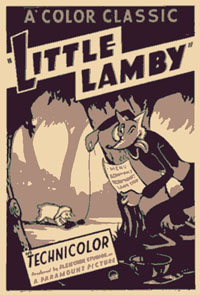
Max Fleischer would include the beaver in a “give him the works” setup in the Color Classic, Little Lamby (Paramount, 12/31/37 – Dave Fleischer, dir., Dave Tendlar/William Sturm, anim.). A traveling fox has a regular regimen planned for obtaining his meals when he visits strange places. Approaching the village of Animalville (population: 201), he views the community’s residents from a hillside through a spyglass. Many species and their offspring are viewed, including a beaver who has found a new use for his tail, having one end of a rubber band tied to it, and the other end ties to a ball, providing a natural game of paddleball. But the fox’s attention is drawn to a grazing baby lamb (one who predicts the later Thumper the Rabbit in not liking greens, only finding grass to be palatable when she (or he?) sprinkles sugar on it). The Fox predicts the results of his own plan, and rubs out the last digit of the population sign at the edge of town, drawing in as its replacement the reduced population tally of 200.
The fox posts a notice in the public square, announcing a Baby Contest, with big prize to the prettiest and healthiest baby (must be kind and tender). All the village takes notice, including a parent beaver carrying his youngster along, riding upon his tail. Soon, everyone is gussying-up their offspring as the logical choice for the prize, while the fox dons a fake beard and constructs a judge’s stand. The entrants parade past him in review, yet there is no sign of the beavers either in the preparation or in the contest. In fact, the beavers do not appear to have even entered, as they are not represented on a cross-off list the fox carries of rejects for his main course, ruling out squirrel on toast, roast duck, and fried rabbit. The lamb finally arrives, and is happily inspected by the fox for its plumpness. “The winner – and, my dinner!” shouts the fox, casting away his fake beard, dropping through the judge’s stand by way of a trap door, and exiting in a hurry upon a hidden motorcycle concealed beneath the stand, with the baby lamb clasped firmly under his arm.
The fox heads for his lair, zooming inside and slamming the door, with a sign hung on it reading “Gone to lunch”. The citizens of the village angrily pound upon his locked door, only to hear the fox inside holler “Scram!” Many means are employed by the animals to gain entry. A rabbit takes hold of the beaver like a power saw, and attempts with him to cut through the trunk base of the large tree stump that is the fox’s home. The fox sticks his head out of a knothole, and smacks the rabbit and beaver with a small club, knocking them out. Two birds fly with their claws clamped onto the handles of a twin-handled saw, flying back and forth in attempt to saw into the trunk from above. The fox, seeing the blade edge protruding into his wall, grabs a sledge hammer, and socks the blade in three places, bending the saw teeth in opposite directions to wedge the saw tight in the tree bark. Only the persistent efforts of a billy goat, holding onto the forward end of a battering ram, and the rest of the community carrying the log (plus a whole jar of headache pills for the goat’s aching noggin) finally bust down the front door. The lamb is rescued in the nick of time from the stove top, where she has been doused with sneeze-inducing pepper and perspires profusely from the stove’s anthropomorphic wood-eating flames. The fox is caught on the end of the battering ram, smacked into the opposite wall, then his arms and legs tied around a center pole support in his living room. A teeter-board is inserted under the fox’s rear, and the animals take turns jumping on one end of the board, launching the fox’s head into the ceiling over and over again. As the fox sits in a daze and with a lump on his head, the baby lamb sprinkles some of the pepper onto the fox’s nose, causing him to get his own case of the sneezes. “Gesundheit”, states the baby, for the iris out.
The House That Jack Built (Screen Gems/Columbia, Color Rhapsody, 4/14/39 – Sid Marcus, dir.) seems to have the distinction of featuring the first beaver character to have a name. The studio isn’t taking any chances as to the audience missing the point that Jack the Beaver is industrious – dressing him in the same worker’s hat and coveralls as Practical Pig, and even giving him a modification of the same voice (provided once again by Pinto Colvig, who also voies an ostrich featured in the story). Jack carries a box of tools and an armload of lumber through the forest to a vacant lot site. On the way, he is accosted by a bear panhandler. “Can you spare a dime for a cup of coffee?”, the bear asks in the standard sympathy ruse. Jack answers with a response I wish I’d turned on some panhandler, guaranteed to kerflummox their true intentions. “I haven’t got a dime…but here’s a cup of coffee.” The bear stares bewildered at the steaming cup handed to him as Jack continues on, and barely has the presence of mind to sip down the brew before tossing the cup away and continuing to pursue Jack. “What’cha doin’?”, asks the bear, seeing jack using a shovel to break ground. “Building a house”, replies Jack. The lazy bear immediately plops himself on his back onto the ground, and proposes. “Build one around me, buddy. I’m sick of the outdoors.” Jack gets as steamed as his coffee, and smacks the bear across the tummy with his shovel, forcing him to retreat a distance behind a tree. Jack begins to lecture in song about his work ethic, as Practical Pig was also prone to do, in a talk-sung number entitled, “You Don’t Get Nothin Doin’ Nothin’”. Bu the time the song is through, we have cross-dissolved our way to the home’s completion. (Being a beaver, Jack prefers lumber to Practical’s bricks.) The bear turns up right on cue, complementing how beautiful the house is, and proposing to an equally-shiftless ostrich pal of his that they should have a house warming. Jack immediately senses trouble, but can’t keep the two buttinskies from forcing their way through the front door, then locking Jack out behind them.
The two intruders are just natural-born troublemakers. The bear leaps into a bed with rollable casters on its poles, and rides the bed into the kitchen, where it stops in a corner directly in front of the refrigerator door, allowing the bear to feast on breakfast in bed. The ostrich isn’t so picky, and does what all cartoon ostriches do – swallow anything and everything in sight. Jack finally finds a point of entry into the house, and immediately rushes for the phone, attempting in a low whisper to phone the police. “Gimme that phone”, snaps the voice of the bear, as he yanks it away from Jack, and tosses it to the ostrich, who proceeds to swallow everything but the handset. Jack is still determined to get his call through, and pokes his finger into the ostrich’s belly to rotary-dial on the apparatus within him. Unfortunately, every time the call is connected, the ostrich hiccups, disconnecting the call. Finally, the bear again takes the matter out of Jack’s hands, grabbing the handset and yanking the rest of the phone out of the ostrich’s belly by the cord. As the ostrich keeps Jack busy in a tussle, the bear, out of pure spite, uses the phone to call the Termite Wrecking Company – a professional all-insect wrecking crew, and requests their services at the newly-built abode. Knowing the fate of Jack’s home is sealed, the bear and ostrich finally allow themselves to be chased out, mockingly bidding a neighborly goodbye as they depart. “Good riddance”, says Jack, settling down at his breakfast table. But…what table? It disappears in about one second flat – as does the chair. The termites have arrived. Within about a minute, the entire place has collapsed to the ground around Jack, and the bear and ostrich laugh uproariously outside at the show. Their laughter is abruptly silenced, as Jack produces from nowhere a shotgun. (Too bad he couldn’t have laid hands on this before.) Before long, the bear and ostrich are marched back to the lot at gunpoint, and work begins on a replacement home – that is, work performed solely by the meddlesome intruders, with Jack sitting by as supervising foreman, shotgun at the ready to dissuade any attempt at slacking off. The bear and ostrich close the film with a reprise of Jack’s song of industry – to be sung by them whether they like it or not.
Wish we had original credits for these. There’s been some mysteries as to whether credits got mixed at some point between the work of Sid Marcus and that of fellow director Art Davis at the studio. While multiple sources list this film as Marcus’s, there are a few artifacts that might suggest Davis’s presence. A few signature present-time dissolves occur between shots in the termite office, which was a camera style Davis was associated with in several Scrappys and even in later life in his Looney Tunes. And an appearance by a recognizable worm who had appeared in two Davis Scrappys, “The Early Bird” and “A Worm’s-Eye View”, in the last shot as Jack eats an apple for lunch. Could this be another instance of director miscrediting?
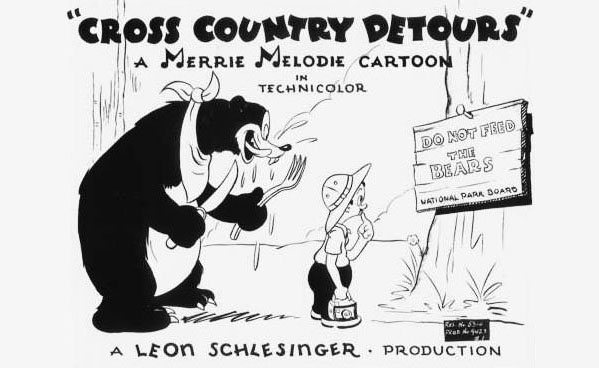
Cross-Country Detours (Warner, Merrie Melodies, 3/16/40 – Fred (Tex) Avery, dir.) – One of the best of Avery’s many spot-gag travelogue spoofs for the studio, featuring a variety of different types of gags. It is perhaps most remembered for its strip-tease rotoscope sequence of a lizard “shedding its skin” (even though this phenomenon of nature only occurs with snakes). Or for its split-screen imagery of something for the adults and something for the kiddies – a gila monster for the grown-ups, and a little girl reciting nursery rhymes for the tots. However, the little girl proves the more ferocious of the two, out-roaring the gila monster, causing him to run away in a panic. Beavers, however, are spotlighted in one sequence, constructing a dam. Before our very eyes, they built from concrete and mortar the mammoth Hoover Dam – then the best known and most modern hydroelectric dam in the nation. Avery would remember to use the structure as a prop again when he migrated to MGM, having his giant cat and mouse scramble over the top of it in King Size Canary.
Snowtime for Comedy (Warner, Merrie Melodies, 8/30/41 – Charles M. (Chuck) Jones, dir.) – Jones’s “two curious puppies” are in another of their battles for a bone – this time set against the icy backdrops of a frozen winter. Both dogs and the bone take a slide down a massive ski-jump, the bone in the lead. The little pup overshoots it, sliding out onto the banks of a not-yet frozen lake. He breaks off a small floe of ice from the banks before reaching the water, then sails out into the middle of the lake, helplessly trapped aboard the small floating chunk of ice. The larger dog also overshoots the bone, but avoids falling into the lake, negotiating a course adjustment in his slide that bowls him right into a small beaver dam just constructed (with the accompanying sounds of a bowling ball scoring a strike on a full lane of pins). The dog is next seen, still sliding, but with the dam’s logs piled atop him in the shape of an Indian teepee. Eventually, he sheds the lumber, only to slide into a snowbank, then collide below the snow surface into the trunk of a half-covered tree.
When the large dog next emerges, he is dazed and woozy, but spots the bone where he passed it, displayed in his POV blurred vision. He carefully tries to creep up upon the bone, but is blown backwards by an icy wind, again colliding with the half-buried tree. Again he attempts to advance, building up speed to fight the wind. He slides directly over the bone, but is unable to clamp his teeth together fast enough to grab it as he passes. What lies ahead? A new dam the beaver has constructed. CRASH! The end result of the collision leaves the sliding dog looking as if he is residing in Uncle Tom’s Cabin.
So what of puppy number 1? His ice floe has been severing into segments below him, again and again, until he is left standing with all four paws piled one-atop-another on one paw-sized fragment of ice. He just manages to hop off before it submerges, onto the icy bank, but is now pursued by a crack he has caused in the ice. The crack chases him right into the latest dam constructed by the beaver, with the typical results, and the lumber assuming the shape of a wooden steamboat surrounding the dog. The little pup is chased into the same snowbank previously occupied by pup #2, crashes into the same tree trunk, then the ice crack splits the entire tree up the middle. When the little pup emerges from the snow, he finally spies the resting place of the bone, and leaps for it. The bone squirts out from between his paws, propelled high into the air. The pup gives chase, and of course crashes into a beaver dam again (this time with no shape shifting gag for the lumber). The bone lands atop the seat of a chair lift leading high into the mountains, and the pup follows on a second chair. At the pinnacle, the bone is deposited by the seat as it turns for the return trip down the mountain, and the pup, leaping upon it, slides with the bone down a steep slope. Tumbling and gathering up snow in a giant snowball, the pup and bone are transformed into a gigantic snow sculpture of – a pup and bone! This mammoth mutt descends on pup number two – and on yet another beaver dam. The beaver isn’t going to stick around close with this monster apparition sliding right toward him, and flees to the highest hillside vantage point he can find, then turns to see the aftermath of the snow-dog’s collision with his construction project. Instead of destroying the new construction, the snow joins with it, emerging as another perfect snow replica of Hoover Dam! Carl Stalling appropriately underscores this finale gag with the notes of Ella Firzgerald’s recent hit, “Keep Cool, Fool.”
The Bear and the Beavers (MGM, Barney Bear, 3/28/42 – Rudolf Ising, dir.) – This picture is frameworked as if taking place within the illustrations of a children’s storybook, much in the same manner as Disney would later framework “Winnie the Pooh”, but without some of the page-turning and type-moving gimmicks. We are told by its pages that Barney (still apparently a nameless bear at the time of release) has gotten tired of living in cold, damp caves and old hollow trees, so has adopted human homebuilding style, constructing himself a sturdy log cabin with massive stone fireplace and chimney (a sign outside names the cabin the “Snuggly-Wuggly”). Barney sits in a plush easy chair padded with multiple pillows, dressed in a warm robe, loading logs into his fireplace only inches-distanced from his reach, and basking in the warmth and comfort. Life might be ideal, but one day he runs out of firewood. He enters the forest, wearing scarf and hat, and armed with an axe and a large box for his wood. We don’t know how Barney got his original supply of big and little logs to build his cabin and stoke his fires, but all indications are that Barney cannot claim the title of an experienced woodsman. He wrestles with an axe head with a talent for coming loose from its handle. It first causes Barney to swing at the tree with no blade, sending a wave of vibrations through his arms and up his entire torso upon impact. Replacing the blade on the handle, Barney swings again, flipping the axe head loose into the air, where it twirls like a Frisbee, and returns for circling passes at Barney’s face again and again like a boomerang. After repeatedly ducking out of its way, Barney stands erect, and extends out his arm with the axe handle, timing things perfectly to catch the whirling blade back upon the handle on the next pass. He finally gets a swing at the tall pine which has been his target. But now the tree gets the vibration shivers just as Barney experienced before, shaking down an avalanche of snow nestled in the tree’s upper branches, right on Barney.
All this while, Barney experiences slow-burn frustration at viewing the ease with which a pair of happy beavers addresses the same task nearby, efficiently alternating axe-swings to chop a tree just as tall into log-sized sections, then piling the perfectly-sized wood onto a small sled for hauling back to their home. When Barney emerges from under the snowbank emptied upon him by the tree, he first drums his fingers as the passing beavers tip their cap in friendly manner to him, and wonders what to do next – then hits upon a revelation. That nice, tidy wood pile on the beavers’ sled! What if…well, you read into Barney’s mind, as he just happens to stroll along whistling, along the same path as the beavers follow, then pitches his unneeded axe into the bushes. Barney ducks into a bush, then cautiously pokes his head through to see what the beavers are up to. What he views is more than he could have hoped for. The beavers have entered the busy little community of Beaverville, where everyone seems to be busy sawing and cutting away at lumber. But in this instance, they are not collecting it for any designated project such as a dam or den construction. Instead, all the collected wood is being stockpiled in one warehouse structure, bearing a sign reading, “Beaverville community woodpile.” This is all the information Barney needs, and his face pulls back into hiding, with a nefarious grin on his face, ready to wait his chance for action.
That night, Barney returns to what will be the scene of – the crime, armed with boxes galore. Displayed as still illustrations within the book pages, Barney “borrows” some wood. The next page displays him loaded – for bear, so to speak, adding the words, “Quite a bit.” The next page shows the beavers’ warehouse, empty, with the additional words, “In fact, all of it.” The theft of the century. However, Barney is as inept in covering his traces as he is as a woodsman. An elderly beaver with a walking cane, who acts as night watchman for the community, passes the warehouse on his rounds – and does a delayed double-take upon discovering the place laid “bear”. He races to a square in the center of the village, and rings a triangle to sound a community alarm, rousing all the other beavers from their dens, in a scene likely inspired by the “Giant on the beach” alarm sounded by Gabby in Fleischer’s “Gulliver’s Travels.” It’s not hard to find the path of the culprit, as the watchman points the community’s eyes to a long trail of huge bear pawprints left in the fallen snow. The trail ends obviously at the doorstep of Barney’s cabin. Inside Barney now basks in the heat of a monster blaze in the fireplace, stoked by a lumber pile at his sides reaching all the way to the ceiling. What’s more, embers and plumes of smoke pour out the chimney top, almost as visible as a rocket’s exhaust, making it elementary to determine from outside where the community woodpile is currently located.
A slow-marching mob (also possibly inspired by “Gulliver’s Travels”) forms from Beaverville, following the tracks to Barney’s door. The parade is led by the equivalent of a beaver “Spirit of ‘76″ fife and drum corps, and by the watchman carrying a yellow lantern (again matching Fleischer’s Gabby) and beckoning the community to follow with a wave of his cane. Everyone seems to be armed with wood-cutting devices, sleds for hauling, and ropes (one of them noticeably fashioned into the familiar form of a hangman’s noose). A beaver at the end of the procession signals the end of the parade with a red-colored lantern dragged along on his tail (possibly a nod to Dopey marching along at night in Snow White’s “Heigh-Ho” sequence). Everyone amasses outside Barney’s home, and the watchman signals with his cane for all to be silent. He peeks in the window of the cabin to get the layout of the room and a view of his opponent, then, when Barney begins to doze off, beckons again with the cane for everyone to advance. Beavers move in from all directions, taking up positions in squads in the cellar, upon the roof, and one beaver slipping into the cabin through some undisclosed entryway, taking up a stance upon a structural cross-beam over Barney’s head. The watchman gets an okay signal from each positioned beaver or squad. Barney meanwhile has heard some rustling, but is still too happily groggy to care about the unexplained disturbance, and settles into relaxed pose again. When all is ready, the watchman chooses the proper moment to blow a shrill note upon a small whistle, as the starting signal for all hell to break loose. The whistle rouses Barney from slumberland, causing him the leap high into the air, directly under the beaver on the rafter – who is carrying a large wooden mallet, with which he conks Barney soundly on the head. As Barney tries to collect his dizzied thoughts, the souds of friction upon wood fill his head from everywhere. Axes chop in random rhythms on the roof and walls. Elsewhere on the structure, hefty buck teeth gnaw their way through log sections. Below the floorboards, sawblades emerge through, carving out whole sections of the floor below Barney’s feet.
Barney is utterly Mesmerized by the flurry of activity, the din of the chopping, and the vibrations of the entire structure, and cannot gather his thought processes to formulate a counter-attack. He instead casts a look at the camera, expressing to us his utter helplessness to address this unexpected onslaught. Then a shout of “Timber” is heard from above the roof. The support beams of the cabin begin to crack and splinter, and within a few seconds, the entire structure collapses upon Barney’s head. Our image blacks out – much as it probably did to Barney, and we fade in to a reprise of the beaver parade, but now heading back home. The fife and drum team passes, then the watchman beckoning the others with his cane. Then the rest – but with a major change. Each beaver is completely loaded down with limber to tote home, forming a line that seems to extend all the way to horizon. At the end of the procession is one of the two beavers whom Barney originally met, carrying the last of the lumber in Barney’s own “wood box’ crate, and again politely tipping his cap to Barney as a good-bye. We see Barney, lying in a heap before the stones of his now empty fireplace, fingers again nervously dropping in frustration, as the camera pulls back, revealing nothing to be left of Barney’s home except the stone fireplace structure, portions of a window-frame with now-shattered glass, and the hanging remnants of the battered “Snuggly-Wuggly” sign outside. The beavers have recovered their own wood, and Barney’s logs as interest for the loan! In a scene excised for years on television release prints, the storybook closes, with the words “The End” on the back cover, while white letters dissolve in across the shot, providing the only dated reference to when the film was released – a standard motto which appeared on most MGM features and shorts from this season, reading “America needs your money. Buy defense bonds and stamps every pay day.”
For reasons I have never understood, some reviewers have criticized this film for slow and deliberate pacing. I have never seen such fault with it, and consider it one of my favorites in the Barney series. If anything, it follows in the same meticulous attention to detail that was the fascination of the tying-the-giant-up sequences of “Gulliver’s Travels”, which as mentioned above, appears to be its obvious inspiration in several respects. The detail of the animation on massed group shots is amazing, the facial expressions and personality animation on the characters is superb, and the backgrounds are picturesque and lush. Everything about the film speaks lavishness, and I have always classed this as among the closest efforts of the studio to matching the best of Disney and Fleischer feature output. View this as if part of an extended feature work without the need to rush through its material and ideas, and I think you’ll see my point.
Nutty Pine Cabin (Lantz/Universal, Andy Panda, 6/1/42 – Alex Lovy, dir.) – Another fun romp, that I remember fondly from early screenings on the Kelloggs’ Woody show as a child. Rustic woodland cabins must have been a part of the American dream in 1942, because Andy Panda has the same home-building fever as Barney Bear. Andy’s chosen material, however, is plywood instead of logs. Though his carpentry supplies include a tape measure, he could use some practice in measuring board length, as the first act of the cartoon displays his battle to hammer in place one board in the cabin’s side wall that is too long. It either pops out at the top, bends upwards at the bottom, or springs outward as a bulge in the middle. When Andy finally manages to hold it in place, its top edge raises the roof just slightly, allowing all the other wall boards to fall out of place, then the roof to collapse upon him for lack of structural support.
Meanwhile, a community of beavers works busily on a dam construction project. One beaver’s neck demonstrates great dexterity. After he has chewed 95% of the way through the trunk of a tree, he backs up a few steps, and allows another beaver to pump on his tail, causing his neck to elevate like an automotive jack to topple the tree above him. A stuttering beaver does an impression of Porky Pig, yelling “T-t-t-t-t….(POW falls the tree upon him)…TIMBER!!” The smallest beaver of the clan is getting nowhere gnawing at a giant tree assigned to him, when he spots Andy sawing away at more boards. Turning on his cutest charm, the little one assumes a begging position and a smile, thumping his tail to get Andy’s attention. Andy passes him a small sample of the lumber as “beaver board”, and thinks he’s done his good deed for the day. But the beavers are opportunists. Rather than waste their efforts on manual labor, the minute the small one shows off his prize and where he got it, all the beavers want Andy’s boards over their own home cuttings. And so, the tables are turned on the Barney Bear scenario, with the beavers becoming the thieves instead of the victims.
The first beaver Andy spots is the same little one he already met. “Want some more wood?”, Andy asks. The beaver quickly nods, and scurries away with another small piece, but only as a cover for the activities of his relatives, who emerge from the side of the house to make hasty exits, not only carrying Andy’s boards, but pails and hardware as well. The last in the line is stopped by Andy stepping on his tail, while the forward motion of the beaver’s feet digs him into a trench in the ground. The embarrassed thief replaces the box of wood he is carrying where he found it, and attempts to back away, stumbling into Andy’s paint supplies, and transforming himself into a Technicolor rainbow. The little beaver is next spotted swiping a mallet, which of course he returns the hard way when Andy demands, “Give it to me.” Andy begins chasing the little one around and around the cabin, Andy becoming a speed blur that transforms into multiple-exposure running images of himself clear around the cabin. When he comes to a stop, all his multiple images catch up with him, colliding themselves back into his person with wooden-sounding clunks. The little beaver descends from the roof with the aid of Andy’s roll-out tape measure, then paddles the panda on the head with his tail, causing Andy’s eyes to bounce in their sockets. Just as Andy is about to toss something at him, the panda is mown down by two other beavers, carting off one of Andy’s finished doors. Andy switches targets, and pursues the door-robbers, who position the door directly in front of a tree trunk. They swing the door open at the last second, and Andy hits the trunk at full speed, penetrating his silhouette through not only this trunk, but those of a dozen other trees in a row behind it.
Andy’s reached his limit, and in scenes often unkindly cut for television broadcasts, resorts to a shotgun, firing pot shots at the beavers. (A similar fate often befell another Lovy episode of Andy from the same season, “Good-bye, Mr. Moth”, where excising of the rifle shots rendered the cartoon’s ending absolutely unfathomable.) The beavers go into a huddle, and devise a new strategy to win the war. They converge upon one of the largest forest giants, with teeth bared, making short work of its trunk. The mighty forest monarch falls, in close proximity to Andy’s cabin, generating shock waves that launch the cabin into the sky. The cabin, with Andy along for the ride, comes to rest skewered atop the uppermost branches of another nearly equally tall tree. Now, the beavers converge again to gnaw the trunk base away to only a pinpoint. One beaver spits against the upper section of the tree to choose the direction of its fall. Good expectorating! With precision, the second tree collapses across the river, jamming Andy’s cabin right into the center gap in the existing dam construction, effectively sealing off the water and completing the project. A defeated Andy slowly raises his head from the chimney, only to be tail-whacked in the head again by the little beaver, who is hiding inside his hat. Andy’s closing expression seems a precise match to Barney Bear’s – a picture of exasperation, silently communicating the phrase, “Why me?”
All Out For ‘V’ (Terrytoons/Fox, 8/7/42 – Mannie Davis, dir.) – An assortment of spot gags, as those in the animal community learn of the pronouncement of war declared from a newspaper extra. Among the first to react to the news are a population of beavers, who attack en masse a grove of trees in the wood, gnawing them within seconds into a bursting cloud of raining logs, which neatly stack into cabins in the newly-formed clearing, providing headquarters space for the War Production Office. The beavers later fell a tree with a shout of “Timber!”, while a woodpecker hammers a large tack into the sawed-off end of the log, a “caterpillar” tractor lassos the nail and tows the whole trunk away, and a team of termites uses their devouring power to cut the log into wooden boards. In a year when every studio got an automatic chance for an Oscar nomination, this film was under vote for the award – not that it had a chance of winning against Donald Duck’s “Der Fuehrer’s Face.”
NEXT TIME: Our buck-toothed friends remain “dammed” if they do, and “dammed” if they don’t.

 Login
Login


 And – onto The Old Shell Game (1948)