Normal view

  • ✇Malay Mail - All
  • State Secretary’s Office: Only Negeri Sembilan ruler can appoint or remove DKU secretary Malay Mail
    KUALA LUMPUR, June 3 — The Negeri Sembilan State Secretary’s Office today said no party other than Yang di-Pertuan Besar Tuanku Muhriz Tuanku Munawir has the power to suspend, terminate, replace or appoint the Dewan Keadilan Undang (DKU) secretary.In a statement, the State Secretary’s Office said the DKU secretary is appointed by the Yang di-Pertuan Besar and holds office for as long as it pleases the ruler, as provided under Clause 25 of the Laws of the Constitu
     

State Secretary’s Office: Only Negeri Sembilan ruler can appoint or remove DKU secretary

3 June 2026 at 12:54

Malay Mail

KUALA LUMPUR, June 3 — The Negeri Sembilan State Secretary’s Office today said no party other than Yang di-Pertuan Besar Tuanku Muhriz Tuanku Munawir has the power to suspend, terminate, replace or appoint the Dewan Keadilan Undang (DKU) secretary.

In a statement, the State Secretary’s Office said the DKU secretary is appointed by the Yang di-Pertuan Besar and holds office for as long as it pleases the ruler, as provided under Clause 25 of the Laws of the Constitution of Negeri Sembilan 1959.

It said the DKU is a constitutional institution headed by the Yang di-Pertuan Besar under Clauses 16, 17 and 19 of the state constitution.

“Therefore, any sitting or meeting held without the consent of DYMM Yang di-Pertuan Besar of Negeri Sembilan cannot be regarded as a DKU sitting,” it said.

The statement comes after several Negeri Sembilan ruling chiefs announced the purported indefinite suspension of DKU secretary Raja Norazli Raja Nordin on May 29.

They had accused him of failing to convene a special DKU meeting to discuss the state’s ongoing royal and customary dispute, and said an interim committee would carry out the secretary’s duties.

Raja Norazli today rejected the suspension, saying he was appointed by Tuanku Muhriz and remained duty-bound to carry out his responsibilities unless instructed otherwise by the state ruler.

The dispute is linked to the removal of Datuk Mubarak Dohak as Undang of Sungei Ujong, which was officially announced after a DKU special sitting on April 17 but took effect from May 13 last year.

The crisis later widened after Mubarak and several ruling chiefs announced the purported removal of Tuanku Muhriz as Yang di-Pertuan Besar, a move that Negeri Sembilan Menteri Besar Datuk Seri Aminuddin Harun said the state government did not recognise.

‘Devoid of legal effect’: Negeri Sembilan DKU secretary rejects suspension amid royal crisis

3 June 2026 at 10:37

Malay Mail

KUALA LUMPUR, June 3 — Dewan Keadilan dan Undang (DKU) secretary Raja Norazli Raja Nordin has reportedly rejected his indefinite suspension by several Negeri Sembilan ruling chiefs, saying the move had no legal effect.

According to The Star, Raja Norazli said in a letter dated today that he was appointed by Yang di-Pertuan Besar Tuanku Muhriz Tuanku Munawir and remained bound to carry out the duties entrusted to him unless instructed otherwise by the state ruler.

“Such is the nature of my office. I am duty-bound to abide by and execute the duties and responsibilities entrusted to me until commanded otherwise by the state Ruler,” he was quoted as saying.

“Any action directed against me constitutes an affront intended to usurp the constitutional powers of the state ruler and is devoid of legal effect,” he reportedly added.

The letter was reportedly addressed to the Undang of Jelebu, Undang of Johol, Undang of Rembau, Tunku Besar Tampin, Datuk Shahbandar Sungei Ujong and Datuk Mubarak Dohak.

The six had on May 29 announced the purported indefinite suspension of Raja Norazli, accusing him of failing to convene a special DKU meeting to discuss the state’s ongoing royal and adat crisis.

They claimed the meeting had the support of six of the DKU’s eight members and said an interim committee would carry out the secretary’s duties.

Raja Norazli, however, said the DKU could not be properly constituted without Tuanku Muhriz, who was not present at the May 29 meeting, and that any meeting called contrary to established procedures would be unconstitutional and void.

He reportedly also said he could not convene the meeting because the six had earlier filed an originating summons against him, the DKU and the state government, and that holding such a meeting could affect ongoing court proceedings.

The DKU is the highest body governing matters related to Negeri Sembilan’s ruling chiefs.

The dispute is linked to the removal of Mubarak as Undang of Sungei Ujong, which was officially announced after a DKU special sitting on April 17 but took effect from May 13 last year.

Mubarak has since challenged his removal.

The crisis widened after Mubarak and several ruling chiefs announced the removal of Tuanku Muhriz as Yang di-Pertuan Besar, a move rejected by the state government.

The dispute now involves overlapping questions over the ruling chiefs’ authority, the role of the state ruler, DKU procedure and pending court action.

  • ✇Malay Mail - All
  • Countdown to election: Negeri Sembilan MB announces formal dissolution of state assembly Malay Mail
    SEREMBAN, June 4 — The Negeri Sembilan State Legislative Assembly, which has 36 seats, will be officially dissolved tomorrow to pave the way for the upcoming State Election (PRN).The announcement was made by Menteri Besar Datuk Seri Aminuddin Harun during a special press conference at his official residence here tonight, bringing an end to weeks of speculation surrounding the timing of the assembly’s dissolution.Aminuddin said the dissolution was carried out afte
     

Countdown to election: Negeri Sembilan MB announces formal dissolution of state assembly

4 June 2026 at 15:48

Malay Mail

SEREMBAN, June 4 — The Negeri Sembilan State Legislative Assembly, which has 36 seats, will be officially dissolved tomorrow to pave the way for the upcoming State Election (PRN).

The announcement was made by Menteri Besar Datuk Seri Aminuddin Harun during a special press conference at his official residence here tonight, bringing an end to weeks of speculation surrounding the timing of the assembly’s dissolution.

Aminuddin said the dissolution was carried out after obtaining the consent of the Yang Dipertuan Besar of Negeri Sembilan, Tuanku Muhriz Tuanku Munawir, during an audience at Istana Besar Seri Menanti earlier today. — Bernama


The constitutional framework of justice: Balancing Adat Perpatih and statutory law in Negeri Sembilan — Dr Hamdan Leman

7 June 2026 at 09:16

Malay Mail

JUNE 7 — The people of Negeri Sembilan hold a justifiable, deep-rooted pride in Adat Perpatih. For centuries, this unique customary framework has defined the state’s identity, offering an extraordinary tradition of consensus, matrilineal democracy, and structural checks and balances.

However, for a society to function cohesively in a modern federation, it is vital to clarify a fundamental legal principle: traditional customs do not operate in isolation, nor do they supersede the supreme constitutional law of the state and the federal framework of Malaysia.

While customary sentiments run deep, public discourse must remain anchored to a universal truth: the ultimate goal of any governance framework—whether customary or statutory—is the preservation of objective justice.

A world in flux: The imperative for institutional stability

We live in an era of profound global uncertainty. On the international stage, we frequently witness the fragility of institutional order, the limitations of international legal bodies to maintain global harmony, and the shifting narratives that blur the lines between right and wrong.

In a world undergoing such rapid geopolitical and social transitions, local institutions have a heightened responsibility to project absolute stability, clarity, and adherence to established rules.

Complex internal disputes regarding state customary traditions should not be handled in a manner that creates administrative ambiguity or public anxiety. Instead, they require a calm, measured alignment with established legal processes.

The code of harmony within Adat Perpatih

Adat Perpatih was never intended to be an instrument of administrative friction or abrupt governance shifts. Historically, its very essence relies on muafakat (consensus), meticulous deliberation, and equity. When customary actions are perceived to bypass codified legal systems, it risks overshadowing the noble values the ancestors sought to protect. Any attempt to alter or challenge the standing of a state’s highest leadership must strictly mirror the fairness, transparency, and balance that Adat itself champions.

To act without these safeguards risks transforming a revered tradition into a tool of procedural instability.

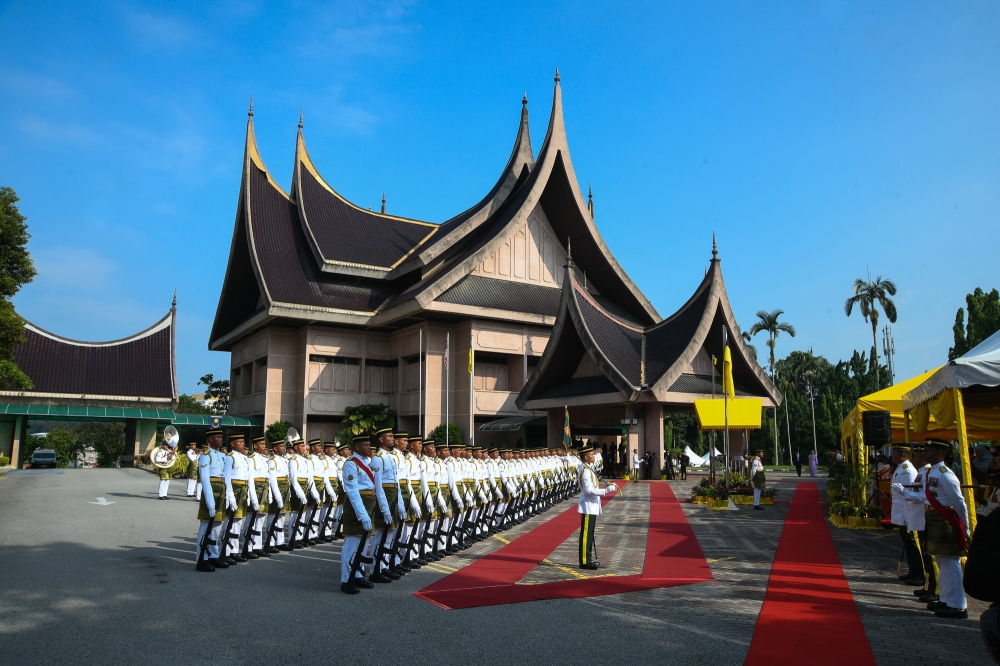
Media practitioners are seen outside the Balai Undang Sungei Ujong in Seremban on April 30, 2026. — Bernama pic

The constitutional safeguards of a sovereign ruler

Under the modern legal framework of Malaysia, the position of the Yang di-Pertuan Besar is heavily protected by a dual layer of customary legitimacy and written statutory law. When faced with unprecedented procedural challenges, the legal recourse and structural protections available to the Ruler are clear:

First, the primacy of the written constitution dictates that in a constitutional monarchy, customary actions must be harmonized with the written law.

Article X of the Negeri Sembilan State Constitution establishes a clear, rigorous threshold for any leadership evaluation. It implicitly demands the application of natural justice—meaning a fair, transparent, and comprehensive enquiry where all sides are heard—alongside the formal concurrence of the state’s executive government.

Unilateral or non-statutory declarations completely lack constitutional efficacy.

Second, the principle of executive concurrence ensures that the state’s administrative apparatus and law enforcement agencies function under the authority of the constitution.

Without the statutory endorsement of the Menteri Besar and the recognition of the Federal Government, alternative customary declarations cannot translate into executive or legal reality.

Third, the strength of administrative continuity reinforces public confidence. By maintaining a dignified, calm, and consistent adherence to royal and constitutional duties, the reigning institution anchors the state.

Stability is maintained not through public friction, but through an unwavering commitment to the continuity of the state’s governance.

Conclusion: Aligning custom with the rule of law

Just as the global community requires clear frameworks to ensure fairness and prevent chaos, local governance demands a strict adherence to constitutional boundaries.

Customary laws like Adat Perpatih are a source of great cultural strength, but their survival and respect depend entirely on their alignment with the universal principles of natural justice and the written constitution.

The institutional integrity of Negeri Sembilan remains firmly protected when all parties prioritize procedural law over emotional sentiment, ensuring that justice remains the true cornerstone of the state.

* This is the personal opinion of the writer or publication and does not necessarily represent the views of Malay Mail.

❌
Subscriptions