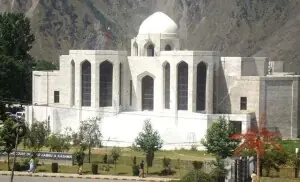
Normal view

Constitutional amendment not a concession to be wrested, says AJK SC on presidential reference

MUZAFFARABAD: The Azad Jammu and Kashmir Supreme Court has observed that any amendment in the region’s constitution was “not a concession to be wrested” from the government, as the court issued its advice on a presidential reference, which emerged on Sunday.

The advisory opinion came in response to a reference filed by acting AJK President Chaudhry Latif Akbar under Article 46-A of the Interim Constitution Act, 1974 after the recently proscribed Joint Awami Action Committee (JAAC) demanded the abolition of 12 refugee seats in the legislative assembly ahead of the July 27 elections.

The 12 seats are reserved for refugees from Indian-occupied Jammu and Kashmir, who settled in mainland Pakistan after 1947. JAAC alleges that these seats were often used by mainstream Pakistani political parties to influence the formation of governments in Muzaffarabad.

The presidential reference had sought answers to five key questions over the constitutional status of the refugee seats, the legislature’s competence to introduce a fundamental constitutional amendment at the present stage, the constitutional limits of the rights of assembly and association, and the state’s obligation to protect the electoral process and reject extra-constitutional demands.

In the advisory opinion, dated June 6 and available with Dawn, AJK SC Chief Justice Raja Saeed Akram Khan held that the constitution of the AJK was the “supreme law” of the state and its provisions the “property of the people of Azad Jammu and Kashmir and of the whole Kashmiri people”.

“The amendment of the constitution is a solemn constitutional act, not a concession to be wrested from a government under duress,” the opinion declared.

“It can only be accomplished through the process the constitution itself prescribes, by an assembly possessed of the full democratic mandate of the people, after deliberation, consultation, and consensus-building,” the advisory opinion read.

The court stated that the advisory opinion was being tendered after “full consideration of the constitutional provisions, the legislative and historical background of the refugee seats, the factual matrix placed before this court, and the submissions of the advocate general and the learned amicus curiae”.

The court observed that the AJK government remained legally obligated to hold elections within the time stipulated by the constitution. It maintained that the constitution was not a “document to be honoured when convenient and discarded when inconvenient”.

“The constitution endures because its guardians, ie, the government, the legislature, the judiciary, and ultimately the people, stand firm in its defence.”

The court’s opinion came a day after the region’s government proscribed the JAAC, days before the group is scheduled to stage a protest on June 9. The JAAC’s latest protest call centred around the highly contentious demand to abolish the 12 refugee seats in the region’s Legislative Assembly.

It has also been calling for economic reforms to lower energy prices and provide free healthcare.

Minister for Parliamentary Affairs Tariq Fazal Chaudhry said on Sunday that most of those demands had been met.

“It’s negative and false propaganda that the government hasn’t addressed the demands. Out of 38 demands, 35 have been addressed,” he said at a media conference.

The same day, AJK Chief Election Commissioner retired Justice Ghulam Mustafa Mughal said while announcing the election schedule that the elections on refugee seats had previously been conducted under judicial supervision, but after the judiciary withdrew from the process, the responsibility would now be carried out by officials of the Election Commission of Pakistan.

Responding to a question about the planned JAAC protests, he said a prolonged agitation could affect the electoral process.

AJK authorities have also advised intending visitors to postpone their trips until June 20, citing security concerns ahead of the planned protests.


  • ✇Dawn Newspaper Pak
  • Four cops martyred, 20 injured as AJK protest spirals none@none.com (Tariq Naqash)
    • Two killed, dozens hurt as riot police use tear gas, batons to disperse protesters• IGP terms attack on CMH ‘outright terrorism’• AJK SC says changes to Constitution ‘not a concession to be wrested from govt’ MUZAFFARABAD: At least four policemen were martyred and 20 were injured after fierce clashes broke out with supporters of the newly-proscribed Joint Awami Action Committee (JAAC) in Rawlakot, police said on Sunday. A statement issued on Sunday night by the office of AJK police chief Liaqa
     

Four cops martyred, 20 injured as AJK protest spirals

• Two killed, dozens hurt as riot police use tear gas, batons to disperse protesters
• IGP terms attack on CMH ‘outright terrorism’
• AJK SC says changes to Constitution ‘not a concession to be wrested from govt’

MUZAFFARABAD: At least four policemen were martyred and 20 were injured after fierce clashes broke out with supporters of the newly-proscribed Joint Awami Action Committee (JAAC) in Rawlakot, police said on Sunday.

A statement issued on Sunday night by the office of AJK police chief Liaqat Ali Malik said four police personnel were martyred when demonstrators “attacked” CMH Rawalakot on Sunday.

The statement maintained the men had been shot by firearms and shotguns, terming it outright “terrorism” and vowing not to compromise on the safety of citizens and public peace.

Additionally, officials said that at least two people from among the protesters had lost their lives, while dozens were said to be injured. Locals fear that the toll could be much higher. The flow of information from AJK has been curtailed by the closure of mobile data services across the region.

Tensions flared in Rawalakot over the death of a trader, who was allegedly shot during a confrontation with law-enforcers on Friday night.

Initially, his family had ann­ounced his funeral would be held on Saturday, but they later changed their mind and brought the body back to the Combined Military Hospital (CMH), apparently for post-mortem examination, and deferred the funeral until Sunday.

The body was shifted to the hospital’s mortuary but a post-mortem examination was not conducted. In the meantime, scores of people continued a sit-in outside CMH.

According to witnesses, when a police party arrived to disperse the protesters, a charged group of demonstrators confronted them.

Riot police then resorted to baton charge and lobbed tear gas shells to disperse the group. In response, the demonstrators pelted police with stones, but no one was hurt.

The family of the deceased man, meanwhile, declared they would not bury him until the home department notification, proscribing the JAAC, was withdrawn.

“Our son faces the allegation of being a terrorist. We will not bury [him] until the notification branding [JAAC] as a terrorist group is withdrawn,” a source quoted a member of his family as saying.

A senior administration official, who spoke to Dawn on condition of anonymity, said the sit-in outside the health facility was causing a great deal of inconvenience to patients, their families and other commuters. He said that the protesters had been asked to disperse peacefully, but to no avail.

The area had not been cleared of protesters until the filing of this report.

AJK SC’s opinion

Meanwhile, in its advisory opinion on a reference sent by AJK President Chaudhry Latif Akbar, the AJK Supreme Court has observed that any amendment in the region’s constitution was “not a concession to be wrested” from the government.

The reference dealt with the JAAC’s demand for the abolition of 12 refugee seats in the legislative assembly ahead of the July 27

elections.

The 12 seats are reserved for refugees from Indian-occupied Jammu and Kashmir, who settled in mainland Pakistan after 1947. JAAC alleges that these seats were often used by mainstream Pakistani political parties to influence the formation of governments in Muzaffarabad.

The presidential reference had sought answers to five key questions over the constitutional status of the refugee seats, the legislature’s competence to introduce a fundamental constitutional amendment at the present stage, the constitutional limits of the rights of assembly and association, and the state’s obligation to protect the electoral process and reject extra-constitutional demands.

In the advisory opinion, dated June 6 and available with Dawn, AJK SC Chief Justice Raja Saeed Akram Khan held that the constitution of the AJK was the “supreme law” of the state and its provisions the “property of the people of Azad Jammu and Kashmir and of the whole Kashmiri people”.

“The amendment of the constitution is a solemn constitutional act, not a concession to be wrested from a government under duress,” the opinion declared.

“It can only be accomplished through the process the constitution itself prescribes, by an assembly possessed of the full democratic mandate of the people, after deliberation, consultation, and consensus-building,” the advisory opinion read.

The court’s opinion came a day after the region’s government proscribed the JAAC, days before the group is scheduled to stage a protest on June 9. The JAAC’s latest protest call centred around the highly contentious demand to abolish the 12 refugee seats in the region’s Legislative Assembly.

It has also been calling for economic reforms to lower energy prices and provide free healthcare.

Minister for Parliamentary Affairs Tariq Fazal Chaudhry said on Sunday that most of those demands had been met.

“It’s negative and false propaganda that the government hasn’t addressed the demands. Out of 38 demands, 35 have been addressed,” he told a press conference.

Published in Dawn, June 8th, 2026

  • ✇Dawn Newspaper Pak
  • PTI’s Gohar Ali Khan summoned over Imran’s social media activity none@none.com (Malik Asad)
    ISLAMABAD: The Islamabad High Court (IHC) has reissued a notice to Pakistan Tehreek-i-Insaf (PTI) Chairman Gohar Ali Khan after the party failed to submit a written response to a petition seeking the closure of the X (formerly Twitter) account allegedly operated by party founder Imran Khan. Justice Arbab Muhammad Tahir heard the petition filed by Advocate Ghulam Murtaza on Thursday. During the hearing, Justice Tahir inquired whether any representative had appeared from the jail in connection wit
     

PTI’s Gohar Ali Khan summoned over Imran’s social media activity

ISLAMABAD: The Islamabad High Court (IHC) has reissued a notice to Pakistan Tehreek-i-Insaf (PTI) Chairman Gohar Ali Khan after the party failed to submit a written response to a petition seeking the closure of the X (formerly Twitter) account allegedly operated by party founder Imran Khan.

Justice Arbab Muhammad Tahir heard the petition filed by Advocate Ghulam Murtaza on Thursday.

During the hearing, Justice Tahir inquired whether any representative had appeared from the jail in connection with the matter. Referring to a recent decision relating to Bushra Bibi, the judge directed counsel to study the ruling, observing that the court had already outlined the legal course of action in cases involving the alleged misuse of prison meetings.

The judge also instructed the law officer representing the Advocate General’s Office to ensure that the Advocate General reviewed the court’s earlier decision on the issue. Addressing a sub-inspector who appeared on behalf of the National Cyber Crime Investigation Agency (NCCIA), Justice Tahir directed that a proper law officer from the agency appear at the next hearing.

Scrutiny of challan completed in prohibited funding case

The court further told counsel for the Pakistan Telecommunication Authority (PTA) that specific questions would be framed for the next hearing regarding the regulator’s authority and responsibilities.

The PTA was directed to explain what action it could legally take as a regulatory body. The hearing was subsequently adjourned until Sept 10.

Prohibited funding case

Meanwhile, in a separate development, the scrutiny process of the challan in the prohibited funding case, formerly known as the foreign funding case, against Imran Khan and other accused has been completed by the court of Judge Abdul Ghafoor Kakar.

During the proceedings, Special Prosecutor Wasiq Malik informed the court that the Registrar’s Office had transmitted the challan for scrutiny.

After completing the review process, the banking court adjourned proceedings in the prohibited funding case until July 9. The case was registered by the FIA against the PTI founder and other accused persons.

Judicial Complex attack case

In another PTI-related case, Judge Tahir Abbas Sipra of the Anti-Terrorism Court expr­essed displeasure over the continued absence of Punjab’s ex-chief minister Pervaiz Elahi, a co-accused in the Judicial Complex attack case.

During the hearing, Elahi’s counsel submitted a request seeking exemption from personal appearance. However, Judge Sipra questioned why the former chief minister was appearing before other courts while repeatedly failing to attend proceedings in his court.

The judge warned that a medical board could be constituted to determine whether Elahi was genuinely unwell.

In response, Elahi’s counsel assured the court that his client would appear at the next hearing and requested one final opportunity. Accepting the assurance, the court adjourned the case until July 22.

The Judicial Complex attack case was registered at a CTD police station against PTI leaders and workers following violent incidents linked to court appearances by the party founder.

Published in Dawn, June 12th, 2026

  • ✇Dawn Newspaper Pak
  • Karachi police formulate anti-drug policy with educational institutions none@none.com (Imtiaz Ali)
    KARACHI: Recognising the growing threat of narcotics consumption in the city’s educational institutions, the city’s South Zone police have prepared an anti-drug policy in collaboration with the heads of 22 universities and schools. Speaking to Dawn on Monday, South Deputy Inspector General of Police (DIG) Syed Asad Raza said: “Recognising the need for a coordinated, proactive and sustainable response, the police have adopted this comprehensive anti-drug policy to safeguard students from substanc
     

Karachi police formulate anti-drug policy with educational institutions

KARACHI: Recognising the growing threat of narcotics consumption in the city’s educational institutions, the city’s South Zone police have prepared an anti-drug policy in collaboration with the heads of 22 universities and schools.

Speaking to Dawn on Monday, South Deputy Inspector General of Police (DIG) Syed Asad Raza said: “Recognising the need for a coordinated, proactive and sustainable response, the police have adopted this comprehensive anti-drug policy to safeguard students from substance abuse and foster a safe, healthy and drug-free educational environment.”

He added that the policy was founded on the principles of “prevention, early intervention, parental engagement, rehabilitation, institutional accountability and lawful enforcement”.

“It aims to establish and maintain drug-free educational institutions, protect students from exposure to narcotics and other harmful substances, and promote awareness of the physical, psychological, social and legal consequences of substance abuse,” the South DIG said.

He maintained that strengthening collaboration among educational institutions, parents, healthcare professionals and law enforcement agencies was key to achieving the policy’s objectives.

“Besides facilitating the early identification, intervention, counselling and rehabilitation of students requiring assistance, the policy also aims to prevent the infiltration of drug supplies, peddlers and criminal elements into educational environments, and foster a culture of responsible citizenship, healthy lifestyles and positive personal development,” the senior police officer said.

The senior police official added that under the policy, anti-drug committees would be formed in educational institutions, comprising institutional heads, teachers, parents and law enforcers.

DIG Asad elaborated that educational institutions would also organise regular seminars and awareness campaigns highlighting the dangers of drug abuse.

“It has also been proposed that parents or legal guardians shall execute a drug prevention consent and responsibility declaration at the time of admission or readmission, authorising the educational institution to conduct reasonable and lawful drug-screening programmes,” he said.

“Educational institutions shall cooperate with law enforcement agencies to identify and report individuals or groups attempting to target students for drug-related activities.”

Furthermore, he observed that the policy represented a collective commitment by educational institutions, parents, students and law enforcement authorities to preserve the sanctity of learning environments and nurture a generation that is healthy, disciplined, productive and resilient.

He said the South district police had already established a “Campus Security and Substance Abuse Watch”, including female police officers, to strengthen surveillance and preventive intervention around educational institutions.

“Out of 158 private schools in the South district, 20 are under surveillance, while eight of the district’s 22 private colleges are under surveillance,” the South DIG said, adding: “Four of the nine private universities in the district are also under surveillance.”

DIG Asad said all senior superintendents of police had been directed to submit fortnightly progress reports highlighting enforcement actions, awareness initiatives, inspections conducted, cases registered and challenges encountered during the crackdown on narcotics.

“The objective is not merely the enforcement of the law but the protection of future generations, the preservation of public health and the strengthening of societal values,” he said.

Last year in October, the Campus Security and Substance Abuse Watch Force comprising 50 police personnel was established to curb the menace of drugs in educational institutions within the jurisdiction of the South Zone of Karachi police.

Bilawal says will meet PM Shehbaz over AJK situation; state media reports JAAC head office sealed

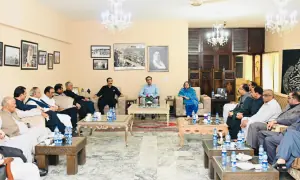
PPP Chairman Bilawal Bhutto-Zardari, whose party holds the majority in the Azad Jammu and Kashmir (AJK) Legislative Assembly, said on Sunday he would meet Prime Minister Shehbaz Sharif over the current situation in AJK, asserting that issues would be resolved through talks.

He said this while presiding over a meeting of the PPP AJK parliamentary party in Islamabad, a statement issued by the PPP said.

The meeting was held as tensions gripped AJK, with the region’s government declaring the Joint Awami Action Committee (JAAC) a proscribed organisation and the latter insisting on its demand to abolish 12 refugee seats in the AJK Legislative Assembly. The group also plans to hold a protest on June 9, days ahead of June 27 elections in the region.

The PPP statement said the party’s political affairs in-charge Faryal Talpur was also present at the meeting on Sunday where the political situation in AJK was reviewed.

“Consultations were held between Bilawal and parliamentary party members regarding the AJK situation,” it said, adding that parliamentary party members gave recommendations to Talpur on the matter.

According to the statement, Bilawal expressed concern over the situation in AJK. “We have always prioritised the issues of Kashmiris,” he was quoted as saying.

He added that political issues should be resolved through negotiations.

“I will meet PM Shehbaz and a solution to the issues would be found through talks and the assembly,” he said.

The meeting was held as AJK police sealed the head office of the JAAC, state broadcaster Radio Pakistan reported.

A day earlier, AJK authorities launched a crackdown on the JAAC, arresting scores of its leaders and activists from different areas.

On Friday, the AJK government declared JAAC a proscribed organisation, days ahead of a planned protest by the group scheduled for June 9, stating that it was “engaged in terrorism” and had acted in a manner “prejudicial to peace and security” of the state.

The group’s latest protest call centres on a highly contentious demand to abolish the 12 seats in the region’s Legislative Assembly that are reserved for refugees from Indian-occupied Jammu and Kashmir who settled in mainland Pakistan after 1947.

JAAC alleges that these seats were often used by mainstream Pakistani political parties to influence the formation of governments in Muzaffarabad.

On Thursday, the AJK Legislative Assembly strongly defended the status quo, backing the refugee seats and calling for elections to proceed on schedule.

Meanwhile, Islamabad dispatched federal paramilitary forces to reinforce the region’s thinly stretched police force.

AJK authorities have also advised intending visitors to postpone their trips until June 20, citing security concerns ahead of the planned protests.
‘Most demands fulfilled’

Earlier on Sunday, Parliamentary Affairs Minister Tariq Fazal Chaudhry maintained that most of the Joint Awami Action Committee’s (JAAC) demands, agreed between the JAAC and the government last October, had been fulfilled.

“Thirty-five out of 38 demands have been implemented,” he said while addressing a press conference in Islamabad. About the remaining demands, he said the courts had issued an order regarding some and others were not feasible.

He claimed “negative propaganda is being spread that the government has fulfilled only three out of 38 demands,” emphasising that the solution to the issues could not be “violent demonstrations” and dialogue should be the way forward.

The minister asked if the unrest was an attempt at “portraying Pakistan and AJK as separate entities; is it an attempt to weaken Pakistan’s relation with AJK; is it an attempt to create hatred between refugees from India-occupied Kashmir and the people of AJK; and lastly, is this an attempt to weaken the Kashmir cause?”

He claimed that the government had not disregarded the JAAC’s demands; however, he pointed out that, “when we talk to them about resolving issues through dialogue, they respond with violent demonstrations; these are two contradictory approaches”.

“The clauses that are yet to be implemented, we can still sit down and talk about them,” he said, reiterating that the solution was not violence and taking law and order into one’s hands.

At the outset of the press conference, Chaudhry said that certain actors were attempting to create unrest ahead of the June 27 elections in AJK.

“Attempts are being made that the violent protests that have happened in the region in the past can be revived,” Chaudhry said, recalling the unrest in the region in September-October 2024.

He recalled that the JAAC was formed in September 2023 and at the time, they had three demands: subsidy on flour, decrease in electricity prices and reduction in elite privileges.

“As a result of that, we saw a shutter-down strike in 2024 in AJK, accompanied by violent demonstrations,” the minister recalled, stating that the government had fulfilled all the demands at the time.

He further stated that the demonstrations broke out again in September 2025, and a charter of demands was presented, listing 38 clauses, following which the government signed an agreement with the JAAC on October 4.

He added that he, along with the Minister for Kashmir Affairs and Gilgit-Baltistan Amir Muqam, had been holding monthly meetings with JAAC to review progress on the agreement.

However, JAAC still put out a fresh call for protests on June 9, he noted.

Chaudhry recalled that on May 30, a committee comprising federal ministers met the JAAC in Muzaffarabad, where the demand for abolishing 12 refugee seats was put forward.

He said that the government’s representatives had also suggested that an all parties meeting be called to debate the matter.

“Around 2-2.2 million Kashmiri refugees are living in Pakistan, and 12 people sitting in a closed room cannot abolish those seats,” the minister asserted, adding that the JAAC’s other demands related to public welfare had been fulfilled.

Chaudhry also said the government’s representatives suggested that the issue should be discussed in the AJK Legislative Assembly or taken to the AJK Supreme Court.

“We requested [during the May 30 meeting] that the June 9 protest be postponed by 8-10 days so that we may hold consultations with our senior leadership and work towards a solution,” the minister said, affirming that the government had never refused to discuss the status of the seats.

Asserting that 35 out of JAAC’s 38 demands had been fulfilled by the government, including withdrawal of first information reports (FIR) against JAAC demonstrators, reinstating government employees who took part in the demonstrations, a feasibility study on the Kahuta Azad Pattan road in the Sandhoti district, procurement of electricity meters via e-tenders, internet connectivity issues, and establishment of a garbage collection system.

As per the minister, some of the other demands fulfilled by the government included amendments in the local government laws, establishment of two new federal boards, and restoration of the health card facility for AJK, among others.

He added that while many of the demands in the agreement could be implemented through executive orders — around 18-19 — the rest included ongoing development projects which “cannot be completed within 3-4 months”.

“It is not justified to hold long marches every six months under such circumstances,” the minister said.

  • ✇Dawn Newspaper Pak
  • OGDCL makes significant oil, gas discovery in Sindh’s Sanghar district none@none.com (Khaleeq Kiani)
    ISLAMABAD: The state-owned Oil and Gas Development Company Limited (OGDCL) on Wednesday said it made a significant oil and gas discovery from its exploratory well Bobi Deep-1, located in Sindh’s Sanghar district. The company is the country’s largest oil and gas producer and, in April this year, began commercial production from Pakistan’s largest-ever oil and gas discovery from a single well. In a statement issued today, OGDCL said the well successfully tested the Massive Sand interval of the Low
     

OGDCL makes significant oil, gas discovery in Sindh’s Sanghar district

ISLAMABAD: The state-owned Oil and Gas Development Company Limited (OGDCL) on Wednesday said it made a significant oil and gas discovery from its exploratory well Bobi Deep-1, located in Sindh’s Sanghar district.

The company is the country’s largest oil and gas producer and, in April this year, began commercial production from Pakistan’s largest-ever oil and gas discovery from a single well.

In a statement issued today, OGDCL said the well successfully tested the Massive Sand interval of the Lower Goru Formation and produced 2,000 barrels of oil per day (bpd) and 1.1 million standard cubic feet of gas per day (mmscfd) through a cased-hole Drill Stem Test (DST), confirming the hydrocarbon potential of the reservoir.

A Drill Stem Test (DST) is a temporary well-completion procedure used in oil and gas exploration to assess the pressure, permeability and production potential of a geological formation. It helps determine whether a well has encountered a commercially viable reservoir without the need for costly permanent casing.

“The achievement marks a major milestone for OGDCL as the first hydrocarbon discovery from the Massive Sand play within the Bobi and Dhamraki Mining Lease,” the company stated.

“Beyond the discovery itself, the success has opened a new exploration window in the area, de-risking similar prospects in the surrounding region and creating opportunities for future reserve additions and resource growth,” said the oil company.

The discovery is particularly significant because the project had previously encountered complex subsurface challenges that led to the suspension of drilling operations.

“Rather than abandoning the prospect, OGDCL relied on indigenous expertise and adopted an innovative approach to address the issue,” it said.

A multidisciplinary team of geoscientists and engineers collaborated with the Centre for Pure and Applied Geology at the University of Sindh, Jamshoro, to investigate the formation through advanced geophysical surveys, subsurface studies and field evaluations.

The joint effort led to the development of a comprehensive geological and geophysical model, enabling OGDC to de-risk the prospect and resume operations. Multiple engineering safeguards, specialised civil works and extensive technical evaluations were carried out before the drilling rig was redeployed and the target depth successfully reached.

“The exploratory well Bobi Deep-1 success story stands as a testament to indigenous innovation, technical excellence and industry-academia collaboration. It demonstrates how local expertise can successfully resolve complex operational challenges and unlock new hydrocarbon resources for the country,” the company said.

“The discovery is expected to contribute towards enhancing Pakistan’s indigenous oil and gas production, strengthening national energy security, reducing reliance on imported energy and augmenting the hydrocarbon reserves base of the country,” it concluded.

Last April, OGDCL announced the successful revival of oil and gas production from Chak#2-2 well, a joint venture in the Sinjhoro Block in Sanghar.

The Sinjhoro Block comprises OGDCL as the operator with a 62.5 per cent working interest, alongside Government Holdings (Pvt) Ltd (GHPL) with 22.5pc, and Orient Petroleum Inc. (OPI) holding a 15pc share.

'Peace has never been this close': PM Shehbaz says text of 'final' US-Iran peace deal agreed upon

Prime Minister Shehbaz Sharif on Friday confirmed that a “final agreed-upon” text of the peace deal between Iran and the United States had been reached.

A day prior, US President Donald Trump said the United States and Iran could sign a peace deal as soon as this weekend, which, if finalised, would be the most significant diplomatic breakthrough yet to end the months-old war.

“We just made a great settlement of the war with Iran,” Trump told reporters at the White House. “The strait will officially open as soon as we sign, which could be soon, very soon, maybe over the weekend in Europe,” he said.

In a post on X, PM Shehbaz said Islamabad was working “closely” with both sides to finalise the next steps of the process.

“Peace has never been this close as it is now.”

The premier also cautioned against an “incessant misinformation campaign being waged by those who want to sabotage the peace deal”.

Iranian Foreign Minister Abbas Araghchi made similar comments, calling the potential deal the “Islamabad memorandum of understanding”.

“The Islamabad Memorandum of Understanding has never been closer,” he wrote on X, urging the press to refrain from speculating until it is finalised.

“In line with our responsible and transparent approach, all details will be shared with the public in due course.”

Earlier today, Trump rejected reports about the terms of a possible deal with Iran in a post on Truth Social, asserting that they have “nothing to do with the terms that were agreed to, in writing”.

He added that Tehran needed to “get their act together, and fast”.

Meanwhile, Vice President JD Vance issued a statement of his own on X to dispel “fake information” revolving around the possible agreement.

“First, the Iranians are not receiving any cash, and no funds are being released for simply signing a deal or attending a meeting,” he wrote on X.

“The deal is structured to ensure that the US and its allies’ concerns are prioritised, and that if the Islamic Republic of Iran meets its obligations, then economic benefits will flow to them and to the entire region.”

He added, “This deal has the potential to remake the region and lead to lasting peace.”

On Wednesday night, it looked like war had resumed, with Washington and Tehran trading strikes after an American Apache attack helicopter went down near the Strait of Hormuz.

The two countries traded strikes again on Thursday, with Trump warning that he had planned “bigger” bombing raids today.

However, he cancelled the strikes following discussions with the highest levels of leadership in Tehran.

“Discussions and final points have been, in both concept and great detail, approved by all parties involved, including the United States, Israel, Saudi Arabia, UAE, Qatar, Turkiye, Pakistan, Bahrain, Kuwait, Jordan, Egypt, and others,” he wrote on Truth Social.

The war started on February 28 with joint US-Israeli strikes on Iran, with both countries trading attacks until a ceasefire was agreed upon in April, with Pakistan acting as a mediator. A round of talks was held in Islamabad that month, though no deal was reached after 21 hours of negotiations.

  • ✇Dawn Newspaper Pak
  • LG bodies in Balochistan to be dissolved in 2027 none@none.com (Saleem Shahid)
    QUETTA: The Balochistan cabinet has approved the dissolution of all local bodies institutions in the province on Feb 8 next year upon completion of their constitutional term, with fresh local government elections, including in Quetta where the administrative division has been split into two districts, to be held thereafter. Chief minister’s aide Shahid Rind while briefing the media after a cabinet meeting on Friday said proposed amendments to the Balochistan Right to Information Commission Act,
     

LG bodies in Balochistan to be dissolved in 2027

QUETTA: The Balochistan cabinet has approved the dissolution of all local bodies institutions in the province on Feb 8 next year upon completion of their constitutional term, with fresh local government elections, including in Quetta where the administrative division has been split into two districts, to be held thereafter.

Chief minister’s aide Shahid Rind while briefing the media after a cabinet meeting on Friday said proposed amendments to the Balochistan Right to Information Commission Act, 2021, were also approved during the huddle with the aim of improving transparency.

He said the cabinet decided that before the next LG elections, all matters relating to the creation of new districts, delimitation of constituencies and court rulings would be placed before the Election Commission of Pakistan to establish a practical and legal framework for the polls.

Another major decision taken by the cabinet was to authorise all sessions judges, additional sessions judges and first-class judicial magistrates across the province to conduct trials under the Control of Narcotic Substances law in order to expedite narcotics-related cases.

He said the cabinet had approved the establishment of new police stations in Hub and Dam, along with a women’s police station in Dalbandin.

The cabinet also approved the Balochistan Public-Private Partnership Rules 2026, the establishment of a cooperative housing society for secretariat employees, and the renaming of the minority affairs department as the interfaith harmony department.

To a question, Mr Rind said the government had attempted to hold talks with young doctors protesting against the acid attack on a female colleague, but they had refused negotiations.

Published in Dawn, June 13th, 2026

Pakistan, Russia sign pacts for cooperation against illegal immigration, drug trafficking

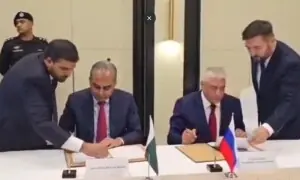
Interior Minister Mohsin Naqvi and his Russian counterpart, Vladimir Kolokoltsev, signed agreements to enhance cooperation in preventing illegal immigration and drug trafficking, the interior ministry said on Saturday.

Naqvi is currently attending a special meeting of the Ministers of Interior and Public Security of the Shanghai Cooperation Organisation (SCO) in Bishkek, Kyrgyzstan.

According to the interior ministry, Naqvi and Kolokoltsev signed agreements aimed at strengthening cooperation to curb illegal immigration and facilitate the repatriation of citizens. 

The two also signed an agreement to enhance collaboration in combating narcotics and preventing drug trafficking.

Meanwhile, Naqvi also held separate meetings with his counterparts from Tajikistan, Uzbekistan, Kyrgyzstan and Kazakhstan, the ministry said.

It added that during his meeting with Tajikistan’s Interior Minister Rahimzoda Ramazon Hamro, the discussions focused on terrorist camps inside Afghanistan.

“Both ministers agreed that terrorist camps and narcotics production in Afghanistan pose serious security concerns for the region,” the ministry said, adding that they noted that 25 terrorist organisations were currently active in Afghanistan.

During the meeting with Uzbekistan’s Interior Minister Aziz Tashpulato, the discussions focused on cooperation between law enforcement agencies and joint training initiatives.

It was decided that a working group would be established to enhance cooperation between the interior ministries of the two countries, the ministry said.

Separately, Naqvi and Kyrgyzstan Interior Minister Ulan Niyazbekov agreed to expand cooperation in areas of mutual interest. The interior minister congratulated Kyrgyzstan on being elected as a non-permanent member of the UN Security Council and also thanked him for the excellent arrangements for the SCO moot, the ministry added.

Naqvi also met with his Kazakh counterpart Yerzhan Sadenov, where the two ministers agreed to enhance cooperation in preventing illegal immigration. They also decided to establish a working group of their respective ministries to strengthen bilateral cooperation, the ministry said.

Naqvi addressed the moot on Friday and reaffirmed Pakistan’s commitment to the “Shanghai spirit” and called for a joint strategy among SCO member states to counter terrorism, organised crime, drug trafficking, cybercrime and terror financing.

On Thursday, Naqvi met his Iranian counterpart, Eskandar Momeni, on the sidelines of the moot and the two discussed bilateral relations and the current regional situation. Both ministers also exchanged views on Pakistan–Iran relations and the latest regional situation.

  • ✇Dawn Newspaper Pak
  • Pakistan ‘secures entry’ to first FIFA ASEAN Cup none@none.com (Monitoring Desk)
    KARACHI: The Paki­stan Football team is set make its appearance in the FIFA ASEAN Cup as the country has been invited to participate in the tournament, according to media reports. According to reports, FIFA has extended an invitation to Pakistan for the newly launched competition, scheduled to be held in Indonesia from Sept 21 to Oct 6. The Pakistan Football Fed­eration (PFF) is also reported to have agreed to participate. The national team would rep­ortedly slot into Divi­s­ion 1, joining a hig
     

Pakistan ‘secures entry’ to first FIFA ASEAN Cup

KARACHI: The Paki­stan Football team is set make its appearance in the FIFA ASEAN Cup as the country has been invited to participate in the tournament, according to media reports.

According to reports, FIFA has extended an invitation to Pakistan for the newly launched competition, scheduled to be held in Indonesia from Sept 21 to Oct 6. The Pakistan Football Fed­eration (PFF) is also reported to have agreed to participate. The national team would rep­ortedly slot into Divi­s­ion 1, joining a highly competitive field that features Tha­iland, Malaysia, Sing­a­pore, the Philippines, India, and the Indonesian hosts.

Local news outlets attributed the unexpected inclusion to ongoing, behind-the-scenes discussions between PFF Presi­dent Mohsen Gilani and FIFA leadership. However, an official confirmation was awaited till filing of this report. Such a development would mark a historic milestone for Pakistani football, representing the country’s first appearance in a FIFA-backed tournament outside of standard World Cup and continental qualifying rounds.

Earlier this week, Pakistan ended a 74-year wait for a football tournament title and defeated Afghanistan 2–0 in the final of the Diamond Jubilee Intern­ational Foot­ball Tournament in at the National Stadium to claim a historic first stand-alone international crown.

Published in Dawn, June 14th, 2026

  • ✇Dawn Newspaper Pak
  • Federal govt extends closing times for markets, restaurants none@none.com (News Desk)
    The federal government on Tuesday, amid deliberations over its ongoing austerity measures, decided to extend the operating hours of shops, markets, restaurants and other commercial outlets citing longer daylight hours and rising summer temperatures. The decision was taken at a meeting of the Committee for Monitoring and Implementation of Austerity Measures, chaired by Deputy Prime Minister and Foreign Minister Ishaq Dar. The government had announced unprecedented austerity measures on March 9 in
     

Federal govt extends closing times for markets, restaurants

The federal government on Tuesday, amid deliberations over its ongoing austerity measures, decided to extend the operating hours of shops, markets, restaurants and other commercial outlets citing longer daylight hours and rising summer temperatures.

The decision was taken at a meeting of the Committee for Monitoring and Implementation of Austerity Measures, chaired by Deputy Prime Minister and Foreign Minister Ishaq Dar.

The government had announced unprecedented austerity measures on March 9 in the wake of the Middle East war to deal with the global energy crisis, which had arisen due to the closure of the Strait of Hormuz.

As per the revised schedule, the closing timings are as follows:

  • Shops, markets, malls, and general retail: 9pm
  • Restaurants, cafes and eateries: 11pm (takeaway and delivery services exempt)
  • Marriage halls and event venues: 10pm (no change in timings)
  • Essential services (pharmacies, hospitals, fuel stations, IT & telecom-related services) are exempted.

“The Committee also directed provincial governments to ensure effective implementation of these guidelines in coordination with federal authorities,” the statement said.

On May 11, PM Shehbaz had extended the countrywide austerity drive till June 13.

The measures extended included 50 per cent reduction in fuel allowance for official vehicles, with the exemption of operational vehicles such as ambulances and public buses.

Other steps included grounding 60pc of official vehicles and a complete ban on foreign visits by ministers and government officials, excluding those deemed essential for the country’s interests, as specified the last time.

Among previously announced austerity measures, the working week for all government offices was reduced to four days — Monday to Thursday.

However, the additional holiday was not availed by banks. It did not apply to the agriculture and industrial sectors, or essential services such as hospitals and ambulance services.

Under the measures, the salary of parliamentarians was to be cut by 25pc, while employees of state-owned enterprises (SOEs) and government-supervised institutions were to see their salaries cut by 5pc-30pc.

Expenses of government departments were reduced by 20pc, along with a ban on purchasing vehicles, furniture, air conditioners and other items for government departments.

Pakistan, 7 other Muslim countries condemn Israeli incursions into Al-Aqsa Mosque, call for an immediate halt

Pakistan, along with seven other Muslim countries, on Tuesday condemned the “continued incursions by extremist Israeli settlers into Al Aqsa Mosque” in the strongest terms, calling for an immediate cessation of all such provocative practices.

According to a joint statement released by the Foreign Office (FO), the foreign ministers of Pakistan, Egypt, Turkiye, Indonesia, Jordan, Saudi Arabia, Qatar and the United Arab Emirates condemned “in the strongest terms the continued incursions by extremist Israeli settlers, into Al Aqsa Mosque under the protection of the Israeli forces, as well as the raising of the Israeli flag within its courtyards”.

“They stress that these provocative and unacceptable actions constitute a flagrant violation of international law, the relevant United Nations resolutions, and the historical and legal status quo at the holy sites in occupied East Jerusalem.

The FO added that the foreign ministers reaffirmed their “categorical rejection” of any attempts to alter the historical and legal status quo in Jerusalem and its Islamic and Christian holy sites, and stressed the preservation of this status quo, while recognising the special role of the historical Hashemite custodianship in this regard.

“The foreign ministers reiterated that the entire area of Al Aqsa Mosque, which amounts to 144 dunams, is a place of worship exclusively for Muslims, and that the Jerusalem Endowments and Al-Aqsa Mosque Affairs Department, affiliated with the Jordanian Ministry of Awqaf and Islamic Affairs, is the legal entity with exclusive jurisdiction to administer the affairs of the blessed Al Aqsa Mosque and to regulate entry thereto.”

Islamabad further stated that the foreign ministers of the aforementioned countries held Israeli authorities responsible for halting these escalatory actions and warned that “repeated Israeli violations exacerbate tensions, fuel instability and extremism, undermine international efforts to achieve peace, and constitute a clear breach of Israel’s obligations under international law”.

The Muslim and Arab countries called for an immediate cessation of all such “Israeli illegal and provocative practices” and reaffirmed the need to respect the historical and legal status quo at Al Aqsa Mosque in its entirety, the FO said.

“The foreign ministers reaffirm their unwavering solidarity with the Palestinian people and their steadfast support for the realisation of their legitimate and inalienable national rights, foremost among them their right to self-determination and the realisation of an independent and sovereign Palestinian State on the 1967 lines, with East Jerusalem as its capital,” the FO said.

They further reaffirmed their support for all efforts aimed at ending the Israeli occupation and achieving a just, lasting, and comprehensive peace based on the two-state solution in accordance with international law, the relevant UN resolutions, and the Arab Peace Initiative, the FO concluded.

Earlier in April, Pakistan condemned in “strongest terms” the storming of the Al Aqsa Mosque compound and the raising of Israel’s flag in its courtyard, terming the acts “reprehensible”.

The condemnation issued by the FO said “these reprehensible acts constitute a blatant violation of international law, as well as of the sanctity and inviolability of the holy site. Such provocative steps also risk further escalating tensions in the region”.

❌
Subscriptions