❌

Normal view

  • βœ‡Creative Boom
  • The best new typefaces for June 2026 Katy Cowan
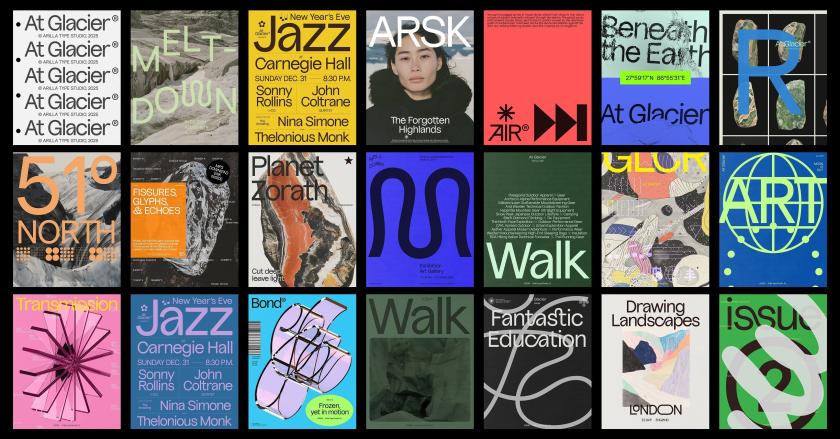
    At Glacier by Omar Careaga For all you graphic designers out there, we've rounded up the latest big releases from foundries across the planet. From display fonts to classic serifs and a family inspired by Iceland's wild landscape, June's offering is so good that some might end up in your current projects. There's something about midsummer that seems to bring out the best in type foundries and designers. Maybe it's the long days. Maybe
     

The best new typefaces for June 2026

15 June 2026 at 06:04

At Glacier by Omar Careaga

At Glacier by Omar Careaga

For all you graphic designers out there, we've rounded up the latest big releases from foundries across the planet. From display fonts to classic serifs and a family inspired by Iceland's wild landscape, June's offering is so good that some might end up in your current projects.

There's something about midsummer that seems to bring out the best in type foundries and designers. Maybe it's the long days. Maybe it's a rush of projects finally being signed off on. Whatever it is, June has an unusually rich crop: revivals lovingly reworked, stencils that break their own rules, and display faces with enough presence to fill a poster that could be seen from space. Well, perhaps not. But you get the picture.

What I love about this month's haul is the sheer range. This is creativity at its finest. There are monospaced workhorses built for important data, dashboards and tidy code. We have warm wedge serifs that nod to mid-century America. There's even a display face carved straight out of Iceland's volcanic landscape.

Whether you're after something quiet and dependable or loud and unapologetic this June, Creative Boom has you covered. So grab a brew, settle in, and see which of the following typefaces make their way into your next project.

Sticks by Nguyen Gobber

Sticks is a monospaced typeface built from rectangular shapes with rounded inner corners, reminiscent of reinforced joints in precision-cut metal components. Its strict, rigid appearance follows the same visual language of construction, technology, and industrial machinery. Perfect for any branding projects in that field.

Originally released in 2019 and discontinued a few years later, the typeface was fully reworked, expanded, and re-released this month as a family of individual styles and a variable font. Nicely done, Nguyen Gobber.

Sahlia Stencil by Arcane Type Foundry

Introducing Sahila Stencil, the latest release from Arcane Type Foundry and an expansion of its existing typeface Sahlia, from a single weight to a 10-style family with true italics and a variable font that covers all styles.

Sahlia is a stencil typeface that breaks all the rules. Where most stencils slice away parts of the letters, Sahlia's extreme contrast dissolves the thin parts entirely, as though worn away over time. The result feels both structured and organic: sharp, high-contrast serifs softened by delicate forms.

In the lighter weights, Sahlia has a graceful presence, while at its heaviest, it becomes more dramatic, yet it keeps its luxurious tone.

Designed for projects that want to make an elegant statement but with a little edge, Sahlia performs in editorial layouts, on luxury packaging, and across lifestyle content. Think candles, self-care, and slow living... that sort of thing.

Curo by Silver Stag Type

SLTF Curo is a super-heavy display sans-serif typeface designed for brands that want some serious presence. Built around a single extreme weight, Curo comes in five distinct corner-style variants: Sharp, Crisp, Regular, Soft, and Rounded, giving designers a complete tonal range within a single typeface family.

Each variant carries the same bold, unapologetic mass but shifts in character. From the hard-edged tension of Curo Sharp to the warm, voluminous fullness of Curo Rounded, the result is a complete design system of five fonts available with a single purchase.

Curo's large x-height and tight counters make it exceptionally impactful at display sizes. A distinctive lowercase 'g', expressive curves, and an alternate single-story 'a' give it a personality that is both retro and unmistakably contemporary. Built for headlines, packaging, logos, posters, and anywhere a brand needs to take up space with total confidence.

Unifora by Yep! Type

Another bold statement for our June round-up is Unifora by Yep! – a massive sans-serif uniwidth superfamily with an industrial edge and architectural feel. "Unifora starts where DIN leaves off, taking the constructed logic of technical lettering and pushing it to meet the demands of modern screens, without softening the edges," explains the foundry.

It comes with five widths, nine weights, and matching italic and roman styles with slants up to 18 degrees. The variable font spans all three axes: weight, width, and slantβ€”in both directions. What's more, the superfamily is available as five standalone sub-families, each built around the uniwidth principle... that is, within any given width, every glyph holds its advance width across all weights and styles. In practice, that means text never reflows when the weight shifts.

Unifora Condensed works for data-dense interfaces like dashboards, table columns and tight mobile layouts. Meanwhile, Unifora Narrow handles compact body copy and sidebars. Unifora Standard is the default width – comfortable with everything from small UI labels to large display. Then there's Unifora SemiExpanded for display, signage and wide-format applications where letterforms need space to breathe. If all that sounds complicated, there's a user manual to help you decide which is best for you.

Halvar Mono by TypeMates

Halvar Mono expands the Halvar universe by taking the next logical step: re-engineering Halvar's "constructed forms, raw charm and machine precision" into a monospaced typeface.

With Halvar Mono, every character in each of its nine weights occupies the same width. Built on Halvar's balanced, medium-weight, monospaced typeface, this version is practical and precise across data, tables, and technical systems; steady and dependable in demanding pixel- and print-based applications.

It has an industrial charm and mechanical design for those who value the structure and elegance of monospaced fonts. It includes extended Latin, Greek and Cyrillic and supports more than 190 languages.

Drika by Ana Laydner

Ana Laydner has released a new typeface that joins Fabio Haag Type's exclusive library with a raw, real aesthetic. Letters might "overlap in a hug or collide in a mosh pit" – something that's been compared to the happy chaos of real life. Figures.

With 14 weights of expressive goodness, Drika has strokes that aren't overly polished and are inspired by the earliest sans serifs of the 19th century. Some diagonals end at an unexpected angle, while others have straight forms.

Emojis of all kinds are sprinkled in along with arrows, and that character comes with every weight of the family. In the heaviest weights, some letters might overlap, and that's ok. It's a sans "unafraid of being", according to Ana. She adds: "Drika is a typeface about presence, about occupying spaces without apology". For those of you feeling rebellious this month, we think you'll love how this one breaks all the rules.

Beth by Alexis Navarro & Latinotype

Beth caught our eye this month, as it draws on early-twentieth-century English shopfront lettering: a tradition built to stop people in their tracks. Its uppercase draws on Neoclassical type with humanist terminals and convex strokes inspired by hand-painted signage, giving each capital a brightness and precision that feel both nostalgic and modern.

The lowercase follows the calligraphic model of Edward Johnston's Foundational Hand: curves that modulate close to 45 degrees, a single-story 'a' with no traditional terminal, and an 's' that, in the designer's own words, is a poem.

The drawing carries the weight of engraving, particularly the work of Gustave DorΓ© and William Blake. Their influence lives in Beth's fine strokes and the richness of its contrast: a typeface that, according to its maker, holds light and shadow the way a copper plate does – "dark where it counts. Bright where it matters".

A pop gothic serif, if we ever saw one, Beth comes with seven weights, from light to black – each with a standard and alternate character set, plus 594 glyphs and discretionary ligatures.

La Mericana by Elena Genova of My Creative Land

La Mericana is a vintage-yet-modern type family inspired by Richard Isbell's Americana, originally designed in 1965 for American Type Founders. It builds on the same qualities that made it a distinctive voice in mid-century American typography : warmth, wedge serifs, and generous x-height  –  and reimagines them for contemporary use.

Nostalgic of classic signage and retro branding, it features a new italic with calligraphic details, adding movement and elegance without losing the family's confident, approachable tone.

La Mericana's large x-height and open proportions keep it legible in tightly set lines. The condensed version preserves the original's distinctive look while making it ideal for branding, editorial, packaging, and compact digital formats, such as  Instagram posts, reels, and stories... basically anywhere that needs impact in a small space.

At Glacier by Omar Careaga

At Glacier is a display typeface inspired by Iceland's raw landscapes. Bold yet refined, it combines sharp structure with flowing forms to create a distinctive and expressive typographic voice. Those famous volcanoes and wild rock formations have clearly made their mark here.

As Arillatype Studio puts it: "Ice-cold elegance with glacial flow" and "a natural grotty, carved by instinct". You could say this typeface is untamed with its unexpected twists and turns. But you'll be glad to know, it's entirely legible and probably our favourite of the bunch this month.

The family includes over 1,000 glyphs, featuring extensive alternates, ligatures, numerals, symbols, arrows, dingbats, and advanced OpenType features. Brought to you by uber-talented graphic designer and printer Omar Careaga.

Reel by Jamie Clarke Type

One of the smartest releases this month is Reel, a condensed headline typeface from Jamie Clarke that asks a deceptively easy question: can a headline grab you without shouting? We all know the usual answer. Condensed ALL CAPS is everywhere, from film titles and posters to tabloid splashes. Sure, it commands attention and locks nicely into a rectangle. But as Clarke points out, it can also feel cold and a touch confrontational, which is why politicians and brands reach for it. Shudder.

His solution is something he calls "Flexi-case": a system that gives lowercase letters the same height and presence as capitals, so you can soften the tone without stray ascenders and descenders breaking that clean rectangular block. It isn't uni-case or anything. Reel keeps the familiar distinctions between upper and lower. It simply lets them share the same space as equals.

Clarke looked to nineteenth-century wood type as inspiration, letting straight strokes bulge gently and curves fill out, especially in the lowercase. "Uppercase is a bit like a poker face," he says. "It projects authority and urgency, but keeps you at a distance. Lowercase carries more personality and humanity because it developed from handwriting."

The upshot is a face built for all the familiar headline territory – film titles, TV graphics, book covers, posters – that still has room to shift tone. Or, as Clarke neatly puts it, a typeface that's "expressive, not oppressive". A fitting typeface to round things off this month.
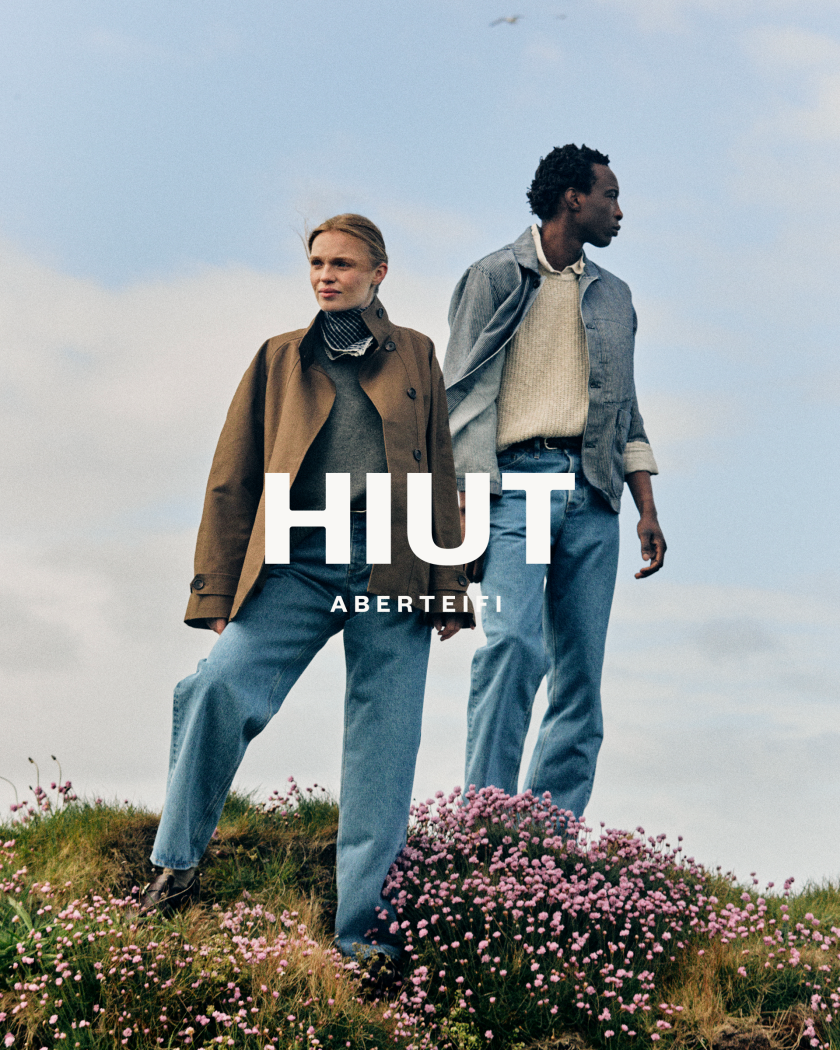

Pentagram's Hugh Miller rebrands Hiut, the Welsh denim label bringing jeans-making back to Aberteifi

16 June 2026 at 05:14

The new identity leans into the contrasts that make Hiut what it is: industry alongside nature, utility alongside craft... right down to a typeface drawn from the makers' own signatures.

There's a lovely bit of stubbornness at the heart of Hiut, and the brand's new look finally does it justice. Pentagram partner Hugh Miller has designed the visual identity and art direction for the premium denim label, which crafts its jeans from a family-run factory in Aberteifi on the Welsh coast.

The town – also known as Cardigan – has denim in its bones. In the 1960s, the first jeans factory employed more than 400 local people and turned out over 35,000 pairs a week, until production moved offshore in 2002, taking the work, though not the know-how, with it. Decades of accumulated skill were simply left sitting there. Hiut was founded in 2011 to bring it back home, put those hands to work again, and train the next generation of makers.

As such, this was never going to be a label that chased trends. Hiut takes its cue from factory life, the skill of its makers and the rugged landscape around it, so Miller's brief was less about reinvention and more about telling that story well. Working closely with the Hiut team, he built the identity around the brand's values, celebrating the factory, its people and its setting, while embracing the contrasts that define it.

The result balances industry with nature, and utility with craft. At its heart sits a redrawn wordmark that nods to the factory's industrial heart, all craft and resilience, with "Aberteifi" added underneath to root the brand firmly to its location, heritage, and mother tongue. Alongside it is a bolder, rounder and altogether more huggable version of Hiut's much-loved owl mascot.

The easy move would have been to reach for navy and the usual heritage-brand polish. Instead, type does some of the heavy lifting. The functional, utilitarian Founders Grotesk handles the day job, joined by 'The Makers Font', an expressive handwritten face drawn from the real signatures the makers scribe into every pair of jeans before they leave the building at night. The colour palette pulls together the muted hues of the local landscape and the raw, functional character of the factory, layered through contrasting textures and tones.

Art direction does the rest. Jess Ellis on stills and Cat Garcia on motion were invited to capture moments of "everyday beauty" from both the surrounding landscape and the factory floor – shot in black and white and colour, leaning into texture and the unexpected details that reveal a brand's human character. From here, the launch campaign and ongoing art direction are led by Hiut's own teams and collaborators, working with photographers, illustrators, videographers, and printers whose approaches genuinely align with the heritage brand.

It's certainly a more elevated and curated expression of Hiut, thanks to Hugh Miller at Pentagram and all involved. It shows the brand hasn't forgotten where it comes from or how it's tied to the people, place and processes that make the jeans so special.

You can see more of the work on the Pentagram website, and find out more about the label at Hiut Denim.

  • βœ‡Creative Boom
  • The web that built your creative business is being dismantled. So what should you do now? Tom May
    Pinterest is changing. What does that mean for creatives? Image licensed via Adobe Stock As AI takes over from Google search, the thing that used to draw people to your creative work is disappearing fast. Here's what's happening, and how to respond. At Cannes Lions 2026, Pinterest said something that should stop every creative in their tracks. Alongside a suite of shiny new AI advertising tools, the platform offered a candid descriptio
     

The web that built your creative business is being dismantled. So what should you do now?

17 June 2026 at 10:30

Pinterest is changing. What does that mean for creatives? Image licensed via Adobe Stock

Pinterest is changing. What does that mean for creatives? Image licensed via Adobe Stock

As AI takes over from Google search, the thing that used to draw people to your creative work is disappearing fast. Here's what's happening, and how to respond.

At Cannes Lions 2026, Pinterest said something that should stop every creative in their tracks. Alongside a suite of shiny new AI advertising tools, the platform offered a candid description of where the whole industry is heading.

The web, it said, is moving "beyond the traditional search-and-click model toward a more conversational and generative web," where brands now compete "not just for attention, but for recommendation, relevance and action". That might sound like a boringly technical sentence, but buried within it is something very profound that affects every creative working today.

Because what it describes isn't just a change in how Pinterest sells ads, but a fundamental change in how people find information and inspiration online. And if you're a creative, the implications for whether you actually get work in future are huge.

Discovery is being dismantled

Until recently, the web gifted creatives many ways to attract clients that didn't demand a huge marketing budget. A portfolio site that ranked in search results for "editorial illustrator" or "branding studio Bristol." Instagram, Behance or Dribbble surfacing work to people who'd never heard of you. A piece is getting shared, and the share carries your name back to your profile. None of this required paid promotion.

Now, though, every rung of that ladder has been sawn off.

We've seen the decline of organic search: on Google, your freelance or studio site now sits below ads, AI Overviews and big-domain content, making it close to hopeless in promoting your craft. Meanwhile, social algorithms have decoupled reach from quality. Feeds now reward volume, trends and posting cadence rather than the best work, and throttle creators unless they either pay or perform constantly.

And now, as the final nail in the coffin, agentic AI (where AI basically acts as your personal assistant) has removed the last thing the first two still left intact: the click that carried a person to your door.

Who wins and who loses?

Nowadays, when someone types "find me an illustrator who works in cut-paper collage for a children's book", AI returns an answer, not a list of links to explore. It decides who gets named, and there's no way to influence it: no ad slot to buy, no SEO lever to pull.

And how does it reach this decision? AI platforms lean on aggregate signals: who's already cited, listed, written about, and linked to. This favours the already-famous and the big studios with a deep web footprint, leaving the vast majority of smaller independents floundering.

It's a virtuous circle for the former, a vicious one for the latter. The visible gets recommended, and the recommendation makes them more visible. The talented new graduate with a thin online presence isn't in AI's field of view, so they stay invisible forever.

Pinterest's new Ask Pinterest app captures this dynamic perfectly. It's designed, the company says, for "more conversational, complex, multi-step decisions that don't fit neatly into a single search": planning a dinner party, furnishing a room over time, finding a gift that feels personal. Truly, it sounds like a great experience. But there's a trade-off, and it's a biggie. When answers arrive without a source, the source no longer matters.

So what should you focus on instead?

Pinterest is changing

Pinterest is changing

Be a category of one

In this shiny new world of AI, you can't optimise your way into a recommendation, the way you once keyword-optimised a website. Recommendation runs on reputation signals that a system can read: being named in other people's work, on lists, in interviews, in the press, and in collaborations. So the answer for creatives isn't to play the algorithms harder. It's to become the name people and systems already trust enough to surface.

One part of that is to own your relationships. A newsletter list, for example, is a direct connection that no algorithm can intermediate away. A community of people who've chosen to hear from you isn't subject to a platform's recommendation logic. Look at how designers like Liz Mosley have built something genuinely resilient: a website, a podcast, templates, resources; an audience that actively follows her work rather than stumbling across it.

Another is to get cited and named, because getting talked about (positively, of course) is the new currency. This means leaning on the channels no algorithm can gatekeep: word of mouth, referrals, events, and real rooms. And in your work, aiming to be a category of one, with a style so specific it gets requested by name rather than retrieved by attribute. The creatives who get asked for by name are the ones that AI can neither replace nor substitute.

Lee Brown, Pinterest's chief business officer, frames it this way: "The future of discovery won't be driven by keywords alone. It will be shaped by context, taste, and trusted recommendations." He's describing his platform's perceived advantage. But he's also, accidentally, describing yours.

Context is where you work. Taste is what you've spent years developing. And trusted recommendations? Those come from people who know you and what you make, not from a system optimising for engagement.

Uncertain future

One last thought. If the systems doing the recommending keep starving the independents who make the original work, they'll eventually run short of anything worth recommending. AI will ultimately kill off its own supply of information and inspiration. Where that death-spiral leads us is anyone's guess, but it's best to be prepared all the same.

In the meantime, I'd advise you to start building those direct relationships. Make the work that can't be AI-assembled from anything else. And above all, don't wait for your web traffic to disappear before you start, because that could be too late.

  • βœ‡Creative Boom
  • How David Adrien uses frames to shift the way we look at everyday things Ayla Angelos
    The Paris-based illustrator and bookbinder creates small, meticulously crafted objects exploring what happens when you merge "playfulness and control". David Adrien grew up in Paris and studied printmaking in Brussels before returning to France to finish his degree and settle there. Since graduating, he has worked primarily as an illustrator, contributing to collective comics fanzines along the way. But more recently, his practice has
     

How David Adrien uses frames to shift the way we look at everyday things

9 June 2026 at 08:00

The Paris-based illustrator and bookbinder creates small, meticulously crafted objects exploring what happens when you merge "playfulness and control".

David Adrien grew up in Paris and studied printmaking in Brussels before returning to France to finish his degree and settle there. Since graduating, he has worked primarily as an illustrator, contributing to collective comics fanzines along the way. But more recently, his practice has expanded back towards something that he's been missing since his school days: "More self-initiated projects involving volume and making things by hand," he says. "I really want to focus on that, also following a strong desire to use fewer digital devices."

Since then, David has been making small framed drawings – gorgeously hand-built objects in which a modest, loosely rendered image sits inside a frame constructed from cardboard, acrylic glue and bookcloth, using techniques borrowed from bookbinding. What makes them compelling is less the image alone than the relationship between the image and the beautiful sculpture that encases it. "I find that since my drawing style for this side of my work is quite simple and loose," he explains, "the frame surrounding it has to be very minimal and meticulously crafted for the piece to be as striking as possible. The tension between playfulness and control is a very important part of my practice."

When he's about to commence one of his frame projects, he starts with observation, watching how things are presented to the eye and closely seeing what happens when the context shifts. "My inspiration really comes from observing my everyday environment and trying to see how everything is framed in a very broad sense," he says. Small adjustments like moving an object, changing a background, placing one thing next to another that has no obvious reason to be there, and looking at it from a different perspective are where his ideas truly take off. "The magic of combination inspires me," he says, "and the unexpected dialogue that can exist between elements that only had a little to do with each other in the first place."

If you were to take a very quick glance at his recent computer works, perhaps with a squint, you might think you're just looking at any old laptop. But then you spot how each piece has a small landscape painting – a nod to the default desktop wallpapers that most of us have long stopped seeing – set within a frame that mimics the proportions of a screen. It's a handcrafted, witty and cleverly built optical illusion. "It connects old subjects and mediums to contemporary technologies and the new challenges they bring," David says, "like a bridge between past, present and future."Β 

In his Fragile series, the frames are made entirely from a squishy protective foam – the kind used to cushion things in transit – wrapped around small colour drawings. The result looks, as David puts it, like a toy version of a traditional artwork. "Seeing such a small piece of art surrounded by this much protection gives it a different status," he says. "It elevates a basic artistic gesture into something precious." The change in perception is something he strives for in his practice. "I'm very interested in tweaking the lenses with which we look at things."

Trickery aside, David wants the work to feel approachable. "I just want to make art that can start conversations while also feeling welcoming," he says. "Sometimes art and the discourse around it can seem a bit daunting from the outside."Β 

These 10 beautiful tributes to David Hockney show just how much the creative community loved him

15 June 2026 at 11:30

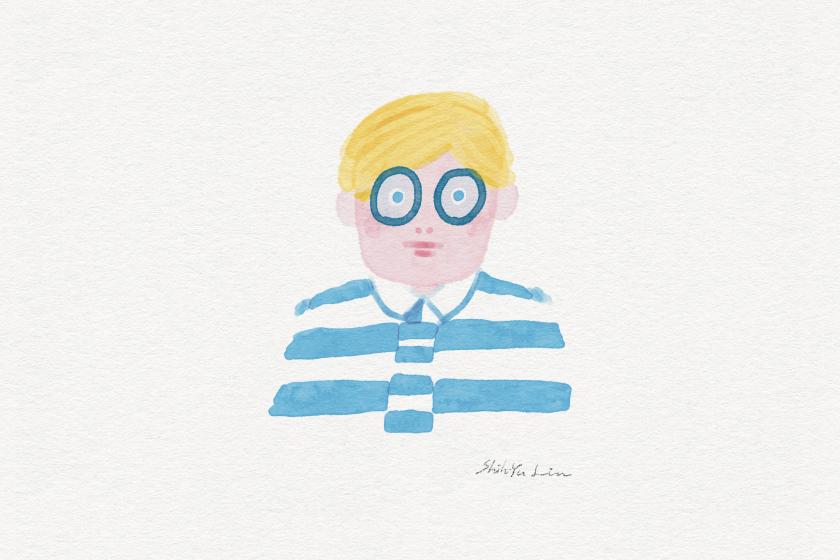
Shih-Yu Lin's watercolour farewell

Shih-Yu Lin's watercolour farewell

From Bradford to Beverly Hills, Hockney's bold colours and irrepressible joy for living inspired a generation. Here's what they created in response to his passing.

David Hockney, who died on 12 June at the age of 88, was one of the most influential British artists of the modern era. Born in Bradford, Yorkshire, he rose to prominence as a leading figure of the 1960s pop art movement. He went on to have a career spanning more than six decades, multiple continents and an astonishing range of media: oil paint, photography, stage design, printmaking and, in his later years, the iPad.

His 1972 painting A Bigger Splash became one of the most recognisable images in 20th-century art, and in 2018 his Portrait of an Artist (Pool with Two Figures) sold for nearly Β£70 million at auction, a record for a living artist at the time.

But Hockney was more than a record-breaker. His depictions of sun-drenched Californian swimming pools, the rolling fields of the East Yorkshire Wolds, and the tender intimacy of gay domestic life were united by a profound love of looking. He taught people to slow down and pay attention to the world around them. And he kept on doing it well into his eighties, painting from his wheelchair right up until the end.

When news of his death broke, the creative community responded with an outpouring of grief and gratitude. We put out a call for illustrated tributes, and the response was overwhelming: artists and illustrators from around the world shared portraits, scenes and homages inspired by the man and his work.

What emerges is a collection that's both a farewell and a love letter, full of colour, warmth and the kind of bold mark-making that Hockney himself would surely have appreciated. Here's a selection of the best, along with the stories behind them.

1. Stanley Chow's minimal masterclass

For our lead image (shown above), celebrated illustrator Stanley Chow took a characteristically reductive approach, distilling Hockney down to his most iconic features: that shock of blond hair, the heavy round spectacles, the slightly unfocused blue gaze. Rendered in flat geometric shapes, with not a line out of place, it captures the unmistakable silhouette of a man who was himself something of a walking work of art.

Stanley credits Hockney directly for the piece's existence. "One of my favourite Hockney quotes is 'You must plan to be spontaneous,'" he explains. "It's a quote I live by, and if it weren't for this quote, this portrait I've done of Hockney wouldn't have happened."

2. Kimiya Justus' hand-lettered homage

Illustrator and artist Kimiya Justus produced a warm, affectionate, waist-up portrait of Hockney in his white flat cap, dark round spectacles and blue and pink striped cardigan over a yellow shirt, set against a bright blue dotted background. A banner across the bottom reads "Look with both eyes," one of Hockney's most celebrated observations. It's cheerful and immediate, with a hand-drawn quality that feels fond and personal.

"Hockney has always been a huge inspiration to me," Kimiya says. "His bold colours, his irresistible drive to paint, and the way he paid attention to the smallest details of everyday life have always inspired me. Just last month, I saw his beautiful exhibition at London's Serpentine Gallery, and it reminded me once again of the simple joy of painting on the iPad."

3. Nia Gould's feline fantasia

Taking a radically different approach, creative director Nia Gould reimagined Hockney's most iconic scenes with cats in the leading roles. But she makes it clear that the humour doesn't diminish the sincerity of the tribute.

"Hockney has been a constant source of inspiration throughout my creative journey," she stresses. "Through my work, I lovingly reimagine some of his most iconic scenes, replacing people and moments with funny feline stand-ins. My work does not act as imitation but an honour to the spirit of his vibrant and quirky works of art throughout his amazingly long and celebrated lifetime."

4. Cel CastellΓ‘'s living colour

illustrator and painter Cel CastellΓ‘ places Hockney against a flat cerulean blue, dressed in his later-years finery: a boldly checked orange and yellow jacket, green cardigan, red tie and white flat cap, leaning forward with that familiar half-smile. The hand-lettered title above reads "I prefer living in colour," and the whole thing feels like a manifesto as much as a portrait.

"Beyond his art, what inspires me most about Hockney's life is the way he lived it," Cel writes. "The optimistic lens he carried into everything he did. His constant exploration led him to digital media. Anyone who dares to live for and through colour, in a world that keeps getting greyer and more boring, deserves admiration."

5. Fries Vansevenant's collage tribute

Graphic and motion designer Fries Vansevenant created a richly layered collage, placing a photorealistic Hockney in a constructed scene full of geometric planes, alongside an easel bearing a canvas signed with the dates 1937–2026. It feels almost archival, like a careful arrangement of everything Hockney stood for.

"For me, David Hockney is all about experimentation," Fries says. "He wasn't afraid to play with perspective, break traditional compositions, and use colour in a way that felt completely his own. What fascinates me most is how his work speaks to such a wide range of people. Not just art lovers, but teenagers and adults alike. That's something special, the mark of a truly memorable artist."

6. Liangliang Luo's 3D character study

Illustrator and animator Liangliang Luo modelled a soft-lit Hockney in 3D: white-haired, yellow-spectacled, seated at a table draped in vivid blue gingham, drawing with a green crayon. The result feels playful and warm, almost toy-like.

Liangliang's tribute is brief but precise. "I went to David Hockney's exhibition a couple of weeks ago and was so moved to see him still creating in his 80s while in a wheelchair," she recalls. "A lifetime of mastery, yet he still approaches the canvas and the iPad with absolute curiosity and zero fear of new mediums. True creative longevity."

7. Katie Smith's poolside portrait

Illustrator Katie Smith places Hockney where he belongs: beside the pool, dressed in a gloriously checked yellow/orange suit, pink cap and yellow Crocs, cradling a small dachshund in his arms. Behind him, lush green hills and pink flowering trees complete the scene. It's warm, joyful and totally alive: a portrait of a man entirely at ease in his own world.

Katie traces her relationship with his work back to her school days. "The first time I ever saw a David Hockney painting was in my Higher Art exam," she recollects. "We were asked to examine 'Portrait of an Artist (Pool with Two Figures)'. I remember thinking it was perfection. I loved the drama, the colour, the perspective. I find his work so whimsical and beautiful, you want to jump into his paintings and live there."

8. Ania Greta's handwritten reflection

Illustrator Ania Greta produced a portrait of a younger Hockney that's full of personality, completed with the quote "Spring cannot be cancelled" written above in blue. Expressing her personal feelings about the artist, Anna again reaches for his own words.

"Hockney states: 'The only real things in life are food and love, in that order, just like our little dog Ruby. I really believe this, and the source of art is love. I love life.' His work will always symbolise joy and a love for life to me. He was a careful observer of the ordinary, not allowing fleeting moments to pass without first giving himself time to admire them."

9. Marine Gentils' standing portrait

Illustrator Hello Marine contributed a confident full-figure illustration of Hockney in his later years: orange jacket, checked trousers, walking stick in one hand, cigar in the other, his shadow stretching behind him against a deep cobalt-to-purple background, standing on a teal green floor.

"I love the way Hockney played with colour, unapologetically, making even the simplest scenes feel special," Marine says. "His work reminds us that the ordinary can be extraordinary if you look closely enough. But what I love most about Hockney is how he embraced change and never stopped experimenting. There's something inspiring about an artist who refuses to stop growing."

10. Shih-Yu Lin's watercolour farewell

Finally, children's book illustrator Shih-Yu Lin offered perhaps the most tender tribute of all: a small, loose watercolour of a young Hockney, his blond hair and oversized round glasses rendered in soft blue and gold washes, titled simply "Goodbye, my inspiration." In its restraint, it says everything.

  • βœ‡Creative Boom
  • How Derek&Eric gave Manomasa a Latin American glow-up with 'Snacks With Spirit' Katy Cowan
    The London studio drags the premium tortilla brand out of the farm-shop aisle with a vibrant new palette, dancing mascots and packaging that tastes as good as it looks. You know those tasty snack-treats called Manomasa? The ones saved for special occasions or BBQs with friends, and only available from the "posher" supermarkets? It's probably because of the premium offering and rather serious packaging – not to mention the muted tones a
     

How Derek&Eric gave Manomasa a Latin American glow-up with 'Snacks With Spirit'

11 June 2026 at 06:02

The London studio drags the premium tortilla brand out of the farm-shop aisle with a vibrant new palette, dancing mascots and packaging that tastes as good as it looks.

You know those tasty snack-treats called Manomasa? The ones saved for special occasions or BBQs with friends, and only available from the "posher" supermarkets? It's probably because of the premium offering and rather serious packaging – not to mention the muted tones and grown-up illustrations that describe exactly what high-end flavours might be waiting inside.

Despite all this, the popular tortillas have just undergone a big brand refresh, thanks to Derek&Eric, the London-based design agency founded by Alex Stewart, Adam Swan, and Jon Gibbs. It's only when you see the new identity and packaging that you realise just how much an update was needed.

Since its launch, Manomasa ("Mano" is Spanish for hand, and "Masa" is the maise dough used to make traditional tortilla chips) might have built a small but devoted following (myself included), but it has struggled to shake off its reputation as a wholesome, "farm shop-esque" snack brand found only in premium retailers. Its parent company, Valeo Foods UK, wanted to break out of this niche and fling itself into the mainstream. How it achieved that began with a review of its strategy.

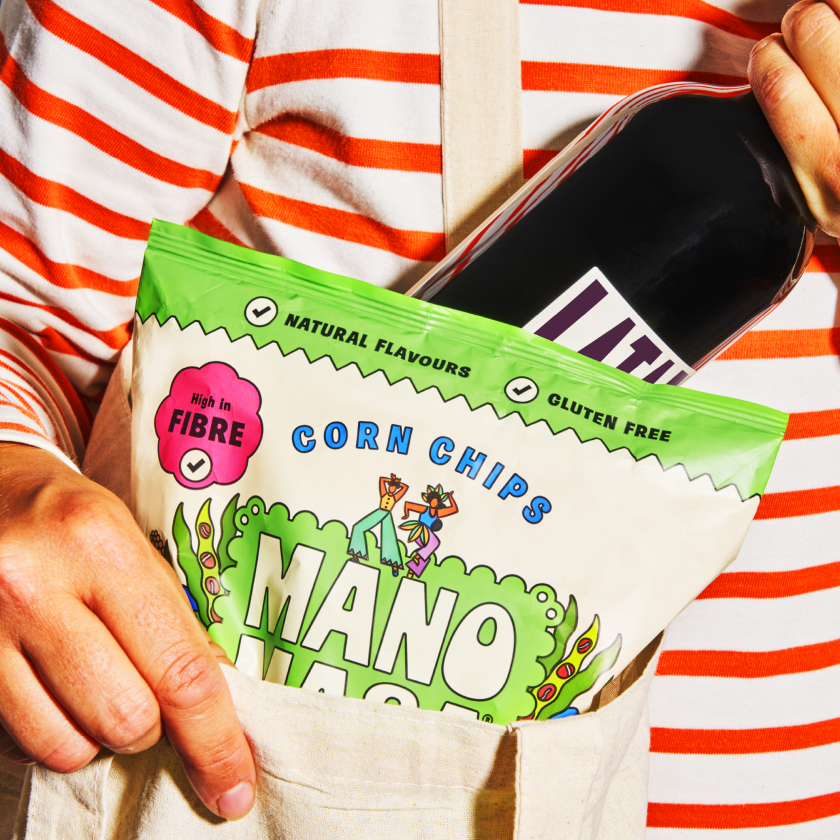
Derek&Eric went back to basics, focusing on what inspired the product in the first place: making the brand's look match how it tastes, while also drawing on influences from Latin America – its energy, passion, colour and warmth. It kept the existing layout of the packaging, with the logo front and centre, as well as the colourful display of ingredients and the cream background, but gave it all a lively Latin American feel.

What that means is a glow-up founded on the tagline "Snacks With Spirit". The palette, as you'd expect, is now satisfyingly vibrant, with splashes of teal, hot pink, bright orange, acid green, and happy yellow that instantly point out the different flavours. Yellow is pineapple and habanero chilli, by the way. We're not sure how that lands, but we're eager to try it.

Derek&Eric also added a new icon featuring two dancers. Caught mid-dance, they convey a sense of rhythm that adds life and movement across all platforms. Accompanying materials for social media, recipe books, packaging, and delivery boxes with branded tape complete the refresh – all with their own happy drama. There are even vinyl records and poster designs, which are hopefully up for grabs. (Derek & Eric, if you're reading this... tell us how to get our hands on them!)

But, aside from the product packaging itself, it's the delivery trucks that are the best of all. Against a beautiful blue backdrop, illustrations decorate the surface… the two dancing mascots appear alongside the new logo in handwritten type. On the truck's rear doors sits a menu, as though it were something out of Jon Favreau's 2014 film Chef. I can almost hear the Latin vibes.

It seems we're not the only ones to appreciate this overhaul: the project won Gold at the FAB Awards. Congratulations to all involved. I'm off to Waitrose to find that pineapple flavour.

  • βœ‡Creative Boom
  • Eight ways to stay discoverable when search, social and AI stop sending people your way Katy Cowan
    Image licensed via Adobe Stock The free routes that used to bring creatives their next commission are closing one by one. It's been happening for some time. And now AI is pretty much destroying the web as we know it. Here's how to keep being found – and, increasingly, recommended – without a marketing budget. For many happy years, getting found was something any creative freelancer or studio could do on the strength of work alone. A we
     

Eight ways to stay discoverable when search, social and AI stop sending people your way

17 June 2026 at 04:30

Image licensed via Adobe Stock

Image licensed via Adobe Stock

The free routes that used to bring creatives their next commission are closing one by one. It's been happening for some time. And now AI is pretty much destroying the web as we know it. Here's how to keep being found – and, increasingly, recommended – without a marketing budget.

For many happy years, getting found was something any creative freelancer or studio could do on the strength of work alone. A website that ranked for your craft. A post that travelled far and wide and carried your name back to your profile. A share that turned a random person into a client. None of it really cost anything except for a bit of time and effort. And all of it was the pipeline to paid work.

Oh, how things change. Organic search has fallen off a cliff. Social media rewards quantity over quality. And the latest? Conversational, agentic AI is now pulling all the shots.

And with today's big news that Pinterest is shifting away from traditional search, it's clear that none of us can out-optimise this on our own. The good news is that the shift rewards a handful of things independent creatives can still build: a direct audience, a distinctive name, and a reputation the new systems can read and recognise as important. Exhausted? Yes, so are we. But here's where to put your energy.

1. Build an audience you actually own

I've been saying it for over a decade – since Meta ruined Facebook for publishers in 2016 – build your own audience. That's because every follower you have is rented. Platforms like Instagram and Pinterest get to decide who sees your work, and the goalposts can change overnight.

An email list is the one audience you get to control. It's a list of people who chose you, and you can reach them directly, whenever you want. So start a simple newsletter, even a short monthly one, and make signing up the clearest call to action on your website. (Our guide to creating a newsletter people actually want is a good place to begin.) A few hundred people who want to hear from you is worth more than ten thousand followers a feed decides to throttle, and it's how plenty of creatives are winning work after quitting social media altogether.

2. Become a "category of one"

Don't roll your eyes, but AI discovery rewards a "good enough" match to a brief, which flattens everyone into interchangeable options. The defence is to be "uninterchangeable". So sharpen the one thing you do that nobody else does in quite the same way. That could be a material, a subject, a voice. You want to be known by name rather than retrieved by attribute. The creatives who survive this current massive shift are the ones a client specifically asks for, because a specific name is the one thing an algorithm can't substitute.

3. Get cited, named and talked about

As someone who worked in PR for two decades, this next tip warms my heart. Because I know public relations is having a golden hour moment. That's because if you still want to be found, recommendation engines lean on signals they can read: who's mentioned in other people's work, who turns up on lists, in interviews, in the press, and in collaborations.

It means that being talked about is more valuable than being optimised. Forget staying in your comfort zone. Say yes to the guest piece, the podcast... even the scary panel on stage that you've been avoiding. Pitch yourself for round-ups in your niche. Every place your name appears alongside your craft is a breadcrumb the systems – and the people – can follow back to you.

4. Make your site easy for a machine to understand

If an AI is going to represent you, it has to be able to read you correctly. That means not blocking AI crawlers on your site. And it means spelling out, in plain language, what you do, who you do it for and what makes your work yours. Don't just have images and a one-word 'work' tab. Name your projects, your clients and your disciplines in actual words. Add alt text to every image. You're not gaming anything here; you're making sure that when a system describes you, it gets you right rather than second-guessing.

5. Show the process and the person

A generative answer can summarise a style, but it can't reproduce the human genius behind it. That's your advantage. In which case, share the process: the sketches, the dead ends, the "why" behind every decision, and the story of a commission. Content about process, along with a real point of view, builds the kind of trust that turns a browsing visitor into a client, and it's exactly the material an AI can't copy from pages that already exist.

6. Make referrals easy to give

Word of mouth is, and always will be, the most powerful marketing channel. And it's still how most independents get their best work. Don't leave it to chance. Tell happy clients you'd welcome an introduction. Keep a tidy one-line description of what you do that someone can paste into a message without having to think. Stay in touch with people you've worked with so you're the name that comes up when they're asked, "Do you know anyone good who can…?"

7. Turn up in real rooms

"In real life" is back, baby. Events, meet-ups, talks and communities – they're all back on the table after those weird post-pandemic years. Like word of mouth, networking is hugely powerful. A conversation at a portfolio night or a face remembered from a meet-up leads to commissions that no number of impressions or page views can match. You don't need a stage, but turning up consistently where your peers and potential clients gather will eventually deliver results.

Just remember to enjoy yourself and make friends, first and foremost. Don't go in with the hard sell, as there is nothing more off-putting.

8. Don't rent your whole presence from one place

Remember the old saying, Don't put your eggs in one basket? It applies here. If a single platform is your entire shop window, one change to its rules can harm you enormously. Spread your presence across things you own and things you earn – your website and newsletter list, plus a couple of channels and the press and communities you show up in. The aim isn't to be everywhere all at once; it's to make sure no one switch, algorithm tweak or new AI layer can take away every route to your door at once.

In summary

None of the above is a quick fix. But don't panic. The creatives who stay discoverable through this enormous revolution won't be the ones who chased the algorithm the hardest; they'll be the ones who built something that's truly their own... a name worth knowing, a direct line to the people who love your work, and a great reputation that travels on its own accord.

  • βœ‡Creative Boom
  • How Hannah Li paints light, and the quiet moment just before something happens Katy Cowan
    Solitude in Transit Β© Hannah Li After more than twenty illustrated books, the New York-based artist has stepped back from publishing to chase something more personal: the way light holds a room, a station or a street corner in the seconds either side of an event. There's a beautiful stillness to Hannah Li's latest work. A train station empties. Light falls across an armchair in an empty room. A city corner waits in anticipation. Nothin
     

How Hannah Li paints light, and the quiet moment just before something happens

16 June 2026 at 10:52

Solitude in Transit Β© Hannah Li

Solitude in Transit Β© Hannah Li

After more than twenty illustrated books, the New York-based artist has stepped back from publishing to chase something more personal: the way light holds a room, a station or a street corner in the seconds either side of an event.

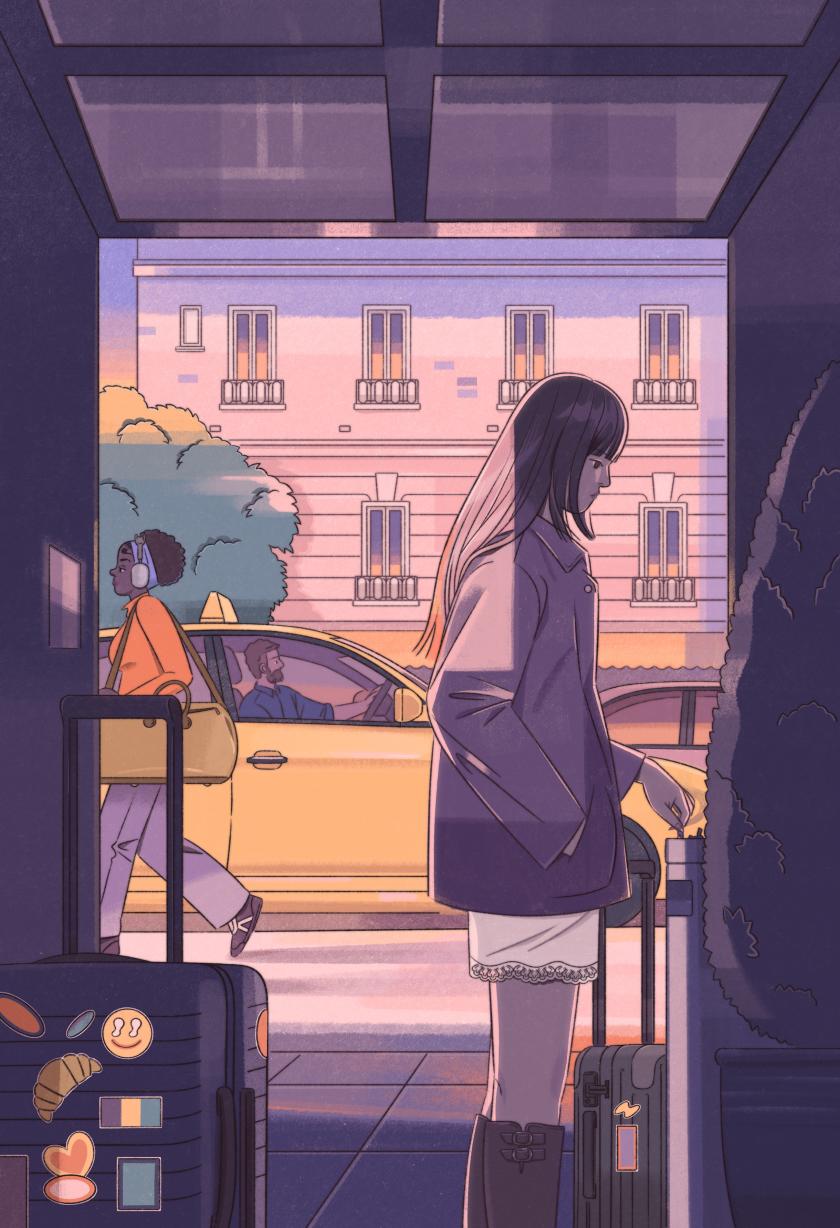
There's a beautiful stillness to Hannah Li's latest work. A train station empties. Light falls across an armchair in an empty room. A city corner waits in anticipation. Nothing dramatic is happening, and that's rather the point. "I'm drawn to moments that feel suspended in time," Hannah tells Creative Boom, "places where something has just happened, or is about to happen."

Hannah is a Chinese illustrator based in New York City, and light has always been the centre of everything she sees. Through interiors, city corners, train stations, and everyday scenes, she explores how light shapes our memories and changes our emotional relationship with space. It is a happy obsession that gives her images their gentle charm: you arrive a little too early, or a little too late, and you feel the difference.

Her practice runs through fine art. Hannah studied oil painting in China before moving to the United States in 2013 for an MFA in illustration at SCAD, and that grounding in paint still shows in the way she handles colour and atmosphere. Since graduating, she has built a substantial editorial and publishing career, with work for The New York Times, The Washington Post, and Harper's Bazaar Germany, as well as more than 20 non-fiction books for publishers including Penguin, Macmillan, and Usborne.

How Light Falls Β© Hannah Li

How Light Falls Β© Hannah Li

Marais Β© Hannah Li

Marais Β© Hannah Li

Long Season Β© Hannah Li

Long Season Β© Hannah Li

Still Life Β© Hannah Li

Still Life Β© Hannah Li

That publishing run was, by her own account, a serious education. Working closely with authors, editors and art directors taught her visual problem-solving, long-form storytelling and the benefit of collaboration. "It taught me how to communicate complex ideas clearly," she says, "while adapting my visual language across a wide range of subjects." For a few years, non-fiction was the centre of her practice.

Then something changed. After what she describes as a series of personal and life transitions, Hannah felt the pull back towards her own voice. She began stepping away from long-term book commissions and rebuilding her art around observation, curiosity and presence – making for herself again, rather than to another brief.

The result is an ongoing personal series called The Way Back. Rather than documenting specific events, it traces her relationship with the world after she, as she puts it, "returns to herself". The illustrations are less interested in narrative than in perception: the feeling of standing between movement and stillness, familiarity and distance, belonging and solitude. They ask you to notice the in-between rather than the big headline.

Pastel Hour Β© Hannah Li

Pastel Hour Β© Hannah Li

Entrance Β© Hannah Li

Entrance Β© Hannah Li

Evening Breath Β© Hannah Li

Evening Breath Β© Hannah Li

Much of the series began on the move. The pieces draw on things Hannah noticed while travelling through Paris, Rome, New York and other cities over the past two years. "Through colour, atmosphere and carefully observed details," she says, "I try to capture small moments where light, space and memory quietly intersect."

It's work that celebrates the art of slowing down, which feels like something she needed for herself after such a busy career in publishing. Beyond books and editorial work, The Way Back asks her only to look, and to trust that a reader will recognise the feeling without being told what it actually is.

  • βœ‡Creative Boom
  • 22 of the best online shops for stationery addicts Tom May
    Colours May Vary, Leeds Forget new technology. Nothing beats the simplicity of a notepad and pencil. It's why stationery is the go-to favourite treat for artists and designers everywhere. If you're looking to update your own kit, here are 22 brilliant shops we highly recommend. We'll apparently spend five years of our lives doomscrolling. A depressing statistic, and one any of us will be eager to reverse. It's a wonder our hands rememb
     

22 of the best online shops for stationery addicts

8 June 2026 at 06:00

Colours May Vary, Leeds

Colours May Vary, Leeds

Forget new technology. Nothing beats the simplicity of a notepad and pencil. It's why stationery is the go-to favourite treat for artists and designers everywhere. If you're looking to update your own kit, here are 22 brilliant shops we highly recommend.

We'll apparently spend five years of our lives doomscrolling. A depressing statistic, and one any of us will be eager to reverse. It's a wonder our hands remember how to do anything other than type and swipe. But all that staring at screens can also take a toll on our creativity. It's why, more than ever before, creatives are craving the physical, tangible, and tactile.

Buying some beautiful stationery can be one of the best ways to re-engage with the physical world and reboot your imagination – not to mention combat all this new technology. Plus, you don't even need to spend a lot of money to adorn your desk with gorgeous, designer-led products. Some of the world's most alluring bespoke stationery can be surprisingly affordable if you know where to look.

To help you out, we've scoured the web to find you the absolute best places to shop for boutique and bespoke stationery right now. These independent shops may fly largely under the radar, but they're passionate about their craft and tend to attract passionate, loyal audiences as a result.

So stop spending your money on boring basics sourced from uncaring tech giants. Check out these amazing stores, and start supporting your fellow creatives instead. As a happy bonus, you'll end up with lots of stunning stationery to die for, helping to reboot your mojo every time you sit down at your desk.

1. Present & Correct

Founded in 2009 by two graphic designers on the go, Present & Correct is imbued with a long-term love for stationery. Their online shop features paper and office objects inspired by homework, the post office and school from more than 18 countries. The pair go on sourcing trips about four times a year in hopes of finding vintage gems, so there's always something new to peruse.

Image courtesy of [Present & Correct](http://www.presentandcorrect.com)

Image courtesy of Present & Correct

2. Fred Aldous

Fred Aldous stocks 25,000 art, craft, photography and gift products online and in its Manchester and Leeds stores. They've been helping people make things they want since 1886. Stationery supplies range from pens and notebooks to washi tape, patterned paper, and more.

3. Hato

Hato store was founded in March 2020. A concept and lifestyle store based in Coal Drops Yard, London, it forms part of the wider HATO family, featuring lifestyle items, books, printed matter, clothing and objects taken from their practice as a design studio and printing press. When it comes to stationery, you can find notebooks, notepads, desktop accessories and plenty more.

Hato, London

Hato, London

4. Papersmiths

Papersmiths specialises in stationery and paper goods and aims to be the shop of your stationery dreams. Alongside their own products, you'll find hand-picked favourites from designers and makers across the globe.

5. Tom Pigeon

Tom Pigeon is a creative studio founded by Pete and Kirsty Thomas in 2014. The pair design and make jewellery, prints, stationery and products, as well as taking on creative commissions and consultancy work. In their online shop, you'll find a particularly beautiful line in cards and year planners.

Image courtesy of [Tom Pigeon](https://www.tompigeon.com)

Image courtesy of Tom Pigeon

6. Before Breakfast

Before Breakfast is named in tribute to the quote from Through the Looking Glass by Lewis Carroll: "Why, sometimes I've believed as many as six impossible things before breakfast." Its founders aim to bring a new perspective to design and craft, using sustainable materials and a responsible-making process. The result is carefully crafted stationery that inspires everyday tasks and creativity in the workspace.

7. The Completist

The passion project of a husband-and-wife duo, Jana and Marko, The Completist features over 400 products, including cards, stationery, gift wrap, and homeware. With a focus on sustainable manufacturing and supporting small British manufacturers, its stationery offering includes planners, journals, notebooks, sketchbooks, calendars and more.

8. Katie Leamon

Katie Leamon founded her London studio in 2010, and her design-led stationery is now stocked everywhere from Harrods to Selfridges. Designed in England with a plastic-free, recyclable approach, the range runs from lay-flat notebooks and weekly planners to greeting cards, gift wrap, pens and desk accessories – considered paper goods with a confident, contemporary look.

9. The Journal Shop

The Journal Shop shares carefully curated stationery and paper goods inspired by the founders' trips to Japan. Its collections of desk and home designs bring joy and comfort while sparking your curiosity and creativity.

10. Nook

Gemma and Jack opened Nook in Stoke Newington, London, in 2012. Their online store showcases accessible designs from the UK, Europe, and beyond, focusing on products that are well-designed and built to last. "Everything we sell we would have in our own home," they say. Stationery includes notebooks, planners, pens, pencils, tape dispensers, scissors and more.

Image courtesy of [Nook](https://www.nookshop.co.uk/collections/office)

Image courtesy of Nook

11. Mark + Fold

Mark+Fold is a London-based stationery studio that prides itself in knowing where and how its products were made, the materials used, and whether they were sustainably sourced. Its notebooks and diaries open flat to 180 degrees, and the pages are made of exceptionally good paper, which is up to 30% thicker than other notebooks.

12. Colours May Vary

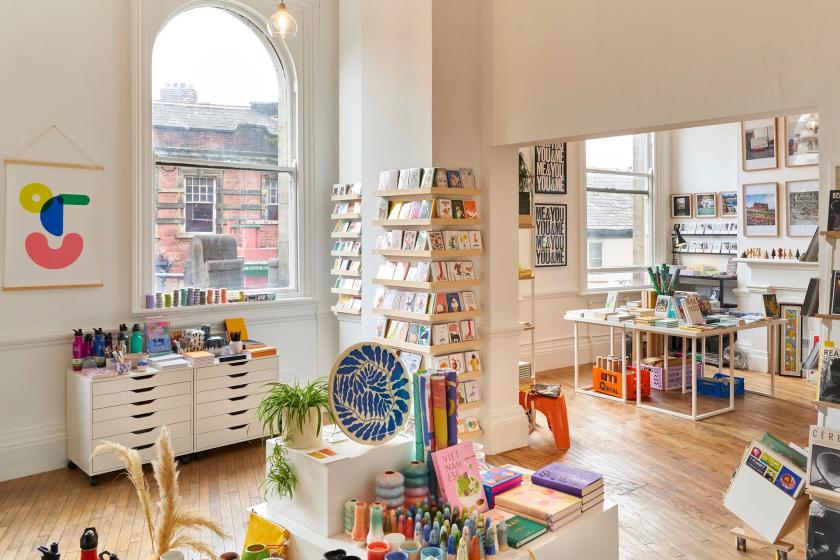
Colours May Vary is an independent shop based in Leeds stocking a range of beautiful, useful and inspirational wares. Their main focus is graphic art and design, typography, illustration and product design, and they stock a range of books, journals, prints, cards, wrapping paper, notebooks and planners.

13. Papergang

Papergang is a stationery subscription series delivering exclusive products to your letterbox. Each month you'll receive a product selection that varies but includes the likes of greeting cards, notebooks, desk accessories and art prints.

14. The Stationer

The Stationer was born in 2014 out of Tessa Sowry-Osborne's love for pens, pencils, paper and everything else that lives on a desk. It's focused on combining classic design with great functionality: items that will make your desk look cool and help you be that little bit more organised.

15. Happy Dashery

Sarah Arkle and Carrie Wainer opened their Bedfordshire store in 2019, intending to be a bright and colourful beacon on their local high street. They look after their online shoppers, too. They can write personalised messages, gift wrap, and include a greeting card with your order on request. Stationery includes pens, pencils, cards, sticky notes, journals and more.

16. Rifle Paper Co.

Rifle Paper Co was founded in 2009 by husband and wife Nathan and Anna Bond. Their site is full of bold colours, hand-painted florals and whimsical characters, and their goal is to create quality products that bring beauty to the everyday. Their stationery includes greeting cards, social stationery sets, card sets, postcards and photobooks.

Image courtesy of [Rifle Paper Co.](https://riflepaperco.com/)

Image courtesy of Rifle Paper Co.

17. Meticulous Ink

The good people of Meticulous proudly print stationery the old-fashioned way, using beautiful papers, time, patience, and a deep-rooted passion for being meticulous. Two original 1960s Heidelberg printing presses are used to create their own greeting cards, stationery box sets, business cards, wedding invites, packaging and bookmarks.

18. Yoseka Stationery

Yoseka Stationery is the US branch of the much-loved Taiwanese store, bringing its beautiful stationery products to a global audience. These include planners, cards, erasers, fountain pens, inks, letter stationery, markers, notebooks, organisers, pens, pencils, refills, stamps and stickers.

19. Wrap

Wrap celebrates the very best in contemporary creativity through its print magazine, its products, and its online content. Its notebook collection has recently had a glow-up and now boasts new styles featuring illustrated covers and gold-foil detailing. Several classic designs from the Wrap archive have also been brought forward into the range.

20. Counter-Print

Counter-Print is one of our favourite book publishers, and they do a mean line in stationery products. These include everything from pencils, rulers, and tape dispensers to art chalk, white vinyl glue, and a screen-printing kit.

CΓ©line Leterme and Jon Dowling, Counter-Print

CΓ©line Leterme and Jon Dowling, Counter-Print

21. Papier

Since 2015, Papier has been an emporium of eclectic designs, including bespoke stationery products that invite curiosity and contemplation. Alongside their in-house collections, they collaborate with bright, up-and-coming artists, iconic brands and exciting fashion labels.

22. Choosing Keeping

Choosing Keeping began in 2012 as a small shop on Columbia Road, a street in East London best known for its flower market and independent boutiques. They offer a fantastic range of stationery products, including writing paper, decorative paper, art tools, office accessories and wrapping paper.

  • βœ‡Creative Boom
  • Vivid and restless, TjaΕ‘a Cizej's compositions are built like puzzles Ayla Angelos
    The Slovenian graphic designer and recent Werkplaats Typografie graduate approaches typography with a messy, intuitive process, making work that is impossible to look away from. Earlier this spring, TjaΕ‘a Cizej was staying at her parents' place in Slovenia, surrounded by nature, and noticed buds on a branch. She had spent the previous two years in Arnhem, in the Netherlands, attending the Werkplaats Typografie master's programme. "Mayb
     

Vivid and restless, TjaΕ‘a Cizej's compositions are built like puzzles

9 June 2026 at 07:51

The Slovenian graphic designer and recent Werkplaats Typografie graduate approaches typography with a messy, intuitive process, making work that is impossible to look away from.

Earlier this spring, TjaΕ‘a Cizej was staying at her parents' place in Slovenia, surrounded by nature, and noticed buds on a branch. She had spent the previous two years in Arnhem, in the Netherlands, attending the Werkplaats Typografie master's programme. "Maybe that has something to do with the fact that I spent a lot of time in cities over the last couple of years, and when I came back home, I became more aware of the beauty and ordinariness of the nature I grew up around," she tells Creative Boom.

TjaΕ‘a started studying graphic design at 15, in high school in Slovenia, before going on to a bachelor's degree at the Academy of Fine Arts in Ljubljana. She graduated from Werkplaats Typografie last summer and is now based in Arnhem, taking on client work and learning to build a variable font on the side. Her practice sits between typography, colour and printmaking, designing posters, identities and collaborative pieces that treat letters as forms to be pushed, pulled, recombined and, occasionally, made almost illegible (almost).

Her process, by her own description, is very messy and very simple. She doesn't sketch beforehand. She starts with a letter and follows the feeling – you know, things like what colours appear first and what forms are starting to take shape. "I'm not professionally trained as a type designer, and honestly, I never really planned to become one," she says. "Mainly, I'm just putting parts of letters together, almost like a puzzle." The posters and identities that emerge from this approach are vivid and restless, awash with saturated colours, forms that hover between legibility and abstraction, and energetic compositions that seem to be communicating something with each line and dent.

Her personal projects are where she creates her favourite pieces, in part because they turned out well, but also because the process of making them was more "lighter and joyful" than others. The Kompas poster is one she is most attached to. Made during her time at Werkplaats Typografie, it involved working with traditional Chinese characters for the first time. "I liked discovering how I could find my own way of working with completely different letterforms," she says. The poster was installed in the lightbox at the Werkplaats Typografie building in Arnhem, where it guided visitors in the right direction, giving the piece a functional dimension alongside its graphic one.

The Book Launch poster, made in collaboration with her classmate and friend Xiaohan Zhang, worked a little differently. Xiaohan provided images and drawing material, while TjaΕ‘a's role was to respond, bringing her typographic and visual interpretation to what she was given. For this piece, she chose a photograph of a child hiding playfully and built around it with small typographic elements. "I'm very happy with how it resonated with the event itself and how everything came together," she says. "It also brings back very nice memories of my classmates at Werkplaats Typografie."

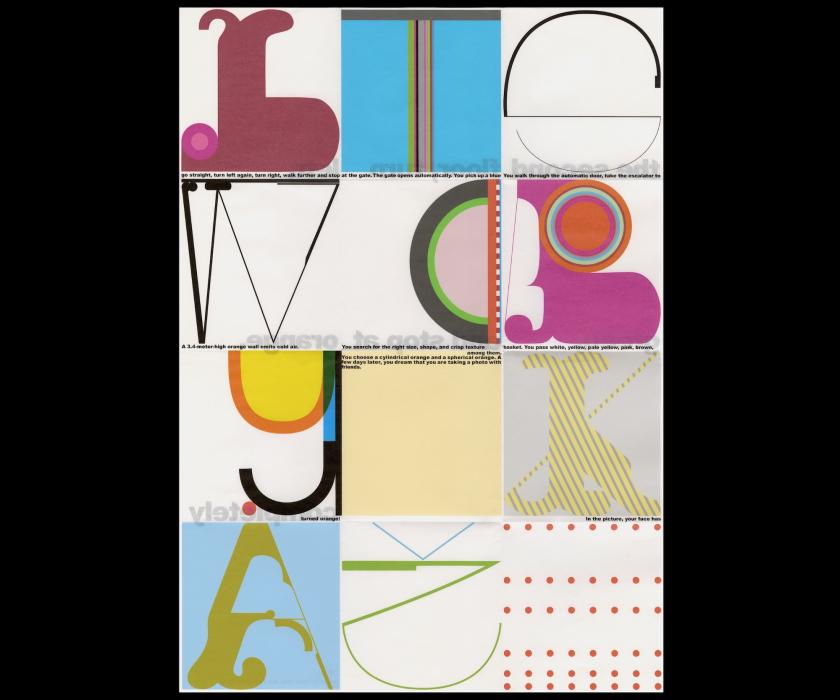
The Orange poster, on the other hand, features a grid of 12 uniform squares, each with its own identity. This isn't necessarily a favourite of hers, but she enjoyed how the project pushed her towards printed matter and physical experimentation, a direction she wants to keep following. "It made me want to create more things like that."

What TjaΕ‘a does not carry into the work is any particular expectation of how it should land. "I don't carry any particular message or meaning in my work," she says, "but it feels very good to express myself through it and to feel fulfilled by that." This summer, she hopes to turn towards personal projects – potentially a first full typeface, and some interactive publications she has been thinking about for a while.

  • βœ‡Creative Boom
  • How&How gives Brunel's SS Great Britain a second life as Bristol Dockyards Katy Cowan
    The studio behind the rebrand has expanded the SS Great Britain into a full cultural destination, with a defiantly un-nautical pink lifted straight from Totterdown's terraces. Some ships are worth knowing about. Brunel's SS Great Britain launched in 1843 as the first of her kind, and in the years since, she has lived more lives than most of us could ever imagine. Ocean liner, cargo ship, coal hulk, stranded castaway off the Falklands –
     

How&How gives Brunel's SS Great Britain a second life as Bristol Dockyards

18 June 2026 at 06:15

The studio behind the rebrand has expanded the SS Great Britain into a full cultural destination, with a defiantly un-nautical pink lifted straight from Totterdown's terraces.

Some ships are worth knowing about. Brunel's SS Great Britain launched in 1843 as the first of her kind, and in the years since, she has lived more lives than most of us could ever imagine. Ocean liner, cargo ship, coal hulk, stranded castaway off the Falklands – she has carried 33,000 passengers around the world, supported war efforts, hauled actual gold, and inspired a few hundred tall tales along the way. Now she is getting her next chapter, and it's a good one.

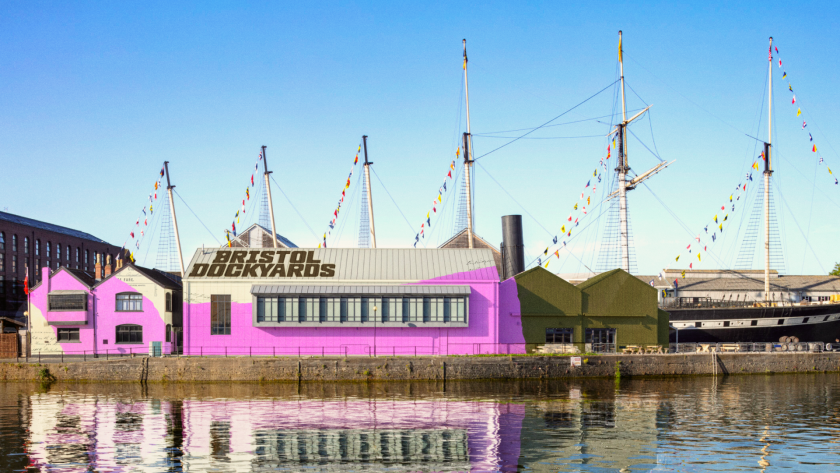
How&How has come aboard to create the experience and identity for the Bristol Dockyards, an all-new cultural destination built around the centuries-old ship and, fittingly, pitched at the heart of Britain's most radical city.

What problem did the rebrand need to solve? Since her triumphant return to Bristol in 1970, the SS Great Britain has been a treasured centrepiece of the city, but treasured isn't the same as visited. Ticket sales had slipped, the audience was ageing, and not enough people could find a reason to justify the 20-minute walk down the quayside to see her. All the care going into preserving this stretch of history simply wasn't, well, landing.

So How&How decided that playing it safe was never going to cut it. The SS Great Britain isn't like any other ship, Brunel isn't like any other engineer, and Bristol – as anyone who has spent a weekend there will tell you – isn't like any other city. The studio built something defiantly different instead, channelling two centuries of innovation and global wandering into a destination that once again wants to spark ideas that change the world.

That began with a complete refresh of brand architecture and a broader name above the gates. The Bristol Dockyards now reflects the full scope of a day out rather than a single vessel, giving three central experiences – the Being Brunel museum, the Brunel Institute's maritime archive, and the ship herself – the room to finally sell themselves.

Holding it all together is a central collage system that tells the story of 200 years of history without letting any of it gather dust. And no, it's not about pretty pictures – more about texture, as it merges timelines, typography and Dockyard odds and ends into something tactile, immersive and unmistakable from across the river.

Then there's the colour, which does a lot of the heavy lifting. A pink borrowed from Totterdown's famous terraces cheerfully defies every black-and-blue nautical brand going, backed up by bright yellows, greens and oranges that feel right at home in a city likely still drum n' bassing by opening time.

The tone of voice follows suit, speaking up for itself the way Bristol always has. Deeper, vaster, braver – it channels the city's attitude rather than imitating its accent, delivering an iron-willed message through iron-clad typography that flits between classic serif and semi-bold sans, from A-boards to the About page.

The Dockyards have always been a place of radical thinking. Now the brand matches. And How&How can't wait to see people once again lining the banks of the Avon, craning for a glimpse of one of the UK's most enduring icons.

You can see the full project on the How&How site, and find out more about visiting at the Bristol Dockyards website.

  • βœ‡Creative Boom
  • Booms & Shakes: June's hires, launches and the studios rethinking themselves Katy Cowan
    New Hapworks Studios in Dundee Strategy leaders are in demand, social-first agencies are hiring more, and one studio has done the brave thing and handed its own rebrand to someone else. Gulp. Here's what's been happening in the creative industry this month. Welcome back to Booms & Shakes, our monthly round-up of the hires, promotions, launches and wins making noise across the creative world right now. A few patterns jumped out of
     

Booms & Shakes: June's hires, launches and the studios rethinking themselves

15 June 2026 at 06:06

New Hapworks Studios in Dundee

New Hapworks Studios in Dundee

Strategy leaders are in demand, social-first agencies are hiring more, and one studio has done the brave thing and handed its own rebrand to someone else. Gulp. Here's what's been happening in the creative industry this month.

Welcome back to Booms & Shakes, our monthly round-up of the hires, promotions, launches and wins making noise across the creative world right now.

A few patterns jumped out of the inbox this rainy June. Half the industry seems to be hiring a head of strategy. "Social-first" studios are building empires. And after May's run of agencies redrawing their own identities, this month we've got the opposite instinct: a studio that decided the best thing it could do for its brand was let another team loose on it.

Read on for who's moving, who's launching, and who's worth keeping half an eye on. It's been quite the busy one.

Story of the month

The studio that let someone else do its rebrand

Ok, first things first. Most studios, when the time comes for a refresh, do it themselves. It's cheaper, on-brand, and, frankly, a nice break from client work. We've watched plenty go down that route lately. So we were impressed by a studio that went the other way.

As it approached its 20th year, 3D and moving-image studio Bolder Creative decided that a proper reset deserved an outside eye and brought in creative studio Monday Nights to do the thinking. If the name rings a bell, Monday Nights is the team we featured last summer for its work on the football game CLUB.

Bolder handed over full creative freedom from day one, and, by Monday Nights' account, the two teams discovered they shared the same belief that good design doesn't need to be wrapped in serious language or a complicated process. Bolder admits it was unusual going on the kind of journey it usually guides its own clients through, which must be a peculiar feeling for any studio used to running the room. They seemed to enjoy being on the other side, though and couldn't resist taking the new brand for a spin in 3D, producing some suitably outrageous animations for the case study.

The new identity is due to land this month. We rather like the principle behind it: sometimes the most confident thing a studio can do is admit it's too close to see itself clearly.

Hires and promotions

Method1 names Jodi Heelan as CEO

New York behavioural-science agency Method1, which builds its work around "indulgence" brands across spirits, drinks and the wider CPG world, has appointed Jodi Heelan as chief executive. Heelan arrives after more than a decade at The Variable, latterly as president, where she helped steer the shop to five Ad Age Small Agency of the Year nods.

Founder MichaelAaron Flicker reckons she understands how creativity, operations and business performance fit together in a way few agency leaders do, and given the brief is to build a more modern, scalable model, that's the right thing to be good at.

Jodi Heelan at Method1

Jodi Heelan at Method1

ByDESIGN appoints Christian Murphy as global CEO

Architecture and design media brand ByDESIGN has named Christian Murphy as its global chief executive as it pushes further into broadcast, streaming and branded content. Murphy, known across the industry as "Murph", brings close to three decades in international television and content, much of it at A+E Global after he moved from Australia to the US in 2008. A media veteran taking the reins of a design-led brand makes for an interesting combo.

Landor keeps building, on both sides of the Atlantic

If May's WPP Brand & Design restructure told you branding was back at the top of the agenda, Landor is making sure you don't forget it. The consultancy has appointed Alana Eversole as global EVP, experience, and promoted Ryan Frost to global executive creative director.

Ryan Frost and Alana Eversole, Landor

Ryan Frost and Alana Eversole, Landor

Eversole returns from Jones Knowles Ritchie, a "boomerang" in Landor's own affectionate phrasing, having already spent more than a decade in the business. Her newly created role pulls together Landor's work across retail, hospitality, events, spatial and immersive design into a single experience offering, the argument being that "in a fragmented, increasingly AI-shaped world, physical and sensory brand moments matter more, not less".

Frost, meanwhile, has spent nearly two decades at Landor across London, Singapore and New York, and steps up to help shape creative direction globally alongside the existing roster of ECDs. Two more signs that the category sees "experience" and "craft" as its growth engine.

M+C Saatchi Talk brings in Pete Harrison

M+C Saatchi Talk has appointed Pete Harrison as managing partner as it enters its 25th year. He joins on the back of a busy run for the agency, following the arrivals of managing director Amaya Alvarez and head of brand PR and influence Callum Powell. Harrison has close to two decades of experience across the UK, the US and Asia-Pacific, with roles at EVH, Salesforce and NBCUniversal, and lands at what the agency calls its "culture-first story-making" proposition. He'll also co-chair the group's Proud employee-led network in the UK.

Pete Harrison, M+C SAATCHI Talk

Pete Harrison, M+C SAATCHI Talk

Lindsay Turner at BBC Studios Digital Brands

Lindsay Turner at BBC Studios Digital Brands

BBC Studios Digital Brands hires Lindsay Turner, with the numbers to back it up

BBC Studios Digital Brands, home to the likes of Bluey, Doctor Who, BBC Earth and Top Gear on YouTube, has appointed Lindsay Turner as VP digital growth and strategy to lead its advertising and commercial partnerships.

For background, the business has held the number-one spot for YouTube watch time in its global competitor set for a second year running, with watch time up 60% year on year to 2.1 billion hours, and branded content growing a frankly startling 124%.

Turner joins from VCCP Media, where she was managing director, with earlier stops at LADbible Group, Spark Foundry and Blue 449. When the platform's already this big, the job is turning attention into revenue, and that's squarely her remit.

Ian Millner resurfaces at ZEAL and NewGen

After 26 years of building Iris Worldwide from a challenger to a global network, founder Ian Millner left in March, and the industry has been wondering where he'd go next. Well, all has been revealed as he's taken the chairman role at brand activation group ZEAL, become non-executive chairman of creator-economy agency NewGen, and joined marketing group MSQ as a non-executive director.

Three businesses, all firmly in growth mode. ZEAL, founded in Manchester in 2014, has been busy acquiring social studio Tommy and launching shopper-PR shop Joe Public; NewGen runs across London, Manchester, New York and Paris. Millner will keep advising Iris in a global capacity, too, so he's hardly stepping back.

Born Social promotes Simon Cooper to ECD

Social-first agency Born Social has promoted Simon Cooper to the newly created role of executive creative director. Cooper joined in 2024 to lead the Ford account, and his back catalogue is impressive: Ford's "The Legend Is Back" Capri reveal, Spotify Wrapped 2022, the Puma Gen-E launch and "The Internet Takeover" with Dan and Phil for BBC Radio 1.

He'll report to chief creative officer Paddy Smith, who's relocated to the US to grow the agency's presence over there, and lead a team of 22 creatives. Part of a wider leadership build-out that also saw Alex Green made UK head of growth.

Ian Millner making moves

Ian Millner making moves

Simon Cooper at Born Social

Simon Cooper at Born Social

JOAN London adds Nicky Vita as head of strategy

JOAN London has appointed Nicky Vita, previously of Atomic London, as head of strategy. She follows close behind Gerry Graf, who was named global chief creative officer earlier this month. Vita started in planning at TBWA in Johannesburg before taking on London roles at BBH (where she rose to partner) and VCCP, working on clients such as Primark, LinkedIn and O2, and arrives with awards from the IPA, The Drum and the Marketing Society in tow.

The female-founded agency, which has been in London only since 2023, counts eBay, Ancestry and TOTM among its clients. Vita's own verdict on the move was endearingly honest: excited, she says, but also "terrified, nervous, delighted, optimistic".

Pearlfisher names Christina Papale head of strategy in New York

Independent brand design agency Pearlfisher has appointed Christina Papale as head of strategy for its New York studio, with a brief to bring strategy, insight and creative closer together.

Papale brings more than 20 years of experience across food and drink, health and wellness, retail, spirits, and beauty, most recently running her own consultancy, Verboten Group, and, before that, 12 years at CBX. She describes her approach as "intrapreneurial", which is a different way of saying she likes working out what a brand needs next before it thinks to ask.

Christina Papale

Christina Papale

More movers

A clutch of other moves worth a mention. Spin, last year's Social Media Agency of the Year at the Europe Agency Awards, has hired George David as group commercial director, joining from Havas-owned Wilderness to drive growth across Spin and its sister brands Be A Bear and Tiny Studios, off the back of pitch wins including Fortnum & Mason, Five Guys and National Rail.

Creative agency Hijinks has appointed Chris Willis, formerly of Fake Empires, as design director, bolstering its brand design work following projects for Fulham Pier and Vue. And in New York, next-generation studio Versus has hired the duo of Rosie Garschina (executive creative director) and Kevin Anderson (executive producer) from TrollbΓ€ck+Company to deepen its brand and design practice.

Spin Hires George David as Group Commercial Director

Spin Hires George David as Group Commercial Director

Chris Willis at Hijinks

Chris Willis at Hijinks

Rosie Garschina & Kevin Anderson at Versus

Rosie Garschina & Kevin Anderson at Versus

Elsewhere, global studio Builders Club has appointed Matt Shannon as executive producer and head of partnerships, bringing experience with Apple, Netflix, Burberry and Rolex to its push into luxury, fashion and tech. Youth marketing agency Raptor, celebrating its 10th year, has promoted group account director Molly Chappin to its board.

GentleForces has expanded its leadership as it turns five, naming Mike Keen as finance director and founding team member Jordanna Andrews as futures practice lead, alongside international wins with Shinola and Kate Spade.

And last but not least, at Fluid Ideas in Derby, Dani Berzins and Sarah Bowler have become the agency's first new shareholders in seven years, exercising EMI share options to step up to partner and co-owner, a lovely example of an agency following through on a progression path.

Matt Shannon at Builders Club

Matt Shannon at Builders Club

John Wilkinson with the team at Raptor

John Wilkinson with the team at Raptor

Sarah Bowler, left, and Dani Berzins of Fluid Ideas

Sarah Bowler, left, and Dani Berzins of Fluid Ideas

L-R: Mike Keen; Quba Tuakli; Danni Mohammed; Jordanna Andrews & Nathan Wilson at Gentle Forces. Photography by Dennis McInally

L-R: Mike Keen; Quba Tuakli; Danni Mohammed; Jordanna Andrews & Nathan Wilson at Gentle Forces. Photography by Dennis McInally

SomeBrightSpark moves to a partner-led model

Independent agency SomeBrightSpark has restructured around a partner-led model with two appointments. George Guildford joins as partner and executive creative director from Moshi, tasked with growing the agency's film, production and social-first work, while client services director Ellie Anderson has been promoted to partner after 13 years at the agency.

Founded in 2008 and working with the likes of Caterpillar, Volkswagen Financial Services and Pinterest, the agency is making the case, as MD Daniel Rogers puts it, that studios outside London can compete creatively at the very highest level. Hard to argue with that, given we're doing alright here in Manchester.

George Guildford & Ellie Anderson, SomeBrightSpark

George Guildford & Ellie Anderson, SomeBrightSpark

Launches and new ventures

M+C Saatchi UK launches Social House

M+C Saatchi UK has launched Social House, a new practice that folds social strategy, creator and community work, content production, paid media, commerce and measurement into a single offer. The thinking is that social has stopped being a channel and become a whole cultural ecosystem, the place people discover what they love and decide what to buy, so it deserves to be treated as a discipline in its own right.

It's built on the group's proprietary "Fancom Accumulator" methodology, and brings in Katy Ball from Hope&Glory as head of social communications, with Shanice Dover promoted to associate director, creator and community.

Shanice Dover, Laura Coller and Katy Ball at M+C Saatchi Social House

Shanice Dover, Laura Coller and Katy Ball at M+C Saatchi Social House

Tracks & Fields opens in London

Berlin-founded music intelligence and operations company Tracks & Fields has opened a London office, with former Superunion and Siegel+Gale leader Mark Mullooly as managing director for the UK. The pitch is an insightful one: as campaigns sprawl across more markets, platforms and rights environments, the music decisions get complicated fast, and brands tend to leave them too late. Since 2008, the company has handled more than €100m in music licensing and artist partnerships for the likes of Mercedes-Benz, Aldi and Zalando, and London joins its offices in Berlin, Warsaw and Tokyo.

Mark Mullooly, Tracks & Fields. Photography by Luke Fullalove

Mark Mullooly, Tracks & Fields. Photography by Luke Fullalove

Akcelo lands in London

Brand experience and innovation company Akcelo has opened its first permanent London office, in Farringdon, as part of what it calls a "borderless" model. Founded in Australia in 2020, the agency works with TikTok, PepsiCo, Amazon, OpenAI and Anytime Fitness, and the London team, led by Ben Phillips, Jade Fonteneau, Mike Gethin and Justin Schoenmaker, is the first proper on-the-ground presence in a region it has so far served from afar. Plans are to add 10 to 20 staff over the next year or so.

Glass Productions opens its doors in the North West

A nice one for the regions. Photographer Georgie Glass has launched Glass Productions, a food and drink creative production agency, alongside Glass Studio, a fully kitted-out dual-kitchen studio space in Cheshire. With 13 years in food and drink and a client list that includes HarperCollins and PepsiCo brands such as Quaker Oats, Glass is betting on the North West's appetite for better visual content. The studio is now open for bookings, so give her a shout.

L-R Mike Gethin Creative Lead, Jade Fonteneau Business Lead, Justin Schoenmaker Creative Lead, Ben Phillips Strategy Partner, Akcelo London

L-R Mike Gethin Creative Lead, Jade Fonteneau Business Lead, Justin Schoenmaker Creative Lead, Ben Phillips Strategy Partner, Akcelo London

Six Dundee studios share a roof at Hapworks

We've got a real soft spot for this one. Six Dundee creative organisations, spanning design, games, culture, research and civic innovation, have come together to launch Hapworks Studios, a shared workspace above The Bach cafΓ© on Albert Square. Agency of None, Biome Collective, Bit Loom, Creative Dundee, tialt and Very Evil Demons now share the space, home to more than 25 people.

It came together partly by accident, after a flood forced Agency of None to move just as the others were grappling with rising rents, but the principle is deliberate: at a time when independent studios are being priced out of city centres across the UK, here's a group choosing to invest collectively in shared infrastructure rather than going it alone. A small, practical answer to a problem a lot of cities are currently wrestling with.

Georgie Glass

Georgie Glass

Partnerships and wins

McCann London wins Mindful Chef

McCann London has been appointed agency of record by recipe box service Mindful Chef following a competitive pitch, and is building a new brand platform to launch in the autumn. It's the brand's biggest marketing investment to date, led by recently appointed CMO Mary Rochester Gearing, with the line that Mindful Chef isn't really about convenient meals but about making food a positive force in how people feel. McCann's deputy ECDs Charlotte Prince and Loriley Sessions called it a dream brief, which, for a team that presumably likes eating well, checks out.

Born Ugly wins LHV Bank

Leeds independent Born Ugly has secured a three-year partnership with LHV Bank to build its brand platform and run integrated campaigns for the savings-focused retail bank. Of the brief put before them, Head of Strategy Clare Deacon says that with low brand awareness in the UK, the real risk for LHV isn't rejection, it's being ignored, so the work is about meaning before scale.

Born Ugly x LHV

Born Ugly x LHV

Havas Miami named by Olive Oils from Spain

Havas Miami has won a three-year, US-wide brief from Olive Oils from Spain, the trade body for Spain's olive oil industry, with the first work due in July. It's more category-building than campaign: the US is about to become the world's biggest consumer of extra virgin olive oil, and the job is to move Spanish olive oil from pantry staple to cultural fixture across food, wellness and modern cooking. ECD Federico Hauri, fresh from co-founding studio MULTI, calls it a dream assignment.

Wonderhood Design picked by VIEVE

Wonderhood Design has been appointed by makeup brand VIEVE, founded by makeup artist Jamie Genevieve, to lead a full brand strategy, identity and packaging project following a competitive pitch back in February. With a community of more than three million followers and fresh investment behind it, VIEVE wants to scale into a next-generation British beauty brand without losing the artistry-led, real-world feel that built it. Wonderhood's job is to bottle that.

Uncovered to lead ClearScore's global social

Social-first agency Uncovered has been appointed by ClearScore to lead its global paid social creative strategy across the UK, Canada, South Africa, Australia and New Zealand. The move is part of ClearScore's shift from scattered local activations to a single, globally aligned model run through its UK HQ. Uncovered apparently won it by balancing global consistency with genuine local nuance, the typical tightrope of any multi-market brief.

Iris London takes on WillPowders

Iris London has won performance nutrition brand WillPowders, founded by Davinia Taylor and Matthew Leyden, after a three-way pitch, and will lead the launch of its new sport range and summer product, Electro Ice. It's WillPowders' first appointment of its kind, and Iris's social and influence lead Melo Meacher-Jones describes the brand exactly as you'd hope an agency would describe a new client: "one with a genuine point of view and the nerve to back it".

BigSmall x War Child

BigSmall x War Child

Delsey Paris - Designed to Move You Campaign - SS26

Delsey Paris - Designed to Move You Campaign - SS26

Gung Ho lands DELSEY Paris

Independent creative collective Gung Ho has been named DELSEY Paris's retained UK PR agency, just as the French luggage brand marks its 80th anniversary and rolls out a new "Designed to move you" platform. Gung Ho, which recently passed 20 years of its own "truth told boldly" ethos, will handle UK press, influence and activations. A heritage brand and a bold-by-name agency are, at least, a promising duo.

BigSmall partners War Child UK

Brand strategy studio BigSmall has been appointed as brand strategy partner for War Child UK, following a competitive pitch. The idea is that it will help sharpen how the charity tells its story. With more than 520 million children worldwide affected by conflict, the work is about clarity rather than relevance. As BigSmall's Lucy Taylor puts it, when a cause is this important, you need one idea people can understand instantly and act on immediately.

Milestones and good news

Distant Future Animation makes the shortlist

A well-earned nod for a small team. Yorkshire studio Distant Future Animation has been shortlisted at the 2026 Prolific North Creative Awards, in the Excellence in Creative Craft category, for Maritime Connected, a film made with Lloyd's Register Foundation.

The brief was to explain why maritime safety matters far beyond shipping, and the studio, just three people, deliberately avoided Western-centric storytelling, using culturally diverse characters and a non-Western voiceover to make a complex global subject land emotionally in under 90 seconds. It premiered in September 2025 and has since reached audiences in more than 40 countries. A great example that you don't need a big team to create something brilliant.

Distant Future Animation makes the shortlist

Distant Future Animation makes the shortlist

One for the diary

The Prolific North Creative Awards are handed out on 25 June in Manchester, so we'll find out then how Distant Future gets on. And the big one, of course, is the 73rd Cannes Lions, running 22 to 26 June. Expect the inbox, and next month's Booms & Shakes, to be heaving with it.

Key takeaways

Step back from June, and a few threads spring to mind. Firstly, everyone wants a strategist. Pearlfisher, JOAN London and GentleForces all named strategy leads this month, and Born Ugly's winning argument for LHV was strategic. After a long stretch of "performance-first thinking", agencies are clearly reinvesting in the bit that comes before the campaign: working out what a brand is actually for.

Secondly, social-first has matured. M+C Saatchi's Social House, Spin's commercial hire, Born Social's new ECD, Uncovered's global ClearScore win and Iris taking on WillPowders all point in the same direction. After all this time, social is no longer a channel an agency bolts on; it's now the discipline around which the whole offering is built.

And finally, it's reassuring to see so many upbeat news stories despite the economic uncertainty and gloom. Six Dundee studios sharing a roof rather than being priced out one by one. A three-person animation team reaching 40 countries. Two long-servers at Fluid Ideas are finally getting their names on the door. None of these win a prize for the biggest move of the month, but they're the ones that remind you why this industry is worth writing about in the first place.

❌
Creative Boom