
 Login
Login
The 85th Anniversary of Fleischer’s “Raggedy Ann and Raggedy Andy”

 In 1918, writer and artist Johnny Gruelle wrote a children’s book about a little doll that would become a big deal. It was called Raggedy Ann Stories. A doll was produced and marketed alongside the book. By late 1938, the year Gruelle sadly passed away, 3 million copies of his book had been sold.
The popularity of Raggedy Ann and her brother, Raggedy Andy, who was introduced in later books, became a phenomenon. The charm and whimsy of their stories made the characters a natural fit for animation.
In 1941, the Fleischer Studio, riding high on the popularity of Betty Boop and Popeye, partnered with Johnny’s son, Worth Gruelle, to bring the characters to life on the screen in the 18-minute, two-reel animated short, Raggedy Ann and Andy, which celebrates its 85th anniversary this spring.
Written by Worth and William Turner, the short opens in a small toy shop with Raggedy Ann and Andy in the window. They are on sale for a dollar for the pair. A little girl runs up to the toy shop with her purse in her hand. She asks the shop owner to buy the girl doll in the window, but he explains they must be sold as a pair and shows their hands stitched together.
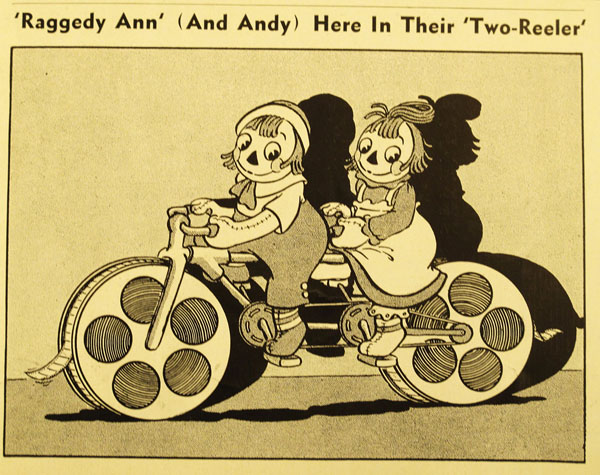
Publicity art promoting the “two-reeler” from the April 11th 1941 issue of Paramount News.
The audience is then taken to Ragland, where stitched quilts cover the landscape. From there, the story moves on to the Glad Rags Doll Factory. Here the dolls are made. All workers are objects—material, needles, scissors, spools— that are anthropomorphized. They assemble two dolls, a boy and a girl, who will become Raggedy Ann and Andy. The Paintbrush feeds them both candy hearts, and they both come to life.
However, they need their names, and for this, they are sent off to the Castle of Names, where they must arrive before sunset. On the way, they run into the Camel with the Wrinkled Knees, who agrees to give them a lift. They just have to stop off at a filling station where the Camel is filled up with sawdust.
 As they continue their journey, Raggedy Andy falls under the spell of a beautiful doll who is singing. He goes off with this beautiful doll, leaving Raggedy Ann heartbroken, and riding off on the Camel with the Wrinkled Knees.
Raggedy Andy and the girl go off to “Glovers Lane,” while Raggedy Ann and the Camel continue to the Castle. Once there, she gets sick and is placed into the King’s infirmary.
Back in Glover’s Lane, Raggedy Andy is asked by the other doll what his name is. He says he doesn’t have one. She notes that he’s a nobody without a name, and he realizes he needs to get to the Castle.
Meanwhile, at the Castle, the hospital’s doctors use a fluoroscope and find that Raggedy Ann’s candy heart is broken. There’s nothing that they can do. Andy arrives at Raggedy Ann’s bedside, with certificates that reveal their names. He sings to her, and she wakes up. To make sure they can never be separated again, the two dolls have their cloth hands stitched together.
 Back at the toy shop, the owner explains to the young girl that is why he cannot sell just one doll. However, he agrees to give her both, as the short ends with a happy ending.
Directed by Dave Fleischer and animated by luminaries such as Myron Waldman, Joseph Oriolo, William Henning, and Arnold Gillespie, Raggedy Ann and Andy is brimming with beautiful visuals. Ragland teems with creativity. The quilted hills seem to go on forever, and the street signs look like needles, as giant gloves surround “Glover’s Lane.”
There are also nice, themed, comedic touches, such as a street named “Linen Lane” and a bakery that sells “rag muffins.”
The Fleischer Studio also made great use of their team of talented voice actors. Pinto Colvig is very “Goofy”-esque as the Camel and also brings great charm. Joy Terry voices Raggedy Ann, Bernie Fleischer plays Raggedy Andy, and Jack Mercer, the voice of Popeye at the time, handles several characters, including the Paintbrush who brings the dolls to life.
 Additionally, the musical arrangements by Sammy Timberg, with lyrics by Al Neiburg and Dave Fleischer, provide entertaining songs. These include “You’re Nobody Without a Name,” sung to the dolls in the factory, and “Raggedy Ann, I Love You,” which Andy sings to her toward the end.
The whole short comes together so well, in fact, that it makes one wish that the Studio had done more with Gruelle’s now iconic characters. (Paramount’s Famous Studios did create two more Raggedy Ann shorts as part of their Noveltoons series in the later 1940s)
Leonard Maltin noted this in his seminal book, Of Mice and Magic: A History of American Animated Cartoons. He wrote, “It’s a shame that the Fleischers didn’t select this property for feature-length treatment. The ingredients are all there, including the imaginative setting of Ragland, with its echoes of Oz, and more possibilities than either Lilliput or Bugtown (in the studio’s subsequent feature Mr. Bug Goes to Town) ever offered.”
Wanting more than its eighteen minutes is just one reason why, looking back eighty-five years later at Raggedy Ann and Andy, it stands as a very well-crafted, entertaining entry in the Fleischer filmography.



 In the mid-’90s, Producer John H. Williams’ children had been reading author and cartoonist William Steig’s picture book Shrek! and Williams brought the book to Jeffrey Katzenberg’s attention.




 Following in the footsteps of favorites like Rudolph, the Red-Nosed Reindeer and Frosty the Snowman, The First Easter Rabbit, directed by Arthur Rankin, Jr. and Jules Bass, shares many familiar plot elements. Just as those specials tell the story of how a holiday legend came to be, so too does this one, highlighting the Easter Rabbit. The special features an appropriately themed song, a narrator, and even an appearance by Santa Claus, making it instantly recognizable as a Rankin/Bass production.


 When it was released on April 12, 1996, filmmakers were looking toward the ever-emerging technology of computer-generated imagery—Toy Story had just been released five months earlier. Despite this industry’s focus on computer graphics, Selick remained very comfortable in his stop-motion lane.




 Charlie Brown is on the pitcher’s mound. He pitches the ball, and the batter hits it. In an attempt to catch the ball, Charlie Brown runs into the outfield, has to hop a fence, runs up and down the bleachers, through someone’s backyard, past some of the girls playing jump rope (he stops and jumps rope himself), he runs into a house, up to the second floor, then finally winds up running out to the backyard and when he finally tries to catch the ball, it drops onto the grass and he misses it.
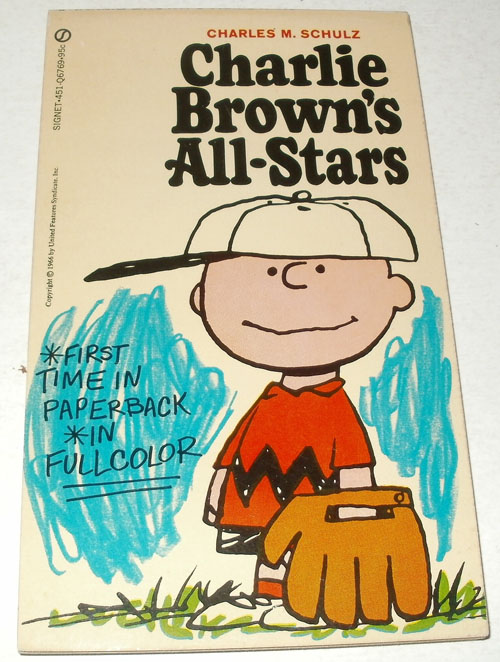
 Directed by Bill Melendez and written by Charles M. Schulz, with animation by Ed Love, Bill Littlejohn, and others, Charlie Brown’s All-Stars!, like the Christmas special that preceded it, does perfect work of melding Schulz’s comic strip panels with the world of animation.


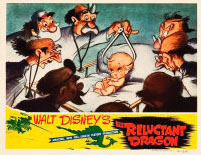 In the style of an “animatic”, essentially told using still storyboard drawings, Baby Weems tells the tale of an infant who is born able to speak and quickly becomes a worldwide sensation. This section itself caused a sensation among the artists in the animation industry – and it was not forgotten. It proved a charming, original animated film could work for an audience using only very limited movement, a technique that was used during the war to produce animation faster for military, educational – and later on, cartoons made for television.
  After, Norm Ferguson animates Pluto for Benchley when Humphrey arrives, taking Benchley to see Walt, who is in the screening room.


 “The Land of Fun” (1941), Columbia – suggested by Paul Groh

 So begins this Peanuts adventure, which actually opens on the first day of school and “flashes back” to summer vacation, as Charlie Brown (Peter Robbins), Linus (Glen Gilger), Lucy (Pamelyn Ferdin), and the gang write their essays about summer vacation when they were all together at camp.


 The 1949 song reached Billboard’s Top 10 and became an Easter standard, making it an obvious choice for Rankin/Bass to adapt as a holiday special.


