Login
Login
The labour codes are playing with fire
Walk into any major Indian airport and observe carefully. The CISF personnel who once staffed security and screening posts have been quietly replaced in many functions by private contractual workers. Ask them what they take home every month. You will rarely hear a number above Rs 25,000, and often it is closer to Rs 15,000. On paper, their salaries may be higher, but the outsourcing agencies that deploy them have their own disbursement arithmetic, and the worker bears the brunt of every deduction.
If this is the reality in one of the most visible public spaces in the country, where the state itself is the ultimate client, imagine the condition of a blue-collar worker in a nondescript factory in a mofussil town or a peripheral industrial estate. It is these workers who needed protection most urgently, and it is precisely these workers whom the Modi government’s four new labour codes have left the most exposed. Central rules for the new codes, implemented in November 2025, were notified earlier this month (on 8–9 May).
That’s not simplification; it’s legalising exploitation in the language of reform.
The consolidation of 29 labour laws into four codes is being marketed as a landmark achievement. Overlapping, contradictory statutes did impose real compliance burdens, especially on small businesses. Some of these changes have merit — for instance, universal minimum wages, formal recognition of gig workers and mandatory appointment letters. But reforms must be judged not by stated intentions but their architecture and these codes tilt structurally towards capital and corporate interests.
An honest reading of labour reforms must also reckon with three decades of post-liberalisation experience. The labour law changes of the 1990s were based on an understanding that stringent pro-worker regulations led to lower investment, employment and productivity in registered manufacturing. It was a well-documented pattern, captured by the Besley-Burgess analysis of Industrial Disputes Act amendments between 1958 and 1992. This research became the intellectual scaffolding of the reforms.
But over the next 30 years, the informal sector in fact expanded. Wages stagnated while corporate profits soared. The lesson was that worker protections are not bad per se for industry. It is badly designed, inconsistently enforced regulations that create perverse incentives.
The most consequential changes
The provision that reveals the true character of the new labour codes is the trebling of the retrenchment approval threshold from 100 to 300 workers. Under the old Industrial Disputes Act, any establishment employing 100 or more workers required government approval before retrenchment, layoff or closure. The new threshold of 300 means that more than 80 per cent of India’s manufacturing establishments can now hire and fire without any government oversight. No accountability, no protection for the worker.
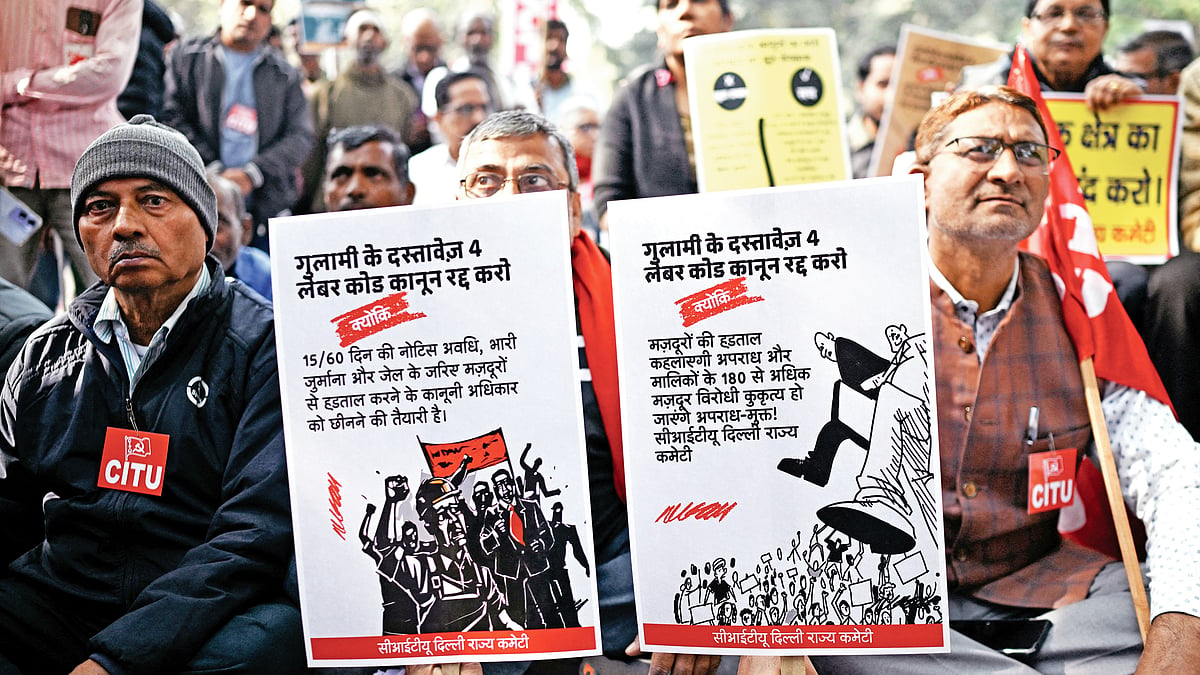
The codes also require workers to give 60 days’ notice before a strike plus a cooling-off period of 14 days. It effectively takes away their right to spontaneous collective action. In addition, a workers’ union must now command 51 per cent membership to be formally recognised, a threshold that sidelines smaller unions and reduces representation for diverse worker groups. Rules governing working hours, leave and termination will not apply to establishments with fewer than 300 workers, leaving out most of India’s industrial units.
Workers in small factories will be most vulnerable, with the threshold for defining an industrial unit as a ‘factory’ now raised to 20 or more workers (for units with power) and 40 or more workers (for units without). Wage offences can now be settled by paying a fee, effectively monetising illegality and turning violations into a manageable business cost.
What the codes ignore
The new codes have been notified at a time when the labour market is already in deep crisis. Real wages in rural India have grown at close to zero per cent since 2014. Regular wages, according to the government’s own Periodic Labour Force Survey, contracted between FY22 and FY24, even as GDP grew at 6.7 per cent.
While salaries and wages stagnated (about 57 per cent of India’s blue-collar workers get less than Rs 20,000 a month), the profits of the Nifty 500 companies grew at 34.5 per cent a year compounded between 2020 and 2024.
The government’s argument that worker protections suppress productivity is false to the point of dishonesty. Productivity is not a single-variable outcome. The ILO-recognised KLEMS framework for measuring productivity captures capital, labour, energy, materials and services as determinants of output. It requires that labour be measured not just quantitatively but in quality terms: education, skills, occupational profile.
In this framework, an economy that cheapens labour may generate short-term cost advantages for individual firms, but it reduces aggregate productivity through skill erosion and demand suppression.
The new codes pay no attention to these factors. The Modi government has put out no white paper or approach document that analyses the relationship between labour regulation, wages and multi-factor productivity. There has been no transparent, evidence-based policy dialogue. When its own Economic Survey 2024-25 acknowledges underemployment, this constitutes a big governance failure.
IT, gig workers and the invisible precariat
The crisis extends well beyond factory gates. India’s IT sector, with 5.4 million employees and over $250 billion in annual exports, operates in a near-vacuum of labour laws. Mass layoffs in 2023 and again in 2025-26, attributed to AI-driven restructuring, occurred without any meaningful state intervention. There is no effective trade union in the sector. Non-compete clauses, variable pay and immediate termination provisions are standard. The new labour codes change none of this.
India’s 12 million-strong gig workforce is projected to reach 23.5 million by 2030. Its formal recognition in the codes is a step forward, but aggregators contributing 1-2 per cent of turnover to welfare funds, while setting rates that require 14- to 16-hour work days to earn a living wage is not social security, it’s eyewash.
The proposed 90-day qualifying period for benefits will exclude millions of multi-platform and seasonal workers. Algorithmic de-boarding, which means that a worker can be blocked from an app without notice or human review, has no legal remedy anywhere in the four codes.
The codes also neglect the large numbers in precarious white-collar jobs in retail, financial services, hospitality and media, where employees have long work hours without overtime and ‘performance-linked’ pay that frequently short-changes them. Nor have they any unions to represent their case or an institutional voice to safeguard their interests.
The democratic subtext
There is a dimension to this debate that goes beyond economics. Labour unions and student movements were historically the nurseries of India’s democratic leadership. Over the past three decades, both have been systematically marginalised.
To restore the health of India’s democracy, these institutions must be revived. The BJP will never champion that cause. Precisely why the Congress and the Opposition must fight for the restoration of labour rights — as a constitutional entitlement, as the centrepiece of an alternative political vision.
What must change
The codes need an overhaul. The retrenchment threshold must be restored to 100 workers or replaced with tiered, enforceable protections. The 51 per cent union recognition threshold must give way to proportional representation. The 60-day strike notice must go; it is unconstitutional.
A meaningful National Minimum Wage, consistent with the Anoop Satpathy Committee’s recommendation of Rs 375 per day at 2019 prices and indexed to inflation, must be enacted and enforced. An Algorithmic Accountability Act must require platforms to disclose the logic of automated work allocation, pricing and disciplinary decisions.
A Universal Social Security Fund must cover all forms of employment, including gig, platform, contract and informal work. And an independent National Commission on Labour Productivity must be constituted to produce a public white paper on what drives India’s productivity gap, before any further legislative changes are made.
The recent labour agitations in Noida, Surat, Haldwani, Manesar, Gurugram, Faridabad, Bhiwandi were not local grievances; they were the portents of a nationwide uprising. The workers were telling us what to expect when wages are suppressed for a decade, when protections are stripped away, and the right to organise is systematically weakened. The government turned a deaf ear then. If it doesn’t pay heed even now, as the new labour codes seem to indicate, it is preparing the ground for a mass upheaval.
Views are personal
Gurdeep Singh Sappal is a Permanent Invitee to the Congress Working Committee. More by the author here