Senate Democrats on Thursday blocked Republicans' attempt to pass a short-term extension of the nation's spy powers by unanimous consent. Sen. Tom Cotton (R-Ark.) asked the chamber for unanimous consent to extend Section 702 of the Foreign Intelligence Surveillance Act (FISA) until July 2, but Sen. Ron Wyden (D-Ore.) objected. Wyden also objected to a...
The US consulate in Hong Kong displayed commemorative candles in its windows on the 37th anniversary of the Tiananmen crackdown on Thursday, while other diplomatic missions paid tribute with social media posts.
Candles in the windows of the US Consulate General in Hong Kong on June 4, 2026, the 37th anniversary of the 1989 Tiananmen crackdown. Photo: Kyle Lam/HKFP.
Candles in the windows of the US Consulate General in Hong Kong on June 4, 2026, the 37th anniversary of the 1989 Tiananmen crackdown. Photo: Tom Grundy/HKFP.
Hundreds, perhaps thousands, died when the People’s Liberation Army cracked down on protesters around Beijing’s Tiananmen Square in 1989.
Candles in the windows of the US Consulate General in Hong Kong on June 4, 2026, the 37th anniversary of the 1989 Tiananmen crackdown. Photo: Tom Grundy/HKFP.
Hong Kong used to be one of the few places on Chinese soil where annual vigils were held to commemorate the people who died in the 1989 crackdown.
Candles in the windows of the US Consulate General in Hong Kong on June 4, 2026, the 37th anniversary of the 1989 Tiananmen crackdown. Photo: Tom Grundy/HKFP.
But police banned the gathering at Victoria Park for the first time in 2020, citing Covid-19 restrictions, and imposed the same ban the following year.
Candles in the windows of the US Consulate General in Hong Kong on June 4, 2026, the 37th anniversary of the 1989 Tiananmen crackdown. Photo: Tom Grundy/HKFP.
No official commemoration has been held since the vigil organiser, the Hong Kong Alliance in Support of Patriotic Democratic Movements of China, disbanded in September 2021. Its leaders were arrested and are currently on trial.
Candles in the windows of the US Consulate General in Hong Kong on June 4, 2026, the 37th anniversary of the 1989 Tiananmen crackdown. Photo: Tom Grundy/HKFP.
Currently occupying Victoria Park – historically the site of Hong Kong’s vigils – is a five-day patriotic carnival organised by pro-Beijing groups.
Diplomatic commemorations
Earlier on Thursday, Britain’s embassy in China shared a social media post featuring an animation with scenes from the bloody crackdown. It was shared without commentary.
Photo: UK in China, via X.
The British consulate in Hong Kong posted a reel of a mobile phone held aloft with its torch on, apparently referencing the candlelit vigils.
Photo: UK in Hong Kong via Facebook.
Washington’s mission in Beijing shared a quote from US Secretary of State Marco Rubio stating: “Those who sacrificed to uphold their unalienable rights of free expression and peaceful assembly will be vindicated someday.”
Photo: U.S. Mission to China, via Facebook.
In response, China’s Foreign Ministry spokesperson Mao Ning said Beijing had “long since reached a clear conclusion regarding that political turmoil that occurred in the late 1980s.”
Chinese foreign ministry spokesperson Mao Ning. File photo: China’s Ministry of Foreign Affairs. Photo: China gov’t.
The Canadian consulate in Hong Kong shared a Facebook post, which read: “Today, Canadians honour the memory of all who lost their lives, were injured or went missing during the Tiananmen Square crackdown on June 4, 1989. Canada stands with the survivors and the families and loved ones who continue to demand accountability.”
Photo: Consulate General of Canada in Hong Kong & Macao via Facebook.
Meanwhile, the Australian consulate in Hong Kong shared on Facebook a photo of candles and a statement reading: “Today, we stand with communities worldwide in remembering those who lost their lives at Tiananmen Square on 4 June 1989. Australia remains steadfast in its commitment to upholding human rights, including freedom of association, of expression, and of political participation.”
Photo: Australian Consulate-General Hong Kong and Macau, via Facebook.
In June 2019, then-leader Carrie Lam said that the city’s annual vigils were “proof that Hong Kong is a free place.”
A Hong Kong court is now hearing a landmark trial of the Alliance and two vigil leaders, Chow Hang-tung and Lee Cheuk-yan. They are accused of “inciting subversion” under the national security law, an offence that carries a maximum penalty of 10 years behind bars.
A Hong Kong Tiananmen vigil activist standing in a national security trial has urged the court to safeguard the “dignity and bottom line of the law,” as she warned judges not to become “accomplices” in an alleged government crackdown on free speech.
The candlelight vigil commemorating the 1989 Tiananmen crackdown in Beijing, in 2018. File photo: Kris Cheng/HKFP.
Chow Hang-tung, a former leader of the now-defunct Hong Kong Alliance in Support of Patriotic Democratic Movements of China, said that authorities have been “reshaping” the city’s long-held values by prosecuting activists who advocate for democracy in China.
Her statement to the court was made on Tuesday as the prosecution and the defence completed their closing arguments. The three-judge panel said they hope to deliver a verdict in “mid or late July.”
Chow is representing herself in the trial, in which she faces a charge of inciting subversion under the Beijing-imposed national security law alongside the Alliance and Lee Cheuk-yan, another former leader of the group. The offence carries a maximum penalty of 10 years behind bars.
Prosecutors accuse the Alliance of inciting others to topple the ruling Chinese Communist Party (CCP) through its calls to “end one-party rule” in China, a key tenet of the group since its founding in 1989 after the Tiananmen crackdown in Beijing.
Delivering closing arguments on Tuesday, Chow said the crux of the case was whether the law protects the “perpetual rule” of the CCP or the rights of people to advocate democracy.
“Ending one-party rule means putting an end to the status quo, in which those in power are not bound by the law,” she said in Cantonese.
‘Unheard of’
Prosecutors previously argued that the Alliance’s calls breached China’s constitution, after a 2018 amendment stipulated that the CCP’s leadership is the “defining feature” of the country’s “fundamental” socialist system.
Chow argued on Tuesday that the CCP’s leadership is merely “symbolic” under China’s constitution, as the text has not demarcated the party’s power and function.
A Correctional Service Department vehicle arrives at the West Kowloon Law Courts Building on January 22, 2026. Photo: Kyle Lam/HKFP.
“King Charles III is also the leader of his country, but he has no real power,” she said, drawing an analogy to the UK’s constitutional monarchy.
Instead, it is a reality that the CCP is in power, she said. The Alliance’s advocacy aimed at creating “favourable conditions” for the country’s democratisation, not toppling the regime, she added.
She argued it was “unheard of” that a government would accuse its citizens of breaching the constitution.
“Any document that can be called a constitution in the world is to restrict the operation of power, not ordinary people,” she said.
Citing the trial of former South Korean president Chun Doo-hwan, who was responsible for the country’s bloody crackdown of the Gwangju uprising in 1980, Chow said it was those who sought to concentrate power that were ruled to have breached the constitution.
‘Accomplice’
She also dismissed the prosecution’s claim that the only “reasonable and natural effect” of the Alliance’s calls was an incitement of others. Her group was merely making political criticism and had not called for action, she said.
She argued that the charge against her demonstrated the government’s “paranoia” and its attempt to silence those making unfavourable opinions, adding that the defendants wholly believed in their advocacy.
If the court found the defendants guilty, that would prohibit the political freedom that the city has long championed, she said.
From left: Lee Cheuk-yan, Albert Ho, Chow Hang-tung. Photos: HKFP.
“If the court cannot rigorously draw a line for what is the reasonable and natural effect [of political speech], it will easily become an accomplice in the authorities’ crime,” she said. “What is on trial is actually the law itself.”
Senior counsel Priscilia Lam, representing the Alliance, argued the prosecution had not been able to present evidence of the group’s alleged incitement to subversion.
“What did the Alliance do to incite people to subvert state power?” Lam said in Cantonese. “I have heard nothing on this after sitting here for so long.”
For decades, the Alliance organised vigils at Victoria Park to commemorate the 1989 Tiananmen crackdown in Beijing, when hundreds, perhaps thousands, were killed as troops dispersed pro-democracy demonstrators in and around Tiananmen Square.
The Alliance disbanded in 2021 after authorities banned the vigil for two years, citing Covid-19 restrictions, and arrested its leadership on national security allegations. Chow and Lee have been behind bars since September 2021.
Another defendant, former lawmaker Albert Ho, pleaded guilty when the trial opened in January.
President Trump has appointed Bill Pulte, an unqualified individual with no experience in intelligence or national security, as Acting Director of National Intelligence, prioritizing his own self-interest over America's national security.
A Hong Kong government proposal that will allow the city’s leader to certify criminal acts as national security offences is intended to “make the law clear,” Chief Executive John Lee has said.
Chief Executive John Lee at a press conference on January 27, 2026. Photo: Kyle Lam/HKFP.
Speaking at a press conference on Tuesday, Lee said the new subsidiary legislation for Hong Kong’s homegrown national security law, the Safeguarding National Security Ordinance, commonly known as Article 23, “is purely to make the law even clearer.”
Shortly after, Lee approved the subsidiary legislation during a meeting with the Executive Council, the city’s top decision-making body.
Under the new law, which was gazetted and came into effect the same day, the chief executive will be able to certify “other offences endangering national security.”
Criminal cases classified as endangering national security will have tougher court procedures, such as a higher bar for bail and trial before designated judges.
“The purpose of introducing the subsidiary legislation is to make it clear, make it much, much clearer, how offences… endangering national security under the law of Hong Kong will be so classified,” Lee told reporters on Tuesday.
“It is not intended and will not expand the definition of the offences, and it’s not adding any new offences or any new powers or punishments. It also does not expand the scope of the application of the law,” he added.
‘Sensitive’ information
Lee said the new piece of legislation would reduce “controversy or debate in court” about what constitutes national security offences.
Asked whether he was concerned about giving an impression of further centralising power into his hands, Lee said the city’s chief executive must shoulder the “important responsibility” of safeguarding national security.
Lee said he would exercise the new power with “prudence and seriousness,” but added that, as city leader, he has access to exclusive information regarding threats to national security.
A lot of activities endangering national security “are committed by state players of another place. They are professional, sophisticated, and the series of information that may be available to indicate the seriousness of the matters [is] privy to the chief executive,” he said.
“A lot of this information is sensitive and not suitable for public disclosure,” he added.
Under the government proposal, the certificate issued by the chief executive will be binding on the city’s courts and cannot be challenged.
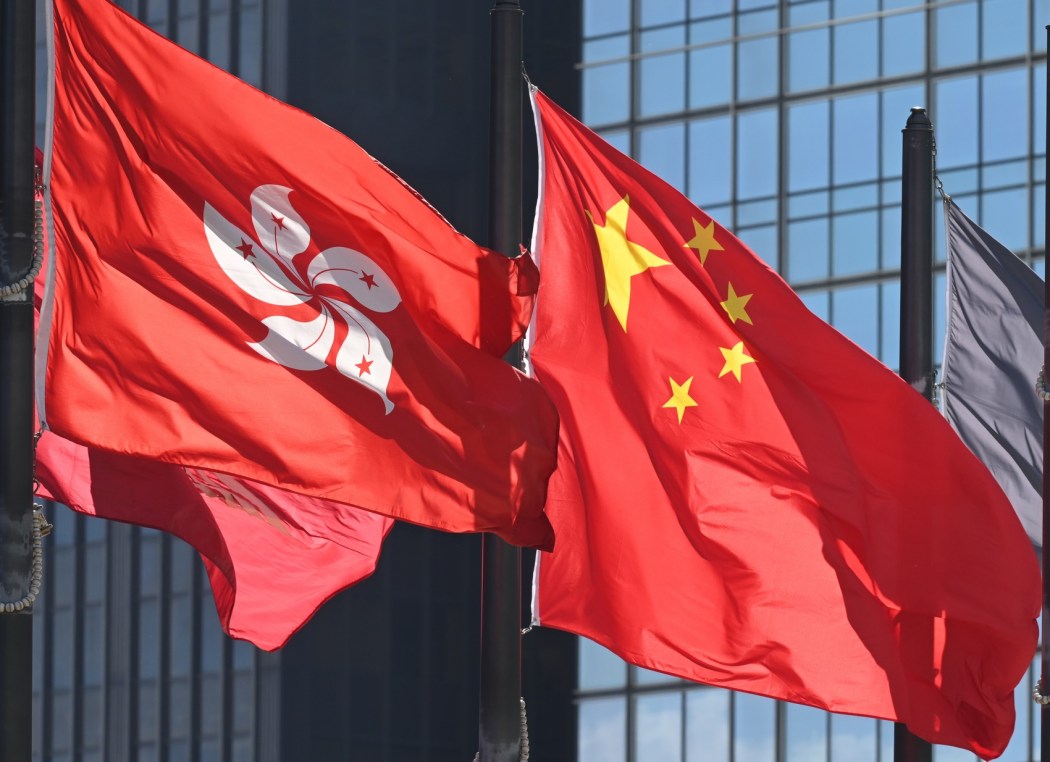
China’s national flags and Hong Kong flags are displayed in the city on September 30, 2025, a day before the 76th anniversary of the People’s Republic of China. Photo: Kyle Lam/HKFP.
Speaking to reporters on Monday, Secretary for Justice Paul Lam said the designation of national security offences involves “highly confidential” information that would not be available to the courts.
“The judiciary would not be capable of making such a decision,” Lam said.
Asked whether the chief executive’s certificates will be announced, Lam only said “people will know” as court proceedings are open to the public.
“If you see designated judges or other special arrangements in a trial, you will know” that the case has been designated as relating to national security, he said.
Two out of three journalists say the working environment in Hong Kong has changed “for the worse” in the past year, according to the latest survey by the Foreign Correspondents’ Club.
Journalists outside Wan Chai’s District Court, on August 29, 2024. Photo: Kyle Lam/HKFP.
The 2026 FCC Press Freedom Survey, which received 78 responses from members, found that “67 per cent of respondents said the working environment for them as a journalist had changed for the worse in the last 12 months.”
The FCC pointed out that the survey “happened to take place” after Apple Daily founder Jimmy Lai was convicted and sentenced to jail, as well as Beijing’s national security office in Hong Kong, the Office for Safeguarding National Security (OSNS), summoned representatives of several major foreign media outlets, shortly following the deadly Wang Fuk Court fire.
At the meeting, the OSNS warned that some media organisations had spread false information and smeared the government in reports on the massive blaze at the housing estate in Tai Po, which killed 168 people and displaced thousands of residents.
‘Watershed moment’
One respondent said that the warning by the OSNS to foreign journalists “should be seen as a watershed moment here in Hong Kong. It has created an increased chilling effect.”
About a quarter of respondents said they experienced minor or significant interference in their work, with most describing incidents while covering the Tai Po fire. One journalist said they were told to leave when they were “speaking to survivors in a corner, disturbing no one.”
A resident in Wang Sun House, Wang Fuk Court, on April 20, 2026. Photo: Kyle Lam/HKFP.
Another respondent said that the 20-year sentence handed down to Lai “only further chills the local reporting environment.”
More than 50 per cent said sources had become less willing to be quoted during the same period, the survey found.
One respondent was quoted as saying that “the scope of what is ‘acceptable’ in terms of who can be quoted” has narrowed each year.
“It has reached the point where non-political voices who question policy-making or have reservations about certain aspects of it will get cut or reduced significantly by editors,” the respondent added.
Fewer respondents had a clear sense of what subjects are sensitive in the most recent survey, down from 78 per cent last year to 65 per cent this year, with one respondent saying the Beijing-imposed national security law “is still rather fluid and capricious.”
Half of the respondents said they were “slightly concerned” about arrest or prosecution in relation to their work as journalists, while 41 said they were not. The remaining 9 per cent said they were very concerned.
The Foreign Correspondents’ Club, Hong Kong. Photo: Kelly Ho/HKFP.
A third of respondents said their organisations had downsized in Hong Kong. Among them, a third cited the political and legal environment as well as corporate cost-cutting.
But 17 per cent of respondents said their organisations had increased staff in the city, with 40 per cent of them citing “the growing importance of Hong Kong” and increased investment.
“Press freedom remains engrained in Hong Kong law, but as is apparent from the results of our survey, the sentiment for working journalists in the city has been in flux,” said FCC President Morgan Davis.
“The FCC supports journalists’ fundamental right to conduct their work freely and without fear of intimidation or harassment,” the club said in its statement.
“We will continue to safeguard press freedom in the city, via engagement with the journalism community and relevant stakeholders, in order to make sure that Hong Kong remains an international hub for media, business and finance.”
The Hong Kong Economic and Trade Office in London. Photo: Wikimedia Commons.
“From the outset, the Hong Kong Special Administrative Region (HKSAR) Government has been clearly stating that the allegations in this case are absolutely not related to the HKSAR Government and the Hong Kong Economic and Trade Office in London (London ETO), nor are we party to the case,” a government statement sent to the media on Friday morning read.
“We firmly oppose any unfounded allegations against the HKSAR Government and the London ETO.”
The statement was issued shortly after Bill Yuen, an office manager at the Hong Kong Economic and Trade Office in London, and former UK Border Force official Peter Wai were found guilty under Britain’s national security laws of assisting a foreign intelligence service.
Yuen and Wai – both British-Chinese dual nationals – were accused of spying on Hong Kong pro-democracy activists living in Britain.
From left: Hong Kong Economic Trade Office (HKETO) official Bill Yuen and former UK Border Force officer Peter Wai. Photos: Metropolitan Police.
Among those the pair were said to have surveilled was Nathan Law, who is wanted by national security police in Hong Kong with a bounty of HK$1,000,000.
Yuen and Wai were charged in May 2024 alongside a third person, UK immigration officer Matthew Trickett. A week after Trickett was charged, he was found dead in a suspected suicide.
According to a statement by UK counter-terrorism police, published after the guilty verdict on Thursday, Yuen had been receiving tasks from Hong Kong authorities and delegating them to Wai and Trickett.
Up to 14 years jail
Yuen and Wai were found guilty by a 10-2 jury verdict on Thursday. Wai was also found guilty of misconduct in public office in relation to abusing Home Office systems while working as a border control officer.
Yuen and Wai will be sentenced on a date yet to be determined. They face up to 14 years in jail.
A Chinese national flag and a Hong Kong SAR flag in Hong Kong. Photo: GovHK.
According to the Friday statement, Hong Kong has 15 overseas ETOs in different cities, including the UK capital.
The London office maintains “close liaison with interlocutors in government, business, think tanks and various sectors to enhance the bilateral ties between Hong Kong and the UK in areas including trade, investment, and arts and culture,” it said.
After the guilty verdict, the UK said that it would summon the Chinese ambassador.
“We will continue to hold China to account and challenge them directly for actions which put the safety of people in our country at risk,” UK Security Minister Dan Jarvis said on Thursday. “That is why the Foreign Office will summon the Chinese Ambassador to make it clear activity like this was, and will always be, unacceptable on UK soil.”
In a statement issued the same day, the Chinese embassy in London condemned the verdict, saying that the UK had manipulated the judicial process as part of its “political move.”
“Its sole purpose is to embolden those anti-China elements who are hiding in the UK and bent on destabilising Hong Kong, and to smear the Chinese government and the Hong Kong SAR government,” it said.
Activists have shown up in Causeway Bay, defying a heavy police deployment at and around the former site of Hong Kong’s commemorative Tiananmen crackdown vigils.
Hong Kong police set up a roadblock in Causeway Bay on June 4, 2026, the 37th anniversary of the 1989 crackdown in Beijing. Photo: Kyle Lam/HKFP.
Large numbers of uniformed and plainclothes officers were seen in Victoria Park – where the Tiananmen vigils were held for decades – and around Causeway Bay on Thursday, the 37th anniversary of the 1989 crackdown.
Hong Kong police set up a roadblock in Causeway Bay on June 4, 2026, the 37th anniversary of the 1989 crackdown in Beijing. Photo: Kyle Lam/HKFP.
A “Sabertooth” police armoured vehicle was spotted in the afternoon near Times Square, as officers set up a roadblock at the intersection of East Point Road and Great George Road.
Exits from Causeway Bay MTR Station were also guarded by officers.
The Tiananmen crackdown occurred on June 4, 1989, ending months of student-led demonstrations in China. It is estimated that hundreds, perhaps thousands, died when the People’s Liberation Army cracked down on protesters in Beijing.
Hong Kong activist Lui Yuk-lin walks and chants a Buddhist mantra in Causeway Bay on June 4, 2026. Photo: Kyle Lam/HKFP.
At around 5pm, activist Lui Yuk-lin walked from Great George Street in Causeway Bay towards Victoria Park. She pressed her hands, wrapped in a black cloth, in a prayer gesture, while chanting the Great Compassion Mantra.
Hong Kong activist Lui Yuk-lin walks and chants a Buddhist mantra in Causeway Bay on June 4, 2026. Photo: Kyle Lam/HKFP.
Bowing every few steps, Lui walked through the park towards Tin Hau and returned to Causeway Bay. The activist said she bowed 37 times in the 40-minute walk.
Hong Kong activist Lui Yuk-lin walks and chants a Buddhist mantra in Causeway Bay on June 4, 2026. Photo: Kyle Lam/HKFP.
Some police officers followed the activist and occasionally held a cordon around her as she walked and chanted.
Lui told reporters that she would be leaving Causeway Bay at 8pm to comply with a police warning. “I’m leaving, I’m leaving,” she said, before police officers swarmed her and escorted her to the MTR station.
Another woman was seen gesturing “six” and “four” with her hands at around 6pm on Great George Street in Causeway Bay, The Collective reported. Police officers at the scene warned her that her behaviour could be “seditious”. They pressed her hands down and took her away in a police vehicle.
At around 6.30pm, Chan Po-ying, chairperson of the now-defunct League of Social Democrats, a pro-democracy party, appeared in Causeway Bay with a yellow paper flower.
Activist Chan Po-ying appears in Causeway Bay with a yellow paper flower on June 4, 2026. Photo: Kyle Lam/HKFP.
Police at the scene warned Chan that her behaviour might constitute “disorder in public places” and told her to put the flower in her bag.
Activist Chan Po-ying appears in Causeway Bay with a yellow paper flower on June 4, 2026. Photo: Kyle Lam/HKFP.
Officers then took her away in a police vehicle.
A man was surrounded by police officers on Paterson Street after being spotted holding a candle at around 7pm.
A man holding a candle is surrounded by police in Causeway Bay on June 4, 2026. Photo: Kyle Lam/HKFP.
While being searched, he asked whether he was being arrested and said that he did not have to comply with their orders if he was not under arrest. “I know my rights,” he said.
After he asked again whether he was under arrest, an officer said, “Disorderly conduct,” and they escorted him into a police van.
A young man in a black T-shirt was intercepted by police after he put on a blindfold and used a red marker pen to write on his arm outside the Sogo department store at around 7.15pm.
A young man in a black T-shirt puts on a blindfold and writes on his arm with a red marker pen on June 4, 2026. Photo: Kyle Lam/HKFP.
Despite being surrounded by police, he continued the act until he was ordered to stop. Moments later, he was taken into a police vehicle.
A young man in a black T-shirt is intercepted by police and pulls out what appears to be China’s constitution on June 4, 2026. Photo: Kyle Lam/HKFP.
Before he got into the van, he pulled out a small red book that appeared to be China’s constitution.
A young man in a black T-shirt is intercepted by police on June 4, 2026. Photo: Kyle Lam/HKFP.
The same man was spotted in Causeway Bay on the past two Tiananmen crackdown anniversaries and was taken away by police on both occasions.
In 2025, he appeared at Victoria Park, wearing a T-shirt saying, “Core Values of Socialism.” In 2024, he showed up at the patriotic food carnival wearing a T-shirt bearing the iconic picture of revolutionary leader Che Guevara. He was escorted away by the carnival’s security guards and later taken into a police vehicle.
A man in a white T-shirt was taken into a police vehicle at around 8pm after sitting cross-legged on the ground outside the Sogo department store.
A man in a white T-shirt is taken into a police vehicle after sitting cross-legged on the ground outside the Sogo department store in Causeway Bay on June 4, 2026. Photo: James Lee/HKFP.
A 70-year-old man, who gave only his surname, Tin, told HKFP that he came to Victoria Park this year to commemorate the crackdown alone, calling it a “pity” that the annual vigils were no more.
The vigils “showed Hong Kong’s freedoms, that we could speak our opinions freely,” Tin said as he walked around the perimeter of Victoria Park’s football pitches. The site, where the vigils were once held before Beijing imposed a national security law in 2020, is currently hosting a five-day patriotic food carnival.
“Now this freedom has been restricted, and no one dares to say anything critical across society,” he added.
Both plainclothes and uniformed police deployed in Victoria Park and other parts of Causeway Bay on June 4, 2026. Photo: Kyle Lam/HKFP.
Tin noted that police presence at the park on Thursday was less heavy-handed than in previous years, when police told him to turn off his phone torch.
But he also said fewer and fewer people had shown up in Victoria Park on June 4, expressing concern that the public memory of the crackdown may wane in the future.
E-commerce shop As One, operated by former district councillor Derek Chu, continued to distribute candles this year on June 4. Meanwhile, Hunter Bookstore, run by ex-district councillor Leticia Wong, sold candles at HK$6.4 each.
A man with flowers in Causeway Bay on June 4, 2026. Photo: Kyle Lam/HKFP.
Pastor Grace Bok of the One Body of Christ Church said she and a group of friends decided to come to Victoria Park for a “walk” at around 10pm.
Bok said that while many feared the heavy police presence in the area, coming to walk around the former vigil venue should be permitted as a form of commemoration.
“It is your own activity, your own way to remember,” she told HKFP in Cantonese. “People should be allowed to remember.”
As night fell, the mood at Victoria Park appeared festive, with music pouring out of the patriotic Hometown Market Carnival.
The patriotic Hometown Carnival Market on June 4, 2026. Photo: Kyle Lam/HKFP.
For the fourth consecutive year, the food carnival is being held in Victoria Park in the week of the crackdown anniversary.
Police officers patrolled the perimeter of the park in small groups, while two robodogs dressed in lion dance costumes and a humanoid robot walked around the market.
Two robodogs dressed in lion dance costumes walk around the patriotic Hometown Market Carnival on June 4, 2026. Photo: Hans Tse/HKFP.
Police officers patrol Victoria Park on June 4, 2026. Photo: Kyle Lam/HKFP.
While the police presence remained heavy inside and around Victoria Park this year, officers appeared more tolerant of commemorative acts.
A woman is being searched by plainclothes police in Hong Kong’s Causeway Bay on June 4, 2026. Photo: Kyle Lam/HKFP.
They patrolled in smaller groups than in previous years and did not search as many people as before.
Police officers are deployed in Causeway Bay on June 4, 2026. Photo: Kyle Lam/HKFP.
At around 9pm, several reporters interviewed a man who was drawing with a few cans of Kronenbourg 1664 beer beside him. The police’s media liaison officers asked journalists not to block the way, but did not interrupt the interview or the man drawing.
Rights group Amnesty International on Thursday urged the Hong Kong government to release the vigil activists, Chow Hang-tung and Lee Cheuk-yan, ahead of their verdict, which is expected in July.
The group said a global petition with over 52,000 signatures had been handed over to the Hong Kong government, urging the immediate release of the pair.
“This is the seventh year Hong Kong’s Victoria Park candlelight vigil has been extinguished by the authorities. But it cannot be extinguished worldwide. From Hong Kong to diaspora communities worldwide, people continue to keep the memory of 4 June alive with creativity and resilience,” said Fernando Cheung, a former Hong Kong lawmaker and now a spokesperson of Amnesty International Hong Kong Overseas.
In Beijing, authorities reportedly prevented the families of victims who died in 1989 from visiting their graves at Wan’an Cemetery, a move Amnesty International called “a heartless act.”
US Secretary of State Marco Rubio said on Wednesday that “no amount of censorship can erase the past,” according to AFP.
Beijing said on Thursday that Rubio’s remarks “distort historical facts, smear China’s political system and development path, and interfere in China’s internal affairs.”
On Wednesday, Hong Kong performance artist Sanmu Chan was stopped and searched by plainclothes police after showing up in Causeway Bay holding a 6.4-metre-long red string ahead of the Tiananmen crackdown anniversary.
A 55-year-old man has pleaded guilty to making and distributing “seditious” materials, including ones that called for a boycott of the “patriots only” legislative elections last year.
West Kowloon Law Courts Building. File photo: Kyle Lam/HKFP.
Raymond Wong, a construction worker, was charged and brought to the West Kowloon Magistrates’ Courts on Thursday afternoon.
He was arrested by national security police on April 21, a government statement said on Thursday. His arrest was not known to the public before, as police did not issue information about it at the time.
Wong was charged with two counts of “doing with a seditious intention an act or acts that had a seditious intention,” an offence under Hong Kong’s homegrown national security law, also known as Article 23.
According to a court document, Wong allegedly made “paper sheets written with statements” and threw them “into a public space” from a 12th-floor flat in On Tat Estate, a public housing estate in Kwun Tong. The first count of the sedition offence was dated October 2, 2024, and the second one was dated December 5, 2025.
Local media reported that on October 2, 2024, a Kwun Tong district councillor found pieces of paper with phrases including “blow up corrupt police officers” scattered on the estate’s podium. The district councillor called the police and handed over 41 sheets of paper.
On Tat Estate, a public housing estate located in Hong Kong’s Kwun Tong. File Photo: Wikimedia Commons.
On December 5 last year, two days before the “patriots only” Legislative Council elections, a staff member at the estate’s property management company found sheets of paper reading “liberate Hong Kong, do not vote,” also on the estate’s podium.
Police were called, and they seized 16 pieces of paper with seditious phrases. Wong’s fingerprints were found on two of them.
Wong’s case was adjourned to June 9 for sentencing to await his background report, a social welfare report and a psychological report.
Sedition is punishable by up to seven years in jail. If the defendant is found to have colluded with an “external force” when committing the offence, they face a maximum of 10 years behind bars.
Jail terms handed down at the magistrate’s court, however, are capped at two years, or three when a defendant is convicted of more than one offence.
The maximum penalty for sedition was increased in March 2024, when lawmakers passed Article 23. Before that, it was punishable by up to two years, when sedition fell under a colonial-era ordinance.
The Hong Kong government has allocated an additional HK$5 billion to a national security special fund, bringing the total amount to HK$18 billion.
The funding is the third allocation for national security since Beijing imposed the national security law in Hong Kong in June 2020.
Hong Kong’s Security Bureau organises a flag-raising ceremony on June 22, 2025, to mark the fifth anniversary of the national security law. Photo: GovHK.
The government unveiled the funding on Friday, when it gazetted the government accounts for the fiscal year 2025-26.
It showed a HK$5 billion allocation for non-recurrent expenditure as special funding for safeguarding national security.
Hong Kong established the special fund in 2020 to finance expenses related to safeguarding national security after the national security law took effect in June that year.
The latest allocation thus brought the total amount to HK$18 billion.
In response to Ming Pao’s enquiry, the Financial Secretary’s Office said authorities will not disclose details of the funding, citing Article 14 of the national security law. It did not respond to whether the previous HK$13 billion funding had been depleted.
According to Article 14 of the national security law, no institution, organisation, nor individual in Hong Kong shall interfere with the work of the Committee for Safeguarding National Security, and information relating to its work shall not be subject to disclosure.
The Hong Kong government’s 2025-26 accounts show HK$5 billion is allocated to a special fund for safeguarding national security. Photo: HKFP screenshot.
The government said in July that it would not disclose any details of the special fund in a report to the legislature on the control and management of the special fund, citing the same article of the national security law.
It said authorities had established “a dedicated accounting and financial unit” in the secretariat of the Committee for Safeguarding National Security.
“The unit, which reports directly to the [financial secretary], is responsible for the revenue and expenditure arrangements and financial matters relating to such work,” the government said.
The looming deadline to renew the nation's warrantless spy powers is clashing with a pressure campaign on the White House to yank the appointment of Bill Pulte, a controversial figure tapped to lead the intelligence community. A growing number of Democrats have said they will not vote to renew Section 702 of the Foreign Intelligence...
Podcaster Joe Rogan said the deployment of Immigration and Customs Enforcement (ICE) officers across the country by the Trump administration sets a “dangerous precedent.” “A different ruler could use this precedent in a very damaging way for our free society. That's my perspective on it,” Rogan said during the Wednesday episode of his podcast. “It's...

 Login
Login