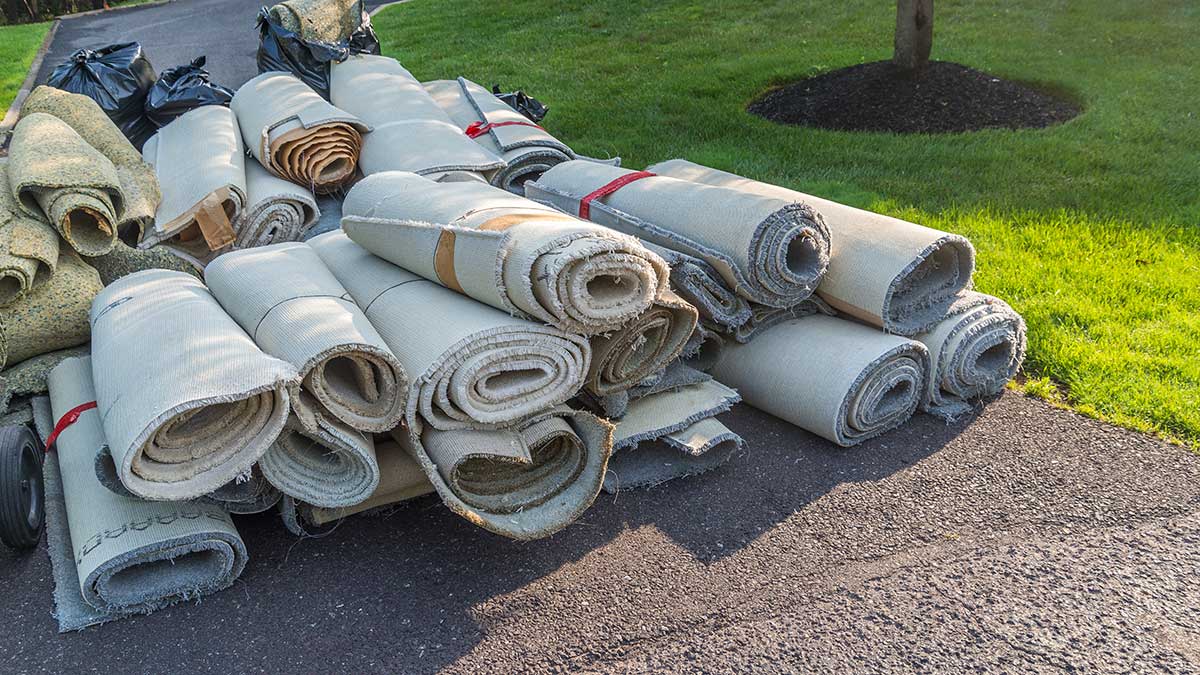
On average, each American throws away about 81 pounds of clothing, shoes, and household textiles every year. That’s roughly a hamper full every month for each person. For a family of four, this adds up to over 320 pounds of textiles tossed or donated each year. Most people don’t realize how much they discard until they actually weigh it over a year.
The number comes from EPA’s most recent, 2018 sustainable-materials accounting, which puts U.S. post-consumer textile generation at roughly 17 million tons and the recovery rate at 14.7 percent. While the EPA has discontinued its reporting, ThredUp’s 2025 Resale Report and the Apparel Impact Institute updates suggest per-capita generation has continued rising. Most of what falls inside that 14.7 percent is downcycled into industrial wiping rags or insulation, not turned into new clothing.
What “donating” actually does
The mental model in most American closets is that the donation bin is the recycling bin. It isn’t. Goodwill, Salvation Army, and the secondhand chains sell what they can on the resale floor, typically only 10 to 30 percent of the clothing they accept as donations. The rest is sold by the pound to textile graders, who export the higher grades to wholesale markets in West Africa, Eastern Europe, and Central America, bale the remainder as wiping rags or insulation feedstock, and landfill the rest.
That export pipeline is under pressure. Ghana, Kenya, and Chile have moved to restrict or refuse low-grade used-clothing imports, citing the volume of unsellable fast-fashion synthetics arriving contaminated and culturally mismatched. The January 2025 GAO report on textile recovery flagged the offshore-disposal pathway as structurally fragile and quietly subsidized by U.S. consumers who treat donation as absolution.
The amount of clothing waste is closely tied to price. Since 1995, clothing prices in the U.S. have dropped by over 30 percent, even as other costs have gone up. This is mainly due to ultra-fast-fashion brands like Shein and Temu. Many clothes, especially those made from polyester-spandex blends, aren’t made to last, be repaired, or recycled. They’re often thrown out after just six wears. According to McKinsey’s State of Fashion report, the average piece of clothing is now worn only seven to ten times before being discarded, much less than in the past.
The household bill
The value of clothing can change a lot, so it’s harder to put an exact dollar amount on waste compared to food. Still, the Bureau of Labor Statistics says the average U.S. household spends about $1,900 a year on clothes. If 30 to 40 percent of those clothes are thrown out within two seasons, that means a household is tossing $570 to $760 worth of new clothing every year.
The environmental impact of clothing is even bigger before it reaches your closet. The UN Environment Programme says fashion is responsible for 2 to 8 percent of global greenhouse gas emissions and 20 percent of industrial water pollution. Making just one cotton t-shirt uses about 2,700 liters of water, which is as much as one person drinks in two and a half years.
The policy lever finally arriving
For years, there were no rules holding clothing producers responsible for textile waste in the U.S. That changed with California’s SB 707, the Responsible Textile Recovery Act of 2024, which is the first law of its kind in the country. CalRecycle chose Landbell USA to run the program starting February 27, 2026. Brands selling clothes and household textiles in California will have to help pay for collection and processing, with requirements rolling out through 2030. Other states like New York, Massachusetts, and Washington are considering similar laws that would make clothing manufacturers cover the costs of fast fashion waste.
Fiber-to-fiber recycling — the missing technology piece — is moving, slowly. Circ, Syre, and Reju are at pilot or first-commercial scale. Renewcell, the most visible name in cellulosic recycling, filed for bankruptcy in early 2024 and has since been acquired and restarted as Circulose. Textile recycling technology is real, but the economics of the business still depend on virgin-fiber prices going higher, the development of a sorting infrastructure, and the kind of policy support SB 707 is now beginning to provide.
What You Can Do
At home and while shopping:
Focus on slowing down how often you buy new clothes, not just buying less. Choose better quality items and wear them for longer. If you double how long you wear each garment, you can cut its total emissions by about half.
Try to fix your clothes before replacing them. Local tailors, Repair Cafés, and repair programs from brands like Patagonia, Nudie Jeans, and Eileen Fisher can help you get more use out of what you already have.
Be honest when sorting your donations. Clean, up-to-date, and resaleable items should go to local thrift stores. Items that are stained or torn should go to textile-specific takeback bins at places like H&M or Madewell, where they can be properly processed.
Before putting anything in your curbside bin, use Earth911’s recycling search to find local textile drop-off locations by ZIP Code. Most curbside bins don’t accept clothing or textiles.
In your community:
Support textile extended producer responsibility (EPR) laws in your state. SB 707 is the example to follow, and the next few states to pass similar laws will help decide if this approach can grow.
Ask retailers to clearly label fiber content and recyclability. The EU will require digital product passports by 2027, and U.S. brands selling overseas will have to comply. Whether these labels appear in the U.S. depends on consumer demand.
Support and volunteer at local repair and reuse programs. Repair Cafés, Buy Nothing groups, and clothing swaps help reduce waste before it starts, which is the most effective way to make a difference.
A solar panel installed this spring will likely still be generating electricity when today’s kindergartners graduate from college. Panels are built to last 25 to 30 years, and the earliest rooftop and utility installations from the 2000s solar boom are now reaching the end of that run.
That first wave of end-of-life panels is the leading edge of a much larger, ongoing challenge, to recover and reuse the materials that convert the sun’s energy into electricity. Nearly everything inside those panels can be recovered and sold back into the supply chain. Today, very little of it is. The International Renewable Energy Agency (IRENA) projects that global solar panel waste could reach 78 million tons by 2050.
The U.S. Environmental Protection Agency expects the United States to generate as much as one million tons of panel waste by 2030 and up to 10 million tons by 2050, the second-largest national total in the world. IRENA estimated in 2016 that the raw materials reclaimable from end-of-life panels will be worth about $450 million globally by 2030 — enough to build some 60 million new panels — and will grow to $15 billion and roughly 2 billion panels’ worth of material by 2050.
What’s In a Solar Panel
Strip a crystalline-silicon module, the type that dominates the solar panel market, down to its components and most of what you find is glass. A panel is roughly 75 percent glass by weight, framed in aluminum and built with copper wiring, polymer layers, a plastic backsheet, the silicon cells themselves, and a junction box. The greatest value sits in the small fraction of these materials: silver, copper, high-purity silicon, plus tin and antimony, and in thin-film panels, tellurium and indium.
Older panels also carry trace lead in their solder, which the reason some are classified as hazardous waste when they break down, as Inside Climate News has reported. Thin-film modules from First Solar and a few others use cadmium telluride, which is stable in the panel but adds its own end-of-life handling requirements. Thin-film remains a small share of the market, under 5 percent globally, so crystalline silicon is the focus of most recycling efforts.
Recovering these materials matters well beyond saving landfill space. Recycled aluminum takes roughly 95 percent less energy to produce than aluminum smelted from ore, and recovered silver and silicon reduce the mining and refining that go into every new panel.
Several of those metals also sit on the U.S. critical-minerals list. The EPA notes that panels can contain aluminum, tin, tellurium, and antimony, with gallium and indium in some thin-film modules, much of which the country currently imports. Recovering them at home converts a disposal headache into a small but genuine piece of supply-chain resilience, and it does so close to where new panels are increasingly being manufactured.
Why So Few Panels Actually Get Recycled
The first obstacle is economics. Sending a panel to a landfill costs about $1 to $5; recycling the same panel runs roughly $15 to $45, according to National Renewable Energy Laboratory figures cited by Chemical & Engineering News (C&EN). Arizona State University researcher Meng Tao, who studies PV recycling, has put the gap plainly to MIT Climate: recycling a panel costs around $20 and yields about $10 to $12 in recovered materials. For a single rooftop system, the math today rarely favors recycling without subsidies.
The technical challenge compounds the financial one. The EPA describes recycling as three escalating steps: remove the aluminum frame and junction box; separate the glass from the silicon wafer using thermal, mechanical, or chemical methods; then purify the silver, silicon, copper, and other metals. Removing the frame is straightforward, and a lot of recycling stops there and the rest gets shredded and sold as low-value glass cullet, C&EN notes. Teasing the glass from the cells and then separating the silver and silicon is far harder, and no single commercial process yet recovers all of it cleanly.
Consequently, the United States currently recycles only about 10 percent of decommissioned panels, while the European Union recovers around 85 percent, according to Public Citizen. The encouraging counter-trend is the rapidly decreasing cost of panel recycling: one industry analysis from Solar Power World reports that the true-recycling costs declined by 42 percent over the past three years, and the most advanced facilities now recover up to 95 percent of a panel’s value.
Landfill vs. recycling a solar panel
Landfill
Recycle
Cost per panel
$1 to $5
$15 to $45 (and falling)
Materials recovered
None
Up to ~95% of a panel’s value: glass, aluminum, silver, copper, silicon
Long-term liability
Lost materials; possible leaching from older lead-soldered panels
Materials returned to the supply chain; lower environmental footprint
U.S. rate today
~90% of decommissioned panels
~10% of decommissioned panels
Reuse offers a partial release valve. Panels that fail early or get swapped out during a system upgrade often still work, and a growing secondhand market resells them at a discount for off-grid, agricultural, and overseas projects. Keeping a working panel in service, or passing it to someone who will, sidesteps the cost-and-complexity problem entirely, which is why reuse remains a bigger share of outcomes compared to recycling.
Public investment is starting to bend the curve, too. The U.S. Department of Energy has funded a slate of PV recycling projects aimed at closing the gap, even as the National Renewable Energy Laboratory has projected that, without faster action, the country would still recycle only about a tenth of its panels by mid-century. The first matters because the second is not inevitable.
The Companies Building a Recycling Industry
A recent market map from MarketsandMarkets lists more than a dozen leading players in solar panel recycling, and reading it closely shows how young and mixed the field still is. It blends three kinds of company: panel manufacturers with their own take-back programs, dedicated PV recyclers, and global waste-management firms moving into the category.
First Solar anchors the first group. The U.S. thin-film manufacturer has run a closed-loop process since 2005, recovering more than 90 percent of each module’s materials in its panels, including the semiconductor itself, for reuse.
Among dedicated recyclers, SOLARCYCLE opened a high-throughput facility in Georgia in 2026 that recovers about 96 percent of a panel’s value — silver, copper, aluminum, and glass — and is scaling toward processing up to 5 gigawatts of panels a year, Solar Washington reports. We Recycle Solar runs a utility-scale plant in Yuma, Arizona, and plans to roughly quadruple its capacity by 2028. In Europe, ROSI, a French company, uses a thermal-and-chemical process to recover high-purity silicon and silver — the toughest materials to reclaim — and recently raised more than $20 million to build a 10,000-ton-per-year facility in Spain. Veolia and Germany’s Reiling round out the European side as larger waste and glass recyclers expanding into PV.
The arrival of so many well-capitalized firms signals that the waste stream is finally large enough to support an industry. The catch is that most of this capacity sits in Europe or at the utility scale, where project owners can absorb the cost, which leaves rooftop owners with fewer easy options for now.
Thin-film (cadmium-telluride) maker that has run its own closed-loop recycling since 2005, recovering more than 90% of each module — including the semiconductor — for use in new panels.
Per-module Recycling Service Agreement (pay-as-you-go); rate not public
Dedicated recycler that recovers about 96% of a panel’s material value (aluminum, silver, copper, silicon, glass), with reverse logistics and ESG reporting for utility-scale projects.
Global crystalline-silicon panel manufacturer included in recycling-market roundups; the source infographic lists it as developing recyclable TOPCon module solutions (manufacturer claim, not independently verified).
High-value recycler using thermal and chemical processes to recover high-purity silicon and silver, plus copper, aluminum, and glass; building a 10,000-ton-per-year plant in Spain.
End-to-end recycler and remarketer of decommissioned panels; runs a utility-scale plant in Yuma, Arizona, with a major capacity expansion planned by 2028.
Solar and semiconductor materials sourcing and project-development firm (polysilicon and wafers, including recycled grades); listed in the recycling roundup for material recovery.
Nanyang Technological University deep-tech spin-off offering PV regeneration (restoring degraded panels) and recycling, plus lifecycle and asset management; technology partner in Singapore’s automated SolaREV facility.
By quote (B2B)
A note on pricing: most of these companies serve utilities, installers, and manufacturers and quote by project, so public per-panel rates are rare.
The Policy Gap
Much of the distance between 10 percent and 85 percent comes down to rules. The EU’s Waste Electrical and Electronic Equipment (WEEE) directive requires panel producers to finance the collection and recycling of every panel they sell in Europe. The United States has no equivalent federal framework.
That is beginning to change, slowly. In October 2023, the EPA announced it would add retired solar panels to its “universal waste” rules, a streamlined category for widely generated hazardous materials such as batteries and pesticides. The proposed rule was originally due in 2025; the agency’s current timeline pushed the proposal to February 2026 and a final rule to August 2027. Until it takes effect, panels can be landfilled as ordinary trash in most states.
A handful of states have moved on their own. Washington created a manufacturer-funded stewardship program that requires producers to take back panels at no cost to the owner, and California classifies end-of-life panels as universal waste requiring specialized handling, as Earth911 has documented. Texas and North Carolina have begun restricting panel disposal as well. For now, what happens to a retired panel depends heavily on where it was installed.
Federal law already reaches panels through the Resource Conservation and Recovery Act. Whoever discards one is technically responsible for determining whether it qualifies as hazardous waste — a determination that hinges on whether metals such as lead leach above regulatory limits in a standardized test. Many intact silicon panels pass and are not hazardous; some, especially older modules with lead-based solder, do not.
For a homeowner, the EPA’s guidance is more straightforward in the meantime: contact your installer or state environmental agency rather than guess.
What You Can Do
Whether you own a single rooftop array or manage a portfolio of sites, end-of-life options are improving. A few practical steps:
For homeowners and individuals
Keep panels in service as long as they perform. Most modules keep producing well past their warranty period; replacing them early creates waste with little benefit.
Reuse or resell working panels. A secondhand market exists for functioning modules, often sold at a discount. Reuse outperforms recycling on both cost and environmental impact.
Let your installer handle logistics. If you are replacing panels, ask whether your installer offers take-back; many will palletize and ship modules to a recycler.
Find a qualified recycler. Look for a dedicated PV recycler or an electronics recycler certified to the R2 or e-Stewards standard, which the EPA recommends.
Know your state’s rules. Washington and California have formal programs; elsewhere, contact your state environmental agency before disposing of panels.
For businesses, installers, and project owners
Build decommissioning and recycling into project contracts and budgets from the start, rather than treating end-of-life as an afterthought.
Choose recyclers certified to SERI’s R2 or e-Stewards standards, and favor those that recover high-value materials over operations that simply downcycle the glass.
For communities and policymakers
Support extended producer responsibility and universal-waste rules, and weigh in during the EPA’s public comment period on its proposed solar panel rule.
The materials inside a solar panel were mined, refined, and assembled at a real environmental cost. Recovering them closes the loop on an energy source designed to be clean from start to finish, and the infrastructure, companies, and rules to do it are finally catching up to the wave.
Open the cabinet under almost any kitchen sink, then check the garage shelf and the basement corner. You will likely find the same inventory: half-used cans of paint, a jug of antifreeze, corroded batteries, an aerosol can of something nobody remembers buying. As much as 100 pounds of hazardous material can pile up in a single home, much of it sitting untouched until the residents move out or finally clear the clutter, according to Environmental Protection Agency estimates.
Household hazardous waste, including the paints, solvents, pesticides, cleaners, and automotive fluids that become toxic, corrosive, or flammable when discarded, is among the most loosely tracked streams in the American waste system. Most of it has no producer-funded route to recovery, so it lands in trash cans, storm drains, and back shelves.
One product is the conspicuous exception. Leftover paint, the largest category by volume, now has a working multi-state recycling system operated by PaintCare and funded by the industry. What that system has accomplished points directly at how to handle the rest.
The waste hiding in plain sight
As of 2018, the last year the EPA collected data, the average American generated an average of about four pounds of household hazardous waste a year — roughly 530,000 tons nationally. Paint, used motor oil, batteries, pesticides, and cleaning chemicals make up the bulk of it.
The volume matters less than where it ends up. When these products go down the drain, onto the ground, into a storm sewer, or out with the regular trash, the consequences are not abstract. The EPA warns that improper disposal can contaminate groundwater and surface water used for drinking, corrode plumbing, disrupt septic systems and wastewater treatment plants, injure sanitation workers, and poison children and pets. The chemistry that makes a solvent useful in the garage makes it dangerous in a landfill leachate pond.
The regulatory gap that shaped the problem
Here is the reason so much household hazardous waste goes unmanaged: the federal government does not regulate it as hazardous waste. Under the household waste exclusion in the Resource Conservation and Recovery Act, waste from routine house and yard maintenance is exempt from the rules that govern industrial hazardous waste. It is overseen only at the state and local level, and treated as ordinary solid waste.
The practical effect is that no business is federally required to take responsibility for these products once a consumer is done with them. Collection and safe disposal fall to municipalities — and to the taxpayers who fund them — if a community offers a program at all. Many offer a single collection day a year, or none. That gap is the backdrop against which paint’s recovery system stands out.
What PaintCare built
Paint manufacturers created PaintCare in 2009, a nonprofit organized through the American Coatings Association to run paint stewardship programs in states that pass paint stewardship laws. When Maryland’s program launched in April 2026, it became the 12th state with a program, alongside the District of Columbia; Illinois had come online only months earlier, in December 2025.
The scale of the program is impressive. PaintCare reports it has managed roughly 85 million gallons of paint, stain, and varnish across its state programs. More than 70 million gallons came through neighborhood drop-off sites and events, and another three million-plus through more than 10,000 large-volume pickups for contractors and institutions with large stockpiles.
Most of what comes back is water-based latex paint, which processors remix into recycled-content paint. In California, leftover paint also becomes retaining wall blocks, landscape stones, and parking stops, a reminder that “recycling” here means real secondary markets, not just diversion from a landfill.
PaintCare offers free, year-round drop-off at paint stores, hardware stores, and municipal facilities replaces the once-a-year collection event.
Never do this: Pour paint, solvents, or automotive fluids down the drain, onto the ground, or into a storm sewer, and never put liquid hazardous products in the trash. Keep products in their original, labeled containers, and never mix incompatible chemicals.
Who pays — and why that is the whole point
PaintCare is funded by a small fee added to new paint at the point of sale. In Maryland it runs from 50 cents to $2.25 per container depending on size, with no fee on containers a half-pint or smaller. That fee is the visible cost to a household. It is also the mechanism that makes the system work. Maryland’s law requires that 90% of residents live within 15 miles of a collection site.
This is a proven example of extended producer responsibility (EPR), the principle that the cost of managing a product at end of life should be built into the product rather than dumped on the general taxpayer. The fee funds the drop-off network, the transportation, the processing, and public education. The result is a closed loop where the people buying paint fund the recovery of paint, and the system is convenient enough that people use it.
The larger savings can’t be easily quantified: paint kept out of waterways, landfill liabilities avoided, and disposal costs lifted off municipal budgets that would otherwise carry them. Those benefits are real even when they resist a tidy per-household number.
What paint reveals about the rest
Paint is one category in a cabinet full of them. Batteries, electronics, pharmaceuticals, mattresses, and packaging are all moving toward producer-funded recovery in various states, and paint is the proof of concept that the model scales. When a modest fee funds genuinely convenient collection, such as with bottle deposit programs, material that used to vanish into the trash or the storm drain starts coming back instead.
When New Hampshire’s governor vetoed a paint stewardship bill in 2026, the stated reason was that the fee amounted to a new tax on residents. But it is not a new cost so much as a reassignment of one: the public already pays to manage household hazardous waste, less efficiently, through municipal collection days and the environmental cost of the paint that never gets collected. EPR makes that cost visible, attaches it to the product, and buys a far more effective recovery system with it.
The question is not whether households pay to deal with leftover paint — they always have — but whether that payment buys a system that works.
PaintCare’s record across 12 states and the District of Columbia is the strongest available evidence that it can. Scaling the model to the rest of household hazardous waste, and to the states that still lack a paint program is the clearest path to closing the gap that federal law left open.
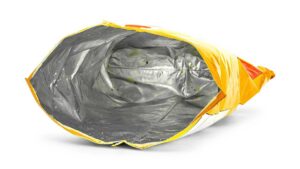
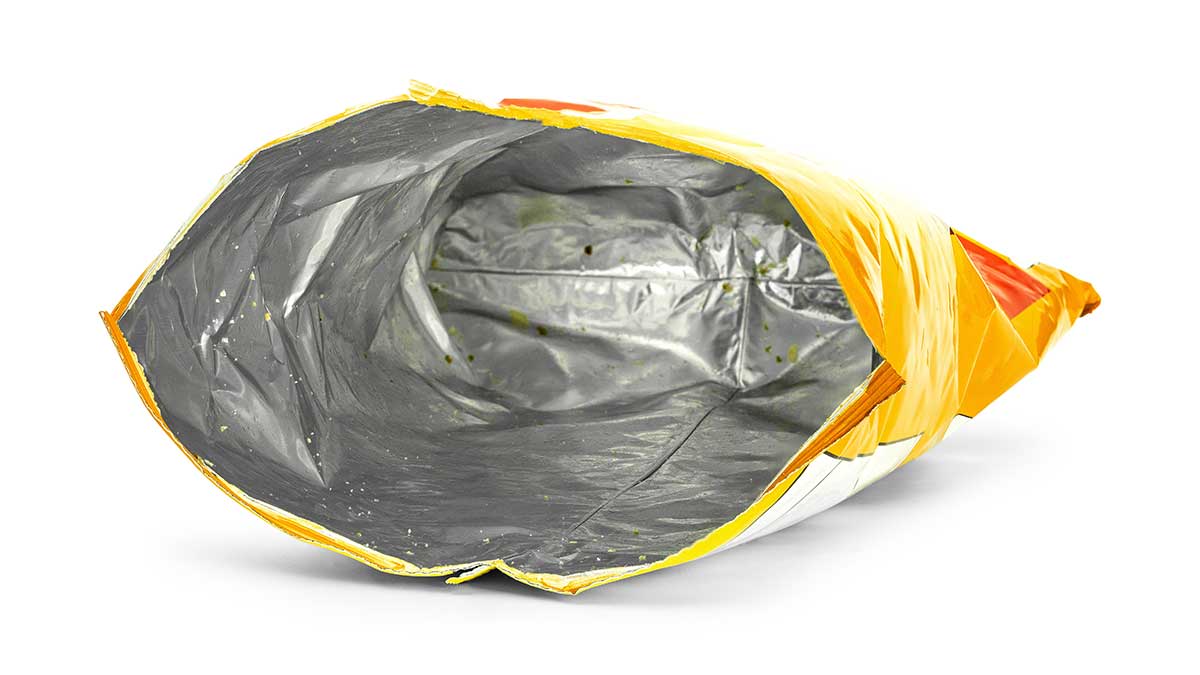
The bag your potato chips come in is seven layers deep. Metalized polyester, a plastic coated with a thin layer of metal, keeps out light. Polyethylene, a common plastic, holds the seal. A printed film provides the label. An oxygen barrier, a layer that blocks oxygen, helps prevent spoilage. There’s another sealant (a layer that helps bond the package), another structural layer for strength, and a food-contact inner skin that directly touches the chips. Each of those layers solves a problem for the manufacturer: preserving freshness, supporting branding, and extending shelf life. Together, these layers are a package no U.S. recycling system can recover for future use.
To put the potato chip bag problem in context, consider American packaging waste as a whole. Americans generated roughly 82.2 million tons of containers and packaging in 2018, about 28 percent of all municipal solid waste, according to the EPA’s most recent national accounting. Plastic packaging contributed more than 14.5 million tons of the total. Those figures are now seven years old. EPA has not issued an updated Facts and Figures report since, even as e-commerce shipments and single-serve formats keep multiplying the number of small, lightweight, hard-to-recycle packages moving through American homes.
The freshest picture comes from California, which is now doing what the federal government has stopped doing. CalRecycle’s SB 54 Material Characterization Study, conducted by Cascadia Consulting Group at 16 landfills in early 2025, found that about 8.5 million tons of single-use packaging and foodware were buried in California landfills in 2024, roughly 21 percent of everything the state landfilled that year. Plastic accounted for about 3.1 million tons of that covered material. Flexible and film plastics — the category that includes chip bags — turned up across all sampling sectors, from single-family curbside collection to commercial routes and self-haul loads. One state, one year, and the composite pouch is everywhere the waste auditors looked.
While composite pouches present a recycling challenge, some rigid plastics fare better. The rigid side of the plastic waste stream — PET water bottles, HDPE milk jugs, some polypropylene tubs — has a functioning recovery system. NAPCOR’s 2024 PET Recycling Report put the U.S. PET bottle collection rate at 30.2 percent; over 70 percent of bottles that reach a curbside bin actually are sorted, baled, and reprocessed into new material.
The situation shifts again when looking at flexible packaging specifically. Flexible bags, pouches, wrappers, and refill sacks that have quietly taken over the grocery aisle are a different story. The U.S. Plastics Pact’s most recent impact report reported a combined U.S. plastic packaging recycling rate of 13.3 percent. Flexibles within that number are a rounding error. Most estimates put flexible-packaging recycling in the United States below 2 percent.
Greenpeace’s 2022 assessment concluded that no type of U.S. plastic packaging meets the Ellen MacArthur Foundation’s definition of ‘recyclable,’ a 30 percent recycling rate across a region of 400 million people.
Why does the material resist recovery
Three things make flexible plastic packaging structurally hard to recycle:
Flexible plastic packaging is not made of a single resin but is often three to nine layers of different plastics and metals bonded together. Mechanical recycling requires a clean, mono-material feedstock, and these laminates cannot be separated into their constituent materials.
Flexible bags are too light for materials recovery facilities (MRFs) to sort effectively. They tangle in screens intended for separating paper from containers, and often jam equipment, prompting shutdowns for removal.
It has no domestic end market. Before China’s 2018 National Sword policy, a ban on imports of many types of foreign waste, much of the U.S. flexible-packaging stream was exported. That relief valve closed. Domestic reprocessing capacity (U.S.-based facilities to clean and reuse the material) for multi-layer flexibles has not been built because no private processor can make the economics work at the price a commodity market will pay for the bale (a compressed block of collected plastic packaging).
Composite film is what industry insiders call a “residual cost material”—meaning the combined cost of collecting, transporting, and processing it exceeds what any buyer will pay for the recovered commodity. The private market will not recycle it.
What store drop-off actually does
For a decade, the polite answer to “what do I do with this bag?” has been: take it to the front of your grocery store. The bins marked for plastic bags and film — operated by the Wrap Recycling Action Program (WRAP) and branded by retailers including Walmart, Kroger, and Target — accept clean polyethylene films: grocery bags, bread bags, dry-cleaning bags, produce bags, and some case-pack overwrap, but not chip bags and other packaging made with composites that combine plastics, paper, and metals.
Most of the polyethylene that does get captured at drop-off goes into composite lumber — Trex decking is the dominant end market, which is a form of downcycling rather than a closed-loop system. It’s a better outcome than landfill. It is also not what the word “recyclable” on the package implies.
Advanced recycling: real, overstated, and controversial
When mechanical recycling cannot process a feedstock, industry increasingly points to “advanced” or “chemical” recycling, which includes pyrolysis, gasification, and solvent-based depolymerization, as the solution for films and flexibles. The promise: break the polymer down to monomer or fuel-feedstock molecules that can be re-polymerized or combusted.
The promise is technically real, though many critics question its promised results. The scale is not yet. Most operating U.S. pyrolysis facilities produce pyrolysis oil sold as fuel, which, from a climate perspective, is combustion with extra steps. A 2023 NRDC analysis found most “advanced recycling” projects in the U.S. are either producing fuel rather than new plastic or operating at a pilot scale. Facilities designed for polymer-to-polymer chemical recycling, such as Eastman’s Kingsport, Tennessee, plant, and Alterra’s Akron facility, process a small fraction of national flexible-packaging generation.
Twenty-five states have now classified advanced recycling as “manufacturing” rather than waste management, easing permitting requirements and exempting the facilities from solid-waste oversight (regulatory supervision for handling waste). Environmental-justice advocates (groups focused on pollution impacts on vulnerable communities) argue the reclassification moves emissions and solid-residue handling out from under the permitting regime designed to protect fenceline communities (neighborhoods directly next to industrial sites). The argument is not settled.
The EPR turn
The meaningful change in the flexible-packaging story over the past eighteen months has not come from new recycling technology. It has come from policy: seven U.S. states now implement Extended Producer Responsibility laws for packaging.
Oregon’s program went operational on July 1, 2025, with the Circular Action Alliance serving as the producer responsibility organization (PRO) that manages the program, supported by roughly $200 million in producer funding for the first year. The state plans to build out 144 PRO-operated recycling collection centers across the state. Colorado, California, Minnesota, Maryland, Washington, and Maine are at various stages behind Oregon, with California’s SB 54 program — the most expansive of the group — scheduled to be fully activated in 2027.
What EPR changes, in plain terms, is that the producer — the brand that chose the seven-layer laminate for branding and shelf life reasons — now pays for the collection and recovery of the package after a consumer uses it. The fees are eco-modulated: simpler, mono-material, more-recyclable packaging pays less; hard-to-recycle multi-layer flexibles pay more. Over time, the fee differential is intended to push producers toward redesigning packaging.
Why we’re paying for the old ways
The externalities the household pays for without seeing them, from flexible packaging specifically:
Landfill tipping fees. At the Environmental Research & Education Foundation’s 2024 weighted-average U.S. tipping fee of $62.63 per ton, the flexible-packaging share of the ~14 million tons of plastic packaging generated annually represents hundreds of millions of dollars in direct municipal disposal cost funded through utility bills and solid-waste budgets.
MRF fire risk. Flexible packaging is the stream that most commonly carries lithium-ion batteries — from disposable vapes, earbud cases, and lithium cells — into the recycling system. Fire Rover’s 2024 annual review reported that publicly tracked MRF and transfer-station fires rose roughly 20 percent year over year, with total damage and operational impact estimated at $1.2 billion annually. Much of that cost is passed through to municipalities in the form of higher processing fees.
Marine and microplastic pollution. Lightweight flexible packaging is disproportionately represented in litter and marine-debris inventories because it is light enough to blow out of collection vehicles, bins, and landfills. Microplastic shedding from degrading film is a growing concern for surface waters and the food chain.
Incinerator air quality. When flexibles are combusted in waste-to-energy plants, the emissions include PM2.5 particles, hydrogen chloride from chlorinated layers, and metals from inks and lamination, which disproportionately fall on the communities that host those plants. Sixteen of the twenty largest U.S. incinerators operate in majority or above-average communities of color.
None of these costs appear on the grocery receipt. Yet, you’re paying these fees until EPR programs force producers to do so.
What You Can Do
For individuals and households, you can make these choices:
Buy the format that’s actually recyclable where you live. Rigid containers — a jar, a bottle, a tub — can be recycled; flexible pouches in most places cannot. When the product is available in both formats, the rigid is the better environmental choice, even when weight is accounted for.
Separate clean polyethylene film for store drop-off. Grocery bags, bread bags, dry-cleaning bags, produce bags, and case-pack overwrap are the films that the WRAP system actually handles. Anything with foil, zippers, or mixed layers should not go in the drop-off bin.
Do not put flexible packaging in your curbside bin. In most municipal systems, composite packaging is treated as contamination that reduces the value of the entire load.
At the community and policy level, you can get involved:
Support packaging EPR in your state. Seven states have laws; a dozen more have active bills. The programs work only when constituents push, and they push when the programs pass.
Ask brands directly. Eco-modulated EPR fees move producers toward better design only if producers perceive consumer pressure alongside the fee. Social-media and direct-contact campaigns targeting specific CPG brands have moved packaging decisions before and will again.
Be skeptical of “chemical recycling” claims. When a brand points to a pyrolysis partnership as evidence of circular packaging, ask which facility, what output, and at what scale relative to the package volume the brand puts into the market.
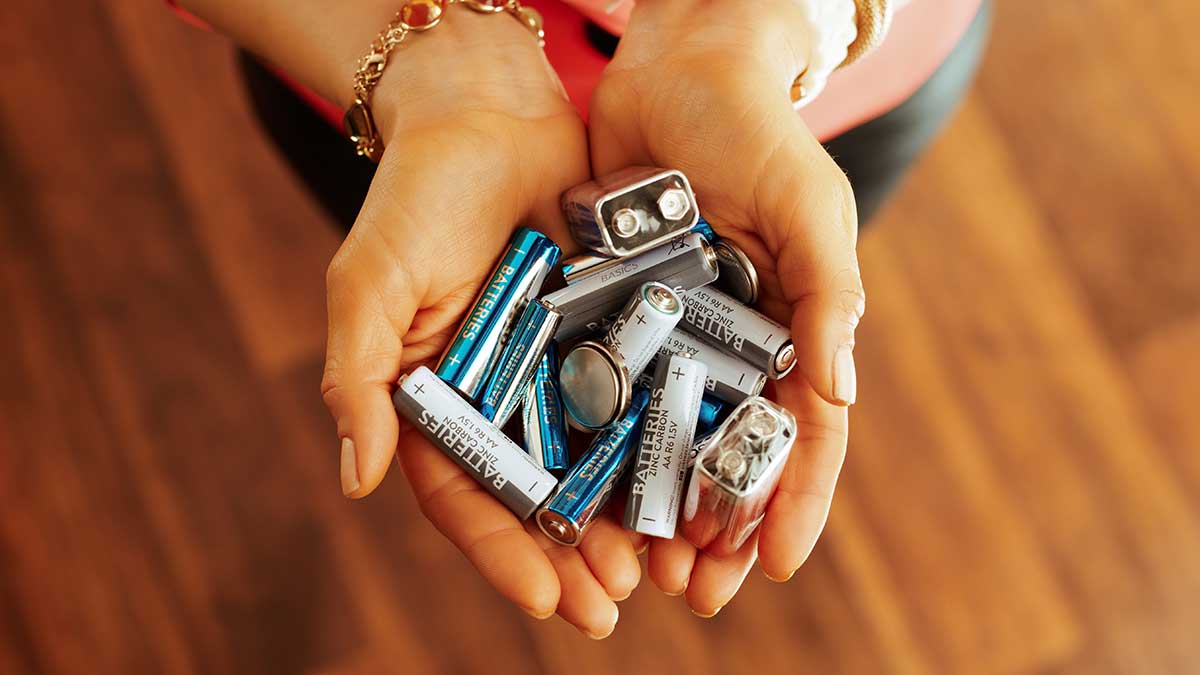
Trash can? Storage container? The dilemma of what should be done with all types of old batteries may seem trifling, but choosing incorrectly is detrimental to our planet and against the law in many states. As a junior in high school, I chose to help people make the right choice by starting an awareness campaign, the Battery Recycling Initiative.
The first step to starting an awareness campaign is identifying the issue you wish to advocate for. Through research and observation, I noted that many of us, including people in my own community, were unaware of the consequences of improper battery disposal on our environment. In fact, according to Recycling Today, 41% of Americans are unaware of the dangers of improper battery disposal.
The second step is to set the scope of your campaign. Are you planning on only advocating locally, globally, or a mix of both? Which specific areas should you advocate in to effectively spread awareness?
For my campaign, I chose to start locally and move globally. To find out if a local battery recycling campaign would be effective in my community, I decided to survey residents in Houston, TX and found out that more than 50% of the residents did not recycle batteries and about 14% only recycled certain types of batteries.
Step 1: Identify the issue and scope of your initiative
How does one start taking inititative? It is simple. Get people to listen. There were three strategies I used to increase awareness about battery recycling:
Provide information digitally and physically
Engage people through interaction and face-to-face conversations
Provide resources for people to take action.
These strategies tend to work for the majority of awareness campaigns: indirectly educate people (this could be through flyers, websites posts, etc.), directly educate people through in-person events, and give them a convenient method to take action. Why are these strategies effective?
Because through these 3 different ways to reach out to and engage people, you can cover most of the reasons why people may choose not to participate in resolving an issue. For example, the three main reasons why people don’t recycle batteries are:
people do not know they can recycle batteries.
recycling batteries is not convenient for some people.
they do not know where to recycle, or people do not have the will to recycle- they see recycling as insignificant, or they are ignorant of grave consequences for future generations.
All three of these problems can be combatted using the three strategies. Through indirect education, people learn that batteries can be recycled and where they can recycle them. Direct education empowers people to recycle, to take action, which combats the lack of will problem. Finally, providing resources to residents, in my case by placing battery recycling bins at my community clubhouses, combatted the lack of convenience aspect.
Step 2: Use the Three Strategies
Strategy 1 – Indirect Education
The first step to indirectly educating people is to ensure your information is accurate. I did plenty of research and talked to various battery recycling centers- like the Fort Bend County Battery Recycling Center- to ensure my information was accurate. The next step is choosing which methods of indirect education you wish to utilize. I chose to provide information via flyers, and use a QR code to help people locate their nearest battery recycling center, to give people quick and easy means to receive the information. I chose to utilize social media as my 2nd method to spread my initiative over a more globalized scope.
Strategy 2 – Direct Education
The main goal of direct education is to empower people to take action and to support/join your initiative. By interacting with people via face-to-face conversations, you retain the person’s attention a lot better than indirect means. By building a connection with the person you converse with, it encourages them to take part in the initiative.
For example, I participated in my community’s Green Day event where I set up a small booth and talked with residents about battery recycling. I remember having a conversation with this resident who was surprised to learn she could recycle batteries.
Many other residents told me they would just store old batteries in a container, not knowing what to do with them. One of my favorite interactions was with this lady who was so inspired by my initiative; she offered to help me out with anything I needed. While direct education does not reach that large of an audience, every meaningful connection you develop carries a depth of impact that numbers alone cannot measure- it has the potential to ripple out and influence countless others.
Strategy 3 – Providing a Convenient Method to Take Action
Convenience and availability play a big part in people’s will to take action. In fact, according to a study done by the Carton Council, these two factors contributed the most towards people’s will to recycle.
By appealing to people’s need for convenience, you spread awareness more effectively and grow your initiative by influencing people to act. I applied this idea by placing two battery recycling bins at both of my community clubhouses. I ended up receiving around 1,000 old batteries from those bins within two weeks, which I then safely recycled by taping the points of contact- this helps prevent fires due to batteries.
Have the Will and a Vision to Make an Impact
It may seem like you are just one person who cannot make an impact, but with a strong will and right vision you can achieve success. Your age, position, or location does not matter: I am just a Junior in high school living in a suburban area, but what does matter is you care and you have the heart to do something about it.
I urge you to utilize these methods and strategies to spread awareness about issues that matter to you, to make an impact. To quote the well-known, “Be the change you wish to see in the world.”
About the Author
Swara Bhatt is a high school junior who loves to paint, read, and watch movies in her free time. She hopes to make the world a better place, one step at a time. If you are interested in seeing updates about the battery recycling initiative, follow the project on Instagram: @batteryrecyclingintitative
Every year, Americans toss out about 17 million tons of textiles, and most items left in donation bins don’t find a new home. Now, more mail-in programs are stepping in to take your old clothes, keep them out of landfills, and reward you—often with store credit or cash-like rewards you can use at familiar brands.
The programs listed here include options that take any brand or condition—even socks and stained T-shirts—as well as brand-specific trade-ins that give you real money for quality items. While none of these fully solves fashion’s waste problem, and some have fees or important details to check, each offers a more responsible choice than tossing clothes in the curbside bin. With the right program, your rewards can even cover your costs or more.
1. Trashie Take Back Bag — The Any-Brand, Any-Condition Option
Trashie ships a prepaid, prepackaged bag that holds up to 15 pounds of clothing, shoes, accessories, and home textiles from any brand, in any condition, including single socks, worn-through T-shirts, and bedsheets. A single Take Back Bag runs $20, though they are frequently on sale, and earns $5 in TrashieCash redeemable for deals at partners including Sephora, Nike, Starbucks, Allbirds, and Cozy Earth.
If you want to recycle often, Trashie Unlimited costs $68 a year and gives you unlimited bags, plus bigger rewards as you go. You get $5 for your first bag, $15 more at your fifth bag (for a total of $26), and by your tenth bag, you’ve earned back your membership with $68 in TrashieCash. After that, every bag earns you extra. Trashie reports that 95% of what they receive is repurposed, reused, or recycled, sorted into over 600 categories.
Best for: that pile of clothes you’ve been meaning to deal with for months, especially items too worn out to donate.
2. Retold Recycling — Subscription Bags With Curated Partner Rewards
Retold Recycling uses a subscription model. Their annual plan costs $99 and comes with six pre-labeled, prepaid bags—three to start, then one each quarter—each holds about five pounds of textiles. You earn Retold Rewards worth about $15 per bag, which you can use at partners like Dropps, Allyoos, Me Mother Earth, and Plaine Products. There’s also a quarterly plan for $24.75 every three months, with the same rewards per bag.
Retold accepts all textiles, including clothing, household linens, and fabric scraps, from any brand. Its recycling partners sort items by fiber content, quality, and style, with the company stating that items are kept out of landfill except when materials like leather, coated textiles, or neoprene can’t be processed. Consumer Reports said only Retold subscribers earn the rewards credits; one-time bag buyers don’t.
Best for: people who want to recycle regularly and like getting discounts at smaller sustainable brands instead of big retailers.
3. Patagonia Worn Wear — Real Trade-In Value for Well-Made Gear
Patagonia’s Worn Wear offers the best payouts if you have Patagonia items. Go to their website, take a quick quiz to check if your items qualify, print a shipping label, and send in your clean, working Patagonia jackets, fleece, pants, packs, and more. You’ll get credit as a gift card to use online or in Patagonia stores.
Trade-in values are usually about 20% of the original price. According to Patagonia’s FAQ, credits can go up to $180 for high-value items, with jackets earning between $10 and $200, and wheeled bags between $45 and $90. Sometimes, they run promotions that double your credit, so keep an eye out for those.
Keep in mind, Worn Wear only takes Patagonia-branded gear that’s still in good, usable shape. They don’t accept underwear, swimwear, or wetsuits. If your items don’t qualify, they’ll either send them back or recycle them for free.
Best for: people clearing out Patagonia gear they no longer need and who already shop at Patagonia.
4. ThredUp Clean Out Kit — Cash or Credit for What Actually Sells
ThredUp is a consignment service, not recycling: the company pays you for items it can resell, and routes the rest to donation or recycling partners. Order a Clean Out Kit, fill it with women’s or kids’ clothing in excellent or like-new condition, and ship it in. Payouts scale with listing price, from low single-digit percentages on inexpensive items to as much as 80% on premium and designer brands like Lululemon or Gucci.
You can get paid in cash or as store credit at ThredUp or partner brands like Gap, Banana Republic, Athleta, Madewell, Janie and Jack, and Reformation. If you pick store credit, you usually get a 15–20% bonus. Be aware that ThredUp takes a $14.99 processing fee from your earnings per bag, and if you want any rejected items sent back, there’s a $10.99 fee. This program isn’t for fast fashion—items from those brands or heavily worn clothes are usually rejected.
Best for: closets with name-brand, current-season women’s and kids’ clothes in good shape—not for stained T-shirts.
5. ReGirlfriend — Closed-Loop Recycling for Activewear
Girlfriend Collective, an athleisure brand, offers ReGirlfriend—a mail-in program run with SuperCircle. You can send in clean clothes from any brand and get $10 in store credit for each Girlfriend item or $5 for each non-Girlfriend item, up to 10 pieces per shipment. There’s a $15 deposit to print your shipping label, but you get it back if you make a purchase within 30 days.
You’ll get personalized discount codes for up to 30% off your next Girlfriend order. For example, a $30 credit needs at least a $100 purchase to use the full amount. Items are sorted for reuse when possible, or they’re recycled, upcycled into new yarn or fabric, or downcycled for industrial uses if they can’t be resold.
Best for: people who already shop at Girlfriend and want a mail-in option for activewear and basics from different brands.
Quick Comparison
Accepts any brand in any condition: Trashie, Retold, ReGirlfriend
Highest potential payout: Patagonia Worn Wear for premium Patagonia items; ThredUp for current-season designer women’s clothing
Get Ready for Mail-In Recycling Success
Sort your clothes before sending them. Items in good enough shape to resell or donate are worth more on ThredUp, Patagonia Worn Wear, or at a local consignment shop. Clothes that are worn out or off-brand are better suited for Trashie, Retold, or ReGirlfriend.
Consider whether a subscription makes sense for you. Trashie Unlimited is worth it if you send about 10 bags a year. Retold’s annual plan can earn you up to $90 in partner rewards. If you won’t fill several bags, it’s better to skip the subscription.
Pick store credit if you already shop at that brand. ThredUp’s 15–20% credit bonus and Patagonia’s double-credit promotions can boost your payout, but only if you were planning to spend there anyway.
Don’t mail clothes that your city already recycles. Many places offer curbside textile pickup or special drop-off bins. Use the Earth911 Recycling Search to find local options before paying to ship clothes out of state.
Check the details on fees. ThredUp charges a $14.99 processing fee, Patagonia deducts $7 for shipping, and ReGirlfriend requires a $15 refundable deposit. Make sure to consider these costs before you decide.
Try to buy less in the first place. No mail-in program can make up for the impact of owning lots of fast fashion. The best thing you can do is choose fewer, longer-lasting clothes.
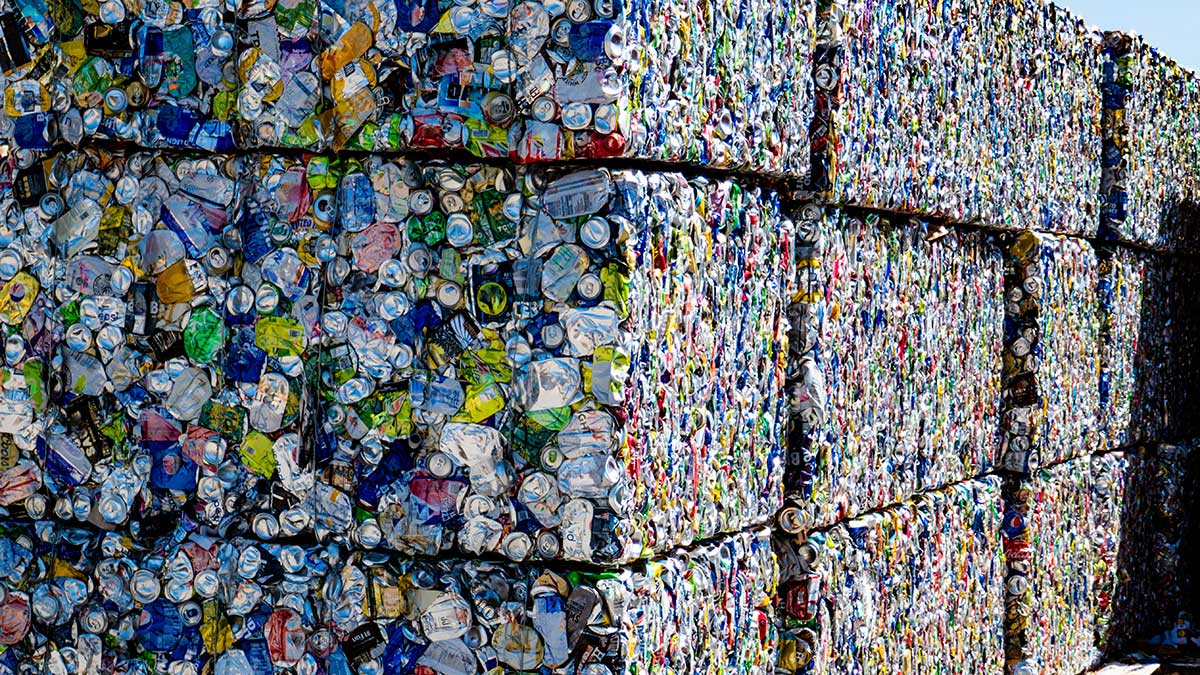
A used aluminum can is worth more, pound for pound, than almost anything else you put at the curb. In late 2024, a ton of crushed and baled cans was selling for around $1,338. Glass, by comparison, sells for roughly, well, nothing. Mixed plastics often cost the recycler money to handle. A single bale of cans, about the size of a small refrigerator, can be worth $40,000 in scrap. In a lot of towns, that one bale is the reason the whole truckful of recyclables is worth picking up.
That makes aluminum the quiet engine of curbside recycling. And right now, fewer Americans are putting cans in their bins than at any time since the early 1990s. According to a 2024 report from the Aluminum Association and Can Manufacturers Institute, the U.S. consumer aluminum-can recycling rate fell to 43 percent in 2023, well below the 30-year average of about 52 percent. Consequently, more than half of every can you finish ends up buried in a landfill instead of back on a store shelf as a new can.
How a recycling plant makes its money
Your bin doesn’t go straight to a recycling factory. It goes to a sorting facility called a MRF, pronounced “murf,” short for material recovery facility. A MRF is essentially a giant conveyor belt with magnets, screens, optical scanners, and people, all pulling the stream into separate piles: cardboard here, paper there, plastics by type, glass, metal.
Each of those piles becomes a bale, a compressed cube of a single material wrapped in wire. The MRF sells the bales to processors, who melt or pulp them into raw material for new products. That sale price, minus what it cost to sort, is the MRF’s revenue.
Most of the bales barely break even. Glass usually loses money. Mixed plastics sometimes make a loss, and sometimes don’t. The bale that consistently makes money is aluminum. A used can returned to a mill is back on a shelf, full of soda or seltzer, in as little as 60 days, using about 95 percent less energy than making aluminum from raw ore. And the metal doesn’t degrade. The same atoms can be recycled over and over, forever, with minimal losses of material during the recovery process.
That combination of high value and infinite recyclability is why aluminum is the only material in your bin that the recycling system genuinely wants. The rest of the content rides on the can’s profit.
Why fewer cans are getting back to mills
The 43 percent national rate hides a sharp split between two kinds of states.
Ten states have a system called a deposit-return scheme, more commonly known as a bottle bill. You pay an extra five or 10 cents when you buy a canned drink and get it back when you return the empty to a store or a redemption center. Those states are California, Connecticut, Hawaii, Iowa, Maine, Massachusetts, Michigan, New York, Oregon, and Vermont, where return rates run from 65 to 90 percent, with Michigan and Oregon — both at $0.10 deposits — consistently reporting the highest recovery rates, according to Container Recycling Institute data.
The other 40 states rely solely on curbside collection. Their rates are about half as high.
The reason is simple. A deposit turns a can from “trash” into “money I’m holding.” It doesn’t take an environmental conviction to bring it back; it takes ten cents on the table. Curbside recycling doesn’t create that signal. It depends on people remembering to rinse and toss every can in the right bin, week after week, with no immediate reward. A lot of cans don’t make it.
What this costs your community
When cans miss the bin, the cost is spread across three areas.
The first is your municipal budget. Many city and county recycling contracts include aluminum revenue as a line item. When that revenue shrinks, somebody covers the gap — usually you, through a slightly higher trash bill or property-tax allocation. According to the Aluminum Association, roughly $800 million worth of cans are landfilled in the U.S. every year. That lost value has to come from somewhere; the gap shows up in your trash bill or your property taxes.
The second is energy. Every can made from raw bauxite ore rather than recycled metal requires far more electricity. Across the volume the U.S. landfills annually, the difference is the equivalent of several large coal-fired power plants’ worth of generation, every year, lit up to make new metal we already have above ground.
The third is the recycling system itself. The aluminum bale is what subsidizes the rest of the bin. When fewer cans go in, the cost of recovering everything else rises — and pressure builds on cities to drop materials they can’t afford to handle. Glass is usually first to go, and it has been abandoned by many municipalities over the last decade.
Why bottle bills are coming back
For most of the late 20th century, the beverage industry fought bottle bills hard. That has flipped. Both the Aluminum Association and Can Manufacturers Institute now back well-designed deposit programs, because the industry has set a 70 percent recovery target by 2030, and the arithmetic doesn’t work without deposits in more states.
Washington State has considered a bottle bill in several recent legislative sessions. Tennessee and Rhode Island also have active or recurring proposals. Since 2019, Vermont, Connecticut, and Oregon have expanded or updated their programs by adding wine and spirits containers, raising deposit amounts, or installing reverse-vending machines that process returns automatically.
Whether recycling scales to your community’s needs depends largely on how loud and informed the local civic conversation gets in the next five years.
What You Can Do
At home
Rinse and recycle every can. Make sure it’s empty and dry before putting it in the bin. A little residue is okay, but food waste lowers the value of the bale.
If you live in a bottle-bill state, don’t crush your cans. Reverse-vending machines need to scan the barcode, and a crushed can can’t be read, so you lose your deposit.
Aluminum foil and trays can be recycled too, but they are sorted separately.
If your state has a deposit system, return your cans for redemption. Cans returned this way go straight to mills with almost no loss during sorting. Curbside cans take a longer route and more are lost along the way.
In your community
Support bottle-bill legislation if your state is thinking about adopting one.
Encourage updates to deposit programs in states with older systems. A five-cent deposit set in the 1970s doesn’t motivate people like it used to. Ten cents is now the standard that works.
Ask your city council how recycling revenue is used. It’s a real part of the budget and directly affects your trash bill. Most people never ask, but those who do usually get answers.
At Earth911, people often ask us, “Is shredded paper recyclable?” The answer is still “yes, but”—and how and where you can recycle it has changed a lot since our last update.
In 2024, 60% to 64% of paper and 69% to 74% of cardboard were recycled in the United States, according to the American Forest & Paper Association. U.S. mills used 32.7 million tons of recycled paper to make new products. Paper is one of the most recycled materials in the country, but shredded paper is an exception because it is more complicated to recycle.
Why Shredded Paper Is Tricky to Recycle
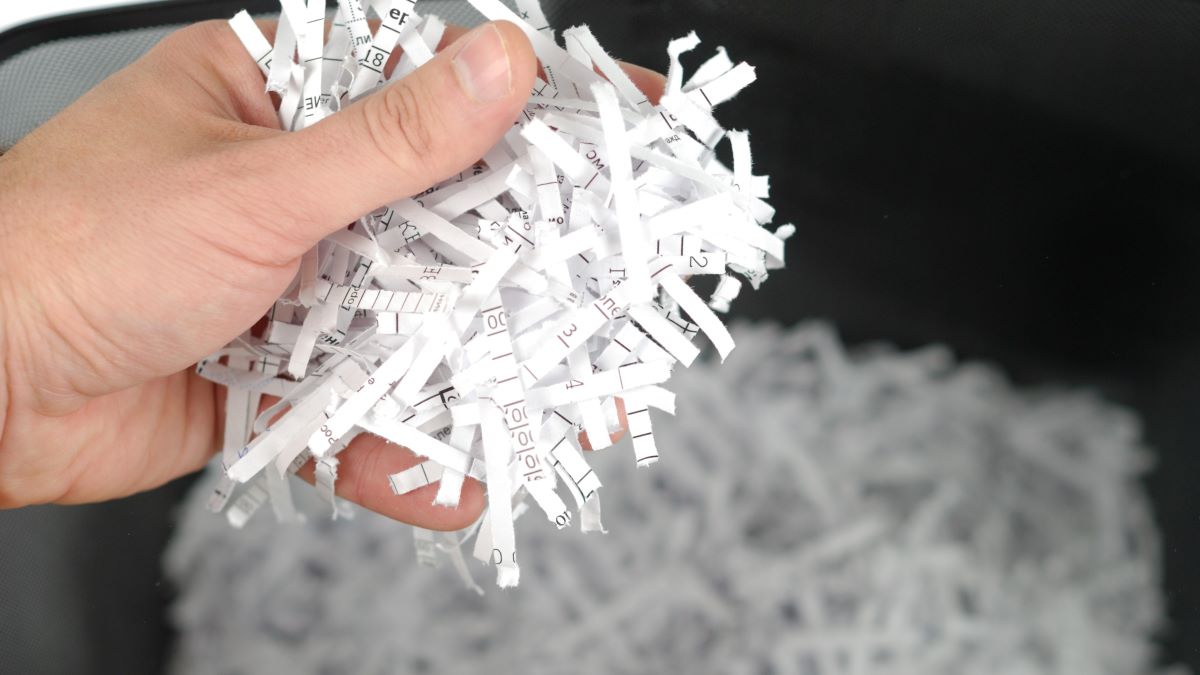
Paper is made of fibers, and longer fibers make paper more valuable for recycling. Each time paper is recycled, the fibers get shorter and lose value. Eventually, recycled paper is turned into tissue or toilet paper. Shredded paper is especially difficult to recycle, so many programs will not accept it.
Shredding accelerates fiber shortening and lowers the paper grade from high-grade to mixed-grade. Mixed-grade paper is still recyclable, but it ends up baled and processed into products like paper towels and packing paper. However, the smaller piece size creates real problems at material recovery facilities (MRFs). Loose shreds fall through sorting screens, jamming optical scanners that need a minimum piece size to identify materials correctly. Shredded paper often contaminates glass, plastic, and other streams. That’s why most programs require you bag shredded paper if they accept shredded paper at all.
The 2026 Curbside Reality: Check Before You Toss
Starting July 1, 2025, Oregon residents saw a change. Under Oregon’s Plastic Pollution and Recycling Modernization Act, shredded paper will no longer be accepted in curbside bins in counties like Clackamas. However, new recycling centers are being set up to take shredded paper. In the Portland metro area, shredded paper was also removed from curbside collection under new Extended Producer Responsibility rules, but new facilities are being built to handle it.
If your local program does accept shredded paper, you’ll almost always need to place it in a paper bag — a standard brown grocery bag works well — and label it clearly as “Shredded Paper” so recycling workers can sort it correctly. Only use a clear plastic bag if your facility explicitly instructs you to; otherwise the whole bag typically goes to the landfill.
One of the biggest changes for shredded paper recycling in 2025 and 2026 is the opening of special drop-off centers run by Producer Responsibility Organizations (PROs) in states with extended producer responsibility (EPR) laws.
Oregon’s RecycleOn Centers: At the RecycleOn Center in Ashland, the first of 144 planned statewide facilities under the Recycling Modernization Act, shredded paper is among the materials now collected, along with aluminum foil, expanded polystyrene, and other items that often contaminate curbside bins. The network began in Southern Oregon and is expanding to Deschutes County, with the Portland metro region expected to see new sites coming in 2026. Find local options at RecycleOn.org.
California, Colorado, Maine, and Minnesota have since passed similar EPR laws, and more states are expected to build comparable drop-off infrastructure for hard-to-recycle materials, including shredded paper.
Professional Shredding Events and Services
Businesses use paper shredders most often to protect confidential information. Many communities offer free shredding events, usually sponsored by banks, credit unions, or local government offices. The shredded paper from these events is reliably recycled instead of being sent to a landfill.
If you have a large amount of paper to shred, certified shredding services offer both security and environmental responsibility. For example, Iron Mountain shreds over 40,000 tons of material each month at its secure facilities and recycles it, helping save more than 4 million trees each year. Shred-it also recycles shredded materials whenever possible, following NAID AAA-certified processes. When choosing a shredding service, look for the NAID AAA designation to make sure your paper is recycled, not just destroyed.
Think Before You Shred
The best recycling strategy often starts before the shredder. In most cases, the information you want to delete is only on one line, such as a name or number. You can use a permanent marker to cover personal data; this ink is easily removed during recycling — then recycle the whole document intact. Intact paper has a higher value, is easier for MRFs to process, and is more likely to make it all the way through the recycling stream.
Only shred documents that really need it, like tax records, medical files, financial statements, or anything with full account numbers or Social Security numbers. For other papers, recycling the whole sheet is better for the environment.
If Recycling Isn’t an Option: Compost Or Reuse
Shredded paper is a great carbon source for composting because it is already partly broken down. You can add it to compost, but avoid glossy or heavily inked paper, which may have harmful chemicals. Mix shredded paper with food scraps, leaves, and other organic material for the best results. You can also reuse shredded paper as packing material or bedding for small animals like hamsters or rabbits, keeping it out of the trash.
Editor’s Note: Originally published on April 19, 2011, this article was updated in March 2026.
That foam coffee cup, takeout box, or packing block likely won’t be recycled. It’s not your fault; most Americans lack access to recycling systems for these materials. The plastics industry says it’s improving, and that’s true in some ways. But there’s still a gap between industry claims and what people can actually do when taking out the trash.
Before we talk about why foam is hard to recycle, it’s helpful to know what it really is. “Polystyrene” is the material, though it is often referred to by the brand name “Styrofoam,” and it comes in different forms. EPS is the foam used in coffee cups, takeout boxes, and packing blocks. The hard kind, found in utensils and appliance parts, is GPPS or HIPS. Both are polystyrene but need different recycling methods.
The #6 symbol on the foam container only tells you what kind of plastic it is, not if it can be recycled. If you put it in the bin just because you see a number and the recycling arrows, it can actually contaminate your other recyclables, like paper, cardboard, and aluminum, and might cause the whole batch to be rejected.
The Recycling That Happens Without You
The plastics industry recently launched the Polystyrene Recycling Alliance (PSRA), which commissioned a detailed study of where polystyrene foam is actually recycled in the US. Its headline stat: about 105 million Americans — roughly one in three — have access to recycling services that handle at least one type of polystyrene.
That sounds promising. But one must read the fine print to see the whole picture.
The PSRA–RRS Polystyrene End Markets Study, published in February 2026, is the most detailed inventory of US and Canadian polystyrene recycling infrastructure to date. It identified 81 companies handling recovered EPS and XPS foam, with 119 facilities spread across 30 US states and four Canadian provinces. About 52% of those companies are manufacturing end markets, businesses that actually turn recovered foam into new products like transport packaging and insulation.
Most of this recycling happens through business-to-business systems that regular people don’t use. Big retailers, warehouses, and appliance stores create large amounts of packing foam. They have private deals with haulers who collect the foam, compress it into dense bricks called “densified foam,” and send it to manufacturers, mainly to make new packaging and insulation. Some European and Asian companies also import compressed EPS from North America for manufacturing. There are also more than 700 drop-off locations for foam across the country.
Environmental groups note that EPS drop-off access, in stark contrast to industry claims, currently reaches only about 3% of the US population.
Between 2019 and 2023, Foam Recycling Coalition-funded programs nearly doubled the amount collected, according to Waste Dive‘s reporting. The Alliance reported 168.6 million pounds of EPS foam were diverted from disposal in North America in 2022. But it’s largely invisible to consumers, and almost none of it involves your curbside bin.
For the rigid forms of polystyrene, the stuff in your fridge’s vegetable drawer or your blender housing, the recycling picture is much less encouraging. The same PSRA–RRS study found just 45 companies handling recovered GPPS and HIPS in the US and Canada, and only 13% of those actually turning it into new products. Those 45 companies operate just 50 facility sites across 22 US states and four Canadian provinces, compared to 119 facilities in 30 states for foam. Most post-consumer rigid polystyrene that does get recycled comes from medical equipment and e-waste programs, not household recycling.
Foam is a recycler’s nightmare, and the reason is simple: it’s mostly air.
EPS is about 95% air by volume. A regular collection truck can fill up with foam that weighs almost nothing, so the hauler spends the same amount of money to collect much less valuable material. Also, foam breaks apart easily, and small pieces can mix with paper and cardboard in the same bin, making everything else less valuable.
A 2024 study in the journal ChemSusChem found that processing polystyrene costs about $1,456 per metric ton, more than for most other plastics. This rate works only when there are grants, subsidies, or a guaranteed supply chain in place, but none of those exist at the scale needed to handle all the foam Americans throw away.
What “Chemical Recycling” Can and Can’t Do
You may have heard that polystyrene can be “chemically recycled,” meaning it is broken down by heat into its original building blocks to make new plastic. While that’s technically possible, it’s not happening on a large scale.
The only US facility dedicated to this polystyrene process, run by a company called Regenyx in Oregon, shut down in early 2024. A National Resources Defense Council report from March 2025 found only eight chemical recycling facilities of any kind operating in the entire US. Most of what these plants produce isn’t new plastic; it’s fuel oil, which means the material isn’t really being recycled so much as burned in a different way. The Regenyx plant generated approximately one ton of hazardous waste for every ton of usable output, a serious problem the industry doesn’t advertise.
The 79% Nobody Talks About
Here’s a number worth sitting with: only 21% of all residential recyclables in the US actually get recycled, according to The Recycling Partnership’s 2024 State of Recycling Report — one of the most comprehensive independent analyses of the US system.
What about the other 79%? Most of it is lost at home before it ever reaches a recycling facility. People might not have access to a recycling program, might not know what their local program accepts, or just don’t take part. The report, along with EPA plastics data, shows that the overall US plastic recycling rate is only about 5–6%. For foam, which most curbside programs don’t accept, this gap at the household level is even harder to close. The industry’s solution is drop-off programs, but these require people to know where to go, make a special trip, and bring clean, uncontaminated foam. That’s asking a lot.
The Recycling Partnership says the biggest problem in the US recycling system isn’t technology or end markets. It’s getting people involved, and the main way to do that is through funding for education and outreach, which most municipalities lack. The EPA’s 2024 Recycling Infrastructure Assessment estimated it would take $36–$43 billion to upgrade the US system by 2030. A Resource Recycling summary found that nearly half of US states don’t even track how many curbside programs they have. You can’t fix a system if you aren’t measuring it.
How The U.S. EPS Recycling Rate Compares
The US lags well behind other wealthy countries when it comes to foam recycling.
Market data compiled through 2023 indicate that EPS recycling rates for comparable packaging are approximately 88% in South Korea, 83% in Taiwan, and 68% in Japan. Europe averages around 40%, though that figure masks wide variations. Some countries, including Portugal and Norway, approach 90% recovery rates, largely driven by fish box collection programs, while thers sit well below the average. North America comes in at roughly 31%, and that figure is almost entirely commercial collection programs, not household recycling.
It’s worth noting that all of these figures come primarily from GESA (the Global EPS Sustainability Alliance) and affiliated national industry groups, organizations with a direct stake in presenting favorable data. Independent verification is limited.
Japan’s foam recycling program has been running since 1978, and the country’s EPS industry group reports an effective utilization rate of 94.2% in 2024. That “effective utilization” figure includes incineration with energy recovery, not just mechanical recycling. South Korea made packaging producers legally responsible for recycling costs as early as 2000, a policy approach called Extended Producer Responsibility (EPR). The US has no federal EPR law for packaging and only seven states that have passed one so far.
Overall, the US ranked 30th in the world on the 2024 Environmental Performance Index’s waste recovery score. Germany, Japan, South Korea, and most of Western Europe all rank higher.
The Biggest Companies Are Giving Up on Foam
One of the clearest signs about foam’s future isn’t coming from regulators. It’s coming from the brands that use it.
The Ellen MacArthur Foundation (EMF), which tracks voluntary sustainability commitments from over 1,000 companies representing about 20% of global plastic packaging production, released its final progress report in late 2025. Since 2018, signatory companies have removed over 775,000 metric tons of the most problematic plastics, including polystyrene and PVC, from their packaging entirely.
The EMF classifies certain polystyrene formats, especially foam foodservice containers, as plastics that should be eliminated rather than recycled. In its framework for problematic plastics, it consistently identifies these materials as candidates for phase-out, not circularity. That’s the stated view of an organization whose members include Nestlé, Unilever, Coca-Cola, and L’Oréal.
Meanwhile, those same companies are falling short of their overall recycled-content targets for plastics. The share of recycled plastic in the broader global packaging market barely moved — from 3.4% to 4.2% — even as committed companies tripled their own use of recycled content. As Chemical & Engineering Newsreported in November 2025, plastics recycling is struggling across the industry.
Voluntary commitments move the leaders, but they don’t move the system.
States Are Banning Expanded Polystyrene
Twelve states and three US territories have chosen not to wait for the recycling system to improve. They’ve banned foam food containers completely, and Earth911 tracks these changes. Oregon, California, Delaware, Rhode Island, and Hawaii all joined the ban list as of January 1, 2025.
California’s law included a recycling test: foam producers had to show a 25% recycling rate by January 2025 to keep selling EPS foodware in the state. When CalRecycle reported to the legislature that the industry had fallen far short—the rate was about 6% when the law passed—foam containers were effectively banned.
Not every ban effort has succeeded. Montana’s legislature passed a phase-out bill in spring 2025 — only to have the governor veto it. And while a federal “Farewell to Foam Act” has been introduced in Congress, it hasn’t passed.
Globally, the bans are further along. The EU banned foam food containers in 2021. Canada followed with federal legislation in 2022. Over 97% of Australians now live somewhere with an EPS ban in place, according to Wikipedia’s phase-out tracker.
What Would Actually Fix Polystyrene Recycling
The most honest answer is that recycling alone won’t solve the foam problem. But better policy can.
The Recycling Partnership’s EPR analysis finds that states with Extended Producer Responsibility laws have recycling rates up to 3 times higher than those without them. EPR generates funds for consumer education, access, and infrastructure that cash-strapped municipalities can’t provide on their own.
The PSRA’s end markets study is candid about what’s missing for rigid polystyrene. For GPPS and HIPS to be recycled at scale, the industry needs to solve a chicken-and-egg problem. Sorting facilities won’t invest in the equipment without a guaranteed buyer for the output, and buyers won’t commit without a reliable supply. The study’s concrete suggestion is to offer subsidies per pound to sorting facilities that would need to separate polystyrene from mixed plastic streams. Without that financial nudge, the economics don’t work.
The broader lesson is that without policy structures that change the economics, including embracing EPR, mandatory recycled content standards, or bans, voluntary action produces incremental progress against a systemic problem. As Chemical & Engineering News reported, even companies with strong sustainability commitments are falling short.
What You Can Do At Home
Find a drop-off:
Search Earth911 for EPS foam drop-off locations near you. These are separate from your curbside bin — call ahead to confirm they accept your specific type of foam.
For foam meat trays, most facilities won’t take food-soiled containers, so they must be clean and dry.
Retailers like The UPS Store accept clean packing peanuts for reuse.
Cut foam out of your routine:
Bring your own insulated mug to the coffee shop instead of accepting a foam cup.
When ordering takeout, ask for paper or compostable containers.
When shipping things, use crumpled newspaper, shredded paper, or molded pulp instead of foam peanuts.
Push for better policy:
Find out whether your state has a packaging EPR bill pending. If it does, contact your representative in support. The trend is moving in that direction.
Before you throw away that empty soda bottle, wine bottle, or milk carton, think about turning it into a bird feeder.
These seven DIY projects show how to reuse common household items to make useful backyard wildlife stations. There’s something for everyone, whether you’re crafting with kids or have experience with tools. Whenever possible, choose glass instead of plastic. Experts say glass bottles last longer in the sun and are easier to clean than plastic.
This article contains affiliate links that help fund our work.
1. Soda Bottle Bird Feeder
Bird feeder #1: You can make a simple, quick DIY bird feeder out of a soda bottle and two wooden spoons or dowels. Photo: Flickr/DENISE CRYER
The soda bottle bird feeder is a classic project that’s easy for anyone to make. Start by saving a 1- or 2-liter soda bottle from the recycling bin. Then, find two wooden spoons, dowels, or sturdy twigs from around your home or yard. These will serve as perches for the birds.
To make one, follow the instructions from Gardening Know How: mark two sets of holes at right angles, insert the spoons or dowels, fill the bottle with birdseed, put the cap back on, and hang it up with string or fishing line. If you’re working with young kids, adults should handle the cutting.
If you prefer not to do DIY from scratch, you can buy soda bottle bird feeder kits. Just attach the tray and wire to your own bottle.
2. Milk Carton Bird Feeder
Making a bird feeder from a milk or juice carton is just as easy as using a soda bottle. The Audubon Society even has a version that’s great for kids. Cut a large opening a few inches from the bottom on one side, add a stick underneath for a perch, make two small holes at the top for hanging, decorate it, and fill with birdseed.
Keep in mind that milk cartons don’t last as long as plastic or glass feeders. Watch for signs of wear and replace your feeder when needed. Remember to recycle the old carton.
3. Tray Bird Feeder
Upcycle old window frames, picture frames, or other wood scraps into a tray bird feeder. Photo: Flickr/ben.thomasson
If you have leftover wood from a home project, you can make a simple tray feeder using Birds & Blooms’ instructions. You’ll need cedar or pine scraps, an aluminum screen for drainage, panel nails, eye screws, and some chain for hanging. You should also be comfortable using a drill and hammer.
You can also reuse old windows, picture frames, or other wooden items from around the house to make a tray feeder. One Instructables tutorial shows how someone built a feeder from the wooden backing of an old bronze award.
Tray feeders bring in many types of birds, like cardinals, chickadees, woodpeckers, and mourning doves. However, they don’t keep out squirrels.
4. Floppy Disk Bird Feeder
If you have some old floppy disks lying around, you can turn them into a retro bird feeder using an Instructables guide.
You’ll need to take apart three disks, remove the magnetic film, cut a window for the seeds, put the pieces together to form a cube, and attach a string for hanging. Use tape or a hot glue gun to hold it together, then add birdseed inside.
5. Self-Refilling Glass Bottle Bird Feeder
This gravity-fed feeder is a smart upgrade from basic designs. Remodelaholic’s wine bottle bird feeder tutorial explains how to build a simple wooden platform with a notched holder that keeps an upside-down glass bottle just above the seed tray. As birds eat, gravity refills the tray with more seed.
You need only a recycled wine bottle (or any narrow-neck glass bottle) and some wood for this project. The screw-based mount makes it easy to remove the bottle for refilling. Use a low- or no-VOC wood sealer to protect the frame.
Fill the bottle with hummingbird nectar. The International Hummingbird Society suggests mixing one part white sugar with four parts water. Don’t use food coloring, honey, or artificial sweeteners. The red parts of the feeder attract the birds, not the nectar itself.
If you want something sturdier and easier to clean, Birds & Blooms offers instructions for a glass bottle hummingbird feeder that uses copper wire and a commercial feeding tube. This version takes more effort to make but lasts much longer.
This is a step up in craft and durability, and a good reason to save that glass Jarritos or Mexican Coke bottle. Birds & Blooms’ glass soda bottle feeder tutorial pairs a recycled glass bottle with a chicken feeder base for a sturdy feeder that holds plenty of seed and will last for years.
The most involved step is drilling a hole in the bottle’s bottom using a diamond drill bit under running water to keep the bit cool so the glass doesn’t crack. A steel rod threads through the bottle and into the chicken feeder base, locked in place with a washer and wing nut; a G-hook at the top completes the hanger. To refill, simply unscrew the base, add seed, and reattach.
This DIY project requires comfort with a drill and patience with glass, but the result looks intentional and well-made, not like a weekend craft project. For the nectar-recipe and feeder-cleaning guidance that applies to all glass bottle builds, the International Hummingbird Society’s feeding page and Birds & Blooms’ black oil sunflower seed guide are solid references depending on what you’re trying to attract.
To find out where to recycle glass bottles in your area, check the Earth911 Recycling Directory. Most curbside programs don’t accept them, but many drop-off sites do.
Tips for Bird Feeders
Clean your feeders every one or two weeks to stop mold and bacteria from harming birds.
Hang feeders at least five feet above the ground and away from bushes where cats might hide.
A 2,000-square-foot house holds about 700 pounds of carpet. The average residential carpet lasts 5 to 15 years, depending on fiber and traffic. When it is removed, more than 90 percent of it goes straight to landfill, a bundle of fiber, backing, latex, calcium carbonate, and whatever stain-resistance chemistry was sprayed on top that will be buried in a single dense, slow-decomposing mass.
The U.S. generates roughly 3.4 million tons of post-consumer carpet a year. The last national report from the Environmental Protection Agency put the national recycling rate at 9.2 percent, essentially flat for a decade and a half, despite a 2002 industry-government agreement that promised steady gains. One state, California, has made significant progress, hitting 38.5 percent in 2024 under a producer-funded program. New York becomes the second state to require an extended producer responsibility (EPR) program for carpet, when its law launches in July 2026.
The remaining 48 states still treat carpet as ordinary household trash.
What’s in the roll
Modern wall-to-wall carpet is a layered composite designed for foot traffic, not disassembly. The face fiber is typically nylon 6, nylon 6,6, polyester (PET), or polypropylene. Beneath that sits a primary backing of woven polypropylene, a layer of styrene-butadiene latex glue, and a secondary backing weighted with calcium carbonate filler. A separate pad — usually rebond polyurethane foam — goes between the carpet and the subfloor. Your floors are covered in plastic that sheds billions of microfibers.
It’s the composite nature of carpet that is the problem. Each material has its own downstream value, but once they are glued, tufted, and coated together, separating them is mechanical and chemical work that the disposal price of carpet does not cover. A 2022 analysis in the Journal of Cleaner Production put it starkly: the annual mass of nylon embedded in U.S. waste carpet exceeds U.S. virgin nylon production. The country buries more of the polymer every year than it makes.
The Dalton concentration
More than 80 percent of the tufted carpet manufactured in America is produced within a 100-mile radius of Dalton, Georgia, the city that calls itself the carpet capital of the world. Shaw Industries, Mohawk Industries, Engineered Floors, and J&J Industries are all headquartered there. The concentration is an engineering and supply-chain success and an environmental liability in the same place.
For decades, Dalton-area mills used per- and polyfluoroalkyl substances, or PFAS, the “forever chemicals” used as stain and water repellents. Wastewater carrying those chemicals was discharged into the Conasauga River and the local land application system, and downstream water utilities in Rome, Georgia, and elsewhere have since sued the manufacturers over drinking-water contamination.
U.S. carpet manufacturers stopped using PFAS in domestic production in 2019, according to the Green Science Policy Institute. Interface began phasing out PFAS in 2011 and completed the process in 2014; Shaw, Mohawk, Tarkett, and Engineered Floors have since followed suit.
The legacy carpet still on American floors and in American landfills — anything installed before roughly 2020 — was largely manufactured with PFAS. In 2024, the EPA designated PFOA and PFOS as hazardous substances, which changes the liability arithmetic for any future cleanup at carpet manufacturing sites or carpet-receiving landfills.
The household line item
Over a 50-year homeownership arc, a single family will buy and discard carpet four to six times. Almost none of it will be recycled.
The cost of unrecycled carpet is uneven. New residential carpet runs $2 to $9 per square foot installed, according to HomeAdvisor, with the typical replacement project costing $780 to $2,813. Carpet removal and disposal adds $0.50 to $1.50 per square foot, a cost that most homeowners pay without seeing because it is bundled into the installer’s invoice. For a 1,500-square-foot home, that is $750 to $2,250 in disposal cost alone, almost all of which pays the tipping fee at the dump. Landfilling carpet is expensive.
The replacement cycle is short by durable-goods standards. Most residential carpet is designed to last 5 to 15 years, according to the Carpet and Rug Institute. PET-based carpet — increasingly common in the budget tier — sits at the lower end and is often replaced after 5 to 10 years.
What California built
California’s Carpet Stewardship Program, authorized in 2010 and run by the Carpet America Recovery Effort (CARE) under CalRecycle oversight, is the only U.S. carpet EPR program with a multi-year track record. A producer-funded assessment of about 35 cents per square yard of carpet sold — far less than the disposal costs in other states — funds collection, transportation, and recycling subsidies that close the gap between the cost of recycling and the lower cost of landfilling.
The state’s 2024 results are the strongest the program has posted. CARE reported a 38.5 percent recycling rate, exceeding CalRecycle’s 34 percent goal for the year. The state collected 82.7 million pounds of carpet, of which 90.5 percent was recycled. Reuse also plays a part, as carpet diverted to a second use rather than ground up grew 249 percent from 2021.
New York’s law, signed in December 2024, is in some respects more aggressive. It is the first U.S. carpet EPR program to include artificial turf, requires that all carpet sold in the state contain at least 10 percent post-consumer recycled content, and bans the sale of PFAS-containing carpet, effective December 31, 2026. Producer plans are due to NYSDEC by December 31, 2025; the producer-funded collection program launches July 1, 2026.
That leaves 48 states with no carpet-specific recovery infrastructure beyond what CARE finances voluntarily and what individual municipal bulky-waste programs choose to set up.
The recycling reality
Even in California, the math is harder than the headline rate suggests. The bulk of recycled carpet today is downcycled, mechanically shredded and pelletized into engineered resins for automotive parts, construction products, and carpet backing, rather than run through a closed-loop fiber-to-fiber recycling process that would substitute for virgin nylon production. Carpet-to-carpet recycling exists at meaningful scale only for nylon 6, which can be depolymerized and repolymerized into new fiber, and only at a small number of facilities globally. Aquafil’s Slovenia and Phoenix plants supply most of the ECONYL closed-loop nylon used in commercial carpet today.
Nylon 6,6, historically dominant in U.S. residential carpet, lacks an equivalent commercial chemical-recycling pathway. PET face-fiber carpet, the fastest-growing residential carpeting, is largely incompatible with existing nylon recovery streams and most municipal PET recycling because its latex backing and calcium carbonate filler contaminate the polymer.
The real cost of unrecycled carpeting
Carpet imposes costs that show up in places other than the homeowner’s invoice:
Landfill volume. At roughly 3.1 million tons of post-consumer carpet landfilled annually, it is one of the larger durable-goods waste streams in the country. Carpet is dense and slow to break down. Most carpet installed today contains synthetic fibers with a century-plus lifespan, so the volume sent to landfills is essentially permanent.
PFAS legacy. Legacy carpet in landfills is a documented source of PFAS leachate. The Interstate Technology and Regulatory Council’s 2024 PFAS fact sheet identifies carpet, textiles, and fluoropolymer-containing consumer products as primary PFAS sources in municipal solid waste streams, with measurable migration into leachate that flows downstream to wastewater treatment plants not designed to remove PFAS.
Methane is not the main story here, but the latex is. Unlike food waste or paper, carpet itself does not generate significant methane in landfill. The climate cost sits earlier in the chain, in the virgin petrochemical production of nylon and polypropylene and the calcium carbonate mining for filler, and at the end, in the slow leaching of additives.
Virgin material extraction. Every ton of carpet not recycled is, in effect, a ton of virgin polymer and filler that requires drilling for oil, refining, and polymerization to replace it. Nylon recovery from end-of-life carpet alone could supplant U.S. virgin nylon demand if collection and chemical recycling capacity existed at scale.
What You Can Do
At home
Buy carpet that can be recycled where you live. Ask the retailer specifically whether the carpet you are considering is recoverable through any program in your state. In California, CARE’s online tool lists certified collection points; outside California, the honest answer is usually that there is no local pathway. Buying with eventual recovery in mind matters most for nylon 6 face fiber, which has the clearest closed-loop pathway.
Choose carpet with verified PFAS-free certification. All major U.S. manufacturers have phased PFAS out of new production, but verify the specific product, particularly for stain-treated lines. Look for OEKO-TEX, Cradle to Cradle, or NSF/ANSI 140 certification, which require disclosure of PFAS content. Avoid imported carpet without an equivalent disclosure.
Extend the carpet you already have.More than 60 percent of premature carpet replacement is driven by poor maintenance or installation rather than fiber failure. Professional cleaning every 12 to 18 months, prompt spot treatment, and replacing the pad rather than the carpet when the pad fails first all measurably extend useful life.
At end of life, ask the installer where the old carpet goes. Most installers default to the nearest landfill because it is the cheapest disposal option. If you live in California, the disposal fee already funds CARE’s recovery system — ask explicitly whether the installer is using a CARE-certified collector. Outside California, ask whether the installer can route to any regional carpet recycler (CARE maintains a national directory), and use the Earth911 recycling search tool to check local options. Be prepared for the answer to be no.
In your community
Ask your state legislator about carpet EPR. Ten states have considered carpet stewardship legislation. Only California and New York have enacted programs. The Product Stewardship Institute tracks model legislation that other states can adopt rather than draft from scratch.
Push municipal bulky-waste programs to separate carpet. Most municipal solid-waste contracts treat carpet as bulky waste to be landfilled with everything else. A separate carpet drop-off, even at one transfer station, is a precondition for any future recovery pathway.
For renters and tenants, ask about flooring material at lease signing. Property managers replace carpet in rental units roughly every 5-7 years, generating the largest aggregate carpet waste stream in many cities. Tenant advocacy for flooring choice and for cleaning rather than replacing where possible reduces per-unit waste meaningfully.
Americans threw away 12.1 million tons of furniture in 2018, the most recent year the U.S. Environmental Protection Agency (EPA) measured the category. About 9.7 million tons went straight to a landfill. Less than half of one percent was recycled.
The jobs that support the fastest, cheapest way to keep that sofa or dresser out of the dump — paying someone to fix it — have been disappearing for a generation. The Bureau of Labor Statistics counts roughly 22,500 upholsterers still working in the United States and projects the occupation will shrink more through 2034. Refinishers, frame menders, and the small repair shops they anchored are vanishing alongside them.
Furniture’s waste problem and the collapse of the repair trades are the same story told from two ends.
What is in the 12.1 million tons
The EPA’s 2018 Advancing Sustainable Materials Management report tracked the fate of furniture and furnishings, including sofas, tables, chairs, dressers, and mattresses, at end of life. In 1960, Americans discarded 2.2 million tons of these items per year. By 2018, the figure had grown 5.5 times, to 12.1 million tons, even as recycling rates for paper, metals, and yard trimmings climbed.
The results are discouraging:
80.1% landfilled (about 9.7 million tons)
19.5% combusted for energy recovery
only 0.3% is recycled
Paper and paperboard, by contrast, are recycled roughly 68% of the time, and about 50% of aluminum cans are turned into new packaging. Furniture barely registers. The category was not designed for recovery: composite wood, polyurethane foam, polyester batting, springs, staples, and flame-retardant fabrics arrive at end of life as a tangled bundle that no current system can economically separate.
The household cost of fast furniture
A 2024 Level Frames analysis of EPA waste data and consumer survey responses found Americans spend roughly $2,750 a year combined on furniture, decor, and trend-driven replacement, with more than a third of those purchases prompted by social media.
The replacement cycle has accelerated. The RE Store, a Bellingham, Washington, reuse retailer that has tracked the category for years, reports that flat-pack pieces from major retailers are typically engineered to last about five years, and design trends now turn over every 10 months or so.
A $150 particleboard dresser tossed when it is three years old costs the household $50 per year of use, before delivery, assembly time, or hauling fees on the back end. Then, they have to pay to have it hauled away or to drop it at a landfill.
The repair trade collapse
For most of the 20th century, furniture was assumed to be repairable. Upholsterers, cane weavers, frame menders, and refinishers anchored a network of independent shops in nearly every American city. That network has thinned to a trickle.
BLS data from 2023 counts 22,519 upholsterers nationwide, with employment in the industry projected to decline through 2034 even as the overall workforce grows. Furniture refinishers and woodworking craftspeople are following the same downward arc. The culprit is particleboard, which can be used to make a side table that costs less than the labor to repair a comparable solid-wood piece; consumer expectations shifted accordingly and people got used to tossing, not repairing, their furniture.
The result is a market failure. EPA’s 0.3% recycling figure reflects a recycling system that cannot disassemble furniture profitably. Curbside programs cannot accept bulky composite goods, like a couch or end table. Few municipalities run dedicated furniture diversion programs. And the repair sector, which once extended product life, has been priced out of business.
Fast furniture is the engine
Two retailers shape the modern category. IKEA accounts for about 7.5% of the global furniture market and recorded roughly 915 million store visits in 2025. Wayfair generated $11.8 billion in revenue in 2024, much of it from drop-shipped flat-pack goods. The category they popularized — engineered wood, foam, and laminate furniture, sold cheaply and shipped flat — has reshaped consumer expectations and what ends up in the landfill.
Particleboard and medium-density fiberboard (MDF) bind wood chips with urea-formaldehyde resins. Oklahoma State University Extension reports these boards continue off-gassing formaldehyde for months to years after manufacture, adding to indoor air pollution alongside volatile organic compounds in polyurethane foam and finishes. The same chemistry that makes the boards cheap to produce makes them impossible to recycle: no mill will accept resin-saturated chips as feedstock.
Upstream impacts are substantial as well. The World Wildlife Fund estimates illegal logging accounts for 15% to 30% of globally traded wood, with furniture among the largest demand categories. A figure circulating in industry blogs suggests that furniture accounts for “12% of global greenhouse gas emissions” is not supported by primary IPCC or peer-reviewed sources and is omitted here; the more defensible claim is that the sector is a meaningful, though not dominant, contributor to forest loss and embodied carbon emissions.
The aggregate numbers
Globally, the European Union generates about 10.78 million tons of furniture waste a year, roughly matching the U.S. figure. The UK alone discards 670,000 tons — about 22 million individual pieces — and recycles only 17% of it. In both, most discarded furniture is judged to be reusable or repairable at the point of disposal.
Even in environmentally progressive Europe, policy responses are uneven. France runs a mature furniture-specific Extended Producer Responsibility (EPR) program in which manufacturers fund repair, reuse, and recycling networks.
No U.S. state has followed the EPR path for general furniture. The closest equivalent is the Mattress Recycling Council, which operates in California, Connecticut, Oregon, and Rhode Island under producer-funded laws that recover about 80% of a mattress’s components. California’s mattress fee were increased to $18 per unit in April 2026.
What you can do
Furniture is one of the few household waste categories where individual action significantly outperforms recycling infrastructure, because the most consequential step happens before purchase.
Before you buy
Choose solid wood over particleboard for high-use pieces. Solid wood can be sanded, refinished, and re-glued; composite cannot.
Look for verified certifications: CertiPUR-US for foam, GREENGUARD Gold for low emissions, FSC for responsibly sourced wood. None are perfect, but each rules out the worst offenders.
Buy used. Estate sales, consignment stores, Habitat for Humanity ReStores, and online resale platforms move millions of pieces a year that would otherwise enter the waste stream.
Before you toss
Search for local upholsterers and refinishers before disposal. Many small cities still have a practitioner or two who are not visible online.
Donate functional furniture to Goodwill, Salvation Army, ReStores, women’s shelters, or refugee resettlement organizations.
Recycle mattresses through Bye Bye Mattress if you live in California, Connecticut, Oregon, or Rhode Island. Other states offer limited drop-off only.
Furniture EPR legislation has been proposed in several U.S. states and could move the financial burden of disposal upstream, where it influences product design. France’s model is the working precedent.
12.1 million tons of furniture waste need not be a fixed feature of American life. It is a downstream consequence of design decisions, retail incentives, and the slow disappearance of a trade. Each of those is reversible, but only if the household, the manufacturer, and the policymaker each carry their share.

 Login
Login