The Hong Kong government has granted 1,000 restaurants the city’s first permits to allow dogs into their premises starting on July 9.
The Food and Environmental Hygiene Department (FEHD) said on Friday that it “conducted an open balloting today and allocated 1,000 quotas for allowing dogs to enter food premises according to the ballot result.”
Pixel, the HKFP news hound, welcomes the move. File photo: Tom Grundy/HKFP.
Among the 1,000 restaurants, 343 are located on Hong Kong Island, 326 in Kowloon, and 331 in the New Territories.
With 111 restaurants granted permits, Wan Chai has the highest number of dog-friendly eateries.
Restaurants must also display dog permit signage at their venue entrances. Photo: GovHK.
According to the FEHD, the restaurants need to pay a fee of HK$140 and amend their licences before June 24.
They are also required to display dog permit signage at the entrances of their venues.
Cathay Chu, who runs Wan Land Cafe with her husband, told HKFP over the phone on Friday that their two branches had received the permits.
“We are happy that now we’ve got the permits, which will make our business easier,” Chu said.
“And as dog owners ourselves, we consider the new policy to be progress for the city.”
Wan Land has always been dog-friendly, she said. However, because dogs were banned from eateries, the restaurateurs had to be really careful and were always worried about FEHD inspections.
“It is really difficult to run a dog-friendly eatery. The dogs can only stay in the area outside the cafes. Besides, some customers who do not really like dogs will be confused as to why there are dogs around,” Chu said in Cantonese.
FEHD officers will visit those permitted restaurants on Tuesday and Wednesday to brief their operators on the statutory requirements, the department said.
Over 2,200 applications
The FEHD said on Friday that it received a total of 2,205 applications.
After striking out duplicated, self-withdrawn, and known-to-be ineligible applications, such as hotpot and barbecue restaurants, it conducted the balloting for the remaining 1,616 applications.
With the Food Business (Amendment) Regulation 2026 coming into effect in early May, all fully licensed eateries – except hotpot and barbecue restaurants – are eligible to apply for dog-friendly permits.
According to a new regime introduced earlier in May, dogs in permitted restaurants “must be kept on a leash not exceeding 1.5 metres. The leash must be held by an adult or tied to a fixture.”
“Known dangerous dogs,” which are classified by court order, and fighting dogs will be prohibited from entering restaurants.
On a sprawling promenade in West Kowloon, a gay choir lit up the stage with a chorus of harmonies. Children listened attentively at a storytelling session led by a drag queen dressed in pink from top to bottom.
Pink Dot at the West Kowloon Cultural District on December 10, 2023. Photo: Pink Dot HK, via Facebook.
Around them, dozens of tents representing LGBTQ-friendly NGOs promoted their services and ran mini games.
These were scenes from Hong Kong’s largest LGBTQ event, Pink Dot, when it was last held in September 2024. The event attracted thousands of people, including families with young kids.
Since then, the annual outdoor carnival, which aims to celebrate diversity, has been axed for two consecutive years, including the one scheduled for this month.
The organisers announced the cancellation on May 18, around five weeks after they said Pink Dot would take place at Stanley Plaza and Murray House in mid-June, coinciding with Pride Month.
The event was also cancelled last year after the West Kowloon Cultural District Authority (WKCDA) declined to rent its Art Park venue to the organisers, although it had done so for five years.
Pink Dot started in Singapore in 2009, and five years later, Hong Kong held its inaugural event. For the first two years – in 2014 and 2015 – the carnival was held at Tamar Park in Admiralty.
In later years, Pink Dot took place at Art Park – except during the 2019 protests and the pandemic restrictions between 2020 and 2022, when the organisers cancelled or moved the event indoors.
Pink Dot Hong Kong co-director Brian Leung at Art Park, in West Kowloon Cultural District, on May 22, 2026. Photo: Kyle Lam/HKFP.
To hold a public event like Pink Dot, organisers must apply for a Temporary Places of Public Entertainment Licence from the Food and Environmental Hygiene Department (FEHD).
Brian Leung, co-director of Hong Kong’s Pink Dot, told HKFP in late May that Link REIT, the venue operator, had informed the organisers that it could not rent the site in June because it had heard of “problems” with the event’s licence application to the FEHD.
Leung said it was unclear how Link REIT heard there were “problems” with the event’s licence application. He was never aware that there was ever any problem.
“So far, I have received no official explanation,” Leung said in Cantonese. “As an organiser, I cannot guess [what happened].”
Pink Dot at the West Kowloon Cultural District on December 10, 2023. Photo: Kyle Lam/HKFP.
In response to HKFP’s enquiry, the FEHD said on May 21 that it received Pink Dot’s application in late April, but the event organisers told the department on May 18 that they had cancelled the event.
The applicant “said it would formally withdraw the application later, so the department does not have any follow-up,” the FEHD wrote in an email.
‘No political aims’
Pink Dot is not the only LGBTQ event that has encountered problems over the past year. The WKCDA axed a queer-themed play, We Are Gay, in October, nearly six weeks before it was set to open at the Xiqu Centre in the cultural district.
The following month, the Hong Kong Pride Committee – which used to hold the city’s Pride marches – called off an outdoor festival at Kwun Tong Promenade after the venue operator said the site was unavailable due to construction work. The last Pride march was held in 2018.
The cancellations have raised questions among LGBTQ activists about the future of holding events in Hong Kong.
“We do have concerns,” Leung said. “Does it mean that going forward, it will be very hard or impossible to find venues for events that are LGBTQ-related?”
In late July last year, Pink Dot’s organisers were forced to cancel – four weeks after the government released its proposed framework for a bill allowing same-sex partners to register their relationships. The bill was to comply with a Court of Final Appeal ruling in a lawsuit filed by LGBTQ activist Jimmy Sham.
LGBTQ activist Jimmy Sham outside the Legislative Council on Sept. 10, 2025. Photo: Kyle Lam/HKFP.
Sham, a former district councillor, told HKFP that when Pink Dot was cancelled last year, he thought it might be because the timing was sensitive, citing the government’s attempt to pass the framework.
“But now that it’s been cancelled for a second year, people don’t have any idea why,” Sham said in Cantonese.
Leung said he brought Pink Dot from Singapore – where the event is still held every year – to Hong Kong in 2014, seeing it as a family-friendly celebration of diversity.
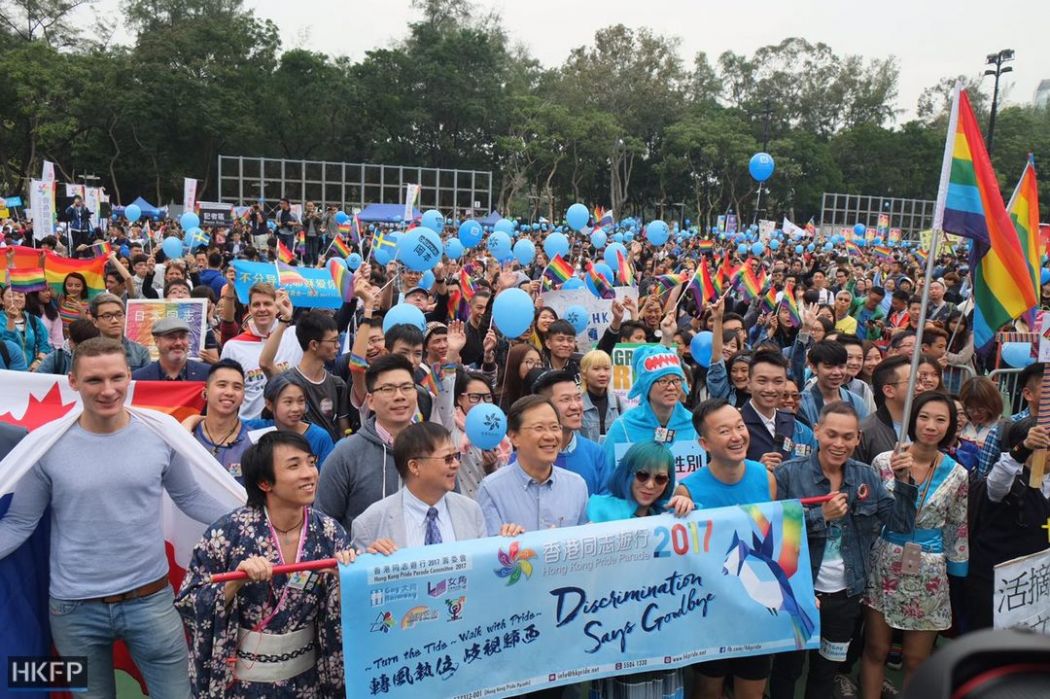
Pro-democracy lawmakers Raymond Chan and Kwok Ka-ki take part in Hong Kong’s Pride Parade in 2017. Photo: Kris Cheng/HKFP.
At the time, Hong Kong had annual Pride parades, with different themes each year, such as “Call for the law, equality for all” and “Stand up for diversity.” It was an opportunity for LGBT groups and their allies, including pro-democracy lawmakers, to rally on the city’s streets, waving rainbow flags and chanting slogans.
Since the Covid-19 pandemic, the organisers of the Pride march have only held indoor events.
“I thought it would be good to have an event like Pink Dot, which is different in nature. The Pride marches had clear political aims, while Pink Dot is softer, with no political aims,” Leung said.
Shrinking LGBTQ space in mainland China
Restrictions on the LGBTQ community in mainland China, where advocacy groups have been forced to disband and queer content has been censored, are not lost on Hong Kong activists and academics.
Jamie Zhao, an assistant professor and scholar on queer media at the City University of Hong Kong, said the shrinking space for LGBT activism could not be separated from mainland authorities’ lack of tolerance for publicly disruptive and “rights-demanding” activities.
The official attitude towards the LGBTQ community is closely aligned with the country’s renewed emphasis on family values, marriage and fertility, Zhao told HKFP. Amid an ageing population and low birth rates, the Chinese government has been encouraging citizens to marry and have children.
“Queer life can be framed as non-reproductive, individualistic, foreign-influenced, or insufficiently aligned with the future of the nation,” Zhao said.
However, Zhao said mainland authorities’ approach to the LGBT community could not be described as a total crackdown. The growth in gay and lesbian bars, “boys’ love” and “girls’ love” drama series, LGBTQ reality dating shows and other elements that make up the “pink economy,” the academic said, shows that “commercially useful queer-coded culture” is still allowed to exist.
Posters featuring boys’ love at a merchandise shop in Beijing on July 9, 2025. Photo: Adek Berry/AFP.
John Burns, an honorary professor at the University of Hong Kong’s Department of Politics and Public Administration, also said the official stance on LGBT matters in mainland China was a mixed picture.
Despite restrictions, Chinese production companies are still making new “boys’ love” dramas to meet popular demand, and they have not been shut down by authorities, Burns said.
In any case, the scholar said he did not believe the Hong Kong government was attempting to ban LGBTQ communities from gathering, or that there had been any related directive from the central government.
“I don’t think the central government is micromanaging Hong Kong on [LGBTQ] issues. I think they’re more likely to be micromanaging Hong Kong on national security issues,” Burns told HKFP.
‘Greater risk of disorder’ outdoors
Since the Beijing-imposed national security law was passed in 2020, large-scale outdoor events like marches and rallies have all but dried up. Besides political protests, the city no longer sees marches on topics like labour issues and women’s rights as it used to.
“If the real issue is that the police are worried about national security, and people exploiting the outdoor event for something that it wasn’t designed for, then [the Hong Kong government] should say so,” Burns said.
Former lawmaker Regina Ip, who leads the government’s advisory body, the Executive Council, told HKFP that police tend to think outdoor events carry a “greater risk of disorder.”
She pointed to the Gay Games opening ceremony in 2023, which “was held at the Queen Elizabeth Stadium and went very well.”
Top government adviser Regina Ip delivers a speech at the opening ceremony of Gay Games 2023 on November 4, 2023. Photo: Graham Uden/Gay Games Hong Kong.
Hong Kong co-hosted the international sporting event with Mexico in 2023, welcoming participants from around the world. However, the Gay Games in the city, which did not receive government sponsorship, saw far less participation than originally expected.
Like last year, Pink Dot organisers are looking into holding a private indoor event that will be livestreamed to the public, Leung said.
Asked whether Pink Dot would consider moving its event indoors in the future, Leung expressed concerns that they would still face problems getting an entertainment licence.
To Zhao, the visibility of the LGBT community has become “politically more vulnerable” in recent years because of its association with the non-establishment camp.
“Many openly queer or queer-associated public figures were connected directly or indirectly to pro-democracy politics, civil society, activism or critical public discourse,” she said.
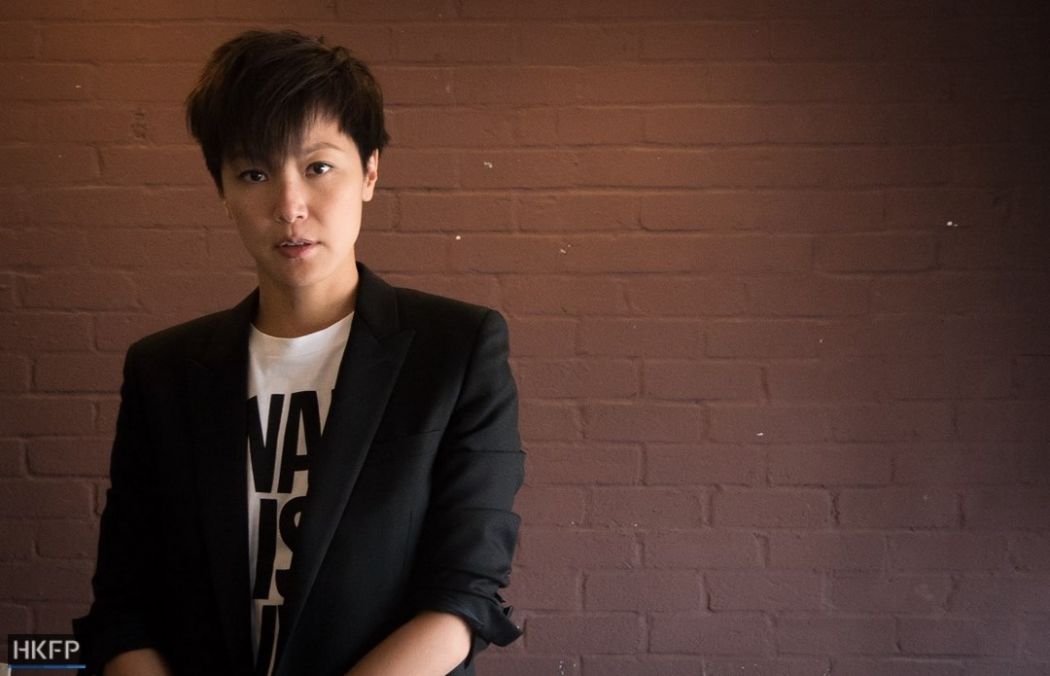
Cantopop singer Denise Ho. File photo: Jennifer Creery/HKFP.
Zhao referred to singer Denise Ho, who came out publicly during the Pride parade in 2012 and has spoken out about her pro-democracy stance.
Many politicians who took part in Pride parades belong to the pro-democracy camp, such as Leung Kwok-hung, also known as “Long Hair”; Raymond Chan, the first openly gay lawmaker; and Sham, one of the openly LGBTQ district councillors elected in 2019.
Leung, Kwok, Chan, and Sham were among the 47 democrats charged in a landmark national security case involving a primary election in 2020, and among the 45 who were jailed.
Zhao said: “This close association between queer culture and civil society has made queer visibility in Hong Kong more politically charged than in many mainland commercial contexts.”
‘Big loss’
Despite Pink Dot’s cancellation, some local activists are still hopeful that an LGBTQ space exists for the community to gather and celebrate diversity.
Jerome Yau on January 8, 2026. Photo: Kyle Lam/HKFP.
Jerome Yau, co-founder of Hong Kong Marriage Equality and chief executive of AIDS Concern, pointed to the fact that an outdoor event marking International Day Against Homophobia, Biphobia, and Transphobia (IDAHOBIT) went ahead over a weekend in mid-May.
On May 16 and 17, various organisations – from NGOs to an LGBTQ-friendly church and a queer advocacy media outlet – set up street booths in the heart of the Causeway Bay shopping district. The same event was held last year.
Yau acknowledged that organisers of large-scale events in Hong Kong faced “growing challenges” nowadays, but said he saw “no evidence” that Link REIT was under pressure.
LGBTQ groups mark International Day Against Homophobia, Biphobia and Transphobia (IDAHOBIT) on May 17, 2025. Photo: Kyle Lam/HKFP.
“Whatever those licensing issues may be, I hope there is more clarification,” he said.
Nick Lee, a lecturer at the Chinese University of Hong Kong’s Gender Studies Programme, however, said he felt it was possible that the venue operator did not experience direct pressure to refuse rental to Pink Dot organisers, but withdrew on its own accord out of an abundance of caution.
Still, Yau found it disappointing that Pink Dot could not be held for a second year in a row.
The event “had a good track record. It was a good sign that Hong Kong at the very least embraces diversity and inclusion,” he said.
“It’s obviously a big loss not just to the LGBTQ community, but to the whole of society.”
IKEA’s Tsim Sha Tsui outlet has halted sales of a frozen dessert item after a food safety test found that its level of coliform bacteria exceeded the standard limit.
The food section at IKEA in K11 Art Mall in Tsim Sha Tsui. Photo: Google Maps.
The Food and Environmental Hygiene Department said in a statement on Tuesday night that the Centre for Food Safety (CFS) conducted tests on a frozen confection sample from a “licensed frozen confection factory in Tsim Sha Tsui” as part of routine checks.
Tests found that the sample contained 240 coliform bacteria per gram, more than twice the legal limit of 100 coliform bacteria per gram.
The frozen dessert was sold at the food section of Swedish furniture giant IKEA’s Tsim Sha Tsui store, located in K11 Art Mall.
“The CFS has informed the frozen confection factory concerned of the irregularity and instructed it to stop selling and to dispose [of] all the affected frozen confection immediately,” the statement read.
Food and Environmental Hygiene Department. File photo: GovHK.
A group of bacteria found in digestive tracts and soil, coliforms in food can suggest contamination. They are usually present in small numbers in items such as raw milk, meat, poultry or other raw foods.
While mostly harmless, high levels of coliforms indicate unsanitary conditions or poor hygiene practices during food production, according to the CFS.
The CFS added that while the coliform count shows hygiene conditions were “unsatisfactory,” it did not mean consumption would cause food poisoning.
In April, the 70th month since Beijing imposed the national security law, the Hong Kong government applied to the court to seize assets belonging to Apple Daily founder Jimmy Lai, who is serving a 20-year prison sentence.
St Paul’s Co-educational College Choir performs at the opening ceremony of National Security Education Day on April 15, 2026, at the Hong Kong Convention and Exhibition Centre. Photo: GovHK.
On National Education Day, a top Chinese official delivered a warning about those who “politicised” the deadly Tai Po fire and tried to “stir up chaos” in the city.
Gov’t seeks to seize Jimmy Lai’s assets
The Hong Kong government filed an application with the High Court on April 2 to seize “offence-related” properties owned by jailed pro-democracy media tycoon Jimmy Lai on national security grounds.
In a statement issued the same day, the government mentioned Lai’s earlier convictions under the Beijing-imposed national security law. It said the High Court had found that he was the “mastermind and driving force behind the case, consciously using Apple Daily and his personal influence” to undermine local and Beijing authorities.
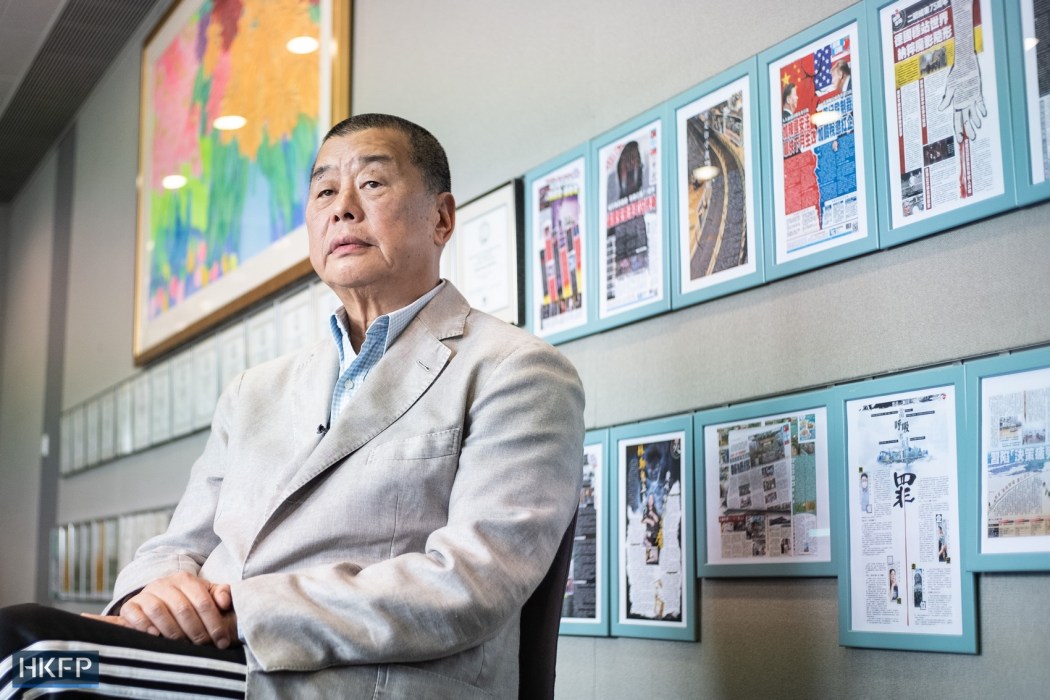
Hong Kong pro-democracy media mogul Jimmy Lai. File photo: Kelly Ho/HKFP.
The assets include credit balances in bank accounts belonging to or linked to the Apple Daily founder.
Fifteen bank accounts under Lai’s name – 10 with HSBC, two with Hang Seng Bank and three with Shanghai Commercial and Savings Bank – have over HK$32 million.
The government is also seeking to seize bank accounts belonging to 17 companies linked to Lai. It is also demanding that Lai give up shares in 17 companies, some of which overlap with the 17 firms whose assets the government is seeking to seize.
Among the companies whose assets and shares the government wants to seize are Dico Consultants Ltd, which has over HK$404,302 in its HSBC account, and Lai’s Hotel Properties Ltd, which has over HK$3.1 million in its four HSBC accounts.
Lai has been summoned to the High Court on July 8 to hear the government’s application. The case will be presided over by Esther Toh, one of the three judges who heard his national security trial.
Apple Daily headquarters. Photo: Candice Chau/HKFP.
The move to seize Lai’s assets came after the government designated three companies linked to Lai’s now-defunct Apple Daily tabloid “prohibited organisations” in late March and removed them from the corporate registry. Police cordoned off the Apple Daily building in Tseung Kwan O a day later.
The three firms were tried and convicted alongside the Apple Daily founder in his high-profile national security case. Lai was sentenced to 20 years behind bars in early February, while the companies were each fined over HK$3 million.
Wong Kwok-ngon, known by his pen name Wong On-yin, has been detained since his arrest in December for allegedly divulging in a YouTube video details of enquiries made by police during a national security investigation.
Judge Stanley Chan said the pre-trial review would take place behind closed doors on August 11, and the trial would begin on October 9.
Wong Kwok-ngon in a YouTube video posted on December 2, 2026. Screenshot: On8 Channel – 王岸然頻道, via YouTube.
Wong’s offence falls under the Safeguarding National Security Ordinance, a homegrown security law known as Article 23. It was added to the ordinance in May as part of subsidiary legislation, and Wong is the first to be charged under the new law.
He is also charged with sedition over videos posted on YouTube between January 3 and December 6 last year. He plans to plead not guilty to both charges.
The defendant, who continues to represent himself, told the court he had dropped his legal aid application.
Asked by the judge whether he had legal knowledge for self-defence, Wong said he had “three law degrees” and was confident of handling the case.
Nat. security clauses for restaurant licences
Secretary for Environment and Ecology Tse Chin-wan said in early April that all Hong Kong restaurant licences would include national security clauses from September.
Shops awaiting for lease on a Hong Kong street in October 2024. File photo: Kyle Lam/HKFP.
Tse made the remarks on April 7, nearly a year after the Food and Environmental Hygiene Department (FEHD) introduced the provisions for restaurant licence renewals in May.
“With restaurants renewing their licences gradually, we expect that by September this year, all restaurant licences will contain the clauses,” Tse told reporters, according to RTHK.
Retiree jailed over seditious Facebook posts
A Hong Kong man was jailed for a year under the city’s homegrown national security law after pleading guilty to making seditious remarks on Facebook, including comments supporting Hong Kong’s and Taiwan’s independence.
The magistrate handed Chong, a retiree in his early 60s, an 18-month sentence but discounted it by six months after considering his guilty plea.
A Facebook log-in screen. Photo: Pixabay, via Pexels.
Chong was accused of making 53 seditious social media posts between March 2024 and November 2025, local media reported.
The posts had wording such as “dissolving the Chinese Communist Party is the most important thing” and “Hong Kong independence is within sight.”
The defendant posted on a public Facebook page called “Holy Raymond,” which features the Chinese phrase “Heaven will destroy the Chinese Communist Party, God bless Hong Kong” as its profile picture.
During mitigation ahead of sentencing, his lawyer argued that Chong was a Falun Gong believer who had come to hate the Chinese Communist Party because of false information that the CCP engaged in live organ harvesting.
Beijing official warned of ‘politicising’ Tai Po fire
China’s top official in charge of Hong Kong affairs warned of some people who “politicised” the deadly Tai Po fire and tried to use the disaster to “stir up chaos” in Hong Kong.
Xia Baolong, director of the Hong Kong and Macao Affairs Office, delivered his remarks on April 15 via a recorded video shown at a National Security Education Day ceremony.
In his speech, Xia mentioned the massive fire that broke out at Wang Fuk Court, a government-subsidised housing estate in Tai Po, on November 26, killing 168 people.
Xia Baolong, the director of the Hong Kong and Macau Affairs Office, gives a speech via a video on National Security Day on April 15, 2026. Photo: GovHK.
“After the Tai Po fire, some malicious people politicised the tragedy, attempting to use the disaster as a means to disrupt Hong Kong,” Xia said in Mandarin, without giving further details.
“Once again, it reminds us that along Hong Kong’s path toward prosperity under good governance, there will be various risks and challenges.”
Speaking at the same event, Hong Kong Chief Executive John Lee also warned that some people were “using the disaster to stir up chaos” and “to incite hatred” in Hong Kong.
“Only through the government’s swift action and decisive law enforcement has the situation been able to return to normal,” Lee said in Mandarin.
French journalist denied entry to city
A French journalist was denied entry to Hong Kong in November, Reporters Without Borders (RSF) said in late April, accusing the city’s authorities of “weaponising visas” against foreign media workers.
French journalist Antoine Vedeilhe. Photo: Reporters Without Borders.
Antoine Vedeilhe, who was shooting a documentary for French public broadcaster France Télévisions, was questioned upon arrival at Hong Kong International Airport on November 2 last year, RSF said in a statement on April 24.
He was detained for three hours before being deported without being given a reason, it added.
The press freedom NGO said Vedeilhe was the 13th foreign media worker who had been denied entry or a visa by the city’s authorities following Beijing’s imposition of the national security law in 2020.
“In the journalist’s view, his detention was a reprisal for his work on a documentary examining Beijing’s grip on Hong Kong,” RSF said.
Another cameraman for the documentary was able to enter the city, RSF said, but he was followed by “unidentified individuals that he suspects were Hong Kong’s national security police.”
“In the following days, there was a hacking attempt on Vedeilhe’s private email account and his sources in the documentary were harassed by the national security police,” the NGO said.
In an emailed reply to HKFP’s enquiries, the Hong Kong government said it “strongly condemns the smearing remarks and distorted narratives by” RSF.
Prosecution and arrests figures
As of April 1, a total of 394 people have been arrested for “cases involving suspected acts or activities that endanger national security” since Beijing’s national security law came into effect, according to the Security Bureau. That figure includes those arrested under Article 23 and for other offences.
Of the 208 people and five companies that have so far been charged, 180 people and four companies have been convicted or are awaiting sentencing.
In total, 100 people and four companies have been charged under Beijing’s national security law, with 79 persons and three companies convicted. Thirteen people have been charged under Article 23, 10 of whom have been convicted.
Hong Kong independent bookshop Book Punch and its owner have been fined HK$6,000 after holding a stand-up comedy show without an entertainment licence – the second time they have been penalised within a month.
Hong Kong independent bookstore Book Punch owner Pong Yat-ming outside the Kowloon City Magistrates’ Courts on April 10, 2026. Photo: Hans Tse/HKFP.
Pong Yat-ming and his firm, Active Experiential Learning Company, which owns Book Punch, were fined HK$3,000 each on Monday afternoon after they were found guilty of breaching the Places of Public Entertainment Ordinance following a trial that morning.
The two defendants were accused of holding a stand-up comedy event at the Sham Shui Po bookstore on June 29 last year, local media reported.
According to a Facebook post that month, the event was a stand-up comedy performance featuring people who had completed a comedy course hosted by the bookstore.
That day, two undercover Food and Environmental Hygiene Department (FEHD) officers attended the pay-as-you-wish event, each giving HK$100.
‘Stage performance’
During the trial, one of the FEHD officers who posed as a participant testified for the prosecution.
The officer, surnamed Hui, described around 40 chairs facing the same direction, towards the event host and performers.
Food and Environmental Hygiene Department. File photo: GovHK.
Representing Pong and his firm, barrister Lawrence Lau asked whether the performance space was on the same level as the audience.
Hui confirmed that there was no stage, so the performers were not elevated.
Lau said he agreed that the event was a “performance,” but since there was no stage – doubted whether it was a “stage performance,” citing the wording used in the Places of Public Entertainment Ordinance.
The ordinance states that the laws apply to “a concert, opera, ballet, stage performance or other musical, dramatic or theatrical entertainment.”
A poster for the stand-up comedy event on June 29, 2025. Photo: Book Punch, via Facebook.
Lau added that while the ordinance lists “comedy” as an example of a “stage performance,” along with other types of entertainment such as melodrama and dancing exhibitions, stand-up comedy should not be considered comedy.
Pong did not testify in the trial.
Past convictions
Delivering the verdict on Monday afternoon, Magistrate Andrew Mok said he disagreed with Lau’s narrow reading of the ordinance.
He said he did not think “stage performance,” as stated in the ordinance, applied only to performances with a stage.
Mok said that Pong showed no remorse during the trial, and therefore, there was no reason to give a lighter penalty. But he noted that Pong’s attitude during the trial was “pragmatic,” and that his past convictions all had to do with promoting culture.
On April 10, Pong and his firm were fined HK$32,000 after being found guilty of running an unregistered school. The case related to a Spanish interest class that was held at the bookstore.
In 2022, Pong was convicted of serving alcohol without a licence after he served sake to attendees at a sake-book-sharing event. The judge handed down a fine of HK$12,000.
Hong Kong restaurants with an area larger than 20 square metres can start applying for licences to allow dogs in their premises from May 18, the government has announced.
The Food and Environmental Hygiene Department said in a statement on Thursday that it would accept applications from May 18 to June 8.
Pixel, the HKFP news hound, welcomes the move. File photo: Tom Grundy/HKFP.
The department is set to approve the first batch of applications in mid-June, with dogs to be allowed in restaurants in July.
The statement said that “the FEHD will specify a date in July from which dogs will be allowed to enter permitted food premises.”
While the Food Business (Amendment) Regulation 2026 came into effect on Friday, the FEHD reminded the public that “restaurants must first submit an application and obtain approval before allowing dogs to enter.”
Hotpot and barbecue restaurants are not eligible to apply for the permits, the government said, citing safety concerns.
The FEHD will hold briefing sessions for restaurant operators from Monday to Wednesday next week, as well as on May 28.
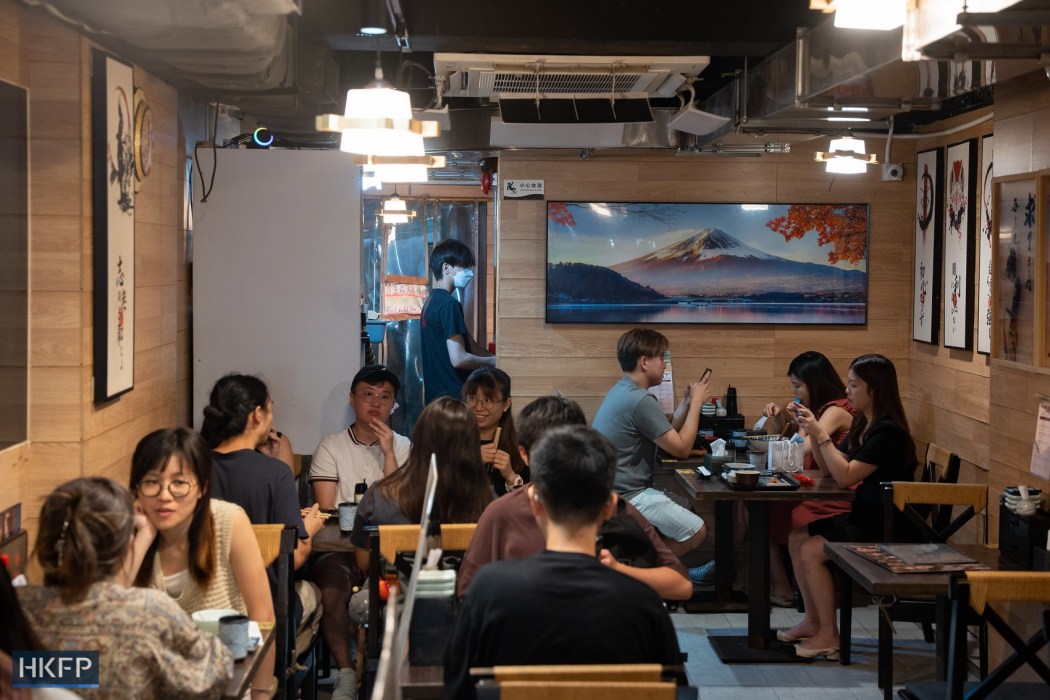
A Hong Kong restaurant. File photo: Kyle Lam/HKFP.
The department said it would publish a list of dog-friendly restaurants once the first batch of permits is approved.
The announcement to update the decades-old Food Business Regulation came after a pet-friendly restaurant in Tai Po had to suspend operations for seven days in January last year for allowing dogs inside.

 Login
Login