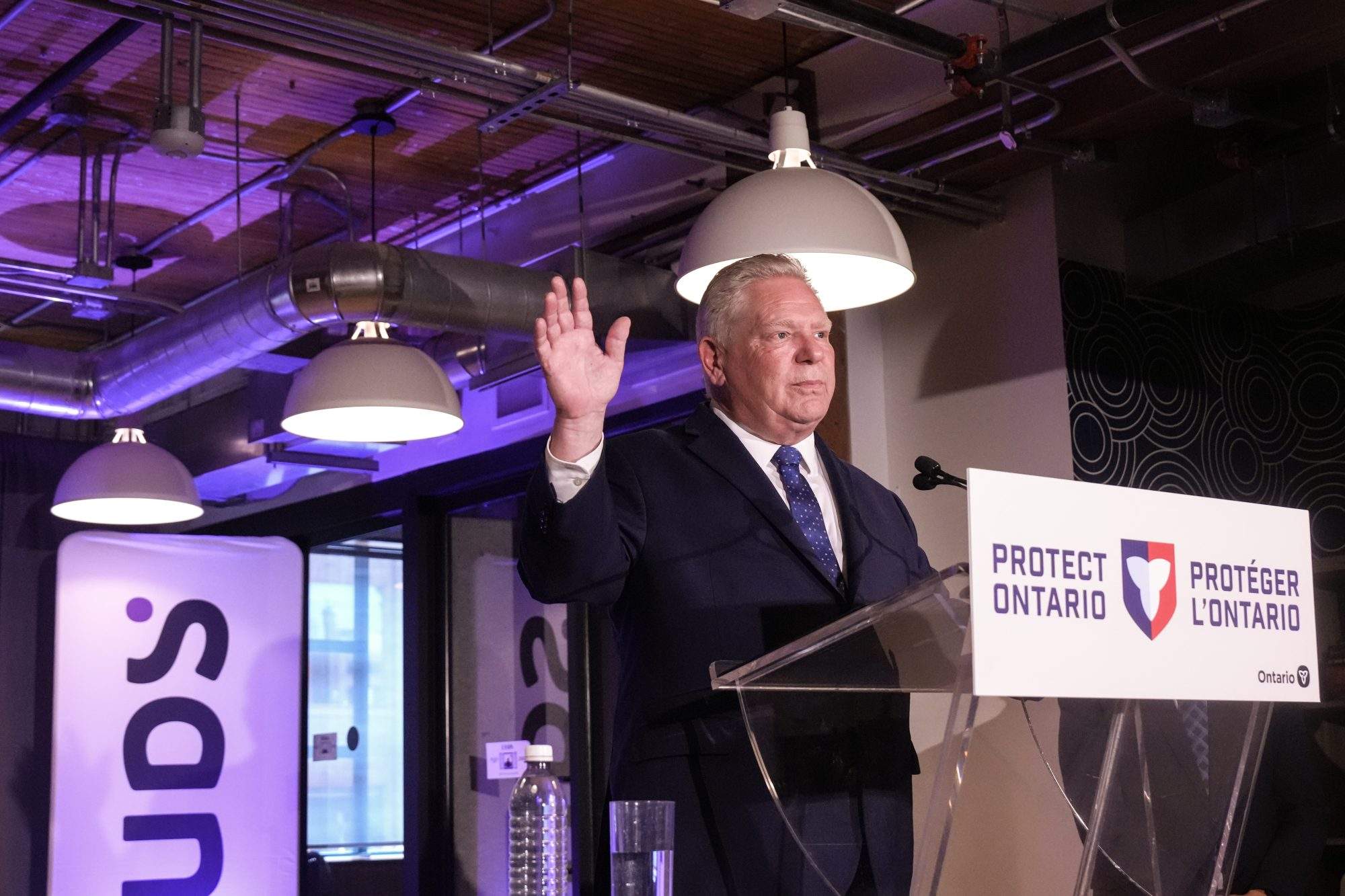
Records show Ford's penchant for private travel took off immediately after winning the 2025 provincial election campaign, during which his party chartered planes to Washington D.C.
Although he reinvented himself as a kingpin in the nursing home business, former Ontario premier Mike Harris used to be best known for the water contamination fiasco that killed seven people and sickened thousands more in Walkerton, ON.
That tragedy led to a dramatic decline in support for his government and was considered a key reason Harris resigned as premier in 2002.
Not surprisingly, the premiers who’ve followed Harris have steered clear of anything that smacks of weakening government surveillance of Ontario’s water systems.
Until now, that is.
Shaking off the Walkerton bogeyman, current Ontario Premier Doug Ford is embarking on a plan that will effectively privatize aspects of the province’s water systems, with potential risks to our drinking water.
Ford is well aware of the political danger of being associated with any weakening of public management of water. This explains why he’s going out of his way to deny the label “privatization” applies to the changes in new legislation, which the government insists will keep our water “publicly owned.”
But, as law professor Joel Bakan and economist Jim Stanford noted in a piece in the Star yesterday, the new legislation creates a regime for water and wastewater services in Ontario that is effectively privatized — despite the Ford government’s attempt to deny what it’s doing amounts to privatization.
The Ford government’s keenness to put in place this new water regime — while disguising the fact that it involves privatization — raises the question: whose interests is the government serving in doing this?
Clearly, there’s no public pressure for our water systems to be redesigned to include profit-making. That’s because there would be no benefit for the public.
However, there is one group that would benefit significantly — private investors.
Indeed, private investors — particularly large global institutional investment firms that represent (among others) pension funds, insurance companies and very wealthy families — have trillions of dollars in capital and are keen to invest it in low-risk projects where they can earn returns as high as seven to nine per cent a year. And public infrastructure, including Ontario’s water system, fits that bill.
Under Ford’s legislation, water and sewage systems can be removed from the control of local governments — the plan is to start with Peel Region — and transferred to specially-created, profit-making corporations.
“Key decisions — including finances, contracts and water rates — would be made by corporate boards,” observes Meera Karunananthan, a geography professor at Carleton University.
She also says that the public would continue to be responsible for the debt from constructing the water infrastructure, while the profits would go to investors. “Simply put, the public bears the burden while shareholders capture the reward.”
The public is also potentially endangered. A 2002 public inquiry found that among the factors contributing to the Walkerton tragedy was the Harris government’s failed provincial oversight after it privatized water testing.
Harris was an unusually gung-ho privatizer, and his legacy of privatization — with all the associated risks — lives on in areas beyond water management.
He also encouraged privatization in Ontario’s long-term-care homes and then went on to benefit handsomely from the privatized nursing home industry he helped create. Shortly after retiring as premier, he became a significant shareholder and chairman of Chartwell Retirement Residences, a major private chain operating publicly-funded nursing homes.
Chartwell was among the for-profit nursing homes that were found to have higher death rates during the COVID pandemic than not-for-profit homes, according to a 2020 investigation by a team of Toronto Star reporters as well as a CBC probe. Harris retired as Chartwell chairman two years later, in 2022.
While public services and infrastructure offer lucrative opportunities for moneyed investors, there’s a reason not to hand over aspects of these vital provincial responsibilities to private interests which are, above all, focused on making profits.
Ontarians died needlessly in nursing homes and in Walkerton. Doug Ford should take note.
This article was originally published in the Toronto Star.
Prime Minister Mark Carney wants to privatize our airports, our seaports and build a lot more private gas and nuclear power plants. Ontario Premier Doug Ford is privatizing our water, our healthcare and building a lot more private gas and nuclear power plants. Carney said Canada was “not for sale,” and Ford says “that’s how we “protect Ontario.”
Both Carney and Ford are using the Trump crisis as was so brilliantly described in Naomi Klein’s book Shock Doctrine. Crisis capitalism is being used to privatize our public assets and services.
When privatizing our public assets and services, we always hear the same song.
We have to “modernize, reform, increase competitiveness, innovation and increased efficiencies through alternative models of ownership.” Then we are told the same false claim: This will lead to “lower costs” which will be passed on to you. The same claim of lower rates came from Ontario Premier Mike Harris’ hydro legislation. Rates have now more than quadrupled.
Hwy 407 is now the most expensive toll way in the world. In a deal far worse than the privatization of HWY 407, the privatization of the Bruce nuclear plant in a long-term lease in the year 2000, the profits were privatized but the $34 billion debt and the risks and cleanup remained public.
The privatization of long-term care homes where many died from neglect during the COVID-19 pandemic and the higher and higher rates of Hydro privatization has left the people of Ontario with no appetite for any more privatization of public assets.
The privatization of Connaught Labs by former Prime Minister Brian Mulroney also hurt us badly during the pandemic. The record of privatization around the world is dismal. The prime example of privatization failures is in the UK where the privatization of water, electricity and rail has left that country a basket case. The record of privatization is clear, when you introduce the profit motive, private corporations benefit and we all will pay a lot more. The risk is not just higher rates,the loss of sovereignty and control is the biggest risk. There doesn’t seem to be any difference between the Conservative and Liberal parties; both are on a public asset privatization rampage.
A Ponzi scheme is where the schemer gets one group of victims to pay another group of victims. Ponzi schemes require an ever-increasing flow of more money to survive. All Ponzi schemes eventually collapse.
High hydro rates were a big problem politically. So, In the 2018 Ontario provincial election Doug Ford promised to lower hydro rates by 12 per cent. Ford has not lowered hydro rates by even one per cent.
What Ford did do was hide and protect private profits with his electricity rebate program subsidy. The Financial Accountability Office has reported the cost to the public treasury from between $6 billion and $7 billion per year.
Last November first the Ontario Energy Board raised electricity rates by 29 per cent. This was done, as it has been done every November 1 and April 1 since June 2002 to pay the rates the deregulated electricity market charged.
Knowing this would not be good optics for him, Ford increased the electricity rebate program from 13 to 23.5 per cent, hiding the increase. Ford never talks about his 2018 promise anymore.
Just doing the math, $6.9 Billion plus 23.5 per cent equals a whopping $8.5215 billion and growing, that figure does not include the November 1 increase of 29 per cent. All paid for by the public treasury. Hard to believe that, on top of all that Ford wants to increase hydro rates by 72.6 per cent to prepay the billions for new nuclear plants that won’t be built for years.
Some history is required.
Like the con man who goes from town to town working their scam, in the 1990’s Enron was wandering the world selling their invention: The deregulated electricity market.
Claiming Ontario hydro was bankrupt because of a $34 billion debt, Harris deregulated our hydro. A debt that was almost entirely nuclear debt showing right up to today how expensive nuclear power is.
Harris then spent millions on a province wide ad campaign promising “lower rates” from his hydro deregulation legislation, as well as promising that “nothing will go wrong”.
Harris rammed through three pieces of legislation in 1998.Bill 35 The Energy Competition Act, The Electricity Act and the Ontario Energy Board Act. Harris then had Enron and a who’s who of private investors design Ontario’s electricity market, which is still the main cause of today’s high hydro rates. Harris’s legislation changed all non-profit at -cost hydro commissions into for-profit corporations. Harris’ promises of “lower rates and nothing will go wrong” was short lived.
After the Enron designed electricity market opened in June of 2002, by 2007 rates doubled, by 2010 rates had tripled and by 2018 rates had quadrupled.
This brings us to Ford’s election and the introduction of Ford’s Ontario electricity rebate hiding the problem. Conservative Alberta is doing the exact same scheme with their electricity rates. Electricity markets are notoriously easy to manipulate, as shown by failures in California and many places around the world.
The victims now paying more and more to fund this Ponzi scheme are all of us.
The crisis in both healthcare and education as well as other public services we all depend on is due to the underfunding and cuts to our critical public services to fund this scam and worst of all, Ford is also borrowing from future taxpayers by using deficit financing to pay for his scheme.
In a nutshell Ford is financing his scheme with social deficits in healthcare, education and public treasury deficits.
The deficit for 2026-27 is now $13.8 billion, indebting future generations.
In the middle of an affordability crisis, Ford’s scheme only protects private profits.
This Ponzi scheme like all others is unsustainable and will eventually collapse.
The Enron designed electricity market must be closed. Rates must be regulated and like nine countries in Europe and Australia we must get on the pathway of public green power and conservation.

 Login
Login