“To me, being a visual activist means I only illustrate stories that resonate with me deeply, by giving voice to minorities or social situations that need to be addressed,” says Fatinha Ramos. “It is the only way I can truly connect with others.”
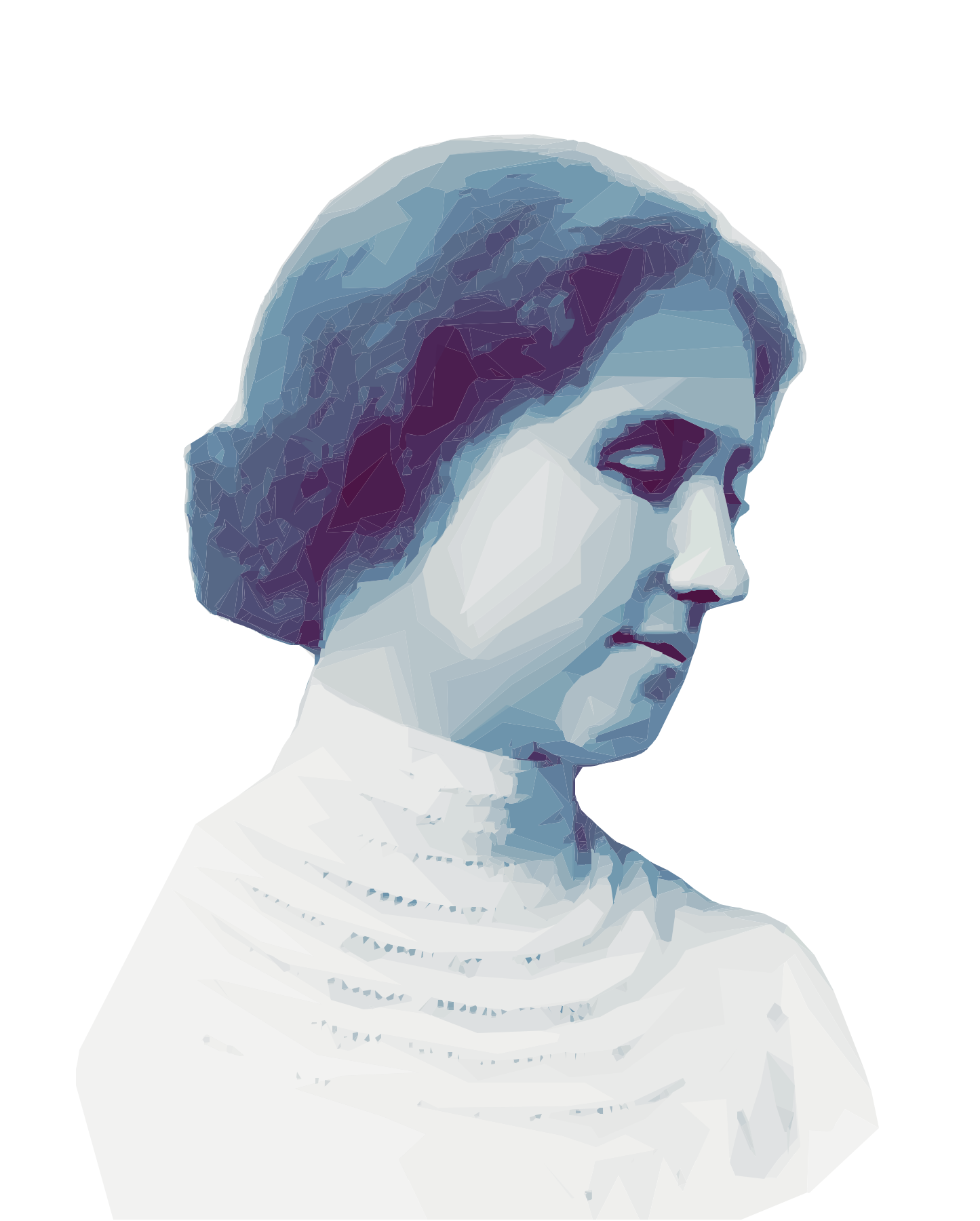
Based in Antwerp, the Portuguese artist and illustrator is well-known for blending analog and digital techniques to create rich, emotive compositions. Collaborating with clients like The New York Times, The Washington Post, Tate, and Scientific American, among many others, Ramos has cultivated a keen eye for storytelling through her distinctive visual language.
Recent partnerships include the Anne Frank Museum and MoMA, the latter of which commissioned the artist to illustrate an essay on her experience being compared to Frida Kahlo. Ramos was born with osteogenesis imperfecta, commonly called brittle bone disease, which spurred a childhood spent in and out of hospitals. Drawing and art-making quickly became a preferred pastime, allowing her to transport herself from such clinical settings.
This adolescent hobby stuck, and Ramos worked as an art director in advertising and publishing for 12 years before venturing out on her own. Boasting an impressive list of clients and collaborators, she considers her practice to be an antidote to stereotypical narratives, whether related to the climate crisis, sexism, racism, or the dire lack of empathy that seems rampant in today’s world.
“I want to move away from the narrative that turns artists with disabilities into symbols of resilience,” she tells MoMA. “Creativity does not happen despite limitations but through them. Art should broaden how we see the world—and that includes how we see bodies, too.”
At the moment, Ramos is only accepting select illustration clients as she focuses on her fine art practice, including a series of anatomical glass sculptures based on brittle bone disease. You can explore more of her practice on her website and Instagram.
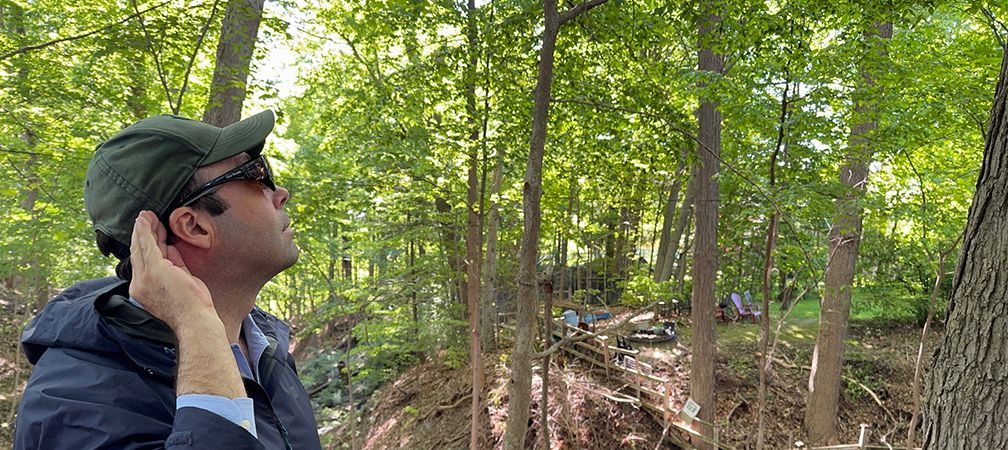
The first time someone called me a birder, I was startled, not only because I’m completely Blind. I had accumulated bits of knowledge here and there over the years and felt smug when I could identify birds by their songs, but I’d never studied, and it had never even occurred to me to go on an outing. Birders get up early, which wasn’t my habit, and I believed falsely that birding was entirely centred on vision. While some are, many birders I’ve spoken to describe listening as one of the key tools in finding birds to identify, especially in high summer when the foliage is at maximum density.
So on a sunny day in late summer, I accompanied Steve Garrett of the Toronto Ornithological Club (TOC), a Nature Network member group, to hear what was to be heard in Toronto’s High Park (mostly it was goldfinches and chickadees). We had our expectations set appropriately, as anyone who can distinguish a house sparrow from a bluejay can tell you, late summer isn’t the best time for birding.
Despite the season, I learned a lot. I got acquainted with the Merlin Bird ID app, and grilled Steve about birders and their ways.
Things I learned:
A “spark bird” is the bird that first catches someone’s attention and turns them into a birder
A “lifer” is a first-ever sighting of a bird that a birder may have been chasing for years
And the best way to get a bird to stop singing is by turning on your ID app microphone
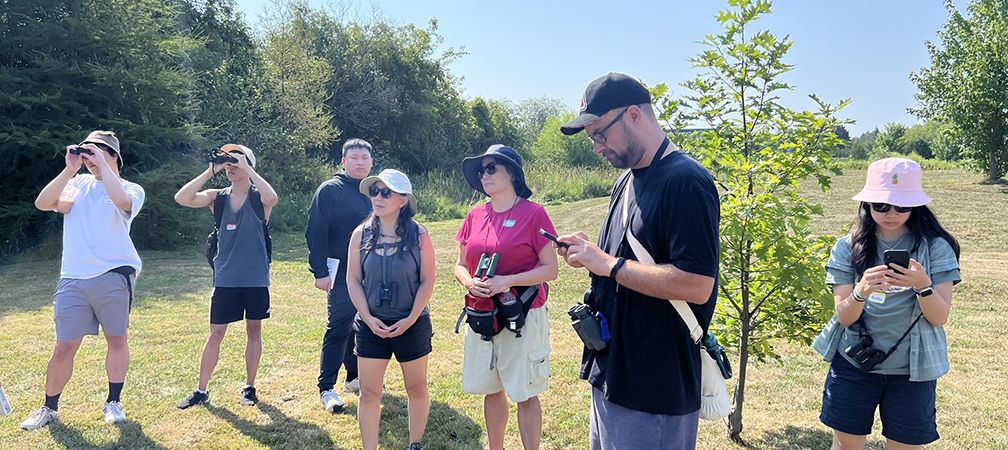
Steve told me the image of the classic birder has changed. The classic birder, armed with field glasses and reference manuals, isn’t quite as conspicuous anymore, because the smart phone offers options both for viewing, photographing, identifying and documenting.
Also, the idea of who a birder is has consciously shifted. “The birding community has followed the cultural shift towards diversity, equity and inclusion,” Steve told me. “When it was founded, way back in 1934, the Toronto Ornithological Club was exclusively men. Of course that’s not true anymore, and we’re actively interested in including people with a wide range of ages, backgrounds and abilities.”
This led to a discussion about an event involving the TOC and a group of Blind adults brought together by Balance for Blind Adults. One participant was Alex Bulmer, a Blind actor and director, who lives near High Park.
Alex, who lost her sight in her 20s, explained that one of the biggest barriers for Blind birding is access. “It’s one thing to walk down the street,” she says, “That’s good, cause there’re birds out on the street in the city and you can travel with your cane or your dog down the street, but you’re limited. Unless you can get into a woodland or a place that’s less navigable, I mean I can’t get into the depths of High Park with my cane or my dog, I just can’t without a sighted guide.”
I also think it’s important to tackle a common myth. Blind people have better hearing than sighted people. My conclusion is that, as a Blind person, I’m no more likely to excel at a hearing test than anyone else, but also as a Blind person, I rely heavily on sounds around me to make my way through the world and perceive what I can about it. This means that I often notice sounds my sighted friends don’t, not because I have quantitatively better hearing, but because I give more energy to processing what I hear.
Technology has also changed birding for Blind people. Gone are the days when sighted birders carried around reference books or paper journals. As a Blind person it’s all about the phone now. And as a totally Blind person, I rely on the voiceover feature on my iPhone which reads screen text aloud as synthetic speech. If an app developer has built accessibility features into their app, my experience will be as smooth as anyone else’s.
I’ve appreciated the opportunity the Merlin Bird ID app gives me to participate in community science by sharing recordings with research databases. Jim Halilton, a retired Blind tech user, became interested in identifying birds through a course called Birdability: Birding By Ear, designed and offered by Birds Canada. I asked him about the Merlin ID app. “It has helped me answer bird-song questions which I have had for decades. since having this app, and recognizing more birds as a result, I now pay more attention to birds I hear, to try to identify those I have not heard before.”
As a Blind birder I won’t be taking photos of birds, but learning their songs and calls helps me fill in the auditory landscape in a way that centres nature rather than just the human-made sounds I hear in my urban life. That persistent trill in my backyard, I discovered, is not a dying squirrel but a dark-eyed junco; I looked it up.

 Login
Login