Reading view

Chinese leaders skip Asia defence summit headlined by US

Dong Jun Pete Hegseth featured image

By Jan Hennop and Matthew Walsh

Pentagon chief Pete Hegseth is the headline speaker at Asia’s premier defence summit opening Friday, but China’s top officials aren’t expected despite weighty questions like Taiwan and the war in Iran.

Chinese Defence Minister Dong Jun speaks during the 21st Shangri-La Dialogue summit at the Shangri-La Hotel in Singapore on June 2, 2024. Photo: The International Institute for Strategic Studies, via Flickr.

Beijing’s defence minister is to skip the three-day Shangri-La Dialogue in Singapore for the second year running, which analysts viewed as a sign of China’s rising power.

Yet, the forum that brings together top officials from around 45 nations has historically provided a setting for debate as well as quiet and high-profile diplomacy.

Defence Minister Dong Jun’s absence means no meeting there with Hegseth as China warns the US over its involvement with Taiwan and Washington seeks an end to the Mideast war.

The Middle East was the source of 57 percent of China’s direct seaborne crude imports in 2025 — 5.9 million barrels per day (mbd) — maritime tracking firm Kpler said.

Hegseth’s second trip to the Shangri-La Dialogue comes after US President Donald Trump’s visit to China in May, and his subsequent suggestion that US arms sales to Taiwan could be used as a bargaining chip with Beijing.

See also: China is ‘preparing’ to use military force in Asia, US says

Hegseth’s speech on Saturday is expected to be “quite strong against China, but mainly for internal (US) consumption”, said Oh Ei Sun, senior fellow at the Singapore Institute of International Affairs.

“I think under Trump anything is negotiable and even with enemies deals can be done… (even) with Taiwan as a negotiating chip,” Oh told AFP.

Trump said “fantastic” trade deals were struck after his visit to China, although details were vague and no breakthrough with Beijing emerged in the war with Iran.

China arrived as ‘major power’

As the US and Iran clashed again on Thursday, threatening to derail a fragile push for peace, it “is unlikely that any possible deal will be discussed at the Shangri-La Dialogue”, Oh said.

China sent Dong to the dialogue as recently as 2024, where he and then Pentagon chief Lloyd Austin met for their first substantive face-to-face talks in 18 months.

“Dong was absent last year, reportedly due to China’s reluctance to engage with… Hegseth,” said William Choong, principal fellow at the ISEAS-Yusof Ishak Institute think-tank.

US Secretary of Defense Pete Hegseth (centre) arrives for a bilateral meeting with Singapore's Minister for Defence Chan Chun Sing on the sidelines of the Shangri-La Dialogue summit in Singapore on May 29, 2026. Photo: Jam Sta Rosa/AFP.
US Secretary of Defense Pete Hegseth (centre) arrives for a bilateral meeting with Singapore’s Minister for Defence Chan Chun Sing on the sidelines of the Shangri-La Dialogue summit in Singapore on May 29, 2026. Photo: Jam Sta Rosa/AFP.

China said Thursday it would send experts and scholars from its army’s study institutions.

Major General Meng Xiangqing of the National Defense University will lead the delegation, which is to include scholars from the National Defense University, the Academy of Military Sciences and the Navy.

Two other former defence ministers Wei Fenghe and Li Shangfu previously spoke at Shangri-La. Both were subsequently handed suspended death sentences on graft charges, analysts point out.

“It’s kind of a poisoned chalice for any Chinese defence minister to speak out publicly,” said Jennifer Parker, adjunct professor at the University of Western Australia’s Defence and Security Institute.

With Dong again not attending, one of the reasons seemed obvious, said Choong, writing for the Lowy Institute think-tank.

“For one thing, China has truly arrived as a major power in the region, so it does not really need to send its defence minister to brave a fusillade of questions and try to ‘score’ brownie points,” he said.

Beijing, however, like last year, risked not having a senior leader present if the two most pertinent global security issues — Taiwan and the opening of the Strait of Hormuz — do come up.

“At a time when perceptions of US leadership are falling, Beijing could soothe some jangled nerves in the region by reassuring delegates that it would use force against the island only as a last resort,” Choong said.

AUKUS focus

The defence ministers of the United States, Britain and Australia — the members of the AUKUS security alliance — are also due to convene.

Australian Defence Minister Richard Marles (right) and US Defense Secretary Pete Hegseth meet on the sidelines of the ASEAN Summit in Kuala Lumpur on November 1, 2025. Photo: Richard Marles, via X.
Australian Defence Minister Richard Marles (right) and US Defense Secretary Pete Hegseth meet on the sidelines of the ASEAN Summit in Kuala Lumpur on November 1, 2025. File photo: Richard Marles, via X.

AUKUS’s stated goal is to ensure a free and open Indo-Pacific region, though it is widely seen as a bulwark against a rising China, which strongly opposes the pact.

Australian Defence Minister Richard Marles said on Friday that Canberra was seeking “the maintenance of the global rules-based order” in the region.

“We’ve seen China engage in a very significant military buildup… and it has not happened with the kind of strategic reassurance which (we) would expect,” he told journalists at the forum.

“Fundamentally, we want to have a productive relationship with China. We want to live in a world which is governed by rules.”

Australian media outlets have reported, citing unnamed sources, that the AUKUS nations are expected to announce a major project, perhaps involving uncrewed underwater vehicles.
  •  

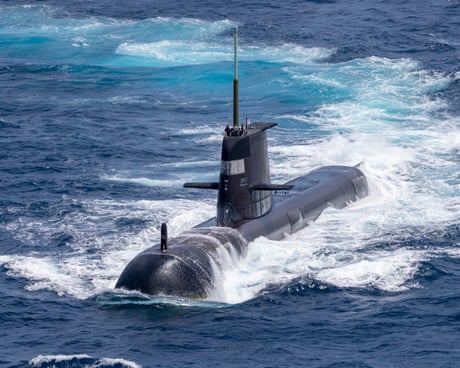
Aukus is among Australia’s worst foreign policy decisions and requires ‘heroic’ optimism, Gareth Evans says

Former Labor foreign affairs minister says belief US would defend Australia in event of an existential attack is a ‘ludicrous delusion’

Aukus will prove to be one of the worst defence and foreign policy decisions ever made by an Australian government and is only being permitted by Donald Trump in order to destroy Chinese nuclear threats to the US mainland, former foreign affairs minister Gareth Evans has said.

In evidence to an independent public inquiry into the $368bn nuclear agreement with the US and UK on Thursday, Evans, a cabinet minister in the Hawke and Keating governments, warned the transfer and construction of submarines to Australia from the early 2030s was effectively only an extension of the American military fleet.

Continue reading...

© Photograph: Australian Defence Force/Getty Images

© Photograph: Australian Defence Force/Getty Images

© Photograph: Australian Defence Force/Getty Images

  •  

Pentagon chief Pete Hegseth says US seeks ‘stable equilibrium’ with China in Asia

Pete Hegseth featured image

By Matthew Walsh and Ludovic Ehret

Pentagon chief Pete Hegseth struck a measured tone towards China at a major defence forum on Saturday, noting “rightful alarm” over Beijing’s military build-up but saying the United States sought a “stable equilibrium” in Asia.

US Secretary of Defence Pete Hegseth speaks during the 23rd Shangri-La Dialogue summit in Singapore on May 30, 2026. Photo: Jam Sta Rosa/AFP.

Hegseth’s headline speech at Singapore’s Shangri-La Dialogue, which brings together top defence officials and experts from around 45 countries, contrasted with his strongly confrontational remarks on China at last year’s gathering.

Unlike Beijing, which has sent a panel of military experts and scholars instead of defence minister Dong Jun for the second year running, Hegseth is leading a bumper US delegation to the event that provides chances for both open debate and behind-closed-doors diplomacy.

“When we look across the region today, there is rightful alarm regarding China’s historic military build-up and the expansion of its military activities in the region and beyond,” Hegseth said.

Washington does not seek “needless confrontation in the region”, but rather “a genuinely stable equilibrium (in Asia) that works for Americans as well as our allies”, he said.

That means “a favourable but durable balance of power in which no state, including China, can impose its hegemony and hold the security or prosperity of our nation and our allies in question”, he added.

China's Major General Meng Xiangqing of the National Defense University, the head of the Chinese delegation, attends the 23rd Shangri-La Dialogue summit in Singapore on May 29, 2026. Photo: Jam Sta Rosa/AFP.
China’s Major General Meng Xiangqing of the National Defense University, the head of the Chinese delegation, attends the 23rd Shangri-La Dialogue summit in Singapore on May 29, 2026. Photo: Jam Sta Rosa/AFP.

He said the United States sought “respectful” and “good-faith” engagement with Beijing, adding: “I wish my counterpart was here at this conference, but I look forward to other options when we can cross paths.”

Trump visited China this month, talking up “fantastic” trade deals but giving few details and later suggesting Washington could use its arms sales to self-ruled Taiwan as a bargaining chip with Beijing.

There had been “no change” in Washington’s stance towards Taiwan, but “any decision about future Taiwan arms sales… will rest with” US President Donald Trump, Hegseth said.

Vibe shift

The remarks contrasted sharply with last year’s event, when Hegseth painted China as a potentially “imminent” threat to security and outlined a swaggering vision of muscular American deterrence.

That day, he also took potshots at Beijing’s absent minister, saying: “We are here this morning, and somebody else isn’t.”

Chinese delegate Da Wei, director of the Center for International Security and Strategy at Beijing’s Tsinghua University, said this year’s address was “much more moderate”.

However, he found Hegseth’s depiction of China “ironic”, adding: “Everyone in the room must have been thinking: who is really hegemonic?

“Given what the US is doing in Iran and has done in Venezuela, I think it’s clear to everyone,” Da said.

US delegate Tammy Duckworth, a Democratic senator and strong Trump critic, said she was “somewhat disturbed” by Hegseth’s remarks, viewing them as overly conciliatory towards China.

US Senator Tammy Duckworth is seen during the 23rd Shangri-La Dialogue summit in Singapore on May 30, 2026. Photo: Mohd Rasfan/AFP.

“I worry that this administration is being distracted into wars that they’ve started in other parts of the world at the expense of our commitment here in the Indo-Pacific,” she told reporters.

Instead of Dong, China has sent experts and scholars from its army’s academic institutions, led by Major General Meng Xiangqing of the National Defense University.

Analysts have said Dong’s no-show reflects Beijing’s confidence as an established power with little inclination to answer publicly for its assertive moves in the region.

But some argue that China is also running the risk of having no senior policymaker present if two major security issues come up: reopening the Strait of Hormuz, and Beijing’s claim to Taiwan.

Hegseth again urged US allies to spend more on their own defence, singling out South Korea, Japan, Australia and the Philippines for praise while threatening consequences for nations that “free-ride on the generosity of the American taxpayer”.

“Those days are over. Allies who refuse to step up and carry their own weight for our collective defense will face a clear shift in how we do business.”

Iran threat

Hegseth’s remarks came as a peace deal between the United States and Iran to end their war remained elusive.

US Secretary of Defence Pete Hegseth speaks during the 23rd Shangri-La Dialogue summit in Singapore on May 30, 2026. The International Institute for Strategic Studies, via Flickr.

A White House official told AFP on Friday that Trump, who is weighing a final decision on a potential accord, would only commit if Iran met all his conditions.

But Iran has said “no final agreement” is in place, and its state media has rebutted parts of Trump’s characterisation of the deal.

Hegseth said Washington was “more than capable” of restarting the war if it wanted.

The head of the Pentagon is also due to meet his British and Australian counterparts as part of the AUKUS security alliance.

Australian media outlets have reported, citing unnamed sources, that the AUKUS nations are expected to announce a major project, perhaps involving uncrewed underwater vehicles.
  •  
❌