Login
Login
Little-ringed Plover DSCN7293
ianpreston posted a photo:

Many thanks to you ALL for the views, faves and comments you make on my shots it is very appreciated.


© ianpreston

ianpreston posted a photo:
Many thanks to you ALL for the views, faves and comments you make on my shots it is very appreciated.
© ianpreston

Eswatini remains the only African nation without tariff-free access to China's market due to its ties with Taiwan.
(Image credit: ChiangYing-ying)


Always available? You might be the reason your team isn’t stepping up.

©
Anthony Marsh appears to be in commanding position in significant boost to opposition leader Jess Wilson
The Liberals have claimed victory in a key Victorian byelection seen as a preview of what to expect when the rest of the state hits the polls in November.
As counting continued in the Mornington peninsula seat of Nepean, the Liberal candidate, Anthony Marsh, appeared to be in a commanding position in a significant boost to opposition leader Jess Wilson.
Continue reading...
© Photograph: Ian Currie/AAP

© Photograph: Ian Currie/AAP

© Photograph: Ian Currie/AAP

US president says ‘we took over the cargo, took over the oil. It’s a very profitable business’
Donald Trump has said the US navy acted “like pirates” as he described an operation seizing a ship amid the tit-for-tat American blockade of Iranian ports.
“We … land on top of it and we took over the ship. We took over the cargo, took over the oil. It’s a very profitable business,” said Trump at a rally in Florida on Friday.
Continue reading...
© Photograph: Cristóbal Herrera/EPA

© Photograph: Cristóbal Herrera/EPA

© Photograph: Cristóbal Herrera/EPA
Why Anthropic’s potential $1 trillion valuation is a signal for the end times.

©
As a Mast of Fraternity and Memory is unveiled in Nantes, calls are growing for Macron to announce framework for discussions
In the French port city of Nantes, once France’s largest departure point for ships that trafficked enslaved Africans across the Atlantic, a new wooden mast rises 18 metres into the sky from the waterside.
The Mast of Fraternity and Memory, inaugurated this month, marks a turning point in France’s complicated relationship with the legacy of its history of enslavement – just as the French president, Emmanuel Macron, comes under pressure to make key announcements on a process of reparatory justice.
Continue reading...
© Photograph: Thomas Louapre/The Guardian

© Photograph: Thomas Louapre/The Guardian

© Photograph: Thomas Louapre/The Guardian

You do a lot with your savings account over the course of a month. From bill payments, fund transfers, investments, to building your account balance, you explore various functions with regular transactions. It helps to get an overview of all the debits and credits to help you keep track of your finances. This is where a bank statement becomes relevant. It is a detailed record of your financial activity. Learn how to read it for proper financial planning in this blog.
What is a savings account statement?
A savings account statement is a periodic summary of your banking activity over a specific time frame. It includes details of every deposit, withdrawal, transfer, and payment made in a single place. This gives you a clear view of the cash flow and the actions leading up to your current account balance.
You see your opening and closing account balances, giving you a snapshot of how you started and where you currently stand. You also get details on the interest credits made to your account. You can estimate the same using a savings account calculator.
Key components of a bank statement
The main aspects covered in a bank statement can be broadly broken down into these components:
Account information
This section is typically the first thing you’ll see. It highlights your name, address, account number, bank name, branch details, etc.
Statement period
The timeframe covered appears at the top. It shows the start and end dates for each of the listed financial activities.
Balance summary
This is an overview of how money moves in and out of your account. You see the opening balance, deposits (credits) or withdrawals/deductions (debits), and the closing balance.
Transaction details
Each entry includes the date of the transaction, a short description to identify the activity, debit/credit amounts, fees, interest, and the balance after each transaction.
Fees and interest
Interest earned and fees applied are also listed. You can cross-check the earnings as estimated against the interest rate with a savings account interest calculator.
How to read your bank statement
Having understood the main aspects covered in a bank statement, you can put it all together easily. Here’s how you can proceed to decode the essentials:
Check your account details and statement period to review transactions within the specific timeline you prefer.
Scan the account balance to get a sense of where you stand with your finances.
Go through each entry carefully to match it to your spending pattern and receipt record.
Review any fees levied and interest credited.
If something looks unfamiliar, double-check against your activity and report it immediately.
Steps to get a bank statement
Many banks send periodic statements to your registered email if you’ve opted in, or you can update your physical passbook. Another convenient option to get your bank statement is online.
Log in to your bank account: Use your bank’s net banking portal or mobile app to access your account.
Navigate the statement section: Look for the ‘Account Statement’ or ‘Download Statement’ option under the menu.
Select the account and time period: Choose the savings account you need the statement for and specify the date range you need.
Generate and download: Confirm your request to view, download, or get the bank statement in your email inbox.
You can do this as many times as you like for different periods. You can get a mini-overview or a detailed statement for a thorough evaluation of your banking activity.
Final words
It’s easy to understand your bank statement once you understand the main components. Look at how it is structured and review all the details to get a complete overview of your transactions. Developing this habit of reading your bank statement is good for planning your finances effectively. It is also a safety measure to spot suspicious account activity in time. Also, the various ways to get your bank statement add to the flexibility.
This is an advertorial. The article is published as received.


No adult living in India today, with a constitutionally guaranteed right to vote, will ever forget the SIR. Not even the legions of India’s unlettered, who won’t even know what those dreaded letters stand for.
The state of West Bengal had its tryst with the process over the past six months, after Bihar had seen it first. In Phase 2 of the SIR that got under way on 4 November 2025, the Election Commission of India (ECI) lavished special attention on Bengal, though it was only one of 12 states and Union Territories covered in this round.
The people of Bengal had seen it coming even before the process started here, when lakhs of deleted voters in Bihar were scrambling desperately to get back onto the electoral rolls. And now, a full six months after the grind started here, they are finally awaiting the results on 4 May.
Irrespective of which way they lean, neither the voters nor the pundits nor even pollsters of any integrity are sure how thoroughly gamed this supposedly ‘free and fair’ process is. Has the ECI done enough to swing it for its political masters?
“If the BJP finally wins West Bengal,” a state this Hindi heartland party has long coveted, “it’ll be because of the SIR,” reflected a veteran of many earlier poll battles, preferring not to be named. “But if it loses again, even after all it has done, it’ll be because of the SIR.”
This apparent paradox isn’t really. If you discount the SIR for just a moment and think only of the palpable mood of the electorate of this state, its people and the BJP are not really ready for each other.
Not even after 15 years of Mamata Banerjee and all the talk about the need for poriborton (change). Poriborton may yet come — if not organically through a popular mandate, then via the BJP’s joint venture with the ECI. But if it doesn’t, the seething anger of voters with the ECI will have played a big hand.
****
For a while it looked like the ECI was still trying to keep the real agenda under wraps, its attempt to re-engineer the electorate to the BJP’s advantage. The BJP has made no secret of its support for the exercise, and a fair-minded outsider might wonder why it’s only the Opposition that worries about largescale exclusions.
Union minister Shantanu Thakur, a prominent Matua leader of the BJP, representing the party from the state’s Bongaon Lok Sabha constituency, said it was preferable to sacrifice 20,000 Hindus to weed out 200,000 Rohingyas. But of the 58.2 lakh ASDD (Absent/Shifted/Dead/Duplicate) deletions in the draft list of December 2025, not one was Rohingya or Bangladeshi.
Soon after, the ECI deployed a mysterious software that flagged 1.3 crore voters for ‘logical discrepancy’ — a newly minted category of provisional deletions — and asked them to produce documents at in-person hearings.
Migrant workers, men, women, the elderly and the ailing queued up to produce the documents they could muster. No receipts were given, no evidence provided that they had been ‘heard’, pointed out Sahidul Munshi, retired justice of the Calcutta High Court, who found his name had been dropped. Following an interview published in Bar & Bench, his name was quickly restored but others were not so lucky.
From the pre-SIR baseline of 7.66 crore voters, the number was down to 7.08 crore (after ~58 lakh deletions) in the draft list of December 2025. The ‘final list’ of 28 February had 7.04 crore names, with ~60 lakh now placed ‘under adjudication’.
Post-adjudication by judicial officers, engaged to do the ECI’s job at the direction of the Supreme Court, 32 lakh names were cleared, which still left 27 lakh voters disenfranchised, who were now advised to approach 19 single-member appellate tribunals, made up of retired chief justices and judges of the Calcutta High Court.
By 23 April (Phase 1 voting day for 152 Assembly constituencies), a total of 138 appeals had been heard and 136 cleared for inclusion; by Phase 2 (on 29 April for 142 constituencies), another 1,474 appeals had been processed and 1,468 names revalidated. At this rate of disposal, the tribunals would have taken 10-12 years to hear the rest of the appeals!
At the end of Bengal’s SIR nightmare, the state’s count of eligible voters for this election was ~90 lakh short of its pre-SIR baseline of 7.66 crore!
No wonder the senior BJP leader who spoke on condition of anonymity felt the anger of the people might singe the party, but he also admitted he didn’t have the courage to warn the party’s big guns from Delhi of the potential backlash.
In West Bengal, he explained, the SIR had completely overshadowed anti-incumbency. All the pre-SIR talking points — corruption, jobs, lack of industries, recruitment scams — had disappeared from the electoral discourse.
Muslims rallied behind the ruling Trinamool Congress, convinced that the SIR was a diabolical plot to strip them of citizenship. Even the Matuas — Scheduled Caste Hindus from Bangladesh, many of whom found their names deleted — felt betrayed by the BJP. Migrant workers were incensed by the harassment and financial loss in travelling back and forth.
****
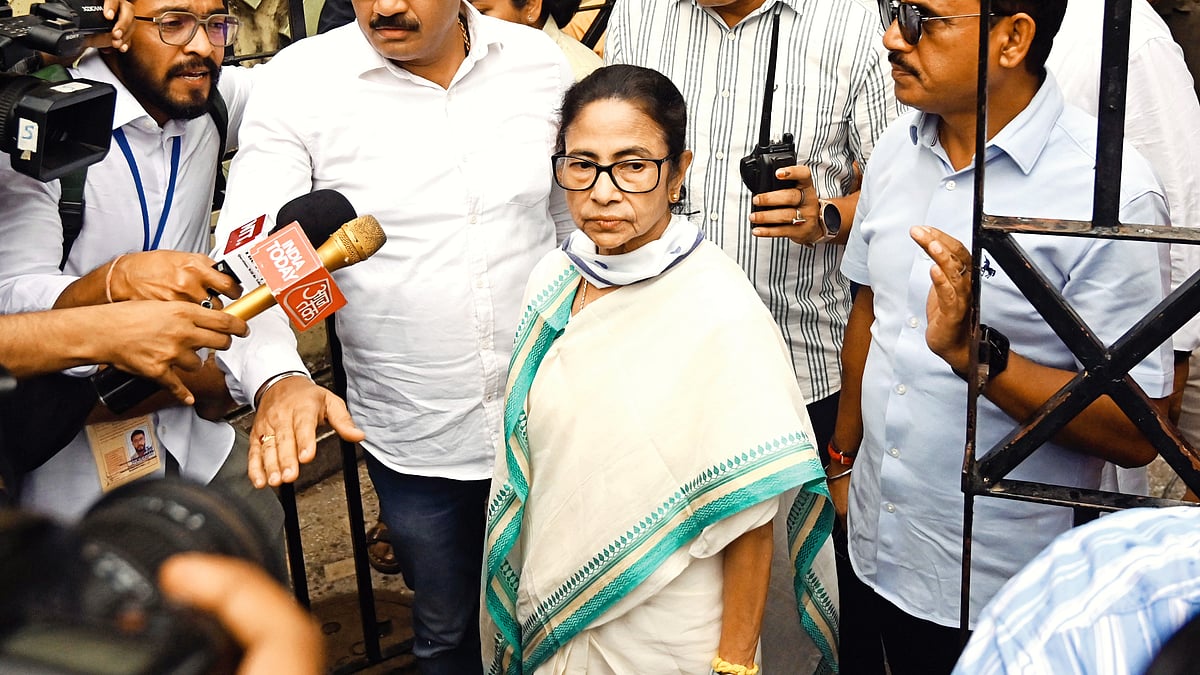
The voter turnout was a record 92.4 per cent and both the TMC and BJP were outwardly confident this was a sign of a mandate in their favour. The BJP would have us believe the political wind is blowing towards ‘poriborton’, the TMC insists the same wind is blowing for ‘pratyaborton’ — the return of 71-year-old Mamata Banerjee as chief minister for a fourth term.
Before returning to Delhi, Union home minister Amit Shah exuded confidence that the BJP would get an absolute majority, even quoting a number — 177 — that sounded suspiciously omniscient. But, then, he had also predicted a 200+ majority for the BJP in 2021!
If indeed the BJP’s brag about the popular mood is right, what was the unprecedented security bandobast in the run-up to elections about? The deployment of 2.8 lakh CAPF troops looked like an invasion rather than an election. (For context, Manipur had 29,000 CAPF troops on ground at the peak of the 2023 ethnic violence.)
Why was the NIA (National Investigating Agency), normally tasked with counter-terrorism duties, strutting around polling booths? Why were Central troops threatening Kolkata mayor Firhad Hakim in Bhabanipur (Mamata Banerjee’s constituency) at 1 a.m. on polling day? “Aap mayor saab ho na? Agar kuchh hua, toh aap ke liye achha nahi hoga (you’re the mayor, right? If anything [untoward] happens, you’ll be in trouble.)"
****
A post-election wisecrack summed up the mood thus: “This is an election the BJP will lose even if it wins. It won’t savour confronting Mamata Banerjee even in Opposition.” Wisecracks aside, if she loses, Mamata Banerjee will certainly be seen as a martyr, defeated unfairly by an unscrupulous rival with the help of the official machinery and a compromised Election Commission.
Most exit polls have predicted a close race, some have forecast a BJP majority, some others a clear return mandate for TMC. Historically, the verdict in West Bengal has been one-sided, with the winning party securing over 200 of the 294 seats in the assembly. In the past three elections (2011, 2016, 2021) , the TMC won 226, 211 and 215 seats, respectively. The Left Front fell four short of the 200-mark in 1996 but made up in the next election by taking its tally to 235. We’ll see if this trend persists.
Five years ago, pollsters People’s Pulse and Axis-My India had predicted the BJP would win 173-192 seats, comfortably ahead of the majority mark of 148. (The BJP won 77.) This time, Axis-My India refrained from projecting a number, claiming that 70 per cent of voters preferred not to divulge who they had voted for. People’s Pulse has predicted 95-110 seats for the BJP, and sees the TMC coasting to victory with 177-187 seats.
We wouldn’t wager any money on these predictions, though exit polls do create a flutter in the stock market and the satta bazaar, and those with an appetite for risk do make a quick crore or few. For other people who have a taste for political theatre but are less invested in the outcome, exit polls are excellent entertainment, certainly worth the price of a PVR movie ticket!
With inputs from Kunal Chatterjee