Reading view

‘Okay, here’s the summit, there is no more up’ — Singaporean husband-wife mountain climbers made it to the top of Everest after surviving bottlenecks, freezing winds and dangerous descent

SINGAPORE: Only a handful of Singaporeans have ever stood on the summit of Mount Everest, and just last month, husband-and-wife team Mark Ng and Ng Li Ying joined that exclusive group after years of climbing, training, and steadily working their way towards the world’s highest mountain.

The pair, who are lead training consultants with Outward Bound Singapore (OBS), may also be the first Singaporean married couple to summit Everest together.

For Ms Ng, reaching the 8,848m summit brought disbelief rather than celebration at first. She said it took time to register that she had finally reached the highest point on Earth. When their trekker guide announced, “Okay, here’s the summit … there is no more up,” Ms Ng said, “I … couldn’t believe I was already there.”

Ms Ng initially struggled to process that there was nowhere left to climb, but after years of preparation and weeks on the mountain, she had finally reached the highest point on Earth. That feeling, however, quickly gave way to concern, because her husband was nowhere in sight.

A dangerous wait near the summit

The pair became separated at the Hillary Step, one of the most notorious sections of the climb just below the summit. The narrow route forces climbers into a single file as they navigate steep rock and ice at extreme altitudes. Delays are common and can be dangerous, especially when temperatures plunge and oxygen is scarce.

Ms Ng had gone ahead after her trekker guide secured a climbing line. Mr Ng was left waiting while descending climbers passed through the bottleneck. He spent about 30 minutes standing in freezing winds. As time passed, Mr Ng became increasingly worried as pain began developing in his fingers and toes, a warning sign in such harsh conditions.

A long line of mountaineers in brightly coloured down suits and oxygen masks moves along a narrow snow-covered ridge high on Mount Everest; climbers are clipped to fixed ropes as steep rocky slopes drop away on one side, and cloud-covered Himalayan peaks stretch into the distance under a clear blue sky
Nick Karean/AI-Generated for illustration purposes only
Climbers queue along Everest’s exposed ridge during a high-altitude ascent

Eventually, the queue moved, and he continued upward. The couple were then reunited on the summit, but even then, the achievement didn’t erase the risks surrounding them.

The summit was never worth risking their lives

Unlike many who view Everest as a once-in-a-lifetime target, the couple approached the mountain differently. They repeatedly stressed that reaching the top was never worth risking their lives, a mindset that was tested earlier in the expedition when Mr Ng’s oxygen levels dropped after reaching Camp 2.

Mountaineers wearing helmets, crampons and heavy backpacks carefully cross a metal ladder spanning a deep ice crevasse in the Khumbu Icefall on Mount Everest as safety ropes are attached to the ladder, towering walls of snow and ice rise around them beneath a clear blue sky
Nick Karean/AI-Generated for illustration purposes only
Climbers cross a ladder bridge over a crevasse in the Khumbu Icefall, Everest

Instead of pushing ahead, Mr Ng was advised to rest and spend the night on supplemental oxygen. This setback could have ended their summit attempt, but it didn’t change their outlook.

Mr Ng said that if climbers had advised him that reaching the summit would likely cost him his life, he would have turned back without hesitation. “If they told me that if you summit you might die, I would just say: ‘Okay, we don’t climb’,” he said.

Getting down was getting harder

Many Everest veterans say the summit is only halfway. The descent is where fatigue, poor judgment, and deteriorating conditions usually claim lives. The mountain reminded the couple of that reality.

While descending from the Hillary Step, Mr Ng slipped due to a foot placement error and fell several metres, but because he was clipped into the safety line, he managed to grab the ropes and stop himself against a ledge. The fall could easily have ended differently.

Later, as the pair returned to Camp 4, exhaustion and cold began taking their toll. Mr Ng said he was losing coordination in his legs. Both climbers were physically drained. They simply needed rest.

Colourful expedition tents are spread across a snowy, rocky base camp at the foot of Mount Everest, as several climbers carrying backpacks walk between the tents, with a massive ice-covered mountain rising in the background beneath a deep blue sky
Nick Karean/AI-Generated for illustration purposes only
Mount Everest base camp, beneath towering snow-covered peaks

Preparing for the worst

Everest is not a mountain that allows for wishful thinking. Before leaving Singapore, the couple met with a lawyer friend to prepare their wills. Family members were concerned but not surprised.

Friends and relatives knew mountaineering had become a major part of their lives and understood that Everest was likely a goal they would eventually pursue.

Support also came from Outward Bound Singapore, which connected them with Singaporean orthopaedic surgeon Dr Kumaran Rasappan, who successfully summited Everest in 2012.

Years of climbing experience led to Everest

Their Everest journey began long before they arrived in Nepal. Mr Ng discovered mountaineering after an expedition to India. Ms Ng developed her interest while studying in China and joining trekking trips with friends.

The pair later met through Outward Bound Singapore. Their first major adventure together was the Kumano Kodo pilgrimage trail in Japan. Mr Ng joked that surviving 10 days together on the trail was a good sign for their future as a married couple.

After getting married in 2020, they continued climbing increasingly challenging mountains. They summited Mera Peak, Island Peak, Lobuche Peak and Himlung Himal before successfully climbing Ama Dablam in 2024. It was after Ama Dablam that their guides suggested they were ready for Everest.

The idea didn’t come as a shock as the couple had spent years gradually building the skills, fitness and experience required for such an expedition.

More than just an Everest story, it was a life lesson beyond just mountaineering

What makes their achievement stand out isn’t only that they reached the summit. It is the way they got there. The couple spent years preparing, accepted setbacks, respected the risks and never allowed summit fever to override common sense.

Their lesson may be particularly relevant for young Singaporeans facing academic, career and personal pressures. Not everyone will climb Everest, but most people will face challenges that feel just as daunting in their own lives. They hope their experience encourages others to tackle their own personal challenges, even if those challenges look nothing like Everest.

Their message is that growth comes from stepping outside familiar routines or comfort zones, staying curious, and persevering through difficulties.

A team of mountaineers in insulated high-altitude suits and oxygen masks climbs a steep, snow-covered mountainside on Mount Everest, using fixed ropes as they spread out along the exposed route, with the vast Khumbu Glacier and rugged Himalayan peaks stretching into the background beneath a clear blue sky
Nick Karean/AI-Generated for illustration purposes only
Climbers ascend a steep Everest slope above the Khumbu Glacier

As for their future adventures, neither appears ready to stop. The couple plans to continue exploring new adventures together. Their achievement shows that remarkable goals are rarely reached in one giant leap. Mostly come from years of preparation, persistence and taking one step after another.

Mr Ng perhaps summed up the expedition best when he reflected on sharing both the mountain’s triumphs and its miserable experiences with his wife. At nearly 8,000m, cold, exhausted and battered by the elements, he found comfort in one thought: if the experience was going to be miserable, at least they were enduring it together.


Read related: Two Singaporeans are reportedly dead after Mount Dukono volcano eruption in eastern Indonesia

Read more: Bodies of two Singaporean hikers recovered after Mount Dukono eruption and three-day search

This article (‘Okay, here’s the summit, there is no more up’ — Singaporean husband-wife mountain climbers made it to the top of Everest after surviving bottlenecks, freezing winds and dangerous descent) first appeared on The Independent Singapore News.


  •  

HDB: 2,520 BTO flats with wait times of 3 years or less to be offered across 3 projects in Sembawang and Ang Mo Kio in June sales

SINGAPORE: Singaporeans hoping to collect their keys sooner may find some welcome news in this month’s Build-to-Order (BTO) exercise.

The Housing and Development Board (HDB) will launch 2,520 flats with waiting times of around three years or less as part of its June 2026 BTO exercise, according to an announcement made on June 7. The flats will be spread across three projects in Sembawang and Ang Mo Kio and account for more than a third of the roughly 6,900 units being offered this month.

For many first-time buyers, waiting time remains one of the biggest concerns when applying for a new flat. While BTO projects typically take several years to complete, these developments aim to shorten the journey from application to key collection.

Faster access keys for buyers in Sembawang

The fastest project in the upcoming launch is Sembawang Portico, a Shorter Waiting Time (SWT) project with an estimated waiting time of two years and seven months. Located along Admiralty Lane and Sembawang Drive, it will offer 875 units ranging from 2-room Flexi to 5-room flats.

Sembawang Portico HDB BTO
Housing and Development Board (HDB)
Artist’s impression of Sembawang Portico

Close behind is Sembawang Brook, another SWT project with a waiting time of two years and nine months. The development, bounded by Admiralty Street and Sungei Sembawang, will offer 1,160 units, including 3Gen flats designed for multi-generation families who wish to live together.

Sembawang Brook HDB BTO
Housing and Development Board (HDB)
Artist’s impression of Sembawang Brook

According to HDB, both projects are located in the new Sembawang North estate and sit next to each other. Future residents can expect faster access to key amenities, including cooked-food outlets, childcare centres, a minimart, and bus services.

Under measures announced earlier this year by the Ministry of National Development, these amenities are expected to open around six months after the first residents collect their keys. The decision is intended to reduce the long-standing issue of residents moving into new estates before shops and services are ready.

The projects will also be near existing facilities such as Sun Plaza and Bukit Canberra, which offer sports, healthcare and community services.

Ang Mo Kio project offers a central location

The third shorter-wait project is Kebun Baru Ridge in Ang Mo Kio. The development will have 485 3- and 4-room flats, with an estimated waiting time of 3 years and 1 month.

Kebun Baru Ridge HDB BTO
Housing and Development Board (HDB)
Artist’s impression of Kebun Baru Ridge

Located along Ang Mo Kio Avenue 2, the project will include a minimart and an eating house. Residents will also be close to existing amenities such as Kebun Baru Market and Food Centre, Mayflower Shopping and Food Centre, and Ang Mo Kio Town Centre.

Public transport access is another draw, with Mayflower MRT station on the Thomson-East Coast Line just a short bus ride away.

Projects are completed faster because planning and construction work begin earlier

The agency works with other government bodies to identify suitable sites in advance and start preparation work before the flats are officially launched for sale. As a result, construction is already well underway by the time buyers book their units.

Apart from Sembawang Portico, Sembawang Brook and Kebun Baru Ridge, four other projects in Ang Mo Kio, Bishan, Bukit Merah, and Woodlands will also be launched in the June BTO sales exercise. HDB said more details, including the projects’ classification categories, will be released when the sales exercise begins.

A flat that arrives sooner can help young couples start families earlier and reduce the years spent in temporary housing. Efforts to shorten wait times while ensuring amenities arrive fast are likely to remain a key focus as Singapore continues to meet housing demand.

This article (HDB: 2,520 BTO flats with wait times of 3 years or less to be offered across 3 projects in Sembawang and Ang Mo Kio in June sales) first appeared on The Independent Singapore News.

  •  

Google exec praises Singapore for actively using technology to improve people’s lives while promoting public trust

SINGAPORE: Karan Bhatia, the Global Head of Government Affairs & Public Policy at Google, was recently in Singapore, having attended the apex event of Asia Tech x Singapore (ATxSG) as well as Google’s AI Ready ASEAN Youth Challenge.

In a May 24 LinkedIn post, he praised Singapore for it’s handing of AI, writing, “Singapore gets it. They’re actively using technology to improve people’s lives while building the guardrails to promote public trust.”

While there has been an amount of backlash against AI, especially among Gen Z in the United States, Mr Bhatia noted that “people in the Asia-Pacific region are consistently the most optimistic in the world” when it comes to the technology, which became apparent to him after he visited Singapore.

In his post, the Google executive listed some takeaways from his trip to the city-state, beginning with declaring that “the next generation is embracing technology for good.”

Mr Bhatia said that he had been honoured to join President Tharman Shanmugaratnam at the AI Ready ASEAN Youth Challenge, and met “impressive young innovators” who were developing, such as an AI platform for dementia care in Brunei and a translation app fighting childhood malnutrition in the Philippines.

He also noted how critical public-private partnerships are, adding that Google has expanded its National AI partnership with the government of Singapore for the purpose of addressing societal challenges in healthcare, life sciences, and education. Google is collaborating with a number of agencies, including GovTech Singapore and the Cyber Security Agency of Singapore, to build the Agentic AI Sandbox, the first-of-its-kind in the world to safely test AI agents in helping people with practical tasks, such as applying for social assistance

Mr Bhatia, who thanked Minister for Digital Development and Information Josephine Teo, wrote, “the rapid pace of technological change requires real-time collaboration between governments and industry,” noting that Google’s partners in Singapore prove that “fast-paced progress and responsible governance can go hand in hand.”

Several commenters on his post agreed with him.

“Singapore understands that the future of AI is not just about speed and capability. It’s about earning trust while scaling innovation responsibly,” one wrote.

“Singapore’s cultural willingness to embrace technology pragmatically: not as innovation for its own sake, but as a tool to improve outcomes, efficiency, and quality of life.

That mindset seems especially well-suited for AI — pairing openness to experimentation with governance and public trust.

Singapore has been ahead of the curve before. It would not surprise me if they continue to lead in operationalising AI at a national scale,” commented another. /TISG

Read also: ‘AI sucks!’: Why many young people are rejecting artificial intelligence

This article (Google exec praises Singapore for actively using technology to improve people’s lives while promoting public trust) first appeared on The Independent Singapore News.

  •  

SG father rants online after son allegedly squandered S$240k in education fees; Redditors discover why: ‘You had an extramarital affair!’

SINGAPORE: A Singaporean father is absolutely devastated after his son decided to drop out of a prestigious international school, an opportunity he believes could have opened many doors for him in the future.

In an online post titled ‘My son wasted his life and is going to drop out in 2 months’ shared on Tuesday (Jun 2), the divorced father recounted how he had initially wanted his son to attend a “normal” local school and grow up alongside other “regular children” his age.

However, his own parents disagreed with that plan. According to him, they felt their grandson deserved every possible opportunity and urged him to give the boy “a chance” at a better future.

As he could not afford the hefty fees himself, his parents offered to cover the cost of sending their grandson to a prestigious international school.

The father revealed that since Secondary 1, his parents have spent around S$240,000 on school fees, money he said came from what was supposed to be their retirement fund.

Despite the significant financial sacrifice, he claimed his son failed to appreciate the opportunity that had been given to him.

“He’s barely passed year on year, and he wasted all his grandfather’s retirement money,” the father wrote.

He went on to allege that his son has become increasingly rude towards family members and is currently failing all his subjects in Grade 11.

“My son also treats us rudely and now failing everything in Grade 11 and saying it’s ok to go to ITE is a slap in my face,” he said.

The father also shared that his son frequently skipped classes, arrived at school only in the afternoons, and sometimes missed tests and examinations by claiming he needed to see the school counsellor. 

“I am so angry and sad. I feel absolutely helpless,” he wrote. “So many kids would really treasure this unfair opportunity to hack the MOE system with money. Waste of his life. It’s my fault. I should have just cut him off and stopped this farce regardless of what my ex-wife would threaten.” 

At the end of his post, he wrote, “Why can’t I have a normal kid who wants to make his parents proud and go to school on time and do homework like everybody else. God hates me.”

“Have you ever asked him what he wanted in life?”

Surprisingly, many Redditors did not side with the father. Internet sleuths quickly dug through his post history and discovered that he had cheated on his previous wife, which they believed added important context to the situation.

They also learned that the son was intentionally failing in school as a way of getting back at his father.

Given these circumstances, many commenters were critical of the father. The top comment read, “Your son did not despise you for no reason. You destroyed your family by having an extramarital affair, and he presumably hates you for that. I would hate you with all my being, too, if I were a 17yo kid. Have you ever asked him what he wanted in life?”

Another wrote, “‘Why can’t I have a normal kid who wants to make his parents proud and go to school on time and do homework like everybody else.’ With this sentence, it shows what kind of father you are. You’re a typical toxic parent. Kids don’t go to school to make their parents proud, and no, not everyone does their homework.”

A third commenter questioned the father’s parenting decisions, saying, “First of all, why did you even listen to your parents’ advice to let your son attend an international school?” 

“Who is your son’s parent? That’s why you never ever let your parents make decisions for your child, nor do you make decisions for your child. Most children are rebellious because their parents don’t get to know and understand what they’re thinking.”

Some commenters were less focused on the family drama and more shocked by the S$240,000 the grandparents had reportedly paid in school fees.

One Singaporean Redditor remarked, “I’m sorry, but 240k is legit insane.”

Another user, however, said the figure was entirely believable. “These international school fees are, on average, S$40k per year. For a six-year IB programme, S$240k sounds about right.”

In other news, a furious online rant about poor hygiene on Singapore’s public transport system has gone viral after one fed-up commuter blasted fellow passengers for allegedly skipping their morning showers before squeezing onto packed MRT trains.

Posting on a local Reddit forum, the woman said, “I have had it with taking the MRT every day and smelling all the stanky [people] who don’t shower in the morning, sia. Like, I don’t get it. Why is it so hard to spend just 5-10 minutes showering?”

Read more: ‘Why is it so hard for everyone to shower in the morning?’: MRT commuter breaks down over poor hygiene on public transport

This article (SG father rants online after son allegedly squandered S$240k in education fees; Redditors discover why: ‘You had an extramarital affair!’) first appeared on The Independent Singapore News.
  •  

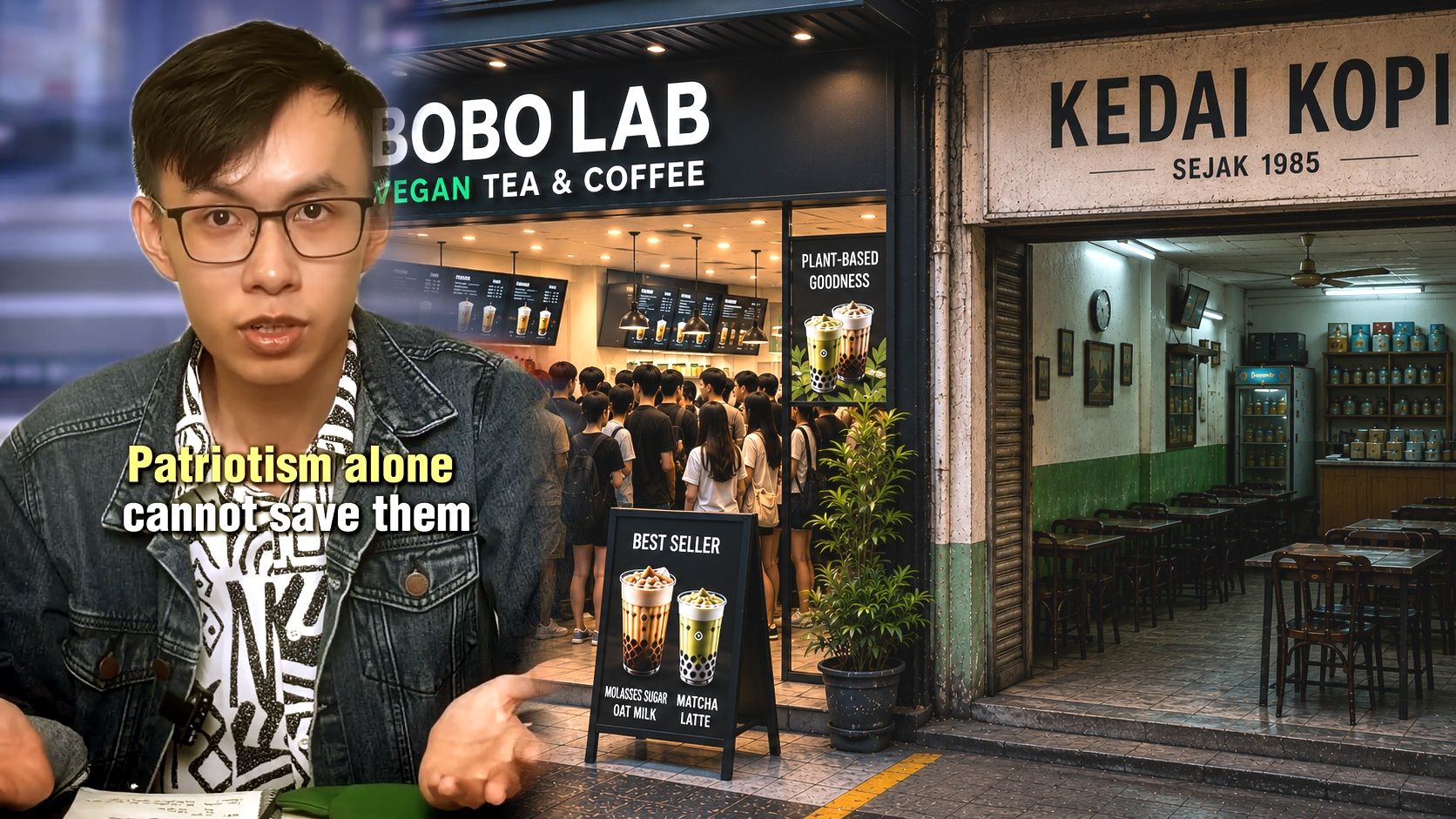
‘Support local businesses, buy Malaysian products’ — TikToker says, ‘Patriotism slogans alone cannot save’ Malaysia’s local businesses from “foreign invasion”

MALAYSIA: As foreign brands continue to expand across Malaysia, a commentator on the Newsenz TikTok channel warns that local businesses can no longer rely on patriotic appeals alone to win customers.

In a TikTok video posted by Newsenz titled “The Inevitable Fall of Local Business?” the TikToker said foreign companies are moving aggressively into sectors once dominated by local players, from food and beverages to telecommunications, automotive services, retail and home furnishings.

“First, they came for our food. Then, the car workshops. Then, our phone plans. Now, they’re coming for everything else,” he said, listing brands such as Mixue, TUHU, CMLink, Sushiro, Kenangan Coffee and LC Waikiki as examples of foreign companies growing their presence in Malaysia.

The Newsenz social media channel commentator added that the rapid expansion is putting pressure on local small and medium-sized enterprises (SMEs), including neighbourhood grocery shops, independent workshops and small cafés.

“This isn’t a competition anymore. This is an invasion…”

The commentator also pointed to several factors behind the decline of local businesses. He said many international brands are pushing overseas growth plans more aggressively than before, bringing established supply chains, strong branding and pricing strategies that help them gain market share fast.

“This isn’t a competition anymore. This is an invasion,” he exclaimed, adding, “And the local businesses are suffering and losing,” pointing out that many local businesses are struggling to keep pace with larger foreign competitors.

He also noted that Malaysia’s relatively open business environment makes market entry easier for foreign firms. According to his comments, setting up a fully foreign-owned company can be done with minimal paid-up capital requirements.

For local SMEs, the challenge usually comes down to resources. “Foreign chains are backed by deep pockets and can absorb losses for months or even years as it grabs market share,” he said. The result, he argued, is that local businesses are competing against businesses with stronger marketing budgets, larger networks and greater economies of scale.

“When foreign brands offer better service, lower prices, and smarter marketing, the ‘support local [businesses]’ argument starts to wear thin…”

One of the most talked-about parts of the video was the commentator’s criticism of the long-running “support local businesses” message.

He suggested that many Malaysians have supported local companies out of patriotism over the years, even when products or services weren’t necessarily the strongest in the market.

“For years, Malaysian consumers have heard the same slogan: support local [businesses] and buy Malaysian [products], and many of us did so out of patriotism, not necessarily because the quality or service was better,” he said.

The commentator further explained that increased competition is now exposing weaknesses that may have gone unnoticed when consumers had fewer alternatives.

“When foreign brands offer better service, lower prices, and smarter marketing, the ‘support local [businesses]’ argument starts to wear thin,” he added.

His comments mirror a similar debate taking place across many countries, including Singapore, where consumers may say they want to support local businesses but still make purchasing decisions based on price, convenience and customer experience.

“Malaysian [automotive] giants are also hurting, too… [with] the continuous influx of Chinese-made vehicles on its low-pricing strategy…”

The commentator also raised concerns among larger Malaysian companies. He cited automotive distributor Bermaz Auto, which reported a sharp drop in net profit and attributed part of the pressure to growing competition from lower-priced Chinese vehicle brands.

“Established Malaysian giants are also hurting, too. Automotive distributor Bermaz Auto saw its net profit plunge more than 77%, and it blames the continuous influx of Chinese-made vehicles on its low-pricing strategy,” he said.

He added that Malaysian authorities have taken notice of the issue, and, according to him, the Ministry of Domestic Trade is reviewing guidelines affecting foreign food and beverage operators, while lawmakers have passed tougher anti-dumping measures aimed at protecting local industries.

“Foreign players don’t rely on patriotism. They rely on efficiency, scale, and customer experience…”

The commentator’s central message was that competition from foreign companies is unlikely to slow down, so rather than relying on patriotic campaigns, he argued that local businesses need to improve product quality, raise service levels, embrace technology, and deliver greater value to customers.

“Foreign players don’t rely on patriotism. They rely on efficiency, scale, and customer experience,” he said, adding, “And that’s exactly where many local SMEs are falling short, not because they lack heart, but because, for too long, the pressure to innovate simply wasn’t there.”

Whether Malaysians agree with his assessment or not, the points he makes touch on a question many businesses across the region face: Is being local enough when consumers have more choices than ever before?

“Compete or get out! Patriotism alone cannot save…”

“And the message to the local business is clear: ‘Compete or get out!’ The landscape of the Malaysian market is changing forever. The era of untouchable local monopolies is over. Consumers now have more choices than ever. And whether we like it or not, businesses that refuse to evolve, better technology, better service, better value, will be left behind. Patriotism alone cannot save them,” the commentator concluded.

Supporting local businesses is important, but long-term success still comes down to giving customers a reason to return. National pride may open the door, but good products, fair prices and reliable service are what keep it open.

This article (‘Support local businesses, buy Malaysian products’ — TikToker says, ‘Patriotism slogans alone cannot save’ Malaysia’s local businesses from “foreign invasion”) first appeared on The Independent Singapore News.

  •  

Man who accused Prime Minister of sexual advances now refuses to return to Malaysia

MALAYSIA: Muhammed Yusoff Rawther, a former research assistant to Prime Minister Anwar Ibrahim, fearing for his safety in Malaysia, left for the United Kingdom to seek asylum.

His lawyer, Muhammad Rafique Rashid Ali, said Yusoff, who accused Anwar of sexual advances, has applied for human rights asylum protection. Hence, he is not returning to Malaysia if the application is successful.

“On June 1, I received notification and confirmation that my client applied for human rights asylum protection to the UK government, and his passport is held by the authorities there.

“He is in London and applied for human rights asylum protection because he is truly in fear, worried about his safety and worried about being harmed,” he said at a press conference in Kuala Lumpur.

Yusoff filed a lawsuit in July 2021 seeking a court declaration that Anwar committed sexual assault against him.

He alleged the PKR president, who was then the opposition leader, committed sexual assault against him in 2018.

This case has not yet begun the full trial due to delays resulting from several pre-trial applications and counterclaims filed by both parties.

The prime minister, meanwhile, filed a preliminary application before trial, seeking to have several issues decided first.

Among those issues is Yusoff’s movement and presence at Anwar’s private residence on the day of the alleged incident, whether through affidavit or closed proceedings (in-camera).

On the other hand, Rafique said the fear faced by Yusoff stemmed from the process his client went through, which he described as very frightening, painful and worrying.

“We know when the charges were brought against him, he always stated he was a victim of entrapment, that he was trapped and subjected to entrapment,” he said.

“I am here to state Yusoff Rawther is afraid to return to Malaysia, afraid for his safety.”

On June 12 last year, Kuala Lumpur High Court Judge Muhammad Jamil Hussin acquitted Yusoff, 32, after finding the prosecution failed to prove a prima facie case against him at the end of the prosecution’s case.

He faced charges of having control, custody and possession of two pistols and drugs.

The Attorney General’s Chambers (AGC) filed a notice of appeal against the High Court’s decision on June 16 last year, and the hearing of the application is scheduled to take place at the Court of Appeal, Putrajaya, on June 15.

Yusoff was arrested, remanded for nine months and 10 days, he went through the court process, fought in court and was proven not guilty. He did not run away from the legal process.

This article (Man who accused Prime Minister of sexual advances now refuses to return to Malaysia) first appeared on The Independent Singapore News.
  •  

Hong Kong school principal resigns after swearing incident in Singapore; but some blame security guard for shouting back

SINGAPORE: A school principal from Hong Kong who made the news earlier this week has resigned from his position.

San Wui Commercial Society Secondary School in Tuen Mun’s head Lee Cheuk-hing was in Singapore recently on a school trip. At an undisclosed location in Jurong on May 22, he was caught on camera shouting at two female security guards who were asking for the vehicle he and his students were using to be moved. He went on to taunt the guards, despite efforts from at least three onlookers to get him to calm down.

Afterwards, it was reported that the incident was under investigation in Singapore, as well as by Hong Kong’s Education Bureau. The school issued a public apology for the incident, and its manager said that Mr Lee had been suspended as his conduct during the incident did not meet public expectations.

On Friday (May 29), Mr Lee resigned from his position, according to the South China Morning Post.

Mr Lee also issued a tearful apology via video, where he said, “As a principal, I should lead by example. Regardless of the circumstances, I should remain calm and restrained. But unfortunately, I failed to do so. I admit [my mistake] and apologise to everyone.”

He also appealed to his students not to follow his mistakes, and to do their best to remain calm and solve problems reasonably.

“Let my mistake serve as a warning; do not let a moment of impulse drive you to say things that you will deeply regret in the future,” he added.

What netizens are saying

While a good many of the netizens who have commented on the incident have condemned Mr Lee’s behaviour, especially since he was seen in a longer clip speaking more calmly to a female Chinese passerby, telling her that he would listen to her as she was “very polite,” while the guards he had shouted at are South Asian women.

However, many netizens have also called out the guard who shouted back at Mr Lee, saying that she should have remained professional and answered him back in a calm manner. 

Others said she needed retraining or to be given disciplinary action.

“Security guards give instructions on parking directions using what tone? Are they courteous throughout, and did they calmly explain parking rules? All people follow blindly and point fault at the principal. I heard shouting from the security guards too,” one wrote. 

“The lady security was indeed rude and loud. She needs to be sent for retraining,” added another.

“Security needs disciplinary action, too! Under whatever circumstances or whether the customer is aggressive, rude, and vulgar, all employees and employees should be calm and polite at all times, even towards colleagues above or below. She screamed at the top of her voice, and that is a no-no,” a Facebook user commented. 

“Firstly, the 2 security guards are not trained well.. don’t understand Mandarin,” another wrote, adding that they resorted to “talk more and less action.”

One opined that the guard’s actions  “really reflect badly on those in the security line of work.”

Nevertheless, others defended the security guard, saying that the Hong Kong principal’s behaviour had been uncalled for. /TISG

Read also: Hong Kong principal who swore at 2 guards in Singapore suspended; online debate on racism, bad behaviour ensues

This article (Hong Kong school principal resigns after swearing incident in Singapore; but some blame security guard for shouting back) first appeared on The Independent Singapore News.
  •  

Singapore’s cost-of-living squeeze reaches even affluent households: Sun Life

SINGAPORE: The squeeze of the rising cost of living has reached even affluent households in Singapore.

According to Singapore Business Review, citing Sun Life Asia’s third “Financial Resilience Index: Asia Navigates Rising Costs” report released on Tuesday (June 9), rising living costs have affected all income groups, including high earners.

Among high-net-worth individuals (HNWIs) earning at least S$250,000 a year, nearly eight in 10 (76%) said inflation made it more difficult to cover their monthly expenses, while nearly six in 10 (59%) said they would likely need to make moderate to significant changes to their lifestyle if living costs continue to rise.

Still, seven in 10 HNWIs reported feeling financially secure. Nearly three in 10 (27%) also believe they could last a year without income.

The share of highly resilient households in Singapore fell to 21%, from 34% last year. Low-resilience households also more than doubled to 20%, from 9% a year earlier.

Highly resilient households were defined as those that feel financially secure, plan at least five years ahead, are prepared to cope with a financial emergency, consider themselves financially literate, and are confident of meeting their long-term financial goals.

Low-resilience households, meanwhile, tend to feel financially insecure, plan only a few months ahead or not at all, are unprepared for financial emergencies, rate their financial literacy poorly, and lack confidence in achieving their long-term financial goals.

The report also found that only one in 10 respondents feels very secure financially, compared to two in 10 last year.

Rising everyday costs, including groceries (95%), utilities (94%), transport fuel (92%), cooking fuel (91%) and healthcare (91%), remain the biggest concerns among households. Over the past six months, respondents said the costs of food and groceries (80%), utilities (58%) and transport (55%) increased the most.

When asked about their top financial priorities over the next 12 months, they cited daily expenses (55%), retirement savings (44%) and building an emergency fund (37%).

More than half (52%) of respondents also said the rising cost of living remains a barrier to improving their financial control. 

While 69% believe having sufficient savings is critical to achieving financial security, only 41% said they could survive without income or external support.

Respondents said they have been cutting back on non-essential spending (54%), tapping into their savings (24%), reducing essential expenses (24%), and pausing retirement contributions (14%) to cope.

Still, those with higher financial literacy were found to be more confident (+44 percentage points) and more optimistic (+41 percentage points) about their financial future, although seven in 10 respondents rated their financial literacy as basic or below basic.

In terms of financial decision-making, 53% use generative artificial intelligence (AI) tools occasionally, with usage expected to rise to 55%. Among HNWIs, 74% already use the tool regularly, while 69% expect to use it more. /TISG

Read also: Netizens say cost-of-living concerns are taking a back seat to politics

This article (Singapore’s cost-of-living squeeze reaches even affluent households: Sun Life) first appeared on The Independent Singapore News.

  •  

‘The company he worked for decided to move production to Malaysia’: Daughter upset after father’s layoff, says he ‘worked hard and stayed loyal’

SINGAPORE: A young Singaporean woman expressed her anger online after her father suddenly lost his job despite spending years working hard and remaining loyal to his company.

On a Reddit forum called “r/SingaporeRaw,” the daughter said she found it rather unfair that her father was laid off after the company decided to relocate its production operations to Malaysia.

“My dad did everything society and this government tells you to do,” she wrote. “Worked hard for years, paid taxes, contributed to CPF, raised a family, and stayed loyal to his company. Yet all it takes is one decision to move jobs elsewhere, and suddenly our family’s future becomes uncertain.”

She also shared that her father had not been acting like himself in the weeks before the retrenchment.

According to her, he became “quieter, more distant” and would spend long periods staring at his phone after work.

“My mum kept asking if something was wrong, but he just brushed it off and said he was tired,” she said.

The truth finally came out a few days later when he broke down and admitted he had lost his job.

The daughter explained that her father is the sole breadwinner of the family, while her mother is disabled and unable to work. She and her sister are also still studying and are financially dependent on him.

She added, “People always say there’s financial assistance available. Maybe there is, but anyone who has actually needed it knows it doesn’t magically solve everything, like school fees, transport, groceries, utilities, and medical expenses. [They] don’t disappear overnight.”

Seeing her father quietly worrying over finances at the dining table has also caused her to reflect on whether ordinary Singaporean workers are truly protected in their own country.

She said, “Every election, we’re told Singaporeans will be protected and that good jobs will be created for locals. But when I look at my dad sitting at the dining table, wondering how he’s going to support the family and pay next month’s bills, I can’t help but wonder what that protection actually means.”

“Maybe there are economic reasons, or maybe companies have to do what’s best for business, or maybe my family is just unlucky; policies don’t work in favour of us. For families like mine, those explanations don’t make paying the bills any easier.”

“I would suggest you contact social workers.”

In the comments, one Singaporean Redditor remarked, “This is sadly the price of capitalism. With a mix of monopoly, it makes it worse.”

Hoping to be of some help, another user wrote, “I would suggest you contact social workers for assistance for your family. I am not familiar with schooling assistance, but for your mum’s disability, see if you can get HGC, which can be S$600/month.”

A third wrote, “Very sorry that this has happened to your family. I believe your father is already at an age where upskilling and other nonsense schemes by the govt won’t be easy or produce any results.”

A fourth added, “Guess it’s time for your family to take stock of any expenditure that is not necessary. And for you and your sister to get part-time jobs if possible.”

In other news, a fresh university graduate in Singapore has found themselves caught between practicality and ambition after receiving a job offer paying S$3,000 a month —a salary they admitted feels difficult to accept, yet equally difficult to walk away from.

Compared with recent graduate salary figures, which place median starting pay anywhere from S$3,840 for ‘Arts, Design and Media’ graduates to around S$5,500 for those in ‘Information and Digital Technologies,’ the offer struck them as rather low.

Read more: ‘If desperate, just take liao’ — Singaporeans weigh in after fresh grad receives S$3K job offer

This article (‘The company he worked for decided to move production to Malaysia’: Daughter upset after father’s layoff, says he ‘worked hard and stayed loyal’) first appeared on The Independent Singapore News.

  •  

More Singaporeans now see Singlish as a symbol of national identity, survey finds

SINGAPORE: Singaporeans are increasingly embracing both English and Singlish as part of their everyday lives and national identity, according to a new survey by the Institute of Policy Studies (IPS).

The findings, drawn from IPS’ “Race, Religion and Language” surveys conducted in 2013, 2018 and 2024, suggest that more Singapore residents now see English proficiency as a strength while also becoming more comfortable with the use of Singlish.

The latest survey, carried out between April and August 2024, involved interviews with 4,000 residents across Singapore.

According to the report, 81.5 per cent of respondents in 2024 said they spoke English well or very well, up significantly from 71.9 per cent in 2013. The improvement was especially pronounced among younger Singaporeans. Nearly all respondents aged between 18 and 35 — 97.3 per cent — rated their English proficiency positively.

In contrast, only about six in 10 respondents aged 65 and above felt they spoke English well.

The survey also found growing familiarity with Singlish. In 2024, 57.8 per cent of respondents said they could speak Singlish well, compared to 46.8 per cent a decade earlier.

Younger respondents appeared most comfortable with Singlish, with 80 per cent of those aged 18 to 35 saying they could speak it at least well. Usage in casual settings has also risen sharply. The proportion of respondents who said they frequently used Singlish when speaking with friends climbed from 39.2 per cent in 2013 to 55 per cent in 2024.

Researchers noted that Singlish is increasingly viewed as more than just an informal way of speaking. It is also becoming a marker of national identity.

In 2018, half of the respondents said Singlish gave Singaporeans a sense of identity. By 2024, that figure had grown to 57.8 per cent.

Still, most respondents distinguished informal and formal contexts. The survey found broad agreement that Singlish was appropriate in casual interactions with friends and family, as well as in everyday settings such as hawker centres. However, standard English remained the preferred choice for formal communication, including classrooms, workplace emails and government speeches.

The report also examined attitudes towards mother tongue languages. Overall self-assessed proficiency levels remained relatively high, with 80.9 per cent of Chinese respondents saying they spoke Mandarin well. Among Malay respondents, the figure stood at 93.2 per cent, while 92.9 per cent of Tamil respondents rated their proficiency positively.

However, fewer respondents believed their mother tongue skills had improved over the past decade. Only 36.5 per cent felt their native language proficiency had become better, compared to 62.4 per cent who believed their English had improved.

Younger respondents, as well as those with higher education levels and incomes, were more likely to feel that their mother tongue proficiency had declined.

The survey also pointed to a broader shift in how Singaporeans identify themselves linguistically. In 2013, 65.1 per cent of respondents said they identified most strongly with their mother tongue or heritage language. By 2024, that proportion had fallen to 50.4 per cent.

Over the same period, the proportion of respondents who identified most with English or Singlish rose from 33.8 per cent to 47.6 per cent.

Researchers said the findings suggest that while mother tongue languages continue to hold cultural importance, English and Singlish are increasingly being used to express a shared Singaporean identity.

They added that the trend is significant because language shapes not only communication, but also questions of identity, cultural belonging and Singapore’s place in a globalised world.

This article (More Singaporeans now see Singlish as a symbol of national identity, survey finds) first appeared on The Independent Singapore News.

  •  

‘It just creates more work’: Singaporean employee says AI is ‘nowhere near as good as bosses think it is’

SINGAPORE: There has been no shortage of headlines, LinkedIn posts, and workplace presentations warning that artificial intelligence is coming for everyone’s jobs. From tech workers and administrators to customer service staff, employees are constantly being told that AI will soon be capable of doing what humans do, only faster and cheaper.

However, one Singaporean employee is not buying into the hype.

Posting on the r/asksg forum on Wednesday (Jun 3), the worker said they are becoming increasingly frustrated with the endless claims that AI is on the verge of replacing large numbers of employees. In their view, the reality inside many workplaces looks very different from the glossy promises being made by executives and consultants.

“Maybe this is an unpopular opinion, but I’m getting tired of hearing ‘AI will replace jobs’ every other week,” they wrote. “AI is nowhere near as good as bosses think it is.”

They then shared, “My company has been pushing AI quite heavily. Every meeting somehow comes back to AI. All departments are expected to use AI. We’re all expected to ‘embrace AI.’”

The problem, however, is that the technology itself does not appear nearly as revolutionary as management makes it out to be.

The employee said the AI tools being rolled out across the company still make far too many mistakes to be trusted on their own.

“Half the time we’re still manually checking its work,” they said, adding that there are occasions when the system produces completely wrong answers.

“It misses obvious details and creates more work because we have to fix its mistakes. And whenever we point this out, management’s response is basically: ‘It’s still improving.’Okay, but then why are employees being told they can be replaced by something that’s still being developed?”

“Maybe AI will eventually get there, I don’t know, but right now, it feels like companies are treating AI as both the future that will replace workers and a work-in-progress that still needs workers to constantly babysit it. Am I the only one seeing this contradiction?”

“Your way of thinking is totally wrong.”

In the discussion thread that followed, quite a few users said they could relate to the original poster’s frustrations.

One user argued that many managers are simply following the trend without fully understanding the technology themselves.

“That’s the problem.  A lot of bosses only ‘think’ AI is great because their fellow bosses tell them it is. I, for one, work in a company where the bosses have no idea how AI works. They are all cluelessly telling staff to use/implement AI without knowing what it really is.”

“It’s a recipe for disaster that has already happened twice before in two previous dot.com booms, but now even worse due to the haemorrhage of real human talent thanks to AI so competently taking over our jobs.”

Another user said, “Those who are retrenching workers already know that; they’re merely using it as a legitimate excuse to get rid of the people they’ve always wanted to get rid of. Ground staff think management are fools, but they’re just shrewd.”

However, others in the thread pushed back on that view.

One told him, “Your way of thinking is totally wrong. AI doesn’t replace ‘a person.’ It can replace maybe 10-50% of the work a person does, depending on what job you’re talking about. So this means one employee can now do things faster or increase output/productivity by 30%, maybe.”

Another remarked, “AI definitely improves efficiency and output of skilled workers. Companies might be able to cut a few jobs due to the increased output of a few workers.”

A third added, “No contradiction. AI will replace fresh graduates because it’s still better than having to deal with some hormonal 20-year-old. It will still need experienced hires to shepherd it along until it improves enough to do better than the experienced. Over time, it will do better than the 5-year employee than the 10-year one.”

In other news, a man has shared online that his sister and brother-in-law have been keeping their distance from his parents after they allegedly demanded an “extravagant Guo Da Li package”, complete with large angbaos, during the couple’s wedding preparations.

In a post published on the r/askSingapore subreddit on Monday (May 11), the man explained that his family used to get along very well with his sister’s husband before wedding planning began.

Read more: Man says his parents demanded ‘extravagant Guo Da Li’ from brother-in-law, now he refuses to let them see his sister: ‘You sold your daughter off’

This article (‘It just creates more work’: Singaporean employee says AI is ‘nowhere near as good as bosses think it is’) first appeared on The Independent Singapore News.

  •  

Two Singaporeans among 8 men of various nationalities were arrested in KL hotel raid after 1 Malaysian man was reported dead

MALAYSIA/SINGAPORE: Malaysian police have arrested eight men after a raid at a luxury hotel near Kuala Lumpur (KL) Sentral, following the death of a 31-year-old Malaysian man who was brought to the hospital unconscious.

Early reports from local media said two Singaporeans were among those detained. However, Singapore’s Central Narcotics Bureau (CNB) later clarified to Channel NewsAsia (CNA) that, based on its understanding, only one of the eight arrested was Singaporean.

The arrests came after authorities received a report that a man had died shortly after arriving at Kuala Lumpur Hospital in the early hours of Sunday.

Hotel raid followed death report

According to Malaysian media reports cited by CNA, police moved into the hotel room at about 4 am after gathering intelligence linked to suspected drug activity.

Brickfields district police chief Hoo Chang Hook said officers from the Narcotics Crime Investigation Department carried out the operation at the room where the deceased had been staying.

Police detained eight men from different countries. Reports identified them as two Malaysians, one Singaporean, and individuals from Hong Kong, Vietnam, Indonesia, and China.

Authorities also recovered a small amount of suspected ketamine and several pills believed to be ecstasy. All eight have been remanded for three days to assist investigations under Malaysia’s Dangerous Drugs Act.

Cause of death still under investigation

Police said the deceased had lost consciousness before being taken to the emergency department. Initial findings suggested that a friend had helped him out of the hotel room at about 3.10 am before he headed to the hospital.

A post-mortem has been completed, though laboratory results are still pending. For now, Malaysian police have classified the case as a sudden death. As of now, investigators haven’t publicly tied the death to any confirmed cause while waiting for medical findings.

Singaporean authorities are working closely with the Malaysian authorities

A CNB spokesperson said Singapore is aware that a Singaporean was among those arrested in Malaysia over suspected drug-related offences. The agency added that it will support Malaysian authorities where needed and declined further comment while investigations continue.

Cross-border cases involving Singaporeans have legal systems and penalties that differ across countries. Cases like this also show how fast routine travel can become a matter for multiple agencies once criminal investigations begin.

For the time being, questions remain unanswered, including what led to the man’s death and whether charges will eventually follow. Early reports can also change as facts are checked and updated, identities confirmed, and investigations move forward.

This article (Two Singaporeans among 8 men of various nationalities were arrested in KL hotel raid after 1 Malaysian man was reported dead) first appeared on The Independent Singapore News.

  •  
❌