The Inland Revenue Department (IRD) has announced that tax revenue jumped by 22 per cent in the 2025-26 fiscal year, hitting a record high of HK$458.3 billion.
Commissioner of Inland Revenue Benjamin Chan (centre), Deputy Commissioners Leung Kin-wa (left) and Chan Shun-mei attend a press conference on May 4, 2026. Photo: GovHK
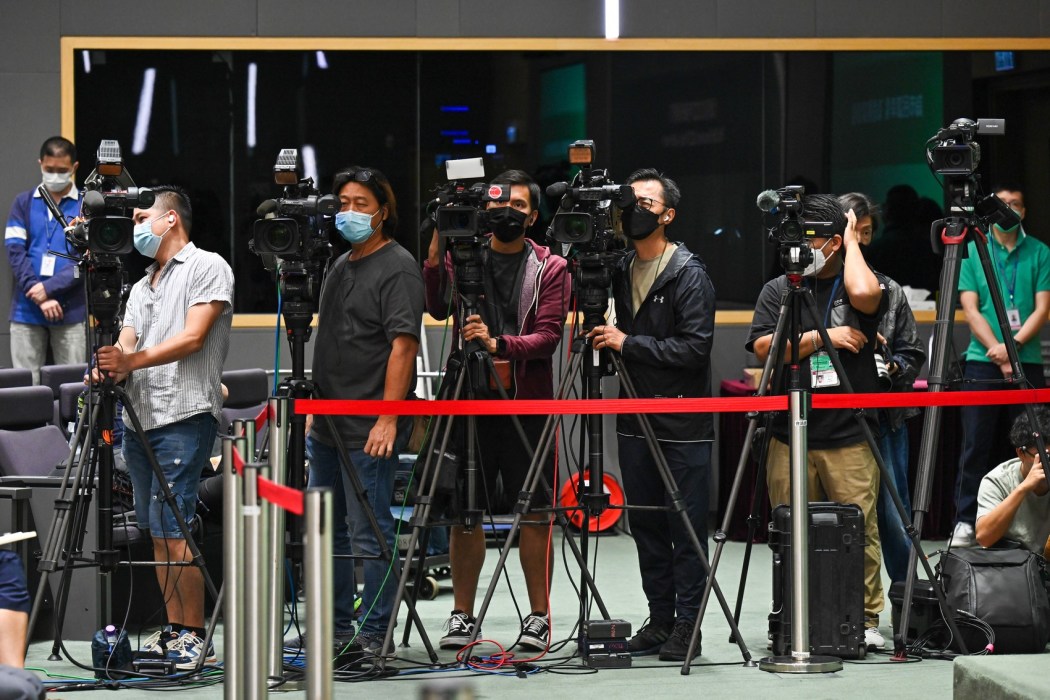
Unveiling the provisional tax figures at a press conference on Monday, Benjamin Chan, commissioner of Inland Revenue, attributed the rise partly to rallies in the property and stock markets.
Revenue from stamp duty – a tax imposed on the transfer of property or assets – reached HK$102.6 billion in 2025-26, a 61 per cent rise from the previous period.
Chan said the IRD also noticed a rise in the income of Hong Kong taxpayers and a higher number of companies paying profits tax.
In 2025-26, the tax office collected HK$212.6 billion in profits tax – a 20 per cent increase from 2024-25 – and HK$97.7 billion in salaries tax – a 10 per cent rise.
“The department’s revenue collection in 2025-26 was HK$458.3 billion, which is a record high,” Chan said.
Hong Kong’s Inland Revenue Department. File photo: Kyle Lam/HKFP.
The government previously logged HK$341.4 billion in tax revenue in 2018-19, a record high at the time, according to an IRD annual report.
The tax revenue declined afterwards – until the 2024-25 fiscal year, which recorded HK$374.5 billion, a 9.5 per cent increase from the previous period.
2.77 million tax returns issued
Chan also said on Monday that the IRD had issued about 2.77 million tax returns for individuals for the 2025-26, an increase of 115,000 from the previous year.
The commissioner also encouraged taxpayers to file their tax returns through eTAX, which is more environmentally friendly and helps ensure they reach the IRD in time.
An extension of one month will be granted for returns filed electronically, according to the IRD.
China’s Wu Yize won the World Snooker Championship for the first time with a dramatic 18-17 victory over Shaun Murphy in the final on Monday.
China’s Wu Yize poses with the championship trophy after his victory over England’s Shaun Murphy in the World Snooker Championship final round at The Crucible in Sheffield, northern England, on May 4, 2026. Photo: Darren Staples/AFP.
Wu held his nerve to seal his thrilling triumph in a tense last frame shoot-out at Sheffield’s Crucible Theatre.
Wu is also the second youngest player to be crowned world champion at the Crucible after Stephen Hendry, who was 21 when he won in 1990.
“I have been trying to go for this for ages. For the past few months, I have been living the same life. I’m so happy that I could play well today,” Wu said.
Wu’s father and mother wiped away tears of joy before joining him for the trophy presentation.
“My parents are the true champions. Since I made the decision to drop out of school, my dad has been by my side,” Wu said.
“My mum has also been going through a lot over the years, they are the source of my strength, I love them so much.”
Asked how he will celebrate, Wu said: “I just want to have a good sleep. I have been feeling nerves all the time since before the match, so now I just want to go to bed!”
Murphy, who has lost four World Championship finals since winning in 2005, added: “I hate being right, but we had a great game in China earlier this season. I came out afterwards and said he would be world champion one day.
Chinese snooker player Wu Yezi (right) and England’s Shaun Murphy pose with the coveted trophy at the World Snooker Championship final on May 3, 2026. Photo: World Snooker Tour.
“It’s just a real shame that it was today, but I couldn’t have given it any more. I played the best shots I could. I just didn’t get my chance.”
Wu’s title march
Wu led 10-7 after Sunday’s play and was 13-12 up following the first session on Monday.
But England’s Murphy pushed Wu all the way to the finish line, levelling at 16-16 with a gritty century break.
Wu recovered from 45-0 down to record a brilliant 91 clearance to go 17-16 ahead.
He moved 43-0 up with the title in his sights, but a missed black gave Murphy the chance to draw level again with a 75 break.
The balance of power in the final frame tipped Wu’s way when Murphy left a difficult red that the Chinese player stroked into the middle pocket, kick-starting a break of 85 that took him to the title.
It was the first World Championship final to go to the deciding frame since Peter Ebdon beat Hendry 18-17 in 2002.
China’s Wu Yize poses with the championship trophy during the awards ceremony in the World Snooker Championship final at The Crucible in Sheffield, England, on May 4, 2026. Photo: World Snooker Tour, via Facebook.
From Lanzhou in the north-west of China, Wu turned professional aged 17 and made a transformative move to England three years ago to join the growing stable of Chinese players based in Sheffield.
Initially living in a windowless flat and sleeping on the same bed as his father, Wu’s switch eventually paid dividends.
Runners-up finishes at the English Open and Scottish Open in 2024 laid the foundations for the emerging star’s march to the world title.
He beat John Higgins in the International Championship last year to clinch his first ranking title.
The youngest player in the world’s top 16, his run at this year’s World Championship included eye-catching wins against Mark Selby and Mark Allen.
Ronnie O’Sullivan once labelled Wu a “more dynamic” version of the legendary Steve Davis.
Like O’Sullivan and Davis, Wu can now call himself a world champion.
A former police officer who led daily press briefings during the 2019 protests and unrest has been appointed to a top post leading the Hong Kong government’s media relations department.
John Tse. Photo: RTHK Screenshot.
Authorities announced on Monday that John Tse would begin the role as head of the Information Services Department (ISD) on Tuesday.
Tse was previously appointed in June 2024 as an information coordinator at the Chief Executive’s Office, where he formulates public relations and media strategies.
John Tse. Photo: GovHK.
Prior to that, he was a communications secretary at the office, whose responsibilities included managing Chief Executive John Lee’s social media, and the principal assistant secretary in the Security Bureau.
Tse is best known as the former chief superintendent of the police force’s public relations branch.
He led daily press conferences during the anti-extradition protests in 2019, when police would announce arrest figures and deployments.
In 2020, Tse was awarded the chief executive’s “commendation for government/public service” for his “outstanding contribution in relation to the handling of social incidents.”
‘Most suitable candidate’
Tse’s appointment as director of the Information Services Department comes after the government launched open recruitment for the position, as well as for the head of the Food and Environmental Hygiene Department.
The recruitment broke the authorities’ long-standing tradition of appointing administrative officers to top roles. The requirements for the jobs included “political acumen.”
According to the government statement on Monday, Tse was identified as “the most suitable candidate” following a selection process.
Information Services Department. Photo: GovHK.
“Mr Tse has extensive experience in public administration, is highly skilled in handling media and public relations, and possesses outstanding leadership and management capabilities,” Secretary for the Civil Service Ingrid Yeung said in the statement.
Tse was rumoured to be up for the job even before the government announced the recruitment.
According to political insiders in October, Tse would be replacing then-ISD chief Apollonia Liu, who at the time was rumoured to be moving to the permanent secretary role at the Security Bureau. Liu took up the new post in February.
Hundreds of people descended on Ham Tin Beach in Sai Kung on Saturday, the second day of the Labour Day Golden Week holiday in mainland China.
Ham Tin Beach in Sai Kung on May 2, 2026, the second day of the Labour Day Golden Week holiday in mainland China. Photo: Kyle Lam/HKFP.
The tranquil spot is one of the many attractions in Hong Kong that have gained popularity on mainland Chinese social media platforms in recent months, prompting concerns about overtourism and environmental damage.
Ham Tin Beach in Sai Kung on May 2, 2026, the second day of the Labour Day Golden Week holiday in mainland China. Photo: Kyle Lam/HKFP.
When HKFP visited Ham Tin Beach on Saturday afternoon, there were around 200 people, most of whom were mainland tourists. They were spotted setting up tents, while some of them were cooking and eating food.
Tourists cooking at Ham Tin Beach in Sai Kung on May 2, 2026, the second day of the Labour Day Golden Week holiday in mainland China. Photo: Kyle Lam/HKFP.A man relaxing at Ham Tin Beach in Sai Kung on May 2, 2026, the second day of the Labour Day Golden Week holiday in mainland China. Photo: Kyle Lam/HKFP.
Burnt twigs suggested some had started fires on the beach. There were also cigarette butts and other trash left behind.
Ham Tin Beach in Sai Kung on May 2, 2026, the second day of the Labour Day Golden Week holiday in mainland China. Photo: Kyle Lam/HKFP.Cigarette butts left on Ham Tin Beach in Sai Kung on May 2, 2026, the second day of the Labour Day Golden Week holiday in mainland China. Photo: Kyle Lam/HKFP.
Officers from the Agriculture, Fisheries and Conservation Department (AFCD) patrolled the area and asked visitors to pick up after themselves.
Tents being set up at Ham Tin Beach in Sai Kung on May 2, 2026, the second day of the Labour Day Golden Week holiday in mainland China. Photo: Kyle Lam/HKFP.
Environmental NGO Greenpeace, which has urged authorities to do more to protect against overtourism and ecological damage to Hong Kong’s countryside, has criticised the government’s measures as lacking deterrence.
Ham Tin Beach in Sai Kung on May 2, 2026, the second day of the Labour Day Golden Week holiday in mainland China. Photo: Kyle Lam/HKFP.Ham Tin Beach in Sai Kung on May 2, 2026, the second day of the Labour Day Golden Week holiday in mainland China. Photo: Kyle Lam/HKFP.Ham Tin Beach in Sai Kung on May 2, 2026, the second day of the Labour Day Golden Week holiday in mainland China. Photo: Kyle Lam/HKFP.Ham Tin Beach in Sai Kung on May 2, 2026, the second day of the Labour Day Golden Week holiday in mainland China. Photo: Kyle Lam/HKFP.Ham Tin Beach in Sai Kung on May 2, 2026, the second day of the Labour Day Golden Week holiday in mainland China. Photo: Kyle Lam/HKFP.Tents set up at Ham Tin Beach in Sai Kung on May 2, 2026, the second day of the Labour Day Golden Week holiday in mainland China. Photo: Kyle Lam/HKFP.
China’s Wu Yize is on track to win the World Snooker Championship after building a 10-7 lead against Shaun Murphy in the final on Sunday.
Chinese snooker player Wu Yezi (right) and England’s Shaun Murphy at the World Snooker Championship final on May 3, 2026. Photo: World Snooker Tour.
The 22-year-old’s superb long potting and composed break-building ensured he would go into Monday’s deciding sessions in pole position to lift the trophy for the first time.
Wu’s clearance of 91 in the last frame of Sunday’s action kept 2005 winner Murphy at bay after he threatened to close the gap to one frame.
Wu is aiming to become the second Chinese player to win the title at Sheffield’s Crucible Theatre after Zhao Xintong’s historic victory over Mark Williams in last year’s final.
He needs to win eight more frames to secure the silverware in his maiden World Championship final.
The drama on the baize was mirrored in the arena with a female spectator thrown out by security officials after shouting out and apparently trying to invade the stage midway through the third frame of the match.
Chinese snooker player Wu Yezi on April 27, 2026. Photo: World Snooker Tour.
Frequent phone interruptions irritated England’s Murphy, leading referee Rob Spencer to admonish the audience at the start of each session.
Wu stepped up a gear after appearing to show some ill-effects from his late-night semi-final win over Mark Allen when the final began on Sunday afternoon, letting a hard-earned 3-0 lead dissolve into a 4-4 tie after the first eight frames.
He was suddenly looking fragile, missing easy shots and reluctant to go for his trademark long pots, and the experienced Murphy sensed weakness, powering in the first century of the final to extend Wu’s frustration.
The Chinese player rallied in the afternoon’s final frame, firing nine reds and eight blacks before jawing a black to the middle pocket and riding his luck as Murphy’s protracted search for snookers came to nothing.
Wu, bidding to become the second youngest player to win the tournament after Stephen Hendry, got back on track in the evening session.
Breaks of 82 and 103 saw him establish a 6-4 lead, and he retained his two-frame advantage at the interval after cancelling out Murphy’s well-taken response of 75 in the 11th frame.
Murphy fashioned a strong chance to escape the evening just one adrift, but played a poor shot after taking a lead of 39, allowing Wu to ram in another long red as he established a potentially decisive lead in the final.
The Hong Kong Journalists Association (HKJA) has said it was ordered to pay HK$730,000 in provisional taxes within days and has accused the city’s tax authorities of misallocating public resources with audits on independent media.
Hong Kong Journalists Association (HKJA) chair Selina Cheng at a press conference on May 4, 2026. Photo: HKJA.
HKJA chairperson Selina Cheng held a press conference on Monday morning – ahead of an Inland Revenue Department (IRD) press conference in the afternoon – to disclose the tax demand and to update on tax audits faced by media outlets and individuals linked to the independent media industry.
Cheng said the HKJA received a letter from the IRD on April 13, demanding that the press union “pay the HK$730,000 provisional tax within two days.”
This year’s amount is more than double that of last year, when the HKJA had to pay HK$300,000 prepaid taxes.
In May last year, the union first revealed that the city’s independent news sector has been facing simultaneous tax audits and backdated demands, affecting six media outlets, including HKFP, and 20 individuals linked to the independent media sector.
Since then, the union has been notified of a “small number” of new cases, Cheng added, without elaborating further.
Cheng also said that four tax investigations had since closed, including those of Hong Kong Free Press (HKFP) and InMedia.
Hong Kong Journalists Association (HKJA) chair Selina Cheng at a press conference on May 4, 2026. Photo: HKJA.
HKFP’s tax probe was settled with a HK$57,692 payment, including penalties, last year, following a 20-month investigation spanning seven years of records. HKFP chose to settle to avoid the likely prohibitive cost of further disputing a modest discrepancy.
The alleged HK$3,020 underpayment in the 2021-22 assessment year was worth 0.78 per cent of HKFP’s income that year.
“The settlement paid by HKFP represented a 135 per cent penalty surcharge, which surpassed the maximum surcharge stipulated by the IRD for a penalty imposed after prompt and full disclosure,” Cheng said.
“The highest penalty surcharge for a prompt disclosure upon receiving a tax probe stands at 100 per cent, according to the IRD.”
HKFP has not complained to the IRD or HKJA of over-charging.
InMedia contested its tax demand, finding that it had owed nothing in taxes, but had to shell out HK$40,000 in administrative and accounting fees to challenge the investigation, the HKJA head said.
“They were found to be at zero fault, but they spent HK$40,000 on auditing and accounting fees, as well as countless hours that they spent themselves on handling paperwork and books,” Cheng said.
She added that the tax audits into one reporter and an independent journalist had also been closed.
‘Undue stress and unfair punishment’
Cheng said that the IRD’s investigations into the independent media industry had diverted public resources away from identifying unpaid taxes by high-value individuals and companies with a clear intent to evade taxes.
Inland Revenue Centre. File photo: Tom Grundy/HKFP.
She pointed out that the settlements from the probes paled compared with the average backdated tax payment and penalty, which reached HK$1.6 million in the 2024-25 tax year and HK$1.7 million a year earlier, according to official figures and the union’s calculations.
“I accept that for the purpose of law enforcement, there needs to be some random checks, but clearly this is not random,” she said of the IRD’s tax audits into the media sector. “It also imposes undue stress and unfair punishment on the media.”
The tax probes also appeared to be aligning with practices in countries that have charged journalists with tax evasion and fraud “to undermine their credibility,” Cheng said.
Speaking at a press conference on Monday afternoon, Inland Revenue Commissioner Benjamin Chan dismissed claims the department had targeted the media sector, adding that the IRD was not able to comment on individual cases due to its privacy terms.
“In our procedures, the IRD does not consider the background or occupation of taxpayers. We are only considering whether there is any risk of a case underpaying or evading taxes,” he said.
The Chinese captain of a ship that Sweden boarded this weekend over suspicions it belonged to Russia’s “shadow fleet” has been arrested, the Swedish prosecution authority said on Monday.
A photo published by the Swedish Coast Guard on May 3, 2026, shows sea vessel Jin Hui (front), suspected of sailing under a false Syrian flag. Photo: Swedish Coast Guard, via Facebook.
Sweden’s coast guard on Sunday boarded the 182-metre (597-foot) Jin Hui, suspected of sailing under a false Syrian flag. It was the latest of several boardings carried out by the Scandinavian country.
Moscow’s “shadow fleet” consists of vessels used to skirt Western sanctions.
They are often ageing ships in poor condition, without proper insurance and with opaque ownership, raising concerns about the risk of an accident.
The Jin Hui is on the sanctions lists of the EU, Britain and Ukraine, Sweden’s Civil Defence Minister Carl-Oskar Bohlin said on Sunday.
The captain, a Chinese national, was arrested “on suspicion of using a forged document” and of violating Sweden’s maritime code regarding “lack of seaworthiness”, the prosecution authority said in a statement.
“An interrogation of the detainee will be held during the day and contact has been initiated with other authorities and countries,” the prosecutor leading the investigation, Adrien Combier-Hogg, said.
Over 60 per cent of Hong Kong’s homeless are unfamiliar with how to apply for medical waivers, and nearly three-fifths are reducing medical visits due to increased public hospital fees, an NGO has found.
The Accident and Emergency (A&E) unit at Prince of Wales Hospital. File photo: GovHK.
ImpactHK, which serves the city’s homeless, surveyed 120 people from February 1 to March 31 to understand how medical fee reforms were affecting the community.
The survey was done after a sweeping public hospital fee overhaul came into effect on January 1, which increased prices of some services, such as accident and emergency (A&E).
At the same time, authorities relaxed the threshold for medical waivers, allowing more people to qualify for more affordable healthcare.
ImpactHK’s survey, however, found that only 38.7 per cent of respondents indicated they understood how to apply for the waivers.
Around 32 per cent said they had a slight idea, while almost 30 per cent said they had no knowledge at all.
Citing its figure that 73 per cent of respondents knew that the fee waivers existed, ImpactHK said there was a “high awareness, low mastery” gap.
It urged the government to simplify documentation requirements for the waiver applications. Currently, applicants must submit income proof for at least the past six months.
Homeless people in Sham Shui Po, on February 4, 2025. Photo: Kyle Lam/HKFP.
The NGO said that the homeless face challenges in keeping documents in order while living on the streets, which are subject to frequent sweeps by authorities.
Some banks charge HK$50 for each physical monthly statement, and while access to digital statements may be exempt from administrative fees, it is difficult for those who are homeless to have a smartphone and a phone number, the NGO said.
ImpactHK urged automatic fee waivers for people experiencing homelessness who are registered with outreach teams to “bypass the digital and administrative divide.”
It also said that NGOs should be allowed to act as correspondence addresses for those who are homeless, as they do not have a fixed abode.
60% cutting hospital visits
The increased public hospital fees were part of the government’s sweeping subsidy reforms, which authorities said were needed to strengthen the sustainability of the healthcare system.
Under the new pricing structure, A&E patients classified as urgent, semi-urgent or non-urgent – per the Hospital Authority’s five-tier triage system – are charged HK$400, up from HK$180. Those categorised as critical or emergency are treated for free.
Queen Mary Hospital. Photo: GovHK.
Fees for general outpatient clinics and specialist outpatient clinics also increased.
According to ImpactHK’s survey, almost 60 per cent of respondents said they were reducing their trips to the hospital as a result of the increased fees.
Almost 30 per cent said they were seeking other subsidised alternatives for medical services, and around 13 per cent said they were cutting down on other expenses to handle the burden of increased medical fees.
Regarding the medical waiver applications, ImpactHK said around one-third of respondents indicated they were worried that the information they provided would be insufficient and that the process would take too long.
The NGO also said the current waiver threshold of HK$7,575 for a single-person household was “unrealistically low.” It proposed increasing the threshold to the median monthly income, which stands at HK$10,500 as of the last quarter of 2025.
This photograph, taken on June 19, 2015, shows media tycoon Jimmy Lai gesturing during an interview in Hong Kong. File photo: Philippe Lopez/AFP.
They also hit out after German public broadcaster Deutsche Welle (DW) awarded jailed media tycoon and Apple Daily founder Jimmy Lai a press freedom prize.
In RSF’s 2026 global press freedom index, released on Thursday, Hong Kong was ranked 140th out of 180 countries and territories – the same position as last year. The press freedom NGO highlighted the 20-year sentence handed down to Lai, who was convicted last year under the security law.
On the same day, DW – which accepts German federal funding – presented its 12th Freedom of Speech Award to the imprisoned 78-year-old.
Efforts to ‘slander, smear’
In response, the Hong Kong government issued a press release on Friday, saying it “strongly condemned the attempts by an anti-China organisation and foreign media to sugarcoat the criminal acts of national security offender [Jimmy] Lai Chee-ying and to slander, smear, as well as attack the HKSAR by releasing a so-called press freedom index and presenting a so-called ‘award’. Such despicable behaviours totally disregarded the rule of law and twisted the facts, which must be strongly condemned.”
It cited 156 days of public hearings and 2,220 pieces of evidence during Lai’s trial. “These are the testaments to the fact that Lai Chee-ying and other defendants were found guilty only after a fair trial,” it said.
Hong Kong government’s headquarters in Tamar. Photo: GovHK.
“The suggestion that any persons or organisations with certain backgrounds should be immune from legal sanctions for their illegal acts and activities is tantamount to granting such persons privileges to break the law and is totally contrary to the spirit of the rule of law.”
Lai’s trial was overseen by security law judges selected by the city’s leader. He was denied his first choice of lawyer.
The statement added that Lai had “colluded with foreign forces to beg for sanctions and engaged in hostile activities,” with the court hearing that Lai had sought to invite sanctions upon the territory through his media platforms and appearances.
The press release named RSF, claiming that the NGO is funded by the US and EU and that its rankings lack credibility. The government also called RSF “a tool for anti-China forces.”
Journalists in Hong Kong. File photo: GovHK.
The same condemnation was echoed hours later by the Legislative Council (LegCo) Secretariat.
In a separate statement, the LegCo Secretariat said it “strongly condemned the release of a so-called press freedom index by a foreign media organisation and presentation of a so-called award to the national security offender Lai Chee-ying to sugarcoat his criminal acts, and smear the press freedom and rule of law” in Hong Kong.
“LegCo urges the international community to recognise the facts and immediately stop making any groundless, fact-distorting, misleading and malicious attacks against Hong Kong,” it added.
Defending journalism ‘not anti-China’
RSF’s Aleksandra Bielakowska – who was denied entry to the city in 2024 – responded to the Hong Kong authorities in a LinkedIn post on Saturday.
Reporters Without Borders’ Asia-Pacific Bureau Advocacy Officer Aleksandra Bielakowska. Photo: RSF.
“To make it clear once again: defending journalism is not ‘anti-China’; it is pro–press freedom,” she said. “At RSF, we stand arm in arm with Hong Kong journalists. We will not be intimidated and we continue supporting all media in Hong Kong, with the hope that one day we will see positive change and that the city will return to its golden years as an exemplar and beacon of press freedom.”
At 140th place on RSF’s press freedom index, between Rwanda and Syria, Hong Kong remains in the “red zone” – meaning a “very serious” situation. In 2002, the city was in 18th place, and in 2019, it was at 73rd place.
But between 2021 and 2022, it fell from 80 to 148, after Apple Daily and other independent media outlets shuttered amid the onset of the security legislation.
Hong Kong’s countryside has seen an influx of tourists with the start of the Labour Day Golden Week in mainland China, recording over 600,000 arrivals in the first two days of the five-day-long holiday.
Visitors camping in Hong Kong’s Ham Tin Wan on May 2, 2026 during the Labour Day Golden Week. Photo: Kyle Lam/HKFP.
The Agriculture, Fisheries and Conservation Department (AFCD) said on Saturday that ecological hotspots were crowded on Friday, the first day of the Labour Day holiday.
High-traffic areas included High Island Reservoir East Dam, Sharp Island, Shui Hau on Lantau, and various Sai Kung East Country Park campsites, the AFCD wrote in a Facebook post.
Over 1,000 camping tents were spotted in the three campsites at Ham Tin Wan, Sai Wan, and Long Ke Wan in Sai Kung East Country Park on Friday evening, the AFCD said, adding that good order and hygiene were maintained at the sites.
High Island Reservoir East Dam, a popular scenic spot in Sai Kung East Country Park, saw 5,700 visitors on Friday, according to the authority.
The department imposed crowd control measures from 11am to 3pm at the Po Pin Chau viewing platform.
Large crowds of tourists in Hong Kong’s Ham Tin Wan on May 2, 2026 during the Labour Day Golden Week. Photo: Kyle Lam/HKFP.
In Sai Kung’s Sharp Island, the number of visitors exceeded expectations, the AFCD said, with around 3,000 arrivals on the first day of Golden Week.
The AFCD conducted joint patrols with the police, the Marine Department, and the Food and Environmental Hygiene Department, issuing around 300 verbal warnings on Friday.
Separately, Shui Hau on Lantau saw around 1,000 arrivals on Friday.
The AFCD announced earlier that it would step up measures at ecological hotspots during the Labour Day Golden Week, deploying drones and additional staff to patrol hotspots as well as conduct public education.
A photo by Greenpeace showed people digging for marine life in Hap Mun Bay on May 1, 2026. Photo: Greenpeace via Facebook
The government has faced criticism over its management of ecological hotspots, especially after concerns of overtourism and damage to the environment came to light during last year’s Golden Week holiday.
Greenpeace said ahead of this Golden Week that AFCD’s new measures were advisory in nature and lacked deterrence.
The international environmental protection NGO said on Facebook on Saturday that it visited Sai Kung’s Sharp Island on Friday and found many visitors had dug up marine life such as clams and sea urchin.
Around 22 people were seen foraging at 4pm on Friday in Hap Mun Bay, a beach located in the southern part of Sharp Island, according to the NGO.
However, there were no government officers on site to stop the visitors, Greenpeace said.
Rising number of tourists
Hong Kong’s finance minister Paul Chan said in his blog on Sunday that the city recorded a total of 602,000 tourists through various checkpoints on Friday and Saturday, the first two days of Golden Week.
The number marked a 6 per cent increase compared to last year, Chan said.
Tourists in Hong Kong’s Golden Bauhinia Square on May 3, 2026. Photo: Kyle Lam/HKFP.
“As the Golden Week holiday enters its third day, Hong Kong remains vibrant with a positive business outlook,” Paul said in the Chinese-language blog. “Many retailers and restaurants expect to see solid business performance throughout this Golden Week period.”
The official said visitor arrivals in the first quarter of 2026 grew by 17 per cent compared to the same period last year, with over 14.3 million arrivals.
The figure still falls short of 2019 levels. In the first quarter of 2019, Hong Kong recorded over 18.2 million of arrivals, according to the Tourism Board.
Sri Lankan police have arrested 37 Chinese nationals suspected of running a cyberscam centre in the capital Colombo, a spokesman said on Sunday, in the latest crackdown on foreign-run online fraud.
A smartphone. Photo: freestocks, via Unsplash.
The suspects, aged between 23 and 44 and including one woman, were arrested after a tip-off, the police spokesman said.
“They had entered the country on tourist visas and were illegally employed, while two of them had overstayed their visas,” he added.
A local police source said 35 tablet computers, 147 mobile phones and 100 SIM cards were seized at the suspected scam centre in the Colombo suburb of Talangama.
The arrests came a month after 152 foreign nationals, mostly Chinese, were detained for allegedly running a cyberscam operation out of a hotel in the island’s northwest.
A Sri Lanka flag. Photo: Chathura Anuradha Subasinghe/Unsplash.
Immigration authorities arrested 135 Chinese men and women in March for allegedly running a similar scam operation. They have since been deported.
Beijing’s embassy in Colombo said at the time it was working closely with local authorities to prevent Chinese nationals from carrying out scam operations in Sri Lanka.
The embassy said Sri Lanka’s developed telecommunications infrastructure, favourable geographical location and relatively lenient visa policies encouraged fraud gangs to move to the South Asian nation.
In 2024, Sri Lankan authorities detained 230 Chinese nationals and 200 Indian nationals accused of operating cybercrime centres in various parts of the island.
Taiwanese President Lai Ching-te on Saturday announced his arrival in Eswatini — Taipei’s only diplomatic ally in Africa — after an earlier trip was cancelled when several countries revoked overflight permits.
This handout photo taken and released on May 2, 2026 by the Taiwan Presidential Office shows Taiwanese President Lai Ching-te (L) speaking with Eswatinis Prime Minister Russell Mmiso Dlamini (R) upon his arrival in Eswatini at King Mswati III International Airport in Sikhuphe. Photo: Taiwan Presidential Office/AFP.
Those various African nations withdrew overflight permission following “intense pressure” from Beijing, one of Lai’s closest advisers said at the time, forcing cancellation of the initially scheduled April 22-26 trip.
Lai on Saturday said only that his initial visit had been “suspended due to unexpected external forces”.
But “after days of secret arrangements by the diplomatic and national security teams, we arrived successfully today (Saturday),” he said in a Facebook post.
“I hope this trip will contribute to even deeper friendship between Taiwan and Eswatini, thanks to closer economic, agricultural, cultural and educational links, as well as promote Taiwan’s international cooperation,” he added.
“The 23 million Taiwanese people have the right to embrace the world and engage with the world,” Lai said in a speech before the Eswatini royal family and assembled dignitaries.
“And no country has the right and no country should ever block Taiwan from contributing more to the world,” he added.
The flags of Taiwan and Eswatini on display in Taipei on May 21, 2024. File photo: Taiwan’s Office of the President.
Earlier Saturday, China’s foreign ministry accused Lai of making a “stowaway-style escape farce” that made him “an international laughing stock”.
“No matter how the DPP authorities collude with external forces … it is all in vain and cannot change the fact that Taiwan is part of China,” an unnamed spokesperson said in a statement on the ministry’s website, referring to Lai’s party.
“We urge Eswatini and other individual countries to see clearly the general trend of history … and not pull chestnuts out of the fire for a handful of ‘Taiwan independence’ separatists,” the statement said.
Eswatini, a small enclave kingdom formerly known as Swaziland, is one of 12 countries that still recognise Taiwan. China has persuaded other nations to break diplomatic ties with the self-ruled island, which it claims as part of its territory.
Lai was due in Eswatini in April for the 40th anniversary of King Mswati III’s accession to the throne, but cancelled the visit after the Seychelles, Mauritius and Madagascar revoked overflight permissions, “unexpectedly and without notice”, according to his office.

 Login
Login