Reading view

Israel court extends detention of two Gaza flotilla activists; lawyers say pair subjected to 'severe physical abuse'

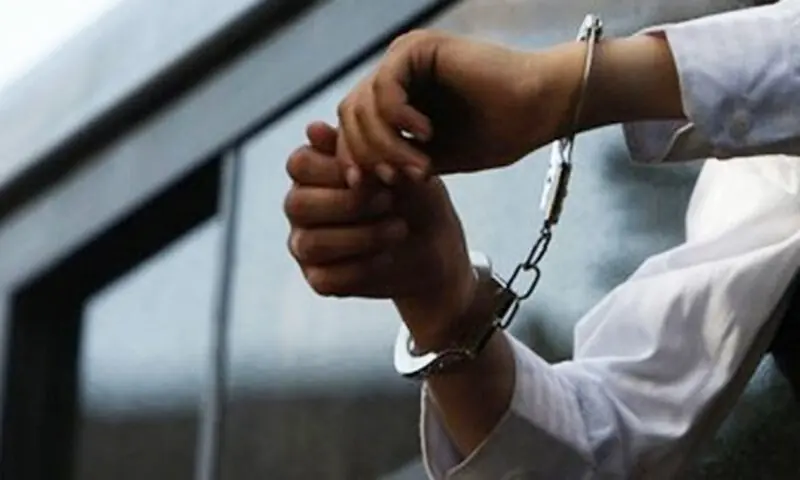
An Israeli court on Sunday extended for two days the detention of two foreign activists from a Gaza-bound flotilla, who were brought to Israel for questioning, a rights group representing them said.

The flotilla of more than 50 vessels had set sail from France, Spain and Italy to break Israel’s blockade of Gaza and bring supplies to the devastated Palestinian territory.

They were intercepted by Israeli forces in international waters off Greece early on Thursday, with Israel saying it had removed some 175 activists — two of whom were taken to Israel for questioning.

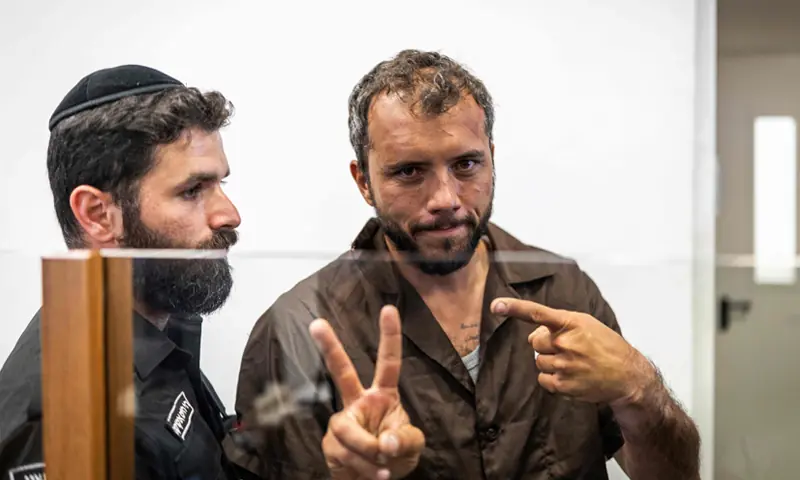
Spanish national Saif Abu Keshek and Brazilian Thiago Avila appeared before a court in the southern city of Ashkelon on Sunday.

AFP footage showed the pair being escorted into the courtroom, with Avila walking with his hands behind his back and Abu Keshek’s feet in shackles.

“The court extended their detention by two days,” Miriam Azem, international advocacy coordinator at the rights group Adalah, told AFP.

Adalah said the state attorney had presented a list of suspected offences authorities said the pair was accused of committing, including “assisting the enemy during wartime” and “membership in and providing services to a terrorist organisation”.

But Adalah’s lawyers challenged the state’s jurisdiction, arguing against the “unlawful abduction” of the two activists in international waters.

Its lawyers told the court Avila and Abu Keshek had testified to “severe physical abuse amounting to torture, including being beaten and held in isolation and blindfolded for days at sea”.

Call for swift release

Israel’s foreign ministry rejected accusations that the men were subjected to physical violence.

“Contrary to the false and baseless claims prepared in advance, at no point were Saif Abu Keshek and Thiago vila subjected to torture,” ministry spokesman Oren Marmorstein told AFP.

“Following violent physical obstruction by Saif Abu Keshek and Thiago vila against Israeli staff members, staff were compelled to act in order to stop these actions. All measures taken were in accordance with the law,” he insisted.

No formal charges were filed against the two, Adalah said.

“We argued that … they were part of a humanitarian mission that aimed to provide humanitarian aid to the civilians in Gaza, and not to any other organisation, whether terrorist or not,” lawyer Hadeel Abu Salih told journalists after the court hearing.

“We deny all the accusations that were presented … and demand these two men be released immediately,” she said.

Spain’s government has called for Abu Keshek’s “immediate release”, the foreign ministry said in a statement to AFP, indicating the Spanish consul had accompanied Abu Keshek to the hearing.

Adalah’s lawyers had met the activists at Ashkelon’s Shikma Prison on Saturday.

They said Avila recounted being “subjected to extreme brutality” by Israeli forces when the vessels were seized, saying he was “dragged face-down across the floor and beaten so severely that he passed out twice”.

Abu Keshek was also “hand-tied and blindfolded … and forced to lie face-down on the floor from the moment of his seizure” until reaching Israel, it said.

Accused of Hamas ties

Israel’s foreign ministry said the pair were affiliated with the Popular Conference for Palestinians Abroad (PCPA) — a group accused by Washington of “clandestinely acting on behalf of” Hamas.

It said Abu Keshek was a leading PCPA member, and that Avila was also linked to the group and “suspected of illegal activity”.

The Global Sumud Flotilla’s first Mediterranean voyage to Gaza last year drew worldwide attention, before being intercepted by Israeli forces off the coasts of Egypt and Gaza.

Avila was one of the organisers of that flotilla, which was also intercepted by Israeli forces, with crew members — including Swedish activist Greta Thunberg – arrested and expelled.

Israel controls all entry points into Gaza, which has been under an Israeli blockade since 2007.

Throughout the Gaza war, there have been shortages of critical supplies in the Palestinian territory, with Israel at times cutting off aid entirely.
  •  

Iran reviewing US response to 14-point proposal: state media

Tehran said on Sunday that the United States had responded to its 14-point proposal via Pakistan and that it was reviewing the response, according to Iranian state media.

“At this stage, we do not have nuclear negotiations,” an Iranian foreign ministry spokesperson said, according to state media.

Earlier, Iran’s Revolutionary Guards said Washington faced a choice between an “impossible” military operation or a “bad deal” with Tehran, after US President Donald Trump disparaged Iran’s latest peace proposal.

Negotiations between the two countries have been deadlocked since a ceasefire, brokered by Pakistan, came into effect on April 8, with only one round of direct peace talks held in Islamabad so far.

Iran’s Tasnim and Fars news agencies reported that Tehran had submitted a 14-point proposal to mediator Pakistan, but Trump was quick to cast doubt on it.

“I will soon be reviewing the plan that Iran has just sent to us, but can’t imagine that it would be acceptable in that they have not yet paid a big enough price for what they have done to Humanity, and the World, over the last 47 years,” Trump said on his Truth Social platform.

US news website Axios reported, citing two sources briefed on the proposal, that it set “a one-month deadline for negotiations on a deal to reopen the Strait of Hormuz, end the US naval blockade and permanently end the war in Iran and in Lebanon”.

Separately, Al Jazeera reported, citing sources, that the proposal envisaged three main stages, aiming to “transform the ceasefire into an end to the war within 30 days”.

According to the report, the proposal “envisions a pledge of nonaggression, including from Israel, to ensure there’s no return to war and an end to fighting throughout the Middle East”.

It said the proposal suggested the gradual reopening of the Strait of Hormuz in the first phase, as well as lifting of the US blockade of Iranian ports.

Under the proposed plan, Tehran would take charge of dealing with sea mines, the report said.

It added that the second phase was proposed to include “Iran’s return to uranium enrichment after the time limit at 3.6 per cent in accordance with the ‘zero-storage principle’“.

Moreover, the plan includes the US and Israel refraining from attacking Iran and its allies in exchange for Iran refraining from launching strikes, the report said, adding that Iran had also rejected “dismantling nuclear infrastructure or destroying Iran’s facilities”.

“Lifting sanctions includes the gradual release of frozen funds,” it said.

In the third phase, Tehran proposed to enter “into a strategic dialogue with Arab neighbours and building a security system that includes the entire Middle East”, the report stated.

‘Impossible operation’

In a statement on Sunday, the Revolutionary Guards sought to put the onus back on Trump, saying he must choose between “an impossible operation or a bad deal with the Islamic Republic of Iran”.

“The room for US decision-making has narrowed,” they said.

The day before, Deputy Foreign Minister Kazem Gharibabadi told diplomats in Tehran that “the ball is in the United States’ court to choose the path of diplomacy or the continuation of a confrontational approach”.

Iran, he said, was “prepared for both paths”.

‘If they misbehave’

In a brief interview with reporters in West Palm Beach, Florida, on Saturday, the US president declined to specify what could trigger new American military action.

“If they misbehave, if they do something bad, but right now, we’ll see,” he said. “But it’s a possibility that could happen, certainly.”

Mohsen Rezaei, a military adviser to Iran’s Supreme Leader Mojtaba Khamenei, said Iranian forces would sink US ships.

“The US is the only pirate in the world that possesses aircraft carriers. Our ability to confront pirates is no less than our ability to sink warships. Prepare to face a graveyard of your carriers and forces,” he posted on X.

His remarks came after Trump, while addressing a rally in Florida, compared the US action in the sea to that of pirates. “We’re like pirates” as he described an earlier helicopter raid on an oil tanker under the US blockade of Iranian ports.

“We … landed on top of it, and we took over the ship. We took over the cargo, took over the oil. It’s a very profitable business,” he remarked.

Axios reported earlier in the week that Trump’s envoy Steve Witkoff had asked for Tehran’s nuclear programme to be put back on the negotiating table.

But Iran’s mission to the UN pointed to the massive US nuclear arsenal, accusing Washington on Saturday of “hypocritical behaviour” towards Iran’s own atomic ambitions.

On Sunday, Iran’s envoy to Pakistan, Reza Amiri Moghadam also said that the continuation of talks between Tehran and Washington depended on the latter’s behaviour.

He expressed these views while speaking to Iranian official news agency IRNA.

The envoy said Iran had shared a comprehensive plan with the US, but “progress hinges on the US’s sincerity and willingness to resolve issues through genuine diplomatic efforts”.

He reiterated Iran’s commitment to safeguarding its national interests and defending its rights.

Moghadam also appreciated Pakistan for its efforts in facilitating dialogue between the US and Iran, and criticised US behavior, describing it as “unpredictable and aggressive”.

  •  

Sri Lanka arrests 37 Chinese nationals at suspected scam centre: police

By: AFP
scam centre

Sri Lankan police have arrested 37 Chinese nationals suspected of running a cyberscam centre in the capital Colombo, a spokesman said on Sunday, in the latest crackdown on foreign-run online fraud.

smartphone
A smartphone. Photo: freestocks, via Unsplash.

The suspects, aged between 23 and 44 and including one woman, were arrested after a tip-off, the police spokesman said.

“They had entered the country on tourist visas and were illegally employed, while two of them had overstayed their visas,” he added.

A local police source said 35 tablet computers, 147 mobile phones and 100 SIM cards were seized at the suspected scam centre in the Colombo suburb of Talangama.

The arrests came a month after 152 foreign nationals, mostly Chinese, were detained for allegedly running a cyberscam operation out of a hotel in the island’s northwest.

A Sri Lanka flag. Photo: Chathura Anuradha Subasinghe/Unsplash.

Immigration authorities arrested 135 Chinese men and women in March for allegedly running a similar scam operation. They have since been deported.

Beijing’s embassy in Colombo said at the time it was working closely with local authorities to prevent Chinese nationals from carrying out scam operations in Sri Lanka.

The embassy said Sri Lanka’s developed telecommunications infrastructure, favourable geographical location and relatively lenient visa policies encouraged fraud gangs to move to the South Asian nation.

In 2024, Sri Lankan authorities detained 230 Chinese nationals and 200 Indian nationals accused of operating cybercrime centres in various parts of the island.

  •  

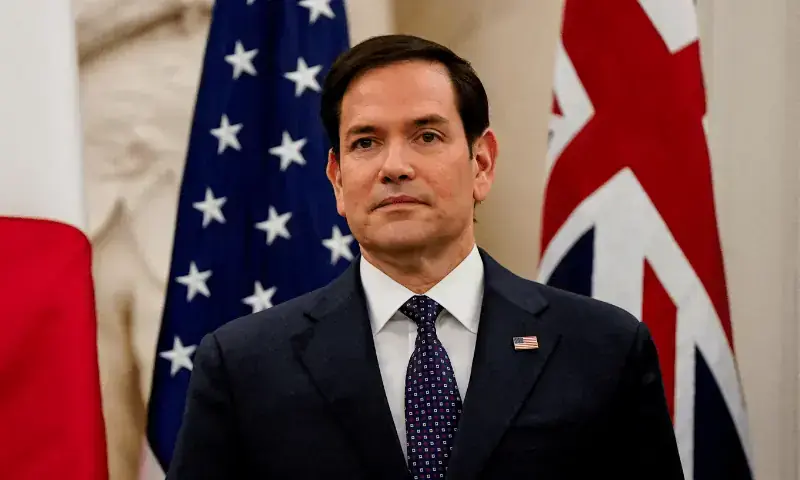
US Secretary of State Rubio to visit Vatican, Rome after Trump's row with Pope

US Secretary of State Marco Rubio will visit Rome and the Vatican this week, an Italian government source said on Sunday, just weeks after a clash between Donald Trump and Pope Leo.

Rubio, who is a Catholic, is expected to meet Vatican Secretary of State Pietro Parolin and Italian Foreign Minister Antonio Tajani, the source told AFP.

Italian media reported that he would also meet Defence Minister Guido Crosetto during the Thursday-Friday visit.

The meetings come several weeks after US President Trump’s extraordinary criticism of Pope Leo XIV over the Catholic leader’s anti-war rhetoric.

Trump also dismissed Italian Prime Minister Giorgia Meloni — one of his closest European allies — as lacking courage after she defended the US pontiff.

Italian media on Sunday presented Rubio’s visit as a meeting to “thaw” relations.

Since taking over as leader of the world’s 1.4 billion Catholics on May 8, 2025, following the death of Pope Francis, Leo has criticised the Trump administration’s crackdown on immigration.

But it was his increasing anti-war rhetoric, particularly following the US-Israeli attack on Iran, that triggered Trump’s ire.

Leo, on April 7, declared Trump’s threat to destroy Iran “unacceptable” and urged Americans to demand that US lawmakers “work for peace”.

The US president subsequently slammed the pontiff in a social media post as “WEAK on Crime, and terrible for Foreign Policy”.

Trump also said he was “not a big fan of Pope Leo” and that he does not “want a pope who thinks it’s OK for Iran to have a nuclear weapon”.

Meloni condemned as “unacceptable” Trump’s criticism — prompting the president to turn his fire on her.

“I’m shocked at her. I thought she had courage, but I was wrong,” the US president said in an interview with Italian daily Corriere della Sera.

He also accused Meloni — a far-right leader who has sought to act as a bridge between diverging US and European views — of failing to help the United States with Nato.

Trump has threatened to pull US troops from Italy, saying Rome “has not been of any help to us” in the Iran war. He has made a similar threat towards Spain, while the Pentagon has announced it is withdrawing 5,000 US troops from Germany.

  •  

Japan contains one of its biggest wildfires in decades after 11-day battle

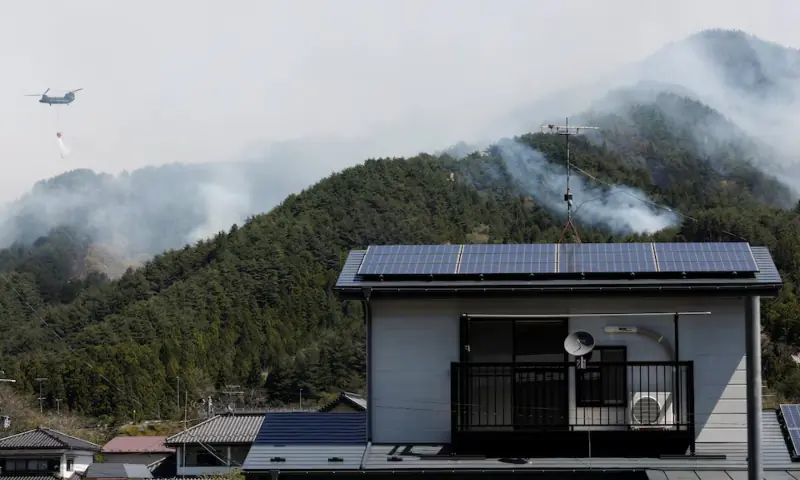
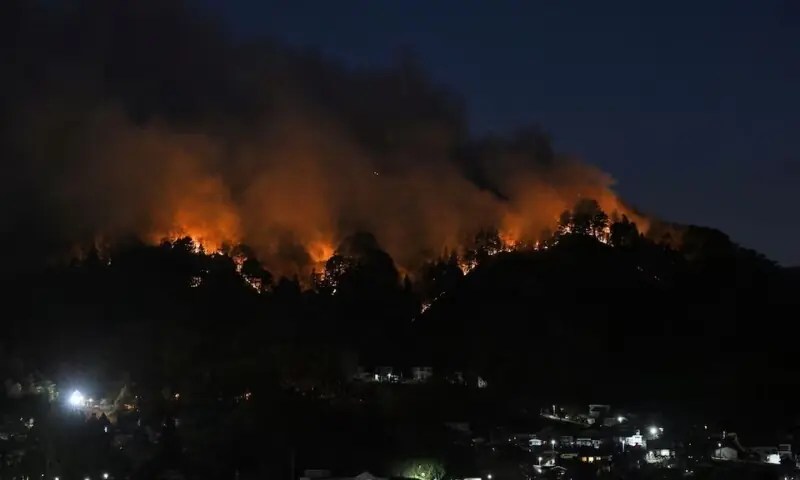
Wildfires that scorched forests in northern Japan, reportedly the second biggest in over 30 years, have been brought under control after 11 days, officials have said.

Hundreds of firefighters and more than 1,000 military personnel had battled the blazes since late April, as they burned around 1,600 hectares (4,000 acres) across the mountainous Iwate region.

The affected area is almost five times the size of New York City’s Central Park.

At least eight buildings were damaged, and two people suffered minor injuries, according to the Fire and Disaster Management Agency. Thousands of people were evacuated as fires picked up.

Otsuchi town mayor Kozo Hirano told reporters on Saturday that he had been “informed that… the fire had been brought under control” after visiting the area with fire officials.

He credited aerial and ground firefighting operations, as well as heavy rainfall, for containing the flames.

But Hirano said authorities would remain vigilant as there was a possibility that smouldering embers would remain.

Kyodo News described the blaze as Japan’s second-largest wildfire in over 30 years.

Increasingly dry winters have raised the risk of wildfires. Last year, Iwate suffered a separate wildfire that burned 2,600 hectares, the largest in Japan since 1975, when 2,700 hectares were scorched by fire in Kushiro, on the northern island of Hokkaido.

Scientists have long warned that climate change caused by mankind’s burning of fossil fuels will make periods of drought more intense and longer-lasting, creating the ideal conditions for wildfires.

  •  

Taiwan leader makes delayed visit to Eswatini after China objections

By: AFP
Taiwan eswatini

Taiwanese President Lai Ching-te on Saturday announced his arrival in Eswatini — Taipei’s only diplomatic ally in Africa — after an earlier trip was cancelled when several countries revoked overflight permits.

This handout photo taken and released on May 2, 2026 by the Taiwan Presidential Office shows Taiwanese President Lai Ching-te (L) speaking with Eswatini’s Prime Minister Russell Mmiso Dlamini (R) upon his arrival in Eswatini at King Mswati III International Airport in Sikhuphe. Photo: Taiwan Presidential Office/AFP.

Those various African nations withdrew overflight permission following “intense pressure” from Beijing, one of Lai’s closest advisers said at the time, forcing cancellation of the initially scheduled April 22-26 trip.

Lai on Saturday said only that his initial visit had been “suspended due to unexpected external forces”.

But “after days of secret arrangements by the diplomatic and national security teams, we arrived successfully today (Saturday),” he said in a Facebook post.

“I hope this trip will contribute to even deeper friendship between Taiwan and Eswatini, thanks to closer economic, agricultural, cultural and educational links, as well as promote Taiwan’s international cooperation,” he added.

“The 23 million Taiwanese people have the right to embrace the world and engage with the world,” Lai said in a speech before the Eswatini royal family and assembled dignitaries.

“And no country has the right and no country should ever block Taiwan from contributing more to the world,” he added.

The flags of Taiwan and Eswatini on display in Taipei on May 21, 2024. File photo: Taiwan's Office of the President.
The flags of Taiwan and Eswatini on display in Taipei on May 21, 2024. File photo: Taiwan’s Office of the President.

Earlier Saturday, China’s foreign ministry accused Lai of making a “stowaway-style escape farce” that made him “an international laughing stock”.

“No matter how the DPP authorities collude with external forces … it is all in vain and cannot change the fact that Taiwan is part of China,” an unnamed spokesperson said in a statement on the ministry’s website, referring to Lai’s party.

“We urge Eswatini and other individual countries to see clearly the general trend of history … and not pull chestnuts out of the fire for a handful of ‘Taiwan independence’ separatists,” the statement said.

Eswatini, a small enclave kingdom formerly known as Swaziland, is one of 12 countries that still recognise Taiwan. China has persuaded other nations to break diplomatic ties with the self-ruled island, which it claims as part of its territory.

Lai was due in Eswatini in April for the 40th anniversary of King Mswati III’s accession to the throne, but cancelled the visit after the Seychelles, Mauritius and Madagascar revoked overflight permissions, “unexpectedly and without notice”, according to his office.

  •  

Austria arrests man suspected of lacing jars of baby food with rat poison

Austrian police have arrested a man suspected of lacing jars of baby food with rat poison in what authorities presumed was an extortion scheme.

Police, cited by the APA news agency, said the suspect, aged 39, was apprehended in the state of Burgenland, south of Vienna. They did not name him nor say where exactly he was arrested.

He was charged with deliberately causing a public danger and attempted grievous bodily harm.

The arrest comes two weeks after Austrian authorities detected rat poison in baby food jars sold in some supermarkets. The jars were made by the German-based company HiPP, and German police became involved in the case.

Five tampered jars were recovered before they were consumed in the following days in Austria, the Czech Republic and Slovakia.

Police said they believed the crime was carried out to extort the company, which put out a product recall in Austria.

One of the adulterated jars was bought in a Spar supermarket in Burgenland state, in the city of Eisenstadt. It was found to contain 15 microgrammes of rat poison.

Another jar sold in the same supermarket was suspected to have also been laced with poison, but it has not yet been recovered.

  •  

2 Gaza aid flotilla activists brought to Israel for questioning, its foreign ministry says

Two activists who participated in a Gaza-bound aid flotilla were brought to Israel for questioning, the foreign ministry said on Saturday, after the vessels were intercepted by Israeli forces this week.

Saif Abu Keshek, from Spain, and Thiago Avila, a Brazilian, were in Israel and would “be transferred for questioning by law enforcement authorities”, the ministry said on X, adding that the two activists were affiliated with an organisation sanctioned by the US Treasury.

The ministry said the activists were affiliated with the Popular Conference for Palestinians Abroad (PCPA), a group Washington has accused of “clandestinely acting on behalf of Hamas”.

In January, the US Treasury imposed sanctions on the group, which it said was involved in organising Gaza-bound civilian flotillas that aimed to break Israel’s sea blockade on the Palestinian territory.

Israel’s foreign ministry said Abu Keshek was a leading member of PCPA and Avila, also linked to the organisation, was “suspected of illegal activity”.

“Both will receive a consular visit from the representatives of their respective countries in Israel,” the ministry said.

Spain condemned the “illegal detention” of its citizen. Abu Keshek “must be released immediately so that he can return to Spain”, Spanish Foreign Minister Jose Manuel Albares told Rac1 radio.

“We are facing an illegal detention in international waters, outside any jurisdiction of the Israeli authorities,” Albares said.

Avila was among the organisers of a flotilla that had tried to bring aid to Gaza last year despite the naval blockade. That effort was also intercepted by Israeli forces.

The current flotilla comprised more than 50 vessels and had set sail from ports in France, Spain and Italy with the aim of breaking the blockade of Gaza and bringing humanitarian aid to the Palestinian territory.

Israel controls all entry points to Gaza.

Throughout the conflict, there have been shortages of critical supplies in Gaza, with Israel at times cutting off the entry of aid entirely. The Gaza Strip has been under Israeli blockade since 2007.
Israel’s foreign ministry earlier claimed around 175 activists had been taken off more than 20 vessels on Thursday by the country’s military. Flotilla organisers said 211 activists had been kidnapped.

Organisers said the Israeli operation had taken place over 1,000 kilometres from the Gaza Strip. Israeli forces halted the boats overnight Wednesday to Thursday, with organisers, the Global Sumud Flotilla, saying their equipment had been smashed and that the intervention had left them facing a “calculated death trap at sea”.

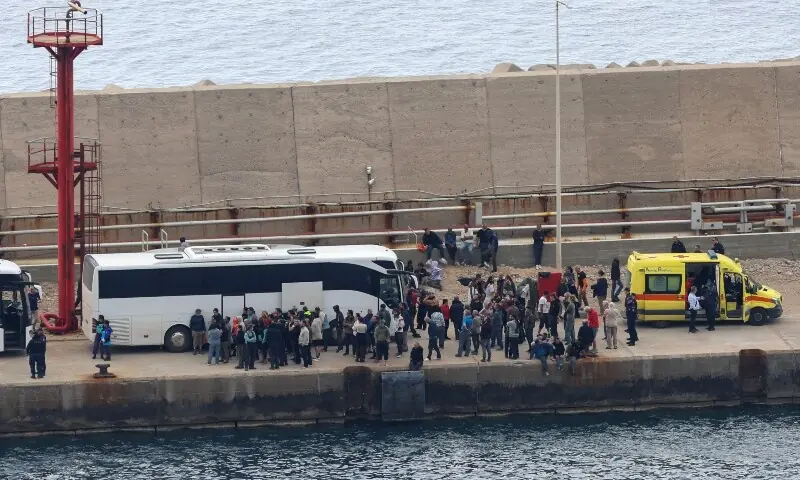
Dozens of intercepted activists disembarked on Friday on the Greek island of Crete, according to an AFP journalist.

Former senator Mushtaq Ahmad was also among those detained. On Friday, Deputy Prime Minister and Foreign Minister Ishaq Dar said on X that Ahmad had been released.

“I reiterate my strongest possible condemnation of the illegal detention of humanitarian workers aboard the flotilla as well as obstruction of humanitarian aid destined for the besieged people of Gaza,” he said.

The United States has backed Israeli authorities, calling the flotilla a “stunt”.

In the summer and autumn of 2025, a first voyage by the Global Sumud Flotilla across the Mediterranean towards Gaza drew worldwide attention. The boats in that flotilla were intercepted by Israel off the coasts of Egypt and the Gaza Strip in early October.

Crew members, including Swedish activist Greta Thunberg, were arrested and then expelled by Israel.

  •  

Chinese swimmer Sun Yang reports cyberbullying to police

By: AFP
Sun Yang

Three-time Chinese Olympic champion swimmer Sun Yang filed a police report after being subjected to “large-scale” cyberbullying, his team said Friday.

Chinese swimmer Sun Yang. File photo: Olympics.

Sun, 34, returned to competition in 2024 after a four-year ban for smashing vials of blood during a 2018 doping test, the circumstances of which he still disputes.

His team said Friday that false information including “maliciously fabricated rumours” had circulated online recently, calling it “organised and planned cyberbullying and defamation”.

They did not specify what false information had been spread about Sun.

The swimmer reported the case to police in the eastern city of Hangzhou, his team said on social media, posting a photo of a notice he had received after filing the complaint.

“We solemnly warn all rumour-mongers and malicious disseminators: immediately delete all infringing content and cease forwarding,” his team said.

The Olympic rings. File photo: Wikicommons.

“Our legal team has secured evidence and will pursue civil, administrative, and even criminal liability according to the law.”

Chinese authorities have been grappling with what state media has called “toxic fandom” surrounding its sports stars.

It includes fans obsessing over athletes’ personal lives and attacking opponents online.

The nearly two-metre tall (six feet seven inches) Sun was China’s first male Olympic swimming champion, winning the 400m and 1500m freestyle at the 2012 London Games.

But he has long been a controversial figure in the pool.

Some rivals accused him of cheating at the 2016 Rio Olympics and two competitors refused to stand with him on medal podiums at the 2019 World Championships.

Sun was also given a three-month ban in 2014 after testing positive for a banned substance.

  •  

Hezbollah's fibre-optic drones pose new challenge for Israel's military

Hezbollah’s cheap fibre-optic drones are creating new challenges for Israeli troops in southern Lebanon, forcing the military to adapt its tactics against an increasingly lethal threat.

The Israeli military — considered one of the most advanced in the world — has confirmed two soldiers and one civilian contractor killed in explosive drone attacks in under a week, with several others wounded despite a ceasefire in place since mid-April.

The devices are small, cheap and readily available, like “children’s toys”, explained Orna Mizrahi, a senior researcher at Israel’s Institute for National Security Studies (INSS).

The military “does not have nowadays any response for that, because they didn’t prepare themselves for such low-tech explosives”, she told AFP.

Israel has been fighting Hezbollah since early March, invading the neighbouring country’s south to confront the group.

Since then, violence has continued, with both sides accusing each other of breaching the ceasefire. Israel has continued its airstrikes since the ceasefire came into effect.

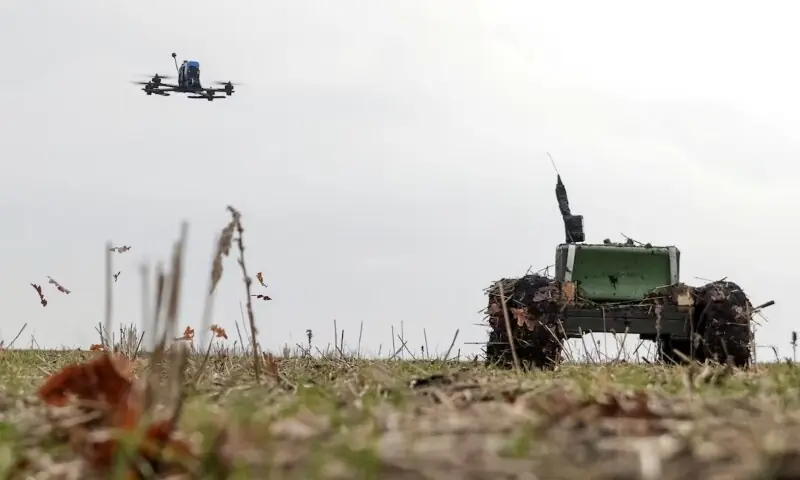
Unlike conventional drones guided by GPS or radio, which can therefore be jammed, Hezbollah is using devices linked to their launch site by a thin fibre-optic cable that can stretch for dozens of kilometres.

Operators pilot the drones in first-person view (FPV) using screens or virtual reality goggles that require limited training.

“Since the drone does not transmit the image via radio broadcast and does not receive guidance commands via radio receiver, it cannot be detected by electronic intelligence means or blocked through electronic warfare,” said Arie Aviram, an expert who has written on the subject for the INSS.

The drones’ speed and precision mean they can cause considerable damage to Israeli targets, and their lack of electronic traces leaves troops reliant on radar or visual detection, which often comes too late.

Asymmetrical warfare

Hezbollah’s use of these drones is characteristic of asymmetrical warfare, explained INSS researcher Mizrahi.

In recent days, Hezbollah has relied more on these drones, a notable shift from the barrages of rockets it unleashed in the weeks after the war broke out.

Experts say the cost of assembling the fibre-optic drones can range from just a few hundred dollars to around $4,000, depending on the quality and type of components, which can be bought on online platforms such as AliExpress.

On Friday, the group’s media chief Youssef al Zein confirmed the group was using the drones and said they were being manufactured in Lebanon.

“We are aware of the enemy’s superiority, but at the same time we are exploiting its weak points,” he said.

For Israel, shooting down cheap drones using sophisticated air defences and fighter jets is unsustainable and costly.

Aviram said that lasers, like those used by Israel’s Iron Beam air defence system, could be a suitable solution “provided they were widely deployed”, which is not the case.

Indicating the challenge posed by these devices, the Israeli defence ministry put out a public call on April 11 for “proposals to identify additional capabilities to address the threat of fibre-optic-controlled FPV drones”.

Nets and barriers

A video shared on social media by prominent Israeli journalist Amit Segal on Wednesday appeared to show military vehicles draped in netting to protect against drones. AFP was unable to verify the footage.

A senior military official told journalists on Tuesday that “so far, we’re using force protection technologies and other protections that we learned from other places, from our own experience with nets, with barriers”.

“But it’s a threat that we’re still adapting to, there’s nothing that is foolproof,” the official added, noting that the military was “learning” from the war in Ukraine, where fibre-optic drones are now common.

Israeli news website Mako reported in 2024 that Ukraine — which has become a world-leading drone expert since Russia’s invasion — offered its expertise to Israel several years ago but was rebuffed.

“There was no concrete response,” Ukraine’s former defence minister Oleksii Reznikov told Mako at the time.

Asked by AFP about the challenges posed by fibre-optic explosive drones, the Israeli military said troops had in recent weeks “conducted an in-depth analysis of how this threat operates and how Hezbollah employs it”.

“The IDF is monitoring the drone threat and developing operational methods to address it,” it said, adding that troops on the ground were “continuously working to improve and adapt their systems in order to deal with the evolving threat”.

  •  

Nato seeks details as US says it will pull about 5,000 troops from Germany

Nato said on Saturday it was working with the United States to understand Washington’s decision to withdraw 5,000 troops from Germany as a rift in transatlantic ties deepens over the Middle East war.

The Pentagon’s announcement of the troop withdrawal follows a spat between US President Donald Trump and German Chancellor Friedrich Merz, who said on Monday that Iran was “humiliating” Washington at the negotiating table.

Trump fired back by saying that Merz “doesn’t know what he’s talking about”.

It also came as Trump announced that tariffs on cars and trucks from the European Union will increase to 25 per cent next week over accusations that the bloc did not comply with a trade deal signed last summer.

Pentagon spokesman Sean Parnell said on Friday the withdrawal of around 5,000 troops from Germany was expected “to be completed over the next six to twelve months”.

“This decision follows a thorough review of the Department’s force posture in Europe and is in recognition of theater requirements and conditions on the ground,” Parnell said in a statement.

There were 36,436 active-duty US troops in Nato ally Germany as of December 31, 2025, compared to 12,662 in Italy and 3,814 in Spain.

German Defence Minister Boris Pistorius said on Saturday the US troop withdrawal “from Europe and also from Germany was to be expected”.

Nato said it was “working with the US to understand the details of their decision on force posture in Germany”.

“This adjustment underscores the need for Europe to continue to invest more in defence and take on a greater share of the responsibility for our shared security,” Nato spokeswoman Allison Hart wrote on X.

‘Why shouldn’t I?’

Trump has made a number of threats to slash US troop numbers in Germany and other European allies during both his terms in office, saying he wants Europe to take on greater responsibility for its defence rather than depending on Washington.

He now appears determined to punish allies who have failed to back the Middle East war or contribute to a peacekeeping force in the crucial Strait of Hormuz waterway, which Tehran’s forces have effectively closed.

Trump also accused German automakers such as Mercedes-Benz and BMW of ripping off Americans, saying on Friday that Germany and “other European nations have not adhered to our trade deal”.

Germany would likely be hit hard by a sharp vehicle tariff because it is responsible for a significant portion of EU auto exports.

Such tariffs would impose “enormous costs on the Germany and European automobile industry,” the head of Germany’s VDA lobby group for the sector, Hildegard Mueller, said in a statement sent to AFP.

She called for an “urgent” de-escalation and speedy negotiations on the issue.

Trump said on Thursday he might pull US troops from Italy and Spain due to their opposition to the war.

“Italy has not been of any help to us and Spain has been horrible, absolutely horrible,” he told reporters in the Oval Office.

“Yeah, probably, I probably will. Why shouldn’t I?” Trump said.

German Foreign Minister Johann Wadephul said on Thursday during a visit to Morocco that Germany was “prepared” for a reduction in US troops and was “discussing it closely and in a spirit of trust in all Nato bodies”.

However, Wadephul said large American bases in Germany are “not up for discussion at all” and cited the example of Ramstein Air Base, which he said has “an irreplaceable function for the United States and for us alike”.

Ukraine support

The EU said on Thursday the deployment of US troops in Europe was in Washington’s interest, and that the US was “a vital partner in contributing to Europe’s security and defence”.

Trump, however, took aim at Merz again, telling him to focus on ending the Ukraine war instead of “interfering” on Iran.

European powers have been on alert since Russia invaded Ukraine in 2022. A spate of drone incursions in the past year, as well as US promises to move away from defending the continent, have pushed the issue to the top of the agenda.

Merz has made national security a priority, announcing unprecedented investments in an army that has been underfunded and under-equipped for decades. He has also reaffirmed support for Ukraine.

  •  

‘Clearly me’: Chinese AI drama accused of stealing faces

By: AFP
Chinese AI drama controversy featured image

By Sophia Xu and Purple Romero

Christine Li is a model and influencer, but not an actor, so when she saw herself playing a cruel character in a Chinese microdrama she felt bewildered, then angry and afraid.

The 26-year-old is one of two people who told AFP their likenesses were cast without consent in the AI-generated show “The Peach Blossom Hairpin”, which ran on Hongguo, a major microdrama app owned by TikTok parent company ByteDance.

A photo taken in Hong Kong on April 16, 2026, shows phones displaying screenshots of a video from Chinese model and influencer Christine Li accusing an AI microdrama of stealing her likeness without consent. Photo: Mahmoud Rizk/AFP.

Li plans to sue the drama makers and the platform, highlighting new legal and regulatory grey areas created by artificial intelligence.

“I was genuinely shocked. It was clearly me,” said Li, who lives in Hangzhou in eastern China.

“It was so obvious that they used a specific set of photos I took two years ago” and had posted on social media, she said.

Microdramas are ultra-short, online soap operas hugely popular in China and elsewhere.

When Li’s fans alerted her to the series, she was horrified to find her digital twin shown slapping women and mistreating animals.

“I also felt a deep fear. I kept wondering what kind of person would do something like this,” Li said.

Hongguo hosts thousands of free, bite-sized shows — both live-action and AI-generated — whose episodes are two or three minutes long.

As of October, the platform had around 245 million monthly active users, according to data cited by Wenwen Han, president of the Short Drama Alliance.

A Hongguo statement in early April said it had taken the series down because the producers had violated platform rules and contractual obligations.

‘Sleazy’ antagonist

AI’s ability to mimic real people has sparked global concern for actors’ jobs, and over such deepfakes being used for scams and propaganda.

Li and a man who says he was portrayed as her AI husband in the series, which became a hit last month on Hongguo, spoke out online about their separate unwelcome discoveries.

But even as their stories sparked a public outcry about AI ethics, AFP saw that “The Peach Blossom Hairpin” kept running for days before its removal, with the disputed characters quietly replaced.

A photo taken in Hong Kong on April 16, 2026, shows phones displaying the screenshots of Chinese "hanfu" stylist Baicai's social media post (left) and the AI microdrama (right) accused of stealing his likeness without authorisation. 
Photo: Mahmoud Rizk/AFP.
A photo taken in Hong Kong on April 16, 2026, shows phones displaying the screenshots of Chinese “hanfu” stylist Baicai’s social media post (left) and the AI microdrama (right) accused of stealing his likeness without authorisation.
Photo: Mahmoud Rizk/AFP.

The man, a stylist specialised in traditional Chinese clothing and make-up, had posted photos of himself in costume on the Instagram-like Xiaohongshu app.

Like Li, he was upset by the “ugly” portrayal of his likeness as a “sleazy” antagonist in the show.

“Will it have an impact on me, on my job, on my future work opportunities?” said the man, who asked to use the pseudonym Baicai.

To keep audiences hooked, microdramas are often full of shocking, larger-than-life moments.

Li and Baicai both showed AFP their original photos and the characters in “The Peach Blossom Hairpin”, which bore a strong resemblance.

Legal risk

For low-budget AI microdramas, Chinese regulations say platforms must be the primary checkpoint for potentially dodgy content.

If they do not carry out mandatory content reviews, the videos will be forcibly taken down, according to the National Radio and Television Administration.

If the platforms were aware of any infringement but failed to act on it, parties affected can alert China’s cyberspace authorities which can impose administrative penalties, according to Zhao Zhanling, a partner at Beijing Javy Law Firm.

Hongguo said in a second statement this month it would continue to strengthen how it reviews content and how it authorises creators, among other steps.

It said it had dealt with 670 AI microdramas that violated regulations, with most taken down, and warned it would crack down on repeated breaches.

When approached for comment, parent company Bytedance referred AFP to the two Hongguo statements.

ByteDance office building in Shanghai. Photo: ByteDance.

Li and Baicai say they need more information from Hongguo to confirm the identity of the drama’s creator — with two companies as potential candidates.

One is linked to a verified account on the Chinese version of TikTok that also published the series. Another is listed as the drama’s producer on an official Chinese filing system.

AFP contacted both firms but received no response.

Using AI to slash costs may be tempting in the fast-growing, multi-billion-dollar microdrama market.

But featuring someone in a demeaning way without permission “may constitute an infringement of both portrait rights and reputation rights”, said Li’s lawyer Yijie Zhao, from Henan Huailv Law Firm.

‘Associated with controversy’

National regulations require microdrama makers to register to obtain a licence — a step made mandatory for AI-generated animations from this month.

But producers could remain in the shadows by registering temporary outfits, Zhao said, while some allegedly use overseas servers to hide.

In 2024, a Beijing court ordered a company to apologise and pay compensation to a celebrity after its AI software enabled users to produce a virtual persona using his photos and name that could exchange intimate messages.

See also: US tech giant Meta sues Brazil, China advertisers over celebrity deepfake scams

But lawyers told AFP that compensation for plaintiffs like Li likely won’t amount to much due to the limited commercial value of an ordinary likeness.

Li worries that the saga may cost her opportunities in the modelling industry, as she is now “associated with controversy”.

Baicai has not launched legal action, but hopes to see more measures from regulators and platforms to protect people like him.

“There are probably plenty of cases with unknown victims,” he said.

  •  
❌