Reading view

Is AIADMK’s heartland giving up on the party?

The political message Edappadi K. Palaniswami delivered in the third week of May was brief, restrained and revealing. Rebel MLAs who had defied the AIADMK leadership and aligned with the Joseph Vijay-led TVK (Tamilaga Vettri Kazhagam) government were welcome to return for talks, he said. Differences could be resolved internally; the movement mustn’t fracture.

For the first time since his victory in the internecine feud in the AIADMK after the death of Jayalalithaa, EPS, as he is popularly called, is struggling to keep a grip on the party. The revolt led by former ministers S.P. Velumani and C.V. Shanmugam has done more than fracture the party in the legislature. More dangerously for the AIADMK, the rebellion has erupted in its political stronghold of Kongu Nadu in western Tamil Nadu, the region that sustained the party after Jayalalithaa’s death and fuelled EPS’s rise.

Succession wars and party feuds have haunted the AIADMK ever since the death of its founder M.G. Ramachandran in 1987. But the party “survived earlier crises because rival factions drew their political sustenance from different political bases, different nodes of power,” says Chennai-based political observer Susithra Maheswaran. “This fracture is inside the same (west Tamil Nadu) leadership structure. That makes the conflict far more dangerous for the party.”

The immediate trigger was the Assembly trust vote following the formation of the Vijay-led TVK government. Palaniswami instructed all AIADMK legislators to oppose the government. Yet nearly half the party MLAs voted in support of Vijay, stunning the leadership and exposing the scale of internal dissent. The rebellion was proof that Palaniswami’s writ didn’t run any longer. This was the man who had successfully defanged rivals O. Panneerselvam, V.K. Sasikala and T.T.V. Dhinakaran just a few years ago.

The rebellion is not surprising, though, after the party’s disappointing performance in the Assembly election. It suffered heavy losses despite projecting Palaniswami as a stable administrator capable of taking on the DMK. Vijay’s dramatic rise, which split the anti-DMK vote, was also read as a sign that the AIADMK did not appeal to younger voters who wanted change.

The response from the EPS camp was initially aggressive. Velumani, C.V. Shanmugam and several others were stripped of their organisational responsibilities, setting up the revolt. Several dissident legislators, who voted with Vijay and were reportedly hoping for ministerial berths, are now stranded between two worlds and reassessing their options.

The TVK, too, appears divided over the nature of its engagement with the rebels. Some in the party view the dissident AIADMK legislators as useful allies, who will not only destabilise Palaniswami but also expand TVK’s influence in western Tamil Nadu. Others fear that accommodating leaders perceived to be soft on the BJP could damage TVK’s image.

The Congress, a key ally of the Vijay government, is understood to have privately urged caution. Senior Congress leaders reportedly fear that a formal embrace of the AIADMK rebels may create ideological confusion in the anti-BJP opposition space and alienate minority voters.

Velumani’s public stand is measured: “We are ready for talks,” he said recently. “It’s not personal. We need to discuss why the party has declined and how collective leadership can strengthen the movement.” The language is conciliatory, but the message is a challenge to EPS’s style of leadership.

The rebel faction accuses EPS of centralising decision-making, sidelining senior leaders and reducing the AIADMK to a tightly controlled apparatus disconnected from changing political realities. Leaders aligned with Velumani argue that alliance decisions, campaign strategies and candidate selection were concentrated in a very tight leadership circle after Palaniswami consolidated power.

Senior AIADMK leader K.P. Munusamy, who remains firmly aligned with EPS, dismisses the criticism. “A movement like the AIADMK cannot function without discipline. Decisions cannot be negotiated through public pressure.” Yet the scale of the rebellion suggests deeper anxieties. Vijay’s rise has disrupted political calculations in the AIADMK. For decades, the party monopolised the anti-DMK political space, but now it is neither in government nor the primary opposition. That makes the party’s crisis existential.

Vijay’s appeal among younger voters, sections of women and segments of the politically disillusioned middle class has created a lot of political uncertainty in the state. Many second-rung AIADMK leaders fear that the party under Palaniswami lacks the emotional momentum to survive the next political cycle. For this lot, supporting Vijay tactically is political insurance.

Sections of the rebel bloc are said to be close to the BJP leadership in Delhi, but chose to align tactically with Vijay during the trust vote. “In the old Dravidian political culture, loyalties were ideologically sharper and emotionally charged. Now politics is becoming transactional. Leaders are positioning themselves for a future where the AIADMK may no longer remain the central opposition,” says Coimbatore-based political observer K. Mohanraj.

The uncertainty surrounding veteran AIADMK figures is another measure of the fragmentation of the party. O. Panneerselvam, once projected as Jayalalithaa’s loyalist successor, now occupies a much diminished, if still symbolically important, space outside the EPS structure.

Sasikala is politically isolated, but still has an emotional hold among sections of the old AIADMK cadre and voter base. T.T.V. Dhinakaran, despite losing organisational relevance, still commands pockets of loyalty through the AMMK network. Sections in the Velumani camp are believed to favour reopening channels with Sasikala and Dhinakaran in the name of ‘AIADMK unity’; this would’ve been unthinkable at the height of EPS’s dominance.

The crossover of Kongu leader Sengottaiyan — now the state finance minister — from the AIADMK in November 2025 was an early sign of the flux in state politics, a sign that sections of the old AIADMK establishment were warily looking at the TVK’s capture of their turf.

Younger Tamilians do not have the same emotional connect to MGR and Jayalalithaa that sustained the AIADMK for decades. Vijay’s political rise has accelerated that shift dramatically. “The danger for the AIADMK is not merely organisational fragmentation,” says Susithra Maheswaran. “The larger danger is gradual political irrelevance among younger voters.”

While the BJP has still not managed to get a foothold in the state, it has played no small role in the current predicament of the AIADMK. Under Modi, the BJP has tried its luck with multiple AIADMK power centres including EPS, Panneerselvam and Sasikala to make a breakthrough in the state. The current split in the AIADMK and the emergence of Vijay has given the BJP pause, though it’ll no doubt keep an eagle eye on new possibilities.

K.A. Shaji is a South India–based journalist who has chronicled rural distress, caste and tribal realities, environmental struggles and development fault lines. More of his writing here

  •  

Yellow survey stones and a project called SilverLine

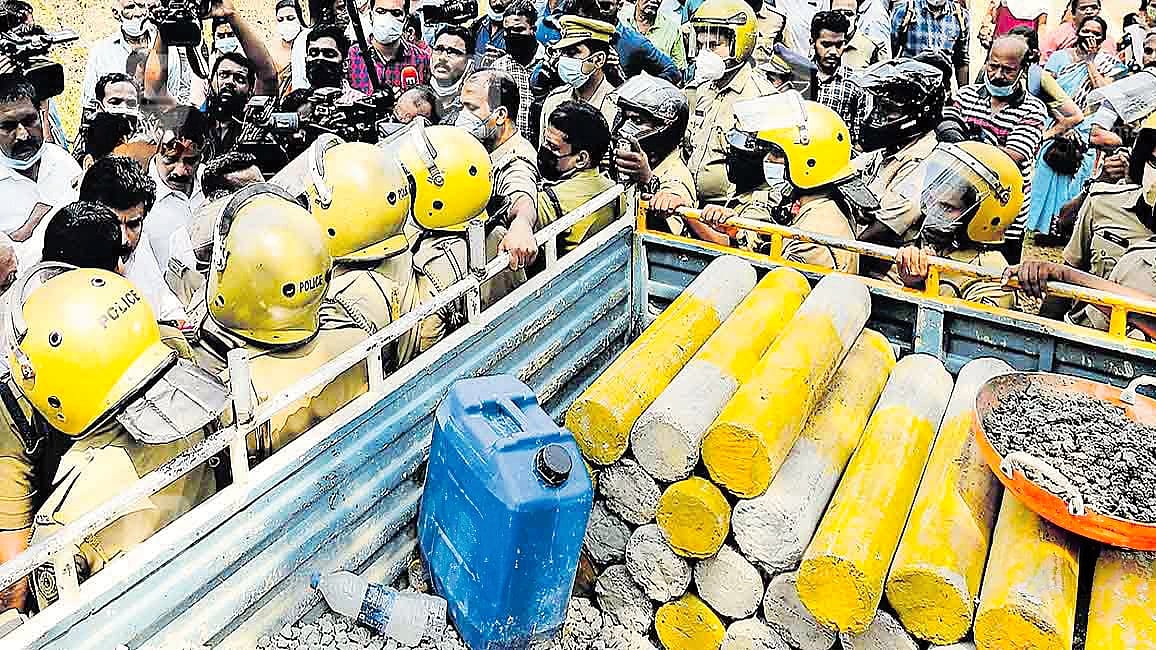
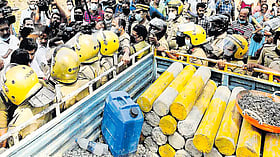
When the yellow survey stone appeared one morning inside K. Thankamma’s kitchen courtyard in Alappuzha’s Kozhuvallur village, the 68-year-old widow felt as if somebody had quietly marked her family for eviction. The stone looked innocuous enough, but its message was terrifying.

These stones were used to mark the proposed alignment of the controversial SilverLine high-speed railway corridor, projected by the then Pinarayi Vijayan-led LDF government as Kerala’s biggest infrastructure dream.

For Thankamma and thousands of others across the state, the yellow stones became symbols of fear, humiliation and uncertainty. Homes that had been around for generations faced demolition. Land prices crashed. Banks hesitated to grant new home loans. Families postponed weddings, house repairs and investments because nobody knew when the eviction notices or bulldozers might arrive.

With the new Congress-led UDF government led by chief minister V.D. Satheesan officially scrapping the project, relief has swept across villages that spent years living in a state of fear. “I used to wake up every day wondering whether this house would survive,” Thankamma told this reporter, standing beside the now fading yellow mark near her kitchen compound. “My husband built this home after years of hard work in the Gulf. After the yellow stone came, peace left this house. Even cooking in this kitchen became painful.”

From Kasaragod in the north to Thiruvananthapuram in the south, the yellow survey stones had entered courtyards, wells, paddy fields, kitchens and bedrooms. They had transformed ordinary homes into sites of anxiety.

Their removal now marks one of the most dramatic political reversals in Kerala’s recent history and a rare victory for sustained public resistance against a mega infrastructure project backed by the full might of the state.

****

In Thottolithazham near Kozhikode city, P.V. Shashindran spent years watching debt slowly consume his family. He had borrowed heavily to build a modest house and get his three daughters married. His liabilities crossed Rs 15 lakh. The only way out was to sell a portion of his ancestral property. Then the yellow stones arrived.

Potential buyers disappeared overnight. Nobody wanted land that could soon be acquired for SilverLine. Financial institutions too were reluctant to touch it. For Shashindran, this was worse than a nightmare — he had legal title of the land but couldn’t mortgage it or sell it. “The project destroyed our peace even before it had taken an inch of land,” he said.

****

In Meenchanda near Kozhikode, Abdul Razak had just finished construction of his new house when officials arrived with police escorts to place survey stones near the property. Panic entered the household at a time when his son was about to get married.

K.V. Razak, also a native of Meenchanda and a heart patient who actively joined the protests, collapsed during demonstrations against the survey. Images of elderly residents crying before police personnel travelled across Kerala.

Families felt abandoned by the state. Nobody would even say if their homes would survive. Even after the authorities hinted at possible alignment changes, the uncertainty continued.

For many affected families, this uncertainty was worse than displacement. People stopped renovating homes. Property transactions froze. Young couples postponed life decisions. Elderly residents were heard saying they would probably be gone before there was clarity.

Rebellion and relief

Madappally near Changanassery in Kottayam district emerged as a hotbed of resistance. Nearly 400 houses here were expected to be affected by the project.

Villagers turned into full-time protesters. Women slept inside makeshift tents. Elderly residents guarded roads at night fearing sudden survey operations. Families organised marches, sit-ins and human chains for years.

The movement shook Kerala after visuals emerged of grassroots activist Roselin Philip being dragged away by the police during a protest while her young daughter stood by and cried.

****

When authorities planted a survey stone in front of Thankamma’s kitchen in Kozhuvallur, villagers felt the state had crossed an invisible line. Protests intensified when the police reinstalled the survey stone after activists had once removed it. Sindhu James, a homemaker, was jailed and later alleged physical and mental harassment in custody.

The incident transformed the anti-SilverLine agitation into a larger statewide movement against what was seen and commonly described as authoritarian governance in Pinarayi Vijayan’s second term.

Environmental activist K.V. Ravishankar said the project failed because it ignored Kerala’s ecological and social realities. “SilverLine represented a dangerous development model imposed without listening to people or understanding Kerala’s fragile environment. The protests showed that ordinary people were no longer willing to sacrifice their homes and livelihoods or the wetlands for projects that mainly benefit contractors and politicians.”

SilverLine, a.k.a. K-Rail, became a moral and political question about whether ‘development’ could justify uprooting thousands of families in one of India’s most densely populated states.

When the new government announced the decision to scrap the project, residents burst crackers and distributed sweets. Many described the moment as liberation from a prolonged psychological siege.

The project that made Kerala see red

The Pinarayi Vijayan government had tried to sell SilverLine to the people as an infrastructure dream. The estimated cost: Rs 63,941 crore. The benefit: a speedy rail link (<4 hours) connecting the length of the state, from state capital Thiruvananthapuram in the south to Kasaragod in the north.

The proposed route cut through densely populated settlements, wetlands, paddy fields, rivers, backwaters and ecologically fragile regions including Madayippara, Kadalundi estuary and Kole wetlands.

It required acquisition of nearly 1,383 hectares of land across Kerala. Environmentalists warned that the corridor could trigger severe hydrological consequences in a state already battered by floods, landslides and coastal erosion. Experts argued that enormous quantities of granite, soil and sand required for embankments and elevated corridors would intensify pressure on the fragile Western Ghats ecosystem.

The financial implications were also controversial. Critics questioned how debt-stressed Kerala could support the cost of the project when it was already struggling with welfare commitments, climate disasters and fiscal instability.

Many experts argued that upgrading the existing railway network with electronic signalling, track doubling and modernisation could substantially reduce travel time without triggering mass displacement and ecological destruction.

Resistance to the project united an unusual coalition of environmentalists, church groups, scientists, civil society organisations and ordinary residents, including sections traditionally sympathetic to the Left.

SilverLine became a referendum on Kerala’s development politics.

Not just SilverLine

SilverLine was possibly the most emblematic of the governance trajectory but not the only infrastructure project under the Pinarayi Vijayan government that drew sharp criticism. The EMCC deep sea fishing project, which threatened the livelihoods of traditional fisher communities, the Vizhinjam port project, the extensive quarrying in ecologically fragile regions, disputes over buffer zones surrounding protected forests and allegations related to coastal mineral sand (black sand) mining had put the erstwhile LDF government on the defensive in the run-up to the recent elections.

While announcing the cancellation of the SilverLine project, just days after taking the oath of office, chief minister V.D. Satheesan said: “We cannot impose development by destroying people’s lives and the ecology. ... Kerala needs modern infrastructure. But every project must [consider] environmental sustainability and respect democratic consultation and the dignity of ordinary citizens.”

  •  

How the deep south was won

The verdict in Kerala on 4 May was not just a vote for change. Nor merely an expression of anti-incumbency as many commentators had you think. It was also a rejection of the divisive politics of the BJP, which did its damnedest to split the vote on communal lines. The party still managed 11.4 per cent of the vote—signalling that the rot may have set in here too—but it wasn’t enough to deliver any more than the three seats it managed. Three seats too many, for many Keralans. 

The Congress-led UDF (United Democratic Front) secured a decisive 102 seats in the 140-member assembly and the CPI(M)-led LDF (Left Democratic Front) saw a big contraction. That contraction was in large measure a verdict on outgoing chief minister Pinarayi Vijayan’s style of functioning—the cult of personality and the extreme concentration of power in his own hands as also his attempts to make nice with the BJP to stay afloat. It took seven rounds of counting for Vijayan to establish a lead in Left citadel Dharmadam and his final margin of victory was much slimmer than the 50,000+ votes in 2021. Thirteen of his cabinet ministers lost.

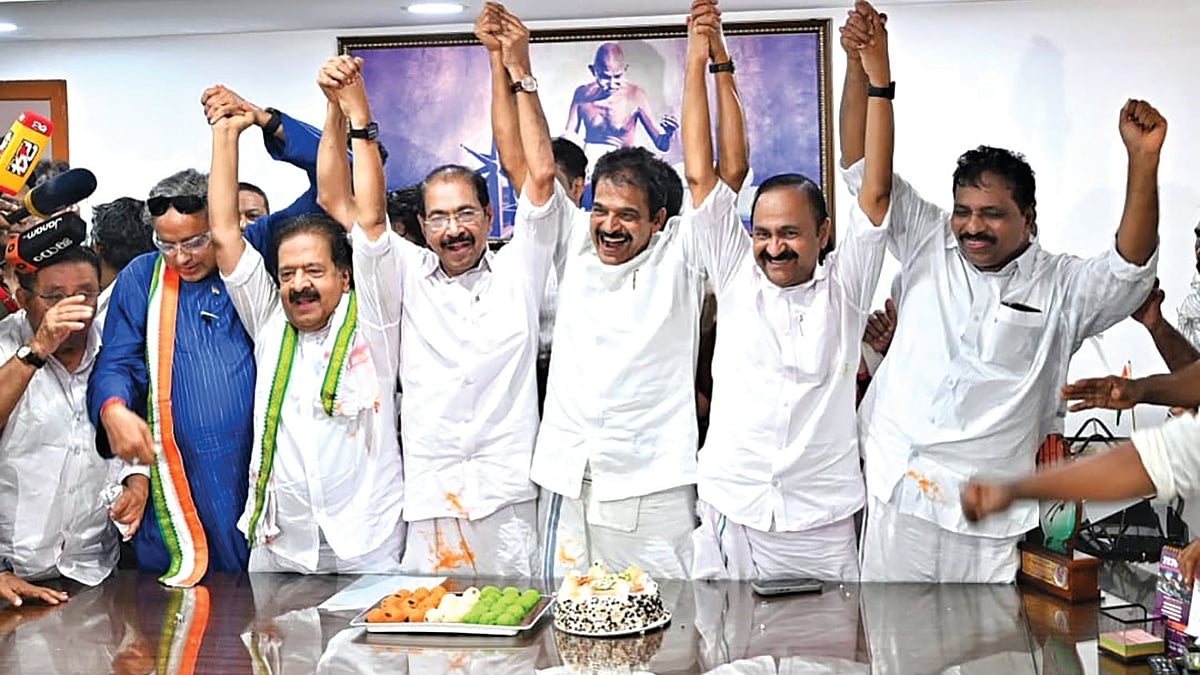
For a long time, factionalism had been the bane of the Congress in Kerala, often spilling into the public domain. And while contesting personal ambitions did again surface after the results, in the run-up to the elections, the party held together. Candidate selection, always a fraught affair, was handled with remarkable smoothness. No public altercations, no competing lists, no late-stage rebellions. 

This unity was not accidental; it was managed with care. Party general secretary (organisation) K.C. Venugopal and Ramesh Chennithala took the lead in handling dissent, engaging with aspirants and ensuring that grievances were resolved internally. The emphasis was clear and consistent: winnability would override factional claims. That message stuck. 

This rare organisational discipline translated into electoral coherence. The UDF looked a coordinated political unit, not a ragtag group carrying the same banner. This unity allowed the alliance to focus sharply on the electorate instead of itself, a critical advantage in a contest that was expected to be tight. 

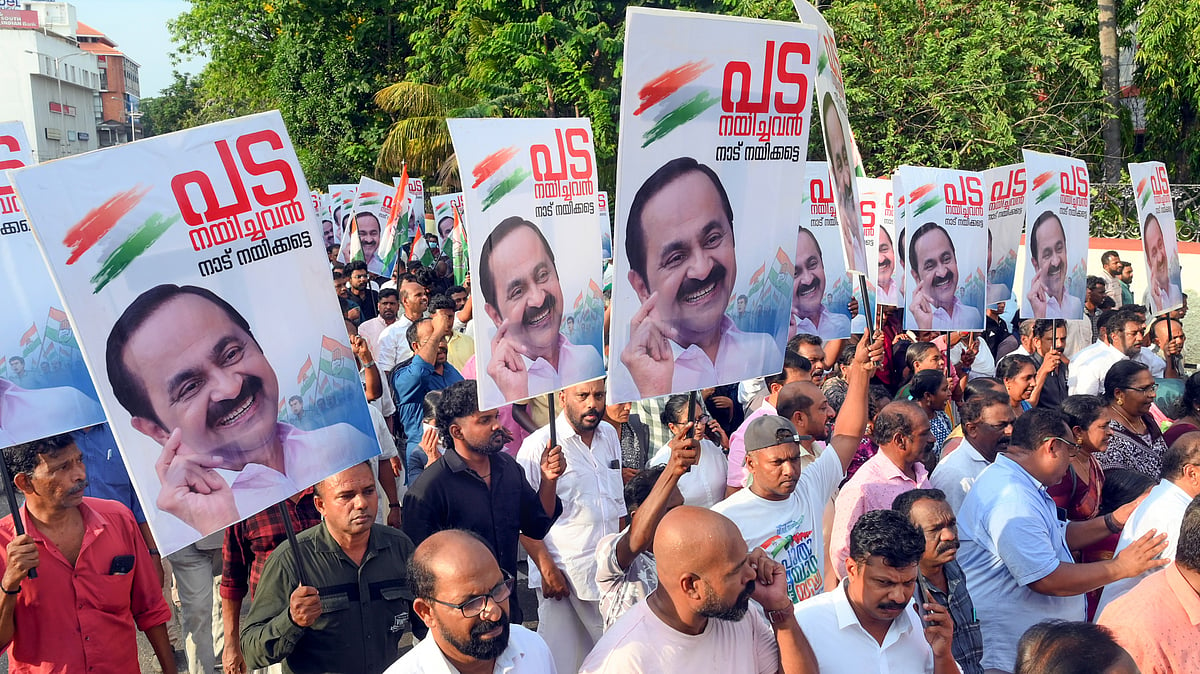
At the campaign level, V.D. Satheesan, leader of the opposition in the previous house, was the principal voice of this reset. His messaging was measured, consistent and rooted in governance concerns. “This verdict is about restoring democratic functioning and accountability,” he said after the results.

The Congress has improved not just its tally of seats—from 22 in 2016 and 21 in 2021 to 63 this time—but also its vote share (28.8 per cent from 25.1 per cent in 2021). Allies like the IUML (Indian Union Muslim League) retained their strongholds. In central Kerala, several constituencies returned to the UDF. In Malabar, traditionally a Left stronghold, the margins narrowed sharply and several seats flipped. Urban and semi-urban constituencies also recorded a shift, driven by economic anxieties and governance concerns. 

One of the most consequential aspects of this election was the consolidation of Muslim and Christian voters behind the UDF, whose assurances clearly carried more credibility with these voters. IUML all-India general secretary P.K. Kunhalikutty said this shift was pivotal to the outcome. “People wanted a government that respects diversity and listens. That trust came back to the UDF,” he said. The IUML’s steady performance in Malabar anchored UDF gains. And the BJP’s outreach to sections of the Church, in an attempt to disrupt settled social equations, failed to make an impact in the vote.

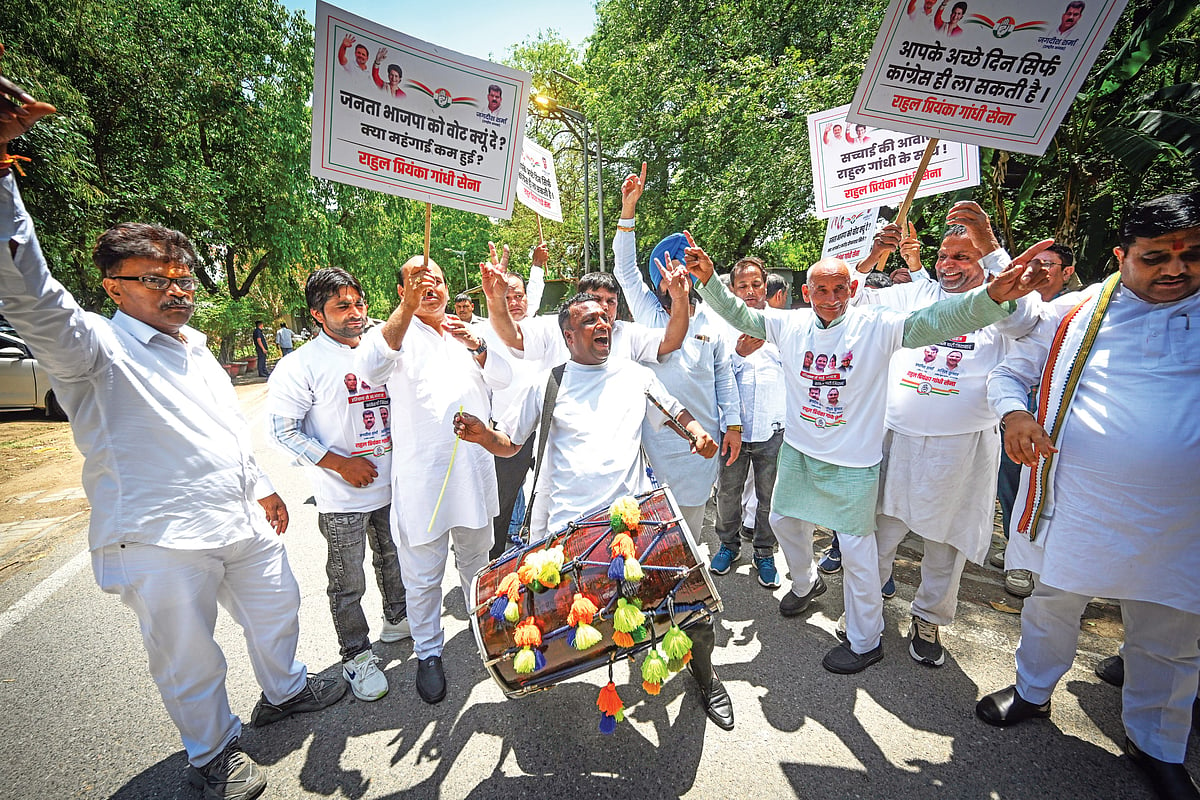
Drums and dance outside the Congress office in New Delhi

The unravelling of the Left

The UDF did also benefit from voter dissatisfaction with the Left ecosystem. Local discontent among CPI(M) cadres and sympathisers further weakened the LDF organisationally.

But the LDF’s defeat cannot be understood without examining the nature of its governance. Under Pinarayi Vijayan, the government projected decisiveness and administrative control. In the early days, this was seen as strength and efficiency, but over time, it began to look like something else—concentration of power and centralised decision-making.

The space for internal dissent shrank. Critics within the Left ecosystem started talking about an arrogant leadership that discouraged debate. 

The Left in Kerala has historically sworn by collective leadership and ideological engagement. But under Vijayan, the political culture changed dramatically, from governance by (party) consensus to governance by decree. For a cadre-based movement, that transition was radical. 

The LDF campaign relied too much on past achievements in welfare and infrastructure. Those achievements are no doubt substantial, but not brag-worthy any more in Kerala, whose voters are used to better base-level human development indicators than, say, the Hindi heartland states. The LDF’s poll campaign was found wanting on emerging concerns such as unemployment and the rising cost of living. CPI state secretary Binoy Viswam admitted the need for introspection: “We must examine where we failed to connect with the people.” 

The SilverLine project (a.k.a. K-Rail)—a proposed 530 km semi-high-speed railway line connecting state capital Thiruvananthapuram in the state’s south to Kasaragod in the north—was another flashpoint during the election. Projected by the LDF government as a transformative infrastructure initiative, it had triggered much concern over displacement, financial viability and its environmental impact. Protests spread across districts, and the government’s response was seen as dismissive. 

The UDF managed to reframe the debate to its advantage—arguing for development that is also sustainable and not thrust upon people. This resonated with a wide cross-section of voters, from farmers to middle-class households.

Even police action during protests—over large projects like SilverLine or even local agitations—and the government’s tendency to justify police action by default had reinforced the perception of an intolerant state administration. 

In the run-up to the election, the LDF would have sensed the changing public mood, and it tried to head off imminent voter rejection with a publicity blitz. But, if anything, the high-decibel PR campaign amplified the gap between the official narrative and everyday reality.

The Left, which no doubt played a big hand in Kerala’s social development, does not have a clear path to renewal; it certainly cannot live off its legacy forever. 

The UDF has reason to feel chuffed with this hard-won victory, but the mandate comes with high expectations, and only good governance can grow their political capital. 

The Kerala verdict carries significance beyond the state. It holds lessons for an Opposition that is up against phenomenal odds. The UDF campaign was united, disciplined and internally consistent, its leadership looked well-coordinated and its message was clear. Differences were managed well and didn’t spill into the public domain. Leaders spoke in one voice. The campaign stayed focused. It takes all of that when you’re fighting with your back to the wall.

  •  

Why Stalin stands tall even in defeat

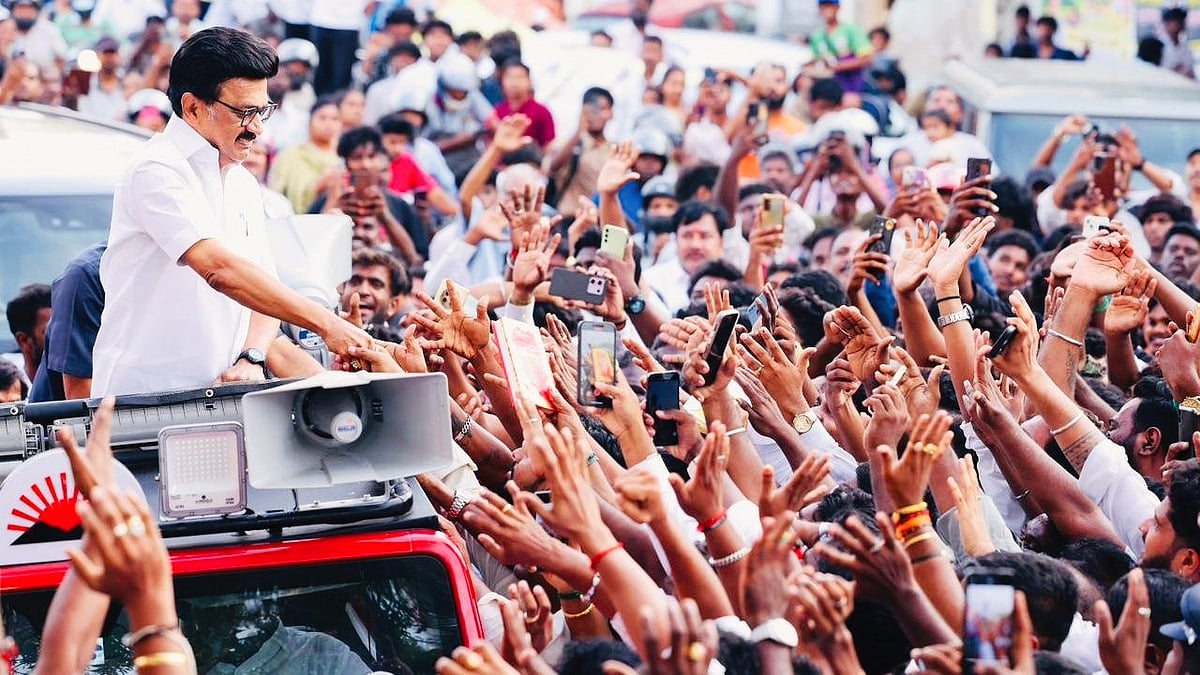
The afternoon M.K. Stalin lost Kolathur, the constituency he had nurtured for years, people imagined he’d show some signs of disappointment, if not anger or a brooding silence. Instead, the outgoing chief minister stepped out to greet tearful party cadres and sympathisers, looking utterly composed, a smile on his face, hands folded before the very voters who’d defeated him.

Travelling in an open vehicle, he thanked the people of Kolathur for standing with him for decades. Electoral verdicts are temporary, but public service must continue, he said, with no bitterness, no allegations of betrayal, no emotional drama. Even his critics admitted that he met defeat with a dignity rare in contemporary Indian politics.

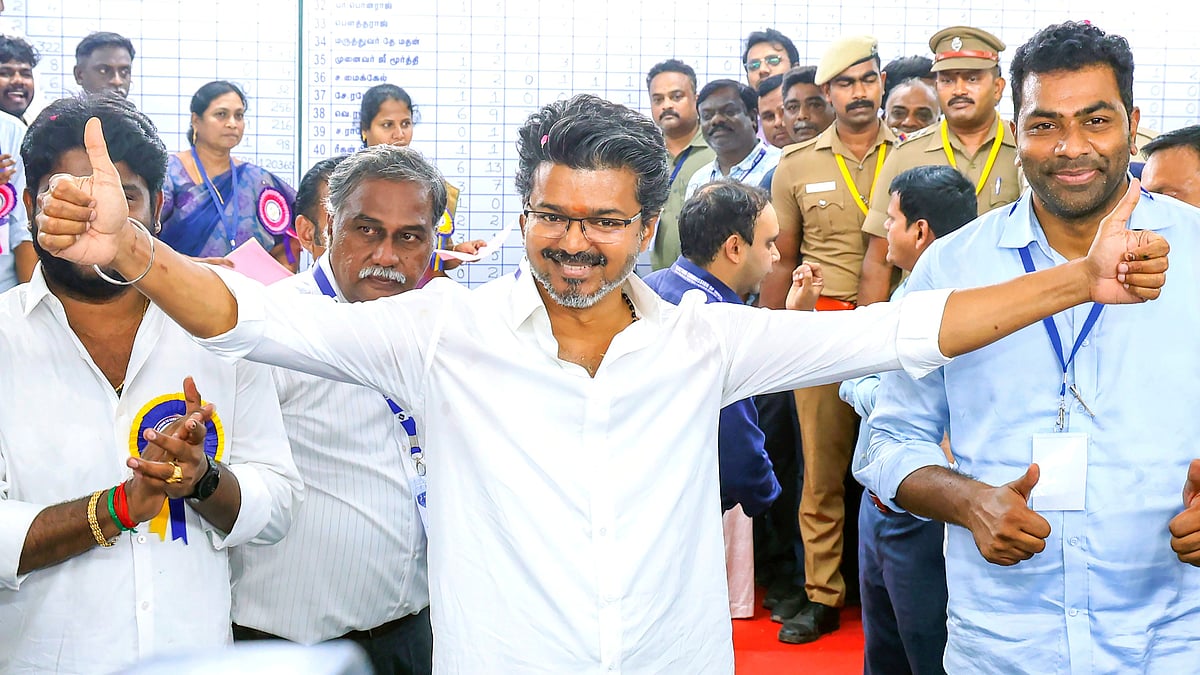
Another image rippled across Tamil Nadu with extraordinary emotional resonance. C. Joseph Vijay, the actor who had just led his new party to power, arrived at Stalin’s residence. Tamil Nadu has an ugly history of chief ministers ordering the arrest of opposition leaders, of ruling party MLAs coming to blows with their rivals inside the Assembly.

But Stalin and his son Udhayanidhi, now leader of the opposition, received Vijay warmly, almost affectionately. No sign of insecurity, no attempt to diminish the young victor, no passive aggression — again, not a very likely scene in contemporary Indian politics.

“We’re still wondering how he lost despite relatively good governance. His clear opposition to aggressive Hindutva kept the BJP at bay. Stalin is far from a spent force,” says Chennai-based writer and social commentator Kavin Malar. Stalin’s political strategies, she argues, will still keep Tamil Nadu difficult for the BJP, which managed to win only a single seat this time. His refusal to allow a DMK-AIADMK pact effectively aborted any possible attempt by the BJP leadership to manipulate the verdict. He even allowed DMK alliance partners to support Vijay.

“Defeat has not diminished him,” says Prof. Sumathi Padmanabhan of Coimbatore’s Kongunadu Arts and Science College. “Somewhere during his stint in power, Stalin ceased to be just a chief minister, he turned into a statesman. For millions in Tamil Nadu, he came to represent ideological clarity, decency and moderation at a time when Indian politics was becoming increasingly shrill and polarised.”

****

Outside Tamil Nadu, many still don’t get Stalin. For years, sections of the national media saw him as the reluctant inheritor of a political dynasty, as someone who lacked the charisma of his father, Karunanidhi. He was mocked for the way he spoke, for his caution and his mannerisms. He didn’t have the star appeal of an MGR or the invincible aura of Jayalalithaa.

“Stalin evolved into a patient politician. He didn’t rule through fear. He didn’t try to project infallibility. He preferred systems over spectacle,” observes veteran Chennai-based journalist and political observer P.K. Sreenivasan.

For many people this writer spoke to, Stalin’s transformation into this leader was first visible during the Covid years. When many Indian states looked clueless or overwhelmed, Stalin strengthened public health outreach, expanded welfare delivery and invested heavily in district-level monitoring. Bureaucrats remarked that Stalin was unusually meticulous in review meetings and more focused on implementation than announcements.

“I’ve worked under different chief ministers,” says a senior IAS officer from Bihar, who also worked with Stalin. “What astonished me was his grasp of environmental concerns, of climate change. Under him, wetlands were protected from encroachment and degradation. Forest cover improved. Biodiversity zones became safer. He represented a model of governance that was rooted in sustainability.”

Across Tamil Nadu, the Chief Minister’s Breakfast Scheme, launched in 2022, became one of the most powerful symbols of Stalin’s politics. In thousands of government schools, children from poor families started receiving breakfast, in addition to the state’s celebrated Nutritious Noon Meal Programme.

Critics were dismissive of ‘just another welfare scheme’, but teachers across the state reported visible change — in attendance and the alertness of their wards. Parents, especially working mothers, expressed great relief.

Similarly, free bus travel for women became transformative in ways that statistics alone cannot capture. The daily commute became easier for domestic workers, nurses, fish vendors, textile labourers and students. Families saved money. Women gained mobility and independence.

Under Stalin, welfare was designed as economic breathing space for ordinary people. Unlike older welfare politics focused entirely on subsidies, he attempted to combine social justice with aspiration. The Naan Mudhalvan programme focused on skill development, language training and employability among students. Tamil Nadu’s lower middle classes increasingly saw the government as a facilitator of upward mobility.

Stalin’s politics also represented a modernisation of the Dravidian ideology, seen outside Tamil Nadu mainly through the lens of anti-Hindi agitations and regional assertion. Stalin expanded Tamil identity politics within the constitutional language of federalism, social justice and pluralism.

He consistently argued that states must retain autonomy within the Union. He opposed Hindi imposition without slipping into separatist rhetoric. He challenged centralisation while remaining firmly committed to constitutional politics. That balance made him nationally important.

“One of the defining moments of his tenure was the appointment of trained temple priests from non-Brahmin communities,” says Nagercoil-based women’s rights activist Jessica Richard. “The move was hugely symbolic. Stalin pitched it as opposition to caste hierarchy rather than anti-religion, continuing the Dravidian movement’s struggle against social exclusion.”

Richard also highlights his government’s early decision “to withdraw thousands of cases filed against protesters, activists and ordinary citizens during the previous regime. Those cases involved the anti-Sterlite protests, anti-CAA demonstrations and various environmental movements. The message was clear: a democratic state should not criminalise dissent.”

Stalin’s arguments on delimitation and his clear articulation of the risks of making this exercise population-centric resonated far beyond Tamil Nadu. His vocal resistance was a big reason why all the southern states made common cause, and why a regional anxiety became a national debate.

His personal journey also struck a chord. Not an overnight sensation manufactured by television studios, Stalin spent decades in organisational politics. As a young man, he went to jail during the Emergency. He spent years in the shadows, and his rise to the top was seen as a culmination of a tenacious political journey.

“Indian politics today is so aggressive. Opposition leaders are often treated as enemies rather than competitors,” says Satheesh Kumar, a Coimbatore-based farmer leader. “Against this backdrop, Stalin’s dignified restraint appeared almost extraordinary.”

Even in defeat, Stalin embodies a different possibility for opposition politics in India. The way he has handed over the baton to Vijay is proof.

K.A. Shaji is a South India–based journalist who has chronicled rural distress, caste and tribal realities, environmental struggles and development fault lines. More of his writing here

  •  

Of black gold and broken shores

An Enforcement Directorate investigation into alleged financial transactions involving Cochin Minerals and Rutile Ltd (CMRL) and Exalogic Solutions, the IT company owned by T. Veena, daughter of former two-term Kerala chief minister and current leader of opposition in the state Assembly Pinarayi Vijayan, has once again thrust a relatively obscure industry into the national spotlight.

The controversy has largely been framed as a politico-legal issue. Yet beyond the allegations and courtroom battles lies a larger story about one of India’s most strategic natural resources and the intense battles surrounding its extraction. CMRL operates in a sector that sits at the intersection of geopolitics, national security, industrial policy, environmental conflict and corporate power.

The renewed attention on the company has revived questions about the vast deposits of heavy mineral sands buried under the beaches of Kerala and Tamil Nadu, resources that have become extremely valuable in a world driven by electric vehicles, renewable energy, advanced electronics, aerospace manufacturing and defence technologies.

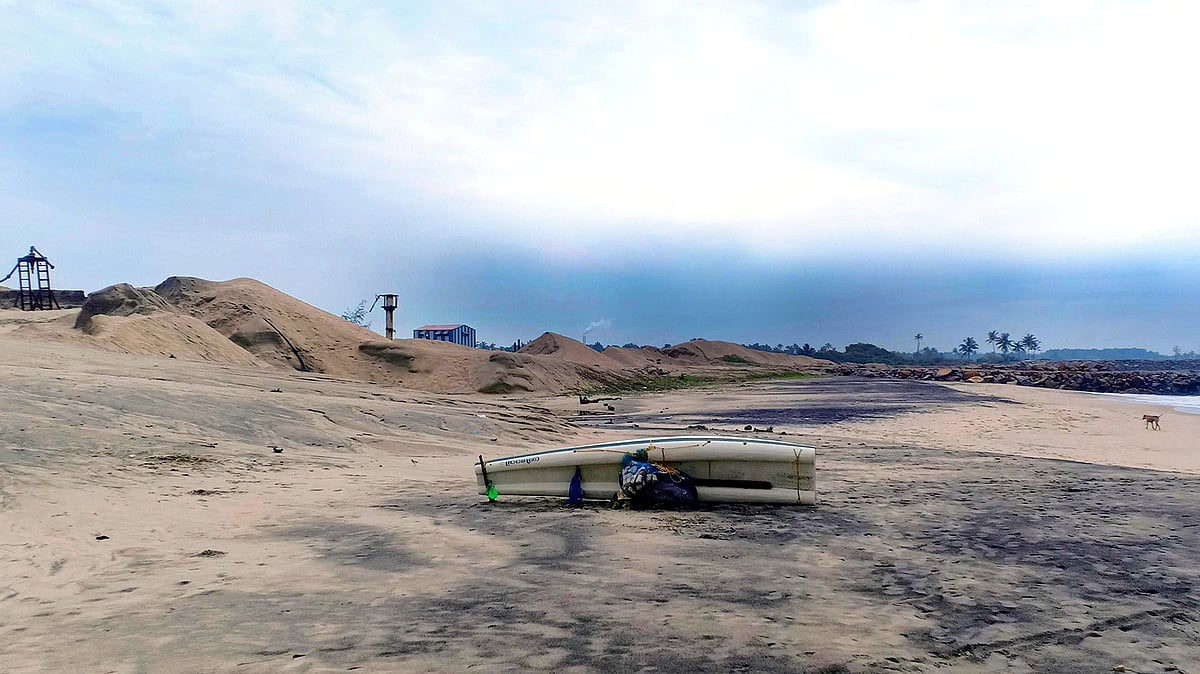
For governments and corporations, these black sands spell enormous wealth and strategic opportunity. For coastal communities, though, they present an entirely different reality — of eroding shorelines, shrinking livelihoods and a protracted battle against extraction projects.

The sands of power

The dark sands that line stretches of Kerala’s coast contain some of the world’s most valuable mineral deposits. Mixed with ordinary beach sand are ilmenite, rutile, zircon, garnet, sillimanite and monazite, minerals that have become indispensable to modern industry.

Ilmenite and rutile are the principal ores of titanium, a metal prized for its strength, corrosion resistance and low weight. Titanium is used extensively in aircraft, spacecraft, missiles, naval vessels and medical implants. Zircon is vital for ceramics, electronics and specialised industrial applications. Monazite, perhaps the most strategically important mineral found in these deposits, contains thorium and rare earth elements.

For fisher families, beaches are not merely deposits of valuable minerals. They are workplaces, community spaces and protective barriers against the sea

Thorium has long occupied a central place in India’s three-stage nuclear programme, while rare earth elements are essential for electric vehicles, wind turbines, semiconductors, missile systems and a range of advanced technologies that increasingly define economic and military power.

India possesses one of the world’s largest monazite reserves. The Chavara belt in Kollam district and the adjoining Tamil Nadu coastline constitute one of the richest heavy mineral sand (HMS) provinces in the world. The significance of these deposits has grown dramatically as countries scramble to secure critical minerals needed for clean energy technologies and advanced manufacturing.

China currently dominates global rare earth processing and refining, giving it enormous leverage over international supply chains. Governments in the US, Europe, Japan and India are seeking alternative sources and building new supply networks.

In this emerging contest, India’s coastal mineral wealth has acquired unprecedented strategic value. What lies under the beaches of Kerala and Tamil Nadu is now linked to electric vehicle factories in Europe, semiconductor industries in East Asia, renewable energy projects across continents and defence establishments around the world.

The enormous value of these resources inevitably attracts political and commercial interest. Control over mining leases, processing facilities, transportation networks and export channels translates into economic influence.

For the very same reason, the mineral sands sector is also mired in controversies. Questions of regulatory oversight, political patronage and corporate influence have surfaced repeatedly over the years. The current controversy involving CMRL is only the latest reminder of how closely mineral wealth and political power are intertwined.

The coast that pays the price

While governments speak about strategic minerals and industrial development, coastal communities tell a very different story. For fisher families, beaches are not merely deposits of valuable minerals. They are workplaces, community spaces and protective barriers against the sea.

Fishing boats are anchored there. Nets are repaired there. Fish are landed, sorted, processed and sold there. The beach is not barren landscape; it’s an extension of everyday life. Any change in its nature has direct consequences for livelihoods and survival.

B. Bhadran, leader of the Alappuzha-based Anti Mineral Sand Mining Action Committee (a.k.a. Samiti), says coastal communities are always ignored in discussions about ‘development’.

“Governments see minerals. Corporations see profits. We see our future dis-appearing. Every truck carrying mineral sand away from the coast takes away part of the protection that stands between our homes and the sea. The benefits go elsewhere; the risks remain here. Fishing communities are expected to pay the environmental price for the creation of wealth they’ll never enjoy.”

According to Bhadran, local residents have repeatedly demanded independent environmental assessments, transparent public consultations and real participation in decision-making. But they find themselves confronting institutions far more powerful than themselves.

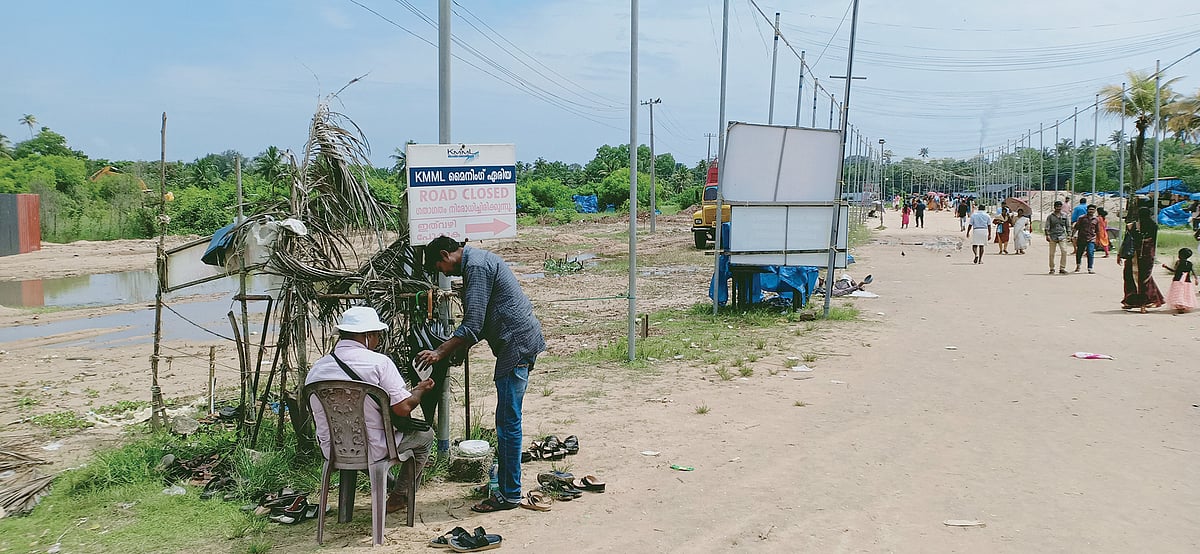
Kerala’s coastline is already facing a profound ecological crisis. Large stretches of the state’s 590-km coastline are affected by erosion. Villages have watched the sea move closer over the past two decades. Houses have collapsed, roads have disappeared and public infrastructure has been damaged. Thousands of families have experienced repeated displacement.

Climate change and sea-level rise are major drivers of this crisis. But scientists point to the impact of human interventions along the coast. Ports, breakwaters, sea-walls, dredging projects and sand extraction have altered natural sediment movement, affecting the delicate balance that sustains beaches and coastal ecosystems.

Environmentalist Sreedhar Radhakrishnan argues that discussions on mineral extraction cannot be separated from Kerala’s larger coastal crisis.

“The coast functions as a connected ecological system. Beaches and dunes absorb wave energy, buffer storms and protect inland settlements. When these systems are disturbed, the consequences are rarely confined to one location. We are already witnessing the impacts of climate change, rising seas and largescale infrastructure projects. Adding further stress without understanding cumulative impact is dangerous.”

A history of conflict

The battle over mineral sands is not new. It has shaped politics, environmental movements and community struggle across Kerala and Tamil Nadu for decades. Chavara in Kerala’s Kollam district has been associated with mineral extraction for nearly a century. Across the border in Tamil Nadu, the mineral-rich belt extends through Kanyakumari, Tirunelveli and Thoothukudi districts. Together, these regions form one of the most valuable coastal mineral zones in the world.

Yet they have also been the site of some of India’s most controversial mining disputes. The environmental impact of mineral sand extraction is a subject of intense debate. Mining involves excavation, separation and processing of large volumes of coastal sediment. The process alters dune systems, removes vegetation, affects groundwater dynamics, disturbs habitats used by birds, marine organisms and nesting turtles, and makes vulnerable communities living near mining areas.

Monazite introduces another layer of complexity because it contains thorium, a radioactive element. Although authorities maintain that operations are regulated and monitored, activists demand greater transparency in the handling and movement of radioactive minerals.

The demand for critical minerals is expected to rise sharply in the coming decades. The transition to renewable energy, electric mobility and advanced manufacturing will intensify pressure to extract these minerals, with all its attendant consequences.

The ED investigation involving T. Veena may dominate the headlines now, but the bigger question is whether extraction can occur without damaging fragile ecosystems? Can communities participate meaningfully in decisions affecting their future? Can governments effectively regulate powerful commercial interests?

K.A. Shaji is a South India–based journalist who has chronicled rural distress, caste and tribal realities, environmental struggles and development fault lines. More of his writing here

  •  

Fire and patience: How V.D. Satheesan fought through Kerala’s political maze

There was a time when Kerala’s political class feared uttering the words “lottery mafia” too loudly. The network was believed to be too wealthy, too politically connected and too deeply embedded within the system. By the mid-2000s, the interstate lottery business had grown into one of Kerala’s most shadowy underground economies, thriving on desperation, poverty and false hope.

Daily wage earners across villages, coastal settlements and working-class neighbourhoods spent precious earnings on lottery tickets sold through sprawling networks that critics alleged operated beyond effective regulation.

Allegations surfaced about fake Bhutan lottery tickets, forged printing systems, benami operations, tax evasion and money laundering linked to Tamil Nadu-based lottery baron Santiago Martin. Politicians spoke privately about the syndicate’s influence over sections of politics, media and the state machinery, but few were willing to confront it openly.

It was during this period that a young Congress MLA from Paravur, V.D. Satheesan, began relentlessly pursuing the issue inside the Kerala Assembly. Armed with documents, financial records and painstakingly collected evidence, Satheesan transformed what many considered a politically dangerous subject into one of Kerala’s defining public confrontations.

He alleged that the lottery business had evolved into an organised exploitation racket that preyed upon the poor while corrupting public institutions. He demanded investigations into fake Bhutan lottery operations, questioned the legality of interstate lottery mechanisms and repeatedly highlighted the nexus between business interests and politics.

Unexpectedly, Satheesan found an unlikely ally in Kerala’s then chief minister, V.S. Achuthanandan. Though ideological warmth across political lines was rare in Kerala, the veteran Marxist appeared to recognise in the young Congress legislator a seriousness that transcended party divisions.

Achuthanandan, who had built his own political career fighting entrenched interests, understood that Satheesan was not merely performing outrage for television cameras. He genuinely believed the lottery network represented a dangerous political and financial menace.

The relationship between the two remained politically adversarial, yet marked by unmistakable respect. Achuthanandan had already initiated strong action against illegal interstate lottery operations and supported investigations into alleged irregularities involving Bhutan lotteries and forged tickets. Satheesan’s interventions strengthened that campaign.

Political observers at the time described the anti-lottery movement as a rare bipartisan moral confrontation against organised financial exploitation — an unusual moment in Kerala’s deeply polarised political culture, where a communist chief minister and a Congress opposition MLA effectively reinforced each other’s battle.

#WATCH | Thiruvananthapuram: On KC Venugopal and Ramesh Chennithala, VD Satheesan, after being named Keralam CM, says, "Both are my leaders and my seniors. I'm junior to them. They have helped a lot with this wonderful victory. As a General Secretary Organisation, he helped a lot… pic.twitter.com/s4ni63RlL0

— ANI (@ANI) May 14, 2026

That confrontation altered Satheesan’s political trajectory permanently.

It transformed him from a promising legislator into one of Kerala’s most respected political figures, a leader whose credibility rested not merely on rhetoric but on preparation, persistence and legislative rigour.

Today, as Satheesan joins the ranks of Kerala chief ministers alongside leaders such as E.M.S. Namboodiripad, C. Achutha Menon, E.K. Nayanar, K. Karunakaran, Oommen Chandy and Achuthanandan himself, what distinguishes his journey is the absence of inevitability.

His rise did not follow the familiar route of dynastic inheritance, factional entitlement or organisational patronage. For years, Kerala politics described his career using the Malayalam expression 'between cup and lip', because power repeatedly appeared within reach only to slip away at the final moment.

To understand Satheesan’s political personality, one must return to the social and emotional landscape of his childhood. Born in 1964 in Nettoor near Kochi, he grew up in a middle-class family shaped by discipline, modesty and the values of education. His father worked in the public sector, while the family remained deeply connected to ordinary Kerala life, where social mobility depended heavily upon education, reading and hard work.

Unlike many future politicians who inherited visible political capital from influential families, Satheesan grew up without the aura of political privilege. What his upbringing offered instead was seriousness and aspiration.

Friends and contemporaries remember him as intensely curious, observant and deeply drawn to reading. He was interested not merely in electoral politics but in ideas themselves. Literature, constitutional debates, economics, political history and social theory attracted him early. That intellectual curiosity later became one of the defining characteristics of his public life. Even ideological rivals would eventually admit that Satheesan rarely entered a debate without studying every possible dimension of an issue.

His educational journey reflected that temperament. He studied at Sacred Heart College, Thevara, before pursuing a Master’s degree in Social Work from Rajagiri College. Later, he studied law and practised in the Kerala High Court.

The combination of social work training and legal education shaped his political approach significantly. Social work exposed him to questions of inequality, marginalisation and public policy, while legal training sharpened his argumentative precision and documentary discipline. Together, they produced a politician capable of combining emotional politics with constitutional and legal clarity.

Politics entered his life through student activism rather than privilege. During his years in the Kerala Students Union and later the NSUI, Satheesan developed a reputation not only as a fiery activist but also as a meticulous organiser. He became chairman of the Mahatma Gandhi University Union during 1986-87 and gradually emerged as one of the articulate young faces of Congress student politics in Kerala.

#WATCH | Thiruvananthapuram | State Police Chief Ravada Azad Chandrasekhar and Law & Order ADGP H Venkatesh, along with other senior police officials, arrived at Contonment House and met Chief Minister designate VD Satheesan,

(Source: VD Satheesan Office) pic.twitter.com/yOhHUj2Ctg

— ANI (@ANI) May 14, 2026

Those years shaped traits that still define him. One was discipline. Another was democratic instinct. Satheesan never evolved into the feudal-style Congress politician insulated by sycophancy and distance. Party workers often speak of his accessibility. Young leaders could disagree with him. Journalists could question him sharply. Grassroots workers could approach him directly.

Yet behind that accessibility lay strict expectations regarding preparation, seriousness and organisational discipline. He demanded hard work not only from himself but from those around him.

His personal life too remained relatively grounded despite his political ascent. Those close to him describe a family-oriented man deeply attached to his wife and daughter, someone who maintained emotional balance even during turbulent political phases. Friends often remark that his family environment helped preserve stability in a profession marked by insecurity, betrayal and exhaustion.

Unlike several Kerala politicians who consciously cultivate flamboyance, Satheesan’s public style remained restrained and understated.

Interestingly, his electoral journey began with defeat. He first contested from Paravur in 1996 and lost. But the setback neither embittered nor discouraged him. Five years later, he returned stronger, winning the constituency and eventually transforming it into one of the Congress party’s safest strongholds.

Across six consecutive victories, Satheesan steadily built the image of perhaps Kerala’s most research-driven MLA. His Assembly speeches drew attention not merely because they were aggressive but because they were layered with data, audit references, documentary evidence and legal scrutiny. He possessed a rare ability to simplify highly technical subjects for ordinary public understanding.

His interventions covered some of Kerala’s most difficult public questions. He repeatedly raised the suffering of Endosulfan victims in Kasaragod, foregrounding human tragedy rather than administrative language. He intervened forcefully on coastal erosion, fisherfolk rehabilitation, wetland destruction and hill cutting. Long before environmental politics became fashionable within mainstream parties, Satheesan had already begun framing ecology as a democratic and livelihood issue.

His opposition to the SilverLine semi-high-speed rail corridor became especially significant. Satheesan recognised early that the project was not merely about infrastructure but also about debt, ecology, displacement and democratic consent. He travelled extensively across affected regions, met families facing displacement and converted scattered anxieties into a broad political movement.

The anti-SilverLine campaign eventually became one of the defining struggles that helped revive the Congress-led Opposition after years of drift and demoralisation.

Yet throughout this rise, power inside the Congress repeatedly eluded him.

When the Congress-led UDF returned to office under Oommen Chandy in 2011, Satheesan was widely regarded as among the most deserving younger legislators for cabinet entry. But factional calculations, caste-community balancing and entrenched organisational structures denied him ministership. The episode became symbolic of his political journey: admired publicly, resisted internally.

For decades, Kerala Congress politics revolved around entrenched factions and delicate community equations. Satheesan never fully belonged to those traditional structures. His independence strengthened his public credibility but complicated his organisational prospects. Several senior leaders admired his intellect while simultaneously remaining wary of his bluntness and assertiveness.

Even his eventual elevation as Opposition Leader after the Congress defeat in 2021 came only after intense internal resistance. Senior leaders were reluctant to yield space to a younger generation. But once Satheesan assumed leadership, the emotional climate within the Congress changed rapidly.

He transformed the Opposition from a defensive coalition into an aggressive political force. Congress workers who had psychologically collapsed after repeated defeats suddenly rediscovered confidence and energy.

Well-known academic and political observer Prof. M.N. Karassery believes Satheesan’s democratic instinct distinguishes him from many contemporary politicians. “Kerala respects leaders who can take clear positions despite pressure,” Karassery says. “Satheesan earned hostility from influential communal and caste leaderships because he refused to reduce politics into appeasement management. That gave him moral legitimacy.”

Satheesan’s confrontations with influential social figures such as Sukumaran Nair, Vellappally Natesan and Kanthapuram A.P. Aboobacker Musliyar strengthened his image among younger voters seeking leaders willing to move beyond old identity vetoes.

His rise also cannot be understood without examining his complicated but ultimately important relationships with Congress organisational general-secretary K.C. Venugopal and senior colleague Ramesh Chennithala. Both were rivals at different moments. Both also became crucial to his eventual ascent.

Chennithala represented organisational continuity and grassroots networks. Venugopal represented national influence and Delhi access. Satheesan represented issue-based politics, public credibility and generational transition. The Congress ultimately needed all three. Their collective involvement helped deliver the UDF’s landslide victory in this election.

K.P. Noushad Ali, the newly elected Congress MLA from Ponnani and one of Satheesan’s strong supporters during the chief ministerial contest, believes workers identify emotionally with Satheesan’s struggles. “He never behaved like power was his birthright,” Noushad Ali says. “Even when repeatedly sidelined, he continued working with the same intensity. That resilience inspired younger Congress workers.”

Lakshmi Subhash, social activist and assistant professor at an aided college in Palakkad, sees in Satheesan a rare combination of intellect and empathy.

“Students and younger professionals connect with him because he reads seriously, studies deeply and prepares thoroughly. But he is also emotionally accessible. That combination is uncommon in contemporary politics.”

Congress leader Soya Joseph from Thrissur believes Satheesan restored emotional confidence within the party itself. “After repeated defeats, many workers had psychologically surrendered. Satheesan changed that mood completely. He convinced the party that survival itself required unity, clarity and fighting spirit.”

Perhaps that is the central meaning of Satheesan’s rise. He arrives at Kerala’s highest office not as a leader manufactured smoothly through patronage systems but as the product of a long political struggle shaped by exclusion, delay, resilience and recovery.

Like Achuthanandan before him, he discovered that political integrity can command respect even across ideological boundaries. Like Oommen Chandy, he cultivated accessibility. Like Achutha Menon, he developed a reputation for intellectual seriousness and administrative engagement.

But fundamentally, Satheesan’s authority emerged through legislative politics itself: through research, argument, democratic confrontation and relentless public engagement.

For a state that takes immense pride in political literacy, that may be the most significant aspect of his story.

K.A. Shaji is a South India–based journalist who has chronicled rural distress, caste and tribal realities, environmental struggles and development fault lines. More of his writing here

  •  

The river we’re fighting over is no longer the same

"The tragedy is not that we are fighting over the Cauvery. It is that the river we are fighting over is slowly disappearing."

In Ayappa’s acclaimed short film The Story of Kaveri, the river speaks as a living presence, reflecting on how those who depend on it have turned against one another. That imagined yet deeply resonant voice captures the paradox of one of India’s most contested rivers.

For decades, the Cauvery has been the site of court battles, tribunal awards, protests and political negotiations. Beneath these visible struggles lies a quieter crisis. The river itself is changing.

Nearly 800 kilometres long, the Cauvery supports more than 80 million people across Karnataka, Tamil Nadu, Kerala and Puducherry, draining a basin of over 81,000 sq km. For centuries, it enabled a highly organised irrigation system, particularly in the delta, where paddy cultivation flourished. That long history of stability is now under strain.

At first glance, the river does not appear broken. Each monsoon, reservoirs fill, canals reopen and water flows into fields. What this seasonal recovery conceals is the Cauvery’s increasing inability to convert rainfall into reliable flows.

Rainfall is not necessarily declining. Climate projections suggest that parts of peninsular India may receive stable or even slightly higher precipitation. Yet the river itself is expected to carry less water.

A basin-scale climate study by IIT Gandhinagar (published this year in Earth’s Future) used CMIP6 climate models to show that effective water availability in the Cauvery basin will continue to decline until at least 2050, beyond which recovery remains uncertain. The study estimates a further reduction of around 3.5 per cent in flows between 2026 and 2050. This may appear modest, but it follows a much larger historical decline: streamflow in the Cauvery dropped by nearly 28 per cent between 1951 and 2012.

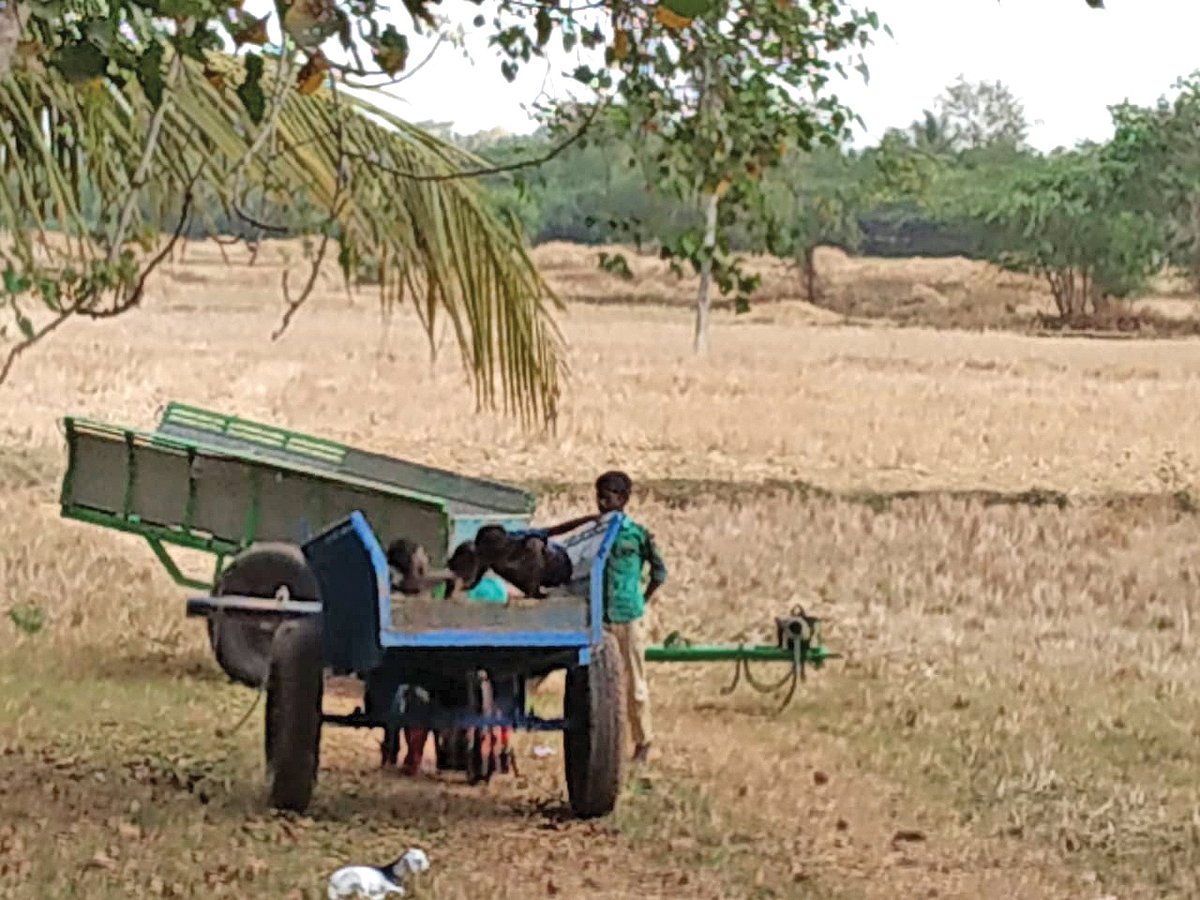
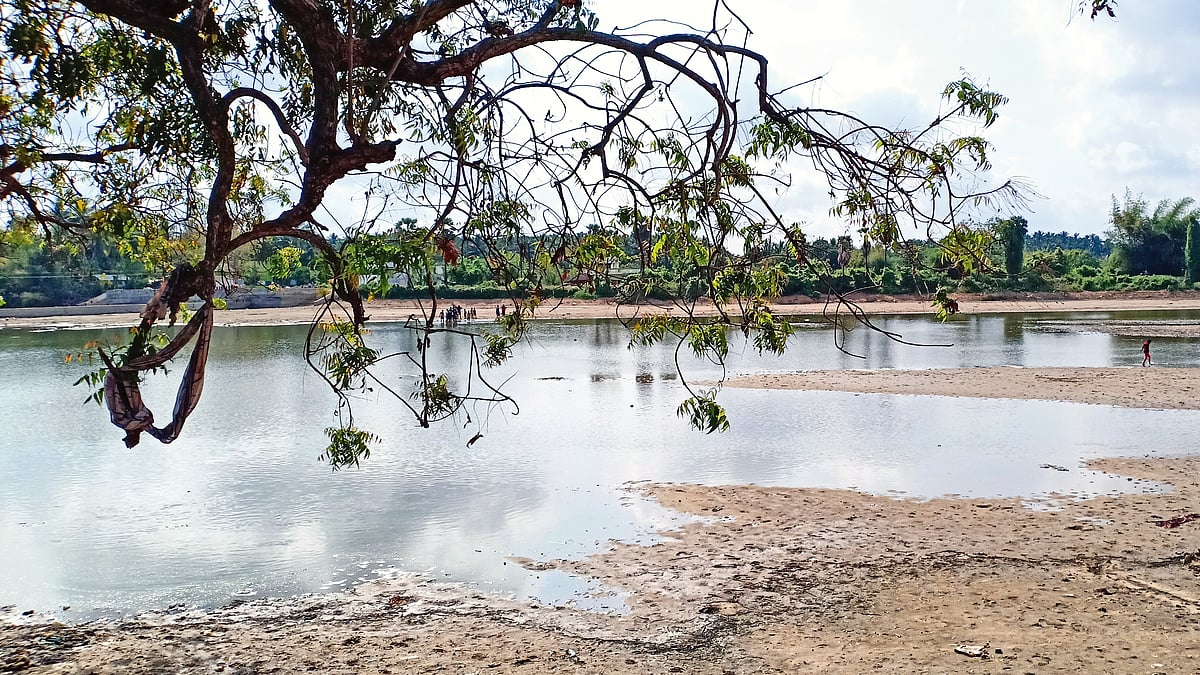
Farmers are now struggling with reduced freshwater inflows and rising sea levels (photo: author)

‘The Cauvery basin stands out as an exception,’ the study notes. ‘While several Indian rivers may see increased discharge, this basin shows a persistent decline due to rising evapotranspiration and altered rainfall patterns.’

Unlike Himalayan rivers, the Cauvery has no glacial buffer. It depends almost entirely on monsoon rainfall. That dependence is now becoming a vulnerability.

What is changing is not just how much rain falls, but how it behaves. Increasingly, rainfall arrives in short, intense bursts followed by prolonged dry spells. A study on precipitation trends by Tamil Nadu Agricultural University notes that ‘short-duration extreme rainfall events are increasing in frequency and intensity, leading to higher runoff and reduced infiltration.’

Rapid runoff reduces groundwater recharge, weakening the base flows that sustain rivers during dry periods. At the same time, rising temperatures increase evapotranspiration, meaning more water is lost to the atmosphere.

The result is hydrological decoupling. Rainfall no longer translates into river flow in a predictable manner. Reservoirs fill quickly during intense rainfall events but struggle to retain levels through extended dry periods. Farmers who once relied on predictable irrigation cycles now face uncertainty within a single season.

Human intervention has heightened this instability. The Cauvery is one of India’s most regulated rivers, with major dams such as Krishnaraja Sagar in Karnataka and Mettur in Tamil Nadu. Built to stabilise irrigation, these dams also altered the river’s natural rhythms.

Flood pulses that once replenished floodplains are curtailed. Sediment that sustained the delta is trapped upstream. Lean-season flows now depend on administrative decisions rather than ecological continuity. ‘The regulation of flows has reduced the river’s resilience,’ note basin-level assessments.

The consequences are most visible in the Cauvery delta. Spread across nearly 14.7 lakh hectares and contributing about 45 per cent of Tamil Nadu’s rice production, the delta has been the backbone of the state’s agrarian economy.

Today, reduced freshwater inflows, erratic rainfall and rising sea levels are reshaping the region. Salinity is pushing inland. Groundwater is turning brackish. Coastal erosion is increasing. Studies indicate that seawater intrusion has intensified as freshwater discharge weakens.

In parts of Thanjavur and Nagapattinam, cropping intensity has declined. Traditional kuruvai and samba cultivation cycles are becoming harder to sustain. Some farmers are shifting to pulses or aquaculture. Others are leaving the land fallow.

“We cannot plan anymore,” says K. Veerapandi, a farmer from Thiruvaiyaru. “Water may come, or it may not. Even if it comes, we don’t know when.”

Leaders of farmer organisations echo this uncertainty. P.R. Pandian of the Cauvery Delta Farmers Protection Association notes that unpredictable releases make cultivation increasingly risky. Activist Ayyakannu has pointed to rising distress, including debt and migration.

When the region was declared a Protected Special Agriculture Zone in 2020, farmer leader S. Ranganathan said, “This will help the delta survive for more than a thousand years.” Others weren’t so hopeful. “The Bill does not have the power to stop ongoing hydrocarbon projects,” says P. Maniarasan.

Even as the state seeks to protect agriculture, large-scale extractive projects continue to be planned. Proposals by ONGC and Vedanta include drilling hundreds of hydrocarbon wells across the delta. Farmers have resisted these projects, highlighting contamination and land degradation in places like Neduvasal and Kathiramangalam.

Environmental groups warn that petrochemical and refinery projects could further strain an already fragile ecosystem. Scientific studies have found heavy metals and chemical pollutants in parts of the Cauvery, including in sediments and fish.

‘The presence of heavy metals in fish indicates bioaccumulation in the food chain,’ notes a 2024 study by N.G. Nikita Gupta and S. Arunachalam, published in Frontiers in Public Health.

Contamination comes from industrial discharge, agricultural runoff and untreated sewage. Over time, pollutants accumulate, creating long-term reservoirs of toxicity. This introduces a second dimension of scarcity. Water may be available, but not usable.

Groundwater, once a fallback, is also under severe strain. Across the basin, extraction has exceeded recharge. Borewells are going deeper. In coastal areas, falling water tables are enabling seawater intrusion.

Assessments by the Central Ground Water Board, which classify several Cauvery basin blocks as over-exploited, along with IIT Gandhinagar projections that show declining runoff, suggest the basin is approaching a point where both surface and groundwater systems will be stressed simultaneously.

Urban demand has added to the pressure. Cities like Bengaluru depend heavily on Cauvery water, intensifying competition between urban and agricultural uses.

Meanwhile, political conflicts continue. The Cauvery dispute between Karnataka and Tamil Nadu has long centred on allocation. As availability declines, the focus is shifting from sharing to scarcity.

Frameworks designed for a more stable river are struggling to adapt to a new hydrological reality. Traditional water systems that once buffered variability are weakening. Tanks, canals and local storage structures have deteriorated. Urbanisation has reduced infiltration and increased runoff. The basin is losing its ability to store water when it is available and endure scarcity when it is not.

The Cauvery can no longer be considered a perennial river that guarantees stability. It is becoming a seasonal, heavily managed, increasingly unreliable system. For millions across the basin, this transition is already felt in the unpredictability of irrigation, the deepening of wells, the risks of cultivation and the shrinking margins of survival.

While we are still fighting over the same river, the river we are fighting over is no longer the same.

K.A. Shaji is a South India–based journalist who has chronicled rural distress, caste and tribal realities, environmental struggles and development fault lines. More of his writing here
  •  

Vijay pries open the politics of Tamil Nadu

Tamil Nadu has delivered a verdict that resists easy interpretation. At the centre of the churn is Joseph Vijay Chandrasekhar, whose emergence has not merely added another player to the field but altered the grammar of politics in the southern state. In challenging the state’s entrenched duopoly of the DMK and AIADMK and successfully resisting a determined campaign by the resource-rich BJP, Vijay has positioned himself as the principal disruptor of a system that seemed immutable for decades.

For over five decades, Tamil Nadu’s political landscape was defined by a stable, deeply institutionalised bipolarity. The DMK and the AIADMK were not just parties competing for office but a political ecosystem of two players that had shaped welfare delivery, governance practices and the state’s distinctive political identity.

In Assembly elections through the 1990s and 2000s, their combined vote share frequently crossed 70 per cent. Even in closer contests, it rarely went below 60 per cent. The reins of government alternated between the two, but the system held. That system has now been shaken loose.

The numbers underline the scale of change. Across urban constituencies, the combined vote share of the DMK and AIADMK has declined by an estimated 8–12 percentage points compared with the previous election cycle. In Chennai, where bipolar contests once produced margins exceeding 15 per cent, several constituencies have recorded victory margins below five per cent.

Multi-cornered contests have replaced predictable outcomes. North Tamil Nadu, including Vellore, Tiruvallur and Kanchipuram, has seen a fragmentation of traditional vote banks. Here, Vijay’s TVK (Tamilaga Vettri Kazhagam) has drawn disproportionately from first-time voters and lower middle-class urban clusters that were once split between the DMK and AIADMK.

Anecdotal evidence suggests that in the industrial belt of Sriperumbudur and Hosur, younger workers and service sector employees have shifted allegiance to the TVK, drawn to its aspirational messaging that still retains cultural familiarity.

In western Tamil Nadu, historically a stronghold of the AIADMK, the shift has been more nuanced. The party retains pockets of strength among intermediate caste groups and agrarian communities, but its margins have thinned. TVK has not completely displaced the AIADMK but cut into its vote share to alter outcomes.

Triangular contests have replaced the earlier bipolar pattern in districts like Coimbatore, Erode and Salem. The Cauvery delta, for long a DMK bastion, continues to favour the party but with reduced margins. Welfare schemes and historical loyalty still hold, but even here, there is visible erosion among younger voters.

Southern Tamil Nadu, including Madurai, Ramanathapuram and Tirunelveli, presents a more complex picture, with caste alignments, local leadership and micro-level issues shaping outcomes alongside broader political churn.

Nearly 20 per cent of the electorate is now in the 18–29 age group. They are less bound to ideological inheritance and more responsive to leadership narratives, governance expectations and digital communication. “This is not a marginal shift in voting behaviour,” says C. Lakshmanan, former faculty at the Madras Institute of Development Studies. “Traditional loyalties are weakening, especially among younger voters.”

Cinema meets politics

Tamil Nadu has known the political power of cinema. M.G. Ramachandran transformed his screen persona into a welfare-driven political force. J. Jayalalithaa consolidated that legacy with a strong leadership model and expansive welfare programmes. M. Karunanidhi, on the other hand, anchored the DMK in ideological depth and organisational continuity. Each phase produced a stable axis of power.

The present moment is different, though, in that it is dissolving the old binary. Vijay’s rise is not sudden; it’s the culmination of a process. The Vijay Makkal Iyakkam, initially a fan network, evolved over two decades into a welfare-oriented organisation. Blood donation drives, disaster relief operations and educational assistance programmes created a grassroots presence that extended beyond fandom.

By the time TVK was launched, the network already had booth-level structures and district-level organisers. Local body election victories provided early evidence of electoral viability.

“This is not just star power,” says political observer Pradeep Damodaran. “It is years of organisational work.”

Cinema provided the emotional connect with his support base. His films Mersal, Sarkar, Master and Leo weren’t pure entertainers; they had a political sub-text. Mersal questioned taxation and public healthcare disparities. Sarkar invoked citizen rights and tangled with electoral malpractices. Master and Leo reinforced the image of an individual confronting entrenched power.

These narratives created a political persona ahead of Vijay’s plunge into active politics. “Cinema prepared audiences to accept him as a political figure,” says Lakshmanan.

A new era of coalition

Vijay’s political arrival, the end of Tamil Nadu’s old duopoly and a hung Assembly have forced the state into a reckoning with coalition politics, a departure from its history of stable single-party dominance.

At the time of writing, the Congress had offered conditional support to the TVK; the Left parties were still dragging their feet; Stalin had announced that the DMK would “not obstruct” the TVK government (if it comes into being) for the first six months and observe its functioning without interference.

The TVK, which has 108 seats, was 10 short of the 118 needed to get a ruling majority. According to some reports, the AIADMK had indicated its willingness to extend support from the outside, while others speculated that a breakaway faction may help it form the government.

Even in the midst of this churn, Tamil Nadu has resisted the national behemoth. With all the resources at its disposal, and even after running a determined campaign, with Prime Minister Modi trying to spin a narrative of civilisational continuity, the BJP has not been able to make significant inroads here, managing to win a solitary seat and 2.97 per cent of the vote.

Vijay’s ambivalence on identity issues, central to the DMK’s politics, and his avoidance of a direct confrontation with the BJP didn’t cost him in this election. In his acknowledgement of Modi’s congratulatory message the day after his victory, Vijay emphasised a commitment to governance that transcends political boundaries. The ambivalence of his public posture may be strategic, but it also makes observers wonder about his ideological moorings.

On the surface, Vijay situates himself within the symbolic universe of Dravidian politics. His gesture of garlanding Periyar and his invocation of Ambedkar and Kamaraj indicate that he draws on secular, Dravidian traditions. His interventions on issues like demonetisation, the Citizenship Amendment Act and the Sterlite protests have provided glimpses of his political credo. Yet these were still mainly gestures, that do not constitute a coherent ideological framework.

Some commentators have seen the Tamil Nadu election as the sun setting on Dravidian politics. But regional assertion and the principles of social justice and welfare remain deeply embedded in voter expectations. What has been challenged is the monopoly over these ideas. “The emotional contract between voters and parties has changed,” says Chennai-based political observer P. Sundar Rajan. “Welfare schemes are still valued, but they are not enough.”

Urbanisation has also played a hand. Tamil Nadu is nearly half-urban (>48 per cent), and exposure to diverse political narratives and the expansion of digital media have weakened the traditional networks of patronage.

If not by design, then simply via the availability of a third credible option, the electorate has forced every party to reassess its relevance. Power is now contingent. For Vijay, the next challenge is to articulate governance priorities and to forge out of his movement an organisation capable of governance.

“There is a difference between building a movement and running a government,” says Sundar Rajan. “The real test lies ahead.”

K.A. Shaji is a South India–based journalist who has chronicled rural distress, caste and tribal realities, environmental struggles and development fault lines. More of his writing here
  •  

Transparency, welfare, accountability: V D Satheesan outline’s roadmap for Kerala

This interview was first published by National Herald on 12 April 2026

V.D. Satheesan, the campaign face of the Congress-led United Democratic Front, speaks with the composure of a leader who has weathered one of the most aggressive campaigns in recent memory. In this post-poll conversation with K.A. Shaji, Satheesan reflects on the shifting nature of Left politics in the state, its lapse into a cult of personality, and why he believes Kerala is on the cusp of change.

You expressed concerns about the scale of personality projection in this election. Tell us more?

What we witnessed was unprecedented in Kerala. More than 10,000 hoardings across the state carried the face of one individual. Roads, junctions, television, newspapers, digital platforms, everywhere. This wasn’t normal political communication. It was the construction of a personality cult using state machinery and political resources.

The BJP tried to counter this with thousands of hoardings of the prime minister. We chose a different path. Across seven hundred hoardings, we presented the collective face of our national and state leaders. Because we believe politics is about institutions and people, not one individual.

You sound confident about the outcome. On what basis?

There is an attempt to influence perception through false surveys. In the last Lok Sabha election, similar surveys predicted defeat for K. Sudhakaran and Shafi Parambil. They both won. This time, money is being spent to discredit us. The verdict will expose these predictions. Congress and the UDF will form a responsible government. And we will create a new Kerala.

You have also argued that the CPI(M) and BJP are not as oppositional as they claim. Could you elaborate?

The CPI(M) needs the BJP as a political reference point. The BJP benefits from the failures of the CPI(M). This reflects in how narratives are shaped and how attacks are directed.

Take specific instances. On the Foreign Contribution Regulation Act (FCRA) and attempts to politically engage sections of the Christian community, the BJP’s strategies stand exposed. On Sabarimala, their approach ended up helping Pinarayi Vijayan politically. In corruption cases, protective shields were provided at crucial moments.

So, while they appear to be adversaries, there are situations where their interests align. The casualty is genuine opposition politics.

You’ve been heard saying “we are the real Left”. What do you mean?

The Left stands for social justice, equality, protection of the vulnerable and democratic rights. Who is actually standing for those values? Today, what we see is centralisation of power, suppression of dissent, lack of transparency and a growing disconnect from the people.

If you look at who is consistently raising issues of livelihood, environment and marginalised communities, it is often the Congress and the UDF. In that sense, we are upholding the real spirit of Left politics today.

Do you agree that this time it was a spectacle-driven campaign?

Yes. There was a clear attempt to reduce politics to spectacle and image management. Real issues like unemployment, environmental degradation, coastal distress and agrarian crisis did not get the attention they deserve. Instead, we saw aggressive PR and emotional mobilisation.

Your critics say you did not respond aggressively enough. Was that deliberate?

Yes. We decided that we will not stoop to that level, whatever the provocation. We wanted to protect the dignity and credibility of electioneering. That matters in a state like Kerala. And I believe people have recognised that difference.

What is your primary critique of the present government’s governance?

Governance has been reduced to announcements and publicity. There is serious financial stress, increased liabilities, delayed welfare payments, lack of transparency in major projects. Kerala cannot move forward on debt-driven models and image-building exercises. We need responsible governance.

You have said this election was a fight against two money powers. Do you still stand by that?

Very clearly. Both the CPI(M) and BJP spent crores in a few months. We don’t have that kind of money. So we depended on democratic mobilisation. Direct engagement with people. That is the UDF’s strength. Also, the Congress in Kerala acted with extreme unity. There were no major fissures. All our alliance partners did their best. It was truly a Team UDF effort.

Now that the dust has settled, what’s your reading of this election campaign?

I’ve been in the Kerala Legislative Assembly for 20 years. I have seen many elections, but never such a defamatory campaign targeting an individual or his party. The CPI(M) targeted Team UDF, and me in particular, because I led a relentless campaign exposing their failures. They received support from the BJP. It was a highly organised attempt at character assassination, blessed by the top leadership. Capsules were distributed among cadres to post on social media.

Every day, for six months, at least 20 cards and 10 reels were created targeting me personally. I was branded a liar for countering them with facts. But I survived because of the strength I drew from the support I have received from Congress workers and from civil society for more than a quarter century. On the other hand, the chief minister’s carefully constructed image began to crack, when he responded to questions in Kollam.

That was when people started seeing the difference between projection and reality.

In terms of issues uppermost on people’s minds, what was this election about?

Can Kerala live with the cult of personality, with a politics driven by money and organised propaganda, or will it vote for a return to democratic values? That’s what this election was about, I think.

Kerala is seen as the last bastion of a certain Left tradition, but that tradition cannot endlessly endure this new cult, the image-building and propaganda around one man. I’m confident the verdict will reflect that people want this to change.

Your manifesto promises welfare expansion. How will you manage finances?

Welfare is an obligation. But it must be backed by sound financial planning. There is inefficiency and misallocation in the current system. If governance improves, resources can be managed better. We also need sustainable investment. Not reckless projects, but planned development.

Why has rehabilitation become a political issue in Wayanad?

Rehabilitation is primarily the responsibility of the state government. Even then, support came from many quarters. The Congress government in Karnataka contributed to the chief minister’s relief fund. Opposition MLAs contributed. Funds are available. But only a small portion is being effectively used. The township was delayed, inaugurated just before the election notification.

Even now, people are not properly accommodated. We faced many hurdles in identifying and purchasing land. The government also took more than a year to finalise land. Despite that, we are moving forward. IUML has constructed 53 houses. We are planning to build houses using AICC and KPCC funds for those excluded and those living in unsafe conditions. We are supporting families with rent. The local Congress MLA has ensured education for 143 students from affected families.

In effect, we are bridging the gaps in official rehabilitation. We supported the government plan. Yet, we were targeted.

If you form the government, what will be your immediate priorities?

First, restore credibility in governance. Transparency in finances and timely delivery of welfare. Second, ensure institutions function independently. Public trust must be rebuilt. Third, review major projects to ensure economic and environmental viability.

  •  
❌