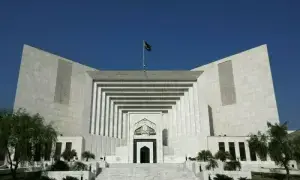
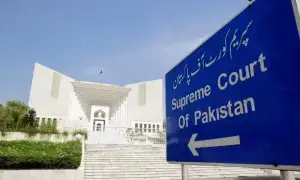
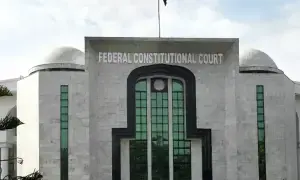
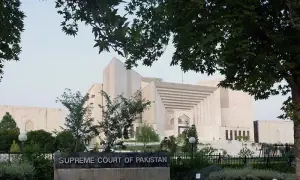
ISLAMABAD: The Supreme Judicial Council (SJC), which approved amendments to the Code of Conduct for judges in its June 11 meeting, decided to allow judges of the superior courts to attend or preside over political or diplomatic functions after obtaining prior permission from the relevant chief justices.
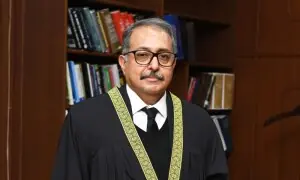
Presided over by Chief Justice of Pakistan (CJP) Yahya Afridi, the June 11 SJC meeting decided to make certain amendments to the Code of Conduct for judges while considering the draft Rules Regul
ISLAMABAD: The Supreme Judicial Council (SJC), which approved amendments to the Code of Conduct for judges in its June 11 meeting, decided to allow judges of the superior courts to attend or preside over political or diplomatic functions after obtaining prior permission from the relevant chief justices.
Presided over by Chief Justice of Pakistan (CJP) Yahya Afridi, the June 11 SJC meeting decided to make certain amendments to the Code of Conduct for judges while considering the draft Rules Regulating Procedure and Conduct of Business of the Council.
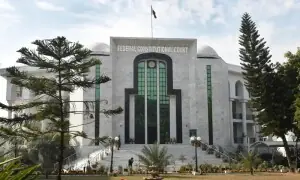
The SJC meeting was also attended by Chief Justice Federal Constitutional Court (FCC) Justice Aminuddin as well as the chief justices of Lahore and Peshawar high courts.
According to an official announcement issued here on Saturday, one of the amendments made to the code provides that judges of the superior courts shall abstain from attending or presiding over any political or diplomatic functions, except with the permission of the relevant chief justices.
Earlier, Article XII of the Code of Conduct had imposed a complete ban on judges of the superior courts from attending or presiding over any social, cultural, political or diplomatic functions.
Likewise, in the definition of “superior court”, the newly established FCC has also been included, as a result of which the title of the Code of Conduct will now read: “Code of Conduct for Judges of the Federal Constitutional Court, the Supreme Court and the High Courts.” Earlier, the FCC was not included in the title.
Similarly, amendments have also been made in Article XV, which requires the judges to decide cases before them on merit alone, possess moral integrity and intellectual capacity to resist internal or external influence, and, where legal powers are lacking, seek an immediate institutional response.
“Judges must promptly inform, in writing, the CJP and the four most senior Supreme Court judges (via the registrar) of any such attempts (to influence); high court judges must also inform their respective chief justices.”
The amendment suggests that judges shall immediately inform, in writing, the chief justice of the relevant high court, the chief justice of Pakistan, the chief justice of the FCC or the Supreme Court, and the two senior-most judges each of the FCC and the Supreme Court through the respective registrars, in case such attempts to influence are made.
In the case of the FCC or the Supreme Court, the judge shall immediately inform, in writing, the chief justice and the four senior-most judges of the relevant court through the respective registrars.
The chief justice of the high court will place the matter before a committee comprising three judges within two days of the report by the judges.
The committee’s decision on the report will be made within a fortnight. In case it is referred for judicial determination, it should be decided as early as possible, in accordance with the principles of fair trial and due process.
If the chief justice or, in the case of the high court, the committee, as the case may be, fails to respond within the stipulated timeframe, the FCC or the Supreme Court, as the case may be, which was informed by the judge, shall take up the matter.
Earlier, the FCC was included in Article XV of the Code of Conduct.
The FCC was established as the apex court in Pakistan after the 27th Constitutional Amendment Bill was passed in November 2025. As a result, the Supreme Court (SC) was reduced to a final appellate court for civil and criminal matters.
ISLAMABAD: Days before the announcement of the budget, the Federal Constitutional Court (FCC) has affirmed that poultry feed manufacturers and poultry farmers were not liable to pay additional tax under Section 3(1A) of the Sales Tax Act, 1990.
A two-judge FCC bench, headed by Justice Aamer Farooq and also including Justice Muhammad Karim Khan Agha, set aside a Dec 24, 2025, Lahore High Court (LHC) judgement and ruled that imposing a 4 per cent tax on supplies made to non-registered entities wou
ISLAMABAD: Days before the announcement of the budget, the Federal Constitutional Court (FCC) has affirmed that poultry feed manufacturers and poultry farmers were not liable to pay additional tax under Section 3(1A) of the Sales Tax Act, 1990.
A two-judge FCC bench, headed by Justice Aamer Farooq and also including Justice Muhammad Karim Khan Agha, set aside a Dec 24, 2025, Lahore High Court (LHC) judgement and ruled that imposing a 4 per cent tax on supplies made to non-registered entities would be unjust and against the sales tax regime.
The bench had taken up a set of appeals moved by Shahzor Feeds (Pvt) Ltd, Lahore Feeds Ltd and S.S. Feed Mills Pvt Ltd.
The petitioners were aggrieved by an order of the Commissioner (Inland) Revenue, LTU, Lahore, issued on Sept 11, 2024, whereby it was held that manufacturers of poultry feed supplying products to farmers were liable to pay an additional tax under section 3(1A) of the 1990 Sales Tax Act since recipients of the supply were not registered.
Court overturns LHC ruling that manufacturers must pay 4pc tax on sales to unregistered entities
For redress of the grievance, the petitioners approached the Lahore High Court, which dismissed their appeal.
Advocate Saad Mumtaz Hashmi, who represented the petitioners at the FCC, contended that his clients fell into two categories: (i) manufacturer of poultry feed and (ii) poultry farmers.
Saad Hashmi contended the latter category was exempted from payment of tax under ITO by virtue of section 13, read with Serial Nos 40 and 48 in Table-II of the Sixth Schedule to the act.
It is an admitted position, the FCC said, that poultry industry has not been exempted from payment of additional tax by the federal government, though the court was informed that different notifications have been issued by the government from time to time.
Since a plain reading of Section 3(1A) of ITO was leading to an anomaly, the judgement said, the court decided to look into the mischief that was sought to be cured by the legislature to encourage and promote registration with the sales tax authority to become active taxpayers.
The law does not require the exempted person from registration of the sales tax. Therefore, the petitioners who are poultry farmers, are not required to be registered, but to make poultry feed manufacturers liable to payment of further tax (which eventually would be passed to poultry farmers), would not only be unjust but also against the system of payment of sales tax under the Act.
Synchronising the provisions including sections 3(1A), 13, 14 and 2(41) of ITO, it would only be fair to come to the conclusion that in the present case, poultry farmers are exempted from payment of sale tax on account of exemption under the law. They are not required to be registered, the judgement said.
“Since the requirement of non-registration is mandated by law (section 14 of the Act), no penal consequences would fall upon either of the categories of petitioners before us by way of payment of additional tax.”
Precedent
In somewhat similar circumstances, the FCC recalled, the LHC had ruled in favour of taxpayers in 2021. The LHC determined that Muhammad Arif Ice Factory was not liable to pay a further tax under section 3(1A) since they were ice manufacturers. Later the Supreme Court had upheld the judgement, the FCC bench said.
“In view of above position of law, the judgement impugned before us is not sustainable as it does not reflect the correct interpretation of law and the High Court erred in upholding the order passed by the tax authorities,” the FCC observed.
The FCC allowed the appeals and set aside the orders passed by the tax authorities.
ISLAMABAD: The Supreme Court (SC) on Thursday dismissed a review petition filed by Zahir Jaffer and maintained its earlier verdict upholding his death sentence in the Noor Mukadam murder case.
Noor, aged 27, was found murdered at Zahir’s Islamabad residence in July 2021, with the probe revealing she was tortured by him before being beheaded. Zahir was sentenced to death by a trial in February 2022 and his sentence has already been upheld by the SC once. Prior to that, the Islamabad High Court ha
ISLAMABAD: The Supreme Court (SC) on Thursday dismissed a review petition filed by Zahir Jaffer and maintained its earlier verdict upholding his death sentence in the Noor Mukadam murder case.
Noor, aged 27, was found murdered at Zahir’s Islamabad residence in July 2021, with the probe revealing she was tortured by him before being beheaded. Zahir was sentenced to death by a trial in February 2022 and his sentence has already been upheld by the SC once. Prior to that, the Islamabad High Court had also dismissed his plea challenging the trial court’s verdict.
A three-member bench comprising Justices Muhammad Hashim Khan Kakar, Salahuddin Panhwar and Ishtiaq Ibrahim heard Zahir’s review plea on the SC verdict on Thursday.
Advocate Khawaja Haris appeared as Zahir’s counsel, while Shah Khawar was present from the respondents’ side. Both presented their arguments, following which the bench announced its verdict.
After today’s ruling, a presidential pardon under Article 45 of the Constitution could possibly provide Zahir pardon, or reprieve, or remit, suspend or commute his sentence.
Zahir was last year contemplating filing a mercy petition before President Asif Ali Zardari, with a letter by jail authorities seeking the formation of a medical board so its opinion could be included in the plea.
Review plea
The SC’s May 2025 ruling, which upheld Zahir’s death sentence for murder, also commuted his second death sentence for rape to life imprisonment. While he was acquitted of the 10-year sentence for kidnapping, a one-year term was handed down for wrongful confinement under Section 342 of the Pakistan Penal Code, according to the SC verdict.
Subsequently, in July 2025, Zahir had sought a review of that SC ruling.
The 47-page review petition was filed by Advocate Haris on behalf of Zahir under Article 188 of the Constitution (review of judgements or orders by SC). The state and Noor’s father, Shaukat Ali Mukadam, were made the respondents.
The petition contended that the issue of Zahir’s alleged “unsoundness of mind or mental capacity” that was raised before the SC in an application had not been addressed and was “given short shrift”.
On the the matter of rape, the review plea argued that it was “apparent from the record that there is no evidence on the record in proof of this allegation”.
The plea argued that the video recordings, based on which the SC upheld the death sentence, had not been proved during the trial and were not provided to any of the accused.
However, in its detailed verdict, the SC had stressed the significance of digital evidence by declaring that footage can be admissible as primary evidence under the “silent witness theory” — a rule of evidence that allows for photographic video or other recorded evidence to be admitted as substantive proof of what it depicts, without the need for an eyewitness’s testimony.
Justice Kakar had observed that the silent witness theory of authentication had developed in almost all jurisdictions over the last 25 years to allow photos to substantively “speak for themselves”.
The SC had also noted that Zahir neglected to provide any explanation for the victim’s presence at his residence and the ensuing recovery of her body from the premises.
Case history
Noor was found murdered at a residence in Islamabad’s upscale Sector F-7/4 on July 20, 2021. An first information report (FIR) was registered later the same day against Zahir, who was arrested at the site of the murder.
At around 10pm on July 20, the victim’s father had received a call from Kohsar police station, informing him that Noor had been murdered.
Police had subsequently taken the complainant to Zahir’s house in Sector F-7/4 where he discovered that his “daughter has been brutally murdered with a sharp-edged weapon and beheaded”, the FIR said.
Police later said that Zahir had confessed to killing Noor, while his DNA test and fingerprints also showed his involvement in the murder.
Zahir’s parents and household staff were also taken into custody by police on July 24, 2021, over allegations of “hiding evidence and being complicit in the crime”.
Zahir’s parents, leading businessman Zakir Jaffer and Asmat Adamji, had been indicted by an Islamabad district and sessions court in October 2021 but were later acquitted by the court.
In February 2022, a district and sessions judge sentenced Jaffer to death for the murder and handed him 25 years of rigorous imprisonment, finding him guilty of rape. His household staff, Mohammad Iftikhar and Jan Mohammad — co-accused in the case — were each sentenced to 10 years in prison.
Six officials of Therapy Works, whose employees had visited the site of the murder before the police, were also among those indicted by the lower court but were later freed of the charges along with the parents.
In March 2023, the IHC, dismissing Zahir’s appeal, not only upheld the death sentence but also converted his 25-year jail term into another death penalty. The IHC had also rejected the pleas of the main suspect’s staff challenging their conviction.
The next month, Zahir approached the SC against the IHC verdict, insisting that his conviction resulted from “erroneous appreciation” of the case evidence and that the high court and trial court could not identify the “fundamental flaws” in the FIR.
In a ruling that was widely seen as justice being served, the SC in May 2025 upheld the convict’s death sentence by rejecting his appeal against the IHC verdict.
Two months later, while also preparing to file a mercy petition, Zahir approached the SC seeking review of its verdict, which was dismissed today.
ISLAMABAD: The Federal Constitutional Court (FCC) on Thursday ruled that directions to the high courts for expeditious decisions in pending matters by superior courts should be issued sparingly and couched in appropriate words.
The judgement comes against the backdrop of a recent petition by the National Cyber Crime Investigation Agency (NCCIA) before the Supreme Court challenging its May 12, 2026 direction to the Islamabad High Court (IHC) for deciding in two weeks the sentence suspension pleas
ISLAMABAD: The Federal Constitutional Court (FCC) on Thursday ruled that directions to the high courts for expeditious decisions in pending matters by superior courts should be issued sparingly and couched in appropriate words.
The judgement comes against the backdrop of a recent petition by the National Cyber Crime Investigation Agency (NCCIA) before the Supreme Court challenging its May 12, 2026 direction to the Islamabad High Court (IHC) for deciding in two weeks the sentence suspension pleas of human rights lawyers Imaan Zainab Mazari-Hazir and Hadi Ali Chattha in the controversial social media posts case.
The NCCIA had also requested the SC to recall and withdraw that order to help preserve the “sanctity and independence of the judiciary, maintaining equality among citizens and avoiding discrimination”.
According to a three-page order by Justice Aamer Farooq, issued in deciding a dispute between the Gujranwala Electric Power Company (Gepco) and Master Tiles and Ceramics Industries Ltd, it was held that high courts have their independent roster and case management schemes along with a policy for fixation of cases. It said that any order or direction, which superimposes case fixation, amounts to intrusion in the judicial and administrative independence of high court.
The petitioner, Gepco, had challenged the July 10, 2025 order of the IHC before FCC, contending that the Attorney General Office was not competent to give consent on behalf of the petitioner in the proceedings before IHC, as the power company was an independent entity to be represented in the court of law by the counsel of its own choice.
On the other hand, Master Tiles and Ceramics, the respondents, had argued that it was not their fault that the consent was given by the Attorney General Office; however, it submitted that if the FCC was inclined to remit the matter back to the IHC, an appropriate direction for expeditious disposal of the case should also be made.
Justice Farooq, who headed the two-judge FCC bench along with Justice Syed Arshad Hussain Shah, however, set aside the IHC order with directions that the writ petitions filed by Master Tiles will be deemed to be pending before the IHC.
It is expected that the case shall be taken up at the earliest, keeping in view the urgency involved in the matter, the FCC said.
In the judgement, Justice Farooq held that the scheme of judicature as provided in the Constitution suggested that there were five independent high courts in the country created under the Constitution.
“The high court, so created, is an independent constitutional court and is not subordinate to either the SC or FCC; however, in the scheme of arrangement, district judiciary and such other courts are subordinate to the respective high court as per Article 203 of the Constitution,” it said.
All decisions of the high court are challengeable before the SC or the FCC, which does not make the referred court subordinate in any manner, he observed.
Justice Farooq emphasised that adding any order or direction, which superimposes such policy or case fixation, amounts to intrusion in the judicial and administrative independence of such courts.
Undoubtedly, at times, exigency or emergency of the lis demands that on remission, the matter be heard by the respective high court at an early date, but such observations must be couched in appropriate words and should not be in a way to affect independence of the high court, observed Justice Farooq.
Even otherwise, generally directions issued are administrative in nature rather than judicial, where even a high court issues directions to the trial courts/subordinate courts, the same are administrative in nature and do not warrant any consequence but are recommendatory, asking the courts to take up the matter in priority keeping in view the urgent nature of the case/lis, Justice Farooq explained.
Justice Farooq observed that the FCC agreed that the assistant attorney general, in the facts and circumstances, was not competent to give consent on behalf of the petitioner company regarding disposal of the writ petition pending before the IHC.
The order stated that requests for the issuance of directions to the high courts for early disposal of cases were being made with considerable frequency, and such orders were passed by the superior courts issuing directions for early decisions.
ISLAMABAD: The Supreme Court has upheld a sentence awarded to a child rapist and a murderer, ruling that individuals who voluntarily become intoxicated cannot claim exemption from criminal liability.
“Intoxication caused by one’s own negligence or recklessness does not excuse the offence,” affirmed Justice Muhammad Hashim Khan Kakar in a three-page verdict he authored.
The court ruling has put to rest the defence advanced by appellant Sunni Masih, who during the trial had taken a specific plea
ISLAMABAD: The Supreme Court has upheld a sentence awarded to a child rapist and a murderer, ruling that individuals who voluntarily become intoxicated cannot claim exemption from criminal liability.
“Intoxication caused by one’s own negligence or recklessness does not excuse the offence,” affirmed Justice Muhammad Hashim Khan Kakar in a three-page verdict he authored.
The court ruling has put to rest the defence advanced by appellant Sunni Masih, who during the trial had taken a specific plea recorded under Section 164 CrPC that he committed the offence under intoxication.
Earlier, the SC had entertained the plea to determine whether a person could be awarded capital punishment if he commits a crime under intoxication.
Intoxication does not absolve offender of liability for an offence committed under the influence, court rules
A three-judge SC bench, headed by Justice Kakar and also comprising Justice Salahuddin Panhwar and Justice Ishtiaq Ibrahim, had taken up an appeal of Sunni Masih against a Feb 28, 2018, order of the Balochistan High Court regarding confirmation of capital punishment for brutally killing a five-year-old girl, Angel Kumari, in Sibi (Balochistan).
Sunni Masih was booked at the Police Station City, Sibi, for raping and killing the girl in January 2014. He was sentenced to death by the trial court under sections 302(b) (murder), 364-A (kidnapping), and 376 (rape) of the Pakistan Penal Code. His appeal was subsequently rejected by the BHC’s Sibi bench, prompting the present appeal to the SC.
At the hearing before the apex court, the appellant’s counsel did not challenge the merits of the conviction, but sought reduction of the death sentence to life imprisonment, arguing that the case rested solely on the appellant’s judicial confession that the offence had been committed under the influence of intoxication.
Justice Kakar noted that the perusal of the record showed that the child was killed after being raped in a cruel manner and after a detailed assessment of the evidence available on record, both the courts below had concurred in their conclusion regarding the guilt of the appellant having been established beyond reasonable doubt. “Upon our own independent evaluation of the evidence we have not been able to take any legitimate exception to the conclusions concurrently reached by the courts below,” he observed.
“A man who gets drunk voluntarily has no right to claim exemption from criminal liability,” he remarked.
While dismissing the appeal, the SC unanimously held that the impugned judgement was free from any illegality or infirmity, besides there was no misreading or non-reading of evidence. Therefore, the high court judgement did not require any interference by the SC.
ISLAMABAD: The Federal Constitutional Court (FCC) on Thursday emphasised that appointments to important public offices must demonstrably conform to constitutional standards of fairness, transparency, institutional integrity and merit-based governance.
“Public authority cannot be exercised on undisclosed considerations, nor can structured procedures be reduced to empty formalities,” observed Justice Rozi Khan Barrech in a judgement he authored.
Justice Barrech was a member of a three-judge FCC
ISLAMABAD: The Federal Constitutional Court (FCC) on Thursday emphasised that appointments to important public offices must demonstrably conform to constitutional standards of fairness, transparency, institutional integrity and merit-based governance.
“Public authority cannot be exercised on undisclosed considerations, nor can structured procedures be reduced to empty formalities,” observed Justice Rozi Khan Barrech in a judgement he authored.
Justice Barrech was a member of a three-judge FCC bench, headed by Justice Syed Hasan Azhar Rizvi, while hearing an appeal filed by Sifatullah Khan against a March 5, 2026, Peshawar High Court (PHC) order setting aside his appointment as chairman of the Board of Intermediate and Secondary Education (BISE), Bannu, in Khyber Pakhtunkhwa.
The FCC observed that the legitimacy of public administration depended not merely on the existence of power, but on the disciplined and transparent exercise of that power in accordance with the law.
It upheld the PHC order, stating that it did not suffer from any legal or constitutional infirmity warranting interference by the FCC.
The petitioner had challenged the PHC verdict that not only set aside his May 13, 2025, appointment notification but also directed the controlling authority to entrust the duties of chairman to another suitable person within three months.
When the post of BISE Bannu chairman fell vacant, applications were invited from eligible candidates. Through a notification dated Feb 2, 2021, the controlling authority constituted a search and scrutiny committee to interview shortlisted candidates for the post.
Under its terms of reference (ToRs), the committee was mandated to evaluate and interview shortlisted candidates and recommend a panel of three officers for each post for approval by the KP chief minister. The committee conducted interviews on Sept 26, 2024.
Later, the committee recommended three names, but dropped that of the petitioner.
The recommendations were forwarded through various secretaries and later placed before the KP chief minister for approval.
The controversy arose when a revised summary was prepared, placing the petitioner’s name at serial number four. He was subsequently appointed on deputation for three years through a notification dated Sept 13, 2025, ignoring the committee’s recommendations entirely.
‘Doctrine of pleasure’
In his judgement, Justice Barrech observed that the “doctrine of pleasure, or the existence of administrative discretion, cannot be invoked to legitimise a process which, on its face, departs from the very mechanism devised by the executive itself”.
The FCC observed that administrative decisions affecting public appointments must disclose the basis for any departure from the prescribed procedure. It added that silence on the record in this regard was fatal to the validity of such action.
“The doctrine of pleasure, in its constitutional and administrative sense, does not confer an unfettered licence upon the executive to act in disregard of self-imposed procedural discipline,” the judgement held.
It added that while the executive might, subject to law, appoint and remove public functionaries, the exercise of such power remained subject to the rule of law and the constitutional obligation to act fairly and rationally.
ISLAMABAD: The Supreme Court, by a majority of two to one, on Thursday set aside its Dec 29, 2022 order endorsing the closure of the right to defence of PTI founder Imran Khan in the Rs10 billion defamation suit filed by Prime Minister Shehbaz Sharif.
In April, the apex court had resumed hearing a review petition filed by PTI founder and former premier against the closure of his right to defence in the Rs10 billion defamation case.
Headed by Justice Ayesha A. Malik, a three-judge SC bench also c
ISLAMABAD: The Supreme Court, by a majority of two to one, on Thursday set aside its Dec 29, 2022 order endorsing the closure of the right to defence of PTI founder Imran Khan in the Rs10 billion defamation suit filed by Prime Minister Shehbaz Sharif.
In April, the apex court had resumed hearing a review petition filed by PTI founder and former premier against the closure of his right to defence in the Rs10 billion defamation case.
Headed by Justice Ayesha A. Malik, a three-judge SC bench also comprising Justice Muhammad Hashim Khan Kakar and Justice Ishtiaq Ibrahim took up a set of review petitions filed by Imran Khan, also a former prime minister. Justice Kakar, however, dissented from the majority judgment.
Overturning the earlier judgments of the LHC as well as the trial court, the SC remanded the matter back to the trial court with the direction to provide the petitioner (Imran Khan) a reasonable opportunity to file his reply to the interrogatories and to proceed with the suit in accordance with law.
Authored by Justice Ibrahim, the majority judgment on Thursday recalled that Imran’s challenge to the earlier judgment was primarily anchored on two pivotal legal infirmities: first, the illegitimacy of relying on past conduct as a retrospective basis for a penal sanction; and second, the absence of a formal application as a mandatory jurisdictional prerequisite for the invocation of Order XI, Rule 21 of the Civil Procedure Code (CPC).
Justice Ibrahim observed that Order XI, Rule 21 of the CPC was not a routine tool of case management; it was the “death knell” of a party’s defence, as its nature was strictly penal.
“The law does not favour the forfeiture of a substantive right of defence on a technicality unless the conduct of the party is proved to be contumacious, obstinate and stubbornly defiant.”
When a court contemplates a measure that deprives a person of their fundamental right of defence, a right that is anchored in the constitutional guarantee of a fair trial under Article 10A, it must exhibit the utmost judicial restraint and proceed with absolute caution, Justice Ibrahim emphasised.
He also observed that the trial court, in its orders of November 8 and 17, had explicitly acknowledged and accepted Imran’s inability to respond to interrogatories due to a critical injury sustained in a widely reported shooting incident that happened on Nov 3, 2022.
Once the trial court accepted the factum of the shooting incident on Nov 8, 2022, the element of “wilfulness” was legally extinguished, the judgment said, while noting, “But on Nov 24, 2022, the trial court abruptly shifted its stance, striking out petitioner’s defence despite continued existence of the same medical incapacity.”
“When a party is hospitalised due to gunshot wounds, the failure to sign an affidavit or consult with counsel is a physical impossibility and not a contumacious act,” Justice Ibrahim observed.
“The law does not compel a man to do what he cannot possibly perform; thus a default occasioned by a physical catastrophe or force majeure that includes circumstances entirely beyond a party’s control, cannot be characterised as wilful or contumacious as was the case at hand.,” stated the judgement.
Justice Ibrahim further observed that the trial court had acted “mechanically” in imposing this penalty upon the petitioner and that the earlier majority judgment erred in the analysis of this fact.
The judgment conceded that the former prime minister indeed sought numerous adjournments since the inception of the proceedings, as rightly pointed out by the earlier majority judgment. However, it was pertinent to note that the trial court saw fit to grant them without ever resorting to the lesser penalties available in the judicial quiver.
“Had the court truly determined that the petitioner was employing strategic delay tactics, it was empowered to ensure the expeditiousness of justice through the imposition of high costs or peremptory orders with realistic timeframes.”
“Instead, the trial court remained dormant in its disciplinary capacity for years, only to jump to the most extreme penalty on Nov 24, 2022, less than a month after the documented firing incident. Such an approach ignores the principle of proportionality as the judiciary’s duty to ensure expeditious justice does not grant a license to commit summary injustice,” Justice Ibrahim observed.
Thus, the judgment said that the earlier majority judgment suffers from errors apparent on the face of the record, which have resulted in a manifest miscarriage of justice, adding that the “judgment erred fundamentally in validating the invocation of Order XI, Rule 21 of the CPC based upon a retrospective evaluation of petitioner’s past conduct, while ignoring the immediate and compelling medical incapacity resulting from the assassination attempt”.
Meanwhile, Justice Malik, in her additional note, observed that in a case plagued by adjournments since 2017, the trial court should weigh the “balance between a fair trial and the legitimate grounds for the latest request for adjournment”.
“The courts are entrusted with the responsibility to dispense justice, for which they are under a duty to ensure a timely trial, which duty may have been overlooked in some of the previous instances of adjournment where requests were granted mechanically and without due consideration,” she maintained.
However, Justice Malick said the petitioner’s public shooting and injury at a political rally justified the grant of an adjournment for a reasonable time under the circumstances.
“The right to defence cannot be struck out without considering all relevant factors, and the court must weigh the balance between a fair trial and the circumstances at hand,” Justice Malik said.
Justice Kakar, in his dissenting note, observed that the case at hand was a classic case of delay on the part of the petitioner and of the trial court’s inability to conclude the lis within a reasonable time.
“Record reveals that the suit was instituted in the year 2017, whereas the written statement was filed after a delay of about four years,” Justice Kakar observed, adding the interrogatories were made on March 16, 2022, and despite availing of 5 to 6 opportunities, the petitioner failed to respond to the same.
“As per order sheet of April 26, 2022, answers to the interrogatories was ready and the draft was only required to be signed by the senior counsel, however, on next date of hearing, instead of answering the interrogatories in compliance of the trial court directions and previous under taking, once again objections were filed just to delay the proceedings,” he wrote, while pointing that “Such conduct on the part of petitioner was apparently wilful disobedient, Justice Kakar observed.
The trial court, through its order of October 20, 2022, dismissed the petitioner’s objections to the interrogatories of the respondent and directed him to submit answers to those interrogatories. Later, through a subsequent order dated Nov 24, 2022, the trial court struck off the petitioner’s right of defence due to non-submission of answers to the interrogatories.
In his suit filed in 2017, PM Shehbaz said Imran levelled baseless allegations against him. He sought a decree for the recovery of Rs10bn as compensation from the defendant for the publication of defamatory content. The defamation suit said Imran wrongly accused PM Shehbaz of offering Rs10bn to the latter through a common friend in exchange for withdrawing the Panama Papers case.
ISLAMABAD: In a landmark judgment, the Supreme Court ruled on Monday that “vitriolage” (acid attack) is an offence more heinous than homicide.
The ruling came after Abdul Manan, convicted for throwing acid on a young woman in Faisalabad, appealed against a 2022 Lahore High Court (LHC) order.
The LHC had upheld an Anti-Terrorism Court (ATC) verdict sentencing him to life imprisonment along with a fine of Rs1 million.
Justice Muhammad Hashim Khan Kakar, heading a three-judge bench consisting of Ju
ISLAMABAD: In a landmark judgment, the Supreme Court ruled on Monday that “vitriolage” (acid attack) is an offence more heinous than homicide.
The ruling came after Abdul Manan, convicted for throwing acid on a young woman in Faisalabad, appealed against a 2022 Lahore High Court (LHC) order.
The LHC had upheld an Anti-Terrorism Court (ATC) verdict sentencing him to life imprisonment along with a fine of Rs1 million.
Justice Muhammad Hashim Khan Kakar, heading a three-judge bench consisting of Justice Salahuddin Panhwar and Justice Ishtiaq Ibrahim, upheld the LHC order.
“Unlike death, which consumes its victim only once, the victim of an acid assault is relegated to a living death, where they are compelled to endure the agony of their trauma and the degradation of their physical self on a daily basis,” observed Justice Kakar in a 14-page strongly worded judgment he authored.
In the court ruling, federal and provincial governments were also recommended to consider accommodating acid attack victims under disability quotas along with enactment and enforcement of specialised legislation for establishment of a National Acid Survivors’ Rehabilitation Fund.
The ruling added that such a statutory fund should provide comprehensive medical coverage for extensive reconstructive surgeries and specialised physical therapy.
The fund should also provide mandatory access to professional trauma counselling, psychotherapy and psychiatric care for psychological and social rehabilitation.
“The perpetrator’s objective is not merely to kill, but to extinguish the victim’s soul, leaving the living corpse as a permanent reminder of their depravity,” Justice Kakar said.
The apex court also recommended a mandatory monthly stipend for survivors who, due to the nature of their injuries or ongoing medical conditions, are rendered incapable of financial self-support.
Justice Kakar also suggested the formulation of national rehabilitation guidelines as a standardised framework ensuring gratuitous, lifelong medical and mental health treatment across all state-mandated and private medical facilities through the fund.
He further observed that acid violence is a tool of patriarchal dominance. “In the past, such incidents have occurred following rejection of marriage proposals or sexual advances, as well as dowry disputes.”
The ruling added that acid violence is used to inflict a social death upon women by destroying their physical identity.
The primary deterrent against such depravity lies in a dual strategy of rigorous criminalisation followed by stringent regulation of corrosive substances, Justice Kakar observed, citing a number of examples from foreign jurisdictions such as Bangladesh and Cambodia.
The first essential step towards eradication is the categorical criminalisation of the act itself, he added.
The judgment also highlighted that the eradication of acid violence was inextricably linked to restrictions on access to corrosive substances.
While the legislative amendments of 2011 served to criminalise acid violence with the severity it warrants, the persistence of such atrocities reveals that penal sanctions alone are insufficient to address the root of the problem, Justice Kakar observed.
“As long as corrosive substances remain easily available, the deterrent effect of penal consequences will be perpetually undermined.”
In this context, the Punjab Acid Control Act 2025 represents a watershed moment in provincial jurisprudence. Justice Kakar cited it as an example of a shift from post-occurrence punishment to pre-emptive regulation, noting that the Act mandates a rigorous licensing regime and categorically prohibits the sale of acid to individuals under the age of 18.
“It is our sanguine expectation that the rigorous enforcement of such specialised regulatory regimes will effectively dismantle the accessibility of these lethal instruments, thereby serving as a robust bulwark to curb and eventually eradicate this heinous offence from our social fabric,” Justice Kakar emphasised.
He added that the ordeal of an acid attack survivor does not end with the conclusion of the criminal trial. Instead, it marks the beginning of a gruelling, lifelong journey of medical intervention.
Survivors are frequently subjected to an exhaustive series of reconstructive surgeries and specialised procedures that are not only physically agonising but also financially prohibitive, rendering essential healthcare inaccessible to the majority of victims, the judgment noted.
Citing the Asian Human Rights Commission, the judgment said the devastating impact of acid violence in Pakistan was exemplified by survivors such as Irum Saeed and Memuna Khan, who underwent 25 and 21 reconstructive surgeries respectively following attacks triggered by marital rejection and inter-family disputes.
Justice Kakar added that despite existing laws, their purpose was defeated if implementation and enforcement remained weak, as evidenced by recurring incidents across the country.
The SC also strongly recommended that the high courts actively monitor and ensure that, in cases of vitriolage, statutory timelines provided under relevant laws for the completion of trials are strictly adhered to.
The prime intent of the legislature is to ensure swift adjudication and prevent secondary victimisation, the judgment added.
Vitriolage is an offence deeply rooted in gender-based violence, deep-seated misogyny and patriarchal aggression, the judgment said.
The Supreme Court also recommended that the federal and all provincial governments impose a complete ban on the sale of acid to private individuals.
For legal acid sales, the court suggested a centralised digital system governed and monitored by the relevant authorities in real time.
Under this system, entities intending to purchase acid must apply through prescribed electronic forms, disclosing the purpose of purchase and the name and details of the purchaser, along with a photograph and biometric thumb impression.
Such a real-time system will completely eradicate manual record-keeping and enable the trade to be managed with absolute transparency, the ruling added.
The apex court judgment was forwarded to all High Courts and relevant departments of the federal and provincial governments.
Case history
On September 4, 2019, the accused threw sulfuric acid on the victim’s face while she was cooking in the kitchen of her home. The victim sustained extensive burns on her face, chest, back, left leg and foot, as well as “complete destruction of the left ear”, court documents state.
The victim was examined on January 16, 2020, during trial proceedings. At the time, “she was unable to recline, move or walk”, according to court documents.
The victim has been bedridden since the incident.
Abdul Manan denied the allegations but failed to provide evidence in his defence. At the time of the incident, he was a minor, with court documents stating his age as 17–18.
The petitioner’s lawyer requested leniency owing to his young age, while the prosecutor argued that “age cannot be a shield for such barbaric acts”.
On February 1, 2020, the Anti-Terrorism Court (ATC) Faisalabad sentenced the accused to life imprisonment along with a fine of Rs1 million to be paid to the victim.
Following an appeal, the Lahore High Court (LHC) upheld the ATC’s ruling on November 21, 2022.
• Criticises practice of frequent strike calls; terms them ‘illegal’ and violative of litigants’ rights• Dismisses Peshawar bar appeal; holds that everyone has right to counsel of choice
ISLAMABAD: In a landmark judgement on an appeal filed by the Peshawar High Court Bar Association, the Federal Constitutional Court (FCC) on Wednesday ruled that bar associations and bar councils cannot suspend a lawyer’s licence solely for representing a client or appearing in court during a strike.
Authored by
• Criticises practice of frequent strike calls; terms them ‘illegal’ and violative of litigants’ rights • Dismisses Peshawar bar appeal; holds that everyone has right to counsel of choice
ISLAMABAD: In a landmark judgement on an appeal filed by the Peshawar High Court Bar Association, the Federal Constitutional Court (FCC) on Wednesday ruled that bar associations and bar councils cannot suspend a lawyer’s licence solely for representing a client or appearing in court during a strike.
Authored by Justice Aamer Farooq, the 20-page judgement also criticised the practice of frequent strike calls by bar associations and bar councils, observing that such strikes were not only illegal but also violated the constitutional right of access to justice of litigants and their counsel.
“When a strike call is made, the lawyer bodies restrict lawyers from appearing before the courts. Consequently, a litigant, on that day, is deprived of his legal practitioner’s representation, and proceedings in his case are adjourned without any progress,” Justice Farooq noted.
“This amounts to a denial of access to justice,” he asserted.
While deciding the challenge to the Oct 15, 2025 judgement of the Peshawar High Court (PHC), the two-member constitutional court, which also included Justice Rozi Khan Barrech, framed two questions for determination.
First, whether the jurisdiction of a high court under Article 199(1)(c) of the Constitution extends to issuing writs against “any person”, including regulatory bodies such as bar councils. Second, whether the suspension of the licences of two lawyers, one for representing a client and the other for appearing in court during a strike, infringed the fundamental right to practise a profession guaranteed under Article 18.
The FCC answered both questions in the affirmative.
The court held that preventing lawyers from representing litigants or from approaching and appearing before courts was wholly impermissible. It observed that such restrictions struck at the heart of the economic freedom guaranteed under Article 18, which was designed to protect the right to pursue a lawful profession.
The controversy arose after the murder of a young lawyer, in connection with which a station house officer (SHO) was implicated. The incident triggered protests demanding that the officer be brought to justice.
Subsequently, the officer surrendered before the relevant court and was taken into custody. He later engaged Advocate Shabbir Hussain Gigyani as his counsel. These developments prompted the Khyber Pakhtunkhwa Bar Council to pass a resolution prohibiting any advocate from representing the accused officer.
Meanwhile, Advocate Azim Afridi faced disciplinary action when the executive committee of the KP Bar Council suspended his licence during an emergency meeting on Oct 8, 2025. The suspension followed a communication from the Peshawar Bar Association, which described his appearance in court during a strike as an act of “indiscipline”.
Both lawyers challenged the suspension of their licences before the PHC, which ruled in their favour.
In the judgement, Justice Farooq observed that the legal system was already overburdened, with courts carrying lengthy cause lists and litigants often waiting years for hearings.
“In such circumstances, strike calls by lawyer bodies only add to the plight of litigants,” the judgement noted.
The court observed that regardless of how noble the cause behind a strike might be, it was neither an appropriate solution nor a legitimate means of expressing grievances, as it came at the expense of litigants seeking redress and justice.
Justice Farooq reiterated that denial of access to justice in any form constituted a violation of the Constitution, whether through non-appearance before courts or the closure of administrative and judicial functions.
The judgement held that the economic freedom clause under Article 18 was clearly attracted when Advocate Afridi, or any lawyer, was prevented from appearing before a court on behalf of a client.
The FCC explained that while a provincial bar council was empowered to suspend or cancel the licence of an advocate of the high court in cases of professional misconduct, no compelling reason existed in the present case to justify preventing lawyers from representing a person accused of murder.
ISLAMABAD: The Supreme Court on Friday lifted the austerity measures it had imposed on March 10, 2026, due to disruptions in petroleum supplies amid the ongoing Iran-US conflict.
On March 10, the apex court announced that the country’s courts would observe four-day work weeks. It further stated that the monthly ceiling of Petroleum, Oil and Lubricants (POL) allocated to judges and entitled officers should be reduced by 50 per cent.
A notification issued with the approval of the Chief Justice of
ISLAMABAD: The Supreme Court on Friday lifted the austerity measures it had imposed on March 10, 2026, due to disruptions in petroleum supplies amid the ongoing Iran-US conflict.
On March 10, the apex court announced that the country’s courts would observe four-day work weeks. It further stated that the monthly ceiling of Petroleum, Oil and Lubricants (POL) allocated to judges and entitled officers should be reduced by 50 per cent.
A notification issued with the approval of the Chief Justice of Pakistan Justice Yahya Afridi stated that the notification, dated March 10, 2026, has been withdrawn.
“Accordingly, all austerity measures adopted in the said notification shall cease to have effect from June 15, 2026,” it added.
The government had announced unprecedented austerity measures on March 9 in the wake of the Middle East war to deal with the global energy crisis, which had arisen due to the closure of the Strait of Hormuz.
Following the government’s announcement, institutions including the Supreme Court, the National Assembly, the Senate and others said they would follow suit.
NJPMC considers PHC, LHC’s proposals
Earlier on Thursday, the 60th meeting of the National Judicial Policy Making Committee (NJPMC), presided over by the chief justice, considered proposals from the Peshawar High Court (PHC) and the Lahore High Court (LHC), seeking reconsideration of the policy of observing three weekly holidays in the district judiciary.
The committee observed that the policy had been introduced under the Judicial Austerity and Energy Conservation Strategy approved by the NJPMC in its 58th meeting to promote prudent utilisation of resources and energy conservation.
During the meeting, the NJPMC appreciated the support of the federal government and considered the eased-out situation conveyed through the secretary of the law ministry, deciding that the district judiciary may revert to a six-day working week in accordance with the working schedule that existed prior to the implementation of the Judicial Austerity and Energy Conservation Strategy.
The committee, however, urged the high courts to implement appropriate resource management and energy-saving measures while maintaining the smooth and uninterrupted administration of justice.
ISLAMABAD: The Supreme Court on Wednesday overturned the convictions of two Muttahida Qaumi Movement (MQM) workers — Abdul Rehman alias Bhola and Zubair alias Chariya — for their alleged involvement in the deadly 2012 Baldia factory fire in Karachi.
Over 260 workers, including 16 who could not be identified, were burnt alive when the multi-storey Ali Enterprises garment factory was set on fire in Baldia Town on Sept 11, 2012, in what became the deadliest industrial blaze in Pakistan’s history.
O
ISLAMABAD: The Supreme Court on Wednesday overturned the convictions of two Muttahida Qaumi Movement (MQM) workers — Abdul Rehman alias Bhola and Zubair alias Chariya — for their alleged involvement in the deadly 2012 Baldia factory fire in Karachi.
Over 260 workers, including 16 who could not be identified, were burnt alive when the multi-storey Ali Enterprises garment factory was set on fire in Baldia Town on Sept 11, 2012, in what became the deadliest industrial blaze in Pakistan’s history.
On Wednesday, a three-judge SC bench, headed by Justice Malik Shahzad Ahmed and including Justice Aqeel Ahmed Abbasi and Justice Shakeel Ahmad, set aside the death sentences awarded to the two accused by an anti-terrorism court (ATC) on charges of murder, extortion, arson and terrorism, granting them the benefit of the doubt.
Abdul Rehman alias Bhola, a former sector in-charge in the party’s organisational structure, and Zubair alias Chariya were sentenced to death in September 2020 for allegedly setting the multi-storey Ali Enterprises garment factory on fire in Baldia Town.
It should be mentioned that in 2023, the Sindh High Court (SHC) had upheld the death penalty handed down to the two workers and also set aside the life term of four employees of the factory. Later, both the convicts had challenged the verdict in the SC.
The SHC had also dismissed an appeal filed by the state challenging the acquittal of then provincial minister for commerce and industries Rauf Siddiqui and three others by the ATC in the same case.
While accepting the appeals of the two accused on Wednesday, the SC indicated that a detailed judgment will be issued later and rejected a request to implead relatives of the deceased as parties in the case, remarking that if the court makes them parties in the matter, 200 more applications may come tomorrow.
Justice Shahzad also ruled that the application to expunge the remarks made by the lower courts related to MQM had become ineffective since their decisions had been declared null and void.
During the hearing, Justice Shahzad said that there was a confessional statement from Zubair alias Chariya but not from the co-accused Abdul Rehman alias Bhola.
“Had there been a demand of extortion by MQM, why was the acquittal of other co-accused (in the case) not challenged?” he inquired.
Appearing on behalf of the petitioners, senior counsel Farogh Naseem argued that the petitioners were innocent and falsely implicated by the police in the case, since the two were never named in the FIR but implicated based on a 2015 Joint Investigation Team (JIT) constituted by the Sindh government — a report which he argued was neither legally admissible as evidence nor can be relied for awarding a death sentence or even life imprisonment.
The counsel reminded that it was a settled law that the benefit of doubt has to be resolved in favour of the accused, when the SHC had already extended the benefit of the doubt to other co-accused.
He further argued that the accused were implicated more than two and a half years after the incident, which he said otherwise proved that the prosecution witnesses were concocted.
The counsel also recalled that three gates of the Ali Enterprises Garment Factory were locked on the alleged orders of the factory owner, Abdul Aziz Bhaila, sometime before the incident.
He further argued that the sons of the owner, namely Arshad Bhaila and Shahid Bhaila, as well as the administration of the three-storey factory building, had not made adequate arrangements for emergency exits for the factory workers.
The counsel said that the iron grills were fixed on the windows due to which workers failed to escape.
The counsel further contended that the JIT was constituted by the Sindh government based on information provided by one Mohammad Rizwan Qureshi.
The appeals contended that Qureshi was never produced or cited as a witness nor made an accused by the prosecution to prove the contents of the JIT, which was recorded nine months after the incident.
It was claimed in the appeals that there was no evidence against the petitioners for the demand of “bhattaa” (extortion), which according to the prosecution was made in July, 2012, while the incident happened in September that year.
Neither were CCTV recordings produced, nor was the specific witness examined to corroborate the allegation of bhattaa from the factory owners, the appeals argued, adding the prosecution had been silent in this respect till 2013 when Qureshi was arrested.
The appeals contended that from the date of occurrence till 2015, the police/factory owners made no complaint nor registered a case for the alleged bhattaa.
The petitions also pleaded that the prosecution had failed to bring on record a report issued by Karachi University’s Science Laboratory to establish that the blaze resulted from a chemical substance.
ISLAMABAD: The Federal Constitutional Court (FCC) on Thursday questioned a 2024 judgment of the Supreme Court (SC) which had paved the way for demolishing the infrastructure developed by the Monal Group of Companies, La Montana and Gloria Jeans, inside the picturesque Margalla Hills National Park (MHNP).
The SC had ordered the closure of Monal and the adjacent La Montana restaurant on August 21, 2024, and they were closed the next month to protect the park’s biodiversity.
Headed by Justice Syed
ISLAMABAD: The Federal Constitutional Court (FCC) on Thursday questioned a 2024 judgment of the Supreme Court (SC) which had paved the way for demolishing the infrastructure developed by the Monal Group of Companies, La Montana and Gloria Jeans, inside the picturesque Margalla Hills National Park (MHNP).
The SC had ordered the closure of Monal and the adjacent La Montana restaurant on August 21, 2024, and they were closed the next month to protect the park’s biodiversity.
Headed by Justice Syed Hasan Azhar Rizvi, a three-judge FCC bench took up a review petition moved by the Capital Development Authority (CDA) challenging the Supreme Court’s (SC) directions to the Islamabad Wildlife Management Board (IWMB) to take possession of restaurants — namely Monal, La Montana and Gloria Jeans — situated inside the MHNP. The CDA and the Islamabad Capital Territory Police were also ordered to assist the wildlife board in this regard.
The SC had also ordered that the entrances to the area where the restaurants were located be barricaded, after which the infrastructure would be demolished — with minimal disturbance to wildlife and without damage to the trees of the national park.
On Sept 10 the same year, the SC had dismissed a similar set of review petitions moved by the Monal Group of Companies, the Capital View Point Restaurant (La Montana), Sunshine Heights (Pvt) Ltd, and Brig (retd) Falak Naz Bangash of the Defence Ministry.
While rejecting the review petitions, the SC had also termed the status of Monal Group’s Luqman Ali Afzal as no better than that of a trespasser, saying he had no legal right to continue possession of the land at the MHNP.
Likewise, the running of restaurants by the owner of La Montana and Gloria Jeans was also in disregard of the provisions of the Islamabad Wildlife (Protection, Preservation and Management) Ordinance.
During Thursday’s hearing, the federal government, through Additional Attorney General Chaudhry Aamir Rehman, supported the CDA’s review petition against the demolition orders concerning the restaurants. It stated that the judgment was not sustainable in the eyes of the law, as besides Monal, around 113 other similar structures still existed in the Margalla Hills.
During the hearing, the FCC also raised questions over the SC’s decision to demolish the restaurants, stating that the judgment suggested that animals had rights but not humans.
Justice Rizvi recalled that the impugned judgment came despite the fact that Monal’s lease revision case was pending before the civil court, in addition to intra-court appeals by some restaurants pending before the Islamabad High Court (IHC).
Senior counsel Ahsan Bhoon, on behalf of the restaurants, contended that all parties were in agreement that the case should be allowed to proceed in the civil court.
However, Justice Rizvi observed that courts are never run on the basis of agreements between parties, saying that the kind of decision the SC had given could not be overturned by consensus among them.
He indicated that a detailed order would be issued if it was decided that the SC’s orders were to be overturned, stating that the FCC did not want to impose its decision “just like that”. The proceedings were then adjourned until the second week of July.
Through its 2024 judgment, the SC had observed that the operators of these restaurants, and those who permitted them to operate, had disregarded the integrity of the national park, ravaged its trees and flora, and displaced and disturbed endemic bird and animal life.
It also stated that the natural environment of the national park was adversely affected, alongside its functions such as acting as a catchment area for rainfall and facilitating the recharge of springs and streams.
An astronomical environmental cost was also borne by the public and would continue to be borne by future generations, the SC warned.

 Login
Login