Normal view

  • ✇Dawn Newspaper Pak
  • UK MP backs Pakistan’s response to attacks from Afghanistan none@none.com (Jamal Shahid)
    ISLAMABAD: Pakis­tan has the right under inte­rnational law to defend itself against atta­cks originating from Afgh­anistan, British Parlia­mentary Under-Secretary for the Middle East, Afghanistan and Pakistan Hamish Falconer said on Monday, while stressing the need for dialogue and regional stability. Speaking during a visit to Islamabad to discuss security concerns with senior Pakistani officials, the British official noted that any country facing cross-border threats was entitled to protect i
     

UK MP backs Pakistan’s response to attacks from Afghanistan

ISLAMABAD: Pakis­tan has the right under inte­rnational law to defend itself against atta­cks originating from Afgh­anistan, British Parlia­mentary Under-Secretary for the Middle East, Afghanistan and Pakistan Hamish Falconer said on Monday, while stressing the need for dialogue and regional stability.

Speaking during a visit to Islamabad to discuss security concerns with senior Pakistani officials, the British official noted that any country facing cross-border threats was entitled to protect its citizens within the framework of international law.

The remarks came amid rising tensions and recent incidents of violence that Pakistani authorities say were linked to terrorist groups operating from Afghan territory.

Talking to Dawn, the visiting dignitary expre­ssed condolences over the recent loss of life in Pakistan, describing the security situation as deeply concerning.

‘Sustainable solutions’

“No one wants to see civilian casualties anywhere, whether in Pakistan or Afghanistan,” the official said, adding that the challenges faced by Islamabad were not isolated but had wider regional implications.

Highlighting the broader context, the official said security threats emanating from Afghanistan did not remain confined within its borders and could affect neighbouring countries and beyond.

This, he noted, made it essential for all stakeholders to work collectively towards sustainable solutions.

He said that during meetings with Pakistan’s leadership, including Deputy Prime Minister and Foreign Minister Ishaq Dar, discussions covered a range of regional and global issues.

These included recent developments surrounding a ceasefire involving Iran, efforts to ensure stability in the Strait of Hormuz, and the importance of maintaining uninterrupted global trade routes.

The talks also focused on Afghanistan, a country the British official described as central to regional peace and security.

Acknowledging Pak­istan’s concerns, the official said British authorities had been in close contact with their Pakistani counterparts to better understand the evolving situation.

“It is clear from our discussions that Pakistan believes some of the threats it faces originate from across the border,” the official said.

“That is a serious concern, and one that requires careful assessment and cooperation.”

While refraining from commenting on the details of private discussions with Dar, Falconer reiterated that the priority should be to prevent further escalation.

‘Diplomatic engagement’

He emphasised the importance of diplomatic engagement between Islamabad and Kabul to address mutual security concerns.

“The most effective way forward is through dialogue,” the official said, while recognising Pakistan’s frustration over the current state of bilateral coordination with Afghanistan. “There must be a shared understanding between both countries to ensure that their territories are not used to harm each other.”

The longstanding relationship between Pakistan and the United Kingdom was another key theme. The official described ties between the two countries as “deep and enduring”, extending beyond diplomacy to strong people-to-people connections.

“Our relationship is not just a foreign partnership; it is built on community links that resemble a family bond,” the official said.

On the issue of Afghan refugees in Pakistan, the official emphasised the importance of upholding international legal standards while acknowledging the complexities involved. He noted that the matter remained primarily for Pakistan and Afghanistan to address jointly.

The official said the trip had helped reinforce cooperation and deepen mutual understanding, and expressed hope for continued engagement on critical regional challenges.

Published in Dawn, June 16th, 2026

  • ✇Dawn Newspaper Pak
  • Flamingos’ killing at Islamabad’s Rawal Lake raises alarm none@none.com (Jamal Shahid)
    ISLAMABAD: A flock of flamingos resting at Rawal Lake was hunted down by poachers with the help of locals, raising concerns among environmentalists. “We also have evidence that poachers also killed other medium-sized water birds such as the magnificent coots and moorhens,” said an official of the Islamabad Wildlife Management Board (IWMB). Most of the IWMB staff was engaged with seasonal firefighting efforts in the Margalla Hills National Park, the official said, adding that “poachers took advan
     

Flamingos’ killing at Islamabad’s Rawal Lake raises alarm

ISLAMABAD: A flock of flamingos resting at Rawal Lake was hunted down by poachers with the help of locals, raising concerns among environmentalists.

“We also have evidence that poachers also killed other medium-sized water birds such as the magnificent coots and moorhens,” said an official of the Islamabad Wildlife Management Board (IWMB).

Most of the IWMB staff was engaged with seasonal firefighting efforts in the Margalla Hills National Park, the official said, adding that “poachers took advantage of our absence to hunt the birds. About 12 to 13 flamingos were allegedly killed but we are still ascertaining the correct numbers”.

A report of the incident has been submitted with the assistant commissioner Islamabad.

Incident being investigated; report submitted with assistant commissioner

“The police are cooperating with the board and a first information report (FIR) will be registered after further investigations are complete,” the IWMB said.

According to the management board, the incident occurred on June 3, and was reported by a bird photographer.

The IWMB said sighting of flamingos in Rawal Lake was rare in this season, calling their killing an ecological tragedy.

“It was after many years that flamingos had been sighted in Rawal Lake. But the excitement was cut short when poachers along with locals hunted the flock, and forced the surviving birds to escape,” the official said.

After inquiries, the IWMB suspected the contractor who has commercial fishing rights for Rawal Lake.

According to a social media post about the incident shared with Dawn, the birds, circled around the lake but whenever they tried to land they were followed and shots were fired at them. The surviving birds took flight again and did not return.

The Islamabad Wildlife Management Board said it had collected enough evidence, including discharged cartridge, to register a complaint with the police. “The assistant commissioner had visited our office recently and extended complete support of the law,” the IWMB official said.

Despite strict laws and patrolling by IWMB staff meant to protect migratory birds, enforcement around the urban wetlands remains challenging.

The IWMB said it was surprised to see migratory birds in Rawal Lake in summers and believed they were vagrant birds, adding that flamingos frequented the Salt Range but were rarely seen in Rawal Lake.

“But now that they had graced our city, this act may have a devastating effect and they might never return,” the board official said.

Expressing serious concern over reports of the alleged killing of flamingos, Ministry of Climate Change and Environmental Coordination spokesperson Mohammad Saleem Shaikh said the Islamabad Wildlife Management Board had taken immediate notice of the incident and initiated an inquiry.

He said an IWMB team had already visited the site, collected preliminary evidence and launched an assessment to ascertain the veracity of the reports and identify those involved in the alleged killing of the birds.

“The IWMB is treating the matter with utmost seriousness. Evidence gathered from the site is being evaluated and further investigations are underway to establish the facts surrounding the incident, including reports that the birds may have been slaughtered and their meat consumed,” Mr Shaikh said.

He added that if the allegations were substantiated, strict legal action would be taken under the applicable wildlife protection laws and all those found responsible would be brought to justice.

Saleem Shaikh said the relevant local police authorities had also been informed and were extending support to trace the perpetrators.

“The ministry and IWMB remain committed to the protection and conservation of wildlife, and any violation of wildlife laws will be dealt with in accordance with the law,” he added.

He said flamingos were an important part of Pakistan’s wetland ecosystems and migratory bird populations, and their protection was essential for maintaining ecological balance and biodiversity conservation.

Published in Dawn, June 9th, 2026

  • ✇Dawn Newspaper Pak
  • Pakistan experiences back-to-back ‘warmest years’ none@none.com (Jamal Shahid)
    A rickshaw driver drinks water as the feels-like temperature in Karachi soared past 54 degrees Celsius.—Online • Rapid warming spikes sharply up north; AJK, GB, KP record highest annual temperatures in 65 years• Extreme heat claims over 200,000 lives in Europe since 2022; El Nino threatens to compound weather extremes• Monsoon delayed in India ISLAMABAD: Pakistan recorded its second-warmest year in 65 years in 2025, intensifying extreme floods and creating a systemic risk
     

Pakistan experiences back-to-back ‘warmest years’

 A rickshaw driver drinks water as the feels-like temperature in Karachi soared past 54 degrees Celsius.—Online
A rickshaw driver drinks water as the feels-like temperature in Karachi soared past 54 degrees Celsius.—Online

• Rapid warming spikes sharply up north; AJK, GB, KP record highest annual temperatures in 65 years
• Extreme heat claims over 200,000 lives in Europe since 2022; El Nino threatens to compound weather extremes
• Monsoon delayed in India

ISLAMABAD: Pakistan recorded its second-warmest year in 65 years in 2025, intensifying extreme floods and creating a systemic risk to the nation’s economy, according to the Economic Survey 2025-26.

Pakistan’s hottest year was 2024, the survey reported 2025 as the second-warmest year in 65 years, marking consecutive years of record high temperatures.

The country experienced a national annual mean temperature of 23.9°C last year, 1.09°C warmer than the 22.8-degree average. Despite contributing less than 1pc to global emissions and 0.4 percent historically, Pakistan bears a disproportionately high burden of global climate change.

“Climate change is no longer a distant or abstract threat to the country but a present reality,” the survey stated, citing an escalating challenge to the economy and population.

Over the last 50 years, the annual mean temperature in Pakistan has increased by approximately 0.5°C, with projections indicating a further rise of 3 to 5 degrees by the end of this century. In 2025, northern regions warmed intensively.

Temperature anomalies reached 1.24°C in Gilgit-Baltistan, 1.29°C in Khyber Pakhtunkhwa, and 1.56°C in Azad Jammu and Kashmir recording their highest annual temperatures in 65 years.

Meanwhile, the country received 288.5 millimetres of rainfall in 2025, about 3pc below the long-term average of 297.6 millimetres.

Rainfall distribution remained uneven. Sindh, Punjab, and GB recorded above-average rainfall, while KP and Balochistan remained below average.

The monsoon season from July to September recorded rainfall 23pc above average, while the year started with significantly below-average rainfall during the January-March period.

These phenomena are accelerating glacial melt and altering monsoon dynamics, creating pronounced rainfall variability. Fewer rainy days with higher intensity have shifted monsoon patterns to the south, changing flood risks. This resulted in the 2025 floods affecting all provinces, mirroring the 2022 devastation.

However, the survey warned Pakistan may fail to fulfil its United Nations climate commitments due to constrained international financing.

The World Bank previously estimated baseline climate-resilient investment needs at $348 billion up to 2030, implying an additional requirement of approximately $217.7bn to meet the $565.7bn total investment needed.

‘Over 200,000 lives lost’

As Pakistan endures record temperatures, extreme heat is claiming lives globally. More than 200,000 lives have been lost to the “silent killer” of heat in Europe since 2022, the World Health Organisation said on Thursday, after a heat wave saw some countries record their highest-ever May temperatures.

“The impacts of climate change are a clear and present danger, and its most immediate and lethal manifestation is extreme heat,” said Hans Henri Kluge, the WHO’s Europe director.

Extreme heat severely impacts the elderly, young, and those with health issues, leading to dehydration and heatstroke. Most of the 200,000 deaths were preventable, according to Kluge, who noted this is just the beginning, as millions more suffer mentally and physically.

Kluge said Europe is “warming faster than any other continent”.

The WHO advises authorities to establish effective heat-warning systems. Kluge emphasised that individual efforts are insufficient against a systemic crisis, advocating for a coordinated, powerful institutional response.

El Nino arrives

Compounding these global weather extremes, the El Nino phenomenon has arrived, the US National Oceanic and Atmospheric Administration said Thursday. Scientists expect it to intensify into the end of the year, potentially reaching historic strength.

El Nino is a natural climate phenomenon that warms surface temperatures in the central and eastern equatorial Pacific Ocean, bringing worldwide changes in winds, rainfall, and erratic weather. Scientists fear it will exacerbate the heat of a planet already warming from burning fossil fuels.

“There is a 63pc chance of a very strong El Nino during November-January that would rank among the largest El Nino events in the historical record going back to 1950,” the NOAA advisory read.

Major events follow familiar patterns, including droughts across parts of the Amazon, Indonesia, and Australia, disrupted monsoons in India, and shifting rainfall.

UN Secretary-General Antonio Guterres urged the world to treat the weather as an urgent warning, stating, “El Nino conditions will pour fuel on the fire of a warming world”.

India monsoon slows

The anticipated disruptions are already manifesting regionally, as India is expected to receive below-average rainfall over the next two weeks. “Western disturbances” have slowed the progress of the annual monsoon, two senior weather bureau officials said on Thursday.

Nearly half of India’s farmland lacks irrigation, and about half the population earns its livelihood from agriculture. Lower rainfall could delay the planting of summer-sown crops.

The June-to-September monsoon typically begins lashing the southern state of Kerala around June 1 before covering the entire country by mid-July, but its onset was delayed by three days this year.

In June, India’s rainfall was 26.5pc below normal. The weather department predicts the monsoon season will bring 90pc of average rainfall, with June’s rainfall at 92pc due to El Nino.

With input from Agencies

Published in Dawn, June 12th, 2026

Devastating fire decimates over 3,000 hectares of forest tree cover in Kotli Sattian

ISLAMABAD: Locals narrate harrowing details of putting out devastating forest fire believed to be human induced, in the ecologically sensitive Kotli Sattian region of Punjab. Caught in the middle of burning towering Pine trees, smoke, and immense heat was Fareha Yousaf and her family.

“The ground was so hot that I could feel my feet burn,” Ms Yousaf said.

Fareha Yousaf, her husband and two daughters along with their five to six staff members struggled to put out flames that had reached the small fence surrounding their house in Karore village in Kotli Sattian.

In the images and videos she shared, her two daughters and staff could be seen picking dry pine needle and shrubs, while others scooped water with plastic mugs from a bucket of water to douse the flames.

Fareha Yousaf said there was a burning sensation inside from inhaling smoke.

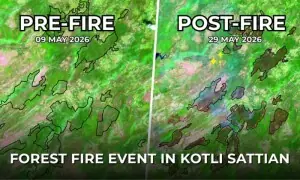
The fires that raged for two days decimated an estimated 3,326.4 hectares of natural forest tree cover across 27 locations in the protected and ecologically rich forest. Forest fire destroyed over 3,000 hectares in Kotli Sattian amid heat wave.

According to satellite data released by Suparco on Space4Climate.gov.pk, the analysis comparing imagery from May 9 to May 29 showed extensive damage in Chir pine forests. These forests play a key role in protecting sub-watersheds linked to the Indus and Jhelum river basins.

Forest Inspector, Forest Department Punjab, Mohammad Tufail told Dawn that flames reached a towering 100 feet fuelled by gusts of stormy winds.

“These are educated people, quite sensitised about risks and consequences of triggering forest fires. It’s lamentable that anyone would act so carelessly,” he said, explaining that in his area of jurisdiction, which was labeled, Forest 99, fires had not raged since 2016-17.

He complained about lack of proper firefighting equipment and manpower to overcome forest fires.

“We were less than a dozen forest staff members with brooms to put out flames that were engulfing Pine trees and dry shrubs fast,” he said.

According to Ministry of Climate Change, forest fire destroys over 3,000 hectares in Kotli Sattian amid heat wave. These forest fire events generally affect the breeding season of the birds, animals, regeneration loss of seedlings and saplings and colonisation of invasive fire tolerant grasses and shrubs.

Environmentalists warned that the ecological aftermath extended far beyond the immediate burn scars and that the disaster had severely disrupted the peak breeding season for local birds and wildlife, destroyed vital young seedlings and saplings, and opened the door for invasive, fire-tolerant grasses and shrubs to colonise the damaged terrain.

Mohammad Saleem, who is spokesperson for the Ministry of Climate Change and Environmental Coordination, told Dawn that the massive wildfire in Kotli Sattian was not an isolated environmental incident. It was a stark warning of a new climate reality confronting Pakistan.

“Forest fires are increasingly becoming the ‘new normal’ across the country as rising temperatures, prolonged dry spells, erratic rainfall patterns and recurrent heat waves create ideal conditions for ignition and rapid fire spread.”

He said scientific evidence was unequivocal.

“A recent study published in NPJ Climate and Atmospheric Science found that the climate crisis was intensifying extreme heat events across South Asia, with Pakistan emerging as one of the regional hotspots for increasingly synchronised and severe heat waves. These conditions substantially elevate wildfire risks by drying vegetation and reducing soil moisture. Likewise, a study published in Nature Communications has shown that global warming is expanding wildfire-prone areas and lengthening fire seasons worldwide.

According to the World Resources Institute, forest fires now burn more than twice as much tree cover globally as they did two decades ago, largely as a consequence of climate change.

He said the future of Pakistan’s forests would be determined not only by climate policies and firefighting equipment, but also by the awareness, vigilance and stewardship of the communities living closest to them.

“Local communities are the frontline protectors of our forests, and investing in their engagement, training and ownership is among the most effective defences against the growing threat of wildfires,” he added.

While local communities and forest department personnel have successfully contained the blaze in several areas, active fires continue to spread across neighbouring slopes, driven by strong, hot winds that threaten further environmental degradation.

According to locals, Kotli Sattian is being promoted by the local government as an upcoming tourist destination, with its pristine natural environment, breathtaking sceneries, the Bisa waterfall, and clear areas for camping.

Kotli Sattian is ecologically sensitive because the Murree-Kotli Sattian landscape was dominated by Chir pine forest, steep slopes and sub-watersheds linked with the Indus/Jhelum basin. Kotli Sattian forest area under Punjab Forest Department jurisdiction was about 27,653 acres.

Fareha Yousaf said she had never faced such a horrific experience where she feared her family would lose their home. “We are all so scared that even though the fire has been put out, the fear is not going away.”

Published in Dawn, June 3rd, 2026

❌
Subscriptions