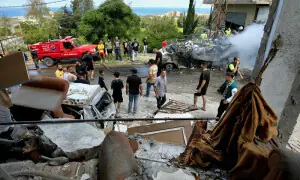
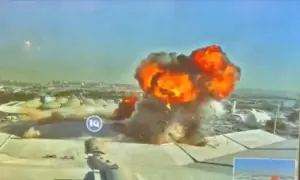
BEIRUT: An Israeli strike on a military vehicle in southern Lebanon killed three soldiers, the Lebanese military said on Saturday, laying bare Israel’s continued aggression just days after the countries discussed a conditional truce during talks in the United States.
Israel has launched an invasion into Lebanon, claiming it seeks to root out Hezbollah, which engaged in the wider Middle East war by launching retaliatory missiles against Israeli forces in response to US-Israeli strikes that killed
BEIRUT: An Israeli strike on a military vehicle in southern Lebanon killed three soldiers, the Lebanese military said on Saturday, laying bare Israel’s continued aggression just days after the countries discussed a conditional truce during talks in the United States.
Israel has launched an invasion into Lebanon, claiming it seeks to root out Hezbollah, which engaged in the wider Middle East war by launching retaliatory missiles against Israeli forces in response to US-Israeli strikes that killed Iran’s supreme leader.
Meanwhile, Lebanon has vowed that it will disarm Hezbollah over time, but has also denounced Israel’s invasion, accusing it of employing scorched-earth tactics to drive civilians out of southern towns and villages.
In the latest incident, the Lebanese army said two officers and a soldier were killed in a strike on a military vehicle on the road between Khardali and Nabatieh.
Tehran rejects claims it is using Lebanon as ‘bargaining chip’, urges Beirut to focus on ‘real foe’
Hezbollah dubbed the attack a “heinous crime”. It criticised the Lebanese government for exposing its own country to further bloodshed through its “complete surrender to the enemy’s demands in Washington”.
A conditional truce announced this week in Washington requires Hezbollah to stop firing and withdraw from near the Israeli border, and would see Lebanon’s army deploy to new “pilot zones” in the area, where it will exercise exclusive control. But Hezbollah has rejected the agreement, demanding a Israeli troops withdrawal.
The Lebanese army said that “the continuation of the deliberate and repeated brutal Israeli aggression … is aimed at thwarting all efforts to reach a solution”.
Lebanese President Joseph Aoun also denounced the latest attack, calling it a “flagrant violation of Lebanese sovereignty … despite Lebanon’s efforts in the Washington negotiations to put an end to the continued Israeli aggression that goes unchecked”.
On Saturday, Israel renewed evacuation orders for five villages in Lebanon’s south and east, telling residents to move north of the Zahrani River. Its military conducted several strikes across South Lebanon, according to Lebanese state media.
Iranian Foreign Minister Abbas Araghchi on Saturday rejected Aoun’s remarks that Lebanon was a bargaining chip for Tehran.
“Had Lebanon been a bargaining chip for Iran, we’d have a deal long ago,” Araghchi posted on X. “Based on Mr Aoun’s comments, one would think it’s Iran that has occupied 1/5 of Lebanon, displaced 1/4 of Lebanese and bombing his country on daily basis… Save Lebanon from your real foe, Mr. President,” Araghchi added.
BAHRAIN: A damaged building and vehicle are seen in the aftermath of Iranian drone attacks.—Reuters
• Announcement comes after US calls off Iran attacks• Oil drops after Washington backs down• IRGC strikes Bahrain, Jordan, Kuwait after US bombs targets across Iran• Tehran says American attacks have rendered ceasefire ‘practically’ meaningless• Saudis call for Pakistan, Qatar-led efforts for renewed talks• Iran ‘completely’ closes Hormuz
WASHINGTON / TEHRAN: US President D
BAHRAIN: A damaged building and vehicle are seen in the aftermath of Iranian drone attacks.—Reuters
• Announcement comes after US calls off Iran attacks • Oil drops after Washington backs down • IRGC strikes Bahrain, Jordan, Kuwait after US bombs targets across Iran • Tehran says American attacks have rendered ceasefire ‘practically’ meaningless • Saudis call for Pakistan, Qatar-led efforts for renewed talks • Iran ‘completely’ closes Hormuz
WASHINGTON / TEHRAN: US President Donald Trump on Thursday said the United States and Iran could sign a peace deal as soon as this weekend that would reopen shipping traffic through the Strait of Hormuz.
The agreement, if finalised, would be the most significant diplomatic breakthrough yet to end the three-month-old war, which has killed thousands of people and sent global energy prices sharply higher.
Iran’s semi-official Fars news agency reported that Tehran is likely to approve the agreement, though it has yet to give a formal response.
However, Iran’s foreign ministry spokesperson said matters related to an agreement are speculation and nothing has been finalised, according to Iran’s state-run IRNA news agency.
“We just made a great settlement of the war with Iran,” Trump told reporters at the White House. “The strait will officially open as soon as we sign, which could be soon, very soon, maybe over the weekend in Europe,” he said. Vice President JD Vance could sign for the United States, Trump added.
When asked if Iran’s Supreme Leader Ayatollah Mojtaba Khamenei has approved the deal, Trump said: “I understand the answer is yes.”
Trump’s announcement came after he called off planned military strikes on Iran, citing progress in talks.
Since mid-March, Trump has repeatedly claimed that a deal with Iran to end the war is close. The two sides have traded strikes throughout the week, straining a ceasefire announced in April.
He called off planned strikes on Iran hours after threatening more bombings and a desire to “take” its oil export hub Kharg Island.
That statement came after both sides attacked each other in the early hours of Thursday, putting an already-fragile ceasefire to the test. After the US attacked targets across Iran, the Iranian army responded with strikes on US targets in Bahrain, Jordan, and Kuwait.
In a statement posted on Truth Social, President Trump said, “Based on the fact that discussions with the Islamic Republic of Iran have been brought to the highest level of Iranian leadership and approved, I have, as President of the United States of America, cancelled the scheduled strikes and bombings against Iran this evening.”
He said “discussions and final points” have been approved by the United States, Israel, Saudi Arabia, UAE, Qatar, Turkiye, Pakistan, Bahrain, Kuwait, Jordan, Egypt and others.
“The Naval Blockade will remain in full force and effect until this Transaction is finalised — Time and place of the signing to be announced shortly,” he added.
Oil prices fell after he cancelled plans to strike Iran within hours. Brent futures fell $2.50, or 2.7pc, to $90.60 a barrel by 1838 GMT. US West Texas Intermediate (WTI) crude futures fell $2.32, or 2.6pc, to settle at $87.71 a barrel.
Overnight strikes
In response to the US strikes, Iran’s Islamic Revolutionary Guard Corps (IRGC) said it fired ballistic missiles at a US command centre in Jordan and attacked the US Fifth Fleet in Bahrain.
“During two waves of operations, eighteen important targets belonging to the US Army in the bases of Ali and Ahmad Ahmad Air Force (were hit),” the Guards said in a statement quoted by state-run IRNA, adding that they also “hit and destroyed Sheikh Isa air bases”.
The US military, meanwhile, said that it targeted “Iranian military surveillance capabilities, communication systems, and air defence sites across Iran”.
“US Marine Corps, Air Force, and Navy assets fired precision munitions on Iranian targets that posed a threat to US forces and international commercial ships transiting regional waters,” Central Command posted on X.
The Fars news agency reported that explosions have been heard in the port city of Bandar Abbas, while citizens have reported hearing explosions in Kargan and Minab.
Following these strikes, the US president warned of more attacks. The US will “be hitting Iran … very hard tonight”, he said, reiterating his claim that Iran’s military and “all other forms of defence” had been rendered inoperable.
“At some point in the not-too-distant future, we will be taking Kharg Island, and other oil infrastructure points, and assume total control of their Oil and Gas Markets, much like we have with Venezuela,” he added in a post on Truth Social.
Iran’s parliament speaker Bagher Ghalibaf, in an apparent warning to President Trump, said, “Wrong strategies and impulsive decisions will reset the entire board for the worse, explode energy infrastructure and markets and create an endless quagmire that you will be stuck in for years.” “You will see a different Iran.”
Iran’s top joint military command, Khatam al-Anbiya Central Headquarters, also warned the United States will receive a more severe response than before.
“Considering recent US threats against Iran’s oil infrastructure, either oil and gas exports are for everyone, or they will be available for no one,” the command said in a statement carried by state media, adding that the war will become more widespread and extensive, causing insecurity in the region.
Meanwhile, Iran’s foreign ministry condemned the latest US strikes on the country, saying the attacks rendered the nearly two-month ceasefire “practically meaningless”.
Calls for renewed talks
As the situation escalated between the two countries, Saudi Arabia called for renewed negotiations under Pakistani and Qatari mediation to end the Middle East war.
In a statement, the Saudi foreign ministry called for “de-escalation and restraint, urging all parties to prioritise wisdom by returning to diplomatic efforts and resuming the constructive negotiations sponsored by the Islamic Republic of Pakistan, along with the efforts of the State of Qatar”.
Pakistan also called for a “negotiated settlement”. Foreign Office spokesperson Tahir Andrabi said Pakistan’s leadership would continue its mediation efforts to help end the war between the United States and Iran despite the recent escalation in the conflict.
“Pakistan remains deeply concerned about the situation in the region, which has been marked by recent escalation. We are of the view that diplomacy and dialogue should be the guiding principles for achieving a negotiated settlement of all contentious issues,” he said during his weekly press briefing.
The renewed strikes also prompted calls for de-escalation from the UN chief, China, Russia, Turkiye and the EU.
Closure of Hormuz
Earlier in the day, Iran’s new body overseeing the Strait of Hormuz confirmed a complete closure order for the strategic waterway until further notice, after the Revolutionary Guards announced the move overnight, AFP reported.
“Due to the tensions caused by the aggression of the American forces in the region and the announcement made last night by the Iranian armed forces, the Strait of Hormuz will be closed until further notice,” the Persian Gulf Strait Authority said in a post on X.
Meanwhile, Indian foreign ministry spokesperson Randhir Jaiswal called for attacks on ships to cease, after three Indians were killed in a US attack on an oil tanker in the Gulf, Al Jazeera reports. Jaiswal told reporters that another ship, M/T Jalveer, was attacked by the US Navy.
• Shehbaz hopes deal will pave way for lasting peace, says Pakistan preparing for ‘electronic signing’• Trump claims signing scheduled for today; threatens Iran; official says Washington to take part in de-mining• Iran states deal close but rules out signing today; negotiators not going to Islamabad, Geneva soon
ISLAMABAD: In what appears to be a historic milestone for Middle East peace, Islamabad is preparing for an electronic signing by the US and Iran on a framework for a peace deal, to be fo
• Shehbaz hopes deal will pave way for lasting peace, says Pakistan preparing for ‘electronic signing’ • Trump claims signing scheduled for today; threatens Iran; official says Washington to take part in de-mining • Iran states deal close but rules out signing today; negotiators not going to Islamabad, Geneva soon
ISLAMABAD: In what appears to be a historic milestone for Middle East peace, Islamabad is preparing for an electronic signing by the US and Iran on a framework for a peace deal, to be followed by technical-level talks next week, albeit with varying dates for the remote signing as Trump insisted that it would be inked on Sunday while Iranian authorities denied it would be as early.
Prime Minister Shehbaz Sharif, in a post on X on Saturday, announced that the agreement was expected to be “finalised in the next 24 hours”. The deal was “closer…than ever before”, he wrote, hoping that the deal would lay a “strong foundation for lasting peace”.
Shortly afterwards, US President Donald Trump reposted PM Shehbaz’s tweet, while Iran ruled out the ‘Islamabad MoU’ would be signed on Sunday.
However, both warring parties have declared it would be signed within a day or two.
In a post on Truth Social, President Trump insisted that the deal was “scheduled to get signed” on Sunday, which would open the Hormuz. According to the US president, no money will exchange hands and that “at the appropriate time, when all is calm, we will go in and get the nuclear dust … and downblend and destroy it, whether in Iran, or the United States”.
“We look forward to working with Iran and the entire Middle East, long into the future. Hopefully, this process will all work out quickly, easily, and smoothly. If it doesn’t, we have the ultimate alternative, hopefully never to be used again!” he added.
Iran ruled out signing the deal on Sunday, but said it was close. The exact timing of the signing of the Islamabad memorandum will not be on Sunday, Iran’s foreign ministry spokesperson Esmaeil Baghaei said.
Mr Baghaei added that the possibility of signing the memorandum in the coming days cannot be ruled out, but added that caution was needed regarding any comment on the signing date due to the hesitation of the other side. “We must wait for the exact time of the signing,” he added. The Iranian spokesperson also said that they would not be travelling to Geneva or Islamabad – the possible venues — in the “next day or two” to sign an agreement.
Iranian President Masoud Pezeshkian said that the country’s 12-day war against Israel last year “proved that, beyond any taste or perspective, whenever our dear Iran is at stake, we are one nation, one clenched fist, and one beating heart”.
De-mining of Hormuz
Reuters quoted a senior US official saying that the US would participate in the de-mining of the Strait of Hormuz once the accord was sealed.
Iranian parliament speaker Bagher Ghalibaf stressed that “enforceable commitments” must accompany any possible understanding between Tehran and Washington, the semi-official Tasnim news agency reported. As both sides gave final touches to a peace agreement, violence in the Strait of Hormuz continued.
The US forces shot down multiple Iranian one-way attack drones heading toward the Strait of Hormuz, Reuters reported. Centcom later confirmed the action and said the waterway was open for transit.
According to Iranian news agencies, explosions were heard along the strait in Iran’s Sirik port and Qeshm Island, which local officials attributed to shots fired by Iranian forces to warn vessels attempting to cross the waterway without permission from the IRGC navy. A day earlier, Mr Araghchi said Iran would not impose tolls on Hormuz but would collect service fees, saying that this would be discussed.
A tanker had been struck by an unknown projectile in its port bow off the coast of Oman, Reuters reports citing the UK Maritime Trade Operations Centre. UKMTO says the incident occurred on Friday, six nautical miles east of Oman. The crew are reported safe and there is no reported environmental impact, while the tanker continues to its next port of call.
On Saturday, PM Shehbaz received a call from Sheikh Mohammed bin Abdulrahman bin Jassim Al Thani, who has paid tribute to the premier and Chief of Army Staff Field Marshal Asim Munir for playing an instrumental role in steering the diplomatic efforts, according to a statement from the Prime Minister’s Office (PMO).
“The prime minister expressed his deep appreciation for Qatar’s strong and steadfast support for Pakistan’s peace efforts throughout the Gulf crisis and stated that a peace deal was ready for signatures by the relevant parties very shortly,” it said.
Foreign Minister Ishaq Dar and his Saudi counterpart, Prince Faisal bin Farhan, also welcomed the final stage of negotiations between the US and Iran, according to a Foreign Office statement.
“They welcomed the US-Iran negotiations in their final stage, with the electronic signing ceremony scheduled for tomorrow, and expressed the hope that this important development will contribute to lasting peace and stability in the region,” the FO said.
NEW YORK: A former Afghan Taliban commander charged by the United States with abducting a journalist and supporting fighters who killed American troops in 2008 was sentenced on Tuesday to 42 years in prison.
Haji Najibullah, 50, was accused by US prosecutors of kidnapping an American journalist, identified as New York Times journalist David Rohde, and two Afghan civilians.
He was also charged with the deaths of three US soldiers and an Afghan interpreter in an attack by forces under his command
NEW YORK: A former Afghan Taliban commander charged by the United States with abducting a journalist and supporting fighters who killed American troops in 2008 was sentenced on Tuesday to 42 years in prison.
Haji Najibullah, 50, was accused by US prosecutors of kidnapping an American journalist, identified as New York Times journalist David Rohde, and two Afghan civilians.
He was also charged with the deaths of three US soldiers and an Afghan interpreter in an attack by forces under his command in June 2008. Arrested in Ukraine, he was extradited to the United States in 2020.
He pleaded guilty last year to hostage taking and providing material support for acts of terrorism resulting in death, according to a Justice Department statement. “Those who harm Americans and engage in acts of terrorism will be hunted down and brought to justice, no matter how long it takes,” Acting Attorney General Todd Blanche said in the statement.
Rohde was kidnapped in Afghanistan in November 2008, along with a translator and a driver. According to the Times, which managed to keep the news of his kidnapping secret so as not to endanger him, Rohde managed to escape from his captors in June 2009.
Najibullah acted as a prominent Taliban commander and unofficial spokesperson in Afghanistan’s Wardak province, managing over 1,000 fighters near Kabul.
He confessed to orchestrating ambush-style attacks against US military convoys. His forces were directly responsible for a June 2008 attack that killed three US soldiers and an Afghan interpreter, as well as the downing of a military helicopter in October 2008.
• Iran launches fresh missile, drone attacks on Kuwait, Bahrain• Kuwait says new attack ‘dangerous escalation’; Bahrain denounces ‘blatant aggression’• Falling debris causes ‘material damage’ in Kuwait• Centcom says four attack drones downed near Hormuz; Iranian coastal radar sites also hit• Trump says Iran has ‘22pc’ of missiles left• US okays sale of $2bn in anti-drone weapons to Kuwait
KUWAIT CITY: Iran launched fresh missile and drone attacks on Bahrain and Kuwait early on Saturday, while th
• Iran launches fresh missile, drone attacks on Kuwait, Bahrain • Kuwait says new attack ‘dangerous escalation’; Bahrain denounces ‘blatant aggression’ • Falling debris causes ‘material damage’ in Kuwait • Centcom says four attack drones downed near Hormuz; Iranian coastal radar sites also hit • Trump says Iran has ‘22pc’ of missiles left • US okays sale of $2bn in anti-drone weapons to Kuwait
KUWAIT CITY: Iran launched fresh missile and drone attacks on Bahrain and Kuwait early on Saturday, while the United States said it struck Iranian coastal radar sites after intercepting missiles and drones aimed at Gulf allies and the Strait of Hormuz, further straining a fragile ceasefire.
Bahrain and Kuwait intercepted seven Iranian missiles, while Bahrain also destroyed several drones, officials said. It was the second attack on both Gulf states since Wednesday.
Iran’s Revolutionary Guards said they had targeted “enemy bases” with missiles after the US military said it struck radar sites in Iran and downed drones headed towards the strategic Strait of Hormuz.
Bahrain, home to the headquarters of the US Fifth Fleet, denounced the attacks against its territory and neighbouring Kuwait as “blatant aggression” and “a flagrant violation of the sovereignty of both countries”.
In Bahrain’s capital Manama, an AFP journalist reported hearing three explosions, while the interior ministry said air raid sirens had sounded across the country.
Later, Bahrain’s military said its air defences had “successfully intercepted and destroyed three missiles and several drones”.
Kuwait also condemned the attacks, calling them a “direct threat” to the lives of citizens and residents and a “dangerous escalation” at a time when the international community was making efforts to stop combat operations.
In Kuwait, an AFP journalist reported hearing repeated blasts near the country’s international airport, which had been struck on Wednesday in an attack blamed on Iran that killed one person.
“We woke up to a huge explosion. The explosions were very loud,” Reem, an Egyptian mother of two, said, referring to the Saturday attacks. “My children were terrified, and I couldn’t calm them down,” she said.
Kuwait’s military said it had “engaged seven hostile ballistic missiles” in Kuwaiti airspace. It added that some interceptions over residential areas caused falling debris, resulting in material damage but no casualties.
In the hours after the barrages, Kuwait’s aviation authority announced the resumption of air traffic, saying 11 Kuwait Airways and Jazeera Airways flights had been diverted during an airspace closure caused by the Iranian attack.
Qatar, Egypt and Jordan joined Bahrain and Kuwait in condemning the attacks, calling them violations of sovereignty and international law.
In a statement, the Qatari Ministry of Foreign Affairs called for de-escalation and stressed the necessity of sparing the region the consequences of “unjustified attacks”.
Egypt also strongly condemned the “heinous Iranian attack that targeted Kuwait and Bahrain”, terming them a flagrant violation of the sovereignty of the two countries and “a dangerous escalation that threatens the security and stability” of the entire region.
The Jordanian foreign ministry said in a statement that the attacks constitute a blatant breach of international law and the United Nations Charter.
US strikes Iranian sites
US Central Command said six of the seven ballistic missiles fired towards Kuwait and Bahrain were downed, while the seventh “did not reach its intended target”.
Centcom also said US forces downed four one-way attack drones before they could threaten maritime traffic near the Strait of Hormuz.
US forces then struck Iranian coastal radar sites to prevent further attacks. No US personnel were harmed, Centcom said.
Iran’s foreign ministry condemned the US attack on coastal radar installations in the Gulf, calling it a “flagrant” violation of the ceasefire in place since April.
It described the strikes as an attack “on the national sovereignty and territorial integrity of the Islamic republic” and denounced Washington’s “hostile and provocative behaviour”.
Trump says Iran still has missiles
US President Donald Trump claimed Iran still had “21, 22 per cent” of its missiles left after Tehran fired dozens across the region.
“They still have capacity. They have some missiles, they have some drones. I would say, percentage-wise, maybe 21, 22pc of their missiles,” Trump told NBC News.
The estimate is higher than the 18pc he gave in May. Trump has often claimed to have completely destroyed Iran’s war-fighting capacity.
Weeks of complex talks marked by threats and flare-ups of violence have failed to secure a deal to end the war. However, Trump said Iran had “got no choice” except to reach an agreement.
“They’re strong, they’re proud, there are things they never thought they’d be doing that they’re going to have to do,” he said.
Meanwhile, the United States also announced its approval of a $1.98 billion arms sale to Kuwait, one of the Gulf countries hit by Iranian strikes during the Middle East war.
In a statement, the US State Department said it would allow purchases of counter-drone technology from defence company Anduril, which was founded by a supporter of President Trump.
“This proposed sale will support the foreign policy and national security objectives of the United States by improving the security of a major non-Nato ally that has been an important force for political stability and economic progress in the Middle East,” the statement said.
MALE: Pakistan ended a 74-year wait for a football tournament title on Wednesday, defeating Afghanistan 2–0 in the final of the Diamond Jubilee International Football Tournament in at the National Stadium to claim a historic first stand-alone international crown.
Shayek Dost produced a spectacular overhead kick to open the scoring in the first half before substitute Harun Hamid added a second in stoppage time to seal victory, as Pakistan lifted a tournament trophy for the first time since 1952
MALE: Pakistan ended a 74-year wait for a football tournament title on Wednesday, defeating Afghanistan 2–0 in the final of the Diamond Jubilee International Football Tournament in at the National Stadium to claim a historic first stand-alone international crown.
Shayek Dost produced a spectacular overhead kick to open the scoring in the first half before substitute Harun Hamid added a second in stoppage time to seal victory, as Pakistan lifted a tournament trophy for the first time since 1952 — when they shared the Asian Quadrangular title on a league basis.
The triumph also marks the first time in Pakistan’s history that the men’s national team has won a tournament final outright.
Afghanistan started brightly and tested Pakistan early, but the Shaheens gradually settled into rhythm. Otis Khan was influential down the left flank and it was from one of his moves that Pakistan struck in the 24th minute.
A loose clearance and a misdirected cross fell kindly for Shayek, who adjusted brilliantly to execute an acrobatic finish into the net, sending the Pakistan supporters into celebration.
Afghanistan responded before half-time, hitting the crossbar in injury time, but Pakistan held on to take a 1–0 lead into the break.
The second half saw Pakistan continue to press, with Adil Nabi striking the bar soon after the restart, while Afghanistan pushed forward in search of an equaliser.
As the match wore on, Pakistan defended resolutely with goalkeeper Saqib Hanif marshaling the back line effectively. Harun then put the result beyond doubt in stoppage time, beating his marker with a sharp turn before finishing past the post.
Pakistan had earlier gone unbeaten en route to the final, including a 2–0 win over Afghanistan in the round-robin stage, and sealed the title with a third consecutive victory in the tournament.
Pakistan head coach Norberto Solano praised his side’s resilience and growth, saying the win reflected their progress ahead of next year’s Asian Cup and World Cup qualifying campaigns.
“We proved that we are a strong group of boys coming back after the Bangladesh draw. They are happy, I am so glad for them, for the Pakistani nation,” Solano said. “This brings back belief in football. They have amazing talent. We have to continue this as we have more challenges in September, October and November. We have to prepare well before Asian competitions start next year.”
Pakistan captain Abdullah Iqbal dedicated the trophy win to the country’s football supporters.
“Very happy with the team first and foremost,” he said after the match. “This one is for the fans. We have worked so hard for the fans. We had to give back to the fans. They had supported us through very tough times. That’s the most important thing for us.”
Pakistan Football Federation (PFF) president Syed Mohsen Gilani, in a brief statement, said the victory marked a key milestone in his tenure and signalled a “new beginning” for Pakistan football.
• Netanyahu not coming to Trump’s bilateral meetings• One-on-one session with Zelensky not planned
WASHINGTON: US President Donald Trump will meet Middle Eastern leaders and attend a working session with Ukrainian President Volodymyr Zelensky during the G7 summit next week, senior US administration officials said on Saturday.
The officials said Trump, who is scheduled to travel to Evian, France, for the G7 summit early on Monday, would meet separately with the leaders of Egypt, Qatar, United Ara
• Netanyahu not coming to Trump’s bilateral meetings • One-on-one session with Zelensky not planned
WASHINGTON: US President Donald Trump will meet Middle Eastern leaders and attend a working session with Ukrainian President Volodymyr Zelensky during the G7 summit next week, senior US administration officials said on Saturday.
The officials said Trump, who is scheduled to travel to Evian, France, for the G7 summit early on Monday, would meet separately with the leaders of Egypt, Qatar, United Arab Emirates, France and India, though no bilateral meeting with Zelensky is planned.
A senior US administration official said that Israel’s Netanyahu is not coming to Trump’s bilateral meetings with Middle Eastern leaders at G7.
Trump will participate in a working session on Tuesday with Zelensky and G7 leaders. The meeting comes at a time when Russian advances in Ukraine have slowed and Ukraine seeks more military funding from its allies.
One of the senior US officials, who briefed reporters on condition of anonymity about Trump’s trip, said Russian gains have “more or less stopped”. “We want the war to end as quickly as possible,” the official said.
Trump has had up-and-down relations with Zelensky. No bilateral meeting was planned with Zelensky but the two leaders could meet on the sidelines of the summit, the officials added.
He will speak to a number of European leaders with whom he has squabbled over trade, tariffs, Ukraine and Nato since his return to the White House early in 2025.
Trump planned to raise issues of shared importance with leaders at the summit, including economic growth and development, supply chain resilience, illegal migration and AI, one of the officials said. He also planned to work on boosting resilience in the supply chain for critical minerals needed for advanced technologies.
Before returning to Washington, Trump planned to attend a dinner with French President Emmanuel Macron at the Palace of Versailles on Wednesday, the officials said.
‘On receiving end’
Meanwhile, Liana Fix, an associate fellow at the Council on Foreign Relations, told AFP ahead of the summit, which will bring the United States face-to-face with France, Germany, Canada, Italy, Japan, and the United Kingdom, “all of these countries’ leaders have been on the receiving end of Trump’s trade pressure or diplomatic intimidation, with the exception of Japanese Prime Minister Sanae Takaichi, for whom he has expressed particular fondness.”
Neither growing unpopularity that could cost Trump control of Congress, nor court’s annulment of his across-the-board tariffs is likely to soften his stance toward partners. European leaders have learned, through the Greenland episode, trade conflicts, and Iran war, “to hope for the best but to expect the worst,” she said.
NEW DELHI: Pakistan has decided not to send its team for the Asian Senior Fencing Championships to be held in New Delhi from June 19 despite the local organisers sending an invite to the neighbouring country to take part in the continental event, Press Trust of India (PTI) news agency reported on Thursday.
India is hosting the championships for the first time. Fencers from more than 30 countries across Asia and Oceania will be seen in action. Nearly 100 delegates and technical officials will ove
NEW DELHI: Pakistan has decided not to send its team for the Asian Senior Fencing Championships to be held in New Delhi from June 19 despite the local organisers sending an invite to the neighbouring country to take part in the continental event, Press Trust of India (PTI) news agency reported on Thursday.
India is hosting the championships for the first time. Fencers from more than 30 countries across Asia and Oceania will be seen in action. Nearly 100 delegates and technical officials will oversee the event.
“We sent an invite to Pakistan, as well as Afghanistan, to participate in the championships but they chose not to send their fencers. The deadline for sending entries is long over and we are now in the process of procuring visas for the athletes and officials,” the Fencing Association of India (FAI) secretary general Rajeev Mehta told PTI.
Last month, the Indian Sports Ministry had reiterated that the blanket ban on bilateral sporting ties with Pakistan that was imposed last year will remain in force, but the athletes from across the border will not be stopped from coming here for multilateral events.
Despite that, Pakistan has chosen not to send the entries of their fencers.
The wife of a Lebanese army captain, who was killed by Israeli bombardment, salutes as mourners carry her husband’s coffin at his home village in southern Lebanon.—AFP
• Woman, child among 12 killed in attacks on Zifta, Tyre• Beirut counts 3,491 Israeli strikes since April 17; fresh bombardment damages Unesco heritage site• Hezbollah denies contact with Trump
BEIRUT: An Israeli strike on southern Lebanon killed 12 people on Monday as Lebanese Defence Minister Michel Menas
The wife of a Lebanese army captain, who was killed by Israeli bombardment, salutes as mourners carry her husband’s coffin at his home village in southern Lebanon.—AFP
• Woman, child among 12 killed in attacks on Zifta, Tyre • Beirut counts 3,491 Israeli strikes since April 17; fresh bombardment damages Unesco heritage site • Hezbollah denies contact with Trump
BEIRUT: An Israeli strike on southern Lebanon killed 12 people on Monday as Lebanese Defence Minister Michel Menassa revealed Israel has carried out nearly 3,500 air strikes since a US-brokered ceasefire took effect in April.
The Lebanese health ministry said the dawn raid on the town of Zifta in the Nabatieh district resulted in seven deaths, including a Syrian child and a woman, and wounded eight others.
Meanwhile, an Israeli strike on Tyre in southern Lebanon on Monday killed five people and wounded eight, the health ministry said, as Israel said it would continue strikes despite Iranian threats.
“An Israeli enemy raid on the city of Tyre, near the Red Cross centre, resulted in five martyrs and eight wounded, four of whom were Red Cross paramedics,” the ministry said in a statement.
The continuing violence underscores the fragility of the ceasefire that came into effect on April 17.
Nearly 3,500 Israeli attacks
During a cabinet meeting on Monday, Menassa said that between April 17 and June 7, Israel conducted 3,491 air strikes, 407 controlled demolitions and six razing operations, flattening entire villages in southernmost Lebanon.
PM Nawaf Salam said the escalation has caused additional waves of displacement. More than 1 million people have been displaced and over 3,600 killed since Hezbollah drew Lebanon into the conflict on March 2 with rocket fire at Israel to avenge the US-Israeli killing of Iran’s supreme leader.
The heavy bombardment in Tyre also damaged a Unesco World Heritage site. Ali Badawi, the culture ministry’s regional director of archaeological sites for south Lebanon, said Sunday’s bombardment had “the worst impact” on Tyre’s ancient areas since the war began. “The amount of debris and damage at the site is high,” Badawi said. “Some archaeological artefacts were damaged when rubble fell on them, as debris fell over a large area, impacting a large number of elements at the site — columns, capitals, column bases, mosaics.”
Tyre’s ruins include Roman baths, a second-century triumphal arch and a hippodrome. Lebanese Culture Minister Ghassan Salame appealed to protect the sites, charging that Israel “does not respect” the Hague Convention on the Protection of Cultural Property.
‘No contact with Trump’
Amid the ongoing conflict, a senior Hezbollah official denied statements from US President Donald Trump suggesting the two sides had communicated.
Senior Hezbollah official Mahmud Qomati said in written remarks that “there has been no direct contact between President Trump and Hezbollah officials”.
Trump told reporters last Wednesday that “we actually spoke with Hezbollah for the first time, ever,” and later claimed he had a “very good call” with the group through highly placed representatives.

 Login
Login