
Normal view

NZ’s ‘light-touch’ approach to voluntary carbon and nature markets may unlock finance but risks credibility

Getty Images

The government’s recent announcement of support for voluntary carbon and nature markets effectively offers a “warrant of fitness” to signal which markets can be trusted, without directly regulating them.

The aim is straightforward. By giving investors, landowners and developers confidence, the government hopes to unlock private finance for projects that reduce emissions or restore ecosystems.

As Associate Minister for the Environment Andrew Hoggard put it:

The pressures on nature and climate are bigger than the public purse.

But voluntary markets are based on self-imposed targets and governed by a patchwork of organisations. The credibility of climate claims in voluntary carbon markets has already been repeatedly challenged internationally.

This raises the deeper question of whether the government can create a credible framework by relying on externally developed standards in a lightly regulated system, or whether it risks outsourcing key decisions about environmental integrity.

How voluntary markets work

Carbon markets allow organisations to buy and sell “credits” representing reductions or removals of greenhouse gas emissions. In compliance markets – such as New Zealand’s Emissions Trading Scheme – participation is required by law, and governments set the rules.

Voluntary carbon markets are different. In these markets, businesses and individuals choose to buy credits to meet self-imposed climate targets or demonstrate environmental responsibility.

They are not governed by a single regulator. Instead, various independent organisations verify projects and issue credits, often following standards set by international bodies.

Voluntary nature markets work in a similar way but extend beyond carbon, covering biodiversity, water quality and ecosystem restoration.

This decentralised structure is both a strength and a weakness. It allows innovation and experimentation, but it also means that credibility depends heavily on the quality and consistency of external standards.

The credibility problem

Voluntary markets can channel finance into projects that fall outside regulated systems such as emissions trading schemes. But internationally, they have been dogged by controversy.

The main issue is credibility. For a carbon credit to have real climate value, the emissions reductions it represents must be real, additional and permanent. In practice, many credits fall short of these criteria.

Concerns have been documented widely. They include weak or inconsistent standards, limited transparency, difficulties verifying whether projects would have happened anyway, risks that stored carbon may later be released, and the possibility of the same reductions being counted more than once.

These problems are not just technical. Some analyses suggest a significant share of offsets used by companies may not deliver genuine emissions reductions.

Even where credits are of high quality, they can be misused to justify claims of “carbon neutrality” without any meaningful reduction in the use of fossil fuels.

The result has been a persistent gap between the promise of voluntary markets and their performance. Investor confidence has been shaken and concerns about greenwashing have grown.

A ‘light-touch’ solution

The government’s response is not to regulate the market directly, but to endorse schemes it considers credible.

Three international initiatives – the Integrity Council for the Voluntary Carbon Market, the Coalition to Grow Carbon Markets and the Paris Agreement’s own Crediting Mechanism – have received approval.

However, endorsement does not eliminate the underlying risks.

These initiatives operate within a system that remains fragmented and evolving. Their effectiveness depends on how consistently standards are applied, how rigorously projects are assessed and how transparently information is shared.

By relying on these schemes, New Zealand is effectively tying its approach to international governance processes over which it has limited control. Endorsement may signal quality, but it also outsources key judgements about environmental integrity.

It is a light-touch approach in a context where the risks are already well established.

Beyond trees

Despite these concerns, voluntary markets could offer important opportunities, particularly for diversifying New Zealand’s approach to carbon removal.

At present, tree planting dominates the country’s removal strategy. But there is growing interest in alternatives such as wetland and peatland restoration, soil carbon, coastal “blue carbon” ecosystems and emerging technologies such as direct air capture.

Many of these approaches are not yet supported by compliance markets. Voluntary markets could provide early-stage funding, helping promising ideas get off the ground.

In this sense, a light-touch approach may encourage innovation.

But here, too, the risks are not insignificant. Measuring and verifying carbon removals in soils, oceans or engineered systems is often more complex and uncertain than measuring emissions reductions. This makes these areas especially vulnerable to weak standards and low-quality credits.

The same flexibility that enables innovation also increases the risk of poor environmental outcomes, particularly in areas where robust measurement is hardest.

What role should voluntary markets play?

The international evidence suggests voluntary carbon and nature markets can play a useful but limited role in climate policy.

They can help mobilise private finance, support conservation and restoration projects and provide early funding for emerging technologies. But they are not a substitute for direct emissions reductions or strong domestic regulation.

For New Zealand, this implies a need for clear boundaries. Voluntary markets should complement, not undermine, the emissions trading scheme and other core climate policies. That means ensuring strict rules around how credits can be used and what claims can be made.

Without guardrails, voluntary markets could expand faster than the governance needed to ensure they deliver genuine climate benefits.

The government’s strategy may succeed in attracting investment. But its long-term credibility will depend on whether that investment translates into real, measurable and lasting environmental gains.

The Conversation

Jennifer Campion received funding from the Ministry of Business, Innovation and Employment under the Endeavour Fund.
NZ Budget 2026 at a glance: follow the money here

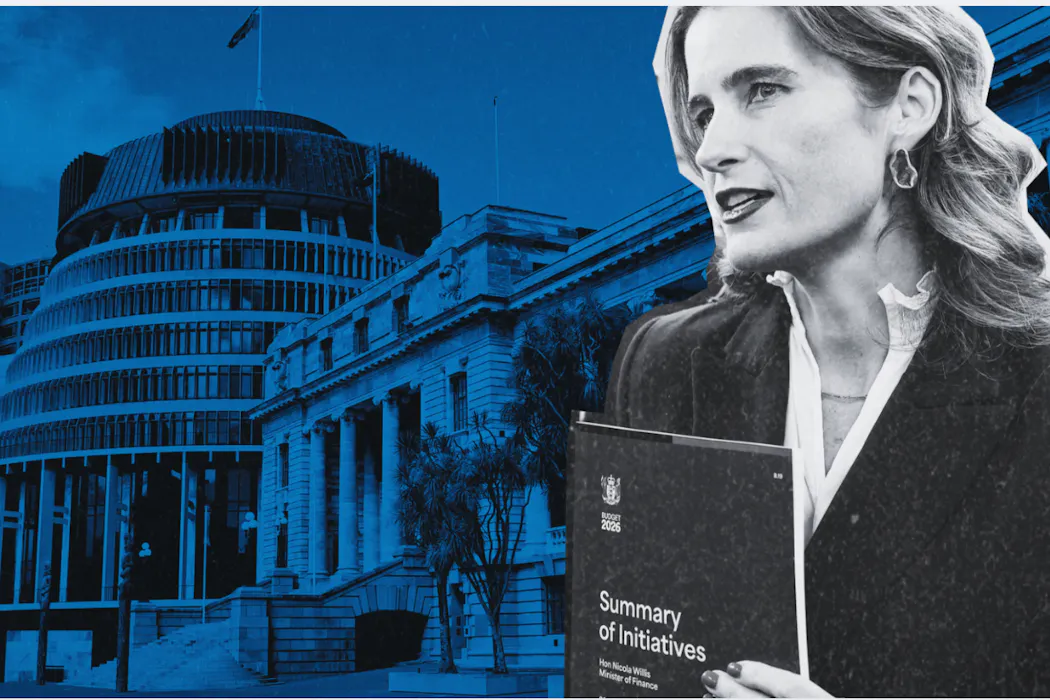
Finance Minister Nicola Willis delivered a disciplined budget today, asking New Zealanders to accept continued restraint in return for promises of longer-term economic growth – and an earlier-than-expected return to surplus.

Willis told Parliament:

This is a responsible budget. The government is responding to an increasingly uncertain world with an economic plan and sensible choices that will make New Zealand more secure in the years ahead.

In her budget address, Willis said New Zealanders could look forward to “growth, higher wages, and rising employment”, as well as “better public infrastructure, expanded healthcare services, better schooling and safer communities”.

A key figure is the projected NZ$2.6 billion surplus by 2028/29 – a notable improvement from the $900 million deficit the government forecast in December, and a year earlier than previously expected.

Willis said the surplus would mean “less debt and lower interest costs for us to pay than would otherwise be the case”. Net core Crown debt is now forecast to peak at 46.1% of GDP in 2027/28.

The government’s central pitch is that careful spending restraint and reprioritisation can return its books to surplus earlier than expected, without abandoning essential public services.

Willis had already revealed the operating allowance for new spending had been reduced by $300 million to $2.1 billion. A total $5.7 billion will be allocated to capital projects.

Budget 2026 introduces a new levy on banks, insurers and financial firms to fund their own regulation via the Reserve Bank from mid-2027, recovering $209 million over four years. Willis noted the levy would shift costs away from taxpayers.

Elsewhere, health received a notable boost, securing $5.8 billion in new operational funding. This includes $5.5 billion to frontline services over four years. There is also $680 million for health infrastructure such as Whangārei Hospital’s new 158-bed ward and land for a new hospital in Drury.

Many other figures and initiatives shared this afternoon were well signalled before budget day. This included a $1.6 billion defence package and a gas transition loan guarantee scheme expected to make up to $1.2 billion of bank loans available to businesses to cut their dependency on gas.

As with the previous budget, the government’s restraint will be keenly felt in some areas – already apparent in the proposed reduction in public service numbers announced earlier this month.

Ultimately, the test will be whether the budget’s restrained operational spending and targeted capital and infrastructure investments provide sufficiently for future productivity growth.

The risks are that tight spending, public sector cuts and limited new operational funding may leave some public services struggling to keep pace with demand, inflation and population growth.

Key spending

The Conversation

Michael P. Cameron is Vice President of the Population Association of New Zealand.

National insecurity: what happens when countries start to lose their sense of identity?

Getty Images

You need only glance at the headlines these days to know that the current state of international relations is dangerous.

From Washington’s retreat from multilateral commitments to Moscow’s aggressive ethno-nationalism, the defining feature of world affairs is not simply cold strategic calculation but something closer to anxiety.

To explain this search for certainty in a world that no longer reflects the stories states have long told about themselves, political theorists have turned to the field of psychiatry. Specifically, to ideas of “self” and “being” that explain the idea of “ontological security”.

Ontology is a branch of philosophy that ponders the basic question of what it means to exist. In psychiatry, the term ontological security was coined by Scottish psychiatrist R.D. Laing, who characterised mentally stable people as having an identity and sense of autonomy that is never in question.

Those suffering from schizophrenia, however, typically felt:

more unreal than real; in a literal sense, more dead than alive; precariously differentiated from the rest of the world so that his identity and autonomy are always in question.

States, too, can suffer from this form of insecurity – not as a clinical condition but a structural one, emerging from the uncertainties of a fracturing international system.

As political scientist Jennifer Mitzen argues, states have similar needs to people: “to experience oneself as a whole, continuous person in time” to maintain a stable identity.

In his book Modernity and Self-Identity, sociologist Anthony Giddens argues that ontological security for states involves a “sense of continuity and order in events” – “security as being” rather than “security as survival”.

When stories don’t come true

The danger is that when a state’s sense of self collapses, identity stops being a background condition of foreign policy and becomes its driving purpose, with potentially catastrophic results.

Russia is perhaps the best example. The collapse of the Soviet Union in the 1990s shattered Russia’s sense of self – its role, purpose and place in the world.

What followed was a decades-long search for ontological security that hardened under President Vladimir Putin into the assertion of a distinct Russian identity fundamentally incompatible with – and threatened by – the West.

But this didn’t provide the ontological security it promised. Rather, it sowed the seeds for the invasion of Ukraine. For Putin, Ukraine’s embrace of Western identity was not merely a geopolitical inconvenience; it was a rebuke to that assertion of Russian identity.

In this sense, the invasion was an attempt to resolve by force what could not be resolved by narrative, namely the claim Ukraine is not a real nation.

The United States is a different but equally instructive case. The post-Cold War moment of supreme ideological confidence – the sense that liberal democracy had triumphed and American power could remake the world in its image – was gradually hollowed out.

The disastrous interventions in Afghanistan and Iraq shattered not just US prestige, but America’s story about being the “shining city on a hill”.

President Donald Trump’s “America First” focus – a notion that the US should recover a simpler, more certain sense of itself by retreating from the commitments of the liberal international order – is a textbook case of a nation seeking ontological security.

But it also has significant ramifications for those countries that have wedded themselves to the US for their own security.

Recovering a shared sense of self

Australia and New Zealand are such countries. Given their relatively small sizes (albeit to different degrees), they have always outsourced their survival to a security guarantor – that being the US for the past 75 years.

The arrangement worked well enough because there was sufficient alignment between them based on their mutual attachment to the world order underwritten by US liberal hegemony.

Yet this is crumbling before our eyes. Under Trump, the US has opted for naked power over liberal persuasion. Both Australia and New Zealand have felt the ire of Washington in recent months.

Add to this domestic pressures such as declining trust in government, cost-of-living crises and growing societal unrest about high immigration.

Beneath this lies the deeper disruption wrought by social media and artificial intelligence, technologies that erode the shared narratives on which collective identity depends.

There is no easy fix. But the antidote may lie in what Canadian Prime Minister Mark Carney has proposed: an alliance of “middle powers”.

If the ontological insecurity of great powers such as the US and Russia is driving the world toward paranoia and conflict, middle powers – unencumbered by imperial pretensions or hegemonic nostalgia – may be better placed to anchor the international order.

Together, New Zealand and Australia have the traditions, relationships and geographic position to play a meaningful role in anchoring a fraying international order.

But doing so requires something harder than diplomacy: recovering a shared sense of what they actually stand for – their own ontological security – at precisely the moment when it is most in doubt.

The Conversation

Nicholas Ross Smith does not work for, consult, own shares in or receive funding from any company or organisation that would benefit from this article, and has disclosed no relevant affiliations beyond their academic appointment.

UN report warns AI could soon use 3% of world’s electricity and more water than we need to drink

Getty Images

One argument often used to quell concerns about the rising energy and resource demand of data centres is that artificial intelligence (AI) models will need less in the future as they improve and become more efficient.

But this seemingly logical thinking is a trap, according to a new United Nations report that quantifies the environmental costs of AI.

The report estimates that by 2030, AI’s energy use could double to consume 3% of the world’s electricity, produce emissions to equal the UK and deplete more water for cooling than the annual drinking water need of the global population.

It also anticipates the use of AI will follow an economic principle known as the “Jevons paradox”, which predicts that when technological improvements increase the efficiency of a resource, it leads to a rise, rather than a fall, in the total consumption of that resource.

The paradox is named after economist William Stanley Jevons who observed this effect with the use of coal in 19th-century England. Efficiency gains did not reduce overall consumption. Instead, the lower costs resulted in expanded use and higher overall demand.

As AI models become cheaper and more attractive, the report expects this to encourage new uses and higher volumes of use, eroding and possibly erasing any savings from efficiency advances.

To avoid falling into this trap, it lays out a roadmap for responsible AI use based on guiding principles of transparency, efficiency by design, equity and justice, lifecycle responsibility, global cooperation and sustainable use.

The scale of the problem

Last year, data centres already consumed as much electricity as Saudi Arabia, which ranks as the world’s 11th largest electricity consumer.

If electricity use doubles as projected by 2030, the associated carbon footprint would require 6.7 billion trees grown over ten years to offset this demand.

Data centres would also require 9.3 trillion litres of water and land nearly ten times the size of Mexico City.

Beyond resource use, the report also underscores the structural inequity at the heart of the AI boom, with only 32 nations hosting AI-specific cloud infrastructure and 90% of that capacity located in the US and China.

It warns of a widening digital divide between nations that build and control AI systems and those that consume them, with the latter often bearing a disproportionate environmental burden caused by mineral extraction and e-waste.

Responsible AI use

Two main forces shape AI’s operational footprint: how much we use it and how we use it.

This involves all tasks AI models perform, from text and code generation to image and video. Each of these tasks requires different levels of computational effort.

The model choice also matters as each AI system performs these task with distinct energy and environmental costs.

The report argues responsible AI requires full value-chain governance, from mineral sourcing to recycling and safe disposal.

It calls for a twinning of capability and environmental stewardship – thinking about both what AI can do for us and the protection of the natural environment.

This would mean making environmental disclosures a routine part of AI development, at both the model and task level, and incorporating projected AI demand in climate and energy planning.

Responsible AI is crucial as countries are promoting and adopting AI across government and the public sector.

In Aotearoa New Zealand, the government has launched a national AI strategy and a public service AI framework.

While the framework was informed by the OECD’s values-based AI principles, including inclusive and sustainable development, there is no requirement for environmental disclosures and no regulator compiling energy use or emissions.

Likewise in Australia, improving public services is part of the national AI plan. For example, the National Film and Sound Archive of Australia has created Bowerbird, a machine learning-enabled mass audio and video transcription engine, to document material. The Department of Veteran’s Affairs has developed a proof-of-concept tool to see whether AI can help speed up the processing of claims.

Both countries take a deliberate “light touch” and principles-based regulatory approach to AI. But this approach risks overlooking the growing environmental cost of AI that can’t be solved by improving it.

The natural environment is foundational to the economy, culture and wellbeing. It should be at the centre of our thinking. It’s time to rethink the AI innovation playbook and shift focus toward a sustainable tech future.

The Conversation

Amanda Turnbull-McRae does not work for, consult, own shares in or receive funding from any company or organisation that would benefit from this article, and has disclosed no relevant affiliations beyond their academic appointment.

Why a US ‘freeloading’ claim has put the heat on NZ’s independent foreign policy

If there’s one area of New Zealand foreign policy that demands delicate diplomatic language from elected officials, it is the country’s nuclear-free status.

So when Defence Minister Chris Penk suggested it “would be helpful” to have a conversation about the difference between nuclear weapons and nuclear propulsion, the response was swift.

Opposition parties questioned whether the government was planning a review of the relevant legislation, forcing Prime Minister Christopher Luxon to confirm there would be no change to the policy.

Unfortunately, the issue may not be that easy to avoid in the near future.

Penk was speaking at a security forum in Singapore and responding to a reporter’s query about what Australia’s acquisition of nuclear-powered submarines might mean for nuclear-free New Zealand.

That’s a fair question, given Australia is New Zealand’s only formal ally, and closer military relations between the two countries are central to the government’s Defence Capability Plan.

The AUKUS factor

Penk’s comments were also timed unfortunately, coming a day after United States Secretary of War Pete Hegseth suggested New Zealand was “freeloading” as an ally, and defence spending at 2% of gross domestic product (GDP) was “not enough”.

This tacit pressure comes at a time when global military expenditure has accelerated rapidly, wars and conflicts are expanding, and fears grow about a new arms race.

Hegseth is pushing for partner nations to “reach a level where 3.5% of national spending goes towards their own military”.

That reflects the recent commitment by NATO countries to invest 5% of GDP annually on defence and security by 2035 (with 3.5% on core military requirements).

New Zealand and Australia are not members, but both have partnership agreements with NATO. Australia currently spends 2.2% of its GDP on the military, and is aiming for 3% by 2033.

New Zealand aims to hit the 2% target in 2032, which would bring spending broadly in line with peacetime military budgets over the past century. Whether that will be enough, however, is a key question – especially as advances in military technology gather pace.

For example, AUKUS partners are about to begin cooperating on the first “Pillar II” initiative, the development of autonomous undersea drone systems. New Zealand is still officially weighing up Pillar II membership, although many of the practical steps required seem to be already underway, and the price of entry to this club will be expensive.

Even outside AUKUS, New Zealand faces a steep bill to replace its ageing navy frigates. While these vessels could supplement Australia’s purchase of 11 new frigates and create efficiencies in the process, it would still stretch spending well beyond the 2% of GDP target.

Undermining nuclear-free law

There’s a wider perspective needed, too. Hegseth’s criticisms must be seen in the context of his administration’s undermining of the international rules-based order central to New Zealand foreign policy.

Any suggestion by a cabinet minister – however vaguely phrased or subsequently rejected by the prime minister – that part of the nuclear free policy might be on the negotiating table becomes doubly sensitive.

The Nuclear Free Zone, Disarmament, and Arms Control Act prohibits the acquisition, testing or stationing of nuclear weapons in New Zealand. It also bans “entry into the internal waters […] by any ship whose propulsion is wholly or partly dependent on nuclear power”.

That means foreign vessels retain freedom of navigation rights, in accordance with international law, for peaceful transit through New Zealand’s territorial waters – but they can’t land.

Chipping away at part of the comprehensive anti-nuclear policy would undermine the overall purpose of the law:

to promote and encourage an active and effective contribution by New Zealand to the essential process of disarmament and international arms control.

New Zealand’s commitment to increase military spending should therefore be matched by support for initiatives that seek to reboot arms control, reduce the risk of wars being triggered accidentally and to regulate military use of artificial intelligence.

As even the major nuclear powers concede, any future war between them cannot be won. For a small power such as New Zealand, working to prevent such a catastrophe is the more important objective.

The Conversation

Alexander Gillespie does not work for, consult, own shares in or receive funding from any company or organisation that would benefit from this article, and has disclosed no relevant affiliations beyond their academic appointment.

In a tight NZ budget, will money go where it’s needed most – or to political priorities?

Dean Purcell/Getty Images

As New Zealand’s budget day looms closer, the government has already revealed one important figure – NZ$2.1 billion – that offers an insight into its approach to spending this year.

That’s the government’s tight operating allowance – or the new money available for ongoing spending. And that’s already been trimmed back from $2.4 billion since its budget strategy was announced in December.

The $300 million cut is small relative to total operating expenses, but still significant.

Operating spending funds ongoing commitments, such as public servants’ salaries, benefits and superannuation payments. It also covers the costs of keeping services running: think medicines for hospitals, or electricity for school classrooms.

Operating allowances, meanwhile, determine how much room the government has for new policies and for meeting cost pressures in these areas.

Ahead of Thursday’s budget, those pressures are already intensifying. The outlook now points to higher near-term inflation than was anticipated when the budget strategy was released five months ago, driven in part by rising oil prices following the US-Iran conflict.

If costs rise faster than operating funding, the government faces increasingly difficult choices over what it can continue to fund, expand or cut back.

The risks behind the cuts

We also now know a little about what some of those choices will look like.

Last week, it was announced government agencies’ operating budgets will be cut by 2% in the coming year, followed by a further 5% in each of the following two years.

The government’s wider reform programme also includes reducing core public service employment to no more than 55,000 full-time equivalent roles by July 2029.

The savings will be redirected to health, education, building infrastructure, defence and police. All of these are worthy causes for extra funding, and in principle, there is nothing wrong with asking whether existing spending delivers value and reallocating spending to where it makes the greatest impact.

But, as always, the devil is in the detail – and this is not yet known. It matters where in health, education or policing the extra money goes. It also matters which public service roles are cut, because so-called “back-office functions” can still be essential to delivering frontline services.

Finance Minister Nicola Willis has suggested greater use of artificial intelligence could help the public service do more with less. But some international studies have found higher AI adoption has yet to translate into higher productivity.

If AI does not deliver substantial productivity gains in the public sector, restraint in government spending will ultimately show up somewhere: in deferred maintenance, scaled-back programmes or lower service levels.

Inflation, resilience and the politics of spending

Rising operating costs are not the only impact that inflation has on the government’s books.

In some ways, it can help. Higher prices and wages can lift tax revenue through the goods and services tax (GST), income tax and company tax receipts. Inflation can also inflate nominal gross domestic product – the dollar value of economic activity – which in turn can make government debt appear smaller relative to the size of the economy.

In other ways, however, inflation adds pressure. Interest costs can rise as government debt is refinanced at higher rates, while benefit payments and other spending tied to inflation or wages also increase.

Meanwhile, the government has announced it is increasing capital spending, which funds long-lived assets such as roads, hospitals, schools, defence equipment and infrastructure.

This would appear a sensible move, given that New Zealand faces an infrastructure deficit in many areas. Addressing it could help bring a much-needed improvement in productivity.

There is also the wider question of New Zealand’s economic resilience.

Independent economist and commentator David Skilling has argued global supply chains are being rewired. Where efficiency and just-in-time delivery once took priority for nations, a more unstable geopolitical environment is now shifting the focus toward resilience and security.

In this context, government capital investment can help address vulnerabilities in New Zealand’s critical supply chains – even if its small-economy status means it will always remain dependent on overseas trade.

At the same time, capital spending can also come with political and economic risks. For instance, projects might be chosen more for their political appeal than for whether they genuinely strengthen productivity or supply chain resilience.

Budget 2026 will therefore represent a test of priorities.

Reprioritisation, allocations from the smaller operating allowance and new capital spending should all face the same question: where will public money produce the greatest value?

The answer should be based on economic and strategic need, rather than political visibility or electoral advantage.

The Conversation

Michael Ryan does not work for, consult, own shares in or receive funding from any company or organisation that would benefit from this article, and has disclosed no relevant affiliations beyond their academic appointment.

❌
Subscriptions