Normal view

Feral horse numbers in Australia’s alps are on the rise again. It’s time to act

Theo Clark/Getty

Last year, we noted early signs of recovery in Australia’s high country, following the reduction of feral horse numbers.

These had dropped from 17,000 in 2023 to around 3,000 in 2024 across Kosciuszko National Park, thanks to the management efforts of NSW National Parks staff and contractors.

But horse numbers are already bouncing back. The latest survey data estimate between 6,476 and 16,411 horses now roam the national park.

So, what happened?

A mild summer

The answer is simple. If feral horse eradication is impossible — or politically and legally off the table — then continuous management of horse numbers is essential.

With no aerial culling within the national park in 2025, two factors likely contributed to this rapid rebound.

First, horses move. Control efforts have largely focused on remote parts of Kosciuszko National Park, away from people, trails and roads. Once resident herds in these areas have been culled, horses from surrounding regions – particularly adjacent state forests – likely moved in.

Second, horses breed. After a mild summer with significant rainfall across the high country, most mares will have bred. During Autumn fieldwork, we observed large numbers of foals accompanying herds throughout the region.

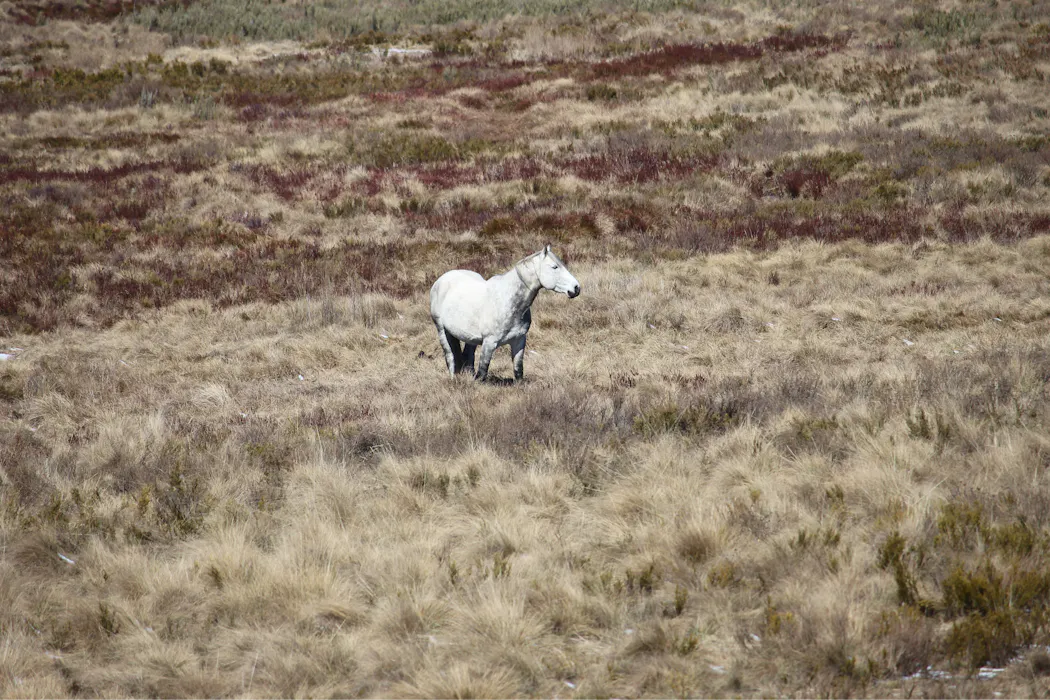
A herd of feral horses in an alpine meadow.
If feral horse numbers aren’t rapidly reduced again, things will get worse for the alpine environment and the horses themselves. crbellette/Getty

A numbers game

If numbers aren’t rapidly reduced again, things will only get worse, both for the fragile alpine environment and the horses themselves. With winter conditions imminent, many horses will struggle to maintain condition as snow covers grazing areas and energy reserves are depleted.

Ironically, some of the strongest opposition to culling overlooks these very real animal welfare consequences. Leaving horse populations unmanaged may ultimately result in prolonged suffering from starvation and exposure, compared with humane control conducted by trained professionals.

Forecast El Niño conditions may further compound these pressures, with drought likely to persist through spring and summer. As water and food become scarce, horses will likely concentrate around creeks, wetlands, alpine bogs, fens and meadows. These are precisely the alpine ecosystems most vulnerable to trampling, grazing and erosion.

And this is where hard-fought gains will be rapidly lost. Banks will become eroded, clear waters fouled and our fabled high plains replaced by overgrazed paddocks.

A long-term effort

We don’t need to look far to see what happens when a population of feral animals goes unchecked. Great Keppel Island, for example, is overrun with a thousand or more feral goats, denuding dune and forcing increasingly exasperated locals to erect fences around their properties

As with horses in Kosciuszko, political hesitancy and delayed action on Great Keppel have allowed ecological damage to escalate while management becomes increasingly difficult and expensive.

New South Wales Environment Minister, Penny Sharpe, recently said the latest Kosciuszko feral horse numbers confirmed the need for “continued management”, required to meet the target of reducing feral horse numbers to 3,000 by mid-2027.

But where did that target come from? It’s a holdover from the repealed Kosciuszko Wild Horse Heritage Act and, when even basic population growth models are applied, the implications become clear. Maintaining a population of 3,000 horses would still require the removal of well over 1,000 animals every two years — indefinitely.

In other words, there is no “set and forget” solution. If horse populations are to remain capped, ongoing culling will be necessary in perpetuity.

Alternative solutions?

Some have suggested that instead of culling, rehoming and fertility control should be used. While many Australians might like the idea of a “brumby” or two grazing in the back paddock, the number of landholders willing and able to care for these animals is far smaller.

Even retired racehorses struggle to find suitable long-term homes once their racing careers end, highlighting the practical limitations of large-scale rehoming programs.

Likewise, although various fertility control options have been suggested, vaccines, intra-uterine devices or surgical sterilisation are all invasive procedures for which horses need to be caught and sedated. These may be effective to maintain a small herd in an easily accessible area. But previous assessments have warned such an approach must be carried out in concert with large scale culling efforts.

Population dynamics vs politics

We don’t have to look far to find other examples of how invasive species management could be improved. In 2016, then New Zealand Prime Minister John Key introduced a bold plan to rid Aotearoa of all introduced predators in the next 30 years.

Predator Free 2050 is the first national-scale initiative to reduce the impacts of introduced predators, capitalising on the invention of new technologies including real-time automated species identification to trap targeted species and mobilising neighbourhoods across the country to join the effort.

Australia faces a different set of challenges — larger landscapes, divided jurisdictions and deeply entrenched cultural and political debates around invasive species management.

But the broader lesson remains the same: meaningful conservation outcomes require long-term commitment, clear targets and the willingness to act before ecological problems become too difficult to reverse.

The Conversation

David M Watson receives funding from the Australian Government (DAFF and DCCEEW).

Patrick Finnerty does not work for, consult, own shares in or receive funding from any company or organisation that would benefit from this article, and has disclosed no relevant affiliations beyond their academic appointment.
What the hit new show Off Campus gets right in its portrayal of sexual violence

Prime Video

In a media landscape where sexual violence is largely normalised, the hit new show Off Campus is a refreshing pivot.

Created for Amazon Prime by showrunners Louisa Levy and Gina Fattore, the series explores the devastating impacts of sexual violence on young women. But it does so with sensitivity, and without gratuitous depictions of said violence.

Normalising sexual assault onscreen

Off Campus, a romantic college drama based on author Elle Kennedy’s novel series of the same name, is enjoying plenty of popularity right now. This is mainly due to its ridiculously attractive leading men and women, coupled with steamy (consensual) sex scenes and cheesy romance.

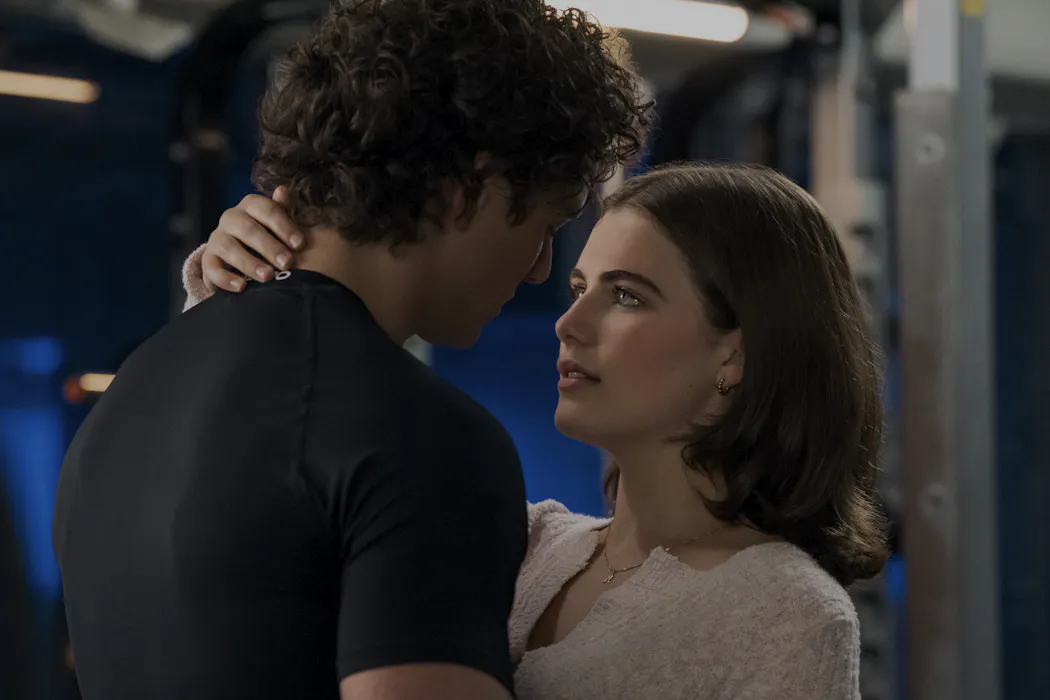
Season one follows college junior Hannah Wells and her fake dating scheme-turned-romance with star hockey-player Garrett Graham.

In a main subplot, we learn Hannah was drugged and raped by a classmate, Aaron Delaney, at a party. She was 15 when it happened.

But Hannah’s experience of assault chronologically takes place before the first episode. The incident is only hinted at subtly, through flashbacks.

Instead, the focus is on her life in the aftermath of sexual assault. This is the kind of representation post-#MeToo activists have been advocating for. Here, the reality of violence against women is addressed, but not viscerally depicted.

Contemporary series and films have a plethora of narrative plots predicated on graphic depictions of violence against women. Yet little has been done to address this.

As gender studies experts Stephanie Patrick and Mythili Rajiva explain, onscreen rape depictions continue to “rehearse gendered scripts, positioning women as sexual objects onscreen for the pleasure of audiences and/or male protagonists”.

These portrayals are now a pervasive part of screen culture, spanning genres and audiences.

Game of Thrones (2011-19), for instance, had multiple violent depictions of rape of prominent female characters, including Daenerys Targaryen, Cersei Lannister and Sansa Stark.

Similarly, Teen drama 13 Reasons Why (2017-20) also depicted both the rape of the central character Hannah Baker and the gang rape of minor character Tyler Down.

Both shows, though wildly different, demonstrate a heinous interest in showing the violation of bodies for entertainment.

What do we audiences get out of watching this, other than gnawing discomfort? And why do such shows remain highly watched, despite the controversy they attract?

Do we need to see sexual violence?

One might argue depictions of sexual assault and violence may make viewers more invested in the issue, and therefore more empathetic towards the experience of survivors.

Feminist film scholar Debra Ferreday says “like fans, feminists are intimately invested in practices of remediation and in the creation of transformative works” – and are therefore more likely to respond to these depictions with an activist mindset.

But, it’s not that simple.

There is also the potential to re-traumatise viewers who have experienced sexual assault, something showrunners are starting to take into account. And this has partly driven the rise of intimacy coordination in the industry. In the words of screen and media scholar Inge Sørensen:

the ways in which nudity, sex and intimacy are […] directed and acted on and off set are no longer only an ethical issue for […] cast and crew members on discrete productions. It is an industry concern with potentially significant financial and reputational consequences for any production.

There is also the potential for graphic depictions of sexual assault to desensitise viewers and normalise predatory and/or violent behaviour, particularly with reference to young men.

We can sen the effects of this in regards to shows such as Game of Thrones, wherein a number of online users argued the fantasy setting provided justification for the violent rape scenes. They saw no issue with them.

The Off Campus approach

Enter Off Campus. Alongside the main plot of Hannah and Garret’s budding attraction, we get glimpses into Hannah’s post-traumatic stress.

She confides in Garrett about her inability to orgasm, is hesitant to drink at parties, and feels guilty the only result of her legal trial against her abuser was the alienation of her family in their hometown in Indiana.

Hannah eventually confides in her family and friends, who rally around her. Prime Video

These moments come to a crux in episode seven, when Aaron plays against Garrett in a hockey game, and Hannah is too traumatised to attend. She isolates herself, struggles with overwhelming anxiety and avoids Garrett’s calls.

This scene mirrors the experience of many victim/survivors, who fear they will not be believed, or their assault won’t be taken seriously. Hannah’s beliefs reflect pervasive rape myths and stereotypes that shroud victim/survivors in doubt and shame.

Off Campus successfully touches on these problematic ideologies, before challenging a legacy of storylines that have helped endorse rape myths and minimise the effects of sexual violence.

Hannah eventually reaches out to her family and friends, who rally around her. Her mum, for instance, tells her she has “nothing to be sorry for”.

Hannah’s performance in the college’s pop showcase symbolises a final reclamation of self. Prime Video

Almost a decade on from #MeToo

The series’ overall sensitive approach suggests at least some showrunners are becoming less interested in violent depictions of sexual assault onscreen.

As we near the ten-year anniversary of the #MeToo movement, violence against women remains high, with an estimated one in five women having experienced sexual violence since the age of 15.

Off Campus marks a pivot away from harmful representation on a macro level, while initiating important conversations around the impact of sexual violence on an individual level. This visibility can steer victim/survivors towards seeking support, and encourage greater empathy and awareness among the broader audience.

The National Sexual Assault, Family and Domestic Violence Counselling Line – 1800 RESPECT (1800 737 732) – is available 24 hours a day, seven days a week for any Australian who has experienced, or is at risk of, family and domestic violence and/or sexual assault.

The Conversation

Bridget Mac Eochagain does not work for, consult, own shares in or receive funding from any company or organisation that would benefit from this article, and has disclosed no relevant affiliations beyond their academic appointment.

Booker winner Douglas Stuart reveals flashes of tenderness in his violent working-class men

Douglas Stuart Martyn Pickersgill/Pan Macmillan

Douglas Stuart’s third novel, John of John, returns to the territory that made his Booker prize-winning Shuggie Bain, and Young Mungo, so unforgettable: the intimate violence of masculinity, and the ways love persists inside families whose members cannot speak or emote plainly to one another.

In Stuart’s Falabay, an imagined town on the Isle of Harris in Scotland’s Outer Hebrides, the wind batters – and people have learned to endure by saying less than they mean.


Review: John of John by Douglas Stuart (Picador)


John Calum (Cal) Macleod returns home from art school in Edinburgh after his father, John, hints at his grandmother’s escalating ailments. For Cal, coming home means regression and constraint. He is indebted, back under the roof of a father who insists, often with overbearing zeal, on obedience and conformity.

In Edinburgh, with dyed hair, new clothes and the agency to publicly express his homosexuality, Cal had begun to assemble a new self. Back in Falabay, Cal is under the roof of his father, a man of unrelenting principle. Control is John’s dialect of love. Proximity must be earned through deference. John forces Cal to listen to bible readings:

because it was too much to ask his son to call him a couple of times a week, or to sit with him by the fire for a few hours and give him all his news. Too much to ask Cal just to be near him.

Intimacy and violence

The Macleods are a weaving family. Stuart, a trained fashion designer, attends to the material textures of that work in imagery of the lanolin that softens and splits skin and fibres that embed themselves in the knuckles of the men.

In two scenes in particular, Stuart demonstrates his skill at writing the tactile and physical. He illustrates John’s attentive care for his son, as well as his violent impulses. After Cal’s hands have been cracked and inflamed by overexposure to artificial heat in the weave shed, John makes him sit, and cares for him “as he might care for any useful tool”.

Cal washed each hand before John dried them on a clean tea-towel. Then John oiled them, rubbing ointment into each knuckle, caressing the webbing between Cal’s forefinger and thumb. Cal winced occasionally, and John went slower, taking care to rub the lotion into the peeling nail beds.

Later, Cal insists on returning the care and tends to his father’s own damaged hands, tweezing wool from John’s inflamed skin and cleaning the wounds. “Look at you two playing nail salons,” Cal’s grandmother, Ella, jokes – yet the intimacy here is unmistakable.

Stuart writes men who are simultaneously opaque to themselves, and overexposed to the community’s judgement.

John polices Cal’s appearance, forbidding him from attending church with neon orange hair, as though colour itself were a provocation. When Cal insists on attending anyway, John beats him in the car.

“He braced his left hand on Cal’s lapel and with his right he punched his son three more times, each blow stronger in its fury and determination.” The beating over, he glimpses his reflection. “Now that the anger had gone, he didn’t know what had possessed him. When he looked in the mirror he saw a devil, and the devil wore his face.”

The scene captures how visibility becomes a moral test in communities trained to prize conformity.

Stuart refuses to excuse John, allowing him full moral agency. Something (the devil) has influenced his behaviour, but John is still the perpetrator. Despite moments of tenderness towards his son, he remains a man who harms people he loves – and crucially, who cannot and will not apologise.

The novel’s most complex reality lies in a truth disclosed early, then handled with delicate restraint: John is in love with his neighbour and childhood friend, Innes. Their relationship is a long, quiet arrangement of glances and hedged intimacies, often reset by John’s fear and Innes’ patience.

“I haven’t had any time alone with you since … I can’t remember when.”
“Cal will be home soon. You have to be patient, please.”
“Am I not the very model of self-control?”
John exhaled as though blowing on a cup of hot tea. Then he nodded slowly. “You are,” he said, “you are.” […] Seeing they were truly alone, he took a step closer. He took Innes’s hand in his, and he stroked the back of it with the side of his thumb.

Stuart gives Innes an eloquent verdict: “It went like this, loving John Macleod. You did it against all reason, against all your better judgement, and in that exact moment he starved the embers into submission, he had the skill to blow on them gentle and ignite them again.” Loving John is an exercise of endurance.

Desire and rejection

For Cal, desire is improvised and punctured by rejection. He answers a lonely-hearts ad and is rebuffed. He fixates on and tries to seduce Innes, an act of longing and misrecognition – a young man reaching for the closest possibility of being known and understood.

If John’s love is performed through maintenance and denial, Cal’s is performed through desperate pursuit. He wants to be seen and held, tenderly.

book cover: John of John

Stuart has a gift for the social contours of villages. In the grudges that accrue and create impenetrable fortresses, Stuart illustrates how family fractures become public currency and harden into comic custom. In Falabay, the MacInnes brothers, Innes and Sorley, share a house without having spoken to each other for 16 years.

Every conversation is duplicated, an arrangement of avoidance, because acknowledgement would concede too much. Cal’s childhood friend, Doll Macdonald, nursing old hurt about Cal “leaving him behind” drinks his life into collapse. Stubbornness provides a kind of safety from ruin. No single slight causes these outcomes, nor could an apology prevent them.

Stuart is attentive to the drawn-out violence of pride and how it makes these men choose solitude over repair, principle over mercy.

Falabay is not glamorised: poverty and precarity pervade the novel, though less centrally than in Shuggie Bain or Young Mungo. Employment is seasonal and signing on (claiming unemployment) becomes an ethical debate whispered over the kitchen table, while the weather decides if your family will eat that night.

Cal’s university debts from Edinburgh haunt the family. In one sharp exchange, John and Cal argue in Gaelic about the dole – is it “dishonest,” or simply necessary?

Controversial on Christianity

Stuart’s handling of religion will be the most controversial element for some readers. It would be wrong to say the novel mocks faith, but it does associate the practise of Christianity with control.

The local minister presides rather than pastors, the congregation is fixated on keeping up social appearances rather than neighbourly care and John is a man who turns Scripture into a blunt instrument of discipline. There’s a matching economy here with the island’s other social systems: faith is kept in working order by policing the boundaries of who belongs.

As a Christian reader, I recognise the ache of filial misunderstanding here, but grace is noticeably absent from the novel. Stuart’s fictional church in Falabay is rendered with nuance, but the faith enacted is mostly a language of pressure: public morality without consolation and doctrine without hospitality.

I longed for a glimpse of forgiveness and repair, especially given the novel’s acute awareness of the ways in which shame distorts the expression of love.

Stuart writes the church in the Scottish Isles as these characters experience it, and he refuses the consolation of counterexample. His refusal is an aesthetic choice as much as a moral one. The novel’s tone remains austere; every consolation is so hard won.

What the novel intricately captures, with unsparing clarity, is how religious performance can lend cover to pride, and how the need to appear righteous can crowd out gentleness and grace.

John of John is a bleak novel, but not entirely hopeless. Tenderness is an event – fleeting, fragile – all the more arresting because of its scarcity. Stuart slows his sentences around these moments: the shoulder‑to‑shoulder quiet after an argument, his grandmother’s silent interventions, the small, comic abrasions of family life.

Readers of Shuggie Bain and Young Mungo will recognise Stuart’s signature: lyrical attention to harm, fierce compassion for children negotiating adult failures, men whose desires costs them dearly, households where harm and love continually conflict.

Falabay may be fictional, but its social world feels unbearably accurate. Stuart has returned to his territory and deepened it.

The Conversation

Caitlin Macdonald is affiliated with The University of Sydney.

Deep-sea sponges survive in complete darkness in ways we didn’t know before

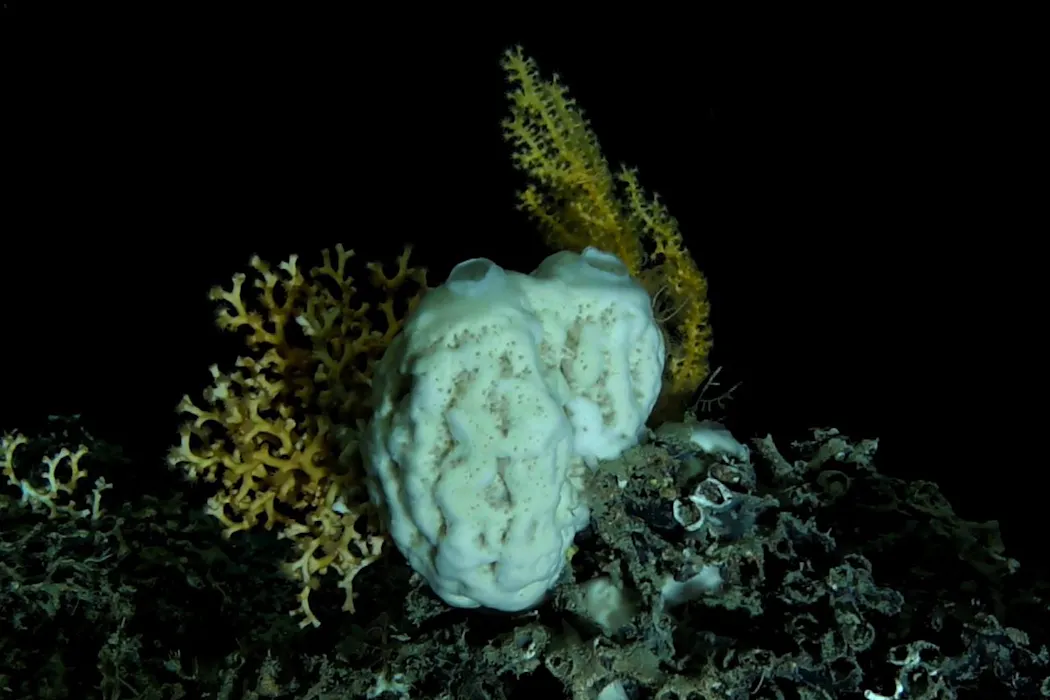
The deep-sea sponge _Calyx_ sp. in its natural habitat. PROBIO-DEEP/Fugro

When we think of marine life, we usually picture colourful coral reefs or dense seaweed forests filled with fish and other critters. The ocean that comes to mind is the one touched by sunlight.

However, most of the ocean is not like that. By volume, roughly 95% of the ocean consists of the permanently dark, cold deep sea. Despite such hostile conditions though, there is life in the ocean’s abyss.

Deep-sea marine sponges are among the organisms that live in these mysterious dark waters. They form “gardens” that are among the largest ecosystems on the planet, some spanning thousands of square kilometres on the ocean floor. They act as ecosystem engineers, providing habitats to many other organisms living on the seafloor.

Individual sponges can also pump and filter thousands of litres of water every day through their bodies. The nutrients they release support other organisms. Yet we know remarkably little about how sponges survive, let alone thrive, in the inhospitable environment of the deep-sea.

Symbiosis with microbes is an important part of how marine sponges live. We’ve been studying deep-sea sponges to better understand life in the ocean’s depths. So far, we’ve found some sponges are packed with microorganisms that use energy from chemical reactions.

The deep-sea sponge Aphrocallistes beatrix has the highest proportion of chemosynthetic symbionts reported to date. PROBIO-DEEP/Fugro

This is called chemosynthesis and is commonly found in other deep-sea organisms, such as mussels and tubeworms living in hydrothermal vents – deep-sea “hot springs”.

Our new study, published today in the journal Microbiome, shows sponges and their microbial partners also use a second strategy to make a living in the deep sea.

Two strategies, one sponge

All living organisms produce waste. Just like humans produce urine, many sponges produce ammonia as one of their waste products.

In this study, we analysed the Calyx species of deep-sea sponges from a depth of 830 metres.

About 16% of their microbial partners use the familiar chemosynthesis process. With ammonia as the energy source, they use carbon dioxide dissolved in the water to build biomass – it’s a bit like plants growing through photosynthesis from sunlight, but in the dark.

In well-lit shallow waters, many sponges and corals have photosynthetic microbes that help them build biomass from carbon dioxide. Our findings show that in the dark depths of the ocean, sponges have microbial partners that use ammonia instead of light for the same process.

The remaining 84% of microbial partners are where it gets really interesting. Instead of chemosynthesis these microbes use heterotrophy, which means consuming organic matter to generate energy and biomass (like the vast majority of animals, humans are also heterotrophs).

The problem here is that there’s little organic matter in the deep sea. Whatever falls down from the surface waters, such as dead plankton and algae, gets stripped by bacteria and small crustaceans of anything easily digestible as it sinks through the water column.

So, the little amount of organic matter that reaches the seafloor is generally poor food for the sponge itself. But, as we discovered, not necessarily for its microbial partners.

It turns out the heterotrophic microbes in Calyx sponges have lots of enzymes specialised in breaking down complex compounds, such as xylan and pectin, which make up the hard-to-digest cell walls of algae.

Feeding on these algal skeletons would allow the microbes to thrive and to transform organic molecules into nutrients their sponge host can use.

Deep-sea sponges and crinoids (marine invertebrates) in a deep-sea reef. PROBIO-DEEP/Fugro

Protecting what we don’t yet understand

Our study shows that sponges and their microbial partners are complex, biogeochemical reactors. They use and recycle ammonia “urine”, carbon dioxide and hard-to-digest organics to generate biomass.

The biomass can then support the growth of other organisms, such as brittle stars and fish, in turn supporting the broader community of animals living on the dark seafloor.

Unfortunately, these ecosystems are under pressure from human activities. Deep-sea trawling physically destroys sponge gardens. Deep-sea mining, now being actively pursued for rare metals used in batteries and electronics, threatens to disrupt the deep-sea habitat in ways that might take centuries to recover.

The United Nations has recognised deep-sea sponge gardens as vulnerable marine ecosystems, a formal acknowledgement of both their ecological importance and their fragility. But recognition alone is not enough.

If we destroy these habitats before we fully understand their role in carbon transformation, then we may lose a critical piece of Earth’s carbon cycle before fully realising it was there.

The Conversation

Torsten Thomas receives funding from the Betty and Gordon Moore Foundation USA and the Australian Government.

Alessandro N. Garritano does not work for, consult, own shares in or receive funding from any company or organisation that would benefit from this article, and has disclosed no relevant affiliations beyond their academic appointment.

How Iran uses billboards as wartime propaganda – we selected 5 to explain what they mean

Since the US–Israel war against Iran began in late February, images of giant billboards in Tehran have been ubiquitous across traditional and social media. These billboards have been placed in some of the busiest and most visible parts of the city, and are constantly being updated to reflect current events.

Iran has long used public spaces as a tool of political communication. Since the 1979 Islamic Revolution – and especially during the Iran–Iraq War – the regime has erected murals and billboards to display revolutionary imagery, war memorials and ideological messages.

Today, these billboards are designed not only for local audiences, but also for global digital circulation. Depicting powerful imagery, slogans and symbolic representations, they serve a dual function:

  • to reinforce a sense of collective identity, national unity and shared emotion during a time of crisis

  • to serve as a tool of propaganda for the state, at times featuring Hebrew and English alongside Farsi (Persian).

Researchers argue these billboards are part of a broader visual communication strategy on the part of the state. They are intended to be photographed, posted and shared widely on social media as a way of projecting power and resistance to a global audience (even with a months-long internet blackout in place).

So, what do the billboards say, and what’s the deeper symbolism behind the imagery? We’ve chosen five samples from Tehran to analyse.

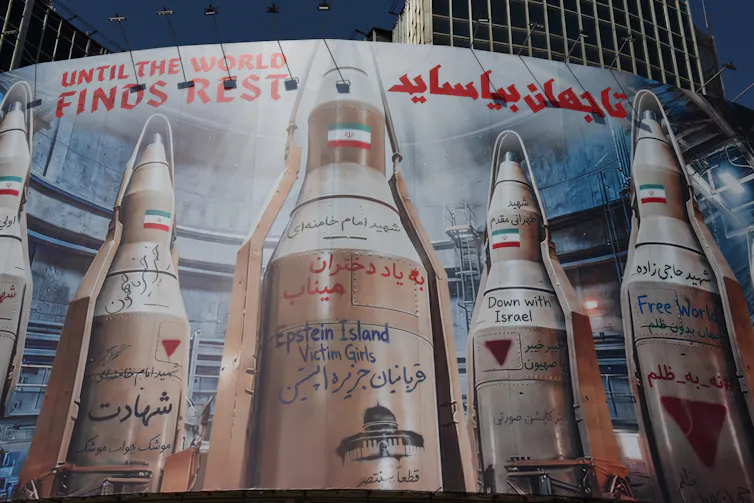
1. The Epstein missile

A billboard in Valiasr Square depicting Iranian missiles with messages on March 17 2026. Kaveh Kazemi/Getty Images

One of the billboards that circulated widely in recent months depicted Iranian missiles covered with handwritten messages and symbolic phrases.

Among the most striking inscriptions is the phrase “To the girls of Minab”, written in bold, red Farsi script. This is a reference to a strike on a girls’ school in the opening days of the war that Iranian officials say killed 175 girls and teachers. Reports indicate US forces were likely responsible.

Directly below that, written in English, are the words “Epstein Island victim girls”, a reference to the island owned by convicted sex offender Jeffrey Epstein where young women were allegedly sexually assaulted.

On another missile is the phrase “the girl with the pink jacket”. This is a deeply emotional reference to a young Iranian girl killed in a terror attack in 2024, who was identified by her pink jacket and heart-shaped earrings.

The intention is to connect these disparate events through a narrative of vulnerable young women affected by violence, exploitation and political power. Rather than presenting missiles only as weapons of destruction, the image reframes them as symbols of grief, revenge, memory and defence.

In this narrative, Iran is portrayed not as seeking war. It is responding to injustice and protecting its people.


2. ‘Masters of war’

A billboard in Enqelab Square, Tehran, threatening Iranian missile attacks on Israel, on October 3 2024. Fatemeh Bahrami/Anadolu via Getty Images

Another billboard that gained significant attention in 2024 depicted the Farsi phrase “If you want war, we are masters of war” above a Hebrew message saying “Israel must be wiped from the face of the earth”.

The billboard portrays the sky over Israel illuminated by waves of incoming missiles, almost resembling a meteor shower or rain of fire. The imagery is highly stylised and cinematic, with the missiles transforming the night sky into a scene of overwhelming force.

By directly addressing Hebrew-speaking viewers, the billboard functions as both a direct warning to Israelis and a symbolic projection of power, designed to have psychological impact. Language becomes a tool of warfare itself.

This multilingual strategy reveals an important shift in Tehran’s urban propaganda. These billboards, which have become more prominent in recent years, are no longer designed solely for Iranian pedestrians and motorists. The regime is aware photographs will circulate instantly across the internet, reaching intended audiences in Israel.


3. Trump’s sutured mouth

Another bilingual billboard is targeted to Western – and specifically American – audiences. It features US President Donald Trump’s mouth with a rendering of the Strait of Hormuz sutured on top, alongside the English phrase “The Breaking Point.”

The Farsi text roughly translates to “its patience has run out”. It also contains a literary pun: the word tang in Farsi can refer both to “narrowness” or “constraint” and to the Strait (tangeh) of Hormuz itself. This creates a double meaning linking the geopolitical tensions in the Strait of Hormuz with the idea of reaching a psychological or political breaking point.

The image also critiques Trump’s constant political rhetoric and media presence. The sutures placed across his mouth symbolise silencing, constraint and the loss of Trump’s authority or influence in relation to Iran and the Strait of Hormuz.


4. Arash the Archer

Another billboard draws on the famous Persian myth of Arash the Archer. In the image, Arash places an arrow into his bow in the heat of battle, surrounded by missiles. The reference comes from the ancient story in which Arash sacrifices his life after shooting an arrow during a mythological war between Iran and neighbouring Turan.

The billboard suggests modern Iranian soldiers, like Arash, are willing to sacrifice their lives to defend their homeland.

More broadly, the image also reflects how poetry, mythology and heroic storytelling are deeply embedded in Iranian history and culture. It connects the contemporary conflict to centuries of struggle.


5. The fishermen

Another billboard demonstrates Iranian military power through the image of a massive fishing net spread across the Persian Gulf. Inside the net are captured American aircraft, drones and naval vessels.

The imagery is accompanied by the phrase, “The entire Persian Gulf is our hunting ground” in Farsi, connoting it is under direct Iranian control and surveillance. The image also emphasises the strategic importance of the Strait of Hormuz, indicating the power to open or close this vital waterway ultimately lies with Iran.

At the same time, the fishing net operates as a cultural metaphor. Like fishing itself, Iran’s warfare strategy is based on patience, resilience, careful strategy and long-term determination, rather than sheer force alone.

The Conversation

The authors do not work for, consult, own shares in or receive funding from any company or organisation that would benefit from this article, and have disclosed no relevant affiliations beyond their academic appointment.

Deep-sea sponges survive in complete darkness in ways we didn’t know before

The deep-sea sponge _Calyx_ sp. in its natural habitat. PROBIO-DEEP/Fugro

When we think of marine life, we usually picture colourful coral reefs or dense seaweed forests filled with fish and other critters. The ocean that comes to mind is the one touched by sunlight.

However, most of the ocean is not like that. By volume, roughly 95% of the ocean consists of the permanently dark, cold deep sea. Despite such hostile conditions though, there is life in the ocean’s abyss.

Deep-sea marine sponges are among the organisms that live in these mysterious dark waters. They form “gardens” that are among the largest ecosystems on the planet, some spanning thousands of square kilometres on the ocean floor. They act as ecosystem engineers, providing habitats to many other organisms living on the seafloor.

Individual sponges can also pump and filter thousands of litres of water every day through their bodies. The nutrients they release support other organisms. Yet we know remarkably little about how sponges survive, let alone thrive, in the inhospitable environment of the deep-sea.

Symbiosis with microbes is an important part of how marine sponges live. We’ve been studying deep-sea sponges to better understand life in the ocean’s depths. So far, we’ve found some sponges are packed with microorganisms that use energy from chemical reactions.

The deep-sea sponge Aphrocallistes beatrix has the highest proportion of chemosynthetic symbionts reported to date. PROBIO-DEEP/Fugro

This is called chemosynthesis and is commonly found in other deep-sea organisms, such as mussels and tubeworms living in hydrothermal vents – deep-sea “hot springs”.

Our new study, published today in the journal Microbiome, shows sponges and their microbial partners also use a second strategy to make a living in the deep sea.

Two strategies, one sponge

All living organisms produce waste. Just like humans produce urine, many sponges produce ammonia as one of their waste products.

In this study, we analysed the Calyx species of deep-sea sponges from a depth of 830 metres.

About 16% of their microbial partners use the familiar chemosynthesis process. With ammonia as the energy source, they use carbon dioxide dissolved in the water to build biomass – it’s a bit like plants growing through photosynthesis from sunlight, but in the dark.

In well-lit shallow waters, many sponges and corals have photosynthetic microbes that help them build biomass from carbon dioxide. Our findings show that in the dark depths of the ocean, sponges have microbial partners that use ammonia instead of light for the same process.

The remaining 84% of microbial partners are where it gets really interesting. Instead of chemosynthesis these microbes use heterotrophy, which means consuming organic matter to generate energy and biomass (like the vast majority of animals, humans are also heterotrophs).

The problem here is that there’s little organic matter in the deep sea. Whatever falls down from the surface waters, such as dead plankton and algae, gets stripped by bacteria and small crustaceans of anything easily digestible as it sinks through the water column.

So, the little amount of organic matter that reaches the seafloor is generally poor food for the sponge itself. But, as we discovered, not necessarily for its microbial partners.

It turns out the heterotrophic microbes in Calyx sponges have lots of enzymes specialised in breaking down complex compounds, such as xylan and pectin, which make up the hard-to-digest cell walls of algae.

Feeding on these algal skeletons would allow the microbes to thrive and to transform organic molecules into nutrients their sponge host can use.

Deep-sea sponges and crinoids (marine invertebrates) in a deep-sea reef. PROBIO-DEEP/Fugro

Protecting what we don’t yet understand

Our study shows that sponges and their microbial partners are complex, biogeochemical reactors. They use and recycle ammonia “urine”, carbon dioxide and hard-to-digest organics to generate biomass.

The biomass can then support the growth of other organisms, such as brittle stars and fish, in turn supporting the broader community of animals living on the dark seafloor.

Unfortunately, these ecosystems are under pressure from human activities. Deep-sea trawling physically destroys sponge gardens. Deep-sea mining, now being actively pursued for rare metals used in batteries and electronics, threatens to disrupt the deep-sea habitat in ways that might take centuries to recover.

The United Nations has recognised deep-sea sponge gardens as vulnerable marine ecosystems, a formal acknowledgement of both their ecological importance and their fragility. But recognition alone is not enough.

If we destroy these habitats before we fully understand their role in carbon transformation, then we may lose a critical piece of Earth’s carbon cycle before fully realising it was there.

The Conversation

Torsten Thomas receives funding from the Betty and Gordon Moore Foundation USA and the Australian Government.

Alessandro N. Garritano does not work for, consult, own shares in or receive funding from any company or organisation that would benefit from this article, and has disclosed no relevant affiliations beyond their academic appointment.

After a landmark international court case backed workers’ right to strike, here’s what could change

The International Court of Justice has just resolved a 14-year dispute over workers’ right to strike – giving trade unions worldwide a significant win.

In a historic decision late last week, the court issued an advisory opinion that the right to strike is protected by a United Nations treaty, the International Labour Organization’s Freedom of Association and Protection of the Right to Organise Convention (also known as convention 87).

The new court decision does not mean we’ll suddenly see outbreaks of strike action all over the world.

However, it does matter right around the world – particularly in 158 countries that have ratified convention 87, including Australia, Canada, Indonesia and the United Kingdom.

A fight triggered by an employers’ ‘strike’

The International Labour Organization (ILO) is unique among the United Nations’ agencies because of its “tripartite” (three part) membership: with representatives from member states, trade unions and employer groups.

In 1948, the ILO adopted convention 87. All the countries that have since formally adopted the convention (a process called “ratification”) committed themselves to protecting freedom of association and the right to organise in their own domestic laws.

The convention made no explicit reference to the right to strike. Yet for decades the ILO’s supervisory bodies – which supervise the implementation of convention obligations – said that the convention did protect the right to strike.

Why? That view was based on the wording of the convention, stating workers have the right to form their own associations and organise their own programmes and activities. Strike action was interpreted as one of those protected activities.

But in 2012, the ILO’s employer representatives decided that longstanding interpretation was wrong – so they staged a “strike” of their own.

For the past 14 years, the employer representatives have refused to cooperate with ILO supervisory processes considering if countries are complying with convention 87 when the right to strike was involved.

Since 2023, that stalemate has been before the International Court of Justice – which is the court which has the power to interpret ILO conventions.

Last week, the court’s judges voted ten to four in favour of the unions’ argument, concluding “the right to strike of workers and their organizations is protected” under the convention.

What was at stake

While countries aren’t legally bound to follow International Court of Justice’s advisory decisions, like this one, they do still carry significant legal and political weight worldwide.

The ILO is the only place in international law where trade unions can make formal complaints if a country is not respecting its obligations to protect the right to strike.

All of that was at risk if the International Court of Justice had made a different decision. A finding that went the other way – in favour of the employers’ case – would have weakened the right to strike worldwide.

Last week’s court finding was a huge win for the international trade union movement.

Australia shows why it matters

The advisory opinion is particularly significant for the 158 nations that have ratified convention 87. Here’s an example of why.

Australia used to be thought of as a country with high rates of strike action.

However, since Australia legislated for a right to strike in 1993, that has stopped being true. In fact, over recent decades, strike action in Australia has stayed as low as it has ever been.

Strike rates in Australia are so low partially because it is harder than people realise to take lawful strike action here.

Since 1993 when a legislated right to strike was introduced, the laws that say when you can strike legally have got tighter and tighter, and the hurdles unions have to jump have got higher and higher.

Even when unions can satisfy the rules around when they can strike, it is easy to get it wrong. When that happens, they can lose the right to strike altogether.

That may sound like a good thing, especially if you’ve ever been caught in a train worker strike, or had to keep children home during a teachers’ strike.

But not being able to strike significantly weakens all workers’ bargaining power. When the cost of living rises and wages don’t keep up, employees end up financially worse off than before.


Read more: Real wages have gone backwards. Even earning $100,000 isn’t what it used to be


What it could mean long term

Like a lot of other nations, Australia won’t see any instant impacts of this new international court advisory opinion.

However, the court’s finding does mean the ILO is no longer stuck in a deadlock. The ICJ decision means that the ILO supervisory bodies can start scrutinising Australia’s strike laws again.

It also means Australian unions have a better chance of bringing complaints about our laws to the ILO – and being successful.

That potential for increased international scrutiny may help shift the dial on Australia’s highly restrictive strike laws.

This is a good thing for workers. A healthy industrial relations system needs a well-protected, accessible right to strike.

The Conversation

Shae McCrystal has received funding from the Australian Research Council. She has published several books including 'The Right to Strike in Australia' and 'Strike Ballots, Democracy and Law'.

Almost 3 million workers will get a 4.75% pay rise in July. But wages can’t catch up with inflation

Andrew Tanglao/Unsplash, CC BY

Around 2.8 million of Australia’s lowest-paid workers will get a 4.75% pay rise from July 1 this year, after the latest Fair Work Commission annual decision on award wages.

Around 100,000 of the very lowest paid workers, on entry level and minimum pay, were singled out for an almost 6% increase, as rising inflation had left some of them unable to pay their bills.

But even after those pay rises, the commission’s expert panel acknowledged low-paid employees still won’t earn as much in real terms as they did five years ago, when inflation spiked towards the end of the COVID pandemic.

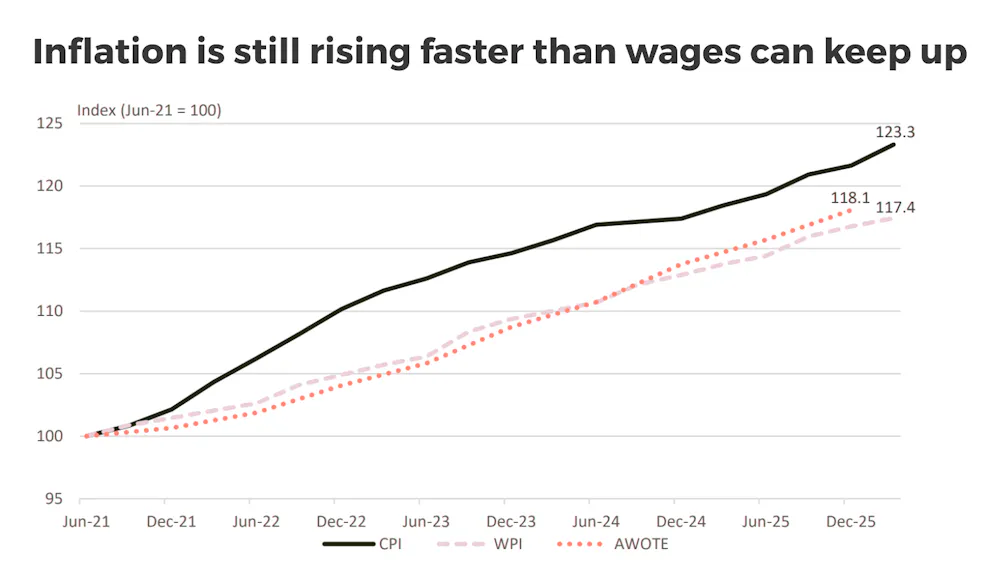
The latest data included in the panel’s decision shows inflation has risen faster than wages since June 2021 – resulting in a real wage cut of 5.9% for average earners.

CPI = Consumer Price Index (inflation). WPI = Wage Price Index, which tracks movements in rates of pay for all employees. AWOTE = average weekly ordinary-time earnings. Note: All data is in original terms. AWOTE is published half-yearly for May and November. Source: ABS, Consumer Price Index, Australia, April 2026; Wage Price Index, Australia, March 2026; Average Weekly Earnings, Australia, November 2025, CC BY-NC

Who benefits from this decision

Announcing the wage rises, Justice Adam Hatcher said this was a “particularly challenging” decision, especially due to the “wild card of the Middle East conflict” and its ongoing price shocks on fuel and other goods.

Amid so much uncertainty, the expert panel said:

we have concluded, regrettably, that it would not be practicable or responsible in the current uncertain circumstances to award a real wage increase for employees reliant on modern award wage rates that would be sufficient to close the real wage gap entirely.

The wage increase starting on July 1 will have the biggest impact on women, part-time and casual workers.

More than 60% of the lowest paid workers are women, with an average age of 34. More than 70% work part-time. They mostly work in four industries: accommodation and food services, health care and social assistance, retail, and administrative and support services.

A 6% rise for the very lowest paid

Around 100,000 of the lowest paid workers will get a 5.97% pay rise.

From July 1, the national minimum wage will be increased from $24.95 an hour to $26.44, or up from $948 a week to $1004.90 per week.

For those starting in entry-level jobs, the lowest award rate for the first six months will rise to $25.74 per hour, or $978.10 per week.

The panel said those increases for the lowest paid 100,000 workers will be followed up with two more rises in coming years.

Future wage rises coming for others

The expert panel said it plans to do more to close the gender pay gap in female-dominated professions.

Over the next few years, this will mean phased-in wage increases for children’s services employees, dental assistants, pathologists, disability home care workers, pharmacists and some other health professionals.

Nurses and flight attendants’ pay will also be examined over the next year.


Read more: Australia’s gender pay gap is narrowing – and the public spotlight seems to be helping


Why wages are struggling to keep up

The expert panel said they didn’t want people to go backwards as inflation keeps rising in the months ahead, so chose a 4.75% rise to at least keep people’s buying power at the level it was a year ago.

However, by my calculations – using their own figures – that still hasn’t happened.

Each year, the panel sets rates for around 21% of Australian workers, on more than 120 different “awards”, which set out minimum terms and conditions of employment.

As a key reference point, the panel looks at the “C10 classification”: the award rate of pay for an entry level tradesperson in manufacturing.

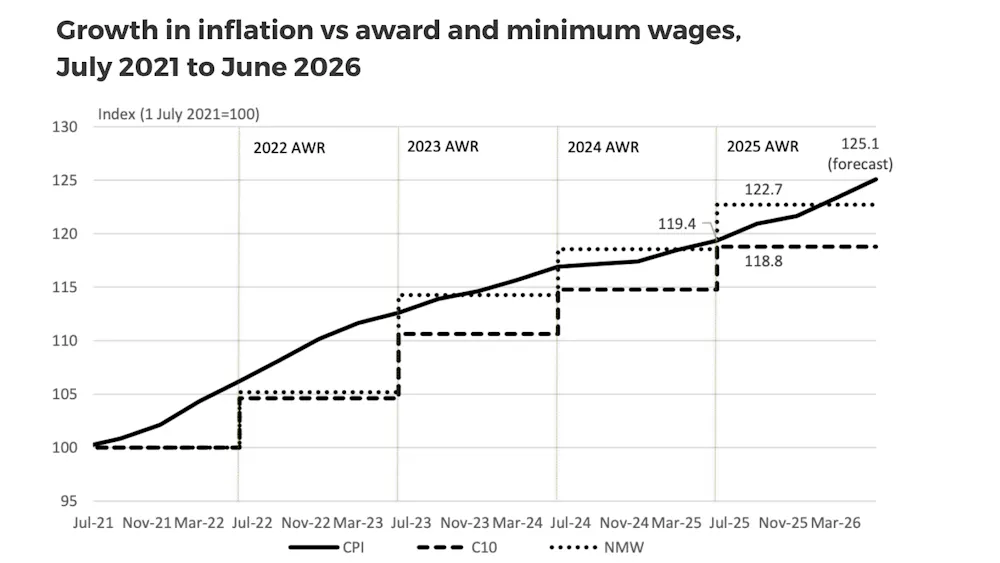
This chart, from today’s decision, shows how inflation has continued to climb faster than the wages of an entry-level tradie, as well as someone on the national minimum wage (NMW).

CPI = Consumer Price Index (inflation), C10 = a rate used to measure typical award wages, NMW = National Minimum Wage. Source: ABS, Consumer Price Index, Australia, April 2026; Fair Work Commission, Modern Awards Pay Database, CC BY

That’s because as you can see – and as the panel itself acknowledged last year – inflation can rise all year, but award wages only increase once a year. This creates a significant fall in people’s real purchasing power between wage increases.

This time last year, the panel noted this had actually resulted in a 14.4% drop in real earnings power for someone on an average award from June 2021 to June 2025.

How does the wage rise compare to inflation?

Inflation was lower than expected last month, partly thanks to fuel discounts that started in April to offset higher oil prices. Those discounts are due to end on June 30.

The monthly consumer price index (CPI) rose 4.2% in the 12 months to April 2026, down from 4.6% in March.


Read more: Interest rates look set to hold, after inflation and fuel costs fell in April. But it’s unlikely to last


Last month, Treasury forecast inflation would peak around 5% in the middle of this year, driven higher by the Middle East war. That’s more than the 4.75% award wage rise.

However, if the war ends and global oil prices ease, inflation is forecast to halve by mid next year, down to 2.5% – back within the Reserve Bank’s target band of 2–3%. That would take the pressure off the bank to keep lifting interest rates, as it’s done three times already this year.

But Treasury also considered a worst-case scenario: that the war drags on and oil prices rise from around US$100 a barrel now to US$200. If that happened, inflation could peak at 7.25% at the end of this year.

What it means for rates and the wealth gap

On balance, this year’s wage decision was conservative, as the expert panel acknowledged themselves by saying they regretted not lifting wages more.

So this decision should not add pressure on the Reserve Bank to lift interest rates in a fortnight, when its board next meets on June 15-16.

Low and middle income earners have not caused Australia’s economic problems. In particular, they are not prime contributors to inflationary pressures.

Just days ago, the Australian Financial Review’s latest Rich List reported Australia produced another 12 billionaires in 2025. Collectively, the top 200’s wealth grew to $707.25 billion – up by 5.9% in the past year.

Contrast that with a real wage cut of at least 5.9% for average earners over the past five years.

Unless next year’s wage review breaks with its timidity and provides for a more reasonable increase, Australian workers are likely to keep seeing their buying power decline for yet another year.

The Conversation

John Buchanan has undertaken research on wages policy for more than 40 years. His most recent work has been supported by funding provided by the Electrical Trades Union, the NSW Nurses and Midwives Association, the Queensland Nurses and Midwives Union, Queensland Teachers Union, Health Services Union and the Australian Salaried Medical Officers Federation (NSW Branch). He has also recently undertaken taken research on the work-health nexus for icare (the NSW government’s workers’ compensation insurer) and Industry Funds Management. He is also a member of the National Tertiary Education Union and an NTEU branch committee member at the University of Sydney.

From ‘USA94’ to now: how soccer has changed since the last American World Cup

The United States hosted its first World Cup in 1994.

Soccer has changed dramatically in many ways since then – on and off the pitch.

As the US (with Mexico and Canada) gets set to host the mega-event once again, more than anything, the tournament’s defining change since 1994 is its sheer scale-up.

The scale-up

This scale-up can be clearly quantified. The 1994 tournament featured 52 matches across 32 days with 24 teams. By contrast, the 2026 event (the first three-nation World Cup) will involve 78 matches in the US alone, over 39 days.

The competition’s 48 teams are divided into 12 groups, with progression to the knockout stage awarded to the top two teams in each group along with the eight best third-placed teams.

In terms of games, the tournament has doubled in size since 1994.

The scale-up is not accidental. It has been driven by the twin forces of globalisation and commodification, alongside a deliberate strategy by FIFA president Gianni Infantino to both protect and extend football’s commercial dominance.

Central to this has been expanding the tournament into non-traditional markets, most notably the US – the world’s largest sports economy – thereby generating substantial financial returns and commercial interest.

Infantino and FIFA have faced sustained criticism in global media – ranging from controversial symbolic gestures involving Donald Trump to concerns over ticket pricing. But the broader outcome is clear: the World Cup has become more expansive and commercially powerful than ever.


Read more: Why Trump and FIFA are perfect bedfellows as the World Cup heads to the US


At the same time, FIFA has deepened its claim to global reach by incorporating smaller nations such as Cape Verde and Curaçao, whose combined populations are well under one million.

The scale-up rests on two core dynamics. First, more matches mean more broadcast content, and media rights remain FIFA’s largest revenue stream. Expanding to 104 matches significantly increases the value of rights deals, particularly across participating nations.

Second, expansion broadens FIFA’s political base. By granting more countries access, it strengthens the influence of nations previously on the margins of global soccer.

Within FIFA’s voting structure, each member association carries equal weight: the vote of powerhouse Brazil counts the same as that of Curaçao, a recent entrant with a population around 150,000.

At the same time, a larger tournament increases the likelihood that major population centres and emerging consumer markets (such as China, India, and Southeast Asia) will participate, further expanding the World Cup’s commercial reach.

The unresolved question for FIFA is one of limits: how far can expansion go before it dilutes the exclusivity and premium value of the World Cup?

The World Game in the US

Soccer in the US has grown markedly since the 1994 event. In many ways, this growth reflects the original intent behind awarding the 1994 World Cup to the States.

The 1994 tournament was still the best-attended in history, largely due to the use of National Football League (NFL) venues. It was granted on the condition that a viable professional league be reestablished following the collapse of the North American Soccer League in 1984.

Major League Soccer (MLS), launched in 1996, is now firmly established within the US sporting landscape.

The pathway has also strengthened, with college athletes feeding into MLS and increasingly major European leagues, alongside the expansion of secondary professional and semi-professional tiers.

Growth has been especially strong in the women’s game thanks to significant new investment.

The US men’s team, currently ranked 16th in the world, could plausibly make a deep run in 2026.

As in 1994, matches this year will largely be staged in football stadiums to maximise capacity.

Rule changes and technology

FIFA’s rule changes are largely designed to keep the ball in play and increase the tempo of matches. Measures addressing time-wasting – from stricter control of throw-ins and goal kicks to tighter management of added time – reflect this objective.

The 1994 World Cup introduced major reforms, including a ban on back-passes to goalkeepers and awarding three points for a win to encourage attacking play.

Looking to the 2026 event, technological oversight will expand, with Video Assistant Referee (VAR) technology applied more broadly to decisions such as second yellow cards and corner calls.

Player welfare has also become more prominent: after the extreme heat issues of 1994, mandated drinks breaks will be introduced – one in each half around the 22-minute mark.

Substitution rules have also evolved significantly, increasing from two in 1994 to five regular substitutions, along with an additional allowance for concussion replacements.

Same game, different scale

Since its codification and even in early filmed matches more than a century ago, soccer’s simplicity has been the foundation of its global dominance.

The sport’s continuity bridges generations. The leading players of the 1994 World Cup, such as Italy’s Roberto Baggio and Brazil’s Romário, could plausibly compete in the modern game, even if today’s players are generally more physically developed.

Ultimately, despite the scale, global reach and commercialisation of tournaments like the World Cup, soccer’s enduring success lies in its consistency.

The game played on the world’s biggest stage remains fundamentally the same as that played in parks, schools and local grounds; simple, universal and instantly recognisable.

The Conversation

Steve Georgakis does not work for, consult, own shares in or receive funding from any company or organisation that would benefit from this article, and has disclosed no relevant affiliations beyond their academic appointment.
What is ‘cycle syncing’, and how might it affect menstruation?

Yan Krukau/Pexels

Menstruation is once again a hot topic on social media, thanks to a new health trend known as “cycle syncing”.

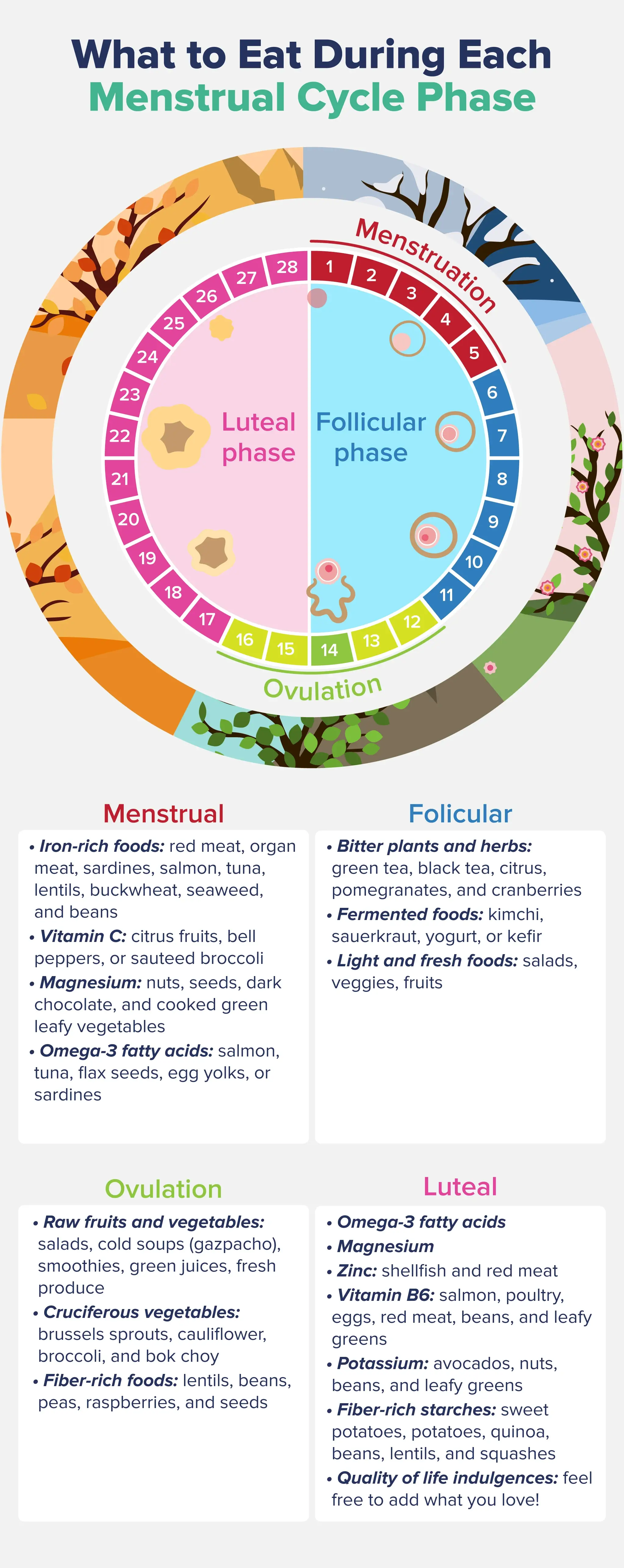
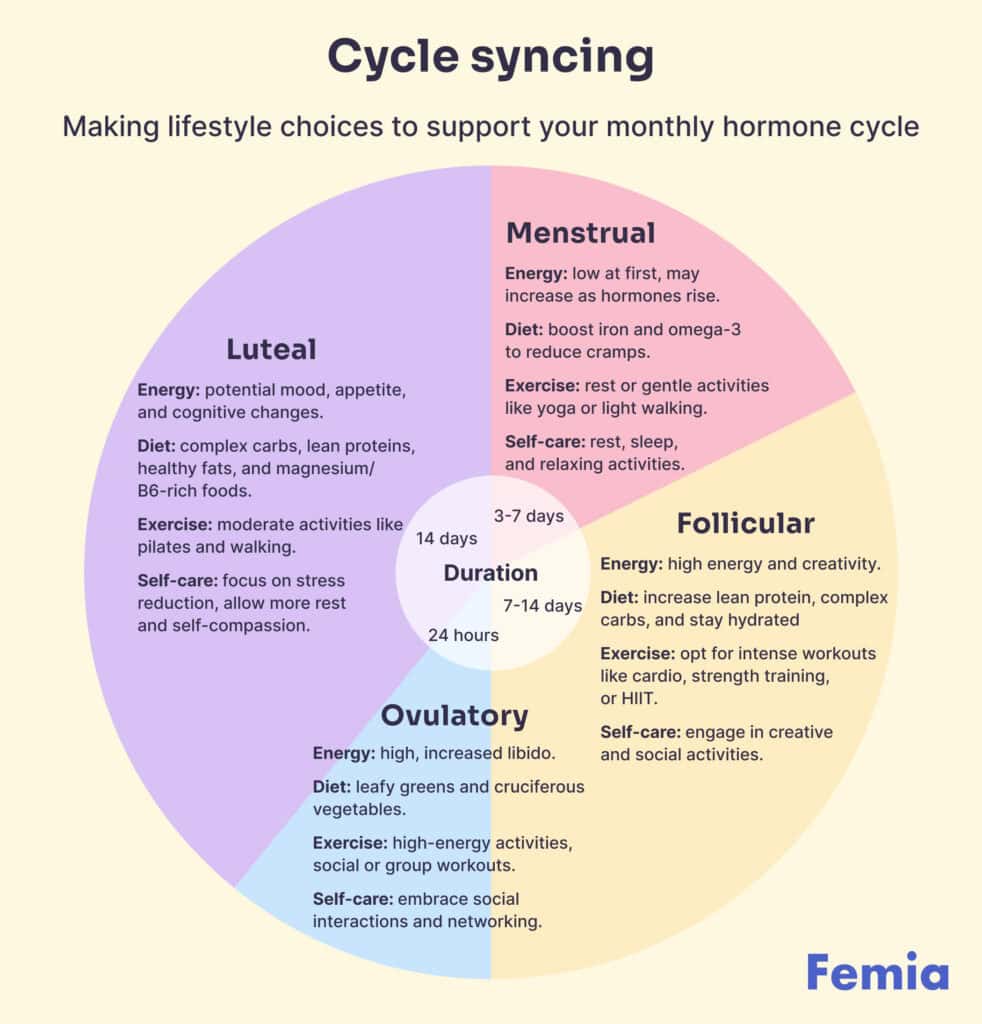
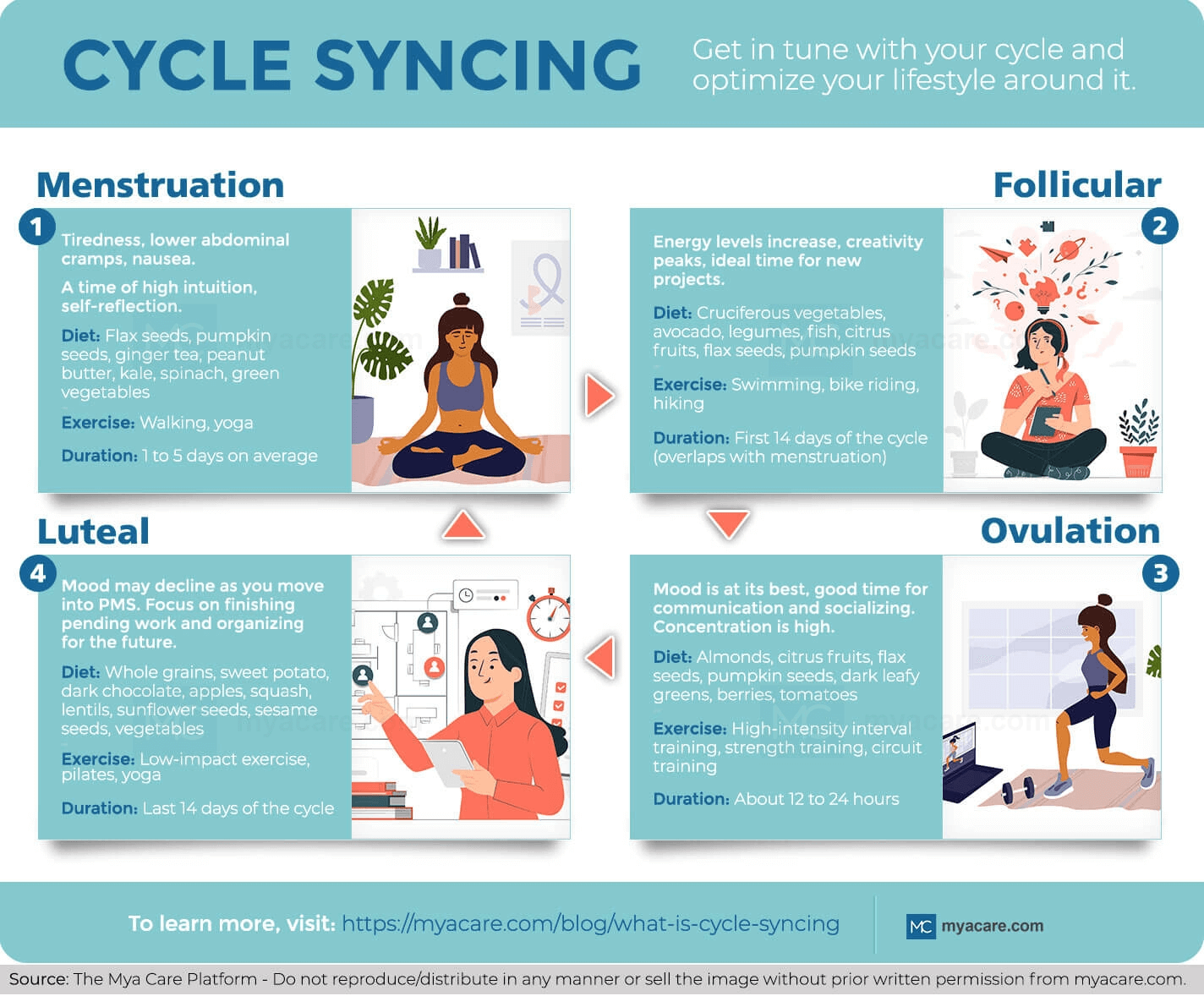
It involves aligning your diet and exercise habits to each phase of your menstrual cycle. For example, you may only do gentle exercises such as yoga or eat more fermented foods during the first phase of menstruation.

Social media influencers are spruiking cycle syncing as a more natural way for women to manage negative symptoms, such as period pain, and be more in tune with their bodies.

So how does it work? And is it supported by research?

The menstrual cycle

During menstruation, the body sheds the uterus lining to prepare for pregnancy. This usually happens every 28–35 days. But bleeding is only one part of the menstrual cycle. The menstrual cycle can be divided into three main phases:

  1. follicular phase, where the body releases a hormone called the follicle-stimulating hormone to help follicles grow in the uterus

  2. ovulation, where the ovary releases a mature egg that may or may not be fertilised

  3. luteal phase, where the body releases a hormone known as progesterone that thickens the lining of the uterus, in preparation for pregnancy. But if the egg is not fertilised, the uterus will shed its lining and this cycle repeats.

Throughout the menstrual cycle, fluctuating hormone levels can cause symptoms such as fatigue, cramps, bloating, mood swings and changes in appetite.


Read more: Planning a baby? A fertility app won’t necessarily tell you the best time to try


Does ‘cycle syncing’ work?

Advocates of cycle syncing say it helps women manage period symptoms and meet the the body’s changing energy needs during menstruation.

However, specific claims often conflict with each other. For example, some who promote cycle syncing suggest eating fermented foods and fresh vegetables during the follicular phase, while others recommend eating lean proteins and wholegrains. Certain cycle syncing advocates emphasise doing cardio workouts and other high-intensity exercise in the follicular phase. Meanwhile, others say swimming or cycling are better options to manage period symptoms.

However, there is little evidence to support these claims.

Various systematic reviews – which summarise all the available research on a specific question – have found no evidence that doing exercise during certain phases of the menstrual cycle improves muscle development or performance. This is the case with both resistance training which aims to build strength, and aerobic exercise, which increases your heart rate.

It also does not appear to reduce your risk of muscle injuries. Research shows immune function may fluctuate throughout the menstrual cycle, but one systematic review found this variation is unlikely to impact exercise.


Read more: Can exercise reduce period pain? And what kind is best?


However, research suggests female athletes may feel less motivated or confident playing sport in the late luteal phase. They were also more likely to think they performed worse at the start and end of their period. This may be because symptoms such as cramping, back pain and tiredness make exercise seem much harder during menstruation.

But research suggests certain types of exercise, including strength training and relaxation-based exercises, may help relieve period pain.

There’s even less evidence examining the link between nutrition and different phases of the menstrual cycle. One 2024 study suggested women may be hungrier or eat more during their luteal phase, compared to the follicular phase. This may be because during the luteal phase, the body consumes more energy to prepare for a potential pregnancy.

However, one systematic review found no conclusive evidence that changing your diet reduces symptoms such as cramps, bloating and fatigue.

What to do instead

Existing studies looking at the relationship between diet, exercise and different menstrual phases have produced extremely varied results. And there are still many gaps in current research, including what the mechanism behind cycle syncing actually is and what its benefits may be.

So for those who want to manage period symptoms, the best approach is to be patient with yourself and listen to bodily cues. For example, if you slept badly because of night-time cramps, you don’t need to do a high-intensity workout the next morning. Consider going for a walk instead. And if you feel extra hungry near the end of your period – in the luteal phase – it’s fine to eat a little more.

The jury’s out as to whether cycle syncing actually works. But making small lifestyle tweaks could help make your time of the month that bit more manageable.

The Conversation

Emmalee Ford is employed by Family Planning Australia, a non-government sexual and reproductive health organisation.

Koala numbers crashed across Australia 100,000 years ago. Global glacial cycles are likely to blame

janclewett/iNaturalist, CC BY-NC

It’s surprising how easy it is to see a koala every day in Australia’s major cities.

The cute, grey marsupial can be found on t-shirts, hanging off people’s bags and pencils, and decorating any decent souvenir shop. But seeing a real koala in the wild has become increasingly tricky in some parts of the country. The iconic marsupial is now listed as endangered in Queensland, New South Wales and the Australian Capital Territory.

But koalas have been in a similar situation before.

As my new study published in the journal Molecular Biology and Evolution shows, koalas experienced a population crash about 100,000 years ago. This finding rewrites our understanding of the genetic history of koalas in Australia – and overturns previous theories about what caused their decline in ancient times.

Turning to the genome

Fossil records of koalas are extremely rare. This makes it difficult to estimate how many koalas were present in the past.

Instead, genomes provide important clues about their evolutionary history. The genome acts as a historical record. It preserves genetic information from ancestral populations that can be used to determine their population size.

Previous genomic studies of koalas have estimated koalas experienced a major population decline roughly 40,000 years ago. This was shortly after the arrival of humans in Australia, suggesting this may have been a contributing factor.

Yet the impact of human arrival on Australian fauna is hotly debated. Some researchers use it to explain the widespread extinction of megafauna during this period.

My new study challenges this theory.

A grey koala sitting in between tree branches.
Koalas are once again experiencing population declines across Australia. dcla/iNaturalist, CC BY-NC

Pushing the timeline back 60,000 years

My colleagues and I set out to construct the first estimate of the koala mutation rate. This is simply the number of mutations that appear in each generation.

Estimating the historical population sizes that have shaped mutation patterns in the genome relies heavily on knowing how often new mutations arise. The problem is that each species has its own unique mutation rate.

To estimate the mutation rate in koalas, we sequenced the genomes of 12 koalas from three families, comprising seven parents and five offspring. This allowed us to count the number of new mutations over each generation.

The whole koala genome has about 3.4 billion sites where changes could occur. We found only 25 mutations per offspring. That’s the equivalent of searching for 25 wrong letters scattered across more than 1,000 copies of The Lord of the Rings trilogy.

We then applied this mutation rate to 457 koala genomes sampled across their entire range. This allowed us to investigate how koala populations have changed over time – including when their numbers crashed.

We found koala population declines occurred around 100,000 years ago – well before humans arrived in Australia. This effectively rules out humans as a cause of the population crash.

Although the mutation rate is a fundamental evolutionary concept, we surprisingly have very few estimates for Australian species. Our estimate is the first from Diprotodontia, the marsupial order which also includes wombats, kangaroos and possums.

Previous studies estimating historical population sizes in koalas have had to rely on mutation rate estimates from distantly related placental mammals such as humans and mice. Applying the koala mutation rate has rewritten the genetic timeline for koalas.

So, what caused the crash?

The koala population crash 100,000 years ago matches a period of intense environmental change across Australia.

The Pleistocene (2.5 million to 11,700 years ago) saw repeated glacial periods, characterised by cold and dry conditions, as well as repeated interglacial periods, characterised by warmer and wetter conditions.

As Australia became drier, the expansion of the Nullarbor Plain established a vast semi-arid shrubland across southern Australia, shrinking suitable koala habitat and separating eastern and western koala populations.

Unfortunately, the population west of the Nullarbor Plain (which was recently described as a distinct species from the modern koala) went extinct around 28,000 years ago.

Although eastern populations were restricted to a small patch of forest on the east coast, they persisted through harsh glacial conditions. Over the last 17,000 years, as conditions became warmer and wetter, they expanded and formed the five genetic groups that are now distributed along the east coast of Australia.

Given our results, we’re now curious to see if other Australian species, including the closest relatives of extinct megafauna, also experienced population declines before humans arrived.

A brown sign signalling the Nullarbor Plain against a blue sky.
The expansion of the Nullarbor Plain established a vast semi-arid shrubland across southern Australia, shrinking suitable koala habitat and separating eastern and western koala populations. Craig Manners/Unsplash

Koalas are back to hard times

Koalas are once again experiencing population declines across Australia.

One similarity between modern and ancient declines is they are both largely driven by reductions in the amount of suitable habitat. The ancient decline was driven by global glacial cycles – an unavoidable result of Earth’s orbit.

However, recent declines have generated a similar bottleneck over a much shorter time window, due to the historical and continued removal of suitable koala habitat. This is made worse by other threats such as hunting, disease, vehicle strikes, feral dog attacks and bushfires.

Fortunately, most koala populations have only recently started losing genetic diversity, and rapid population recovery can prevent further loss and inbreeding.

Hopefully the eastern koala will persist once again.

The Conversation

Toby Kovacs does not work for, consult, own shares in or receive funding from any company or organisation that would benefit from this article, and has disclosed no relevant affiliations beyond their academic appointment.

NATO would survive a US withdrawal. But what kind of alliance would it become?

As NATO counts down to its annual summit in Turkey in July, the alliance is facing perhaps the biggest challenge in its history – what a potential future without the United States, or US security guarantees, would look like.

In recent weeks, the Trump administration has taken a series of steps widely interpreted in European capitals as retaliation for allies’ reluctance to more strongly support the US position in the Iran war. It has announced the withdrawal of 5,000 troops out of Germany, halted the deployment of 4,000 troops to Poland and even reportedly considered moves to suspend Spain from the alliance.

Europe was already uneasy about Washington’s broader strategic intentions. Increasingly, NATO allies are realising they can no longer depend on the United States for their security and will have to shoulder far greater responsibility themselves.

NATO 3.0

US President Donald Trump’s narrow understanding of the value of alliances has long been known. Now, his vision for a new NATO is coming into view.

At a NATO defence minister meeting in February, the US under secretary of defence for policy, Elbridge Colby, introduced the idea of “NATO 3.0”. This would entail Europeans assuming a much larger role in conventional deterrence. The US, meanwhile, would prioritise strategic competition with China and supporting European security more selectively and from greater distance.

NATO Secretary General Mark Rutte and Elbridge Colby speaking at NATO in February.

At the same time, the White House has reportedly been pushing to roll back decades of NATO’s mission expansion and keep Ukraine and NATO’s four Indo-Pacific partners (Japan, South Korea, Australia and New Zealand) out of the annual summit in July.

This reflects a broader transformation in US strategic thinking. NATO is no longer viewed as a political community and a pillar of the liberal international order. Increasingly, it is seen as a narrower military arrangement whose value depends on whether Europeans can shoulder more of the burden themselves and remain compliant with Trump’s agenda.

In this new paradigm, the United States is not simply asking European allies to spend more. It is telling Europe to do more with less American hardware, a looser political alignment, and fewer guarantees.

Plus, there’s a deeper problem: the erosion of trust within the alliance and the assumptions that have underpinned NATO’s deterrence posture for decades.

The result is a “Europeanised NATO” emerging by necessity rather than design. What such an alliance would actually look like remains unclear.

A focus on collective defence

One thing is certain: one single country won’t simply replace the United States as alliance leader. No European power possesses the capabilities, resources or political legitimacy to fill that role alone. Instead, leadership will likely come from the most capable states acting together.

That trend is already visible in “Europe’s minilateral moment”. The E3 group (Britain, France and Germany) and newer E5 coalition (with Italy and Poland), for example, have begun accelerating coordination among Europe’s leading military powers.

These arrangements are not alternatives to NATO. Rather, they may become the mechanisms through which a stronger European focus inside NATO is organised.

But this is where the uncertainties begin. A more Europeanised NATO is far from guaranteed to become a more cohesive NATO. The alliance has long struggled with the strategic cacophony of its 32 members, driven by divergent threat perceptions, regional priorities and strategic cultures. As American leadership recedes, those differences may become even sharper and harder to manage.

A more Europeanised alliance is, at least initially, likely to narrow its focus on collective defence and deterrence to counter Russia’s militarism and its ongoing war against Ukraine.

The broader agenda that expanded after the Cold War to include crisis management and cooperative security may increasingly become secondary. This included efforts to address global security challenges (such as supporting capacity building in countries affected by violent conflict), counter-terrorism operations, and enhancing energy and maritime security.

Yet, many NATO allies, particularly those on NATO’s southern flank, continue to argue that crisis management and cooperative security must remain core alliance functions. For countries facing instability across North Africa and the Middle East, migration pressures, terrorism and maritime insecurity, NATO cannot be concerned only with Russia.

NATO’s cooperative security partnerships in the Indo-Pacific are also increasingly important, even though they are no longer openly supported by the US administration.

Cooperation with Japan, South Korea, Australia and New Zealand (known as the IP4) has emerged as perhaps NATO’s most promising cooperative-security framework, precisely because it strengthens the alliance’s core deterrence mission.

Unlike many earlier partnership initiatives, this is tied directly to defence-industrial cooperation, technological resilience, security of supply chains for defence-critical materials, and strategic signalling.

The new reality

The “new NATO” is by no means a settled compact. It is an alliance caught between competing visions, profoundly uncertain political commitments from erstwhile supporters, and unresolved strategic questions.

Europe is moving towards greater responsibility for its security, but without a clear consensus on what greater strategic autonomy ultimately means.

The central question facing NATO today is not whether the alliance survives. It almost certainly will in some form, as one should never underestimate the binding power of bureaucracies.

The real question is what kind of alliance emerges and how credible it remains. Will it be a narrower military pact laser-focused on continental defence? Or a broader political-security community capable of managing the full spectrum of crises affecting Europe?

The Conversation

Gorana Grgić was previously a recipient of research and teaching funding from NATO.

❌
Subscriptions