Normal view

Solar activity follows an 11-year cycle – here’s how it controls eruptions and solar flares

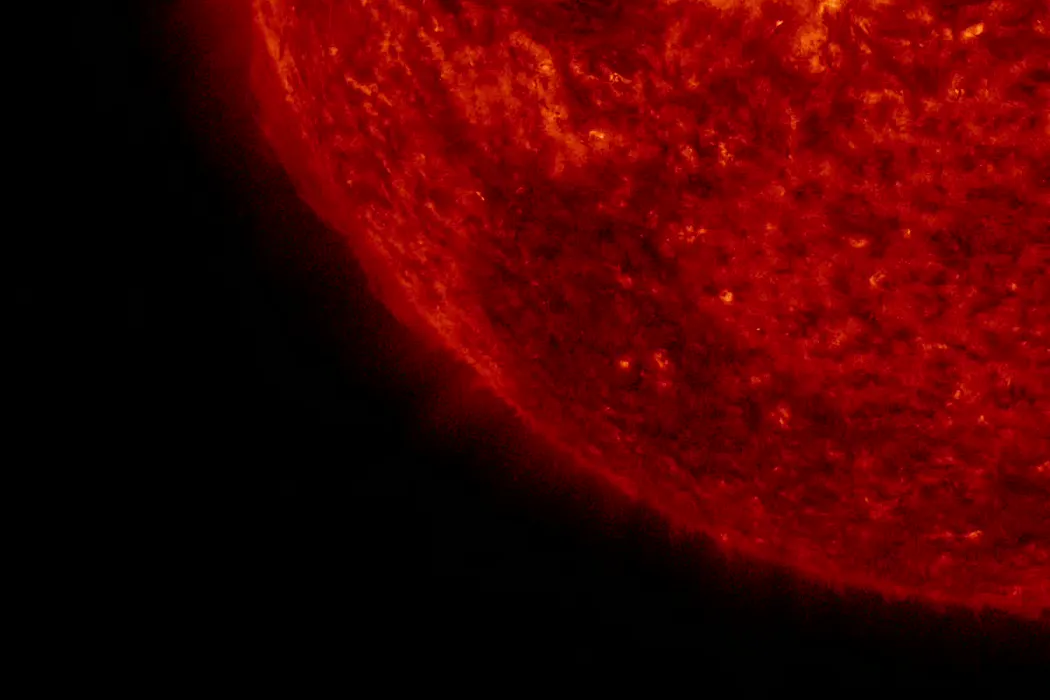
The Sun's surface is dynamic, affected by convection in its interior. NASA/Solar Dynamics Observatory

When you look up at the sky on a sunny day, the Sun might seem like a bright spot, unchanging in the sky. But the Sun is a complex, dynamic celestial body, wrapped in electrical currents and magnetic fields that constantly move and tangle as it rotates. At times the Sun’s surface is very active, casting out powerful bursts of plasma called coronal mass ejections, while at other times it is calmer.

I’m a solar physicist who has spent over a decade researching the Sun. Its movement and activity is directly linked to conditions on Earth: Solar flares and ejections can cause space weather that produces beautiful Northern lights but threatens satellites. This activity follows a roughly 11-year-long cycle, and learning about this cycle helps researchers predict future space weather.

Inside the Sun

The Sun is a star composed of plasma: a hot, ionized gas. The plasma acts as an electrically conductive fluid, and generates large-scale magnetic fields that encircle the Sun.

The Sun is composed of several layers, all made up of a plasma that’s about 70% hydrogen and 28% helium by mass.

The Sun has a solid core at its center and a dense layer outside the core, where particles of light bounce around, transferring energy outwards. Beyond that layer is a thin line called the tachocline that separates those inner layers from the outer layer. This outer zone is cooler and less dense, allowing plasma to move around.
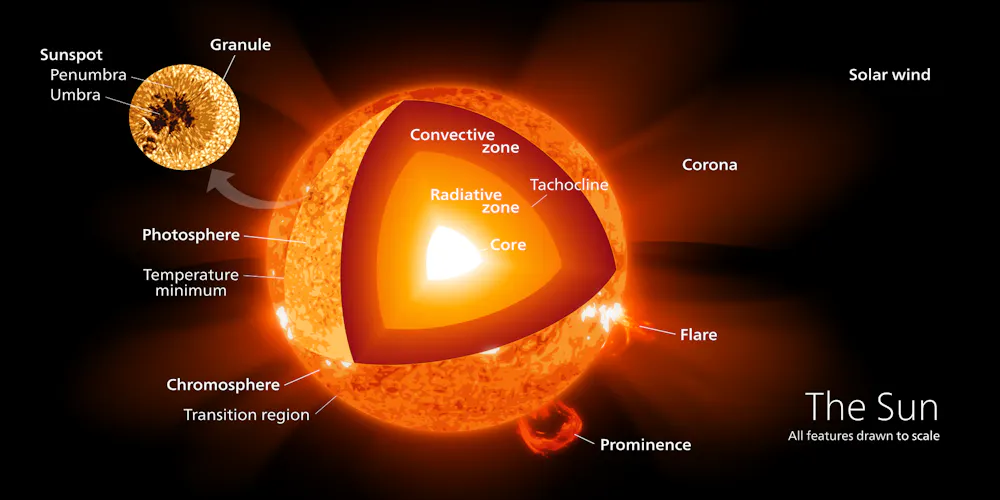
A diagram showing all the different regions and layers of the Sun
The Sun’s interior is made up of several layers. Kelvinsong/Wikimedia Commons, CC BY-SA

Inside the core, particles collide and release incredible amounts of energy, which radiate out from the Sun in the form of light – a process called nuclear fusion. The light travels outward towards the radiative zone outside the core, before reaching the tachocline.

At the outer layer of the Sun above the tachocline, called the convective zone, the hot plasma travels from deep in the Sun to its surface. As it moves, the plasma cools and contracts, causing it to sink back down. This cyclic process is called convection.

Explaining sunspots, solar cycle and solar dynamo.

The Sun is constantly generating magnetic fields that grow and twist below its surface. Two processes control these magnetic fields by moving the electric charges around in the plasma. One is convection, and the other is the Sun’s rotation.

Scientists think that together, these two processes are ultimately responsible for the Sun’s magnetic activity cycle, during which the Sun shifts from an organized to a less organized magnetic field arrangement. The entire cycle, called the Schwabe Cycle, takes roughly 11 years. Over the course of two Schwabe cycles, the Sun’s magnetic poles flip, and then return to their original orientation.

The Schwabe cycle

When the Sun is in an organized state, the center of the Sun resembles a giant vertical bar magnet with positive and negative ends at the top and bottom, or vice versa – called a magnetic dipole. In the 11-year solar cycle, this phase is known as solar minimum.

A diagram showing the Sun with the top pole labeled '+' and bottom pole labeled '-'. Magnetic field lines come from each pole and curve down vertically to reach the other pole.
During the solar minimum, the Sun’s magnetic field is a simple dipole, with a positive pole and a negative pole on either end. Throughout the solar cycle, the magnetic fields go from simple lines to tangled chaos. NSF/AURA/NSO

Although you cannot see the invisible magnetic field directly, the glowing plasma sticks to these field lines. The magnetic field’s shape during the solar minimum is similar to Earth’s magnetic field, with open-ended magnetic field lines at the north and south poles and closed, looped fields near the equator. After the solar minimum state, the Sun’s magnetic field grows tangled over time. Eventually, it reaches its solar maximum state, where the solar atmosphere resembles tangled up spaghetti.

Two main forces tangle the magnetic field as the Sun rotates and plasma churns away in the convection zone: the Omega and Alpha effects.

Alpha and Omega effects

The Sun doesn’t rotate as a solid body everywhere. The interior of the Sun – the core and radiative layers – spins as a solid sphere, like a basketball. Outside these layers, the convection zone and the surface of the Sun do not spin all together.

By observing the Sun’s visible surface, scientists found out that the solar equator in the center rotates faster than the poles, near the top and bottom of the Sun. It takes the solar equator about 25 days to make a full rotation, while the poles take longer – about 35 days. Because the equator moves faster, it overtakes the poles in a phenomenon called differential rotation.

Differential rotation stretches the vertical magnetic field lines around the Sun, causing them to wrap around the Sun horizontally like a belt. The field lines pull on the Sun more tightly as differential rotation continues throughout the solar cycle, in a process known as the Omega Effect.
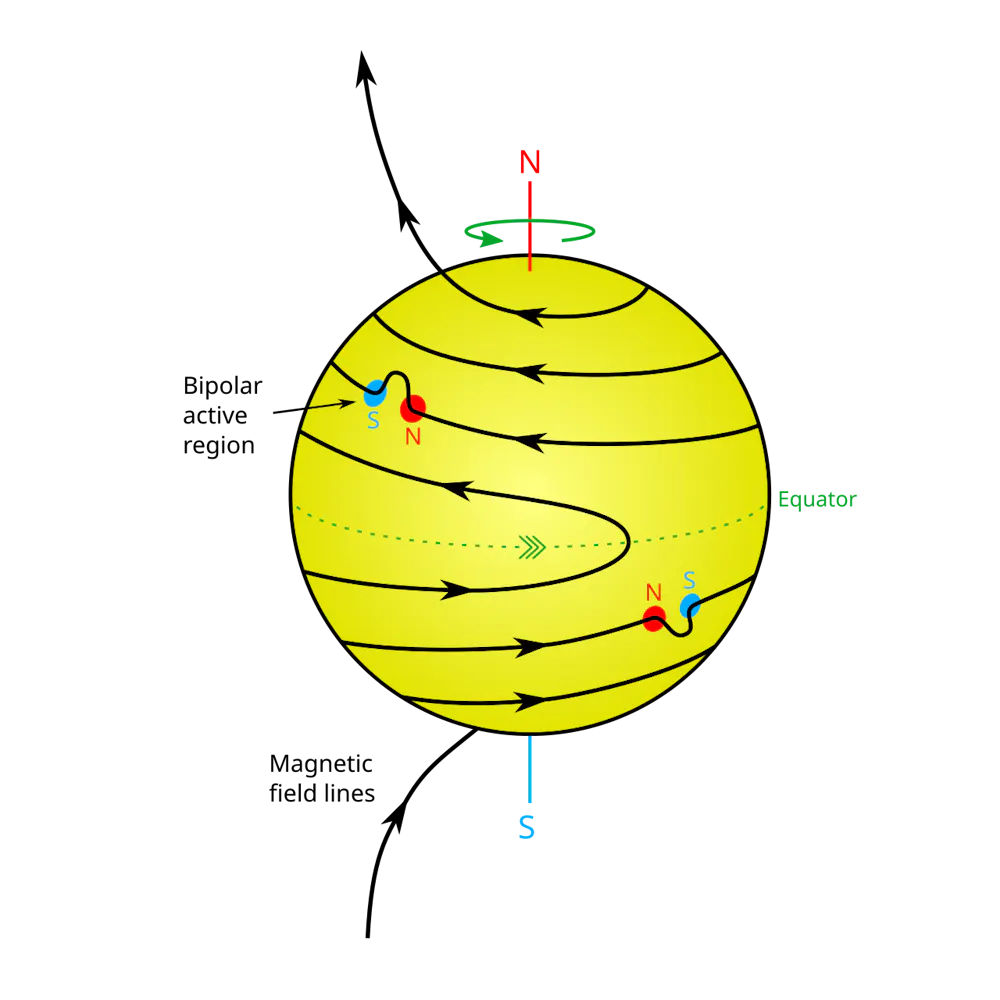
A diagram showing the magnetic field lines wrapping around the Sun and doubling back.
Differential rotation – where the poles of the Sun rotate more slowly than the center – leads the solar magnetic field lines to stretch as they wrap around the Sun. CoronalMassAffection/Wikimedia Commons, CC BY

The second effect, called the Alpha Effect, is thought to arise from convection taking place below the Sun’s surface coupled with its rotation. Like bubbles rising to the surface in boiling water, the tangled magnetic field becomes buoyant and kinked, popping through the surface to create sunspots.

Sunspots look like clusters of dark spots on the Sun’s surface. Scientists can also identify active regions of intensely strong and complex magnetic field bundles by taking images of the Sun in ultraviolet light, where the bundles appear as bright structures.

Solar eruptions called solar flares and coronal mass ejections occur most frequently in these active regions. The appearance of more sunspots, active regions and solar eruptions all signal to scientists that the Sun is entering its solar maximum phase.

Moving magnetic poles

Over the course of the solar cycle, the Sun’s magnetic poles move. At solar minimum, the magnetic poles are oriented vertically through the Sun’s center. But over the course of the solar cycle, the poles begin to tilt, until the pole previously at the top of the Sun is pointed roughly at its equator.

The Sun flipping its magnetic field.

But at the same time, all the tangled magnetic fields make the poles less defined. This chaotic magnetic state partially leads to sunspots and solar eruptions. After solar maximum, as the Sun’s magnetic state grows more organized again, the poles reappear and continue migrating back towards the top and bottom of the Sun.

However, the magnetic pole previously pointed at the top now points to the bottom, and vice versa. The configuration appears upside down from what it was 11 years ago. A full magnetic cycle takes two Schwabe Cycles – during this time, the Sun’s poles flip twice and return back to the original orientation.

Scientists have observed that several other stars, not just our Sun, have a magnetic activity cycle, though their duration can vary. And, like our Sun, other stars also produce eruptions like stellar flares and coronal mass ejections, likely due to their activity cycles.

Studying magnetic cycles in other stars can help astronomers determine whether distant planets could support life. A star’s magnetic activity directly dictates the amount of space weather the planets around that star experience. These effects can strip away the protective atmospheres around planets, prohibiting them from supporting life.

The Conversation

Yeimy J. Rivera does not work for, consult, own shares in or receive funding from any company or organization that would benefit from this article, and has disclosed no relevant affiliations beyond their academic appointment.

How Iran uses billboards as wartime propaganda – we selected 5 to explain what they mean

Since the US–Israel war against Iran began in late February, images of giant billboards in Tehran have been ubiquitous across traditional and social media. These billboards have been placed in some of the busiest and most visible parts of the city, and are constantly being updated to reflect current events.

Iran has long used public spaces as a tool of political communication. Since the 1979 Islamic Revolution – and especially during the Iran–Iraq War – the regime has erected murals and billboards to display revolutionary imagery, war memorials and ideological messages.

Today, these billboards are designed not only for local audiences, but also for global digital circulation. Depicting powerful imagery, slogans and symbolic representations, they serve a dual function:

  • to reinforce a sense of collective identity, national unity and shared emotion during a time of crisis

  • to serve as a tool of propaganda for the state, at times featuring Hebrew and English alongside Farsi (Persian).

Researchers argue these billboards are part of a broader visual communication strategy on the part of the state. They are intended to be photographed, posted and shared widely on social media as a way of projecting power and resistance to a global audience (even with a months-long internet blackout in place).

So, what do the billboards say, and what’s the deeper symbolism behind the imagery? We’ve chosen five samples from Tehran to analyse.

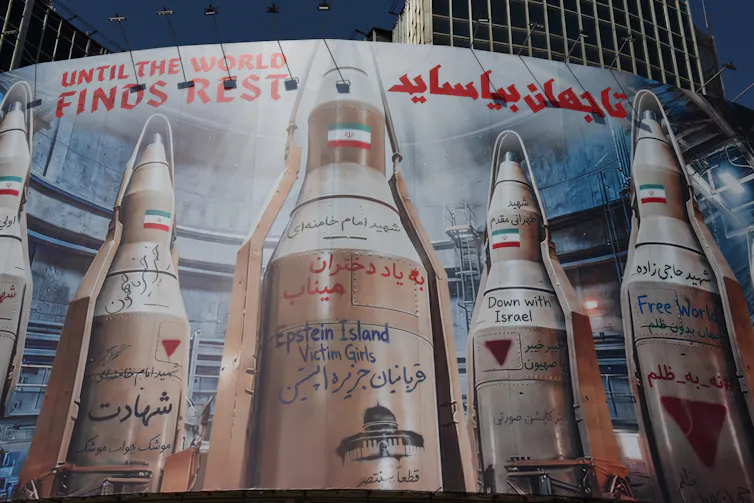
1. The Epstein missile

A billboard in Valiasr Square depicting Iranian missiles with messages on March 17 2026. Kaveh Kazemi/Getty Images

One of the billboards that circulated widely in recent months depicted Iranian missiles covered with handwritten messages and symbolic phrases.

Among the most striking inscriptions is the phrase “To the girls of Minab”, written in bold, red Farsi script. This is a reference to a strike on a girls’ school in the opening days of the war that Iranian officials say killed 175 girls and teachers. Reports indicate US forces were likely responsible.

Directly below that, written in English, are the words “Epstein Island victim girls”, a reference to the island owned by convicted sex offender Jeffrey Epstein where young women were allegedly sexually assaulted.

On another missile is the phrase “the girl with the pink jacket”. This is a deeply emotional reference to a young Iranian girl killed in a terror attack in 2024, who was identified by her pink jacket and heart-shaped earrings.

The intention is to connect these disparate events through a narrative of vulnerable young women affected by violence, exploitation and political power. Rather than presenting missiles only as weapons of destruction, the image reframes them as symbols of grief, revenge, memory and defence.

In this narrative, Iran is portrayed not as seeking war. It is responding to injustice and protecting its people.


2. ‘Masters of war’

A billboard in Enqelab Square, Tehran, threatening Iranian missile attacks on Israel, on October 3 2024. Fatemeh Bahrami/Anadolu via Getty Images

Another billboard that gained significant attention in 2024 depicted the Farsi phrase “If you want war, we are masters of war” above a Hebrew message saying “Israel must be wiped from the face of the earth”.

The billboard portrays the sky over Israel illuminated by waves of incoming missiles, almost resembling a meteor shower or rain of fire. The imagery is highly stylised and cinematic, with the missiles transforming the night sky into a scene of overwhelming force.

By directly addressing Hebrew-speaking viewers, the billboard functions as both a direct warning to Israelis and a symbolic projection of power, designed to have psychological impact. Language becomes a tool of warfare itself.

This multilingual strategy reveals an important shift in Tehran’s urban propaganda. These billboards, which have become more prominent in recent years, are no longer designed solely for Iranian pedestrians and motorists. The regime is aware photographs will circulate instantly across the internet, reaching intended audiences in Israel.


3. Trump’s sutured mouth

Another bilingual billboard is targeted to Western – and specifically American – audiences. It features US President Donald Trump’s mouth with a rendering of the Strait of Hormuz sutured on top, alongside the English phrase “The Breaking Point.”

The Farsi text roughly translates to “its patience has run out”. It also contains a literary pun: the word tang in Farsi can refer both to “narrowness” or “constraint” and to the Strait (tangeh) of Hormuz itself. This creates a double meaning linking the geopolitical tensions in the Strait of Hormuz with the idea of reaching a psychological or political breaking point.

The image also critiques Trump’s constant political rhetoric and media presence. The sutures placed across his mouth symbolise silencing, constraint and the loss of Trump’s authority or influence in relation to Iran and the Strait of Hormuz.


4. Arash the Archer

Another billboard draws on the famous Persian myth of Arash the Archer. In the image, Arash places an arrow into his bow in the heat of battle, surrounded by missiles. The reference comes from the ancient story in which Arash sacrifices his life after shooting an arrow during a mythological war between Iran and neighbouring Turan.

The billboard suggests modern Iranian soldiers, like Arash, are willing to sacrifice their lives to defend their homeland.

More broadly, the image also reflects how poetry, mythology and heroic storytelling are deeply embedded in Iranian history and culture. It connects the contemporary conflict to centuries of struggle.


5. The fishermen

Another billboard demonstrates Iranian military power through the image of a massive fishing net spread across the Persian Gulf. Inside the net are captured American aircraft, drones and naval vessels.

The imagery is accompanied by the phrase, “The entire Persian Gulf is our hunting ground” in Farsi, connoting it is under direct Iranian control and surveillance. The image also emphasises the strategic importance of the Strait of Hormuz, indicating the power to open or close this vital waterway ultimately lies with Iran.

At the same time, the fishing net operates as a cultural metaphor. Like fishing itself, Iran’s warfare strategy is based on patience, resilience, careful strategy and long-term determination, rather than sheer force alone.

The Conversation

The authors do not work for, consult, own shares in or receive funding from any company or organisation that would benefit from this article, and have disclosed no relevant affiliations beyond their academic appointment.

How did we learn which plants are safe to eat? 2 food scientists explain

Catherine Delahaye/Getty

Have you ever eaten a green potato, or a bunch of rhubarb leaves?

Hopefully not, because these two plant parts can be toxic to humans. While they may seem edible, they contain chemicals that can make you seriously ill.

Over centuries, humans have learnt which plants are safe to eat and which are not, often by combining ancient knowledge with modern science.

The power of plants

Without plants, we would struggle to get the nutrients we need.

Crops such as wheat and rice provide carbohydrates, the body’s main source of energy. Fruits and vegetables contain a wide range of vitamins that help us stay healthy.

Plants are also chemical factories. To survive, they produce compounds that deter insects and animals that might eat them. They may also release chemicals that protect them from disease. One example is the tobacco plant which produces nicotine, a natural alkaloid that helps protect the plant from insect attacks.

Globally, there are tens of thousands of plants that contain toxic compounds. In Australia, we have more than 1,000 native and introduced plant species that can be toxic to humans and animals, under certain conditions. However, humans only consume a small fraction of the world’s edible plant species.

What makes a plant toxic?

A key principle of toxicology – the study of what makes something poisonous – is “it’s the dose that makes the poison”. This means certain toxic compounds are safe to consume, as long as you don’t eat too much of them.

Table salt is one example. You likely eat it everyday, but this substance can be harmful in excessive amounts.

And many plant compounds that sound dangerous are actually safe, when consumed in small amounts. For instance, green potatoes contain glycoalkaloids, a group of chemicals that can cause symptoms such as vomiting, fever and diarrhea when consumed in large amounts. Oxalates are a type of toxin found in rhubarb leaves. They too can make you sick, but only if you eat lots of them.

Preparation is key

At first, humans learnt which plants were nourishing and which were harmful through years of observation and experimentation. For instance, cassava was first domesticated in South America where Indigenous communities developed processing methods to remove cyanide, a poisonous chemical found in the plant’s roots and leaves.

Many other First Nations peoples developed sophisticated ways of preparing plants that contained toxins. Some Aboriginal communities in northern Australia would soak, grind or cook cycad seeds to remove naturally occurring toxins before consumption.

This knowledge soon became embedded in each community’s culture, as it was passed down through generations.

Today, we use various techniques to reduce or remove harmful compounds from plants. For example, raw or undercooked kidney beans contain a natural toxin called phytohaemagglutinin, which can cause illness. But by soaking and thoroughly boiling kidney beans, you can easily get rid of this toxin.

Fermentation is another way to remove poisonous chemicals from plants. This is because fermentation changes the plant’s chemistry in ways that can reduce or remove toxic compounds. For example, during soybean fermentation, microbes break down harmful compounds such as phytates and trypsin inhibitors, making the soybeans safer and easier to digest.


Read more: Little shop of horrors: the Australian plants that can kill you


The role of modern science

In some cases, scientists have modified toxic plants to make them safe to eat.

Faba beans, also known as broad beans, are one example. Faba beans are an increasingly important crop for Australian farmers, as they can attract high prices and help manage weeds.

Like many plants, faba beans naturally contain vicine and convicine, two compounds that generally don’t affect humans. But in people with a genetic condition called G6PD deficiency, they can trigger a serious reaction called favism. This condition can be life-threatening as it causes your red blood cells to rapidly break down.

Rather than abandoning this crop, scientists have used modern chemistry and plant breeding to develop new faba bean varieties with lower concentrations of these compounds. And farmers are already planting low-vicine varieties as part of their crop rotations.

Over millenia, humans have unpacked the complex chemistry of plants to learn what is safe to eat. But how we consume these plants, and how much of them we eat, also affects how toxic they may be.

The Conversation

Joel Johnson receives scholarship funding from the Australian government for his PhD program.

Mani Naiker does not work for, consult, own shares in or receive funding from any company or organisation that would benefit from this article, and has disclosed no relevant affiliations beyond their academic appointment.
Iran is threatening undersea cables. The world’s ‘digital chokepoints’ have never been more vulnerable

imaginima / Getty Images

Early this week, Iranian state-linked media floated a plan to charge the operators of undersea internet cables in the Strait of Hormuz for access to what they say is Iran’s offshore territory.

The suggestion comes after Iranian warnings that several important cables in the strait were a vulnerable point for economies in the Middle East.

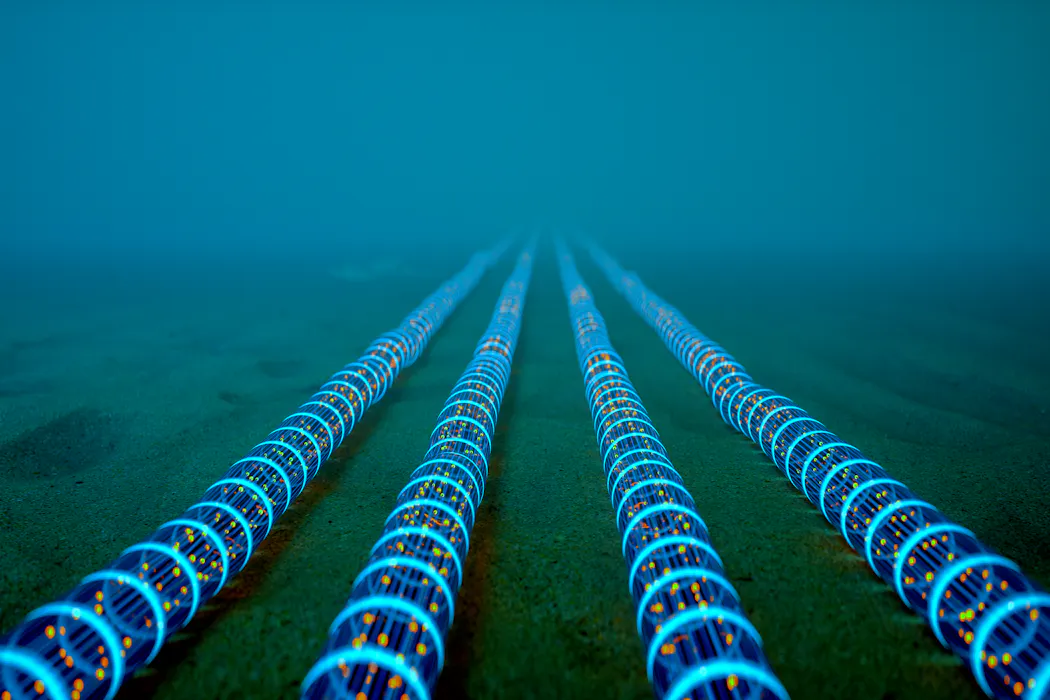
Iran’s comments expose an invisible foundation of the internet and globalisation itself: the web of more than 500 undersea cables that carries more than 95% of international data traffic.

We may think the internet lives in a kind of virtual cloud. But its physical underpinnings are vulnerable – and that vulnerability is becoming a very real geopolitical concern.

Gulfs, straits and cables

Several of the world’s most critical submarine cable routes run through the Middle East. Narrow sealanes through the Red Sea, Bab el-Mandeb Strait, Suez Canal, and the Strait of Hormuz also function as “digital chokepoints”.

These maritime corridors connect major economic centres in Europe, Asia and Africa. In 2024, submarine cable incidents in the Red Sea disrupted around 25% of the internet traffic between Europe and Asia.

The strategic importance of submarine cables is not lost on Iran. Damage to these cables, whether accidental or deliberate, would have significant consequences.

In the bigger picture, the message is unmistakable. Digital infrastructure can give states strategic leverage, but it’s also a potential target.

Digital infrastructure

Critical infrastructure used to mean oil pipelines, ports, or power grids. But data infrastructure has become just as important for national and economic security.

The core problem of undersea cables lies in the concentration of infrastructure. Many of the cables are bundled together along the same seabed routes and funnelled through a small number of maritime chokepoints.

This creates dangerous single points of failure. A cable cut – whether deliberate or accidental – can degrade connectivity across multiple regions simultaneously.

While cable breaks are not uncommon, repairs are difficult – especially in contested or militarised waters. Repair vessels require safe access, international coordination, and time.

Fragmentation and disruption

A serious submarine cable disruption could have profound consequences. One immediate effect would be the fragmentation of global connectivity. The ability to communicate with anyone anywhere that we now take for granted could take a significant hit.

Regions which depend heavily on vulnerable cable routes might experience degraded internet performance, communications blackouts, or financial instability. Countries with little backup infrastructure, particularly developing states across parts of Africa, the Middle East, and South Asia, would be disproportionately affected.

Financial markets too are vulnerable. Extremely fast and reliable data flows underpin high-frequency trading systems, global payment networks, and international banking transactions.

Even brief disruptions can make markets fluctuate rapidly, delay transactions, and make investors uncertain. Because so much of the global economy is so thoroughly interconnected, digital instability in one region can rapidly create worldwide financial shockwaves.

If cable disruptions coincided with conflict or instability along major maritime trade routes such as the Strait of Hormuz or the Suez Canal, insurance markets, shipping industries, and energy supply chains would also face increased uncertainty.

The military domain

The military and strategic consequences of cable disruption may prove even more serious. Armed forces rely on secure long-range communications and real-time coordination.

When you get down to it, everything from command-and-control systems to drone operations and logistics planning relies on undersea cables. Damage to these networks would make forces less effective, make it harder to coordinate with allies, and make miscalculations more likely.

Cable sabotage is not as clear-cut a provocation as a conventional attack on a military target. It’s hard to work out who did it – in cases such as cable breakages in the Baltic Sea often attributed to Russian action – and the legal situation is ambiguous. This ambiguity creates a risk that conflict will escalate, as states may struggle to determine whether disruptions are accidental, criminal, or acts of war.

The digital world has physical foundations

The US–Iran conflict has already delayed construction of new undersea cables. It also highlights a broader reality: the foundations of the digital world are real and concrete, and they are not invulnerable.

Any deliberate targeting or sabotage would not just be a local event. It would reverberate across global communications, economies, and security systems. The seabed has become a zone of geopolitical competition – and the consequences of disruption could affect the world’s stability for years to come.

The Conversation

Meredith Primrose Jones does not work for, consult, own shares in or receive funding from any company or organisation that would benefit from this article, and has disclosed no relevant affiliations beyond their academic appointment.

Teens aren’t as disengaged as you may think: What adults get wrong about adolescents’ civic contributions

Teens contribute in ways that go far beyond organized volunteering. Maskot/DigitalVision via Getty Images

A teenager scrolls through their phone at the dinner table, barely looks up and answers questions with one-word replies. For many adults, that image has come to stand for a larger fear: that today’s young people are disconnected from others and may be uninterested in the world around them. Concerns about declining civic participation often deepen that worry.

As researchers who study adolescent development, we believe this picture is incomplete. Adults help shape the environments in which young people learn to contribute, or learn not to. In worrying that young people are disengaged from participating in civic society, adults may overlook both their own role in fostering engagement and the many ways young people are already contributing.

Youth civic and community engagement matters because it helps build skills, relationships and habits of participation that carry into adulthood. How do teens actually express their care for the world around them, and what helps them to do so?

What does engagement really look like?

When adults talk about “engaged” teens, they often picture a narrow set of activities: volunteering, joining clubs, leading student government, maybe attending a rally or organizing a fundraiser. Those forms of contribution to society matter. But they are not the whole story.

In two recent studies, we surveyed 723 American adolescents, with an average age of 15, to understand what predicts whether teens will contribute to society and what their contribution looks like.

In the first study, we identified four distinct patterns: Some teens were generally less engaged; this group represented 21% of our sample. Another 19% we called “Digital Advocates,” highly active online but less involved in face-to-face settings. A third group, 33% of our sample, we termed “Local Helpers,” more engaged in interpersonal and community-based helping. “Contributors” were our fourth profile type, making up 26% of our sample; they reported high engagement across all domains.

Our finding pushes back against a common adult assumption that “real” engagement has to look a certain way. It doesn’t. A teen sharing information online about where local families can access food assistance and a teen quietly checking in on a struggling friend are both contributing – just differently. Digital participation is not automatically shallow; for many young people, online spaces are where they learn about issues, form opinions and connect with others who share their concerns.

Crucially, these profiles were shaped less by demographics – age, gender or race and ethnicity – and more by whether our teen respondents had the personal and contextual supports that helped them act on what they cared about.

What supports adolescent contribution?

In our second study, we found that more-engaged young people reported higher levels of hope, purpose and critical consciousness, which together help explain why some adolescents are more likely to act on what they care about. Hope is the sense that the future can be better and that you can help make it better. Purpose is a stable sense of direction. Critical consciousness is a teen’s ability to notice and think critically about the social dynamics around them.

We were especially interested to see that purpose mattered not only when it was self-focused – wanting to succeed, build a career and so on – but also when it extended beyond the self, such as wanting to help others or contribute to something larger than one’s own interests.

That may sound obvious, but it has real implications. Adults often tell teens to “get involved” without helping them connect that involvement to a meaningful why. Our findings suggest young people are more likely to contribute when they feel hopeful about the future and when they see their lives as connected to others.

What adults can do

To help young people make a difference, first broaden your definition of contribution. The teenager organizing a school drive, the one helping a neighbor and the one making informative videos about a community issue are all contributing in real ways. Notice these efforts and support them in their chosen contribution.

You can also support adolescents in building the traits that make it easier for them to get involved and make a difference:

  • Help young people develop a sense of purpose that goes beyond themselves. Ask questions like: What do you care about? What kind of difference do you want to make? Purpose-driven engagement tends to be more durable than participation that’s driven by obligation.

  • Nurture hope. Young people are less likely to act when they feel that nothing will change. Adults can support hope by helping teens see realistic pathways for success and giving them opportunities to speak up or solve real problems in their schools and communities.

  • Make space for critical consciousness. After-school programs, classrooms and youth groups can create environments where conversations about social issues are taken seriously and connected to real action. Young people need chances to talk about the world they see – and the world they want.

Teens often make a difference in ways that reflect both what they care about and how they are beginning to understand the world around them. Contributing is about more than just involvement in civic institutions; it can also look like helping a neighbor, speaking up for others or creating social media content that raises awareness about an issue. Instead of expecting teens to be checked out, caring adults can help them develop the skills and resources to contribute in any and all of these meaningful ways.

The Conversation

The authors do not work for, consult, own shares in or receive funding from any company or organization that would benefit from this article, and have disclosed no relevant affiliations beyond their academic appointment.

How AI can lead to false arrests and wrongful convictions

AI algorithms such as facial recognition systems produce probabilities, not facts. Matthew Horwood/Getty Images

In Baltimore County, Maryland on Oct. 20, 2025, a 17-year-old student named Taki Allen was sitting outside his high school after football practice when an artificial intelligence-enhanced surveillance camera falsely identified the Doritos bag in his pocket as a gun. Within moments police cars arrived, officers drew their weapons and Allen was forced to his knees and handcuffed while they searched him. All they found was a crumpled bag of chips. The AI’s misidentification and the human decisions that followed turned a normal evening into a traumatic confrontation.

On Dec. 24, 2025, Angela Lipps, a Tennessee grandmother, was released after spending five months in jail because facial recognition software had incorrectly connected her to fraud crimes in North Dakota, a state she had never visited. Police had arrested her at gunpoint while she was babysitting her four grandchildren.

These are unfortunate examples of how AI can lead to mistreatment of people because of technical flaws as well as misplaced human faith in the technology’s supposed objectivity. These cases involve different tools, but the underlying issue is the same. AI systems produce probabilities, and people treat them as certainties.

We are researchers who study the intersection of technology, law and public administration. In researching how police departments use AI and how digital technologies operate in a democratic society, we have seen how quickly the shift from probabilistic prediction to operational certainty happens in practice.

AI policing tools are used in dozens of U.S. cities, although no public registry tracks the full footprint. The tools ingest historical crime data and score neighborhoods on predicted risk so officers can be routed toward the resulting hot spots. The mechanism is straightforward, but its consequence is not. Once a system signals a possible threat, the question is no longer how certain the prediction is but what to do about it. A statistical output turns into a deployment decision, and the uncertainty that produced it gets lost on the way.

A matter of probabilities

When generative AI models such as ChatGPT or Claude respond to human requests, they are not searching a database and pulling out facts. They are predicting the most likely answer based on patterns in data they have been trained on. When asked, “Who invented the light bulb?” the models do not go to a source or fact-check a finding. They generate a statistically probable answer which is “Thomas Edison.” The reply might be right, but it might not capture the full story – such as Joseph Swan’s parallel invention at the same time as Edison’s. The danger arises when people believe that the model is retrieving truth rather than generating likelihoods.

This distinction matters. The most probable response is not the same as a factually verified answer, complete with context.

Police handcuffed teenager Taki Allen at gunpoint after an AI camera system incorrectly indicated he had a gun.

This reality can be highly problematic for policing and law. For example, when law enforcement agencies use AI systems trained on geographical data to estimate where criminal activity is likely to occur, the algorithms analyze historical crime data and geographic patterns. These systems generate statistical risk scores or heat maps for locations based on prior incidents. But such predictions may have little bearing on who was involved in a new crime in the area, even if an algorithm generates information that sounds authoritative.

Some researchers have argued that predictive policing systems do not increase the likelihood that racial minorities will be arrested more often relative to traditional policing practices. The broader concern, however, is not limited to measurable disparities in arrest outcomes alone. It is about how probabilistic predictions can become standardized operational decisions absent further verification.

Artificial intelligence researchers caution against using these models in isolation for crime and legal proceedings or decision-making. Research at the University of Virginia’s Digital Technology for Democracy Lab with police chiefs shows that some law enforcement groups follow strict policies that dictate when technology is used in tandem with, or in place of, human discretion, while others have no such policy.

What most users do not realize is that AI systems rarely produce binary answers: yes or no, a positive identification or a negative one. They generate probabilities. Some systems assign scores that assess the system’s confidence in a prediction. In those cases, engineers set a confidence threshold, a level of certainty that determines when the system should trigger an alert about a possible threat. You can think of this threshold as settings on a control knob. A 95% confidence level, for example, indicates that the model considers its interpretation to be highly likely.

A low threshold catches more potential threats but increases false alarms. A high threshold reduces mistakes but risks missing real dangers. Either way, these algorithmic thresholds are often invisible to the public and are set quietly by vendors or agencies, even though they shape when police action begins.

Angela Lipps was unjustly jailed for more than five months based on a mistake by a facial recognition system.

Where to draw the line

In medicine, these kinds of trade-offs are explicit. Diagnostic tools are calibrated on the relative harm of different errors. In infectious disease settings, for instance, systems that detect infections are often designed to accept more false positives to avoid missing contagious individuals. Then medical professionals look into the human cases. And the algorithm-based decisions are subject to professional standards, ethics reviews and regulatory oversight.

In policing, an AI system must balance false positives, where the system flags a threat that does not exist, and false negatives, where it fails to detect a real danger. The trade-off carries significant consequences. A lower threshold may generate more alerts and allow officers to intervene earlier, but it also increases the risk of mistaken identifications, which happened to Angela Lipps, or escalated encounters like the one Taki Allen experienced. A higher threshold may reduce wrongful interventions but could allow legitimate threats to go undetected.

Some law enforcement agencies argue that acting on imperfect signals is preferable to missing serious risks. But lowering the bar for algorithmic alerts based on probabilistic estimates effectively expands the number of people subjected to police attention. It is important to realize that these thresholds are not neutral features of the technology; they are choices embedded by the creators in the model’s code. Decisions about where to draw the line determine when an algorithmic suspicion becomes a real-world police action, even though the public rarely sees or debates how those thresholds are set.

Limits of optimization

Developers often use several methods to determine where to set a confidence threshold. Techniques such as “receiver operating characteristic curve analysis” examine how changing the threshold for an alert alters the balance between correctly identifying real events and mistakenly flagging harmless ones. Precision–recall analysis examines a similar trade-off, asking how accurate the system’s alerts are relative to the number of incidents it successfully detects.

These approaches could help calibrate systems more responsibly by testing how often an algorithm wrongly flags people or locations. Fine-tuning can improve system performance. But the techniques cannot resolve the underlying question of how much algorithmic uncertainty society is willing to tolerate.

In law, legal standards of proof determine how convincing evidence must be before a judge or jury can rule in favor of a plaintiff or defendant. Courts use formal standards of proof depending on the stakes, such as probable cause, preponderance of the evidence and beyond a reasonable doubt. These standards reflect a societal judgment about how much uncertainty is acceptable before exercising legal authority. A court does not accept a guess or a prediction; it follows a process to weigh evidence. Unlike humans, an AI model does not usually say, “I’m not sure.” A model typically has confidence in its reply, even when the answer is incorrect.

Stakes are rising as AI enters the courtroom, law enforcement, the classroom, the doctor’s office and the public sector. It is important for people to understand that AI does not know things the way many assume it does. It does not distinguish between “maybe” and “definitely.” That is up to us. We believe that technologists should design systems that admit uncertainty and need to educate users about how to interpret AI outputs responsibly.

This article has been updated to correct the location of an AI system’s false detection of a gun. It was in Baltimore County, Maryland.

The Conversation

Maria Lungu is affiliated with the Digital Technology for Democracy Lab at the University of Virginia, Kennesaw State University, and the Center for DI and Digital Policy (CAIDP).

Steven L. Johnson is affiliated with the Digital Technology for Democracy Lab at the University of Virginia.

Seahorses and shark fins are illegally trafficked. An AI tool could help stop this crime

Marine wildlife samples used to create marine detection algorithms. Samples provided by the Australian Museum. Dr Vanessa Pirotta

Shark fins on a plane, seahorses in your bag and sea cucumbers in the post – these are just a few examples of illegal marine wildlife trafficking.

This crime can be hard to detect. But in a new study, published in the journal Frontiers in Ocean Sustainability, we show how artificial intelligence (AI) can be harnessed as a complimentary detection tool to help stop marine wildlife trafficking at international airports and mail facilities.

A global crime

The cross-border trade in live animals, animal parts or products is a global crime, facilitating the flow of billions of illicit dollars each year. It’s known to converge with other criminal activity, including the trafficking in drugs, arms and humans.

The United Nations Office on Drugs and Crime identifies five sources of demand for wildlife trafficking: food, medicine, pets and ornamental plants, specialist collection and adornment.

In some cases, such as pet prestige, people are motivated both by the desire to have a pet and the perceived status it brings to own an exotic animal.

People traffic marine animals too

Wildlife trafficking affects around 4,000 species. Many of the more well-known examples involve land-based animals – ivory from elephant tusks, horns from rhinos and scales from pangolins – the world’s most trafficked mammal.

Closer to home, we also see native Australian reptiles and birds, sometimes shoved in tins, put in socks and packaged up live to be sent overseas.

Marine creatures, unfortunately, are targeted too. This can include live animals such as fish in people’s bags, or dried marine life such as the rise of the seahorse trade and demand for shark fin.

We have small pockets of knowledge of this activity. But the reality is we don’t fully understand how widespread it is.

AI to detect marine wildlife trade

Currently, the best means of detecting illegally trafficked wildlife is humans. And then there are our four-legged friends: biosecurity dogs.

Recently, Australia has also been working to develop the use of AI as a potential means of detecting land-based wildlife in illegal wildlife movements – building on existing detection pathways using 3D X-ray machines fitted with algorithms.

For our latest study, we built on these efforts by developing world-first marine wildlife algorithms. We taught computers to look for shark fins, seahorses and sea cucumbers.

Eight fins illuminated in blue light.
Shark fins scanned under 3D X-ray. Vanessa Pirotta

We did this by collecting a total of 68 samples of dead marine animals, which we scanned in a 3D X-ray machine to create a library of images. We then used this image library to develop algorithms to enable computers to search for what we taught it to look for – in this case, shark fins, seahorses and sea cucumbers.

Samples were scanned alone and then in more complicated scenarios to reflect how people actually traffic marine life. This means if a bag or mail item is hiding a shark fin, seahorse or sea cucumber, the algorithm will be able to flag this to an operator, prompting them to inspect the item.

Out of a total of 298 scans and a training data set derived from these samples, our algorithm had success rates of 95%, 95% and 85% for shark fins, seahorses and sea cucumbers, respectively.

Humans and biosecurity dogs still needed alongside AI

While technology fitted with computer algorithms may help people inspecting luggage or mail, we still need people to verify what computers see. Sometimes the algorithms get it wrong and may miss items.

Despite this, the broader implications of having AI as a second set of eyes searching for trafficked marine life will aid in identifying key trade routes to potentially stop this activity. The next step is relying on implementation of these algorithms at the front lines.

Like computer algorithms and AI, the more we learn, the better we get at detecting and potentially stopping this harmful crime.

The Conversation

Vanessa Pirotta received funding from Rapiscan Systems for this research.

Justine O'Brien receives funding from the San Diego Zoo and Wildlife Alliance; NSW Department of Climate Change, Energy, the Environment and Water; the Australian Research Council; Institute of Museum and Library Services; Great Barrier Reef Foundation; and the Taronga Foundation.

Phoebe Meagher receives funding from San Diego Zoo and Wildlife Alliance and the Taronga Foundation.

Zara Bending serves as a Resident Expert for the Jane Goodall Institute Global and is a Distinguished Research Fellow at the Macquarie University Environmental Law Research Centre.

How migration became a key to World Cup success

Morocco had more foreign-born players than any other nation at the 2022 Fifa World Cup. Abdelrahman Emam / Shutterstock

Few would have predicted Morocco’s success at the 2022 Fifa World Cup. Heading into the tournament, they were ranked 22nd in the world and had never progressed beyond the round of 16.

Yet they beat Belgium, Spain and Portugal – countries that both then and now rank inside the world’s top ten – on their way to becoming the first African nation ever to reach the semi-final.

Morocco’s run was not only remarkable (and thoroughly deserved). It also sparked debate beyond football because 14 of the players in their 26-man squad were foreign-born, more than any other nation in the tournament.

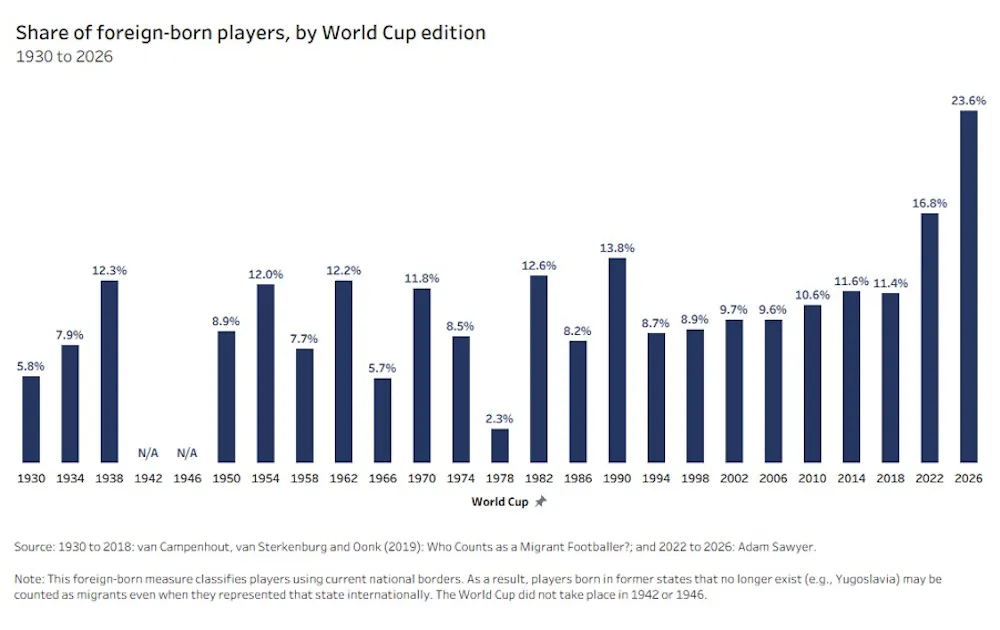
The 2026 World Cup will feature more foreign-born players than any previous edition. Nearly a quarter of the 1,248 players selected for national teams were born in a different country from the one they will represent.

In some squads, the proportions are far higher than this – 96% of Curaçao’s players were born abroad, as were 85% of the Democratic Republic of the Congo’s and 73% of Morocco’s. Overall, foreign-born players make up the majority of footballers in eight of the tournament’s 48 squads.

A bar chart showing the proportion of foreign-born players at football world cups since 1930.
CC BY-NC-ND

Migration has been part of the World Cup story since its inception. At the tournament’s third edition in 1938, for example, 12% of players represented a country other than the one in which they were born.

This was in part because Fifa didn’t introduce regulations governing football players’ eligibility for national teams until 1962, meaning it was not uncommon for players to represent multiple countries throughout their careers.

Some players represent countries other than those in which they were born because they are eligible through a parent or grandparent. These players often emerge from diaspora communities created by earlier waves of migration.

One example is 2018 World Cup finalist Ivan Rakitić, who was born and raised in Switzerland but chose to represent Croatia. In a 2025 interview, Rakitić explained that when he had to choose between the two countries, his heart told him he should play for Croatia.

Other players qualify through residency requirements. Pepe, for example, was born in Brazil but played in four World Cups for Portugal between 2010 and 2022 after becoming a Portuguese citizen at the age of 24.

Yet foreign-born players are only part of the story. World Cup squads also contain many second-generation migrants. France’s 2018 World Cup-winning squad is perhaps the best-known example: 12 of their 23 players had African parents.

Such patterns are not random. France’s squad reflected the country’s colonial and postcolonial links with north and west Africa. Similarly, since the mid-2000s, Switzerland’s national team has increasingly been shaped by migration from the former Yugoslavia following the conflicts and displacement that accompanied its breakup in the 1990s.

England’s 2026 squad also tells a story about the country’s migration history. Alongside Marc Guéhi, who was born in Ivory Coast, at least nine players had a parent born overseas. Most have family roots in former British colonies in Africa and the Caribbean, reflecting patterns of post-second world war migration to the UK.

At the same time, 24 players born in England have been selected by other World Cup teams. This includes five representing Scotland and 19 playing for countries beyond the British Isles (including the US, New Zealand and Ghana).

Does this matter on the pitch?

Relatively little research has examined whether national teams with more migrant players perform better on the pitch. But the available evidence suggests they do.

One study from 2022 analysed every World Cup between 1970 and 2018 and found that teams with more foreign-born players generally progressed further in the tournament. On average, each additional foreign-born player was associated with roughly 0.15 additional matches played.

The relationship remained even after accounting for broader differences between countries, suggesting that migration may provide advantages beyond those associated with wealth or footballing tradition alone.

Another study from 2023 examined European national teams competing in World Cups and European Championships between 1970 and 2018. Using players’ surnames to estimate their ancestral origins, it measured the diversity of backgrounds within each squad and found that more diverse teams tended to perform better on average.

Specifically, the research found that a one standard deviation increase in diversity led to an increase in goal difference (the number of goals a team scores minus the number of goals they concede) of around 1.3 per match on average.

There are at least two factors that might explain these results. First, migration can expand the pool of players available to a national team. Ghana’s squad for the 2026 tournament draws heavily on diaspora communities in western Europe. This allows it to recruit players developed in some of the world’s strongest football systems.

Second, migration may increase the diversity of skills available within a squad. Football players need specific physical traits and technical skills to succeed on the pitch. Central defenders, for example, are usually tall and physically strong. More attacking players, on the other hand, often require speed.

A more diverse population will probably provide a larger pool of potential players for each position, resulting in better complementarity at the team level.

This does not mean that migration wins World Cups. Argentina won the 2022 World Cup without a single foreign-born player in their squad. Success also depends on population size, economic wealth and coaching. Lionel Messi playing for your team helps, too.

Nonetheless, the limited evidence available indicates that migration may influence international football beyond simply changing the make-up of the teams competing.

If Morocco’s 2022 squad had been limited to players born and raised in Morocco, would they still have reached the semi-finals? We’ll never know for sure. But if Curaçao do so this time around, the role of migration in footballing success may become harder to ignore.

The Conversation

The 2022 and 2026 data on the share of foreign-born players selected in World Cup squads was compiled and analysed by Adam Sawyer, co-founder and director of research at Relevant Research, which provides technical and logistical support to immigration researchers.

Three hours of free power a day sounds good – but is Australia’s scheme fair?

xavierarnau/Getty

From July 1, many Australians can choose something that once sounded absurd: free electricity in the middle of the day. The federal government’s opt-in Solar Sharer Offer will give three hours of free power to households with smart meters in New South Wales, South Australia and southeast Queensland. Victoria’s separate scheme will launch in October.

Free power sounds like a giveaway. It isn’t. It’s meant to encourage people to use more electricity during the hours when solar power flows into the grid. The real aim is to get people to shift the use of water heaters, pool pumps, air-conditioning and electric vehicle charging to the middle of the day. At other times, power prices will be slightly more expensive.

The main challenge for Australia’s power systems is no longer how to meet peak demand in the evening. We now have to use or manage the floods of very cheap solar during the sunniest hours when there’s more supply than demand. If this imbalance isn’t managed, electricity voltage and frequency can move outside safe limits, equipment can trip, and the risk of outages rises.

The scheme makes sense. But there are still questions about its fairness. Electrified households will benefit most, while renters and other groups may benefit less.

The challenge of solar abundance

About one in three Australian homes now has solar. At times, this power source can supply 50% of total demand on Australia’s biggest power grid, the National Energy Market. Wholesale prices have regularly gone negative in recent quarters.

In big solar states such as South Australia, solar can supply more power than the state can use. Surplus power is exported, stored in batteries or curtailed – wasted.

The Solar Sharer Offer is meant to make better use of these floods of solar power.

This financial year, the three hours of free power will be 11am to 2pm daily in NSW and southeast Queensland and 12 to 3pm in South Australia. Australia’s energy regulator chose these times to match when solar output is highest, and network and wholesale costs are lowest. This may change year by year.

The reason the scheme isn’t national is because it’s tied to the Default Market Offer — a regulated safety net plan for electricity customers – which only applies in NSW, SA and southeast Queensland.

red brick apartment block in sunshine.
Renters and people in apartments may find it harder to benefit from the free power scheme. Andrew Merry/Getty

Who will benefit most?

Ensuring fair access has been a constant challenge for household clean-energy schemes. People who own their homes and have access to capital are usually better placed to benefit. This scheme has the same issue.

It’s easy to picture the ideal customer for three hours of free power – a homeowner with a smart meter, flexible hot water, electric vehicle, home battery and the ability to choose when power-hungry appliances run.

That’s great for them. But what about everyone else? For instance, you have to have a smart meter to be eligible. Only about 60% of households have one.

The harder question is whether this offer is fair for other households.

Renters, apartment residents and people on embedded networks in retirement villages, caravan parks or shopping centres face another barrier. If they opt in without being able to make good use of the free power, they could actually be worse off due to the higher prices at other times. These concerns were raised during the consultation process.

Making it fairer

The government is aware of these issues. The free power period is capped at 24 kilowatt hours a day, enough to cover several large daytime loads such as hot water, dishwashing, laundry, air-conditioning or part-charging of an EV.

The cap matters because offering electricity for free still incurs costs for energy retailers. To recover the missed revenue during the free window, retailers will boost other usage charges. Capping free power at 24 kWh a day limits how much high-consumption households can use at zero price, which limits how much revenue has to be recovered from usage at other times of day.

More needs to be done to ensure it’s fair. A key step is unglamorous but effective: helping households heat water during the day. Heating water takes a lot of power. Electric hot-water systems are often on controlled-load tariffs designed for overnight operation. A South Australian trial moved close to 50% of water heating from night to day with little reported inconvenience.

Where safe and practical, retailers and network businesses could shift the time these systems charge to the middle of the day. Governments could help rentals and apartment residents by supporting the use of timers, smart controllers and efficient heat-pump hot-water systems. The same logic applies to other flexible loads.

The free lunch is real. The question is who gets a seat at the table.

The Conversation

Saman Gorji receives funding from the Recycling and Clean Energy Commercialisation Hub (REACH), supported by the Australian government's Trailblazer Universities Program.

Alireza Ganjovi does not work for, consult, own shares in or receive funding from any company or organisation that would benefit from this article, and has disclosed no relevant affiliations beyond their academic appointment.

South African telescope detects record-breaking signal from the early universe

Astronomers using the MeerKAT radio telescope in South Africa have discovered the most distant hydroxyl megamaser ever detected, opening a new radio astronomy frontier. A hydroxyl megamaser is a natural space laser, and this one is located in a violently merging galaxy more than 8 billion light-years away.

We spoke to the astronomers, Thato Manamela, a postdoctoral researcher at the University of Pretoria, and Roger Deane, director of the Inter-University Institute for Data Intensive Astronomy and a professor at the universities of Cape Town and Pretoria, about their study.

What you’ve found has been described as a ‘new frontier’ in space research. Why is it extraordinary?

This discovery is extraordinary because of the record distance at which we’ve detected it, over eight billion light-years away. That places it deep into the early universe. This means that we aren’t seeing the galaxy as it exists today. We are seeing it as it was 8 billion years ago. Since the Big Bang happened about 13.8 billion years ago, we are looking at a “toddler” version of the universe. At that stage where the maser signal was transmitted by the host galaxy, galaxies were much more “chaotic”, they collided more often and were much more active than the stable, mature galaxies we see nearby today.

It gives us a rare glimpse of galaxy interactions and extreme star-forming environments when the cosmos was less than half its current age. Think of light like a letter in the mail. If a friend sends a letter from overseas, by the time you read it, the news is old. In space, light is the letter. The “news” from this galaxy took 8 billion years to reach us. We see the galaxy as a “toddler” even though, in its own time, it has already grown up or changed.

We detected this megamaser, which operates on a scale of power millions of times greater than a typical galactic maser. Both megamasers and gigamasers are cosmic radio lasers. While a megamaser is a million times more luminous than a standard maser found in the local universe, a gigamaser is a billion times more luminous, making it 1,000 times more powerful than a megamaser.

In just five hours of observing time we found a signal that typically requires hundreds of hours of observation, given its distance and rarity. But gravitational lensing boosted the signal enough to detect it. Additionally, while we were targeting neutral hydrogen, MeerKAT’s wide bandwidth enabled the surprise discovery of the megamaser signal in the same data.

This rapid detection suggests that future surveys with MeerKAT and the upcoming SKA Observatory could uncover many more such distant, extreme objects. Its ability to find this so quickly proves that we finally have the technology to see faint signals from the very distant past. It’s a preview of what the upcoming Square Kilometre Array (SKA), a unique, one-of-a-kind international mega-project, might achieve.

But a highly complementary next-generation facility called the next-generation Very Large Array (ngVLA) is being planned and designed for construction in the US. The SKA Observatory (SKA-Low and SKA-Mid) focuses on low-to-mid radio frequencies. The ngVLA will operate at much higher frequencies. Together, they will form two of the major pillars of next-generation global radio astronomy. The finding gives astronomers a new way to study how galaxies evolved in the early universe.

What technologies or capabilities made this possible?

The discovery was made possible by the sensitivity and wide frequency coverage of the MeerKAT radio telescope. Its ability to detect faint signals over a broad frequency range allows us to search for spectral lines across large cosmic volumes. A spectral line is a cosmic chemical fingerprint. Every atom or molecule emits electromagnetic waves at specific frequencies. Detecting those frequencies tells astronomers what the gas is made of.

In this case, MeerKAT’s wide bandwidth allowed us to detect both the hydroxyl line and neutral hydrogen absorption in a single observation. Previously, with older technology, this would have taken two separate observations.

Equally important are advances in data processing and computing. The data were processed using high-performance computing resources at the Inter-University Institute for Data Intensive Astronomy (IDIA).

Processing such massive amounts of data is like trying to drink from a firehose. MeerKAT collects gigabytes of information every second, resulting in files far too large for a standard computer to handle. To find a signal from 8 billion years ago, which is millions of times fainter than a cell phone signal, we must use robust calibration pipelines. These act like an automated high-tech car wash to scrub away digital noise and sharpen the telescope’s focus. This “cleaning” process requires trillions of mathematical calculations, necessitating the use of supercomputers that work for days to transform raw radio interference into a clear scientific discovery.

Gravitational lensing also played a key role. A massive foreground object, like a star or galaxy, for example, amplified the signal from the distant galaxy, effectively acting as a natural telescope and boosting our ability to detect it.

How does what you’ve found change our understanding of the universe?

It’s rare that a single astrophysical system, a collection of celestial objects, in this case, two galaxies forming a lens system, can change our understanding of the universe. We typically need large sample sizes to do that. But the combination of the recording-breaking distance and the speed of the discovery was impressive.

It suggests that systematic searches – such as those conducted by deep MeerKAT surveys – could convert these once-rare finds into powerful probes of extreme, yet highly obscured star formation in the distant universe. As a result of this observation, the SKA Observatory and other future telescopes won’t just be looking for more of the same; they will be looking for hidden history.

Hydroxyl megamasers are usually associated with galaxy mergers. We expect some galaxy mergers to host pairs of supermassive black holes. Almost every large galaxy has a supermassive black hole at its centre. When galaxies merge, the supermassive black holes at their centres can eventually spiral towards each other, producing gravitational waves, ripples in space-time. Finding systems like this helps astronomers study an important stage in galaxy evolution and the environments where these extreme events occur.

By using megamasers to find these pairs, we can study the final stages of how the largest objects in the universe are built. This is a major milestone in a galaxy’s life. By finding these galaxies now, we are catching them at a key evolutionary stage, the final countdown before they collide and release a massive burst of energy that our next generation of detectors will be able to hear.

The strength of the MeerKAT-detected hydroxyl signal after such a short observation time therefore implies that astronomers will be able to detect large numbers of these systems across most of cosmic time.

What does the discovery say about South Africa’s place in data-intensive radio astronomy?

This discovery highlights South Africa’s leading role in radio astronomy. Facilities such as MeerKAT, combined with data-intensive platforms like IDIA, provide world-class capabilities for both observation and analysis. It also demonstrates strong local expertise in handling large, complex datasets.

Discoveries like this rely on advanced data processing, signal extraction and scientific interpretation. These are all key strengths within the South African research community. As we move from using current scout telescopes like MeerKAT to building and operating the world’s largest radio observatory, the SKAO, South Africa is well positioned to remain a hub for data-intensive astronomy. Results like this reinforce the country’s role in shaping the future of the field.

The Conversation

Thato Manamela works for the University of Pretoria. He receives funding from the National Research Foundation (NRF SARAO). He is affiliated with UP and IDIA.

Roger P. Deane previously held an SKA Research Chair in Radio Astronomy, funded by the South African Radio Astronomy Observatory, which is a facility of the National Research Foundation (NRF), an agency of the Department of Science, Technology and Innovation (DSTI).

‘Some people’s lives matter more than others’: local responders in Sudan feel ignored as the world focuses on other crises

In April 2026, Sudan marked three years of civil war – one of the most ignored humanitarian crises in the world.

This conflict began between two factions that seized power after a coup in 2021: the Sudanese Armed Forces (SAF), led by Abdel Fattah al-Burhan, and the Rapid Support Forces (RSF), a paramilitary group led by Mohamed Hamdan “Hemedti” Dagalo.

The actions of these men have thrown Sudan into the worst humanitarian crisis in the world. It has involved crimes against humanity, genocide, the death of potentially more than 150,000 people, the forced displacement of more than 15 million civilians and 19 million people facing acute hunger.

In one of the most dangerous places in the world, local leaders are putting their lives at risk to provide humanitarian assistance within their communities.

These volunteers have formed Emergency Response Rooms or غرف الطواريء to coordinate, resource and carry out life-saving assistance. They describe being motivated by nafeer – a Sudanese tradition focused on a “deep sense of social responsibility” and “collective volunteerism”.

This concept is grounded in the idea that one must “lift your bowl to your neighbour”. Diaspora communities around the world have been funding and coordinating this work for years.

As one 25-year-old female volunteer told us:

The success of emergency rooms stems from the spirit of volunteerism and the desire to help others. This motivation keeps people working despite the challenges they face, like lack of funding, security threats from authorities and working in active war zone.

However, nafeer, by its nature, should only last for a limited period. After three years, these crisis leaders are exhausted, and the international humanitarian system is not stepping up to support them.

In fact, our recent research shows the system’s own structures are making their work harder.

Our research

We spoke to 20 local leaders from Emergency Response Rooms, civil society organisations and women’s associations. These interviewees were based in Darfur, Greater Khartoum, Gezira, Kassala, Al-Qadarif, Kordofan and the Nuba Mountains.

Interviews were conducted online in Arabic by Mayada Elmaki, a Sudanese-British researcher living between Europe and Qatar.

Responders’ names, organisations and locations were taken out, due to safety concerns. Of the 20 leaders we spoke with, only a quarter received a salary. The remainder were unpaid volunteers.

Because these community organisations have not been formally recognised as “humanitarian” by the international humanitarian system itself, their people are not considered “humanitarian workers”. This means they are not given the legal protection afforded those conferred on humanitarian workers under international law, including the Geneva Conventions. This puts them at extra risk of harm from military and paramilitary forces.

The Sudanese emergency workers say funders from within the humanitarian system – including governments, nongovernmental organisations and UN agencies – are often more focused on managing perceived risk than on what the community actually needs.

Funding is often so inflexible, it takes an “extremely, extremely long time” to access. Getting money from funders require negotiating quite different templates and procedures.

As one person told us:

when our priority is saving lives first, it’s problematic when donors dictate what we should focus on.

Sudan is one of the most dangerous places in the world to deliver humanitarian assistance. It is also home to one of the most chronically underfunded humanitarian crises.

The number of organisations in Sudan getting money from these major humanitarian funders has fallen dramatically in recent years. This isn’t because things have improved, but because the priorities of many international organisations have shifted elsewhere.

As one Sudanese humanitarian leader put it:

When one crisis receives more attention and support than another, it means some people’s lives matter more than others.

At the heart of the international humanitarian system’s ethical foundation is the idea that assistance should be based on need alone – not factors such as geopolitical interest. But this is not what many of our interviewees have experienced.

The international community has taken some notice. Sudan’s Emergency Response Rooms were awarded major humanitarian prizes in 2025 and have been twice nominated for the Nobel Peace Prize.

But awards are not protection, funding, or recognition within the humanitarian system.

As Sudanese leaders, community members and volunteers endure one of the world’s worst humanitarian crises, the international system needs to step up.

Local priorities

Our research seeks to amplify the priorities of local Sudanese responders.

They are calling for:

  • better protection and compensation for those on the front lines
  • more flexible agreements with major funding bodies
  • direct funding that acknowledges operational costs
  • funding for long-term rebuilding of Sudan (not just the emergency response).

Otherwise, the international humanitarian system and the major players in it will, as one person told us, continue “ploughing the sea”, and “keep going in circles without real progress”. They added:

I hope my words reach them and make them reconsider their policies and establish long-term strategies for developing local communities.

The Conversation

Max Kelly recevies funding from the Norwegian Refugee Council. This research is funded in part by Deakin University, and the Norwegian Refugee Council (NRC).

Julia Hartelius and Mayada Elmaki do not work for, consult, own shares in or receive funding from any company or organisation that would benefit from this article, and have disclosed no relevant affiliations beyond their academic appointment.

Famesick: Lena Dunham makes us laugh about a dream job turned brutal nightmare

During the final season of Lena Dunham’s acclaimed comedy drama series, Girls, the character she plays, Hannah Horvath, says her ambition as a writer is to make people laugh about painful things. In real life, this is exactly what Dunham has achieved with her second memoir, Famesick which opens with a prime example.

“It’s very hard to remember a time – aside from brief flashes of adrenaline on a set or a date or at a fashion party where people are inadvertently dressed like kids in a school play about Greek gods – when being in my body didn’t feel like towing a wrecked car across town at midnight,” she writes.

A searingly funny, bare-hearted exploration of the cost of success, Dunham’s book charts her meteoric rise as a young screenwriter, director and actor with brutal honesty.


Review: Famesick by Lena Dunham (4th Estate)


Smart, sassy and highly entertaining, Famesick is ultimately a painfully astute analysis of the ways a dream job can morph into a perilous nightmare. Particularly for someone who is neurodivergent, barely out of college, emotionally dependent on their parents and suffering from a rare, undiagnosed chronic disease.

Throughout the first decade of her glittering career, Dunham balanced precariously between adulation and critical attacks. Her intelligent, sharply observed humour defined her public and professional image, but her personal boundaries were all too permeable. The demands of her job bled into her life with devastating consequences for her body.

Careering from one disastrous man to another, leaning hard on colleagues and friends, Dunham looked to others for the psychological stability she hadn’t yet developed. Her heart dangerously exposed on her sleeve, she poured the events of her life into screenplays, medicated her stress and crashed her way through stardom, unprotected by the industry that relied on her.

The price of Dunham’s success was exorbitant, involving much more than long hours and hard work. Yet while parts of her story are harrowingly visceral, she refuses self-pity and keeps away from the confessional traps of trauma porn.

There is nothing gratuitous or exploitative in these pages and Dunham refrains from blaming others for her chaos. Instead, she frames her drug addiction, unhealthy relationship patterns and debilitating chronic health issues as the cost of her own ambition, with a central question in mind. Was it worth it?

A cursed, well-connected fairy tale

Dunham’s narrative begins like a modern-day fairy tale with the story of her name, chosen by her mother “because it sounded like the name of someone who could be a movie star or a lawyer with an equal measure of success”. As a legacy, this turned out to be something of a curse.

Raised within privileged and well connected New York circles, by artist parents, Dunham began experimenting with film-making while attending liberal arts college Oberlin. Her first breakthrough was in 2010, with the award-winning semi-autobiographical movie, Tiny Furniture. She was just 23.

book cover - Alice in Wonderland white tights and Mary Janes under a blue skirt

Six months after her film premiere, Dunham’s career skyrocketed when HBO contracted her to write and direct the pilot episode of Girls. Aiming to reflect the messy, early twenties stage of life, “when you don’t even know enough to even know what you’re looking for”, the show, like her film, starred herself and her childhood friend Jemima Kirke, with Allison Williams and Zosia Mamet completing the quartet of titular girls.

The series’ most intriguing character was arguably Hannah’s oddball boyfriend, Adam Sackler, played with unnerving conviction by Adam Driver in his first major role. Sackler, a misanthropic alcoholic, was based on Dunham’s real-life abusive lover in the first season. Later, the character evolved into a tender and devoted partner.

Off screen, Driver and Dunham’s relationship was, according to the book, also intense. The two actors skirted each other as Dunham tried to fathom her co-star’s unpredictable, occasionally explosive behaviour.

On one occasion, rehearsing a fight scene, he threw a chair at a wall when she couldn’t remember her lines. But while she recalls his verbal aggression and short temper, she also remembers spending “an inordinate amount of time wondering if Adam liked me”. Given the obvious strength of her seemingly unresolved feelings for Driver, it’s hard to know how to read her interpretation of him, though she clearly never figured him out.

With its frank, often hilarious, sometimes uncomfortable, all too relatable depictions of troubled friendship, awkward sex, career missteps and the fraught struggle for identity, Girls made a huge impact. From 2012, it ran for six seasons and five years, by which time all four main actors were turning 30. According to Dunham, the ending was planned to avoid losing “the creative clarity and specificity that gave it value”.

The show established Dunham as a sharp-sighted, uniquely talented visionary, but also attracted pernicious criticism that took her many years to process.

Accused of exploiting her nepo baby status, reviled for daring to expose her perfectly average physique, branded a myopic millennial, Dunham was both pummelled and pressurised for assuming the voice of her generation. “Or a voice,” as Dunham remembers her high-powered co-showrunner, Jenni Konner quipping. “Of a generation.”

Body as battleground

The irony of her situation was ridiculous. The whole point of Girls was to satirise the hot, flawed, contradictory tangle of young, white female adulthood experienced by Dunham and her friends. But like countless other women, Dunham was vilified for daring to give herself a platform. Worse – again, like so many other women – she experienced every mistake as an abject failure that filled her with shame.

Dunham’s extraordinary trajectory served as both example and warning to her peers, but behind the scenes of her controversial story, her body had become a battleground.

Between the pilot of Girls, when a colitis attack landed her in hospital, and the final season, when she shattered her elbow, collapsed from endometriosis and suffered a massive internal haemorrhagic cyst that caused so much pain she could barely walk, Dunham had chosen to “ignore my body’s noisy signals in favour of this thing I wanted so badly”.

In 2019, Dunham was diagnosed with Ehlers-Danlos syndrome, a rare genetic connective tissue disorder that explained many of her symptoms. Prior to this, her faltering health was often just another source of shame. Hospital stays and bed rest delayed production, which was expensive and upset Konner. So Dunham numbed herself with prescription pills and kept going.

On the brink of her career, Dunham was in thrall to Konner. Brought in by HBO, the 38-year-old supervisor was already a television heavyweight and represented a big sister figure for the less experienced creator, who was her junior by 14 years.

Within days of their first meeting, Konner began divulging intimate details of her life and making extremely personal remarks to Dunham, all while teaching her how to write a pilot. But once filming started, she began exercising her authority “on a more sinister note”, telling her protegee she had to gain weight and look dowdy in order to stay funny.

Years later, when working with younger women herself, Dunham could see “how absurd it would seem to link myself to them in ways beyond the playful support system an on-set adult provides”. But as the ingenue, Dunham placed all her faith in Konner, and immersed herself in a lopsided relationship that grossly transgressed professional boundaries.

Together with Kirke, and Dunham’s long-term partner, music mogul Jack Antonoff, Konner became one of the author’s “three Js”; effectively a triumvirate who “defined my world, and in relation to whom I defined myself”. Caught up in this circle of co-dependency, Dunham was invariably left with an overwhelming sense of inadequacy. She felt she was

always in trouble with one of them for something: A dinner I arrived late for and left early. A messy breakdown I couldn’t predict or control … and the endless cycle of reassurance I required afterward. The only thing I could promise was to never miss a deadline.

Dunham is more circumspect when it comes to her parents. However, it’s impossible not to speculate over her enmeshed relationships in light of her family dynamic. Supportive, but also overprotective and possessive, her mother (“the original frenemy”) and father tended to burden her with “unreasonable expectations”.

And they appeared to have been threatened by her success, as Dunham explains, “because it forced them to admit how much of their own self-image rode on their own highly specific public identities”.

Other telling details are scattered throughout the book, including the death of her beloved anorexic grandmother and her estranged brother, Cyrus, who couldn’t bear the attention his older sister’s fame commanded. (A media storm over a passage in Dunham’s first book had resulted in claims she had sexually abused Cyrus when they were both children, and though Dunham strenuously denied this and issued an apology, damage was done.)

There is enough here to know that Dunham’s comparatively untold family story has been a difficult and complicated one, with firmly embedded roots and a pretty long shadow.

After Girls, Dunham’s life imploded. Her physical suffering culminated in a hysterectomy. She broke up with Antonoff after five years. And her addiction to benzodiasepines, taken to suppress her anxiety, finally landed her in rehab.

Her recovery, chronicled in the third part of the book, was slow and incremental as she learned to reappraise her work ethic, to accept her body and to learn to live with chronic illness. She also had to let go of Konner, which broke her heart, but helped her become more forgiving towards her younger, needier self.

As the book moves towards its poignant conclusion, which sees Dunham married to British musician Luis Felber and settled into a more sustainable rhythm of work and life, the price she has paid for fame becomes clear.

“Hollywood’s culture has always been permissive toward everything but human frailty,” she writes. And with this final insight, she points her reader back to the front of her book, and the long, tragic list of now-dead stars to whom her memoir is dedicated, along with “anyone else who was too Famesick to be cured”.

The Conversation

Liz Evans does not work for, consult, own shares in or receive funding from any company or organisation that would benefit from this article, and has disclosed no relevant affiliations beyond their academic appointment.

❌
Subscriptions