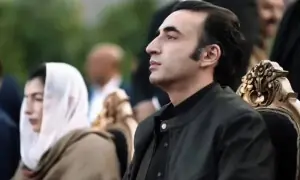
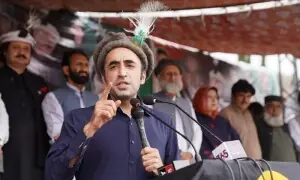
PPP Chairman Bilawal Bhutto-Zardari on Friday promised to ensure the right of ownership and the protections of the 18th Constitutional Amendment for the people of Gilgit-Baltistan.
His remarks came during a public rally in Gilgit, part of his region-wide campaign ahead of the June 7 elections.
Addressing the rally, Bilawal said it was part of the PPP’s election manifesto to grant all constitutional rights to the region, including the right to own land and financial protections under the 18th Con
PPP Chairman Bilawal Bhutto-Zardari on Friday promised to ensure the right of ownership and the protections of the 18th Constitutional Amendment for the people of Gilgit-Baltistan.
His remarks came during a public rally in Gilgit, part of his region-wide campaign ahead of the June 7 elections.
Addressing the rally, Bilawal said it was part of the PPP’s election manifesto to grant all constitutional rights to the region, including the right to own land and financial protections under the 18th Constitutional Amendment.
He urged the people of GB to give the PPP a “heavy mandate”, so the party could continue its struggle to secure the region’s ownership rights, calling on them to spread his message.
Bilawal said legislation on the matter had been tabled in the Gilgit-Baltistan Assembly and had been passed by the house.
“As per the legislation, 28,000 square miles of land owned by the government has been converted into common land. We have fulfilled our promise to this stage,” the PPP chairman said.
Bilawal added that the legislation should now be implemented.
“I request the people of Gilgit-Baltistan that this time I need a heavy majority,” he said, warning that if any party other than the PPP came into power, it would “tear this legislation apart”.
“Whether you belong to the PPP or not, I request all the people of the region to vote for the PPP, because only we can safeguard ownership rights.”
The former foreign minister said that the region was the Koh-i-Noor of Pakistan’s destiny, adding that if the PPP won the upcoming elections, it would unlock the economic potential of GB.
“The politicians of the 1990s do not understand the role technology can play,” he said.
Bilawal said that digital infrastructure was more “crucial” than transport or physical infrastructure. “Through digital connectivity, a youngster living in Gilgit-Baltistan can earn money from home,” he said.
“We will make efforts to ask China for optical fibre connectivity; if not, we will request the United States to provide satellite-based Starlink internet services so we can move forward,” the PPP chairman said.
During his address, he also made various promises to initiate public-private partnership-based projects, including a health network and a housing scheme for people affected by floods in the region.
He said the entire Muslim world was going through difficult times.
“You can see what’s happening in Palestine, Lebanon, Arab countries, and specifically Iran,” he said, asking who could represent the country in such times.
“During these times, if we want to raise the voice of Gilgit-Baltistan in Islamabad and across the world, there is no better option than President Asif Ali Zardari,” he said.
Bilawal has spent the last few days addressing campaign rallies in the region, including a rally in Shigar on Monday where he stated that any new constitutional amendment should provide protection to the rights of GB.
He also addressed a public gathering in Skardu on Tuesday where he called for greater rights for the region. There, the Bhutto scion asserted that the PPP was the “only party that represents the underprivileged and the poor”, and emphasised that the country could only develop once the working class and the youth were economically empowered.
Additionally, speaking in Diamer on Wednesday, he vowed to address the resettlement concerns of those affected by the construction of the Diamer-Bhasha Dam on an “immediate basis” if his party was elected. He added that had President Asif Ali Zardari’s government not been removed in 2013, the dam would have been built by now.
General elections in GB are scheduled for Sunday, after a four-month delay attributed to harsh winter weather.
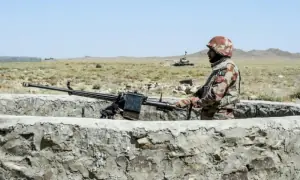
Security forces killed 17 terrorists during intelligence-based operations (IBOs) in different districts of Balochistan following the suicide car bomb attack against a shuttle train in Quetta, said a statement released by the Inter-Services Public Relations (ISPR) on Tuesday.
At least 14 people were killed and 20 others were injured in the incident, which took place on May 24.
The IBOs were conducted in the districts of Mastung, Nushki, Khuzdar and Kech.
The military’s media wing added that multi
Security forces killed 17 terrorists during intelligence-based operations (IBOs) in different districts of Balochistan following the suicide car bomb attack against a shuttle train in Quetta, said a statement released by the Inter-Services Public Relations (ISPR) on Tuesday.
At least 14 people were killed and 20 others were injured in the incident, which took place on May 24.
The IBOs were conducted in the districts of Mastung, Nushki, Khuzdar and Kech.
The military’s media wing added that multiple terrorist locations were targeted by security personnel during these operations.
“Following intense and fierce exchanges of fire, 17 terrorists belonging to Indian-sponsored Fitna al Hindustan have been sent to hell, giving a significant blow to the terrorist networks operating in these areas,” the statement read.
The state has designated Balochistan-based terrorist groups as Fitna-al-Hindustan to highlight India’s alleged role in terrorism and destabilisation across Pakistan.
ISPR added that weapons, ammunition and a large cache of explosives were recovered from the dead terrorists, as well as improvised explosive devices (IEDs).
It added that the terrorists remained actively involved in numerous terrorist activities in the area.
“Sanitisation operations continue to eliminate terrorists from these areas, as [the] relentless counter-terrorism campaign under vision ‘Azm e Istehkam’ (as approved by Federal Apex Committee on National Action Plan) by security forces and law enforcement agencies of Pakistan will continue at full pace to wipe out the menace of foreign-sponsored and supported terrorism from the country,” ISPR stated.
Last month, a major was among five soldiers martyred during an area sanitisation operation in Balochistan’s Barkhan district, according to ISPR.
At least seven terrorists were also killed during the operation, and the operation was carried out by the Pakistan Army and Frontier Corps.
There has been a resurgence in terrorism in Pakistan since the Afghan Taliban returned to power in Kabul in 2021.
Islamabad has repeatedly urged the Taliban administration to dismantle terrorist sanctuaries on Afghan soil, particularly those linked to the banned TTP. Officials say those appeals have gone unheeded.
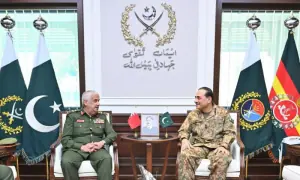
RAWALPINDI: The commander of Bahrain’s National Guard, General Shaikh Mohammad bin Isa bin Salman Al Khalifa, discussed the strengthening of military collaboration with Pakistan in a meeting with Chief of Defence Forces (CDF) and Chief of the Army Staff (COAS) Field Marshal Syed Asim Munir on Tuesday.
A press release issued on Tuesday by the Inter-Services Public Relations (ISPR) said that the Bahraini commander called on CDF Munir at General Headquarters (GHQ) Rawalpindi today, where the two di
RAWALPINDI: The commander of Bahrain’s National Guard, General Shaikh Mohammad bin Isa bin Salman Al Khalifa, discussed the strengthening of military collaboration with Pakistan in a meeting with Chief of Defence Forces (CDF) and Chief of the Army Staff (COAS) Field Marshal Syed Asim Munir on Tuesday.
A press release issued on Tuesday by the Inter-Services Public Relations (ISPR) said that the Bahraini commander called on CDF Munir at General Headquarters (GHQ) Rawalpindi today, where the two discussed “matters of mutual interest, [the] regional security environment, and avenues for enhanced bilateral defence and security cooperation”.
“Both dignitaries expressed satisfaction over the longstanding brotherly relations between Pakistan and Bahrain and underscored the importance of further strengthening military-to-military collaboration,” the ISPR statement said.
Earlier, the commander also separately called on Chief of the Naval Staff Admiral Naveed Ashraf, and Chief of the Air Staff Zaheer Ahmed Baber Sidhu.
The meeting at the Naval Headquarters focused on bilateral defence collaboration and regional security dynamics. The commander commended the Pakistan Navy’s constructive role in advancing cooperative maritime security across the region, expressing appreciation for its role as “the regional maritime security stabiliser”.
Meanwhile, during the meeting at Air Headquarters, the air chief highlighted Pakistan Air Force’s modernisation efforts, “including capability enhancement, infrastructure development, indigenisation, and advanced training reforms”, the statement said.
“Discussions focused on emerging defence technologies such as drones, artificial intelligence, autonomous systems, advanced sensors, and digital innovation, as well as evolving air defence challenges and integrated defence architectures,” added the military’s media wing.
The Bahraini commander appreciated the professionalism, operational readiness, and contributions of Pakistan’s armed forces towards regional peace and stability. He also praised the army’s modernisation initiatives and indigenous capabilities, expressing interest in further cooperation in training, emerging technologies, and capacity-building initiatives, according to the ISPR.
“The visit reflects the strong and enduring defence partnership between Pakistan and Bahrain and is expected to further advance bilateral military cooperation for the mutual benefit of both brotherly nations,” the statement said.
The discussions on security and defence cooperation come amid tensions in the Middle East, as a three-month long war between the United States and Iran remains unresolved by a fragile ceasefire. Pakistan has emerged as a key mediator in the conflict, having hosted a round of talks between the two sides in Islamabad in April and staying in the picture even after plans for a second round fell through.
Earlier today, the CDF also met with the Lebanese army’s Commander-in-Chief General Rodolphe Haykal at the GHQ to exchange views on the evolving regional security environment. The discussions focused on strengthening professional interactions, training cooperation and institutional linkages between the armed forces of the two countries, according to the military’s media wing.
In January, President Asif Ali Zardari met with Bahrain’s King Hamad bin Isa Al Khalifa in Manama, with the former reaffirming Pakistan’s commitment to broadening cooperation between the two countries across political, economic, defence and cultural fields.
Last year in November, Prime Minister Shehbaz Sharif, during a two-day visit to Bahrain, had reiterated Pakistan’s commitment to deepening ties with the kingdom.
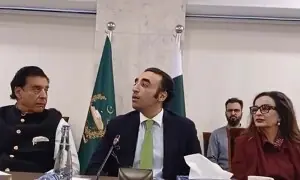
ISLAMABAD: PPP Chairman Bilawal Bhutto Zardari on Friday welcomed Prime Minister Shehbaz Sharif’s statement regarding the formation of a government in Gilgit-Baltistan (GB) and expressed his gratitude.
The PPP is all set to form a government in the region after it gained 11 out of 24 seats in the GB Legislative Assembly, according to the unofficial results (Form-47) of the June 7 elections.
According to Radio Pakistan, the prime minister assured full support from the PML-N to the PPP on governm
ISLAMABAD: PPP Chairman Bilawal Bhutto Zardari on Friday welcomed Prime Minister Shehbaz Sharif’s statement regarding the formation of a government in Gilgit-Baltistan (GB) and expressed his gratitude.
The PPP is all set to form a government in the region after it gained 11 out of 24 seats in the GB Legislative Assembly, according to the unofficial results (Form-47) of the June 7 elections.
According to Radio Pakistan, the prime minister assured full support from the PML-N to the PPP on government formation.
The prime minister said the PML-N has decided to sit on the opposition benches in the Gilgit-Baltistan Legislative Assembly, but its elected members will vote in favour of the PPP to form the government.
In a statement, Bilawal said that recognising the PPP’s majority in GB is the continuation of a democratic tradition and added that the party views the premier’s invitation to form the government as a “positive step”.
“As a result of a consensus agreement, the positions of governor and deputy speaker of Gilgit-Baltistan will be allocated to the PML-N,” he was quoted as saying. “The PPP will utilise all its capabilities to serve the people of Gilgit-Baltistan.”
The party chairman specifically thanked the people of GB, saying that by placing their trust in the PPP, they entrusted the responsibility of safeguarding their property rights, employment rights, and constitutional rights to the party.
“The Pakistan Peoples Party will fulfil this responsibility effectively and with dedication,” he concluded.
A day earlier, delegations of the PPP and PML-N met in GB to discuss proposals for forming a government in the region after the recent elections. Key leaders from both parties held detailed consultations on government formation proposals.
In its statement, the PPP described the talks as a “major breakthrough”, saying both parties agreed to present proposals to their respective central leaderships.
It said the discussions also covered political cooperation and various national and regional issues.
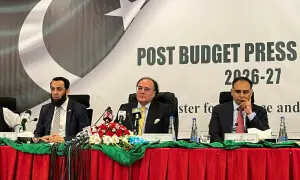
Finance Minister Muhammad Aurangzeb on Saturday termed the proposed budget for FY26-27 as a significant move towards setting the country on the path of economic growth.
“In this budget, we have made significant progress in that direction of travel [towards economic growth] that we spoke earlier about,” he said at the outset of his media briefing in Islamabad.
The minister affirmed that the government has “made comprehensive efforts to create an enabling environment” for an export-led growth, rec
Finance Minister Muhammad Aurangzeb on Saturday termed the proposed budget for FY26-27 as a significant move towards setting the country on the path of economic growth.
“In this budget, we have made significant progress in that direction of travel [towards economic growth] that we spoke earlier about,” he said at the outset of his media briefing in Islamabad.
The minister affirmed that the government has “made comprehensive efforts to create an enabling environment” for an export-led growth, recalling the abolishment of an advance tax.
He stressed the decision to reduce the super tax for businesses earning more than Rs500 million, terming it a “very meaningful direction of travel”.
During the budget presentation yesterday, the finance minister announced that super tax would be abolished for businesses earning between Rs150m and Rs500m annually, and it would be reduced from 10pc to 8pc for businesses whose income exceeded Rs500m.
Aurangzeb said he proposed the abolishment of the super tax for “all exporters”, as per the directives of Prime Minister Shehbaz Sharif.
He further noted the matter also pertained to “financing rather than just taxation”. He added that an additional subsidy of Rs70 billion has been proposed in the budget to take the Export Refinance Scheme (EFS) “to a different level”.
“Macrostability is basic hygiene. It is as simple as that. If there would be forex reserves, interest rates, foreign exchange, and consistent policies in this country, then local investors would come first, followed by foreign investors,” Aurangzeb remarked.
Referring to the freeze on provincial development allocations, the finance czar lauded the provinces for stepping up and “helping us in some of the most pressing needs”.
“Some of those have been reflected in the defence budget,” he said, adding that the arrangement was expected to remain in place for the next three years.
On another question, Aurangzeb asserted that the issue was “not a lack of resources”, noting that Rs4.3bn had been allocated for the uplift plans for the entire country.
He emphasised the need to move towards the public-private partnership (PPP) model, so that the private sector could be promoted.
Asked about rumours that the Board of Investment (BoI) and the Special Investment Facilitation Council (SIFC) merger, the minister said the merger of various ministries was part of the government’s rightsizing exercise.
“As far as BoI and SIFC are concerned, duplication can be seen in them; both have similar objectives of investment and facilitation. Therefore, a joint secretary was appointed, but it is best if foreign investors use and work with a one-window [system],” he said.
The finmin said Prime Minister Shehbaz Sharif has “made the principal decision to merge them”, with the process yet to be determined.
On the 7pc increase in salaries and pensions for all government employees, Aurangzeb said the benchmark was determined based on the inflation index and termed the raise “satisfactory” considering the tax relief.
Taxation
On taxation, the finance czar emphasised the aspects of “both deepening and broadening” the revenue collection.
Affirming that digital monitoring and other measures were already leading to additional revenues, he noted that a “new tax model” presented in the parliament yesterday was in design.
“We want to take this towards automation and AI, and reduce human intervention,” he said, mentioning that the retailers’ scheme has been proposed to widen the tax base.
Noting that questions had been raised about economic growth, rather than stabilisation, Aurangzeb asserted: “We have fully utilised the fiscal space available to us. There is more to do […] The feedback we have received so far is that we have set out on the path to economic progress.”
Responding to a question, the finance minister clarified that the petroleum levy was not being increased.
However, he acknowledged that the government “keeps interchanging the amount between petrol and diesel”, but there was no proposal to increase it.
About the recent surge in oil prices, Aurangzeb said that the impact of the Middle East conflict “will spill over into the next fiscal year”.
“Whether it is the supply or the prices, we have built in that redundancy into our fiscal position for the next year,” he added.
Replying to a query, the finance minister pointed out the abolishment of taxes on contraceptives and sounded the alarm on Pakistan’s high population growth rate.
“If today, with a population of 250m, you are highlighting there is child-stunting and learning poverty, which is primarily girls out of school, then can you imagine what will happen if we reach 300m to 400m?” he said.
Terming it an “existential issue”, he affirmed that the government was working on a comprehensive plan.
“When the next NFC (National Finance Commission) award is allocated, this particular allocation driver has to be reviewed and has to change,” he said, referring to population.
At one point during the press conference, responding to speculations before the budget was proposed — such as an increase in the sales tax — Aurangzeb quipped that the reporters should hold their sources “accountable” for the incorrect information they were given.
He also took exception to earlier reports of imposing taxes on solar equipment. “This was never part of the discussion.”
‘Entire budget is for export-led growth’
Speaking about tariffs, the finance minister noted that the government was in the second year of the five-year plan “in terms of bringing the cost down in terms of intermediate goods and the raw material”.
He stressed the importance of reducing the “trade deficit for goods”, adding that the services exports, particularly IT, were “becoming more and more important as we go forward”.
He said IT exports were expected to reach $4.5bn and that the overall “goods and export data for next year is very good”.
“This is why the government has announced to maintain the 0.25 per cent Final Tax Regime (FTR) as per the discussions that came through the IT industry, freelancers and PASHA,” he said.
Aurangzeb emphasised that the government tried to “provide relief to the lowest segments of the salaried class”, recalling that the slabs of 5pc and 15pc were reduced to 1pc and 13pc, respectively.
Meanwhile, FBR Chairman Rashid Mahmood Langrial said the “entire budget is a budget for export-led growth”.
Noting that there was a limited market within Pakistan to sell locally-manufactured goods, he said, “Unless you sell those goods abroad, poverty will not decline in Pakistan.”
He observed that there were two sets of people for reducing poverty, with the Benazir Income Support Programme (BISP) addressing the set that cannot become a part of the economic activity and “would be left behind in any system”.
Focus on agri, construction
Aurangzeb noted that agricultural credit and financing had risen by 15pc year-on-year (YoY) and the overall agri-financing has crossed Rs2 trillion. He highlighted that the Zarkhez-e Scheme for small farmers was collateral-free and was “moving in the right direction”.
The overall size of the Prime Minister’s Youth Business & Agriculture Loan Scheme (PMYB&ALS) was Rs262bn, out of which Rs125bn were allocated for agriculture, he noted.
The finance czar underscored the need for “value addition” in the equipment imported, such as combined harvesters, tractors and centrifugal pumps. “The customs duties and regulatory duties on all these things were reduced to zero,” he added.
Speaking about the construction sector, the minister said housing and construction “play a very important role” for a “pro-business and pro-growth direction” of the economy.
In his remarks, Tarar observed that 12 industries “feed into the housing sector”.
He mentioned Prime Minister’s Apna Ghar Programme, for which additional allocations have been proposed in the budget.
Space for relief ‘not created overnight’
Speaking during the press conference, Minister of State for Finance Bilal Azhar Kiani termed the proposed financial plan a “budget of the salaried class, industrialist, exporter, construction sector, the person who does not have the resources to build their house”.
Acknowledging that the salaried class was at the top of the list of those bearing the burden of taxation, he said that relief was given this year in such a way that “every person would feel a significant reduction in that burden”.
Replying to a question, Kiani highlighted that the government had prioritised the lowest-income slabs — those earning up to Rs2.2m — and provided them relief.
Kiyani said that the abolishment of the advance tax for exporters and six slabs of the super tax were the “primary demands” of the exporters and the formal industry.
The state minister affirmed that the government heard the concerns of all chambers of commerce and addressed them.
He further noted that some taxes had notable importance for the social sector, such as taxes on sanitary pads and contraceptives, which would be abolished.
Also speaking at the press briefing, Information Minister Attaullah Tarar noted that the space for relief was “not created overnight”.
He also hailed the Federal Board of Revenue (FBR) reforms as “unprecedented”. “It would not be wrong for me to say that the entire structure of FBR is free of references and political influence,” he asserted.
Tarar highlighted the government’s steps to improve transparency and curb leakages, particularly in the sugar industry.
On Friday, the finance minister presented the proposed FY27 budget before the National Assembly, announcing a three-year freeze on provincial transfers as the government reallocated resources for security needs and relief measures for the salaried, corporate, real estate and export sectors to revive struggling economic activity.
In his third budget — and the fifth of the major coalition partners — the minister has proposed taxes on social media earnings, a fixed tax scheme for small traders and shopkeepers, a higher minimum tax rate for wholesalers and retailers, incentives for small electric vehicles and bikes, and barriers for luxury e-vehicles.
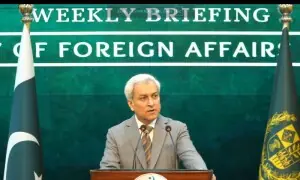
The Foreign Office on Thursday warned that any deliberate attempt to block water essential to Pakistan’s survival and development would have “far-reaching consequences”.
“Any such act would be treated with utmost seriousness and could possibly amount to an act of war under Article 51 of the UN Charter,” said FO spokesperson Tahir Andrabi during a weekly media briefing while responding to a question about recent remarks by Indian water minister.
A day ago, Indian Minister of Water CR Patil told I
The Foreign Office on Thursday warned that any deliberate attempt to block water essential to Pakistan’s survival and development would have “far-reaching consequences”.
“Any such act would be treated with utmost seriousness and could possibly amount to an act of war under Article 51 of the UN Charter,” said FO spokesperson Tahir Andrabi during a weekly media briefing while responding to a question about recent remarks by Indian water minister.
A day ago, Indian Minister of Water CR Patil told India’s ANI news agency that “not a single drop of water will go [to Pakistan] in the coming years”.
Patil said that India was “actively working on it” after “directives” from Prime Minister Narendra Modi.
Taking note of the remarks, Andrabi said that “any attempt to block or substantially curtail water that is vital to the livelihood, agriculture and well being of over 25o million Pakistanis would be a deeply irresponsible act”.
He added it would violate established international obligations “concerning transboundary rivers and indeed India’s own bilateral agreement with Pakistan”.
“Pakistan firmly rejects any notion that water can be treated as a political tool or instrument of coercion or a weapon,” he said, emphasising that such an action would be a threat to the regional peace and security in South Asia and beyond.
He said that the responsibility of such a threat “to international peace and security would fall squarely on India’s shoulders”.
The FO spokesperson added that Pakistan’s rights and interests regarding its water resources were non-negotiable.
He said that Pakistan would “vigorously” defend those rights, utilising all available diplomatic, political, legal, economic and other measures consistent with international law and the UN Charter.
“Any deliberate attempt to block water essential to Pakistan’s survival and development would constitute an extremely grave act with far-reaching consequences, as stated at the top leadership level by Pakistan,” Andrabi warned.
Every state had the right of self-defence, she said, adding that Pakistan would take “all necessary measures to safeguard its economy and its vital national interests and lives of 250m people”.
Andrabi called on India to “act responsibly, honour its international commitments and refrain from statements and actions that could further escalate tensions in the region”.
He stated that Pakistan remained committed to safeguarding its interests and “will closely monitor developments on the ground in India-occupied Kashmir and elsewhere from where these water resources emerge”.
Expansion of India’s nuclear arsenal ‘not surprising’
In response to a question over India expanding its nuclear arsenal, as per a recent report by the Stockholm International Peace Research Institute (SIPRI), Andrabi said the finding was not surprising to Pakistan.
“It broadly corroborates concerns that Pakistan has consistently been raising regarding India’s continued vertical proliferation,” he stated, hinting that the findings may not “fully reflect” India’s scale of nuclear arsenal.
The spokesperson noted that Pakistan also remained aware of recent developments in India’s strategic capabilities, including “cannisterisation of the missile systems, expansions of sea-based nuclear-capable submarines and pursuit of increasingly longer-range intercontinental ballistic missile systems that go beyond India’s periphery, neighbourhood or legitimate defence deals”.
Andrabi warned of “grave consequences” for international peace and security in the context of the development.
“These developments enhance operational readiness, complicate crisis stability, and carry implications that extend beyond South Asia,” he remarked.
Andrabi said while Pakistan did not seek an arms race and was “not interested in matching warheads and ammunition by number,” it also remained cognisant of the “evolving security environment”.
He said Pakistan continued to work towards the preservation of “strategic stability and deter any possible Indian aggression,” and urged the international community to “closely monitor” the situation.
“Deployment of India’s nuclear arsenal may affect strategic stability in South Asia and undermine peace and security at the regional and global level,” he cautioned.
In the given context, he said the international community, in particular the suppliers of high technology, should be cognisant of the implications of “advanced technologies and emerging capabilities being incorporated into India’s posture with grave international consequences”.
Release of Pakistani seafarers in Somalia ‘high priority’
On the issue of Pakistani sailors held captive by pirates aboard a vessel off the coast of Somalia, Andrabi said their rescue and safe repatriation remained a “high priority”; however, he also acknowledged that the situation had so far proved to be “difficult and operationally challenging”.
The seamen were taken hostage more than a month ago when pirates hijacked the MT Honour 25 off the southeastern coast of Somalia on April 21. There were 11 Pakistanis among the vessel’s crew, who remain in the pirates’ captivity.
“Sadly, despite our best efforts, we have not been able to secure their release,” Andrabi said of the 11 Pakistani seafarers, but voiced optimism that Pakistan was making “earnest efforts” to secure their release.
“We are engaged with the Somali authorities and the ship owner, both of whom are engaged with the pirates to secure early release,” he said.
He recalled that the Deputy Prime Minister and Foreign Minister Ishaq Dar had been in touch with the Somali Foreign Minister Abdisalam Abdi Ali over the issue.
In a phone call with the Somali FM, DPM Dar had conveyed his “grave concern” about the situation and stressed the need to ensure the early release and safe repatriation of the individuals, Andrabi said.
DPM Dar also urged measures to improve the living conditions of all the captives aboard the vessels.
Dar’s Somali counterpart assured him of the Somali government’s “continued and sincere” efforts to secure the release of the Pakistani individuals.
“Both leaders agreed to remain in close coordination until the matter is resolved,” Andrabi said.
Further elaborating on the steps taken by the government to secure their release, Anbrabi said that the Somali ambassador in Islamabad was called to the Ministry of Foreign Affairs (MOFA) over the issue.
He also recalled that the Pakistani embassy in Djibouti had dispatched teams to the Somali capital Mogadishu and added that authorities were holding “interministerial and inter-departmental meetings” on the issue as well.
“Another important in-person meeting will be held next week here at MOFA,” Andrabi said.
The spokesperson said that the situation was “operationally challenging”.
“They (captives) are held in a part of Somalia which is a semi-autonomous region [..] there are tribal societies and the pirates belong to a certain tribe and the ship owners belong to another tribe.”
He called on the families to exercise patience, vowing that the matter remained a high priority.
‘Curtains on Pakistan’s mediation role not drawn yet’
When asked about the recent escalation in the US-Iran war, Andrabi remarked that while it was difficult to remain optimistic in the current scenario, Pakistan remained engaged in diplomacy.
“If a mediator and facilitator loses hope, or becomes pessimistic, this does not augur well for the peace process,” Andrabi said.
Pakistan was cognisant of the challenges, he said, acknowledging that diplomatic space had “shrunk” due to the renewed aggression. However, he said that such was often the “natural progression” in conflict situations.
“Challenges of ceasefire, and cycles in an armed conflict — where you have space for peace, space for dialogue, and then you have a cycle of hostilities are expected in all international conflicts,” he said, expressing Pakistan’s readiness to “work with positivity”.
He recalled Prime Minister Shehbaz Sharif’s statement from June 8, which he said summarised Pakistan’s stance, reiterating that diplomatic efforts continued, citing DPM Dar’s phone call with his Turkish counterpart Hakan Fidan as well as coordination with other regional partners and Interior Minister Mohsin Naqvi’s recent visit to Tehran.
“Let us not draw the curtains on Pakistan’s mediation role, and let us not lose hope,” the spokesperson remarked.
On being asked if there are any exchanges of visits from Iran or Pakistan expected, the spokesperson said, “I do not have any specific information right now, but I certainly do not rule out such visits in the future”.
PPP Chairman Bilawal Bhutto-Zardari on Wednesday vowed to address resettlement concerns of those affected by the construction of the Diamer-Bhasha Dam on an “immediate basis” if his party emerges victorious in the June 7 polls.
Bilawal made the declaration while addressing a rally in Diamer, as the PPP and other political parties have, over the past few days, ramped up efforts to garner support ahead of the polls.
Addressing the rally, the Bhutto scion asserted that the project saw “great progre
PPP Chairman Bilawal Bhutto-Zardari on Wednesday vowed to address resettlement concerns of those affected by the construction of the Diamer-Bhasha Dam on an “immediate basis” if his party emerges victorious in the June 7 polls.
Bilawal made the declaration while addressing a rally in Diamer, as the PPP and other political parties have, over the past few days, ramped up efforts to garner support ahead of the polls.
Addressing the rally, the Bhutto scion asserted that the project saw “great progress” during the PPP’s tenure. He added that had President Asif Ali Zardari’s government not been removed in 2013, the Diamer-Bhasha Dam would have been built by now.
The PPP chairman lamented that it was “unfortunate” that affected citizens of the region had not had their resettlement issues addressed.
“I would like to promise you that after June 7 — when PPP forms government in GB — we will ensure that the work is [completed] and as far as resettlement is concerned, we will address it on an immediate basis,” Bilawal said.
He urged the Centre to prioritise the construction of the dam. “This is not only the right of the people of Diamer, but it is a necessity for Pakistan,” the PPP chairman said.
“No project is more important for Pakistan at the moment than the Diamer-Bhasha Dam,” Bilawal emphasised, calling on Prime Minister Shehbaz Sharif to expedite work on the project.
“We have heard of your ‘Shehbaz speed’ in Lahore [..] please show your ‘Shehbaz speed’ to the people of Diamer as well and ensure that the project is completed,” Bilawal quipped.
In April, the Diamer-Bhasha Dam land-affected committee, under the ‘Huqooq Do, Dam Banao’ (ensure rights, build the dam) movement, staged a sit-in in the Chilas and Thore areas of Diamer that lasted several days, over the non-implementation of a 2025 agreement on compensation for those affected by the construction of the dam, among other demands.
Bilawal calls on GB to elect jiyala CM
Bilawal claimed that PPP was the “sole political party which was looking out for the interest of the people of GB and had the people’s faith”.
“On June 7, the people of GB will demonstrate their power and elect a jiyala chief minister,” Bilawal said.
Outlining PPP’s contributions towards the region, Bilawal recalled that it was his father, President Zardari, who “gave GB its current identity as the region was referred to as Northern Areas before”.
Taking note of the regional crisis, Bilawal stressed that Pakistan needed a government “like PPP who can look the world in the eye”, adding that they were only able to do so as the party was the “true representative of the Pakistani people”.
He called on the people of GB to “struggle against these difficult times and ensure the formation of a PPP government in the region”. At this, Bilawal also voiced optimism that the country will see similar results in the next general elections.
The PPP chairman reiterated his support for “securing GB’s constitutional rights,” stressing that Islamabad must understand that “Pakistan can only prosper if the people of GB prosper”.
He vowed that with the party’s public-private partnership initiatives, “not only will you fulfil your own energy requirements but also sell it to the rest of the country”.
“I am not here to air any grievances; it is not in our nature. Why was the Quaid-i-Awam (former prime minister Zulfiqar Ali Bhutto) hanged or why my mother (former prime minister Benazir Bhutto) was martyred [..] have you ever heard me complain? or why was my father was imprisoned for 14 years [..] we are not the kind to complain; we only know how to take back our rights. So support me, and I will not disappoint you,” Bilawal told the rally.
The PPP chairman also took a jibe at the ruling ally PML-N, wondering why the “rest of the political parties campaigning in GB looked so worried”.
“Throwing money at things might work in Lahore, but not in GB; the people here are honourable and cannot be bought,” he quipped.
“Many political parties make claims that they have carried out considerable development work in their provinces; I would like to tell you that whatever you have been able to do was because of President Zardari”.
He recalled that President Zardari was responsible for the 18th Amendment, which enabled greater provincial development.
“If they were able to build metros or run trains in any city, it was because of the 18th Amendment and the NFC Award, which enabled provinces to secure the resources needed for such development projects,” Bilawal said.
First Lady Aseefa Bhutto-Zardari also addressed an election rally in the region, calling on people to support the PPP and stressing that the party’s electoral symbol, the arrow, was “a symbol of rights, betterment, power and hope for the poor, and the identity of democracy”.
Expressing support for her brother’s vision, Aseefa said a PPP-led government would create opportunities for the youth, including quality educational institutions, IT parks, improved internet connectivity and employment.
“We want every youth of GB to see a bright future, for everyone to have access to healthcare, and for every child to be educated,” she said.
The Lebanese army commander held a meeting with Chief of Defence Forces and Chief of Army Staff Field Marshal Asim Munir on Tuesday, during which the two exchanged views on the evolving regional security environment.
The military’s media affairs wing said in a statement that Lebanese armed forces’ Commander-in-Chief General Rodolphe Haykal called on CDF Munir at the General Headquarters (GHQ) in Rawalpindi.
He was presented a guard of honour by a smartly turned-out tri-services contingent upon h
The Lebanese army commander held a meeting with Chief of Defence Forces and Chief of Army Staff Field Marshal Asim Munir on Tuesday, during which the two exchanged views on the evolving regional security environment.
The military’s media affairs wing said in a statement that Lebanese armed forces’ Commander-in-Chief General Rodolphe Haykal called on CDF Munir at the General Headquarters (GHQ) in Rawalpindi.
He was presented a guard of honour by a smartly turned-out tri-services contingent upon his arrival at the GHQ, the statement by the Inter-Services Public Relations said.
“During the meeting, both dignitaries exchanged views on matters of mutual interest, evolving regional security environment, defence cooperation and prospects for enhancing bilateral military relations,” it added.
The discussions focused on strengthening professional interactions, training cooperation and institutional linkages between the armed forces of the two countries, the statement said.
It said Field Marshal Munir reaffirmed during the meeting the “importance Pakistan attaches to its longstanding and cordial relations with Lebanon and underscored the Pakistan Army’s commitment to expanding defence collaboration with the Lebanese Armed Forces”.
For his part, General Haykal “appreciated the professionalism and operational excellence of Pakistan’s armed forces and acknowledged their contributions to regional peace, stability and international peacekeeping efforts”, it said.
“The visit reflects the shared commitment of both armed forces to fostering closer military-to-military cooperation,” the ISPR statement concluded.
On Saturday, Lebanon’s army General Haykal had departed for Pakistan as Islamabad continues efforts to mediate an end to the US-Israeli conflict with Iran, which has also spilled into Lebanon.
The Lebanese army said the visit was at the invitation of Haykal’s Pakistani counterpart, Field Marshal Munir, but did not immediately provide further details on its purpose or duration.
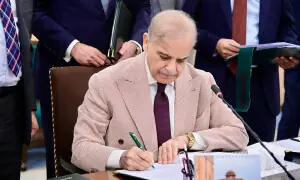
Prime Minister Shehbaz Sharif on Friday stressed the importance of the country having “strong” security, as he spoke about the budget-making process.
He made the remarks during a federal cabinet meeting that approved the budget, which is now expected to be tabled in the parliament. “Today, we are presenting the third budget of our government,” the premier noted.
“There were definitely a lot of challenges while preparing this budget. I believe that no nation can handle its matters, let alone make
Prime Minister Shehbaz Sharif on Friday stressed the importance of the country having “strong” security, as he spoke about the budget-making process.
He made the remarks during a federal cabinet meeting that approved the budget, which is now expected to be tabled in the parliament. “Today, we are presenting the third budget of our government,” the premier noted.
“There were definitely a lot of challenges while preparing this budget. I believe that no nation can handle its matters, let alone make progress, if its security is not strong and invincible,” the prime minister stressed.
He added, “We have to build water reservoirs and dams [as well as] work with speed on indigenous energy resources, which include solar panels, wind, and batteries.”
The prime minister mentioned that “measures for tax relief and economic progress” will be proposed in the budget.
Noting that the government had “lengthy discussions” with the International Monetary Fund (IMF) during the budget-making process, PM Shehbaz said he had a 30 to 45-minute-long phone call with its Managing Director Kristalina Georgieva, who hailed Pakistan’s economic progress.
He noted that the PML-N had “very detailed conversations” with its ally PPP, which were “successful”. He also thanked other coalition allies for their “unconditional” support.
The prime minister highlighted that the Centre remained engaged in “comprehensive interaction” with the four provinces over the past one and a half months.
“They were told how the centre needs additional funds,” he said, terming the dialogue with the provinces “very meaningful”.
The PML-N and the PPP had agreed to cut development and other expenditures at all tiers of the federation and jointly create similar, but higher, fiscal space next year for additional “strategic needs”.
As a result, the freeze on allocations for provincial development programmes will continue for a specific period beyond one year, according to Finance Minister Muhammad Aurangzeb.
During his address, PM Shehbaz appreciated PML-N President Nawaz Sharif, calling him his “leader”, and Punjab Chief Minister Maryam Nawaz for “showing a big heart for the pressing needs of the federal government”.
“They said that they stood ready to extend support to the federal government in challenges in defence and water security,” he remarked.
The prime minister then recalled his team had “several” meetings with the Sindh leadership, which also cooperated. He thanked President Asif Ali Zardari and PPP Chairman Bilawal Bhutto-Zardari for their “decision in the best interest of the country”.
PM Shehbaz also thanked Balochistan CM Sarfraz Bugti’s “big-heartedness” and KP CM Sohail Afridi’s “positive sentiments”.
“There can be no grander demonstration of national unity, solidarity, and cohesion than this,” he remarked.
The premier acknowledged that “despite our best efforts”, the government had to impose taxes in the past two budgets due to the “national and IMF requirements so that the economy […] could be stabilised and the avenues for progress could be expanded”.
The prime minister added: “Definitely, the common man had to face many difficulties due to it, and I, on my own and the cabinet’s behalf, would like to thank the 240 million people of Pakistan who tolerated the inflation with patience.”
PM Shehbaz highlighted that inflation had declined to single-digit from 38 per cent in the past two years, before increasing slightly due to the ongoing Middle East conflict. He further highlighted that the policy rate had also dipped to 11pc from 22.5pc during the period, but had to be raised due to the impacts of the US-Iran war.
“Today, our economy is stable, and we should hope that with this third budget, […] the wheel of our economy will pick up pace on the condition that we collectively work hard around the clock and stand ready to fulfil our responsibilities,” he emphasised.
At the outset of his address, PM Shehbaz said he attended the funeral prayers of “martyrs who sacrificed their lives in the line of duty”, which included two Christians.
“It was a heart-wrenching scenario that brought tears to every eye,” he said, recalling his meeting with the families of the martyred personnel.
Unofficial and preliminary election results for 24 seats of the Gilgit-Baltistan Legislative Assembly show that the PPP is leading the race with success in 10 constituencies.
According to the unofficial results, second in the race is PML-N with six seats, while independent candidates, including two PTI-backed ones, emerged victorious in seven constituencies. Majlis Wahdat-i-Muslimeen was able to win just one seat, the results showed.
Polling for the 24 seats had concluded peacefully on Sunday ev
Unofficial and preliminary election results for 24 seats of the Gilgit-Baltistan Legislative Assembly show that the PPP is leading the race with success in 10 constituencies.
According to the unofficial results, second in the race is PML-N with six seats, while independent candidates, including two PTI-backed ones, emerged victorious in seven constituencies. Majlis Wahdat-i-Muslimeen was able to win just one seat, the results showed.
Polling for the 24 seats had concluded peacefully on Sunday evening amid tight security arrangements.
Unofficial Provisional Results
Gilgit-Baltistan Assembly Elections
24 seats · Results as reported
PPP 10
PML-N 6
Independent 5
PTI-backed Ind. 2
MWM 1
Seat
District
Winner
GBA-1
Gilgit
PPP
GBA-2
Gilgit
PML-N
GBA-3
Gilgit
PTI-backed Ind.
GBA-4
Nagar
PPP
GBA-5
Nagar
PPP
GBA-6
Hunza
PTI-backed Ind.
GBA-7
Skardu
PPP
GBA-8
Skardu
MWM
GBA-9
Skardu
PPP
GBA-10
Roundu
PPP
GBA-11
Kharmang
PPP
GBA-12
Shigar
PPP
GBA-13
Astore
PML-N
GBA-14
Astore
PML-N
GBA-15
Diamer
Independent
GBA-16
Diamer
Independent
GBA-17
Darel
PPP
GBA-18
Tangir
PML-N
GBA-19
Ghizer
PPP
GBA-20
Ghizer
PML-N
GBA-21
Yasin
Independent
GBA-22
Ghanche
PML-N
GBA-23
Ghanche
Independent
GBA-24
Ghanche
Independent
* Unofficial provisional results. PTI-backed candidates ran as independents.
The Gilgit-Baltistan Assembly has a total of 33 seats — 24 of which are contested through direct elections, six are reserved for women, and three are reserved for technocrats and professionals. Political parties can nominate candidates for the reserved seats through proportional representation.
The general elections for GB took place after a four-month delay, which was attributed to harsh winter weather.
A total of 396 candidates contested the elections, with 266 running as independents. Only eight women contested the elections, five of them as independent candidates.
The total number of registered voters in the region’s 10 districts was 963,034, including 566,097 male and 396,937 female voters.
PPP’s allegations
The voting process remained largely peaceful throughout the region.
However, as the voting closed, PPP Secretary General Nayyar Hussain Bukhari alleged delays in the provision of Form-45.
A Form-45 is the result of the vote count prepared by a presiding officer (PO) at each polling station.
“We have contacted the chief election commissioner and informed him about the matter,” Bukhari said in a statement.
Separately, PPP spokesperson Shazia Marri said in a statement that the “delay in the issuance of Form-45 was unacceptable”.
She also alleged that voter lists were altered before the election and polling stations were changed, saying that these actions indicated rigging.
PPP alleged earlier that the Balachi polling station in Astore-II’s Bunji area was relocated from the roadside to the top of a hill overnight while the voting was underway.
In a post on X, the party noted that the polling station had 206 registered voters, asserting that the “local population is known for its strong support” of the PPP.
“This decision appears to be an attempt to affect the PPP’s vote bank and discourage voters from participating in the polling process,” it alleged.
The party added that residents blocked the Gilgit-Skardu Road in protest of this action.
In her statement, Marri said the PPP would not let an attempt to steal the public’s mandate succeed.
She demanded that the Election Commission fulfill its constitutional responsibility and issue correct results.
Meanwhile, PPP’s Nadeem Afzal accused the federal government of “electoral engineering”, alleging that two federal ministers present in GB were pressuring the administration and state machinery to influence results. “The presence of Amir Muqam and Aleem Khan in GB and their activities go against the requirements of a fair election,” he added.
“There are also reports that presiding officers are being pressurised not to issue Form-45, which raises a question on the election’s transparency,” Chan said in a statement.
PPP Secretary General also made these allegations in a video statement.
PTI claims lead in polls, alleges rigging
Similarly, the PTI claimed in a statement that its candidates were leading, according to initial and unofficial results.
“PTI candidates were clearly leading until 7pm. However, immediately afterwards, results from certain polling stations began to emerge with suspiciously high turnouts exceeding 80 per cent and individual ballot boxes having 700-800 votes. These figures raise serious doubts and suspicions,” the party said.
It further said, “This is a blot on the entire electoral process and its transparency.”
The PTI also alleged that its polling agents were not being issued Form-46, terming it a “clear violation of election laws that has further intensified fears of result manipulation”.
It said reports had emerged of members of other parties being caught red-handed with fake ballot papers in multiple areas, including Nagar.
“This rigging is part of a well-planned and systematic conspiracy,” the party has claimed.
It alleged that before polling, voter lists were tampered with in specific constituencies, police and administration were used to change delimitation and polling schemes, and opposition candidates and workers were “systematically harassed and pressurised”.
The PTI warned that any attempt to manipulate the results would have serious consequences.
“PTI will employ every constitutional, legal, and democratic avenue to protect the votes of its supporters. We demand that authentic results from all polling stations be released immediately, Form-45 and Form-46 be provided to every candidate without delay, a swift inquiry be conducted into suspicious polling stations with strict action against those responsible, and the Election Commission fulfil its constitutional duty by ensuring complete transparency,” the party stated.
Polling
As polling began, GB Chief Election Commissioner (CEC) Raja Shahbaz Khan visited various polling stations across Gilgit city to review the process, security arrangements and the overall electoral environment.
He also inspected the facilities and arrangements provided to voters at the polling stations and met polling agents representing different candidates.
Speaking to PTV News, Khan noted that he had visited around 10 polling stations, where security arrangements were satisfactory.
He said women were turning out in large numbers to cast ballots, which reflected strong public awareness about the importance of exercising their democratic right.
He added that all political parties were participating peacefully in the electoral process.
GB caretaker Interior Minister Sajid Ali Baig said he visited various polling stations, where the overall environment remained peaceful.
According to APP, he told a local media outlet that there were public demands for further deployment of police forces in some areas for smooth and secure polling.
The minister said minor irregularities observed at certain locations were being addressed promptly by the authorities concerned.
Who was in the race?
PPP fielded 23 candidates, PML-N 22, Istehkam-i-Pakistan Party (IPP) 15, PML-Q 11, Tehreek-i-Islami Pakistan 10, Pakistan Nazriyati Party (PNP) also 10, while nine candidates from the Jamiat Ulema-i-Islam-Fazl (JUI-F) also contested the elections.
Meanwhile, the PTI, which won the 2020 elections, has remained without an electoral symbol since Jan 13, 2024 and therefore, its candidates were contesting as independents.
In line with its strategy for the national 2024 elections, it allied with the Majlis Wahdat-i-Muslimeen (MWM). A social media post by the party showed their alliance has 22 candidates combined, with MWM nominees bearing the “tent” symbol.
MWM had three candidates in the running, and one candidate from the Sunni Ittehad Council (SIC) also contested the election.
Six candidates each from Jamaat-i-Islami and the Muttahida Qaumi Movement (MQM-P) also contested the elections, along with four candidates from Awami Workers Party (AWP) and one nominee from Awami National Party (ANP).
PPP, IPP, and PNP nominated one woman each.
The main contenders for the winning candidate were Advocate Amjad Hussain from the PPP and former chief minister Hafiz Hafeezur Rehman from the PML-N.
Hussain, president of the PPP’s GB chapter, has served as a member of the GB assembly from 2020 to 2025 and as a member of the GB council from 2009 to 2014. He is contesting from GBA-1 (Gilgit-I).
Rehman, currently the president of the PML-N’s GB chapter, served as the chief minister from 2015 to 2020. He also served as an assembly member from 2004 to 2009. The former CM is contesting the polls from GBA-2 (Gilgit-II).
This photo combo shows PML-N’s Hafiz Hafeezur Rehman (L) and Advocate Amjad Hussain (R). — X/@CMGBPK / Facebook/@AdvocateAmjad
GB top court orders ‘fair’ elections after KP CM’s letter
Separately, the GB Supreme Appellate Court directed the election commission to hold elections in a free and fair manner after Khyber Pakhtunkhwa CM Sohail Afridi wrote to Chief Justice Sardar Muhammad Shamim Khan.
A press release by the appellate court recalled that CM Afridi had written a letter to the chief justice, in which he requested equal opportunities for all political parties in the elections.
Subsequently, the statement said, Justice Khan issued a written order to the GB CEC, directing him to conduct the general elections in a “transparent, impartial and fair manner”.
In his response, the CEC assured the chief justice that the electoral process would be carried out under “a transparent, impartial and organised system”.
“In his detailed letter, he has also informed the esteemed court in detail about the steps taken by the election commission to ensure the transparency and impartiality of the elections,” the court’s statement said.
The appellate court affirmed that it was striving to ensure the provision of justice to the people.
PPP pledges rights; PML-N vows projects
In a video statement issued early in the morning, PPP Chairman Bilawal Bhutto-Zardari urged the public across GB to turn up in large numbers and cast their vote on the party’s “arrow” symbol.
“I want to get the people of Gilgit-Baltistan haq-i-hakmiyat (right to govern). I want to get Gilgit-Baltistan constitutional rights. Come, make PPP win so we can make GB the fifth province,” Bilawal said.
He further promised to provide “haq-i-rozgar (right to employment)” to the youth of GB if his party got elected.
“From the riverside to the peak of the mountains, I want to make you the owner of your land,” the PPP chairman said, adding that a vast area of land had been turned into “common land from state land”.
In his video statement, PML-N’s Rehman noted that his party held over 200 corner meetings, more than 40 jalsas and 11 rallies during the election campaign.
He apologised to PML-N supporters for not being able to visit various areas he wanted to due to party duties.
“I hope that your vote will be in support of progress, peace, development that has been paused since 2020, [and] for the eradication of load-shedding,” the former CM remarked.
Rehman emphasised his party’s pledge to work on development projects, construction of roads and metro buses, and better governance.
Tight security
As part of security arrangements, 6,000 Punjab police personnel and 2,000 from Islamabad police — including 150 personnel from its security division — have been assigned for election duty in the mountainous region.
According to a list issued by the GB Election Commission, a total of 1,391 polling stations have been established across the region, of which 488 are categorised as normal, 349 as sensitive and 551 as highly sensitive.
Diamer, with 119 highly sensitive polling stations out of a total of 174, has the highest number of such stations among all districts.
Additional security personnel will be deployed at vulnerable locations, while law enforcement agencies and the district administration will remain on high alert throughout the election process.
On Saturday, the GB CEC urged voters to exercise their democratic right and play a constructive role in maintaining law and order.
He asserted that all necessary arrangements had been put in place to ensure peaceful, free, fair and transparent elections across the region.
CEC Khan had delegated powers of a first-class magistrate to all district returning officers (DROs) and returning officers (ROs) for the peaceful and transparent conduct of the elections.
The election campaign
The last elections — held on Nov 15, 2020 — had been won by the PTI, which was also in power in the Centre at the time.
Subsequently, a coalition government was formed by members of the PTI, PPP and PML-N with Haji Gulbar Khan — an estranged PTI member — elected by the assembly as the new chief minister.
In the run-up to the current polls, the PML-N and the PPP campaigned with full force as their party chiefs toured the region.
PML-N President Nawaz Sharif visited Gilgit, while Bilawal gave fiery speeches at rallies in various districts.
However, the PTI decried a “lack of level playing field” in the current elections after its key leaders were expelled from GB on separate occasions. The party has also alleged other tactics to deter its election campaign activities.
Meanwhile, the PPP raised concerns over the deployment of Punjab police personnel and the participation of federal ministers in the PML-N’s campaign.
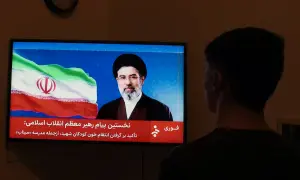
Iran’s Supreme Leader Ayatollah Mojtaba Khamenei said on Thursday that his country’s adversaries had turned to “hybrid warfare”, aimed at creating divisions among Iranians, after receiving a “decisive blow”.
Mojtaba, who has not appeared publicly since being named as the supreme leader on March 8, made these remarks in his message on the death anniversary of Iran’s founder, Ayatollah Ruhollah Khomeini.
The message shared on his official X account and reported by the Iranian media.
Mojtaba’s mess
Iran’s Supreme Leader Ayatollah Mojtaba Khamenei said on Thursday that his country’s adversaries had turned to “hybrid warfare”, aimed at creating divisions among Iranians, after receiving a “decisive blow”.
Mojtaba, who has not appeared publicly since being named as the supreme leader on March 8, made these remarks in his message on the death anniversary of Iran’s founder, Ayatollah Ruhollah Khomeini.
The message shared on his official X account and reported by the Iranian media.
Mojtaba’s message stated, “The malicious enemy has been defeated in its confrontation with the armed forces. Since it has received a decisive blow both in military combat and in Iran’s public squares and streets, it’s experiencing a profound and significant humiliation.
“The enemy has focused its schemes in hybrid warfare on two points: the resilience of the Iranian people and trying to create errors in the assessments of the country’s officials. The instrument it’s using for both is sowing the seeds of doubt, despair, fear, mistrust and discord.”
“In confronting these ill intentions, everyone must, through steadfastness, insight, preserving unity and cohesion … neutralise their sinister plot,” his message said.
He further said, “Imperialism, led by the US, has built a military base called Israel over the past 80 years. And they don’t accept the existence of a strong, independent Iran on the eastern border of the false, illegitimate geography of ‘Greater Israel’ — that is, east of the Euphrates River.”
Mojtaba also highlighted the role of Iranian authorities in this regard, saying that “any act that causes pessimism and disappointment among the people is considered a kind of aid to the enemy of this country and its people”, Press TV reported.
The remarks by Iran’s third supreme leader were read out by a prayer leader at the mausoleum of Khomeini, on the 37th anniversary of his death.
After Khomeini’s death in 1989, Ali Khamenei succeeded him as supreme leader until he was assassinated on February 28 this year during US and Israeli attacks that triggered a regional war.
The conflict was halted with a ceasefire deal on April 8, followed by direct and mediated talks for a permanent end that have failed to reach an agreement.
Every June 4 since 1989, Ali Khamenei had delivered a speech at the commemoration. This year, an empty chair bearing his portrait stood at the mausoleum, according to footage broadcast from the site.
Portraits of Mojtaba and the two previous supreme leaders were displayed at the mausoleum in southern Tehran, according to the live broadcast.
Attendees waved the flag of the Islamic republic and banners of the Lebanese group Hezbollah.
Temperatures crossed 40 degrees Celsius in parts of the country on Tuesday, amid a heatwave forecast to last till June 12.
On Tuesday, the highest temperature recorded in Lahore was 43°C, while the mercury reached 41°C in Islamabad. The highest temperature recorded in Karachi was 36°C.
Commuters rush to board an air-conditioned bus on a hot summer day in Rawalpindi on June 9, 2026. —AFP
Commuters stand under a bus shelter as they wait to board an
Temperatures crossed 40 degrees Celsius in parts of the country on Tuesday, amid a heatwave forecast to last till June 12.
On Tuesday, the highest temperature recorded in Lahore was 43°C, while the mercury reached 41°C in Islamabad. The highest temperature recorded in Karachi was 36°C.
Commuters rush to board an air-conditioned bus on a hot summer day in Rawalpindi on June 9, 2026. —AFP
Commuters stand under a bus shelter as they wait to board an air-conditioned bus on a hot summer day in Rawalpindi on June 9, 2026. —AFP
A worker pushes a cart along a street on a hot summer day in Lahore on June 9, 2026. —AFP
A man pushes a cart loaded with water cans on a hot summer day in Lahore on June 9, 2026. —AFP
Commuters drink cold water served along a street during a hot summer day in Karachi on June 9, 2026. —AFP
Commuters stand under a bus shelter as they wait to board an air-conditioned bus on a hot summer day in Rawalpindi on June 9, 2026. —AFP
Traffic police personnel cover their heads with cloth as they stand at a road junction amid a heatwave in Rawalpindi on June 9, 2026. —AFP
Labourers cover their heads with cloth as they push a loaded cart amid a heatwave in Rawalpindi on June 9, 2026. —AFP
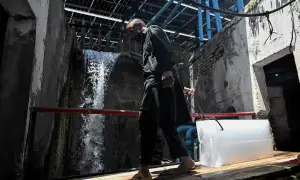
Workers load ice blocks onto a vehicle on a hot summer day in Lahore on June 9, 2026. —AFP
A labourer shields his head with a cloth as he hauls a loaded cart amid a heatwave in Rawalpindi on June 9, 2026. —AFP

 Login
Login