Normal view

  • ✇Ontario Nature Blog
  • Removing Provincial Park Protections from Wasaga Beach Puts Piping Plovers at Risk Macey Whiteside
    Wasaga Beach Provincial Park is one of Ontario’s most beloved natural places and provides habitat for endangered piping plovers. Stretching 14 kilometres along the Georgian Bay shoreline, it attracts more than one million visitors annually. Wasaga Beach is the most visited provincial park in the province. Beyond the crowds, the park protects dune ecosystems and habitats that are vital to other at-risk species like the eastern hognose snake, Hill’s thistle and the monarch butterfly. Now, the Go
     

Removing Provincial Park Protections from Wasaga Beach Puts Piping Plovers at Risk

19 February 2026 at 19:05

Wasaga Beach Provincial Park is one of Ontario’s most beloved natural places and provides habitat for endangered piping plovers. Stretching 14 kilometres along the Georgian Bay shoreline, it attracts more than one million visitors annually. Wasaga Beach is the most visited provincial park in the province. Beyond the crowds, the park protects dune ecosystems and habitats that are vital to other at-risk species like the eastern hognose snake, Hill’s thistle and the monarch butterfly.

Now, the Government of Ontario has removed provincial park protections from a significant portion of the beach and intends to transfer the lands to the Town of Wasaga Beach. This would weaken long-standing protections for these fragile habitats, and the piping plovers that depend on them.

The Plan: Develop Lands for Tourism

The news came in May 2025, when the Government of Ontario announced the transferring of lands to the Town of Wasaga Beach to develop the waterfront for tourism.

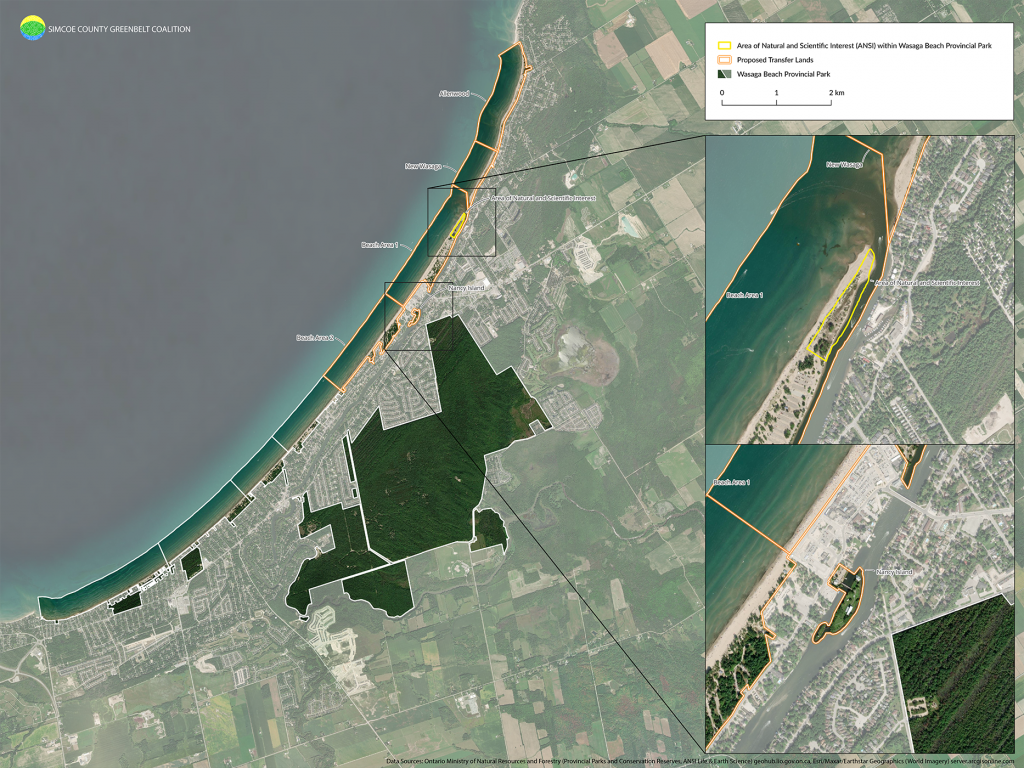
In June, the government posted a proposal on the Environmental Registry (ERO #025-0694) to amend the Provincial Parks and Conservation Reserves Act. The proposal would remove several parcels of land from Wasaga Beach Provincial Park (roughly 60 hectares). Four of the park’s eight beach areas, including Areas 1 and 2, New Wasaga Beach and Allenwood Beach are included in the transfer. These areas are the most important piping plover habitat at Wasaga Beach.

At the end of November, the Government of Ontario passed Bill 68, Plan to Protect Ontario Act (Budget Measures), 2025 (No.2), which included a schedule removing these lands from regulation under the Provincial Parks and Conservation Reserves Act.

Public response to the proposal was overwhelmingly opposed, with approximately 98 percent of comments objecting to the removal of beach areas from the park. Key concerns focused on potential environmental impacts, legal and governance issues, and implications for public access and equity.

Despite this feedback, no changes were made to the proposal, citing the Town of Wasaga Beach’s commitments to maintaining public access, and avoiding development on the beach. Lands removed from the park will remain subject to Ontario’s environmental protection laws.

While the province has stated the beaches will remain public, what remains unclear is how these lands and their ecological integrity would be managed once they are no longer under provincial park legislation. These changes come at the hills of over 100 species losing protection under the province’s new Species Conservation Act.

Photo of Wasaga Beach Provincial Park lands, including areas transferred to the Town of Wasaga Beach
Photo of Wasaga Beach Provincial Park lands, including areas transferred to the Town of Wasaga Beach © Simcoe County Greenbelt Coalition

Piping Plovers Could Lose Critical Protections

The changes to both land ownership and species at risk laws significantly heighten the endangerment to piping plovers at Wasaga Beach.

Piping plovers are small shorebirds that nest directly on open sand, making them especially vulnerable to disturbance. In Ontario, they are listed as endangered under federal law, and Wasaga Beach has played a critical role in their population recovery. Successful nesting depends on a healthy dune ecosystem, undisturbed beaches, and careful seasonal management – conditions that can be easily disrupted if the lands are developed for tourism.

With decisions about shoreline use, tourism infrastructure, and beach “maintenance” now under municipal authority, activities like beach raking could threaten nesting piping plovers and weaken the dune systems that naturally protect the shoreline from erosion, storms, and climate impacts.

The replacement of Ontario’s Endangered Species Act with the Species Conservation Act narrows the definition of protected habitats, potentially leaving dunes and foraging areas outside nesting sites unprotected. In addition, the Government of Ontario intends to de-list migratory birds all together to “remove duplication for species already receiving federal protections.” To date, the federal government has been reluctant to implement the Species at Risk Act on non-federal lands, which is why complementary provincial legislation was always necessary.

In a 2025 media release, Ontario Nature’s Conservation Policy and Campaigns Director Tony Morris said transferring these areas to the town puts both wildlife and long-standing conservation efforts at risk.

Under municipal ownership, decades-long dune restoration and habitat protections, carried out by Ontario Parks, could disappear. Without the Provincial Parks and Conservation Reserves Act in place, Morris says the town would not be required to manage the land for ecological health.

Piping plover and chick, endangered species, Ontario Breeding Bird Atlas, community science, species at risk, wildlife monitoring
Piping plover and chick © Ian K. Barker

Federal Emergency Action Sought

In response to the loss of provincial protections, Ecojustice has filed a formal request on behalf of Environmental Defence and Ontario Nature, calling on the federal Minister of Environment, Climate Change and Nature Julie Dabrusin, to recommend an Emergency Order under the federal Species at Risk Act.

The emergency order request seeks immediate protection for critical piping plover habitat at Wasaga Beach. With the nesting season approaching, conservation groups are calling for action by March 1, 2026, noting that further delays could have serious consequences for the species’ survival and recovery in Ontario.

Piping plover and chick, Endangered, Species at Risk in Ontario, habitat degradation, habitat loss, Lake Huron
Piping plover and chick © Merri-Lee

What You Can Do

Call or email your MPP, and elected officials from the Town of Wasaga Beach to ask what they are doing to ensure Wasaga Beach remains a natural shoreline that balances tourism and a healthy ecosystem for the species that call it home.

You can also learn about the major projects and initiatives at the Town of Wasaga Beach.

If you are a resident of Wasaga Beach, visit this website to learn how you can get involved.

You can also contact Wasaga Beach’s Mayor and Council to ask them to protect this globally rare ecosystem.

  • ✇Ontario Nature Blog
  • Recycling in Ontario: Your Questions Answered Macey Whiteside
    Recycling in Ontario is changing in a big way. As of January 1, 2026, the province has fully transitioned to a new Blue Box system that changes who is responsible for recycling and is intended to make the process more consistent across Ontario. Under the new rules, recycling is now managed and funded by the companies that produce packaging and paper products, rather than municipalities. This shift is known as Extended Producer Responsibility (EPR). The idea is that companies should take more r
     

Recycling in Ontario: Your Questions Answered

16 April 2026 at 18:08

Recycling in Ontario is changing in a big way. As of January 1, 2026, the province has fully transitioned to a new Blue Box system that changes who is responsible for recycling and is intended to make the process more consistent across Ontario.

Under the new rules, recycling is now managed and funded by the companies that produce packaging and paper products, rather than municipalities. This shift is known as Extended Producer Responsibility (EPR). The idea is that companies should take more responsibility for the waste they create, while making recycling systems easier for residents to navigate.

Reduce, reuse, recycle sign, homemade sign, support for recycling, 3 Rs
Reduce, reuse, recycle sign © Andy Arthur CC BY 2.0

The goal is to recycle more, send less waste to landfills, and move toward a more circular economy. But for many Ontarians, the new rules also raise a lot of questions. Here are some of the most common ones.

Frequently Asked Questions

1. What changed in Ontario’s recycling system in 2026?

Ontario’s Blue Box program is now fully run by producers – the companies that create packaging and paper products. That means they are responsible for collecting, sorting, and recycling those materials.

An organization called Circular Materials now helps operate the Blue Box program across Ontario.

For most residents, the day-to-day experience may still look similar. The province will continue using the same blue boxes, the same curbside pickup and will continue to accept many of the same items. But behind the scenes the system has changed significantly, with the goal of creating more consistent recycling rules across the province.

2. Why is Ontario changing its recycling system?

Before this transition, municipalities shared the cost and responsibility of recycling programs, and each city or region often had its own rules. That meant something recyclable in one community might not be accepted in another.

The new system is meant to reduce that confusion. By making producers responsible for the materials they put into the marketplace, the Blue Box program should, in theory, put more pressure on companies to reduce unnecessary packaging and design products that are easier to recycle. However, advocates have raised concerns about the true efficacy of this program, including looser reporting requirements, lack of transparency in operations, increased incineration of recyclable materials, and the exclusion of many groups like multi-residential buildings, public spaces and schools.

Recycling bins overloaded with recyclable paper with materials
Recycling bins with materials © John Lambert Pearson CC BY 2.0

3. Will recycling rules still differ depending on where I live?

Historically, yes. What you could recycle in Toronto might not have been accepted in London, Kingston, or another municipality.

The new Blue Box system is designed to make accepted materials more consistent across Ontario. However, some local differences may still exist in how recycling is collected. For example, some municipalities may use blue boxes, while others use large recycling carts. Pickup schedules and collection contractors may also vary by region.

So while the rules about what can be recycled are becoming more standardized, the way recycling is collected may still look different from place to place.

4. Can I recycle…?

If you’ve ever stood over your recycling bin wondering, “can I recycle this?” You’re not alone.

Some cities across Ontario have helpful tools. For example, if you live in Toronto, one of the easiest ways to check is by using the Waste Wizard, an online tool that lets you search specific items and find out whether they belong in recycling, garbage, organics, or special drop-off.

Although Toronto’s Waste Wizard is one of the best-known examples, other municipalities across Ontario offer similar search tools or waste apps. They can be especially helpful for sorting items like black plastic, coffee pods, takeout containers, or mixed-material packaging.

The updated Blue Box program expands the list of accepted materials. In many cases, you can now recycle more types of packaging than before, including items like foam containers, black plastic, and certain flexible plastics. But contamination — such as food waste, liquids, or hazardous materials — can still create major problems in the recycling stream.

5. If the province has one system, why do municipalities still matter?

Even though the recycling rules are now set at the provincial level, municipalities still play a major role in waste management.

They are often responsible for services like garbage collection, green bins or organics, household hazardous waste depots and local public education. Municipalities also help residents understand changes to collection schedules, bin types and local disposal options.

In other words, the province may be standardizing the recycling system, but municipalities are still an important part of how that system works in practice.

Five municipal blue recycling bins in a row
Recycling bins © Dano CC BY 2.0

6. Does recycling actually work?

This is one of the most important questions and one of the hardest to answer simply.

Recycling can help reduce landfill waste and recover useful materials, but it is far from a perfect solution. In Canada, recycling rates remain low. Currently, only 7% of Ontario’s waste is recycled through the Blue Box. This is due to a combination of factors, including contamination, complex materials, and limited recycling markets.

Ontario’s new recycling system is intended to improve outcomes by making producers more accountable and expanding what can be collected. But recycling alone will not solve the waste crisis.

Reducing waste in the first place and reusing materials whenever possible remains essential.

7. What should I do with electronics or hazardous waste?

Electronics and hazardous materials should never go in your Blue Box.

Items like batteries, old phones, chargers, paint, propane tanks, light bulbs, and cleaning chemicals require special handling. If they are placed in recycling, they can contaminate other materials, damage equipment, or create safety risks for workers.

Instead, these items should be taken to a designated drop-off depot, household hazardous waste site, or e-waste collection program in your municipality. Many communities in Ontario offer permanent depots or seasonal collection events for these materials.

If you are unsure, your municipality’s waste lookup tool is the best place to check.

The Bottom Line

Ontario’s new recycling rules are a major shift. By making producers responsible for the packaging they create the province is trying to improve recycling and reduce confusion for residents.

But even the best recycling system depends on public understanding and participation. Knowing what belongs in your Blue Box and taking the extra moment to check when you’re unsure can make a real difference.

At the same time, recycling is only one part of the solution. If Ontario is serious about reducing waste and protecting the environment, we also need to focus on addressing the systemic root of continuous waste generation in the first place.

❌
Subscriptions