Normal view

Iran’s attacks on Israel were an attempt to shape the region on its own terms – and it might just do so

Iran fired barrages of missiles at Israel for the first time in two months on June 7. The initial trigger was an Israeli strike against a Hezbollah target in the Lebanese capital of Beirut earlier that day, an attack that Donald Trump had only recently asked the Israeli prime minister, Benjamin Netanyahu, to avoid carrying out.

Israel’s military soon launched retaliatory strikes on targets in western and central Iran, again defying calls by Trump for restraint. Iran subsequently launched fresh strikes of its own, before the Iranian military announced it was bringing its attacks to an end. In a statement, Iran warned it would carry out a “more severe” response if Israel’s attacks on Lebanon continue.

What caught my attention about this round of fighting is the geopolitical context in which it has occurred. Iran is trying to establish a new regional order, based on new rules. And it might just pull it off.

The first notable feature of this order is that Iran dictates to Israel and the US what they may and may not do. Iran started this latest round of fighting not because of an attack on Iranian territory, but as an attempt to dictate Israeli military actions in Lebanon.

Six months ago, Israel could do as it pleased in Lebanon without Iranian intervention. Now, thanks to Trump and Netanyahu’s war, Tehran feels empowered enough to try and place limits on Israeli action on Israel’s own borders.

We have seen, somewhat more obliquely, the same principle apply in the Strait of Hormuz over the past month or so. Iran established a chokehold over the vital waterway shortly after the start of the war in late February. And it has no intention of letting its control go.

This, too, is part of Iran’s new regional order. It is telling its opponents: do as we say or we tighten our stranglehold on the global economy. For now at least, US actions show that Washington would rather accept the continued existence of this reality than fight to change it.

A second aspect of the new regional order is Iran’s expanding ways of inflicting pain on its enemies in order to force acceptance of this new world. Iran has established that it can rain missiles on Israel, strike infrastructure across the Gulf states, kill American soldiers and choke the global economy of oil, all without facing a realistic attempt at regime change.

Iran also still has many cards in its pocket. These range from expanding the scope of energy and desalination targets it hits across the Gulf to activating the Houthis to block energy traffic in the Red Sea. The Houthis have announced a ban on Israeli shipping in the Red Sea following the latest escalation.

The US has threatened many times now to attack Iranian civilian infrastructure, invade its Kharg island export terminal or to escort ships through Hormuz. However, it has backed down from all of them out of fear of the consequences.

Strained US-Israeli ties

The third feature of the new regional order is that Israel and the US no longer march in lockstep. Trump responded to Iran’s attack on Israel by emphasising that his priority was to stop Israel from retaliating. “I am going to call Bibi right now and tell him not to retaliate,” he said following the initial Iranian strikes.

Netanyahu has managed to manoeuvre Israel into a position in which a Republican president is telling him not to respond to incoming Iranian missile barrages targeting Israeli civilians. This situation would scarcely have been believable six months ago.

Separating Israel from the US is a longstanding dream of Tehran. So far at least, there is no hint that Trump is threatening to withhold missile interceptor defences from Israel over the resumption in hostilities. But even while keeping American defensive aid, it would be very difficult for Israel to sustain further conflict with Iran.

Hunting missiles launchers would alone prove a challenge, because Israeli air power would be stretched much more thinly without American assistance in hitting targets. If the northern front against Hezbollah remains active as well, the Israeli military’s resources will be even more strained.

And for how long is the US going to accept running down its missile interceptor stocks in order to defend Israel from a bout of warfare that its famously mercurial president told the country not to start? In the short term, perhaps for a while. But over the longer term, it is not sustainable for the US to dedicate a substantial portion of its missile defences to protecting Israel.

The fourth and final feature of the new regional order is that peace seems impossible to imagine. Netanyahu cannot accept an Iranian veto over Israel’s actions in Lebanon, nor absorb the implications for Israeli deterrence if he lets attacks from Iran go unanswered.

Trump cannot get his peace deal with Iran while Israel is bombing Lebanon. And Iran has the incentive to keep pushing for more, inflicting more costs on its opponents, because in the new regional order it can do so without many consequences.

This is the result of a disastrous war of choice which will go down as one of the most ill-conceived in American history.

The Conversation

Andrew Gawthorpe is affiliated with the Foreign Policy Centre in London. He is the author of America Explained (https://amerex.substack.com/), a newsletter covering US politics, foreign policy and history, which features regular analysis of the Iran war.

Trump-Xi summit: US president says he will discuss arms sales to Taiwan – breaking decades of US policy

Donald Trump and Xi Jinping are likely to discuss many issues as they meet this week in Beijing. But alongside trade, technology and the war in Iran, one topic of conversation will stand out – the future of Taiwan.

Taiwan has long been a sensitive issue in Sino-American relations. Beijing regards the island as a breakaway province which must be reunited with the mainland. The United States has long opposed such a step. Yet in recent months, Trump has fuelled speculation that he may be ready to change key aspects of US policy on the issue, potentially granting Beijing long-sought concessions.

Trump’s apparent readiness to make these moves means that Taiwan is one of the issues on which we might see the most significant policy developments at the summit. And that could happen simply through the famously voluble president uttering just a few simple words.

The president’s policy towards Taiwan has been inconsistent and seemingly more malleable than that of previous administrations. Advocates for Taiwan point out that his administration recently approved the largest ever US arms sale to the island. But at the same time, he has sowed doubts about the strength of his support for Taiwan’s independence.

US policy towards Taiwan has traditionally been based on two principles. The first is “strategic ambiguity”, which means that the US declines to explicitly state whether it would actively use its military to defend Taiwan from attack by China. This policy is supposed to deter China while also discouraging Taiwan from formally declaring its independence from Beijing.

The second principle is the “one China policy”. According to this policy, the US recognises Beijing as the legitimate government of China, while opposing any violent solution to its dispute with Taiwan. It also retains robust informal links to the Taiwanese government in Taipei.

Observers are concerned that Trump may water down these principles during his summit with Xi. For instance, he might state that the US not only “does not support” Taiwanese independence but actively “opposes” it. Or he might double down on previous comments he has made indicating that whether or not Xi invades Taiwan is “up to him”.

Trump has also explicitly stated that he will discuss future US arms sales to Taiwan with Xi during this week’s summit. This violates one of the so-called Six Assurances that the US has upheld towards Taiwan since the 1980s, and which were endorsed by the US Congress in 2016.

Even securing a discussion of arms sales would be a victory for Xi, who would welcome an opportunity to chip away at the Six Assurances. Presumably he would then try to weaken the US commitment to the other five, which include a US commitment not to change its position on Taiwan’s sovereignty.

More concretely, if Xi succeeds in making US arms sales to Taiwan a legitimate topic of negotiation in Sino-American relations, then he could head them off in the future by offering the US concessions in other areas. For instance, if Trump or a future president asks Beijing for its help settling a conflict like that in Iran, Beijing might demand an end to US arms sales to Taiwan as the price.

High stakes

Given Trump’s reputation as a formidable China hawk, his attitude towards Taiwan may seem surprising. But it’s actually part of a longstanding pattern.

In relations with China, Trump has arguably always prioritised economic issues, while appearing less concerned about the security of America’s regional allies. He has also raised doubts about whether Taiwan is even defensible. In his first term, he reportedly told aides that: “Taiwan is like two feet from China. We are 8,000 miles away. If they invade, there isn’t a fucking thing we can do about it”.

Trump is also both highly transactional and less focused on abstract principles of foreign policy than most previous presidents. He views America’s support of allies such as Taiwan as a gift that it gives them, one that is often not worth the cost. If he can achieve a concrete victory for himself today by trading away support for Taiwan tomorrow, he may well be willing to do so.

All of these developments matter because they make a violent conflict between China and Taiwan, potentially ultimately involving the US, more likely. If Trump makes concessions to Xi, it will be the latest signal that US support for Taiwan is wavering. That made be read in Beijing as permission to violently change the status quo. Even though such an act might belatedly then be met with force from Washington in response, it is made more likely by Trump’s stance today.

Even worse for Trump, the summit comes at a time when American power and the wisdom of its long-term strategy are being visibly called into question in the Middle East. The US is bogged down in an intractable conflict and has severely damaged its deterrent capacity in the Indo-Pacific by burning through advanced munitions at a high rate. Trump’s personal unpopularity is also rising at home amid the war and its economic fallout.

This weakened position makes it even more likely that Trump will want to strike a deal with Xi to help end the war in Iran or ease trade tensions to help the economy at home. Taiwan may be the price of that – and, ultimately, peace.

The Conversation

Andrew Gawthorpe is affiliated with the Foreign Policy Centre in London.

Trump-Xi summit: US president says he will discuss arms sales to Taiwan – breaking decades of US policy

Donald Trump and Xi Jinping are likely to discuss many issues as they meet this week in Beijing. But alongside trade, technology and the war in Iran, one topic of conversation will stand out – the future of Taiwan.

Taiwan has long been a sensitive issue in Sino-American relations. Beijing regards the island as a breakaway province which must be reunited with the mainland. The United States has long opposed such a step. Yet in recent months, Trump has fuelled speculation that he may be ready to change key aspects of US policy on the issue, potentially granting Beijing long-sought concessions.

Trump’s apparent readiness to make these moves means that Taiwan is one of the issues on which we might see the most significant policy developments at the summit. And that could happen simply through the famously voluble president uttering just a few simple words.

The president’s policy towards Taiwan has been inconsistent and seemingly more malleable than that of previous administrations. Advocates for Taiwan point out that his administration recently approved the largest ever US arms sale to the island. But at the same time, he has sowed doubts about the strength of his support for Taiwan’s independence.

US policy towards Taiwan has traditionally been based on two principles. The first is “strategic ambiguity”, which means that the US declines to explicitly state whether it would actively use its military to defend Taiwan from attack by China. This policy is supposed to deter China while also discouraging Taiwan from formally declaring its independence from Beijing.

The second principle is the “one China policy”. According to this policy, the US recognises Beijing as the legitimate government of China, while opposing any violent solution to its dispute with Taiwan. It also retains robust informal links to the Taiwanese government in Taipei.

Observers are concerned that Trump may water down these principles during his summit with Xi. For instance, he might state that the US not only “does not support” Taiwanese independence but actively “opposes” it. Or he might double down on previous comments he has made indicating that whether or not Xi invades Taiwan is “up to him”.

Trump has also explicitly stated that he will discuss future US arms sales to Taiwan with Xi during this week’s summit. This violates one of the so-called Six Assurances that the US has upheld towards Taiwan since the 1980s, and which were endorsed by the US Congress in 2016.

Even securing a discussion of arms sales would be a victory for Xi, who would welcome an opportunity to chip away at the Six Assurances. Presumably he would then try to weaken the US commitment to the other five, which include a US commitment not to change its position on Taiwan’s sovereignty.

More concretely, if Xi succeeds in making US arms sales to Taiwan a legitimate topic of negotiation in Sino-American relations, then he could head them off in the future by offering the US concessions in other areas. For instance, if Trump or a future president asks Beijing for its help settling a conflict like that in Iran, Beijing might demand an end to US arms sales to Taiwan as the price.

High stakes

Given Trump’s reputation as a formidable China hawk, his attitude towards Taiwan may seem surprising. But it’s actually part of a longstanding pattern.

In relations with China, Trump has arguably always prioritised economic issues, while appearing less concerned about the security of America’s regional allies. He has also raised doubts about whether Taiwan is even defensible. In his first term, he reportedly told aides that: “Taiwan is like two feet from China. We are 8,000 miles away. If they invade, there isn’t a fucking thing we can do about it”.

Trump is also both highly transactional and less focused on abstract principles of foreign policy than most previous presidents. He views America’s support of allies such as Taiwan as a gift that it gives them, one that is often not worth the cost. If he can achieve a concrete victory for himself today by trading away support for Taiwan tomorrow, he may well be willing to do so.

All of these developments matter because they make a violent conflict between China and Taiwan, potentially ultimately involving the US, more likely. If Trump makes concessions to Xi, it will be the latest signal that US support for Taiwan is wavering. That made be read in Beijing as permission to violently change the status quo. Even though such an act might belatedly then be met with force from Washington in response, it is made more likely by Trump’s stance today.

Even worse for Trump, the summit comes at a time when American power and the wisdom of its long-term strategy are being visibly called into question in the Middle East. The US is bogged down in an intractable conflict and has severely damaged its deterrent capacity in the Indo-Pacific by burning through advanced munitions at a high rate. Trump’s personal unpopularity is also rising at home amid the war and its economic fallout.

This weakened position makes it even more likely that Trump will want to strike a deal with Xi to help end the war in Iran or ease trade tensions to help the economy at home. Taiwan may be the price of that – and, ultimately, peace.

The Conversation

Andrew Gawthorpe is affiliated with the Foreign Policy Centre in London.

Trump’s Cabinet dramatically changed American foreign policy while the president made noise – a scholar of presidential rhetoric explains

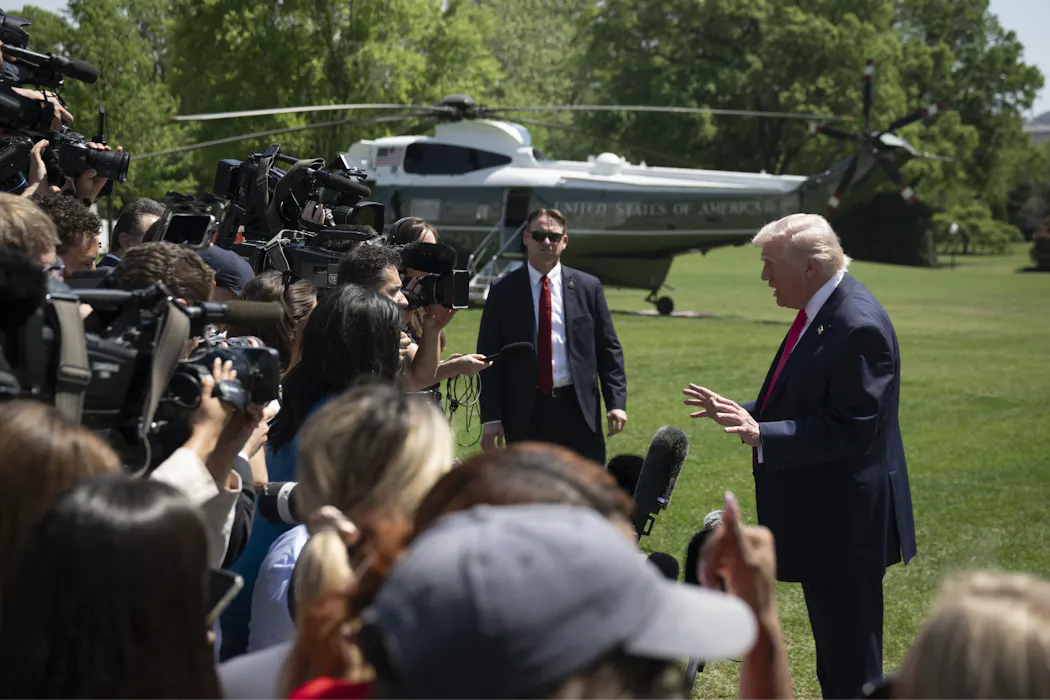
President Trump often stops to speak off the cuff with the press. Celal Gunes/Anadolu via Getty Images

The first half of 2026 has been a chaotic time for U.S. foreign policy: new tariffs, threats to annex Greenland, the capture of Venezuelan President Nicolás Maduro and the struggle for control of the Strait of Hormuz.

As a researcher focused on the values and rhetoric of American presidents, I study how presidents and their administrations communicate to the public about foreign policy. My primary aim is to understand the values systems and policy priorities that make up a president’s public persona.

I have found the second Trump administration exceptionally difficult to track and assess. Keeping up with Truth Social posts, press conferences and off-the-cuff Oval Office remarks from the president can feel like drinking from a fire hose.

Gone for now are the days when a U.S. president stepped to the lectern and delivered a speech direct from the teleprompter or released a carefully crafted statement that was understood to be official U.S. policy.

In its place is an unpredictable barrage of communication – ranging from traditionally worded executive orders in the mold of previous administrations to an expletive-laden Truth Social post on Easter morning in the midst of Operation Epic Fury, the Pentagon name for the war in Iran.

The president’s rhetorical style, heard most recently on his mid-May trip to China, is explained by political allies as part of Trump’s strategic approach and criticized by his opponents as the dangerous musings of an unstable leader.

In either case – whether it’s Trump’s defenders or detractors – it is increasingly difficult to ascertain whether the language of the president signals actual policy positions from the White House.

If the words of the American president no longer function as reliable indicators of U.S. foreign policy, where can the public, U.S. allies and America’s adversaries look to better understand the administration’s geopolitical priorities?

One answer may be found by examining the words of key Cabinet members.

Vance redefines ‘Western’ values

At the 2025 Munich Security Conference, U.S. Vice President JD Vance shocked gathered leaders when he spoke about ‘the retreat of Europe from some of its most fundamental values.’

Trump’s second term has introduced a political paradox: because he is president, his words carry enormous weight. And yet, because of his hyperbolic and often erratic communication style, each statement also carries significant political uncertainty.

Will the next social media post threatening to exit NATO hint at a real policy position? Or will it simply disappear into the digital information ecosystem as another “Trump being Trump” moment?

The rhetoric of Cabinet members increasingly serves as a bridge between Trump’s erratic communication style and actual policy.

Public statements delivered in 2025 by Vice President JD Vance, Secretary of State Marco Rubio and Defense Secretary Pete Hegseth offered, I believe, critical insight into the administration’s foreign policy vision and helped lay the groundwork for major policy actions in 2026.

In February 2025, Vance stood at a lectern at the Munich Security Conference to address a gathering of prominent European political and military leaders. Many analysts expected an aggressive speech from Vance criticizing Europe’s spending on defense in the context of shared American-European security concerns, such as NATO and the war in Ukraine.

Instead, Vance argued that Europe’s political elites had failed to defend “Western” values. Speaking over audible gasps from attendees, Vance declared: “What I worry about is the threat from within, the retreat of Europe from some of its most fundamental values, values shared with the United States of America.”

Using freedom of speech as a shared value, Vance argued that many left-leaning European governments – not authoritarian-led Russia or Hungary – posed the real threat to this cornerstone of Western society.

As the first major foreign policy speech delivered abroad by the second Trump administration, Vance’s remarks signaled a major shift in America’s approach to the trans-Atlantic alliance.

The speech suggested that, in the eyes of the administration, the “values-and-interests” framework that shaped the U.S.-European relationship post-World War II had weakened. In that phrase, “values” are understood as a country’s moral and cultural preferences and its “interests” as the factors that advance its security and prosperity.

Instead, Vance argued that liberal values alone would no longer guarantee cooperation, and the administration made clear it would not avoid public fights over ideological differences with European allies.

The speech also appeared to send a clear signal to right-leaning political leaders in Europe, including then-Hungarian Prime Minister Viktor Orbán, that their brand of “Western” values had become increasingly attractive to Washington.

It is not difficult to connect Vance’s Munich speech to the administration’s subsequent embrace of right-leaning political leaders and its pullback from postwar liberal foreign policy priorities, such as a commitment to international aid.

Rubio: Trade over humanitarian aid

One of the most tumultuous domestic periods of Trump 2.0 came during the DOGE process of massive budget cutting, which eliminated programs across the government.

One DOGE flash point was the fate of the U.S. Agency for International Development, or USAID, which since 1961 had been the American government’s primary organization delivering humanitarian aid globally.

On July 1, 2025, the administration officially announced that USAID would stop providing foreign assistance, which it had been doing in approximately 130 countries.

That same day, Rubio published an article on the State Department’s Substack account titled Make Foreign Aid Great Again, arguing for a new approach that prioritized “trade over aid, opportunity over dependency, and investment over assistance.”

Like Vance in Munich, Rubio adopted an overtly aggressive tone in criticizing both USAID and America’s broader humanitarian aid model. Rubio argued that the “charity-based model failed.” Rubio’s rhetoric built on and complemented themes from Vance’s speech.

First, it reinforced the administration’s broader free-ride-is-over argument that prioritized quid pro quo relationships over established liberal values-based commitments. While Vance applied this logic to European allies in the context of “Western” values and military support, Rubio applied it to humanitarian aid projects and America’s relationships across the Global South.

Second, Rubio’s remarks made clear that a quid pro quo foreign policy rooted in what he deemed to be U.S. national interests would increasingly shape State Department decision-making – regardless of the humanitarian consequences from cuts to international aid programs or multilateral institutions such as the United Nations.

Hegseth rewrites US rules of war

In September 2025, Secretary of Defense Pete Hegseth stood in the Oval Office alongside Trump to discuss his department’s renaming to the “Department of War.” Hegseth asserted that the War Department would focus on “maximum lethality, not tepid legality; violent effect, not politically correct.”

Viewed alongside the administration’s actions in late 2025 and into 2026 – from attacks on nonmilitary vessels around Venezuela to the extraction of Maduro, to the scale of destructive force deployed against Iran – the “maximum lethality” statement may prove to be one of the most consequential rhetorical moments from a Trump Cabinet official.

Pete Hegseth declares that the newly named Department of War will focus on ‘maximum lethality, not tepid legality; violent effect, not politically correct.’

As Operation Epic Fury continues, Hegseth has defiantly reaffirmed the administration’s “maximum lethality” posture. At one point he declared that “we negotiate with bombs,” and at another briefing he called for “no quarter, no mercy for our enemies” – a practice that violates international law.

These remarks and others underscore the administration’s rejection of international law and diplomacy in favor of military force as the preferred tool of American foreign policy.

Beyond the noise

In 2025, Vance, Rubio and Hegseth articulated new visions of America’s role in the world. In their own ways, they deployed rhetoric that sought to reshape U.S. foreign policy by redefining Western values, embracing quid pro quo relationships and prioritizing military force as guiding principles of the Trump administration’s agenda.

Despite the daily frenetic social posts and statements from Trump, members of his Cabinet will surely continue to project their own moral and political visions of America throughout 2026 and beyond.

The Conversation

Kevin Maloney is affiliated with the Carnegie Council for Ethics in International Affairs.

Iran’s attacks on Israel were an attempt to shape the region on its own terms – and it might just do so

Iran fired barrages of missiles at Israel for the first time in two months on June 7. The initial trigger was an Israeli strike against a Hezbollah target in the Lebanese capital of Beirut earlier that day, an attack that Donald Trump had only recently asked the Israeli prime minister, Benjamin Netanyahu, to avoid carrying out.

Israel’s military soon launched retaliatory strikes on targets in western and central Iran, again defying calls by Trump for restraint. Iran subsequently launched fresh strikes of its own, before the Iranian military announced it was bringing its attacks to an end. In a statement, Iran warned it would carry out a “more severe” response if Israel’s attacks on Lebanon continue.

What caught my attention about this round of fighting is the geopolitical context in which it has occurred. Iran is trying to establish a new regional order, based on new rules. And it might just pull it off.

The first notable feature of this order is that Iran dictates to Israel and the US what they may and may not do. Iran started this latest round of fighting not because of an attack on Iranian territory, but as an attempt to dictate Israeli military actions in Lebanon.

Six months ago, Israel could do as it pleased in Lebanon without Iranian intervention. Now, thanks to Trump and Netanyahu’s war, Tehran feels empowered enough to try and place limits on Israeli action on Israel’s own borders.

We have seen, somewhat more obliquely, the same principle apply in the Strait of Hormuz over the past month or so. Iran established a chokehold over the vital waterway shortly after the start of the war in late February. And it has no intention of letting its control go.

This, too, is part of Iran’s new regional order. It is telling its opponents: do as we say or we tighten our stranglehold on the global economy. For now at least, US actions show that Washington would rather accept the continued existence of this reality than fight to change it.

A second aspect of the new regional order is Iran’s expanding ways of inflicting pain on its enemies in order to force acceptance of this new world. Iran has established that it can rain missiles on Israel, strike infrastructure across the Gulf states, kill American soldiers and choke the global economy of oil, all without facing a realistic attempt at regime change.

Iran also still has many cards in its pocket. These range from expanding the scope of energy and desalination targets it hits across the Gulf to activating the Houthis to block energy traffic in the Red Sea. The Houthis have announced a ban on Israeli shipping in the Red Sea following the latest escalation.

The US has threatened many times now to attack Iranian civilian infrastructure, invade its Kharg island export terminal or to escort ships through Hormuz. However, it has backed down from all of them out of fear of the consequences.

Strained US-Israeli ties

The third feature of the new regional order is that Israel and the US no longer march in lockstep. Trump responded to Iran’s attack on Israel by emphasising that his priority was to stop Israel from retaliating. “I am going to call Bibi right now and tell him not to retaliate,” he said following the initial Iranian strikes.

Netanyahu has managed to manoeuvre Israel into a position in which a Republican president is telling him not to respond to incoming Iranian missile barrages targeting Israeli civilians. This situation would scarcely have been believable six months ago.

Separating Israel from the US is a longstanding dream of Tehran. So far at least, there is no hint that Trump is threatening to withhold missile interceptor defences from Israel over the resumption in hostilities. But even while keeping American defensive aid, it would be very difficult for Israel to sustain further conflict with Iran.

Hunting missiles launchers would alone prove a challenge, because Israeli air power would be stretched much more thinly without American assistance in hitting targets. If the northern front against Hezbollah remains active as well, the Israeli military’s resources will be even more strained.

And for how long is the US going to accept running down its missile interceptor stocks in order to defend Israel from a bout of warfare that its famously mercurial president told the country not to start? In the short term, perhaps for a while. But over the longer term, it is not sustainable for the US to dedicate a substantial portion of its missile defences to protecting Israel.

The fourth and final feature of the new regional order is that peace seems impossible to imagine. Netanyahu cannot accept an Iranian veto over Israel’s actions in Lebanon, nor absorb the implications for Israeli deterrence if he lets attacks from Iran go unanswered.

Trump cannot get his peace deal with Iran while Israel is bombing Lebanon. And Iran has the incentive to keep pushing for more, inflicting more costs on its opponents, because in the new regional order it can do so without many consequences.

This is the result of a disastrous war of choice which will go down as one of the most ill-conceived in American history.

The Conversation

Andrew Gawthorpe is affiliated with the Foreign Policy Centre in London. He is the author of America Explained (https://amerex.substack.com/), a newsletter covering US politics, foreign policy and history, which features regular analysis of the Iran war.

❌
Subscriptions