Normal view

  • ✇National Herald
  • Not Modi or Shah, Prajapati from Surat most talked about Gujarati in Kolkata AJ Prabal
    Both Prime Minister Narendra Modi and Union home minister Amit Shah spent several days campaigning in West Bengal and camping in Kolkata. Besides other things, Shah declared that Kolkata was a "city of slums". In his turn, PM Modi declared that while the capital was not a "slum city", its pride Jadavpur University had descended into anarchy and had become a den of, what else, "urban Naxals". Both comments drew attention in the media; but as West Bengal gears up for counting day tomorrow, 4 May,
     

Not Modi or Shah, Prajapati from Surat most talked about Gujarati in Kolkata

3 May 2026 at 14:31

Both Prime Minister Narendra Modi and Union home minister Amit Shah spent several days campaigning in West Bengal and camping in Kolkata. Besides other things, Shah declared that Kolkata was a "city of slums". In his turn, PM Modi declared that while the capital was not a "slum city", its pride Jadavpur University had descended into anarchy and had become a den of, what else, "urban Naxals".

Both comments drew attention in the media; but as West Bengal gears up for counting day tomorrow, 4 May, another Gujarati, a young man from Surat, is the one who has emerged as the most talked about Gujarati in the state.

Deep Prajapati first drew attention in the third week of April when a reel began circulating of him chatting with a group of young women sitting together on the stairs of what appeared to be a college or university. The video was shot by a companion from behind as Prajapati distributed forms for ‘Annapurna Bhandar’, the BJP election offer meant to counter Mamata Banerjee’s Lakshmir Bhandar scheme with a monthly cash transfer to women of Rs 3,000.

He had come all the way from Gujarat because he felt sorry for West Bengal, he was heard saying condescendingly. The women must vote for the BJP if they wanted a change for the better, he earnestly added. The women politely smiled and shook him off.

Team of @ndtvindia should do basic homework rather than blatantly peddling agenda for a particular party.

Here’s few pictures of that full time BJP worker. He is not simply a vlogger as claimed⬇️ https://t.co/lApMtZAnxZ pic.twitter.com/USq2ZnAfUZ

— Bhartendu Sharma (@Bhar10duSharma) May 3, 2026

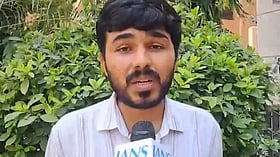
Possibly drawn by the reel, which was shared widely, Bengali TV channel ABP Ananda caught up with him. This time in chief minister Mamata Banerjee’s constituency Bhabanipur. Prajapati, asked what brought him to the city, claimed he was visiting relatives. As an Indian citizen he was free to travel anywhere he liked, he belligerently added.

As to why he was loitering in Bhabanipur — prompting Trinamool Congress workers to single him out as an outsider who was not a voter in the constituency, possibly referring to the West Bengal chief electoral officer's directive that non-voters were to leave the constituencies even if they were visiting — he said he was just a visitor to the city, not a BJP worker. But he was aware of the "pathetic situation" in West Bengal and it was his duty to document it. As a young citizen, he told ABP Ananda, it was his responsibility to highlight the plight of Bengal. He was not committing any crime, he added.

Despite claiming he was just a casual visitor, he shared videos of a table occupied by BJP workers — seven or eight of them — on polling day in Bhabanipur, gleefully pointing to an adjacent Trinamool Congress table being manned by just one fidgety worker.

Can a Bengali go to #Gujarat and campaign against Modi, can anyone go to UP and protest against #Hathras ? Just asking! https://t.co/2u7Bc1Nvxy

— Suman সুমন #Andolanjeevi #SaabYaadRakhaJayega (@sumonseng) May 1, 2026

He popped up once again at the strongroom where EVMs used in the Bhabanipur constituency were kept. TMC workers claimed the strongroom was opened to BJP’s agents without informing TMC, that BJP workers were being allowed to count postal ballots.

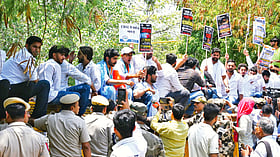
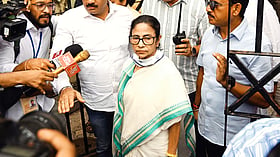
A ruckus followed as TMC workers, alerted by the scouts at the spot, gathered and started raising slogans. Banerjee herself appeared to find out what was happening. When she finally drove out of the complex, she stopped to speak to the media and showed a video clip of BJP workers inside. Sure enough, Prajapati was prominently visible.

This time, a national TV channel, NDTV, jumped in and reported the incident. The channel also apparently aired a brief conversation with Prajapati, who parroted the line that he was just visiting his relatives in the city. This time, the TMC delved into Prajapati’s social media pages and outed photographs that established him as a BJP worker from Surat.

Prajapati has generated considerable interest and triggered some sharp questions. “Can a Bengali go to Gujarat and campaign against the BJP or visit Uttar Pradesh and speak against Yogi Adityanath in public and on TV channels? Can anyone visit BJP-ruled states and move freely, openly abusing governance in the state on regional TV channels?” asked Bengalis on social media.

They seemed both proud of their state which allows dissent and such freedom; proud that West Bengal Police ignored the provocations directed at the ruling party, which did not lead to violence — contrary to the image of the state. They also sounded outraged at the impunity with which Gujaratis were abusing the state.

  • ✇National Herald
  • Why rebel TMC MPs in Lok Sabha are liable to be disqualified AJ Prabal
    The rebel TMC MPs argue that their 'merger' with the NCPI is constitutionally valid because they constitute at least two-thirds of the party's strength in the Lok Sabha. They point to earlier precedents. When seven Rajya Sabha MPs of the Aam Aadmi Party, led by Raghav Chadha, crossed over to the BJP earlier this year, Rajya Sabha Chairman C.P. Radhakrishnan allowed them to sit with BJP members, effectively recognising the merger. Similarly, in 2021, then Rajya Sabha chairman M. Venkaiah Naidu re
     

Why rebel TMC MPs in Lok Sabha are liable to be disqualified

16 June 2026 at 09:47

The rebel TMC MPs argue that their 'merger' with the NCPI is constitutionally valid because they constitute at least two-thirds of the party's strength in the Lok Sabha. They point to earlier precedents. When seven Rajya Sabha MPs of the Aam Aadmi Party, led by Raghav Chadha, crossed over to the BJP earlier this year, Rajya Sabha Chairman C.P. Radhakrishnan allowed them to sit with BJP members, effectively recognising the merger. Similarly, in 2021, then Rajya Sabha chairman M. Venkaiah Naidu recognised the merger of six TDP MPs with the BJP.

However, the Tenth Schedule of the Constitution prohibits elected MPs and MLAs from defecting from the political party on whose ticket they were elected. Paragraph 2(1)(a) of the Tenth Schedule provides that a member belonging to any political party shall be disqualified if he or she voluntarily gives up membership of that party. The Explanation to Paragraph 2 further states that a legislator is deemed to belong to the political party that set him or her up as a candidate for election.

Paragraph 4 of the Tenth Schedule lays down a twin test for a valid merger. First, there must be a merger of the original political party with another party. Second, at least two-thirds of its legislators must agree to such a merger. In essence, the merger must originate from the original political party itself; a group of legislators cannot invoke it to escape anti-defection proceedings.

This position was upheld by the Supreme Court in its 2023 Constitution Bench judgment in Subhash Desai v. Principal Secretary, Governor of Maharashtra. The Court held that the “original political party” and the “legislature party” are distinct entities under the Tenth Schedule. Paragraph 1(b) defines a “legislature party” as a group of members belonging to a particular political party in the House, while Paragraph 1(c) defines an “original political party” as the party to which such members belong outside the legislature.

Despite the Supreme Court’s 2023 ruling, a Bombay High Court on 16 January 2025 approved the shift of Goa Congress legislators to the BJP in 2022 as a valid ‘merger’. The rebel MPs from the Trinamool Congress are citing this ruling of the Bombay High Court as validation. The Supreme Court is however currently examining a petition filed by Goa Congress leader Girish Chodankar challenging the decision. The petition argues that “mergers of State legislature party in Opposition led by the Leader of Opposition are not only a ‘Constitutional sin’ but also amount to a direct attack on the democratic set-up of an Assembly”.

Senior Advocate Kapil Sibal believes the rebel TMC MPs have invited disqualification. Individually or as a group, the MPs cannot decide to merge the party with another party. The 28 or 20 Lok Sabha MPs do not constitute the Trinamool Congress Party, he points out. The ‘merger’ provision is for parties and not individual MPs or a group of them, he argues. Critics question what the rebels can possibly ‘merge’? They themselves are the creatures of the party which gave them the symbol to contest elections. They can neither lay claim to the party nor the party symbol, structure or funds. What then are they merging?

“It is the symbol of the party that helps you become a MLA or MP. Now, if the legislative party merges, they don’t take the symbol of the parent or original party they belonged to. So, they will be represented as MPs with reference to the symbol of a party from whose symbol they did not contest the election or get elected. It is per se illegal,” he explains.

Former Lok Sabha secretary-general P.D.T. Achary also concurs with Sibal, emphasising that the Tenth Schedule recognises the centrality of political parties. It is the political party that can merge with another party, not the legislature party. Achary said sub-paragraph (2) of Paragraph 4 means that if the political party wants to merge with another, two-thirds of its MPs in a House have to agree to the said merger.

While the rebel camp cited the Bombay High Court verdict, Achary believes the 2023 Supreme Court verdict in the Shiv Sena split case (Subhash Desai vs principal secretary, governor of Maharashtra) made it clear that a legislature party cannot act independently of the political party. The Supreme Court said in its judgment that it was the political party and not the legislature party that appoints the Whip and issues directions to vote in a particular manner.

  • ✇National Herald
  • Suspense over Iran-US peace plan: A ‘deal’ which does not look like a ‘done deal’ AJ Prabal
    Western media outlets, including the Al Jazeera, are reporting growing protests in Iran against negotiators accused of conceding too much to the US. With no authentic text of the agreement expected to be signed in Geneva on Friday yet available, the exact terms remain unclear. What is evident, however, is the widening gap between the Iranian and American narratives.While the Iranian narrative maintains that ships passing through the Strait of Hormuz will pay a "management fee" to Iran and Oman,
     

Suspense over Iran-US peace plan: A ‘deal’ which does not look like a ‘done deal’

16 June 2026 at 07:31

Western media outlets, including the Al Jazeera, are reporting growing protests in Iran against negotiators accused of conceding too much to the US. With no authentic text of the agreement expected to be signed in Geneva on Friday yet available, the exact terms remain unclear. What is evident, however, is the widening gap between the Iranian and American narratives.

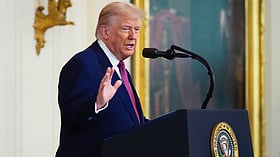
While the Iranian narrative maintains that ships passing through the Strait of Hormuz will pay a "management fee" to Iran and Oman, US President Donald Trump has dismissed such claims as "fake news", insisting that passage through the waterway will remain toll-free. Iranian media have also celebrated the reported release of frozen Iranian assets by Western powers, yet Western coverage of the proposed peace plan has been notably silent on the issue. Similarly, Iranian outlets have claimed that Washington agreed to stop interfering in Iran's sovereignty, a contention seemingly contradicted by Trump's own statements. And while Tehran views the ceasefire as a permanent arrangement, Western media reports suggest it may amount to only a temporary pause contingent on Iran's "good behaviour".

It is a little rich, considering it is the United States and Israel which attacked Iran without any provocation in both 2025 and on 28 February, 2026. The airstrikes on the very first day killed 40 top leaders, advisors, scientists and military officials in Iran besides hitting a primary school, killing 168 children and their teachers. In the days of targeting by Artificial Intelligence, there is no way the US was not aware of what they were doing. Indeed, the Americans and Israel boasted of the assassination while evading the issue of bombing the school. It was again the US which sunk an Iranian naval ship in the Indian Ocean which was returning from a ceremonial visit to an Indian port.

Both the rogue nations, however, demand ‘good behaviour’ from Iran. If reports of growing protests in Iran are true, it would be extremely difficult for Iranian negotiators to sign a peace deal on Friday.

Reports in the Iranian media have claimed that Iran will gain access to $24 billion in frozen assets and enjoy suspension of oil sanctions. Iranian media insist talks will focus only on enrichment and sanctions relief, excluding missiles and regional proxies. Iranian outlets highlight US commitments to non-interference in Iran’s internal affairs and some reports mentioned that the US and allies are ready to offer a $300 billion in reconstruction plans. In return, Iran would restrict the enrichment of uranium.

An even more striking divergence is on nuclear weapons. While the Iranian narrative hold that the issue will be negotiated in future, the western media reports categorically state that Iran had agreed to never have nuclear weapons. Pointing out that the final text of the deal has not been published yet, western narratives claim that key issues remain unresolved. The peace plan, at best, will restore the status-quo-ante or the situation prevailing before the unilateral strikes by US and Israel on Iran on 28 February.

US President Donald Trump declared on Truth Social on Monday that “Iran has agreed to never have a Nuclear Weapon!”, which according to the western media narrative, is a key clause in the memorandum of understanding (MOU) signed by Washington and Tehran on Sunday to end more than 100 days of war. In the same post, Trump pushed back sharply on financial reporting around the deal. “…the story that the US is paying Iran 300 million Dollars is Fake News, put out by the Democrats!!!” he wrote.

To add to the uncertainty, the chief of Iran's Islamic Revolutionary Guard Corps (IRGC) ruled out dismantling Hezbollah or allowing toll-free passage through the Strait of Hormuz — two key demands of the US and Israel. He also rejected calls to disband resistance groups such as Ansar Allah and the Houthis. Even as Trump claimed the Strait would be "completely free" by 19 June, Iranian foreign minister Seyed Abbas Araghchi struck a cautious note. "We have a history of broken commitments. We have a history of agreements being torn up. All of this is present in our minds," he wrote on X.

Donald Trump
  • ✇National Herald
  • So, did ‘SIR ji’ help the BJP in Bengal? AJ Prabal
    “If 10 per cent of the electorate does not vote and the winning margin is more than 10 per cent…what will happen? Suppose margin is 2 per cent and 15 per cent of the electorate who are mapped could not vote, then maybe… we are not expressing any opinion, but we would definitely have to apply our minds,” observed Justice Joymalya Bagchi in the Supreme Court during hearing of petitions challenging SIR. Justice Bagchi's half-articulated apprehension appears to be borne out by the results of the Wes
     

So, did ‘SIR ji’ help the BJP in Bengal?

6 May 2026 at 16:20

“If 10 per cent of the electorate does not vote and the winning margin is more than 10 per cent…what will happen? Suppose margin is 2 per cent and 15 per cent of the electorate who are mapped could not vote, then maybe… we are not expressing any opinion, but we would definitely have to apply our minds,” observed Justice Joymalya Bagchi in the Supreme Court during hearing of petitions challenging SIR.

Justice Bagchi's half-articulated apprehension appears to be borne out by the results of the West Bengal Assembly elections declared on Monday, 4 May.

'In 105 seats that the Bharatiya Janata Party won in West Bengal, the total number of voters deleted during the special intensive revision exceeds its margin of victory,' reported a data analysis by Scroll.

In a separate analysis The Wire reported, 'In 150 seats, more than half of West Bengal’s 294, total deletions were greater than victory margins, and BJP won 99. In 2021, it had won just 19 of these.' 

The bulk of these 105 seats have never been won before by the BJP. Banerjee’s party ended up losing 129 seats it had held to the BJP. The Hindutva party, on the other hand, won every single seat that it had won five years ago.

Of the 91 lakh total deletions in the SIR, at least 27 lakh voters are still under adjudication, with their fate to be decided by special tribunals.https://t.co/boMkDX8bjD

The BJP was the only major political party in Bengal that supported the exercise from start to finish.… pic.twitter.com/o0zjrn2CnF

— Scroll.in (@scroll_in) May 6, 2026

The analysis by both the portals underscores that of the 105 seats, 86 were never won by the BJP. Bengal has 294 Assembly seats in all, and the BJP secured a two-thirds majority to end outgoing chief minister Mamata Banerjee’s 15-year reign in the state. Both the news portals cited several results to indicate how SIR may have affected the final outcome.

1. The Indus seat in Bankura was won by the BJP this time by just 900 votes. SIR had deleted 7,515 voters in the constituency.

2. BJP won the Jadavpur Assembly seat in south Kolkata by a margin of 27,716 votes. The SIR excluded more than 56,000 names in the constituency, a stronghold of the CPI(M), which polled a little over 41,000 votes.

3. Aroop Biswas, a minister in the outgoing government, lost the Tollygunge seat by 6,013 votes. The total number of voters deleted by SIR was 37,889.

4. Mamata Banerjee also lost her Bhabanipur seat to BJP heavyweight Suvendu Adhikari by 15,105 votes, while the SIR had deleted over 51,000 voters.

5. In Satgachhia, the BJP’s victory margin was 401 votes while there were 17,669 ASDD deletions and 8,785 'under adjudication' voters were found ineligible

6. In Rajarhat New Town, the BJP’s victory margin of 316 votes followed over 63,000 total deletions.

7. In Raina, BJP won by 834 votes, while total deletions crossed 23,000.

8. In Jangipur, BJP won by 10,542, while deletions stood at 36,581 in a constituency with over 51 per cent Muslim population.

On SIR and West Bengal:

I see several journalists, analysts as well as opinion writers trying to assess how much the SIR in West Bengal impacted Trinamool and BJP's fortunes.

We @reporters_co tracked the SIR in West Bengal from scratch. We reviewed the previous voter…

— Nitin Sethi (@nit_set) May 6, 2026

In West Bengal, SIR was a contentious exercise which dragged on for six months until days before polling and culminated in a total of about 91 lakh names being deleted, shrinking the state’s voter rolls by nearly 12 per cent. Of the 91 lakh total deletions, at least 34 lakh voters are known to have filed petitions against their deletion before appellate tribunals which will take a year or, according to some estimates, 10 years to complete the process.

Nitin Sethi, founder of Reporters’ Collective, which has conducted several forensic examinations of SIR since it was first conducted in Bihar from June 2025, said in a statement on Wednesday: 'If you are reading others on this (the impact of SIR on Bengal results), I would advise you to consider if the following have been parsed and factored in:

1. The 2025 or previous voter lists, the historical and accumulated problems in that and the patterns of those problems.

2. The actual process of how deletions, detection of doubtful voters through the software happened at different states (and it did keep on changing).

3. Overlap this with the organic voter shift in favour of BJP.

4. Actively avoiding confirmation bias while building assumptions and conclusions drawn from correlations.

'I am yet to see any cogent argument or reportage that acknowledges taking these four into account while concluding, by allusion or directly, how significant SIR's impact is on any party's votes in the state in a quantifiable manner across the state.

'That said, the SIR, as done in West Bengal and largely condoned by SC (in fact, enabled by it), regardless of how it impacted any political party's fortunes, is a dangerous and deeply worrisome precedent for voters and citizens in India. It sets a paradigm that endangers the fabric of electoral politics, democratic integrity, and citizen right in India. Regardless of who the voter today or tomorrow votes for.'

  • ✇National Herald
  • Put students ahead of political theatre AJ Prabal
    On 2 June 2026, hours after 17-year-old Sarthak Sidhant, a schoolboy from Ranchi, made a presentation to the parliamentary standing committee on education, the government transferred the chairman and secretary of the CBSE (Central Board of Secondary Education), both IAS officers. It also announced a departmental inquiry committee to look into the hurried introduction of a digital evaluation system that led to this fiasco.Since the CBSE Class 12 results were announced on 13 May, lakhs of harried
     

Put students ahead of political theatre

6 June 2026 at 04:55

On 2 June 2026, hours after 17-year-old Sarthak Sidhant, a schoolboy from Ranchi, made a presentation to the parliamentary standing committee on education, the government transferred the chairman and secretary of the CBSE (Central Board of Secondary Education), both IAS officers. It also announced a departmental inquiry committee to look into the hurried introduction of a digital evaluation system that led to this fiasco.

Since the CBSE Class 12 results were announced on 13 May, lakhs of harried students have reported totalling errors, unmarked questions, mismatched answer sheets, blurred scans and missing supplementary sheets. Lakhs have applied for verification. In a tweet on 26 May, the CBSE acknowledged receiving 4.04 lakh ‘applications for scanned copies of answer books’. The same tweet claimed to have received ‘11.31 lakh requests for answer books’. The distinction was not clear to this reporter.

For students waiting for re-evaluation, this is no longer a technical glitch. The results are now suspect and at risk are college admissions that are often provisional pending proof that candidates have secured the necessary cut-off marks in their board exams.

Transferring a few worthies and demanding that the education minister resign does not solve the students’ problems nor secure their future. Even now, after its hurriedly introduced on-screen marking (OSM) web domain has been conclusively proven to be hackable, the CBSE’s response is to accept re-evaluation requests — for a fee! It has even managed to come up with a graded fee structure for this re-evaluation. And, believe it or not, will conduct the re-evaluation on the same compromised web domain. If the CBSE has alternative plans, there have been no public announcements to that effect.

****

Sarthak Sidhant and 19-year-old Nisarga Adhikary from Siliguri have thoroughly exposed the OSM platform used to evaluate the CBSE Class 12 board papers of 18 lakh students. Sarthak went a step further and exposed how the CBSE tweaked conditions to favour Hyderabad-based Coempt Eduteck over Tata Consultancy Services (TCS).

Quick aside: TCS with 600,000 employees, an annual revenue of $29 billion (Rs 2.40 lakh crore) and 57 years of experience lost out to a company with 51 employees and an average annual turnover of Rs 50 crore.

Sure, size doesn’t bestow credibility but ‘CBSE did not just pick a bad software vendor by accident. They lowered financial baselines. They dropped software security certifications. They cut the corrupt practices cooling-off period by half. They removed the physical server isolation requirement. They erased the word ‘blacklisting’ from their penalty matrix via a last-minute corrigendum, before bidding; and they bypassed their own mandatory CERT-In production audits,’ Sarthak points out in a blog post.

Why did TCS lose the contract? CBSE floated the tender thrice in 2025 — in February, May and August — each time diluting some of the conditions, lowering the bar and making it easier for Coempt Eduteck to bid. On paper, TCS with its vast network, expertise and collaborators abroad, did look qualified to roll out India’s first online evaluation platform. But it became clear that the CBSE was doing everything possible to keep it out. It even decided that the vendor needn’t have its own ‘data centre and disaster recovery centre’, that it would do if the vendor relied on a ‘MeitY-empanelled data and disaster recovery centre’.

There were other tweaks in the OSM tender that Sarthak Sidhant prised open and laid bare. ‘They gambled with our data security, our marks, our mental health; the institution failed us,’ Sarthak writes in his blog.

Nisarga, who had discovered how vulnerable the platform was back in February, three months before the Class 12 board examination began (on 17 May), was equally scathing.

He could have sold the data and made a lot of money, he said. But he didn’t. He could have also kept quiet and used the loopholes to manipulate the marks for whoever was willing to pay. He didn’t. If access to the evaluators’ platform was as easy as Nisarga had demonstrated, what is the guarantee that bad actors did not?

Nisarga, the ethical hacker, promptly informed India’s Computer Emergency Response Team (CERT-In) what he had found and shared what needed to be done to plug the loopholes. CBSE and CERT-In were both casual and callous. Coempt Eduteck, presumably alerted by the CBSE and CERT-In, ignored the warning from the student. What could a Class 12 student possibly do?

The company, the 19-year-old flagged, had ‘not only kept the door to the evaluators’ platform open but kept the key hanging in the lock.’ The password to access the platform was in full public view and he could easily retrieve data and details of schools and examiners, Nisarga said. Anyone could take over any examiner’s account, view answer sheets and edit marks.

Nisarga reported this to CERT-In on 25 February. He was asked for a screen recording and he promptly shared the ‘full walkthrough’, retracing the steps he took to gain access. He received an acknowledgment and a case reference number: CERTIn-16590126. He was assured that CERT-In was in touch with the agencies concerned. However, the loopholes remained till the results were declared on 13 May.

Another examinee, Vedant Srivastava,demanded to see his marked Physics answer sheet, which was emailed to him by the CBSE. Vedant was horrified to find that while the first page of the answer sheet, where roll number, school code etc. had to be filled, was in his own handwriting, the rest of the answer sheet was in somebody else’s handwriting.

After the CBSE stonewalled him, he took to X on 22 May to complain. He was trolled as a ‘Pakistani’, an ‘anti-national’. By a hostile TV anchor, among others.

The same day Nisarga made his blogpost public amplifying how the platform was an invitation to manipulate marks. The CBSE claimed it was a test portal, but quietly deleted its tweet after a friend of Nisarga bought the domain for Rs 99.

On 25 May, Nisarga detected another vulnerability, and again reported it to CERT-In. Four hours later, the CBSE took the whole portal down. On 31 May, he managed to access another CBSE portal with details of 45,074 failed payments for re-evaluation including emails, phone numbers, payment IDs and order IDs. The CBSE doubled down to say there was nothing wrong, that the system was robust.

****

There are questions that the CBSE needs to answer. Was it under any pressure to award the contract to the Hyderabad-based company? Why did it fail to heed warnings given by its own governing body members and evaluators? Why were tender conditions tweaked? Who demanded these tweaks and who approved them? Why was Coempt Eduteck picked despite its dubious track record?

Most importantly, how will the CBSE restore faith in the sanctity of these results short of a full re-evaluation of all papers, by means that are considered fair and above board by independent auditors.

Given that these ethical hackers have repeatedly and conclusively demonstrated that the OSM domain is compromised, that it can be hacked and marks altered at will, what is the guarantee that this hasn’t happened? Is the CBSE in a position to vouch that bad actors were not involved to game the results for a price?

‘You study day and night for two full years. You sacrifice sleep, fun, family time, everything, just to score well in your Class 12 boards. You dream of JEE, NEET, a good future. Then the results come... and every-thing is destroyed. This is not a story. This is what lakhs of CBSE students are living right now,’ Tanmay Kashyap, a CBSE Class 12 student from Patna wrote on social media, echoing the sentiment of lakhs of students.

  • ✇National Herald
  • West Bengal: Has the ECI done enough? AJ Prabal
    No adult living in India today, with a constitutionally guaranteed right to vote, will ever forget the SIR. Not even the legions of India’s unlettered, who won’t even know what those dreaded letters stand for.The state of West Bengal had its tryst with the process over the past six months, after Bihar had seen it first. In Phase 2 of the SIR that got under way on 4 November 2025, the Election Commission of India (ECI) lavished special attention on Bengal, though it was only one of 12 states and
     

West Bengal: Has the ECI done enough?

2 May 2026 at 07:07

No adult living in India today, with a constitutionally guaranteed right to vote, will ever forget the SIR. Not even the legions of India’s unlettered, who won’t even know what those dreaded letters stand for.

The state of West Bengal had its tryst with the process over the past six months, after Bihar had seen it first. In Phase 2 of the SIR that got under way on 4 November 2025, the Election Commission of India (ECI) lavished special attention on Bengal, though it was only one of 12 states and Union Territories covered in this round.

The people of Bengal had seen it coming even before the process started here, when lakhs of deleted voters in Bihar were scrambling desperately to get back onto the electoral rolls. And now, a full six months after the grind started here, they are finally awaiting the results on 4 May.

Irrespective of which way they lean, neither the voters nor the pundits nor even pollsters of any integrity are sure how thoroughly gamed this supposedly ‘free and fair’ process is. Has the ECI done enough to swing it for its political masters?

“If the BJP finally wins West Bengal,” a state this Hindi heartland party has long coveted, “it’ll be because of the SIR,” reflected a veteran of many earlier poll battles, preferring not to be named. “But if it loses again, even after all it has done, it’ll be because of the SIR.”

This apparent paradox isn’t really. If you discount the SIR for just a moment and think only of the palpable mood of the electorate of this state, its people and the BJP are not really ready for each other.

Not even after 15 years of Mamata Banerjee and all the talk about the need for poriborton (change). Poriborton may yet come — if not organically through a popular mandate, then via the BJP’s joint venture with the ECI. But if it doesn’t, the seething anger of voters with the ECI will have played a big hand.

****

For a while it looked like the ECI was still trying to keep the real agenda under wraps, its attempt to re-engineer the electorate to the BJP’s advantage. The BJP has made no secret of its support for the exercise, and a fair-minded outsider might wonder why it’s only the Opposition that worries about largescale exclusions.

Union minister Shantanu Thakur, a prominent Matua leader of the BJP, representing the party from the state’s Bongaon Lok Sabha constituency, said it was preferable to sacrifice 20,000 Hindus to weed out 200,000 Rohingyas. But of the 58.2 lakh ASDD (Absent/Shifted/Dead/Duplicate) deletions in the draft list of December 2025, not one was Rohingya or Bangladeshi.

Soon after, the ECI deployed a mysterious software that flagged 1.3 crore voters for ‘logical discrepancy’ — a newly minted category of provisional deletions — and asked them to produce documents at in-person hearings.

Migrant workers, men, women, the elderly and the ailing queued up to produce the documents they could muster. No receipts were given, no evidence provided that they had been ‘heard’, pointed out Sahidul Munshi, retired justice of the Calcutta High Court, who found his name had been dropped. Following an interview published in Bar & Bench, his name was quickly restored but others were not so lucky.

From the pre-SIR baseline of 7.66 crore voters, the number was down to 7.08 crore (after ~58 lakh deletions) in the draft list of December 2025. The ‘final list’ of 28 February had 7.04 crore names, with ~60 lakh now placed ‘under adjudication’.

Post-adjudication by judicial officers, engaged to do the ECI’s job at the direction of the Supreme Court, 32 lakh names were cleared, which still left 27 lakh voters disenfranchised, who were now advised to approach 19 single-member appellate tribunals, made up of retired chief justices and judges of the Calcutta High Court.

By 23 April (Phase 1 voting day for 152 Assembly constituencies), a total of 138 appeals had been heard and 136 cleared for inclusion; by Phase 2 (on 29 April for 142 constituencies), another 1,474 appeals had been processed and 1,468 names revalidated. At this rate of disposal, the tribunals would have taken 10-12 years to hear the rest of the appeals!

At the end of Bengal’s SIR nightmare, the state’s count of eligible voters for this election was ~90 lakh short of its pre-SIR baseline of 7.66 crore!

No wonder the senior BJP leader who spoke on condition of anonymity felt the anger of the people might singe the party, but he also admitted he didn’t have the courage to warn the party’s big guns from Delhi of the potential backlash.

In West Bengal, he explained, the SIR had completely overshadowed anti-incumbency. All the pre-SIR talking points — corruption, jobs, lack of industries, recruitment scams — had disappeared from the electoral discourse.

Muslims rallied behind the ruling Trinamool Congress, convinced that the SIR was a diabolical plot to strip them of citizenship. Even the Matuas — Scheduled Caste Hindus from Bangladesh, many of whom found their names deleted — felt betrayed by the BJP. Migrant workers were incensed by the harassment and financial loss in travelling back and forth.

****

The voter turnout was a record 92.4 per cent and both the TMC and BJP were outwardly confident this was a sign of a mandate in their favour. The BJP would have us believe the political wind is blowing towards ‘poriborton’, the TMC insists the same wind is blowing for ‘pratyaborton’ — the return of 71-year-old Mamata Banerjee as chief minister for a fourth term.

Before returning to Delhi, Union home minister Amit Shah exuded confidence that the BJP would get an absolute majority, even quoting a number — 177 — that sounded suspiciously omniscient. But, then, he had also predicted a 200+ majority for the BJP in 2021!

If indeed the BJP’s brag about the popular mood is right, what was the unprecedented security bandobast in the run-up to elections about? The deployment of 2.8 lakh CAPF troops looked like an invasion rather than an election. (For context, Manipur had 29,000 CAPF troops on ground at the peak of the 2023 ethnic violence.)

Why was the NIA (National Investigating Agency), normally tasked with counter-terrorism duties, strutting around polling booths? Why were Central troops threatening Kolkata mayor Firhad Hakim in Bhabanipur (Mamata Banerjee’s constituency) at 1 a.m. on polling day? “Aap mayor saab ho na? Agar kuchh hua, toh aap ke liye achha nahi hoga (you’re the mayor, right? If anything [untoward] happens, you’ll be in trouble.)"

****

A post-election wisecrack summed up the mood thus: “This is an election the BJP will lose even if it wins. It won’t savour confronting Mamata Banerjee even in Opposition.” Wisecracks aside, if she loses, Mamata Banerjee will certainly be seen as a martyr, defeated unfairly by an unscrupulous rival with the help of the official machinery and a compromised Election Commission.

Most exit polls have predicted a close race, some have forecast a BJP majority, some others a clear return mandate for TMC. Historically, the verdict in West Bengal has been one-sided, with the winning party securing over 200 of the 294 seats in the assembly. In the past three elections (2011, 2016, 2021) , the TMC won 226, 211 and 215 seats, respectively. The Left Front fell four short of the 200-mark in 1996 but made up in the next election by taking its tally to 235. We’ll see if this trend persists.

Five years ago, pollsters People’s Pulse and Axis-My India had predicted the BJP would win 173-192 seats, comfortably ahead of the majority mark of 148. (The BJP won 77.) This time, Axis-My India refrained from projecting a number, claiming that 70 per cent of voters preferred not to divulge who they had voted for. People’s Pulse has predicted 95-110 seats for the BJP, and sees the TMC coasting to victory with 177-187 seats.

We wouldn’t wager any money on these predictions, though exit polls do create a flutter in the stock market and the satta bazaar, and those with an appetite for risk do make a quick crore or few. For other people who have a taste for political theatre but are less invested in the outcome, exit polls are excellent entertainment, certainly worth the price of a PVR movie ticket!

With inputs from Kunal Chatterjee

  • ✇National Herald
  • NAMO in, SIR out: an election the media did not question AJ Prabal
    “We can count the votes that were cast. We cannot recover the votes that were never allowed to be cast,” writes Gilles Vernier, a researcher at the Sciences Po in Paris. Vernier, who had helped build up electoral data from past elections while at Ashoka University, has been a long-time poll analyst.In a column published in The Economic Times on 5 May 2026, however, he wrote that he was unable to analyse the results in West Bengal. Election Commission’s interference, he added, had muddied the out
     

NAMO in, SIR out: an election the media did not question

5 May 2026 at 17:26

“We can count the votes that were cast. We cannot recover the votes that were never allowed to be cast,” writes Gilles Vernier, a researcher at the Sciences Po in Paris. Vernier, who had helped build up electoral data from past elections while at Ashoka University, has been a long-time poll analyst.

In a column published in The Economic Times on 5 May 2026, however, he wrote that he was unable to analyse the results in West Bengal. Election Commission’s interference, he added, had muddied the outcome and ‘precluded any clear analysis’.

Newspapers and the electronic media, however, scrupulously avoided mentioning the role of SIR which disenfranchised 34 lakh voters in West Bengal, all of them Indian citizens (even the election commission does not say they are foreigners or Bangladeshis) on dubious grounds. Barely 1,600 of them could reach out to the appellate tribunals which restored 99 per cent of them back to the electoral roll. Which way they would have voted cannot obviously be known but that a disproportionate number of them were women and Muslims are now public knowledge.

Headlines foregrounded spectacle and personality. Images of Narendra Modi in a Bengali-style dhoti dominated front pages, with newspapers crediting him for the BJP’s performance in Bengal and Assam. Wordplay flourished. The Tribune ingeniously but clumsily highlighted ‘Bengal’s historic TriNAMOol shift’. ‘JeetMuri’ was the headline in Rajasthan Patrika, a laboured reference to the photo-op of the prime minister’s stop to buy the popular street snack jhalmuri (puffed rice with green chilli, onions and other condiments) while campaigning in Jhargram.

Among Hindi newspapers, The Navbharat Times (NBT) carried a large illustration of the penalty area of a football field. With goalkeeper Mamata Banerjee sprawled on the ground and Modi shown having taken the penalty kick, the ball is in the net while Amit Shah in football gear is celebrating with arms raised—the only front page that highlighted the Union home minister. The NBT headline in Hindi hailed both the men as ‘Bharatiya Rajneeti Ke Babumoshai’, whatever the headline writer and illustrator may have meant.

Newspapers, apparently. pic.twitter.com/bznEMpeiiy

— churumuri (@churumuri) May 5, 2026

The front-page report in The Economic Times, predictably perhaps, carried a large photograph of Modi in the Bengali style dhoti and dramatically put the following words, as if spoken by the Prime Minister: ‘Aandhi Ban Ke Aaya Hoon (I have arrived like a storm)’—a clear and unabashed reference to this year’s Bollywood blockbuster Dhurandhar The Revenge. The prime minister would have been pleased. Other financial dailies were less theatrical. ‘A vote for change and continuity’, headlined the Business Standard. ‘A shock verdict in Tamil Nadu and Bengal’, read the Business Line headline while Mint led with ‘Saffron storm in Bengal’. ‘Parivartan, delivered’ was the headline in Financial Express.

The front-page headline in The Telegraph splashed in orange took the easy way out. It simply said, BJP’s Bengal with the outline of Kolkata’s iconic Howrah bridge. The largest circulated Bengali daily newspaper Ananda Bazar Patrika was even more cautious, headlining the verdict as the fall of Mamata and the rise of the BJP in the state. Neither SIR nor the Election Commission of India and Supreme Court found mention in the lavish coverage in the two newspapers.

The front-page headlines in newspapers outside the state were either bland or effusive. Times of India came up with ‘BJP is Bengal Janata’s Party’. Hindustan Times went with ‘Sunset for Satraps’. The Hindu, as always, played it safe and said ‘Change and Churn in Bengal, TN and Kerala’.

The Indian Express was the only one which tried to analyse the effect of SIR on voting in West Bengal, only to tie itself in knots. The misleading or mischievous headline of its front-page report read ‘Bengal SIR: TMC won 13 of 20 seats with highest voter deletions’. However, the report went on to say: ‘In the 187 seats that saw over 5,000 names deleted, the BJP won or was leading in 119. Of these 187 constituencies, the number of excluded voters was higher than the margin of victory or leads in 47. Overall, in these 187 seats—results were available for 170 and leads for 17—the number of excluded voters was higher than the margin of victory or leads in 47 seats, an analysis by The Indian Express shows.’

The Hindu in its editorial made a passing reference to the ‘tainted election process’. For all practical purposes though, the Indian media appeared to have moved on from SIR and its implications.

  • ✇National Herald
  • So returning officer is right and Meenakshi Natarajan was wrong? Not really AJ Prabal
    A lady filed a complaint of inappropriate behaviour against a Congress worker in 2022 in Telangana. Three years later, the Congress made Meenakshi Natarajan — former Lok Sabha MP and a resident of Madhya Pradesh — in-charge of Telangana. The lady went to court and filed a complaint against several people including Natarajan, named at number 4 for ostensibly taking no action against the man she had accused. A Telangana court sent notices to the people named, including Natarajan, in September 2025
     

So returning officer is right and Meenakshi Natarajan was wrong? Not really

12 June 2026 at 12:39

A lady filed a complaint of inappropriate behaviour against a Congress worker in 2022 in Telangana. Three years later, the Congress made Meenakshi Natarajan — former Lok Sabha MP and a resident of Madhya Pradesh — in-charge of Telangana. The lady went to court and filed a complaint against several people including Natarajan, named at number 4 for ostensibly taking no action against the man she had accused. A Telangana court sent notices to the people named, including Natarajan, in September 2025. The court is yet to take cognisance of the case and the charges are yet to be framed.

Now, hear Natarajan herself. The returning officer for the upcoming Rajya Sabha election, she claimed, had held that she had concealed information about the ‘notice’ in Form 26, which she had filled as part of her Rajya Sabha nomination papers. Details required in the form ranged from the political party she sought to represent, her serial number in the electoral roll, information about Income Tax, PAN, properties and personal information like her phone number and email ID.

The form also sought details about a) details of pending criminal cases against her and b) details of cases in which she may have been convicted by a court of law.

Form 26, she claimed, did not seek any detail about legal notices or summons sent to her. There was no column either for providing details of notices or cases which courts had not taken cognisance of. So, she asked, how was she at fault?

ये कहा गया कि मैंने राज्यसभा नामांकन के फॉर्म 26 में जानकारी छिपाई।

फॉर्म 26 में इन बातों का ब्यौरा मांगा जाता है

⦁ राजनीतिक दल की जानकारी
⦁ मतदाता सूची में उम्मीदवार का क्रमांक
⦁ उम्मीदवार का फोन नंबर, ई-मेल आदि जानकारियां
⦁ PAN और इनकम टैक्स रिटर्न की जानकारी
⦁… pic.twitter.com/roRhwbxLnD

— Congress (@INCIndia) June 12, 2026

Let us now turn to the Supreme Court hearing on Friday, 12 June. A Bench of Justices P.K. Mishra and A.S. Chandurkar held that election-related petitions are not maintainable by courts after commencement of the election process. The Bench said it was not inclined to entertain Natarajan’s plea in view of the law laid down in the 1952 judgement in N.P. Ponnuswamy vs Returning Officer, that the appropriate remedy in election matters is an election petition filed before the appropriate high court.

Senior advocate Abhishek Manu Singhvi argued in vain that the court had to jurisdiction to step in if the returning officer made a gross error. Natarajan, he pointed out, was seeking relief to participate in the biennial election to the Rajya Sabha. Her appeal was to establish her right to contest. She did not file the petition asking the Supreme Court to declare her the winner. If the electors chose to vote against her, she would lose, Singhvi argued. The court could direct the Election Commission to accept her nomination and allow her to contest in the election scheduled for Wednesday, 18 June.

But the returning officer declared the three BJP candidates elected unopposed from Madhya Pradesh. In the election to the Rajya Sabha, elected members of state Assemblies cast their preferential vote and winners are decided by virtue of a formula. Very often candidates, falling short of the required number of votes, buy votes, a phenomenon widely known; which is why political parties often herd their MLAs into resorts so that rival parties are not able to contact them. 

The Election Commission and the courts are aware of this reality and yet, this does not seem to bother them. The Commission has never been directed by the judiciary to tighten rules so that the integrity of an election is not compromised.

मीनाक्षी नटराजन जी का राज्यसभा नामांकन रद्द होना गैरकानूनी और लोकतंत्र के खिलाफ है।

ऐसा होना नरेंद्र मोदी के इशारे के बिना संभव नहीं है। नरेंद्र मोदी कांग्रेस और लोकतंत्र को खत्म करने के लिए ऐसी साजिशें करवा रहे हैं।

हम चाहते हैं कि सरकार लोकतंत्र के खिलाफ काम न करे, लेकिन मोदी… pic.twitter.com/Ksf26oEAPF

— Congress (@INCIndia) June 12, 2026

Time and again, however, the Supreme Court has refused to interfere in the electoral process on the ground that once the process is set in motion, the Election Commission alone was the appropriate authority to remedy the situation. Once the election is over, the only recourse for aggrieved parties and candidates is to file election petitions, which on paper must be decided within six months but are seldom settled before four or five years. 

In an editorial on 12 June, The Hindu pointed out that Section 33A of the Representation of the People Act required disclosure only of those cases that carry a punishment of two years or more and, above all, only of those cases in which charges have been framed.

'Framing of charges is a judicial step, which follows the filing of a charge sheet. The RO’s position that material facts had been concealed and the nomination papers were incomplete is not merely a misinterpretation of the law, but an insult to common sense. Going by that logic, a candidate could be disqualified for failing to list notices of traffic violations too,' the editorial noted.

So, was the Supreme Court right in dismissing her petition? Natarajan, a steadfast and stoic Gandhian, reacted by saying, “This is not a personal setback. This is a setback to democracy and the Constitution of India... I said this in the beginning that members of the Election Commission were compromised. When our people went to the Election Commission, they did not answer us for 48 hours. The Supreme Court at least heard our plea and gave a verdict..."

  • ✇National Herald
  • NEET-UG paper leak: Who, how many bought question papers for Rs 15 lakh? AJ Prabal
    Arrests made in Sikar (Rajasthan), Nashik (Maharashtra) and Dehradun (Uttarakhand) indicate that question papers were on sale weeks before the national entrance test for admission in undergraduate courses in medical colleges. A set of 400 to 600 questions were being offered for Rs 10 lakhs to Rs 15 lakhs to aspirants across the country. According to the police, as many as 120 questions from the set figured in the 180 questions framed. The fact that the sets were being sold at such high prices es
     

NEET-UG paper leak: Who, how many bought question papers for Rs 15 lakh?

13 May 2026 at 10:23

Arrests made in Sikar (Rajasthan), Nashik (Maharashtra) and Dehradun (Uttarakhand) indicate that question papers were on sale weeks before the national entrance test for admission in undergraduate courses in medical colleges. A set of 400 to 600 questions were being offered for Rs 10 lakhs to Rs 15 lakhs to aspirants across the country.

According to the police, as many as 120 questions from the set figured in the 180 questions framed. The fact that the sets were being sold at such high prices establish that the buyers were aware that the questions would be asked at the test.

The reason why 400 to 600 questions formed each set, it is speculated, is to provide the sellers and the buyers the alibi that they were buying ‘guess papers’ and it was a coincidence that 120 questions from the set were asked at the test.

“What we know is that 140 of the 180 questions in NEET were part of a guess paper of 410 questions. What is alarming is that the order of the questions and the options were exactly the same. The modus operandi is simple. In Sikar, the students are called in for a mock test, a day before the actual exam and made to prepare for each of the questions in the guess paper.

The students had 140 of the 180 questions prepared, which guaranteed them 600 of the 720 marks even before they entered the exam hall,” tweeted Maheshwar Peri, founder of career counselling firm Careers 360.

Vishal Bansal, Additional Director General of Police, SOG, Rajasthan had stated that the ‘guess paper’ had over 400 questions of which around 120 appeared in the actual examination.

“…this guess paper was with students’ weeks before the examination, as far back as a month,” he said, adding that the inquiry so far hasn’t revealed where the question paper originated from and that it was found on WhatsApp – in the mobile phones of students appearing for this examination, “It is a .pdf file of about 150 pages with over 400 questions,” he added.

The examination was conducted across the country at over 5,432 centres, in 551 cities in India and 14 cities abroad. Approximately 22.79 lakh registered students are believed to have appeared at the examination. Physically transporting question papers to all these centres would have taken several weeks and involved hundreds of agencies and handlers—making it difficult to track down leaks.

All that the National Testing Agency (NTA) has stated so far is that they were tipped off about the leak on 7 May, four days after the examination; that the NTA referred the case to the police the next day. Once confirmation was received about the leak, the NTA decided to cancel the examination and hold the examination again.

“NEET is a pen & paper examination. The physical paper is transported to over 5000 centres and involve at least 200,000 hands,” pointed out Peri. With question papers being transported for weeks before the examination, their vulnerability is high, he said on TV.

“It is common sense that in the conduct of such an examination over a large geographical area, the question paper has a very high probability of being leaked and such leaks have happened in the past too; the answer is not attempts to 'plug' the leaks but the answer is to abolish NEET,” fumed former union minister P. Chidambaram.

What also makes leakage of question papers inevitable is the huge difference between the cost of medical admission in government medical colleges, where the fee hovers around five lakh Rupees, and private medical colleges where a seat may cost up to Rs 1.5 crore. It makes sense for parents to shell out Rs 15 lakhs for question papers in advance of the test, if that helps secure a seat in a government medical college.

Former Rajasthan Chief Minister Ashok Gehlot has alleged that Rajasthan government tried to cover up the case for two weeks. “The BJP government in Rajasthan deliberately tried to cover it up for two weeks and played with the future of the youth.

The BJP government in Rajasthan had previously concealed the OMR sheet scam in the Employee Selection Board (recruitment exam) to avoid tarnishing the government’s image. Due to weak prosecution, the accused in that case were even granted bail. Similarly, an attempt was made to hide information about the NEET (UG) exam leak, he alleged.

Rajya Sabha MP Kapil Sibal also weighed in and wondered why leaks of question papers are being reported from primarily BJP-ruled states, pointing out the national level entrance exams cancelled since 2014.

  • ✇National Herald
  • BJP had the ‘machinery’ backing it, Mamata Banerjee did not AJ Prabal
    Although only 1 crore votes out of 6 crore had been counted till 1.00 pm on Monday, 4 May, the writing on the wall appeared clear enough. The BJP was leading across West Bengal. Its unexpected victory even in Muslim-dominated constituencies in Murshidabad and Malda reflected how badly minority votes had been split. Pollsters claimed over 60 per cent Hindu voters in the state had consolidated behind the BJP to end the 15-year-rule of Mamata Banerjee and Trinamool Congress.When Prime Minister Nare
     

BJP had the ‘machinery’ backing it, Mamata Banerjee did not

4 May 2026 at 12:09

Although only 1 crore votes out of 6 crore had been counted till 1.00 pm on Monday, 4 May, the writing on the wall appeared clear enough. The BJP was leading across West Bengal. Its unexpected victory even in Muslim-dominated constituencies in Murshidabad and Malda reflected how badly minority votes had been split. Pollsters claimed over 60 per cent Hindu voters in the state had consolidated behind the BJP to end the 15-year-rule of Mamata Banerjee and Trinamool Congress.

When Prime Minister Narendra Modi and Union home minister Amit Shah left the state on the last day of campaigning on 27 April, both said they would return at the swearing-in of the BJP government. West Bengal governor R.N. Ravi, brought in before the election, twice declared that change was coming to the state. The day before the counting of votes, Mumbai Police gave permission to a victory march celebrating the BJP’s win in West Bengal. They did not need exit polls to tell them the result. They knew.

In hindsight, TMC's defeat will undoubtedly be attributed to people’s restlessness for change and their belief that the BJP, which had held up Central grants, would loosen the purse strings once they came to power in the state.

Big business could barely hide its happiness. Industrialist Harsh Goenka tweeted on Monday afternoon, “Bengal’s business community is absolutely delighted with result of Bengal elections: 1. Development will be back on the agenda 2. Jobs and investments will follow 3. A stronger, more cohesive social climate will emerge. A decisive mandate for BJP is the catalyst Bengal’s economy has been waiting for”.

Both Muslims and women, it was believed, would stand by the TMC. The women’s support for and loyalty to Mamata Banerjee, it was said, was not transactional and BJP’s promise of doubling the cash transfer from Rs 1,500 to Rs 3,000, it was felt, would have no impact.

This turned out to be delusionary, as the counting trend suggested. The pillars had not entirely collapsed but had cracked just enough for the BJP to cash in. Both demography and linguistic pride, wrote columnist Swaminathan Aiyar, would ensure a victory for Mamata. West Bengal, he felt, was not yet ready to accept the hegemony of Hindi-Hindu-Hindustan. Like many other commentators, he has turned out to be wrong.

Even the anger generated by a largely senseless and illogical Special Intensive Revision (SIR) of electoral rolls does not seem to have made any difference. The large number of migrant workers, who were subjected to considerable harassment, having to travel back and forth from their places of work in BJP-ruled states, it was argued, would vote against the BJP, which supported the exercise, with a vengeance. They apparently did not. Could they have been driven to vote for the BJP to buy peace at their place of work?

Anti-incumbency, recruitment scams, women’s safety, lack of industrialisation and steady jobs, corruption and lumpenisation of TMC cadres will be cited no doubt as some of the other factors which influenced the voters in the state. However, the key reason for the defeat of the ruling party seems to be the crippling of Mamata Banerjee by the Union government and the Election Commission ever since the election was notified on 15 March.

The unprecedented transfer of several hundred officers in the state by the Election Commission — from district magistrate and SPs to police constables — would have dealt a blow to the ruling party. The chief minister was reduced to a lame duck as Central Armed Police Forces took over police stations and collectorates. Central agencies like ED and Income Tax raided the offices and the directors of I-PAC, the political consultancy firm which acted as an extension of the ruling party in the districts. While BJP retained control over the ‘machinery’, TMC lost control of it.

The CAPF accompanied BJP candidates during campaigning and warned TMC leaders to ensure that their party cadres did not disturb BJP’s campaigning. TMC overnight stopped being ‘feared’ even as BJP president Nitin Nabin was seen riding in an armoured vehicle of the CAPF.

Reports suggested that all CAPF heads were ordered to remain in the state till after the counting; and the Union home minister — not the Election Commission — declared that 750 companies would stay back in the state even after a new government is installed. Such decisions were once left to the ECI but the difference between the Union government and the election commission has got blurred.

❌
Subscriptions