Normal view

These 10 beautiful tributes to David Hockney show just how much the creative community loved him

15 June 2026 at 11:30

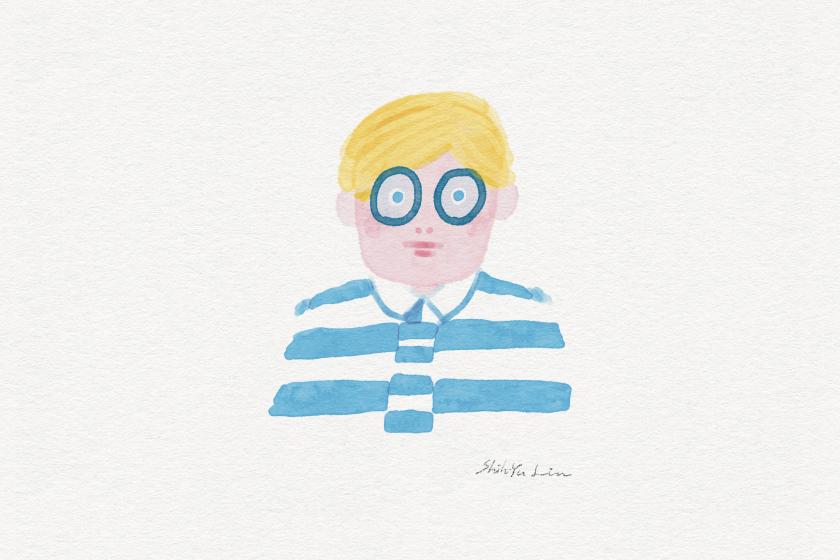
Shih-Yu Lin's watercolour farewell

Shih-Yu Lin's watercolour farewell

From Bradford to Beverly Hills, Hockney's bold colours and irrepressible joy for living inspired a generation. Here's what they created in response to his passing.

David Hockney, who died on 12 June at the age of 88, was one of the most influential British artists of the modern era. Born in Bradford, Yorkshire, he rose to prominence as a leading figure of the 1960s pop art movement. He went on to have a career spanning more than six decades, multiple continents and an astonishing range of media: oil paint, photography, stage design, printmaking and, in his later years, the iPad.

His 1972 painting A Bigger Splash became one of the most recognisable images in 20th-century art, and in 2018 his Portrait of an Artist (Pool with Two Figures) sold for nearly £70 million at auction, a record for a living artist at the time.

But Hockney was more than a record-breaker. His depictions of sun-drenched Californian swimming pools, the rolling fields of the East Yorkshire Wolds, and the tender intimacy of gay domestic life were united by a profound love of looking. He taught people to slow down and pay attention to the world around them. And he kept on doing it well into his eighties, painting from his wheelchair right up until the end.

When news of his death broke, the creative community responded with an outpouring of grief and gratitude. We put out a call for illustrated tributes, and the response was overwhelming: artists and illustrators from around the world shared portraits, scenes and homages inspired by the man and his work.

What emerges is a collection that's both a farewell and a love letter, full of colour, warmth and the kind of bold mark-making that Hockney himself would surely have appreciated. Here's a selection of the best, along with the stories behind them.

1. Stanley Chow's minimal masterclass

For our lead image (shown above), celebrated illustrator Stanley Chow took a characteristically reductive approach, distilling Hockney down to his most iconic features: that shock of blond hair, the heavy round spectacles, the slightly unfocused blue gaze. Rendered in flat geometric shapes, with not a line out of place, it captures the unmistakable silhouette of a man who was himself something of a walking work of art.

Stanley credits Hockney directly for the piece's existence. "One of my favourite Hockney quotes is 'You must plan to be spontaneous,'" he explains. "It's a quote I live by, and if it weren't for this quote, this portrait I've done of Hockney wouldn't have happened."

2. Kimiya Justus' hand-lettered homage

Illustrator and artist Kimiya Justus produced a warm, affectionate, waist-up portrait of Hockney in his white flat cap, dark round spectacles and blue and pink striped cardigan over a yellow shirt, set against a bright blue dotted background. A banner across the bottom reads "Look with both eyes," one of Hockney's most celebrated observations. It's cheerful and immediate, with a hand-drawn quality that feels fond and personal.

"Hockney has always been a huge inspiration to me," Kimiya says. "His bold colours, his irresistible drive to paint, and the way he paid attention to the smallest details of everyday life have always inspired me. Just last month, I saw his beautiful exhibition at London's Serpentine Gallery, and it reminded me once again of the simple joy of painting on the iPad."

3. Nia Gould's feline fantasia

Taking a radically different approach, creative director Nia Gould reimagined Hockney's most iconic scenes with cats in the leading roles. But she makes it clear that the humour doesn't diminish the sincerity of the tribute.

"Hockney has been a constant source of inspiration throughout my creative journey," she stresses. "Through my work, I lovingly reimagine some of his most iconic scenes, replacing people and moments with funny feline stand-ins. My work does not act as imitation but an honour to the spirit of his vibrant and quirky works of art throughout his amazingly long and celebrated lifetime."

4. Cel Castellá's living colour

illustrator and painter Cel Castellá places Hockney against a flat cerulean blue, dressed in his later-years finery: a boldly checked orange and yellow jacket, green cardigan, red tie and white flat cap, leaning forward with that familiar half-smile. The hand-lettered title above reads "I prefer living in colour," and the whole thing feels like a manifesto as much as a portrait.

"Beyond his art, what inspires me most about Hockney's life is the way he lived it," Cel writes. "The optimistic lens he carried into everything he did. His constant exploration led him to digital media. Anyone who dares to live for and through colour, in a world that keeps getting greyer and more boring, deserves admiration."

5. Fries Vansevenant's collage tribute

Graphic and motion designer Fries Vansevenant created a richly layered collage, placing a photorealistic Hockney in a constructed scene full of geometric planes, alongside an easel bearing a canvas signed with the dates 1937–2026. It feels almost archival, like a careful arrangement of everything Hockney stood for.

"For me, David Hockney is all about experimentation," Fries says. "He wasn't afraid to play with perspective, break traditional compositions, and use colour in a way that felt completely his own. What fascinates me most is how his work speaks to such a wide range of people. Not just art lovers, but teenagers and adults alike. That's something special, the mark of a truly memorable artist."

6. Liangliang Luo's 3D character study

Illustrator and animator Liangliang Luo modelled a soft-lit Hockney in 3D: white-haired, yellow-spectacled, seated at a table draped in vivid blue gingham, drawing with a green crayon. The result feels playful and warm, almost toy-like.

Liangliang's tribute is brief but precise. "I went to David Hockney's exhibition a couple of weeks ago and was so moved to see him still creating in his 80s while in a wheelchair," she recalls. "A lifetime of mastery, yet he still approaches the canvas and the iPad with absolute curiosity and zero fear of new mediums. True creative longevity."

7. Katie Smith's poolside portrait

Illustrator Katie Smith places Hockney where he belongs: beside the pool, dressed in a gloriously checked yellow/orange suit, pink cap and yellow Crocs, cradling a small dachshund in his arms. Behind him, lush green hills and pink flowering trees complete the scene. It's warm, joyful and totally alive: a portrait of a man entirely at ease in his own world.

Katie traces her relationship with his work back to her school days. "The first time I ever saw a David Hockney painting was in my Higher Art exam," she recollects. "We were asked to examine 'Portrait of an Artist (Pool with Two Figures)'. I remember thinking it was perfection. I loved the drama, the colour, the perspective. I find his work so whimsical and beautiful, you want to jump into his paintings and live there."

8. Ania Greta's handwritten reflection

Illustrator Ania Greta produced a portrait of a younger Hockney that's full of personality, completed with the quote "Spring cannot be cancelled" written above in blue. Expressing her personal feelings about the artist, Anna again reaches for his own words.

"Hockney states: 'The only real things in life are food and love, in that order, just like our little dog Ruby. I really believe this, and the source of art is love. I love life.' His work will always symbolise joy and a love for life to me. He was a careful observer of the ordinary, not allowing fleeting moments to pass without first giving himself time to admire them."

9. Marine Gentils' standing portrait

Illustrator Hello Marine contributed a confident full-figure illustration of Hockney in his later years: orange jacket, checked trousers, walking stick in one hand, cigar in the other, his shadow stretching behind him against a deep cobalt-to-purple background, standing on a teal green floor.

"I love the way Hockney played with colour, unapologetically, making even the simplest scenes feel special," Marine says. "His work reminds us that the ordinary can be extraordinary if you look closely enough. But what I love most about Hockney is how he embraced change and never stopped experimenting. There's something inspiring about an artist who refuses to stop growing."

10. Shih-Yu Lin's watercolour farewell

Finally, children's book illustrator Shih-Yu Lin offered perhaps the most tender tribute of all: a small, loose watercolour of a young Hockney, his blond hair and oversized round glasses rendered in soft blue and gold washes, titled simply "Goodbye, my inspiration." In its restraint, it says everything.
Multidisciplinary artist Murugiah on why your most personal work is always the most creative

16 June 2026 at 15:00

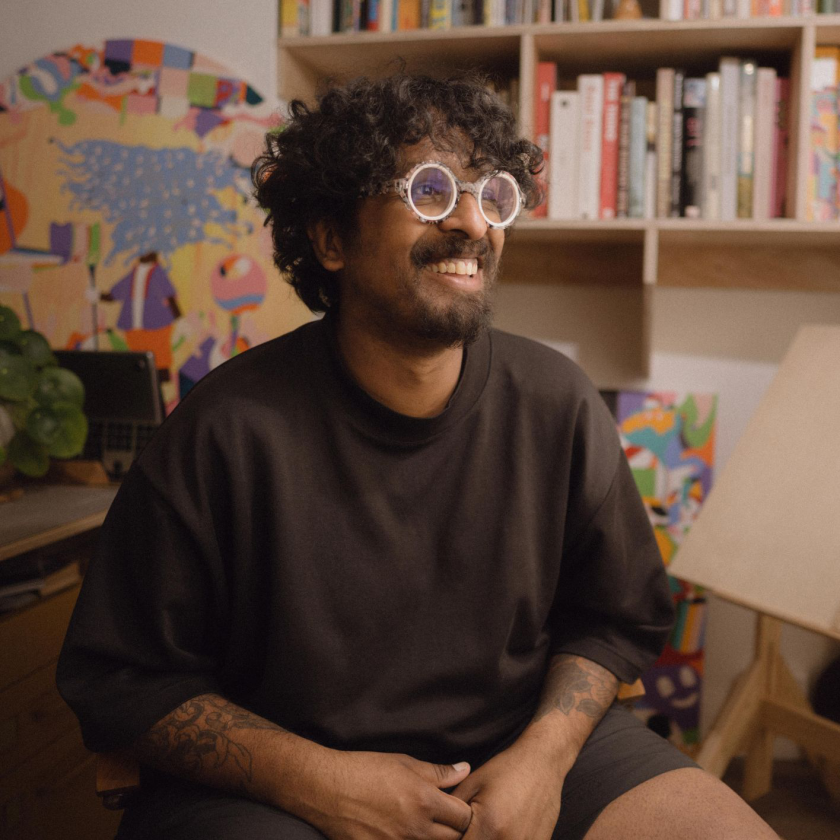
Murugiah. Image credit: Jack Woodhams

Murugiah. Image credit: Jack Woodhams

The London-based artist behind the Quentin Blake Centre's debut solo show talks to us about parent pressure, pandemic breakthroughs and learning to stop making other people's art.

On day one of his first solo exhibition, hosted at London's Quentin Blake Centre for Illustration, the multidisciplinary artist Murugiah did something unconventional: he showed up. In practice, most artists tend to stay away, spooked by the fear of watching strangers encounter their work for the first time. Murugiah, however, stationed himself in the gallery.

The first visitor to walk in looked around, slightly bewildered, and asked which way to go. He pointed her upstairs. She asked, with polite uncertainty, whether she was supposed to know who he was. "No," he told her. "This is my debut show, so enjoy it." Then he went and sat in the café. Half an hour later, the visitor came and found him. She sat down and spoke with him for 20 minutes about his work. "I didn't know who you were before," she told him, "but I definitely know now."

It's the kind of moment that's impossible to engineer, but for Murugiah, it meant something profound. That work rooted in genuine personal truth can reach people who've never heard of you, on its own terms, without any of the machinery of reputation.

And this idea, that the most personal work is always the most creative, sits at the heart of everything he's been building towards.

Murugiah was speaking as part of The Studio, Creative Boom's membership community for working creatives, and what came across most strongly, beyond the charm and the self-deprecating humour, was the rigour underneath.

This is a creative who's spent years deliberately, and sometimes painfully, figuring out what he actually wants to say, and who's arrived at a genuinely unusual place. A creative practice rooted in personal truth that also happens to be commercially thriving.

The crucial pivot

Murugiah trained as an architect. Not for a year or two, but for a full seven. He emerged qualified and, as he puts it, looking one way while feeling quite another. "Losing all of your hair from stress of a seven-year course suggested that maybe that subject wasn't the right thing to continue with," he says, with characteristic dryness.

He'd loved art and design since school and had asked his parents if he could pursue it at 18, but had been firmly steered towards something more dependable. When he eventually left architecture in 2012 and told his parents he was going back to illustration, their response was more resignation than enthusiasm. "Just do what makes you happy," they sighed. He took it.

What followed was a decade of learning, iteration and accumulated frustration. He worked in-house at a greeting card company. He created packaging for a restaurant chain, designed crisp packets, and learned about kerning. He developed a freelance illustration style that was technically accomplished, which led to editorial work and a book project illustrating scenes from films. And then he stopped, looked at what he'd made, and felt… nothing.

"I just felt so inauthentic making this work," he says. "I was like: 'This is not the way I think. This is not the way my work should be.'"

That reckoning came just before the pandemic. When it hit, and the government support payments arrived, he gave himself permission to start again. "Your rent is covered," he reasoned with himself. "You've got all this time on your hands. You've been complaining about not doing the most authentic thing. Just sit down and try something new."

Digging into his influences

The breakthrough came via a conversation with a friend and fellow illustrator Doaly, who made a simple observation. Murugiah was good at detail, colour, and dense compositions. So were lots of people. What was different about him? "You're a brown guy," he said, matter-of-factly. ("He's brown too," adds Murugiah, "so he's allowed to say that.") Doaly's suggestion was to make work about that specific experience; to bring his heritage into the visual language he was developing, rather than treating it as incidental.

What followed for Murugiah was a period of digging back through his influences: his Sri Lankan heritage, his suburban Welsh upbringing, his love of pop punk, anime, 1960s illustration and cult cinema. He started to see how they could coexist.

His first test piece merged Sri Lankan raksha masks with characters from his favourite Marvel comics and the protagonist of Jodorowsky's The Holy Mountain. "I was like, 'Oh my God, I've come up with something unique, weird and fun,'" he recalls.

From there, he gave himself a simple weekly discipline: one new piece, built on the same visual rules as the last, iterated slightly each time, posted publicly regardless of the response. "I just knew I wanted to build a world, build a visual world for me to play within," he says. "I didn't stop. I just did it over and over again, once every week consistently."

By the end of that year, he had a style. More precisely, he had something that felt inalienable to him. The commissions followed, and they haven't stopped since.

Really saying something

His exhibition at the Quentin Blake Centre represents Murugiah's attempt to take stock of everything those years produced. He approached the centre in 2024 with a proposal to show a small group of personal paintings in their windmill space; they came back and offered him the main gallery.

The U-shaped former pumping hall now houses a chronological journey through Murugiah's commercial collaborations on one side and his personal paintings on the other, with a centrepiece sculpture based on his painting Iceberg, which he describes as being about "not really knowing what's beneath the surface". That phrase could double as a description of his practice more broadly. The candy colours and surreal characters are what you notice first; the emotional weight comes later.

One painting is about external pressure and the point at which it becomes unbearable. Another depicts the creative process as two flower characters, one with broken petals, one fully formed, "almost like they're evolving like a Pokémon," he explains. In short, he's arrived at a place where his personal themes, identity, heritage, and the gap between who you are and who others expect you to be have become inseparable from his visual language.

Murugiah quotes Martin Scorsese's advice to Bong Joon-ho: the most personal work is the most creative, and you can see why it resonates. "I feel good about having a similar ethos," he says. "That making really personal work means you'll get really creative output."

Finding his voice

Asked when he knew he'd found his voice, Murugiah is characteristically precise. It wasn't after the first good piece, but after a year of them, each one building on the last, iterating in small ways, accumulating until the overall direction felt clear. "By the end of that, I was like, all right, I got it."

When asked what assumptions about himself he'd had to let go of first, the answer is disarmingly honest: "That I was good at drawing. Or that I could draw as other people could." The compare-and-despair mentality, he explains, long predates social media.

What matters, in his view, is finding the specific things you're actually good at and doubling down on them. For Murugiah, that meant flat colour, dense composition, strong shapes, immersive worlds. "The skill set you have is good enough," he says. "It feels good enough for you. And once you get out of your own way, everything seems to make sense."

  • ✇Creative Boom
  • 22 of the best online shops for stationery addicts Tom May
    Colours May Vary, Leeds Forget new technology. Nothing beats the simplicity of a notepad and pencil. It's why stationery is the go-to favourite treat for artists and designers everywhere. If you're looking to update your own kit, here are 22 brilliant shops we highly recommend. We'll apparently spend five years of our lives doomscrolling. A depressing statistic, and one any of us will be eager to reverse. It's a wonder our hands rememb
     

22 of the best online shops for stationery addicts

8 June 2026 at 06:00

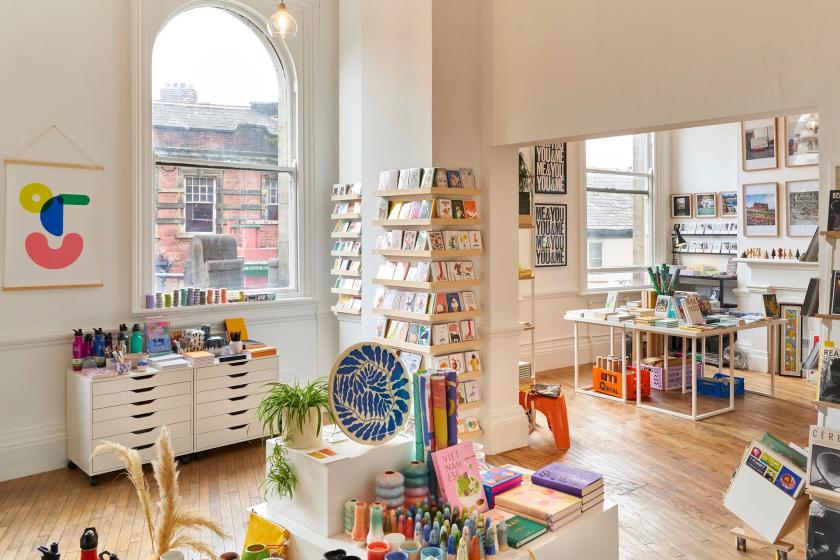
Colours May Vary, Leeds

Colours May Vary, Leeds

Forget new technology. Nothing beats the simplicity of a notepad and pencil. It's why stationery is the go-to favourite treat for artists and designers everywhere. If you're looking to update your own kit, here are 22 brilliant shops we highly recommend.

We'll apparently spend five years of our lives doomscrolling. A depressing statistic, and one any of us will be eager to reverse. It's a wonder our hands remember how to do anything other than type and swipe. But all that staring at screens can also take a toll on our creativity. It's why, more than ever before, creatives are craving the physical, tangible, and tactile.

Buying some beautiful stationery can be one of the best ways to re-engage with the physical world and reboot your imagination – not to mention combat all this new technology. Plus, you don't even need to spend a lot of money to adorn your desk with gorgeous, designer-led products. Some of the world's most alluring bespoke stationery can be surprisingly affordable if you know where to look.

To help you out, we've scoured the web to find you the absolute best places to shop for boutique and bespoke stationery right now. These independent shops may fly largely under the radar, but they're passionate about their craft and tend to attract passionate, loyal audiences as a result.

So stop spending your money on boring basics sourced from uncaring tech giants. Check out these amazing stores, and start supporting your fellow creatives instead. As a happy bonus, you'll end up with lots of stunning stationery to die for, helping to reboot your mojo every time you sit down at your desk.

1. Present & Correct

Founded in 2009 by two graphic designers on the go, Present & Correct is imbued with a long-term love for stationery. Their online shop features paper and office objects inspired by homework, the post office and school from more than 18 countries. The pair go on sourcing trips about four times a year in hopes of finding vintage gems, so there's always something new to peruse.

Image courtesy of [Present & Correct](http://www.presentandcorrect.com)

Image courtesy of Present & Correct

2. Fred Aldous

Fred Aldous stocks 25,000 art, craft, photography and gift products online and in its Manchester and Leeds stores. They've been helping people make things they want since 1886. Stationery supplies range from pens and notebooks to washi tape, patterned paper, and more.

3. Hato

Hato store was founded in March 2020. A concept and lifestyle store based in Coal Drops Yard, London, it forms part of the wider HATO family, featuring lifestyle items, books, printed matter, clothing and objects taken from their practice as a design studio and printing press. When it comes to stationery, you can find notebooks, notepads, desktop accessories and plenty more.

Hato, London

Hato, London

4. Papersmiths

Papersmiths specialises in stationery and paper goods and aims to be the shop of your stationery dreams. Alongside their own products, you'll find hand-picked favourites from designers and makers across the globe.

5. Tom Pigeon

Tom Pigeon is a creative studio founded by Pete and Kirsty Thomas in 2014. The pair design and make jewellery, prints, stationery and products, as well as taking on creative commissions and consultancy work. In their online shop, you'll find a particularly beautiful line in cards and year planners.

Image courtesy of [Tom Pigeon](https://www.tompigeon.com)

Image courtesy of Tom Pigeon

6. Before Breakfast

Before Breakfast is named in tribute to the quote from Through the Looking Glass by Lewis Carroll: "Why, sometimes I've believed as many as six impossible things before breakfast." Its founders aim to bring a new perspective to design and craft, using sustainable materials and a responsible-making process. The result is carefully crafted stationery that inspires everyday tasks and creativity in the workspace.

7. The Completist

The passion project of a husband-and-wife duo, Jana and Marko, The Completist features over 400 products, including cards, stationery, gift wrap, and homeware. With a focus on sustainable manufacturing and supporting small British manufacturers, its stationery offering includes planners, journals, notebooks, sketchbooks, calendars and more.

8. Katie Leamon

Katie Leamon founded her London studio in 2010, and her design-led stationery is now stocked everywhere from Harrods to Selfridges. Designed in England with a plastic-free, recyclable approach, the range runs from lay-flat notebooks and weekly planners to greeting cards, gift wrap, pens and desk accessories – considered paper goods with a confident, contemporary look.

9. The Journal Shop

The Journal Shop shares carefully curated stationery and paper goods inspired by the founders' trips to Japan. Its collections of desk and home designs bring joy and comfort while sparking your curiosity and creativity.

10. Nook

Gemma and Jack opened Nook in Stoke Newington, London, in 2012. Their online store showcases accessible designs from the UK, Europe, and beyond, focusing on products that are well-designed and built to last. "Everything we sell we would have in our own home," they say. Stationery includes notebooks, planners, pens, pencils, tape dispensers, scissors and more.

Image courtesy of [Nook](https://www.nookshop.co.uk/collections/office)

Image courtesy of Nook

11. Mark + Fold

Mark+Fold is a London-based stationery studio that prides itself in knowing where and how its products were made, the materials used, and whether they were sustainably sourced. Its notebooks and diaries open flat to 180 degrees, and the pages are made of exceptionally good paper, which is up to 30% thicker than other notebooks.

12. Colours May Vary

Colours May Vary is an independent shop based in Leeds stocking a range of beautiful, useful and inspirational wares. Their main focus is graphic art and design, typography, illustration and product design, and they stock a range of books, journals, prints, cards, wrapping paper, notebooks and planners.

13. Papergang

Papergang is a stationery subscription series delivering exclusive products to your letterbox. Each month you'll receive a product selection that varies but includes the likes of greeting cards, notebooks, desk accessories and art prints.

14. The Stationer

The Stationer was born in 2014 out of Tessa Sowry-Osborne's love for pens, pencils, paper and everything else that lives on a desk. It's focused on combining classic design with great functionality: items that will make your desk look cool and help you be that little bit more organised.

15. Happy Dashery

Sarah Arkle and Carrie Wainer opened their Bedfordshire store in 2019, intending to be a bright and colourful beacon on their local high street. They look after their online shoppers, too. They can write personalised messages, gift wrap, and include a greeting card with your order on request. Stationery includes pens, pencils, cards, sticky notes, journals and more.

16. Rifle Paper Co.

Rifle Paper Co was founded in 2009 by husband and wife Nathan and Anna Bond. Their site is full of bold colours, hand-painted florals and whimsical characters, and their goal is to create quality products that bring beauty to the everyday. Their stationery includes greeting cards, social stationery sets, card sets, postcards and photobooks.

Image courtesy of [Rifle Paper Co.](https://riflepaperco.com/)

Image courtesy of Rifle Paper Co.

17. Meticulous Ink

The good people of Meticulous proudly print stationery the old-fashioned way, using beautiful papers, time, patience, and a deep-rooted passion for being meticulous. Two original 1960s Heidelberg printing presses are used to create their own greeting cards, stationery box sets, business cards, wedding invites, packaging and bookmarks.

18. Yoseka Stationery

Yoseka Stationery is the US branch of the much-loved Taiwanese store, bringing its beautiful stationery products to a global audience. These include planners, cards, erasers, fountain pens, inks, letter stationery, markers, notebooks, organisers, pens, pencils, refills, stamps and stickers.

19. Wrap

Wrap celebrates the very best in contemporary creativity through its print magazine, its products, and its online content. Its notebook collection has recently had a glow-up and now boasts new styles featuring illustrated covers and gold-foil detailing. Several classic designs from the Wrap archive have also been brought forward into the range.

20. Counter-Print

Counter-Print is one of our favourite book publishers, and they do a mean line in stationery products. These include everything from pencils, rulers, and tape dispensers to art chalk, white vinyl glue, and a screen-printing kit.

Céline Leterme and Jon Dowling, Counter-Print

Céline Leterme and Jon Dowling, Counter-Print

21. Papier

Since 2015, Papier has been an emporium of eclectic designs, including bespoke stationery products that invite curiosity and contemplation. Alongside their in-house collections, they collaborate with bright, up-and-coming artists, iconic brands and exciting fashion labels.

22. Choosing Keeping

Choosing Keeping began in 2012 as a small shop on Columbia Road, a street in East London best known for its flower market and independent boutiques. They offer a fantastic range of stationery products, including writing paper, decorative paper, art tools, office accessories and wrapping paper.

  • ✇Creative Boom
  • The web that built your creative business is being dismantled. So what should you do now? Tom May
    Pinterest is changing. What does that mean for creatives? Image licensed via Adobe Stock As AI takes over from Google search, the thing that used to draw people to your creative work is disappearing fast. Here's what's happening, and how to respond. At Cannes Lions 2026, Pinterest said something that should stop every creative in their tracks. Alongside a suite of shiny new AI advertising tools, the platform offered a candid descriptio
     

The web that built your creative business is being dismantled. So what should you do now?

17 June 2026 at 10:30

Pinterest is changing. What does that mean for creatives? Image licensed via Adobe Stock

Pinterest is changing. What does that mean for creatives? Image licensed via Adobe Stock

As AI takes over from Google search, the thing that used to draw people to your creative work is disappearing fast. Here's what's happening, and how to respond.

At Cannes Lions 2026, Pinterest said something that should stop every creative in their tracks. Alongside a suite of shiny new AI advertising tools, the platform offered a candid description of where the whole industry is heading.

The web, it said, is moving "beyond the traditional search-and-click model toward a more conversational and generative web," where brands now compete "not just for attention, but for recommendation, relevance and action". That might sound like a boringly technical sentence, but buried within it is something very profound that affects every creative working today.

Because what it describes isn't just a change in how Pinterest sells ads, but a fundamental change in how people find information and inspiration online. And if you're a creative, the implications for whether you actually get work in future are huge.

Discovery is being dismantled

Until recently, the web gifted creatives many ways to attract clients that didn't demand a huge marketing budget. A portfolio site that ranked in search results for "editorial illustrator" or "branding studio Bristol." Instagram, Behance or Dribbble surfacing work to people who'd never heard of you. A piece is getting shared, and the share carries your name back to your profile. None of this required paid promotion.

Now, though, every rung of that ladder has been sawn off.

We've seen the decline of organic search: on Google, your freelance or studio site now sits below ads, AI Overviews and big-domain content, making it close to hopeless in promoting your craft. Meanwhile, social algorithms have decoupled reach from quality. Feeds now reward volume, trends and posting cadence rather than the best work, and throttle creators unless they either pay or perform constantly.

And now, as the final nail in the coffin, agentic AI (where AI basically acts as your personal assistant) has removed the last thing the first two still left intact: the click that carried a person to your door.

Who wins and who loses?

Nowadays, when someone types "find me an illustrator who works in cut-paper collage for a children's book", AI returns an answer, not a list of links to explore. It decides who gets named, and there's no way to influence it: no ad slot to buy, no SEO lever to pull.

And how does it reach this decision? AI platforms lean on aggregate signals: who's already cited, listed, written about, and linked to. This favours the already-famous and the big studios with a deep web footprint, leaving the vast majority of smaller independents floundering.

It's a virtuous circle for the former, a vicious one for the latter. The visible gets recommended, and the recommendation makes them more visible. The talented new graduate with a thin online presence isn't in AI's field of view, so they stay invisible forever.

Pinterest's new Ask Pinterest app captures this dynamic perfectly. It's designed, the company says, for "more conversational, complex, multi-step decisions that don't fit neatly into a single search": planning a dinner party, furnishing a room over time, finding a gift that feels personal. Truly, it sounds like a great experience. But there's a trade-off, and it's a biggie. When answers arrive without a source, the source no longer matters.

So what should you focus on instead?

Pinterest is changing

Pinterest is changing

Be a category of one

In this shiny new world of AI, you can't optimise your way into a recommendation, the way you once keyword-optimised a website. Recommendation runs on reputation signals that a system can read: being named in other people's work, on lists, in interviews, in the press, and in collaborations. So the answer for creatives isn't to play the algorithms harder. It's to become the name people and systems already trust enough to surface.

One part of that is to own your relationships. A newsletter list, for example, is a direct connection that no algorithm can intermediate away. A community of people who've chosen to hear from you isn't subject to a platform's recommendation logic. Look at how designers like Liz Mosley have built something genuinely resilient: a website, a podcast, templates, resources; an audience that actively follows her work rather than stumbling across it.

Another is to get cited and named, because getting talked about (positively, of course) is the new currency. This means leaning on the channels no algorithm can gatekeep: word of mouth, referrals, events, and real rooms. And in your work, aiming to be a category of one, with a style so specific it gets requested by name rather than retrieved by attribute. The creatives who get asked for by name are the ones that AI can neither replace nor substitute.

Lee Brown, Pinterest's chief business officer, frames it this way: "The future of discovery won't be driven by keywords alone. It will be shaped by context, taste, and trusted recommendations." He's describing his platform's perceived advantage. But he's also, accidentally, describing yours.

Context is where you work. Taste is what you've spent years developing. And trusted recommendations? Those come from people who know you and what you make, not from a system optimising for engagement.

Uncertain future

One last thought. If the systems doing the recommending keep starving the independents who make the original work, they'll eventually run short of anything worth recommending. AI will ultimately kill off its own supply of information and inspiration. Where that death-spiral leads us is anyone's guess, but it's best to be prepared all the same.

In the meantime, I'd advise you to start building those direct relationships. Make the work that can't be AI-assembled from anything else. And above all, don't wait for your web traffic to disappear before you start, because that could be too late.

Loneliness, 2am doubts & getting ghosted: indie agency founders share their experiences of year one

18 June 2026 at 06:05

Image licensed via Alamy

Image licensed via Alamy

What actually happens when you leave your comfy job and start from scratch? We chat to agency founders to hear their stories.

Right now, something is shifting in the creative industry. Across the UK, senior creatives are leaving the relative safety of network agencies—some after decades of painstakingly climbing the ladder—to launch their own studios.

The Drum has called 2026 the "Year of the Indie". But what does going independent actually look like from the inside, beyond the tasteful brand identity and the optimism-laden "We're thrilled to announce…" post?

To find out, we set out to uncover the real stories. The first client. The months when the money doesn't come in. The moments of doubt that hit hardest.

Founders from Manchester, Leeds, Liverpool, London and beyond shared with us accounts that were funny, raw, occasionally terrifying… but also useful. What emerged isn't a simple call to "follow your dreams." It's something more complicated, and a lot more interesting, than that.

The moment the penny drops

What struck us most is how often the decision to leave a comfy job isn't driven by pure ambition, but disillusionment. These are typically people who were good at working within large structures, who rose to the top of them… then looked around at what they'd built, and found it wanting.

Take Steven Bennett-Day, founder of B Corp creative studio Ourselves, who launched his agency in 2019 alongside a partner, after both had reached board level in global networks. "Our leap came as we found out just how little of a client's budget went on actual creativity," he says. "We realised many of the business decisions made by those agencies were in support of an operating model that was struggling. Big ideas felt a bit like small print in that world."

This feeling—that the machine has grown too big, too expensive and too distracted to serve the actual work—comes up again and again.

For Steffan Cummins, who left Wolff Olins two years ago to start Lost Property (now a team of six), the shift is visible in client behaviour, too. "Clients are more interested in getting to know the specific people behind the work, versus the weight of a historic agency name," he says. "Add, of course, the cost difference."

Rich Pay, creative director and founder of MOKSi Creative in Liverpool, frames it in the simplest of terms. "People buy people," he explains. "Even at network agencies, there tend to be the faces that the client knows and trusts, then the rest of the team. With stretched budgets, the cost attached to that starts to sound unreasonable."

Year one: the reality

Here's where the bravado of those triumphant LinkedIn posts can start to ebb away. Almost every founder we talked to described year one as significantly harder than anticipated, and in ways they hadn't predicted.

Marianne Olaleye left ustwo three years ago to go freelance before founding Jaiku, a storytelling agency for purpose-led brands. "The hardest part of year one was overdelivering, but not pricing myself high enough," she recalls. By year two, a different problem had arrived. "It was the loneliness and relentless decision-making.

"When you go at it alone, every week brings a hundred decisions and no one to sense-check some of them with," Marianne reflects. "You learn to trust your own judgment in ways that are both revelatory and terrifying." What helped? "Therapy, trusted friends, and people who know you deeply beyond the business become incredibly important."

Mike Bryan, creative director of CGI and film studio And Seventy, describes his own departure with classic understatement. "I went into work one morning and handed in my notice, almost without realising what it actually meant. It quickly sank in." He'd left with two months' rent in the bank. "I've not had a good night's sleep since and have wondered many times what the hell I'm doing at 2am." And yet, he's still feeling positive. "We've seen great traction this year and are working on some landmark projects both here and in New York."

Steven from Ourselves captures the cruel issues of timing that seem to plague many founders. "We started in March 2019. Our first clients were Gail's Bakery, Blue Dragon and Vivobarefoot. Everything was starting to roll, but then COVID shut everything down." His advice to anyone starting out now is hard-won: "New business is really, really hard. After three years, you will run out of contacts. You won't be the new thing any more, so inbound work will slow down. Finding work at that stage takes time; make sure you develop the right way of doing it that is authentic to you."

Building something that lasts

Despite the challenges, there's joy in being your own boss. For instance, several founders describe consciously designing their studios around what they wanted their working lives to look like, not just what the market demanded.

Marianne, for her part, focused on longevity. "I built Jaiku with my 60-year-old self in mind. I deliberately built in the things I love, workshops, consultations, teaching, so that even in the hardest months, the work itself sustains me."

Alister Shapley, who founded type-led brand design studio Applied Systems in Manchester in late 2024 after leading the branding team at a commercial real estate firm, took a similarly structured approach, albeit one that brought its own complications. He built three revenue streams from the start: branding, a commercial type foundry, and lecturing.

"What sounds great in theory was, in reality, three independent revenue streams, each with its own demands," he admits. "The branding side has been a mixed bag, with some amazing clients, but also long periods of quiet." Still, he's playing a longer game: "The education side plays into a longer-term goal of creating more alternative routes into design."

For Joe Simons, co-founder of Leeds-based studio Edna, the 'anchor client' principle proved both a lifeline and a lesson. Edna's five founders were made redundant just before the second lockdown and negotiated the right to approach their former employer's clients. One was Primark. "From this perspective, we were very fortunate," Joe says, "but at the same time, none of us had run an agency before, so we had to go from zero to one hundred very quickly."

Joe's top piece of advice is specific. "Find your anchor client, one that you know will give you enough work to cover costs every month. Without this, things can get very stressful very quickly. Even with Primark on our books from the outset, it was six months before we had enough to pay ourselves a decent wage."

What's actually changing

Many of these lessons will be familiar to anyone who's run a business, but it's worth taking a step back to understand why this moment feels different from previous waves of studio launches. Richard Taylor, founder and CEO of Brandon Consultants, is blunt about the structural forces at play. "Clients need partners to be true partners: extensions of their diminished teams that come in like ninjas to solve business problems through creative brand marketing," he stresses. "Clients by-and-large aren't interested in big fancy offices on the Thames, or bloated teams. They want small smart teams dedicated to their business problems."

John Whalley, a creative director and brand designer who spent more than 20 years helping grow a Manchester agency from 25 to over 160 people before eventually going freelance, describes a widening structural divide. "On one side, the few 'big agencies' are doing battle for the 'big clients' on an ever-shrinking battlefield. On the other side, freelance creatives like myself work directly with a diverse range of founders and small businesses." His conclusion is characteristically honest: "Whilst budgets are most definitely smaller, working directly with business founders is far more rewarding in so many other ways."

Key takeaway

Ultimately, the 2026 wave of indie agency isn't just a mood or hype. It's a structural response to how client budgets have shrunk, how trust is built, and how talent now flows. The people we chatted to aren't romantic idealists; most of them are pragmatic professionals who ran the numbers, spotted the gap, and made a calculated leap.

Some nearly didn't make it through year one. Most are still standing. Long may that continue.

As Steven puts it: "Being here for seven years is a win with all of the worldly stuff that has happened, and is still happening."

❌
Creative Boom