Normal view

Could the Democrats win control of Congress in the US midterms? All eyes are on these pivotal races

US presidential elections are always about a choice for the future. Who do you want to lead the country? Who will best address your needs?

But the US midterm elections – where all the seats in the House of Representatives and one-third of the Senate are on the ballot – are always a referendum on the president and his party in Congress.

So, given US President Donald Trump’s current popularity, what does this mean for the Republicans’ chances in November?

Struggling with key demographics

In short, Trump is in terrible shape politically at the moment. His net-approval rate is in negative territory in 44 of the 50 states in the country. His national approval rating is also well below 40%, and is heading lower.

Polling consistently shows most voters do not approve of Trump’s management of major issues, including the economy, inflation, jobs, health care, immigration and foreign policy. His decision to launch the Iran war in late February had the lowest approval of any war in American history. It remains among the most unpopular wars.

Inflation is accelerating in the US. Credit card delinquencies are at a 15-year high. With no end to the war in sight, and petrol so expensive, consumer sentiment has crashed to historic lows.

While Trump has broadly retained support among Republicans, his approval rating has declined among independent and Latino voters – two key demographic groups that were crucial to Trump’s election two years ago.

A clear path in the House

Does this mean the Democrats will stroll to victory in the midterms? It’s not quite that simple. US politics is extremely volatile, and there are fewer and fewer seats that are truly contestable.

To control the House, the Democrats need a net gain of three seats, and in the Senate, four seats. Based on my calculations of the six midterm elections this century, the president’s party has lost an average of 27 seats in the House and three seats in the Senate.

The only president to buck the trend was George W. Bush in 2002. Bush’s approval rating was still extremely high – 65% – one year after the September 11 terrorist attacks. The US invasion of Iraq, which would prove deeply unpopular, was still six months away. The Republicans gained eight seats in the House and two in the Senate in those midterms.

This year, the Republicans are more vulnerable in the House than they are in the Senate.

To protect their tiny majority in the House, Trump and the Republicans have launched a war to gerrymander congressional districts in several Republican-controlled states to boost the number of seats they can win this year. Democrats countered by redrawing the maps to favour their party in California.

And last month, the conservative US Supreme Court gave the Republicans another edge when it ruled that protections under the Voting Rights Act to help ensure Black-held seats in the South were unconstitutional. This could threaten up to six black Democratic members in November.

But several Republicans are expected to be ousted from their marginal seats across the country. Amy Walter of the Cook Political Report predicts:

It’s more likely than not that almost all of the closest races break toward the party out of power (in this case, the Democrats). So winning 60 to 70 percent of the closest races is not a huge lift [to capture the House].

Senate up for grabs?

By contrast, the Republicans have been relatively confident of their position to retain control of the Senate.

The seats up for election this year are mostly in states that voted for Trump. That gives Democrats a very narrow path towards winning control of the Senate through states like Texas, Ohio, Alaska, Maine and North Carolina.

In both Ohio and North Carolina, the Democratic candidates are both popular politicians – former Senator Sherrod Brown and former Governor Roy Cooper – and are doing well in the polls. In Alaska, Republican incumbent Dan Sullivan is facing a very well-regarded former House member, Mary Peltola.

Republican Senator Susan Collins is also looking very vulnerable in Democratic-leaning Maine, though the presumptive Democratic candidate, Graham Platner, has been dogged by some controversies lately.

The race that could decide the Senate, however, is in suddenly competitive Texas, a state that has not elected a Democrat to the Senate in 38 years.

Trump successfully urged Republicans to support the controversial former attorney general, Ken Paxton, over veteran incumbent John Cornyn in last week’s primary. Paxton, who has previously been indicted on felony securities fraud charges and impeached by the Texas legislature, will now face the rising political star James Talarico, a progressive Christian Democrat. Talarico is leading in some polls.

The Democrats probably have to worry about one seat in Michigan. The Republican candidate, former House member Mike Rogers, is running his second campaign for the Senate there after losing by less than 20,000 votes two years ago. The Democratic candidate will be decided in an August primary. This is a true tossup that could take away a Democratic seat.

Republicans can afford to lose four seats and still keep control of the Senate with the tie-breaking vote of Vice President JD Vance.

What does this mean for 2027 and beyond?

There is a stark difference between Democrats winning just the House versus the entire Congress.

If Democrats take control of the House, they will put a check on Trump through greater oversight and investigations of his actions. He may well be impeached – for a remarkable third time. This is exactly what happened to Trump after the Democrats won the House in the 2018 midterm elections.

If Democrats are in charge of both chambers, however, they will be able to pass bill after bill that Trump will likely veto. This would further weaken Trump’s political strength – as well as the Republicans – in advance of the 2028 presidential and congressional elections.

Under either scenario, Trump’s legislative agenda will be dead.

After two years of acquiescing to the president by the Republican-held Congress, the midterms will offer a chance to shift the balance of power. If Democrats win the House, Congress will gain a voice again. And the guardrails that have been missing for two years will again be in place to safeguard American democracy.


Correction: This piece has been updated to correct that George W. Bush was president in 2002, not his father, George H.W. Bush.

The Conversation

Bruce Wolpe is a non-resident Senior Fellow at the United States Studies Centre, University of Sydney and is author of two books on Trump and Australia. He served on the Democratic staff in the US Congress in President Obama's first term. He has contributed to Democratic candidates for elected office.

Why drinking alcohol makes you reach for chips and nachos

Taha Samet Arslan/Pexels

Have you ever wondered why savoury foods like chips, nachos and salted nuts go so well with a beer or glass of wine? And why sometimes you feel an insatiable appetite for junk food while drinking?

Our new study examined the diets and alcohol intake of Australians to find out why.

Alcohol is packed with energy, but also stimulates appetite. We found alcohol may lead you to eat more unhealthy foods by amplifying a biological drive for protein.

Protein craving

Our previous work showed that humans and other animals have a dedicated appetite for protein. We specifically crave savoury, protein-rich foods and avoid sweet foods when our body needs protein.

Protein craving and sweet avoidance is signalled to the brain by a hormone called FGF21. The liver releases this when the body detects a shortage of protein.

Drinking alcohol causes the release of FGF21, stimulating a hunger for protein.

This explains why alcohol is paired with food across many cultures: a glass of bubbly before dinner, wine with the meal. Alcoholic drinks stimulate the protein appetite and, in this way, enhance the pleasure of eating.

Scientists call this the “aperitif effect”, and have shown it’s directed towards savoury foods.

‘Protein decoys’ don’t satisfy our hunger

But not all savoury foods are alike. The main sources of savoury flavour used to be protein-rich foods like meat, seafood, poultry and pulses.

However, ultra-processed foods don’t fit into this category. Today, industrial food systems produce many foods with added savoury flavouring that are low in protein and high in fat and carbohydrates, such as chips, savoury crackers, pizzas and hot dogs.

We have called such foods “protein decoys”: they deliver the sensory cues typically associated with protein-rich foods but instead provide energy-rich fats and carbs.

This means you may overeat

In our new study, we found alcohol consumption was linked to a greater intake of savoury foods. But the effects on total energy intake varied depending on foods eaten.

When savoury whole foods such as lean meat, poultry, or pulses were chosen, protein intakes were high, but calorie intakes weren’t elevated, despite the high energy content of alcohol.

But when diets were rich in protein decoys – including savoury ultra-processed foods and fatty meats – energy intakes were higher than normal, risking weight gain.

Even without alcohol, diets high in ultra-processed foods are associated with excess energy intake and weight gain.

Many factors contribute to this, including the low protein content of ultra-processed foods. More needs to be eaten to satisfy the body’s protein target, a mechanism called “protein leverage”.

Pizza shop worker hands a pizza over to another man
Still feel like pizza at the end of a big night? Mike Jones/Pexels

That’s why, after a night of salty snacks, you might still have room for a pizza or kebab, or wake up craving a fry up.

Our new study shows that combining alcohol with ultra-processed foods can increase energy intake, both directly through the energy alcohol contributes and through the increased appetite for protein.

How we studied this

We modelled how FGF21, alcohol and protein appetite interact with diets rich in either processed or unprocessed foods. We tested our model using detailed daily dietary records of 9,337 adults from the Australian Adult Health Survey, one-third of whom reported drinking alcohol on the day of the survey.

This approach, called mechanistic ecological modelling, allows us to examine how physiological mechanisms discovered in experimental research influences behaviour and potentially health outside of the experimental lab, in the real world.

How can you avoid the alcohol-junk food trap?

Australia has among the highest intakes of alcoholic drinks and ultra-processed foods – and obesity.

If you drink alcohol regularly, recognise the accompanying savoury craving for what it is: your body seeking protein. Answer this by eating savoury protein-rich whole foods such as lean cold meats, roasted chickpeas, eggs or seafood.

Don’t be deceived by fat- and carb-rich protein decoys that trick your brain into thinking it’s eating protein. This will just leave your powerful protein appetite unsatisfied.

The Conversation

David Raubenheimer receives funding from the Australian Research Council and the National Health and Medical Research Council.

Amanda Grech The University of Sydney. She received funding from The National Health and Medical Research Center.

Stephen J Simpson does not work for, consult, own shares in or receive funding from any company or organisation that would benefit from this article, and has disclosed no relevant affiliations beyond their academic appointment.

From ‘USA94’ to now: how soccer has changed since the last American World Cup

The United States hosted its first World Cup in 1994.

Soccer has changed dramatically in many ways since then – on and off the pitch.

As the US (with Mexico and Canada) gets set to host the mega-event once again, more than anything, the tournament’s defining change since 1994 is its sheer scale-up.

The scale-up

This scale-up can be clearly quantified. The 1994 tournament featured 52 matches across 32 days with 24 teams. By contrast, the 2026 event (the first three-nation World Cup) will involve 78 matches in the US alone, over 39 days.

The competition’s 48 teams are divided into 12 groups, with progression to the knockout stage awarded to the top two teams in each group along with the eight best third-placed teams.

In terms of games, the tournament has doubled in size since 1994.

The scale-up is not accidental. It has been driven by the twin forces of globalisation and commodification, alongside a deliberate strategy by FIFA president Gianni Infantino to both protect and extend football’s commercial dominance.

Central to this has been expanding the tournament into non-traditional markets, most notably the US – the world’s largest sports economy – thereby generating substantial financial returns and commercial interest.

Infantino and FIFA have faced sustained criticism in global media – ranging from controversial symbolic gestures involving Donald Trump to concerns over ticket pricing. But the broader outcome is clear: the World Cup has become more expansive and commercially powerful than ever.


Read more: Why Trump and FIFA are perfect bedfellows as the World Cup heads to the US


At the same time, FIFA has deepened its claim to global reach by incorporating smaller nations such as Cape Verde and Curaçao, whose combined populations are well under one million.

The scale-up rests on two core dynamics. First, more matches mean more broadcast content, and media rights remain FIFA’s largest revenue stream. Expanding to 104 matches significantly increases the value of rights deals, particularly across participating nations.

Second, expansion broadens FIFA’s political base. By granting more countries access, it strengthens the influence of nations previously on the margins of global soccer.

Within FIFA’s voting structure, each member association carries equal weight: the vote of powerhouse Brazil counts the same as that of Curaçao, a recent entrant with a population around 150,000.

At the same time, a larger tournament increases the likelihood that major population centres and emerging consumer markets (such as China, India, and Southeast Asia) will participate, further expanding the World Cup’s commercial reach.

The unresolved question for FIFA is one of limits: how far can expansion go before it dilutes the exclusivity and premium value of the World Cup?

The World Game in the US

Soccer in the US has grown markedly since the 1994 event. In many ways, this growth reflects the original intent behind awarding the 1994 World Cup to the States.

The 1994 tournament was still the best-attended in history, largely due to the use of National Football League (NFL) venues. It was granted on the condition that a viable professional league be reestablished following the collapse of the North American Soccer League in 1984.

Major League Soccer (MLS), launched in 1996, is now firmly established within the US sporting landscape.

The pathway has also strengthened, with college athletes feeding into MLS and increasingly major European leagues, alongside the expansion of secondary professional and semi-professional tiers.

Growth has been especially strong in the women’s game thanks to significant new investment.

The US men’s team, currently ranked 16th in the world, could plausibly make a deep run in 2026.

As in 1994, matches this year will largely be staged in football stadiums to maximise capacity.

Rule changes and technology

FIFA’s rule changes are largely designed to keep the ball in play and increase the tempo of matches. Measures addressing time-wasting – from stricter control of throw-ins and goal kicks to tighter management of added time – reflect this objective.

The 1994 World Cup introduced major reforms, including a ban on back-passes to goalkeepers and awarding three points for a win to encourage attacking play.

Looking to the 2026 event, technological oversight will expand, with Video Assistant Referee (VAR) technology applied more broadly to decisions such as second yellow cards and corner calls.

Player welfare has also become more prominent: after the extreme heat issues of 1994, mandated drinks breaks will be introduced – one in each half around the 22-minute mark.

Substitution rules have also evolved significantly, increasing from two in 1994 to five regular substitutions, along with an additional allowance for concussion replacements.

Same game, different scale

Since its codification and even in early filmed matches more than a century ago, soccer’s simplicity has been the foundation of its global dominance.

The sport’s continuity bridges generations. The leading players of the 1994 World Cup, such as Italy’s Roberto Baggio and Brazil’s Romário, could plausibly compete in the modern game, even if today’s players are generally more physically developed.

Ultimately, despite the scale, global reach and commercialisation of tournaments like the World Cup, soccer’s enduring success lies in its consistency.

The game played on the world’s biggest stage remains fundamentally the same as that played in parks, schools and local grounds; simple, universal and instantly recognisable.

The Conversation

Steve Georgakis does not work for, consult, own shares in or receive funding from any company or organisation that would benefit from this article, and has disclosed no relevant affiliations beyond their academic appointment.

Auction sales are sliding, banks are tightening loans. But is the budget really the only factor?

To say this year’s federal budget has ruffled some feathers would be an understatement. The Albanese government announced major reforms to two tax breaks long seen as politically untouchable – negative gearing and the capital gains tax discount.

In response, some banks are reportedly tightening their lending to property investors. And there are early reports of lower attendance at open homes, suggesting buyer caution.

The government’s budget changes are not yet law. But two weeks on from budget night, are we already beginning to see the first ripple effects hitting the Australian property market?

And how much of what we’re seeing in the housing market right now – such as falling sales at auction – can really be attributed just to the budget?

Auction sales have been sliding for months

Auction clearance rates – the percentage of listed properties successfully sold at auction – fell the week after budget. Despite a slight rebound last week, they remain lower than usual.

The longer-term average rate sits in the mid-60s – meaning more than six out of ten homes successfully sell at auction. The rate has now slipped to around 50–60% nationally, so it is clearly down.

But auction activity was already trending down months before the budget was announced, as interest rate hikes and economic uncertainty subdued the market.

Adding to this, figures from the Australian Bureau of Statistics show both investor and homeowner borrowing in decline since December last year.

Competing forecasts on house prices

Based on Treasury modelling, the federal government estimates house prices will still grow – but by 2% less than they would have without these tax reforms over the next couple of years.

Similarly, forecasts by the Commonwealth Bank predict slower growth over the next couple of years, not an outright fall.

Previous research estimating the effect of removing negative gearing on the Australian housing market suggested house prices would fall by just 1%, while homeownership for young people could rise by up to 3%.

At the other end of the scale, investment bank Morgan Stanley made a bold prediction: that housing could see “one of the largest price corrections over the past 40 years”, with falls of up to 10%.

However, as noted by most analysts, Australia’s property market was already softening ahead of the budget. Borrowers have endured three interest rate hikes already this year, with further increases still possible.

Why home ownership is still out of reach for many

For young people feeling locked out of the housing market, the media storm surrounding possible house price falls since the budget may be hard to understand.

House price growth has been highly volatile over the past two decades, from slight falls in some years to spikes of 10–20% in others.

But it has averaged about 8% per year – still far faster than the growth in most people’s wages.

The median home value is now more than eight times median Australian household income. That means homeownership is far less affordable than it once was.

Different markets, different impacts

Looking to where things might be headed, another important nuance arises from the fact investors and prospective owner-occupiers operate in different markets. That means the changes could impact prices unevenly across Australia.

Research has shown investors are far more likely to buy small properties, preferring apartments over houses. Investors purchase 25% of all one-bedroom properties, compared to only 16% of three-bedroom properties and just 10% of four-bedroom properties.

For those seeking to buy an inner-city apartment, where investors are more active, the government’s reforms may have a bigger impact on prices.

But for those buying family homes on the outskirts of the city, these changes may have only a small impact because investors were never as active in those housing markets in the first place.

Over the next few months, the Australian property market may continue to weaken, especially with the possibility of further interest rate rises before the end of this year.

In the short term, it does appear that many home buyers, investors and banks have reacted cautiously to this federal budget.

But it would be wrong to attribute the current cooling down of the market entirely to the reforms announced in the budget – as some commentators may try to do.

The Conversation

James Graham receives funding from the Australian Research Council and the Australian Housing and Urban Research Institute. James is a member of Sydney YIMBY (Yes In My Backyard), a grassroots group advocating for increased housing density in the inner city to improve affordability.

Is the ‘Quad’ dying a slow death? Even with Trump, it still has a vital role to play

Analysts have tried to make sense of US President Donald Trump’s second term with countless, sometimes contradictory, labels. He’s isolationist and transactional. He’s a populist. Or, more recently, a neoconservative.

One way to make sense of both him and the broader state of geopolitics at the moment is to understand the difference between structure and agency.

Trump has undoubtedly exercised his agency in expansive ways since beginning his second term. Yet, at the same time, he has been constrained by structural limitations. The Supreme Court’s ruling against his Liberation Day tariffs is one example. Another is Congress’ release of the Epstein files.

Even Trump’s fiercest boosters will admit that he is, like his predecessors who also sought to expand executive powers, limited by the US constitution and its stipulation of three co-equal branches of government.

The same goes for foreign policy. Trump can berate allies, implement tariffs and withdraw from international institutions, but he can’t fundamentally alter certain structural realities. This is helpful in making sense of the way Trump’s actions are impacting the US’ alliances and partnerships.

A pivotal moment for the Quad

This week, the foreign ministers of the four nations in the so-called “Quad” – the United States, Australia, Japan and India – met in New Delhi.

The leaders of these nations, however, haven’t gathered for a summit since 2024, when Joe Biden was president. India was meant to host last year, but a summit never came together. It’s unclear if one will happen this year, either.

This has prompted much handwringing. Critics are saying the Quad is drifting “towards irrelevance” and “on the brink of extinction”.


Read more: Trump tariffs and warming India-China ties have silenced the Quad partnership … for now


Yet, as much as the leaders of the four nations have exercised their agency in distinct ways – including, at times, changing the trajectory of the Quad to be less ambitious – the structural dynamics in the Indo-Pacific remain unchanged.

China’s rapid military buildup, extensive maritime aggression, economically destabilising practices, wolf-warrior diplomacy and violent border clashes have altered the strategic calculations of the region for the foreseeable future.

This is why, before the Trump administration took office in January 2025, the four Quad nations dramatically expanded the group’s scope and ambitions. The members agreed to cooperate on everything from fighting cancer to developing vaccines to enhancing cyber security.

They declared at their last leaders’ summit:

…[the] Quad countries have built a vital and enduring regional grouping that will buttress the Indo-Pacific for decades to come.

US-India ties go downhill

This is not to say there hasn’t been challenges.

No single issue has been as problematic for Quad ambitions in the second Trump administration than US-India ties.

For decades, US presidents have all touted the importance of a powerful, independent and democratic India to American’s national interests. In their view, India served as a helpful counterbalance to China in the Indo-Pacific. It was the first Trump administration, after all, that resuscitated the Quad in 2017. (The group was originally formed in 2007, but fell apart soon after that.)

Trump also befriended Indian Prime Minister Narendra Modi during his first term, calling him “one of America’s greatest, most devoted, and most loyal friends”.

Since 2025, however, India-US relations have soured due to the second Trump administration’s massive immigration crackdown, his tariffs on India, tensions over India’s purchases of Russian oil and Trump’s growing closeness with Pakistan.

And after a testy exchange between Trump and Modi over the phone last June, Trump reportedly cancelled his plans to travel to India for the summit.

An effective counter-balance to China

Beijing has been opposed to the Quad since its inception, accusing the four democratic members of encirclement, engaging in a Cold War mentality and antagonising China. Beijing said it would accelerate its own military modernisation in response.

After the Quad disbanded in 2008 – for reasons that remain debated – one US scholar argued:

The Quad came down and China did exactly what it said it was going to do if the Quad persisted.

Unsurprisingly, China has continued to oppose the Quad since it regrouped. It still sees the Quad the same way the four members envisioned it – as an effective, albeit still nascent, counterbalance to China.

At this week’s foreign ministers’ meeting in India, the Quad members agreed to jointly build a port in Fiji, increase critical minerals cooperation and expand maritime cooperation in the region.

Beijing wasn’t impressed. Almost immediately after the meeting ended, Chinese state media ran a story with the headline, “Beijing blasts exclusive cliques after Quad meeting”.

Why the Quad still matters

Public opinion in the four Quad countries also shows firm backing for the alignment. Our polling at the US Studies Centre at the University of Sydney in 2025, for example, found respondents were far more supportive of the Quad becoming a formal military alliance than not.

Australians were the most supportive (49% agree), followed by Indians (44%), Americans (42%) and Japanese respondents (41%). Only a small number of respondents in the four nations opposed the Quad becoming a formal military alliance (from 7-15%). The rest either didn’t know or were unsure.

Cooperation among the Quad members is continuing to expand and deepen, as well. With every passing year, the Quad nations are engaging in an increasing number of military exercises, humanitarian and disaster assistance activities, and maritime cooperation efforts.

The individual leaders of the four nations will continue to change. And they will at times have significant reservations about each other. Yet China’s destabilising behaviour gives the Quad members few alternatives but to persist in using their agency to counterbalance Beijing’s revisionist agenda.

The Conversation

Jared Mondschein does not work for, consult, own shares in or receive funding from any company or organisation that would benefit from this article, and has disclosed no relevant affiliations beyond their academic appointment.

I don’t want to kill the spiders, ants and other bugs in my house. What should I do instead?

Rhian Sousa/Pexels

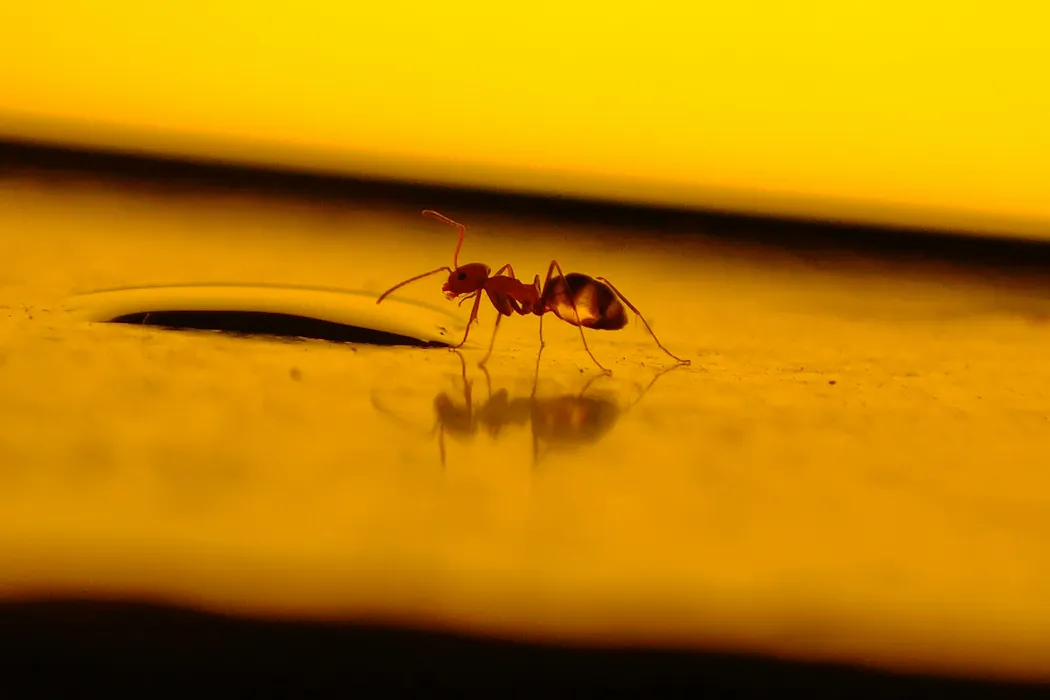
We’ve all been there: just as you’re about to fall asleep, you notice a huntsman spider on the ceiling. Or you walk into your kitchen and find a long trail of ants snaking into your pantry.

Given there are an estimated 10 quintillion individual insects alive on Earth at any one time, it’s no surprise they sometimes find their way into our homes. In fact, the average Australian shares their home with around 100 different insect and spider species.

But the reality is most of these tiny housemates won’t hurt us, and you really don’t need to kill them. In fact, many perform helpful jobs such as catching flies and mosquitoes, or tidying up crumbs.

So, what can you do instead?

Starting with spiders

Remember: many spiders in your home are harmless.

Common spider housemates include:

They’re big and speedy, but huntsmen are gentle giants that rarely bite and their venom can’t hurt humans. They are naturally timid animals that will usually try to avoid us big, scary humans.

A huntsman spider resting on the authors wall.
A huntsman spider resting on the author’s wall.

Black and brown house spiders live in messy webs often on screen doors or in corners. They are sometimes mistaken for funnel-web spiders, and while their venom can cause unpleasant symptoms such as nausea and swelling, they are generally timid and rarely bite.

Daddy long-legs spiders are the source of an urban legend claiming they are the most venomous spider in Australia, but have jaws too weak to break human skin. This is false; there’s no evidence these lovely spiders have venom capable of harming a human.

The author's housemate, a house spider (_Badumna_ sp)  named Arachne, paying its rent by catching flies.
The author’s housemate, a house spider (Badumna sp) named Arachne, paying its rent by catching flies.

There have been no confirmed deaths from a spider bite in Australia in nearly 50 years, partly due to the introduction of effective antivenom and partly because most spiders are very reluctant to bite.

In fact, you are far more likely to be killed by a dog, cow or kangaroo than by a spider.

Even redbacks are shy and non-aggressive and will often play dead rather than bite; most bites occur when the spider is accidentally squeezed, such as when moving a pot plant or putting on a shoe. Although their venom can make us unwell, no one has died from a redback bite since antivenom was introduced in 1956.

While a bite from a Sydney funnel web spider (Atrax robustus) should always be treated as a medical emergency, effective antivenom treatments mean no one has died from a funnel-web bite since 1981.

What about ants and flies?

Most ants in the house are harmless. They are likely scavenging for food, looking for water, or may even be passing through on their way to somewhere else.

Having said that, sometimes it’s hard to figure out what they’re doing. I have a trail of ants that runs up my shower wall – I have no idea what they are doing or why they are there. They’re just part of the family now.

Some people worry insects can spread disease. Yes, cockroaches, ants and flies can potentially transfer bacteria from one surface to another but this is rarely a problem in our homes since a single fly touchdown is unlikely to transfer enough bacteria to cause issues. Our homes also don’t typically have rotting food or faeces lying around where insects can touch it and spread germs elsewhere.

What should I do about them?

In many cases, you don’t have to do anything; the bug or spider in your house is likely harmless and won’t cause problems.

And growing evidence suggests at least some insects, including crickets, can experience pain or pain-like states.

While scientists still debate exactly what insects experience, it’s increasingly clear insects and spiders are far more behaviourally and neurologically complex than once assumed.

Is it really worth causing suffering to an animal that has done nothing wrong other than share your space?

Instead, consider simply capturing the animal in a container and sliding a piece of cardboard or plastic underneath before releasing it outside.

If you live with a phobia, perhaps you could ask a friend or neighbour to do it for you.

Most spiders make great housemates that help control insects, like this adorable jumping spider (_Salticidae sp_)
Most spiders make great housemates that help control insects, like this adorable jumping spider (Salticidae spp)

To make your home less attractive to insects and spiders, you can:

  • cover food sources, including pet food
  • clean up any spilled foods, crumbs or food residues
  • store loose food in sealed containers to prevent pantry moths and grain beetles
  • make sure your bin seals properly when closed
  • ensure your windows have well-fitting fly screens.

Only if everything else fails — or if the spider or insect is genuinely dangerous, which is rare — should lethal control such as pesticides or squishing be considered.

Remember: household insecticides are not necessarily harmless. Some studies have linked insecticide exposure to a range of health concerns (particularly in children).

Learning to live with them

The minibeasts in our homes are fascinating to watch and can provide a source of entertainment and education.

Kids (and adults!) can learn a lot about nature, ecology and science from watching insects and spiders at home. In fact, keeping and observing an insect has even been used as a successful form of therapy for children.

It’s OK to be scared of insects and spiders, but perhaps we should approach it the same way we approach fear of dogs or other furry animals: not through killing but by acknowledging the fear and working towards managing it.

The Conversation

Tanya Latty co-founded and volunteers for conservation organisation Invertebrates Australia and is former president of the Australasian Society for the Study of Animal Behaviour. She receives funding from the Australian Research Council and NSW Saving our Species.

Interest rates look set to hold, after inflation and fuel costs fell in April. But it’s unlikely to last

Inflation actually fell in Australia last month, thanks to temporary government fuel discounts that saw fuel prices come down by 7% from their record peaks in March.

New Australian Bureau of Statistics figures show the monthly consumer price index (CPI) rose 4.2% in the 12 months to April 2026 – down from 4.6% in March and lower than market expectations.

However, the underlying picture was less reassuring.

The closely watched “trimmed mean” measure rose to 3.4%, up from 3.3% a month earlier. (The trimmed mean is the average rate of inflation after “trimming” away the items with the largest price rises or falls, leaving the weighted average of the middle 70% of items.)


Australia’s latest inflation figures will give the Reserve Bank a reason to hold interest rates steady at its June 15-16 meeting, but not a reason to relax about inflation.

With fuel prices still much higher than before the Middle East war began, the risks of further spikes in inflation and more rate rises this year have not gone away.

How fuel discounts helped cool inflation

When oil prices surged following the war in Iran, which began on February 28, the immediate effect was obvious: petrol became more expensive, soaring nearly 33% higher in March.

The new ABS data showed fuel prices actually fell 7% in April. On April 1, the federal government dropped its fuel excise by around 32 cents per litre from April 1, as well as cutting road user charges for heavy vehicles.

Both of those discounts are set to end on July 1. The government is yet to decide whether to extend them.

But central banks worry less about the initial jump in fuel prices than about how higher transport and energy costs are feeding into many other prices across the economy.

Spreading oil price shocks

According to the new data, the largest contributors to annual inflation were housing, up 6.3%, transport, up 6.6%, and food and non-alcoholic beverages, up 2.8%.

These are essential parts of household budgets, which helps explain why inflation still feels acute for many families even as the headline rate has eased.

At the same time, the rise in trimmed mean inflation to 3.4% suggests price pressures are not limited to a few volatile items in the basket of goods used to measure inflation in Australia.


Read more: What exactly is inflation, and are interest rates the only option for dealing with it?


In a speech last week, Reserve Bank Assistant Governor Sarah Hunter warned this was exactly the risk policymakers were monitoring.

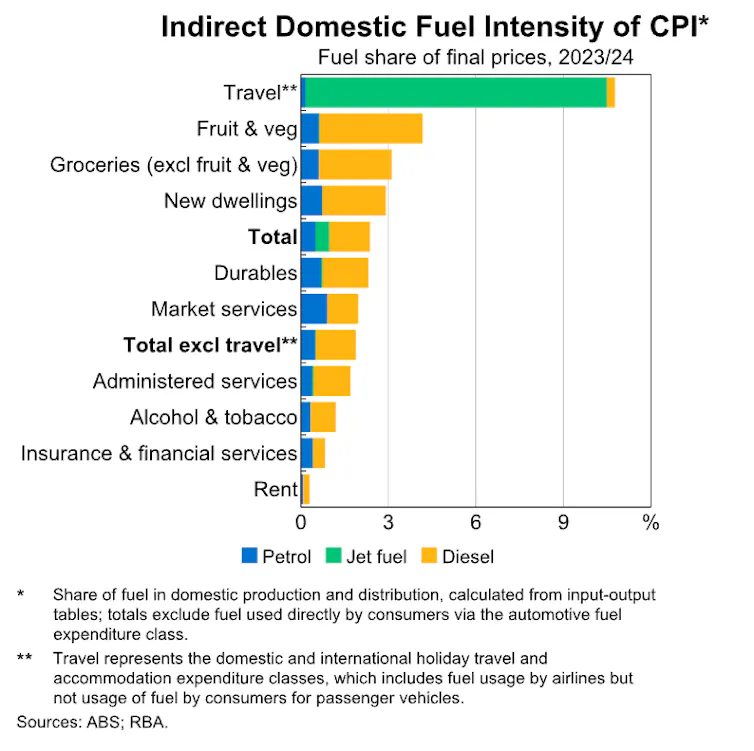
Hunter noted fuel accounts for around 2–2.5% of the cost of producing and distributing other goods and services in the CPI basket. Travel, transport and postal services, grocery items (particularly fruit and vegetables) and new home construction are all especially exposed, as Hunter highlighted with this chart.

The parts of Australia's economy most exposed to oil prices, led by travel, grocery items like fruit and vegetuables and new home construction.
The parts of Australia’s economy most exposed to oil prices, according to the Reserve Bank. RBA, May 2026

Oil also affects inflation indirectly through global supply chains of fertilisers, plastics and other industrial inputs. So higher oil prices can eventually feed into the prices of imported goods that are not obviously energy-related.

A likely interest rate hold – for now

Last month, Reserve Bank of Australia (RBA) Governor Michele Bullock warned more interest rate hikes may be on the way to fight inflation and get it back to the bank’s target of between 2–3%.

April’s softer-than-expected headline inflation number of 4.2% will reduce the case for another immediate rate rise at the bank’s June 15-16 meeting.

However, the rise in underlying inflation to 3.4% means Bullock is unlikely to sound relaxed after that meeting. Its concerns about “second-round effects” from higher oil prices have not gone away.

The Reserve Bank now faces a difficult balancing act. Higher oil prices reduce household purchasing power and slow growth. But if businesses pass rising costs through more broadly, inflation may stay above its 2–3% target for longer. That is the classic “stagflation” dilemma central banks fear.

In its May statement on monetary policy, the Reserve Bank revised up its inflation forecasts, saying it expected headline inflation to peak at 4.8%, while underlying inflation is projected to reach 3.8%. That suggests policymakers expect the oil shock to have a more persistent effect over coming quarters.

The Reserve Bank has already increased rates three times this year, lifting the cash rate from 3.6% to 4.35%.


There are now signs the economy is softening, giving the bank’s board more reason for pause.

The latest labour force data showed the unemployment rate rose to 4.5% in April, its highest level since December 2021. This is happening as households are under pressure from high interest rates, weak real income growth and elevated living costs.

Together, these figures strengthen the case for the Reserve Bank to keep rates on hold in June. But the rise in trimmed mean inflation means the Bank is still likely to emphasise caution, rather than signal Australia’s inflation problem has passed.

Looking ahead

The next few months will be critical. If global energy markets stabilise and supply disruptions ease, some inflation pressure could fade relatively quickly. That would give the Reserve Bank more confidence that inflation is moving back towards 2–3%.

But if oil prices remain elevated, or if businesses keep passing higher transport, freight and import costs through to consumers, the inflation problem could become more persistent.

The Reserve Bank is particularly alert to the possibility that repeated global inflation shocks – first the COVID pandemic, then supply chain disruptions, and now oil prices – may gradually change how businesses and households think about inflation itself.

That is why the Reserve Bank’s focus is shifting from the direct impact of higher petrol prices to the broader behavioural response across the economy.

Today’s data was therefore reassuring, but only up to a point. The headline number was better than expected. The underlying number was not.

That’s why the Reserve Bank will be cautious about declaring victory too early.

The Conversation

Stella Huangfu does not work for, consult, own shares in or receive funding from any company or organisation that would benefit from this article, and has disclosed no relevant affiliations beyond their academic appointment.

Booker winner Douglas Stuart reveals flashes of tenderness in his violent working-class men

Douglas Stuart Martyn Pickersgill/Pan Macmillan

Douglas Stuart’s third novel, John of John, returns to the territory that made his Booker prize-winning Shuggie Bain, and Young Mungo, so unforgettable: the intimate violence of masculinity, and the ways love persists inside families whose members cannot speak or emote plainly to one another.

In Stuart’s Falabay, an imagined town on the Isle of Harris in Scotland’s Outer Hebrides, the wind batters – and people have learned to endure by saying less than they mean.


Review: John of John by Douglas Stuart (Picador)


John Calum (Cal) Macleod returns home from art school in Edinburgh after his father, John, hints at his grandmother’s escalating ailments. For Cal, coming home means regression and constraint. He is indebted, back under the roof of a father who insists, often with overbearing zeal, on obedience and conformity.

In Edinburgh, with dyed hair, new clothes and the agency to publicly express his homosexuality, Cal had begun to assemble a new self. Back in Falabay, Cal is under the roof of his father, a man of unrelenting principle. Control is John’s dialect of love. Proximity must be earned through deference. John forces Cal to listen to bible readings:

because it was too much to ask his son to call him a couple of times a week, or to sit with him by the fire for a few hours and give him all his news. Too much to ask Cal just to be near him.

Intimacy and violence

The Macleods are a weaving family. Stuart, a trained fashion designer, attends to the material textures of that work in imagery of the lanolin that softens and splits skin and fibres that embed themselves in the knuckles of the men.

In two scenes in particular, Stuart demonstrates his skill at writing the tactile and physical. He illustrates John’s attentive care for his son, as well as his violent impulses. After Cal’s hands have been cracked and inflamed by overexposure to artificial heat in the weave shed, John makes him sit, and cares for him “as he might care for any useful tool”.

Cal washed each hand before John dried them on a clean tea-towel. Then John oiled them, rubbing ointment into each knuckle, caressing the webbing between Cal’s forefinger and thumb. Cal winced occasionally, and John went slower, taking care to rub the lotion into the peeling nail beds.

Later, Cal insists on returning the care and tends to his father’s own damaged hands, tweezing wool from John’s inflamed skin and cleaning the wounds. “Look at you two playing nail salons,” Cal’s grandmother, Ella, jokes – yet the intimacy here is unmistakable.

Stuart writes men who are simultaneously opaque to themselves, and overexposed to the community’s judgement.

John polices Cal’s appearance, forbidding him from attending church with neon orange hair, as though colour itself were a provocation. When Cal insists on attending anyway, John beats him in the car.

“He braced his left hand on Cal’s lapel and with his right he punched his son three more times, each blow stronger in its fury and determination.” The beating over, he glimpses his reflection. “Now that the anger had gone, he didn’t know what had possessed him. When he looked in the mirror he saw a devil, and the devil wore his face.”

The scene captures how visibility becomes a moral test in communities trained to prize conformity.

Stuart refuses to excuse John, allowing him full moral agency. Something (the devil) has influenced his behaviour, but John is still the perpetrator. Despite moments of tenderness towards his son, he remains a man who harms people he loves – and crucially, who cannot and will not apologise.

The novel’s most complex reality lies in a truth disclosed early, then handled with delicate restraint: John is in love with his neighbour and childhood friend, Innes. Their relationship is a long, quiet arrangement of glances and hedged intimacies, often reset by John’s fear and Innes’ patience.

“I haven’t had any time alone with you since … I can’t remember when.”
“Cal will be home soon. You have to be patient, please.”
“Am I not the very model of self-control?”
John exhaled as though blowing on a cup of hot tea. Then he nodded slowly. “You are,” he said, “you are.” […] Seeing they were truly alone, he took a step closer. He took Innes’s hand in his, and he stroked the back of it with the side of his thumb.

Stuart gives Innes an eloquent verdict: “It went like this, loving John Macleod. You did it against all reason, against all your better judgement, and in that exact moment he starved the embers into submission, he had the skill to blow on them gentle and ignite them again.” Loving John is an exercise of endurance.

Desire and rejection

For Cal, desire is improvised and punctured by rejection. He answers a lonely-hearts ad and is rebuffed. He fixates on and tries to seduce Innes, an act of longing and misrecognition – a young man reaching for the closest possibility of being known and understood.

If John’s love is performed through maintenance and denial, Cal’s is performed through desperate pursuit. He wants to be seen and held, tenderly.

book cover: John of John

Stuart has a gift for the social contours of villages. In the grudges that accrue and create impenetrable fortresses, Stuart illustrates how family fractures become public currency and harden into comic custom. In Falabay, the MacInnes brothers, Innes and Sorley, share a house without having spoken to each other for 16 years.

Every conversation is duplicated, an arrangement of avoidance, because acknowledgement would concede too much. Cal’s childhood friend, Doll Macdonald, nursing old hurt about Cal “leaving him behind” drinks his life into collapse. Stubbornness provides a kind of safety from ruin. No single slight causes these outcomes, nor could an apology prevent them.

Stuart is attentive to the drawn-out violence of pride and how it makes these men choose solitude over repair, principle over mercy.

Falabay is not glamorised: poverty and precarity pervade the novel, though less centrally than in Shuggie Bain or Young Mungo. Employment is seasonal and signing on (claiming unemployment) becomes an ethical debate whispered over the kitchen table, while the weather decides if your family will eat that night.

Cal’s university debts from Edinburgh haunt the family. In one sharp exchange, John and Cal argue in Gaelic about the dole – is it “dishonest,” or simply necessary?

Controversial on Christianity

Stuart’s handling of religion will be the most controversial element for some readers. It would be wrong to say the novel mocks faith, but it does associate the practise of Christianity with control.

The local minister presides rather than pastors, the congregation is fixated on keeping up social appearances rather than neighbourly care and John is a man who turns Scripture into a blunt instrument of discipline. There’s a matching economy here with the island’s other social systems: faith is kept in working order by policing the boundaries of who belongs.

As a Christian reader, I recognise the ache of filial misunderstanding here, but grace is noticeably absent from the novel. Stuart’s fictional church in Falabay is rendered with nuance, but the faith enacted is mostly a language of pressure: public morality without consolation and doctrine without hospitality.

I longed for a glimpse of forgiveness and repair, especially given the novel’s acute awareness of the ways in which shame distorts the expression of love.

Stuart writes the church in the Scottish Isles as these characters experience it, and he refuses the consolation of counterexample. His refusal is an aesthetic choice as much as a moral one. The novel’s tone remains austere; every consolation is so hard won.

What the novel intricately captures, with unsparing clarity, is how religious performance can lend cover to pride, and how the need to appear righteous can crowd out gentleness and grace.

John of John is a bleak novel, but not entirely hopeless. Tenderness is an event – fleeting, fragile – all the more arresting because of its scarcity. Stuart slows his sentences around these moments: the shoulder‑to‑shoulder quiet after an argument, his grandmother’s silent interventions, the small, comic abrasions of family life.

Readers of Shuggie Bain and Young Mungo will recognise Stuart’s signature: lyrical attention to harm, fierce compassion for children negotiating adult failures, men whose desires costs them dearly, households where harm and love continually conflict.

Falabay may be fictional, but its social world feels unbearably accurate. Stuart has returned to his territory and deepened it.

The Conversation

Caitlin Macdonald is affiliated with The University of Sydney.

Exoskeletons for people with cerebral palsy are now a reality – but there’s still much to figure out

Cerebral palsy is the most common disability that starts in childhood, affecting about 50 million people worldwide.

Cerebral palsy can impact a person’s ability to move their body. This can result in mobility problems, muscle stiffness or weakness, and abnormal movements. There are often other neurological issues as well, such as epilepsy or visual impairment.

Physiotherapy can help people with cerebral palsy across the lifespan. It uses a range of interventions to improve mobility and function. Conventional physiotherapy includes treadmill training, strength training and task-specific training (such as practising getting in and out of a car).

But there’s another therapy tool that’s been showing promise – exoskeletons. These wearable devices support a person’s body from the outside, helping their posture and movements.

For two decades, lower limb robotic exoskeletons have been a major focus in neurological rehab for adults. The majority of research has been about people with stroke and spinal cord injury.

Can they help with cerebral palsy too? Published in Disability and Rehabilitation Journal, our new systematic review of robotic exoskeletons for cerebral palsy reports promising findings – and more questions to tackle.

From the lab to everyday life

The first exoskeletons to help people walk were developed in the 1960s. These were clunky, complex devices, and took several decades to leave the lab.

Over the past 60 years, exoskeletons have become much more streamlined. In Australia, several have been approved by the Therapeutic Goods Administration in recent years.

There are three main categories of medical exoskeleton. Two of them are essentially stuck in place – these are devices paired with treadmills, such as the Lokomat, and “end-effectors” (static devices similar to an elliptical machine), such as the Innowalk.

The third category are devices which can be used overground, such as the Atlas 2030. With overground devices, users can have more choice in where they move, and interact with their environment more.

They even show promise as longer term assistive devices – something the person might wear in everyday life.

What does the evidence say?

An advisory committee for Australia’s National Disability Insurance Scheme (NDIS) is currently reviewing various supports for people with disability, including robot-assisted gait training.

The results will advise Australia’s peak disability funding body on whether and how to fund therapy with this technology. So, it’s timely to look at the evidence. That’s exactly what our systematic review did.

We asked: what are the effects of wearable overground exoskeleton-assisted therapy on physical, functional, quality of life and participatory domains for people with cerebral palsy? “Participation” refers to being truly involved, rather than just present, in chosen activities.

We included 21 studies representing 241 people with cerebral palsy, with an average age of nine. Then, we extracted and analysed data for all clinical outcomes. This included walking speed, endurance, balance, high-level mobility (running and jumping), strength, goal attainment and more.

Robotic rehabilitation outperformed conventional therapies for four outcomes:

  • walking speed
  • walking endurance
  • balance
  • high-level mobility.

This means using exoskeletons could provide meaningful benefits in these areas for people with cerebral palsy.

For other outcomes, there was not enough data to make recommendations, or results were inconsistent. Skin irritation was reported in some studies, but never prevented ongoing use of the exoskeleton. Where mentioned, user experiences were generally positive, although most studies didn’t evaluate them.

More to discover

Despite our review showing some encouraging benefits of exoskeleton therapy for people with cerebral palsy, there’s much we still don’t know. Very few of the included studies reevaluated outcomes after the person stopped the therapy. So we can’t say whether benefits are sustained.

We also couldn’t categorise results by type or severity of cerebral palsy, or by age. And with only seven adult participants represented in this systematic review, results can be confidently applied to children, but not adults.

There’s some evidence this technology is beneficial, compared to conventional therapy. However, no studies explicitly compared the use of the exoskeleton with the next most equivalent, and more readily available intervention – bodyweight supported treadmill training.

Staff at a hospital in Bilbao, Spain working with a child using the ATLAS 2030 exoskeleton.

Exciting is not enough

Recently, therapy with overground exoskeletons is becoming more available in Australia. Costs for these sessions with trained and experienced clinicians can be supported through NDIS funding. However, currently no scheme in Australia will fund a person to have an exoskeleton of their own.

It’s very common for families to want to “try it all”, particularly new and exciting therapy options. Exoskeletons are definitely exciting and attract significant interest.

However, it’s important that families don’t waste money and time on inappropriate therapies.

Our systematic review supports the use of overground exoskeletons for walking speed, walking endurance, balance and high-level mobility for people with cerebral palsy.

It’s crucial for clinicians to provide appropriate and evidence-based advice on the best treatment options. If someone with cerebral palsy wants to try robotic exoskeleton therapy, the clinician should set clear goals for what results to expect, and step forward with caution.

The Conversation

Nicola Postol does not work for, consult, own shares in or receive funding from any company or organisation that would benefit from this article, and has disclosed no relevant affiliations beyond their academic appointment.

What does the ‘avant-garde’ look like today? Two new novels give very different answers

Wassily Kandinsky -- Inner Alliance (1929) Public domain, via Wikimedia Commons

Giada Scodellaro’s Ruins, Child and Anna Poletti’s Hello, World? are very different books. Scodellaro won the 2024 Novel Prize; her book stitches together a history of Black feminist poetry, theory and prose. Poletti’s novel is a work of queer erotic introspection, investigating the limits of domination and submission.

There’s not much to connect them in terms of style, theme or ambition. If there is a common anchor, it is that both dispense with the traditional mechanisms of narrative. They abandon conventional chapter and paragraph forms, prioritising “fragments” as the unit of construction.


Ruins, Child – Giada Scodellaro (Giramondo)

Hello, World? – Anna Poletti (Puncher & Wattmann)


Because of this experimental approach, these books might be considered “avant-garde”. This is a loaded term that originally referred to soldiers who scouted ahead of the army. The military metaphor was attached, in the 19th and early 20th centuries, to writers and artists who worked in spaces yet to be cleared by human consciousness.

Sometimes, but not always, these artists were aligned with progressive politics, and sought to use their works to help people imagine a different, more liberated future.

Neither Ruins, Child nor Hello, World? attempt this gesture. Scodellaro’s novel is interested in the experience of “lateness”; Poletti’s uncovers some of the bonds that make personal progress a fraught project. Both dwell in a kind of political melancholy where the priorities are not revolution, but survival and care.

If these are the radical novels charting new territory in the 2020s, they raise an important question: what does the “avant-garde” look like today?

Hello, World?

Anna Poletti is an Australian queer and feminist media-studies scholar who works in Utrecht. The endorsements on the back cover of her book come from Chris Kraus and McKenzie Wark, heavy hitters of theory and postmodern literature.

Hello, World? follows Seasonal, a genderqueer academic, who moves to the Netherlands for a job. After they break up with their long-term partner, they undergo a sort of katabasis: a journey into the underworld of their deeper sexual drives.

The book compares itself to Pauline Réage’s erotic novel The Story of O and the work of the notorious French libertine the Marquis de Sade. It spends most of its time exploring Seasonal’s dominant/submissive relationship with Laszlo, a self-exiled Hungarian.

The Kraus endorsement calls the book “radical”, and it’s true that it depicts a kind of relationship that is usually kept hidden. Poletti goes to the root of kink culture, trying to chart the ethics that sustain a relationship ultimately built on structured violence.

But the fragmentary approach, which moves between vignette-paragraphs and long text-message exchanges, allows the author to avoid some of the more intense moments between the characters. The book often stops just short of showing us the interior of the erotic relationship. It is elliptical about things that might be interesting for a reader of queer erotica.

That seems to be part of the point. The real subject of the book is the modulations of the relationship, as each character tries to avoid tipping the scales from domination to exploitation.

Seasonal often muses on their relationship to their own trauma. They are troubled when Laszlo uses the language of violence to describe them. It seems neither character can fly by the nets of their cultural and sexual conditioning.

In its exploration of the limits of trauma and violence, Hello, World? does chart somewhat virgin waters. Seasonal is an interesting creation. While they wax theoretical about relationships, they garble judgements about art and politics, declaring no interest in learning about either. They discard their long-term partner with relative ease when he says he won’t have sex with them.

They are straightforwardly dedicated to their own pleasure, in the best Sadean fashion, and largely indifferent to the suffering of those around them.

This complex portrait uncovers some interesting aspects of the doctrine of personal sexual liberation. Seasonal’s fairly uncritical embrace of identity politics and communitarianism leads to a sympathy with some of the arguments of Viktor Orban’s Hungarian nationalism. For all the rejection of the Enlightenment in the novel, the only thing that separates kink from abuse ends up being rational consent.

In the end, Seasonal’s pursuit of sexual freedom makes them into the sort of person they have spent their life rejecting.

As a diagnosis of the politics of self, Hello, World? works quite well. But its deconstruction of progressivism and internalised hetero-patriarchy is not “avant-garde”, nor particularly radical. I wonder what sort of circulation it will have outside the coterie of media-studies lecturers.

Ruins, Child

Like Hello, World?, Ruins, Child is a novel of fragments. But it arranges its fragments in a very different way. It is a tessellate of a huge number of texts drawn from the tradition of Black poetics and radicalism.

The notes identify the main texts as the writings of August Wilson, Toni Cade Bambara, Derek Walcott, Zora Neale Hurston, Langston Hughes and June Jordan. References to art, architecture, music and film are woven through the book.

The image on the front cover is a collage by Lorna Simpson, and collage is certainly one way we might think about Ruins, Child. The narrative is based on Bannu Cennetoglù’s HOWBEIT, a video-art project comprising 128 hours of footage taken between 2006 and 2018. The setting of the novel, Scodellaro explains in her notes, recalls the idea of “The Hill”, a figure of suburban ghettoisation in the work of Wilson and Bambara. The central characters are in constant dialogue with Bambara’s novel The Salt Eaters (1980), which Ruins, Child seems to be remixing.

The novel assembles these parts into a fascinating puzzle, revolving around six characters watching footage taken earlier in their lives. The women live in a crumbling apartment tower, shunted there by a neglectful government. They watch their past selves prepare for a carnival and trade boyfriends, and as the oldest of them, Vonetta, endures a seemingly endless pregnancy. Reality is stretched across decades. We are often left guessing the time and place of a given event.

This indeterminacy of time is right at the heart of the novel. Events seem to be taking place in the not-too-distant future. There is something vaguely prognostic about the world we are creating today: infrastructure and the old forms of society are eroding; the natural cycle of the seasons has given way to extremes of heat and cold.

But this is not an attempt to think about the future, so much as a consideration of what has already been lost. Scodellaro draws on the work of architects Peter Eisenman and Elisa Iturbe, whose theory of “lateness” in architecture is a sort of metaphor for what Ruins, Child is doing with history. Instead of building something new, the novel is picking up pieces. Vonetta, the eternal mother, laughs at people who want to “live in the near future”. She suggests “the mother does not aim for this, she does not think about being avant-garde”.

Philosopher and cultural critic Walter Benjamin mused that ruins, like other fragments, call out for the critic and historian to make them whole again. This means trying to revive the ideas and dreams that went into their creation before they were destroyed.

Ruins, Child brings together the pieces of nearly a century of Black radical writing in a similar gesture of salvation. It dwells in the moments of allegiance and solidarity that have allowed the oppressed to survive in a crumbling world.

Inwards and backwards

Poletti’s hello, world? reflects some cynicism about the progressive project; Scodellaro’s novel explicitly rejects the idea of being “avant-garde”. But neither book has its eyes set on the artistic or political horizon. They turn their eyes inwards and backwards, explaining our failed liberation or saving what they can as the world hurtles to oblivion.

I think both are conservative postures. It may well be that these ways of adapting to our present have contributed to us being where we are. There is a kind of easy melancholy in dwelling on the contradictions of personal politics and stooping to retrieve the relics of the past.

Scodellaro’s book is a wonderfully wrought collage; its clever construction rewards close reading. Poletti’s book has less to offer, though it does carry some important lessons in its slippery portrait of Seasonal.

Neither book is utopian, because neither really believes in politics. That our boldest books are restrained and intimate rather than forward-looking and activist is, I think, as telling a fact about literature in the mid-2020s as anything else.

The Conversation

Giacomo Bianchino does not work for, consult, own shares in or receive funding from any company or organisation that would benefit from this article, and has disclosed no relevant affiliations beyond their academic appointment.

Deep-sea sponges survive in complete darkness in ways we didn’t know before

The deep-sea sponge _Calyx_ sp. in its natural habitat. PROBIO-DEEP/Fugro

When we think of marine life, we usually picture colourful coral reefs or dense seaweed forests filled with fish and other critters. The ocean that comes to mind is the one touched by sunlight.

However, most of the ocean is not like that. By volume, roughly 95% of the ocean consists of the permanently dark, cold deep sea. Despite such hostile conditions though, there is life in the ocean’s abyss.

Deep-sea marine sponges are among the organisms that live in these mysterious dark waters. They form “gardens” that are among the largest ecosystems on the planet, some spanning thousands of square kilometres on the ocean floor. They act as ecosystem engineers, providing habitats to many other organisms living on the seafloor.

Individual sponges can also pump and filter thousands of litres of water every day through their bodies. The nutrients they release support other organisms. Yet we know remarkably little about how sponges survive, let alone thrive, in the inhospitable environment of the deep-sea.

Symbiosis with microbes is an important part of how marine sponges live. We’ve been studying deep-sea sponges to better understand life in the ocean’s depths. So far, we’ve found some sponges are packed with microorganisms that use energy from chemical reactions.

The deep-sea sponge Aphrocallistes beatrix has the highest proportion of chemosynthetic symbionts reported to date. PROBIO-DEEP/Fugro

This is called chemosynthesis and is commonly found in other deep-sea organisms, such as mussels and tubeworms living in hydrothermal vents – deep-sea “hot springs”.

Our new study, published today in the journal Microbiome, shows sponges and their microbial partners also use a second strategy to make a living in the deep sea.

Two strategies, one sponge

All living organisms produce waste. Just like humans produce urine, many sponges produce ammonia as one of their waste products.

In this study, we analysed the Calyx species of deep-sea sponges from a depth of 830 metres.

About 16% of their microbial partners use the familiar chemosynthesis process. With ammonia as the energy source, they use carbon dioxide dissolved in the water to build biomass – it’s a bit like plants growing through photosynthesis from sunlight, but in the dark.

In well-lit shallow waters, many sponges and corals have photosynthetic microbes that help them build biomass from carbon dioxide. Our findings show that in the dark depths of the ocean, sponges have microbial partners that use ammonia instead of light for the same process.

The remaining 84% of microbial partners are where it gets really interesting. Instead of chemosynthesis these microbes use heterotrophy, which means consuming organic matter to generate energy and biomass (like the vast majority of animals, humans are also heterotrophs).

The problem here is that there’s little organic matter in the deep sea. Whatever falls down from the surface waters, such as dead plankton and algae, gets stripped by bacteria and small crustaceans of anything easily digestible as it sinks through the water column.

So, the little amount of organic matter that reaches the seafloor is generally poor food for the sponge itself. But, as we discovered, not necessarily for its microbial partners.

It turns out the heterotrophic microbes in Calyx sponges have lots of enzymes specialised in breaking down complex compounds, such as xylan and pectin, which make up the hard-to-digest cell walls of algae.

Feeding on these algal skeletons would allow the microbes to thrive and to transform organic molecules into nutrients their sponge host can use.

Deep-sea sponges and crinoids (marine invertebrates) in a deep-sea reef. PROBIO-DEEP/Fugro

Protecting what we don’t yet understand

Our study shows that sponges and their microbial partners are complex, biogeochemical reactors. They use and recycle ammonia “urine”, carbon dioxide and hard-to-digest organics to generate biomass.

The biomass can then support the growth of other organisms, such as brittle stars and fish, in turn supporting the broader community of animals living on the dark seafloor.

Unfortunately, these ecosystems are under pressure from human activities. Deep-sea trawling physically destroys sponge gardens. Deep-sea mining, now being actively pursued for rare metals used in batteries and electronics, threatens to disrupt the deep-sea habitat in ways that might take centuries to recover.

The United Nations has recognised deep-sea sponge gardens as vulnerable marine ecosystems, a formal acknowledgement of both their ecological importance and their fragility. But recognition alone is not enough.

If we destroy these habitats before we fully understand their role in carbon transformation, then we may lose a critical piece of Earth’s carbon cycle before fully realising it was there.

The Conversation

Torsten Thomas receives funding from the Betty and Gordon Moore Foundation USA and the Australian Government.

Alessandro N. Garritano does not work for, consult, own shares in or receive funding from any company or organisation that would benefit from this article, and has disclosed no relevant affiliations beyond their academic appointment.

What the hit new show Off Campus gets right in its portrayal of sexual violence

Prime Video

In a media landscape where sexual violence is largely normalised, the hit new show Off Campus is a refreshing pivot.

Created for Amazon Prime by showrunners Louisa Levy and Gina Fattore, the series explores the devastating impacts of sexual violence on young women. But it does so with sensitivity, and without gratuitous depictions of said violence.

Normalising sexual assault onscreen

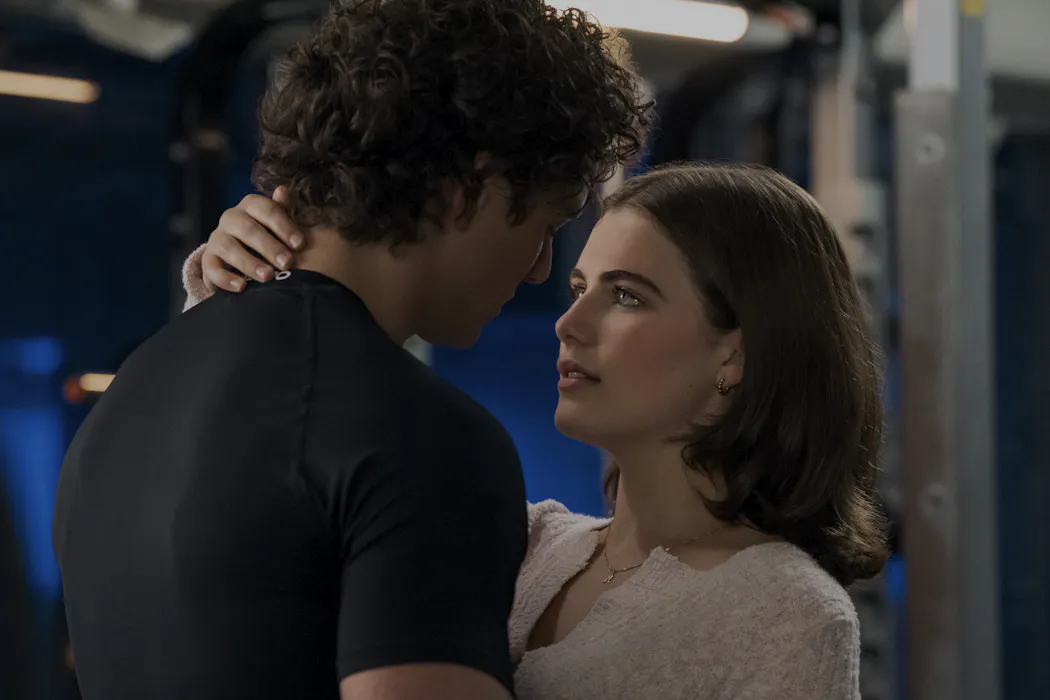
Off Campus, a romantic college drama based on author Elle Kennedy’s novel series of the same name, is enjoying plenty of popularity right now. This is mainly due to its ridiculously attractive leading men and women, coupled with steamy (consensual) sex scenes and cheesy romance.

Season one follows college junior Hannah Wells and her fake dating scheme-turned-romance with star hockey-player Garrett Graham.

In a main subplot, we learn Hannah was drugged and raped by a classmate, Aaron Delaney, at a party. She was 15 when it happened.

But Hannah’s experience of assault chronologically takes place before the first episode. The incident is only hinted at subtly, through flashbacks.

Instead, the focus is on her life in the aftermath of sexual assault. This is the kind of representation post-#MeToo activists have been advocating for. Here, the reality of violence against women is addressed, but not viscerally depicted.

Contemporary series and films have a plethora of narrative plots predicated on graphic depictions of violence against women. Yet little has been done to address this.

As gender studies experts Stephanie Patrick and Mythili Rajiva explain, onscreen rape depictions continue to “rehearse gendered scripts, positioning women as sexual objects onscreen for the pleasure of audiences and/or male protagonists”.

These portrayals are now a pervasive part of screen culture, spanning genres and audiences.

Game of Thrones (2011-19), for instance, had multiple violent depictions of rape of prominent female characters, including Daenerys Targaryen, Cersei Lannister and Sansa Stark.

Similarly, Teen drama 13 Reasons Why (2017-20) also depicted both the rape of the central character Hannah Baker and the gang rape of minor character Tyler Down.

Both shows, though wildly different, demonstrate a heinous interest in showing the violation of bodies for entertainment.

What do we audiences get out of watching this, other than gnawing discomfort? And why do such shows remain highly watched, despite the controversy they attract?

Do we need to see sexual violence?

One might argue depictions of sexual assault and violence may make viewers more invested in the issue, and therefore more empathetic towards the experience of survivors.

Feminist film scholar Debra Ferreday says “like fans, feminists are intimately invested in practices of remediation and in the creation of transformative works” – and are therefore more likely to respond to these depictions with an activist mindset.

But, it’s not that simple.

There is also the potential to re-traumatise viewers who have experienced sexual assault, something showrunners are starting to take into account. And this has partly driven the rise of intimacy coordination in the industry. In the words of screen and media scholar Inge Sørensen:

the ways in which nudity, sex and intimacy are […] directed and acted on and off set are no longer only an ethical issue for […] cast and crew members on discrete productions. It is an industry concern with potentially significant financial and reputational consequences for any production.

There is also the potential for graphic depictions of sexual assault to desensitise viewers and normalise predatory and/or violent behaviour, particularly with reference to young men.

We can sen the effects of this in regards to shows such as Game of Thrones, wherein a number of online users argued the fantasy setting provided justification for the violent rape scenes. They saw no issue with them.

The Off Campus approach

Enter Off Campus. Alongside the main plot of Hannah and Garret’s budding attraction, we get glimpses into Hannah’s post-traumatic stress.

She confides in Garrett about her inability to orgasm, is hesitant to drink at parties, and feels guilty the only result of her legal trial against her abuser was the alienation of her family in their hometown in Indiana.

Hannah eventually confides in her family and friends, who rally around her. Prime Video

These moments come to a crux in episode seven, when Aaron plays against Garrett in a hockey game, and Hannah is too traumatised to attend. She isolates herself, struggles with overwhelming anxiety and avoids Garrett’s calls.

This scene mirrors the experience of many victim/survivors, who fear they will not be believed, or their assault won’t be taken seriously. Hannah’s beliefs reflect pervasive rape myths and stereotypes that shroud victim/survivors in doubt and shame.

Off Campus successfully touches on these problematic ideologies, before challenging a legacy of storylines that have helped endorse rape myths and minimise the effects of sexual violence.

Hannah eventually reaches out to her family and friends, who rally around her. Her mum, for instance, tells her she has “nothing to be sorry for”.

Hannah’s performance in the college’s pop showcase symbolises a final reclamation of self. Prime Video

Almost a decade on from #MeToo

The series’ overall sensitive approach suggests at least some showrunners are becoming less interested in violent depictions of sexual assault onscreen.

As we near the ten-year anniversary of the #MeToo movement, violence against women remains high, with an estimated one in five women having experienced sexual violence since the age of 15.

Off Campus marks a pivot away from harmful representation on a macro level, while initiating important conversations around the impact of sexual violence on an individual level. This visibility can steer victim/survivors towards seeking support, and encourage greater empathy and awareness among the broader audience.

The National Sexual Assault, Family and Domestic Violence Counselling Line – 1800 RESPECT (1800 737 732) – is available 24 hours a day, seven days a week for any Australian who has experienced, or is at risk of, family and domestic violence and/or sexual assault.

The Conversation

Bridget Mac Eochagain does not work for, consult, own shares in or receive funding from any company or organisation that would benefit from this article, and has disclosed no relevant affiliations beyond their academic appointment.

❌
AU Conversation